Background

24/7 EMERGENCY RESPONSE

Fire Damage Restoration: We Help You Rebuild After the Unthinkable

A fire changes everything in an instant. Our IICRC S700 certified team walks you through every step—from emergency board-up and smoke cleanup to complete reconstruction. 2026 average restoration cost $27,091 ($4-$7/sq ft). You don't face this alone.

You're Not Alone in This

A Fire Changes Everything—But Recovery Is Possible

If you're reading this, you may be dealing with one of the most stressful experiences a homeowner or business owner can face. A fire doesn't just damage property—it disrupts your sense of safety, your daily life, and your peace of mind. We understand that, and we want you to know: it does get better from here.

Whether it was a kitchen fire, an electrical fire, or wildfire damage, the path forward starts with understanding what happened and what comes next. The smoke smell, the soot on everything, the water left behind by firefighters—these problems are real, but they're also solvable. Thousands of families and business owners have walked this road before you, and they've come out the other side.

This guide will walk you through every step of fire and smoke damage restoration—from what to do in the first 24 hours to how long the full recovery takes. Our goal isn't to sell you something. It's to give you the information you need to make good decisions during a difficult time.
Need to talk to someone right now?

Our team is available 24/7 and can walk you through what to expect.

After the Fire: Your First 24 Hours

Immediate Steps After a Fire

What you do in the first day after a fire can significantly impact your recovery. Follow these steps to protect your safety, your property, and your insurance claim.

1 Safety Critical

Wait for Fire Department Clearance

Never re-enter your property until the fire department and fire marshal have cleared the structure. Even after the flames are out, structural instability, toxic gases, and hot spots can pose serious risks.

2 Safety Critical

Watch for Safety Hazards

Once cleared to enter, be aware of weakened floors, damaged stairs, compromised roofing, and exposed electrical wiring. Wear an N95 mask—soot particles are harmful to breathe. If anything feels unstable, leave immediately.

3

Ventilate If Safe to Do So

If the structure is safe, open windows and doors to begin airing out smoke. Do not turn on the HVAC system—smoke particles in the ductwork will spread contamination to unaffected areas of your home or business.

4

Document Everything Before Touching Anything

Take photos and video of every room, every damaged item, and every surface before any cleanup begins. Your insurance company will need this documentation. Walk through room by room, capturing damage from multiple angles.

5

Contact Your Insurance Company

File your claim as soon as possible. Ask about Additional Living Expenses (ALE) coverage if you can't stay in your home. Keep your claim number handy—you'll reference it throughout the restoration process.

6

Call a Certified Restoration Company

Contact an IICRC-certified restoration company to begin emergency mitigation. Board-up services protect against weather and vandalism. Water extraction prevents mold from firefighting runoff. The first 24-48 hours are critical for saving contents and surfaces.

Important Safety Reminders

  • Do not attempt to clean soot yourself—incorrect methods can set stains permanently
  • Avoid using household cleaners on smoke-damaged surfaces
  • Do not turn on the HVAC system until professionally cleaned
  • Keep children and pets away from fire-damaged areas

Regional Fire Risks to Keep in Mind

Florida

Kitchen fires and electrical fires from humidity-related corrosion are the most common causes. Florida's wildfire-urban interface also puts properties at risk during dry seasons.

North Carolina & South Carolina

Heating-related fires from space heaters, fireplaces, and wood stoves spike during winter months. Older homes may have outdated wiring that increases electrical fire risk.

Hour-by-Hour Fire Damage Timeline

What Happens In The First 48 Hours After A Fire

Soot is chemically active. Fresh smoke residue is easier to remove than 48-hour-old residue, and 72-hour-old residue can permanently etch metal and plastic at the molecular level. Every hour of delay compounds both the cost and the probability of permanent damage. See our fire damage cost guide for the complete breakdown.

0-1h Golden hour
1-6h Stabilize
6-24h Soot oxidation
24-48h Permanent staining
48-72h Metal corrosion
1wk+ Structural risk
2wk+ Odor embedded
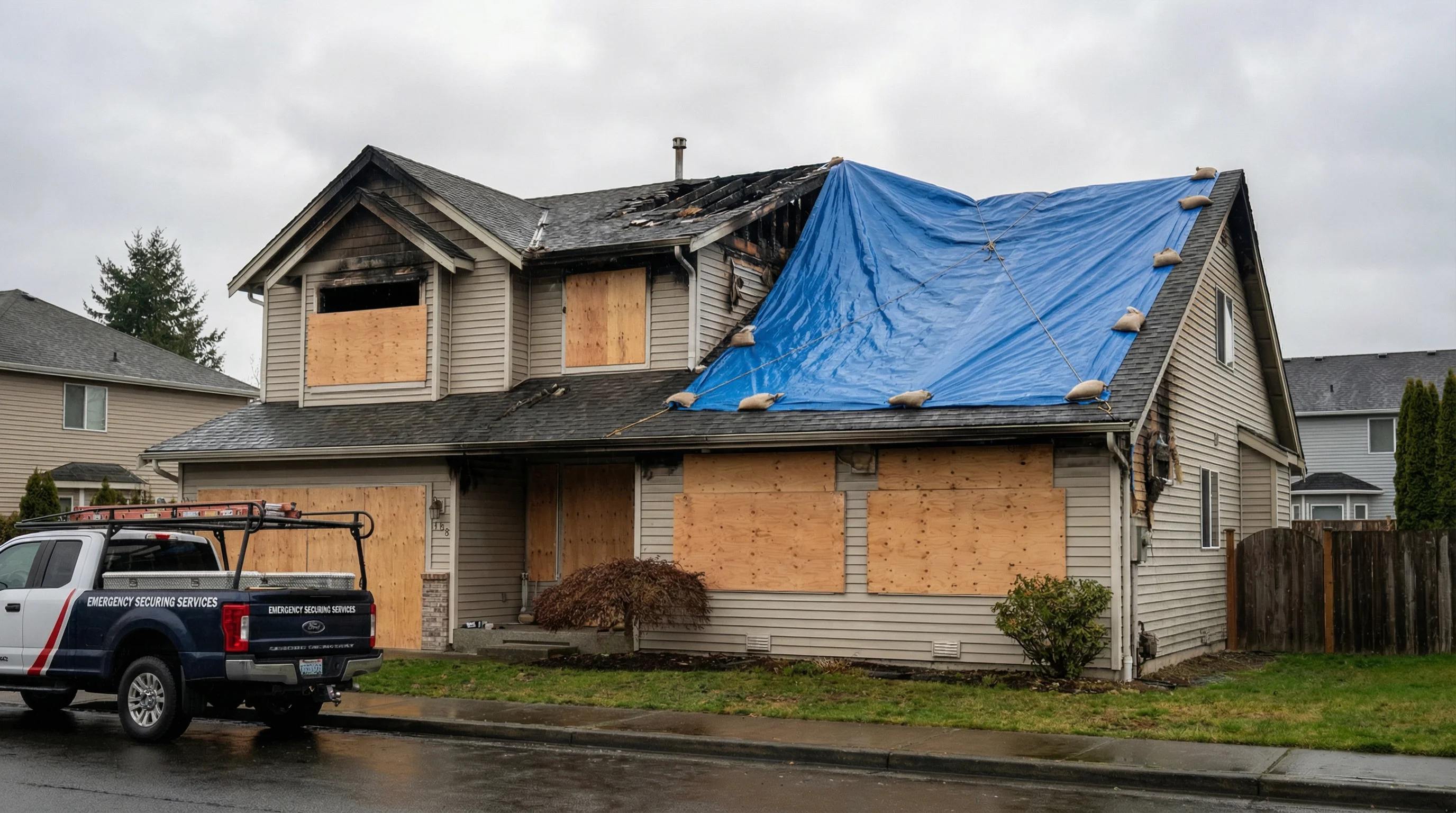
Palm Build emergency fire damage response with board-up and roof tarp on residential home after fire
Emergency board-up and tarping happens within the first 1-6 hours. Weather and secondary water damage are the biggest post-fire risks to an already-compromised structure.
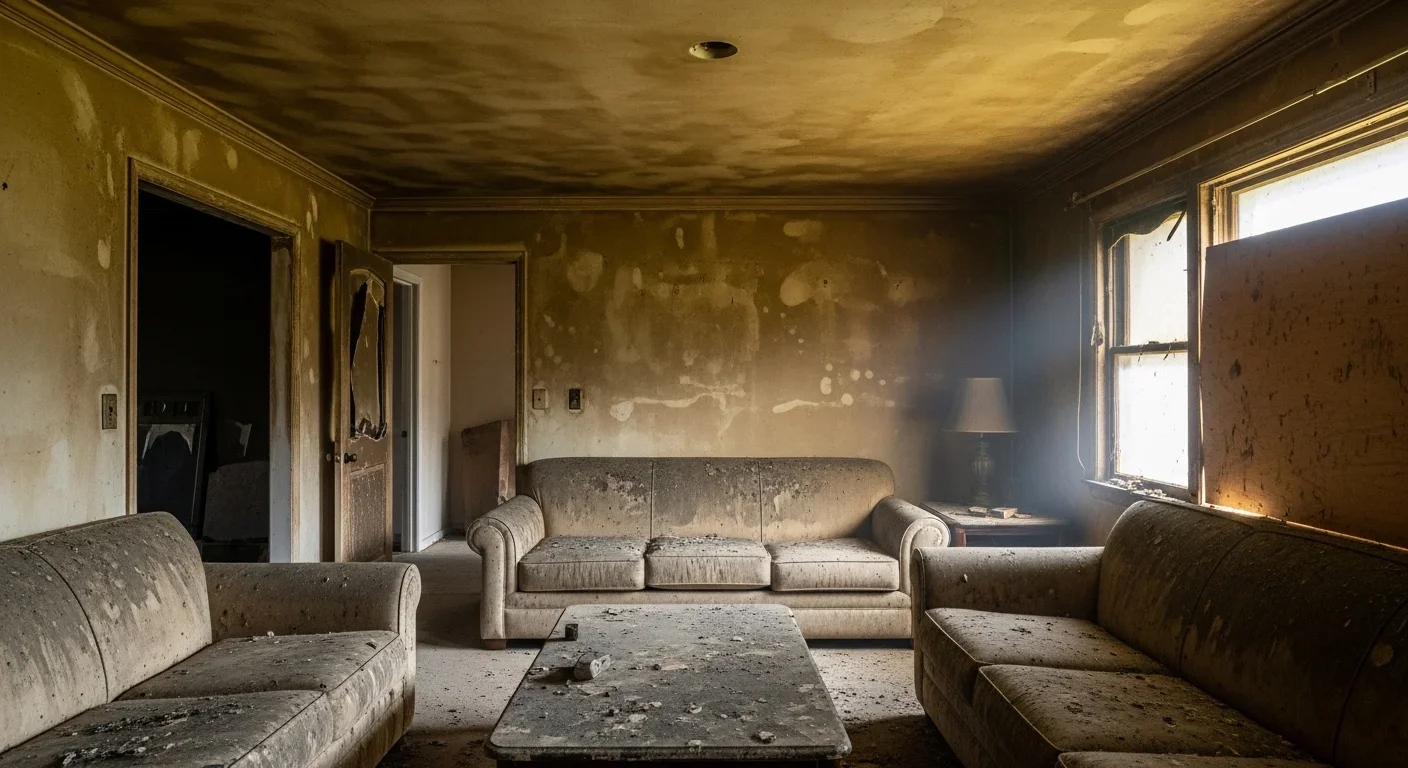
Heavy smoke staining on residential living room walls showing progressive damage at 48+ hours after fire
At 48+ hours, acidic soot has begun permanently etching paint and wall finishes. Delayed response is the single biggest cost multiplier on fire restoration projects.
Fire damage progression by hour
WindowWhat's happeningRisk & cost impact
0-1 hour

Fire suppressed; smoke cooling; soot beginning to settle on surfaces

Action: Safety walk-through, confirm fire marshal release, call 24/7 dispatch, DO NOT enter until cleared

Lowest — most contamination still airborne

Cost impact: Standard emergency response rates apply

1-6 hours

Water from firefighting saturating drywall, wood, carpet; soot bonding to warm surfaces

Action: Emergency board-up, roof tarping, water extraction begins, contents documented in place

Low if immediate action; Category 2+ water already forming

Cost impact: Board-up $500-$3,000; tarping $400-$1,500; extraction billed hourly

6-24 hours

Soot oxidation begins — acidic residues react with metal, grout, plastics; wet smoke penetrating porous materials

Action: HEPA air scrubbers deployed, contents pack-out triage, insurance notification, moisture mapping for fire water damage

Moderate — irreversible metal/plastic damage possible if delayed

Cost impact: HVAC duct cleaning $250-$500; antimicrobial treatment adds $400-$800

24-48 hours

Permanent yellow-brown staining on walls, ceilings, fabrics; smoke odor migrating into HVAC and wall cavities

Action: Full chemical cleaning begins, thermal fogging deployed, contents relocated to facility for ozone treatment

Significant — stain permanence rising; mold risk from firefighting water

Cost impact: Expect $2,000-$5,000 in added deep-cleaning line items

48-72 hours

Metal surfaces pitting; plastic discoloring; electronics developing corrosion on circuit boards

Action: Electronics pack-out to ultrasonic facility, structural soot removal, expanded demo of heavily damaged materials

High — hidden electronic damage often discovered at this stage

Cost impact: Electronics restoration $200-$1,000 per item; project 30-50% higher than Day 0 estimate

1+ week

Wood framing beginning to absorb odor molecules; paint unable to seal in smoke smell; mold from unaddressed water

Action: Full structural encapsulation, deeper demo, mold remediation coordination, reconstruction planning

Severe — structural components may need replacement not just cleaning

Cost impact: Project cost can double if not addressed; insurance supplements required

2+ weeks

Smoke odor permanently embedded in insulation, carpet pad, drywall paper; active mold on damp materials

Action: Full mold remediation protocol, insulation replacement, complete demo of porous materials, air quality testing

Critical — health impacts for occupants, resale disclosure obligations

Cost impact: Total restoration cost can triple original estimate

Why speed matters more for fire than for most restoration work

Fire residue is chemically reactive. Acidic soot oxidizes on contact with oxygen, bonding increasingly tightly to every surface it touches. Protein soot from grease fires penetrates paint, drywall, and fabric within hours. Metal corrosion from fuel-oil puffback can begin in 72 hours and become irreversible within a week. The golden response window for fire restoration is under 24 hours — every additional day compounds both cost and permanent damage probability. Coordinate water extraction and mold prevention in parallel because firefighting water creates a 24-48 hour mold risk window on top of the fire damage itself.

Call dispatch within the first hour to stay in standard response pricing.

IICRC S700 Standard

The 4 Smoke Categories Under IICRC S700

The IICRC S700 Standard for Professional Fire and Smoke Damage Restoration is the ANSI-accredited reference your insurance adjuster expects every certified restoration company to follow. S700 classifies fire residue into four distinct smoke categories, each with its own cleaning protocol. Using the wrong protocol on the wrong residue type is the single most common reason DIY cleanup permanently sets damage instead of removing it.

Dry Smoke

Fast, hot fire

$4.00 - $5.50 / sq ft

Common sources

Fast-burning fires at high temperature — paper, wood, plastic materials burning with good oxygen supply

Residue character

Fine, dry, powdery particulate. Sits on top of surfaces rather than bonding deeply. Non-smeary.

Cleaning protocol

HEPA vacuuming → dry chemical sponge → pH-neutral wet cleaning → odor sealing

Key challenge

Easiest smoke type to remove if addressed within 72 hours

Wet Smoke

Slow, smoldering fire

$5.50 - $7.00 / sq ft

Common sources

Slow, low-heat fires with poor oxygen — synthetic materials, plastics, rubber, upholstery smoldering

Residue character

Thick, smeary, black residue with strong odor. Bonds to surfaces tightly. Corrosive to metal and grout.

Cleaning protocol

Cannot dry-sponge — smears deeper. Requires solvent-based chemical cleaners, repeated wet passes, often selective demo

Key challenge

Hardest smoke type to clean; wrong technique makes it worse

Protein Smoke

Kitchen grease fires

$5.00 - $7.00 / sq ft

Common sources

Kitchen grease fires, protein combustion (meat, poultry, fat) — the classic "unattended stovetop" incident

Residue character

Often INVISIBLE to the eye but leaves a pervasive, penetrating odor. Yellow-brown oily film bonds at molecular level

Cleaning protocol

Degreaser pre-treatment → enzymatic cleaners → thermal fogging with protein-neutralizing agent → ozone treatment

Key challenge

Most often misdiagnosed because damage is invisible; homeowners attempt DIY and embed the odor permanently

Fuel Oil / Puffback

HVAC malfunction

$6.00 - $8.00 / sq ft (whole-home typical)

Common sources

Oil furnace puffback events, boiler failures, HVAC ignition malfunctions — unique winter hazard in NC, uncommon in FL

Residue character

Fine black powder covering every surface in the home via forced-air distribution. Acidic — causes rapid metal corrosion

Cleaning protocol

Whole-home deployment required (HVAC spread is total). HEPA vacuum → solvent cleaning → duct cleaning mandatory → complete HVAC filter replacement

Key challenge

HVAC MUST be shut down immediately — running it spreads contamination within minutes

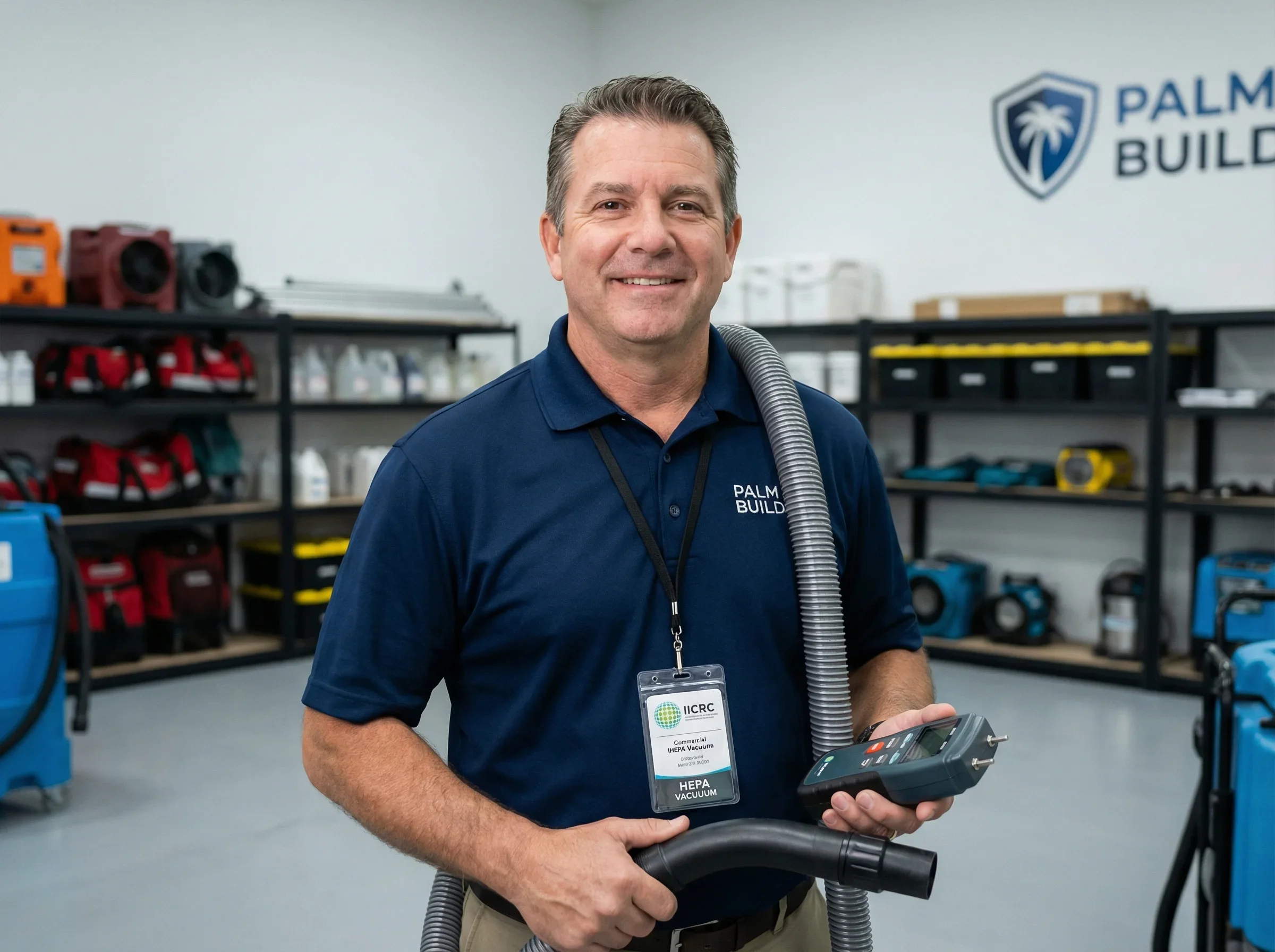
IICRC S700 certified Palm Build fire restoration technician with visible credentials
All Palm Build fire restoration follows IICRC S700. Our technicians hold FSRT (Fire & Smoke Restoration Technician) and OCT (Odor Control Technician) certifications.

S700 cleaning protocols: what works, what fails

Every smoke type responds to a specific cleaning approach. Applying the wrong protocol — especially dry-sponging wet smoke, or running the HVAC after a puffback — permanently worsens the damage. Here is what a certified S700 technician knows on contact.

ProtocolWorks onFailure mode
HEPA vacuumingALL types

Removes loose soot without aerosolizing particulate. Always the first step.

Regular vacuum disperses fine soot through exhaust, making damage worse

Dry chemical spongeDry smoke only

Rubbery sponge absorbs soot in a single downward stroke without smearing

On wet smoke it smears residue deeper; on protein it bonds with surface oil

Solvent chemical cleaningWet smoke, protein, fuel oil

pH-matched chemical agent dissolves bonded residue without damaging substrate

Wrong pH etches paint/finish; water-based cleaner spreads oily residues

Thermal foggingOdor phase — all types

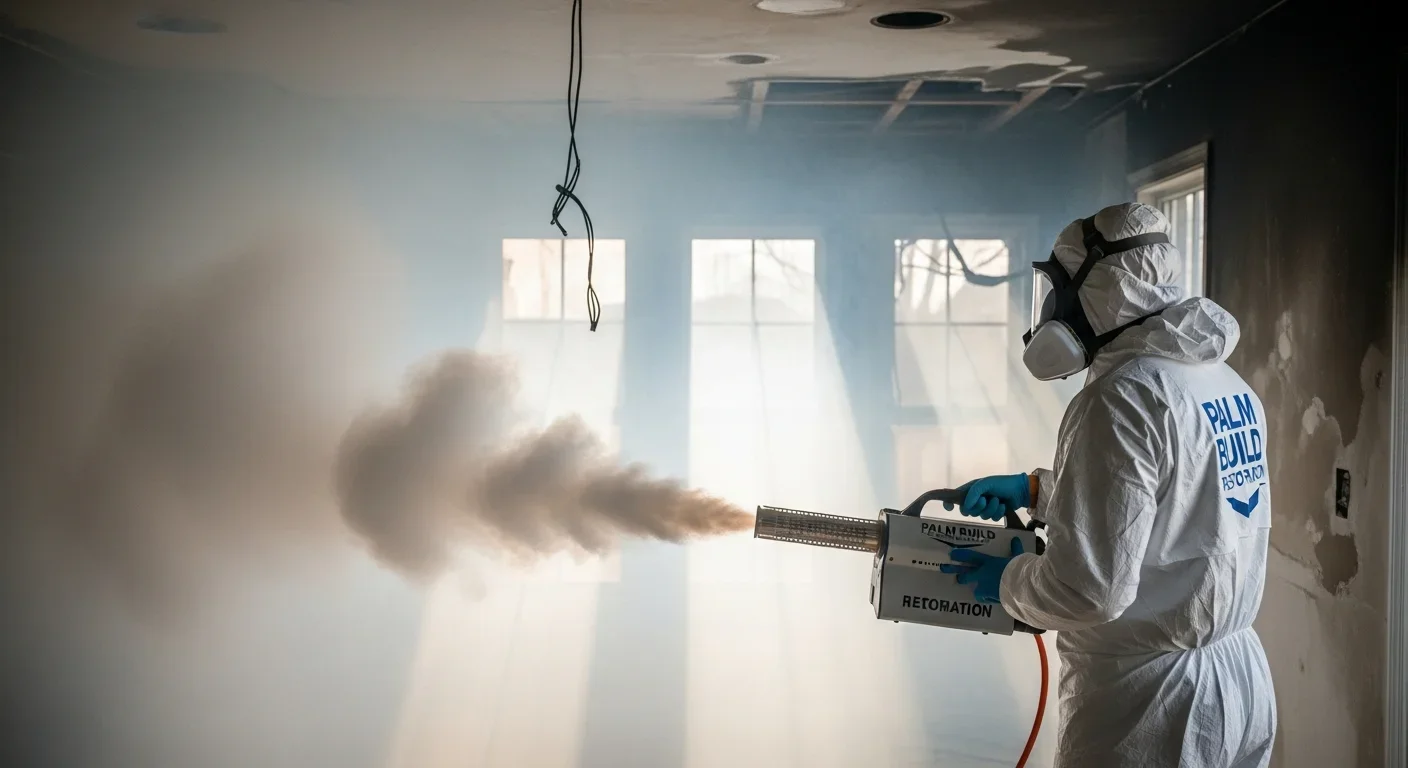
Vaporized deodorant penetrates the same pathways smoke traveled, neutralizing odor

Must be applied AFTER cleaning; before cleaning it can bond residue further

Ozone treatmentOdor phase — all types

O₃ oxidizes volatile organic compounds (VOCs) trapped in porous materials

Unsafe for occupied spaces; kills plants, damages rubber, requires vacated treatment zone

Hydroxyl generatorsOdor phase — safe for occupied

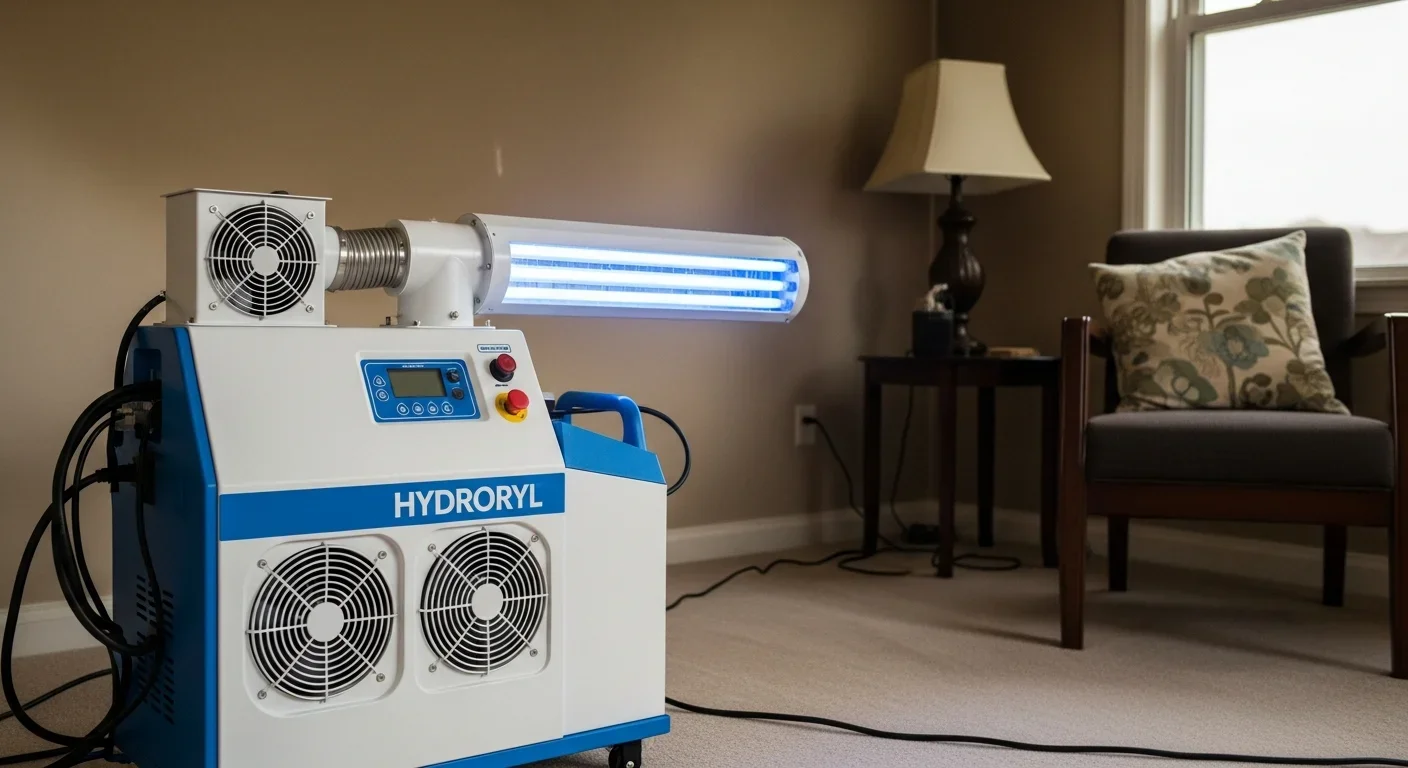
UV-generated hydroxyl radicals break odor molecules; safer than ozone

Slower than ozone; less effective on deeply penetrated odors alone

NFPA Fire Classification

Fire Classes A, B, C, and D Explained

Fire class determines both how the fire is suppressed and what kind of residue it leaves behind — which in turn drives the restoration cost and cleaning protocol. A small Class B grease fire can be more expensive to restore than a larger Class A wood fire because protein soot is harder to remove than dry smoke. Understanding which class your fire falls into helps you anticipate scope, cost, and timeline.

Class A

Ordinary Combustibles

Common sources

Wood, paper, cloth, rubber, plastics, furniture, textiles, residential building contents

Frequency

Most common residential fire — roughly 85% of all home fires

Extinguisher

Water (A), foam (AB), multipurpose dry chemical (ABC)

Residue left behind

Dry smoke, powdery soot; generally easier to remove if addressed quickly

Restoration protocol

Standard IICRC S700 protocols: HEPA vacuum → dry sponge → wet clean → odor treatment

$4-$5.50/sq ft typical for remediation scope

Class B

Flammable Liquids & Gases

Common sources

Kitchen grease, cooking oil, gasoline, propane, solvents, paint thinner, alcohol

Frequency

Second most common residential — kitchen fires account for ~50% of US home fires

Extinguisher

Foam (AB), CO₂ (BC), dry chemical (ABC/BC). NEVER use water — spreads the fuel

Residue left behind

Protein soot (grease fires) — invisible film with pervasive odor that embeds in porous surfaces

Restoration protocol

Degreaser pre-treatment → enzymatic cleaners → thermal fogging → ozone chamber for contents

$5-$7/sq ft typical; often more expensive than Class A due to protein soot difficulty

Class C

Energized Electrical Equipment

Common sources

Wiring, outlets, appliances, HVAC units, lighting circuits, electronics; fuel-oil puffbacks

Frequency

Third most common; ~13% of residential fires involve electrical failure

Extinguisher

CO₂ (BC), dry chemical (ABC/BC), clean agent (Class C). NEVER use water

Residue left behind

Wet smoke + acidic oil soot from insulation and plastic wiring covers. Very corrosive to metal.

Restoration protocol

Immediate HVAC shutdown → solvent cleaning → complete duct cleaning → electrical system inspection

$5.50-$7.50/sq ft; HVAC spread often makes this a whole-home remediation

Class D

Combustible Metals

Common sources

Magnesium, titanium, sodium, lithium, potassium — industrial, lab, machine shop fires

Frequency

Rare in residential; common in industrial facilities

Extinguisher

Class D dry powder ONLY. Water or CO₂ causes violent reaction

Residue left behind

Reactive metal oxides and residues; may require specialized hazmat protocols

Restoration protocol

Custom scoping required; often industrial hygiene coordination

Custom quote; highly project-dependent

Most residential fires are mixed-class

A kitchen grease fire (Class B) typically escalates to involve cabinets, drywall, and nearby wood framing (Class A) and sometimes appliance wiring (Class C). This is why IICRC S700 certified fire restoration is typically scoped across multiple smoke types and cleaning protocols simultaneously — a single-class estimate underestimates a real residential project. See our kitchen fire restoration guide for the most common mixed-class scenario.

Equipment & Protocol Science

The Equipment Palm Build Deploys On A Fire Loss

Fire restoration is measured work, not guesswork. Each piece of equipment exists for a specific smoke category and a specific phase of the project. Using the right tool at the right time is what separates professional restoration from an expensive mistake.

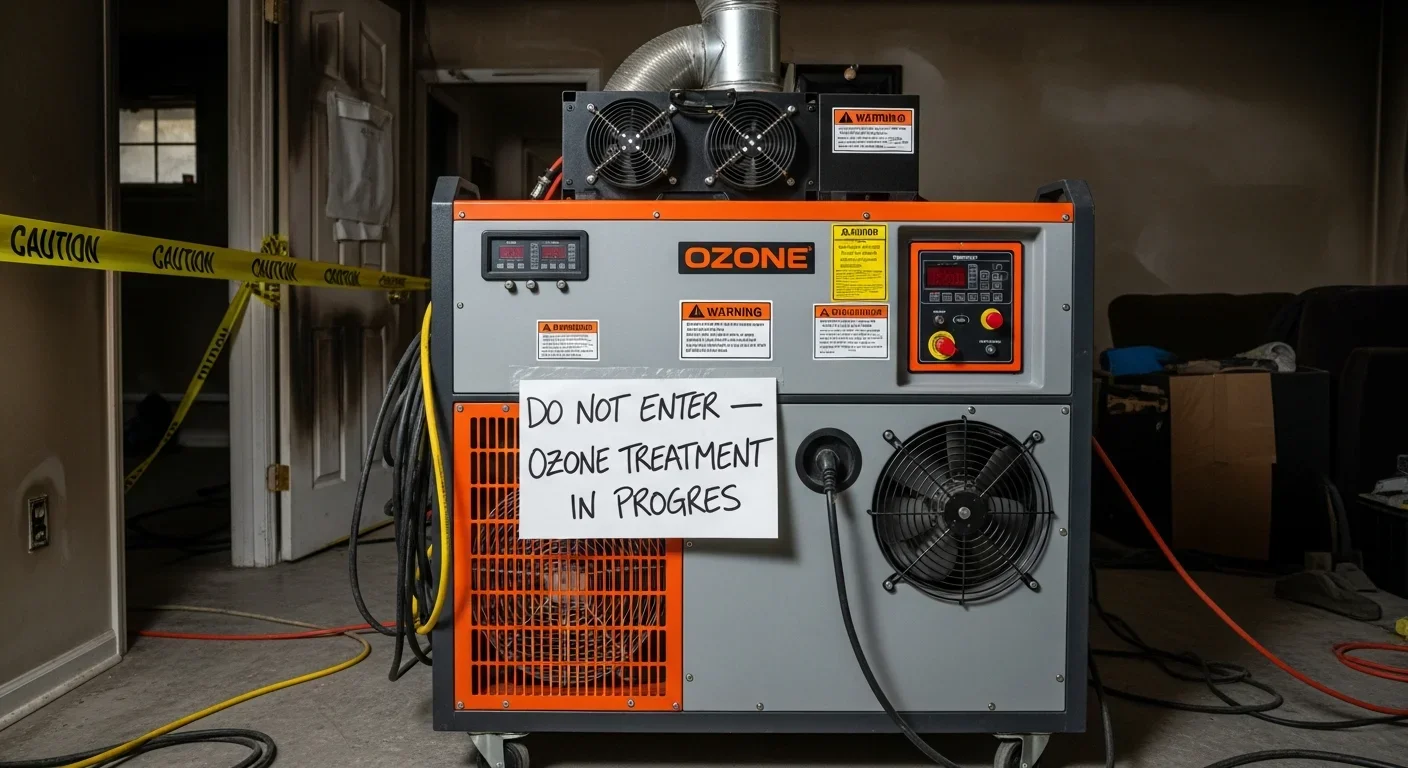
Commercial ozone generator deployed in smoke-damaged residential living room during fire restoration treatment
Hydroxyl generator operating safely in partially occupied residential space during fire odor restoration
Thermal fogging deodorization treatment actively deploying vaporized odor neutralizer in fire-damaged room
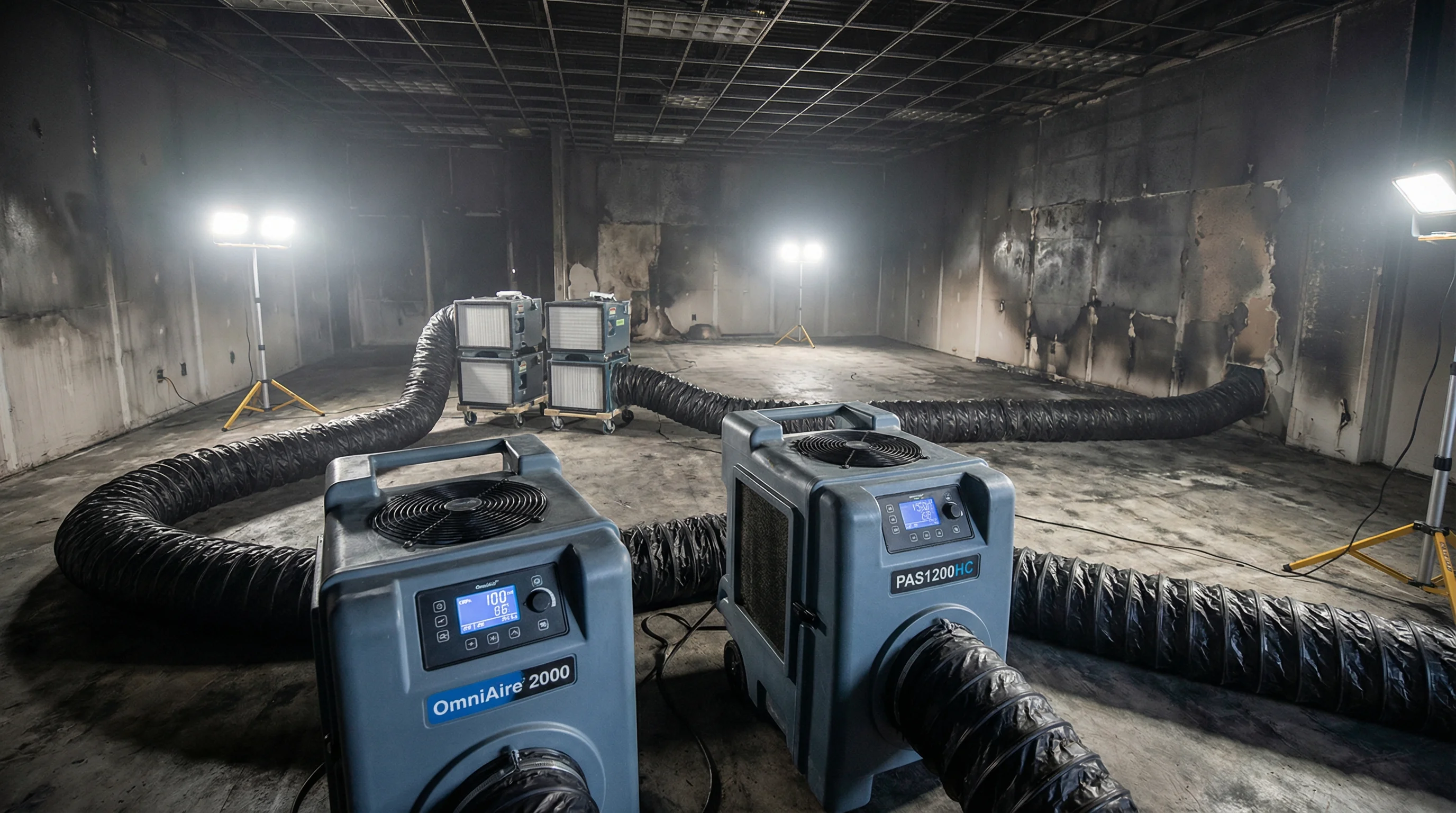
HEPA air scrubber filtering airborne soot particulate during fire restoration work
Fire restoration equipment fleet — what we deploy and when
EquipmentSpecificationPurposeWhen deployed
Ozone generator (high-output)7,000-14,000 mg/hr O₃Oxidizes odor molecules at the molecular level; penetrates same pathways smoke traveledUnoccupied spaces only — vacated treatment zones. Used on Class B and C fires after cleaning phase complete.
Hydroxyl generator (UV-based)1,500-4,500 ft³ coverageUV-generated ·OH radicals break odor compounds; safe for occupied spacesOccupied structures, hospitals, schools, situations where ozone is not an option.
Thermal foggerVapor particles 0.5-50 micronDeodorizing agent vaporized to same particle size as smoke so it follows identical pathwaysOdor neutralization AFTER chemical cleaning; before cleaning it bonds residue.
HEPA air scrubber500-2,000 CFM, 99.97% @ 0.3μmPulls airborne particulate from active work zone; maintains negative pressureDeployed from Day 0. One per 250-500 sq ft of affected area, running 24/7.
HEPA vacuum (industrial)200+ CFM with filtered exhaustRemoves loose soot without dispersal; critical first cleanup stepAlways before any wet cleaning. Standard vacuums exhaust fine soot back into air.
Chemical sponge (dry)Vulcanized rubber, reusableAbsorbs dry smoke residue from walls and ceilings without smearingDry smoke ONLY. Wrong technique on wet smoke embeds residue deeper.
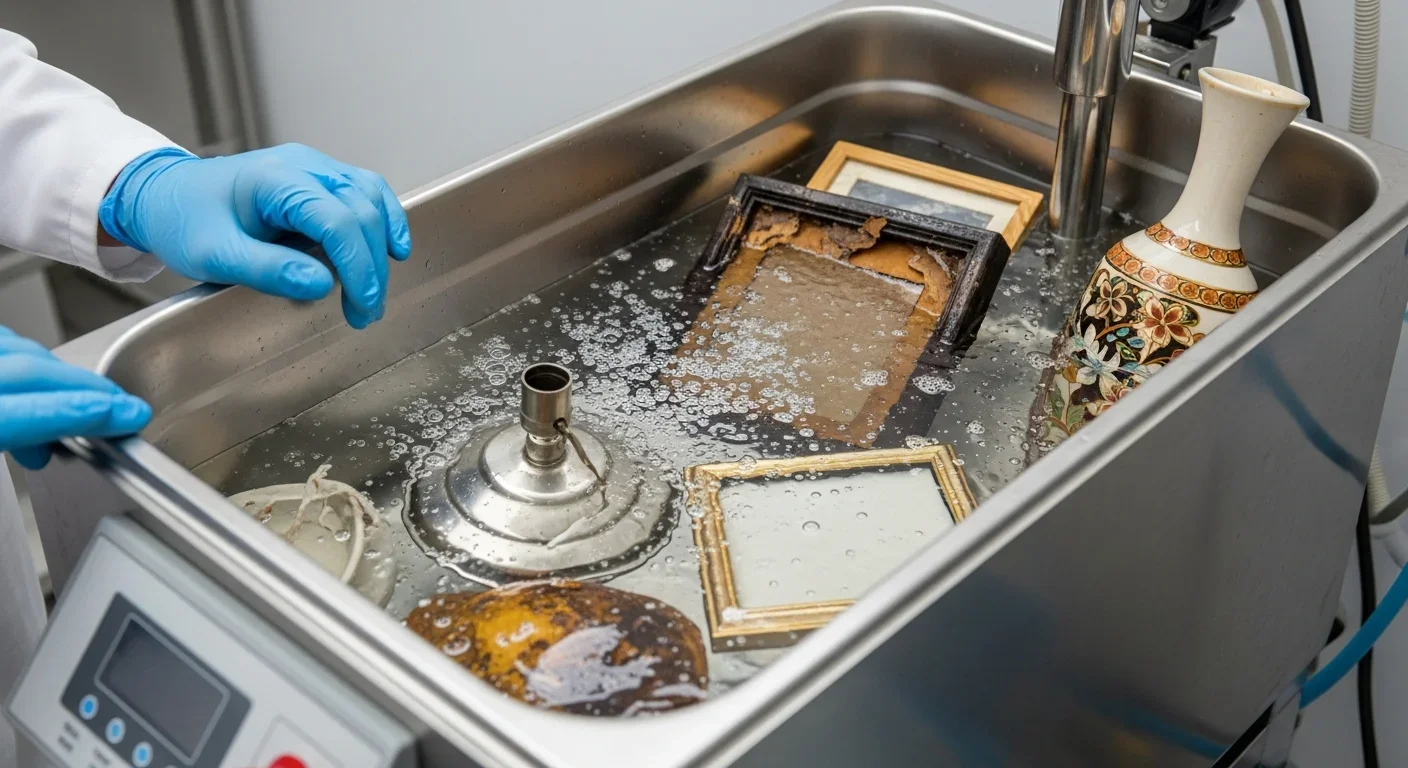
Ultrasonic cleaner (contents)40 kHz cavitation, stainless tankCavitation bubbles mechanically clean smoke residue from complex surfacesElectronics, metal contents, jewelry, small hardware — facility pack-out required.
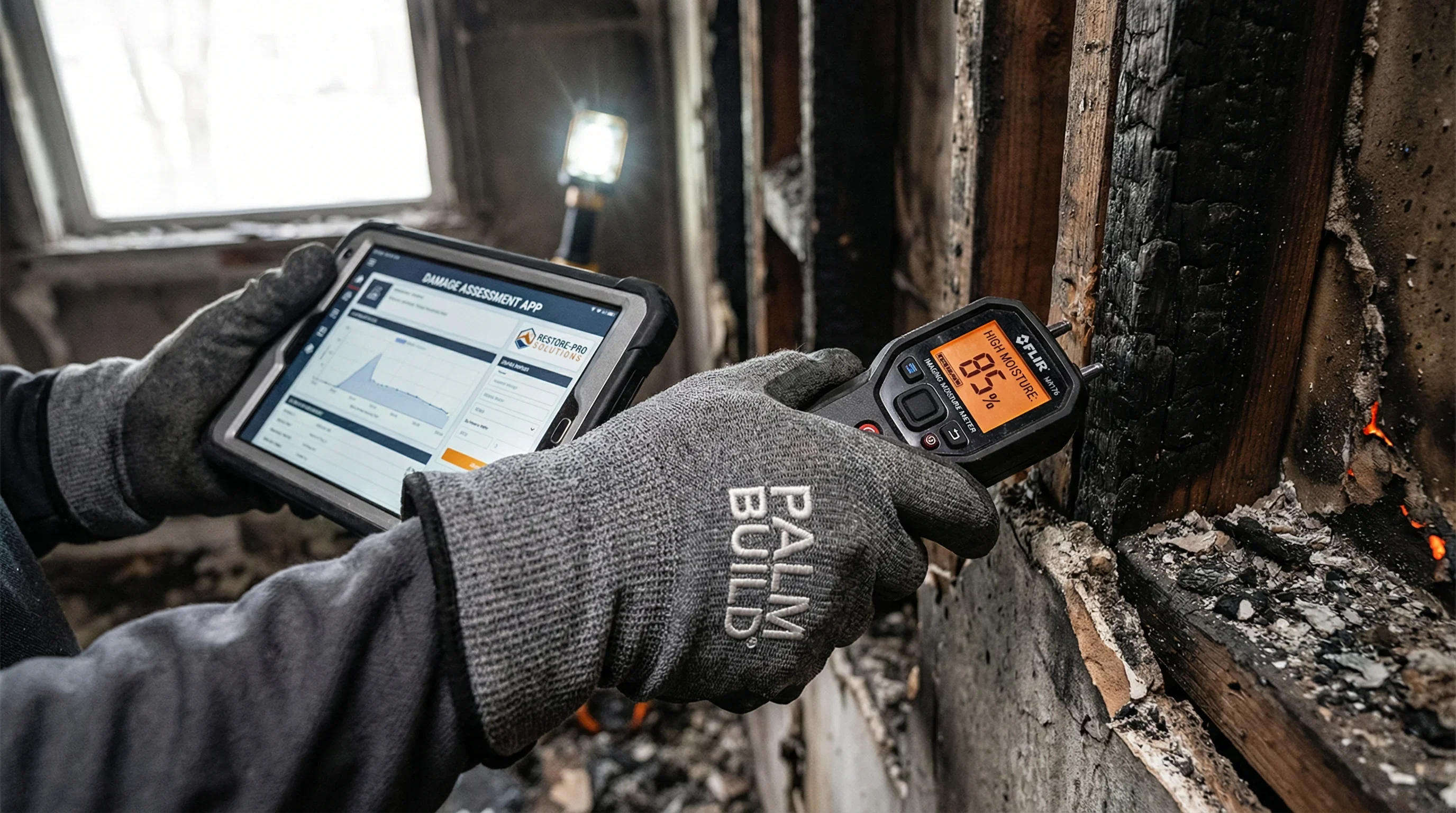
FLIR thermal imaging camera320×240 resolution, ±2°CFinds hidden smoke pathways and fire-water saturation behind wallsAssessment phase and final clearance. Reveals hidden damage invisible to the eye.
Deployment rules — when tools help and when they hurt
RuleVerdictWhy
Ozone BEFORE cleaningFAILBonds residue further into surfaces. Always clean first, ozone last.
Ozone in occupied spaceFAILRespiratory harm, kills plants, degrades rubber. Vacated zone only.
HVAC running during fire cleanupFAILSpreads contamination whole-home. Shut down Day 0 until duct cleaning complete.
HEPA scrubber from Day 0CORRECTPulls airborne particulate; maintains negative pressure in work zone.
Thermal fog after final cleaning passCORRECTDeodorizing particles follow smoke pathways when cleaning is complete.
Hydroxyl for occupied restorationCORRECTSlower than ozone but safe for homeowner presence during treatment.
2026 Fire Damage Cost Guide

Fire Damage Restoration Cost (2026)

Most fire damage restoration projects cost between $3,098 and $51,243 in 2026, with a national average near $27,091. Restoration scope runs $4-$7 per square foot (avg ~$5.50), and labor accounts for 50-70% of the total. Costs scale with fire class, smoke travel distance, water damage from suppression, and structural involvement. See our 2026 fire damage cost guide for full methodology.

National average

$27,091

Total 2026 fire damage restoration

Per sq ft (restoration)

$4-$7

Smoke, soot, water, selective repair

Labor share

50-70%

Of total restoration cost

Fire restoration cost by scope
ScopeWhat it includes2026 price range
Remediation (cleanup)Soot/smoke cleanup, HVAC decontamination, deodorization, water extraction$4-$7 / sq ft ($3,098-$25,000 typical)
Structural repairDrywall tear-out, framing replacement, roofing, electrical, plumbing$1.50-$3 / sq ft drywall, $5,900-$12,800 roof
Contents restorationPack-out, ultrasonic cleaning, ozone chamber, textile/electronics$200-$1,000 per item; $50-$100/lb removal
Full restoration (all scopes)Complete remediation plus structural rebuild plus contents$8,000-$51,243+ ($27,091 avg)
Palm Build technician documenting fire damage restoration cost scope on tablet
Detailed documentation separates remediation, structural repair, and contents restoration — three different cost scopes your adjuster will review line by line.

Cost by fire class (NFPA classification)

Fire classification drives both residue type and cleaning protocol. Protein soot from a Class B grease fire is often more expensive to remediate than a larger Class A fire because the residue is harder to remove.

Class A — Ordinary combustibles

Wood, paper, cloth, furniture, most residential fires

Dry smoke residue — powdery, easier to vacuum

Cleanup scope

$4.00 - $5.50 / sq ft

Class B — Grease & flammable liquids

Kitchen grease fires, oil, gasoline, solvents

Protein soot — invisible greasy film, hard to remove

Cleanup scope

$5.00 - $7.00 / sq ft

Class C — Electrical

Wiring, outlets, appliances, HVAC failures, puffbacks

Wet smoke + acidic oil soot — aggressive corrosion

Cleanup scope

$5.50 - $7.50 / sq ft

Class D — Metal fires

Rare residential — industrial, machine shops, labs

Reactive metal residues, specialized hazmat protocols

Cleanup scope

Custom quote required

Cost by project size (low / expected / high)
Project sizeLowExpectedHigh
Single room (under 200 sq ft)$800$2,500$9,500
Multiple rooms (200-500 sq ft)$3,098$8,000$14,000
Whole floor (500-1,200 sq ft)$8,000$18,000$25,000+
Major structural (1,200-2,000 sq ft)$15,000$27,091$51,243+
Whole-home / total loss$35,000$75,000$200,000+

Regional fire restoration pricing: FL, NC, SC

Florida

South FL / Palm Beach

$5,200 - $32,000

Hurricane-related fires, lightning strikes, hot-humid drying makes water mitigation urgent

North Carolina

Charlotte / Metrolina

$4,800 - $29,500

Winter furnace puffbacks, electrical fires during cold snaps; crawl space smoke spread

South Carolina

Statewide

$4,500 - $28,000

Lightning-related fires, coastal wildfire risk, older brick homes with hidden smoke

Pricing anchored to 2026 national averages. See the full fire damage cost guide for source methodology and line-item breakdowns.

Call for a free fire damage assessment

IICRC S700-certified scope review, documented for your insurance adjuster

Request Fire Assessment
Regional Fire Risk

Regional Fire Risk Matrix: FL, NC, SC

Fire risk is not uniform across Palm Build's service area. A Charlotte homeowner is five times more likely to experience a winter furnace puffback than a Palm Beach homeowner, but far less likely to deal with a hurricane-related fire event. Knowing the regional pattern helps you prioritize prevention and understand how your insurance might respond.

Fire risk by type and state, with insurance notes
Fire risk typeFloridaNorth CarolinaSouth CarolinaInsurance treatment
Kitchen grease fireHIGHHIGHHIGHCovered under standard HO-3. Protein soot often requires supplement claim as damage is under-scoped at initial inspection.
Electrical fireMODERATEMODERATEMODERATETypically covered. Watch for exclusions on pre-existing wiring issues or code-compliance gaps in older homes.
HVAC/furnace puffbackLOWHIGHMODERATEUsually covered. NC winter oil furnace incidents are common; insurers sometimes dispute cause. Keep service records.
Lightning strike fireVERY HIGHHIGHVERY HIGHFL and SC lead US in lightning density. Standard HO-3 covers; electrical surge exclusions sometimes apply to electronics.
WildfireLOWMODERATEMODERATECovered under standard HO-3. Brush fire and wildfire smoke intrusion are increasingly common in upstate SC and western NC.
Hurricane-related fireHIGHMODERATEMODERATEFire damage from storm events is covered, but wind and water exclusions can complicate claims. Document cause carefully.

Florida — The Lightning Capital

Hurricane-era fire risk

Florida has the highest US lightning density and frequent hurricane impacts. Electrical fires from storm damage, generator backfeed, and damaged wiring are common in the days and weeks after a storm. Hot-humid climate makes water mitigation from fire suppression urgent because the 24-48 hour mold window is even tighter. Document fire damage separately from wind damage for clean insurance claim paths.

North Carolina — Winter Puffback Season

Cold-weather HVAC fires

Oil furnace puffbacks spike during January and February when furnaces run continuously. Electrical fires from auxiliary heating, dryer vents, and holiday lighting are concentrated November-February. Crawl space fires from damaged wiring are common in the older Metrolina housing stock. Regular furnace service records matter for insurance claims disputing cause.

South Carolina — Coastal & Upstate Split

Lightning + wildfire exposure

Upstate SC sits in the southern Appalachian wildfire corridor; coastal SC combines lightning density with older brick housing stock that hides smoke in wall cavities. Tropical storm season brings both direct wind-fire events and secondary electrical fires from power surges. Palm Build coordinates with local fire marshals in Charleston, Columbia, and Greenville areas.

Recognize the Warning Signs

Signs of Fire & Smoke Damage

After fire departments extinguish the fire, damage continues to spread. Quick identification helps restoration professionals prevent further damage to your home or business.

Act Fast
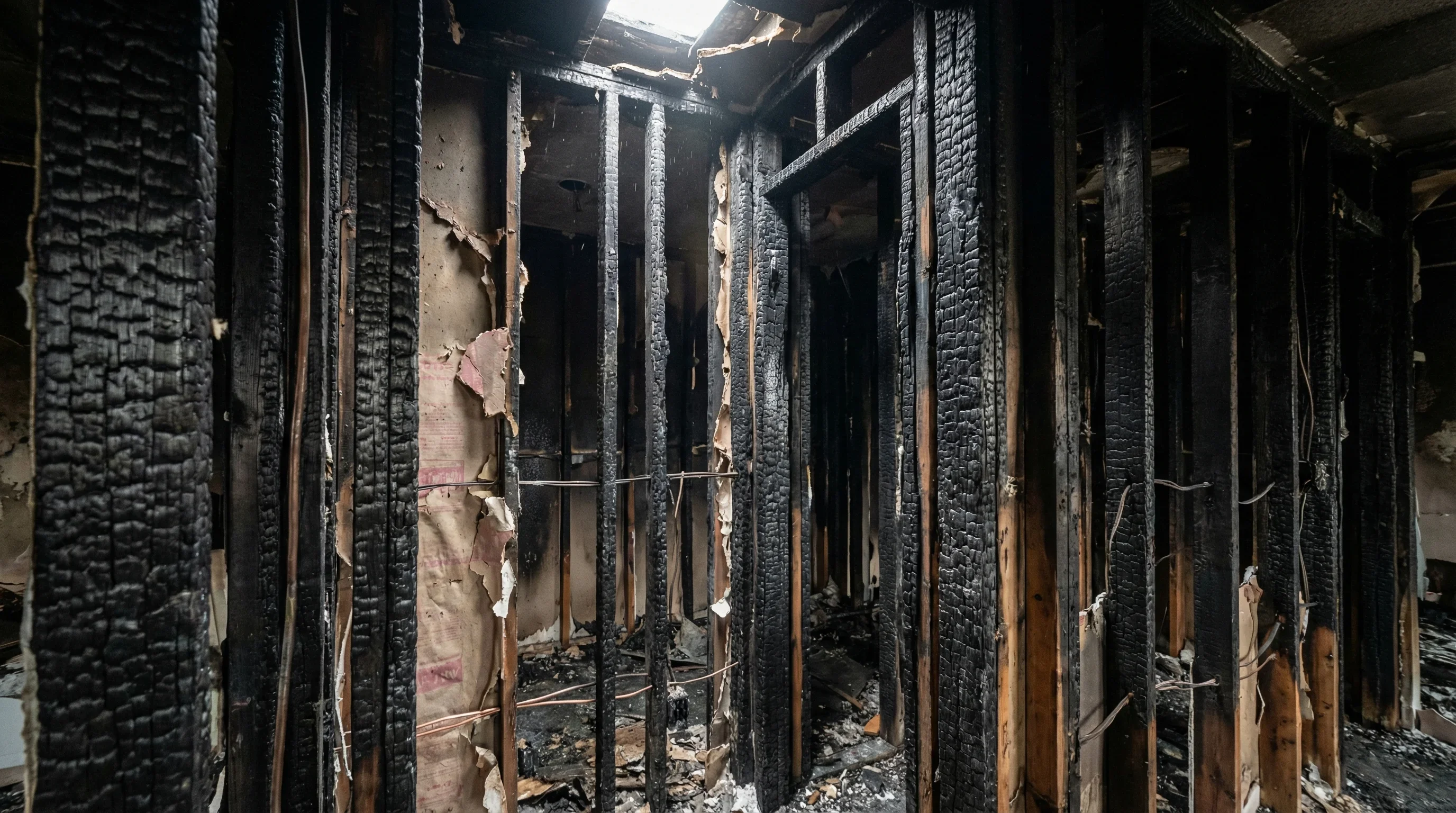
Charred wood structural beams and burn damage on building materials after fire

Visible Char & Burn Marks

Charred wood, melted materials, or visible burn damage indicate direct flame contact. The extent of the damage determines whether materials can be cleaned and restored or need replacement.

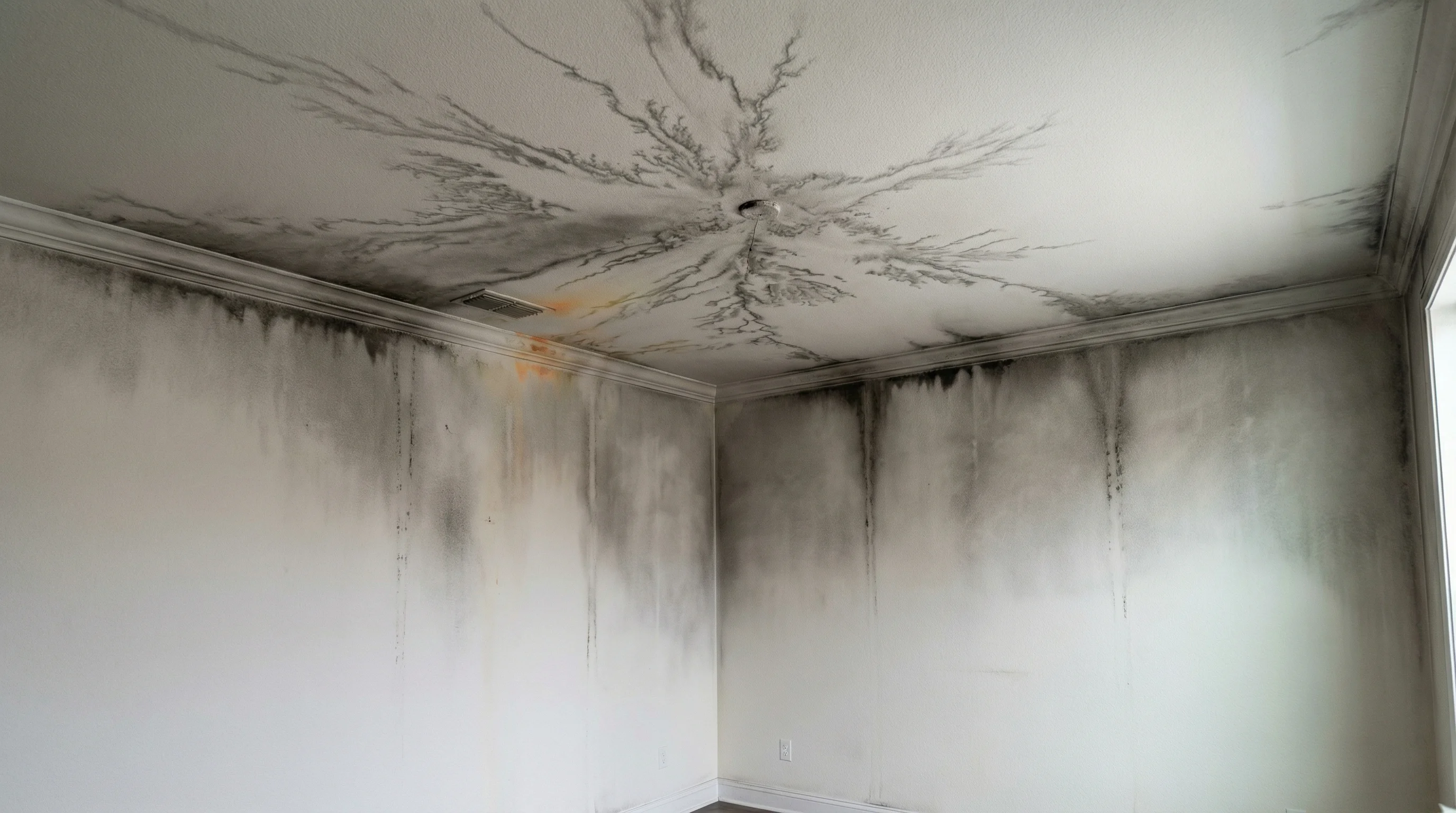
Gray and black smoke stains on ceiling and walls showing smoke damage patterns

Smoke Staining on Surfaces

Gray or black discoloration on walls, ceilings, and other surfaces shows where smoke traveled. Fire and smoke damage often extends far beyond the area where flames were present.

Act Fast
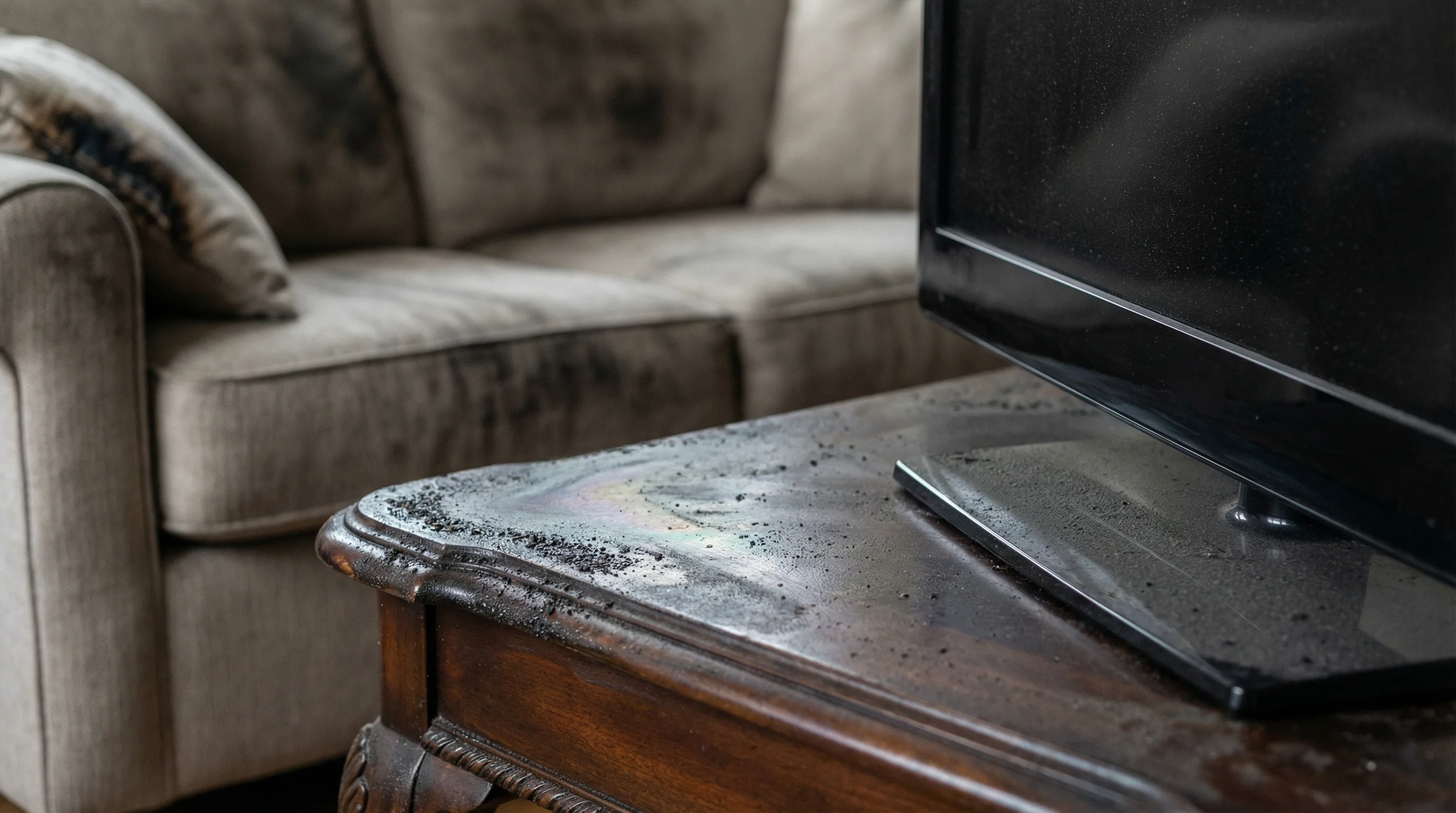
Heavy black soot residue coating furniture and surfaces after house fire

Soot Residues

Fine black or oily particles on surfaces, furniture, and belongings. Soot residues are acidic and can permanently damage materials if not cleaned by restoration professionals promptly.

Smoke-damaged room interior with persistent odor issues requiring deodorization

Lingering Smoke Odor

Persistent smoky smell indicates smoke particles have penetrated porous materials. Professional deodorization is needed to fully eliminate the odor from your home or business.

Soot becomes permanent within 24-48 hours

Acidic soot residues etch into surfaces quickly. Restoration professionals can prevent further damage by beginning cleanup immediately after the fire.

Get Emergency Help
Certified Restoration Company

Expert Repairs & Restoration After Fire

When disaster strikes your home or business, our team responds fast. We specialize in complete smoke cleanup, soot removal, and reconstruction—helping property owners recover quickly. Restoration professionals with IICRC certification handle every step.

24/7
Emergency Response
100%
Satisfaction
15yrs
Experience
IICRC certified fire restoration technician with Palm Build uniform and professional equipment

IICRC Certified Technicians

Trained specialists with expertise in smoke cleanup, structural repairs, and content restoration for your home or business

IICRC
Certified

Insurance Coordination

We work directly with your insurance company for smooth claims

24/7 Emergency

Immediate response to prevent further damage and start cleanup

Emergency Response

24/7 availability for your home or business

Smoke & Soot Removal

Advanced techniques eliminate soot residues

Odor Elimination

Permanent removal of lingering smoke smell

Repairs & Reconstruction

Full structural repairs to pre-loss condition

Going Through a Fire? We're Here to Help You Rebuild.

(888) 245-5155
Our Proven Approach

How We Restore Your Property

Our 6-step process is designed for efficiency and thoroughness. From emergency response through complete repairs and reconstruction, we follow IICRC protocols to ensure your home or business is properly cleaned and restored.

01

Emergency Response

Our 24/7 team arrives quickly to secure your home or business. Board-up and roof-tarping services prevent further damage from weather and vandalism.

02

Damage Assessment

Restoration professionals document the extent of the damage with photos and detailed reports. We work with your insurance company to support your claim.

03

Water Removal

After fire departments extinguish the fire, water damage often follows. We extract all standing water and dry structures to prevent mold growth.

04

Soot & Smoke Removal

Specialized equipment removes soot residues from surfaces, belongings, and HVAC systems. Fire and smoke damage extends far beyond the burn area.

05

Cleaning & Sanitizing

Items that can be cleaned and restored undergo professional treatment. Air scrubbers and fogging eliminate smoke odors—not just mask them.

06

Repairs & Reconstruction

From minor structural damage to complete rebuilds, our team handles all repairs. Your property is returned to pre-loss condition.

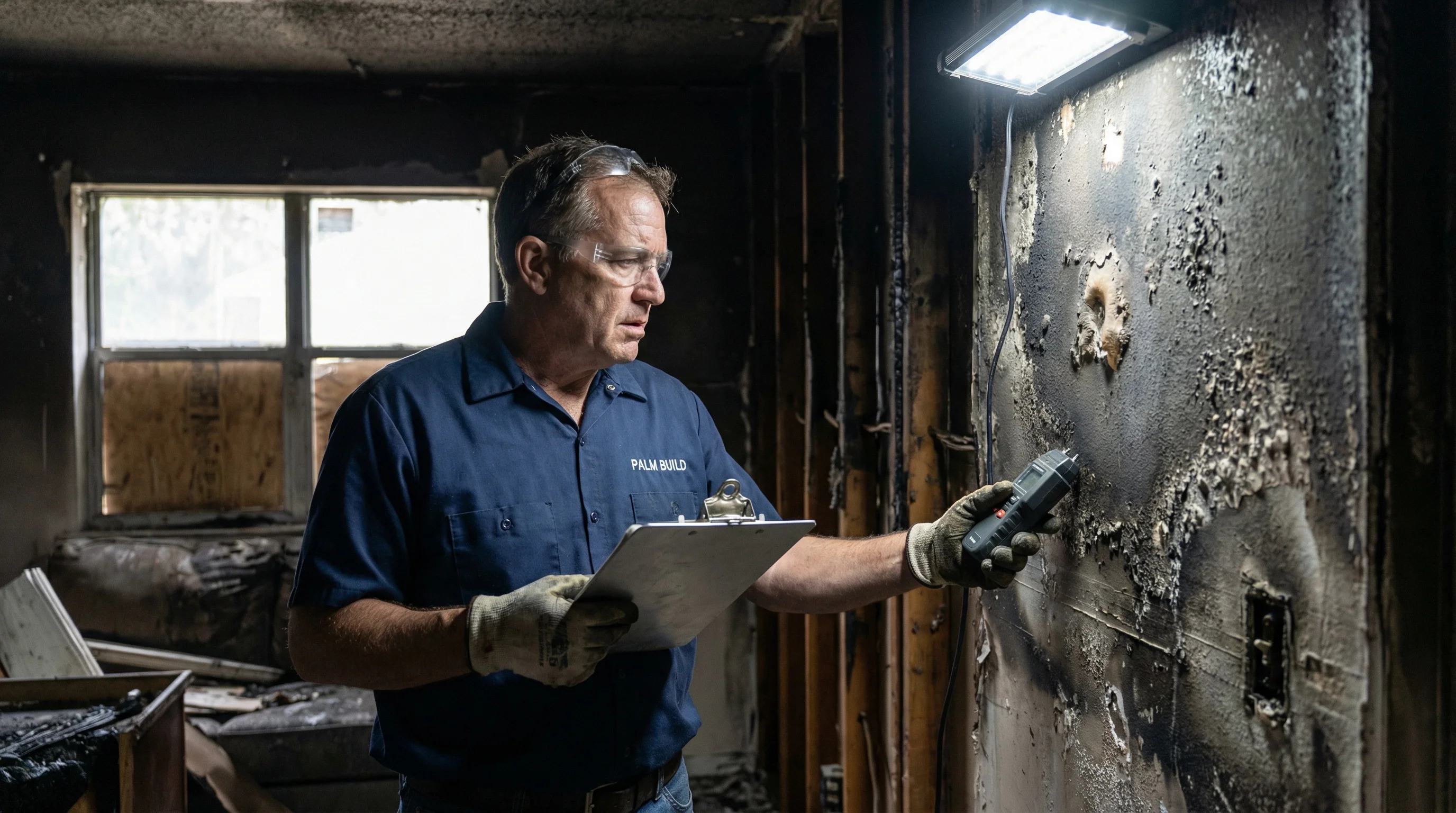
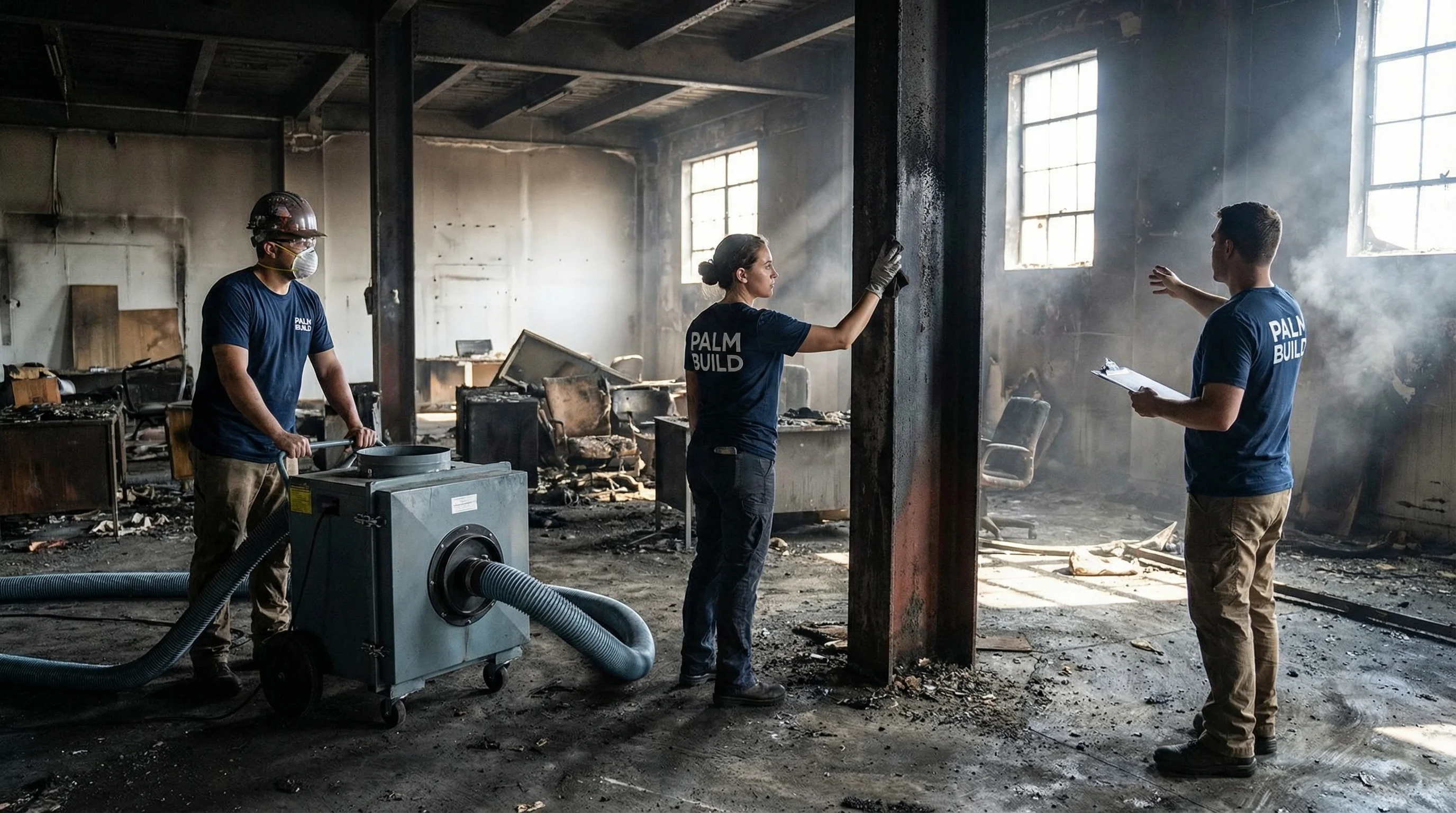
Fire restoration technician in Palm Build uniform inspecting fire damage and documenting assessment

IICRC Certified Specialists

Our trained technicians follow industry protocols that meet your insurance company's documentation requirements while ensuring complete restoration of your property.

Why Our Process Works

1

Rapid Action

Quick response minimizes damage to your home or business.

2

Advanced Equipment

Industrial-grade tools remove soot residues and smoke particles fast.

3

Content Recovery

Many items can be cleaned and restored by our specialists.

4

Insurance Coordination

We handle documentation for your insurance company.

Average Timeline for Repairs & Restoration

Day 1 Emergency
Response
Days 2-5 Cleanup &
Mitigation
Days 6-14 Odor
Removal
2-6 Weeks Restoration &
Reconstruction

*Timeline varies based on the extent of the damage. Minor smoke damage may resolve in 1-2 weeks, while major structural damage can take 2-3 months for complete repairs and reconstruction.

Professional Advantage

Why Choose Our Restoration Company

Professional repairs and restoration deliver results that DIY methods can't match. Protect your home or business with expert help from trained specialists.

24/7 Emergency Response

Our rapid response teams are available around the clock to prevent further damage and begin recovery immediately.

On-call restoration company

Advanced Soot Removal

Specialized equipment removes soot residues from all surfaces. Without quick cleanup, acidic soot can permanently etch materials.

Complete particle extraction

Odor Elimination

Permanent odor removal using thermal fogging, ozone treatment, and HEPA air scrubbers. We eliminate smoke smell—not just mask it.

100% odor neutralization

Content Recovery

Many belongings can be cleaned and restored by our specialists. We carefully handle furniture, documents, and valuables.

Personal property saved

Structural Repairs

Complete repairs and reconstruction to return your property to pre-loss condition. We handle structural damage of any scale.

Full reconstruction services

Insurance Coordination

We work directly with your insurance company throughout the claims process, providing documentation and supporting your claim.

Direct billing available

Certified Specialists

IICRC certified technicians trained in the latest techniques. Our restoration professionals follow strict safety protocols.

Industry-leading certification

Property Owner Support

We understand the stress every property owner faces after a fire. Clear communication and compassionate service throughout recovery.

Personalized guidance

What Our Clients Say

"They responded within 30 minutes of our call after a kitchen fire. Professional, thorough, and our home was restored better than before."
M

Michael R., Miami

Ready to Start Rebuilding? We're Here for You.

Don't let the damage spread. Our expert team is ready to help you recover quickly with professional repairs and restoration for your home or business.

15+
Years Experience
500+
Projects Completed
100% Satisfaction Guarantee

Fast Response

Our emergency teams respond quickly to assess damage and start mitigation immediately.

Insurance Approved

We work directly with all major insurance providers to streamline claims and maximize your coverage benefits.

Certified Experts

IICRC certified technicians trained in smoke cleanup, soot removal, and complete structural reconstruction.

Transformation Gallery

Before & After Restoration

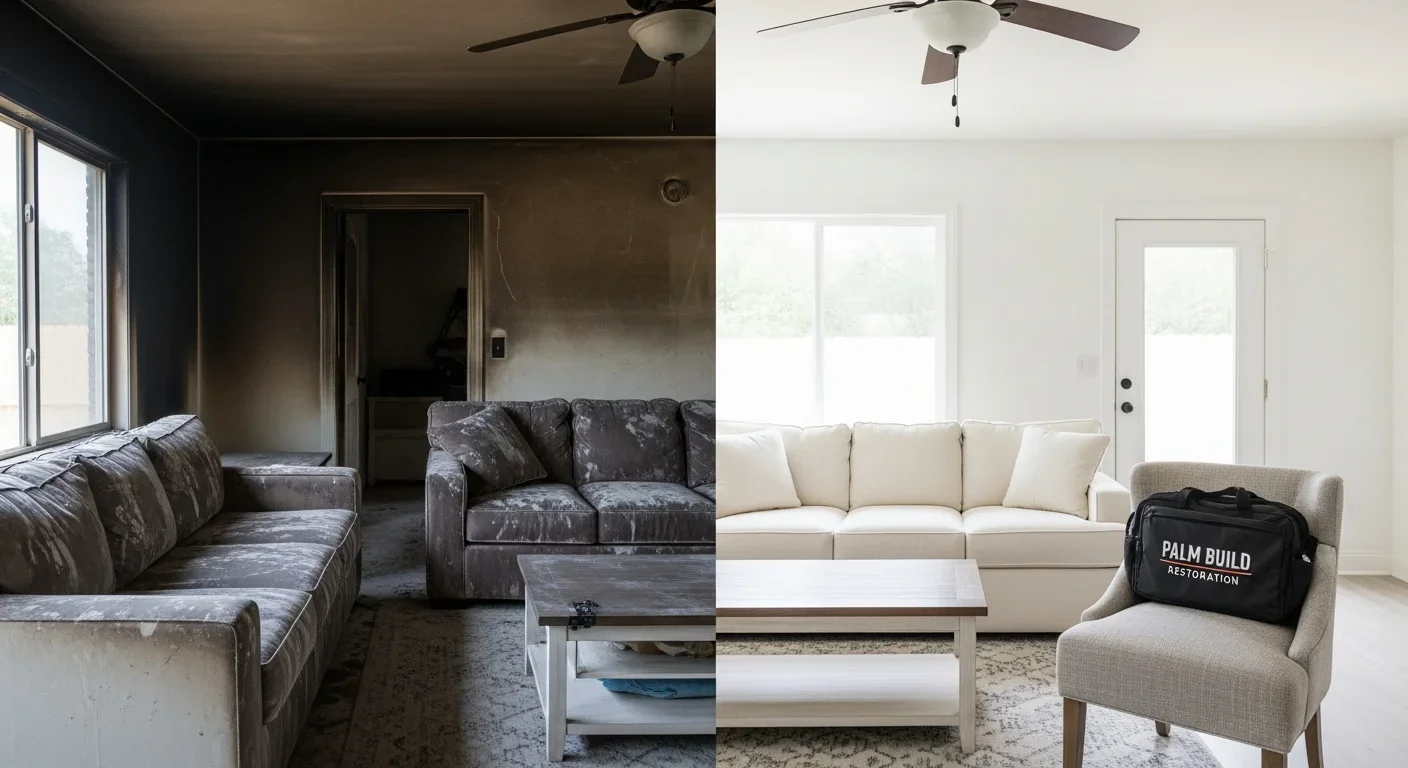
See the dramatic difference our professional fire restoration services make. Drag the slider to reveal the transformation.

Need fire or smoke damage restoration?

Get a Free Estimate
Fire Safety & Preparedness

Before Disaster Strikes

Preparation is your best defense against fire damage. Learn how to protect your property and what to do when fire strikes.

Emergency Preparedness

Create an Evacuation Plan

Establish and practice an evacuation plan for your home or business, including meeting points and escape routes.

Document Your Property

Keep an inventory of personal property with photos. Your insurance company will need this documentation.

Store Important Documents

Keep important documents in a fireproof safe or create digital backups. This simplifies the claims process.

Save Emergency Contacts

Keep contacts for fire departments, your insurance company, and a trusted restoration company ready.

Fire Damage Facts

1

Fire and smoke damage extends far beyond the area directly affected by flames

2

Acidic soot residues can permanently etch surfaces if not cleaned within hours

3

Water damage from firefighting often requires as much attention as the fire itself

4

Up to 90% of belongings can be cleaned and restored with quick professional response

5

Proper odor removal requires specialized equipment—DIY methods only mask the smell

Time is critical after fire damage
Call Now

Emergency Checklist

Install smoke detectors on every level of your home

Test smoke detectors monthly and replace batteries annually

Keep fire extinguishers accessible and know how to use them

Create and practice a fire escape plan with your family

24/7 Emergency Response for Your Home or Business

Our teams are standing by to begin cleanup after fire departments extinguish the fire. Quick action prevents further damage and protects what can be cleaned and restored.

Understanding the Invisible Threat

Smoke Damage: Often Worse Than the Fire Itself

While flames cause the most visible destruction, smoke travels through your entire property—through HVAC ducts, wall cavities, and porous materials. Understanding the type of smoke residue in your home determines the cleaning approach.

Dry Smoke Residue

From fast-burning, high-temperature fires

Dry smoke comes from fires that burn quickly at high temperatures—often paper, wood, or structural fires with good oxygen supply. The residue is powdery and non-smeary, which makes it easier to clean from hard surfaces but tricky on porous materials where it can settle deep into fibers.

Characteristics

  • Fine, powdery texture
  • Easier to vacuum from hard surfaces
  • Penetrates deep into porous materials
  • Less visible odor than wet smoke

Professional Cleaning Method

HEPA vacuuming followed by dry sponge cleaning. Porous materials may require deep extraction.

Smoke traveling through HVAC system spreading contamination to other rooms

How Smoke Travels Through Your HVAC

Smoke particles are microscopic—as small as 0.1 microns. When your HVAC system runs during or after a fire, it pulls smoke through ductwork and distributes it to every room in your property. This is why rooms far from the fire source often have smoke damage. Professional HVAC cleaning and sealing is essential during restoration. Do not run your HVAC until it has been professionally inspected.

This type of water and smoke cross-contamination is why we often coordinate water restoration alongside fire cleanup—especially when firefighting water has entered the duct system.

Where Smoke Hides

Smoke residue often settles in places you can't see, causing ongoing odor issues and gradual material degradation. Professional restoration teams know to check these hidden locations:

  • Inside HVAC ductwork and behind return vents
  • Behind walls and inside wall cavities
  • Under carpets and inside carpet padding
  • Inside electrical outlets and junction boxes
  • Behind cabinets and inside drawers
  • In attic insulation and crawl spaces

If smoke has reached your crawl space, specialized crawl space cleanup may be needed to prevent long-term odor and moisture issues.

Smoke Odor Science

Why Smoke Odor Removal Is Molecular Chemistry, Not Air Freshener

Smoke odor is caused by actual volatile organic compound (VOC) molecules embedded in porous materials — drywall paper, carpet pad, upholstery foam, insulation, wood framing. Masking sprays don't touch these molecules; they just add a second odor to the first one. Professional odor removal works at the molecular level, either by breaking the odor molecules apart (ozone, hydroxyl, thermal fog) or sealing them in place (encapsulation). Most real projects use multiple methods in sequence.

Ozone (O₃)

Mechanism: Oxidizes odor molecules by adding a third oxygen atom to volatile organic compounds, breaking them apart at the subatomic level.

Pros

Most powerful; penetrates same pathways smoke traveled; effective on deeply embedded odors

Cons

Unsafe for occupied spaces; vacated treatment zone required; kills plants, degrades rubber

Best for

Vacated homes, commercial spaces, post-cleaning odor phase

$400-$800 per treatment

Hydroxyl radical (·OH)

Mechanism: UV light generates hydroxyl radicals in ambient humidity; radicals break down odor molecules through oxidation but at lower reactivity than ozone.

Pros

Safe for occupied spaces; runs continuously without vacating; no residue

Cons

Slower than ozone; less effective on deeply penetrated heavy odors alone

Best for

Occupied homes, hospitals, schools, phased restoration projects

$500-$1,200 per week of continuous deployment

Thermal fogging

Mechanism: Deodorizing solvent is heated to vapor-phase particles 0.5-50 microns in size — the same particle-size distribution as smoke. The vapor travels identical pathways, neutralizing odor where smoke settled.

Pros

Reaches inside wall cavities, HVAC ducts, and upholstery interiors; very fast

Cons

Must be applied AFTER chemical cleaning; can bond residue if applied too early

Best for

Post-cleaning odor phase; structures with extensive hidden smoke penetration

$200-$600 per room

Encapsulation / sealing

Mechanism: A specialized odor-blocking primer (typically shellac-based) creates a physical barrier between the porous substrate and the indoor air, preventing odor molecules from off-gassing.

Pros

Cheap; prevents odor recurrence; accepts normal paint after curing

Cons

Does NOT remove odor — only contains it. Fails if substrate is not cleaned first.

Best for

Final step after complete cleaning; reconstruction-phase wall prep

$1.50-$3 per sq ft

Odor removal method comparison
AttributeOzoneHydroxylThermal fogEncapsulation
MechanismOxidation via O₃Oxidation via ·OHPathway matchingPhysical barrier
Occupied space safe❌ NO✅ YES❌ NO✅ YES
Treats embedded odor✅ Deeply✅ Gradually✅ Via pathway match❌ Contains only
Fast (single session)✅ Hours❌ Days-weeks✅ Hours✅ Hours
Typical cost$400-$800$500-$1,200/wk$200-$600/rm$1.50-$3/sq ft
When to usePost-clean, vacatedOccupied projectsPost-clean phasePre-reconstruction

Why DIY odor removal almost always fails

Candles, air fresheners, vinegar bowls, and baking soda work on mild surface odors. They cannot reach the smoke molecules embedded half a millimeter deep in drywall paper or several inches into carpet pad. After a fire, smoke penetrates wherever air moves — into HVAC ducts, behind outlet covers, inside wall cavities, under baseboards, and into the upholstery foam of every soft surface in the home. Treating the visible surface does nothing to the hidden reservoirs. A week later, when the DIY spray wears off, the smoke odor returns unchanged. Professional molecular-level treatment is the only permanent solution.

The Science Behind Odor Removal

Why Masking Doesn't Work—And What Does

Candles, air fresheners, and store-bought sprays can't eliminate smoke odor—they only cover it temporarily. Smoke molecules are embedded in materials at a microscopic level. Professional deodorization destroys these molecules rather than masking them.

What Doesn't Work

  • Scented candles and air fresheners (temporary masking only)
  • Household cleaning sprays on soot (can set stains permanently)
  • Vinegar or baking soda alone (insufficient for embedded smoke)
  • Opening windows indefinitely (won't address embedded particles)

What Actually Works

  • Professional thermal fogging (penetrates like smoke did)
  • Hydroxyl generators (safe, continuous molecular breakdown)
  • Ozone treatment (powerful oxidation for severe cases)
  • HEPA air scrubbing (removes airborne soot particles)

Thermal Fogging

Highly Effective

Creates a heated fog that penetrates the same crevices and porous materials that smoke did. The deodorizing agent bonds with smoke molecules and neutralizes them at the source. Especially effective for structural smoke damage in walls and framing.

Best for: Structural smoke odor, large areas
1-3 treatments over 1-2 weeks

Hydroxyl Generators

Highly Effective

Uses UV light to create hydroxyl radicals—the same molecules that naturally clean the atmosphere. Safe to use while people, pets, and plants are present. Breaks down smoke odor molecules without leaving any residue or harmful byproducts.

Best for: Occupied spaces, sensitive materials, ongoing treatment
3-7 days of continuous operation

Ozone Treatment

Highest Effectiveness

Generates ozone (O3) that oxidizes and destroys odor-causing molecules. Extremely effective but requires the space to be completely unoccupied—ozone is harmful to breathe. The area must be ventilated thoroughly before re-entry.

Best for: Severe odor, unoccupied spaces
24-72 hours per treatment cycle

HEPA Air Scrubbers

Highly Effective

Industrial-grade HEPA filtration captures smoke particles down to 0.3 microns. While not a deodorizer itself, removing airborne soot particles significantly reduces ongoing odor and prevents re-contamination of cleaned surfaces.

Best for: Air quality improvement, particle removal
Continuous during restoration

How Long Does Odor Removal Take?

Complete smoke odor elimination typically takes 1-4 weeks depending on severity. Minor smoke damage (kitchen fire, small area) may clear in a few days. Severe whole-house smoke damage can require multiple treatment cycles over several weeks. Our team monitors progress with odor detection equipment and won't consider the job done until the smell is completely gone—not just reduced.

Molecular-Level Contaminants

Why You Can't Just Paint Over Smoke Damage

Smoke damage isn't just cosmetic. Fire residue contains a mix of carcinogenic compounds, acidic particles, heavy metals, and volatile organic compounds that continue to off-gas, corrode, and react for weeks or months after the fire is out. Understanding what's actually in post-fire residue is why professional remediation exists — and why DIY "clean and repaint" approaches frequently fail inspection and create lingering health hazards.

Structural fire damage showing charred wood with alligator char pattern revealing contamination depth
Char depth indicates thermal exposure. Charred wood absorbs VOCs deep into the grain.
Acidic soot residue inside HVAC ductwork showing metal corrosion progression
Acidic soot corrodes metal starting within 72 hours. HVAC damage compounds daily.
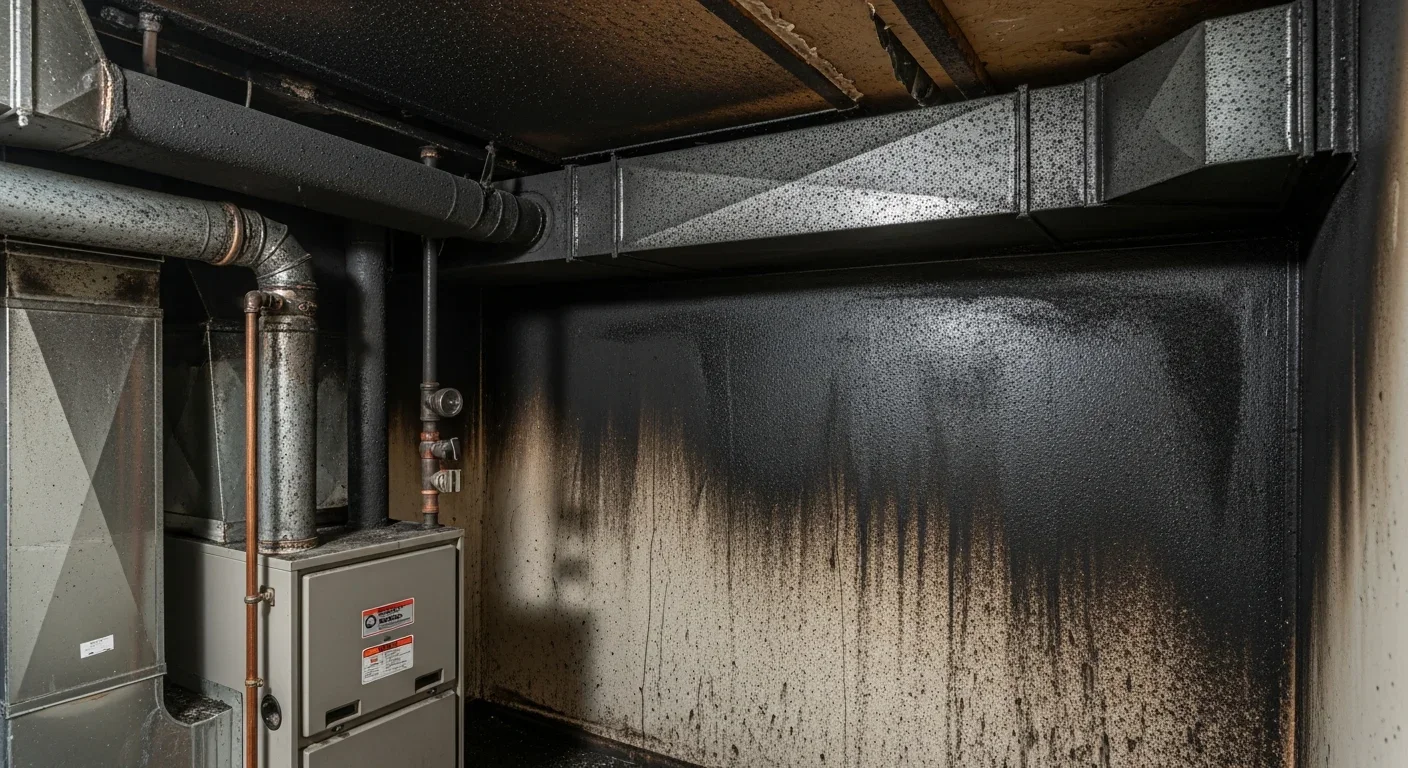
Furnace puffback fine oil soot distributed whole-home through HVAC showing contamination pattern
Puffback fine-oil soot carries the highest concentration of PAHs and acidic compounds.

PAHs (Polycyclic Aromatic Hydrocarbons)

What it is

Complex organic compounds formed when carbon-based materials burn at high temperatures. Several are EPA-classified carcinogens.

Where it ends up

Embedded in soot particles, drywall, insulation, upholstery foam, and HVAC duct interior surfaces after any wood or plastic fire.

Why it matters

Linked to skin, lung, and bladder cancer risk with prolonged exposure. Children and elderly are higher risk. Do not vacuum without HEPA.

VOCs (Volatile Organic Compounds)

What it is

Gas-phase carbon compounds that evaporate from burned plastics, paint, and synthetic materials. Primary source of lingering smoke odor.

Where it ends up

Off-gassing from damaged materials for weeks or months post-fire. Re-activated by humidity and temperature changes.

Why it matters

Headaches, respiratory irritation, long-term exposure linked to various health impacts. Source of "the smell came back" complaints after cleanup.

Acidic soot compounds

What it is

Chloride, sulfate, and nitrate compounds formed when PVC, upholstery, and some plastics burn. Deposit as acidic residue.

Where it ends up

Metal surfaces (copper pipes, electronics, stainless steel), grout lines, marble, painted finishes — anywhere soot settled.

Why it matters

Causes progressive corrosion starting within 72 hours. Electronics failures may not appear for weeks post-fire. Metal pitting becomes irreversible.

Heavy metals

What it is

Lead, cadmium, arsenic, mercury released from burning paint (older homes), electronics, treated wood, and certain plastics.

Where it ends up

Accumulated in soot residue, particularly on flat surfaces and in HVAC ducts. Highest in older pre-1978 homes with lead paint.

Why it matters

Toxic via inhalation or ingestion. Children at highest risk for lead exposure. Professional remediation uses lead-safe practices when triggered.

Asbestos (in older homes)

What it is

Pre-1980 homes may contain asbestos in insulation, joint compound, floor tile, and HVAC duct wrap. Disturbed during fire.

Where it ends up

Airborne after fire damage to older construction materials. Attic insulation, basement pipe wrap, and floor tile adhesive are common sources.

Why it matters

Known carcinogen. Fire damage to pre-1980 homes requires asbestos testing and licensed abatement if present. Cannot be handled by standard crews.

Sources & professional guidance

The EPA, CDC, and National Institute for Occupational Safety and Health (NIOSH) all publish guidance on post-fire residue hazards. IICRC S700 incorporates these sources into the certified fire restoration protocol. Palm Build's fire restoration crews wear full PPE (Tyvek, P100 respirators, nitrile gloves) during soot handling because the cumulative exposure risk is real. Homeowners should not attempt DIY soot cleanup in any meaningful volume — particularly in pre-1980 homes where asbestos and lead paint may also be involved. See our mold remediation guide for the related water-damage-after-fire risk, and our firefighting water damage guide for the contamination pattern suppression water creates.

Your Recovery Roadmap

Fire Damage Restoration Timeline

Understanding how long fire restoration takes helps you plan and reduces uncertainty. Tap each phase to see what happens and when.

Timelines vary based on damage severity. A small kitchen fire may complete restoration in 3-4 weeks. Severe structural damage can take 4-6 months. Your restoration team will provide a detailed timeline after the initial assessment. Need help with the reconstruction phase? Our team handles everything from framing to finish work.

Contents Restoration

Saving What Can Be Saved: Contents Restoration

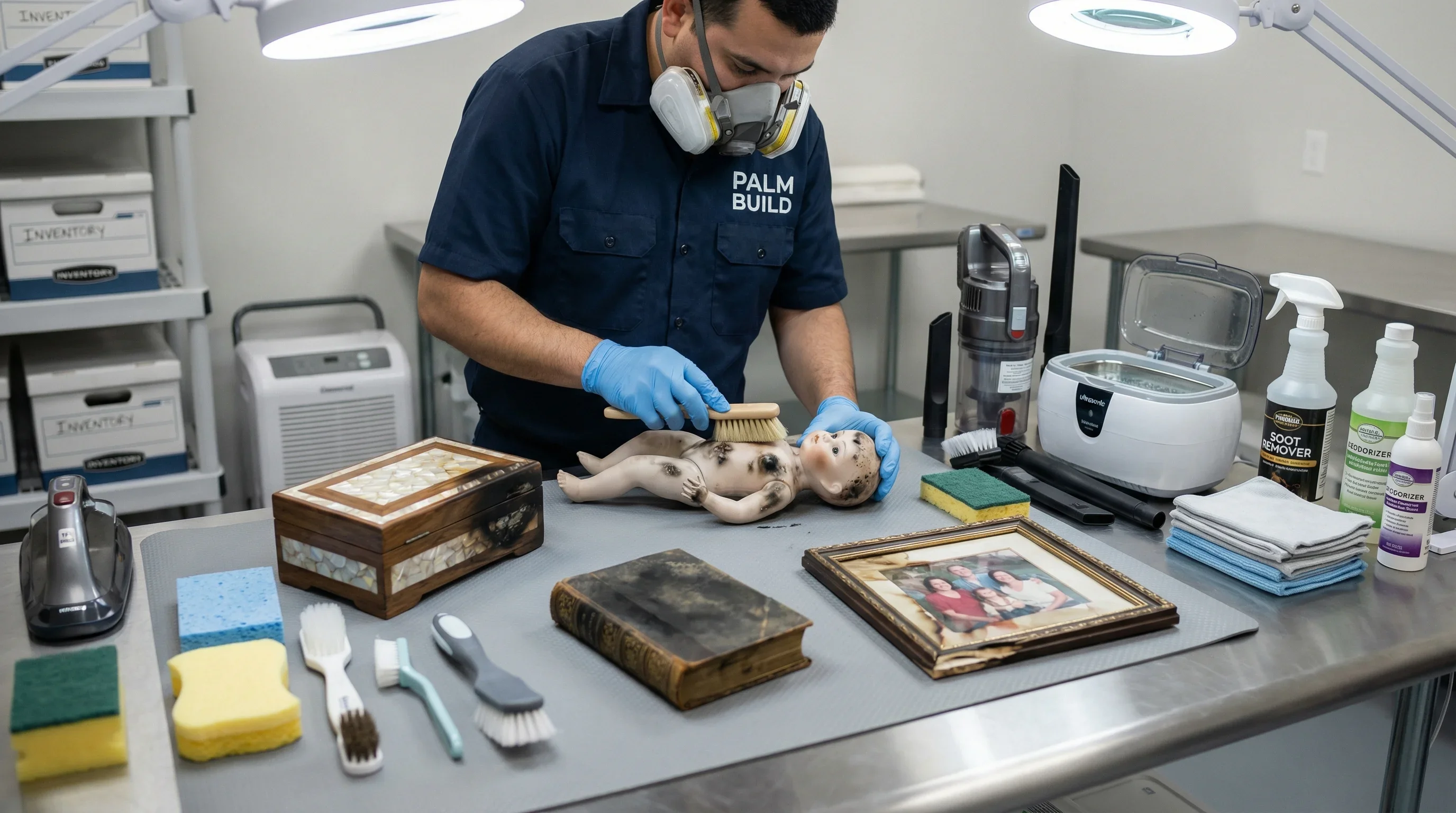
One of the biggest surprises for homeowners after a fire is how much of their belongings can actually be professionally restored. With fast response, up to 90% of contents are typically recoverable — a fraction of the replacement cost and, for personal items, the only path to truly replacing what was lost. Palm Build's contents restoration process is a structured pack-out → clean → store → return workflow coordinated with your insurance adjuster from day one.

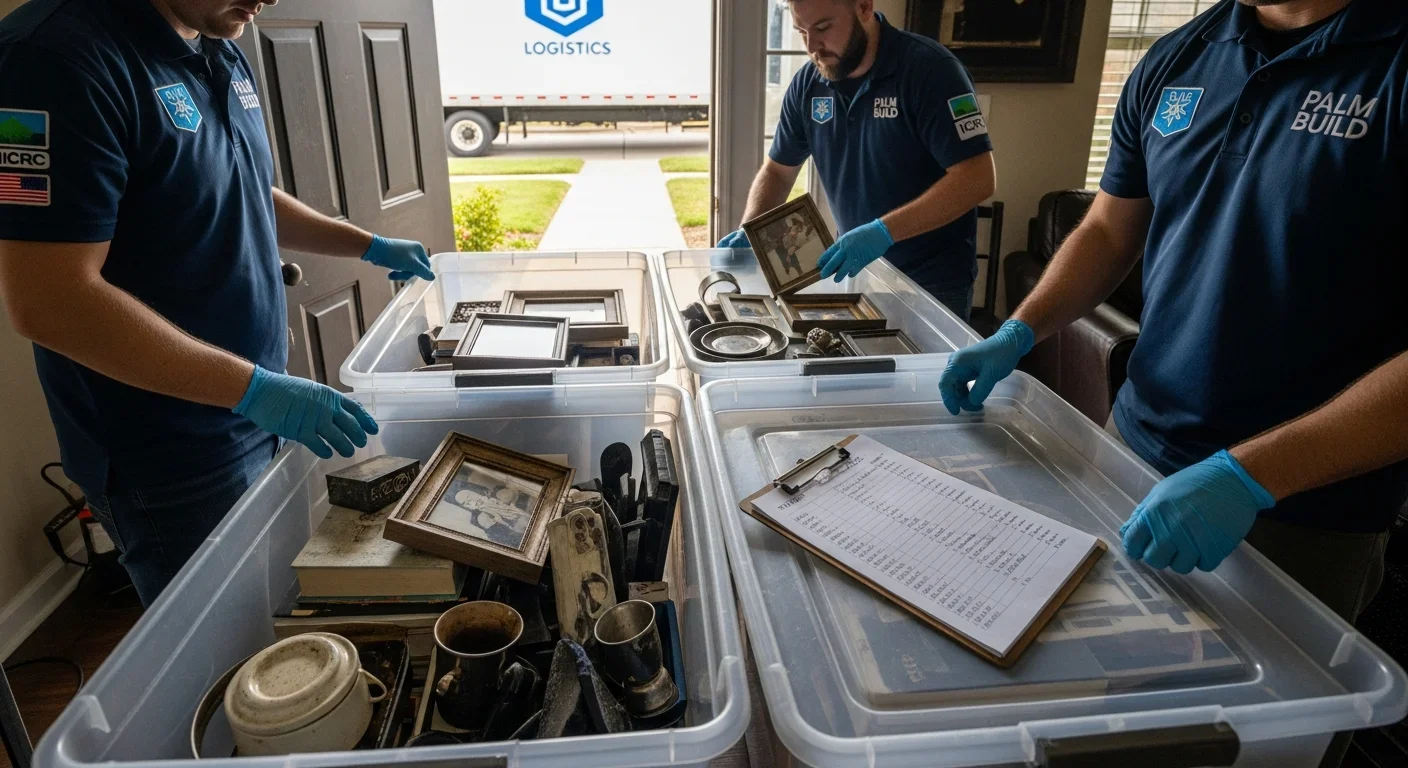
Pack-out process for fire-damaged contents with crew loading labeled containers
Pack-out is done room by room with itemized inventory tracking for insurance.
Ultrasonic cleaning bath with smoke-damaged hard goods in pH-neutral solution
Ultrasonic cleaning uses cavitation bubbles to mechanically clean complex surfaces.

The pack-out → clean → store → return workflow

  1. 1

    Room-by-room triage with insurance

    Each room is inventoried, photographed, and items tagged with one of three labels: restorable, document and discard, or specialty conservation required.

  2. 2

    Itemized pack-out with barcode tracking

    Restorable items are packed into labeled containers, barcoded, and transported to the contents restoration facility. Every item is traceable back to its original room.

  3. 3

    Material-specific cleaning at the facility

    Each item is matched to the right cleaning protocol — ultrasonic for electronics and hard goods, ozone chamber for textiles, conservation partner for fine art. See the matrix below.

  4. 4

    Climate-controlled storage during rebuild

    Cleaned contents stay in secure, climate-controlled storage while the structure is being restored. Standard storage is typically 30-90 days; longer on major rebuilds.

  5. 5

    Return and placement

    Once the structure is restored and deodorized, contents are returned and placed in their original rooms. Final walkthrough documents successful return to pre-loss condition.

Contents cleaning methodology by material class
MaterialExamplesMethodSalvage rate
ElectronicsLaptops, TVs, gaming consoles, audio equipment, printersUltrasonic cleaning at 40 kHz in pH-neutral solution; anti-corrosion treatment80-95% if cleaned within 7 days; drops sharply after corrosion sets in
Textiles & clothingWardrobes, bed linens, drapery, upholstery fabricOzone chamber pre-treatment → specialized dry cleaning → final ozone pass75-90% depending on fiber type and smoke category
Books & documentsPersonal libraries, photo albums, vital records, artwork on paperFreeze-drying for wet items; gentle HEPA vacuum and specialized page cleaning70-95% for dry items; water-saturated items require immediate freeze-drying
Fine art & antiquesPaintings, sculptures, rare furniture, musical instrumentsMuseum-grade conservation partners; controlled environment cleaning60-95% with conservator involvement; highly item-specific
Hard goods (metal/ceramic/glass)Cookware, dishware, small appliances, decorative items, hardwareUltrasonic cleaning → chemical rinse → polish and re-packaging90-98% — hardest to damage, easiest to restore
Food, medications, cosmeticsRefrigerator/pantry contents, prescription drugs, skincare productsNOT SALVAGED — all documented for insurance replacement0% — safety protocols require replacement regardless of visible damage
Professional content pack-out and cleaning restoration of fire-damaged belongings

Saving What Matters Most

Content Pack-Out & Restoration

One of the biggest concerns after a fire is your personal belongings. The good news: with quick professional response, up to 90% of contents can be saved. Our pack-out process carefully inventories, transports, and cleans your items at our specialized facility—protecting them from further soot damage while structural work is underway.

Furniture, clothing, and textiles cleaned and deodorized
Electronics assessed individually—many can be restored
Documents, photos, and artwork receive specialty treatment
Complete inventory for insurance documentation
Ask about our contents restoration process
Fire Insurance Claim Walkthrough

How To File A Fire Damage Insurance Claim

Six steps from fire marshal release to final supplement approval, with the exact phrases adjusters expect to hear. For state-specific deadlines and the full cost methodology see our 2026 fire damage cost guide.

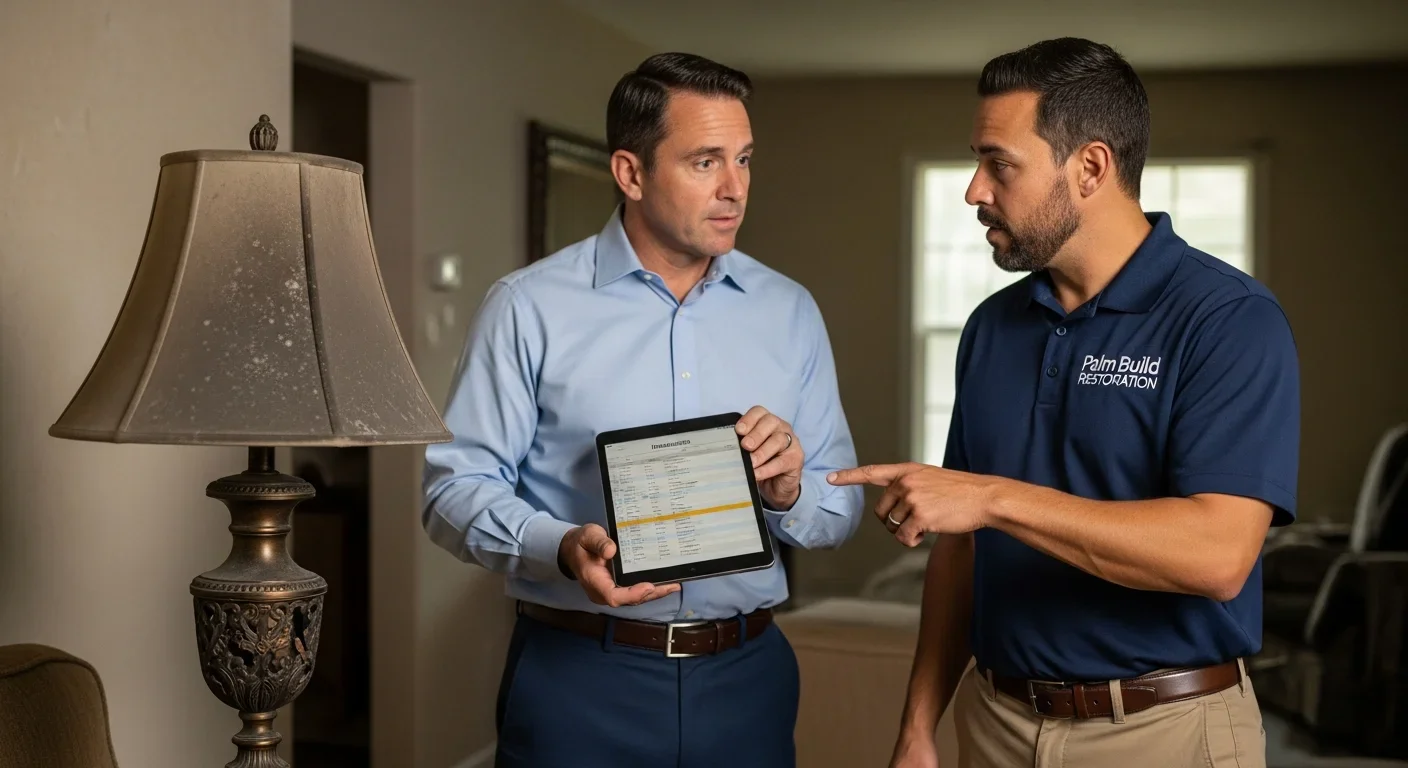
Insurance adjuster and Palm Build technician jointly inventorying fire-damaged contents with tablet
Joint contents inventory with your adjuster and restoration company present is the strongest documentation for contents claims — every item is agreed on the spot.
1

Get the fire marshal report first — everything flows from it

The fire department releases the scene with an incident report that documents cause, origin, and time. Insurance adjusters anchor the entire claim to this report. Request a copy the same day; if not yet filed, ask for the incident number and the shift commander's name. Do NOT enter the property until cleared. Fire marshal release is your proof that mitigation is allowed to begin.

What to say to your adjuster

"I have the fire marshal incident report number [####]. The cause of origin is documented and the property was released for mitigation at [time]."

2

Authorize emergency mitigation immediately — do not wait for the adjuster

Most homeowner policies REQUIRE you to mitigate further damage to preserve coverage. Waiting 3-5 days for the adjuster to arrive before board-up, water extraction, or drying is the #1 reason claims are partially denied. Your restoration company can document the pre-mitigation state with photos and video before starting work. Save the fire marshal clearance as the trigger for authorizing mitigation.

What to say to your adjuster

"Mitigation began at [time] to meet my duty to protect. Pre-mitigation photos and fire marshal report are on file. The restoration company is documenting daily progress."

3

Contents inventory — photograph everything before it moves

Before any pack-out or cleaning, photograph every item in every room from multiple angles. For high-value items (electronics, art, jewelry, instruments) create close-up shots with visible damage. Your insurance will use this inventory to assess contents coverage. Items discarded without documentation often become disputed claim amounts later.

What to say to your adjuster

"I have a complete photo and video inventory of all contents before any movement. The restoration company has a detailed itemized list."

4

Activate ALE — Additional Living Expense coverage

Most HO-3 policies include Additional Living Expense (ALE) or Loss of Use coverage that pays for your hotel, food, and incidental costs while the home is uninhabitable. This is a separate line from structure and contents. Open ALE at the same time as the main claim. Keep hotel receipts, restaurant tabs that exceed your normal grocery budget, and rental car costs. ALE typically runs 12-24 months max.

What to say to your adjuster

"I'm requesting ALE coverage effective [date]. I have hotel reservations through [date] at [location] and will submit expenses weekly."

5

Code upgrade coverage — often overlooked but critical

Many policies include a code-upgrade rider (typically 10% of dwelling coverage) that pays for bringing the property up to current building code during reconstruction. After a fire, older homes frequently need electrical, plumbing, or structural upgrades that weren't required pre-loss. Ask your adjuster specifically about this rider. A denied code upgrade supplement is one of the most common reasons rebuilds run over-budget.

What to say to your adjuster

"I'm activating the Ordinance or Law coverage endorsement. My contractor identified [specific items] that require code-compliant upgrade during rebuild."

6

Debris removal — separate line item often under-scoped

Debris removal (burned materials, contaminated insulation, damaged drywall) is typically covered as a separate line under "debris removal" or as a percentage add-on to dwelling coverage (often 5%). Standard initial estimates often underbid debris because the full demolition scope isn't known until cleaning begins. Request a supplement if the initial debris allowance is exhausted.

What to say to your adjuster

"The debris removal scope exceeds the initial estimate. Restoration company documentation shows [volume] of damaged material at [rate]. Please supplement the debris line."

Fire damage coverage cheat-sheet by category
Coverage categoryTypical amountNotes
Structure (Dwelling)100% of rebuild cost up to policy limitStandard on HO-3 / HO-5; verify replacement cost vs actual cash value
Contents (Personal Property)50-75% of dwelling coverageTypically reimbursed at actual cash value unless replacement cost rider added
ALE / Loss of Use20-30% of dwelling coverageHotel, food differential, rental car while home is uninhabitable. Time-capped.
Debris Removal5% of dwelling or line itemOften initially under-scoped; supplements common during demolition phase
Code Upgrade (Ordinance/Law)10% of dwelling (optional rider)Verify your policy has this; not always automatic on HO-3
Landscaping & trees$500-$1,500 per tree, up to 5% of dwellingFire suppression damage to trees and landscaping often forgotten on claims

Sample claim breakdown — kitchen grease fire, ~800 sq ft smoke migration

Emergency board-up and roof tarp$1,800
Water extraction (fire suppression cleanup)$2,200
HEPA air scrubbers and containment (14 days)$2,800
Structural soot removal and chemical cleaning$4,500
HVAC duct cleaning and filter replacement$1,100
Thermal fogging and ozone treatment$900
Contents pack-out and ultrasonic cleaning$3,200
Selective demo (kitchen cabinets, drywall, flooring)$3,400
Reconstruction (cabinets, drywall, paint, flooring)$4,800
ALE (14 nights hotel + food differential)$2,100
Total claim value$26,800

Navigating Insurance After a Fire

Insurance Claims: What to Know Right Now

The insurance process can feel overwhelming after a fire. Here's a quick overview of what to do, common pitfalls to avoid, and how we help.

Quick Documentation Checklist

  • Document damage with photos and video before any cleanup begins
  • Keep all receipts for emergency expenses (hotel, meals, clothing)
  • Ask your adjuster about ALE (Additional Living Expenses) coverage
  • Get a written scope of work before restoration begins
  • Don't throw anything away until your adjuster has seen it

Common Fire Claim Pitfalls

  • Accepting the first settlement offer without review
  • Not documenting pre-loss condition of your property
  • Disposing of damaged items before the adjuster visits
  • Failing to claim ALE for temporary housing costs

We work directly with your insurance company

Our team documents the full extent of damage and communicates with your adjuster so you don't have to navigate it alone.

Understanding the Damage

Types of Damage After a Fire

Fire causes multiple types of damage that require different restoration approaches. Understanding the extent of the damage helps property owners know what to expect during recovery.

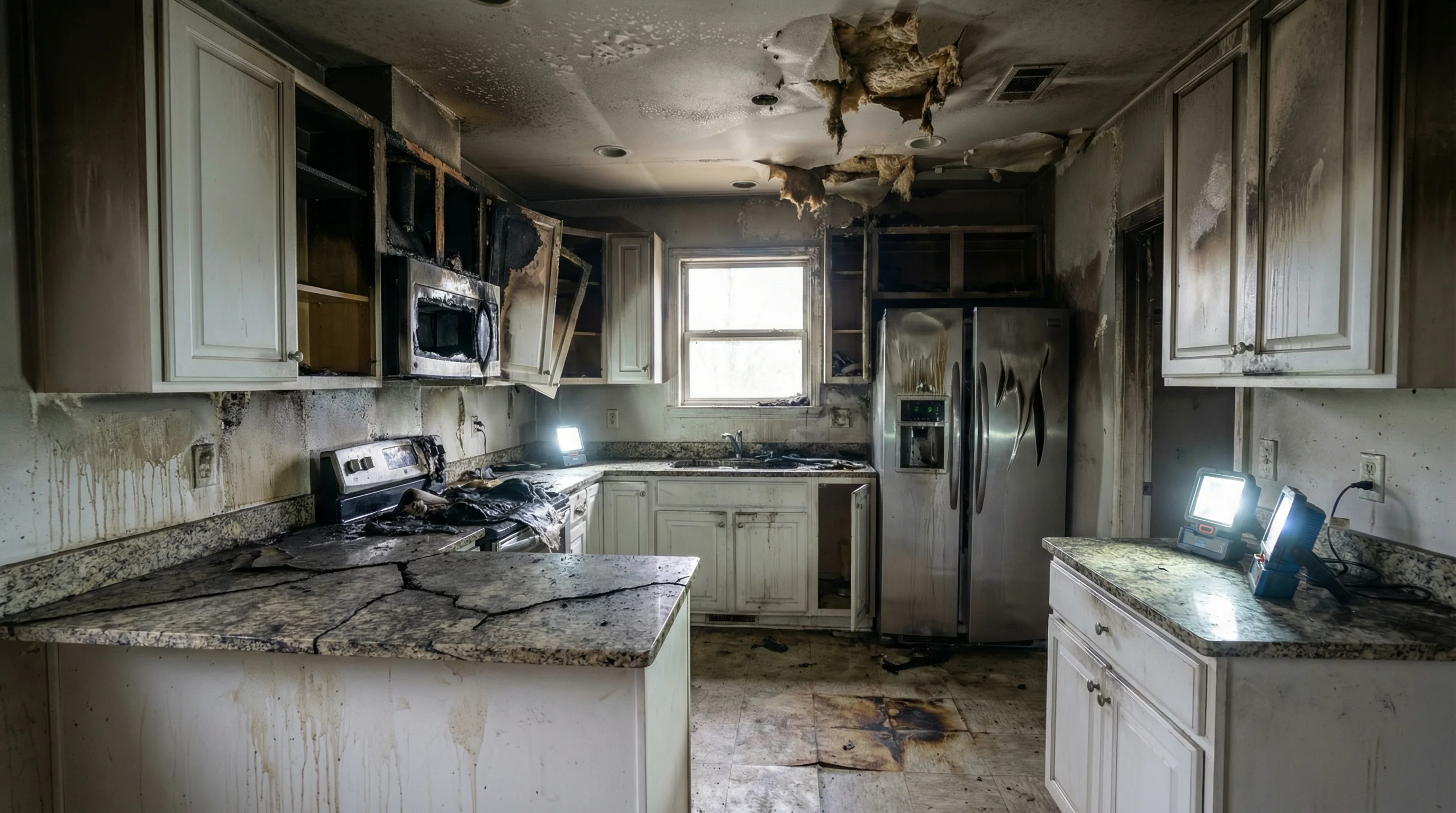
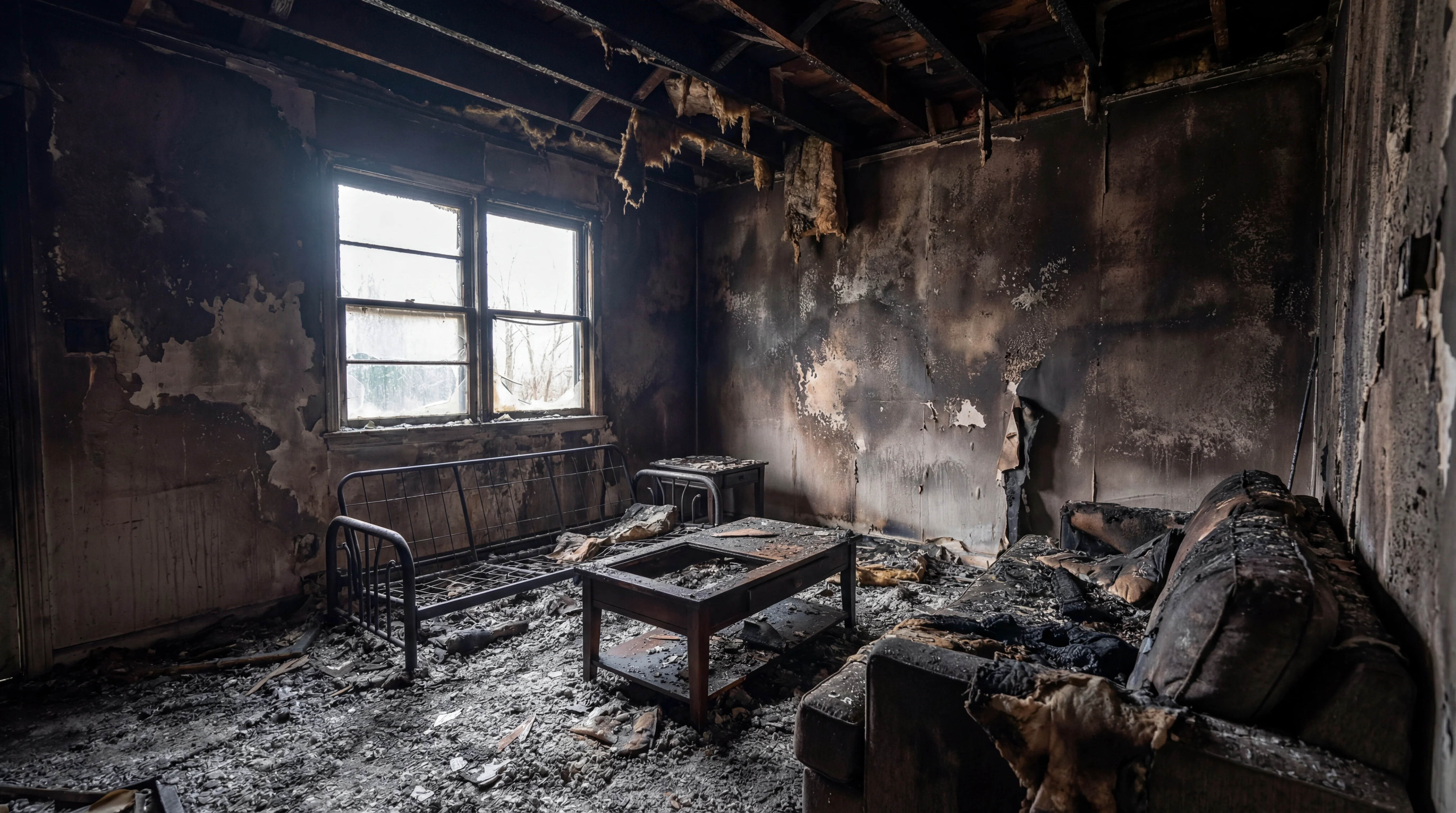
Severe direct flame damage in kitchen with charred cabinets and melted appliances

Direct Flame Damage

The most visible form of damage where flames directly contacted materials. Charred wood, melted plastics, and burned belongings often require removal and reconstruction.

Charred structural elements
Melted fixtures
Destroyed contents
Smoke and soot damage coating surfaces throughout residential home

Smoke & Soot Damage

Fire and smoke damage extends far beyond the burn area. Smoke particles travel through HVAC systems and penetrate porous materials throughout your home or business.

Discolored walls/ceilings
Coated surfaces
Contaminated air ducts
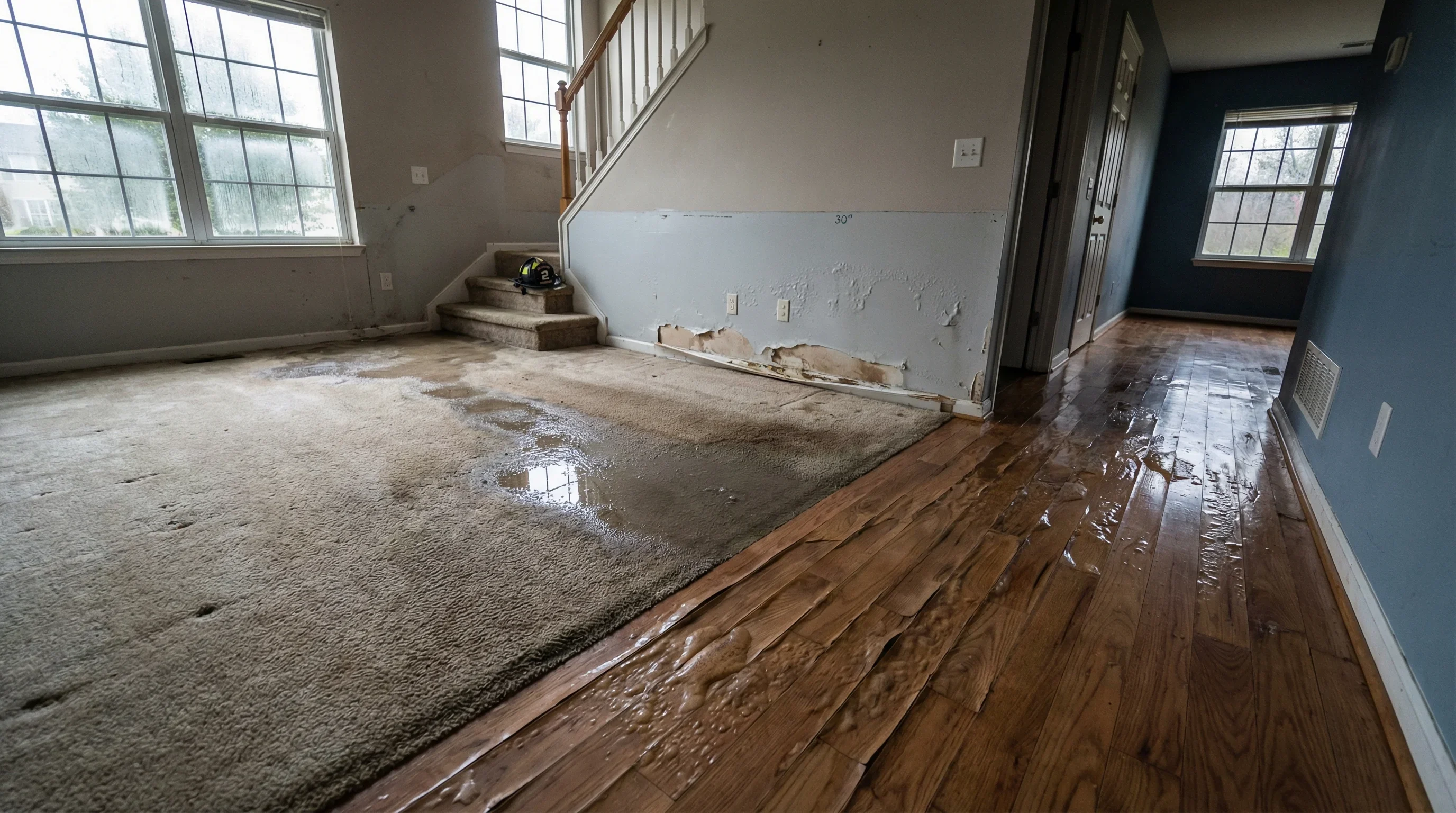
Water damage from firefighting efforts with saturated flooring and standing water

Water Damage from Firefighting

After fire departments extinguish the fire, water damage often causes more destruction than the flames. Gallons of water soak into floors, walls, and belongings.

Saturated flooring
Damaged drywall
Waterlogged contents

What Happens After Fire Departments Leave

1

Fire Departments Secure the Scene

After firefighters extinguish the fire, they ensure the structure is safe to enter. You may not be allowed back until the fire marshal clears the property.

2

Water Removal Begins

The water used to extinguish the fire must be extracted quickly to prevent mold growth and additional structural damage to your property.

3

Damage Assessment

Restoration professionals evaluate the extent of the damage to determine what can be cleaned and restored versus what needs replacement.

4

Prevent Further Damage

Board-up and tarping services protect your home or business from weather, vandalism, and additional deterioration while restoration work proceeds.

Structural Damage Needs Professional Assessment

Structural damage from fire can compromise the safety of your home or business. Our certified professionals assess load-bearing walls, roof integrity, and foundation stability before restoration work begins. For extensive structural repair, our reconstruction team handles everything from framing to finish work.

Professional Restoration

What Can Be Cleaned and Restored?

Many items you might assume are lost can actually be saved by restoration professionals. Understanding what can be restored helps property owners make informed decisions during the claims process.

Professional Assessment

Restoration professionals carefully evaluate every item and surface. The extent of the damage determines whether belongings can be cleaned and restored or need replacement.

Detailed inventory and documentation

Specialized Cleaning

Items that can be salvaged undergo specialized cleaning processes. Soot, smoke residue, and odors are removed using techniques not available to property owners.

Save up to 90% of contents

Quality Verification

Each restored item is inspected to ensure it meets pre-loss condition standards. Items that cannot be properly cleaned and restored are documented for insurance claims.

Insurance-ready documentation

Often Restorable

  • Furniture
  • Clothing
  • Electronics (case by case)
  • Documents
  • Photos
  • Artwork

Success depends on the extent of the damage and how quickly restoration professionals begin work.

Usually Needs Replacement

  • Food items
  • Medications
  • Cosmetics
  • Heavily charred materials
  • Melted plastics

Safety concerns and contamination typically make these items unrestorable.

Why Hire Restoration Professionals?

Professional restoration companies have specialized equipment, training, and experience that allow them to save items that would otherwise be discarded. This often results in significant savings compared to replacement costs.

IICRC Certified Technicians

Trained in the latest restoration techniques and safety protocols

Insurance Coordination

We work with your insurance company to document and maximize your claim

90%
of contents can be saved with quick response
Get Your Free Assessment

Free Self-Assessment

Assess Your Fire Damage Situation

Answer a few quick questions to understand the urgency of your situation. Every property owner deserves to know how to prevent further damage to their home or business.

Step 1 of 4 25% complete
Fire Source

What type of fire affected your property?

This self-assessment is for informational purposes only. A professional inspection by restoration professionals is the only way to accurately assess the extent of the damage.

In-Depth Guides

Explore Fire Restoration Topics

Each guide covers a specific aspect of fire and smoke damage restoration in detail. Find the information most relevant to your situation.

Smoke Damage Cleaning

Complete guide to smoke residue types, surface-specific cleaning techniques, and what to expect from professional soot removal.

Soot RemovalSurface CleaningSmoke Residue
Read Guide

Soot Removal

Dry chemical sponge, wet chemical cleaning, and dry-ice blasting. IICRC S700 certified protocols for every smoke category.

Chemical SpongeDry-Ice BlastingWet Smoke
Read Guide

Fire Board-Up Services

Emergency property securing after a fire—board-up, tarping, and vandalism prevention to protect your home or business.

Emergency Board-UpProperty SecurityDamage Prevention
Read Guide

Smoke Odor Removal

Deep dive into professional deodorization: thermal fogging, hydroxyl generators, ozone treatment, and HEPA air scrubbing.

Odor EliminationThermal FoggingAir Quality
Read Guide

Kitchen Fire Restoration

The most common residential fire type. Grease fire cleanup, appliance replacement, and complete kitchen rebuild guidance.

Grease FireKitchen RebuildAppliance Damage
Read Guide

Structural Fire Damage

Engineer-coordinated char depth assessment, load-bearing integrity, code-compliant rebuild. $15K-$200K+ typical scope.

Char DepthLoad-BearingEngineer-Certified
Read Guide

Contents Cleaning After Fire

Pack-out, ultrasonic cleaning, ozone chamber, climate-controlled storage. Save up to 90% of your belongings.

Pack-OutUltrasonicUp to 90% Salvage
Read Guide

HVAC Smoke Cleanup

NADCA-aligned duct cleaning, coil cleaning, and full system decontamination. Stops smoke recirculation whole-home.

NADCA ACRDuct CleaningCoil Cleaning
Read Guide

Commercial Fire Damage

Business-specific fire restoration including business interruption planning, compliance requirements, and large-loss coordination.

Business RestorationComplianceLarge Loss
Read Guide

Local Service Pages

Fire & Smoke Cleanup by City

Aventura, FL

Tier 4 · Local office

Belmont, NC

Tier 2 · Local office

Boca Raton, FL

Tier 1 · Local office

Boynton Beach, FL

Tier 1 · Local office

Charlotte, NC

Tier 1 · Local office

Clover, SC

Tier 2 · Local office

Coconut Creek, FL

Tier 2 · Local office

Concord, NC

Tier 1 · Local office

Coral Springs, FL

Tier 2 · Local office

Cornelius, NC

Tier 2 · Local office

Dania Beach, FL

Tier 4 · Local office

Davie, FL

Tier 4 · Local office

Deerfield Beach, FL

Tier 2 · Local office

Delray Beach, FL

Tier 1 · Local office

Fort Lauderdale, FL

Tier 1 · Local office

Fort Mill, SC

Tier 1 · Local office

Gastonia, NC

Tier 1 · Local office

Greensboro, NC

Tier 4 · Local office

Hallandale Beach, FL

Tier 4 · Local office

Hollywood, FL

Tier 2 · Local office

Huntersville, NC

Tier 2 · Local office

Indian Land, SC

Tier 2 · Local office

Indian Trail, NC

Tier 2 · Local office

Jupiter, FL

Tier 2 · Local office

Lake Worth Beach, FL

Tier 2 · Local office

Lauderhill, FL

Tier 4 · Local office

Lighthouse Point, FL

Tier 4 · Local office

Margate, FL

Tier 3 · Local office

Matthews, NC

Tier 1 · Local office

Miami, FL

Tier 2 · Local office

Miramar, FL

Tier 2 · Local office

Monroe, NC

Tier 2 · Local office

Mooresville, NC

Tier 2 · Local office

Mount Holly, NC

Tier 2 · Local office

Oakland Park, FL

Tier 3 · Local office

Orlando, FL

Tier 4 · Local office

Palm Beach Gardens, FL

Tier 2 · Local office

Parkland, FL

Tier 2 · Local office

Pembroke Pines, FL

Tier 2 · Local office

Plantation, FL

Tier 2 · Local office

Pompano Beach, FL

Tier 1 · Local office

Raleigh, NC

Tier 4 · Local office

Rock Hill, SC

Tier 1 · Local office

Shelby, NC

Tier 2 · Local office

Sunrise, FL

Tier 2 · Local office

Tamarac, FL

Tier 3 · Local office

Tega Cay, SC

Tier 2 · Local office

Waxhaw, NC

Tier 1 · Local office

West Palm Beach, FL

Tier 1 · Local office

Weston, FL

Tier 3 · Local office

York, SC

Tier 2 · Local office

Frequently Asked Questions

Expert answers about smoke cleanup, restoration, and the recovery process for your home or business.

FAQ Topics

2026 Cost & IICRC S700

Fire damage restoration typically costs $3,098 to $51,243 in 2026, with a national average around $27,091. Per-square-foot restoration scope runs $4 to $7 (avg ~$5.50), and labor accounts for 50-70% of the total. Minor smoke damage can be under $10,000, moderate room-level fires run $8,000-$25,000+, and major structural fires with full reconstruction start at $51,000 and often reach six figures. See our 2026 fire damage cost guide for line-item pricing and state-specific details.

Still have questions about 2026 cost & iicrc s700?

After Fire, Every Hour Matters. We're Ready 24/7.

Fire and smoke damage continues even after fire departments extinguish the fire. Soot residues cause ongoing damage to surfaces and belongings. Our restoration professionals respond immediately to prevent further damage.

24/7 Emergency Response

For your home or business

Smoke & Soot Removal

Professional cleanup of soot residues

Odor Elimination

Permanent removal, not masking

Repairs & Reconstruction

Complete structural restoration

Request Emergency Service

Need help right now? Call us.

24/7 live dispatch — average answer time under 30 seconds

(888) 245-5155