From electrical fires in Admirals Cove waterfront estates to kitchen fires in Abacoa townhomes, Jupiter's CBS stucco construction complicates smoke penetration into block cavities while Florida's humidity accelerates secondary damage. Palm Build responds from our Deerfield Beach hub with emergency board-up, structural assessment, and the documentation Jupiter's insurance carriers require.
Deerfield Beach — Rapid Response to Jupiter Under 60 min Response IICRC Certified
Why Fire & Smoke Damage in Jupiter Requires Specialist Response
Jupiter's CBS stucco construction, coastal humidity, salt air exposure, and high-value
housing stock create fire restoration challenges that generic contractors are not
equipped to handle. Every factor compounds the others — making speed and specialization
critical.
CBS Stucco Traps Smoke in Block Cavities
8-inchhollow block cores trap smoke
Jupiter's predominant CBS (concrete block and stucco) construction creates restoration challenges unique to South Florida. During a fire, smoke infiltrates hollow concrete block cores through electrical penetrations, plumbing chases, and micro-pores in the stucco finish. Once inside, smoke compounds become trapped — invisible from the surface but actively releasing odors for months. Standard drywall removal won't reach the contamination; CBS remediation requires injection techniques or partial block demolition.
Florida Humidity Accelerates Secondary Damage
24 hrsto mold growth from fire-suppression water
Fire-suppression water pooling on Jupiter's slab-on-grade floors creates an immediate mold risk in South Florida's 74% average humidity. The water seeps into CBS wall cavities, under baseboards, and into subfloor materials — and mold colonization begins within 24 hours on surfaces already weakened by heat and soot. Every fire restoration in Jupiter is simultaneously a water damage job, requiring extraction, dehumidification, and mold prevention protocols running in parallel with soot cleanup.
Salt Air Corrosion Weakens Electrical Systems
2-3xfaster electrical degradation vs. inland
Jupiter's coastal location exposes electrical infrastructure to constant salt air corrosion. Circuit breakers, outlet connections, wiring insulation, and panel bus bars degrade 2-3 times faster than inland properties. In waterfront communities like Admirals Cove and The Bluffs, this corrosion creates the conditions for arc faults and electrical fires. After a fire, every electrical component in the affected area must be inspected for both fire damage and pre-existing corrosion before energizing.
High-Value Finishes Require Careful Restoration
$500K+median home value in Jupiter
Jupiter's homes — from Admirals Cove's waterfront estates to Jupiter Country Club's luxury residences — contain premium finishes that demand specialized restoration techniques. Marble countertops etch from acidic soot within hours. Custom cabinetry absorbs smoke compounds into the grain. Impact-rated windows and hurricane-grade materials require manufacturer-specific cleaning protocols. Aggressive cleaning methods that work on builder-grade materials will destroy these finishes, turning a $20,000 cleaning job into a $60,000 replacement.
Neighborhood Fire Risk Profiles
Fire Risk by Jupiter Neighborhood
Every Jupiter neighborhood has its own fire risk profile based on construction era,
building type, and electrical infrastructure. Understanding which risks apply to your
property ensures our team arrives with the right equipment and restoration plan from
minute one.
Admirals Cove
High
1988-Present · Waterfront Gated Community
Complex electrical systems, salt air corrosion on waterfront homes
Luxury waterfront estates with extensive electrical systems powering dock lifts, pool/spa equipment, landscape lighting, and smart home automation. Salt air from the Intracoastal accelerates wiring corrosion. Homes averaging 4,000-8,000 sq ft with multiple AC zones create high electrical loads. Fire in these homes involves premium finishes — marble, custom millwork, impact glass — requiring specialized restoration protocols to avoid converting a cleaning job into a replacement job.
Jonathan's Landing
High
1986-2000s · Golf Community
Aging wiring from 1986 original construction, high electrical loads
Original 1986 electrical infrastructure now serves modern appliance loads far exceeding original design capacity. Many homes have added pool heaters, EV chargers, and home offices without full panel upgrades. The community's mix of single-family homes and attached villas means fire in a villa can spread smoke through shared wall cavities and HVAC plenums.
The Bluffs
High
1980s · Coastal CBS Homes
Older electrical panels, coastal salt exposure
1980s-era CBS construction with original electrical panels and wiring. Proximity to the Jupiter Inlet means elevated salt air exposure — accelerating corrosion on electrical connections, circuit breakers, and bus bars. Federal Pacific and Zinsco panels documented in some units. The older CBS construction with original stucco finishes creates maximum smoke penetration into block cavities during a fire event.
Jupiter Farms
Critical
1970s-Present · Large-Lot Rural/Residential
Brush fire risk, longer fire department response times
Jupiter Farms' 1.25-acre minimum lots border undeveloped scrubland and pine flatwoods — creating direct brush fire exposure during dry winter months. Fire department response times to western Jupiter Farms lots can exceed 8-10 minutes. Many properties have outbuildings, barns, and workshops with independent electrical systems. The rural character means some properties still have older well pumps and septic systems on the same circuits as modern AC and kitchen loads.
Abacoa
Moderate
2000s · New Urbanist Townhomes & Single-Family
Shared-wall fire spread in townhome sections
Abacoa's townhome sections share structural walls that allow fire and smoke migration between units. While newer construction with better electrical infrastructure, the higher-density layout means a kitchen fire in one unit sends smoke through shared attic spaces and wall cavities into adjacent homes. Single-family sections have modern wiring but open-concept floor plans that allow rapid smoke distribution throughout the entire home via HVAC.
Ocean Parks
High
1973-1985 · CBS Ranch & Two-Story Homes
Original 1970s-80s wiring, flat roof complications
Some of Jupiter's older residential construction with electrical systems designed for 1970s loads now serving modern demands. Flat roofs common in this era complicate fire-suppression water drainage — water pools on the roof and seeps through fire-damaged sections into ceiling cavities. CBS block construction with original stucco maximizes smoke retention in wall cavities.
Chasewood
High
1980s · Condo Community
Inter-unit fire migration through shared walls and HVAC
Multi-story condo construction where fire in one unit distributes smoke through shared HVAC plenums, elevator shafts, and stairwells to neighboring units. Older electrical risers serve units now drawing significantly more power than 1980s design loads. Restoration requires HOA coordination and multi-unit smoke remediation — a single kitchen fire can contaminate 4-8 adjacent units with smoke odor.
Jupiter Country Club
Moderate
2006-Present · Luxury Gated Golf Community
Complex home automation, high-value finishes at risk
Newer construction with modern electrical, but homes averaging 3,500-6,000 sq ft with smart home systems, pool automation, generator transfer switches, and extensive landscape lighting create complex electrical loads. The primary risk is kitchen fires from large entertaining kitchens. Premium finishes — imported stone, custom cabinetry, designer fixtures — require meticulous cleaning protocols. Aggressive restoration on these surfaces causes more damage than the fire itself.
Egret Landing
Low-Moderate
1990s-2000s · Family Community
Kitchen fires, holiday cooking incidents
Relatively newer CBS construction with adequate electrical infrastructure. Primary risks are cooking fires and appliance malfunctions — standard residential fire scenarios. CBS construction still means any fire creates the smoke-in-wall-cavity challenges specific to South Florida restoration. Open floor plans distribute smoke quickly through entire living spaces and into HVAC ductwork.
Our 7-Step Process
Our 7-Step Fire & Smoke Restoration Process
Fire restoration is the most complex restoration discipline — involving structural
damage, soot contamination, smoke odor, and water from fire suppression simultaneously.
Our process addresses all four damage types in a coordinated sequence optimized for
Jupiter's CBS construction.
01
Emergency Board-Up & Tarping
Hours 1-4
We secure your Jupiter home against weather, theft, and further damage within hours. This includes boarding windows, tarping damaged roof sections, and securing doors. In Jupiter's climate — where afternoon thunderstorms develop daily from May through October and salt air corrodes exposed structural members — an unsecured fire-damaged home sustains thousands in additional damage from every passing storm.
02
Comprehensive Damage Assessment
Days 1-2
Our IICRC-certified team documents every affected area with photos, video, thermal imaging, and moisture readings. We classify the fire type (protein, natural, synthetic), assess CBS structural integrity, identify smoke penetration pathways through block cavities and HVAC ductwork, and create a detailed scope of work. This documentation becomes the foundation of your insurance claim — formatted for South Florida adjusters.
03
Water Removal from Fire Suppression
Days 1-5
Fire-suppression water on Jupiter's slab-on-grade construction pools with nowhere to drain naturally. We extract standing water, inject moisture probes into CBS wall cavities, and deploy commercial dehumidifiers and air movers. In Jupiter's 74% humidity, this step prevents mold colonization on surfaces already weakened by heat — turning a fire restoration into a mold remediation if delayed beyond 24 hours.
04
Soot & Smoke Cleanup
Days 3-10
Professional soot removal matched to the specific soot chemistry. HEPA vacuuming lifts loose particulate, chemical sponges absorb embedded residue, and wet cleaning with specialized detergents addresses remaining contamination on stucco, tile, cabinetry, and structural surfaces. Jupiter's porous stucco finishes require careful technique — wrong products or pressure permanently set stains into the surface.
05
Odor Elimination
Days 5-14
Thermal fogging reaches smoke trapped in CBS block cavities. Ozone treatment handles sealed rooms at maximum concentration. Hydroxyl generators treat occupied areas safely. For Jupiter's concrete block construction, we use injection techniques to deliver deodorizing agents directly into hollow block cores — a step unnecessary in wood-frame homes but critical for complete smoke odor elimination in CBS buildings.
06
Contents Restoration
Days 3-21
Salvageable belongings are inventoried, packed out, and transported to specialized facilities for professional restoration. Electronics undergo ultrasonic cleaning, fabrics receive ozone treatment, documents are freeze-dried. Every item is documented for your insurance claim. Contents restoration typically saves 40-60% compared to full replacement — significant savings on Jupiter's high-value household contents.
07
Structural Reconstruction
Weeks 2-8+
Full reconstruction from CBS block and stucco repair through final paint and fixtures. Florida Building Code requires all reconstruction to meet current standards — meaning upgraded electrical, impact-rated windows, hurricane strapping, and current insulation requirements. We manage the full permitting and inspection process with Palm Beach County, turning reconstruction into an opportunity to modernize your Jupiter home's resilience.
CBS Construction Deep Dive
How Smoke Penetrates Jupiter's CBS Construction
Understanding smoke pathways in CBS (concrete block and stucco) homes explains why
Jupiter fire damage is more complex than wood-frame construction — and why restoration
companies without CBS experience leave behind hidden contamination that produces odors
for months after the job is "complete."
Through CBS Block Cavities
Jupiter's homes are built with 8-inch concrete masonry units (CMU) — hollow blocks with 2-3 open cores per block. During a fire, smoke under pressure infiltrates these cavities through electrical box penetrations, plumbing passes, and joints between blocks. The smoke fills the interconnected cavities vertically and horizontally, spreading far beyond the fire origin. Once inside, the smoke compounds condense on the cool interior surfaces of the block — creating a reservoir of odor-producing residue that is completely invisible from either side of the wall.
Restoration Challenge
Accessing contaminated block cores requires injection techniques through small drilled ports, or partial demolition of the stucco finish and block face. Neither is possible without specialized equipment and CBS construction experience.
Through Stucco Micro-Pores
Stucco — the exterior and often interior finish on Jupiter's CBS homes — is inherently porous. Smoke particulate (0.1 to 4 microns) penetrates the stucco surface through microscopic pores, capillaries, and hairline cracks that develop over years of Florida's thermal cycling. The porous nature of stucco means it absorbs smoke compounds like a sponge. Surface cleaning removes visible soot but leaves embedded smoke residue that continues off-gassing — especially in Jupiter's heat, which drives volatile compounds out of the stucco into indoor air.
Restoration Challenge
Stucco requires chemical neutralization treatments that penetrate the full depth of the finish coat without damaging the texture or bond to the block substrate. Pressure washing drives contaminants deeper.
Through HVAC Ductwork
Every Jupiter home runs central AC year-round. When a fire occurs, the return air system — operating on a thermostat cycle — pulls smoke particles into the air handler and distributes them through ductwork to every room in the home. Within a single cooling cycle, soot and smoke compounds coat the interior of every duct run, the evaporator coil, the blower assembly, and every supply register. Rooms on the opposite side of the house from the fire receive a steady stream of smoke contamination.
Restoration Challenge
Complete HVAC decontamination requires duct cleaning, coil cleaning, blower disassembly, and filter system replacement. If the system runs before professional cleaning, it redistributes contaminants with every cycle.
Through Plumbing & Electrical Chases
CBS construction uses vertical and horizontal chases — channels cut or formed in the block walls — to route plumbing pipes and electrical conduit. These chases act as highways for smoke, allowing it to travel between floors and rooms through pathways that are completely hidden from view. In two-story Jupiter homes, smoke from a first-floor kitchen fire travels up plumbing chases into second-floor bathrooms and bedrooms without any visible path of contamination.
Restoration Challenge
Chase-transported smoke contamination appears in rooms with no logical connection to the fire origin. Identifying and treating these hidden pathways requires thermal imaging, smoke detection instruments, and CBS construction knowledge.
Why This Matters for Jupiter Homeowners
In wood-frame construction, smoke damage is largely visible — you can open walls, clean
surfaces, and verify completeness. In Jupiter's CBS construction, the majority of smoke
contamination is hidden inside block cavities, absorbed into stucco pores, and trapped
in utility chases. A restoration company that treats a CBS home like a wood-frame home
will clean visible surfaces and declare the job complete — leaving behind the 60-70% of
smoke contamination that is embedded in the concrete block assembly itself.
Jupiter Pricing
Fire Damage Restoration Costs in Jupiter, FL
Fire restoration in Jupiter runs higher than national averages due to CBS construction
complexity, Florida Building Code upgrade requirements, and Palm Beach County's elevated
material and labor costs. Concrete block demolition and stucco repair cost significantly
more than standard drywall replacement. The good news: fire is one of the most
comprehensively covered perils under Florida homeowners insurance.
Minor Kitchen Fire (Contained)
Soot cleanup, odor elimination, minor CBS repair
$5,000 – $15,000
Contained cooking fires with smoke and soot damage limited to the kitchen and adjacent rooms. Includes HEPA vacuuming, chemical sponge cleaning, thermal fogging for CBS cavities, HVAC cleaning, and minor surface repair.
Single-Room Fire
Structural repair, CBS wall remediation, full room restoration
$15,000 – $45,000
Fire damage to one room with smoke spread to additional areas. Includes CBS block cavity treatment, stucco repair or replacement, electrical re-routing, odor elimination, and full room reconstruction to Florida Building Code.
Multi-Room Structural Fire
Major reconstruction, roof/truss work, full-home restoration
$45,000 – $150,000+
Significant structural damage across multiple rooms. CBS block demolition and reconstruction, roof truss replacement, full electrical and plumbing re-routing, whole-home odor elimination, and complete reconstruction to current Florida Building Code standards.
Smoke contamination without direct fire damage — common when a neighboring unit or nearby brush fire sends smoke through the home. Cost depends on how far smoke traveled through HVAC ductwork and how deeply it penetrated CBS wall cavities and stucco surfaces.
CBS Demolition Complexity
Unlike wood-frame homes where drywall removal is straightforward, CBS construction
requires cutting and removing concrete block — a slower, more labor-intensive process that
generates significant debris and dust. Stucco repair must match existing textures and
requires proper curing time in Jupiter's humidity. These CBS-specific factors add 15-25%
to reconstruction costs compared to equivalent wood-frame projects.
Insurance Coverage
Fire Insurance Claims in Jupiter: What's Covered
Fire is one of the most comprehensively covered perils under Florida homeowners
insurance. Unlike water or mold damage — which face significant coverage restrictions in
Florida — fire claims under a standard HO-3 policy rarely face disputes. Jupiter
homeowners pay $4,500 to $9,000 annually for coverage that absolutely includes fire
damage.
Dwelling Coverage (Coverage A)
Covers structural repair and reconstruction of your Jupiter home to pre-loss condition — including CBS block, stucco, roofing, electrical, plumbing, and all interior finishes damaged by fire.
Contents Coverage (Coverage C)
Covers personal property damaged or destroyed by fire and smoke — furniture, electronics, clothing, appliances. Replacement cost vs. actual cash value depends on your policy endorsements.
Additional Living Expenses (Coverage D)
Covers temporary housing, meals, and additional costs while your Jupiter home is uninhabitable during restoration. ALE coverage continues until restoration is complete or the policy limit is reached.
Soot & Smoke Cleanup
Professional soot removal, smoke odor elimination, HVAC decontamination, and CBS wall cavity treatment are all covered under standard fire damage claims.
Water Damage from Fire Suppression
Water extraction, structural drying, and mold prevention from fire-fighting water are covered as part of the fire loss — not subject to separate water damage limitations.
Debris Removal
Removal and disposal of fire-damaged materials, including CBS block, stucco, roofing materials, and hazardous debris. Typically covered up to an additional percentage of your dwelling coverage.
Code Upgrade Coverage (Ordinance & Law)
Florida Building Code requires reconstruction to meet current standards. With an ordinance-and-law endorsement, the cost of required upgrades — impact windows, hurricane strapping, modern electrical — is covered beyond your base dwelling limit.
Florida Claim Deadlines & Documentation
Notify your insurer:Immediately (within 24-48 hours)
File proof of loss:As required by your policy (typically 60 days)
Document all damage before cleanup:Before any cleanup begins — photos, video, inventory
Keep receipts for all expenses:Ongoing — temporary housing, meals, emergency purchases
Palm Build Manages Your Fire Claim
We work directly with your insurance adjuster from the first inspection. Our fire damage
documentation — structural assessments, soot type classification, moisture readings, photo
evidence, and itemized scopes of work — is formatted exactly how South Florida adjusters
and Palm Beach County carriers expect to receive it. With Florida's complex insurance
landscape and frequent carrier changes, having a restoration company that understands
FL-specific documentation gets your claim approved faster.
Fire risk in Jupiter follows predictable seasonal patterns tied to cooking habits,
electrical loads, dry season conditions, and storm activity. Understanding these cycles
helps with prevention — and explains why Palm Build maintains 24/7 emergency readiness
year-round.
Holiday Cooking Fires
November – January
Highest Risk
Cooking fires spike during the holiday season as Jupiter's population surges with seasonal residents returning to waterfront homes. More deep-frying turkeys outdoors near lanai screens, more cooking in unfamiliar kitchens, and more candle use throughout the home. Kitchen fires in CBS homes send smoke through open-concept floor plans into HVAC ductwork, contaminating the entire home within a single AC cycle. Thanksgiving through New Year's accounts for approximately 30% of Jupiter's annual residential cooking fire calls.
Summer AC Overload & Electrical Failures
June – September
High Risk
Jupiter's summer heat pushes AC systems to continuous operation — some running 18-20 hours per day. Older electrical panels in neighborhoods like Jonathan's Landing and The Bluffs were never designed for this sustained load. Compressors, capacitors, and contactors fail under heat stress. Combined with pool pumps, irrigation timers, and EV chargers all running simultaneously, summer creates peak electrical fire risk in Jupiter's older communities.
Brush Fires Near Jupiter Farms
December – May (Dry Season)
Moderate-High Risk
Florida's dry season reduces moisture in the pine flatwoods and scrubland surrounding Jupiter Farms and western Jupiter. Brush fires — whether from lightning, equipment, or human causes — threaten properties on 1.25-acre lots that border undeveloped land. Embers from brush fires travel hundreds of yards and ignite roof materials, landscaping mulch, and outbuildings. Even homes not directly burned receive heavy smoke contamination that penetrates CBS walls and coats every surface.
Lightning Strike Fires
June – September (Storm Season)
Moderate Risk
South Florida averages 80-100 lightning days per year — more than any other region in the United States. Lightning strikes to Jupiter homes can ignite attic insulation, damage electrical panels, and start fires in roof structures. CBS construction means the fire may smolder in the attic or within block cavities before detection, allowing smoke to permeate the entire wall assembly. Lightning-caused fires also create unique insurance documentation requirements — the strike itself is a covered peril, but documentation of the origination point is critical.
Our Work
Jupiter Fire Restoration: The Process in Action
From emergency assessment through complete restoration — see how Palm Build handles fire
and smoke damage in Jupiter's CBS construction homes.
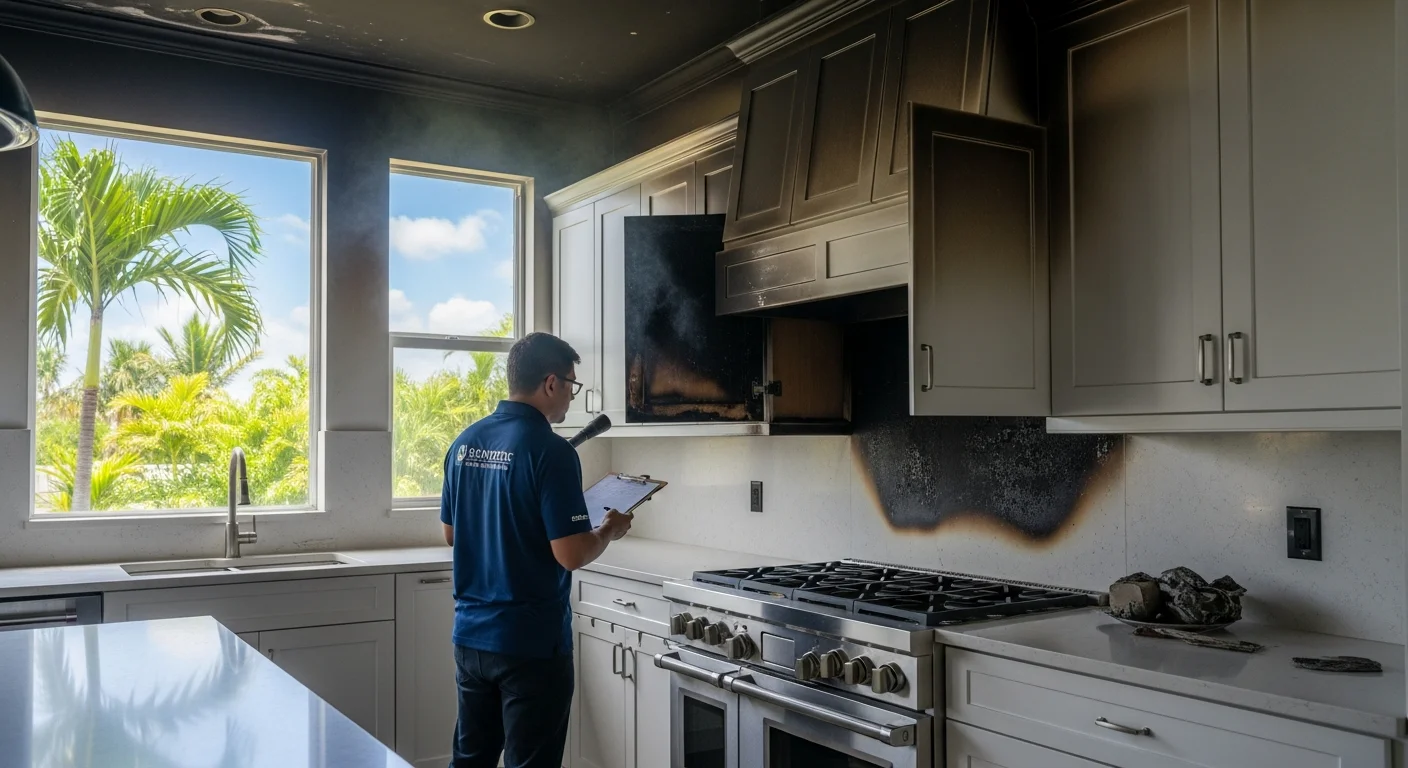
Emergency fire damage assessment — soot and smoke contamination covering CBS stucco walls and ceiling surfaces
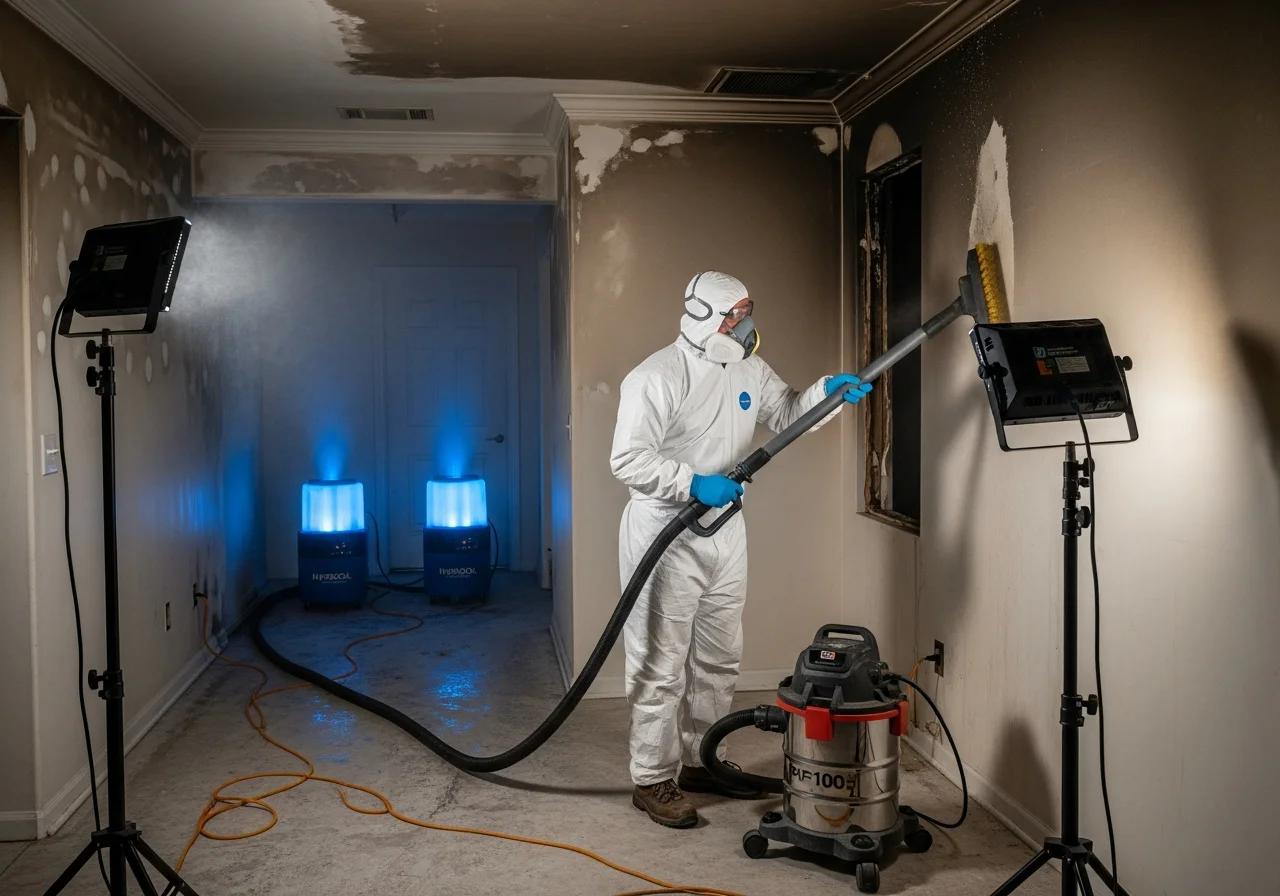
Professional soot removal using HEPA vacuums and chemical sponges on porous stucco surfaces
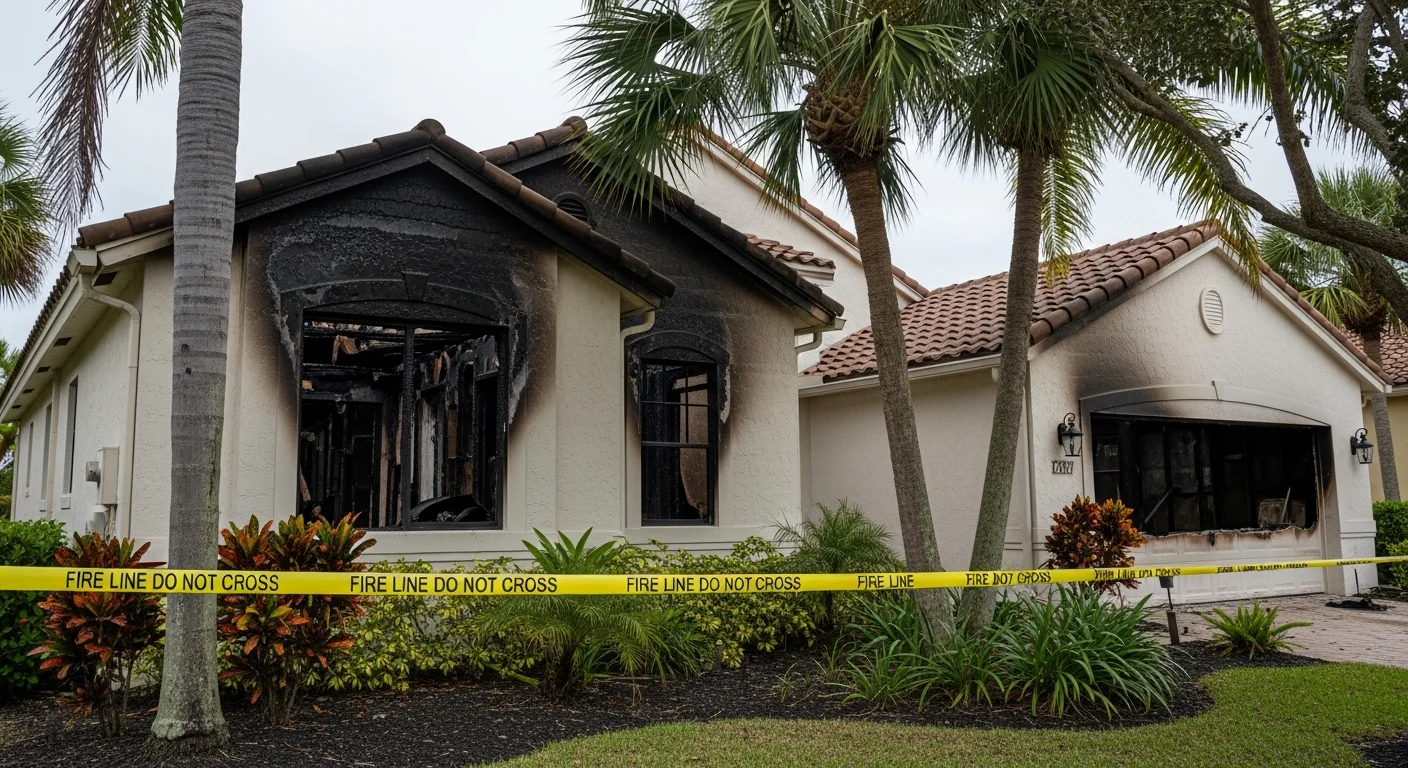
Exterior fire damage requiring CBS block assessment, stucco repair, and Florida Building Code reconstruction
The Palm Build Difference
Why Jupiter Homeowners Choose Palm Build After a Fire
Deerfield Beach Hub — Under 60 Min to Jupiter
Our South Florida operations hub at 786 S Military Trail in Deerfield Beach puts us on any Jupiter address in under 60 minutes via I-95. Emergency board-up, tarping, and soot stabilization begin the same night — not the next business day.
IICRC Fire & Smoke Certified
Every crew lead holds current IICRC Fire and Smoke Restoration Technician (FSRT) certification. We follow the S540 standard for professional fire and smoke damage restoration — the certification that insurance adjusters verify before approving restoration scopes.
CBS Construction Specialists
We understand how smoke travels through CBS block cavities, how soot bonds to porous stucco, and how to remediate concrete block walls without unnecessary demolition. This CBS expertise is critical in Jupiter — where nearly every home uses this construction method. Generic contractors from outside South Florida treat CBS homes like wood-frame homes and miss 60-70% of hidden contamination.
Florida Insurance Documentation Experts
Our fire damage documentation — structural assessments, soot classification, moisture readings, thermal imaging, and itemized scopes — is formatted exactly how South Florida adjusters and Palm Beach County carriers expect. With Florida's complex and shifting insurance landscape, proper documentation gets claims approved weeks faster.
Full Reconstruction to Florida Building Code
From emergency board-up through final inspection, we handle the entire project. Florida Building Code requires all reconstruction to meet current standards — impact windows, hurricane strapping, updated electrical, current insulation. We manage permitting and inspections with Palm Beach County, turning a fire loss into a home improvement.
24/7 Emergency Dispatch — No Answering Service
Fire damage does not wait for business hours. Our emergency line connects you directly to a project manager who can authorize crew dispatch immediately — not an answering service that takes a message. Crews are on the road within 15 minutes of your call, arriving in Jupiter with board-up materials and soot stabilization equipment loaded.
Common Questions
Jupiter Fire & Smoke Damage FAQ
How quickly can Palm Build respond to fire damage in Jupiter?
Palm Build dispatches from our Deerfield Beach operations hub and reaches any Jupiter address — from Admirals Cove to Jupiter Farms — in under 60 minutes. Our emergency crews travel I-95 northbound with board-up materials, tarps, and soot stabilization equipment loaded. In South Florida's climate, fire-suppression water begins feeding mold growth within 24 hours and humidity accelerates soot corrosion by the hour, so we prioritize same-night response to stop all damage clocks simultaneously.
Why does CBS stucco construction make Jupiter fire damage more complex?
Jupiter's predominant CBS (concrete block and stucco) construction creates a unique restoration challenge. During a fire, smoke infiltrates the hollow cores of concrete block walls through electrical penetrations, plumbing chases, and stucco micro-pores — then becomes trapped inside the wall cavities. This smoke is invisible from the surface but continues releasing odor compounds for months. Unlike wood-frame homes where drywall removal exposes the affected area, CBS remediation requires specialized injection techniques, thermal fogging into block cores, or partial demolition to access contaminated cavities.
How long does smoke odor elimination take in a Jupiter home?
Smoke odor elimination in Jupiter's CBS homes typically takes 5 to 14 days depending on the fire severity and how deeply smoke penetrated wall cavities. We use a three-method approach: thermal fogging to reach CBS block cores, ozone treatment for sealed rooms, and hydroxyl generation for occupied areas. Florida's 74% average humidity makes smoke odor molecules bind more aggressively to porous stucco and concrete surfaces, often requiring multiple treatment cycles. Kitchen protein fires are the fastest to treat (5-7 days); synthetic material fires with soot in HVAC ductwork take the longest.
How do I file a fire damage insurance claim in Florida?
Contact your insurance carrier immediately and document everything with photos and video before cleanup begins. Florida law requires prompt notice of loss. Fire is one of the most comprehensively covered perils under standard HO-3 policies — coverage includes structural repair, contents replacement, smoke and soot cleanup, and Additional Living Expenses (ALE) for temporary housing. Palm Build manages the documentation process from day one, providing the detailed damage assessments, soot classification reports, moisture readings, and itemized scopes of work that South Florida adjusters require for approval.
What does fire damage restoration cost in Jupiter, FL?
Fire restoration costs in Jupiter range from $5,000-$15,000 for a contained kitchen fire (soot cleanup, odor elimination, minor repairs) to $45,000-$150,000+ for multi-room structural fires requiring CBS wall reconstruction. Smoke-only damage without structural fire typically runs $3,000-$25,000 depending on how far smoke traveled through the HVAC system. Jupiter's CBS construction adds complexity — concrete block demolition and stucco repair cost more than standard drywall replacement. Florida Building Code also requires any reconstruction to meet current standards, which may add scope for electrical, impact windows, and hurricane strapping.
When is it safe to return home after a fire in Jupiter?
Do not re-enter your Jupiter home until the fire department issues a written clearance confirming structural safety. Even after clearance, fire-damaged homes contain invisible hazards: toxic soot particles (especially from burned synthetics), carbon monoxide residue, compromised electrical systems, and weakened structural members in CBS construction. Palm Build performs air quality testing and structural assessments before recommending re-occupancy. For homes with heavy smoke damage, we typically recommend staying out until soot cleaning and odor treatment are complete — usually 7 to 14 days for a single-room fire.
Are older Jupiter homes at higher risk for electrical fires?
Yes. Jupiter neighborhoods built in the 1970s and 1980s — including Jonathan's Landing (1986), The Bluffs (1980s), and Ocean Parks (1973-1985) — have electrical systems designed for era-appropriate loads. Decades of added circuits for pool pumps, AC upgrades, EV chargers, and modern appliances create overload conditions on panels never designed for today's demand. Salt air corrosion from Jupiter's coastal location accelerates degradation of connections, breakers, and wiring insulation. Federal Pacific and Zinsco panels found in many of these homes have documented failure rates and are a leading cause of residential electrical fires.
Can fire-damaged personal belongings be restored?
Many personal belongings can be professionally restored after fire and smoke damage, saving significant replacement costs. Electronics, furniture, artwork, clothing, and documents each require different restoration techniques — ultrasonic cleaning for hard goods, ozone treatment for fabrics, freeze-drying for documents. Palm Build coordinates contents pack-out, inventorying every item for your insurance claim and transporting salvageable items to specialized restoration facilities. Items that cannot be restored are documented for replacement-value claims. Contents restoration typically saves insurance carriers 40-60% compared to full replacement.
Trusted Vendors
Trusted local pros in Jupiter
Outside our restoration scope, these are the vetted, licensed contractors we trust
alongside our work. Personally evaluated, reference-checked, and recommended by Palm
Build.
Florida's humidity accelerates soot corrosion and smoke penetration by the hour. Palm Build's Deerfield Beach team responds to Jupiter in under 60 minutes with emergency board-up, soot stabilization, and insurance documentation from the first call.