Water Damage Restoration in Concord, North Carolina
From Christenbury basements to Beverly Hills crawl spaces, Palm Build's Charlotte-based team responds in 30-45 minutes with truck-mounted extraction, structural drying, and insurance-ready documentation across Cabarrus County.
20 miles — Charlotte, NC 30-45 min Response IICRC Certified
Concord has more than doubled in population since 2000 — but the city's explosive growth
sits on a foundation of Piedmont clay, aging crawl spaces, and persistent humidity that
makes water damage an inevitability. When a burst pipe floods your Christenbury Hall
basement or a summer storm overwhelms your Beverly Hills crawl space, mold can begin growing in 24 to 48 hours.
Piedmont Cecil Clay Soil
6-15 cm/hr
Clay infiltration rate
Concord sits atop Cecil series clay — iron-rich, deep red, and nearly impermeable. Infiltration rates of just 6-15 cm/hour mean a 3-inch rainfall generates far more foundation pressure than the same event on sandy coastal soil. Water pools against your foundation for days.
Vented Crawl Space Foundations
80%+ RH
Vented crawl space humidity
The majority of pre-2005 Concord homes sit on vented crawl spaces — the highest-risk foundation type. Advanced Energy research found vented crawl spaces in NC exceed 80% relative humidity in spring and summer, while sealed crawl spaces stay below 65%.
Five-Month Humidity Window
5 months
Continuous mold-risk window
Outdoor dew points exceed 65°F from late May through early October. Warm air entering a crawl space 10-15°F cooler causes immediate condensation on framing and ductwork — no rainfall needed. Mold risk is continuous, not episodic.
Two-Era Housing Risk
25-45 yrs
Dominant housing age
Concord's 1980s-1990s homes have failing polybutylene pipes, degraded vapor barriers, and composition board subfloors that swell irreversibly when wet. Meanwhile, Christenbury-era luxury homes ($500K-$2M+) carry HVAC and basement flood risk.
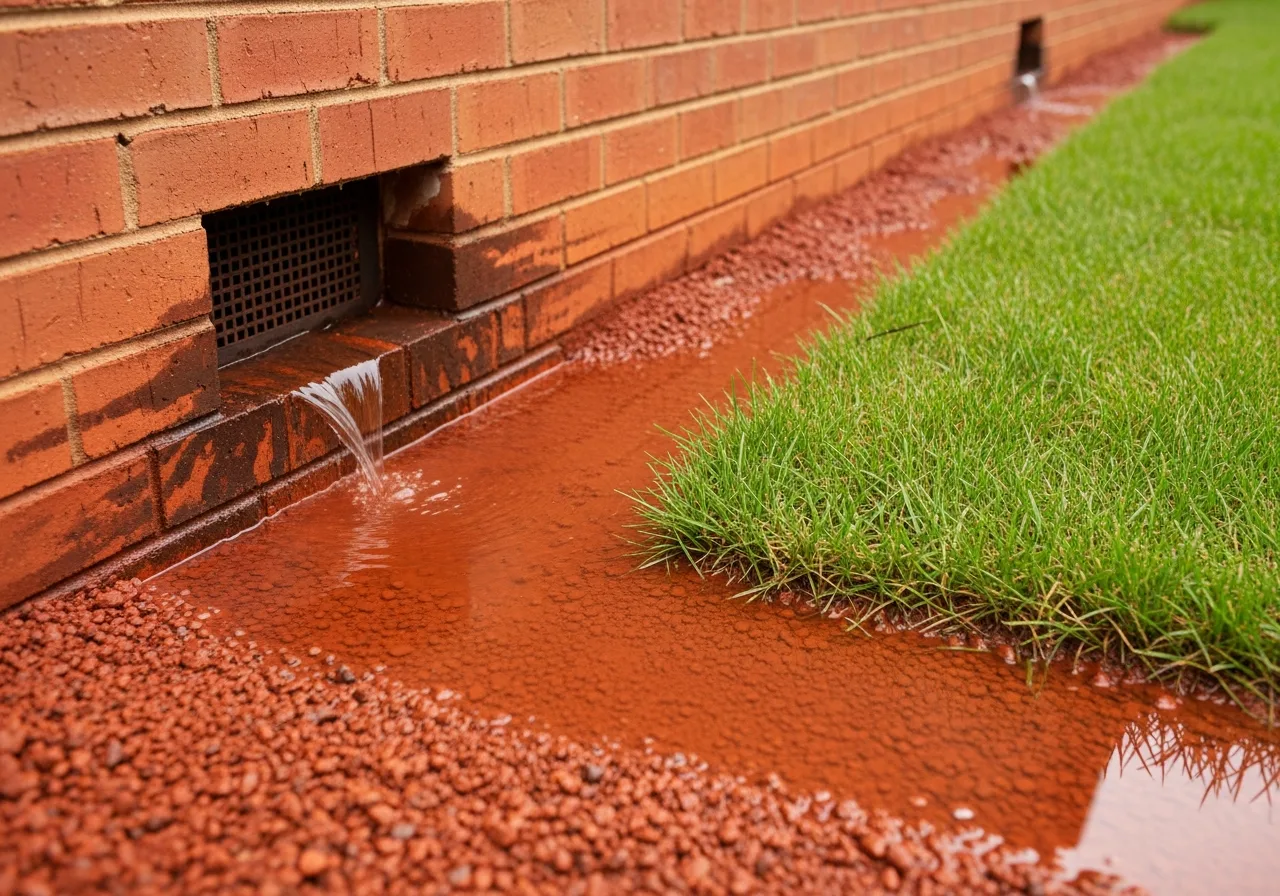
Concord's red clay soil holds water against foundations for days after rainfall, feeding
moisture into crawl spaces through foundation vents — the root cause of most water
damage in Cabarrus County.
Neighborhood-Level Intelligence
Concord Neighborhood Water Damage Risk Profiles
Water damage in Concord follows predictable patterns based on housing age, construction
type, and proximity to the five waterways that bisect the city. Here's what we see in
the neighborhoods where we work most frequently.
North & South Union Historic Districts
Critical
Built: 1880s-1930s
Foundation: Crawl space / pier
Primary risk: Aging plumbing, wood rot, foundation water infiltration
Common damage: Cast-iron drain line failure, pier foundation shifting, crawl space flooding through deteriorated vents
Beverly Hills
High Risk
Built: 1950s-1970s
Foundation: Crawl space
Primary risk: Burst pipes in freeze-thaw, crawl space mold, drainage failures
Common damage: Galvanized pipe bursts, vented crawl space moisture exceeding 80% RH, subfloor rot
Logan / West Concord
High Risk
Built: 1940s-1970s
Foundation: Crawl space
Primary risk: Rocky River / Three Mile Branch flood proximity, aging infrastructure
Common damage: Flash flood intrusion, crawl space standing water after storms, deteriorated vapor barriers
Oak Park / Sheffield Manor
Moderate
Built: 1985-2000
Foundation: Crawl space
Primary risk: Crawl space moisture surge, degraded vapor barriers
Common damage: Polybutylene plumbing failure, crawl space condensation, mold on floor joists
Castlebrooke / Laurel Park
Moderate
Built: 1990s-2005
Foundation: Crawl / slab mix
Primary risk: Water intrusion through aging flashing, crawl space condensation
Common damage: Window and roof flashing leaks, HVAC duct condensation in crawl spaces
Common damage: Condensation from attic HVAC units, slab moisture wicking, engineered floor buckling
Christenbury Chase / Mews
Moderate
Built: 2007-2015
Foundation: Crawl / slab
Primary risk: High-value water damage, complex multi-story drying
Common damage: Multi-level water migration, premium finish damage, extended drying timelines
Christenbury Hall / Glen
High Risk
Built: 2009-2018
Foundation: Basement
Primary risk: Basement flooding in storms, premium restoration requirements
Common damage: Finished basement flooding, sump pump failure, high-value contents damage in $500K-$2M+ homes
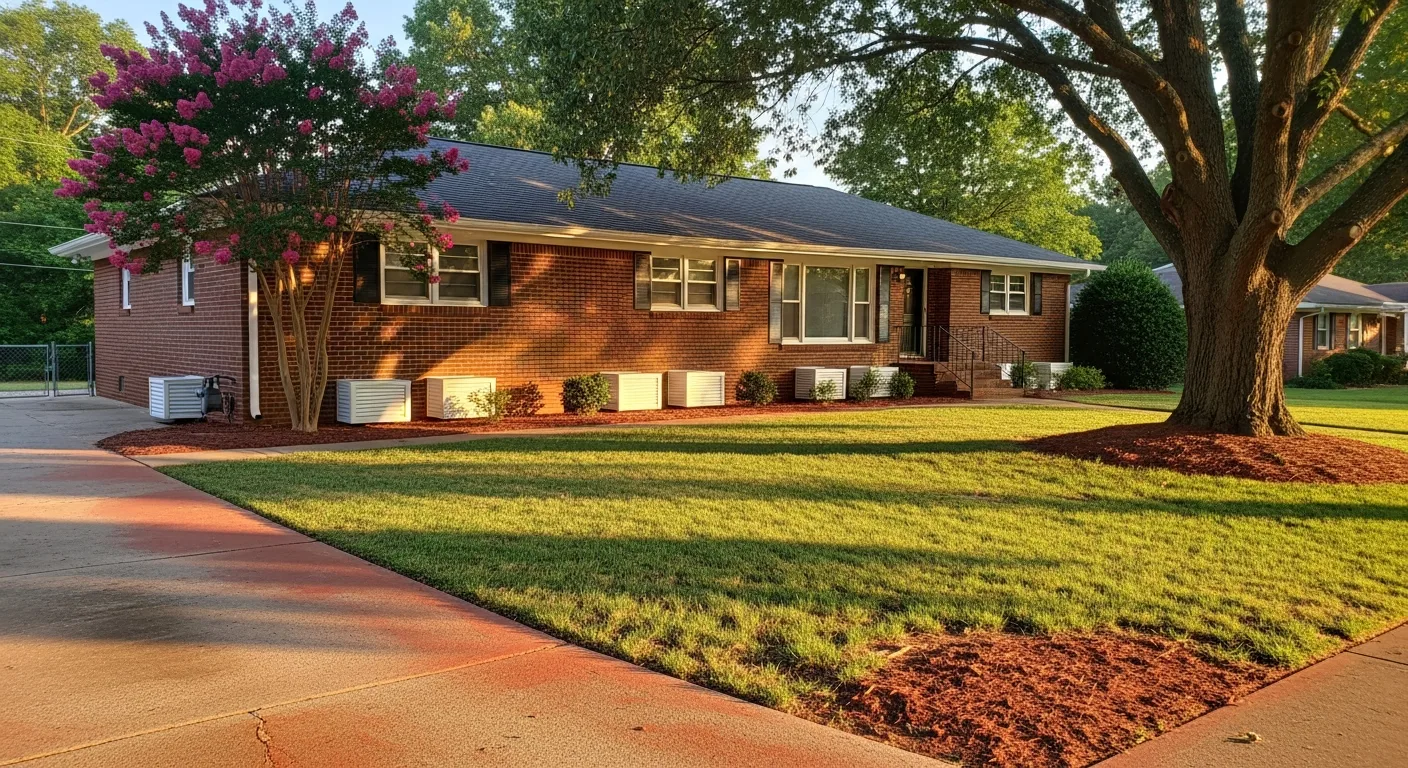
The brick ranch homes of Beverly Hills and Oak Park neighborhoods sit on vented crawl
spaces — the highest-risk foundation type for water and mold damage in Concord.
Neighborhood-Level Intelligence
Concord Damage Risk Navigator
Water damage in Concord follows predictable patterns tied to housing era, foundation
type, and proximity to waterways. Identify your risk zone to understand what your home
faces — and what Palm Build will prioritize when we arrive.
Historic Core
Highest Risk
ZIP: 28025Era: Pre-1970
The oldest homes in Concord — pier-and-beam, crawl space foundations on ungraded clay. Galvanized and cast-iron plumbing, no vapor barriers, and decades of deferred drainage improvements. Highest per-capita water damage claim rate in Cabarrus County.
Mid-Century Suburban
High Risk
ZIP: 28025Era: 1970s-1990s
Brick ranch homes dominate this era — vented crawl spaces, polybutylene supply lines, and composition board subfloors. Crawl space mold is the dominant damage type, driven by Cecil clay saturation and inadequate vapor barriers.
Turn-of-Century Suburban
Moderate Risk
ZIP: 28025 / 28027Era: 1990s-2005
Mixed foundation types — slab, crawl space, and some basement construction. Better materials than earlier eras, but HVAC condensation and water heater failures in interior closets create hidden leak risks. Winding Walk and Skybrook subdivisions fall here.
Modern Luxury
Lower Frequency
ZIP: 28027Era: 2005-Present
Christenbury corridor and newer luxury developments. High-value homes ($500K-$2M+) with modern construction but lower damage frequency. When losses do occur, the dollar-per-incident cost is significantly higher due to premium finishes, engineered hardwoods, and custom cabinetry.
Flood Corridor
Critical Risk
ZIP: AllEra: Any
Properties within 0.5 miles of Rocky River, Coddle Creek, or Irish Buffalo Creek. These waterways rise rapidly after sustained rainfall on Piedmont clay. Flood insurance is essential — many of these properties sit outside FEMA Special Flood Hazard Areas but experience recurring flood events.
Not Sure Which Zone You're In?
Call us at (704) 464-0121 and give us your address. We'll tell you your risk profile, foundation type, and what to watch
for — no obligation. We've inspected hundreds of Concord homes and know the damage patterns
in every neighborhood.
Our Concord Process
How We Restore Concord Homes After Water Damage
Every water damage event is different, but the science of restoration follows a proven
sequence. Here's exactly what happens when you call Palm Build for a Concord water
emergency.
01
Emergency Dispatch
30-45 Minutes
02
Damage Assessment
First 2 Hours
03
Water Extraction
Hours 2-6
04
Structural Drying
3-5 Days
05
Mold Prevention
During Drying
06
Full Restoration
1-4 Weeks
01
Emergency Dispatch
30-45 Minutes
Call our North Carolina line at (704) 464-0121 any time, day or night. Our dispatcher sends a crew from our Charlotte operations hub to Concord with truck-mounted extraction equipment, commercial dehumidifiers, and air movers.
02
Damage Assessment
First 2 Hours
IICRC-certified technicians use infrared thermal imaging and pin-type moisture meters to map exactly where water has traveled — behind walls, under flooring, into crawl spaces. This documentation becomes the foundation of your insurance claim.
03
Water Extraction
Hours 2-6
Truck-mounted extractors remove standing water at rates exceeding 25 gallons per minute. For Concord crawl spaces, we deploy submersible pumps and specialized low-profile extractors designed for confined spaces over clay soil.
04
Structural Drying
3-5 Days
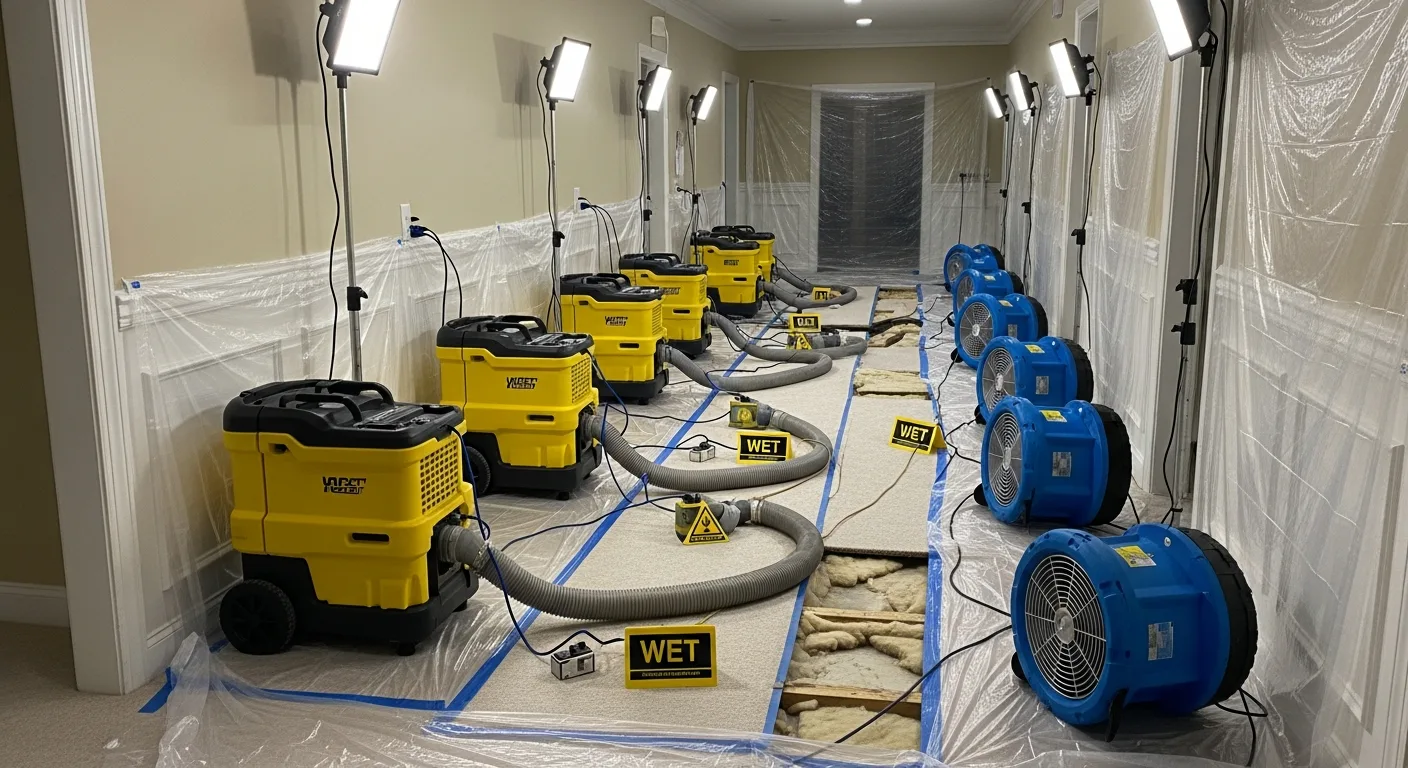
Commercial LGR dehumidifiers and high-velocity air movers create a controlled drying environment. We monitor moisture readings daily with data loggers. Concord's clay soil means crawl space drying takes longer than coastal properties — we plan for that.
05
Mold Prevention
During Drying
EPA-registered antimicrobial treatments are applied during drying. Concord's humidity and crawl space prevalence make mold colonization almost inevitable without intervention — every water restoration includes antimicrobial treatment of affected framing and subfloor.
06
Full Restoration
1-4 Weeks
Drywall, flooring, baseboard, trim, painting, and structural work. All repairs are fully permitted through Cabarrus County Construction Standards Division, with zoning review by the City of Concord.
Why Our Concord Process Works
1
Local Knowledge
We know Concord's clay soil, crawl spaces, and five flood corridors
2
Speed
30-45 minute response from our Charlotte operations hub
3
Scientific Drying
Daily moisture readings until every material reaches dry standard
4
Insurance-Ready
Documentation formatted for your adjuster from day one
These ranges reflect real-world project costs in the Concord and Cabarrus County area —
not national averages. Concord's prevalence of crawl space construction, clay soil
moisture retention, and the mix of 1950s-2010s housing stock all affect the final
number.
Water damage in Concord follows seasonal patterns driven by Piedmont weather, clay soil
behavior, and housing stock vulnerabilities. Understanding this calendar helps you catch
problems early.
January - February
Pipe Freeze Season
January lows average 29°F. Older homes with uninsulated crawl space pipes are most vulnerable. Polybutylene and galvanized lines in 1980s-1990s homes fail first. Beverly Hills and Oak Park brick ranches with exposed crawl space plumbing are highest risk.
March - May
Crawl Space Moisture Surge
Warm humid air enters cold crawl spaces, driving condensation on cool surfaces. Spring rainfall saturates clay soil. Vented crawl spaces exceed 80% relative humidity. Mold colonization accelerates on floor joists and subfloor throughout older Concord neighborhoods.
May - August
Severe Thunderstorm Season
Charlotte metro averages 50+ severe thunderstorm events annually. Summer convective storms produce localized flooding across Cabarrus County. Flash flood risk peaks along Rocky River and Coddle Creek corridors, threatening Logan, West Concord, and properties near Poplar Tent Road.
August - October
Tropical Storm Remnants
Tropical Storm Debby (August 2024) and Hurricane Helene (September 2024) both impacted Cabarrus County. Rocky River rose approximately 25 feet in downstream reaches during Debby. This is the peak window for catastrophic flooding along all five of Concord's waterway corridors.
November - December
Pre-Winter Transition & Fire Risk
Heating season begins with increased fire risk from furnaces and space heaters. Temperature cycling stresses aging plumbing. Last opportunity for crawl space inspection before winter seals moisture in. Fire suppression water damage peaks during the holidays.
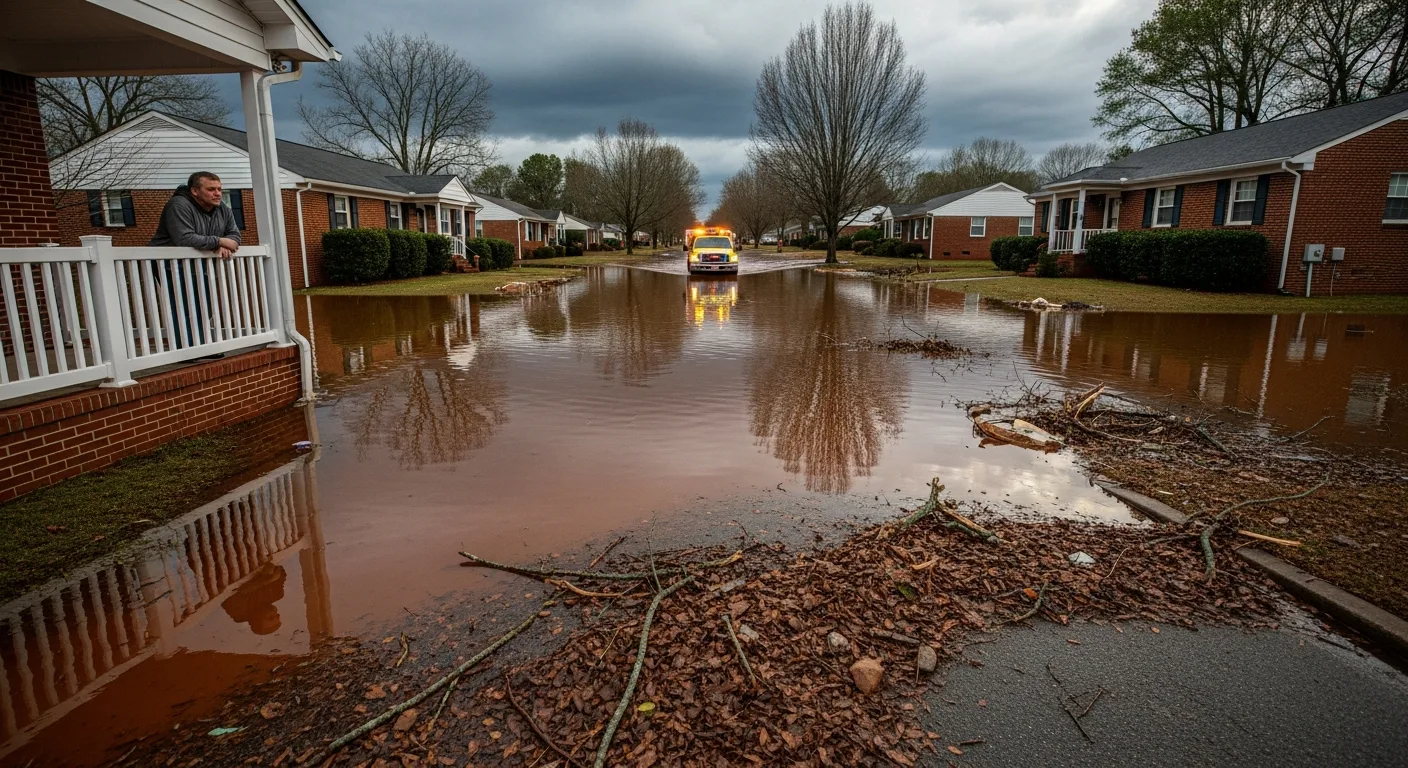
After heavy rainfall, Concord's impermeable clay soil and strained stormwater
infrastructure can cause street-level flooding that pushes water against foundations.
Concord's Hidden Flood Risk
Rocky River and Concord's Five Flood Corridors
Concord sits in the Pee Dee River Basin and is bisected by five waterways that create
distinct flood corridors across the city. Approximately 9.6% of Concord's 64.7 square
miles lies within FEMA Special Flood Hazard Areas — and FEMA records show four
structures with repetitive flood loss claims.
Homes within half a mile of these corridors — particularly along the Rocky River near
Poplar Tent Road, Weddington Road, and the Odell area — carry the highest structural
flood risk in Cabarrus County.
Rocky River
Largest waterway — flows through western Concord. Rose approximately 25 feet during Tropical Storm Debby (August 2024). Properties along Poplar Tent Road and Weddington Road carry highest risk.
Coddle Creek
Fed by Lake Howell, drains the western third of Concord. Flash flood potential during heavy rainfall events when lake levels are already elevated.
Irish Buffalo Creek
Runs through the Kannapolis-to-Southeast-Concord corridor. Industrial and residential development along the floodplain increases runoff volume.
Cold Water Creek
Eastern edge of the city. Less developed corridor, but clay soil saturation creates rapid runoff during multi-day rain events.
Three Mile Branch
Runs through central Concord near Logan and West Concord. Proximity to older housing stock with vented crawl spaces compounds flood damage risk.
Flood Insurance Gap in Concord
Standard HO-3 homeowners policies exclude flood damage entirely. Many Concord
homeowners near Rocky River, Coddle Creek, or Three Mile Branch assume storm-related
water intrusion is covered and are surprised at claim time. If you're in or near a
flood zone, separate NFIP or private flood insurance is essential.
Key Flood Statistics
Rocky River rose ~25 feet during Tropical Storm Debby (Aug 2024)
9.6% of Concord (64.7 sq mi) in FEMA Special Flood Hazard Areas
4 repetitive flood loss structures recorded by FEMA
What You Should Do
Review your FEMA flood zone designation at msc.fema.gov
Consider private flood insurance even outside mapped flood zones
Document pre-storm property condition for faster claims
Have a restoration company on call before storm season
Insurance Navigation
Insurance Claims for Water Damage in Concord
Concord homeowners pay $2,045 to $2,435 per year for homeowners insurance —
significantly below the NC statewide average of $3,025. Understanding what your policy
covers can mean the difference between a fully covered restoration and tens of thousands
out of pocket.
$2,045-$2,435
Avg annual premium
$5K-$10K
Typical mold sublimit
5 Carriers
Common in Cabarrus County
State FarmTravelersSafecoNC Farm BureauAllstate
Coverage Gaps Every Concord Homeowner Should Know
Sudden and accidental discharge (burst pipe, appliance failure, supply line rupture)
Wind-driven rain entering through storm-damaged roof or siding
Flood damage is excluded from standard HO-3 policies — requires separate NFIP or private flood coverage
Sewer and drain backup is excluded unless you add an endorsement ($40-$100/year)
Mold coverage is sublimited to $5,000-$10,000 — far below full crawl space remediation costs
Gradual damage (slow leaks, rising damp) is typically excluded — document the triggering event
Matching and cosmetic coverage (replacing undamaged materials to match) is not guaranteed in NC
Palm Build Handles the Documentation
We work directly with your insurance adjuster from the first inspection. Our moisture
maps, thermal images, daily drying logs, and photo documentation are formatted for the
adjuster workflow — reducing delays and disputes. Concord homeowners never navigate the
claims process alone.
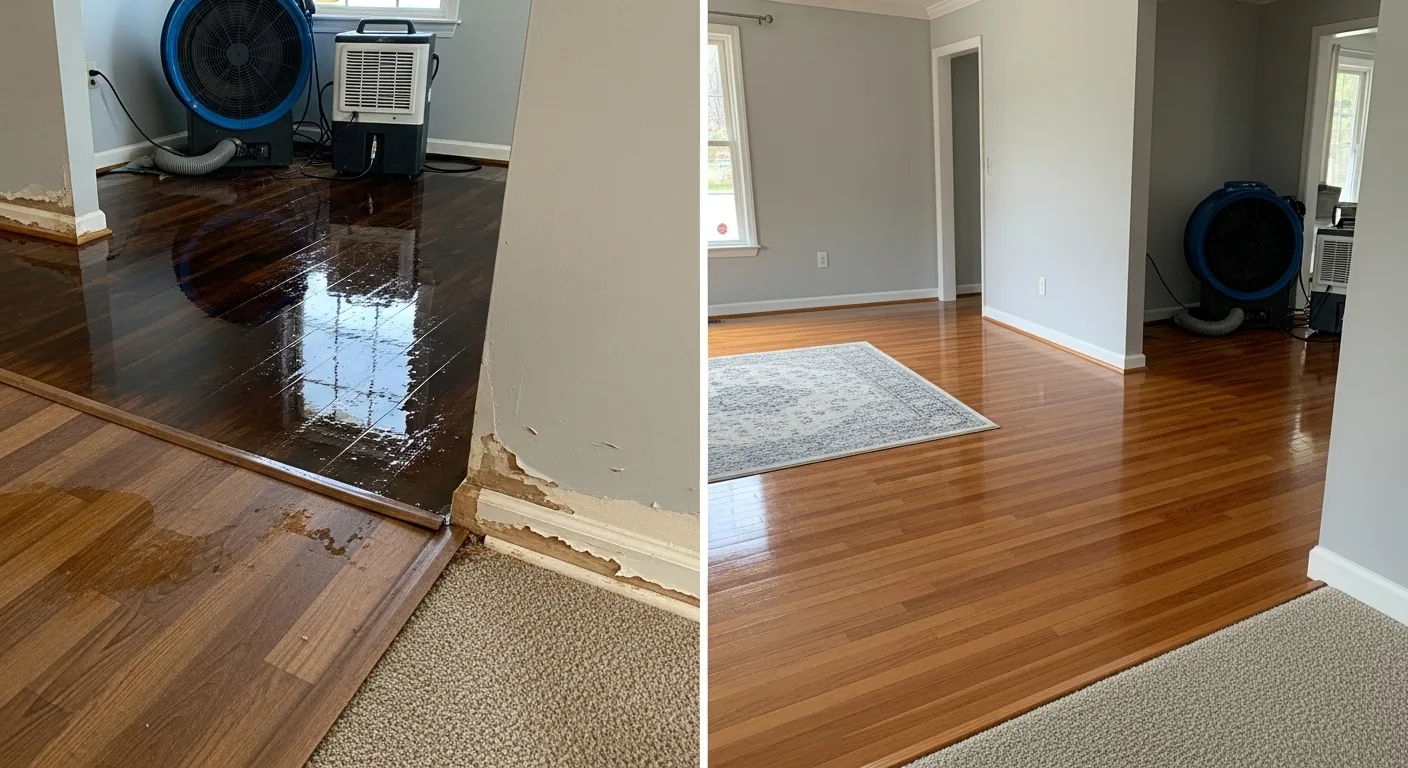
Living room restoration: from standing water to restored hardwood in a Concord brick ranch
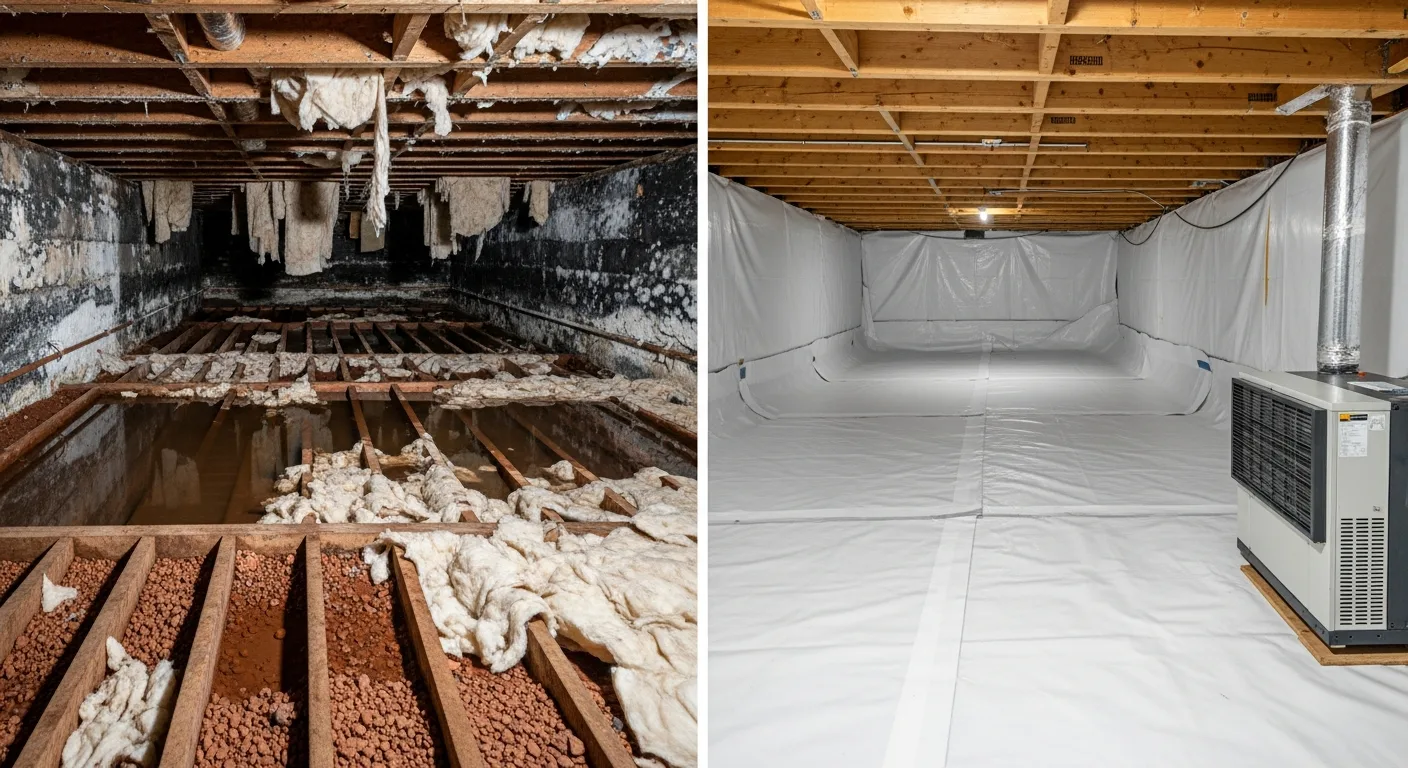
Crawl space remediation: from active mold on bare clay to sealed, encapsulated, and dehumidified
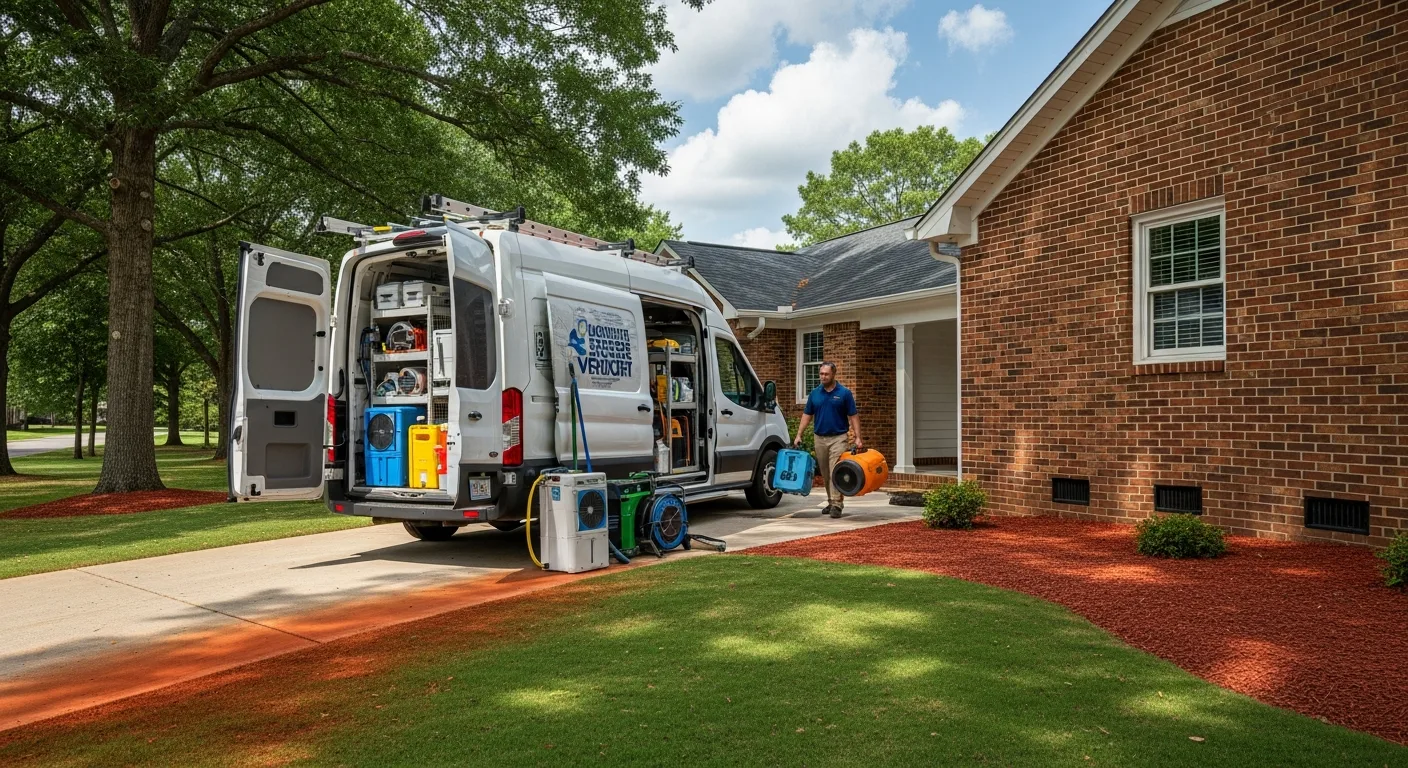
Palm Build's fully equipped response van on-site in a Concord neighborhood
Our Charlotte-area team — IICRC certified and ready for Concord water emergencies
What We See Most
Common Types of Water Damage in Concord Homes
Burst Pipes
Poly and galvanized plumbing failures in 1980s-90s homes are the leading emergency call in Concord. January-February freeze events cause supply line bursts that can flood an entire floor in under an hour.
Crawl Space Flooding
Cecil clay soil saturation drives water through foundation vents across the Rocky River corridor. Standing water in vented crawl spaces leads to joist rot, mold colonization, and subfloor failure.
Appliance Failures
Water heaters, washing machines, and dishwashers — common failure points in aging 1990s kitchens. Many Concord homes have water heaters in crawl spaces without drain pans, allowing undetected leaks.
Storm Water Intrusion
Roof leaks from hail and wind damage, window seal failures during severe thunderstorms. Concord averages 43+ inches of rain annually, with intense summer storms capable of 2-3 inches per hour.
HVAC Condensation
Crawl space duct sweating and attic unit condensate overflow are chronic issues in Skybrook, Winding Walk, and other post-2000 subdivisions where HVAC systems run 8+ months per year.
Sewer Backup
Aging clay-tile sewer lines in pre-1990 neighborhoods are vulnerable to tree root infiltration and collapse. A single backup can contaminate an entire floor with Category 3 black water.
The Palm Build Difference
Why Concord Homeowners Choose Palm Build
National franchises fill the Concord market by volume. But none of them understand Cecil
clay drainage, Rocky River flood patterns, or the polybutylene plumbing epidemic in
Cabarrus County's 1980s-90s housing stock. We do.
1
30-45 Minute Response
From our Charlotte hub to any Concord address in 30-45 minutes. Faster than franchise call centers that route through national dispatch, we deploy directly from our local operations base.
2
IICRC-Certified Technicians
Every crew lead holds current IICRC Water Restoration Technician (WRT) and Applied Structural Drying (ASD) certifications. Real credentials that franchise operations in Concord cannot match with locally hired content.
3
Insurance-First Documentation
Our moisture mapping, thermal imaging, daily drying logs, and photo documentation use the same classification system your insurance adjuster relies on. No translation needed — your claim moves faster.
4
Crawl Space Specialists
We understand Cecil clay behavior, vented vs. encapsulated crawl space dynamics, and the unique Piedmont moisture patterns that drive 60% of Concord water damage claims. This is our backyard.
5
Fully Permitted Reconstruction
We handle Cabarrus County Construction Standards and City of Concord Planning permits in-house. From emergency mitigation through final rebuild, one company manages the entire project.
Our Charlotte-area team responds to Concord water emergencies within 30-45 minutes —
fully equipped and IICRC certified.
Common Questions
Concord Water Damage FAQ
How fast can Palm Build respond to a water emergency in Concord?
Our Charlotte-based team typically arrives in Concord within 30 to 45 minutes from our Crompton Street operations hub — about 20 miles. We dispatch 24/7/365. Call (704) 464-0121 any time.
Does insurance cover water damage in Concord homes?
Standard homeowners insurance (HO-3) typically covers sudden and accidental water damage like burst pipes or appliance failures. It does not cover flood damage from rising water, gradual leaks, or long-term moisture problems. Mold coverage is usually sublimited to $5,000-$10,000 on NC policies. Concord homeowners near Rocky River or Coddle Creek should carry separate flood insurance.
How long does water damage restoration take in Concord?
Structural drying typically takes 3 to 5 days — sometimes longer for Concord crawl spaces due to clay soil moisture retention. Full restoration including reconstruction usually takes 2 to 6 weeks for a typical residential project.
What makes Concord water damage different from other cities?
Concord's Cecil series Piedmont clay soil drains at only 6-15 cm/hour, keeping water against foundations far longer than sandy coastal soils. The dominant 1980s-1990s housing stock sits on vented crawl spaces that trap moisture. Add five waterway flood corridors (Rocky River, Coddle Creek, Irish Buffalo Creek, Cold Water Creek, Three Mile Branch) and you have a unique risk profile no other city in the metro matches.
Should I worry about mold after water damage in Concord?
Absolutely. Advanced Energy research on NC crawl spaces found vented crawl spaces in the Southeast regularly exceed 80% relative humidity in spring and summer — well above the 60% threshold for mold colonization. After any water event in a Concord home, mold prevention treatment is essential within 24-48 hours.
How much does water damage restoration cost in Concord?
Standard water damage restoration in Concord typically ranges from $3,000 to $12,000. Projects involving crawl space remediation or mold treatment range from $15,000 to $40,000. Basement flooding in Christenbury-area homes can reach $20,000-$65,000 due to the scale and value of affected finishes.
Do I need flood insurance in Concord?
If your property is in a FEMA Special Flood Hazard Area (9.6% of Concord's land area), flood insurance is required by most mortgage lenders. Even outside the SFHA, properties near Rocky River, Coddle Creek, or Three Mile Branch should consider private flood coverage. Standard homeowners policies exclude all flood damage.
What areas of Concord does Palm Build serve?
We serve all of Concord and Cabarrus County including Christenbury, Beverly Hills, Logan, West Concord, Skybrook, Winding Walk, Cannon Crossing, Oak Park, Sheffield Manor, Castlebrooke, Laurel Park, Moss Creek, the Historic Districts, and surrounding areas including Kannapolis, Harrisburg, and Midland. Both 28025 and 28027 zip codes.
Water Damage in Concord? We're Already on the Way.
Palm Build's Charlotte-area team responds to Concord in 30-45 minutes with truck-mounted extraction, commercial drying equipment, and insurance-ready documentation. Call our local line now — we answer 24/7.