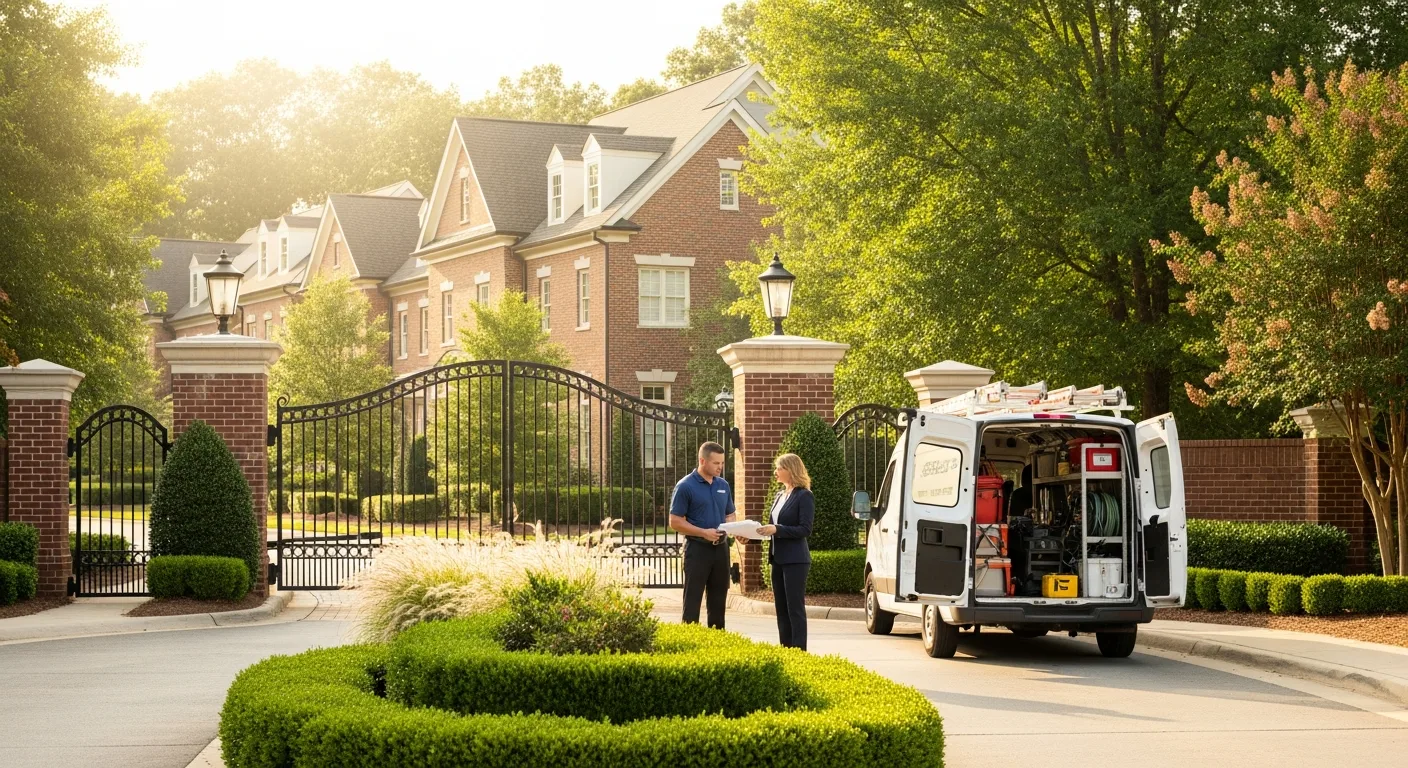
HOA Restoration Services in Concord, North Carolina
From Christenbury Hall's luxury estates to Cornerstone Condos' shared-wall units, Palm Build navigates the complexities of HOA-governed restoration in Concord — contractor approval processes, shared-wall moisture assessments, master policy coordination, and the documentation every board and property manager requires.
20 miles — Charlotte, NC 30-45 min Response IICRC Certified
Why Concord HOA Properties Need Specialized Restoration
Concord's rapid growth has created a dense network of HOA-governed communities —
from Christenbury Hall's gated estates to Edison Square's townhomes. Each community
has unique access requirements, architectural standards, insurance structures, and
shared-system complexities that standard residential contractors are not equipped to
navigate.
Gated Communities
$1M+
Estate home values
Christenbury Hall anchors Concord's gated community market with estate homes exceeding $1 million. Gated communities require pre-approved contractor access, architectural review board compliance for exterior restoration, and coordination with community management companies. Restoration crews need gate codes, approved vehicle lists, and work-hour compliance that standard contractors often fail to navigate — delaying emergency response when hours matter most.
Master-Planned HOA Communities
5+
Major master-planned HOAs
Christenbury Village, Skybrook North, Winding Walk, Cannon Crossing, and Carriage Downs represent Concord's largest master-planned communities — each with active HOA boards, architectural review committees, and community standards that govern exterior appearance, contractor access, and work schedules. Water damage from shared irrigation systems, storm damage affecting multiple homes simultaneously, and common-area responsibility splits create restoration complexity unique to these communities.
Condos & Townhome Communities
6+
Condo/townhome communities
Cornerstone, Riverbend, Ridgeview, Oakleaf, Kenton Glenn, and Edison Square represent Concord's attached-housing market where shared walls, shared plumbing risers, and master policy insurance create restoration scenarios that are fundamentally different from single-family work. Water from a burst pipe in one unit migrates through shared walls and floor systems into adjacent units — requiring multi-unit scoping, separate insurance claims, and coordinated restoration timelines.
Concord HOA Growth
2x
Population growth since 2000
Concord has more than doubled in population since 2000, and the majority of new residential construction has been HOA-governed. This means a growing percentage of Concord homeowners navigate restoration through HOA processes they may not fully understand — board notification requirements, architectural review for exterior work, master policy vs. individual policy coverage splits, and shared-system responsibilities that affect who pays for what.
Palm Build provides HOA-compliant restoration across Concord's gated communities,
master-planned neighborhoods, and attached-housing associations.
5+ master-planned communities with active HOA boards
6+ condo/townhome communities with shared-wall construction
Master policy vs. HO-6 coverage splits vary by community
Cabarrus County permits required for structural restoration
Concord HOA Communities
Concord HOA Communities We Serve
From gated Christenbury Hall estates to Edison Square townhomes, each Concord HOA
community has unique access requirements, architectural standards, and restoration
dynamics. Here are the communities where Palm Build has direct experience.
Christenbury Hall
$700K - $1.5M+
Gated estates
Guard-gated estate community with architectural review board. Pre-approved contractor access required. High-value contents and custom finishes demand premium restoration techniques.
Common issues: Basement flooding, premium finish damage, architectural review required
Christenbury Village
$350K - $600K
Master-planned single-family
Active HOA with architectural standards for exterior restoration. Community-wide storm events may require coordinated multi-home response.
Common issues: Storm damage, crawl space moisture, HOA exterior standards
Skybrook North
$400K - $700K
Master-planned single-family
Newer construction with slab foundations and engineered materials. HVAC-related moisture and storm damage are the most common restoration triggers.
Common issues: HVAC condensation, storm damage, engineered wood flooring
Winding Walk
$350K - $550K
Master-planned single-family
Community-wide drainage considerations. HOA board notification required before exterior work. Crawl space construction in older sections.
Common issues: Crawl space moisture, stormwater drainage, mold risk
Cornerstone
$200K - $350K
Condos / Townhomes
Attached construction requires shared-wall moisture assessment. Master policy and individual HO-6 coordination for every claim.
Common issues: Shared-wall water migration, master policy claims, multi-unit coordination
Riverbend
$180K - $320K
Condos / Townhomes
Multi-story attached units with shared plumbing. A burst pipe in one unit can affect 2-4 adjacent units through shared walls and floor systems.
Common issues: Plumbing riser failures, shared HVAC, water migration between units
Kenton Glenn
$220K - $380K
Condos / Townhomes
Newer townhome construction with shared drainage systems. HOA manages exterior and roof, owner responsible for interior finishes.
Common issues: HVAC condensation, shared drainage, exterior storm damage
Edison Square
$250K - $400K
Condos / Townhomes
Dense attached housing where single water events frequently affect multiple units. Master policy deductible sharing creates financial complexity.
Common issues: Multi-unit water events, shared wall assessment, condo association coordination
HOA Restoration Process
How We Handle HOA Restoration in Concord
HOA restoration is not just fixing damage — it is navigating board approvals,
architectural standards, shared-wall assessments, and insurance structures that standard
contractors overlook. Here is exactly how we manage the process.
01
HOA Board Notification
Immediate
We notify the HOA board or community management company within hours of engagement. For gated communities like Christenbury Hall, we coordinate gate access, approved vehicle registration, and work-hour compliance before crews arrive. Concord HOA boards need to know what happened, what work is planned, and how it will affect the community — we provide this communication on your behalf.
02
Pre-Work Approval & Access
Day 1-2
Architectural review boards in communities like Christenbury Village and Skybrook North require pre-approval for exterior work. We submit scope of work documentation, material specifications, and contractor insurance certificates to the board before beginning any visible exterior restoration. For emergency mitigation, we begin interior work immediately while exterior approvals process in parallel.
03
Contractor Insurance Certificates
Day 1
Every Concord HOA requires proof of contractor insurance before work begins. We provide certificates of insurance listing the HOA as additional insured, including general liability, workers compensation, and commercial auto coverage. These documents are submitted to the community management company and are on file before any crew enters the property.
04
Shared-Wall Assessment
Days 1-3
For condo and townhome communities — Cornerstone, Riverbend, Kenton Glenn, Edison Square — we assess both the affected unit and adjacent units sharing walls, floors, or ceilings. Moisture meters and thermal imaging identify water migration through shared assemblies that the visible damage does not reveal. This step prevents callbacks and secondary damage claims from neighbors.
05
Timeline Guarantees & Completion
Project Duration
HOA boards and community managers need predictable timelines — not open-ended "we'll see how it goes" estimates. We provide written timeline guarantees with milestone dates for each phase of restoration. Daily progress reports keep the board, homeowner, and insurance adjuster informed. Cabarrus County permit inspections are scheduled proactively to prevent delays.
Unit Owner vs. Association: Who Pays for What in Concord?
This is the most common question Concord condo and townhome owners ask after damage.
Communities like Cornerstone, Riverbend, and Edison Square each have governing documents
that define the split — but here is the most common structure. Palm Build reviews your
specific CC&Rs and master deed before work begins to ensure the correct insurance
carrier is billed for each scope item.
Master Policy (Association Responsibility)
Roof, exterior walls, and building envelope
Shared plumbing risers and main water lines
Common areas (clubhouse, pool, hallways, parking)
Structural framing, foundation, and load-bearing walls
Building-wide HVAC and fire suppression systems
Exterior storm damage, siding, and shared drainage
HO-6 Policy (Unit Owner Responsibility)
Interior drywall, paint, and finishes (studs-in)
Flooring — hardwood, tile, carpet, vinyl
Kitchen cabinets, countertops, and appliances
Bathroom fixtures and vanities
Personal property and contents
Unit-specific plumbing fixtures and supply lines
Loss assessment coverage (HOA special assessments)
When Both Policies Apply
Most Concord condo restoration projects involve both the master policy and the unit
owner's HO-6 policy. A burst shared plumbing riser that floods a unit triggers the
association's master policy for the pipe repair and structural drying, while the unit
owner's HO-6 covers interior finishes, flooring, and personal property. Palm Build
creates separate scope documents for each carrier and coordinates approval timelines so
both claims progress simultaneously — not sequentially.
Deductible Responsibility
Many Concord associations pass the master policy deductible to the responsible unit
owner through a "deductible responsibility" clause in the CC&Rs. This can mean a
$5,000-$25,000 charge to the unit owner whose plumbing failed — on top of their own HO-6
deductible. Understanding this exposure before damage occurs is critical. Always check your governing documents. Palm Build reviews your CC&Rs and
master deed before beginning work to identify all responsible parties and insurance carriers.
Shared-Wall Expertise
Shared-Wall Moisture Assessment for Concord Condos & Townhomes
No competitor in the Concord market systematically assesses shared-wall moisture
migration. This is the single most common source of missed damage, denied claims, and
recurring mold problems in attached-housing communities. Here is why it matters and how
we handle it.
How Moisture Crosses Shared Walls
In Concord townhome and condo communities — Cornerstone, Riverbend, Ridgeview, Kenton Glenn, Edison Square — shared walls are not solid barriers. They contain electrical conduits, plumbing chases, HVAC ductwork, and fire-stopping materials that create pathways for moisture migration. Water from a burst pipe in Unit A can travel through the shared wall assembly and emerge as damage in Unit B days later — long after the source leak has been repaired. Insulation within the wall cavity acts as a sponge, holding moisture against wood framing and creating conditions for mold colonization invisible from either side.
Why Both Units Need Inspection
Standard restoration contractors scope only the unit that called them. This is a critical mistake in shared-wall construction. Our Concord team uses thermal imaging cameras and pin-type moisture meters to scan the full depth of shared wall assemblies from both sides. We check adjacent units above, below, and beside the affected unit — because water follows gravity, plumbing chases, and the path of least resistance, not property lines. Failing to inspect the adjacent unit means missing hidden damage that will surface as mold, odor, or structural deterioration weeks or months later.
Insurance Implications of Shared-Wall Damage
When water crosses a shared wall, two insurance claims are triggered — the originating unit's HO-6 policy and the affected neighbor's HO-6 policy. If the water source is a shared system (plumbing riser, building envelope), the master policy may also be implicated. Without proper shared-wall assessment, the neighbor's damage goes undetected until it becomes a separate, larger claim months later — with the original carrier denying coverage because the damage was "pre-existing" by the time it was discovered. Palm Build documents shared-wall moisture readings on day one to prevent this scenario.
Concerned About Shared-Wall Damage?
If your Concord condo or townhome has experienced water damage, the adjacent unit
likely needs inspection too. Contact us for a shared-wall moisture assessment.
Standard restoration contractors treat HOA properties like single-family homes — and
create problems with boards, neighbors, and insurance carriers as a result. Our
HOA-specific approach eliminates these friction points before they begin.
1
HOA Documentation Compliance
We submit scope of work documentation, material specifications, progress reports, and completion certificates in the format HOA boards and community management companies expect. Architectural review board packages are prepared before exterior work begins. Every communication is documented and available to the board, homeowner, and insurance adjuster.
2
Board Communication
HOA boards need to know what is happening in their community — without being overwhelmed by daily restoration details. We provide structured board updates at key milestones: project start, mid-point, and completion. For community-wide events affecting multiple homes, we attend board meetings to present restoration plans and answer questions directly.
3
Shared-Wall Expertise
No other Concord restoration company systematically assesses shared-wall moisture migration in condo and townhome communities. We inspect adjacent units on every attached-housing project, document moisture readings through the full wall assembly, and coordinate multi-unit insurance claims when water crosses property boundaries.
4
Contractor Insurance on File
We maintain current certificates of insurance listing Concord HOAs as additional insured — general liability, workers compensation, and commercial auto. These certificates are submitted to community management companies before any crew enters the property. For gated communities like Christenbury Hall, our approved contractor status eliminates access delays during emergencies.
5
Written Timeline Guarantees
HOA boards and community managers need predictable timelines. We provide written milestone dates for each restoration phase, enforce daily progress tracking, and proactively schedule Cabarrus County permit inspections to prevent delays. If a timeline shifts, the board, homeowner, and adjuster are notified immediately with a revised schedule and explanation.
Common Questions
Concord HOA Restoration FAQ
Who is responsible for restoration in a Concord condo — the unit owner or the HOA?
It depends on your association's governing documents and the location of the damage. Generally, the HOA's master policy covers common elements — roof, exterior walls, shared plumbing, common areas, and structural components of shared walls. Individual unit owners are responsible for interior finishes — drywall, flooring, cabinets, personal property — through their HO-6 policy. However, Concord's condo communities each have unique governing documents that define this split differently. Palm Build reviews your community's declarations and bylaws to determine the correct responsibility allocation before work begins.
Does Palm Build handle the HOA approval process for restoration work in Concord?
Yes. We understand that most Concord HOA communities require board or architectural review committee approval before non-emergency work can proceed. We prepare and submit complete documentation packages — insurance certificates, detailed scope, material specifications matching community standards, timeline guarantees, and crew identification — within 24 hours. For emergency mitigation, we begin immediately under the governing documents' emergency authorization and coordinate board approval for reconstruction in parallel.
What is a shared-wall moisture assessment and why do Concord condos need it?
A shared-wall moisture assessment uses thermal imaging and pin-type moisture meters to check for hidden moisture on both sides of walls shared between condo or townhome units. Water follows gravity and shared framing, so a leak in one unit can migrate into adjacent units through common framing, plumbing chases, and continuous attic spaces without any visible evidence. In Concord communities like Cornerstone Condos, Ridgeview Condos, and Kenton Glenn Townhomes, this assessment prevents undiscovered damage from becoming a second — and more expensive — claim months later.
How do master policy and HO-6 insurance claims work together in a Concord condo?
When damage affects both common elements and individual unit interiors, two separate claims are filed simultaneously. The association's master policy covers structural and common element damage, while each affected unit owner files an HO-6 claim for interior damage. Palm Build coordinates with both carriers, providing separate documentation packages to each. We ensure no gap in coverage falls through — which is common when carriers disagree on the boundary between structural and interior damage.
What Concord HOA communities does Palm Build serve?
We serve all HOA-governed communities in Concord and Cabarrus County including Christenbury Hall, Christenbury Village, Christenbury Mews Village, Skybrook North Villages, Winding Walk, Cannon Crossing, Carriage Downs, Cornerstone Condos, Riverbend Condos, Ridgeview Condos, Oakleaf Condos, Kenton Glenn Townhomes, Edison Square Townhomes, and dozens of smaller associations throughout Concord, Kannapolis, and Harrisburg.
Can Palm Build meet the documentation requirements for Christenbury's gated communities?
Yes. Christenbury Hall and other gated Christenbury sub-associations have the most stringent contractor requirements in Concord — higher insurance minimums ($2M general liability), vehicle registration for gate access, crew identification lists, architectural review for all exterior work, and premium material matching. We maintain current documentation templates for Christenbury communities and can deliver a complete approval package within 24 hours of first contact.
How long does HOA restoration typically take in Concord?
Timeline depends on the scope of damage and the community's approval process. Emergency mitigation begins immediately — most governing documents authorize this without board vote. Board approval for reconstruction typically takes 3-10 business days. The restoration itself ranges from 1-2 weeks for single-unit work to 4-8 weeks for multi-unit or common area projects. We provide timeline guarantees as part of our HOA documentation package.
Does Palm Build work with property management companies in Concord?
Yes. Most Concord HOA and condo communities are managed by professional property management firms. We work directly with property managers for access coordination, resident communication, board meeting scheduling, vendor approval processes, and insurance documentation. Our reporting is designed for the multi-stakeholder communication that property managers require — daily progress updates, photo documentation, and milestone tracking accessible to all parties.
HOA or Condo Damage in Concord? We Handle the Complexity.
Palm Build navigates the unique challenges of HOA restoration — contractor approval processes, shared-wall assessments, master policy coordination, and unit-owner responsibility disputes. One team manages the damage, the documentation, and the insurance. Call our local line now.