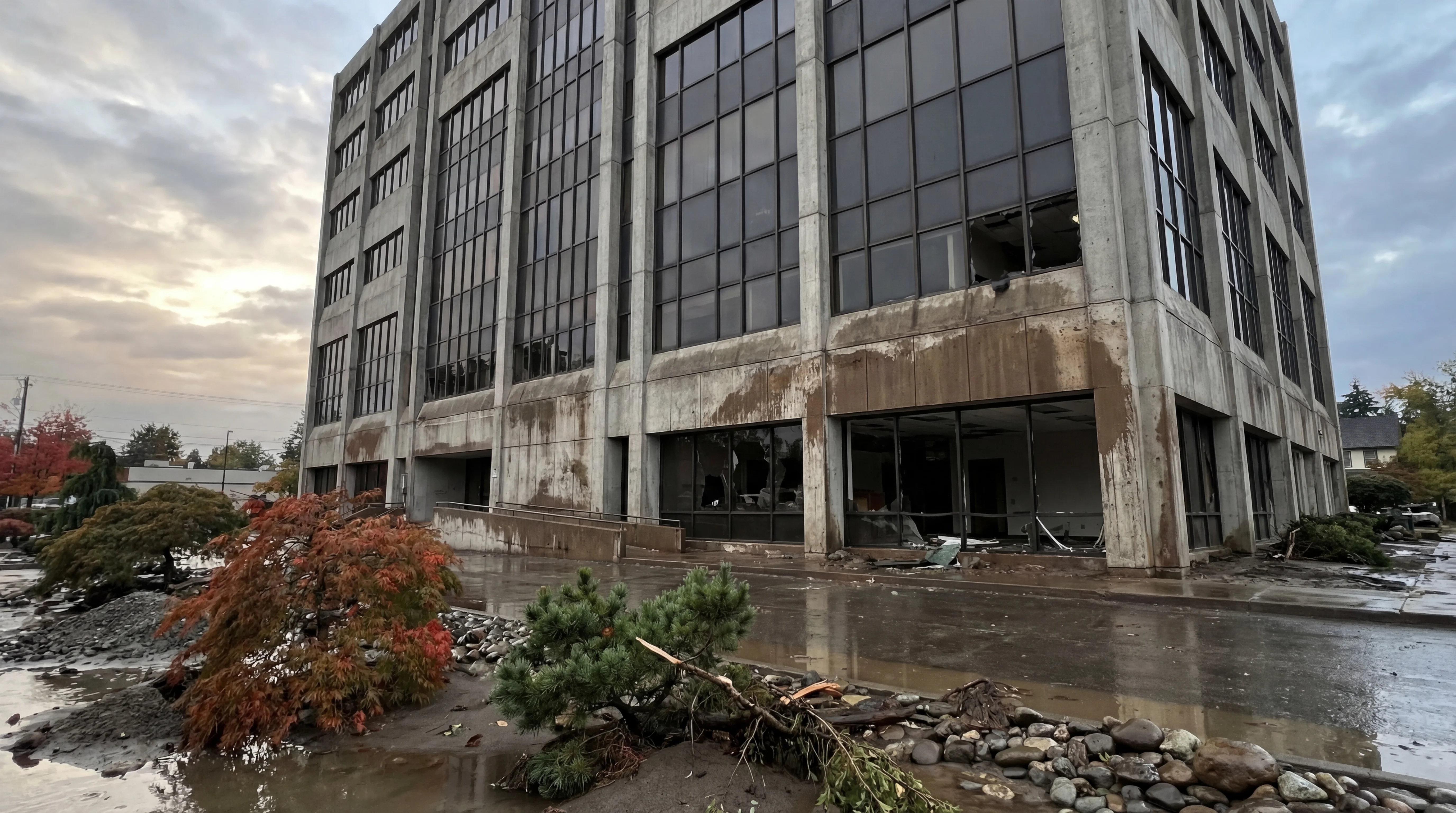
Background

MINIMIZE DOWNTIME. MAXIMIZE RECOVERY.

Commercial Property Restoration

When property damage hits your business, every hour counts. Palm Build delivers commercial restoration with 24/7 emergency response, dedicated project management, and insurance coordination built for the complexity of commercial claims.

Your Business Continuity Partner

Commercial restoration that protects your operations while we restore your property

Commercial property damage affects more than just buildings — it affects your revenue, your employees, and your customers. Our commercial teams understand the urgency of getting your business back to full operation. We work efficiently, often after hours, to minimize disruption while properly restoring your facility. For multi-site and catastrophic events, we coordinate with large loss handling and transition directly into reconstruction when structural scope is required.

  • 24/7 emergency response for businesses
  • Dedicated project manager for every commercial job
  • After-hours and weekend work standard
  • Xactimate estimates with BI claim documentation
  • Licensed in FL, NC, SC — insured and bonded
The Business Continuity Framework

Five Pillars That Keep Your Business Open Through Recovery

Commercial restoration is about more than fixing a building — it's about protecting the revenue, employees, and customers that depend on it. Palm Build's framework is engineered to minimize downtime at every phase, from after-hours dispatch through the day you reopen to full operations.

01

Rapid Response & Triage

After-hours dispatch within 60 minutes of call. A dedicated commercial PM mobilizes a scaled crew, isolates utilities, contains the loss, and prevents further damage and revenue interruption before any other contractor arrives on-site.

< 60 min · Response window
8+ techs · Crew size
24/7/365 · Coverage
02

Containment & Occupant Protection

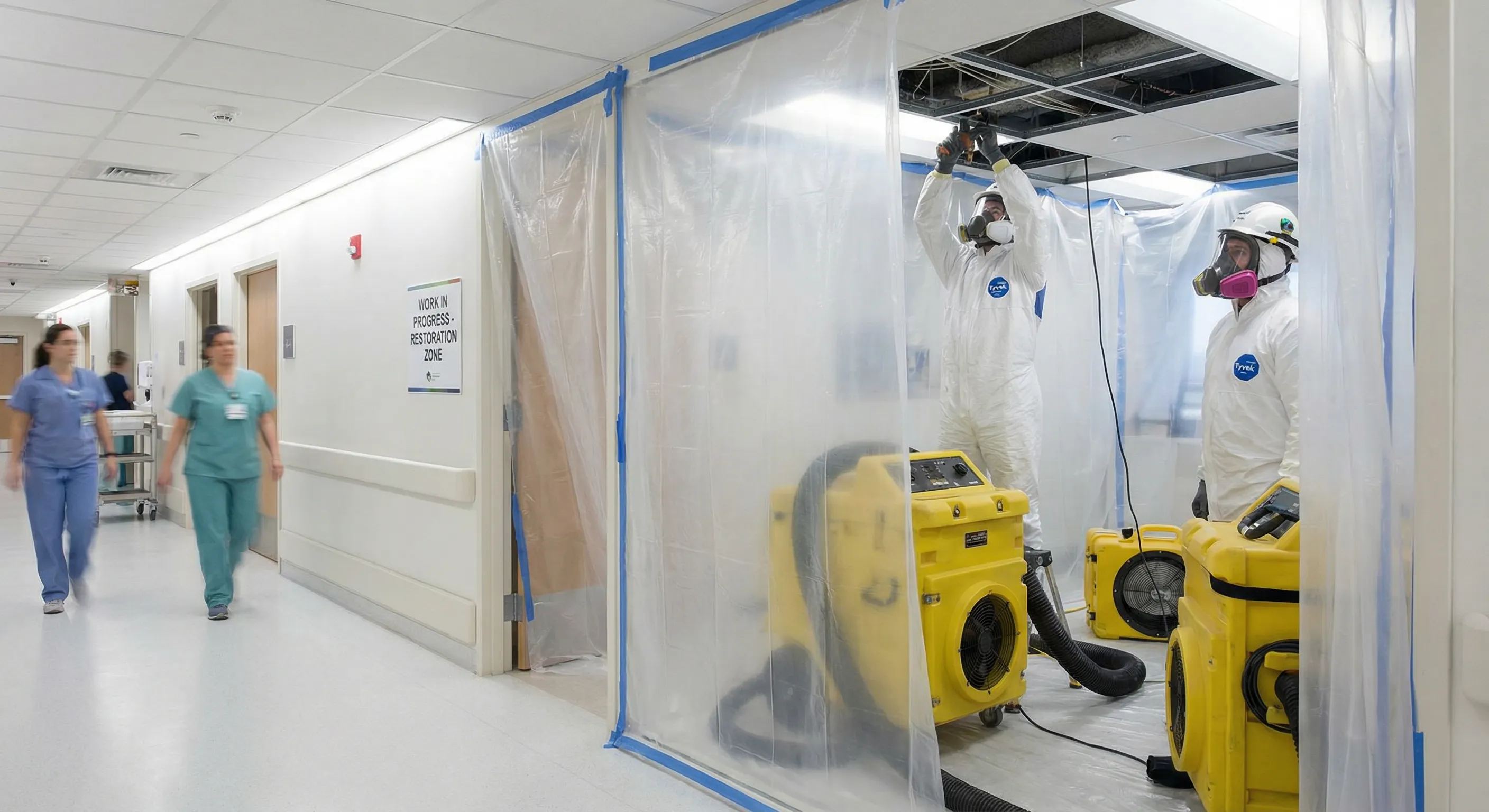
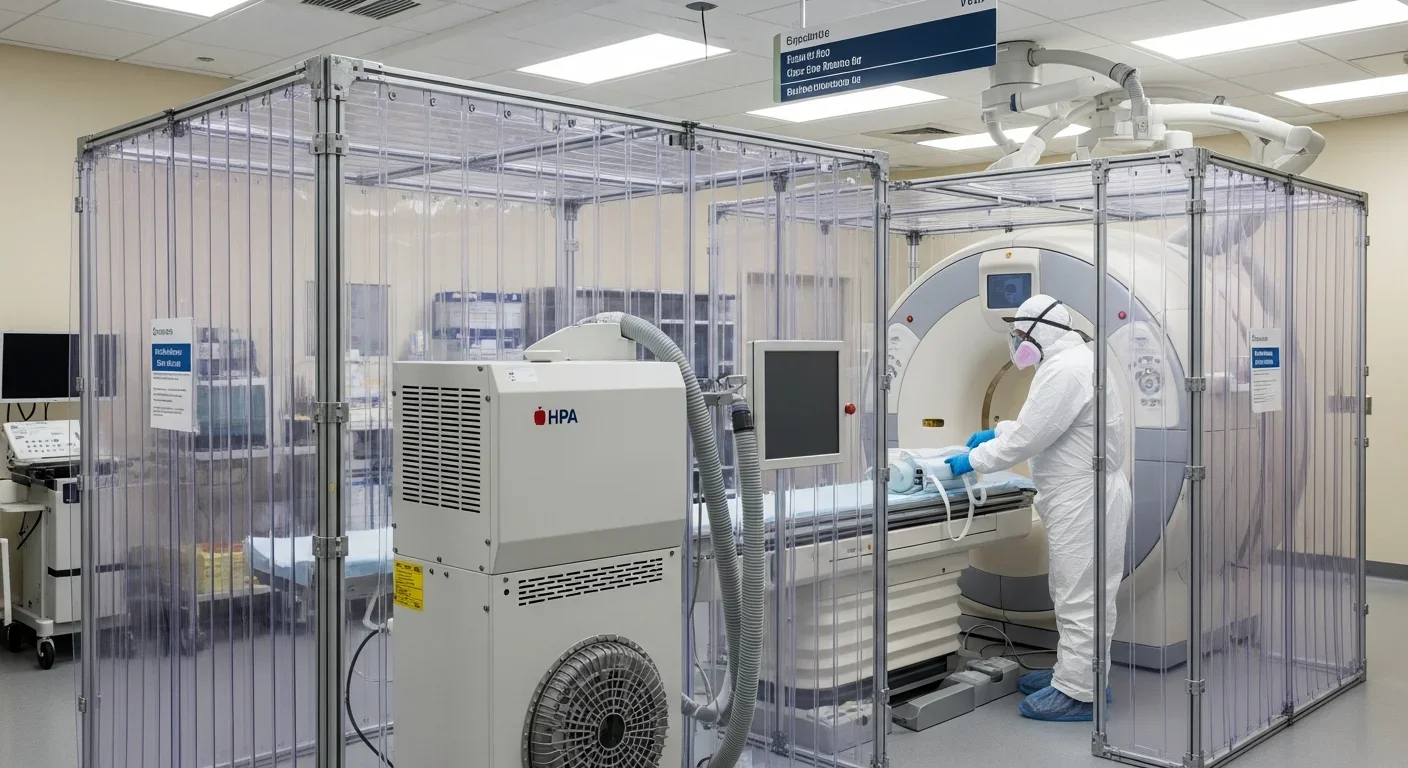
Critical-barrier containment with HEPA-filtered negative-air machines, sealed work zones, and corridor protection. Tenant and customer pathways stay open wherever possible. ICRA Class III/IV protocols engaged for healthcare and medical environments.

HEPA · Negative air
Class IV · ICRA ready
Stay open · Pathways
03

Phased Execution & After-Hours Scheduling

Restoration phased around occupancy. Noisy and disruptive work scheduled for nights, weekends, and holidays. Floor-by-floor, wing-by-wing, or zone-by-zone execution lets your business continue operating in unaffected areas throughout mitigation and reconstruction.

Standard · After-hours
Floor-by-floor · Zoning
Continuous · Operations
04

Documentation & TPA Coordination

Daily progress reports, moisture readings, photos, and Xactimate updates submitted directly into TPA portals (Contractor Connection, Crawford, Code Blue, Alacrity, and others). Digital chain of custody is preserved for property, contents, and business interruption claim substantiation.

Xactimate · Estimates
Native · TPA portals
Daily · Reporting
05

Business Reopening & Verification

Independent moisture verification, post-remediation clearance testing, ADA reopening compliance, and coordination with health departments and AHJs. Final completion package supports business interruption claim closeout and full reopening readiness.

Independent · Verification
ADA compliant · Reopening
BI ready · Closeout

The framework is the deliverable.

Property managers, facility teams, TPAs, and commercial adjusters have a single point of accountability through every phase. Each pillar is documented, every step is reportable, and every reopening is verified.

Request Commercial Assessment

Every Hour of Downtime Costs Money

Property Damage Affects More Than Your Building

When water, fire, or storm damage hits your commercial property, the physical repairs are only part of the equation. Lost revenue, displaced employees, impacted customers, and lease obligations all compound daily. The speed and quality of your restoration partner directly determines how much this event costs your business.

$8,000+

Average daily revenue loss for small businesses during closure

40%

of businesses never fully recover from major property damage

48hrs

is all it takes for secondary damage (mold, corrosion) to begin

24/7 Emergency Response

On-site within hours, not days. Every hour of delay compounds the damage and the cost.

Dedicated Project Manager

One point of contact manages all trades, coordinates with your team, and reports progress.

Insurance Coordination

We document everything and work directly with your adjuster on both property and BI claims.

Business Continuity Focus

Phased restoration and after-hours work keep your operations running during recovery.

Emergency Response at Commercial Scale

Built To Mobilize Like A Commercial Operator

A residential restoration shop cannot run a commercial loss. Palm Build is staffed, equipped, and dispatched as a dedicated commercial program — with the crew capacity, the truck-mount fleet, and the cross-state coordination that property managers and TPAs expect.

8+

Crews simultaneous

Scaled deployment for large losses, multi-site events, and CAT response

500+

Commercial projects/yr

Offices, retail, hotels, warehouses, healthcare, restaurants, and industrial

< 60 min

After-hours dispatch

Charlotte, Metrolina, South Florida, and the I-95 corridor

7 states

Multi-state coordination

FL · NC · SC · GA · TN · TX · NJ — pre-positioned for storm events

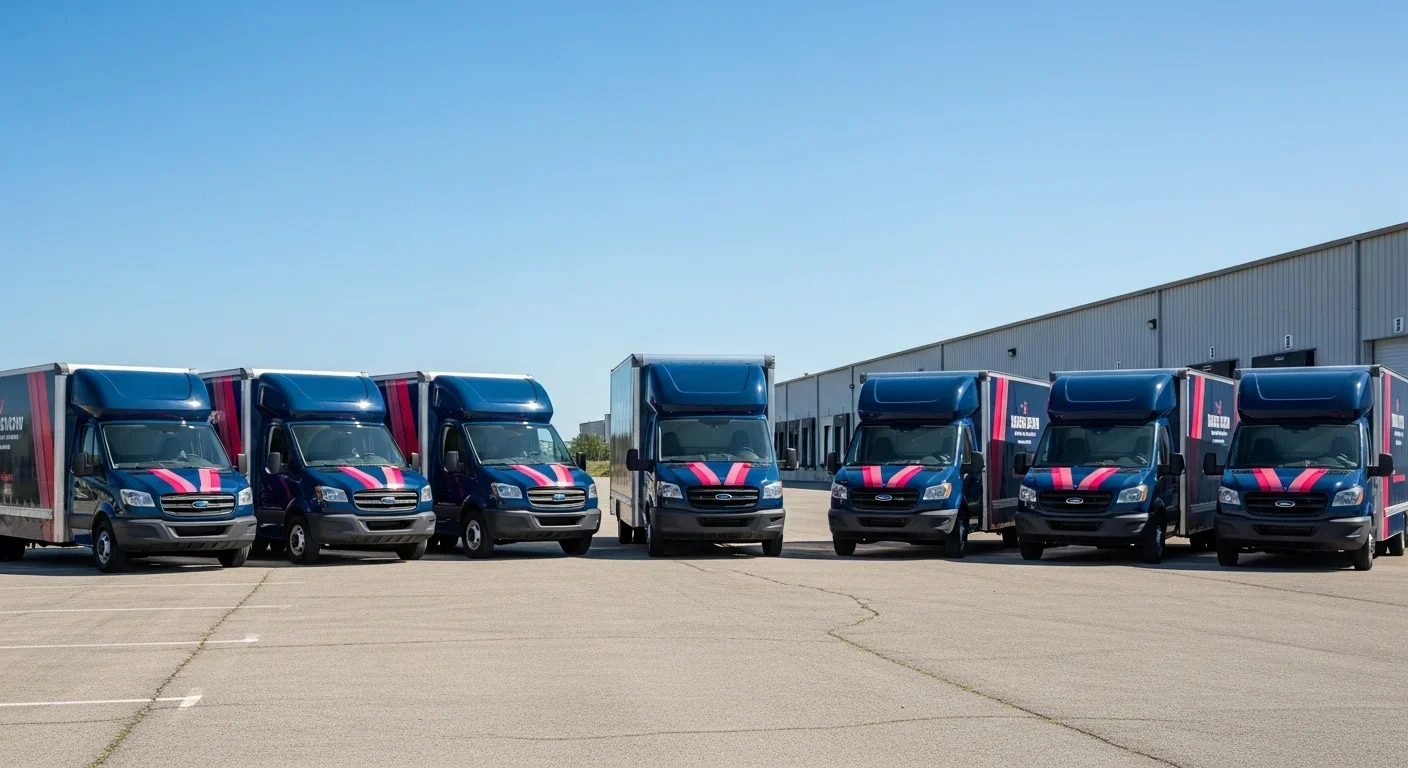
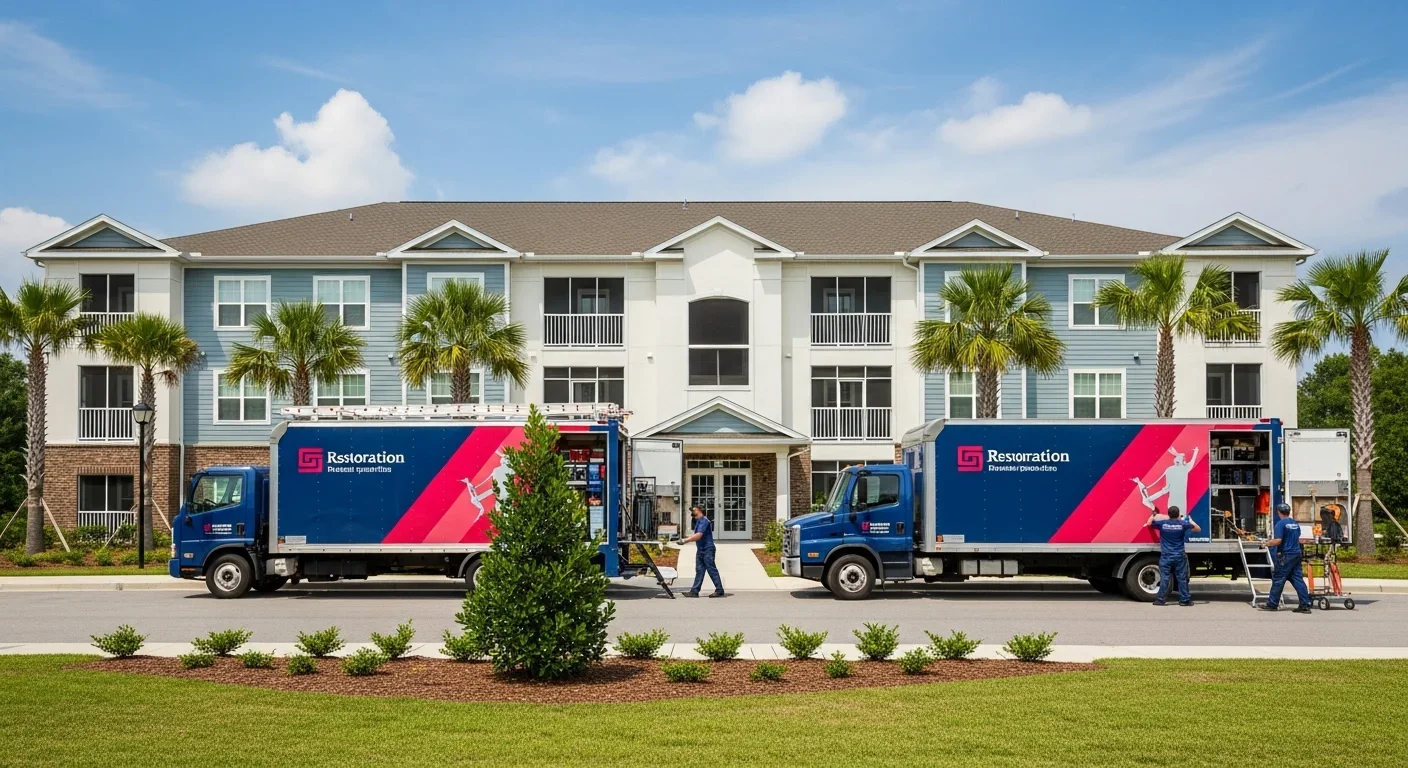
Palm Build Restoration commercial truck fleet staged at warehouse facility

Pre-staged commercial fleet

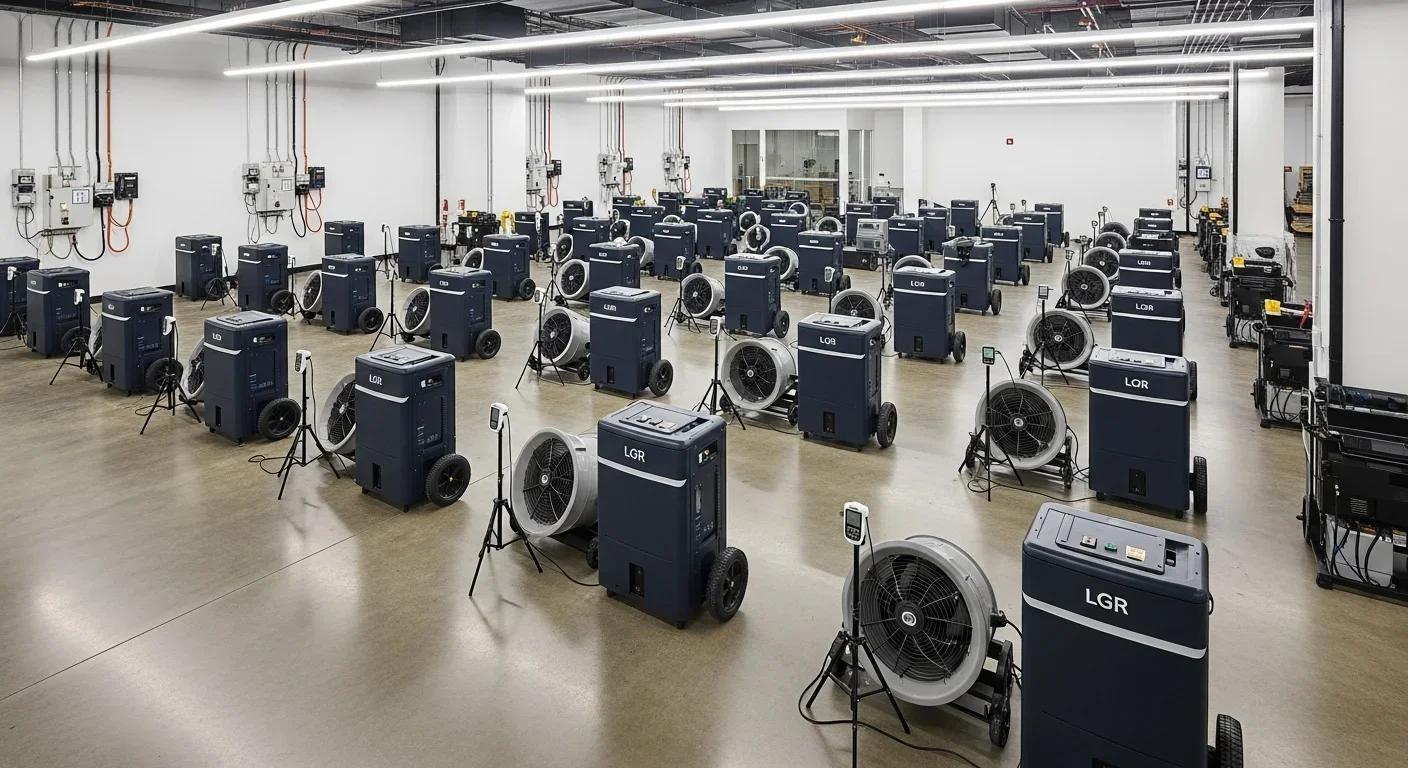
A dedicated commercial truck-mount fleet kept inspection-ready in Charlotte and Deerfield Beach. Trucks roll on first call — no pulling vans off residential jobs.

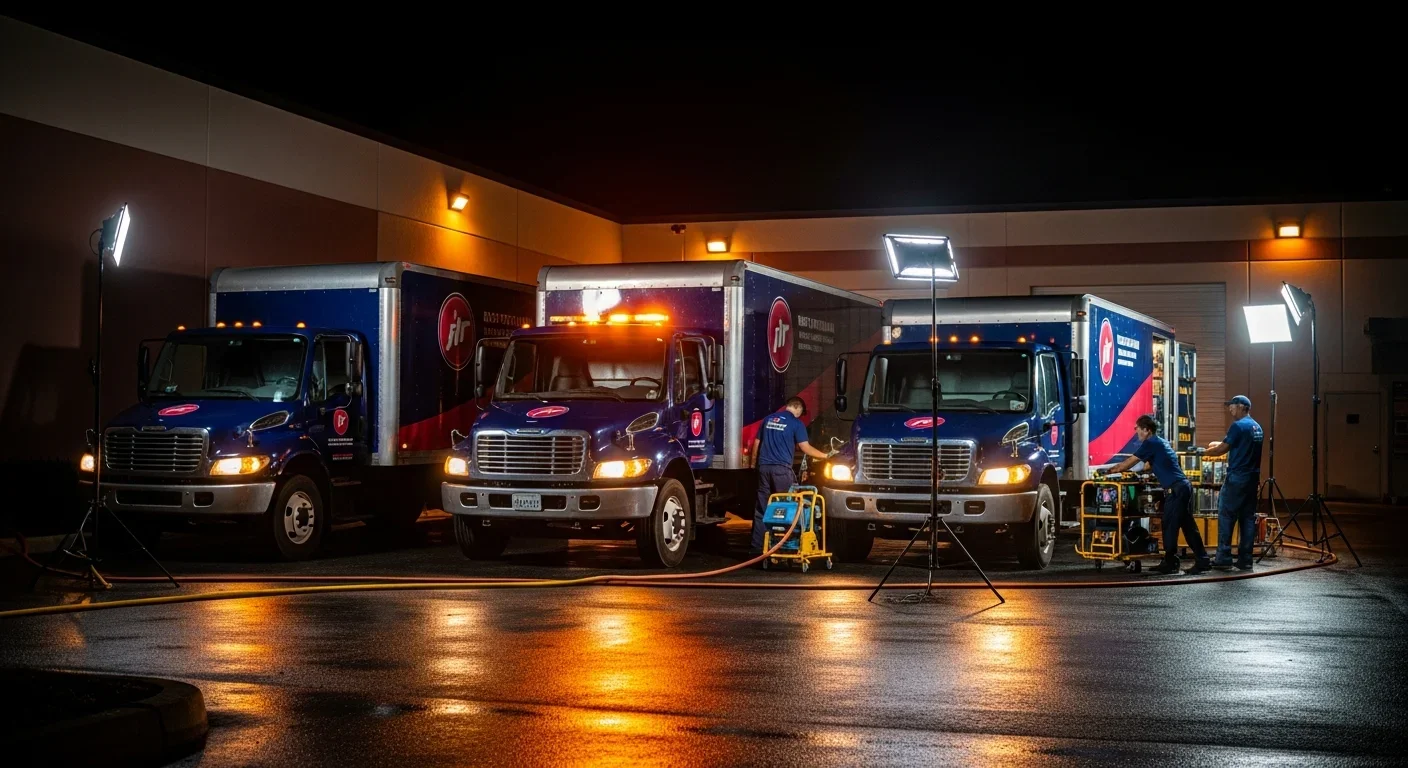
Palm Build commercial restoration crew dispatching at night with branded trucks under floodlights

After-hours dispatch coordination

Commercial PMs on-call 24/7. When a property manager calls at 2 AM, equipment, crew, and project documentation are mobilized in parallel — not sequentially.

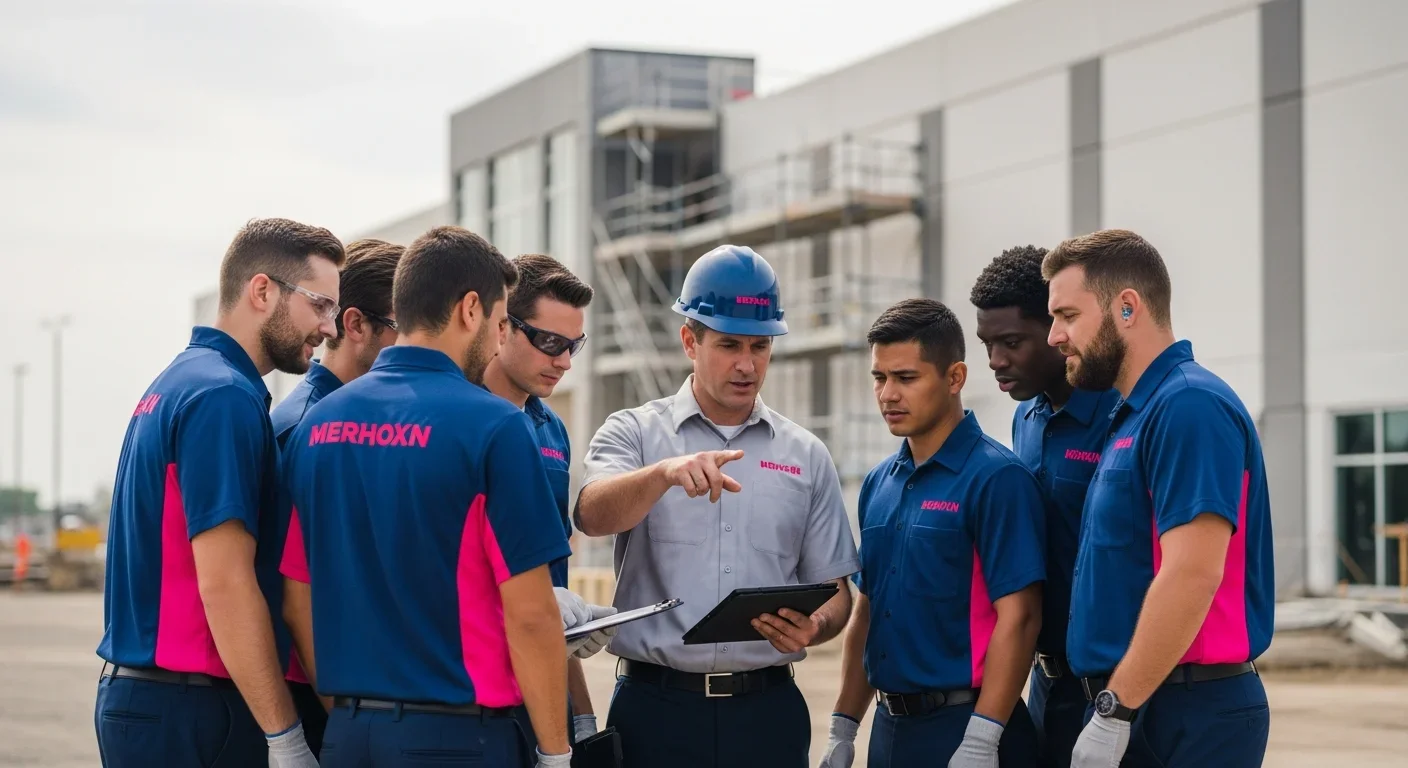
Commercial restoration crew coordinating on-site at multi-property catastrophic event

Multi-site CAT deployment

For hurricanes and multi-property events we coordinate cross-state crew movement, pre-position equipment ahead of forecasts, and run parallel job sites under a single program management track.

Property damage in progress? Our PMs are awake.

One call routes you to a commercial PM, not a residential dispatcher. Equipment rolls inside the hour. Documentation starts the moment our crew arrives.

Industries We Serve

Commercial Restoration for Every Property Type

Every industry has unique restoration challenges. We adapt our approach, equipment, and scheduling to minimize disruption to your specific operations.

Property Type Matrix

Every commercial property has a different downtime story

Restoration playbooks change by property type. A 2-hour delay in a hospital corridor is not the same as a 2-hour delay in a warehouse. Use this matrix to see how Palm Build adjusts crew, equipment, scheduling, and documentation to the operating reality of your property.

Office Buildings

Typical Losses
Burst risers, sprinkler malfunctions, HVAC condensate, fire-suppression discharge
Downtime Tolerance
Hours — productivity loss, client meetings, server-room risk
Considerations
Server rooms and data infrastructure, raised-floor moisture, multi-tenant coordination
Regulations
OSHA 1926, ADA Title III on reopening

Retail

Typical Losses
Roof leaks, sprinkler events, sewer backups, fire damage in storage
Downtime Tolerance
Same-day to 24h — closed door = lost revenue, brand image risk
Considerations
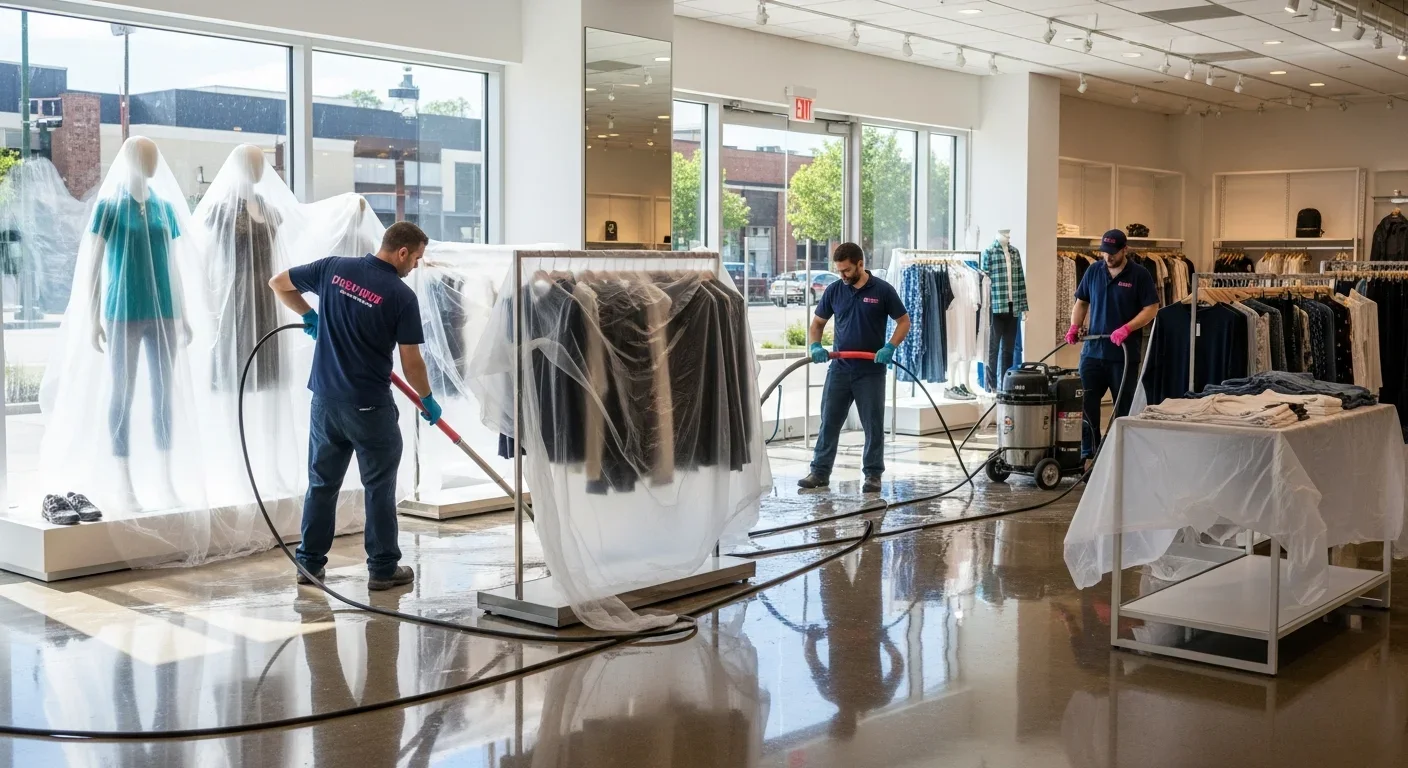
Inventory protection and pack-out, customer pathways, brand-standard finishes
Regulations
ADA Title III, fire code reopening, local sign permits

Hotels & Hospitality

Typical Losses
Multi-floor water from in-room fixtures, kitchen fires, HVAC smoke, storm damage
Downtime Tolerance
Days — room nights cannot be rebooked once lost
Considerations
Phased work to keep guest occupancy, brand-standard finishes, F&B health-dept inspections
Regulations
State hotel reopening, FL/NC building codes, ADA, health department

Restaurants & Kitchens

Typical Losses
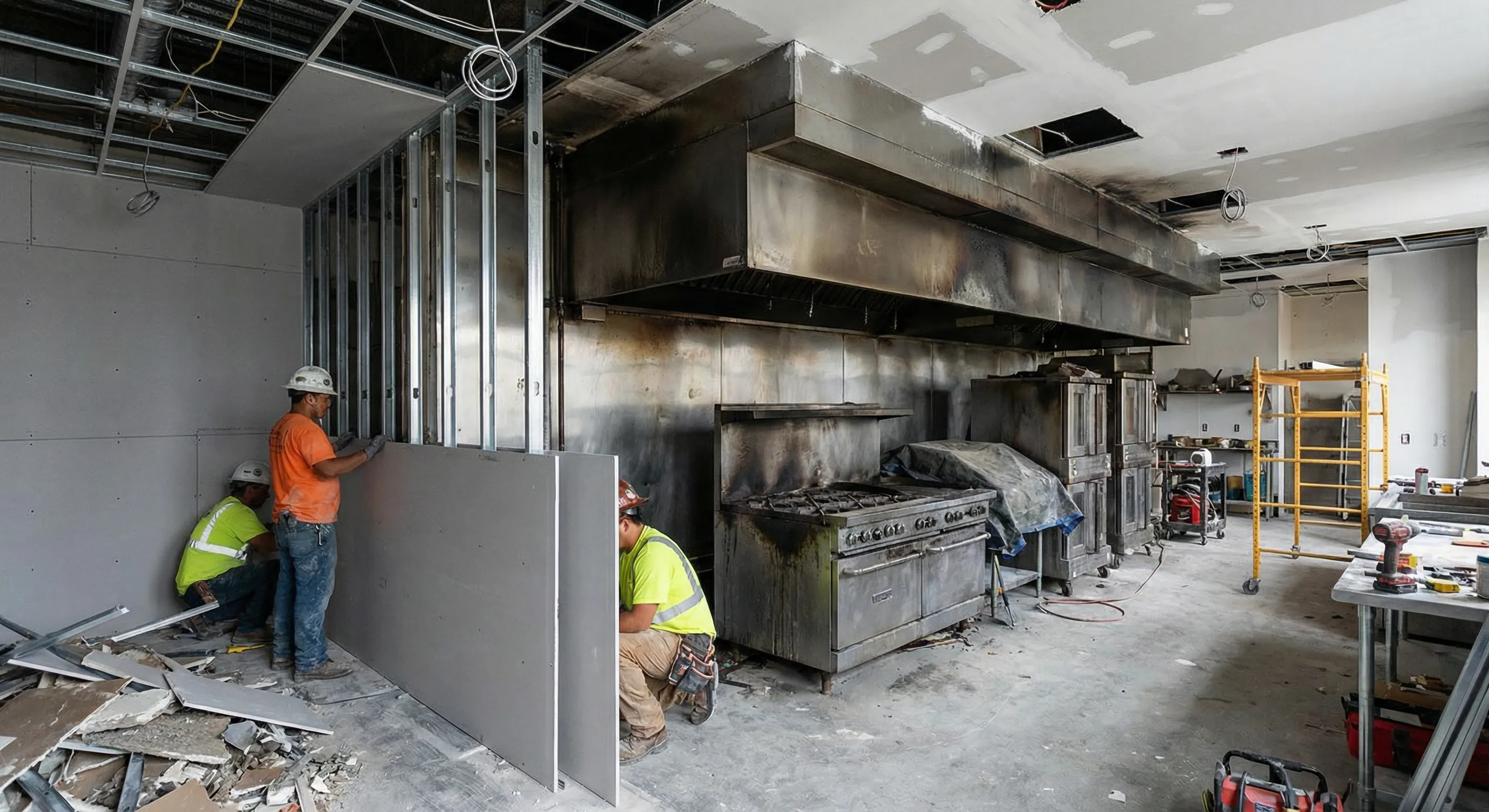
Kitchen fires, hood/duct grease, walk-in cooler failures, sewer backups
Downtime Tolerance
Hours — every closed shift is direct revenue loss
Considerations
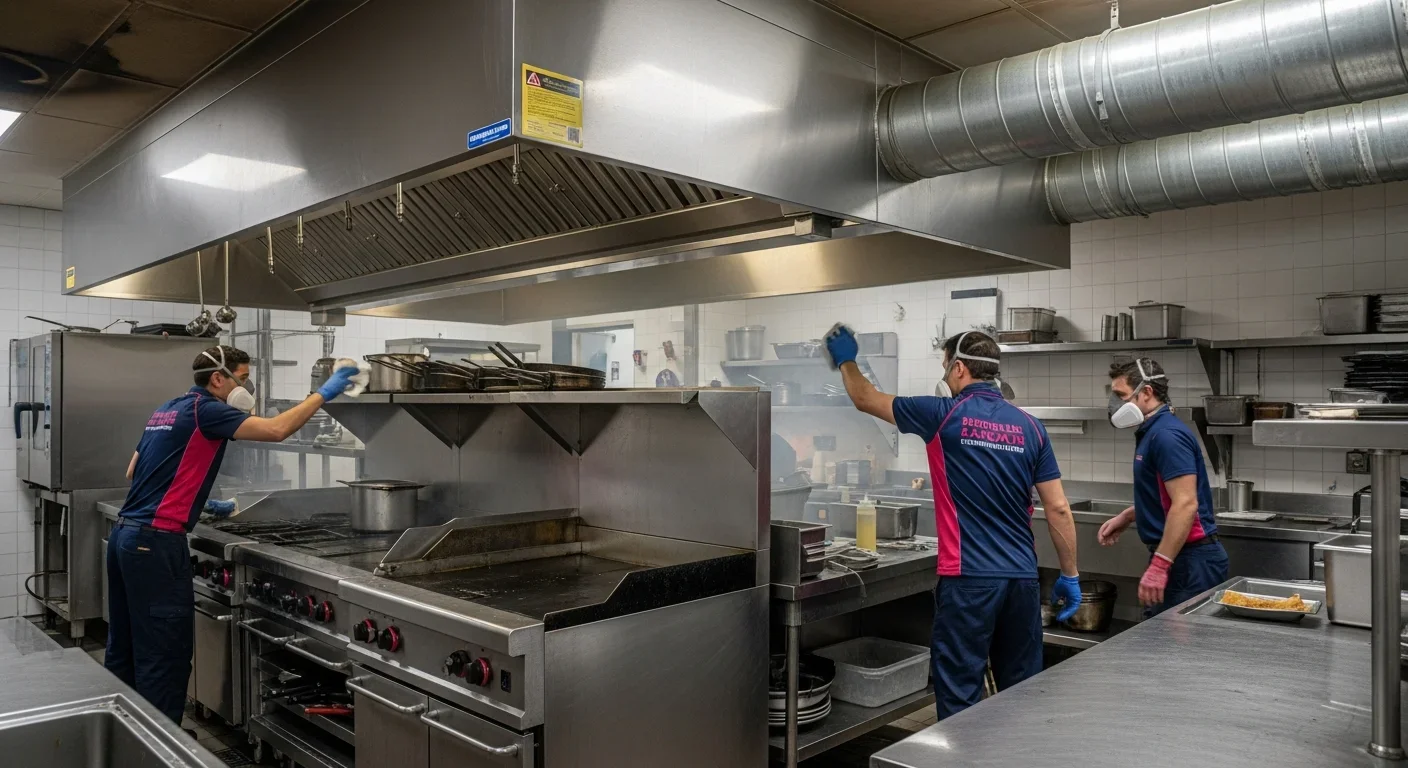
Health department coordination, hood/duct decontamination, equipment salvage
Regulations
Health dept reinspection, ANSUL re-certification, fire code

Warehouse & Industrial

Typical Losses
Roof leaks, sprinkler discharge, forklift damage, fire/smoke from racking events
Downtime Tolerance
Days — inventory damage, supply chain ripple, equipment downtime
Considerations
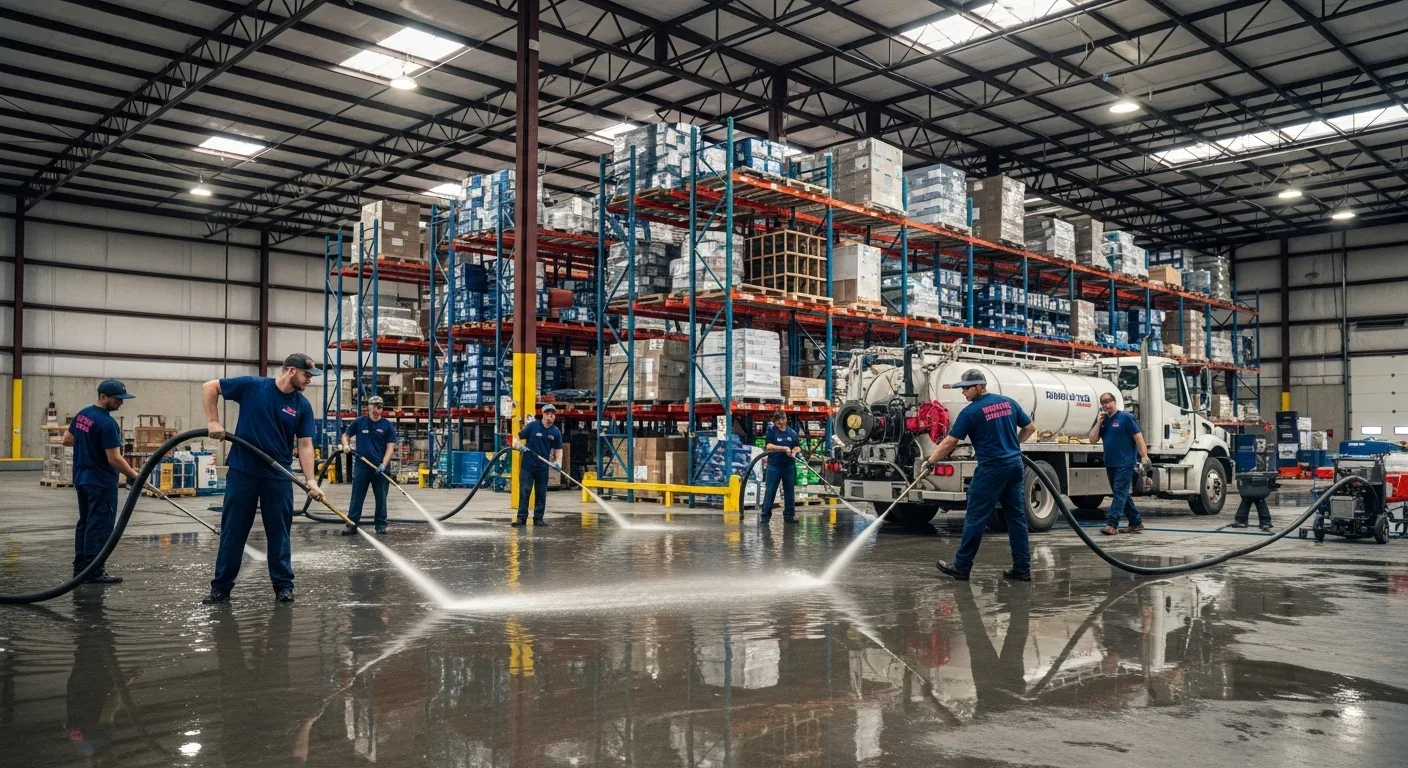
Inventory protection (pack-out / shrink-wrap), forklift access for crews, racking integrity
Regulations
OSHA 1926, OSHA 1910 (general industry), fire code, EPA storm water

Healthcare & Medical Facilities

Typical Losses
Pipe failures in patient corridors, mold in HVAC, fire in mechanical, sewer backups
Downtime Tolerance
Hours — patient safety, scheduled procedures, infection control risk
Considerations
ICRA Class III/IV containment, sterile field protection, equipment-sensitive drying
Regulations
JCAHO/AAAHC, HIPAA-adjacent, state DOH, FGI guidelines

Mixed-Use & Multi-Family

Typical Losses
Stack pipe failures, balcony leaks, common-area fires, hurricane damage
Downtime Tolerance
Days — tenant notification, displacement risk, HOA board accountability
Considerations
Corridor strategy, tenant communication cadence, HOA / property manager coordination
Regulations
State HOA statutes, ADA on common areas, fire code

Business Impact Calculator

How Much Is Downtime Costing Your Business?

Property damage costs more than repairs. Estimate the total financial impact of business interruption and see how immediate response reduces your loss.

1 200
500 100,000

Type of Damage

Daily Revenue Loss

$5,000

Daily Employee Cost

$2,500

Total Daily Impact

$7,500

Est. Restoration Days

8 days

Commercial Cost Factors

Why commercial restoration costs differ from residential

Commercial pricing reflects the realities of after-hours labor, phased occupancy work, and the documentation rigor required for TPA and BI claims. These tables explain where the cost variance comes from — and what you can expect in a commercial loss scenario.

Commercial-Specific Cost Multipliers

FactorTriggerPremiumWhy It Happens
After-hours dispatch6 PM – 7 AM weekday+25%Emergency mobilization requires on-call labor. Most commercial losses can't wait until 8 AM.
Weekend / holiday workSaturday, Sunday, federal holidays+35%Phased work in occupied buildings is often required to land on weekends to avoid tenant disruption.
Overtime labor> 40 hours/week per crew+50%Large-loss timelines often require sustained overtime to meet BI-claim drying targets.
Emergency mobilization< 60 min response window$500 – $2,500Pre-positioned crew, fueled trucks, and equipment-ready dispatch carry standby cost.
Expedited dryingReduced drying window for BI minimization+15 – 30%More dehumidifiers, more air movers, denser monitoring — higher equipment density to hit a tighter target.

Phased Occupancy Cost Impact

Phasing ScopeCost ImpactWhat It Adds
Single corridor / wing+10 – 20%Containment poly + zoning, daily access coordination, limited noise hours
Floor-by-floor (high-rise / hotel)+20 – 35%Vertical equipment staging, elevator coordination, parallel zone documentation, room-block scheduling
Off-hours only (no daytime work)+30 – 50%Crew shifts shifted entirely to nights/weekends; doubled mobilization on each shift change
Active business operations adjacent+15 – 25%HEPA negative-air, dust/odor control, customer-facing pathway protection, daily safety walks

Typical Cost Ranges by Property Type

Property TypeSmall Loss
< 1,500 sq ft
Medium Loss
1,500 – 6,000 sq ft
Large Loss
6,000+ sq ft
Office (single suite)$3,500 – $12,000$15,000 – $45,000$60,000 – $200,000+
Retail storefront$5,000 – $18,000$22,000 – $65,000$80,000 – $250,000+
Restaurant$8,000 – $25,000$35,000 – $90,000$120,000 – $400,000+
Hotel$10,000 – $35,000$50,000 – $150,000$200,000 – $1,000,000+
Warehouse / industrial$8,000 – $30,000$45,000 – $140,000$180,000 – $750,000+
Healthcare facility$12,000 – $40,000$55,000 – $160,000$220,000 – $1,200,000+

These ranges assume Cat 1/Cat 2 water or moderate fire/smoke. Cat 3 (sewage), large fire rebuild, and full-mold containment can increase costs significantly. Insurance coverage, deductibles, and BI/extra-expense provisions affect out-of-pocket exposure.

The Commercial Restoration Process

From Emergency Call to Certificate of Completion

Commercial restoration follows a structured process designed to minimize business interruption while ensuring quality, code compliance, and thorough insurance documentation at every step.

01

Emergency Response & Stabilization

Hours 1-4

Immediate deployment to stop damage progression. Water extraction begins, fire-damaged areas are secured, emergency board-up protects openings, and utilities are assessed.

Water shutoff and extraction Emergency board-up Utility assessment Site security
02

Damage Assessment & Scope Development

Days 1-3

Comprehensive documentation of all damage using moisture meters, thermal imaging, and air quality testing. Detailed scope of work developed with insurance coordination.

Moisture mapping Thermal imaging Photo/video documentation Xactimate estimate
03

Project Manager Assignment

Day 1

A dedicated project manager is assigned as your single point of contact. They develop the project plan, establish communication protocols, and coordinate with all stakeholders.

Communication plan Stakeholder briefing Timeline development Tenant notification
04

Phased Restoration Plan

Days 3-7

Work is phased to allow partial building operations where possible. Critical areas are prioritized. After-hours scheduling minimizes disruption to tenants and customers.

Zone prioritization Containment barriers After-hours scheduling Partial occupancy plan
05

Equipment Deployment & Restoration

Days 3-30+

Commercial-grade equipment deployed at scale. Industrial drying, decontamination, demolition, and reconstruction proceed according to the phased plan with daily monitoring.

Industrial drying Decontamination Demolition as needed Reconstruction
06

Compliance, Inspection & Certificate

Final Phase

All required inspections are scheduled and passed. Final documentation package compiled for insurance and records. Certificate of completion issued for reopening.

Building inspections Air quality clearance Insurance documentation Certificate of completion

Not Just a Bigger Job

Commercial vs. Residential Restoration

Commercial restoration is fundamentally different from residential work. The scale is larger, the compliance requirements are stricter, and the financial stakes are higher. Understanding these differences helps you choose the right partner and set accurate expectations.

Scale & Equipment

Commercial

Industrial extractors, commercial dehumidifiers processing thousands of CFM, desiccant drying trailers, scissor lifts for high ceilings

Residential

Portable extractors, standard dehumidifiers and air movers, residential-grade equipment

Compliance

Commercial

OSHA job site requirements, ADA compliance, fire marshal inspections, health department approval, occupancy permits

Residential

Standard building code compliance, basic permit requirements

Stakeholders

Commercial

Property owners, property managers, multiple tenants, insurance adjusters, city inspectors, risk managers

Residential

Homeowner and insurance adjuster

Documentation

Commercial

Daily progress reports, moisture mapping, business interruption substantiation, multiple claim coordination, Xactimate with line-item detail

Residential

Standard scope of work, estimate, and completion photos

Work Schedule

Commercial

After-hours and weekend work standard. Multiple shifts. Phased restoration to maintain partial operations.

Residential

Standard business hours with some flexibility

Insurance

Commercial

Multiple policies (property, contents, BI, liability). Higher limits, percentage deductibles, business interruption claims.

Residential

Single homeowners policy covering dwelling and contents

Why it matters: Hiring a company that primarily handles residential work for a commercial loss often results in underscoped estimates, missed compliance requirements, and longer timelines. Commercial restoration demands commercial experience, commercial equipment, and a project management approach built for multi-stakeholder environments.

Commercial Damage Response

Specialized Response for Every Damage Type

Commercial properties have unique considerations that differ from residential restoration. Each damage type requires specialized equipment, compliance knowledge, and business-aware project management.

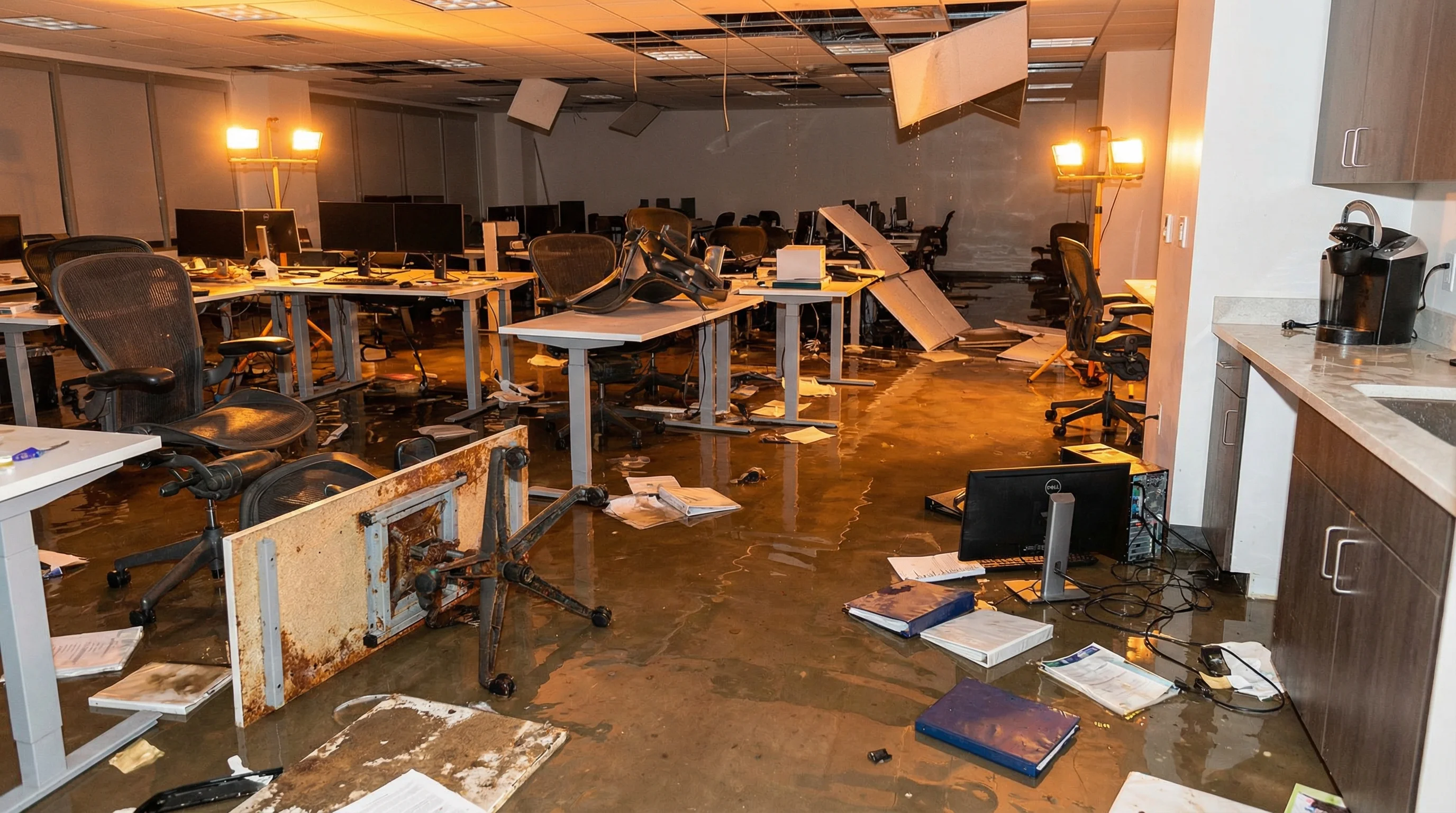
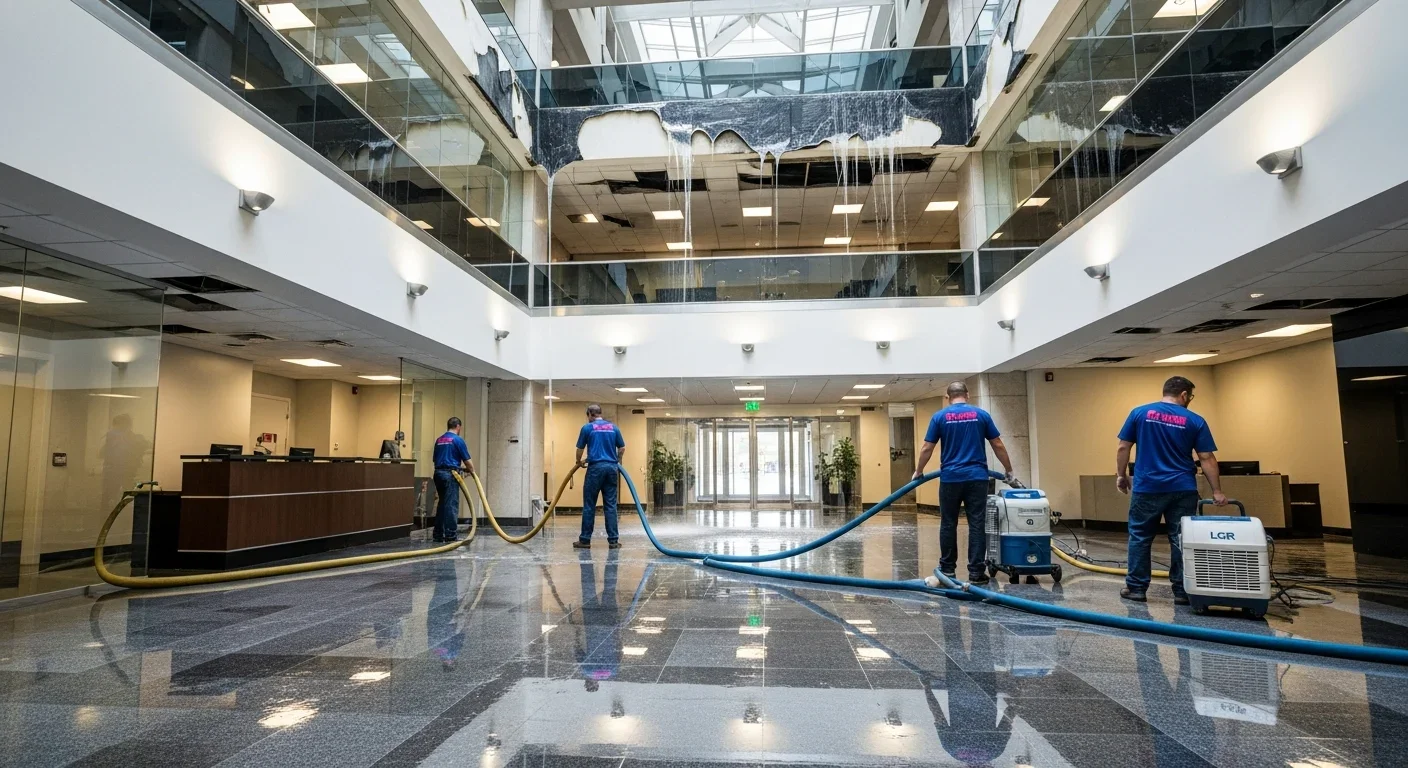
Flooded commercial office interior showing water damage

Commercial Water Damage

Large-scale water events in commercial buildings require industrial extraction and drying. Sprinkler activations, burst pipes, and roof failures can affect multiple floors and tenants simultaneously. Server rooms and IT infrastructure require priority protection.

Commercial Considerations:

  • Industrial extraction and drying
  • IT equipment protection
  • Multi-floor water migration
  • Inventory assessment
Learn about water damage
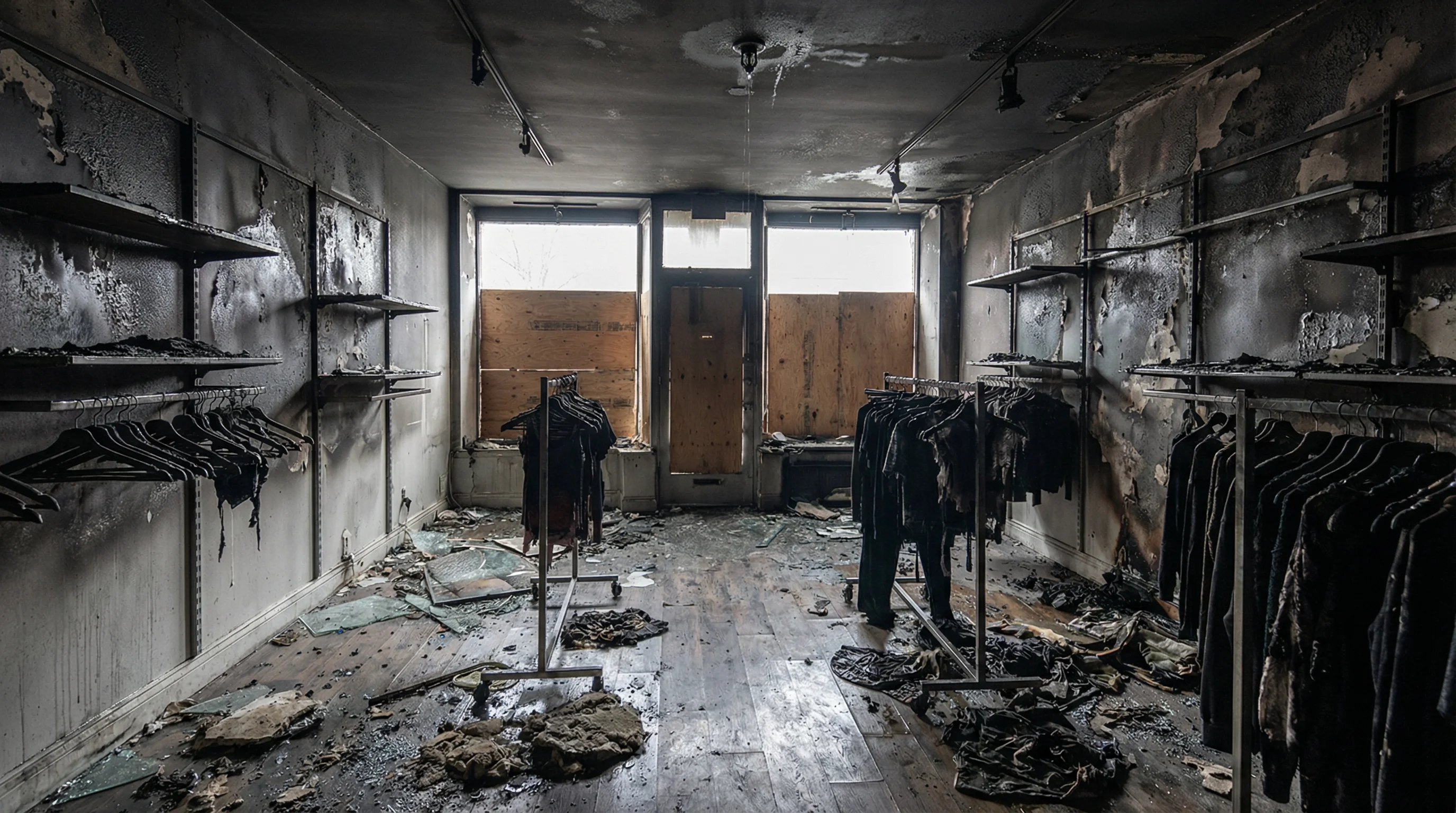
Fire-damaged commercial retail space requiring restoration

Commercial Fire & Smoke

Commercial fires produce building-wide smoke contamination through HVAC systems. Kitchen fires, electrical fires, and structural fires each require different approaches. Fire marshal coordination and code compliance are required for reopening.

Commercial Considerations:

  • HVAC smoke decontamination
  • Fire marshal coordination
  • Employee and customer safety
  • Code-compliant reconstruction
Learn about fire & smoke
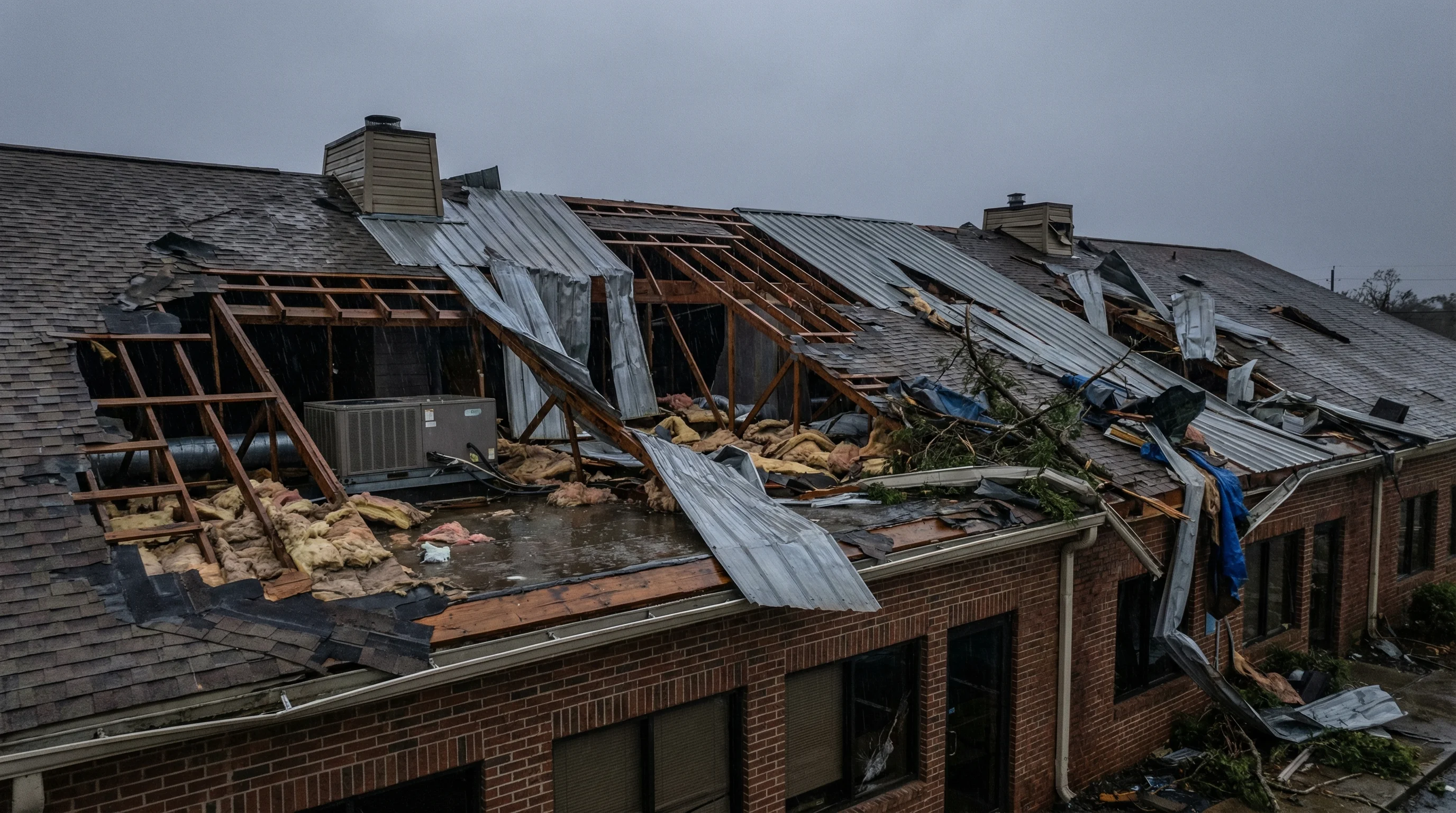
Storm-damaged commercial building roof

Storm & Wind Damage

Hurricane, tornado, and severe storm damage to commercial buildings affects roofing, windows, and structural elements. Water intrusion follows exterior breaches. Florida and coastal properties face strict wind code requirements for reconstruction.

Commercial Considerations:

  • Emergency tarping and board-up
  • Structural engineering assessment
  • Wind code compliance (FL)
  • Multi-phase restoration planning
Learn about storm & wind damage

Commercial Mold

Mold in commercial buildings spreads through HVAC systems and can contaminate entire floors. Employee health concerns, OSHA requirements, and air quality testing add compliance layers not present in residential work. Clearance testing is required before reoccupancy.

Commercial Considerations:

  • HVAC system contamination
  • Employee health and OSHA
  • Air quality monitoring
  • Post-remediation clearance
Learn about mold

24/7 Commercial Emergency Line

Business emergencies don't wait for business hours. Our commercial restoration teams are available around the clock to respond to your property damage emergency.

After-Hours & Phased Execution

How occupied-building work actually runs

The biggest difference between residential and commercial restoration isn't the equipment — it's the operating discipline required to work inside a building that hasn't shut down. Six tactics that make occupied-building restoration possible.

01

Night-shift staffing

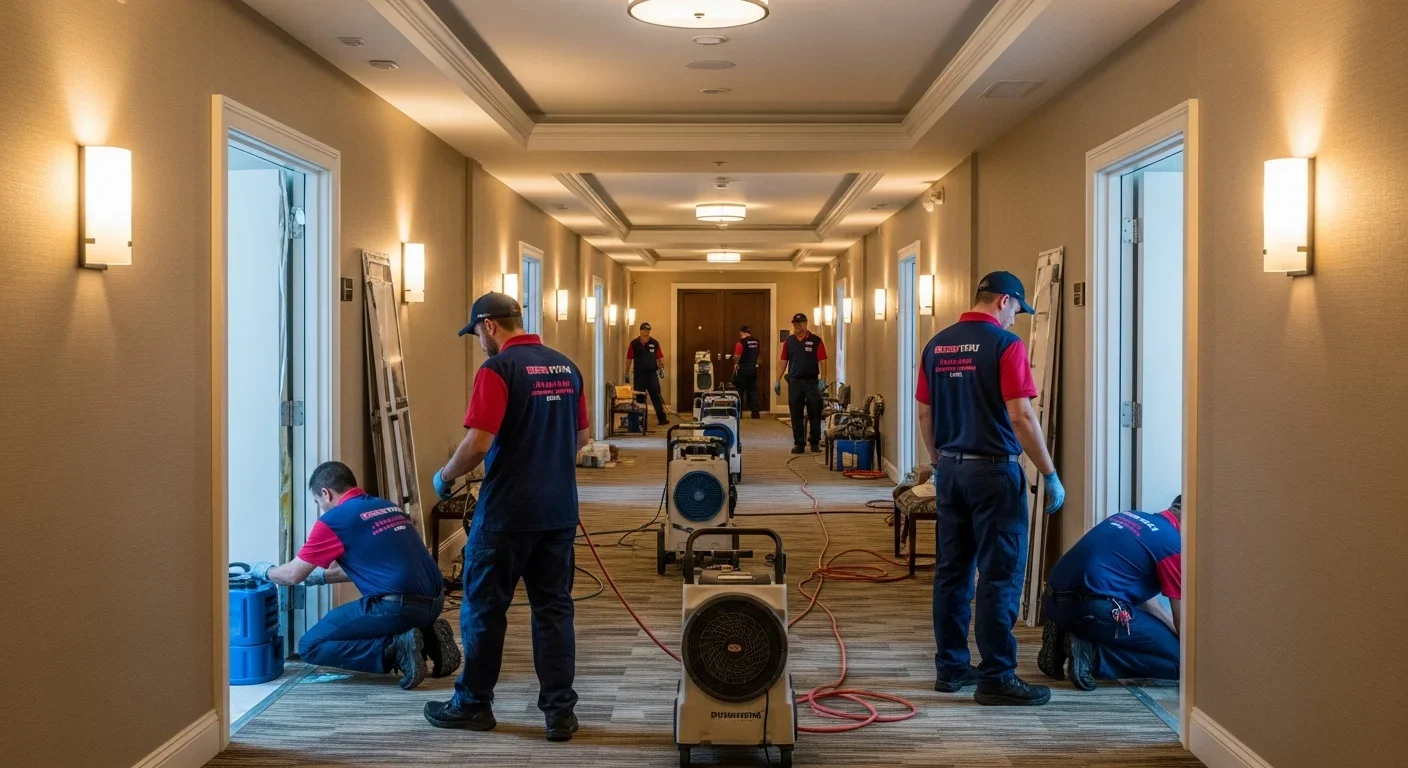
For occupied office buildings, retail centers, and hotels, the loudest mitigation work — extraction, demolition, equipment moves, drying-equipment swaps — runs after the building closes for the day. Crews are scheduled in 8-hour overnight shifts with hot handoffs to a daytime quiet-mode crew that monitors equipment and continues low-impact work.

02

Noise restrictions & quiet hours

Property managers set the windows. We honor them. Drying equipment is staged in low-decibel arrays during business hours (LGRs over compressors, low-velocity air movers near tenant walls), with louder demolition and reconstruction reserved for the agreed quiet hours. Noise complaints from tenants are the fastest way to derail a commercial project.

03

Dust & odor containment

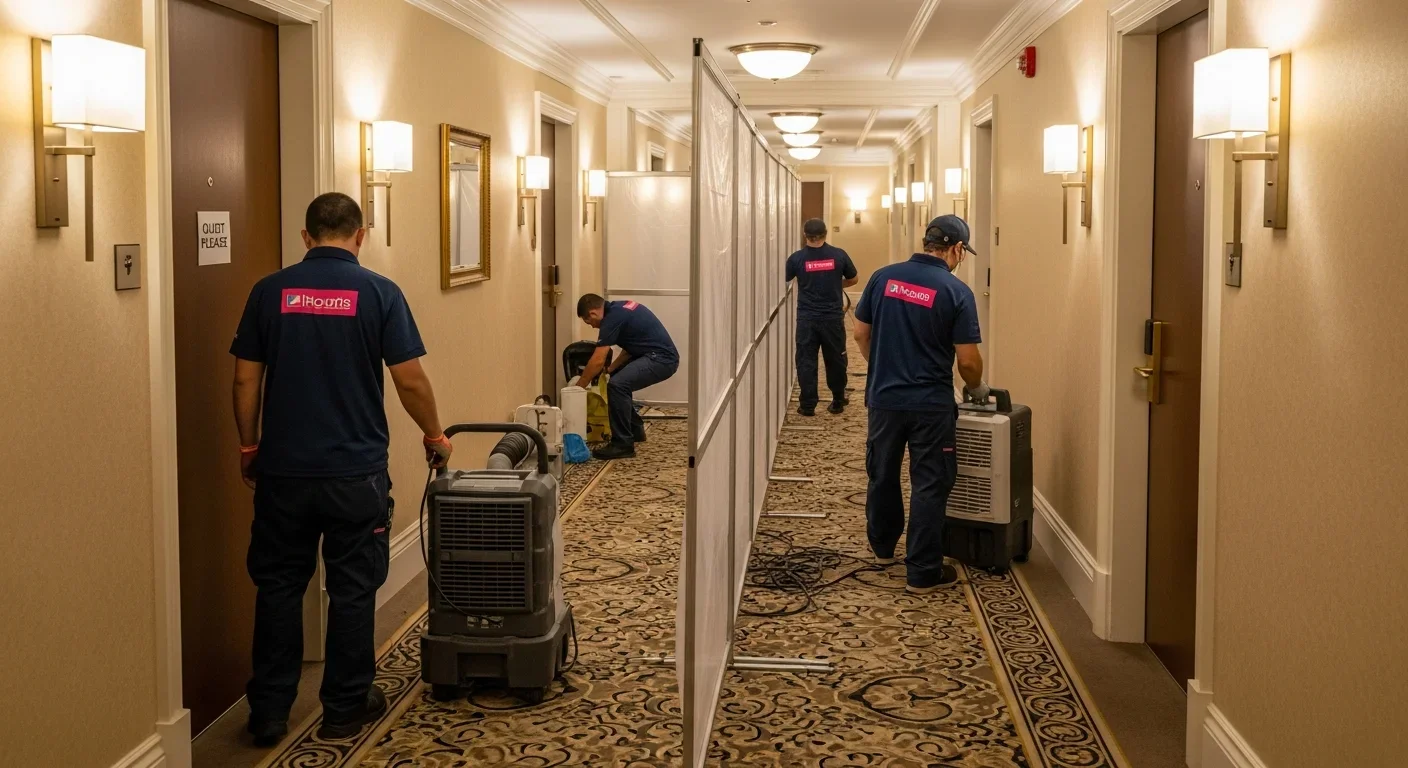
Critical-barrier 6-mil poly with zipper doors plus HEPA-filtered negative-air machines pulling 500–2,000 CFM from the work zone. Adjacent corridors stay dust-free, odor-free, and pressure-isolated. For medical, food service, and hospitality this isn't optional — it's the only way the property can stay open during work.

04

Common-area protection

Floor protection in elevator vestibules, lobby paths, and main corridors. Wall and corner protection on tight turns. Daily janitorial coordination with on-site building staff to keep the public-facing areas pristine even when active mitigation is happening 30 feet away. The building should look unaffected to anyone walking through.

05

Tenant communication cadence

A daily email update from the on-site PM to the property manager and affected tenants: what was completed yesterday, what's happening today, what to expect tomorrow, when access will change. Surprise access changes break trust faster than the damage itself. We over-communicate by default.

06

Contractor badge programs

Every Palm Build technician carries a printed badge with photo ID, project number, on-site PM contact, and emergency dispatch line. For buildings with badge-based access control, we onboard the crew through the property's existing system on day one. Tenants and guests can verify any technician on the floor at any time.

Operating principles

  • After-hours work is the default for occupied commercial buildings — not an upcharge to negotiate later.
  • Containment is set up before mitigation begins, not after a tenant complains.
  • Property managers receive a single point of contact PM for the entire project lifecycle.
  • Noise and dust complaints are treated as project failures, not normal friction.
  • Tenant access changes are communicated in writing 24 hours in advance whenever possible.

Built for B2B Relationships

Working With Property Managers & Facility Teams

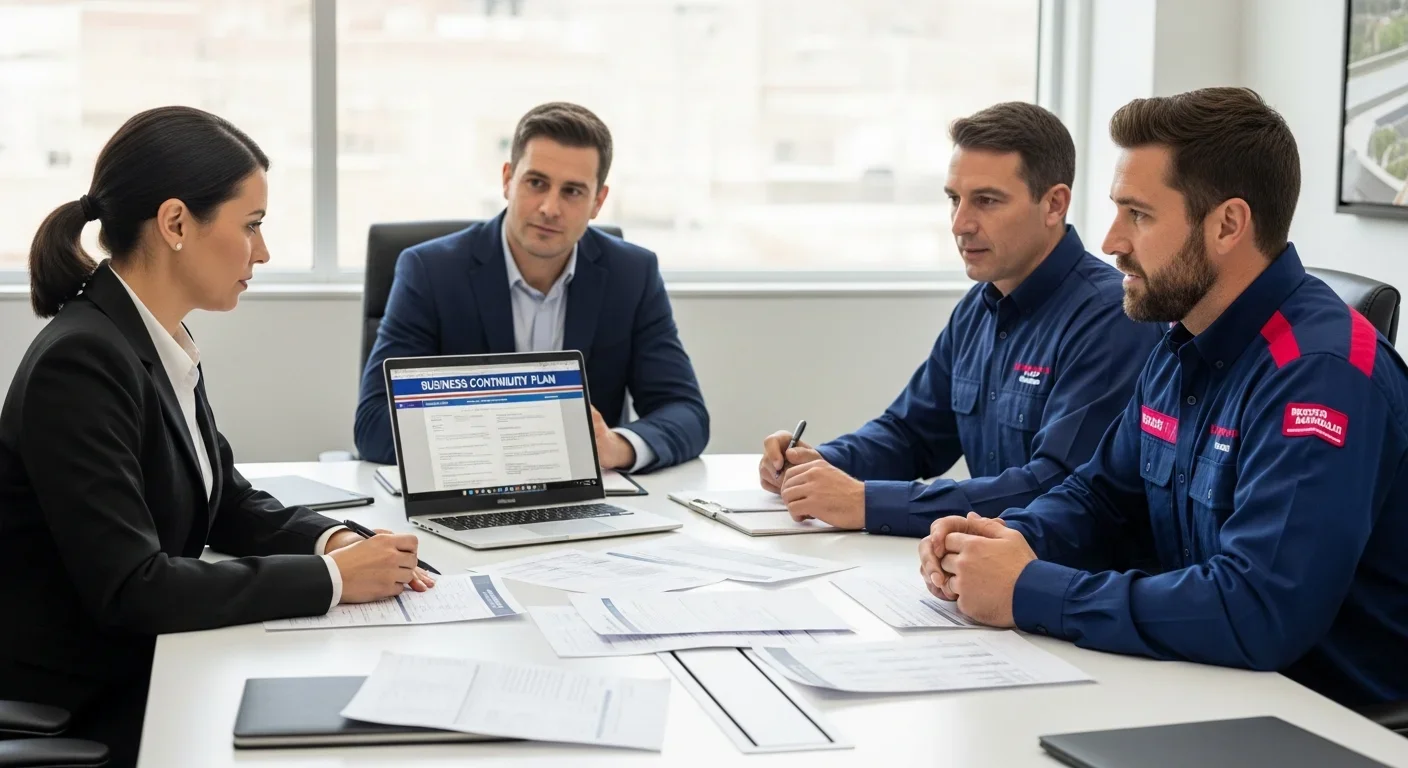
We understand that property managers and facility directors juggle dozens of responsibilities during a disaster. You need a restoration partner who operates independently, communicates proactively, and delivers results you can report up the chain with confidence.

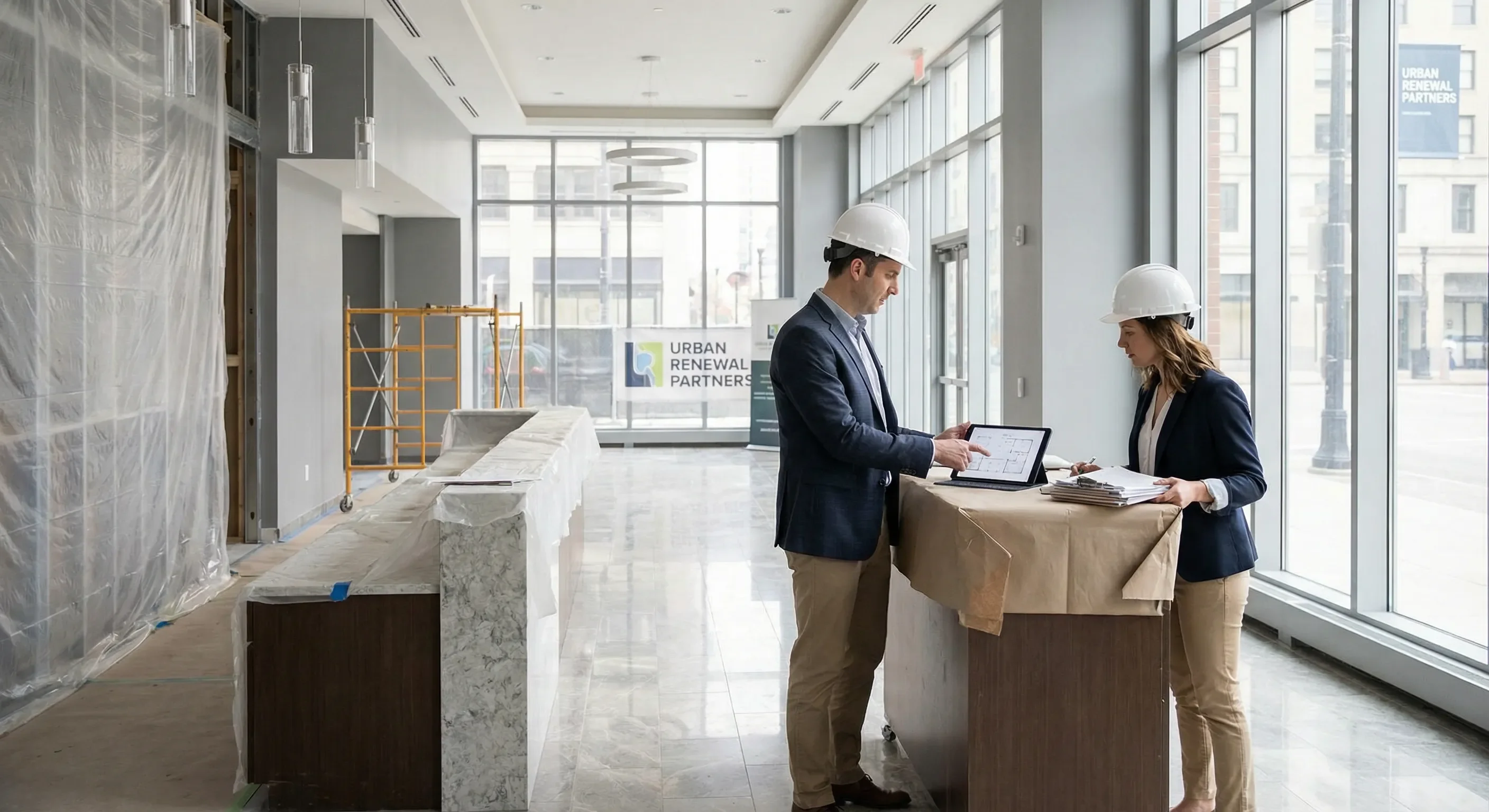
Property manager and restoration project manager reviewing plans in commercial building

Communication Protocols

Property Managers

Structured updates at the cadence you need. Daily written progress reports, scheduled check-in calls, and a dedicated project manager who answers when you call. We provide tenant-facing communications and talking points so your team delivers consistent messaging.

Reporting & Documentation

Asset Managers

Photo-documented progress reports, moisture readings, equipment logs, and scope updates delivered on schedule. Everything formatted to pass along to building owners, boards, or asset managers. Our documentation supports both insurance claims and stakeholder accountability.

Tenant Coordination

Multi-Tenant Properties

We help manage tenant expectations and minimize disruption. From notifying tenants about affected areas to coordinating access schedules and addressing concerns, our team acts as an extension of your management office during the restoration process.

Vendor Management Integration

Facility Teams

We integrate with your existing vendor ecosystem. If your building has preferred HVAC, electrical, or elevator contractors, we coordinate with them directly. Our team manages scheduling conflicts and ensures all trades work efficiently without stepping on each other.

Portfolio-level partnerships

We offer priority response agreements for property management companies overseeing multiple buildings, with pre-arranged pricing and guaranteed response times.

Discuss Partnership

TPA & Carrier Integration

Built for the way commercial claims actually move

Commercial claims live in TPA portals, carrier vendor networks, and digital chain-of- custody workflows that residential restorers rarely touch. Palm Build is engineered to operate inside those systems — pre-approved, portal-native, and documentation-ready from day one.

Pre-Approved Vendor Programs

Palm Build is an established vendor across major commercial TPA networks and carrier programs.

  • Contractor Connection (Crawford & Company)
  • Code Blue (CRDN)
  • Alacrity Solutions
  • Sedgwick property restoration
  • Direct vendor agreements with national commercial carriers
  • State Farm, Travelers, Liberty Mutual, Chubb, AIG commercial workflows
Pre-approved status accelerates assignment and reduces back-and-forth on commercial claims.

Digital Chain of Custody

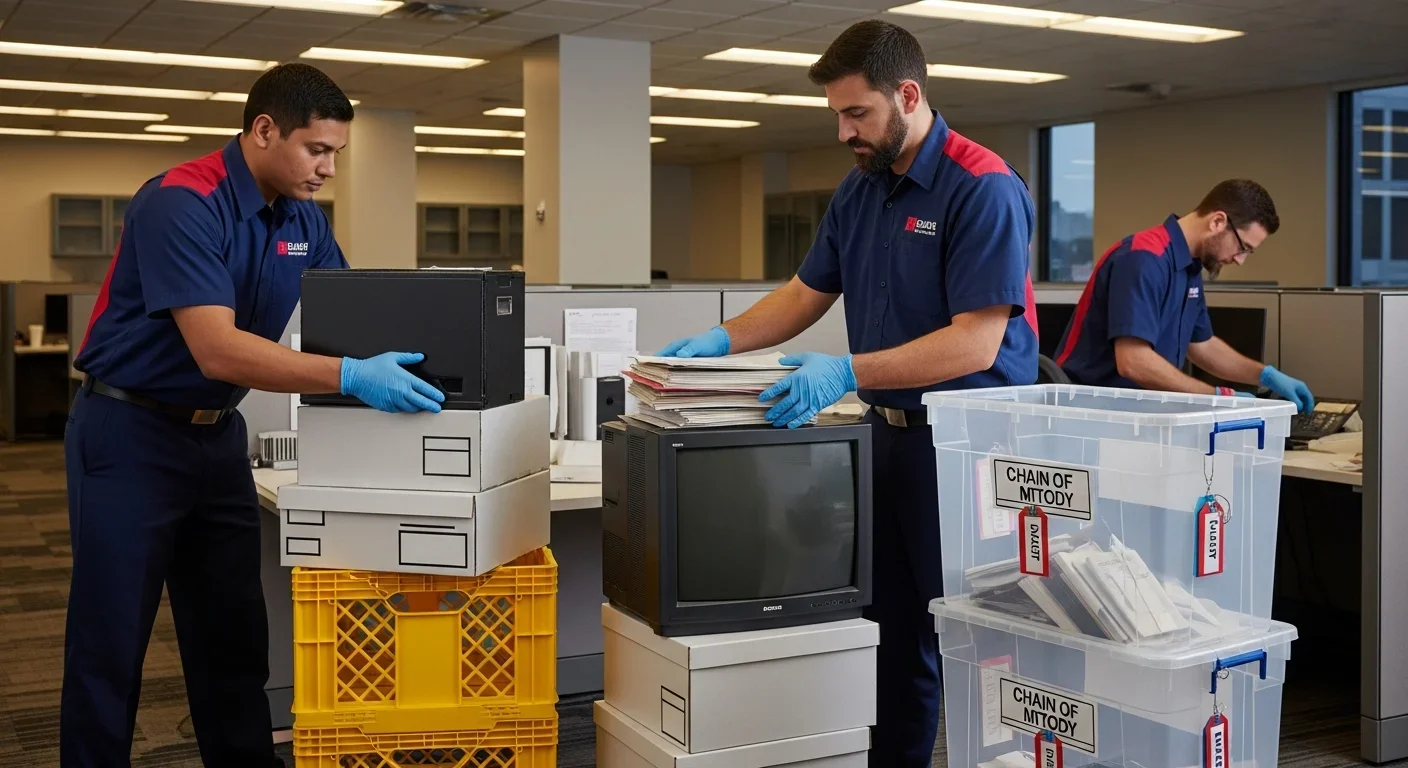
Every commercial loss is documented from first-call to closeout with TPA-portal-ready deliverables.

  • Initial damage assessment with geo-tagged photos
  • Daily moisture readings exported to portal
  • Xactimate estimates and supplements
  • Contents pack-out manifests with chain-of-custody tags
  • Subcontractor / specialty vendor coordination logs
  • Final completion package with permits, inspections, and clearance reports
Documentation is generated in parallel with the work — never reconstructed after the fact.

Required Documentation Standards

Commercial claims need more than residential — and we deliver the standards carriers and TPAs expect.

  • Xactimate-format estimates with line-item granularity
  • BI / extra-expense supporting documentation
  • OSHA-compliant site safety plans on file
  • Certificates of insurance (general liability, auto, workers' comp, umbrella)
  • Licensing documentation for FL, NC, SC
  • W-9, vendor onboarding packets, ACH payment setup
Onboarding documentation is delivered same-day so commercial claims do not stall on paperwork.

Pre-Approved Across Major Commercial TPA & Carrier Networks

Contractor Connection
Code Blue
Alacrity
Sedgwick
Crawford
Travelers
State Farm Commercial
Liberty Mutual
Chubb
AIG
Zurich
Nationwide

Logos shown as placeholder; partner relationships maintained directly with each carrier and TPA.

Already on a TPA panel? We integrate cleanly.

If you assign Palm Build through your existing TPA or carrier vendor program, we accept the assignment, follow the documentation cadence, and submit through the portal you already use. No friction, no proprietary tooling required.

See Insurance Process Details

Commercial Insurance Walkthrough

A complete commercial insurance claim, end to end

Commercial insurance is more layered than homeowner — multiple coverages, time-element BI provisions, and ordinance/law upgrades all interact. This walkthrough explains the coverages, the 6-step process, and the breakdown of a representative $75,000 commercial claim.

Commercial vs. homeowner: the structural differences

Homeowner

  • · Named peril (fire, wind, water from named events)
  • · Single dwelling structure + contents
  • · Additional Living Expense (ALE) for displacement
  • · Replacement cost typically standard
  • · Single-page declarations page

Commercial

  • · All-risk (covered unless specifically excluded)
  • · Building, business personal property, contents, equipment
  • · Business Income (BI) + Extra Expense for revenue loss
  • · May be ACV or RC; deductibles often percentage-based
  • · Multi-page schedules, blanket limits, sub-limits

The four coverages on every commercial claim

Commercial Property

Building structure, improvements, fixtures, and on-site equipment. Usually all-risk on commercial vs. named-peril on homeowner.

All-risk policies cover losses unless specifically excluded — broader than homeowner. Replacement cost vs. actual cash value matters: ACV settlements depreciate, RC pays the cost to replace.

Business Income (BI)

Lost net income + continuing expenses while operations are interrupted by a covered loss.

Time-element coverage. Settlement is based on what you would have earned, less variable expenses, plus payroll and rent. Documentation drives the claim — the better the timeline, the better the settlement.

Extra Expense

Costs to expedite repairs, rent temporary space, or otherwise minimize the duration of the BI loss.

Extra expense pays for things you would not normally pay for (overtime crews, temp generators, alternative location rent) when those expenses are reasonable and reduce BI loss. Often under-utilized.

Ordinance & Law

Cost to bring undamaged portions of the building up to current code as part of repair.

Particularly important for older commercial buildings. If you have to upgrade fire sprinklers, ADA hardware, or electrical to current code as part of the rebuild, this coverage closes the gap between policy limits and actual cost.

The 6-step commercial claim process

01

First Notice & Stabilization

Loss reported to carrier and Palm Build simultaneously. Initial damage photos, video, and assessment captured. Mitigation begins to stop further damage.

Deliverable: Initial assessment report

02

Adjuster Coordination

Commercial adjuster (carrier or independent) meets on-site with Palm Build PM. Scope of loss reviewed. TPA assignment confirmed.

Deliverable: Joint scope walkthrough

03

Xactimate Estimate Submitted

Detailed line-item Xactimate estimate written and submitted to carrier/TPA. Includes mitigation, demo, drying, contents, and reconstruction scopes.

Deliverable: Xactimate package

04

Restoration Execution & Daily Reporting

Mitigation, demo, drying, and reconstruction performed in phases. Daily moisture readings, photos, and progress reports submitted to TPA portal.

Deliverable: Daily progress logs

05

BI Documentation & Supplements

Restoration timeline documented for BI substantiation. Supplemental damage discovered during work submitted with photo evidence and revised scope.

Deliverable: BI timeline + supplements

06

Closeout & Final Payment

Independent verification, AHJ inspections, ADA reopening checks. Final completion package delivered. Final invoice and BI claim closed.

Deliverable: Closeout package

Sample $75,000 Claim Breakdown

What a representative commercial water loss looks like

Mid-size office building (~3,500 sq ft affected), Cat 2 water from a sprinkler discharge, 10-day drying timeline, full reconstruction with after-hours phasing.

Line ItemAmount
Emergency mitigation (extraction + drying)$8,500
Demolition & debris removal$6,200
Structural drying equipment + monitoring (10 days)$9,800
Antimicrobial / containment$3,200
Reconstruction (drywall, paint, flooring, trim)$28,500
Contents pack-out, cleaning, return$5,400
After-hours / weekend labor premium (+25%)$4,800
Project management & documentation$4,100
Permits & inspection coordination$1,900
Code upgrades (ADA hardware, fire alarm)$2,600
Estimated total$75,000
Note: A typical commercial BI claim alongside a $75,000 property claim might add $15,000–$80,000+ in lost income depending on the property type, daily revenue, and how long the building was unable to operate. Faster restoration directly reduces BI exposure — that is why every day of timeline compression has measurable claim value.

Standards & Compliance

Commercial-Grade Quality and Compliance

Commercial restoration demands a higher standard of safety, compliance, and documentation than residential work. Our teams operate under formal safety programs and hold the certifications commercial clients require.

IICRC Certified Technicians

Our commercial restoration technicians hold IICRC certifications in water restoration, fire and smoke restoration, and mold remediation. Advanced certifications include Commercial Drying Specialist (CDS) and Applied Structural Drying (ASD).

OSHA Compliance

Every commercial job site operates under a written safety plan. Crews follow OSHA construction standards including fall protection, PPE requirements, hazard communication, and proper scaffolding practices. We maintain a strong safety record and carry full workers compensation coverage.

Permitting & Inspections

We pull all required building, electrical, plumbing, and mechanical permits for commercial reconstruction. Our team schedules and attends all inspections through final certificate of occupancy or completion.

Licensed General Contracting

Palm Build holds active general contractor licenses in Florida and North Carolina. We are insured, bonded, and qualified to manage commercial restoration projects of any scale. Proof of insurance is available on request.

ADA Compliance

Commercial reconstruction must meet ADA accessibility requirements. When significant repairs trigger ADA upgrades, we identify those requirements during scope development and implement them correctly during the rebuild.

Fire Code & Life Safety

Restored commercial properties must pass fire marshal inspection before reopening. We ensure fire alarms, sprinkler systems, exit signage, and emergency lighting are fully functional and code-compliant after any restoration work.

Regulatory Compliance Deep Dive

Commercial restoration is a regulated activity

OSHA, EPA, ADA, IICRC, state building codes, and health departments all touch a commercial restoration project. Palm Build maintains active certification across each framework so your reopening is not stalled by a missing inspection or unfiled permit.

RegulationScopePalm Build ComplianceDocumentation
OSHA 29 CFR 1926Construction industry safety standards for restoration job sitesOSHA 30 certification for project managers, OSHA 10 for technicians, site-specific safety plan for every job, fall protection, lockout/tagout, respiratory protection programSite safety plan (SSP), training records, JSA per task, daily safety briefing log
OSHA 29 CFR 1910 (General Industry)Industrial / warehouse environments, hazard communication, PPEHazCom training, SDS access, full PPE (eye/ear/respiratory/foot), forklift operator certification when requiredHazCom binder, SDS index, PPE issue log, forklift cards
EPA RRP Rule (40 CFR 745)Renovation, repair, painting in pre-1978 buildings with child-occupied facilities or residential portionsEPA RRP-certified renovators on every triggered job, lead-safe work practices, containment, dust control, HEPA cleaning, cleaning verificationEPA firm certification, RRP renovator cards, pre-renovation pamphlet receipt, cleaning verification record
ADA Title IIICommercial places of public accommodation — accessible routes, restrooms, parking, signage, hardwareReopening readiness coordination with AHJ, ADA-knowledgeable architects on rebuild, replaced finishes meet current ADA standardsADA reopening checklist, AHJ inspection sign-off, finish substitution log
IICRC S500 / S520Water damage restoration (S500) and mold remediation (S520) industry standardsIICRC-certified WRT, AMRT, ASD, CDS, FSRT, OCT, and CMP technicians; psychrometric drying targets; containment protocolsDaily moisture readings, drying log, containment photos, clearance reports
HIPAA-Adjacent (Healthcare/Medical)Restoration in healthcare environments where patient information may be present in work zonesBAA where required, HIPAA-aware crew briefing, no photography of PHI, secured pack-out for any clinical paper recordsBAA on file, HIPAA briefing log, chain-of-custody for clinical records
FL Building Code (Chapter 11 — Hospitality)Hotel and lodging reopening — egress, life safety, fire alarm, ADA accessible roomsFL state-licensed GC, hurricane wind-load on exterior repairs, FL Building Code post-loss reinspectionPermit packets, inspection records, life-safety re-certification
NC Building Code Commercial (12-Chapter)NC commercial repair permits, structural, mechanical, electrical, fireNC state-licensed GC, building / mechanical / electrical / fire inspection coordinationNC permit set, inspection certificates, sign-off log
Health Department (Restaurant / F&B)Restaurant, commercial kitchen, hotel F&B reopening after fire/water/sewageHood / duct decontamination, ANSUL re-certification, walk-in cooler condition, sanitization logHealth-dept reinspection report, ANSUL certificate, sanitization record, manager sign-off

The reopening cost of a missed inspection is the BI loss extension.

A single failed AHJ inspection at reopening can extend a hotel's BI loss by days. Palm Build builds the inspection / permit / certification trail in parallel with the work — not at the end — so closeout is the day the work is finished, not the day the paperwork catches up.

Regional Expertise

Commercial Restoration by Region

Commercial building codes, climate risks, and market conditions vary significantly across our service areas. Local knowledge directly affects restoration speed, cost accuracy, and compliance.

Hurricane Preparedness & Recovery

Florida commercial properties face hurricane risk every season. We offer Emergency Response Plans (ERPs) with pre-arranged pricing and guaranteed priority response when storms make landfall. Post-hurricane, we mobilize commercial-scale equipment and crews to get your facility operational fast.

Florida Building Code (FBC)

Commercial reconstruction must comply with the FBC, one of the strictest in the nation. Wind-resistance upgrades, impact-rated materials, and structural connection requirements frequently add scope to commercial rebuilds. We manage these code-driven upgrades and file for Ordinance and Law coverage.

The 50% Rule in Flood Zones

If restoration costs exceed 50% of the commercial building value in a FEMA-designated flood zone, the entire structure may need to be brought to current flood elevation and code standards. This can dramatically change the scope and cost of a project. We assess this threshold early and advise accordingly.

Humidity and Mold Prevention

Florida humidity accelerates mold growth to within 48 hours of water intrusion. Commercial properties with central HVAC can spread spores throughout multi-floor facilities if not addressed immediately. Our commercial drying protocols account for Florida climate conditions.

Regional Commercial Snapshot

Commercial coverage across FL, NC, and SC

Three states, three different commercial profiles, one program. Below is the snapshot of Palm Build commercial activity in each state — with the local hub, the case volume, and the property-type specialties that define our work in that region.

300+

Florida

Hurricane CAT response · South FL hub

Commercial losses served

South Florida response hub

Deerfield Beach

Specialties

  • Hurricane CAT response with pre-staged equipment
  • Hospitality and high-rise condo focus
  • Florida Building Code wind-resistance compliance
  • County-by-county health-dept coordination (F&B)
  • FEMA flood-zone substantial-improvement evaluation
450+

North Carolina

Charlotte + Raleigh commercial base

Commercial losses served

Metrolina commercial dispatch

Charlotte (Crompton St)

Specialties

  • Banking, finance, and corporate-campus response
  • Winter pipe-burst high-rise response
  • Data-center / server-room sensitive drying
  • Historic district / preservation coordination
  • NC commercial GC license and reconstruction in-house
120+

South Carolina

Coastal commercial + hospitality corridor

Commercial losses served

Upstate + coastal coverage

Cross-border from Charlotte

Specialties

  • Charleston, Myrtle Beach, Hilton Head hospitality
  • Coastal hurricane and salt-air corrosion expertise
  • Tourism-season expedited restoration timelines
  • SC DHEC food-service reinspection coordination
  • Cross-state CAT crew movement from NC and FL

For multi-state CAT events, we coordinate cross-state crew movement and pre-position equipment ahead of forecasted storms. One PM, one program, three states.

Large Loss Handling

Multi-Family · HOA · Large-Loss Crossover

When a commercial loss is also a multi-family event

Mixed-use, condo, and HOA-managed properties cross every line: a single burst riser involves the commercial floor below, the residential units above, the HOA board, and the property manager. Palm Build runs the whole event under one project track — no handoffs, no finger-pointing.

The Corridor Strategy

Corridor-by-corridor execution that keeps residents at home

In multi-family and condo properties, full displacement is expensive and politically painful. Palm Build's corridor strategy keeps residents in unaffected wings or floors while we restore the affected zones. Tenant notifications go out daily; common areas stay clean and accessible; HOA boards get a standing report.

  • Tenant notification cadence: daily access changes, anticipated noise windows, and contact for after-hours questions
  • Common-area protection: lobby, mail room, gym, pool deck safeguarded with poly, signage, and walkway protection
  • Phased displacement minimization: only the units that absolutely must be displaced are vacated; everyone else stays put
  • HOA / property manager standing report: daily progress brief designed for board meetings and owner communications
Palm Build commercial restoration crew responding to a multi-family apartment building water loss

Multi-Family Response

Corridor strategy in action

Commercial Damage Assessment

What Type of Damage Is Your Business Facing?

Select your situation to understand how we can help your business recover.

How to Choose a Commercial Restoration Partner

Three pillars to evaluate before you assign your next loss

Property managers and TPAs get the most pain from contractors that look commercial on paper but can’t actually run a commercial loss. Use this 3-pillar framework to separate real commercial restorers from residential shops in commercial clothing.

01

Capacity Verification

Can the contractor actually mobilize at commercial scale? Property managers and TPAs get burned by residential restorers who promise commercial capability and then sub everything out at the first crew gap.

What to look for

  • In-house truck-mount fleet (not rented per job)
  • Documented headcount of W-2 technicians, not 1099 referrals
  • Reference list of recent commercial losses with verifiable PMs
  • In-house reconstruction capability (or formal GC partnership)
  • Demonstrated multi-state coordination on a real project

Red flags

  • "We can scale up if needed" without crew names attached
  • No real photos of commercial trucks or commercial PPE
  • References that all turn out to be residential losses
  • No commercial GC license in the states they claim to serve
  • Unwilling to share the actual PM who would run your project
02

TPA Program Status

Is the contractor pre-approved with the TPAs and carrier programs that handle your portfolio? Pre-approved status determines how fast claims move and how much friction you absorb on every loss.

What to look for

  • Active vendor status on major TPA panels (Contractor Connection, Crawford, Code Blue, Alacrity, Sedgwick)
  • Direct vendor agreements with major commercial carriers
  • Demonstrated daily portal reporting cadence on past claims
  • Xactimate-format estimates as standard, not optional
  • Documented chain of custody for property and contents

Red flags

  • "We can get on a TPA panel if you need us to"
  • Estimates delivered in PDF instead of Xactimate format
  • No examples of past TPA portal submissions
  • Friction with adjusters on past commercial claims
  • Refusal to follow documented carrier program rules
03

Documentation Standards

Can the contractor produce the documentation a commercial claim — and a business interruption claim — actually requires? Documentation is the difference between a clean closeout and a 6-month dispute.

What to look for

  • Daily moisture readings exported to a real platform, not handwritten
  • Geo-tagged photo evidence with timestamp on every site visit
  • Restoration timeline documentation built for BI substantiation
  • Permit, inspection, and clearance records compiled in parallel
  • Final completion package delivered before final invoice

Red flags

  • Documentation reconstructed at the end of the project
  • No moisture log, no daily photos, no daily report
  • BI timeline missing or vague
  • Permits chased after the fact (often after a failed inspection)
  • Closeout package incomplete or "we will get it to you next week"

The framework is the deliverable. Palm Build can produce evidence on every line of all three pillars. If a contractor can’t do the same, that gap is going to show up at 2 a.m. on the worst possible commercial loss day.

Industry-Specific Guides

Commercial Restoration by Property Type

Every property type has its own restoration playbook. Explore detailed guides for your specific commercial property — including compliance requirements, typical timelines, and what to expect from first call to reopening.

Office Building Restoration

Office Building Restoration

Multi-tenant offices · IT-protected · After-hours work

Multi-tenant office restoration with server-room and IT protection, after-hours work, and tenant coordination. Corporate campuses, high-rise facilities, and Class A commercial space.

  • Server room protection
  • Tenant coordination
  • Floor-by-floor execution
Read guide
Retail Store Restoration

Retail Store Restoration

Storefronts · Inventory salvage · Rapid reopening

Customer-facing space restoration, inventory salvage, brand-standard finishes, and rapid reopening strategies for retail businesses protecting both revenue and brand reputation.

  • Inventory protection
  • Brand-standard finishes
  • Sign permit coordination
Read guide
Warehouse & Industrial Restoration

Warehouse & Industrial Restoration

Large-scale drying · Inventory · Equipment recovery

Large-scale drying, inventory protection, industrial equipment assessment, and production line recovery for manufacturing and distribution facilities. OSHA 1910 compliant.

  • Large-loss extraction
  • Racking integrity
  • Production line recovery
Read guide
Hotel & Hospitality Restoration

Hotel & Hospitality Restoration

Phased work · Brand standards · Guest occupancy preserved

Phased corridor and room-block restoration that keeps guest occupancy open in unaffected wings. Brand-standard finishes, F&B health-department coordination, and ADA reopening readiness.

  • Phased room blocks
  • Brand-standard finishes
  • ADA reopening compliance
Read guide
Restaurant & Kitchen Restoration

Restaurant & Kitchen Restoration

Kitchen fires · Health dept · ANSUL re-cert

Commercial kitchen fires, hood and duct decontamination, walk-in cooler failures, and rapid health-department reopening. ANSUL re-certification and equipment salvage included.

  • Hood / duct decon
  • Health dept reopening
  • ANSUL re-certification
Read guide
Healthcare & Medical Facility Restoration

Healthcare & Medical Facility Restoration

ICRA Class III/IV · Sterile field · Patient safety first

Hospital, clinic, surgery center, dental, imaging, and senior living restoration with ICRA Class III/IV containment, sterile field protection, equipment-sensitive drying, and HIPAA-aware crew protocols.

  • ICRA Class III/IV
  • Sterile field protection
  • HIPAA-aware crews
Read guide

Local Service Pages

Commercial Restoration by City

Aventura, FL

Tier 4 · Local office

Belmont, NC

Tier 2 · Local office

Boca Raton, FL

Tier 1 · Local office

Boynton Beach, FL

Tier 1 · Local office

Charlotte, NC

Tier 1 · Local office

Clover, SC

Tier 2 · Local office

Coconut Creek, FL

Tier 2 · Local office

Concord, NC

Tier 1 · Local office

Coral Springs, FL

Tier 2 · Local office

Cornelius, NC

Tier 2 · Local office

Dania Beach, FL

Tier 4 · Local office

Davie, FL

Tier 4 · Local office

Deerfield Beach, FL

Tier 2 · Local office

Delray Beach, FL

Tier 1 · Local office

Fort Lauderdale, FL

Tier 1 · Local office

Fort Mill, SC

Tier 1 · Local office

Gastonia, NC

Tier 1 · Local office

Greensboro, NC

Tier 4 · Local office

Hallandale Beach, FL

Tier 4 · Local office

Hollywood, FL

Tier 2 · Local office

Huntersville, NC

Tier 2 · Local office

Indian Land, SC

Tier 2 · Local office

Indian Trail, NC

Tier 2 · Local office

Jupiter, FL

Tier 2 · Local office

Lake Worth Beach, FL

Tier 2 · Local office

Lauderhill, FL

Tier 4 · Local office

Lighthouse Point, FL

Tier 4 · Local office

Margate, FL

Tier 3 · Local office

Matthews, NC

Tier 1 · Local office

Miami, FL

Tier 2 · Local office

Miramar, FL

Tier 2 · Local office

Monroe, NC

Tier 2 · Local office

Mooresville, NC

Tier 2 · Local office

Mount Holly, NC

Tier 2 · Local office

Oakland Park, FL

Tier 3 · Local office

Orlando, FL

Tier 4 · Local office

Palm Beach Gardens, FL

Tier 2 · Local office

Parkland, FL

Tier 2 · Local office

Pembroke Pines, FL

Tier 2 · Local office

Plantation, FL

Tier 2 · Local office

Pompano Beach, FL

Tier 1 · Local office

Raleigh, NC

Tier 4 · Local office

Rock Hill, SC

Tier 1 · Local office

Shelby, NC

Tier 2 · Local office

Sunrise, FL

Tier 2 · Local office

Tamarac, FL

Tier 3 · Local office

Tega Cay, SC

Tier 2 · Local office

Waxhaw, NC

Tier 1 · Local office

West Palm Beach, FL

Tier 1 · Local office

Weston, FL

Tier 3 · Local office

York, SC

Tier 2 · Local office

Property Damage Affecting Your Business?

Every hour of downtime costs your business money. Our commercial teams respond 24/7 and are equipped to handle any size commercial loss — from a single office to an entire campus. Get emergency response now or schedule a commercial assessment.

Commercial Restoration FAQ

Answers about commercial property restoration, minimizing business downtime, TPA and carrier coordination, regulatory compliance, and what property managers and facility managers should expect from emergency response through reopening.

FAQ Topics

Commercial Restoration Services

Our commercial restoration services cover every damage type and property category: water extraction and structural drying for offices and warehouses, fire and smoke cleanup for restaurants and retail, commercial mold remediation, storm damage repair, content restoration, and complete reconstruction. We serve offices, retail spaces, restaurants, hotels, warehouses, industrial facilities, healthcare clinics, medical facilities, schools, and multi-tenant buildings throughout Florida, North Carolina, and South Carolina.

Still have questions about commercial restoration services?

Business Downtime Costs Money. We Minimize Both.

Commercial property damage affects your revenue, employees, and customers. Our teams respond 24/7 and work around your schedule to restore your property while minimizing disruption to business operations.

Business Focused

Minimize operational impact

24/7 Response

Immediate emergency mobilization

After-Hours Work

Restore around your schedule

BI Documentation

Business interruption claims

Request Emergency Service

Need help right now? Call us.

24/7 live dispatch — average answer time under 30 seconds

(888) 245-5155