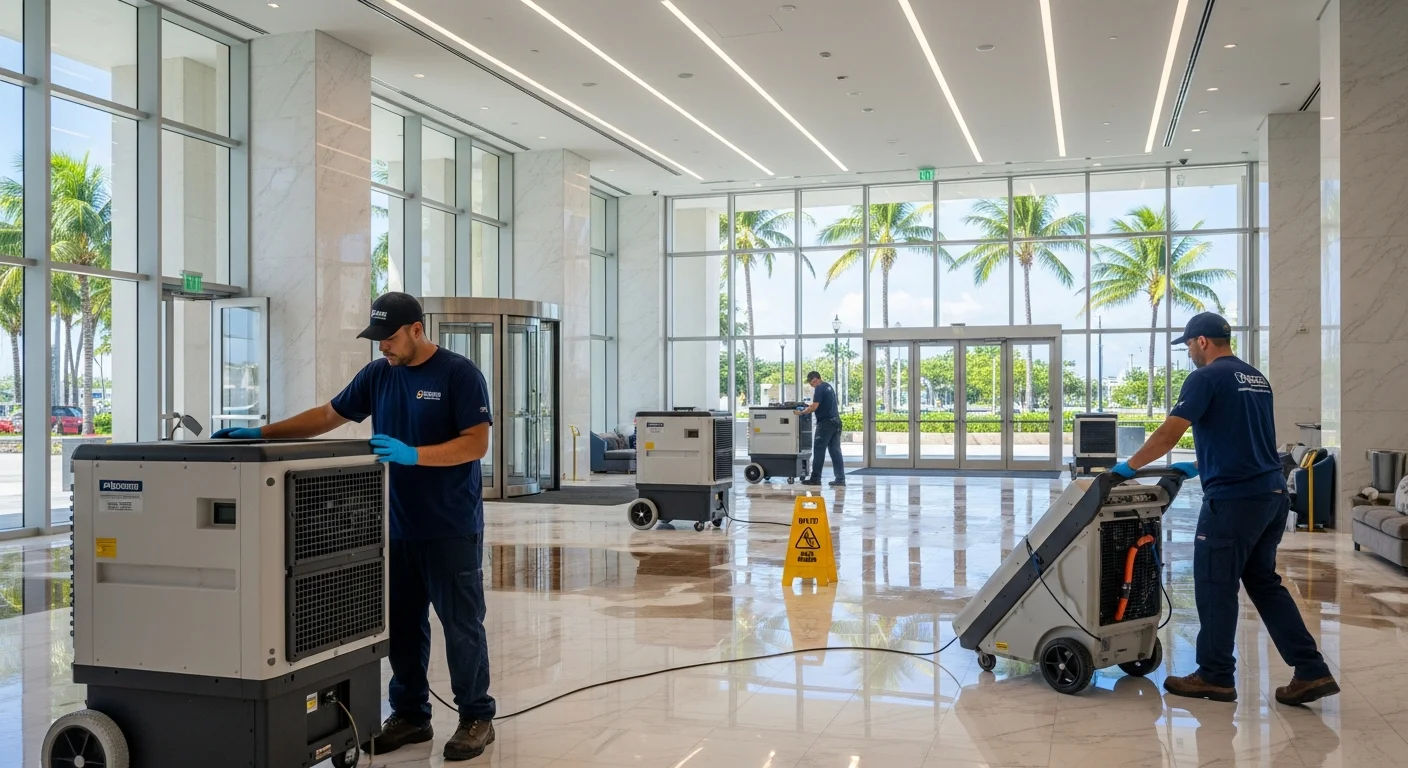
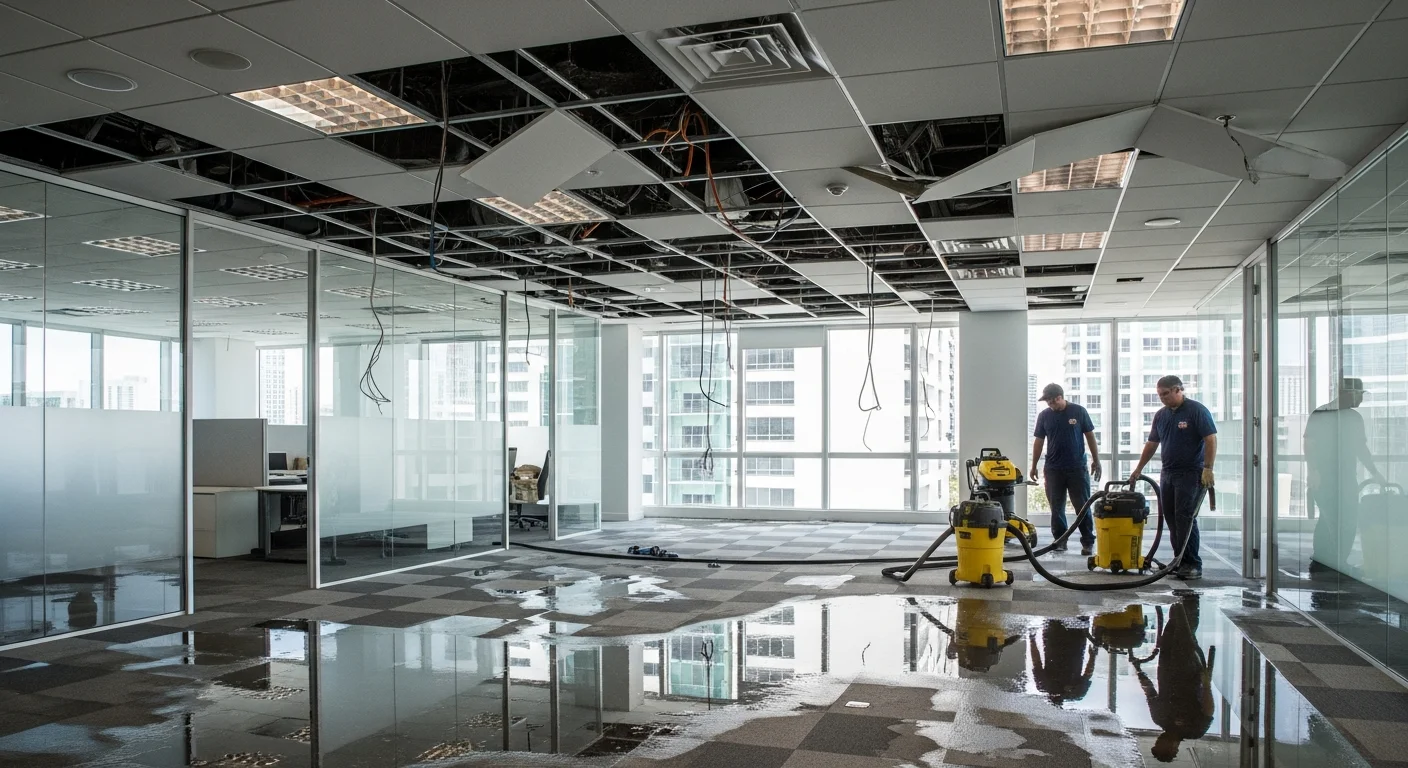
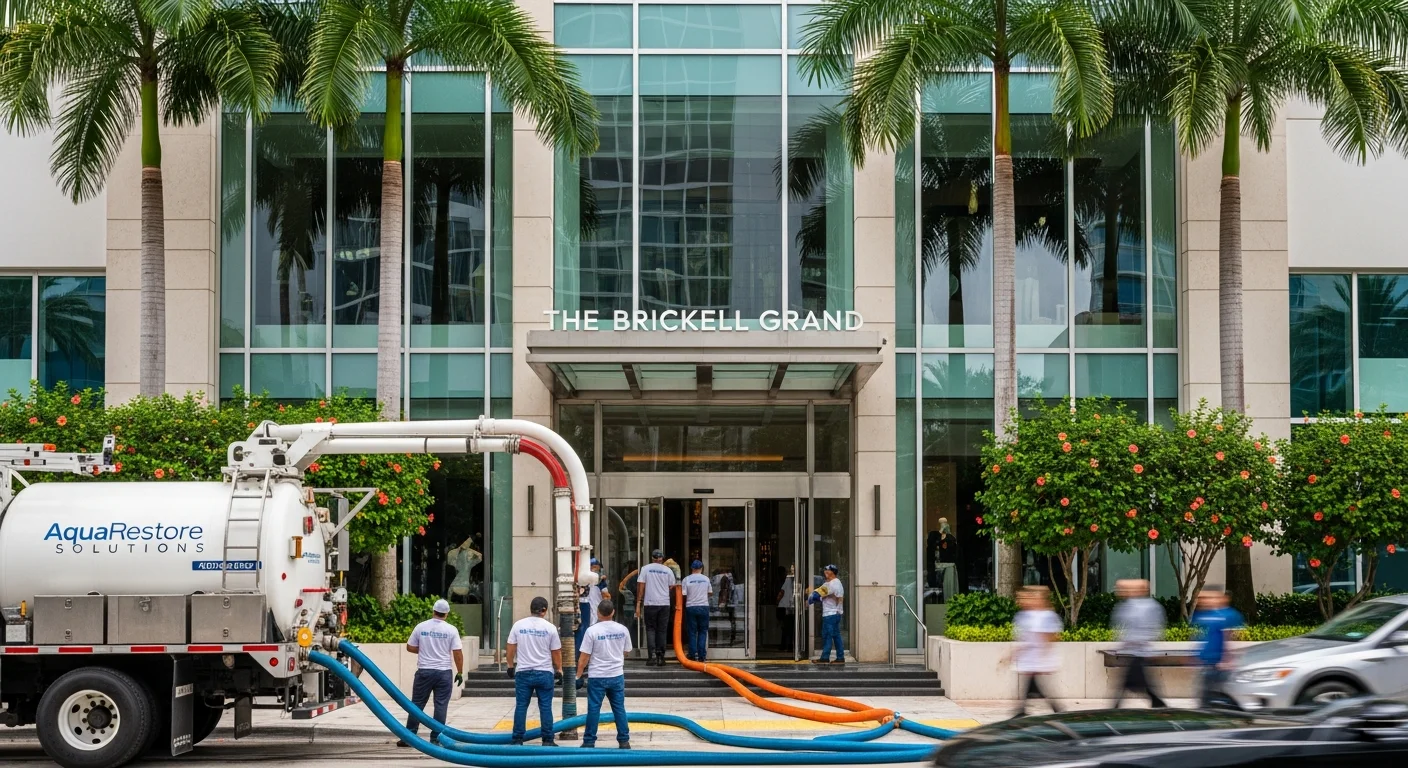
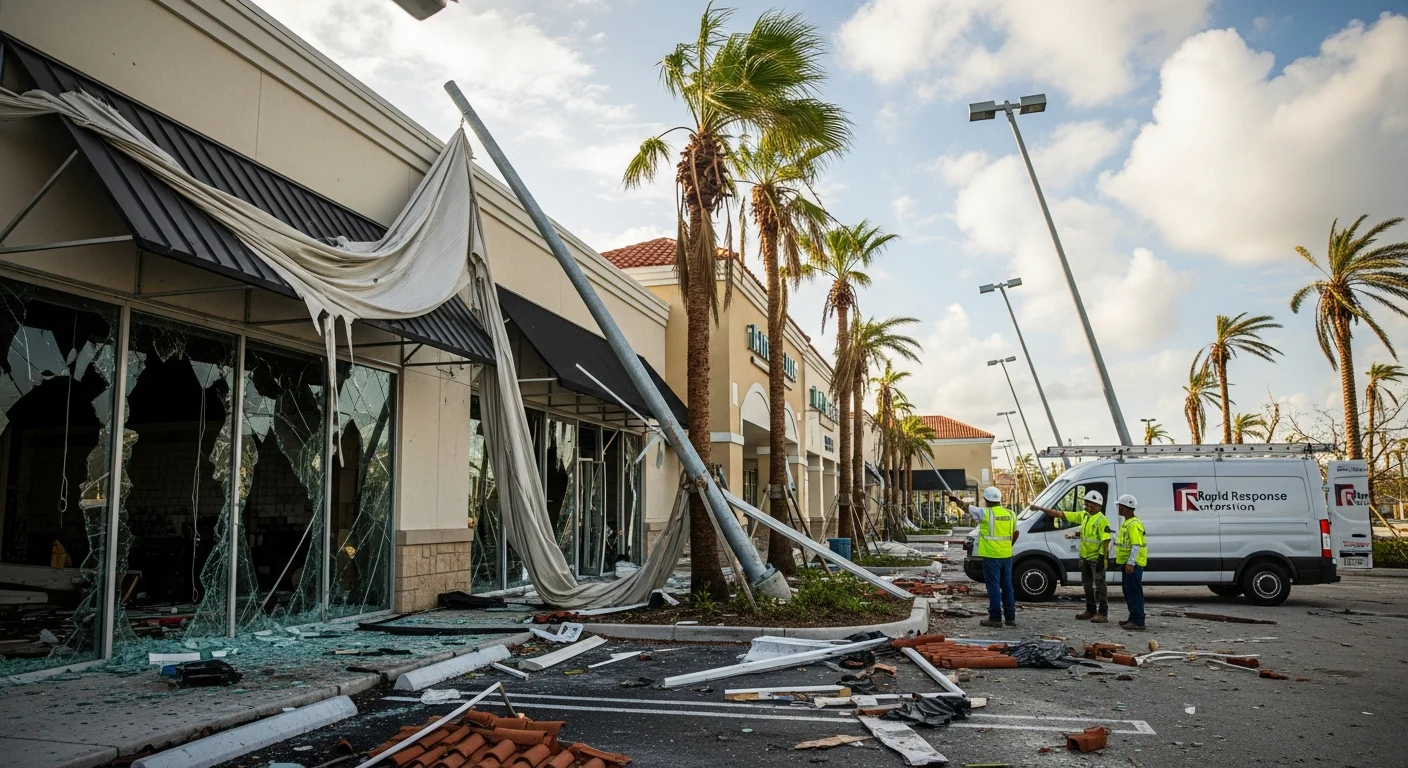
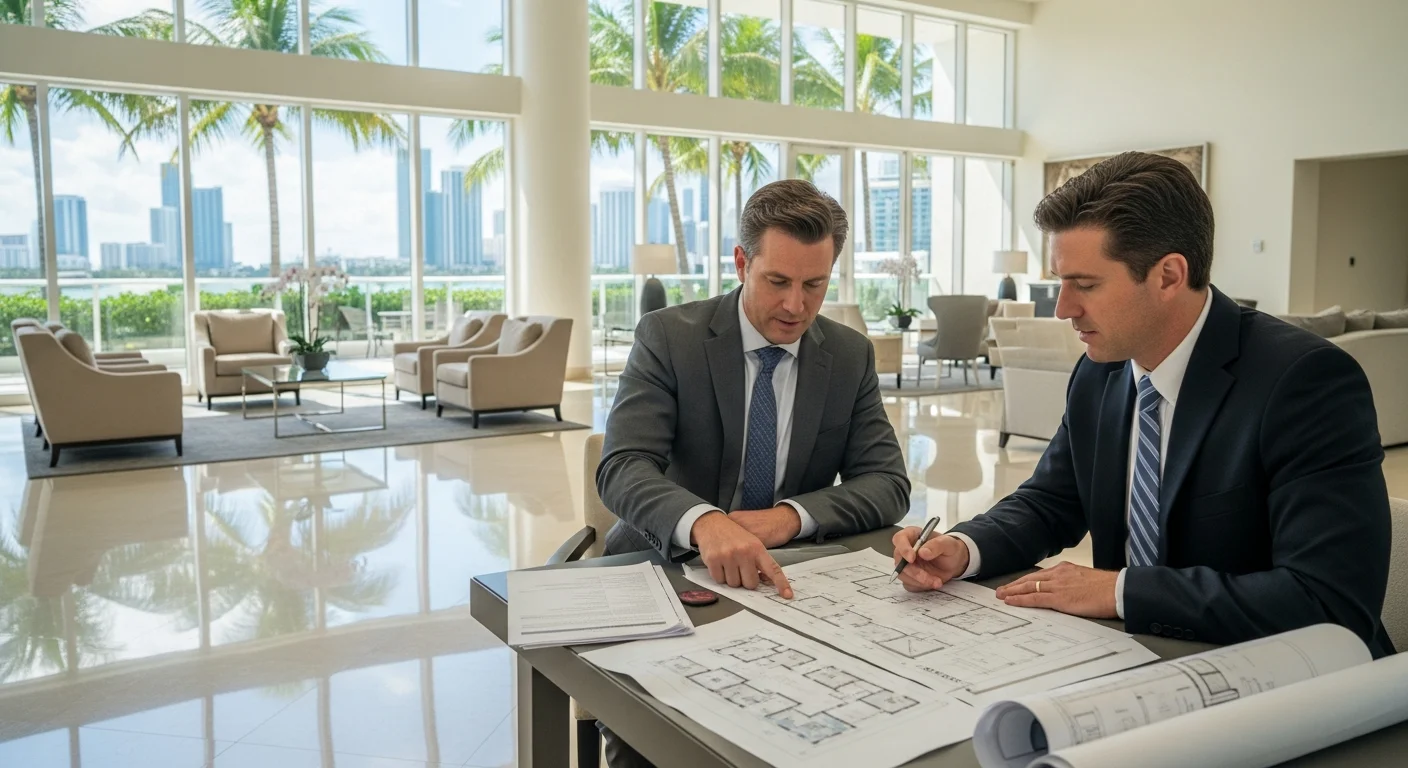
From Brickell's 70+ financial towers and Wynwood's gallery-filled warehouse conversions to Miami Beach's Art Deco hotel district and Doral's corporate campuses, Palm Build provides 24/7 commercial restoration with HVHZ-compliant reconstruction, high-rise building expertise, and insurance documentation built for Miami-Dade's $40 billion commercial economy. Our Deerfield Beach team responds in under 60 minutes with commercial-grade equipment.
Deerfield Beach — Rapid Response to Miami-Dade Under 60 min Response IICRC Certified
Why Commercial Restoration in Miami Requires a Different Approach
Commercial property damage in Miami is not "residential restoration at a bigger scale."
It's a fundamentally different discipline with different urgency, stakeholders,
equipment, and insurance structures. In a city with 160+ restoration companies and a $40
billion commercial economy, choosing a restoration partner with genuine commercial
expertise is the most critical decision after the damage occurs.
Every Hour of Closure = Peak-Revenue Lost
Miami's $40 billion commercial economy operates at full intensity 365 days a year — there is no off-season to absorb a closure. A shuttered Miami Beach hotel loses $30,000-$80,000 per day in room revenue alone, before factoring restaurant, spa, and event income. A flooded Wynwood restaurant loses $5,000-$15,000 daily. A water-damaged Brickell office suite triggers lease abatement clauses and tenant relocation costs within days. Unlike residential restoration where the homeowner is inconvenienced, commercial restoration in Miami is a race against cascading revenue loss — and the restoration approach, equipment scale, and crew deployment must reflect that urgency.
Multi-Stakeholder Coordination at Scale
Commercial projects in Miami involve property owners, tenants, property managers, commercial insurance carriers (often multiple policies including Citizens Property Insurance), Miami-Dade County building officials, health departments, and sometimes condo association boards and attorneys. Brickell towers alone can have 30+ tenant suites affected by a single water event cascading through floors. In Wynwood's converted warehouses, adjacent galleries and restaurants share walls with minimal fire separation — one incident triggers multi-tenant coordination across separate insurance carriers, landlords, and business operators simultaneously.
High-Rise CBS Construction & HVHZ Code
Miami's commercial buildings are predominantly concrete block and stucco (CBS) construction built to Florida's High-Velocity Hurricane Zone (HVHZ) code — the most stringent wind-resistance standard in the nation. Brickell's 70+ towers present unique vertical water migration challenges: a sprinkler failure on the 30th floor sends water cascading through elevator shafts, plumbing chases, and electrical conduits to 15 floors below before anyone reaches the shutoff. CBS walls trap moisture behind stucco for weeks, and sealed building envelopes designed to resist hurricanes also trap humidity inside, accelerating mold growth in Miami's subtropical climate.
Florida's Most Complex Insurance Market
Miami-Dade's commercial insurance landscape is uniquely challenging — Citizens Property Insurance serves as the insurer of last resort for many properties, premiums have increased dramatically, and wind-vs-water coverage disputes after hurricane events create claim complexity that doesn't exist elsewhere. With 160+ restoration companies competing in Miami-Dade, most handle mitigation but lack the licensure for HVHZ-compliant reconstruction. Commercial policies include business interruption, extra expense, business personal property, equipment breakdown, inland marine, and ordinance-and-law coverages that must each be documented and claimed separately.
Property Expertise
Commercial Property Types We Restore in Miami
Each commercial property type has specific regulatory, safety, and operational
requirements that inform the restoration approach. Here's our Miami-specific expertise
across the major commercial property categories.
High-Rise Office Towers
Brickell's 70+ office and mixed-use towers — plus Downtown Miami's growing skyline — present the most complex commercial restoration scenarios in Florida. Sprinkler system failures, chiller line breaks, and riser pipe bursts create vertical water migration through multiple floors via elevator shafts and plumbing chases. A 30th-floor event can affect 10-15 floors below before anyone reaches a shutoff valve. Multi-tenant coordination across dozens of law firms, financial institutions, and corporate suites requires separate insurance documentation per tenant, server room protection protocols, and phased restoration to keep unaffected suites operational during the restoration process.
Hotels & Hospitality
Miami Beach's 400+ hotels and resorts — from Art Deco boutique hotels on Ocean Drive to full-service resorts on Collins Avenue — represent the highest-stakes commercial restoration in South Florida. Daily revenue losses can exceed $50,000 during peak season. Salt air corrosion, storm surge exposure, and constant humidity accelerate damage. Historic Art Deco properties require preservation-sensitive restoration approaches. Our phased approach keeps portions of the property operational during restoration, protecting online reviews and minimizing booking cancellations. Short-term rental properties in beach condo towers add complex owner-manager-platform coordination.
Restaurants & Nightlife
Miami's 800+ restaurants across Miami Beach, Wynwood, Brickell, Coconut Grove, and the Design District face unique restoration requirements. Commercial kitchens have grease-laden exhaust systems that complicate fire restoration, walk-in coolers requiring temperature maintenance during water events, and Miami-Dade County Health Department clearance before reopening. Wynwood's gallery-restaurant hybrid spaces require coordinated restoration across art salvage and food service compliance. We coordinate health department re-inspection as part of every food service restoration scope and phase work around service hours.
Retail & Shopping Centers
From the Design District's luxury flagships and Brickell City Centre to Wynwood's boutique retail and Doral's big-box centers, retail restoration must prioritize getting the sales floor operational first while continuing back-of-house and storage area restoration in parallel. Miami's year-round tourism traffic means there is no slow season to absorb closure losses. Premium retail spaces require exact-match finishes and specialized cleaning protocols for high-end fixtures, display cases, and inventory salvage.
Medical & Dental Facilities
Medical and dental facilities across Miami-Dade — concentrated along US-1, in Coral Gables, and in Doral's medical corridor — face the most complex regulatory restoration requirements. HIPAA-compliant document handling during water events, patient record protection, specialized equipment decontamination, pharmaceutical storage maintenance, and Florida Department of Health re-certification all add layers of complexity. Our medical facility restoration protocols address sterilization standards, biohazard containment, and the specialized HVAC filtration requirements for healthcare environments.
Warehouse, Industrial & Logistics
Doral's corporate corridor and the warehouse district near Miami International Airport feature distribution centers, logistics facilities, light manufacturing, and marine service companies with specialized fire suppression systems, high-value cargo inventory, and industrial equipment needing professional decontamination. These properties operate 24/7 — a single day of warehouse closure can disrupt deliveries across the entire Southeast. Florida's humidity accelerates mold growth in warehouses with compromised roofing, making rapid response critical for preventing secondary damage.
Condo Common Areas & Mixed-Use
Miami's condo-dense market — especially Brickell, Edgewater, and Miami Beach — combines residential units with commercial common areas: lobbies, fitness centers, restaurants, pools, parking garages, and mechanical rooms under a master HOA policy. Water events in high-rises cascade through multiple floors via elevator shafts and plumbing chases. Florida's 40-year building recertification requirement (enhanced post-Surfside) adds structural assessment complexity. We coordinate with boards, property managers, and association attorneys to ensure proper insurance allocation between master policy and unit-owner claims.
Local Market Knowledge
Miami's Commercial Corridors
Miami's commercial districts each have distinct property types, building ages, and
restoration challenges. Our team knows the specific requirements of each corridor — from
Brickell's dense financial towers to Wynwood's converted warehouse galleries and Miami
Beach's Art Deco hotel district.
Brickell Financial District
Types: Class A high-rise offices, mixed-use towers, luxury retail, fine dining, banking headquarters
Key challenges: Miami's densest commercial corridor packs 70+ office and mixed-use towers into a half-mile radius. Sprinkler system failures, chiller line breaks, and riser pipe bursts create vertical water migration through elevator shafts and plumbing chases — a 30th-floor event can affect 15 floors below. Multi-tenant coordination across dozens of law firms, financial institutions, and corporate suites requires separate insurance documentation per tenant and phased restoration to keep unaffected floors operational.
Downtown / Arts & Entertainment District
Types: Government buildings, courthouses, performing arts venues, mixed-use developments, transit hubs
Key challenges: Downtown Miami's major commercial corridors include government offices, the Adrienne Arsht Center for the Performing Arts, and rapidly growing mixed-use developments. Restoration challenges include coordinating with Miami-Dade County government operations, protecting irreplaceable cultural assets in performance venues, managing restoration around Metromover transit operations, and navigating older CBS construction alongside new high-rise developments — each with different building systems and code requirements.
Key challenges: Wynwood's converted warehouse district poses unique commercial restoration challenges. Minimal fire separation between tenants means one incident can damage an entire block of galleries, restaurants, and retail spaces. High-value art inventory requires specialized salvage and climate-controlled storage. The Design District's luxury retail flagships demand exact-match finishes and specialized cleaning protocols. Open-concept warehouse conversions with exposed ceilings and ductwork spread smoke and water contamination rapidly across large floor plates.
Key challenges: Miami Beach's hospitality corridor represents the highest-stakes commercial restoration in South Florida — daily revenue losses for hotels can exceed $50,000 during peak season. Historic Art Deco buildings require preservation-sensitive restoration approaches. Salt air corrosion, storm surge exposure, and constant humidity accelerate damage. Short-term rental properties in beach condo towers add complex owner-manager-platform coordination. Health department clearance is required before any restaurant can reopen after water or fire damage.
Coconut Grove / Coral Gables
Types: Upscale restaurants, boutique retail, professional offices, medical facilities, hospitality
Key challenges: Coconut Grove's village-style commercial district and Coral Gables' Miracle Mile feature a mix of historic and modern commercial properties. Mature tree canopy creates storm debris risk during hurricane season. Coral Gables' architectural review requirements add complexity to exterior reconstruction. Medical and dental offices along US-1 and in Coral Gables face HIPAA-compliant document handling and specialized equipment decontamination during restoration.
Doral / Airport West
Types: Corporate campuses, distribution centers, logistics facilities, light manufacturing, office parks
Key challenges: Doral's corporate corridor and the warehouse/logistics district near Miami International Airport feature large-format commercial properties with specialized fire suppression systems, high-value cargo inventory, industrial equipment requiring professional decontamination, and operations running 24/7. Distribution center restoration must coordinate with supply chain schedules — a single day of warehouse closure can disrupt deliveries across the entire Southeast. Flat commercial roofs in this area are prone to ponding water after heavy rains.
Commercial Process
Our Miami Commercial Restoration Process
Commercial restoration requires larger equipment, faster timelines, and
multi-stakeholder coordination. Here's how we manage the process from emergency call
through business reopening — with business continuity as the driving priority.
01
Emergency Response & Stabilization
Hours 1-4
Immediate deployment of commercial-scale equipment: truck-mounted extractors capable of removing 300+ gallons per hour, industrial LGR dehumidifiers, and large-format HEPA air scrubbers. Board-up and tarping for hurricane or storm exposure. Utilities assessment including gas, water, and electrical safety. Initial damage documentation begins simultaneously with mitigation. For Miami's high-rise CBS commercial buildings, we deploy multi-floor containment protocols and specialized moisture detection equipment designed for concrete block walls that retain water behind stucco for weeks after an event.
02
Business Continuity Planning
Hours 4-12
Before full-scale restoration begins, we develop a business continuity plan with property managers and tenants. For Brickell office towers, this means identifying which floors and suites can remain operational while affected areas are restored. For Miami Beach hotels, it means determining which wings and room blocks stay open. For Wynwood restaurants and galleries, it means phasing work around event schedules and peak traffic hours. This plan drives every subsequent restoration decision — the goal is minimum viable operation, not just minimum viable restoration.
03
Comprehensive Damage Assessment
Days 1-3
Full documentation using thermal imaging, moisture mapping, and room-by-room photography. We develop zone-based drying plans for multi-tenant buildings, identify areas safe for continued occupancy during restoration, and create a phased restoration timeline. For Brickell high-rises, we map vertical water migration floor-by-floor. For multi-tenant properties in Downtown or Wynwood, we document damage by tenant for separate insurance claims. For hotel properties on Miami Beach, we document room-by-room to support revenue loss claims.
04
Restoration Execution
Days 1-21
Industrial-scale water extraction, structural drying, soot removal, mold containment, or debris clearing depending on loss type. For Miami's commercial properties, we deploy during off-hours when possible — nights and weekends for Wynwood restaurants and galleries, after-business-hours for Brickell offices, low-occupancy periods for Miami Beach hotels. Daily progress reports go to property managers, owners, and insurance adjusters. Miami-Dade's subtropical humidity requires aggressive dehumidification protocols exceeding standard practices — our commercial LGR units run 24/7 with daily moisture readings documented for the adjuster.
05
HVHZ Code Compliance & Reconstruction
Weeks 2-12
Full commercial reconstruction including tenant improvements, ADA compliance, HVHZ hurricane code requirements, health department requirements for food service, and fire code compliance. Miami-Dade County permitting and inspections including impact-rated glazing, NOA-approved products, TAS-tested roofing systems, and enhanced wind-load structural connections. Many restoration companies complete mitigation but lack the licensure for HVHZ-compliant reconstruction — Palm Build handles both under one contractor, eliminating handoff delays and ensuring your restored property meets Miami-Dade's rigorous permitting requirements.
06
Project Closeout & Business Reopening
Project Completion
All regulatory inspections completed — building, fire, health department as applicable. Certificate of occupancy or re-occupancy confirmed. Business reopening coordination with tenants, property management, and insurance carriers. Final documentation package includes business interruption timeline evidence, extra expense documentation, and complete claim closeout materials. For buildings approaching 40-year recertification, we coordinate with structural engineers to address any concerns discovered during restoration. Post-restoration monitoring confirms dry standard maintenance in Miami's high-humidity environment.
Protecting Revenue
Business Interruption: The Hidden Cost of Commercial Damage in Miami
In Miami's $40 billion commercial economy, business interruption isn't just an
inconvenience — it's a financial emergency that compounds daily. Understanding the true
cost of downtime is critical to making the right restoration decisions.
$30K-$80K/day
Miami Beach hotel revenue loss
$5K-$15K/day
Wynwood/Brickell restaurant revenue loss
160+
Restoration companies competing in Miami-Dade
$40B+
Miami-Dade annual commercial economy
Direct Revenue Loss
Miami's commercial economy operates at full intensity year-round with no slow season. A shuttered Miami Beach hotel loses room revenue, restaurant income, spa bookings, event fees, and ancillary spending every single day. A closed Wynwood restaurant loses daily covers that can never be recovered. A Brickell office tower water event displaces tenants who trigger lease abatement clauses immediately. Unlike seasonal markets where you might absorb a closure during a slow month, Miami's 365-day tourism and business calendar means every day of downtime is a peak-revenue day lost — and the compounding effect accelerates as closure extends.
Lease, Contract & Compliance Obligations
Commercial tenants in Brickell and Downtown Miami face lease obligations that continue during closure — rent, CAM charges, and insurance premiums don't pause for restoration. Property owners face tenant abatement claims, potential lease termination triggers, and the cost of finding replacement tenants if businesses relocate permanently. Miami Beach short-term rental owners face platform penalties and lost booking revenue. Condo associations with commercial common areas face special assessment triggers and board liability. Each cascading obligation multiplies the total cost beyond the physical damage.
Employee, Supply Chain & Reputation Impact
Extended closure displaces employees who may find other positions in Miami's competitive hospitality market — rehiring and retraining after reopening adds weeks and costs. Supply chain relationships with vendors are disrupted. Insurance policies, liquor licenses, and health department permits may require reactivation. For Miami Beach hotels and Wynwood restaurants, online review scores crater during extended closures and take months to recover. Each cascading impact multiplies the total cost of business interruption far beyond the physical restoration expense.
Palm Build's commercial restoration approach is engineered around one principle: minimize your time to reopening. Our
daily progress reports, milestone documentation, and phased occupancy tracking create
the evidence trail that commercial adjusters need to approve business interruption
payments — including extra expense items that are covered but frequently go unclaimed.
Commercial Insurance Coverage for Miami Businesses
Miami-Dade's commercial insurance landscape is uniquely complex — from Citizens Property
Insurance as the insurer of last resort to wind-vs-water coverage disputes after
hurricane events. With 160+ restoration companies competing in this market, many handle
mitigation only. Palm Build's commercial claims team ensures every applicable coverage
is activated and documented — including business interruption and extra expense items
that are frequently left on the table in Miami's high-value commercial market.
Building coverage — structural damage repair and CBS reconstruction to Florida Building Code HVHZ standards with Miami-Dade NOA-approved products
Business personal property — furniture, equipment, inventory, fixtures, point-of-sale systems, and high-value art or gallery inventory
Business interruption — lost revenue during restoration period (critical in Miami year-round tourism and financial-sector economy)
Equipment breakdown — specialized equipment repair or replacement including commercial kitchen, HVAC, medical devices, and server infrastructure
Ordinance and law — Florida Building Code upgrades during reconstruction including HVHZ impact-rated glazing, wind-load requirements, and TAS-tested roofing
Inland marine — specialized coverage for movable property, tools, and equipment in transit or at temporary locations
Tenant improvements — custom buildout restoration for leased spaces in Brickell towers, Wynwood conversions, and Downtown office buildings
Wind vs. water delineation — proper allocation between windstorm and flood coverage after hurricane events in Miami-Dade
The Palm Build Difference
Why Miami Businesses Choose Palm Build
Under 60-Min Miami-Dade Response
Our Deerfield Beach operations hub dispatches commercial-scale equipment — truck-mounted extractors, industrial dehumidifiers, large air scrubbers — to Miami-Dade County within 60 minutes, 24/7/365. For major commercial losses in Brickell, Downtown, or Miami Beach, we activate additional crews from our catastrophe response network. In Miami's year-round commercial economy with $40 billion+ in annual output, we understand that every hour of downtime is a peak-revenue hour lost — our response urgency matches the financial stakes.
High-Rise & HVHZ Code Expertise
Miami's commercial buildings are predominantly CBS construction built to Florida's High-Velocity Hurricane Zone code — the most stringent wind-resistance standard in the nation. We understand vertical water migration in Brickell's 70+ towers, moisture trapped behind stucco in CBS walls, and the specialized drying equipment required for high-mass wall assemblies. Our reconstruction meets current Miami-Dade County permitting requirements including NOA-approved products, impact-rated glazing, TAS-tested roofing, and enhanced wind-load structural connections — most restoration companies can't do this.
Multi-Stakeholder Coordination
Commercial projects in Miami involve property owners, tenants, property managers, multiple insurance carriers (including Citizens Property Insurance), Miami-Dade building officials, health departments, and often condo association boards, attorneys, and management companies. We manage all stakeholder communication, provide separate documentation packages per carrier, and coordinate restoration scheduling across all parties — from Brickell office tenants to Miami Beach hotel operations to Wynwood gallery owners to condo association boards.
Florida Commercial Claims Expertise
Miami-Dade's commercial insurance market is the most complex in Florida — Citizens Property Insurance, wind-vs-water disputes, skyrocketing premiums, and evolving coverage structures require specialized claims knowledge. We understand building vs. contents, business interruption, extra expense, tenant improvements, inland marine, equipment breakdown, and ordinance-and-law coverages. Our Xactimate estimates are formatted specifically for Florida commercial claims processing and Miami-Dade County requirements.
Off-Hours & Phased Restoration
We routinely perform commercial work during nights, weekends, and holidays to keep Miami businesses operational. For Miami Beach hotels, we phase restoration to maintain maximum occupancy. For Wynwood restaurants and galleries, we coordinate around event schedules and peak traffic. For Brickell offices, we schedule disruptive work outside business hours, coordinating with building management and security. Miami has no off-season — and neither do we.
40-Year Recertification Awareness
Florida's enhanced building recertification requirements (strengthened post-Surfside collapse) add complexity to commercial restoration, particularly for Miami's condo towers and older commercial structures. When restoration work exposes structural concerns, we coordinate with licensed structural engineers and Miami-Dade County building officials to ensure recertification considerations are addressed during — not after — the restoration process, preventing costly rework and protecting property owners from future liability.
Common Questions
Miami Commercial Restoration FAQ
How quickly can Palm Build respond to a commercial emergency in Miami?
Our South Florida team dispatches from our Deerfield Beach operations hub and typically arrives in Miami-Dade County within 60 minutes, 24/7/365. We deploy with commercial-scale equipment including truck-mounted extractors capable of removing 300+ gallons per hour, industrial LGR dehumidifiers, and large-format HEPA air scrubbers. For major commercial losses in Brickell, Downtown, or Miami Beach, we activate our catastrophe response protocol with additional crews. In Miami's economy, every hour of business interruption costs significant revenue — our response urgency matches yours.
How do you handle water damage in Miami high-rise office buildings?
High-rise commercial water damage is one of our specialties. In Brickell and Downtown Miami, sprinkler system failures, chiller line breaks, and riser pipe bursts cause vertical water migration through multiple floors — a 30th-floor event can affect 10-15 floors below. We respond with multi-floor containment and extraction protocols, coordinate with building management and security for after-hours access, deploy drying equipment floor-by-floor, and document damage for each affected tenant's commercial policy separately. We also manage elevator shaft water intrusion and electrical system isolation to prevent secondary damage.
Can you restore my Miami Beach hotel or restaurant while it stays partially open?
Yes. We routinely perform phased hospitality restoration that keeps unaffected portions operational while damaged areas are restored. For Miami Beach hotels along Collins Avenue and Ocean Drive, we create containment barriers, manage noise and dust to protect guest experience, and coordinate with front desk and housekeeping for minimal disruption. For restaurants, we phase work around service hours — often performing demolition and reconstruction overnight. The goal is always to protect your online reviews, minimize cancellations, and get you fully operational as fast as possible.
What does business interruption insurance cover during commercial restoration in Miami?
Business interruption coverage reimburses lost income and continuing expenses (rent, payroll, utilities) while your commercial property is being restored. In Miami, daily revenue losses for hotels can exceed $50,000, restaurants $5,000-$15,000, and retail stores $2,000-$10,000. Palm Build provides detailed documentation including timestamps of damage discovery, mitigation start, partial occupancy restoration, and full operations resumption. We also document extra expense items — temporary relocation, expedited materials, overtime labor — that are covered under most commercial policies but frequently go unclaimed. Our Xactimate estimates are formatted specifically for Florida commercial claims processing.
How does HVHZ building code affect commercial restoration in Miami-Dade?
Every commercial restoration and reconstruction project in Miami-Dade County must comply with Florida's High-Velocity Hurricane Zone (HVHZ) building code — the most stringent wind-resistance standard in the nation. This means impact-rated glazing, enhanced wind-load structural connections, Miami-Dade County NOA-approved products, and TAS-tested roofing systems. Many restoration companies complete the mitigation phase but lack the licensure and expertise for HVHZ-compliant reconstruction. Palm Build handles both — from emergency water extraction through final code-compliant rebuild — under one contractor, eliminating handoff delays and ensuring your restored property meets current Miami-Dade permitting requirements.
Do you restore condo association common areas in Miami?
Yes. Condo common-area restoration falls under commercial scope — lobbies, hallways, parking garages, pool decks, fitness centers, and mechanical rooms are covered by the association's master commercial property policy, not individual unit-owner HO-6 policies. In Miami's condo-dense market — especially Brickell, Edgewater, and Miami Beach — we coordinate with boards, property managers, and association attorneys to ensure proper insurance allocation between master policy and unit-owner claims. We also address Florida's 40-year building recertification requirements when restoration reveals structural concerns.
What types of commercial properties does Palm Build restore in Miami?
We restore all commercial property types across Miami-Dade including high-rise office towers in Brickell and Downtown, hotels and resorts on Miami Beach and in Coconut Grove, restaurants and nightlife venues in Wynwood and the Design District, retail stores and shopping centers, medical and dental offices, warehouses and distribution centers in Doral and Medley, mixed-use developments, condo common areas, corporate campuses, and educational facilities. Each property type has specific life-safety, regulatory, and operational requirements that inform our restoration plan.
Can you work nights and weekends to minimize disruption at my Miami commercial property?
Yes. We routinely perform commercial restoration during off-hours — nights, weekends, and holidays — to minimize disruption to business operations. For Wynwood galleries and restaurants, we phase work around event schedules and peak traffic. For Brickell office towers, we schedule noisy demolition and reconstruction outside business hours, coordinating with building management. For Miami Beach hotels, we align work with low-occupancy periods. Miami's commercial economy operates 24/7 year-round with no true off-season — our scheduling flexibility reflects that reality.
Trusted Vendors
Trusted local pros in Miami
Outside our restoration scope, these are the vetted, licensed contractors we trust
alongside our work. Personally evaluated, reference-checked, and recommended by Palm
Build.
Commercial Damage in Miami? Every Hour Costs Revenue.
Palm Build's commercial restoration team responds to Miami-Dade in under 60 minutes with industrial-scale equipment and a restoration plan engineered to minimize your business interruption. High-rise expertise, HVHZ-compliant reconstruction, and insurance documentation built for Florida's commercial market.