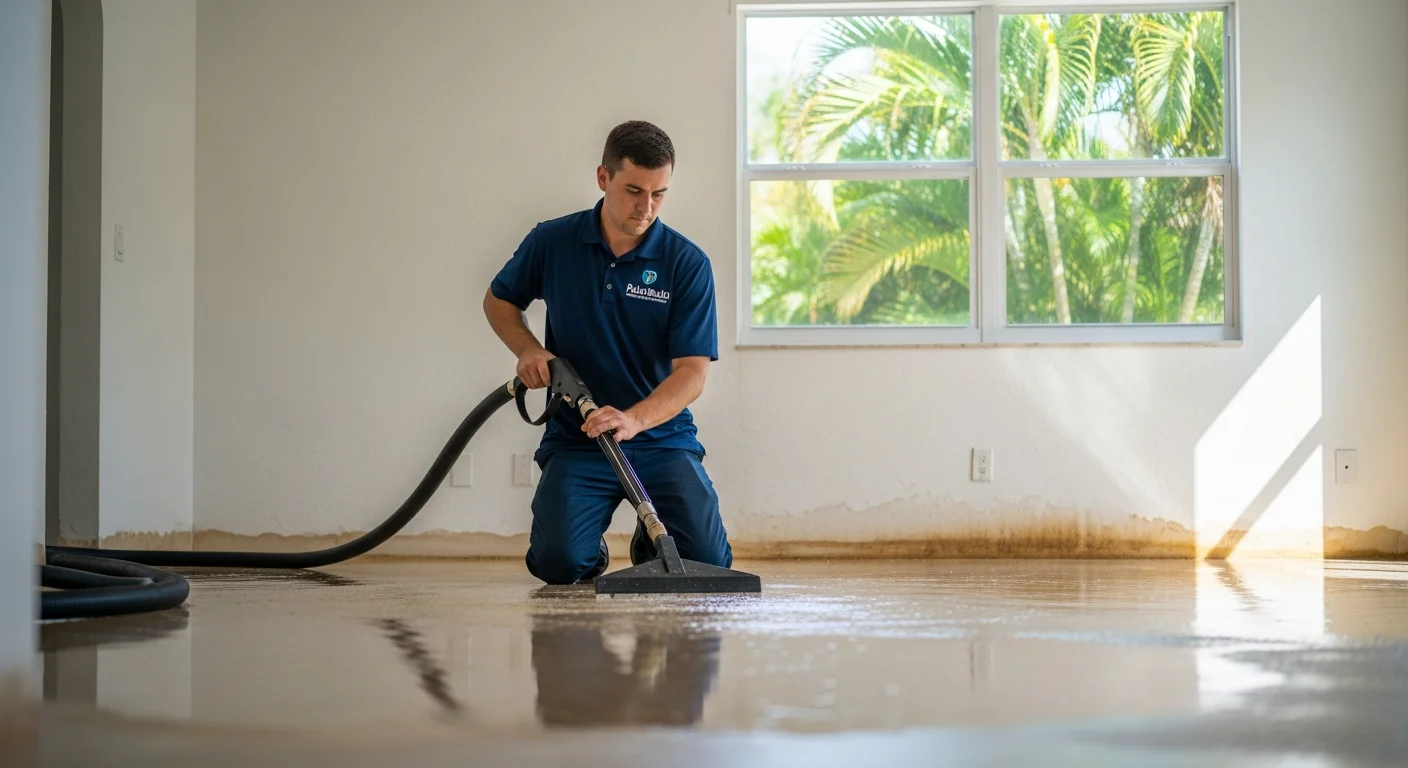
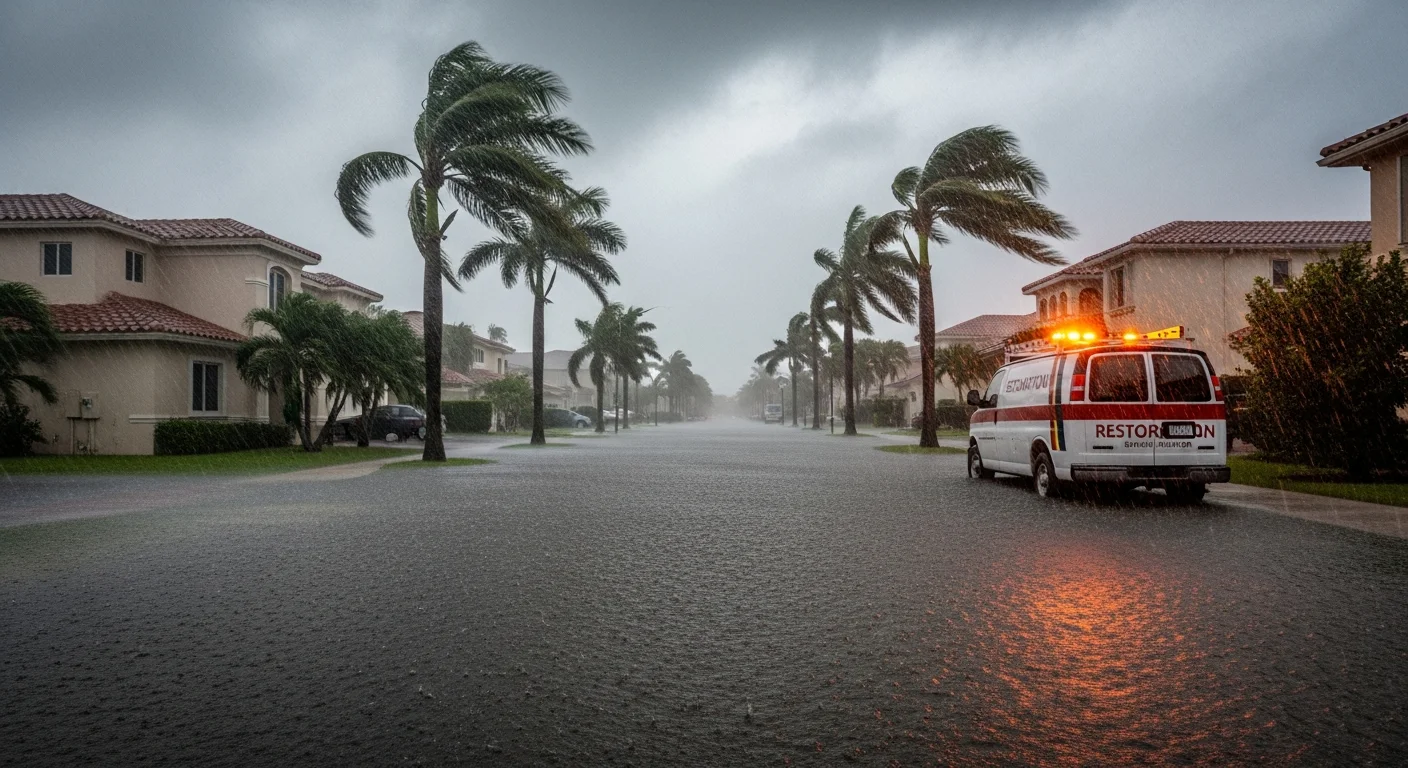
Miami's tropical monsoon climate delivers 67 inches of rain annually, king tides flood coastal neighborhoods on clear days, and 490,000 residents live surrounded by FEMA AE and VE flood zones. From a burst pipe in your Kendall CBS ranch to a condo garage flood in Brickell, Palm Build's South Florida team responds from our Deerfield Beach hub with truck-mounted extraction and the HVHZ-compliant restoration Miami-Dade demands.
Deerfield Beach — Rapid Response to Miami-Dade Under 60 min Response IICRC Certified
No city in the continental U.S. combines Miami's rainfall intensity, coastal flood
exposure, and year-round humidity. When the mold clock starts ticking, Miami's climate makes it run faster than anywhere else — and the construction that
protects against hurricanes traps moisture inside.
Tropical Monsoon Rainfall
67 in
Annual rainfall
Miami receives 67 inches of rain annually — 70% above the national average — with June alone averaging 10.5 inches. The city's flat topography, porous limestone substrate, and tidally influenced outfalls mean stormwater literally has nowhere to go. The June 2024 storms dumped 20 inches on North Miami in two days, overwhelming every drainage system in the metro.
CBS Stucco Construction
CBS
Dominant construction
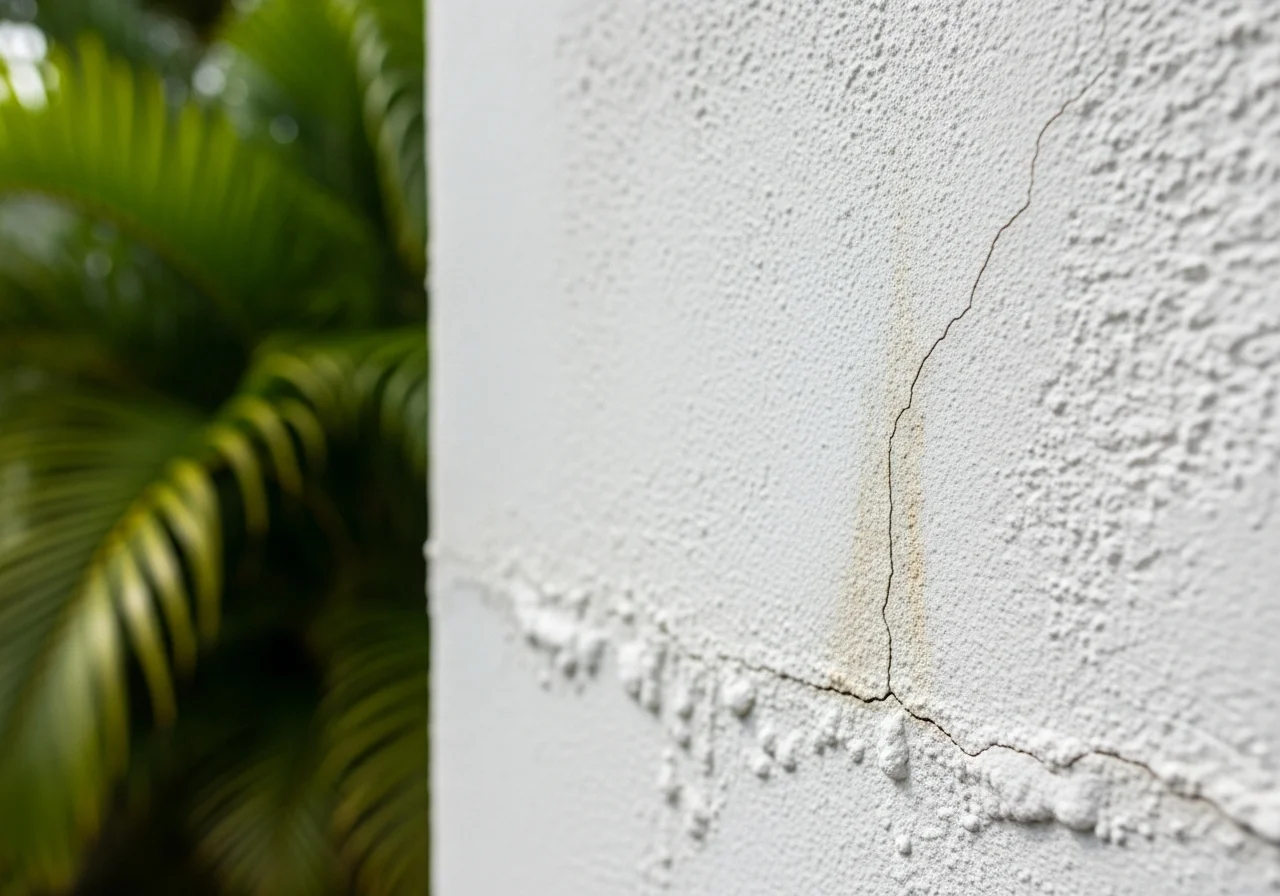
Miami's dominant construction type — concrete block structure (CBS) with stucco exterior — is built for hurricane winds, not chronic moisture. Hairline cracks from decades of thermal cycling allow wind-driven rain to saturate block cores and furring cavities. The moisture remains trapped behind intact-looking drywall, invisible until mold colonizes or finishes delaminate.
73% Average Humidity
73%
Avg relative humidity
Miami's relative humidity averages 73% year-round, reaching 84% during morning hours in wet season. At these levels, natural air drying is physically impossible. Combined with temperatures in the upper 70s to mid-80s, these conditions create an ideal incubation chamber for mold — professional dehumidification is the only path to dry standard.
The 24-Hour Mold Window
24 hrs
Until mold begins
In Miami's tropical climate, mold spores germinate faster than almost anywhere in the continental United States. The combination of warm temperatures and extreme humidity means every water damage event — from a burst pipe to a roof leak — starts a biological countdown. Within 24-48 hours, mold begins colonizing any wet organic material.
Miami's tropical monsoon climate delivers 67 inches of annual rainfall — overwhelming
the city's tidally influenced drainage system and flooding neighborhoods from Shorecrest
to Kendall.
Neighborhood Risk Profiles
Miami Water Damage Risk by Neighborhood
Every Miami neighborhood has its own water damage signature — shaped by proximity to the
coast, age of construction, elevation, and flood zone classification. Here is what
drives risk in yours.
Dense luxury high-rise corridor along Biscayne Bay. Wind-driven rain intrusion at curtain wall joints, king tide garage flooding, and vertical water migration from supply line failures affecting multiple floors simultaneously.
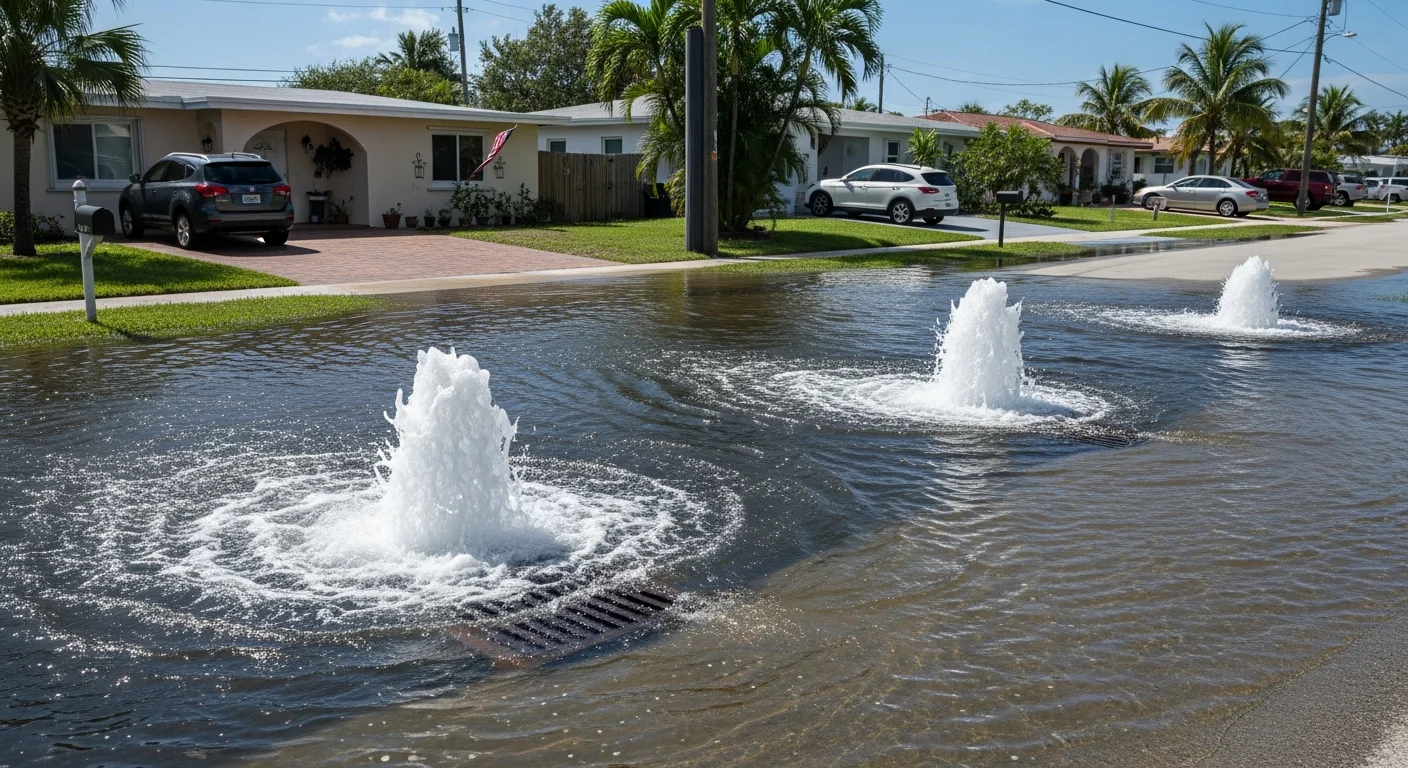
Saltwater routinely bubbles up through storm drains during king tides, flooding streets and driveways 2-3 feet deep on clear sunny days. Chronic moisture, slab-edge corrosion, and near-constant mold risk.
Miami Beach
Critical
Built: 1920s-2020sType: Art Deco masonry, CBS, high-rise
Storm surge, tidal flooding, salt corrosion
Barrier island with maximum coastal exposure. Street flooding from king tides and extreme rain, rebar corrosion and concrete spalling, flat-roof membrane failures, and chronic humidity in older Art Deco structures.
Barrier island with high-value properties in VE flood zones. Maximum storm-surge exposure, overwash flooding potential, and accelerated salt-air corrosion of metals and building components.
Coconut Grove
High
Built: 1890s-2020sType: Wood bungalows to modern luxury
Treefall damage, complex rooflines
Dense mature tree canopy causes significant storm damage. Complex rooflines on older homes create flashing vulnerabilities. Hidden mold in plaster-and-lathe walls of historic cottages.
Historic homes with clay tile roofs experiencing underlayment failure. Cast-iron and galvanized drain failures inside slabs causing slab leaks and sewer backups in homes built before 1975.
Little Havana
High
Built: 1940s-1960sType: CBS/stucco, flat roofs
Flat roof leaks, aging plumbing
Dense older housing stock with deteriorating flat-roof membranes. Window-unit AC condensate leaks, aging supply and drain lines, and chronic interior humidity in poorly ventilated apartments.
Edgewater / Wynwood
High
Built: Mixed: old + 2000s towersType: Converted warehouses, new high-rise
Flash flooding, poor ventilation
High modeled flood risk despite Zone X designation. Garage and street flooding in extreme rain, flat-roof drain failures on converted industrial buildings, chronic humidity in poorly ventilated loft conversions.
Kendall / Westchester
Elevated
Built: 1960s-1990sType: CBS/stucco ranch, HOA communities
Interior plumbing, AC condensate
Sprawling tract housing with some 1978-1995 era polybutylene plumbing. AC condensate leaks, shingle roof aging, and occasional street flooding from extreme rain events in HOA-governed communities.
Stronger post-Andrew construction but still vulnerable to extreme hurricanes. Canal overflows, window/door flashing failures, and critical mold growth risk during prolonged power outages when AC systems fail.
Miami Shores
High
Built: 1920s-1950sType: CBS, Mediterranean, mid-century modern
Canal exposure, aging construction
Charming historic neighborhood with significant canal frontage near Biscayne Bay. Aging roofs, outdated plumbing, and low elevations create compound water damage risk during storm events.
Modern high-rise condos with water damage from supply or fire-line failures migrating down through multiple floors. Roof and amenity-deck leaks, garage flooding, and sealed-unit humidity issues.
King Tides, Storm Surge & FEMA Zones
Miami's Multi-Layer Flood Risk
Unlike most cities where flooding comes from rain, Miami faces flooding from above, below, and sideways — tropical downpours overwhelm
drainage from above, king tides push saltwater up through storm drains from below, and hurricane
surge rushes inland from the coast. Understanding your FEMA zone is the first step to protecting
your property.
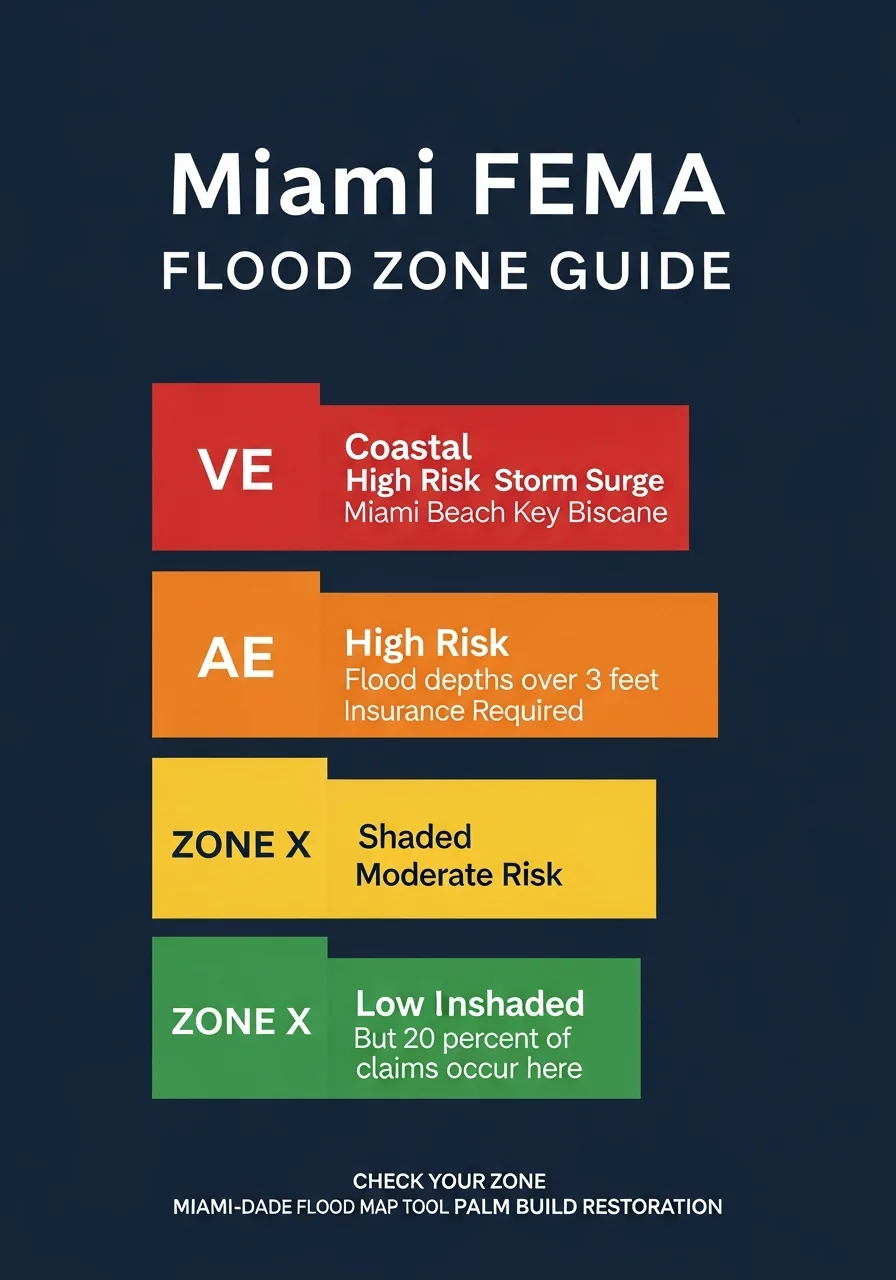
Zone VE
Highest Risk
Miami Beach, Key Biscayne, Brickell waterfront, Edgewater bayfront
Coastal high-risk zone with storm surge and wave action. Mandatory flood insurance for mortgaged properties. These areas face the highest probability of catastrophic water damage from tropical systems.
Zone AE
High Risk
Shorecrest, Upper Eastside, low-lying Coconut Grove, canal-adjacent neighborhoods
High-risk areas with modeled flood depths greater than 3 feet. Mandatory flood insurance applies. King tide flooding and extreme rainfall routinely affect these zones.
Zone X (Shaded)
Moderate Risk
Parts of Coral Gables, Kendall, Little Havana interior
Moderate risk with 0.2% annual chance of flooding. Flood insurance optional but strongly recommended — 20% of all NFIP claims nationally come from Zone X properties.
Zone X (Unshaded)
Lower Risk
Western Kendall, Westchester, some inland areas
Minimal modeled flood risk, but Miami's June 2024 rainfall event proved that extreme storms can overwhelm drainage anywhere in the metro. Interior water damage from plumbing and HVAC remains a year-round risk.
Shorecrest king tide flooding — saltwater backs up through storm drains on perfectly
clear days, flooding streets and driveways without a single drop of rain.Check your property's flood zone using Miami-Dade County's interactive flood map at
gisweb.miamidade.gov — 20% of NFIP claims occur in low-to-moderate risk zones.
Our Miami Process
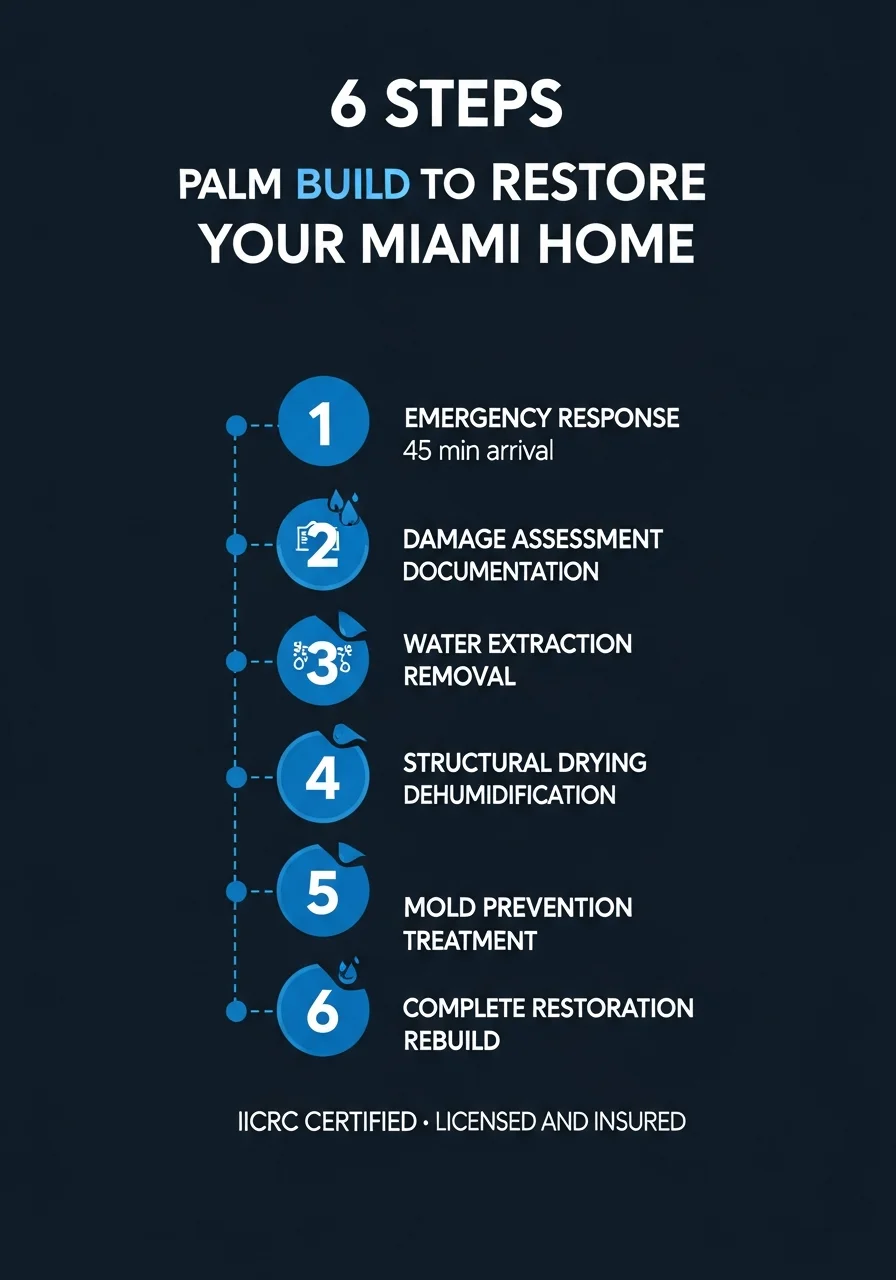
6 Steps to Restore Your Miami Property
Every water damage restoration in Miami follows our proven process — adapted for CBS
construction, tropical humidity, and HVHZ code compliance.
STEP 01
Emergency Dispatch
0-60 minutes
Call (754) 600-3369 any time, day or night. Our dispatcher confirms your Miami address, identifies the water source if known, and deploys the nearest crew from our Deerfield Beach hub with truck-mounted extraction equipment. We arrive ready to work — no waiting for a second trip.
STEP 02
Damage Assessment & Documentation
First 2 hours
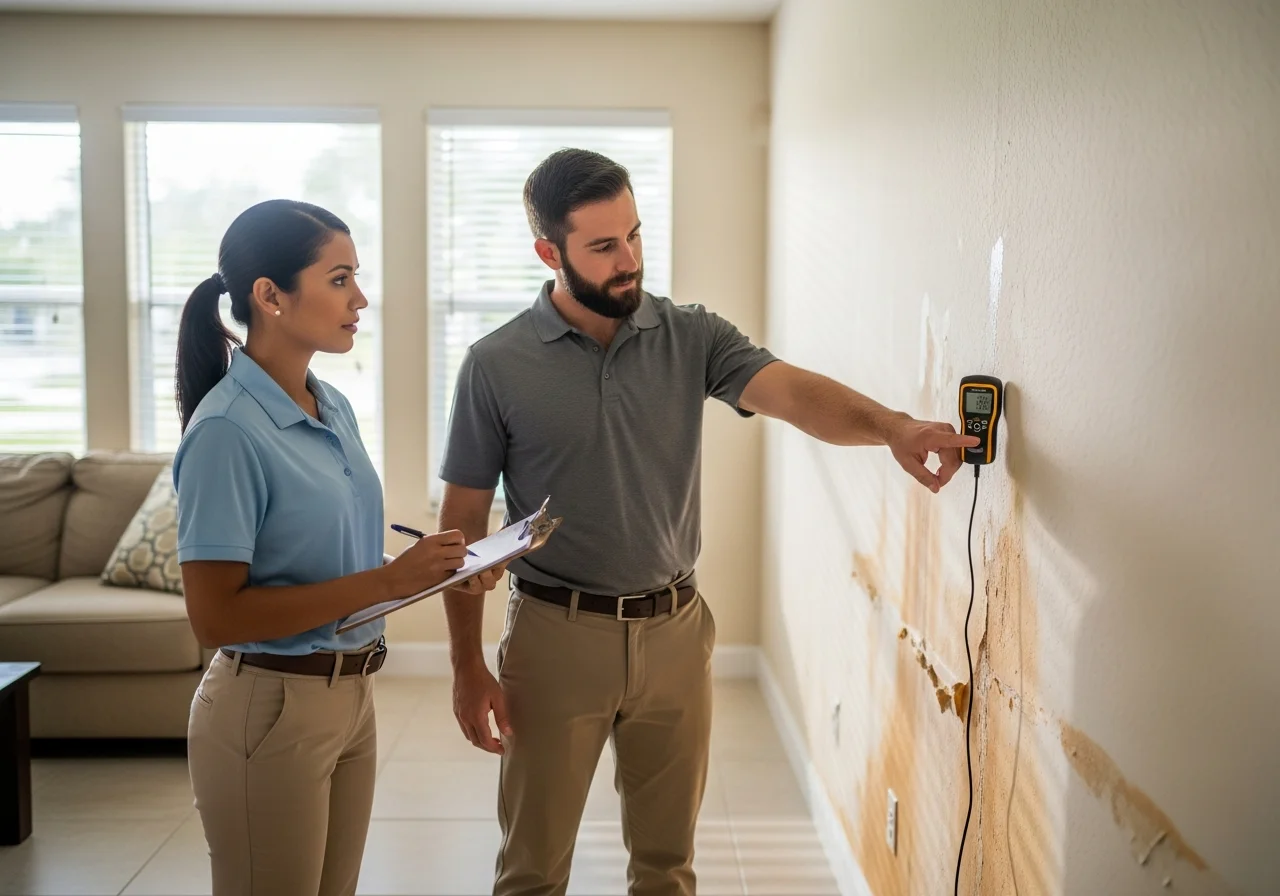
We map the full extent of water intrusion using infrared thermal imaging and pin-type moisture meters — critical in Miami's CBS construction where moisture hides behind intact stucco. We classify the water category (1-3) per IICRC S500 standards and document everything for your insurance carrier with timestamped photos and moisture readings.
STEP 03
Water Extraction
Hours 2-8
Truck-mounted extraction pulls standing water at rates exceeding 25 gallons per minute. For Miami high-rise condos, we bring portable submersible pumps and weighted extraction tools for tile, terrazzo, and floating floors. The goal: remove 95%+ of standing water before the first dehumidifier fires up.
STEP 04
Structural Drying & Dehumidification
Days 1-5
In Miami's 73% ambient humidity, commercial LGR dehumidifiers pulling 15-30 gallons per day are mandatory — natural air drying is physically impossible here. We position air movers for maximum evaporation across CBS block walls, monitor daily with moisture meters, and adjust equipment placement until every material reaches dry standard.
STEP 05
Antimicrobial & Mold Prevention
Days 3-5
Given Miami's mold-accelerating climate, we apply EPA-registered antimicrobial treatments to all affected surfaces as soon as materials reach dry standard. This critical step prevents secondary mold colonization that would otherwise be virtually guaranteed in South Florida's tropical humidity.
STEP 06
Restoration & Reconstruction
Days 5-21+
From drywall replacement to complete room rebuilds, our crews handle every phase of reconstruction under one contract. All work complies with Miami-Dade's HVHZ building code — impact-rated openings, TAS-tested materials, and proper permitting through the Miami-Dade building department.
Palm Build's proven 6-step restoration process — adapted for Miami's tropical climate,
CBS construction, and HVHZ code requirements.
Seasonal Risk Calendar
When Miami Properties Are Most at Risk
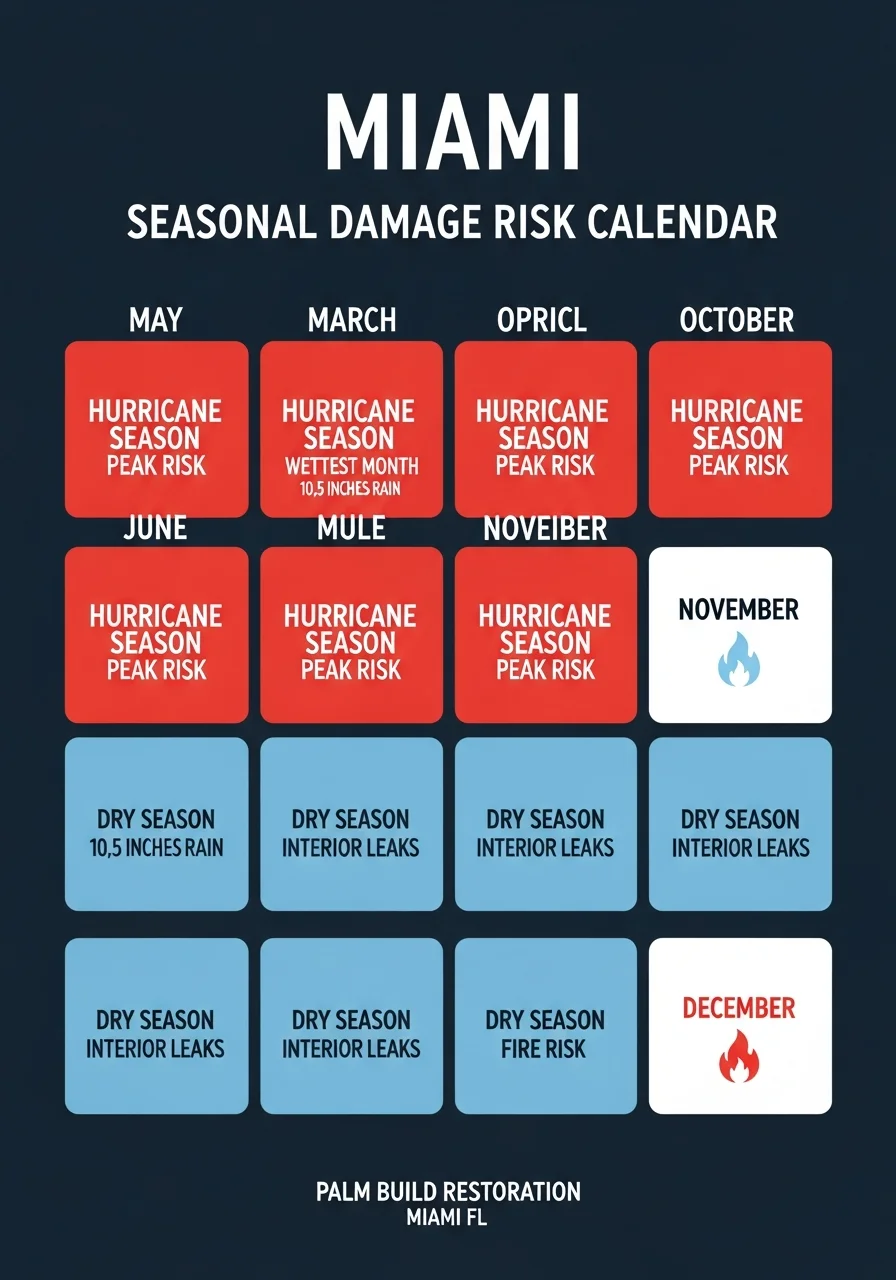
Miami's tropical monsoon climate creates distinct seasonal damage patterns.
Understanding when your property faces the highest risk helps you prepare — and know
when to call.
May – October
Wet Season / Hurricane Season
Water DamagePEAK
10+ inches of monthly rainfall. Flash flooding, roof leaks, AC condensate overflows, and wind-driven rain intrusion. June and September are the wettest months.
Storm DamagePEAK
Hurricane season peaks August-October. treefall, surge, tornadoes, and extended power outages drive massive damage spikes across Miami-Dade.
Mold GrowthEXTREME
Sustained humidity above 80% with temperatures in the mid-80s creates ideal mold conditions. Any moisture event triggers rapid colonization within 24 hours.
November – April
Dry Season
Water DamageMODERATE
Interior sources dominate — burst pipes, water heater failures, appliance leaks. Occasional strong frontal storms bring heavy rain. King tides peak October-November.
Fire RiskELEVATED
Holiday cooking fires spike November-January. Space heater use in older homes without central heat creates electrical fire risk. Dry vegetation increases exterior fire spread.
Mold DiscoveryHIGH
Wet season damage that was never properly dried reveals itself as mold growth. Slow plumbing leaks and condensation in sealed buildings feed ongoing colonies through dry season.
Miami's damage risk peaks May through October with tropical rainfall and hurricane
activity — but interior damage and mold discovery drive calls year-round.
5,356 Condo Associations in Miami-Dade
High-Rise & Condo Water Damage Restoration
Miami-Dade County contains 19.4% of all Florida condo associations and 20.5% of all
condo units statewide. Water damage in high-rise and HOA properties is fundamentally
different from single-family — multiple insurance policies, board governance, vertical
water migration, and building access constraints demand specialized expertise.
Vertical Water Migration
A supply line failure on the 14th floor cascades through chase walls, elevator shafts, and between-floor assemblies, damaging units on every floor below. A single event can affect 10+ units and involve both unit-owner HO-6 policies and the association's master policy simultaneously.
Master Policy vs. HO-6 Coverage
Miami condos typically have "bare walls" or "all-in" master policies. Understanding which policy covers what — and coordinating claims between the association's carrier and individual unit-owner policies — is critical to avoiding coverage gaps that leave homeowners paying out of pocket.
Board Approvals & Vendor Access
Condo associations control vendor access, construction hours, elevator reservations, and restoration scope in common areas. Palm Build navigates these requirements daily — we carry the insurance certificates, licenses, and documentation boards require before granting access.
Multi-Unit Coordination
Water events affecting multiple units require simultaneous extraction, drying, and monitoring across all affected spaces. We deploy dedicated project managers for multi-unit events to coordinate access, track moisture readings per unit, and communicate with each owner's insurance carrier.
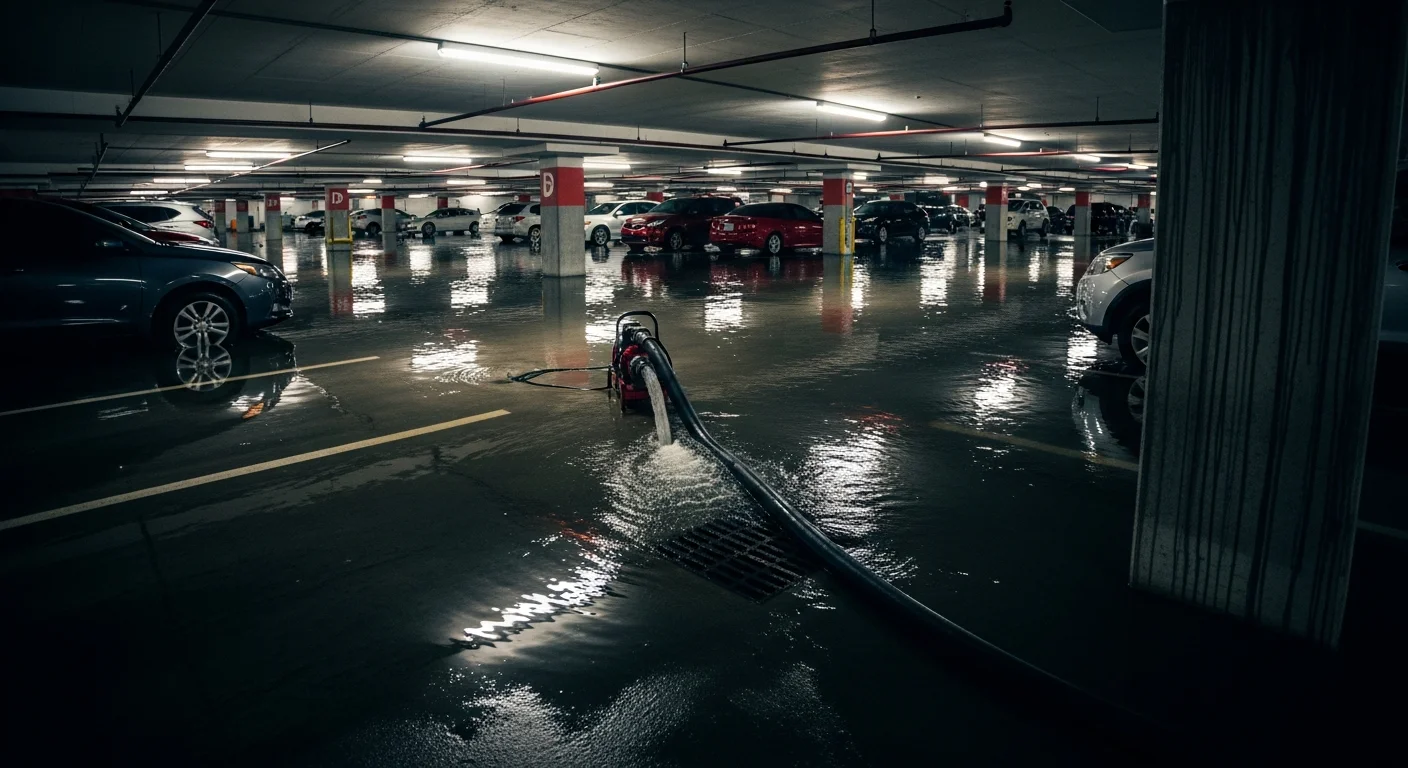
Garage & Amenity Flooding
King tides and tropical storms flood underground and podium-level garages across Brickell, Edgewater, and Miami Beach. Amenity decks with pools, spas, and landscaping create additional water intrusion pathways into the building envelope.
Post-Surfside Structural Requirements
Following the 2021 Champlain Towers collapse, Florida enacted milestone structural inspection requirements for buildings 3+ stories at 25 and 30 years. Water intrusion identified during these inspections often requires immediate remediation — Palm Build handles both the water damage and structural repairs.
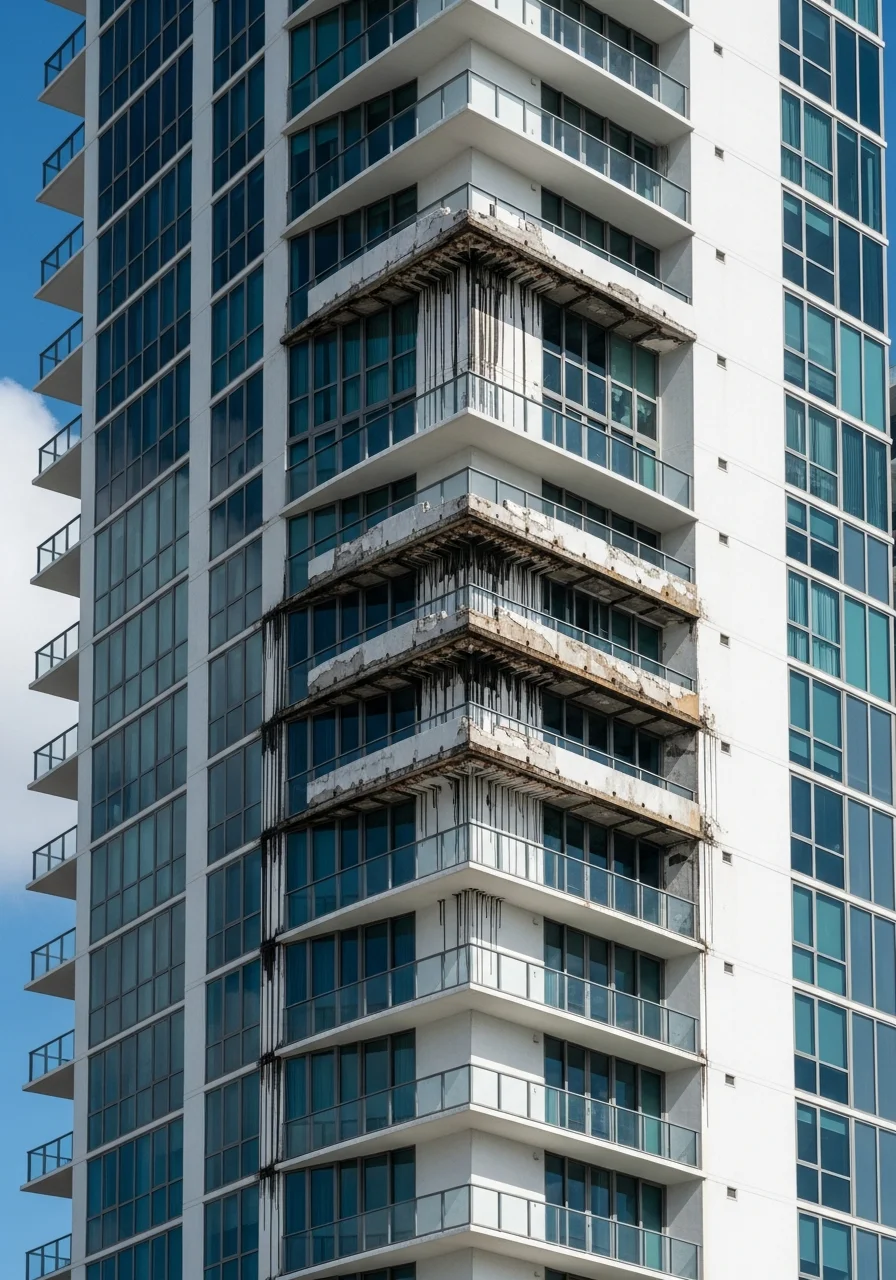
Brickell high-rise — exterior water staining and concrete spalling from chronic water
intrusion and salt-air corrosion require specialized restoration approaches.Condo garage flooding during tropical storms — a recurring challenge across Brickell,
Edgewater, and Miami Beach requiring rapid pump-out and structural drying.
Damage Patterns
How Water Damages Miami Properties
Miami's unique combination of tropical climate, coastal exposure, and CBS construction
creates six distinct water damage mechanisms — each requiring a different restoration
approach.
King Tide & Storm Surge Flooding
Saltwater backing up through storm drains during king tides or rushing inland during hurricanes. IICRC Category 3 — the most contaminated classification. All porous materials must be removed. Salt residue continues corroding metals for weeks after apparent drying.
At-risk areas: Shorecrest, Miami Beach, Key Biscayne, Brickell waterfront
Tropical Rainfall Flash Flooding
Miami's 10+ inches of monthly rainfall during wet season overwhelms the city's tidally influenced outfalls. Water enters through door thresholds, garage doors, slab cracks, and foundation penetrations — even in Zone X neighborhoods far from the coast.
At-risk areas: Wynwood-Edgewater, Little Havana, interior basins
HVAC Condensation Damage
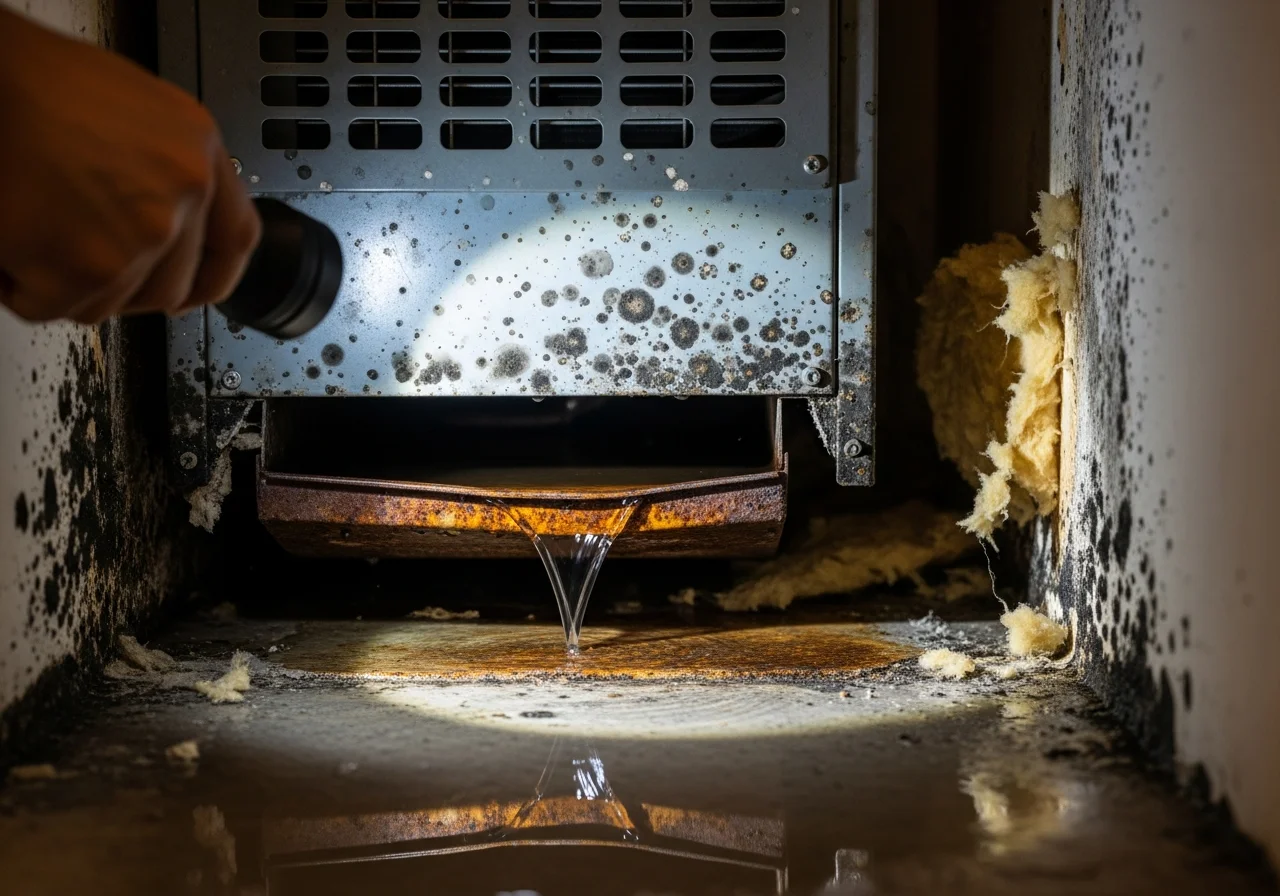
High ambient humidity plus sealed, energy-efficient buildings lead to condensation on ducts and supply diffusers. Clogged or improperly sloped AC condensate lines overflow into ceiling cavities, closets, and wall cavities — causing slow, hidden water and mold damage.
Polybutylene plumbing (1978-1995 era homes) degrades from chlorinated water and fails catastrophically. Cast-iron drain lines in pre-1975 homes corrode from the inside out. Both cause sudden, severe interior water damage requiring emergency extraction.
At-risk areas: Kendall, Westchester, Coral Gables older stock, Little Havana
Stucco & CBS Water Intrusion
Hairline cracks in stucco facades allow wind-driven rain to penetrate CBS block cores. Moisture gets trapped in furring cavities behind drywall — invisible until mold colonies develop or interior finishes delaminate. Thermal cycling accelerates crack formation.
At-risk areas: All CBS neighborhoods — virtually every Miami area
High-Rise Vertical Water Events
Supply line, fire sprinkler, or drain failures in upper-floor condos cause water to cascade through multiple floors via chase walls, elevator shafts, and between-floor assemblies. A single 14th-floor pipe failure can damage units on floors 14 through 2.
Stucco cracks on CBS homes allow wind-driven rain to saturate block cores — moisture
hides behind intact-looking walls until mold develops.HVAC condensation is one of Miami's most common — and most overlooked — water damage
sources, causing hidden mold in ceiling cavities and closets.
Miami Restoration Gallery
Water Damage Restoration Across Miami
From Art Deco apartments in Miami Beach to luxury Brickell condos and Mediterranean
homes in Coral Gables — every Miami property type demands a different restoration
approach.
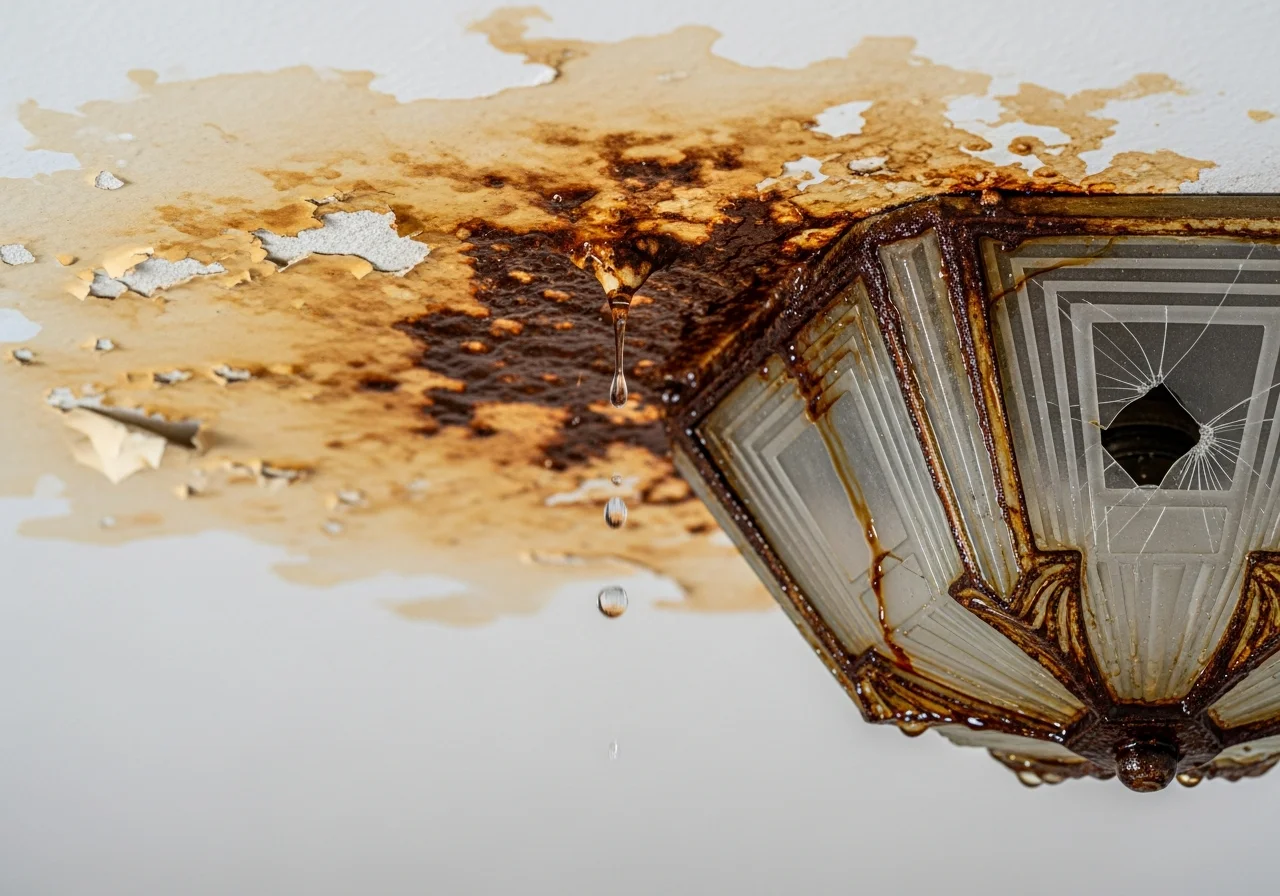
Miami Beach Art Deco — ceiling water intrusion from the unit above
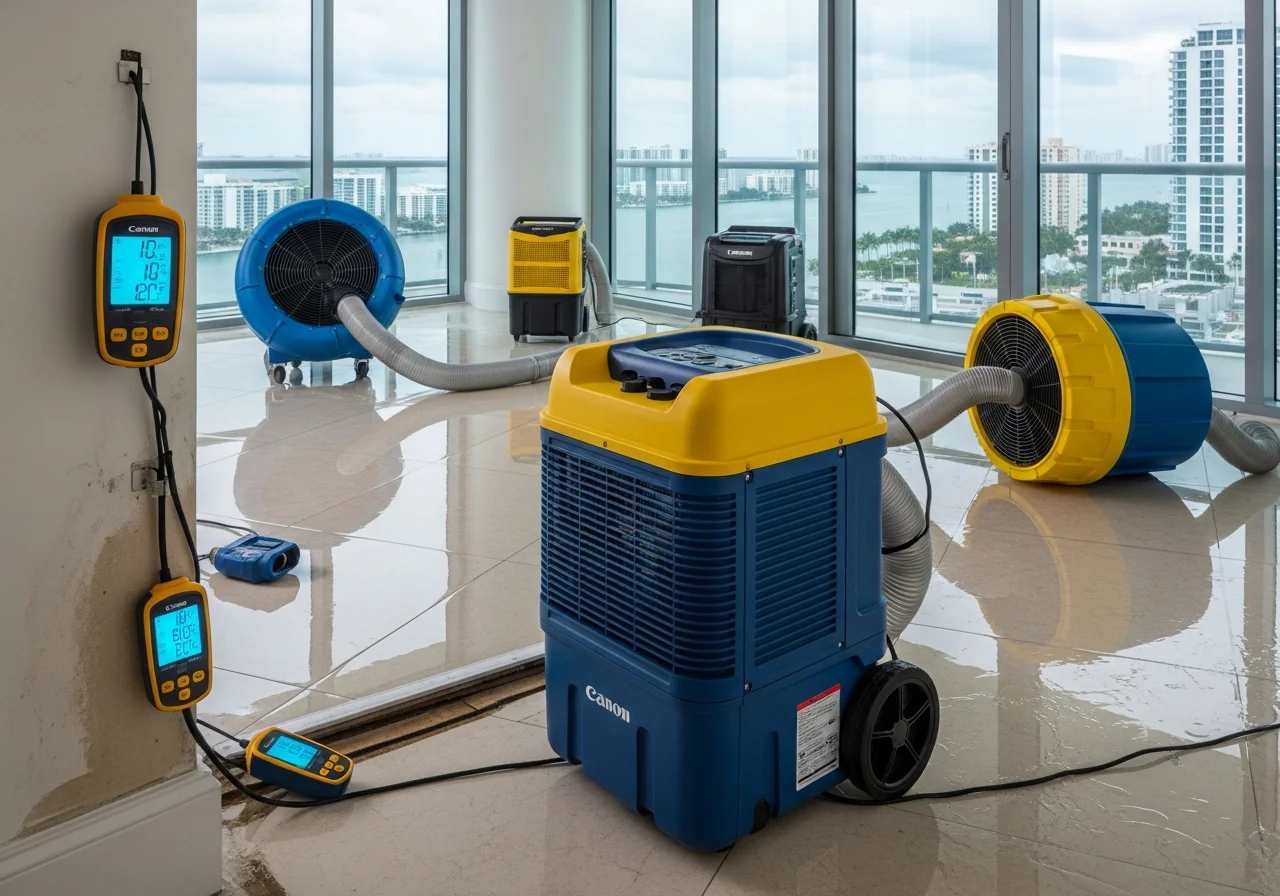
Brickell luxury condo — professional drying equipment in a bay-view unit
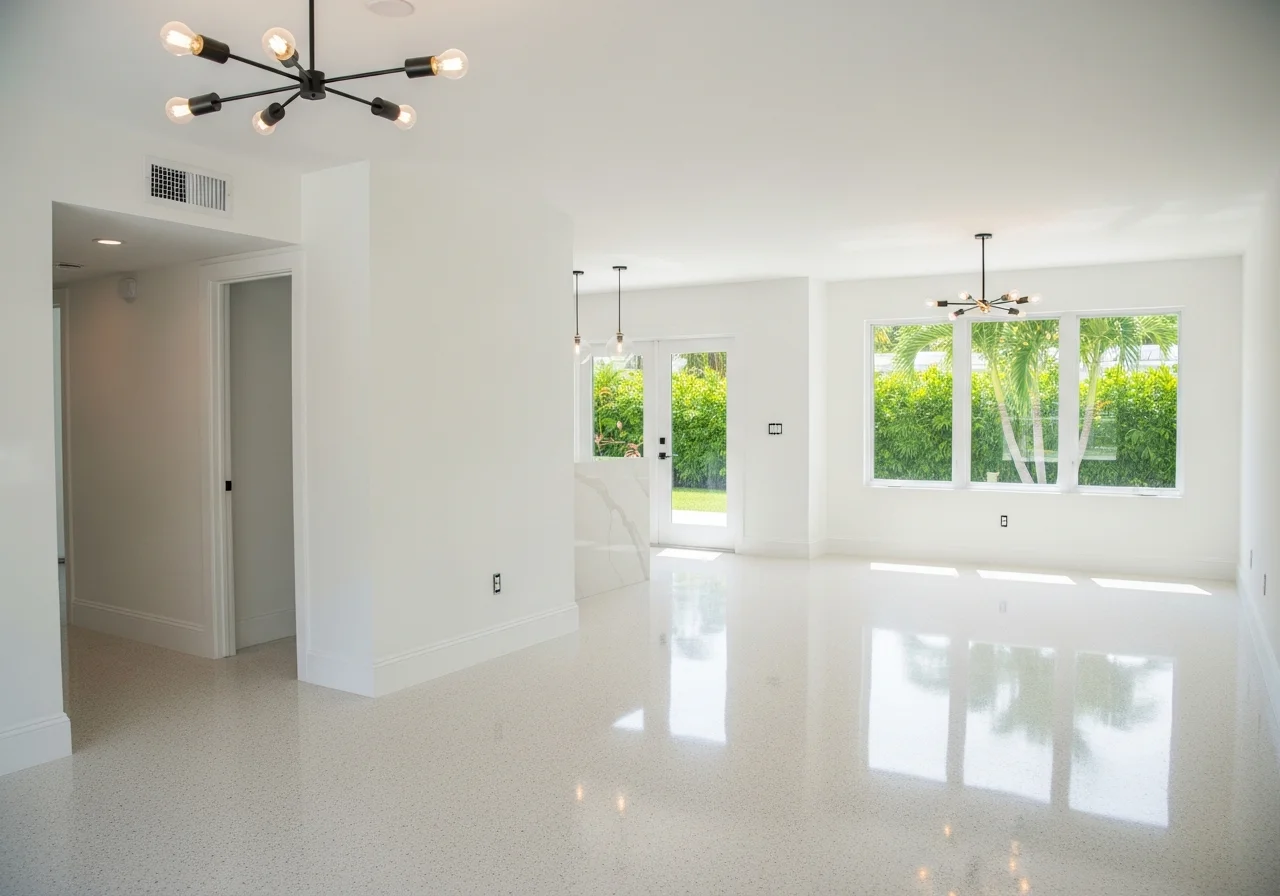
Completed restoration — pristine terrazzo floors and fresh finishes
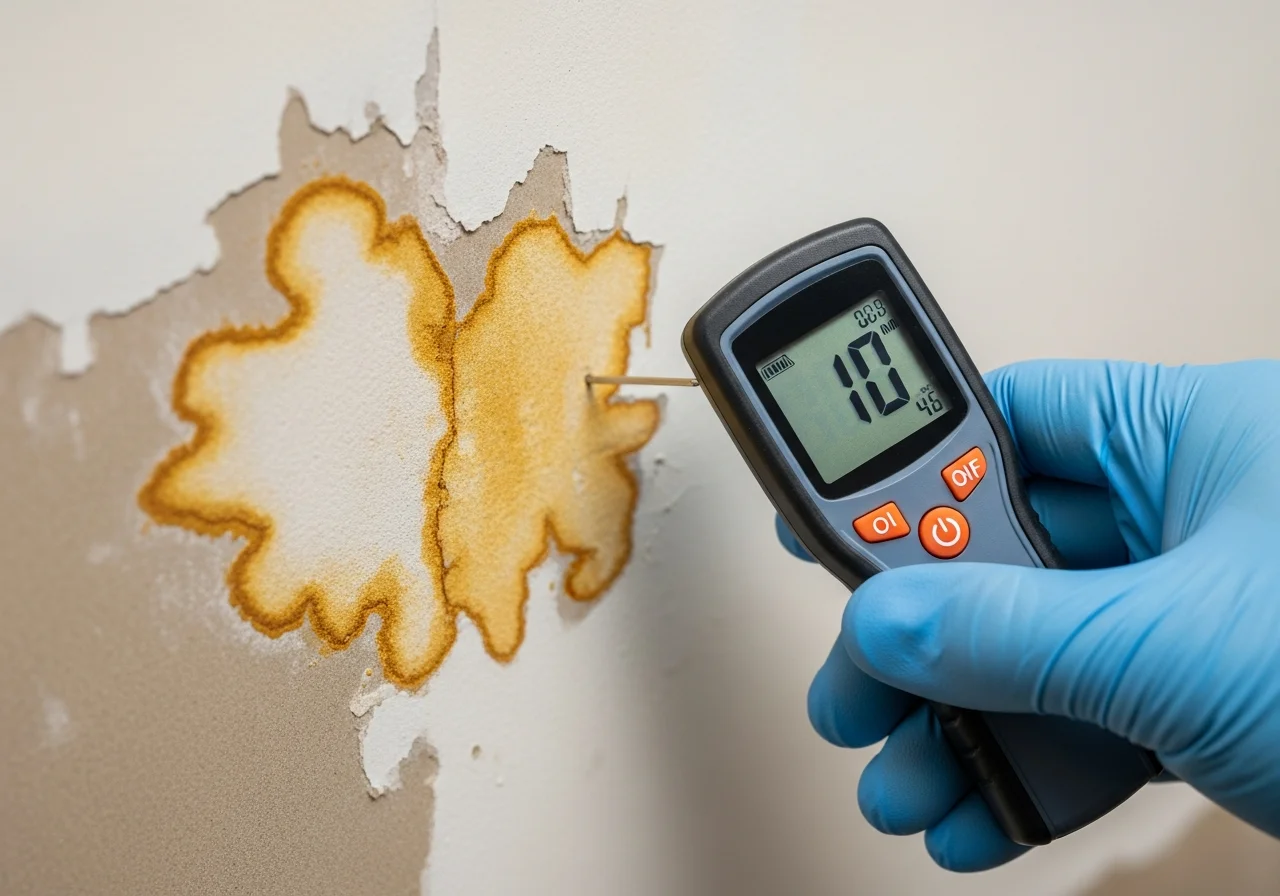
Moisture meter documentation — proving hidden moisture in CBS walls
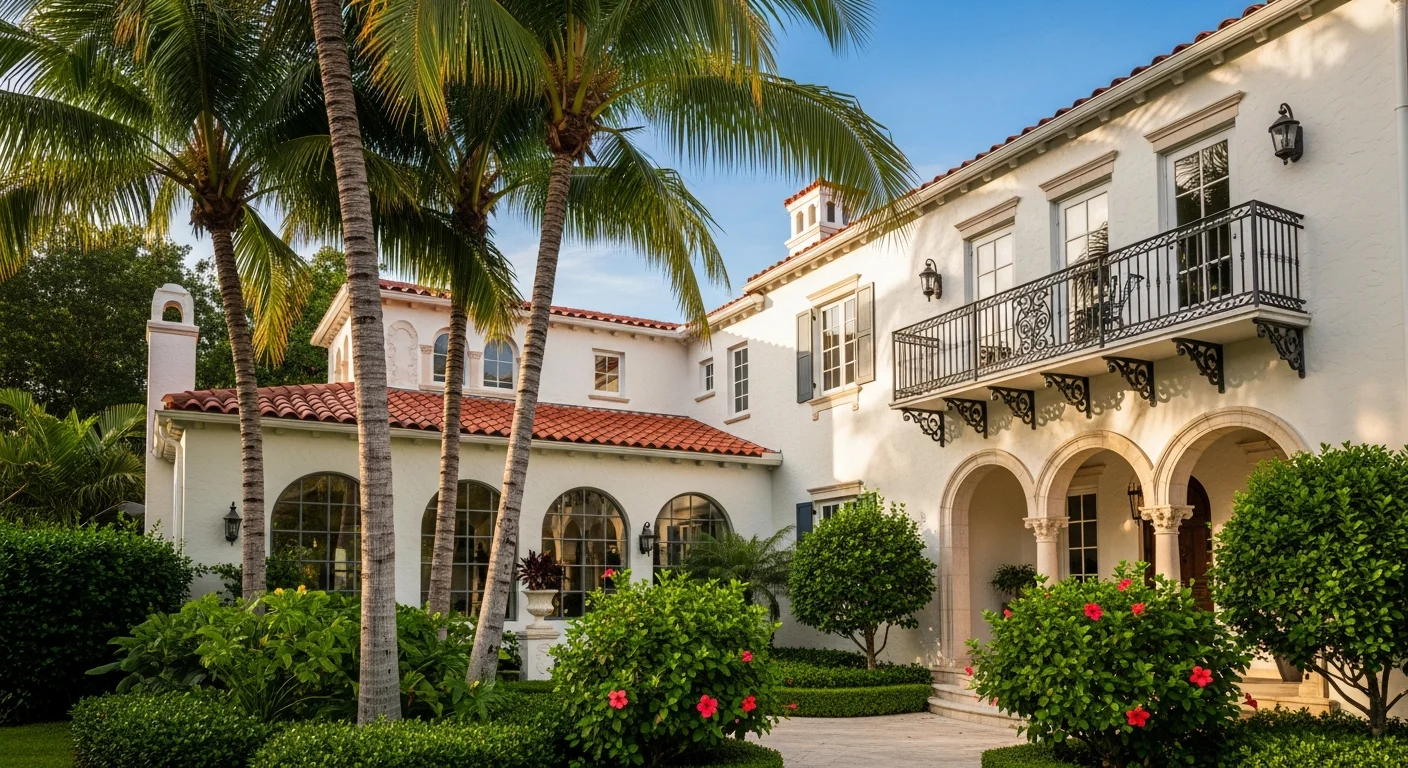
Coral Gables Mediterranean Revival — tile roof and stucco restoration
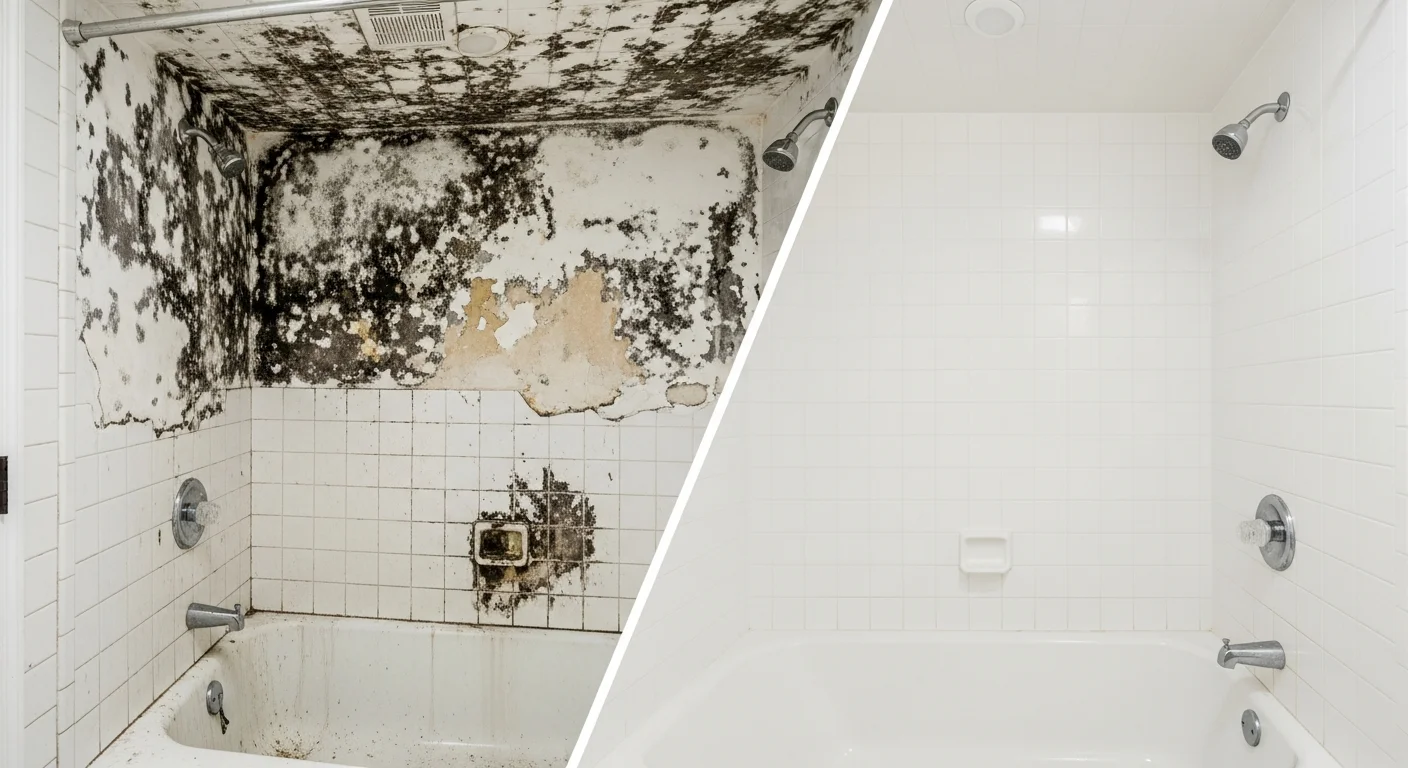
Before and after — bathroom mold remediation in a Miami CBS home
Restoration Cost Guide
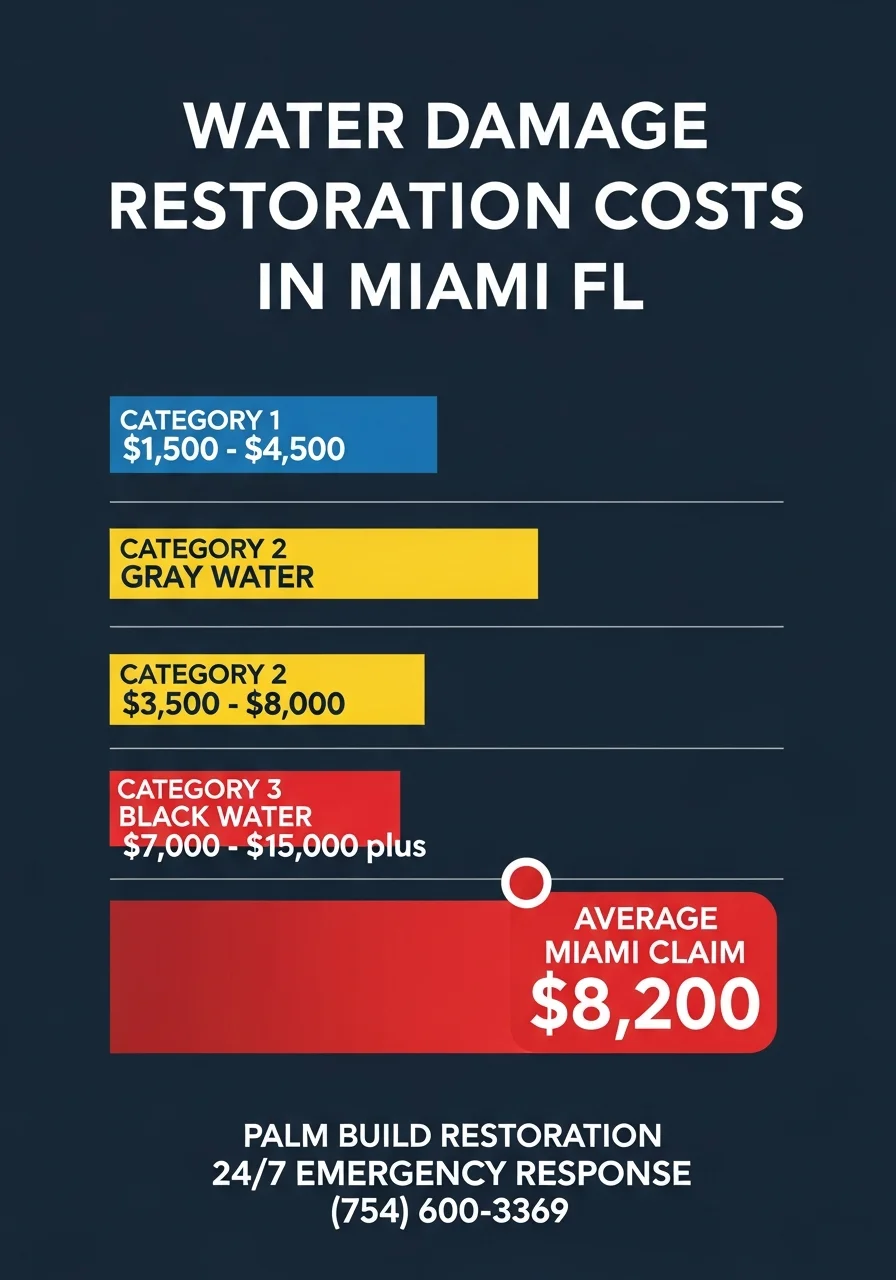
Water Damage Restoration Costs in Miami
Miami-Dade's HVHZ building code, premium labor market, and saltwater contamination risk
mean restoration costs run significantly above national averages. Here is what Miami
homeowners typically face.
Miami's HVHZ code compliance, premium materials, and saltwater contamination risk
contribute to above-average restoration costs — but faster response means lower total
costs.
Florida Insurance Guide
Navigating Miami Water Damage Insurance Claims
Miami homeowners pay an average of $3,572 per year for insurance — 56% above the Florida
state average. Understanding your policy's coverage, gaps, and Florida's statutory
requirements can save tens of thousands on a water damage claim.
1 Year to File
Florida Statutory Deadlines
Florida Statute 627.70132 requires property insurance claims to be filed within 1 year of the date of loss. Supplemental claims must be noticed within 18 months. Missing these deadlines can result in complete denial of an otherwise valid claim.
2-5% of Dwelling
Hurricane Deductibles
Miami-Dade hurricane deductibles typically run 2-5% of dwelling coverage value. On a $570,000 home, that means $11,400 to $28,500 out-of-pocket before insurance pays anything on a hurricane-related claim. Understanding this threshold helps set realistic recovery expectations.
Not Included in HO-3
Flood Insurance Gap
Standard homeowners policies exclude flood damage from rising water. Separate NFIP or private flood policies are required. Many Miami properties in Zone X forgo flood coverage despite the fact that 20% of all NFIP claims nationally occur in moderate-to-low risk zones.
Transparent Billing
AOB Reform (2019)
Florida's Assignment of Benefits reform (section 627.7152) curtailed abusive contractor-driven claims that were adding billions to Florida insurance costs. Palm Build uses transparent homeowner-centric billing and direct-to-carrier documentation rather than controversial AOB arrangements.
Palm Build documents every water damage event with timestamped photos, moisture
readings, and IICRC-standard reports — the documentation Florida carriers require for
claim approval.
Why Palm Build
Miami's Water Damage Restoration Experts
With 160+ restoration companies in Miami, choosing the right one matters. Here is what
sets Palm Build apart in this competitive, demanding market.
Under 60-Minute Miami Response
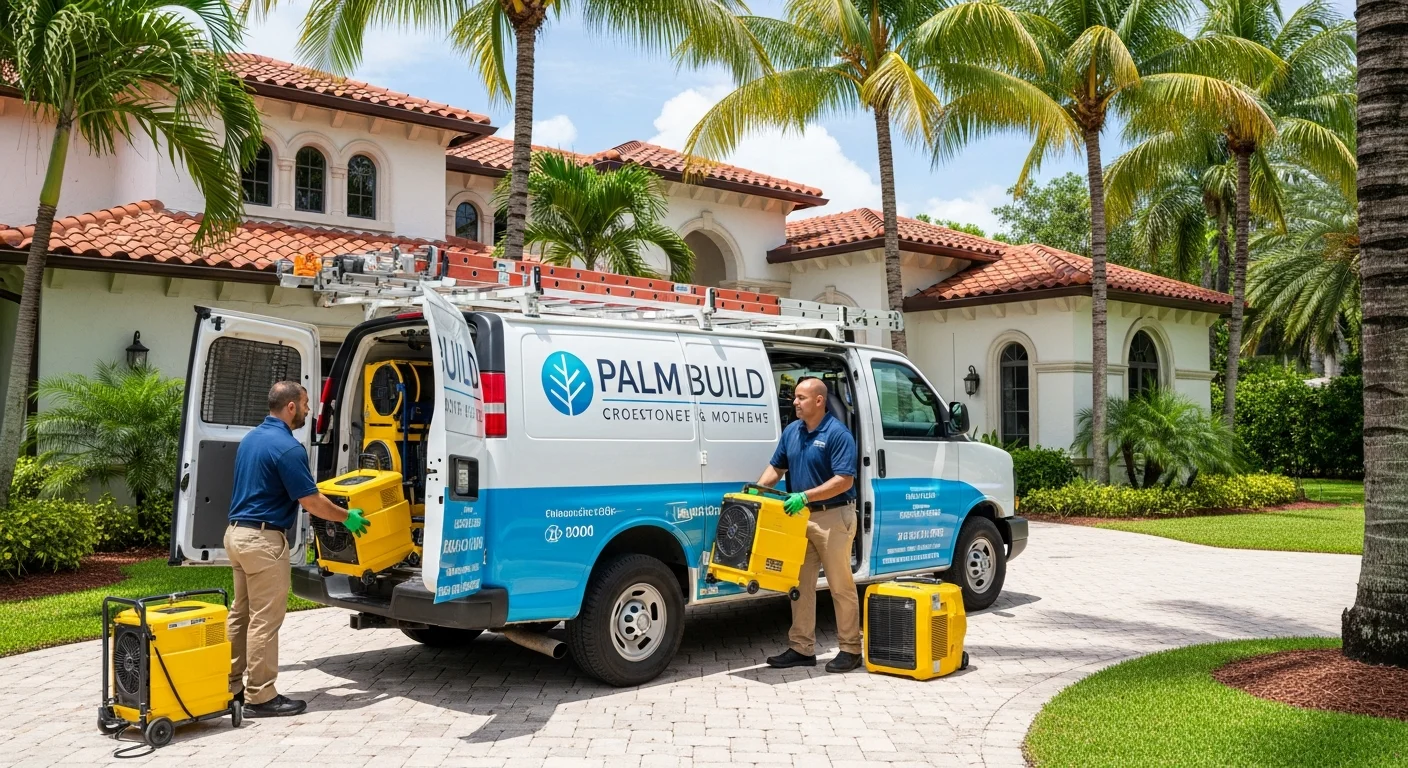
Our Deerfield Beach operations hub serves all of Miami-Dade County. Trucks roll fully loaded with extraction equipment, commercial dehumidifiers, and air movers — no second trip needed.
IICRC Certified Technicians
Every Palm Build technician holds current IICRC certifications in Water Damage Restoration (WRT), Applied Structural Drying (ASD), and Applied Microbial Remediation (AMRT).
Insurance-Ready Documentation
We produce the timestamped photos, moisture readings, drying logs, and IICRC-standard reports that Florida carriers require. We work directly with your adjuster to streamline approval.
HVHZ Code Expertise
Miami-Dade's High Velocity Hurricane Zone imposes the strictest building codes in the country. Our crews understand NOA requirements, TAS-tested materials, and HVHZ permitting.
Licensed Mold Prevention
Florida-licensed mold remediation included in every water damage project. In Miami's tropical climate, antimicrobial treatment is not optional — it is the difference between repair and a gut renovation.
Condo & HOA Experience
Miami-Dade has 5,356 condo associations. We navigate board approvals, coordinate multi-unit restorations, handle unit-owner vs. master-policy claims, and comply with building access requirements.
Palm Build's South Florida team arrives fully equipped to every Miami water damage
emergency — extraction, drying, documentation, and mold prevention in one deployment.
Common Questions
Miami Water Damage Restoration FAQ
How quickly can Palm Build respond to water damage in Miami?
Our Deerfield Beach operations hub serves all of Miami-Dade County. We typically respond within 60 minutes to most Miami neighborhoods, often faster during business hours. Our trucks carry truck-mounted extraction equipment, commercial LGR dehumidifiers, and air movers — we begin mitigation immediately upon arrival to stop damage from compounding.
Is king tide flooding in Miami treated differently than a plumbing leak?
Yes. King tide flooding in Miami — especially in Shorecrest, Miami Beach, and bayfront neighborhoods — involves saltwater that backs up through storm drains. This is classified as IICRC Category 3 (contaminated water), requiring complete removal of all porous materials including drywall, carpet, insulation, and cabinetry. A clean-water plumbing leak is typically Category 1, allowing more materials to be salvaged. The restoration scope, timeline, and cost differ significantly.
My Miami home has stucco cracks — can water get behind the walls?
Absolutely. Miami's CBS (concrete block structure) homes rely on stucco as their primary weather barrier. Hairline and moderate cracks — caused by thermal cycling, settlement, or impact — allow wind-driven rain to penetrate and saturate block cores. The moisture gets trapped in furring cavities behind drywall, invisible until mold develops or interior finishes delaminate. We use infrared thermal imaging and pin-type moisture meters to detect hidden moisture behind intact-looking walls.
Does my Miami homeowners insurance cover water damage?
Most HO-3 policies cover sudden, accidental water damage like burst pipes and appliance failures, but exclude flood damage from rising water — that requires separate NFIP or private flood insurance. Florida law (Fla. Stat. 627.70132) requires claims within 1 year of the date of loss, with supplemental claims within 18 months. Miami-Dade homeowners pay approximately $3,572 per year for insurance — 56% above the state average — and hurricane deductibles typically run 2-5% of dwelling coverage.
Why is water damage restoration more expensive in Miami?
Miami-Dade sits in Florida's High Velocity Hurricane Zone (HVHZ), which imposes the strictest building codes in the country. All restoration work must comply with HVHZ standards — impact-rated windows, TAS-tested roofing systems, upgraded straps and connectors. Materials and labor costs reflect these requirements. Standard water damage restoration in Miami typically ranges from $3,500 to $15,000, while complex projects involving saltwater contamination or HVHZ-compliant reconstruction can range from $15,000 to $75,000+.
What FEMA flood zone is my Miami property in?
Miami-Dade contains all major FEMA flood zone classifications. Coastal areas like Miami Beach, Key Biscayne, and bayfront Brickell are typically Zone VE (storm surge and wave action). Many inland areas are Zone AE (high-risk, flood insurance required). Even Zone X areas — considered low-to-moderate risk — account for 20% of all NFIP flood claims nationally. You can check your property's zone using Miami-Dade County's interactive flood zone map at gisweb.miamidade.gov.
How does Miami's humidity affect the restoration timeline?
Miami's average relative humidity of 73% — reaching 84% in the morning during wet season — makes natural air drying impossible. Professional commercial LGR dehumidifiers pulling 15-30 gallons per day are mandatory to achieve dry standard within the 24-48 hour window before mold colonization begins. Without professional drying equipment, every water damage event in Miami will result in secondary mold damage. Our typical drying timeline is 3-5 days depending on the scope.
Do you restore water damage in Miami high-rise condos?
Yes. High-rise condos in Brickell, Edgewater, Downtown, and Miami Beach present unique water damage challenges — vertical water migration through multiple floors from supply line failures, AC condensate overflows in ceiling cavities, balcony door leaks from wind-driven rain, and garage flooding from king tides. We coordinate with building management, handle unit-owner and master-policy insurance claims, and comply with building access and construction hour requirements.
Trusted Vendors
Trusted local pros in Miami
Outside our restoration scope, these are the vetted, licensed contractors we trust
alongside our work. Personally evaluated, reference-checked, and recommended by Palm
Build.
Our South Florida team responds to Miami-Dade County with truck-mounted extraction, commercial drying, and HVHZ-compliant restoration. Call now for 24/7 emergency response — IICRC-certified technicians who understand CBS construction, king tide flooding, condo water events, and Florida insurance requirements.