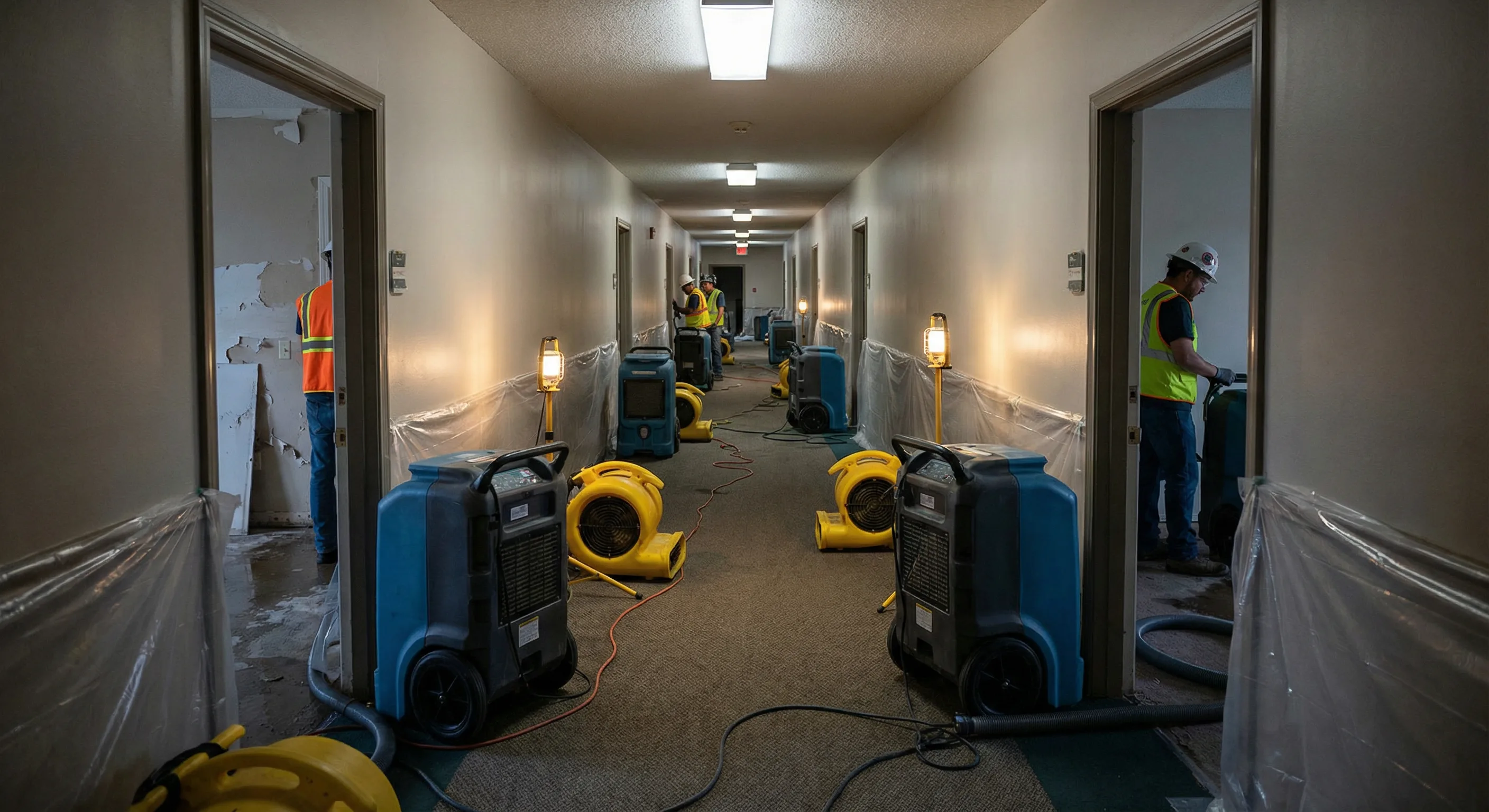
Corridor & Stack Strategy
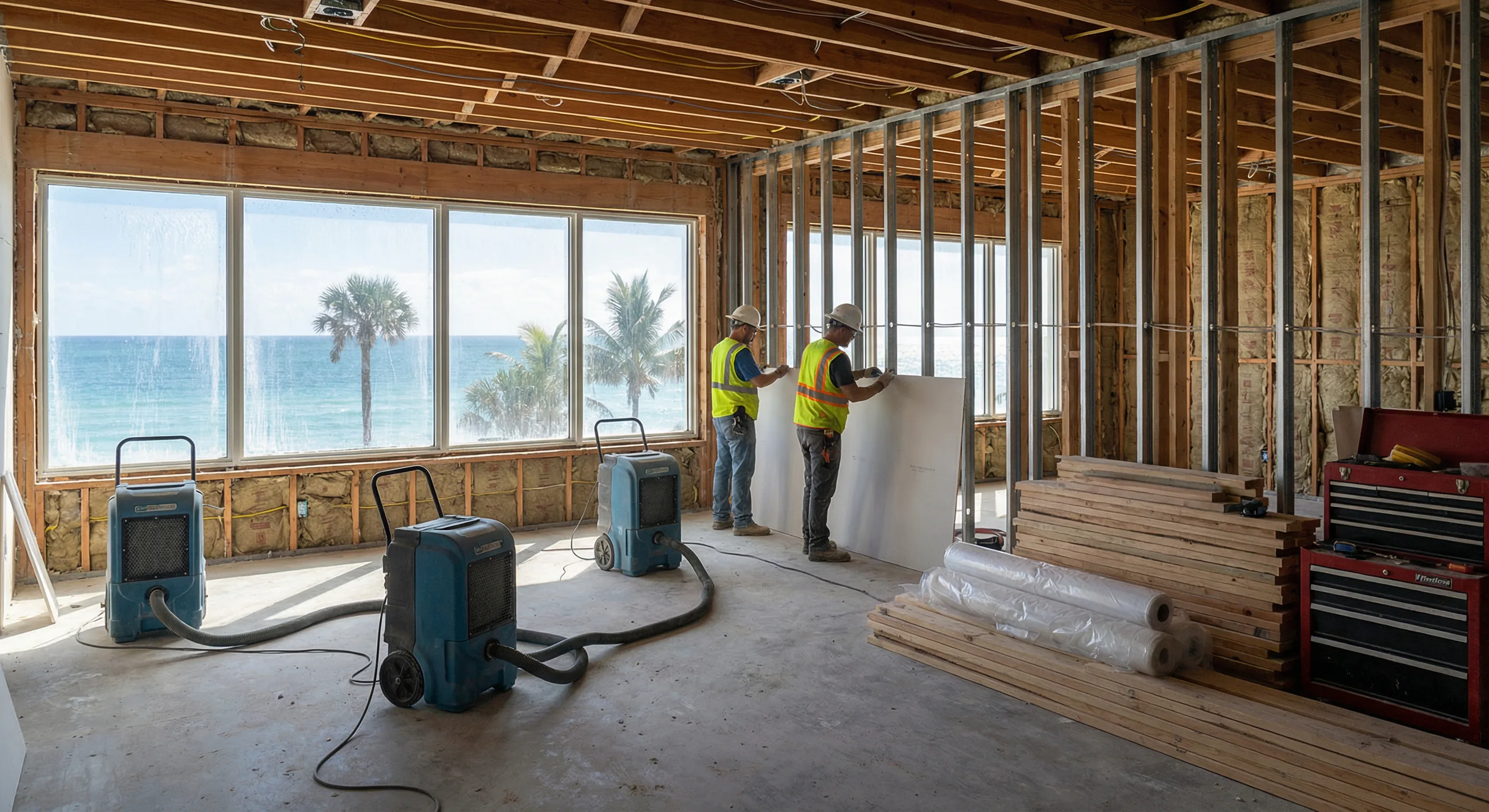
In multi-unit buildings, we work in corridors and vertical stacks to avoid disturbing unaffected units. Containment barriers and negative-air machines isolate work zones from occupied areas while drying proceeds.
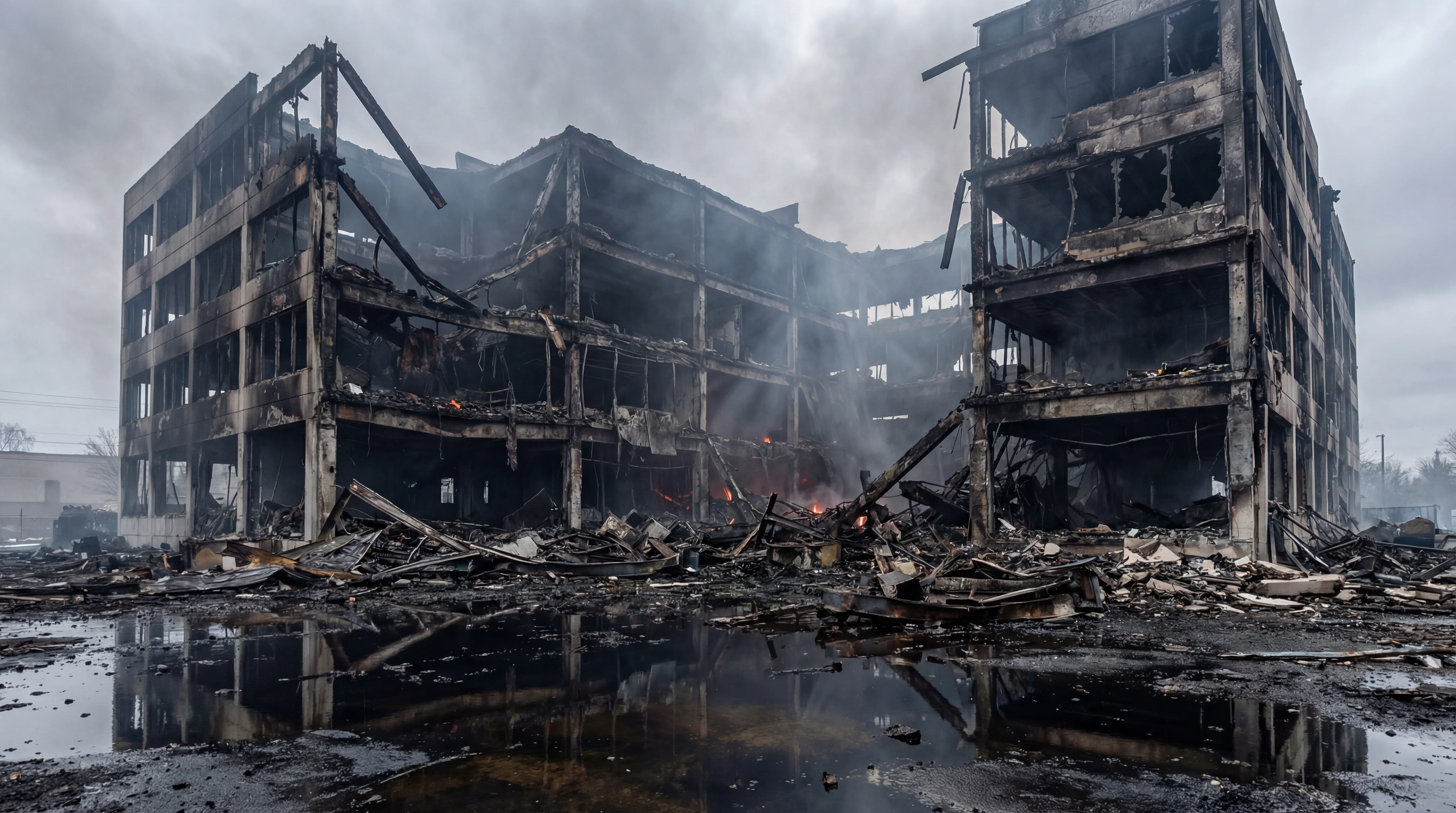
Catastrophic damage demands more than standard restoration. Palm Build deploys industrial equipment, experienced project managers, and multi-crew operations for disasters exceeding $100K — from single-building losses to regional catastrophe events.
Beyond Ordinary Restoration
A "large loss" is any disaster big enough to require special resources, extended timelines, and coordination beyond what a typical contractor can provide. Whether you're facing a catastrophic hurricane event, a major commercial fire, or widespread flooding affecting multiple buildings, our large loss team brings industrial-scale equipment, experienced project managers, and the capacity to deploy multiple crews immediately. For properties requiring full rebuild, we transition directly into reconstruction under the same project manager.
The First 2 Hours
Catastrophic damage compounds faster than residential losses. Every hour without industrial-scale response increases total project cost by 10-20%. Four critical moves in the first two hours.
Ensure all occupants and personnel are safe and accounted for. Shut off utilities if accessible without entering compromised areas. Establish a perimeter — do not allow anyone into structurally damaged zones until engineering assessment is complete.
Before anyone touches the property, photograph and video every angle — exterior damage, interior rooms, roof lines, mechanical systems. Wide shots and close-ups. This baseline documentation is the foundation of your insurance claim and will be worth tens of thousands in adjuster negotiations.
Large losses exceed what a single contractor can manage. Call a restoration company with CAT-level resources — industrial equipment, multiple crews, and project managers who handle $100K+ scopes daily. Delays of even 12 hours compound damage exponentially at this scale.
File the claim immediately and request a large loss adjuster — standard desk adjusters are not equipped for six- and seven-figure scopes. Provide your initial documentation. A restoration partner experienced in large loss claims can coordinate directly with the carrier from hour one.
24/7 CAT team dispatch across FL, NC, and SC. We mobilize industrial equipment and multi-crew operations for disasters exceeding $100K.
Loss Scale Taxonomy
The restoration industry uses tiered thresholds to define large loss work. Each tier triggers different crew sizes, equipment fleets, carrier workflows, and timeline expectations. Knowing your tier shapes the entire project from day one.
$500K
Median Project Value
typical large loss across our portfolio
$3M+
Owned Fleet Value
equipment and vehicles, not rental-dependent
30+
Max Concurrent Sites
simultaneous projects during major CAT events
Standard Commercial
$100K – $250K
Large Loss
$250K – $1M
Catastrophe
$1M – $5M
Major CAT
$5M+
Standard Commercial
$100K – $250K
Large Loss
$250K – $1M
Catastrophe
$1M – $5M
Major CAT
$5M+
When You Need Large Loss Services
Large loss typically refers to damage exceeding $100,000 in scope, multi-building events, or projects requiring specialized resources, multi-crew coordination, engineering consultants, and complex project management that standard restoration cannot address.
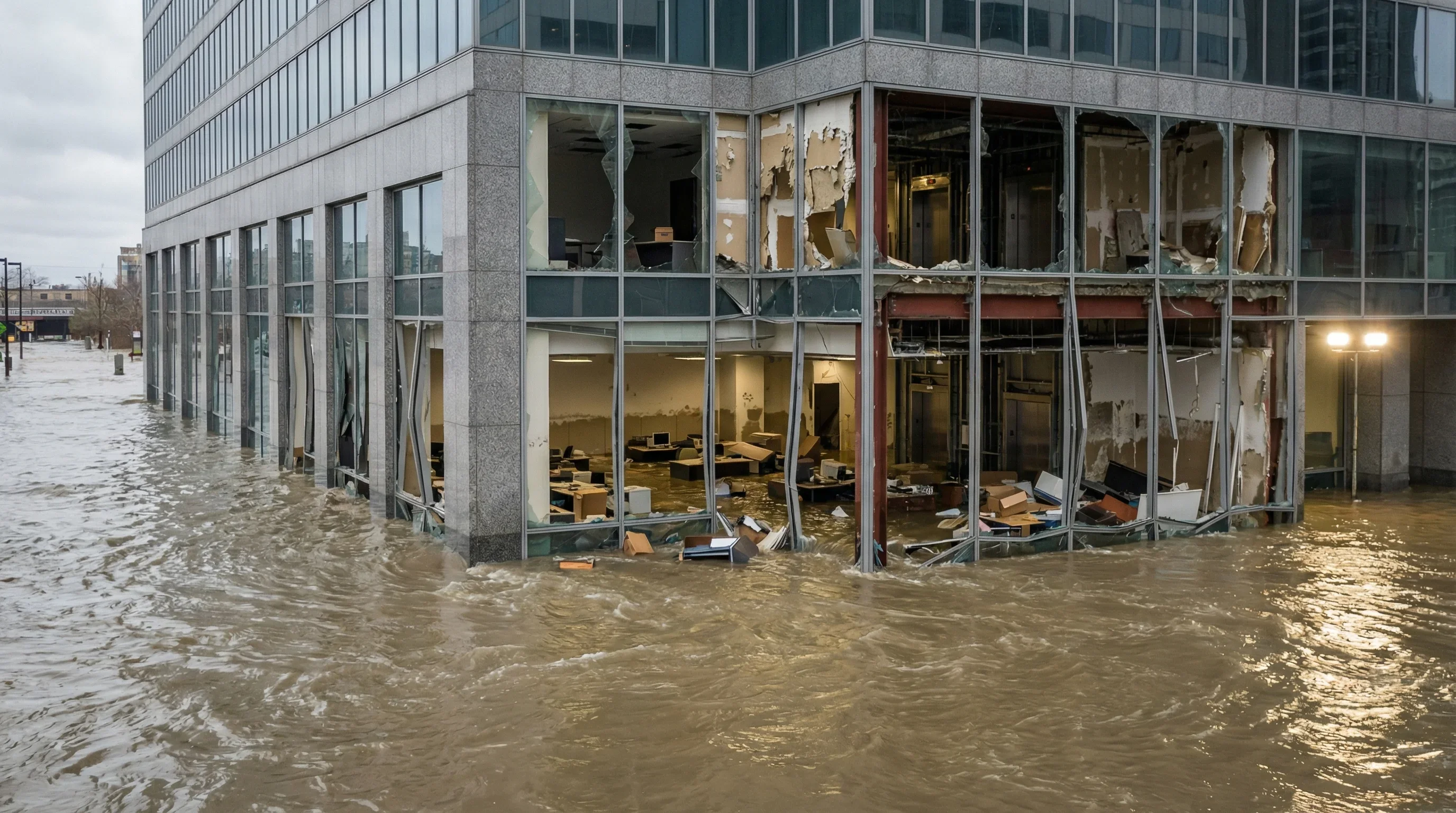
Flooding affecting multiple floors or buildings, burst main water lines, sprinkler system failures, or catastrophic pipe failures requiring industrial extraction and multi-crew response.
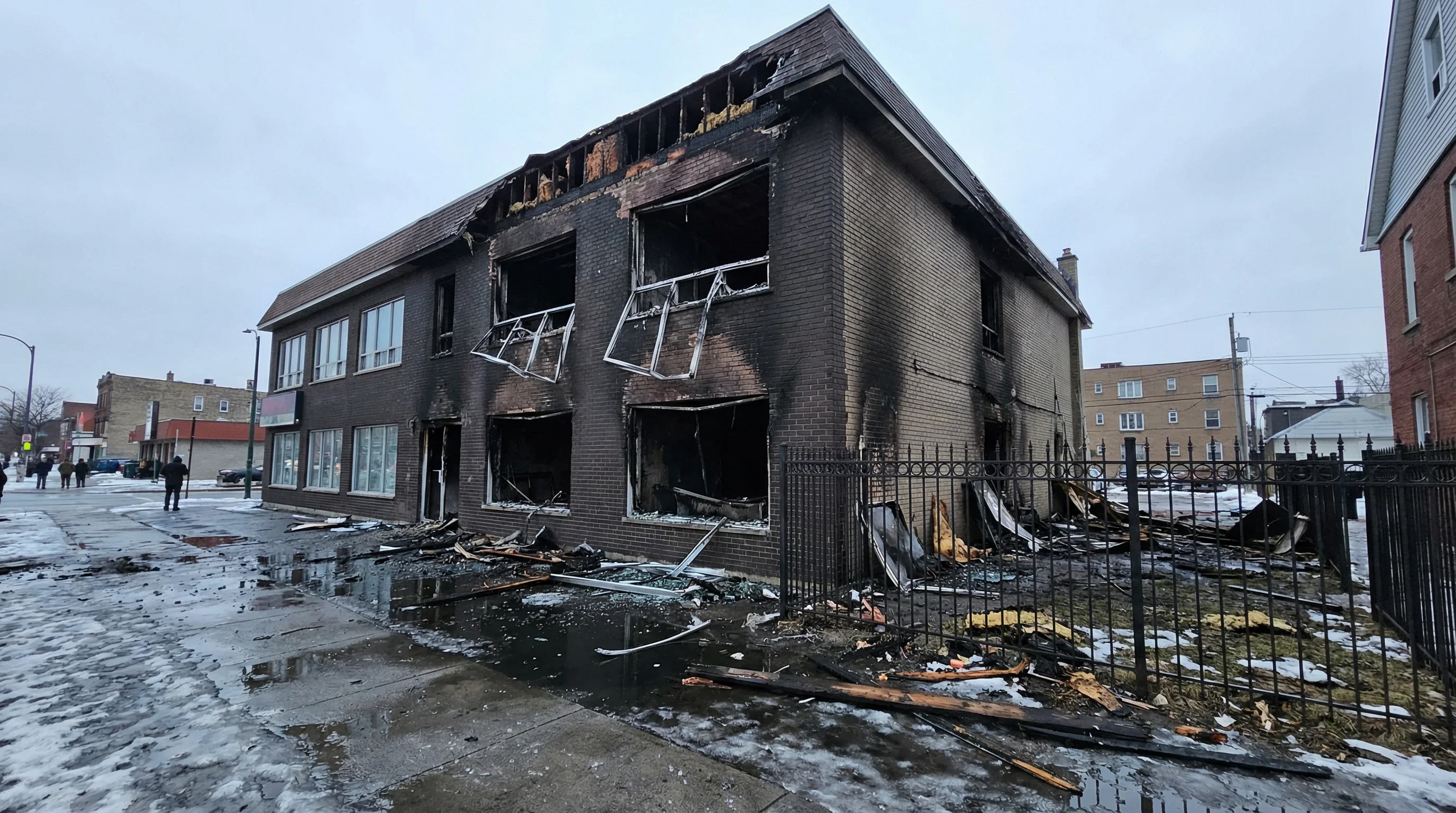
Large-scale fire damage requiring structural engineering assessment, multi-phase restoration, environmental testing, and coordination with fire investigators and insurance carriers.
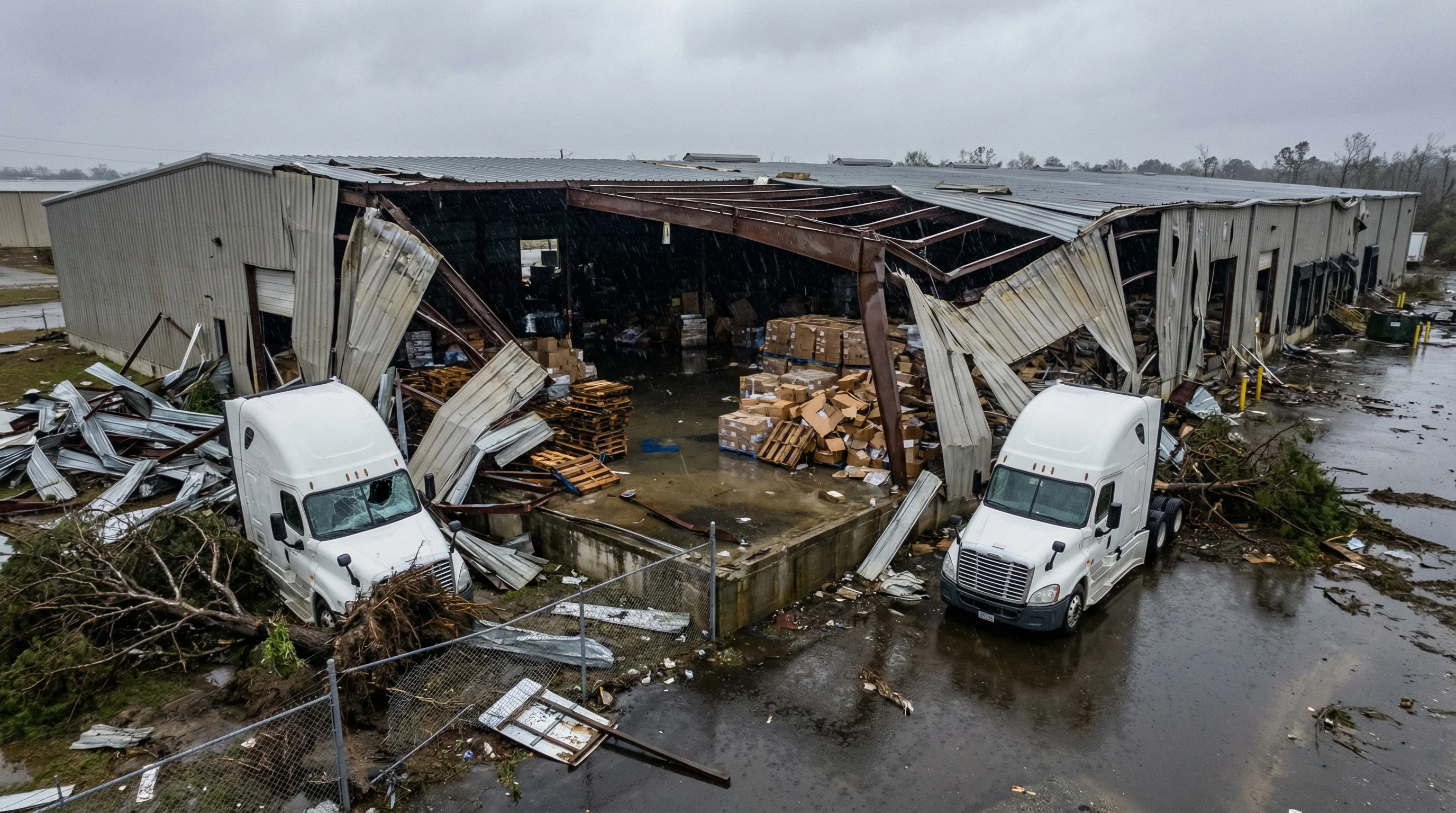
Hurricane, tornado, or severe storm damage affecting entire properties or multiple locations simultaneously. Requires rapid mobilization, emergency tarping, and coordinated multi-site response.
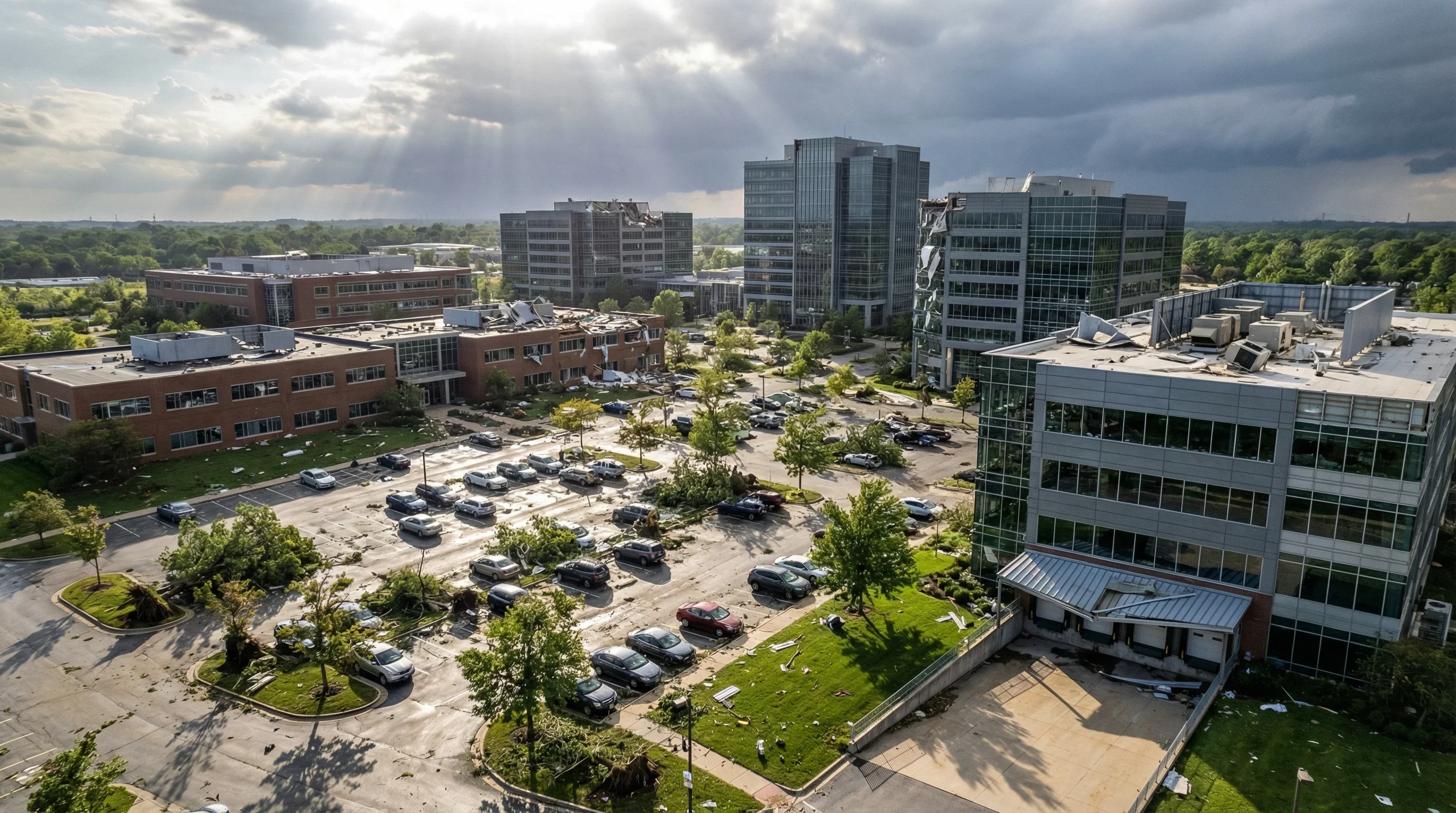
Disasters affecting multiple properties requiring coordinated response teams, centralized project management, and standardized documentation across locations.
Call us at (888) 245-5155 for a rapid assessment. Our large loss coordinators can evaluate your situation and recommend the appropriate response level within minutes.
Capability Overview
A professional overview of our capacity at every scale — from single-property losses to regional catastrophe events requiring multi-site coordination.
| Service | Single Property | Multi-Unit | Campus / Complex | Regional CAT Event |
|---|---|---|---|---|
Water Extraction & Drying | Standard crew | Multiple crews, industrial extractors | Truck-mounted + desiccant dehumidifiers | Full fleet deployment, multi-site |
Fire & Smoke Restoration | Standard scope | Engineering assessment + phased | Multi-building, environmental testing | Coordinated with investigators |
Mold Remediation | Containment + HEPA | Multi-zone containment | Building-wide protocols, IH oversight | Regional surge, post-storm mold |
Reconstruction | In-house GC | Phased rebuild, permit management | Multi-building, code upgrades | Full-scale reconstruction program |
Contents & Pack-Out | Standard inventory | Unit-by-unit inventory | Warehouse storage, cataloging | Mass pack-out, secure logistics |
Emergency Board-Up | Same-day | Multi-crew, priority dispatch | Building-by-building triage | Pre-staged materials, rapid deploy |
Equipment Specs & Deployment
Counting "200+ air movers" tells you scale, not capability. Large loss decisions hinge on hard specs — gallons per minute, cubic feet per minute, pints per day, kilowatts — and on knowing exactly which fleet recipe matches the scenario in front of you.
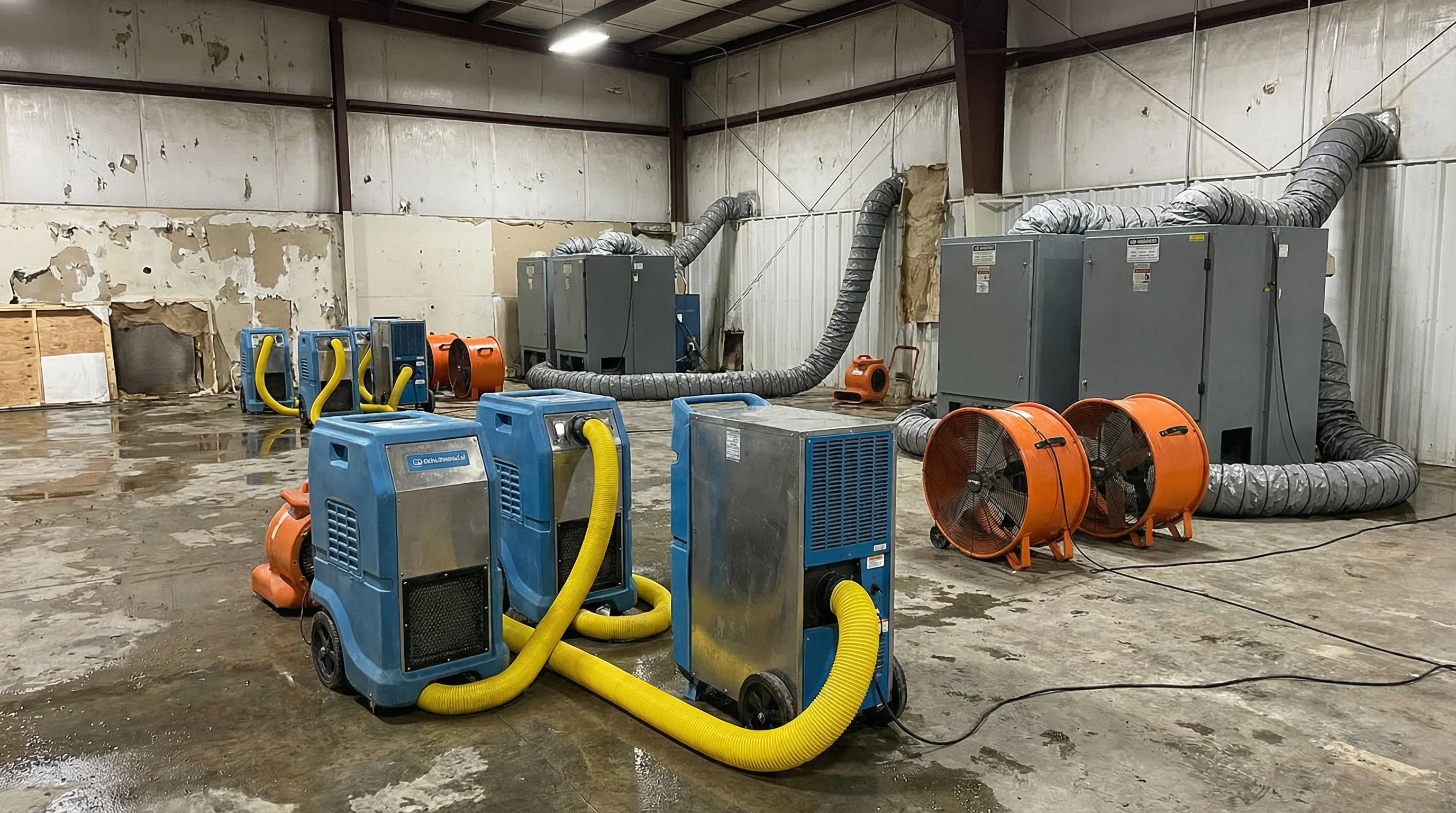
| Category | Representative Model | Specs | Fleet Qty | Typical Use |
|---|---|---|---|---|
Truck-Mount Extractors | HydraMaster CDS 4.8 | 12 GPM flow, 350 CFM vacuum, 230°F heat | 8 units | High-volume standing water removal, Cat 3 black-water response |
Desiccant Dehumidifier Trailers | Phoenix DesiccantMax 400 | 5,500 CFM process air, 75 lb/hr moisture removal | 4 trailers | Large-footprint drying (20K+ sq ft), cold environments, tight timelines |
LGR Commercial Dehumidifiers | Dri-Eaz LGR 7000XLi | 240 PPD at AHAM, 235 CFM | 50+ units | Precision drying of contained spaces, Cat 2 / 3 events |
High-Velocity Air Movers | Phoenix Axial Air Mover | 3,400 CFM airflow, low-amp draw | 200+ units | Broad-area evaporation across multi-floor deployments |
HEPA Air Scrubbers | Abatement Predator 750 | 750 CFM HEPA filtration, 0.3μm rating | 40+ units | Containment, Cat 3 microbial response, mold abatement |
Portable Generators | Multiquip DCA-70USI | 56 kW prime, Tier 4 final, sound-attenuated | 12 units | Utility-down scenarios during CAT events, off-grid sites |
Truck-Mount Extractors
Desiccant Dehumidifier Trailers
LGR Commercial Dehumidifiers
High-Velocity Air Movers
HEPA Air Scrubbers
Portable Generators
Fleet Deployment Recipes
Single Commercial Loss
$250K – $1M
1 truck-mount extractor, 20 air movers, 4 LGR dehus, 2 HEPA scrubbers, 1 generator
Multi-Building Complex
$1M – $5M
2 truck-mounts, 80 air movers, 12 LGR dehus, 8 HEPA scrubbers, 1 desiccant trailer, 3 generators
CAT Event (Regional)
$5M+
Full fleet deployment: all truck-mounts, 200+ air movers, all LGR units + 4 desiccant trailers, 40 HEPA scrubbers, 12 generators, self-sufficient support package
Large loss restoration typically starts at $100,000 and can exceed $5 million for multi-structure catastrophe events. The primary cost drivers are damage type, affected square footage, number of structures, environmental hazards, and reconstruction complexity. Palm Build provides Xactimate-based scoping using the same platform your insurance carrier uses — so estimates align from day one.
Large loss threshold
$100K+
Multi-crew, multi-phase scope
Avg catastrophic claim
$280K
2026 multi-peril residential
Max single-event scope
$5M+
Multi-structure CAT deployment
Every large loss is unique, but these ranges reflect 2026 Xactimate pricing across Palm Build's project history in Florida, North Carolina, and South Carolina.
Multi-floor pipe burst, sprinkler discharge, or sewage backup affecting 10,000+ sq ft with structural saturation
Typical range
$100K - $500K
Phases: Emergency extraction, industrial drying (50+ dehu/air mover sets), selective demo, rebuild
Multi-room or multi-story fire with smoke migration, structural compromise, and contents loss across the building
Typical range
$150K - $1.2M
Phases: Board-up, hazmat abatement, structural demo, smoke remediation, full reconstruction
Wind and water intrusion across multiple structures, roof loss, flooding, and debris impact requiring regional deployment
Typical range
$250K - $5M+
Phases: Emergency tarping, water extraction, mold prevention, phased reconstruction across structures
Campus, HOA complex, or multi-tenant commercial property with simultaneous damage across buildings
Typical range
$200K - $3M+
Phases: Parallel mitigation crews, phased occupancy management, multi-carrier coordination
| Phase | What it includes | % of total | Timeline |
|---|---|---|---|
| Emergency response & stabilization | Board-up, tarping, emergency extraction, hazmat assessment, power/generator setup, temporary climate control | 15-25% | Hours 0-48 |
| Mitigation & environmental | Industrial drying, smoke/soot remediation, mold prevention, asbestos/lead abatement, contents pack-out | 20-35% | Days 2-21 |
| Selective demolition | Structural tear-out, contaminated material removal, environmental clearance testing, engineering assessments | 10-15% | Weeks 2-6 |
| Reconstruction & finish | Structural framing, MEP rough-in, drywall, flooring, cabinetry, paint, fixtures, final inspections | 30-45% | Weeks 4-26+ |
Phase percentages shift based on damage severity and reconstruction scope. Fire losses allocate more to demolition and environmental; water losses allocate more to mitigation and drying. Multi-structure events add 10-20% for coordination and logistics overhead.
Florida
$120K - $2.5M avg
Hurricane frequency drives demand surges that spike material and labor costs 20-40% during CAT events. Flood vs wind deductible splits add claims complexity. Post-2024 insurance reform affects carrier response timelines.
North Carolina
$100K - $1.8M avg
Winter freeze events and mountain flooding create concentrated large losses. Lower labor rates offset longer mobilization distances. State licensing requirements add compliance overhead to multi-trade reconstruction.
South Carolina
$110K - $2.2M avg
Coastal hurricane exposure combined with aging building stock increases structural reconstruction scope. Multi-carrier coordination across HOA complexes is common. State wind/hail pool adds claims-handling complexity.
Need a large loss scope assessment?
Our project managers provide detailed Xactimate-based estimates for losses exceeding $100K
Our Large Loss Response Process
Large loss projects follow a structured 7-phase process designed to control complexity, maintain documentation standards, and deliver predictable outcomes on high-stakes, extended-timeline restorations.
Crew deployment, equipment staging, logistics coordination. Self-sufficient teams mobilize with generators, fuel, and supplies. For CAT events, pre-staged resources deploy from positions near the impact zone.
Comprehensive damage assessment across all affected areas. Emergency stabilization begins immediately — water extraction, board-up, shoring, utility isolation. Thermal imaging and moisture mapping establish baseline.
Detailed Xactimate estimates developed. Initial adjuster walkthrough scheduled. Multiple carrier coordination begins for complex claims. Scope document establishes the foundation for project approval.
Multiple crews operating simultaneously across zones. Industrial drying, decontamination, and selective demolition proceed 24/7 when needed. Phased approach allows partial operations in occupied buildings.
Dedicated project manager coordinates all trades, subcontractors, and stakeholders. Daily progress reports with photos, moisture data, and crew logs. Weekly stakeholder briefings keep all parties aligned.
Seamless transition from mitigation to reconstruction. Permits, engineering, and trade coordination managed under one project manager. Phased rebuild allows partial occupancy where possible.
Building inspections, air quality clearance, and certificate of completion. Final documentation package compiled for insurance records — including complete photo history, moisture logs, and financial reconciliation.
Timelines vary by scope. Minor large losses may complete in 4-8 weeks. Major multi-building catastrophe events can span 6-12 months. We provide detailed project schedules with milestones at the outset.
Phased Execution Framework
Large loss timelines are not sequential checklists — they are overlapping workflows choreographed by a project manager. This is what the calendar actually looks like across 12 weeks of mitigation through close-out.
Emergency Stabilization
w1–2Extraction, board-up, temporary power, moisture control. The clock starts the moment we get the call.
Scope & Insurance Coordination
w1–3Adjuster walkthroughs, Xactimate writeups, carrier approvals. Runs in parallel with stabilization.
Selective Demolition & Dry-Out
w2–4Controlled demo, structural drying to S500 standard, daily moisture logging.
Decontamination & Environmental
w3–5Mold prevention, antimicrobial treatment, environmental testing and clearance documentation.
Reconstruction Planning
w4–6Permits, material procurement, subcontractor scheduling, trade sequencing.
Structural Rebuild
w5–9Framing, electrical, plumbing, HVAC, drywall, insulation. Multi-trade coordination under one PM.
Finishes & Punchlist
w8–11Paint, flooring, trim, fixtures, punchlist closeout, owner walkthroughs.
Close-Out & Documentation
w10–12Final certifications, lien waivers, document package delivery. Warranty period starts at handover.
Emergency Stabilization
Week 1–2Extraction, board-up, temporary power, moisture control. The clock starts the moment we get the call.
Scope & Insurance Coordination
Week 1–3Adjuster walkthroughs, Xactimate writeups, carrier approvals. Runs in parallel with stabilization.
Selective Demolition & Dry-Out
Week 2–4Controlled demo, structural drying to S500 standard, daily moisture logging.
Decontamination & Environmental
Week 3–5Mold prevention, antimicrobial treatment, environmental testing and clearance documentation.
Reconstruction Planning
Week 4–6Permits, material procurement, subcontractor scheduling, trade sequencing.
Structural Rebuild
Week 5–9Framing, electrical, plumbing, HVAC, drywall, insulation. Multi-trade coordination under one PM.
Finishes & Punchlist
Week 8–11Paint, flooring, trim, fixtures, punchlist closeout, owner walkthroughs.
Close-Out & Documentation
Week 10–12Final certifications, lien waivers, document package delivery. Warranty period starts at handover.
Why the overlap matters: Overlap is intentional — parallel workflows compress total calendar days. A 12-week sequential project compresses to 8 – 10 weeks when scope, decontamination, and rebuild planning run concurrently rather than sequentially.
Catastrophe (CAT) Event Response
Catastrophe events like hurricanes affect hundreds of properties simultaneously. Responding at this scale requires pre-planned deployment strategies, self-sufficient teams, and the organizational capacity to manage dozens of large loss projects concurrently across a wide geographic area.
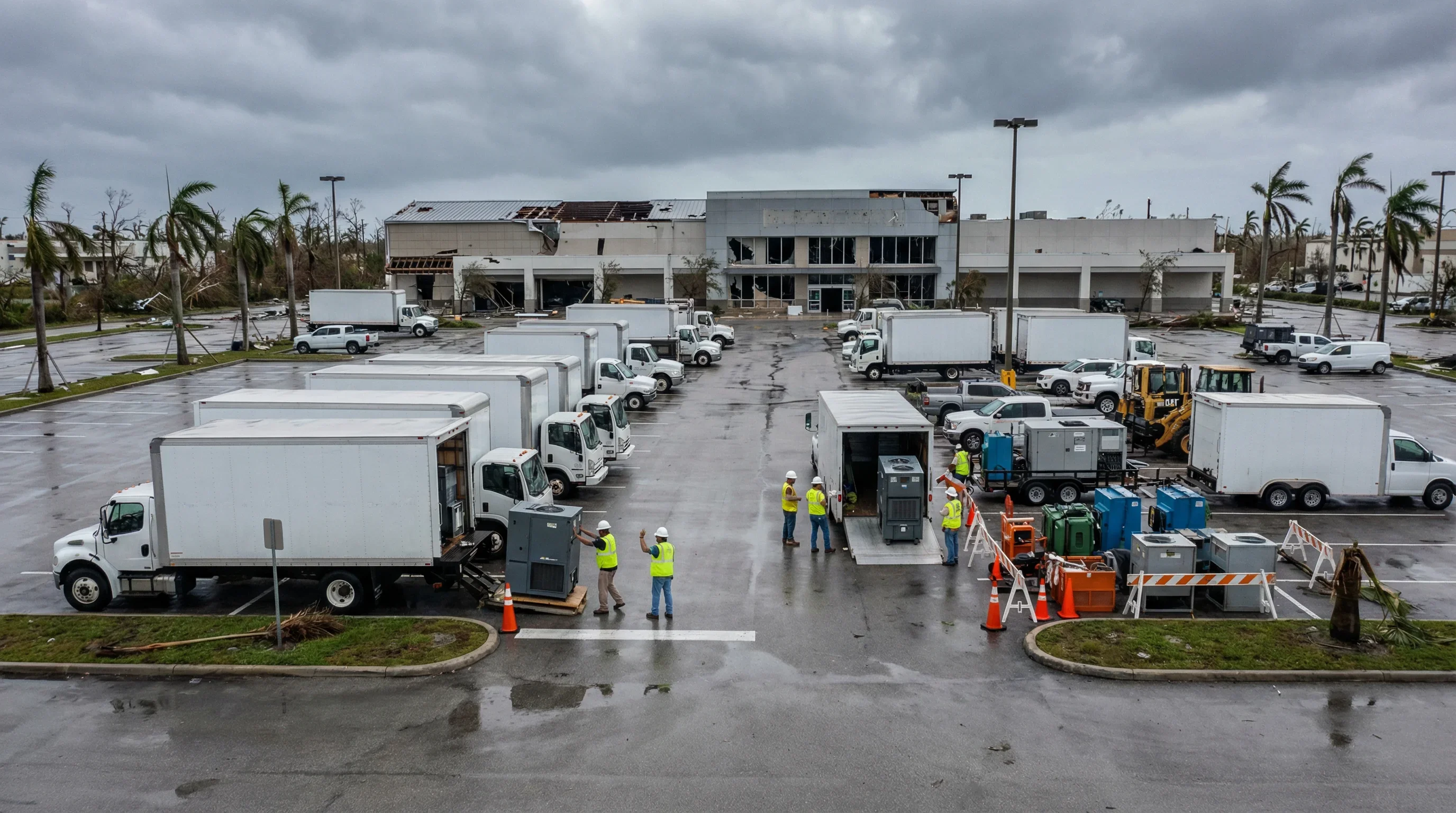
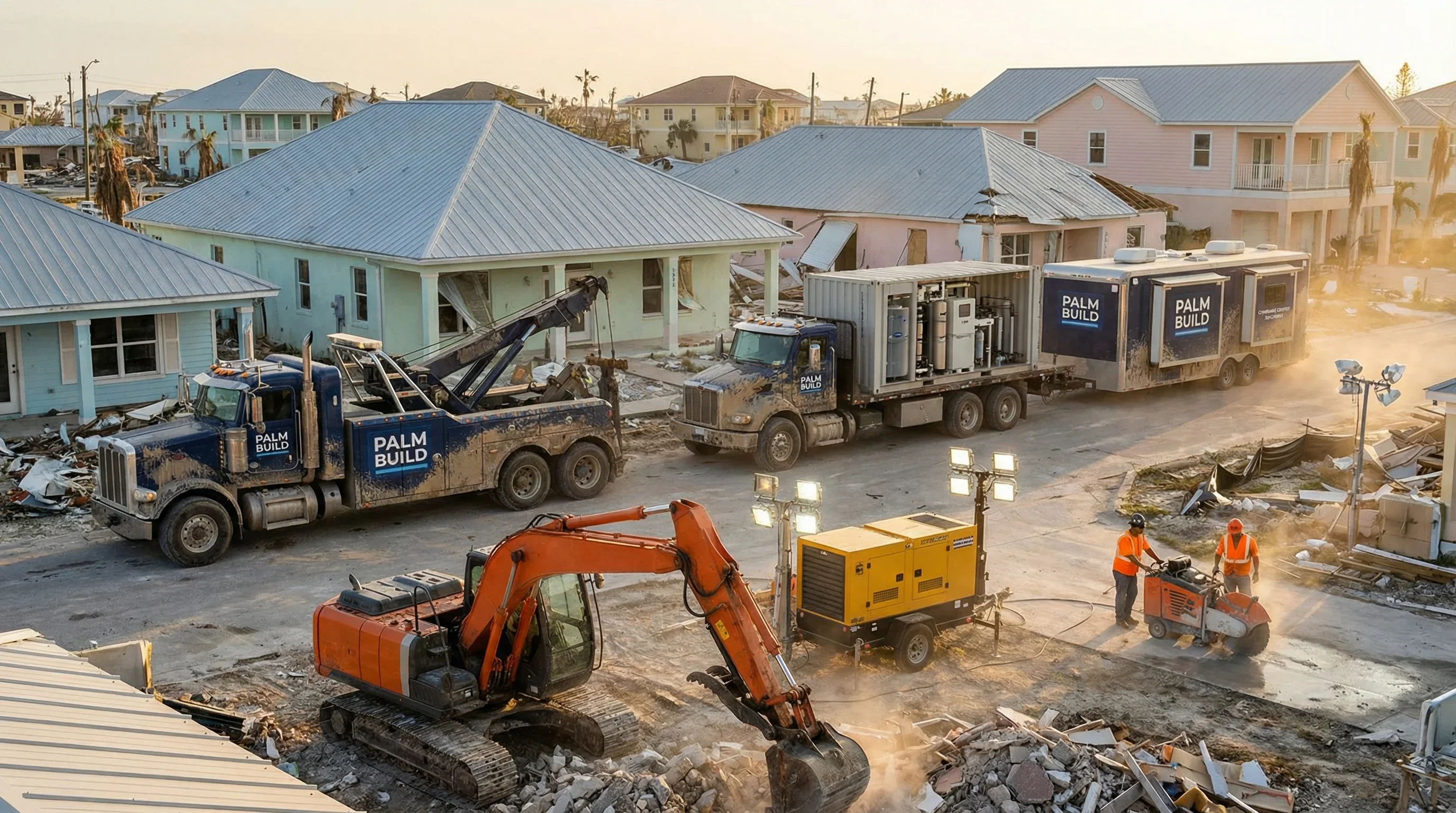
CAT staging area — equipment and crews pre-positioned for rapid deployment
We monitor storm tracks and stage equipment and crews outside the projected impact zone days before landfall. When winds die down, we mobilize within hours — not days.
CAT teams deploy with generators, fuel, satellite communications, food, and lodging. We do not depend on local infrastructure that is likely down after a regional disaster.
Offices in Florida and North Carolina with coverage extending to South Carolina, Georgia, Tennessee, and Texas. Partner networks provide additional surge capacity nationwide.
After a hurricane, we may run dozens of projects concurrently. Triage protocols prioritize critical sites — hospitals, occupied buildings, revenue-generating properties — while less critical sites queue behind.
Pre-arranged fuel contracts, material supply agreements, and lodging reservations. We truck in our own supplies and maintain equipment independently during extended deployments.
In widespread disasters, different properties are insured by different carriers. We coordinate with numerous adjusters simultaneously, maintaining carrier-specific documentation for each site.
Pre-Staged
Equipment positioned during hurricane season
12-24 hrs
Full mobilization for multi-state CAT events
Dozens
Concurrent projects managed during CAT events
Named Storm Protocol
Hurricane response is a temporal protocol, not a checklist. From the moment a storm enters the cone of uncertainty to the final demobilization weeks after landfall, every decision is shaped by the clock. This is how Palm Build runs a named-storm CAT response from staging through reset.
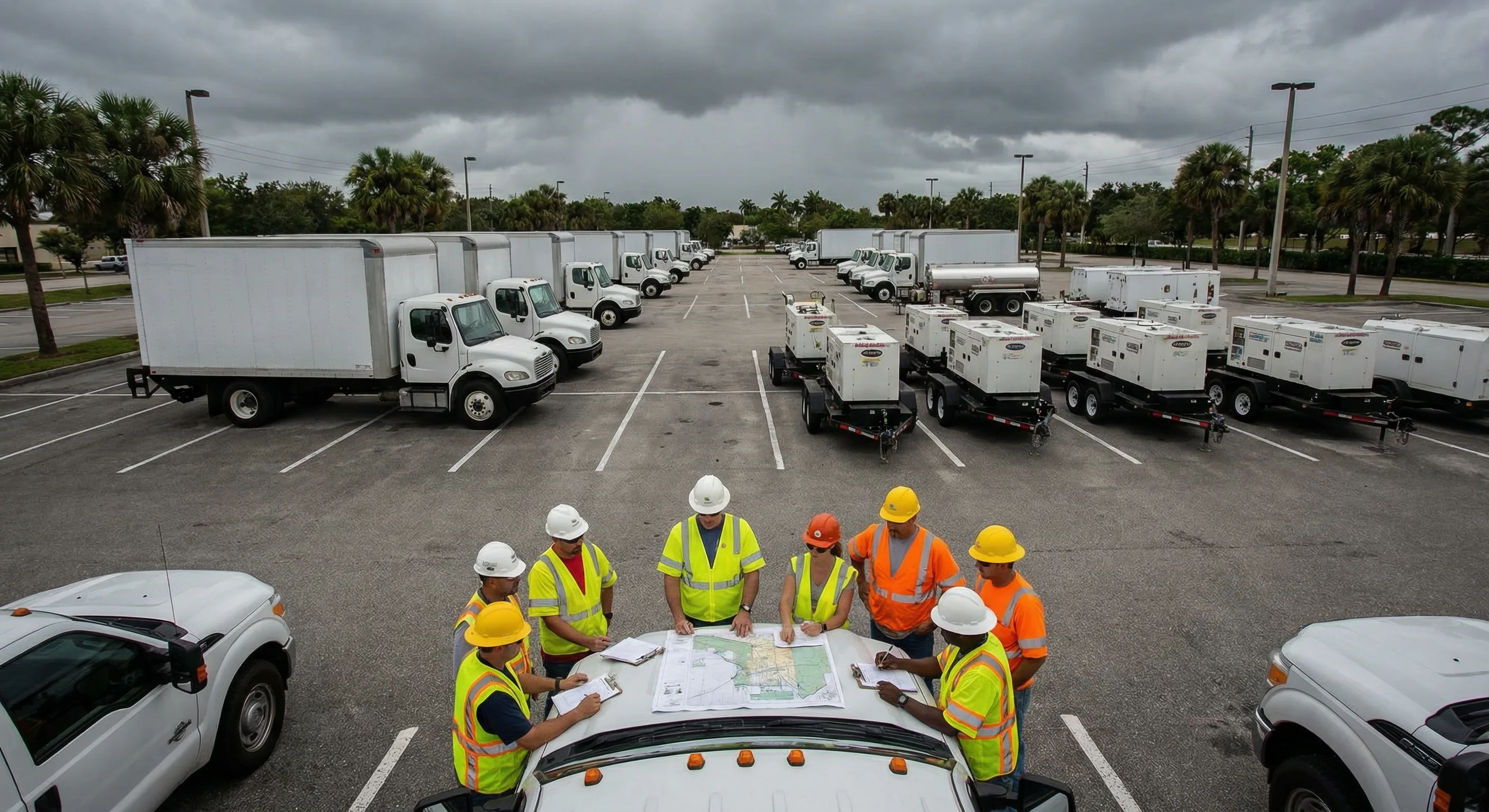
Pre-landfall staging — equipment and fuel trailers positioned outside the projected cone of impact.
Track the storm cone, convoy equipment to staging areas outside the projected impact zone, and pre-position fuel trailers, generators, truck-mounts, and desiccant trailers. Crew lodging is confirmed on the safe side of the storm before landfall.
Once roads are passable, sweep teams enter assigned zones and grid-categorize every claim property by severity (red / yellow / green), structural safety, and access. Data flows into the dispatch matrix in real time.
Emergency stabilization rolls out by priority — hospitals, occupied residential, revenue-critical commercial, then secondary sites. Tarping, board-up, extraction, and temporary power deploy on 24/7 shifts.
Document disaster declaration status, coordinate with FEMA and SBA inspectors where applicable, and notify carriers of CAT-scale claims. Expedited authorizations and emergency scope approvals unlock faster mitigation.
Coordinate debris hauling, C&D disposal, hazmat segregation, and right-of-way staging per local emergency ordinances. Many municipalities waive tip fees for CAT debris — documented separately for claim reimbursement.
As stabilized properties hand off to reconstruction, new intake replaces them in the queue. PMs maintain emergency response at newly assessed sites without losing sight of stabilized ones.
As the emergency phase winds down, surge crews and rental gear return home. Core PM teams remain for reconstruction. A full after-action review captures lessons for next-season readiness.
Large Loss Scenarios We Handle
Each scenario below requires capabilities beyond standard restoration — specialized equipment, multi-crew coordination, complex insurance handling, and experienced project management.
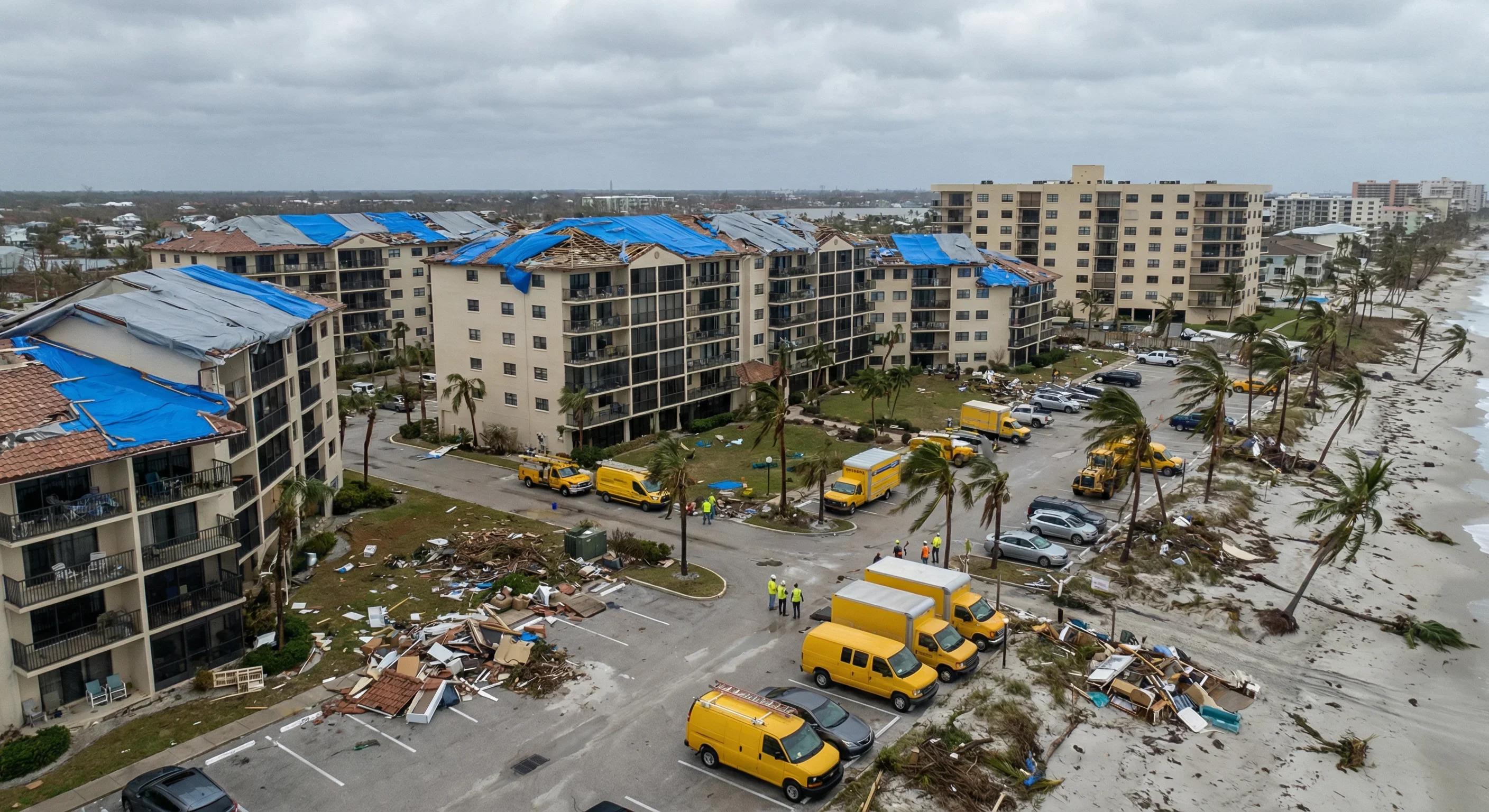
Scope: Portfolio-wide roof damage, water intrusion, debris removal across 10+ buildings. Multiple insurance carriers, displaced tenants, and emergency temporary repairs.
What makes it large loss: Requires CAT deployment, multi-site triage, and coordination with multiple adjusters simultaneously.
Related service details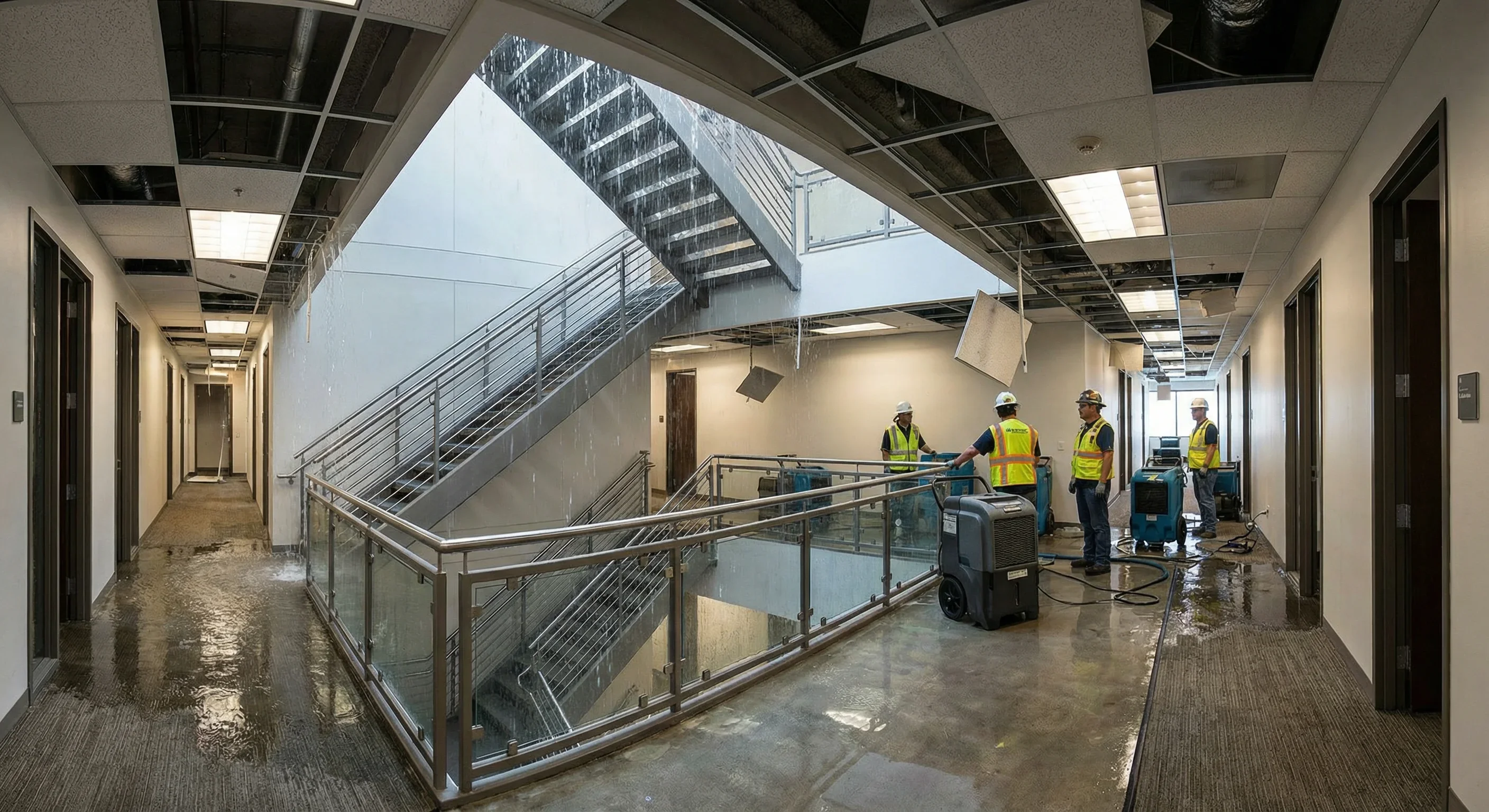
Scope: Sprinkler activation or pipe failure on upper floors, water cascading through 10-20 floors. Server rooms, tenant improvements, and common areas affected.
What makes it large loss: Industrial extraction at scale, floor-by-floor drying, occupied building phasing, and business interruption coordination.
Related service details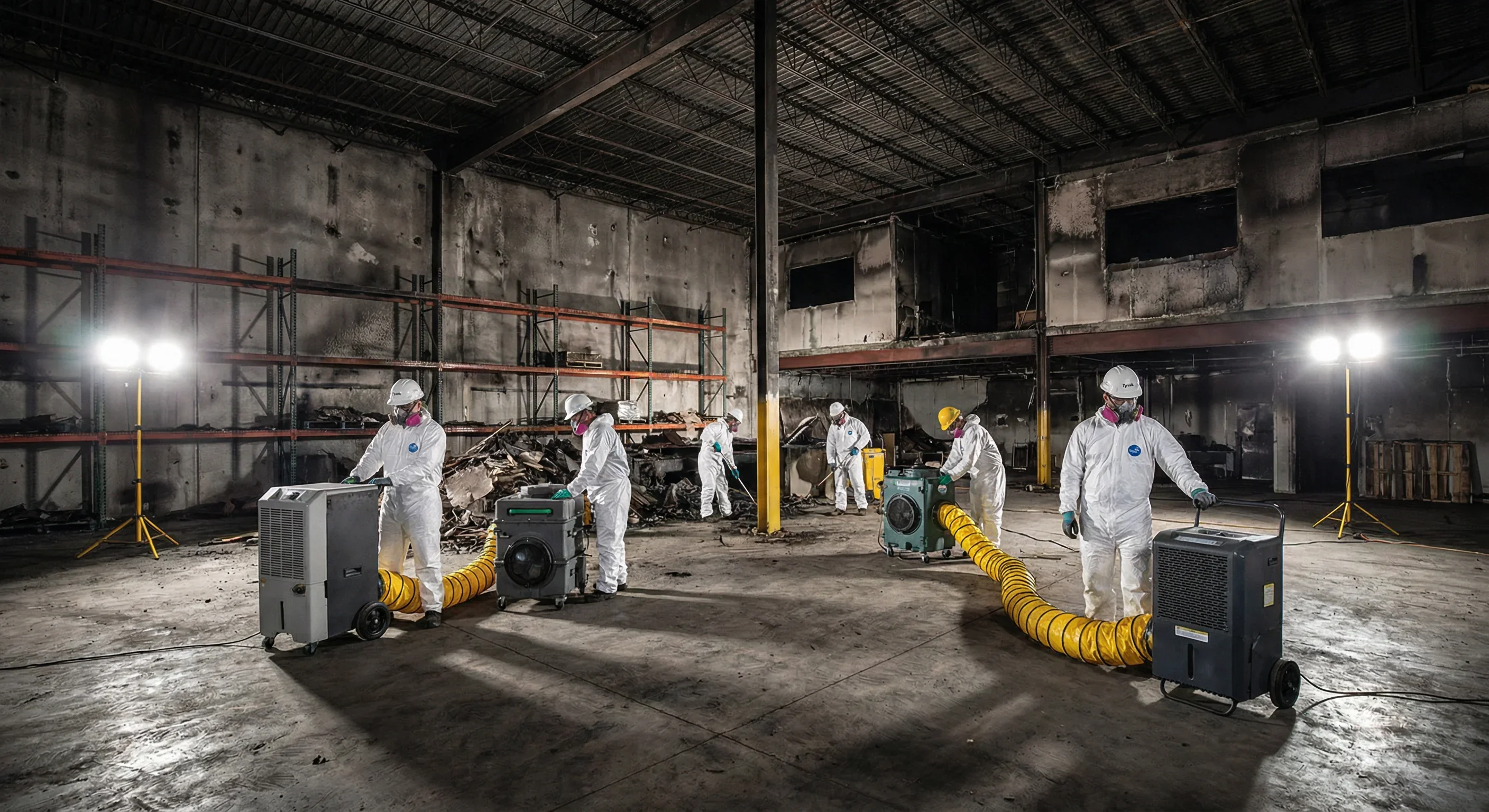
Scope: Hotel, apartment complex, or warehouse fire affecting 50,000+ sq ft. Structural compromise, environmental testing, contents pack-out, and complete reconstruction.
What makes it large loss: Engineering assessment, fire investigator coordination, environmental clearance, and phased multi-trade reconstruction.
Related service details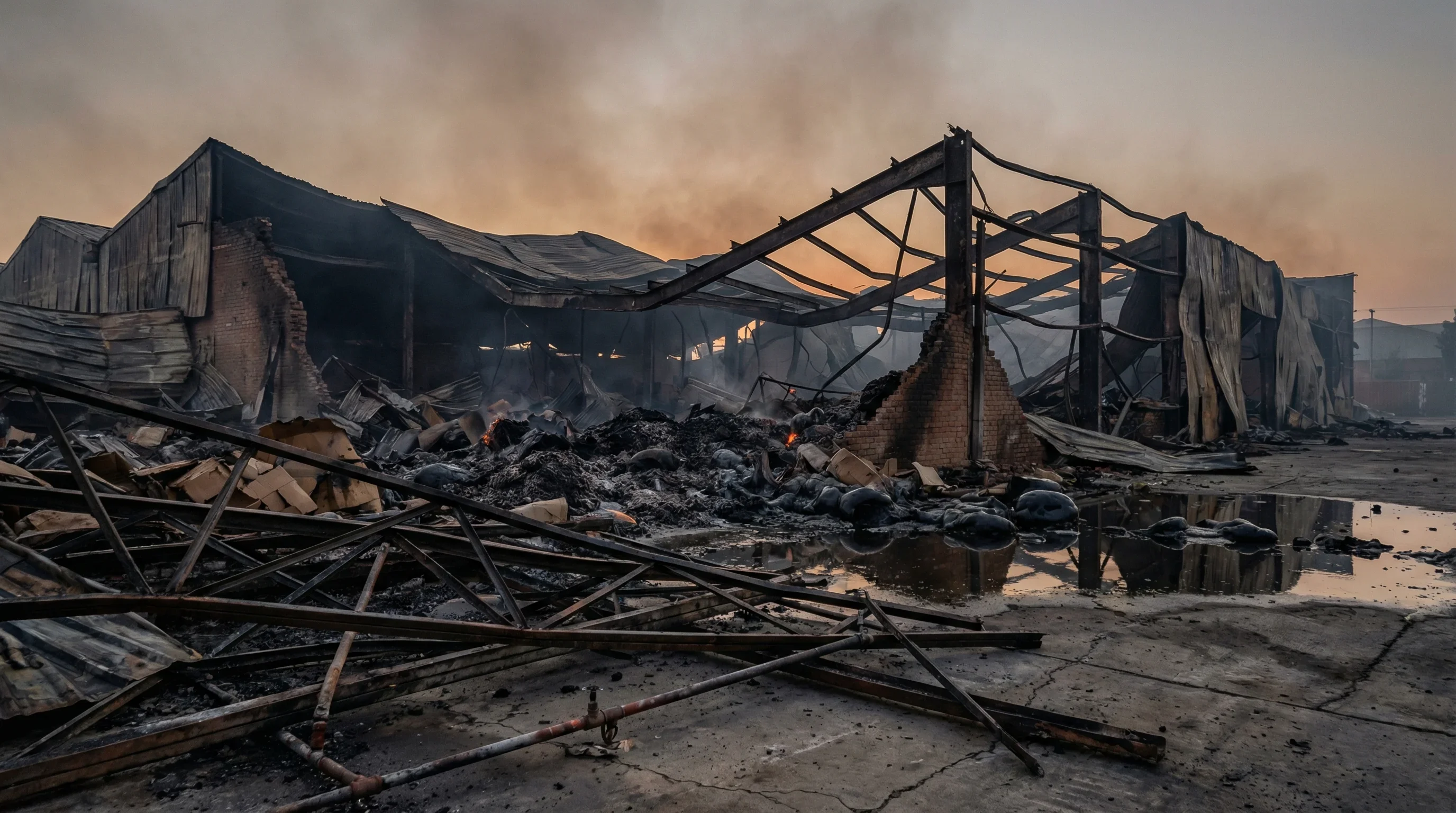
Scope: Manufacturing plant or warehouse with equipment damage, chemical residues, hazardous materials, and production line interruption. Environmental compliance required.
What makes it large loss: HAZWOPER-trained crews, environmental consultants, equipment decontamination, and production timeline coordination.
Related service details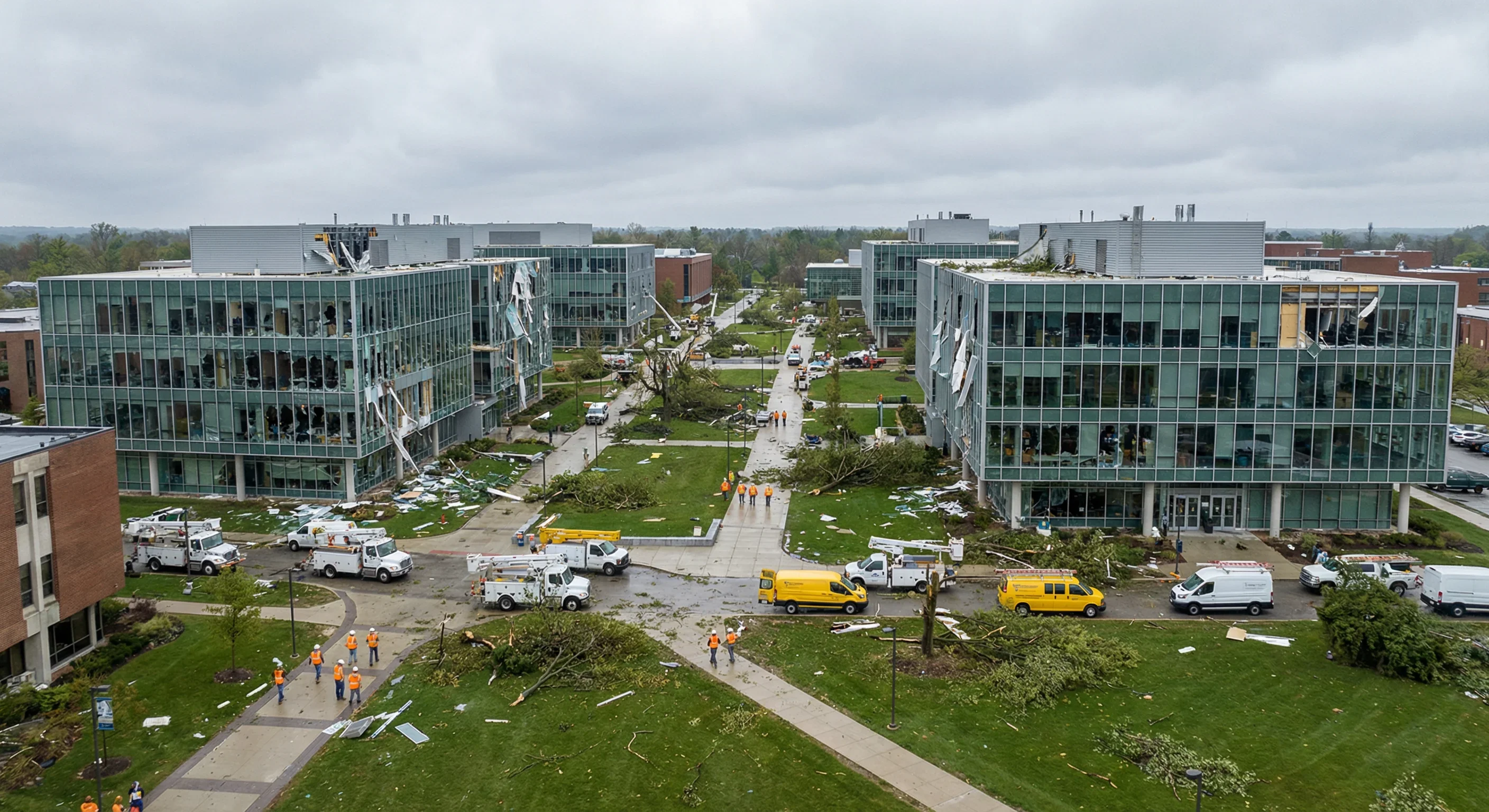
Scope: University, corporate campus, or hospital complex with weather or water damage affecting multiple buildings. Occupied spaces, critical operations, and tight deadlines.
What makes it large loss: Phased restoration in occupied facilities, stakeholder communication protocols, and deadline-driven scheduling.
Related service detailsMulti-Structure Coordination
Multi-structure restoration is fundamentally a coordination problem, not a technical one. Occupants, tenants, board members, facility managers, and property managers all have priorities — and the project schedule has to absorb every one of them without missing a milestone.
In multi-unit buildings, we work in corridors and vertical stacks to avoid disturbing unaffected units. Containment barriers and negative-air machines isolate work zones from occupied areas while drying proceeds.
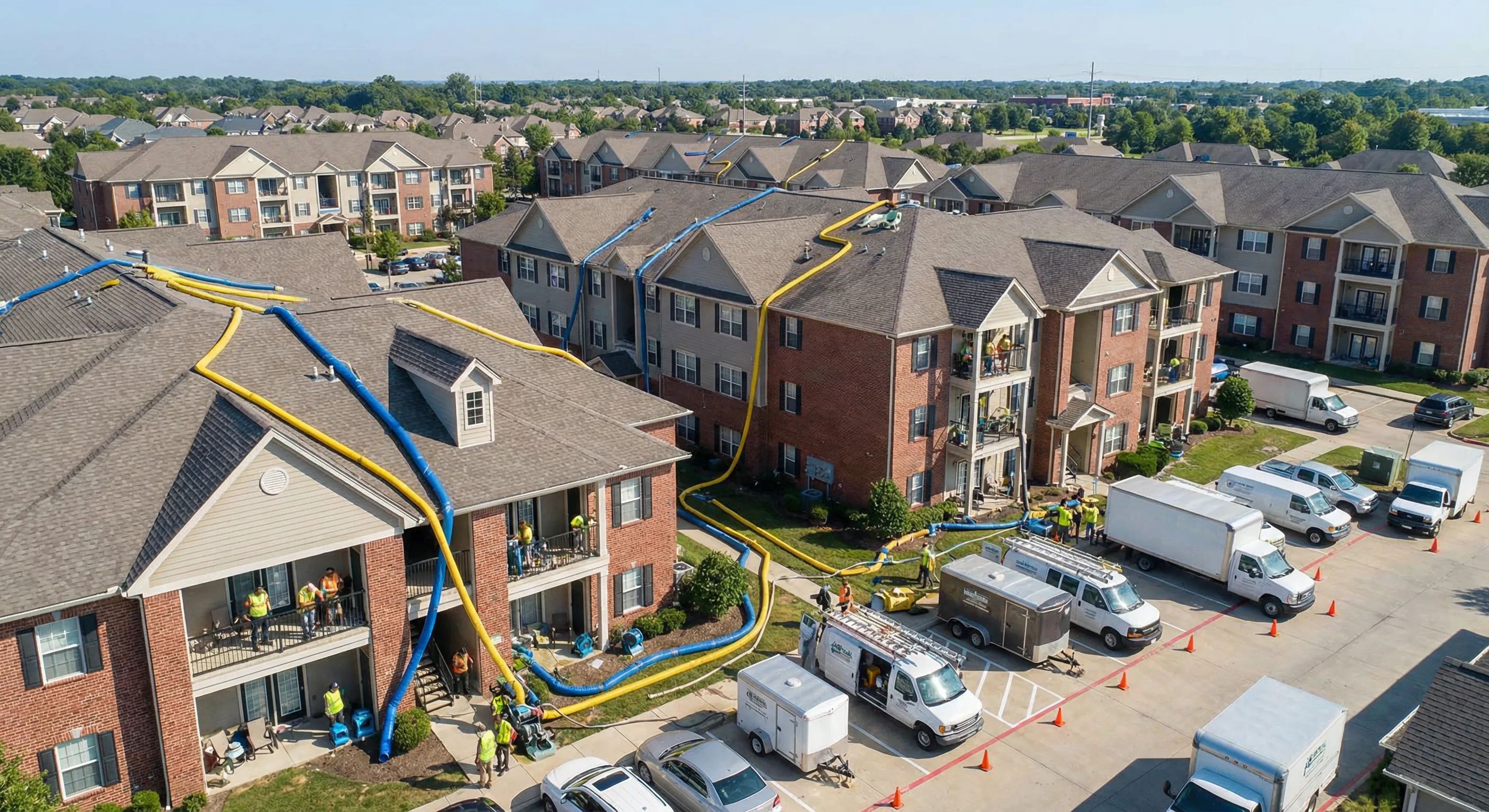
Unit access is scheduled 48 hours in advance with written occupant notifications. The PM coordinates with property managers for master-key access, and vacant units are worked first to minimize occupant disruption.
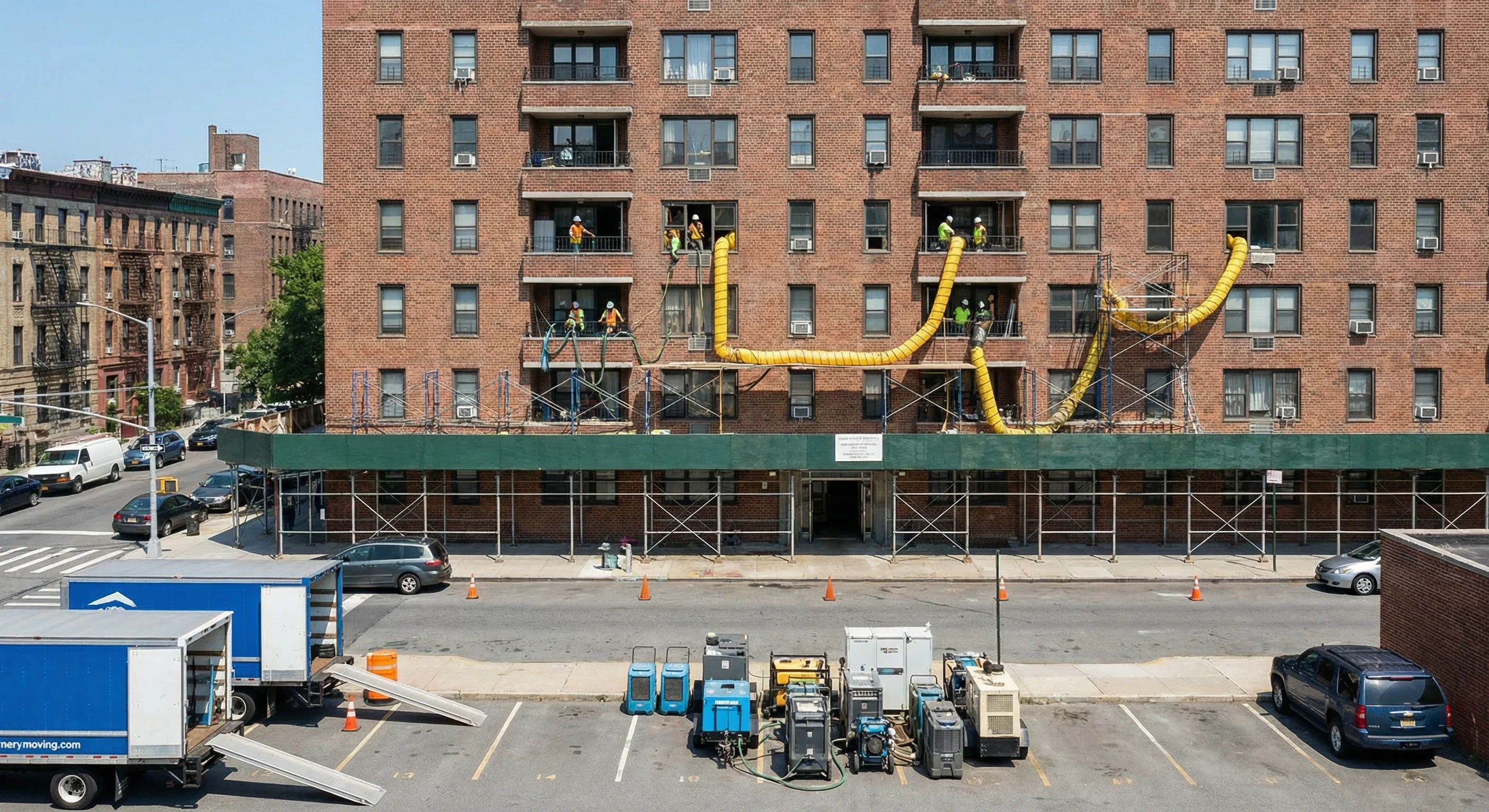
When units are uninhabitable, we coordinate with ALE (Additional Living Expense) coverage providers, document ALE expenses for claim reimbursement, and maintain occupant communication through the displacement period.
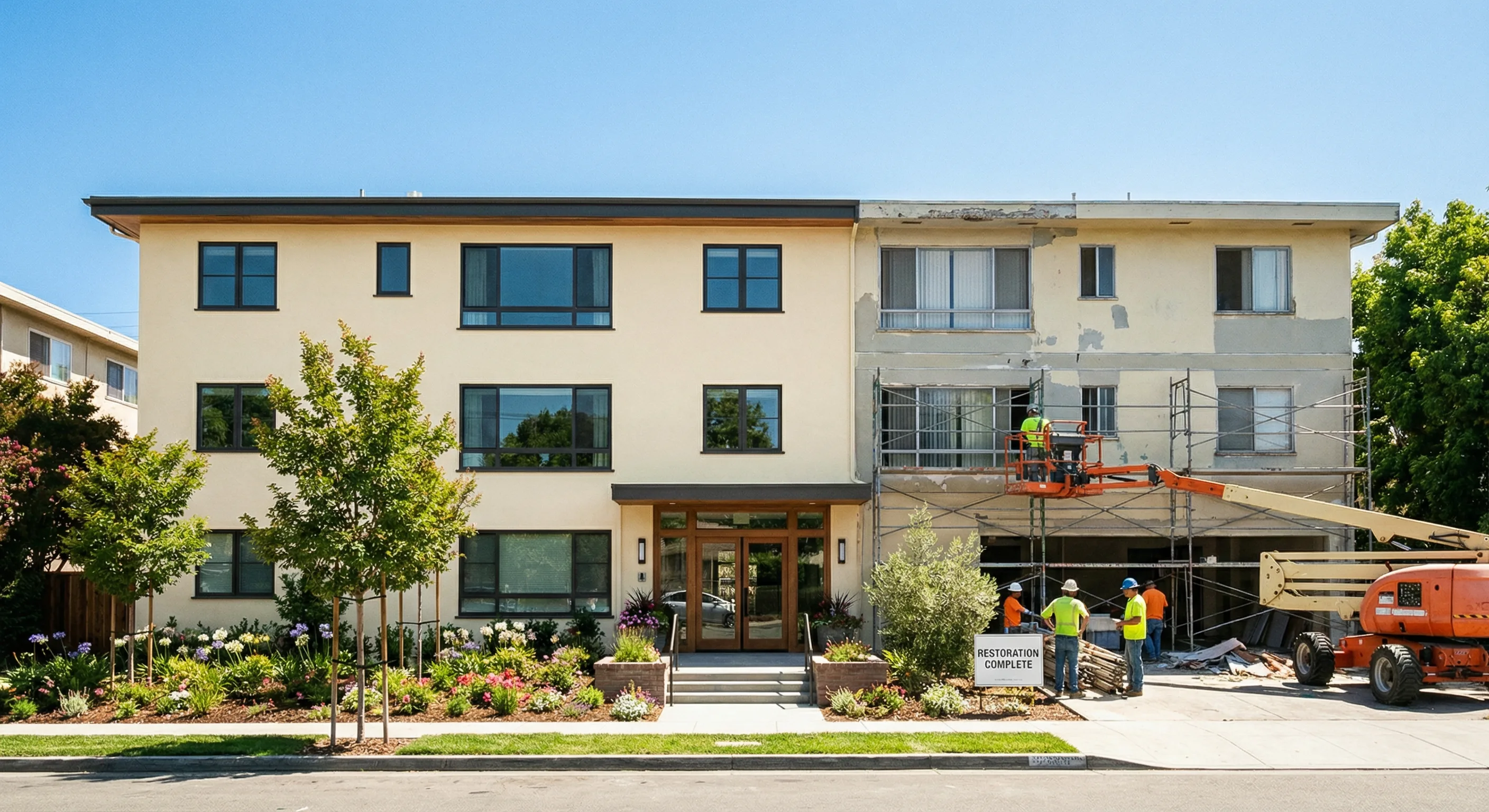
Weekly resident email updates, posted corridor notices for daily work plans, and a dedicated resident hotline. Clear communication reduces complaints and accelerates restoration timeline.
Coordination Matrix by Property Type
| Scenario | Primary Contact | Uniquely Difficult | Our Solution |
|---|---|---|---|
| HOA / Condo Association | Board President + Property Manager | Common-area vs. unit-owner policy boundary | Scope split at policy boundary, joint adjuster walkthrough on both sides |
| Apartment Complex | Property Manager | ALE coverage and tenant relocation logistics | ALE coordination, unit-by-unit relocation tracking, displaced-tenant communication plan |
| Commercial Campus | Facility Manager | Keeping operations running during mitigation | Off-hours work, phased zone access, full containment with negative air |
| Mixed-Use Development | Master Owner + Tenants | Competing stakeholder priorities, multi-tenant scheduling | Weekly stakeholder standup with all parties, unified project schedule |
HOA / Condo Association
Apartment Complex
Commercial Campus
Mixed-Use Development
Project Management & Documentation
Handling a large loss is as much an organizational challenge as a technical one. The difference between a project that stalls and one that instills confidence is rigorous project management, relentless communication, and documentation that can withstand any level of scrutiny.
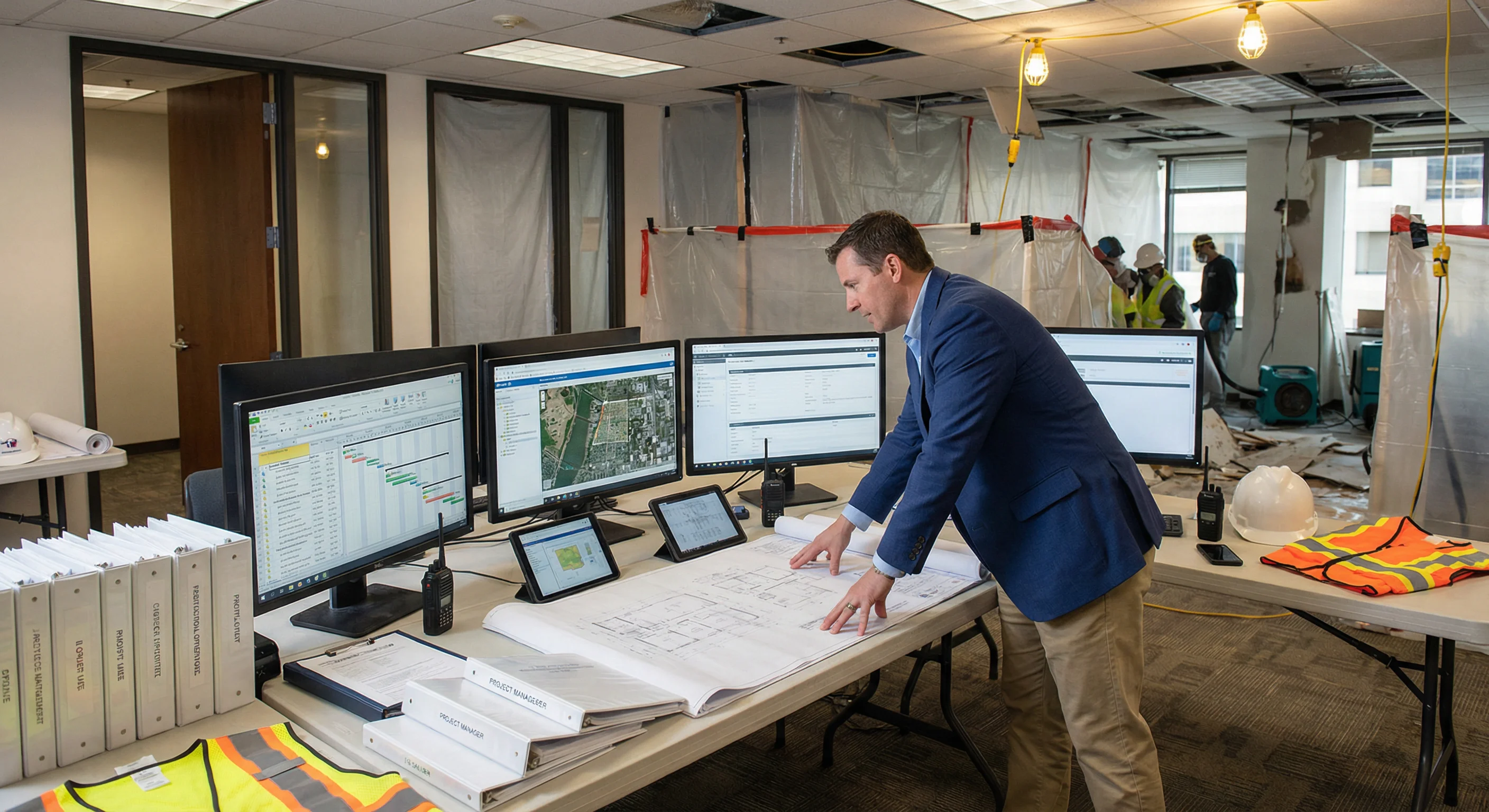
Dedicated command center for large loss project coordination and real-time monitoring.
Every large loss receives a dedicated PM who serves as your single point of contact. They coordinate all trades, manage subcontractors, maintain the schedule, and handle insurance communication. You deal with one person — they deal with everything else.
Structured daily reports document crews on site, work completed, equipment deployed, and upcoming activities. Executive summaries are distributed to all stakeholders each evening so decisions happen in real time, not weeks later.
Time-stamped photographic evidence of all damage, demolition, and restoration progress — organized by location and date. Before, during, and after photos for every affected area create an indisputable record for insurance and legal purposes.
Building-wide moisture readings recorded daily across all affected areas using thermal imaging and commercial moisture meters. Data tracks drying progress, identifies problem areas, and provides the documentation adjusters need to verify mitigation effectiveness.
Real-time budget tracking against the approved scope. Change orders are documented with photos and justification, then submitted for adjuster approval before execution. No scope creep, no billing surprises.
Structured communication cadence: daily reports, weekly stakeholder briefings, and milestone meetings with adjusters. In occupied buildings, tenant notifications and access coordination ensure minimal disruption to ongoing operations.
Audit-Grade Documentation
Beyond the dedicated PM and daily reports, high-value claims require an audit-grade documentation chain. Forensic accountants, SIU investigators, and litigation attorneys can scrutinize every photo, every moisture reading, and every distribution log months — sometimes years — after the project closes. This is the digital infrastructure that holds up to that scrutiny.
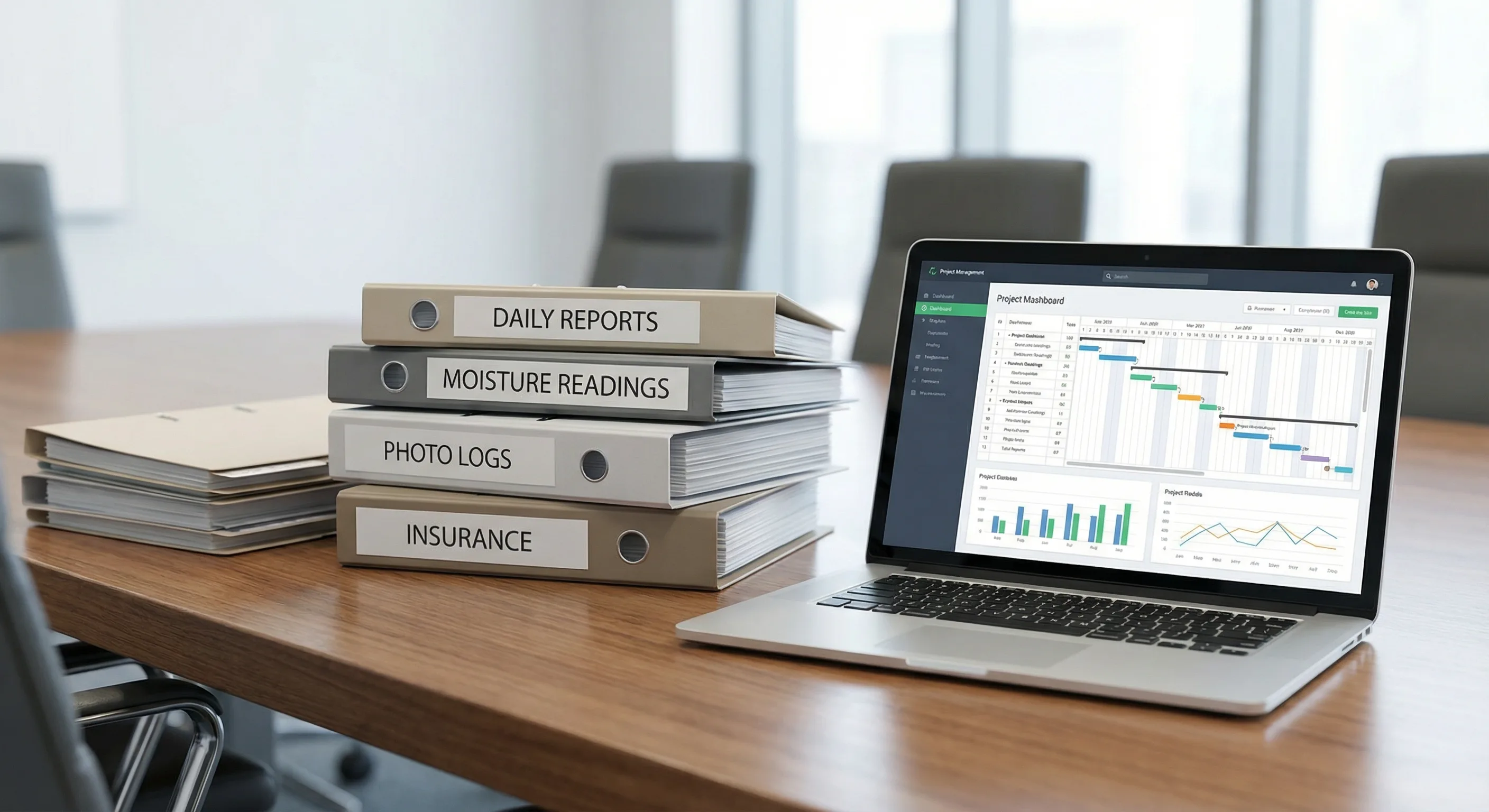
Carrier-ready documentation package — every photo, log, and report linked through a verified chain of custody.
Every moisture reading, photo, and report is timestamped server-side within 60 seconds of capture. Offline captures queue locally and sync when connectivity restores — timestamps are GPS and network-verified, not just device-clock.
All photos retain original EXIF metadata: capture time, GPS, device, orientation. Photos are hash-signed and uploaded to cold storage immediately. The hash chain lets carriers and SIUs confirm no photo was altered post-capture.
Contents pack-out uses barcoded tracking labels on every box. Item-level inventory captured with photo + category + condition note. Restoration, cleaning, and storage are logged per item for full chain-of-custody documentation.
Daily field reports auto-distribute to adjuster, policyholder, PM, and carrier SIU where applicable. The distribution log records email delivery, timestamps, and recipient confirmation for claim-dispute defensibility.
On claims over $250K, Special Investigations Units may review the documentation package. Our packages meet insurance fraud prevention standards: hash-verified photos, GPS-stamped moisture data, time-locked daily reports, and the full chain-of-custody log.
audit-log.txt
// Sample chain-of-custody excerpt
| Timestamp | Action |
|---|---|
| 2026-03-14 07:42:16 EST | Moisture reading — Unit 314, wall cavity Tech J. Morales → 28.4% WME |
| 2026-03-14 07:43:02 EST | Photo captured — Unit 314 IR thermal Tech J. Morales → SHA-256 verified |
| 2026-03-14 08:15:44 EST | Daily report drafted PM K. Reyes → Draft v1 |
| 2026-03-14 18:00:00 EST | Daily report distributed System → 4 recipients, all delivered |
// SHA-256 chain hash: a7e9...c4f1
Sample 4-event excerpt from a real chain-of-custody log
Working With Insurance on Large Losses
Large loss insurance claims involve more parties, more documentation, more scrutiny, and more money than standard claims. Adjusters, TPAs, forensic accountants, and sometimes attorneys all interact with the restoration process. We have the administrative capacity and experience to keep the claim moving.
Large losses often involve separate property, contents, flood, wind, and business interruption policies — sometimes with different carriers. We maintain separate documentation streams and coordinate site visits with multiple adjusters simultaneously.
We work within Third Party Administrator frameworks including predetermined Xactimate pricing, strict SLAs for response and reporting, and standardized documentation formats. Our internal processes mirror TPA requirements for consistency.
BI claims require meticulous timeline documentation. We provide daily logs, schedules, and delay documentation that forensic accountants need to substantiate lost income. Faster restoration directly reduces BI exposure.
All estimates written in Xactimate with detailed line items matching the adjuster's system. For large losses, dedicated in-house estimators write and negotiate scope separate from the field crews performing the work.
Hidden damage is common in large losses. We perform exploratory demolition early to identify problems before they burst the budget. Each supplement is documented with photos, data, and scope justification.
We have working relationships with adjusters from major insurance companies built over years of professional collaboration. Understanding each carrier's requirements, documentation preferences, and procedures accelerates approvals.
For a comprehensive guide to the insurance claims process — from filing through final payment — visit our dedicated insurance resource page.
Insurance Restoration GuideNamed Partners
Large loss claims move at program speed when the restoration vendor is already inside the carrier or TPA system. We hold pre-approved vendor status with the major TPAs and maintain working relationships with adjusters across the largest commercial carriers.
Sedgwick
TPA Program
Crawford & Company
TPA Program
Gallagher Bassett
TPA Program
All estimators certified in Xactimate; line items match adjuster format exactly. ESX files exchanged directly with carriers via XactAnalysis — no manual re-entry on either side.
Pre-negotiated program pricing on major TPA programs eliminates rate disputes and accelerates scope approval cycles by days, sometimes weeks.
TPA SLAs (4-hour contact, 24-hour arrival, 48-hour scope) are tracked in our internal dashboards and proven on every claim with delivery timestamps.
Direct integration with XactAnalysis, Sedgwick viaOne, Crawford ClaimsCenter, and GB Luminos eliminates manual data entry and reduces claim turnaround.
Working relationships with adjusters from major commercial carriers including:
Insurance Walkthrough
Large loss claims do not move on autopilot. Every phase has a deliverable, every deliverable has a deadline, and every dispute has a resolution path. This is what the walkthrough actually looks like — capped with a real $812K sample claim breakdown.
Initial Xactimate ESX with line-by-line scope, photo documentation, and moisture log submitted within 72 hours of stabilization. The carrier receives one structured package — no back-and-forth on basics.
Joint site walk with adjuster (and engineer if structural). All disputed items walked in person with photo evidence. Adjuster notes captured on a shared tablet — no post-visit surprises.
Hidden damage discovered during demo becomes a formal supplement with photos, test data, and scope justification. Submitted within 5 business days, followed up until disposition is in writing.
If scope disputes arise, we initiate a joint re-walk with the adjuster and PM. For unresolved items, we support appraisal, umpire, or mediation processes with documentation ready for third-party review.
Final invoicing matches the approved scope exactly. Lien waivers, warranty docs, and the full documentation package delivered with the final invoice for rapid settlement.
Real-World Example
Approved scope after supplements, ready for final invoice
| Line Item | Amount |
|---|---|
| Emergency mitigation (extraction, board-up, contents pack-out) | $67,200 |
| Structural drying (desiccant trailer, 14 days) | $48,900 |
| Selective demolition (4 units, common corridor) | $56,400 |
| Environmental testing & clearance | $14,700 |
| Framing, drywall, insulation (rebuild) | $198,500 |
| Mechanical, electrical, plumbing rough-in | $142,800 |
| Flooring, finishes, millwork | $121,600 |
| Paint, fixtures, final trim | $78,250 |
| HVAC cleaning and ducting replacement | $41,300 |
| Contents restoration (textile, electronics, pack-back) | $29,800 |
| Project management & supervision (10% loaded) | $73,000 |
| Permit fees & engineering | $12,500 |
| Supplement Carrier-approved supplements (hidden framing damage) | +$27,500 |
| Approved Total | $812,450 |
How to read this: This claim closed at $812,450 after a single approved supplement of $27,500 for hidden framing damage discovered during selective demolition. The supplement was submitted within 5 business days of discovery and approved without dispute because the documentation chain held up. Every line item maps to an Xactimate scope, every photo hash-verified, every report time-stamped.
Regional Large Loss Preparedness
Each region presents different large loss risks, building code requirements, and climate conditions. Local knowledge directly affects response speed, scope accuracy, and regulatory compliance on complex projects.
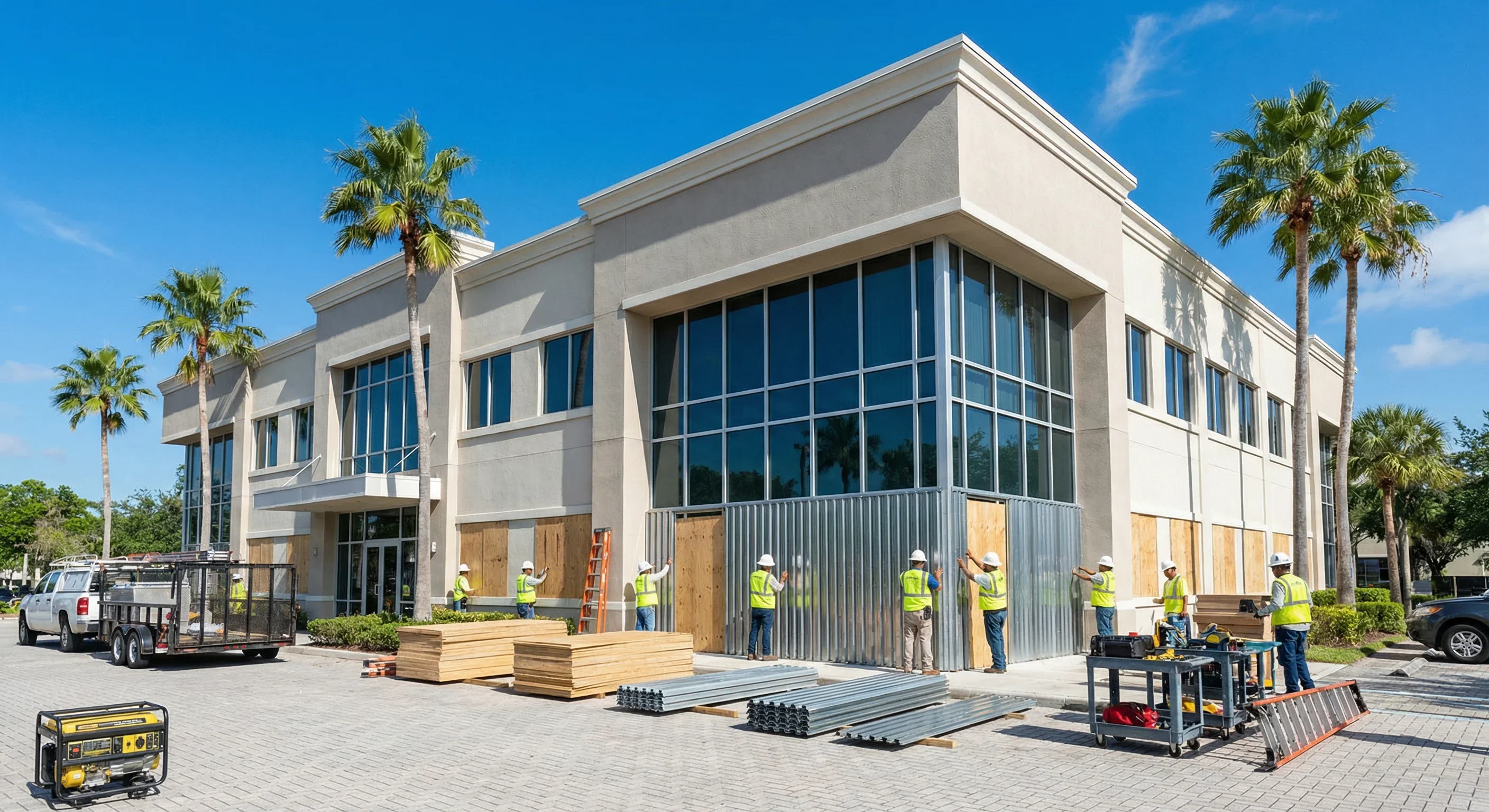
Florida faces hurricane risk every season from June through November. We maintain pre-staged equipment and crews for rapid post-landfall deployment. Emergency Response Plan (ERP) clients receive guaranteed priority response, pre-arranged pricing, and a dedicated account manager who already knows their properties.
Coastal commercial properties face storm surge, wind-driven rain intrusion, and saltwater damage that requires specialized remediation. We deploy industrial extraction equipment and desiccant dehumidifiers within hours of storm passage. Salt decontamination protocols prevent long-term corrosion damage.
Large loss reconstruction in Florida must comply with the FBC — one of the strictest in the nation. Wind-resistance upgrades, impact-rated materials, and structural connections frequently add scope. We identify code-required upgrades early and file for Ordinance and Law coverage.
Florida humidity accelerates mold growth to within 24-48 hours of water intrusion. In large commercial facilities with central HVAC, spores spread rapidly through multi-floor ductwork. Our large loss drying protocols account for Florida climate conditions with industrial dehumidification capacity.
Large Loss Assessment
Select your situation to understand how our large loss team responds.
Visual Scale Proof
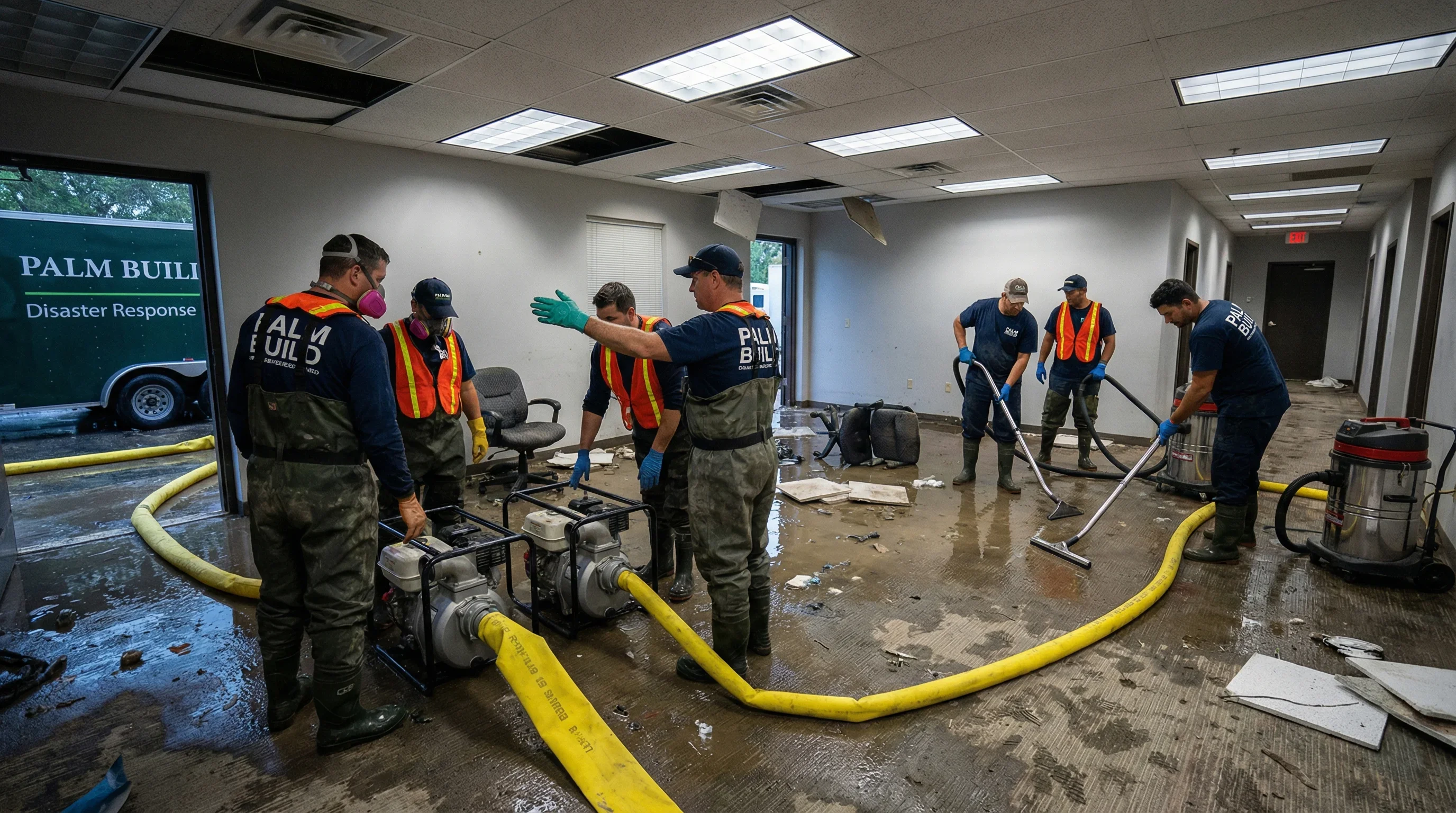
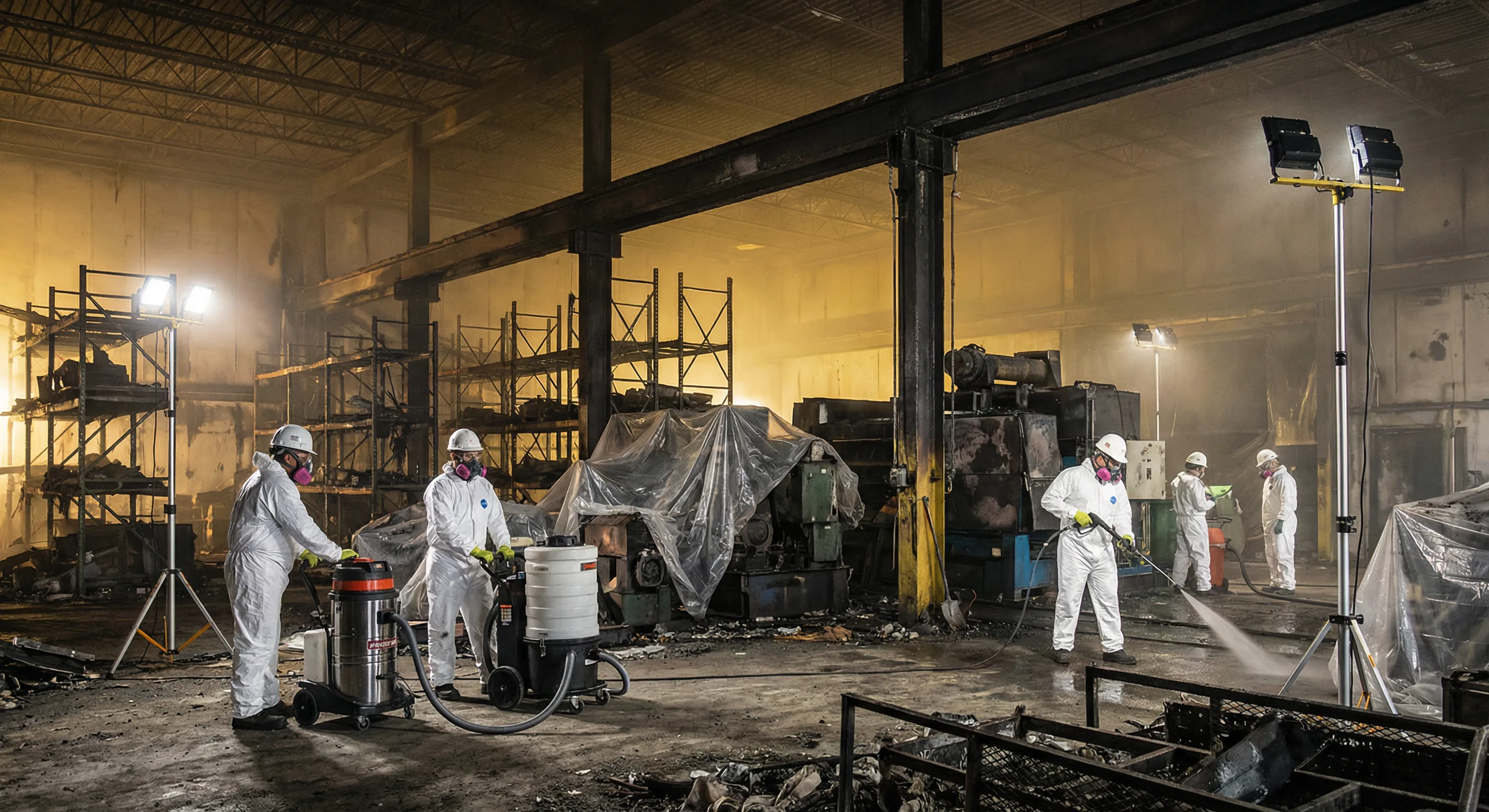
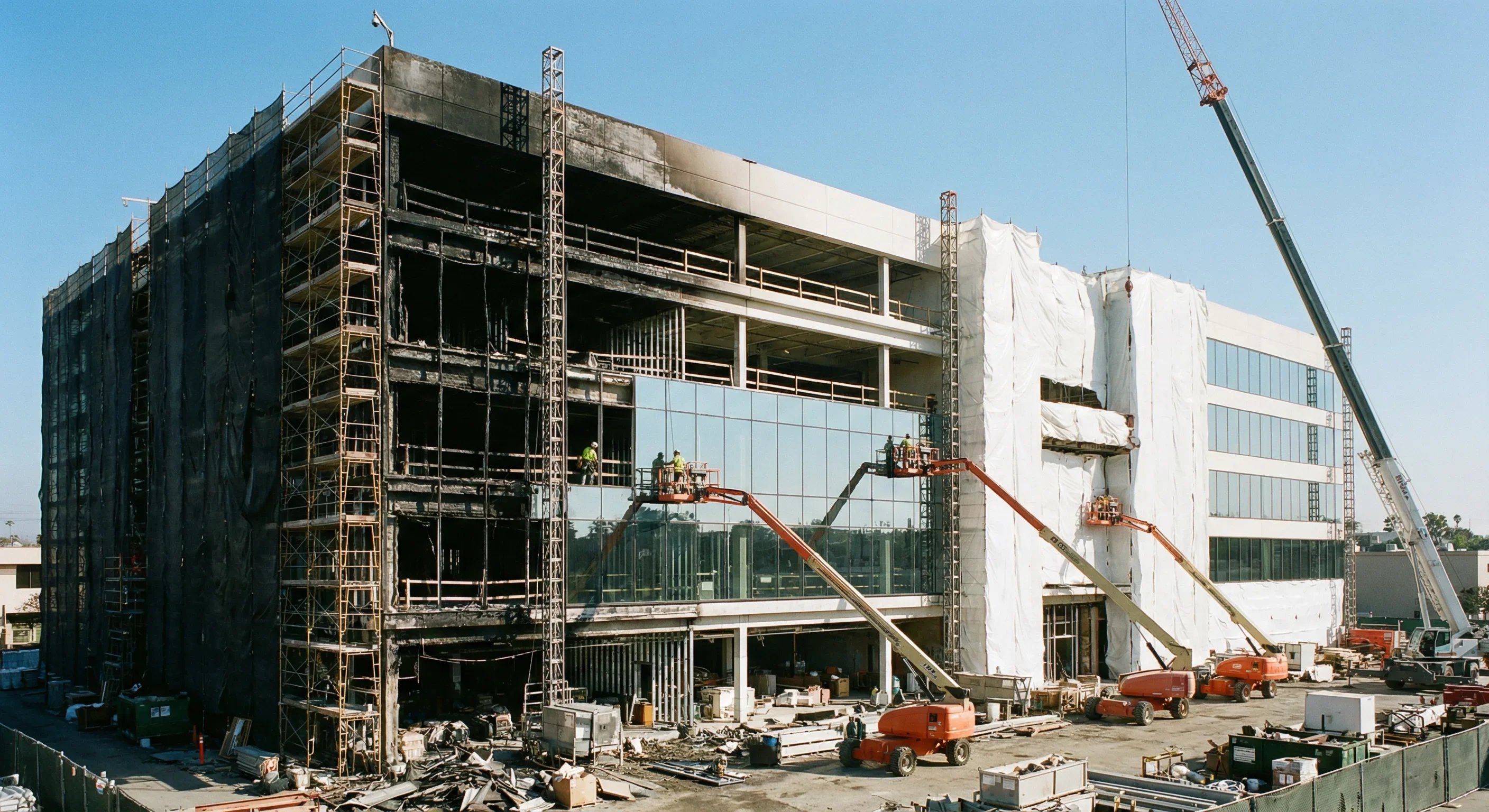
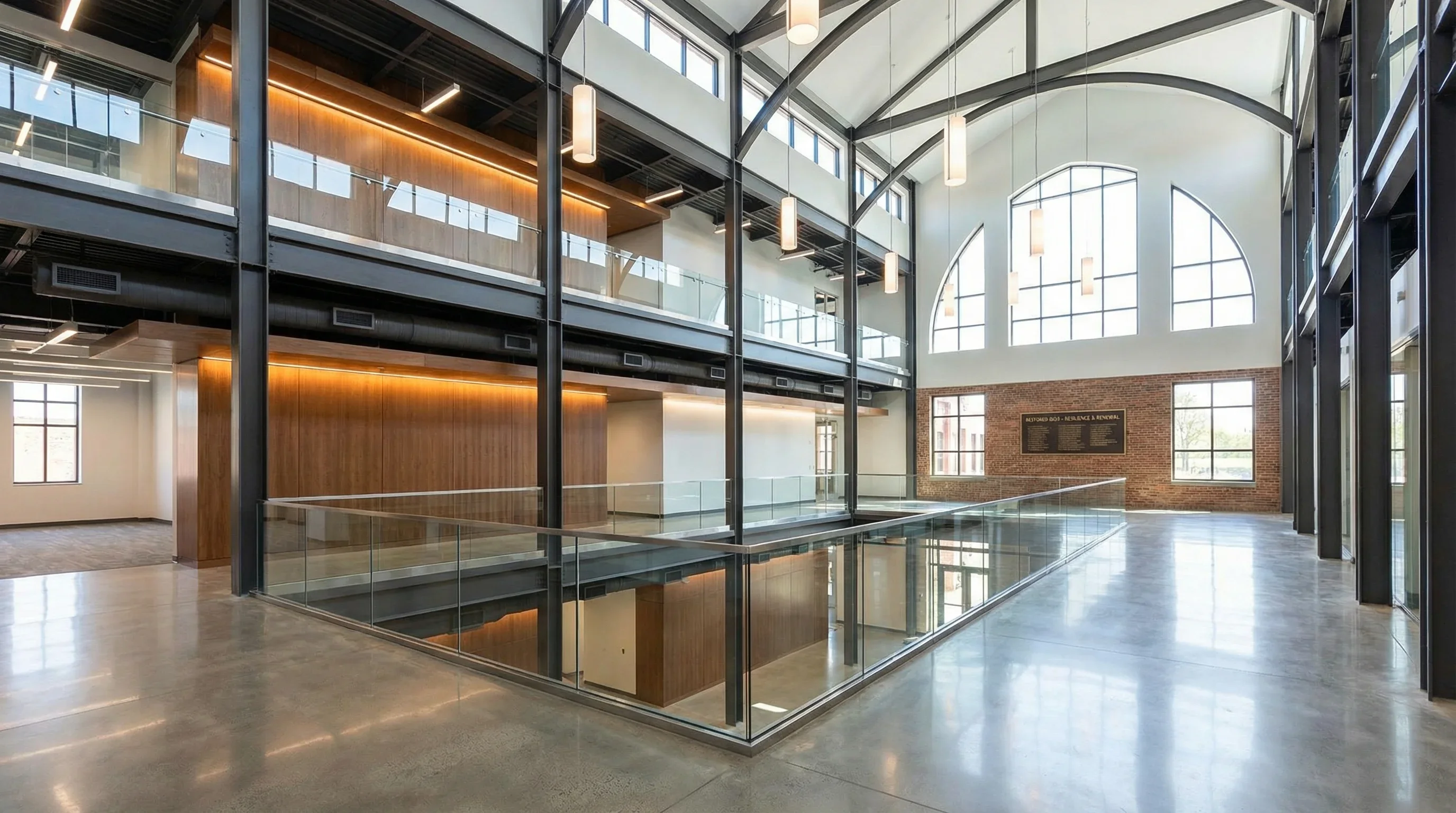
Twelve real moments from large loss and catastrophe response work — multi-crew operations, high-rise corridor strategies, hurricane aftermath, command centers, and completed rebuilds. The scale is the differentiator.
Specialized Guides
Each large loss category presents unique challenges. Explore detailed guides for your specific situation, including response protocols, typical timelines, insurance considerations, and what to expect.
Hurricane-specific large loss at scale. Multi-property storm surge and wind damage, pre-positioned CAT teams, and coordinated recovery across coastal communities.
Read guide Apartment complexes, condo buildings, and campus-wide events requiring coordinated restoration across multiple structures with centralized project management.
Read guide High-value commercial properties with complex logistics, business impact coordination, occupied building phasing, and multi-carrier insurance claims.
Read guide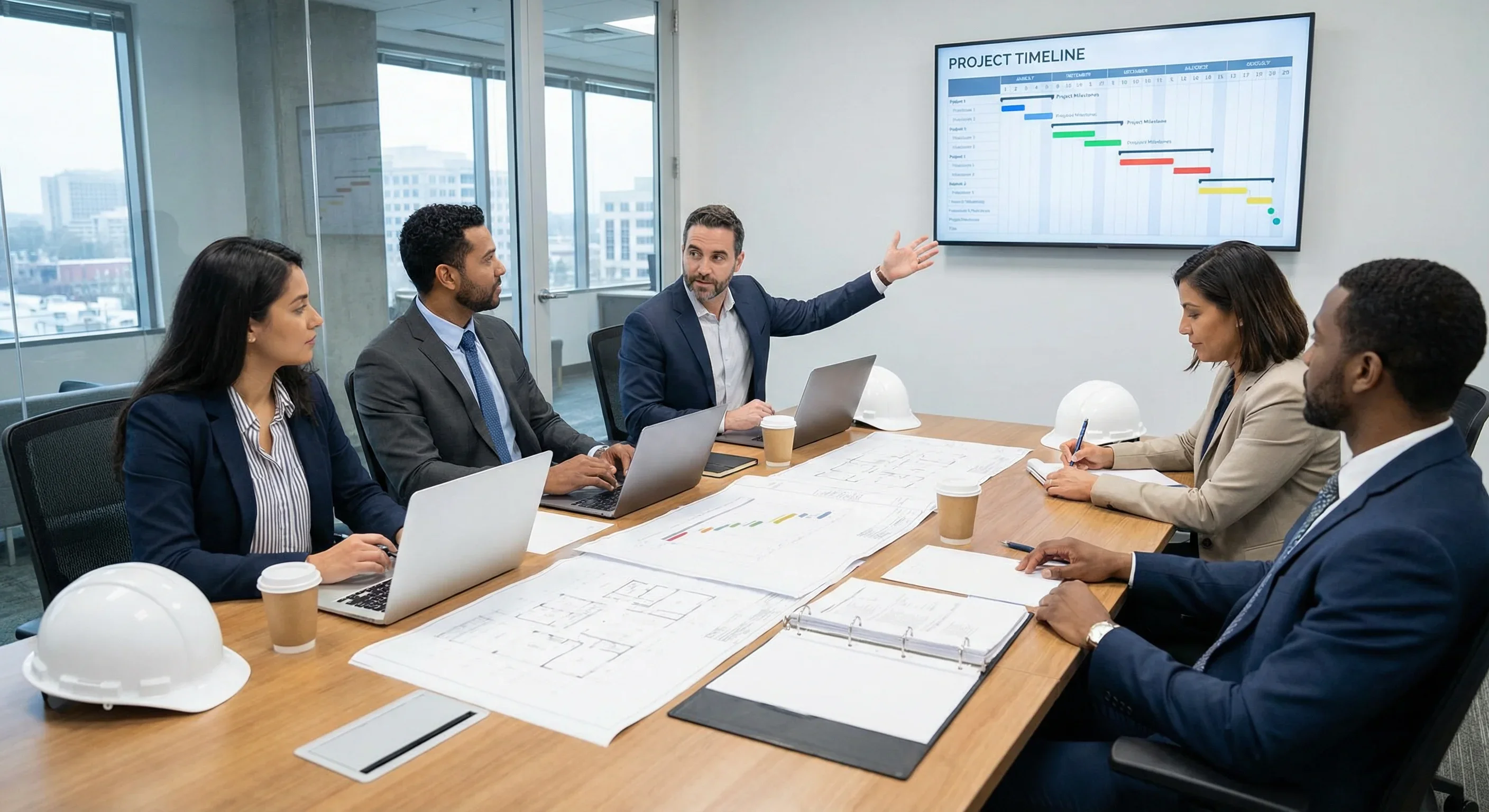
Program-level project management, documentation standards, carrier coordination, and portfolio-wide disaster recovery for property management companies.
Read guide Multi-carrier large loss claim coordination. Scope submission, supplements, dispute resolution, and appraisal support for complex $250K+ claims with adjusters, forensic accountants, and SIUs.
Read guide Pre-approved vendor status with Sedgwick, Crawford, and Gallagher Bassett. SLA compliance, portal integration, and program-level execution for TPA-directed commercial and catastrophe claims.
Read guideRelated Services
Large loss events often require multiple specialized service lines. Explore our capabilities that support comprehensive property recovery at any scale.
Industrial extraction and structural drying for catastrophic water events.
Large-scale fire restoration, environmental testing, and decontamination.
Emergency board-up, tarping, and storm damage repair at scale.
Standard commercial restoration for losses below the large loss threshold.
Multi-unit coordination for HOA and condominium association properties.
Large-scale reconstruction from structural repairs to finishing touches.
Large loss claims require dedicated adjuster coordination, supplements, and phased documentation.
High-volume contents pack-out, inventory, and restoration for catastrophic property losses.
Local Service Pages
Tier 4 · Local office
Tier 1 · Local office
Tier 1 · Local office
Tier 1 · Local office
Tier 1 · Local office
Tier 4 · Local office
Tier 4 · Local office
Tier 2 · Local office
Tier 1 · Local office
Tier 1 · Local office
Tier 1 · Local office
Tier 1 · Local office
Tier 4 · Local office
Tier 4 · Local office
Tier 4 · Local office
Tier 4 · Local office
Tier 3 · Local office
Tier 1 · Local office
Tier 3 · Local office
Tier 4 · Local office
Tier 1 · Local office
Tier 4 · Local office
Tier 1 · Local office
Tier 3 · Local office
Tier 1 · Local office
Tier 1 · Local office
Tier 3 · Local office
Large-loss isn't just a dollar figure — it's scope, speed, and infrastructure. Learn what triggers CAT-crew deployment and TPA coordination in South Florida.
11 min read
When a hurricane becomes a large-loss event, the first 72 hours set the outcome. Here is exactly how CAT crews stage, triage, and mobilize at scale across South Florida.
11 min read
A large-loss claim is not just a bigger version of a routine job. TPA assignment, program management, documentation depth, and timelines all change — here is how.
11 min read
Palm Build Tools
Estimate flood severity, storm triage, insurance scope, and restoration timelines for large-scale losses — no signup, no lead gate.
Large-scale flood events require severity, salvage, and cost planning at scale. Estimate flood-specific damage factors for bigger events.
CAT response triage starts with accurate assessment. Upload photos, check live NWS alerts, and generate a structured damage report.
Large loss claims involve multi-carrier coordination, phased documentation, and complex supplemental filings. Estimate claim scope and exposure.
Multi-building losses run on different timelines. See realistic durations for phased mitigation, rebuild, and occupancy milestones.
Property managers, risk managers, and insurance professionals trust our large loss team to manage complex, high-value restoration projects with the precision and documentation standards these situations demand. Whether you need emergency mobilization now or want to discuss an Emergency Response Plan for the future, our team is ready.
Answers about large loss restoration, catastrophe response, multi-building coordination, complex insurance claims, and what to expect when the scope exceeds ordinary.
In the restoration industry, a "large loss" generally refers to damage exceeding $100,000 in scope, but the dollar amount alone is not the only factor. Multi-building events, multi-floor commercial damage, catastrophe events like hurricanes or tornadoes, projects requiring coordination beyond a single crew, and high-profile or time-sensitive situations all qualify. The defining characteristic is complexity: multiple stakeholders, extended timelines measured in weeks or months, specialized equipment, and coordination between insurers, adjusters, engineers, and the property management team.
Still have questions about large loss & catastrophe basics?
Large loss events require industrial equipment, experienced project managers, multi-crew coordination, and complex insurance navigation. Our CAT teams are built for exactly these situations and can deploy 24/7.
Equipment fleet for $1M+ losses
Large loss project managers
24/7 catastrophe mobilization
TPA and adjuster coordination
Need help right now? Call us.
24/7 live dispatch — average answer time under 30 seconds