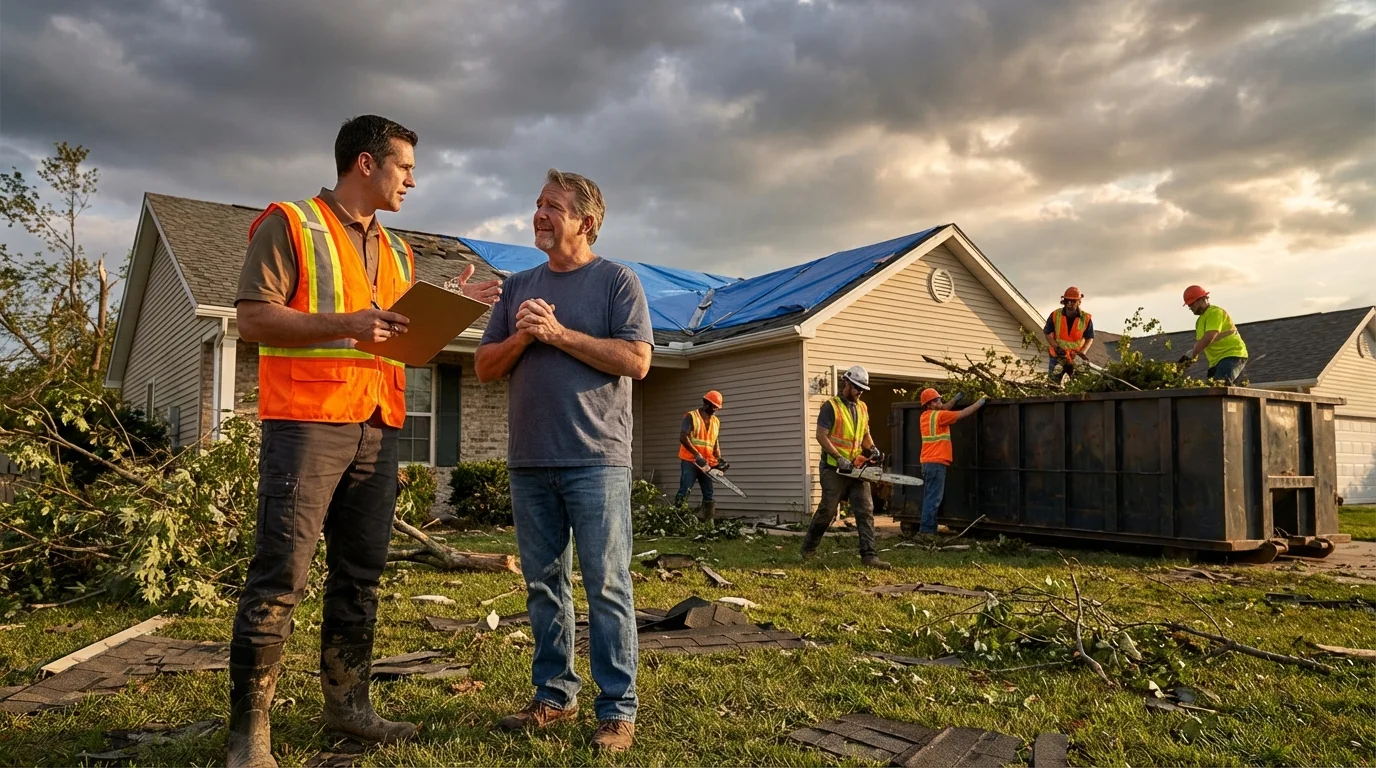
24/7 STORM AND HURRICANE RESPONSE
Hurricane & Storm Damage Restoration for Florida and the Carolinas
From emergency roof tarping and board-up to structural drying, debris clearing, and full rebuilds, Palm Build responds fast when storms hit. Wind vs flood claim guidance, hurricane deductible navigation, and CAT response — built for two moments: urgent recovery now and disciplined preparation before the next storm season.
Hurricane & Storm Damage Restoration Near Fort Lauderdale, Deerfield Beach, Palm Coast, and Charlotte
One playbook for urgent response and pre-season risk reduction
Storm losses usually stack fast: wind breaches the envelope, rain intrudes, debris impacts structure, and moisture sets mold conditions within 24-48 hours. This pillar combines emergency actions, hurricane deductible math, wind-vs-flood claim guidance, and preparedness planning so property owners can reduce claim friction and shorten total recovery time.
- Clear split path: immediate storm damage response vs. month-by-month preparedness.
- Technical guidance for tarping, board-up, wind damage, storm surge, and tree impacts.
- Hurricane deductible math, wind-vs-flood claim navigation, and FL/NC/SC state rules.
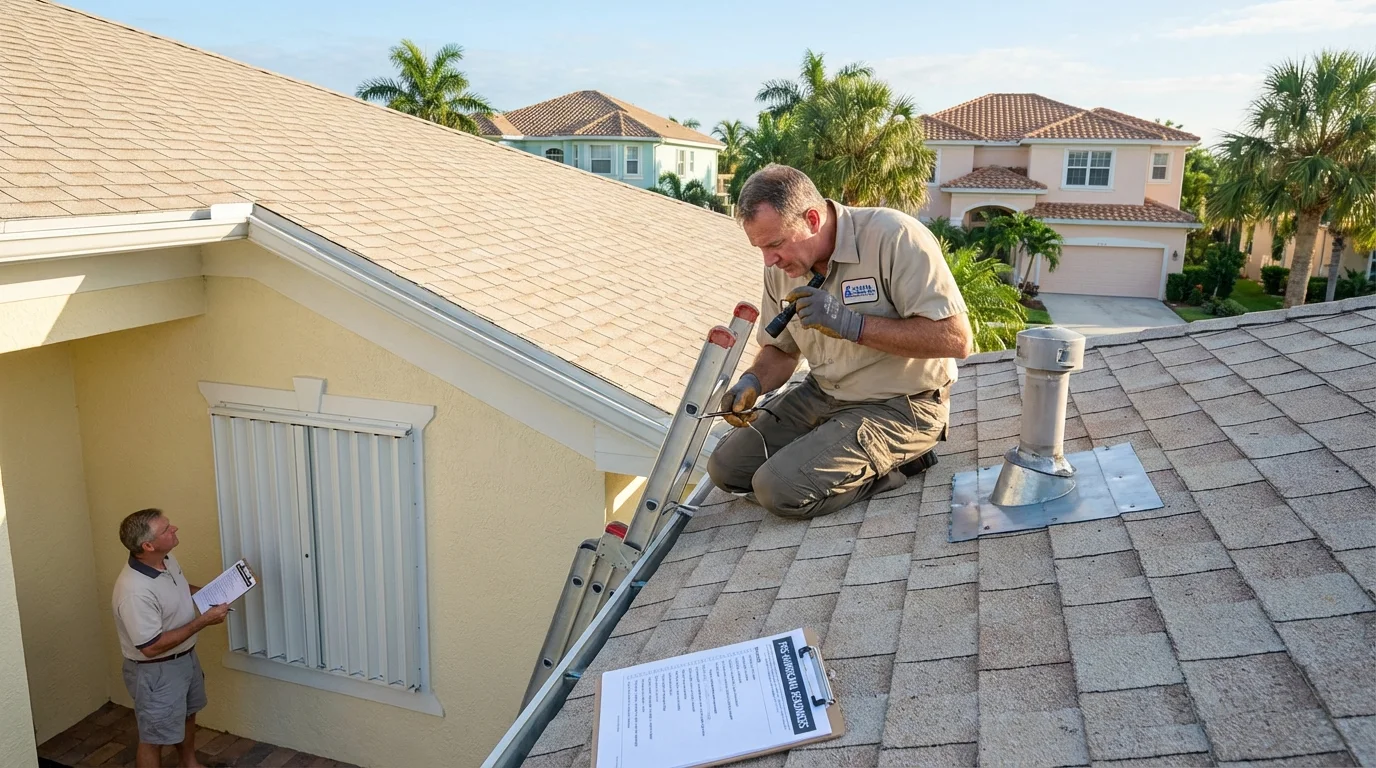
Storm Damage Restoration
After the Storm: We're Here to Help
Whether you just weathered a hurricane or you're watching the forecast with concern, knowing what to do makes all the difference. Choose where you need to start, and we'll guide you through every step.
I Have Storm Damage NOW
Your property has been hit by a storm, hurricane, or severe wind event. Get step-by-step emergency guidance and connect with our 24/7 response team.
I Want to Prepare for Storm Season
Hurricane season runs June through November. Use our hurricane preparation checklist to learn what to inspect, document, and how to protect your property before the next storm hits.
FL Hurricane Season
June–Nov
24/7 Emergency Line
(888) 245-5155
Service Coverage
3 States Served
After the Storm: Your First 24 Hours
Emergency Storm Response Steps
Safety comes first. Follow these steps in order to protect your family, preserve your insurance claim, and prevent further damage to your property.
Safety-First: Life-Threatening Hazards
These hazards kill more people after a storm than the storm itself.
- Downed power lines — stay 35+ feet away and call your utility company immediately
- Structural collapse — do not enter if walls, roof, or foundation appear compromised
- Gas leaks — if you smell gas, evacuate and call 911 before doing anything else
- Standing water near electrical — never wade through water with unknown electrical contact
- Weakened trees — leaning or partially uprooted trees can fall without warning
Need Emergency Storm Response?
Our crews deploy 24/7 across Florida, North Carolina, and South Carolina. Emergency tarping, water extraction, and board-up services are available immediately.
Post-storm 48-hour action timeline
What you do — and don't do — in the first 48 hours determines whether your claim pays out cleanly or gets stuck in dispute. The mold clock starts at hour zero and the carrier expects mitigation, not waiting. Hidden water damage from secondary sources like firefighting follows the same rules.
Window
0 - 6 hours
Safety + immediate tarping
- Stay clear of downed power lines and unstable structures
- Check for gas leaks; evacuate if any doubt
- Tarp obvious roof openings if safe to do so
- Begin water extraction with wet/dry vacs and buckets
Cost impact
Tarping $500-$2,500
Insurance implication
No carrier contact yet — focus on stopping further damage. Tarping costs are reimbursable as required mitigation.
Window
6 - 24 hours
Document + open the claim
- Photo and video every damaged area, exterior and interior
- Save samples of damaged materials (shingles, drywall pieces)
- Open the insurance claim by phone — get the claim number
- Run dehumidifiers and fans on all wet materials
Cost impact
$0 (do it yourself)
Insurance implication
Initial notice locks in your claim. FL requires notice within 1 year of loss; insurer must respond within 60 days.
Window
24 - 48 hours
Mitigation authorization (mold clock)
- Call professional restoration for assessment + mitigation
- Authorize emergency mitigation in writing
- Begin selective demolition of saturated drywall and insulation
- Set HEPA scrubbers if Cat 2/3 contamination is suspected
Cost impact
Water mitigation $3-$7.50/sq ft
Insurance implication
EPA, CDC, and OSHA all confirm mold growth begins on damp materials within 24-48 hours. Failing to mitigate in this window can void coverage for secondary damage.
Window
48 - 72 hours
Adjuster meeting + secondary damage check
- Adjuster on-site walkthrough and scope review
- Causation report separating wind from water damage
- Confirm coverage on all damaged areas before further work
- Identify any hidden moisture in wall cavities and attic
Cost impact
$0 (covered by insurer)
Insurance implication
This is the wind-vs-flood pivot point. If both perils are present, you may need two adjusters (HO-3 and NFIP) — request both immediately.
Window
1 week +
Reconstruction planning
- Approved scope of work between contractor and carrier
- Order long-lead materials (impact windows, custom trim)
- Begin reconstruction once dry standards are verified
- Track every change order through claim supplement process
Cost impact
$8,000 - $75,000+ depending on scope
Insurance implication
FL supplemental claims must be noticed within 18 months of loss. Document every change order against the original adjuster scope.
Stop the bleeding before secondary damage starts
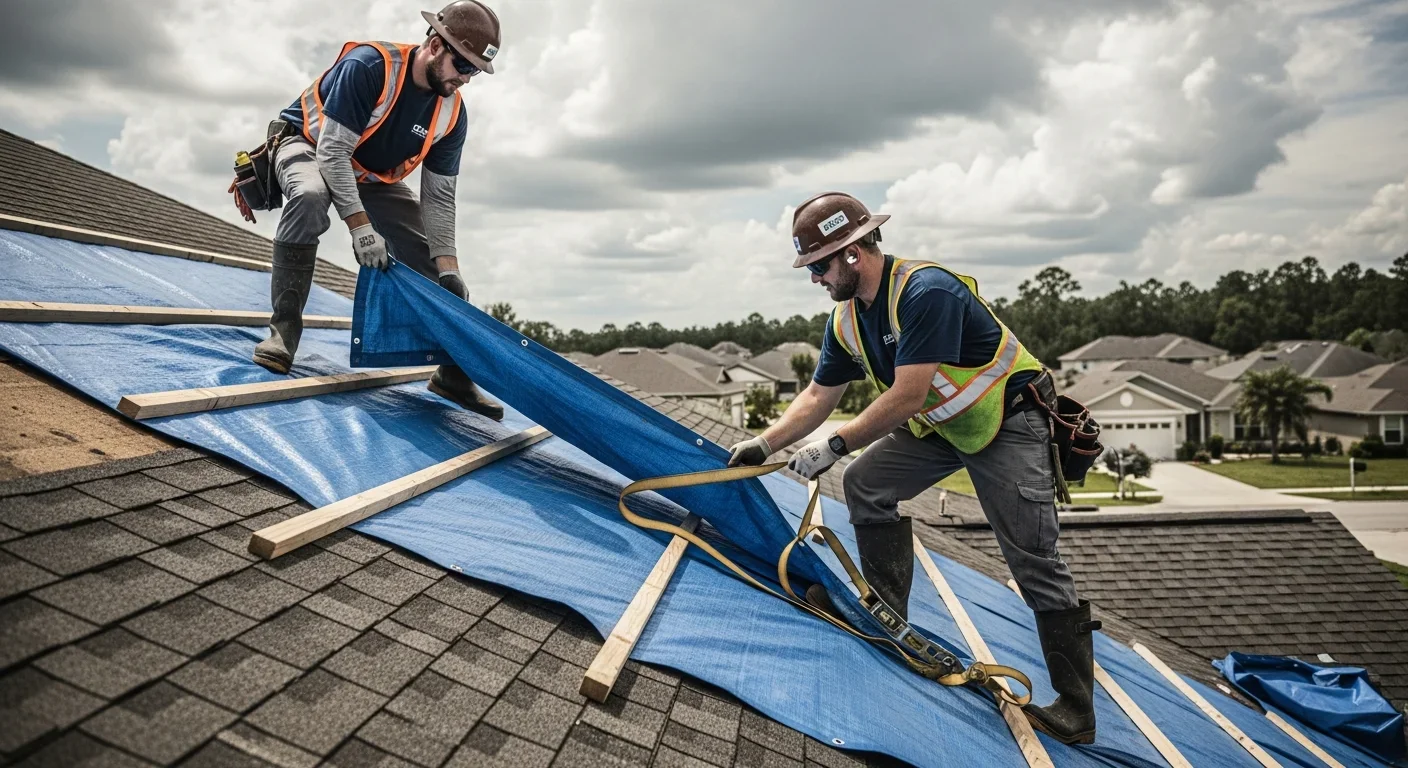
Tarping and board-up are not optional cleanup — they are required mitigation under your homeowners policy. Done in the first 24 hours, they can save tens of thousands of dollars in secondary damage. Done wrong, they fail in the next gust and expose you to denial under failure-to-mitigate provisions.
| Material | Spec | Lifespan | Cost |
|---|---|---|---|
| Reinforced poly tarp | 6 mil minimum, 20x30 ft+ | 30 - 90 days | $50 - $200 (material) |
| 7/16" OSB sheathing | Pre-cut to opening sizes | Until permanent repair | $25 - $50 / panel |
| 5/8" plywood | Higher rigidity than OSB | Until permanent repair | $40 - $80 / panel |
| Storm panels (aluminum) | Hurricane-rated, reusable | Multi-season | $115 - $240 / window |
Protocol 1
Safety check first
No tarping work on a wet, sloped, or unstable roof in active wind. Call professionals when conditions are dangerous — DIY tarping injuries are one of the most common post-storm ER visits.
Protocol 2
Anchor with battens
2x4 wood battens screwed through the tarp into solid roof framing — never just tucked under shingles. Wind will tear an unsecured tarp off in the first gust.
Protocol 3
Shingle-style overlap
Higher-elevation tarp edges overlap lower edges by 6+ inches. Run the tarp up and over the ridge whenever possible so wind cannot get underneath.
Protocol 4
Drainage path
Tarp slope must shed water away from the breach, not pond on top. Standing water adds 8+ pounds per square foot and tears the tarp.
Protocol 5
Document everything
Before, during, and after photos with timestamps. Save all receipts. This is reimbursable mitigation, not optional cleanup.
Reinforced poly tarps last 30 to 90 days in the field depending on UV exposure, wind cycling, and ponding. They are stopgaps — not permanent repairs. Schedule the permanent roof repair within 60 days of tarping to avoid replacing the tarp itself.
Emergency Tarping: (888) 245-5155| Scope | Typical price |
|---|---|
| Single window board-up (plywood) | $15 - $45 per window |
| Single window board-up (storm panel) | $115 - $240 per window |
| Whole-home plywood board-up (10 windows) | $300 - $600 |
| Roof tarp (small breach, ≤200 sq ft) | $500 - $1,200 |
| Roof tarp (large breach, 200-600 sq ft) | $1,200 - $2,500 |
| Combination tarp + multiple board-up | $1,500 - $3,500 |
All emergency mitigation is reimbursable under your policy's loss-mitigation clause. Save every receipt and submit them with your claim. See our hurricane prep checklist for material-stocking guidance.
When the storm hits a region, not just a home
Catastrophic events — major hurricanes, tornado outbreaks, derechos — overwhelm normal dispatch systems. Hundreds of properties need response in the same 48-hour window. Palm Build runs a dedicated CAT response protocol that mirrors how FEMA and large national carriers coordinate: pre-staging, grid assessment, triage, and dual-pipeline documentation. For multi-property and portfolio events, see also our large loss handling service.
Pre-landfall staging
Resource pre-staging 48-72 hours before projected landfall. Generators, tarps, dehumidifiers, and crews positioned at safe distance from the projected path. Coordination with corporate clients on portfolio risk.
Post-landfall grid assessment
First 12-24 hours: aerial and ground-level damage survey across the affected grid. Triage decisions based on structural integrity, occupancy status, and water intrusion severity.
Priority dispatch triage
Life safety first. Then habitable single-family residences. Then income-producing commercial. Then secondary structures and contents. Every CAT response follows the same triage tree to minimize total community recovery time.
FEMA + carrier coordination
Documentation routed simultaneously to private carriers and FEMA Individual Assistance applications. The two systems are designed to complement each other; we keep records consistent across both pipelines.

The triage tree
- 1 Life safety: anyone trapped, gas leaks, structural collapse risk
- 2 Habitable single-family residences with active water intrusion
- 3 Income-producing commercial property (business continuity)
- 4 Secondary structures, contents, fence and landscape damage
Understanding Storm Damage
Types of Storm Damage to Your Property
Storms cause different types of damage that require different restoration approaches. Understanding what you're dealing with helps you communicate effectively with your insurance company and restoration team.
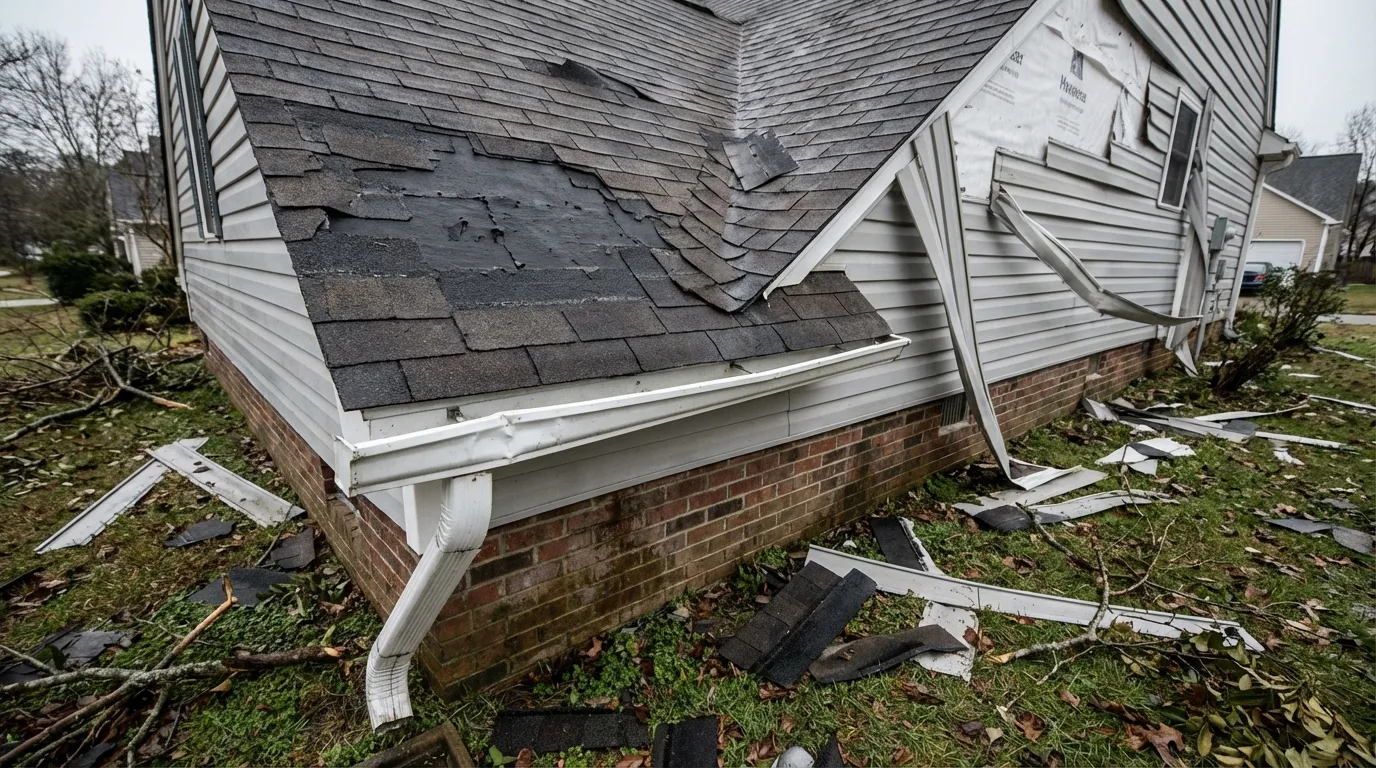
Wind Damage
Roof, siding, windows & structural
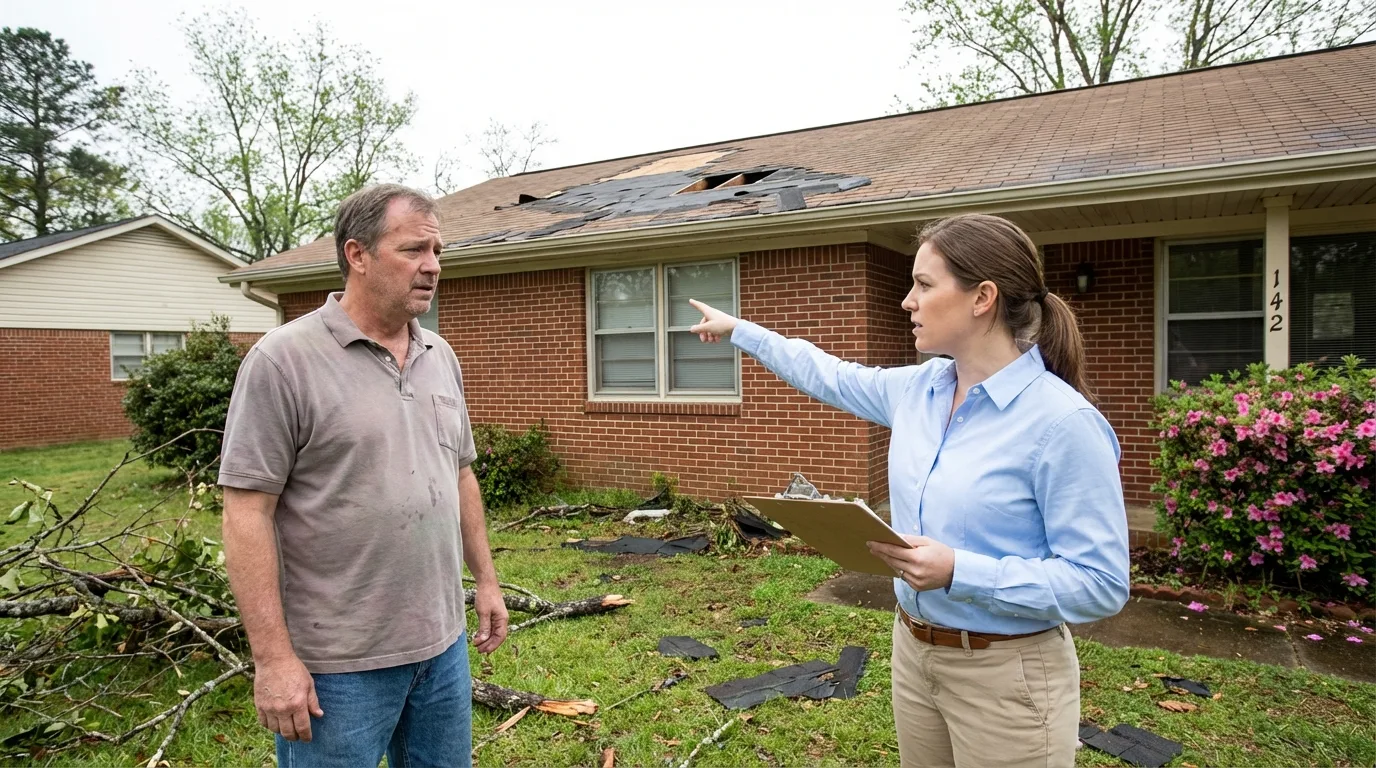
High winds are the most common cause of storm property damage. Sustained winds above 60 mph can tear shingles from roofs, rip siding from walls, shatter windows, and compromise structural framing. Even below hurricane force, straight-line winds and microbursts cause significant damage to residential and commercial properties.
Restoration Approach
- Emergency tarping of compromised roof sections
- Structural assessment of framing and load-bearing walls
- Siding replacement and window boarding/replacement
- Debris removal and site clearance
- Full reconstruction of severely damaged areas
Insurance Considerations
Wind damage is typically covered under standard homeowners insurance. Document lifted shingles, displaced siding, and broken windows immediately — insurers look for wind-pattern evidence.
Not Sure What Type of Damage You Have?
Our team will assess the damage, document it for insurance, and create a restoration plan tailored to your property.
Storm Damage Restoration Cost (2026)
Storm damage costs swing wildly based on whether the loss is wind-only (HO-3 territory), flood-only (NFIP territory), or both at once. The average NFIP flood claim from 2020-2024 was $82,614, while wind-only repairs typically run $3,500-$25,000. Hurricane deductibles in Florida add a 2-10% out-of-pocket layer on top of everything else.
Avg NFIP flood claim
$82,614
2020-2024 nationwide average
Hurricane deductible
2-10%
Of dwelling Coverage A in FL
Mold risk window
24-48 hrs
EPA, CDC, OSHA guidance
NFIP coverage cap
$250K
Building cap; $100K contents
| Scope | What it includes | 2026 price range |
|---|---|---|
| Emergency tarping & board-up | Reinforced tarps, OSB/plywood board-up, batten anchoring, water extraction | $500 - $2,500 |
| Roof repair (wind-only) | Shingle replacement, underlayment, flashing, soffit, fascia | $3,500 - $15,000 |
| Structural repair (wind + impact) | Truss/rafter repair, sheathing, framing, structural drying | $8,000 - $35,000 |
| Whole-home restoration (CAT) | Mitigation, demo, reconstruction, finish work, contents pack-out | $25,000 - $75,000+ |
Cost by storm type and insurance treatment
Wind-driven rain through breaches, torn shingles, siding, fence damage
Typical range
$3,500 - $25,000
Storm surge, rising water, overland flooding, sewer backup
Typical range
$15,000 - $82,614 avg
Hurricane with storm surge — split claim across HO-3 and NFIP
Typical range
$30,000 - $150,000
Major hurricane (Cat 3+), tornado outbreak, derecho — full reconstruction
Typical range
$75,000 - $500,000+
| Severity tier | Low | Expected | High |
|---|---|---|---|
| Minor (single room / partial roof) | $1,500 | $4,500 | $8,000 |
| Moderate (multi-room / full roof) | $8,000 | $18,000 | $30,000 |
| Severe (structural compromise) | $25,000 | $45,000 | $80,000 |
| Catastrophic (whole home) | $60,000 | $120,000 | $300,000+ |
Regional pricing: Florida, North Carolina, South Carolina
Florida
FL coastal counties
$8,000 - $75,000+
2-10% hurricane deductible activates on hurricane warning, stays 72hr after final termination. Highest US humidity = mold risk on every loss.
North Carolina
NC coast + Piedmont
$5,000 - $50,000
Named storm deductible triggers on watch/warning, stays 24hr after termination. Inland tornado + ice storm exposure adds winter peril.
South Carolina
SC coastal + upstate
$6,000 - $60,000
45+ tropical landfalls 1851-2024. SC Wind & Hail Underwriting Association serves coastal residual market with disclosure requirements.
Hardening costs to factor against deductibles: hurricane shutters whole-home $1,475-$5,884 (avg $3,674), plywood $15-$45 per window, storm panels $115-$240 per window, impact windows $1,200-$2,500 each, garage door reinforcement $200-$600. The My Safe Florida Home program offers up to $10,000 in matching grants for homes insured at $700,000 or less.
Get your storm damage range in 60 seconds
Use our estimator or call for a free on-site assessment after the storm
7-step pre-season preparedness framework
Atlantic hurricane season runs June 1 through November 30, with 78% of tropical storm days falling between mid-August and mid-October. NOAA's 1991-2020 averages put the season at 14.4 named storms, 7.2 hurricanes, and 3.2 major (Category 3+) hurricanes. The work below is what separates a damaged home from a destroyed one. Read our full Florida hurricane preparation checklist.
Roof inspection (May)
Professional roof inspection: loose shingles, deteriorated flashing, sealant cracks, soffit attachment. Address weak points before peak season — repairing now is dramatically cheaper than emergency tarping later.
Typical cost
$200 - $500
Gutter and drainage clearing
Clear gutters, downspouts, and yard drains. Hurricane rainfall can dump 8+ inches in hours — blocked drainage forces water under shingles and through foundation walls.
Typical cost
$150 - $400
Window protection prep
Pre-cut plywood ($15-$45 per 7 sq ft window) or install storm panels ($115-$240 per window) or impact windows ($1,200-$2,500 each). Hurricane shutters whole-home average $3,674.
Typical cost
$1,475 - $5,884 whole-home
Tree and branch trimming
Trim dead and overhanging branches near the structure and power lines. Tree-on-house claims are one of the most common HO-3 hurricane payouts and most are preventable.
Typical cost
$270 - $1,800
Emergency supply staging
Generator (≥10,000 watt running, FL tax-free year-round), waterproof tarps (≤1,000 sq ft tax-free), portable fuel cans, batteries, fire extinguisher, life jackets, NOAA weather radio. Generator must run ≥20 ft from structure with exhaust pointed away from openings (CDC).
Typical cost
$800 - $3,500
Documentation snapshot
Photograph every room, exterior elevation, roof condition, and contents inventory. Store in cloud + print copy with policy declarations. This baseline is your single best defense in any future wind-vs-flood dispute.
Typical cost
$0 (do it yourself)
Evacuation + insurance plan
Confirm flood policy is active (NFIP requires 30-day waiting period — buying during a warning is too late). Verify hurricane deductible (FL: 2-10% of dwelling). Set up document go-bag with policies, ID, medications, pet records.
Typical cost
$0 - $400 NFIP premium
My Safe Florida Home matching grants
Up to $10,000 in matching funds for homestead single-family homes and townhomes insured at $700,000 or less. Free wind mitigation inspection plus dollar-for-dollar matching for approved upgrades.
Month-by-Month Storm Preparedness by State
Different states face different storm risks throughout the year. For a complete step-by-step guide, see our hurricane preparation checklist for Florida homeowners. Select your state below to see a tailored timeline with specific tasks for each month.
Storm damage? We respond 24/7.
Emergency tarping, water extraction, and debris removal begin as soon as it is safe.
Storm patterns vary year to year. Always monitor local forecasts from the National Weather Service and your local emergency management agency. This calendar provides general preparedness guidance and is not a substitute for official weather alerts.
Commercial and Multi-Property Storm Recovery
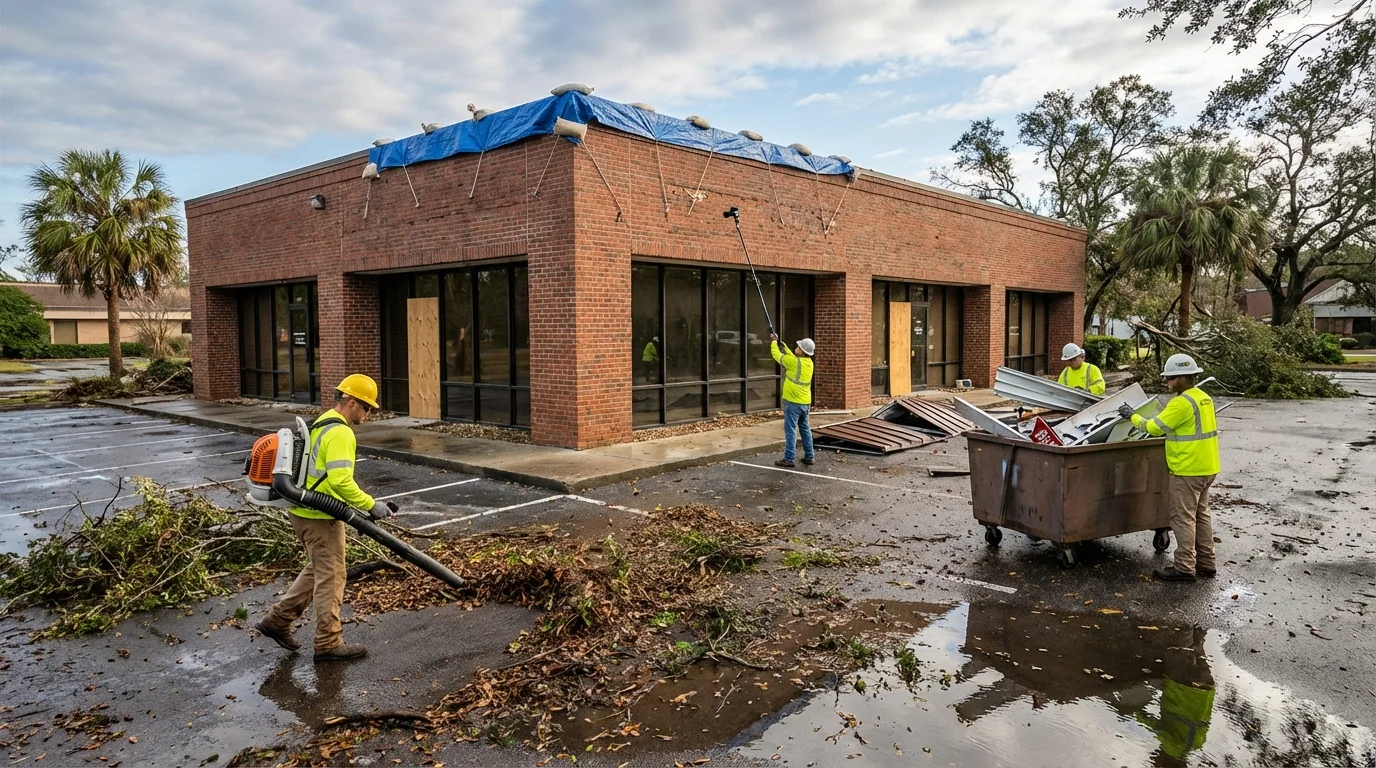
When storms impact multiple structures, coordination is the project
Storm events often hit offices, retail, HOA communities, and mixed-use portfolios at the same time. Palm Build can sequence emergency secure-up, debris management, moisture control, and reconstruction across multiple structures without losing claim documentation discipline.
Tree Damage Assessment & Safe Removal
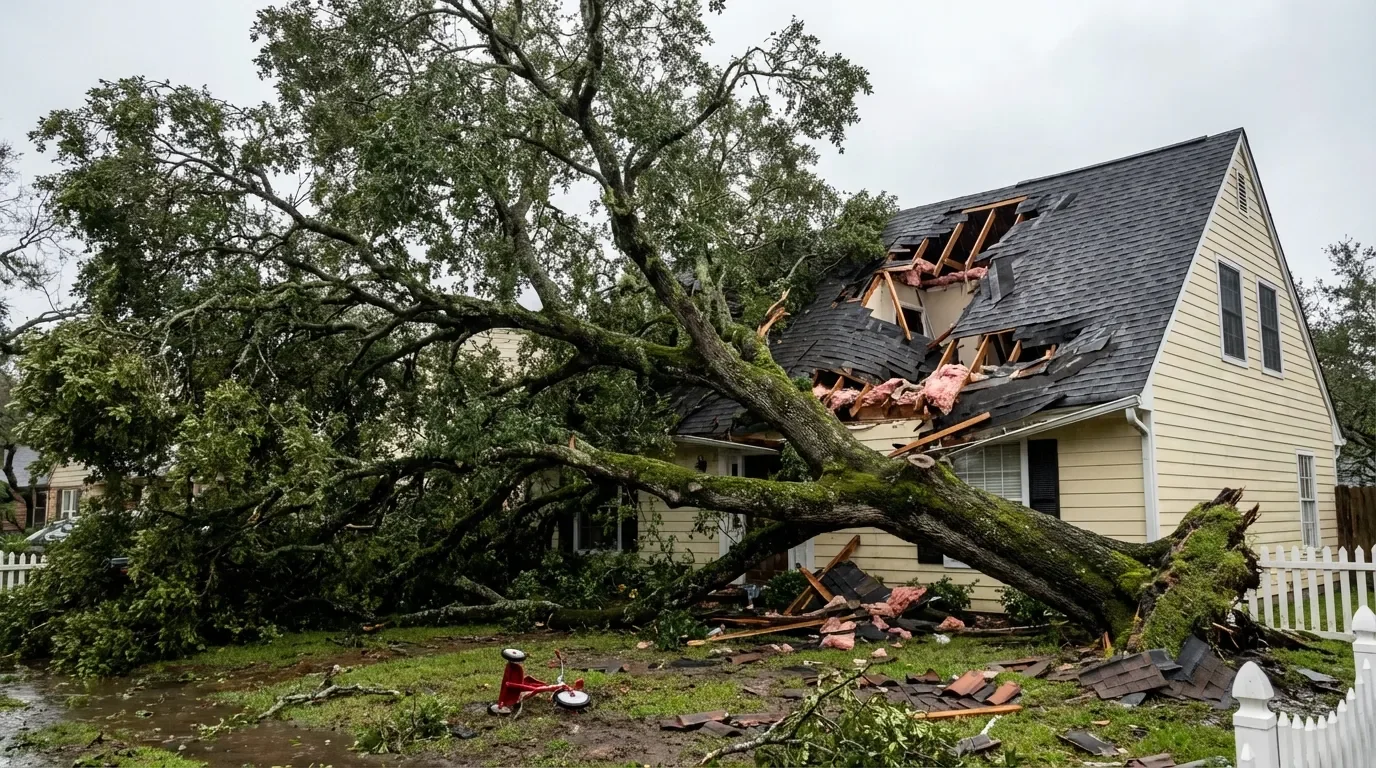
Fallen trees are the most common cause of structural damage during storms. Safe removal requires coordination between arborists, structural engineers, and restoration professionals to protect your property and maximize insurance coverage.
Safety First Protocol
Never attempt to remove a tree from a structure yourself. Tension in bent trees and compromised load-bearing elements create life-threatening hazards that require professional assessment.
When You Need a Structural Engineer
- Tree has fallen on a load-bearing wall, ridge beam, or roof truss
- Visible structural deflection, sagging, or cracking in walls or ceilings
- Tree has penetrated through the roof into living spaces
- Foundation or slab has shifted from root upheaval or impact
- Multiple trees have impacted the same structure
Safe Removal Process
- Certified arborist assesses tree condition, lean, and tension points before cutting
- Utility company clears any downed lines before tree work begins
- Sectional removal prevents further structural damage during extraction
- Restoration team tarps and secures the opening immediately after removal
- Full debris clearing and site preparation for reconstruction
Debris Hauling & Site Clearing
- Heavy equipment for large trees and root balls that require crane or loader removal
- Complete debris removal from roof, yard, and adjacent properties
- Stump grinding and root system management to prevent future issues
- Sorting of salvageable materials from waste for cost-effective restoration
- Site grading and drainage restoration after large-scale tree removal
Insurance Coverage for Tree Removal
- Tree removal is typically covered if the tree hit an insured structure (home, garage, fence)
- Most policies cover $500-$1,000 per tree for removal costs
- Trees that fall but miss all structures are often NOT covered for removal
- Debris removal from the yard (not on a structure) may have separate sublimits
- Damage from a neighbor's tree falling on your property is covered by YOUR policy, not theirs
Multi-tree events? We handle large losses.
When multiple trees damage a property or an entire neighborhood is affected, our large loss team coordinates heavy equipment, multiple crews, and complex insurance claims to restore your property efficiently.
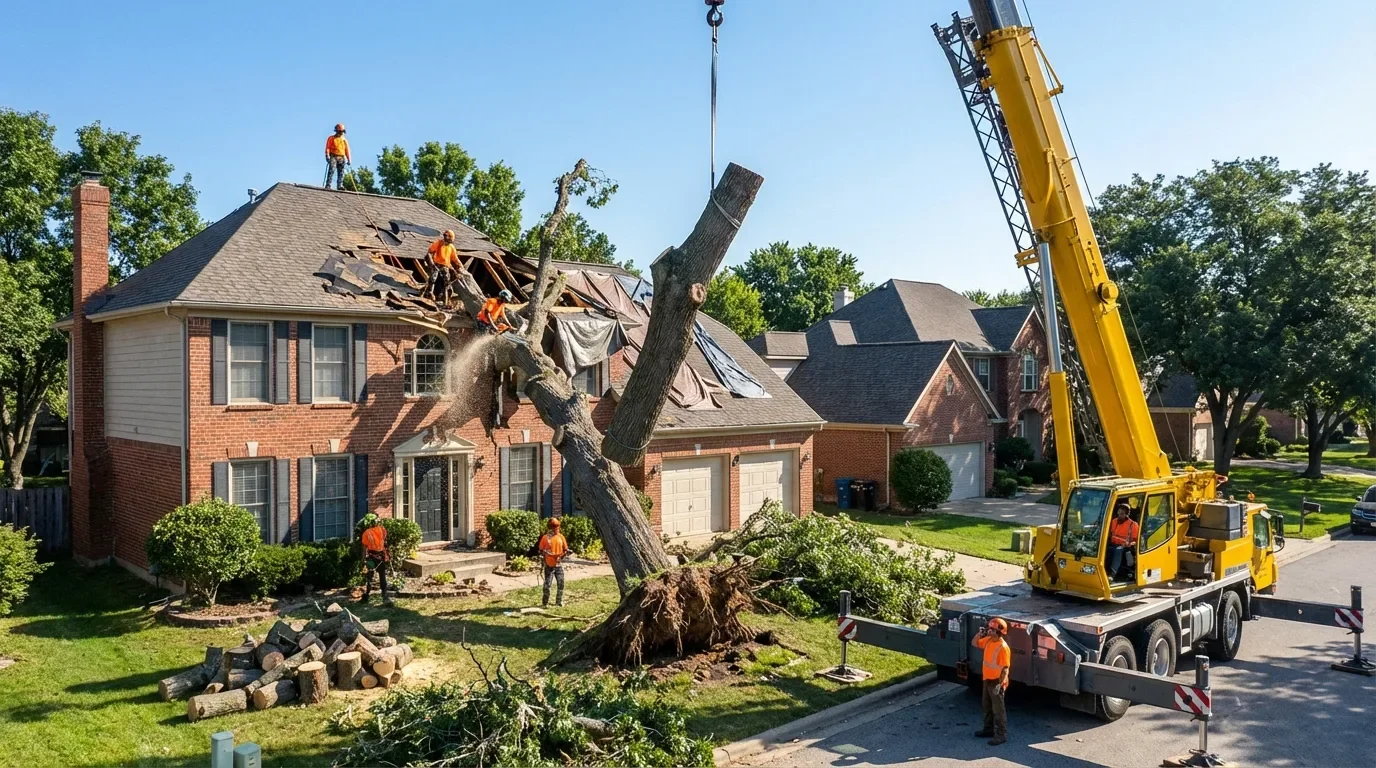
Tree on your home? Call now for emergency response.
Our team coordinates arborist services, emergency tarping, and structural assessment. We document everything for your insurance claim so nothing is missed.
Understanding Storm Risk in Your State
Each state faces unique storm threats based on geography, climate, and historical patterns. Know your region's risk profile to prepare effectively and recover faster.
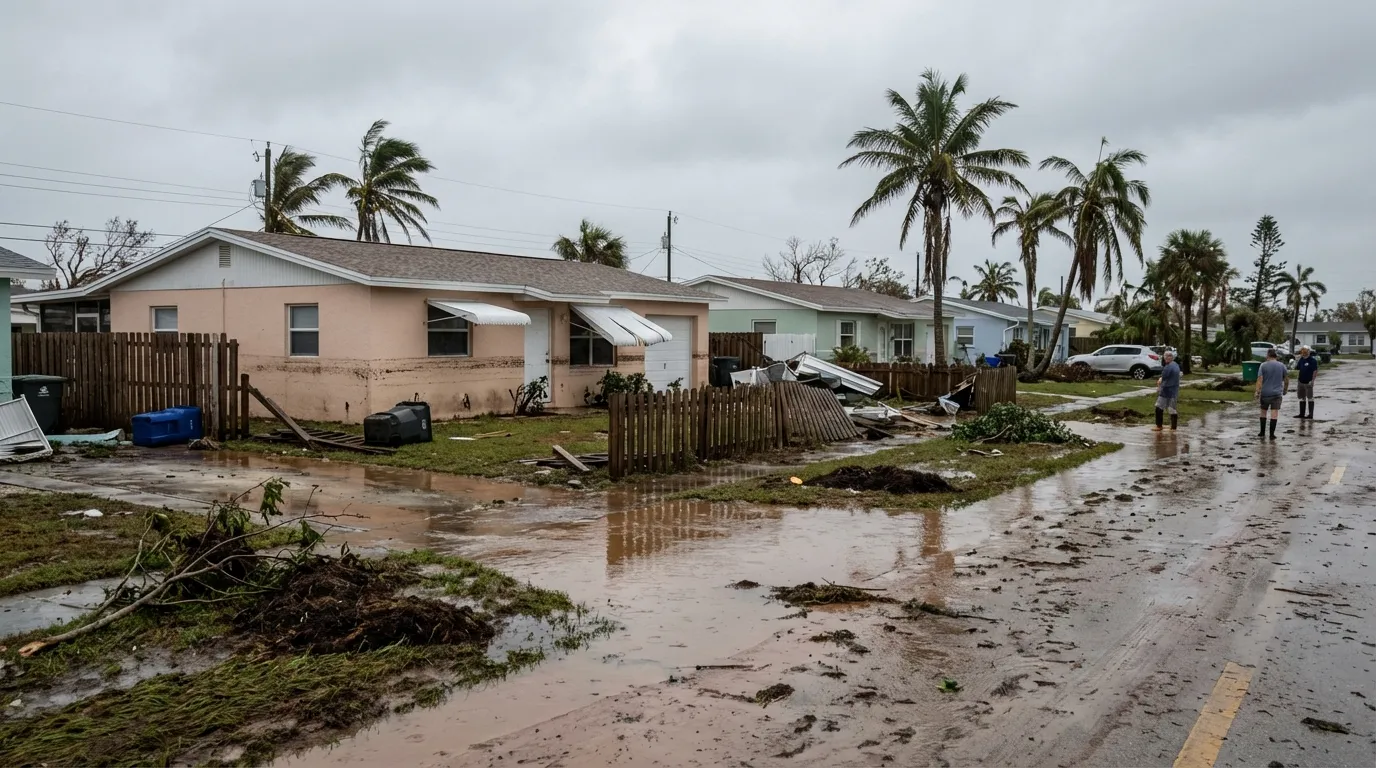
Florida
Hurricane Alley
Common Storm Damage in Florida
- Roof shingle and decking failures from sustained winds
- Storm surge flooding in coastal and low-lying areas
- Wind-driven rain intrusion through windows and soffits
- Fallen trees and debris impacting structures
- Power outages leading to secondary water damage (sump pump failure)
- Mold growth from post-storm moisture within 24-48 hours
Notable Storms
Hurricane Andrew (1992)
Category 5. Destroyed 63,000 homes in Dade County. Led to modern FL building codes.
Hurricane Irma (2017)
Category 4 at landfall. $50B+ in damage. Impacted the entire state from Keys to Jacksonville.
Hurricane Ian (2022)
Category 4. Fort Myers devastated by storm surge. $110B in damage, among costliest US hurricanes.
Hurricane Helene (2024)
Category 4. Big Bend landfall with major storm surge along Gulf Coast and inland flooding.
Hurricane Milton (2024)
Category 3 at landfall near Sarasota. Spawned over 30 tornadoes across central Florida.
Building Code Context: Florida
After Hurricane Andrew devastated South Florida in 1992, Florida adopted the strictest building codes in the nation. The Florida Building Code (FBC) now requires impact-resistant windows or shutters in wind-borne debris regions, enhanced roof-to-wall connections using hurricane straps, and minimum design wind speeds of 110-180 mph depending on location. Homes built to post-2002 FBC standards sustain significantly less damage, but older construction remains highly vulnerable. Wind mitigation inspections can qualify homeowners for substantial insurance premium credits.
Six storm risks across three states
Florida, North Carolina, and South Carolina don't share the same storm profile. Florida is the world capital of lightning and the most-struck state for major hurricanes; North Carolina adds winter ice storms to the tropical mix; South Carolina's coast has weathered 45+ tropical landfalls since 1851. Each cell in this matrix shows where the deductible math and coverage rules diverge.
| Storm risk | Florida | North Carolina | South Carolina | Insurance treatment |
|---|---|---|---|---|
| Tropical cyclone (hurricane) | Very High Statewide; June-Nov season | High (coast) Outer Banks + Cape Fear | Very High 45+ landfalls since 1851 | HO-3 wind + NFIP flood (separate). FL hurricane deductible 2-10%. |
| Tornado / supercell | Moderate Embedded in tropical systems | Moderate Spring + fall outbreaks | Moderate Upstate + coastal mix | HO-3 covered. AOP deductible (not hurricane deductible) usually applies. |
| Severe thunderstorm / hail | High Year-round; daily afternoon | High Spring + summer convective | High Upstate hail corridor | HO-3 covered. Wind/hail deductible may apply in coastal SC and parts of NC. |
| Winter storm / ice | Low Rare in panhandle only | High Piedmont ice + Mountains snow | Moderate Upstate ice events | HO-3 covered including frozen pipe burst from heating system failure. |
| Lightning strike | Very High World capital of lightning | Moderate Summer convective season | Moderate Coastal + upstate seasonal | HO-3 covered for fire, surge damage, and structural strikes. |
| Derecho (straight-line wind) | Moderate Inland panhandle exposure | Moderate Foothills + Piedmont | Moderate Upstate exposure | HO-3 covered. NWS damage survey often confirms category for claim support. |
Coverage gaps to watch: Standard HO-3 policies exclude flood and storm surge in every state. NFIP requires a 30-day waiting period and caps building coverage at $250,000 — buying it during a hurricane warning is too late. Sewer backup is an endorsement, not a default. Verify all three coverages before May.
HO-3 vs NFIP: who pays for what
Homeowners HO-3 policies cover wind damage and wind-driven rain through wind-created breaches. NFIP flood policies cover rising water, storm surge, and overland flooding. When a hurricane hits, both perils are usually present — and the dispute over which one caused which damage is where most claims get stuck. Use this matrix to know what to document for which adjuster.
| Peril / damage type | HO-3 standard | NFIP flood | Hurricane deductible applies | Documentation needed |
|---|---|---|---|---|
| Wind-driven rain through roof breach | Covered | Not covered | Yes (FL named storm) | Photos of breach + interior damage, moisture readings |
| Tree on house (wind-felled) | Covered | Not covered | Yes if named storm | Origin photos, arborist report, structural assessment |
| Flood / overland water | Excluded | Covered | No (separate NFIP deductible) | High-water marks, exterior approach photos, debris line |
| Storm surge (saltwater) | Excluded | Covered | No (NFIP separate) | Salt residue test, contamination logs, FEMA flood zone |
| Sewer backup during storm | Endorsement only | Limited | Sometimes | Backup source, contamination Cat 3 logs, treatment receipts |
| Wind damage to fence | Covered (Coverage B) | Not covered | Yes (FL) | Pre/post photos, materials list, repair estimate |
| Wind damage to detached structure | Covered (Coverage B) | Building only if separate policy | Yes (FL) | Structural photos, prior condition baseline, contents inventory |
| Wind + flood combined | Wind portion only | Flood portion only | Yes (split claim) | Causation report separating wind vs water, two adjusters |
| Tornado damage | Covered | Not covered | No (different deductible) | NWS tornado report, EF rating, debris pattern photos |
| Hail damage to roof | Covered | Not covered | Wind/hail deductible may apply | Hail size verification, impact pattern photos, NWS report |
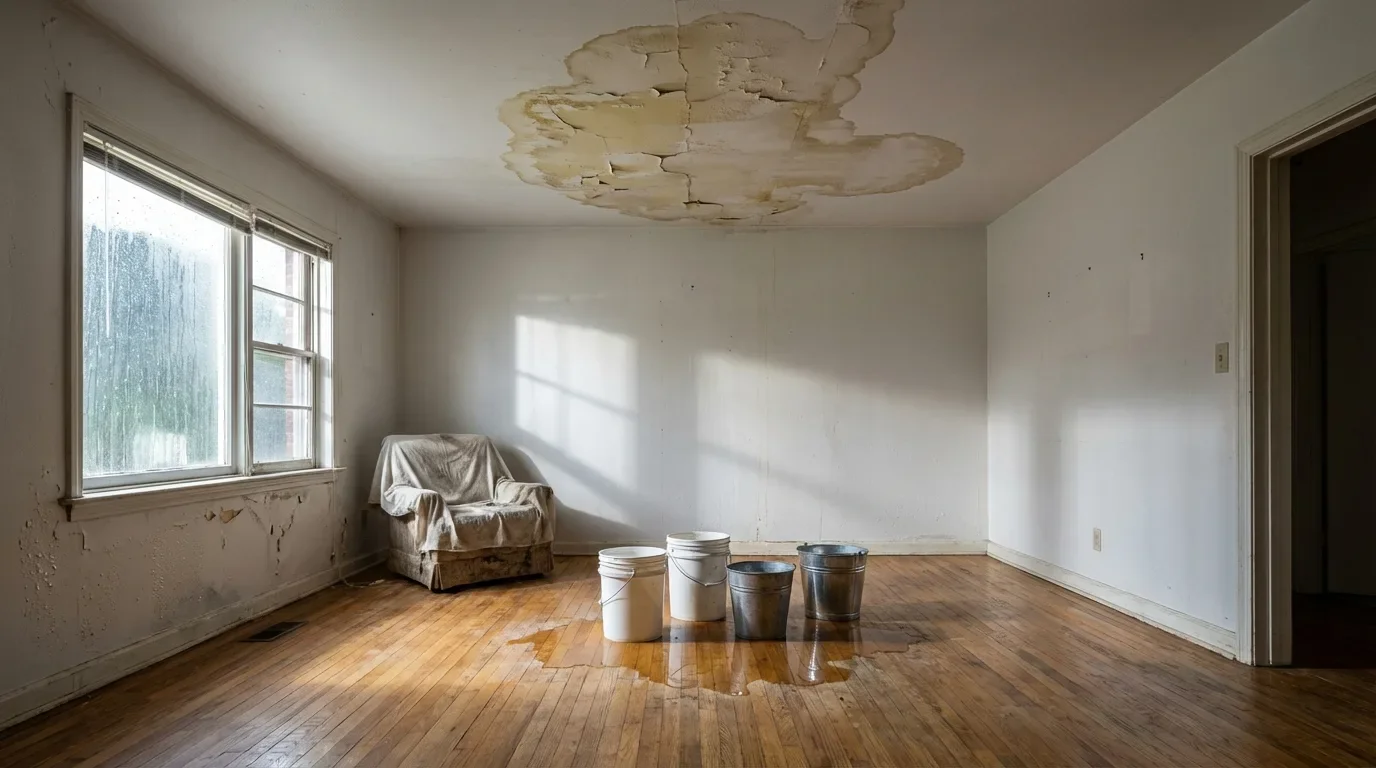
If a hurricane brings 8 inches of rain and your roof loses shingles in the same storm, you need photos of the missing shingles AND the interior water damage in the same timestamp window. Without that pairing, your carrier may argue the rain entered through pre-existing wear (excluded) instead of a wind-created opening (covered).
The full breakdown — including how to handle dual claims when wind and flood both apply — lives in our wind vs flood insurance guide.
Read the full guideThe percentage that nobody reads until it's too late
Hurricane deductibles are not flat dollar amounts — they are percentages of your dwelling Coverage A. On a $400,000 home with a 5% hurricane deductible, you pay the first $20,000 of any hurricane claim before insurance pays anything. This is the single biggest surprise Florida and Carolina homeowners encounter after a named storm. The deductible is also separate from — and stacks alongside — your standard all-other-perils (AOP) deductible.
Hurricane deductible
Florida
Options
$500, 2%, 5%, or 10% of Coverage A
Trigger
Hurricane warning declared by NHC for any FL zone
In-effect window
Stays in effect until 72 hours after final hurricane watch/warning terminates
Named storm deductible
North Carolina
Options
1%, 2%, or 5% of Coverage A
Trigger
Named storm watch/warning issued for NC zone
In-effect window
Stays in effect 24 hours after final named storm watch/warning terminates
Wind/hail deductible (coastal)
South Carolina
Options
1%, 2%, or 5% of Coverage A in coastal zones
Trigger
Wind or hail event in designated coastal counties
In-effect window
Per-event basis; required disclosure with worked example on declarations
| Home value | Deductible | Your out-of-pocket | Notes |
|---|---|---|---|
| $400,000 dwelling | 5% hurricane | $20,000 | You pay the first $20K. Insurer pays the remainder up to policy limits. |
| $300,000 dwelling | 2% hurricane | $6,000 | Lower percentage, lower out-of-pocket — but higher annual premium. |
| $600,000 dwelling | 10% hurricane | $60,000 | Maximum FL deductible — usually paired with the cheapest premium and worst surprise. |
| $250,000 dwelling | $500 flat | $500 | FL flat-dollar option — most expensive premium but predictable out-of-pocket. |
The buy-down option
Some Florida carriers offer hurricane deductible buy-down endorsements that convert the percentage to a flat dollar amount.
Buy-downs typically cost $200-$800 per year and can save tens of thousands of dollars in a single major storm. They are particularly valuable if your dwelling coverage exceeds $400,000 or you live in a coastal county where hurricane strikes are more probable. Ask your agent before renewal.
Citizens Insurance is cutting 2026 rates by an average of -8.8% multiperil and ~5.5% wind-only — premiums are softening even as deductibles stay percentage-based. Now is the right time to shop and to compare buy-down add-ons. See our wind vs flood coverage breakdown for the full claim-side picture.
From damage to payout, the right way
Florida law gives you 1 year from the date of loss to file the initial claim and 18 months for supplements. The insurer must pay or deny within 60 days of receiving notice. North Carolina and South Carolina don't have hard statutory deadlines, but most carriers contractually require prompt notice within 60-90 days. Open the claim immediately. See our Florida claim deadline guide.
Photo and video everything BEFORE cleanup
Wide shots, mid shots, close-ups. Interior, exterior, every angle. Time-stamped if possible. This is the single most important step — once debris is moved, the evidence is gone.
Common pitfall
Do not rearrange or discard any structural materials before documenting them.
Contact your carrier (and wait for inspector before moving debris)
Call to open the claim and get a claim number. Confirm whether your carrier wants the adjuster on-site before debris removal or if they authorize emergency mitigation in writing first.
Common pitfall
Some carriers require pre-authorization for any work over a dollar threshold.
Document tree and debris origins
For tree-on-house claims, document the tree base (yours? neighbor?) and the path of impact. For wind-blown debris, capture the trajectory and source if visible. Causation matters for coverage.
Common pitfall
A tree from your neighbor's yard may shift carrier responsibility — confirm.
Emergency mitigation with receipts
Tarping ($500-$2,500), board-up ($300-$600), water extraction ($3-$7.50/sq ft). All reimbursable under loss-mitigation clause. Keep every receipt and photo every step. Do this within 24-48 hours before mold sets in.
Common pitfall
Failing to mitigate can void coverage on secondary water damage and mold.
Dual claim if both wind + flood are involved
Separate claims to HO-3 (wind portion) and NFIP (flood portion). Two adjusters, two deductibles, two scopes. Request both inspectors immediately so the causation report can be reconciled.
Common pitfall
Mixing wind and flood damage in a single claim is the #1 reason hurricane claims get stuck.
Supplement process for hidden damage
When repairs reveal additional damage (rotted sheathing, hidden mold, structural issues), file a supplemental claim. FL allows supplements within 18 months of date of loss; document each change order against the original adjuster scope.
Common pitfall
Most homeowners forget about supplements and leave thousands on the table.
Sample $40,680 claim breakdown
Wind + rain intrusion claim on a $400,000 Florida home
| Roof shingle replacement (full slope) | $8,500 |
| Underlayment + flashing | $1,800 |
| Interior ceiling drywall (3 rooms) | $4,200 |
| Insulation R&R (attic + walls) | $2,400 |
| Wind-driven rain mitigation (3-day drying) | $3,600 |
| Paint + finish work | $5,800 |
| Contents pack-out / clean / restore | $6,200 |
| Emergency tarping (reimbursed mitigation) | $1,400 |
| General contractor overhead + profit (20%) | $6,780 |
| Subtotal before deductible | $40,680 |
| Hurricane deductible (5% of $400K dwelling) | −$20,000 |
| Carrier payout | $20,680 |
| Out-of-pocket (deductible) | $20,000 |
Real-world scenario. The $20,000 deductible is the part most homeowners don't see coming. A buy-down endorsement at $200-$800/yr would have eliminated this exposure.
What storm damage actually looks like
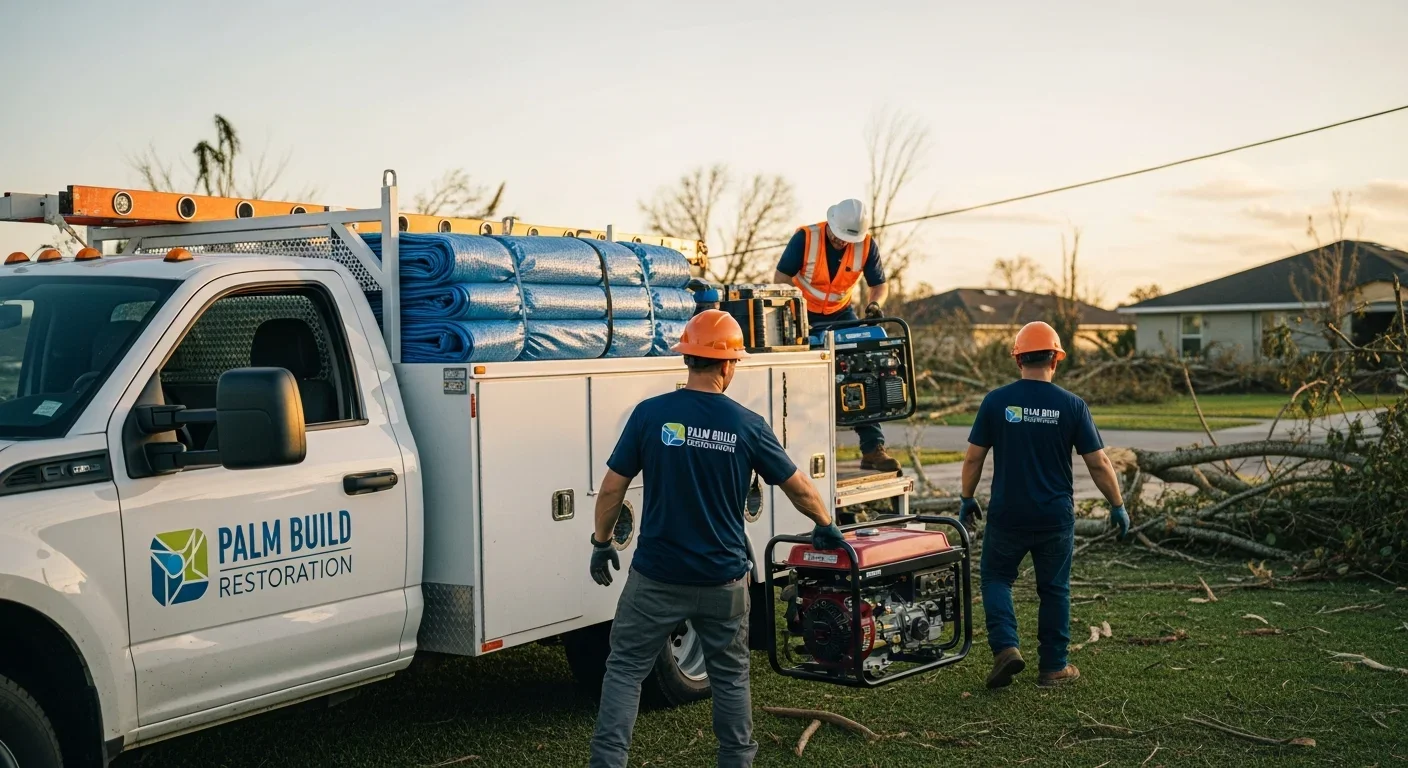
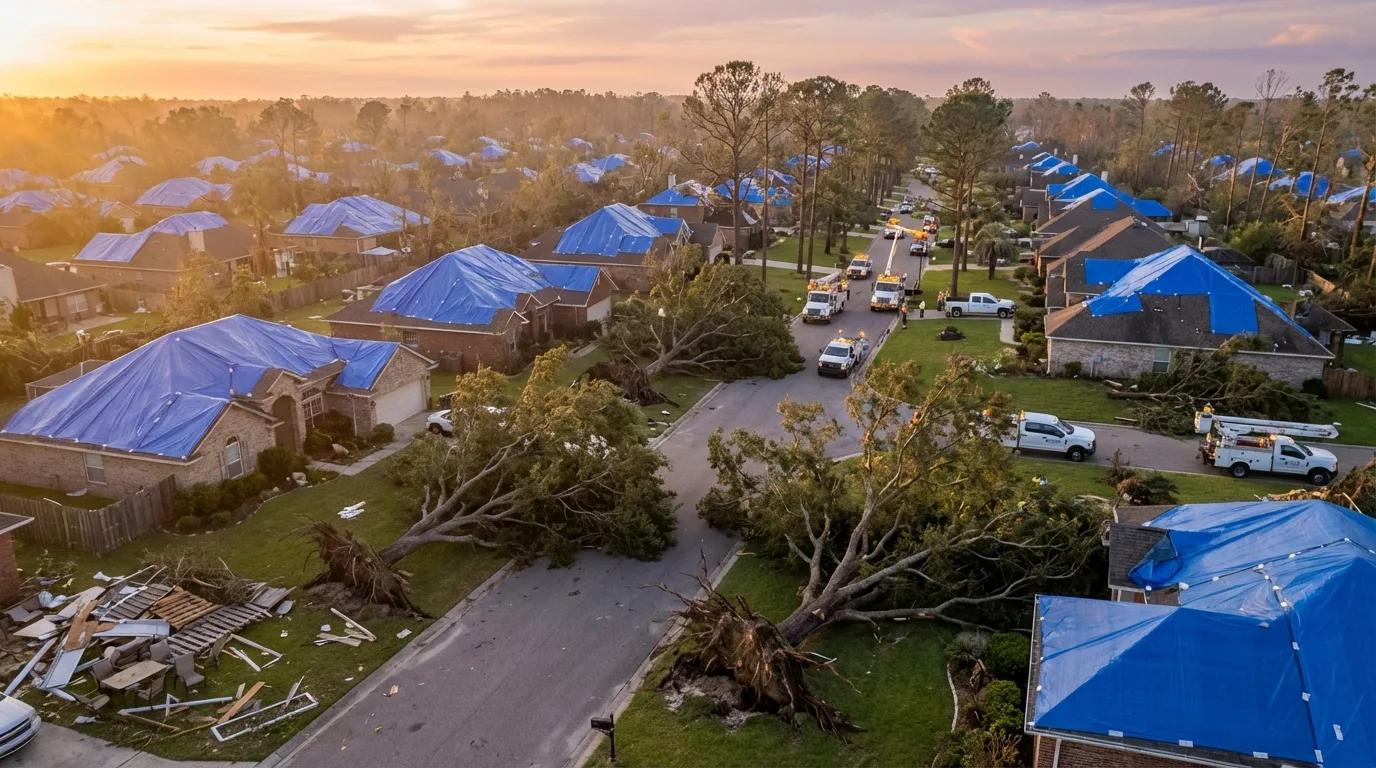
Twelve scenes from the field — emergency response, roof tarping, surge flooding, tornado debris, ice storms, and the command center keeping it all coordinated. Every image is from a real Palm Build response or branded prep environment.
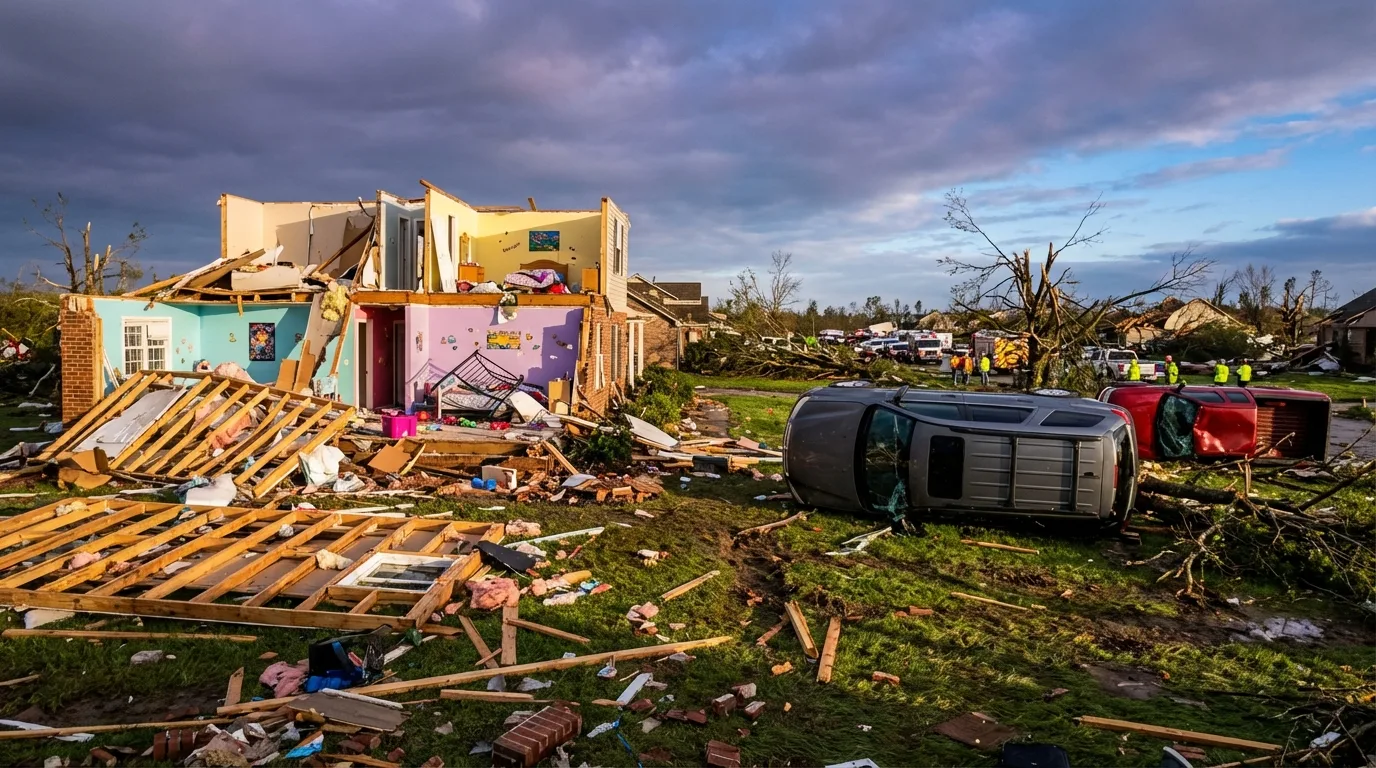
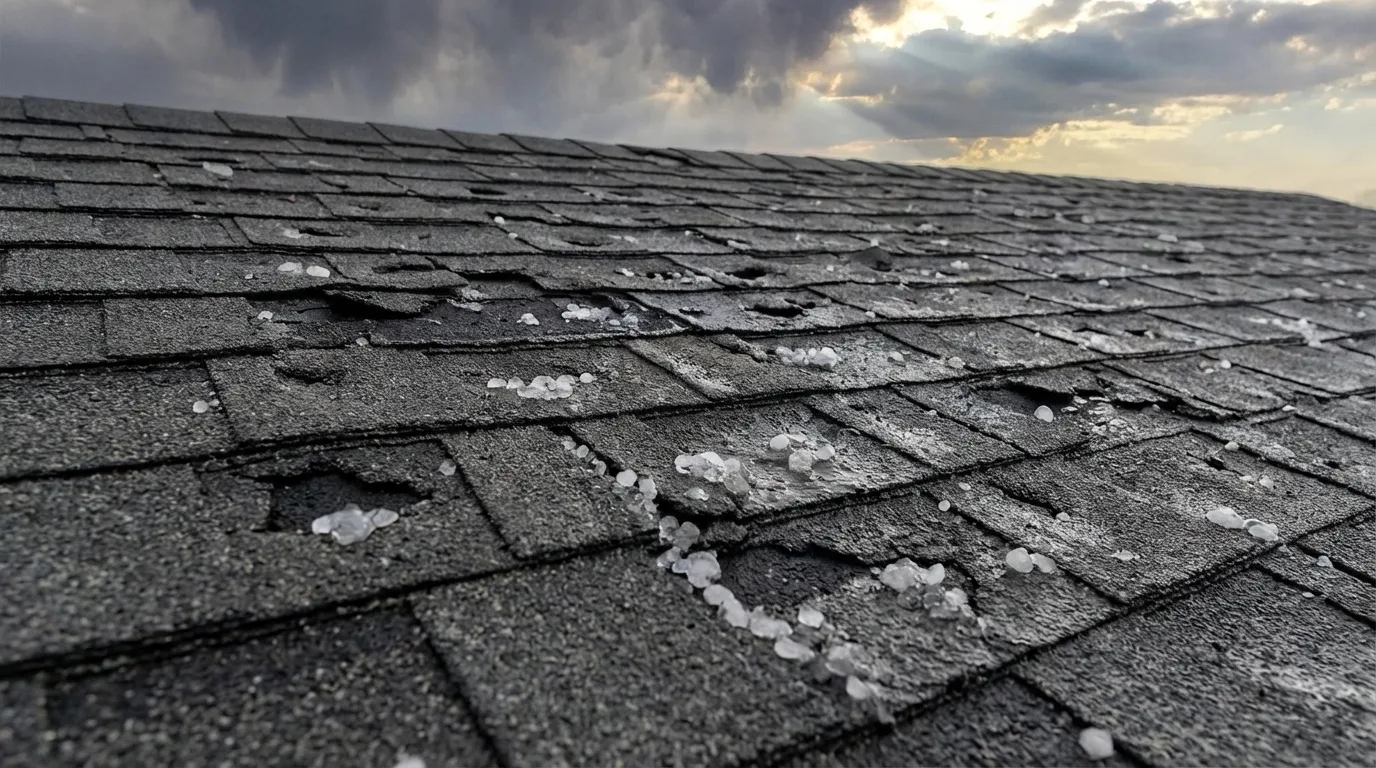
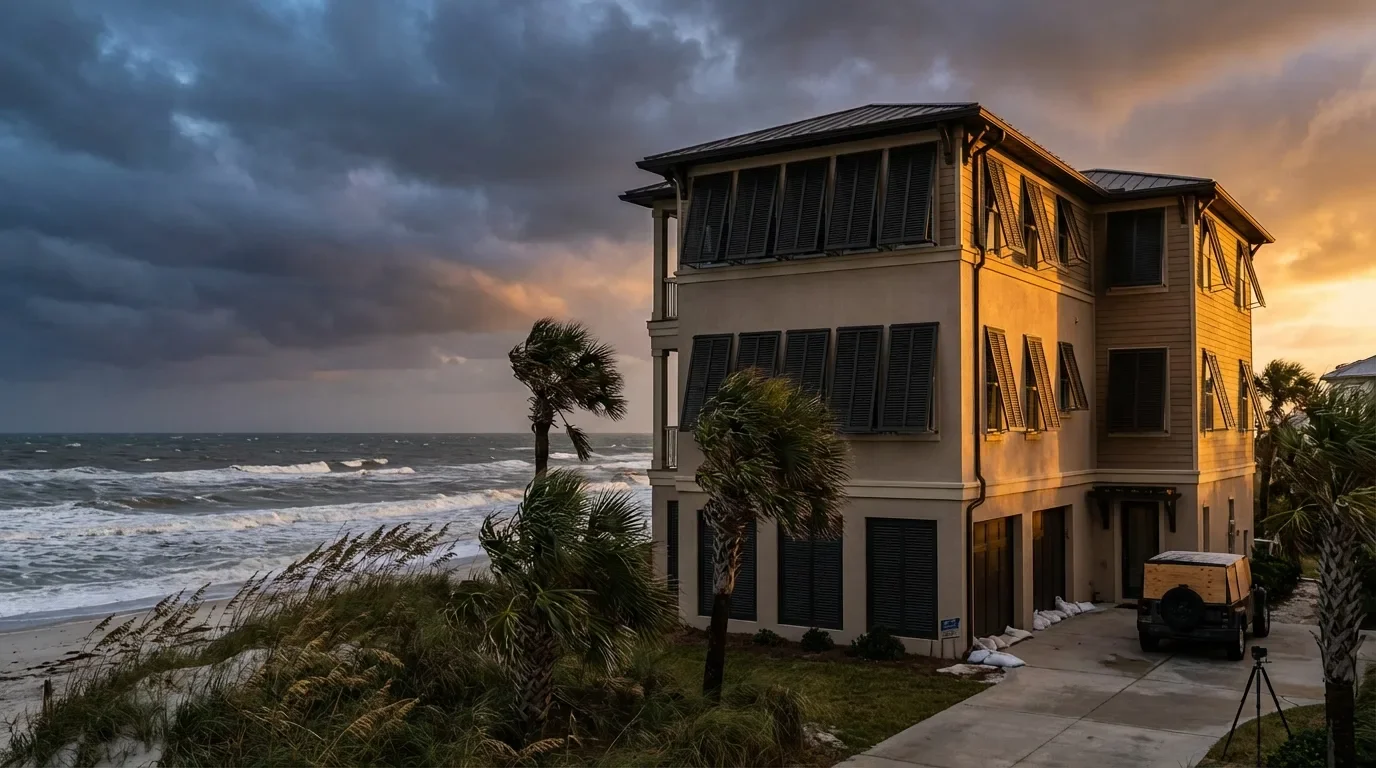
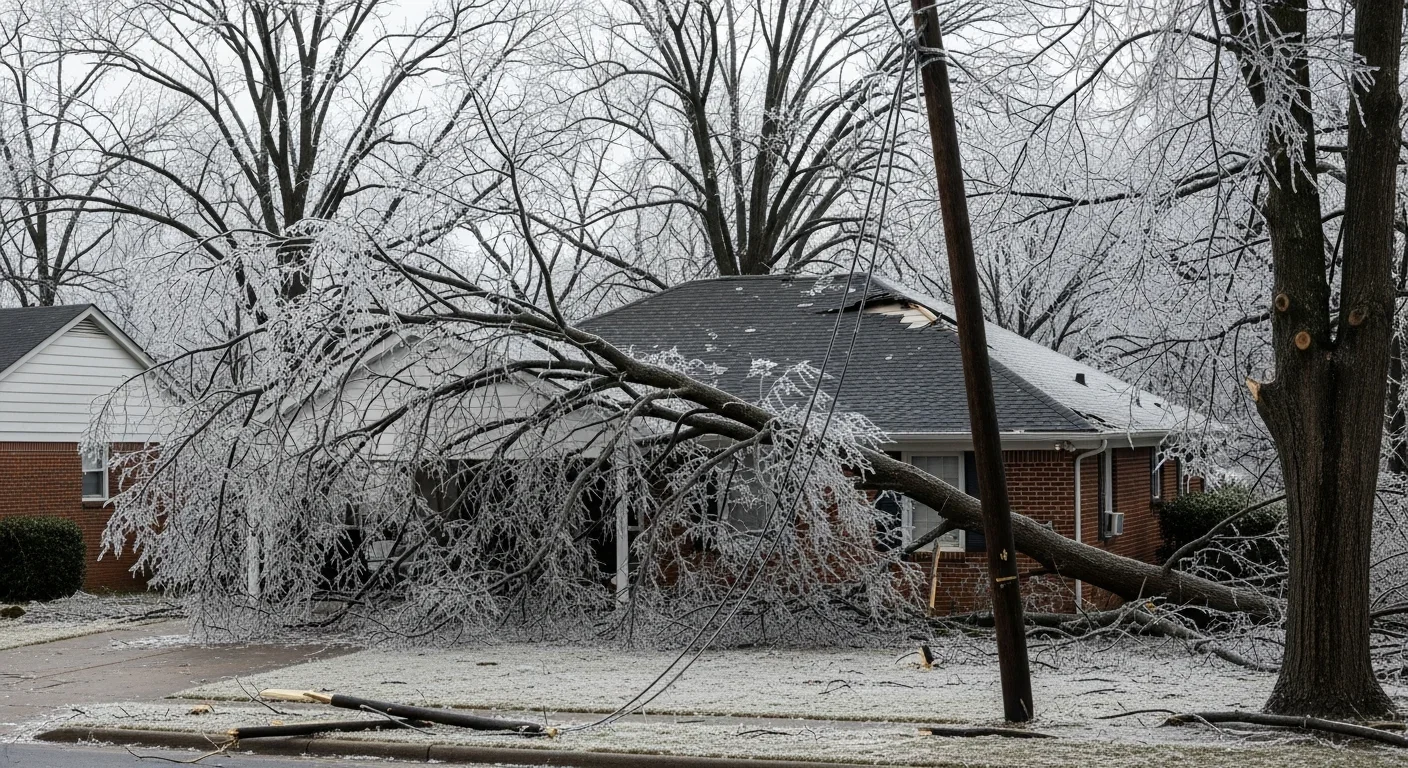
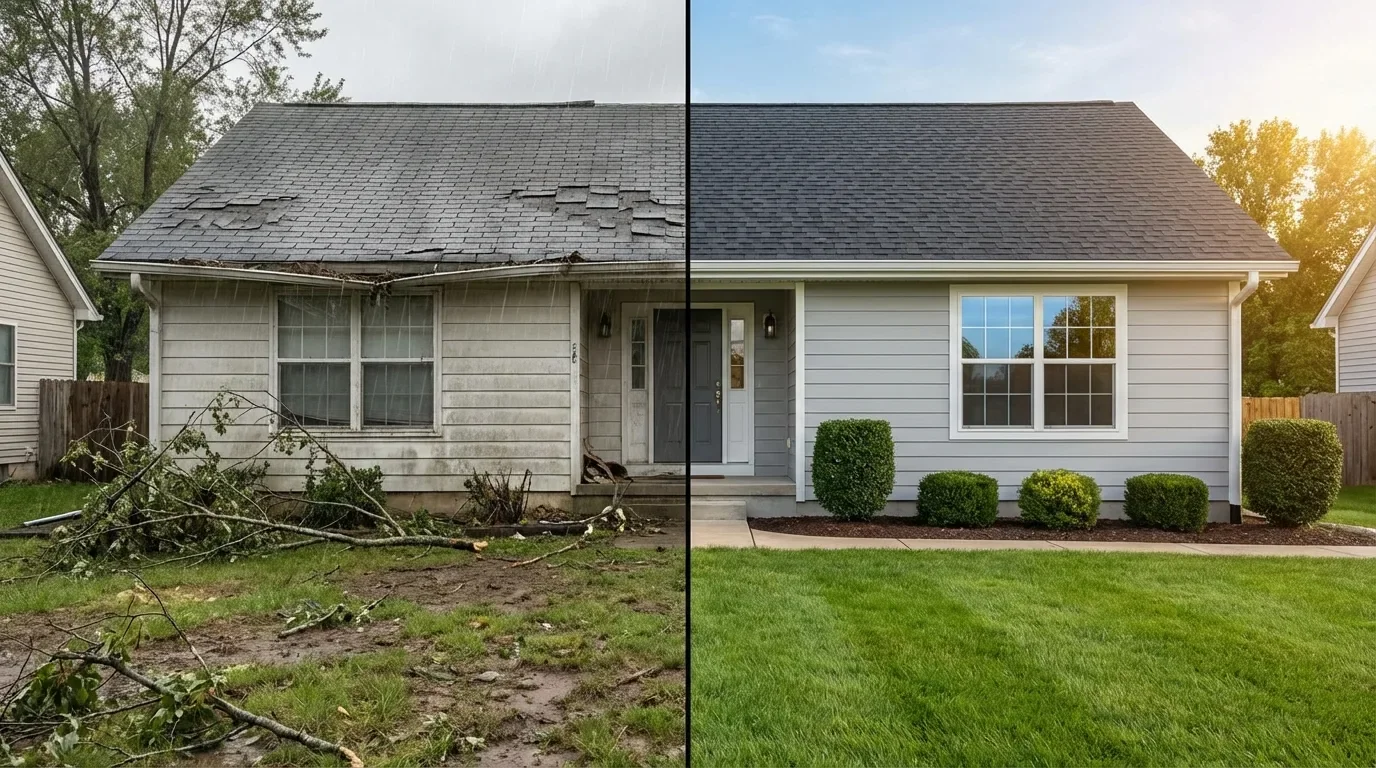
Six dedicated storm response paths
Six specialized service paths under our storm damage program. Open a dedicated guide for roof tarping, wind repair, hurricane restoration, or insurance, while the remaining cards keep useful in-page navigation to response details.
Emergency Roof Tarping
Reinforced poly tarps + 2x4 batten anchors stop water intrusion within hours. Required mitigation, not optional.
Common cost
$500 - $2,500
Wind Damage Repair
Shingle, siding, soffit, fascia, window, and structural framing repairs with claim-ready documentation.
Common cost
$3,500 - $25,000
Tornado Damage Restoration
EF-rated structural assessment, debris clearing, and full reconstruction after tornado and supercell events.
Common cost
$25,000 - $150,000
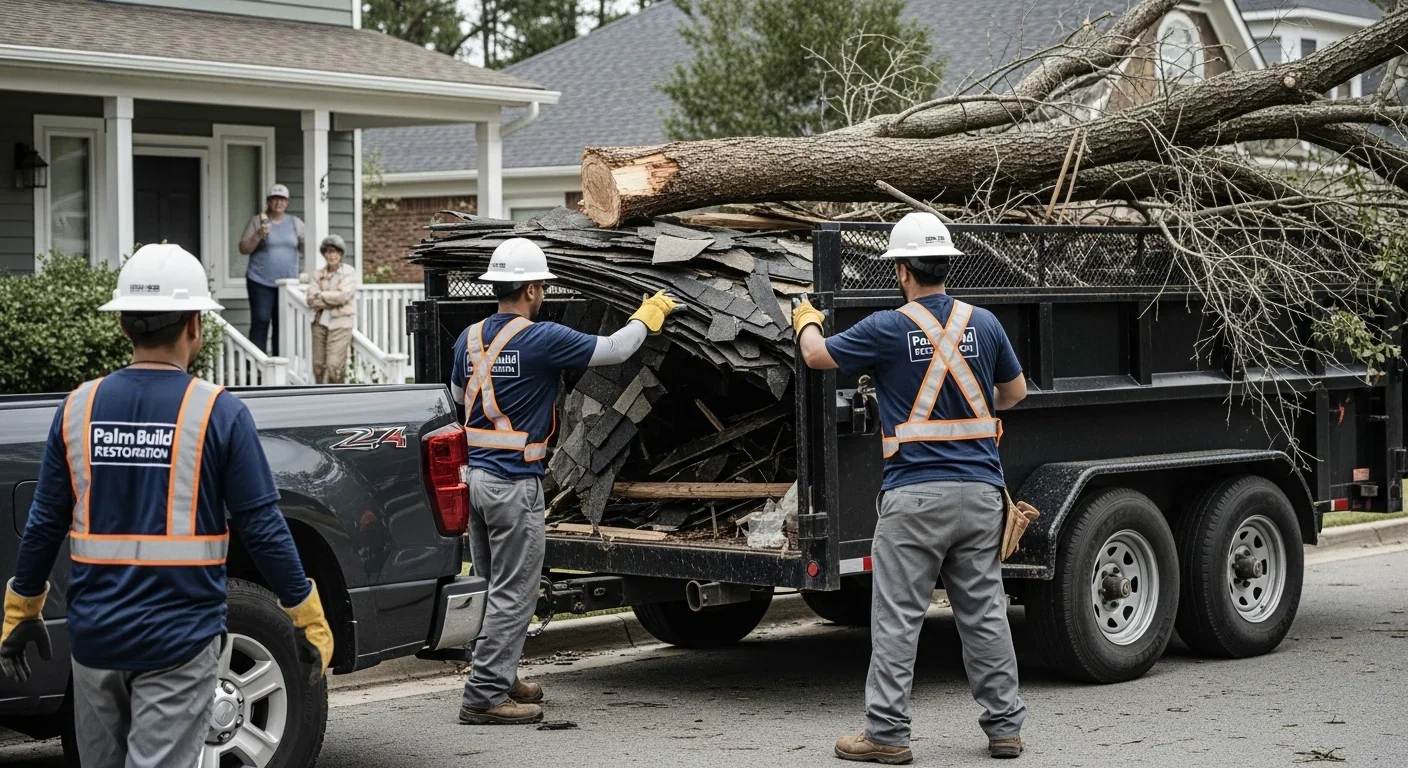
Storm Debris Removal
Safe removal of downed trees, roofing debris, and storm-scattered materials with arborist coordination.
Common cost
$1,500 - $8,000
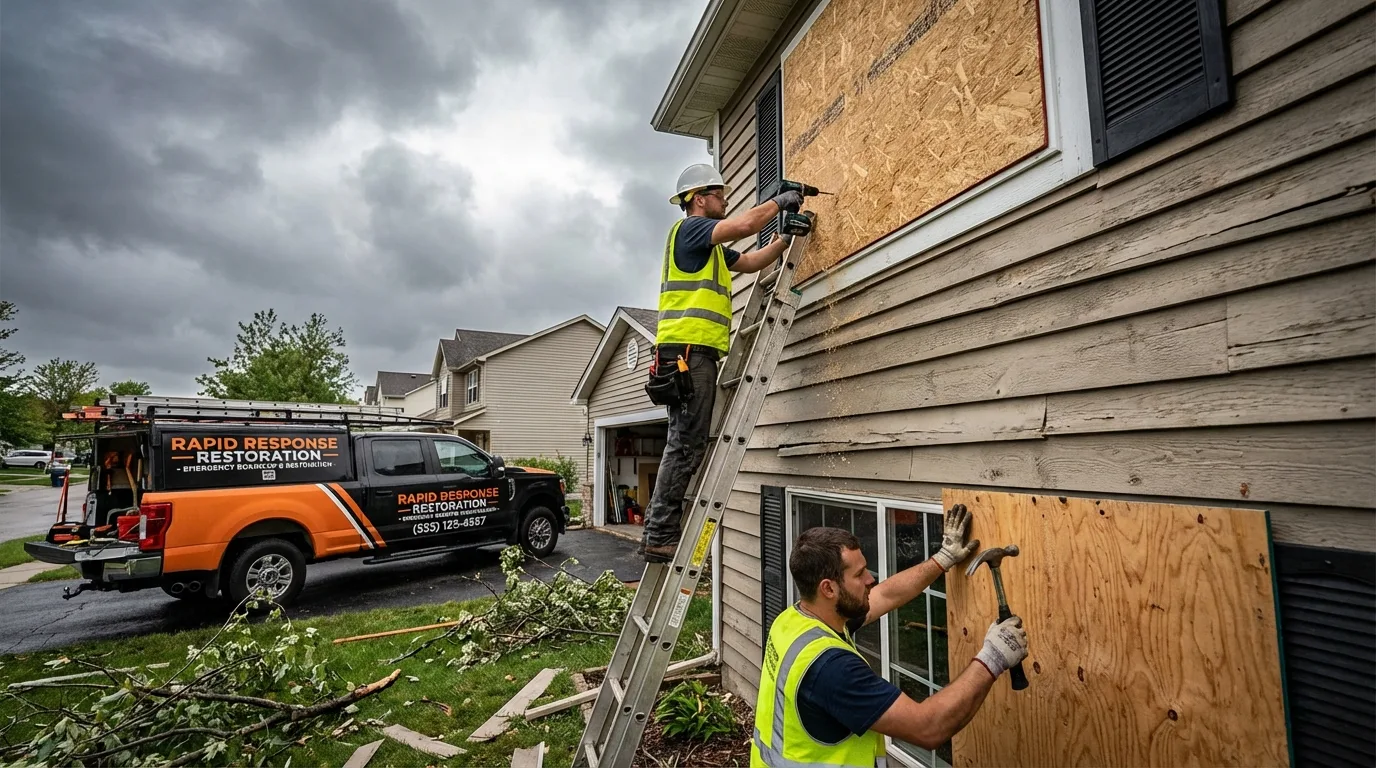
Hurricane Board-Up
Pre-landfall and post-impact window and opening protection with plywood, OSB, and storm panels.
Common cost
$300 - $2,400
Post-Storm Inspection
Documented wind-vs-water assessment for insurance claims and hidden moisture detection.
Common cost
$150 - $500
Local Service Pages
Storm & Hurricane Damage by City
Tier 4 · Local office
Tier 2 · Local office
Tier 1 · Local office
Tier 1 · Local office
Tier 1 · Local office
Tier 2 · Local office
Tier 2 · Local office
Tier 1 · Local office
Tier 2 · Local office
Tier 2 · Local office
Tier 4 · Local office
Tier 4 · Local office
Tier 2 · Local office
Tier 1 · Local office
Tier 1 · Local office
Tier 1 · Local office
Tier 1 · Local office
Tier 4 · Local office
Tier 4 · Local office
Tier 2 · Local office
Tier 2 · Local office
Tier 2 · Local office
Tier 2 · Local office
Tier 2 · Local office
Tier 2 · Local office
Tier 4 · Local office
Tier 4 · Local office
Tier 3 · Local office
Tier 1 · Local office
Tier 2 · Local office
Tier 2 · Local office
Tier 2 · Local office
Tier 2 · Local office
Tier 2 · Local office
Tier 3 · Local office
Tier 4 · Local office
Tier 2 · Local office
Tier 2 · Local office
Tier 2 · Local office
Tier 2 · Local office
Tier 1 · Local office
Tier 4 · Local office
Tier 1 · Local office
Tier 2 · Local office
Tier 2 · Local office
Tier 3 · Local office
Tier 2 · Local office
Tier 1 · Local office
Tier 1 · Local office
Tier 3 · Local office
Tier 2 · Local office
Related Restoration Paths
Keep your storm recovery connected across services
Storm damage rarely exists in isolation. Use these connected guides to move from emergency mitigation into full restoration with a clear, claim-aligned scope.
Water Restoration
Storm-driven water intrusion, extraction, and structural drying after emergency secure-up.
Mold Remediation
Rapid mold risk control after high-humidity storm events, rain intrusion, and delayed drying.
Reconstruction Services
Permanent structural repairs after wind and impact damage, with code-aligned rebuild scope.
Insurance Restoration Process
Full claims workflow support for wind-versus-water disputes, supplements, and adjuster coordination.
Large Loss Handling
Neighborhood and portfolio-level storm events requiring multi-crew coordination and phased recovery.
Commercial Restoration
Business continuity-focused response for office, retail, and mixed-use storm damage scenarios.
Contents Restoration
Storm-damaged belongings, furniture, and personal property can be packed out, cleaned, and restored.
Textile Restoration
Clothing, rugs, and fabrics exposed to storm water and debris need specialized cleaning to prevent permanent damage.
Next Step
Need emergency response now or a pre-season inspection plan?
Choose the path that matches your timeline. Our crews handle immediate storm stabilization and scheduled preparedness inspections across Florida and the Carolinas.
Guides & Resources
Related Guides
How to Spot Storm Damage on Your Roof
Spot wind and hail damage on shingles, flashing, and gutters with a fast inspection checklist, photo guide, and FL/NC/SC claim-deadline rules.
13 min read
Wind vs Flood Damage: Insurance Coverage
Learn what homeowners vs. flood insurance covers after a hurricane, how deductibles work in FL, NC, and SC, and what to do when wind and flood damage overlap.
12 min read
Tornado vs Hurricane Damage: Insurance Guide
Tornado vs hurricane damage: how deductibles, payouts, and restoration timelines differ — and which one applies when a hurricane spawns a tornado in FL, NC, or SC.
14 min read
Palm Build Tools
Need structure before the inspection or claim call?
These tools turn post-storm uncertainty into a cleaner triage path, flood plan, claim readiness summary, or AI-assisted photo briefing.
Storm Damage Assessment Tool
Use same-day triage to prioritize hazards, openings, flood concerns, and what to document before the next rain.
Flood Damage Estimator
When the storm included standing or rising water, shift into a flood-specific severity and salvage plan.
Insurance Claim Estimator
Check claim-worthiness, deductible exposure, and claim-readiness after wind, flood, or mixed-event damage.
AI Damage Analyzer
Upload storm photos for a structured triage summary, likely categories, and questions to take into inspection.
Hurricane & Storm Damage FAQ
Expert answers on emergency response, hurricane deductibles, NFIP flood vs HO-3 wind coverage, FL/NC/SC claim deadlines, and storm season preparedness.
Emergency Response, Storm Damage Types, Insurance & Claims, Preparedness & Costs
Need immediate storm damage help?
Emergency Response
First, ensure everyone is safe — stay clear of downed power lines, check for gas leaks, and avoid structurally compromised areas. Once safe, document everything with photos and video before moving anything. Cover broken windows and roof openings with tarps or plywood if you can do so safely. Contact your carrier to open a claim, then call a professional restoration company. The EPA, CDC, and OSHA all confirm mold can begin growing on damp materials within 24-48 hours, so mitigation cannot wait for the adjuster — most policies require you to mitigate further damage. See our post-storm 48-hour mold guide.
Don't see your question? Contact us directly. emergency response?
24/7 Storm Damage Response
Our crews stay storm-ready before, during, and after every named system. Call anytime for emergency help.
Rapid Deployment
Pre-positioned crews on-site within hours, even during active storms
All Storm Types
Hurricane, wind, tornado, hail, ice, surge — every category of storm damage
Insurance Experts
Wind vs water disputes, hurricane deductibles, NFIP, and FEMA
Request Emergency Service
Need help right now? Call us.
24/7 live dispatch — average answer time under 30 seconds