FORT LAUDERDALE FL — 24/7 HURRICANE & STORM DAMAGE RESPONSE
Storm & Hurricane Damage Restoration in Fort Lauderdale, FL
Fort Lauderdale has been hit by 73 tropical systems in 153 years — an average of one every 6.12 years. The April 2023 Rain Bomb dumped 25.91 inches in 12 hours, damaging 1,121 homes and closing Fort Lauderdale-Hollywood International Airport. With 165+ miles of canals creating dual storm surge and overflow risk, Palm Build's Deerfield Beach team provides emergency tarping, saltwater extraction, and full HVHZ-compliant reconstruction — 24/7 with insurance coordination from the first call.
18 miles — Deerfield Beach, FL Under 30 min Response IICRC Certified
Fort Lauderdale's Hurricane History: A Storm Every 6.12 Years
Fort Lauderdale has been hit by 73 tropical systems in 153 years — an average of one
every 6.12 years. Situated on the Atlantic coast with 165+ miles of canals and direct
Gulf Stream exposure just 2 miles offshore, the city faces rapid-intensification threats
that leave minimal preparation time. From Hurricane Irma's 104 mph gusts in 2017 to the
April 2023 Rain Bomb that rewrote the definition of flood risk, this is the timeline
that defines Fort Lauderdale's storm restoration landscape.
Hurricane Irma
Catastrophic
September 10, 2017
Irma made Florida landfall as a Category 4 in the Keys and tracked up the west coast, but Fort Lauderdale took a severe hit on the east side of the storm. The city experienced 87 mph sustained winds with gusts reaching 104 mph. A total of 115 homes sustained major damage across Broward County, with widespread roof failures in older neighborhoods that predated HVHZ code requirements. Storm surge pushed seawater through the Intracoastal canal system, flooding Las Olas Isles, Harbor Beach, and properties along the New River. Irma caused $50 billion in total US damage and proved that Fort Lauderdale does not need a direct hit to suffer catastrophic losses.
Hurricane Ian
Significant
September 28, 2022
Ian made landfall as a Category 4 in southwest Florida but generated tropical storm conditions across Broward County. Fort Lauderdale experienced sustained winds of 50-65 mph with heavy rain bands that dropped 6-8 inches in under 24 hours. The storm caused scattered roof damage, tree falls, and localized canal flooding. While Fort Lauderdale was spared the worst, Ian served as a rehearsal for evacuation logistics and exposed gaps in post-storm communication between the city, Broward County Emergency Management, and residents.
The April 2023 Rain Bomb
Catastrophic
April 12-13, 2023
A stalled tropical moisture band dumped 25.91 inches of rain on Fort Lauderdale in approximately 12 hours — a 1-in-1,000-year rainfall event. The drainage system, engineered for 3-7 inches per day, collapsed within 2 hours. A total of 1,121 homes were damaged, 766 with major damage (18+ inches of standing water). Fort Lauderdale-Hollywood International Airport closed for the first time in its history. Water rescues were conducted in the Edgewood neighborhood. This was not a hurricane — no named storm, no tropical storm warning — yet it caused more residential damage than any single hurricane in Fort Lauderdale since Wilma.
Hurricane Milton
Moderate
October 9, 2024
Milton made landfall near Siesta Key as a Category 3, 131 miles north of Fort Lauderdale, and generated $34.3 billion in statewide damage. Fort Lauderdale experienced outer band rain squalls, tropical storm force gusts, and localized flooding along the canal network. Milton demonstrated that Fort Lauderdale sits in a damage radius where even storms making landfall well to the north produce insurance-worthy wind and water damage across Broward County.
73
Tropical systems in 153 years
104 mph
Irma gusts — Sept 2017
25.91"
Rain in 12 hours — April 2023
$34.3B
Milton statewide — Oct 2024
Case Study: April 12-13, 2023
The Rain Bomb: 25.91 Inches in 12 Hours
On April 12-13, 2023, a stalled tropical moisture band parked over Fort Lauderdale and
unleashed 25.91 inches of rain in approximately 12 hours — a 1-in-1,000-year rainfall
event that the National Weather Service later classified as the most extreme
short-duration rainfall ever recorded in Southeast Florida. There was no named
hurricane. No tropical storm warning. Just an overwhelming deluge that exposed every
weakness in Fort Lauderdale's drainage infrastructure.
Fort Lauderdale's drainage system was engineered for 3-7 inches of rainfall per day. It
received nearly four times that capacity in half a day. The canal network — 165+ miles
of waterways that the city depends on entirely for stormwater management — reached
capacity within the first two hours. Water backed up through storm drains and into
streets, garages, and living spaces across virtually every neighborhood west of the
Intracoastal.
A total of 1,121 homes were damaged. Of those, 766 sustained major damage — defined as
18 or more inches of standing water inside the structure. Fort Lauderdale-Hollywood
International Airport closed for the first time in its history after runways flooded
under 2-3 feet of standing water. Water rescues were conducted by boat in the Edgewood
neighborhood, where residents were trapped by 4+ feet of street-level flooding. For
restoration professionals, the April 2023 Rain Bomb is Fort Lauderdale's defining
disaster — proof that the city's greatest storm threat is not a Category 4 hurricane,
but an extreme rainfall event that overwhelms a drainage system never designed for this
volume.
25.91"
Rain in 12 hours
1,121
Homes damaged
766
Major damage (18"+)
Closed
FLL Airport — first time ever
Rescues
Edgewood water rescues
1-in-1,000
Year rainfall event
The Drainage Catastrophe
Fort Lauderdale's 165+ miles of canals were engineered for daily rainfall rates of 3-7
inches — the historical norm for South Florida thunderstorms. The April 2023 event
delivered 25.91 inches in 12 hours, nearly 4 times the system's maximum daily capacity
in half a day. When canals reached saturation, water had nowhere to go. Storm drains
became fountains, pushing water upward into streets. The entire western half of the
city, from Edgewood to Davie Boulevard, experienced sheet flooding that turned
residential streets into rivers 2-4 feet deep. No hurricane force winds. No storm
surge. Just rain and a drainage system overwhelmed beyond any historical precedent.
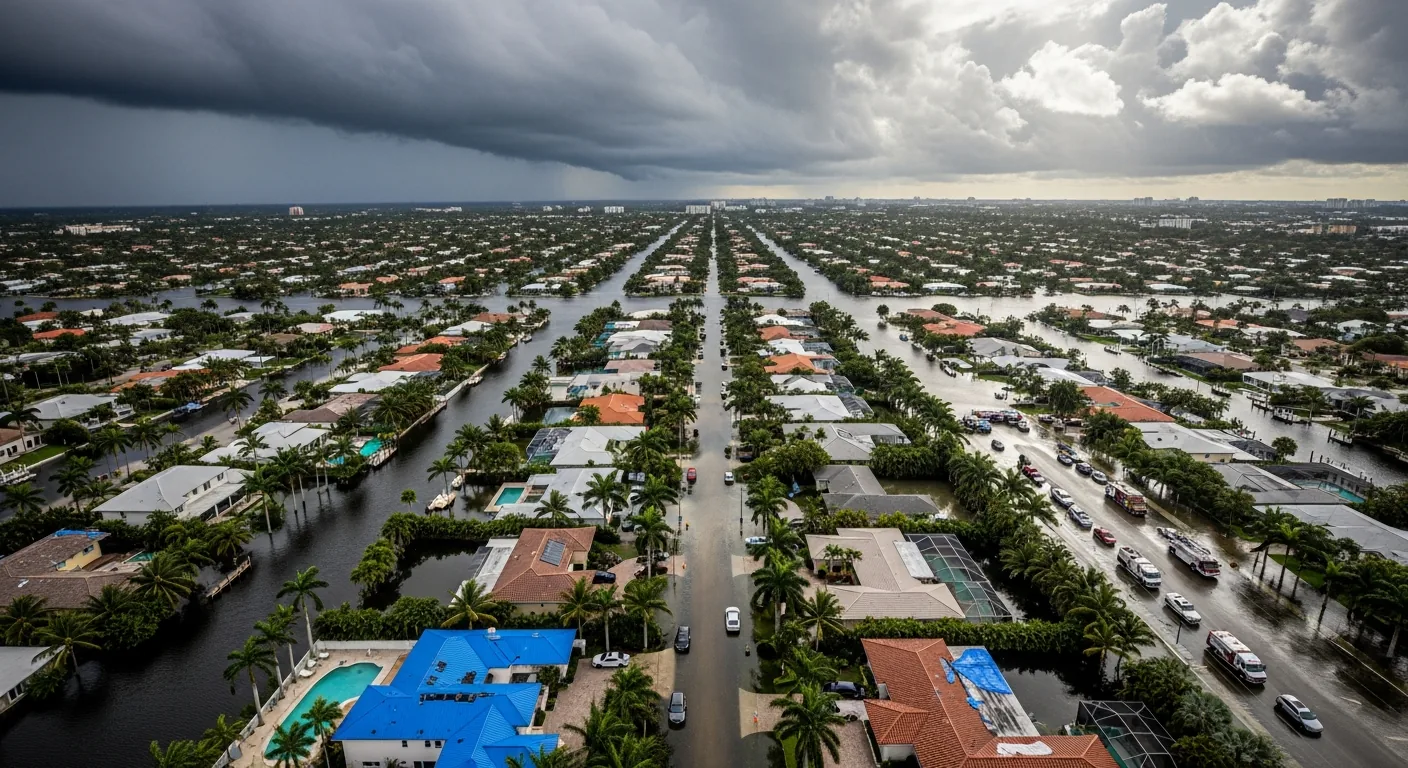
April 2023 flooding overwhelmed Fort Lauderdale streets and the canal system, damaging
1,121 homes across the city
Lessons from the Rain Bomb
Flood insurance is essential regardless of your FEMA zone — the Rain Bomb flooded areas
outside Special Flood Hazard Areas
Standard homeowners insurance does not cover flood damage — a separate NFIP or private
flood policy is the only protection
Install backflow preventers on floor drains and plumbing if your home is near any canal
in the Fort Lauderdale network
Establish a restoration company relationship before hurricane season — response times
tripled during the Rain Bomb event
Types of Storm Damage
How Hurricanes Damage Fort Lauderdale Homes
Hurricane and storm damage in Fort Lauderdale manifests in six distinct ways — and major
storms typically trigger multiple damage types simultaneously. The city's unique
combination of 165+ miles of canals, saltwater exposure, and HVHZ building code
requirements creates a restoration landscape that demands specialized knowledge of each
damage category, its insurance coverage, and the appropriate remediation protocol.
High
Wind-Driven Rain Intrusion
Fort Lauderdale's stucco-clad construction is tested by every hurricane. Wind-driven rain at 80-130+ mph penetrates through hairline stucco cracks, tile displacement gaps, and deteriorated window sealant joints. Because stucco traps moisture between the exterior finish and interior drywall, water damage may remain hidden for weeks after a storm. HVHZ-code homes (post-2002) feature enhanced stucco attachment and flashing, but the majority of Fort Lauderdale's housing stock predates these requirements. Post-storm moisture meter inspection is essential — visible damage represents a fraction of actual water intrusion.
Critical
Saltwater Storm Surge (Category 3)
Properties east of the Intracoastal Waterway — Las Olas Isles, Harbor Beach, Seven Isles, Nurmi Isles, and the barrier island — face direct storm surge exposure. Under IICRC S500 standards, saltwater storm surge is Category 3 (grossly contaminated) water, requiring complete demolition and removal of all affected porous materials. Salt crystals embedded in concrete slabs, wall framing, and subfloor systems continue absorbing atmospheric moisture indefinitely, creating perpetual dampness and accelerated corrosion. This is the most destructive and expensive form of storm damage in Fort Lauderdale.
High
Canal Overflow & Brackish Flooding
Fort Lauderdale's 165+ miles of canals — the New River, Tarpon River, Middle River, and connecting laterals — are the primary drainage system. When rainfall exceeds canal capacity (as the April 2023 Rain Bomb proved), water backs up through storm drains and floods streets, garages, and living spaces. Fort Lauderdale's canal water is typically brackish (mixed salt and fresh), meaning canal overflow flooding is classified as Category 2 or Category 3 under IICRC standards — more aggressive remediation than pure freshwater but less destructive than direct ocean surge.
High
Roof Damage (Tile, Flashing, Soffit)
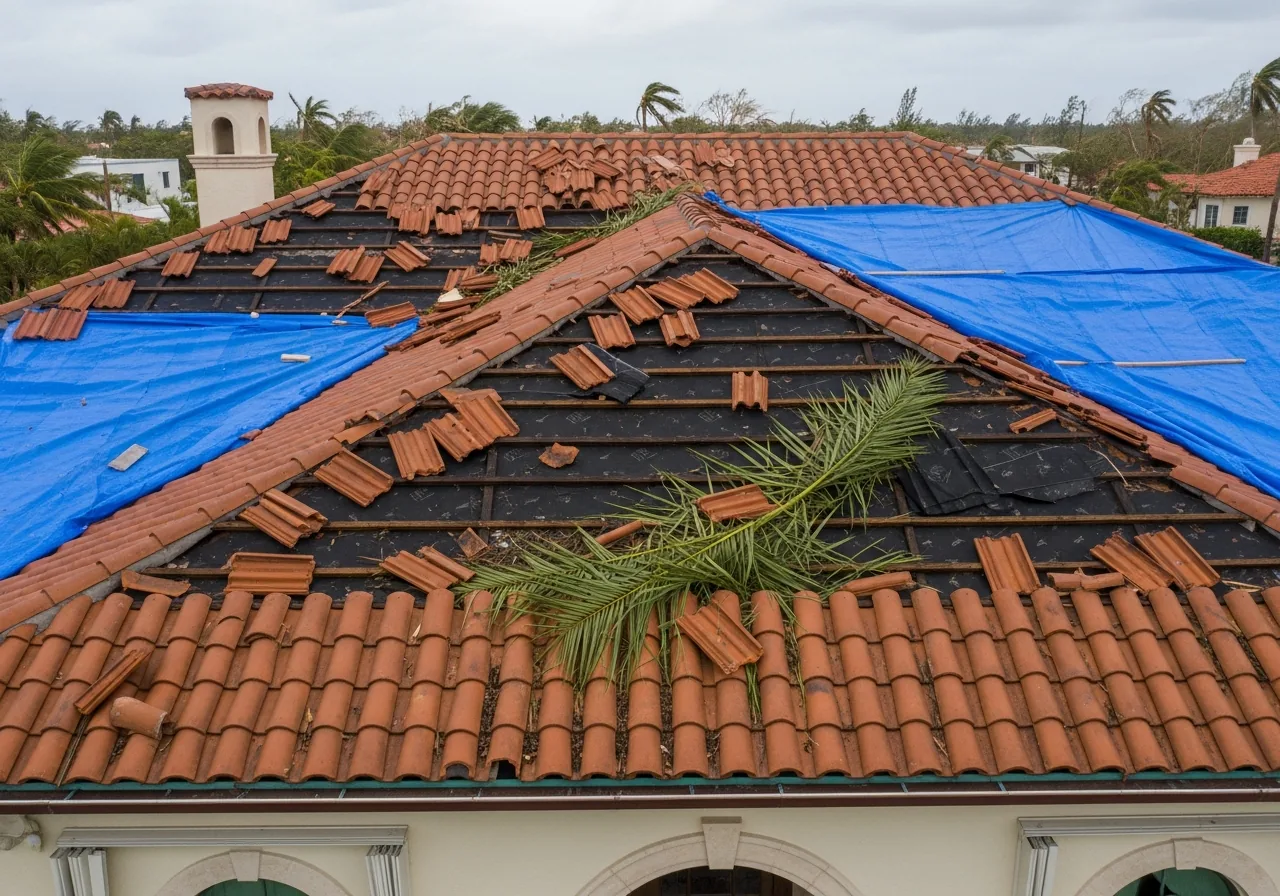
Fort Lauderdale's tile roofs — barrel, flat, and S-tile — are engineered for hurricane loads under HVHZ standards, but adhesive and mechanical fasteners deteriorate in the salt air environment over 15-25 years. Hurricane-force winds lift individual tiles, break adhesive bonds, and create cascading failures. A single displaced tile exposes the underlayment to direct rain, leading to $15,000-$50,000+ in interior water damage if not tarped immediately. Flashing failures around vent pipes, skylights, and parapet walls are the second most common water entry point after tile displacement.
Moderate
Window & Impact Glass Failure
HVHZ-code impact windows are Fort Lauderdale's primary defense against wind-borne debris, rated for large missile impact at 170+ mph. When impact glass fails — from age, improper installation, or debris loads exceeding design capacity — the result is catastrophic interior pressurization. Wind entering through a failed window creates uplift pressure that can blow the roof off from inside. Even homes with code-compliant impact windows should have shutters inspected: accordion track corrosion from salt air is the most common failure point.
Critical
Post-Storm Mold Colonization
Fort Lauderdale's year-round humidity of 70-85% combined with post-storm water intrusion creates ideal conditions for mold colonization within 24-48 hours. After a hurricane, power outages disable air conditioning and dehumidification, accelerating mold growth exponentially. Stachybotrys (black mold), Aspergillus, and Penicillium species thrive behind wet drywall, under flooring, and inside HVAC systems. Mold remediation adds $5,000-$30,000+ to storm restoration costs and can delay re-occupancy by weeks if not addressed during the initial water extraction phase.
Evacuation Zones & Vulnerability Map
Fort Lauderdale's Most Storm-Vulnerable Areas
Storm damage in Fort Lauderdale concentrates along predictable corridors: Evacuation
Zone A (east of Intracoastal) faces direct saltwater storm surge — the most destructive
and expensive damage type. Zone B (east of US-1) evacuates for Category 3+ storms. But
the April 2023 Rain Bomb proved that canal overflow and drainage failure can devastate
neighborhoods well outside surge zones. Understanding your area's specific risk profile
is essential for insurance planning and emergency preparation.
Las Olas Isles / Seven Isles / Nurmi Isles (Zone A)
Critical
Evacuation Zone A
Direct saltwater storm surge — east of Intracoastal Waterway. IICRC Category 3 contamination from any surge event. Highest-value properties in Fort Lauderdale with $2M-$20M+ exposure per home.
Harbor Beach / Lauderdale Beach / Barrier Island (Zone A)
Critical
Evacuation Zone A
Oceanfront and Intracoastal-adjacent properties face dual exposure: Atlantic storm surge from the east and Intracoastal surge push from the west. First to evacuate, last to re-enter. Saltwater Category 3 flooding guaranteed in any major surge event.
Victoria Park / Coral Ridge / Flagler Village (Zone B)
Critical
Evacuation Zone B (Cat 3+)
East of US-1, Zone B evacuation for Category 3+ storms. Middle River canal overflow exposure. Mix of pre-HVHZ and post-HVHZ construction. Victoria Park experienced significant flooding in April 2023 despite being outside Zone A.
Edgewood / Progresso / Sailboat Bend
Critical
Rain Bomb Ground Zero
Confirmed April 2023 Rain Bomb epicenter — water rescues conducted in Edgewood with 4+ feet of street flooding. Near New River and Tarpon River confluence creates canal backflow chokepoint. Lower-elevation older construction with limited flood protection.
Rio Vista / Riviera Isles / Tarpon River
High Risk
Canal Corridor
Along the New River and Tarpon River corridor. Canal overflow during heavy rainfall events plus storm surge push through the river mouth. Mix of historic homes and newer construction. April 2023 flooding affected ground-floor properties throughout.
Colee Hammock / Las Olas Boulevard Corridor
High Risk
Historic District
Low-lying historic district between Las Olas and the New River. Pre-HVHZ construction dominates. Storm surge and canal overflow converge in this area. Commercial ground-floor flooding impacts Las Olas restaurant and retail corridor.
Lauderdale Isles / Melrose Manors / Croissant Park
Moderate
Western Canal Network
Properties along the western canal network including Dania Cut-Off Canal and connecting laterals. Canal overflow during extreme rainfall as demonstrated in April 2023. Lower elevation areas with limited natural drainage.
Inland western communities face primarily wind damage and localized drainage flooding. Newer construction generally meets HVHZ requirements. Lower storm surge risk but canal overflow exposure remains during extreme rainfall events.
Hurricane Restoration Process
How We Restore Fort Lauderdale Homes After Hurricane Damage
Hurricane restoration in Fort Lauderdale requires navigating HVHZ building code
requirements, saltwater decontamination protocols, and dual wind/flood insurance claims
simultaneously. Here is our proven six-step process from first call through final
inspection.
01
Emergency Tarping & Board-Up
Hours 1-4
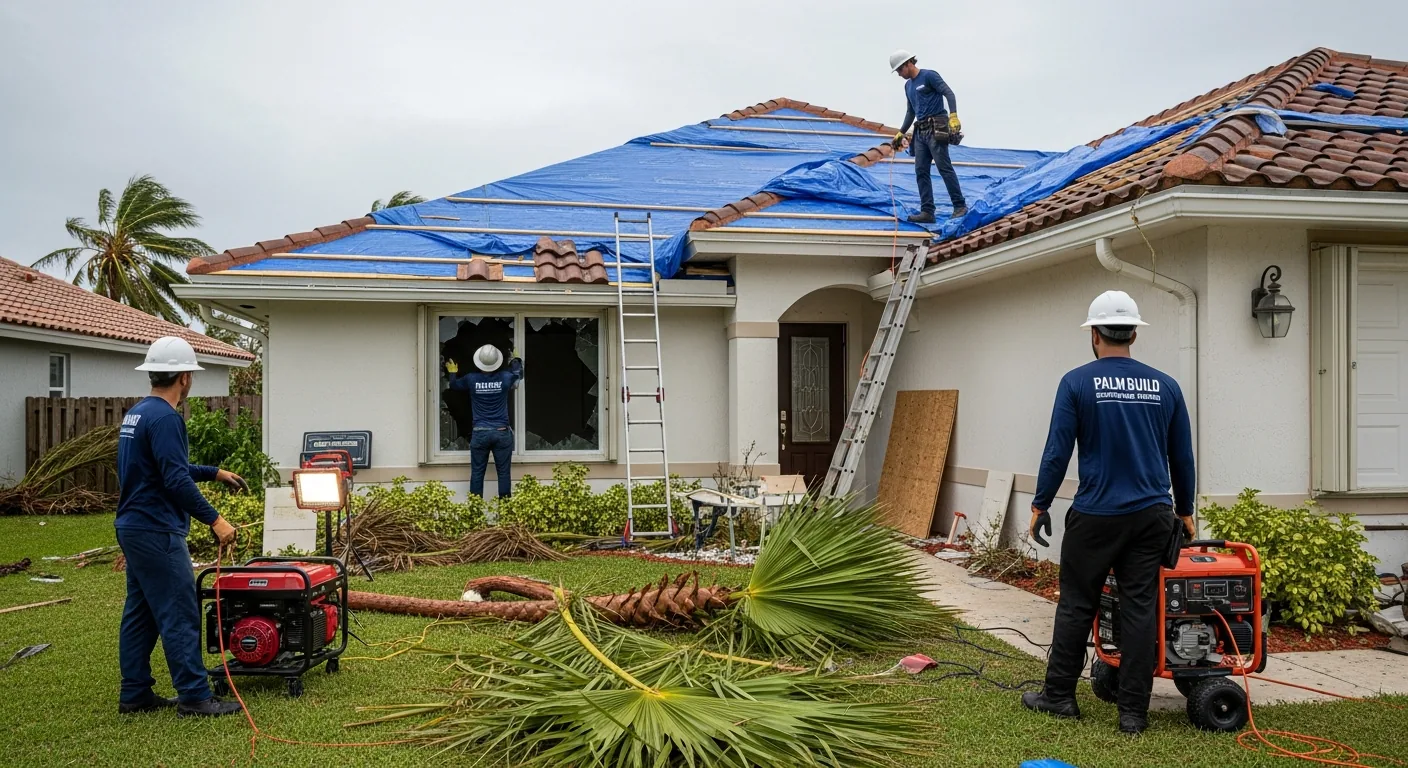
We secure your Fort Lauderdale home against further weather and water damage. Displaced tile roof sections are tarped with reinforced polyethylene rated for HVHZ wind loads, failed impact windows are boarded, and compromised doors are sealed. In hurricane conditions, this may require waiting for winds to drop below 45 mph for crew safety. Emergency tarping is covered by your insurance policy as part of your duty to mitigate further damage — and it's critical before the next rain band passes through Fort Lauderdale's multi-hour storm events.
02
Damage Assessment & Water Category Testing
Days 1-3
Comprehensive documentation of all storm damage classified by cause: wind damage (tiles, siding, windows), saltwater surge (Category 3), brackish canal overflow (Category 2-3), and freshwater intrusion (Category 1-2). In Fort Lauderdale, where 165+ miles of canals carry brackish water, we test flooding contamination levels on-site to determine the correct IICRC remediation protocol. We photograph every affected area, map moisture intrusion with thermal cameras, and create separate scopes for wind claims (homeowners policy) and flood claims (NFIP or private flood).
03
Water Extraction & Decontamination
Days 1-10
Storm damage in Fort Lauderdale almost always includes water intrusion — through displaced tiles, failed impact glass, storm surge, or canal overflow. We extract standing water, classify contamination level, and begin appropriate protocols. Saltwater surge (Category 3) requires full demolition of affected porous materials. Brackish canal overflow (Category 2-3) requires contamination testing to determine salvage viability. Commercial dehumidifiers and air movers bring humidity below 60% to prevent mold colonization in Fort Lauderdale's 70-85% ambient humidity environment.
04
Structural Drying & Mold Prevention
Days 3-14
Fort Lauderdale's year-round humidity makes structural drying more demanding than anywhere else in the country. Without power (common after hurricanes), air conditioning and dehumidification stop, and mold colonization begins within 24-48 hours. We deploy industrial desiccant dehumidifiers, establish negative air pressure containment, and monitor moisture levels twice daily until all building materials reach target moisture content. HEPA air scrubbing removes airborne mold spores and prevents cross-contamination to unaffected areas of the home.
05
HVHZ-Compliant Reconstruction
Weeks 2-16
Once the property is dried, decontaminated, and cleared, we begin full reconstruction to HVHZ (High Velocity Hurricane Zone) standards — the strictest wind-resistance building code in the United States. Every element of reconstruction must meet Florida Building Code Section 1626: enhanced roof-to-wall connections, impact-rated windows and doors, reinforced garage doors, and engineered wind-load specifications. HVHZ-compliant materials and installation add 15-25% to costs compared to non-HVHZ construction, but compliance is mandatory for all permitted work in Broward County.
06
Final Inspection & Insurance Closeout
Week 16+
Broward County Building Division inspections verify all structural, electrical, mechanical, and plumbing work meets current HVHZ standards. We perform a final walk-through with the homeowner and provide complete documentation for insurance closeout — including all invoices, permits, inspection records, HVHZ compliance certificates, and warranty information. For hurricane claims involving both wind and flood policies, we coordinate dual-claim closeout to ensure maximum recovery from both carriers.
Before the Hurricane
Hurricane Preparedness for Fort Lauderdale Homeowners
The most expensive hurricane damage is the damage you could have prevented or documented
before the storm. These six steps, taken before June 1, can save Fort Lauderdale
homeowners tens of thousands in unrecovered losses and months of extended displacement.
The April 2023 Rain Bomb proved that Fort Lauderdale's flood risk extends far beyond
traditional evacuation zones.
Document Your Possessions Before Hurricane Season
Walk every room with a video camera and photograph high-value items, serial numbers, and existing conditions of walls, ceilings, and flooring. Store documentation in the cloud — not on a phone that could be lost in an evacuation. This pre-storm baseline is your strongest evidence for insurance claims. After the April 2023 Rain Bomb, homeowners without documentation waited months longer for claim settlements because adjusters had no baseline for pre-loss condition.
Know Your Flood Zone & Evacuation Zone
Check your property's FEMA flood zone designation at FEMA's Map Service Center and your evacuation zone at Broward County Emergency Management. Fort Lauderdale Evacuation Zone A (east of Intracoastal) evacuates for any hurricane. Zone B (east of US-1) evacuates for Category 3+. But the April 2023 Rain Bomb proved that canal flooding devastates areas well outside both zones. Knowing your zone determines insurance requirements and evacuation timing.
Verify Insurance Coverage — Wind AND Flood Separately
Florida homeowners policies carry separate hurricane deductibles of 2-5% of insured value — not a flat dollar amount. On a $617,000 Fort Lauderdale home (Broward County median), that's $12,340 to $30,850 out of pocket on wind claims alone. Confirm your deductible percentage and dwelling coverage limits. Separately, verify your flood insurance: NFIP policies cap at $250,000 dwelling coverage, which is insufficient for most Fort Lauderdale homes. Consider private flood for higher limits.
Know Your Hurricane Deductible — It's Not What You Think
Most Fort Lauderdale homeowners do not understand their hurricane deductible until they file a claim. A 2% deductible on a $617,000 home is $12,340 out of pocket. At 5%, it's $30,850. This is separate from any flood deductible. Run the calculation on your specific policy: multiply your dwelling coverage amount by your hurricane deductible percentage. If the result is more than you can pay out of pocket, consider restructuring your policy before hurricane season.
Establish a Restoration Company Relationship
After the April 2023 Rain Bomb, every restoration company in Broward County was overwhelmed simultaneously. Response times that are normally 25-45 minutes stretched to days. Homeowners who had an existing relationship with a restoration company received prioritized dispatch. Contact Palm Build before hurricane season to establish your account, review your property's specific vulnerabilities (canal proximity, elevation, construction era), and get pre-positioned on our priority list.
Prepare a Go-Bag & Critical Document Kit
Pack a waterproof go-bag with insurance policy numbers and agent contacts, mortgage documents, property deed, photo ID, prescription medications, and a portable phone charger. Include your restoration company's emergency number ((754) 600-3369 for Palm Build). Store copies of all documents in cloud storage accessible from any device. In a mandatory evacuation, you may have 12-24 hours to leave — having these items pre-packed eliminates critical decision-making under pressure.
Critical Insurance Distinction
Wind vs. Flood Insurance: Fort Lauderdale's Most Expensive Misunderstanding
This is the single most important insurance concept for Fort Lauderdale storm damage.
Wind damage and flood damage from the same hurricane are covered by different policies,
carry different deductibles, and are filed as separate claims. In a city with 165+ miles
of canals, most hurricane events produce both wind and flood damage simultaneously —
making proper damage classification the difference between full recovery and financial
catastrophe.
Tile roof displacement from wind uplift and flying debris
Impact window, shutter, and door damage from wind pressure
Rain water entering through wind-created openings
Stucco and structural damage from wind load or debris impact
Emergency tarping and board-up costs (duty to mitigate)
ALE (Additional Living Expenses) if home is uninhabitable
FL Hurricane Deductible: 2-5% of insured value. On a $617K Fort Lauderdale
home = $12,340-$30,850 out of pocket before coverage begins.
Flood Damage (Separate NFIP or Private Flood Policy)
Storm surge from the Intracoastal or ocean (Category 3 saltwater)
Canal overflow from the 165+ mile canal network (brackish Category 2-3)
Groundwater intrusion through slab or foundation
Sewer backup from overwhelmed municipal systems
NFIP max dwelling coverage: $250,000 (insufficient for most FLL homes)
NOT covered by standard homeowners — requires separate flood policy
NFIP 60-Day Rule: Proof of loss must be filed within 60 days of the flood
event. Missing this deadline can void your entire flood claim.
Hurricane Deductible Calculator: Fort Lauderdale
Broward County's median home value is approximately $617,000. At a 2% hurricane
deductible, that is $12,340 out of pocket before your wind claim pays anything. At 5%,
it is $30,850. This deductible applies to every hurricane event — not annually. If two
hurricanes hit in one season (as Frances and Jeanne did in 2004), you pay the
deductible twice. Many Fort Lauderdale homeowners are stunned by this number when they
file their first hurricane claim. Review your policy now, before a storm forces the
conversation.
Hurricane restoration costs in Fort Lauderdale are among the highest in Florida due to
HVHZ-compliant materials and installation, saltwater exposure, and South Florida's
elevated labor costs. The HVHZ premium alone adds 15-25% to reconstruction costs
compared to non-HVHZ Florida construction. After major hurricanes, contractor demand and
material shortages across Broward County increase costs 20-40% and extend timelines by
months.
What Hurricane Damage Looks Like in Fort Lauderdale
Canal overflow flooding overwhelms Fort Lauderdale streets during extreme rainfall events — 165+ miles of waterways create city-wide flood risk
HVHZ-rated tile roofs resist wind loads, but aging adhesive bonds fail under sustained hurricane gusts — a single tile opens the path for catastrophic water intrusion
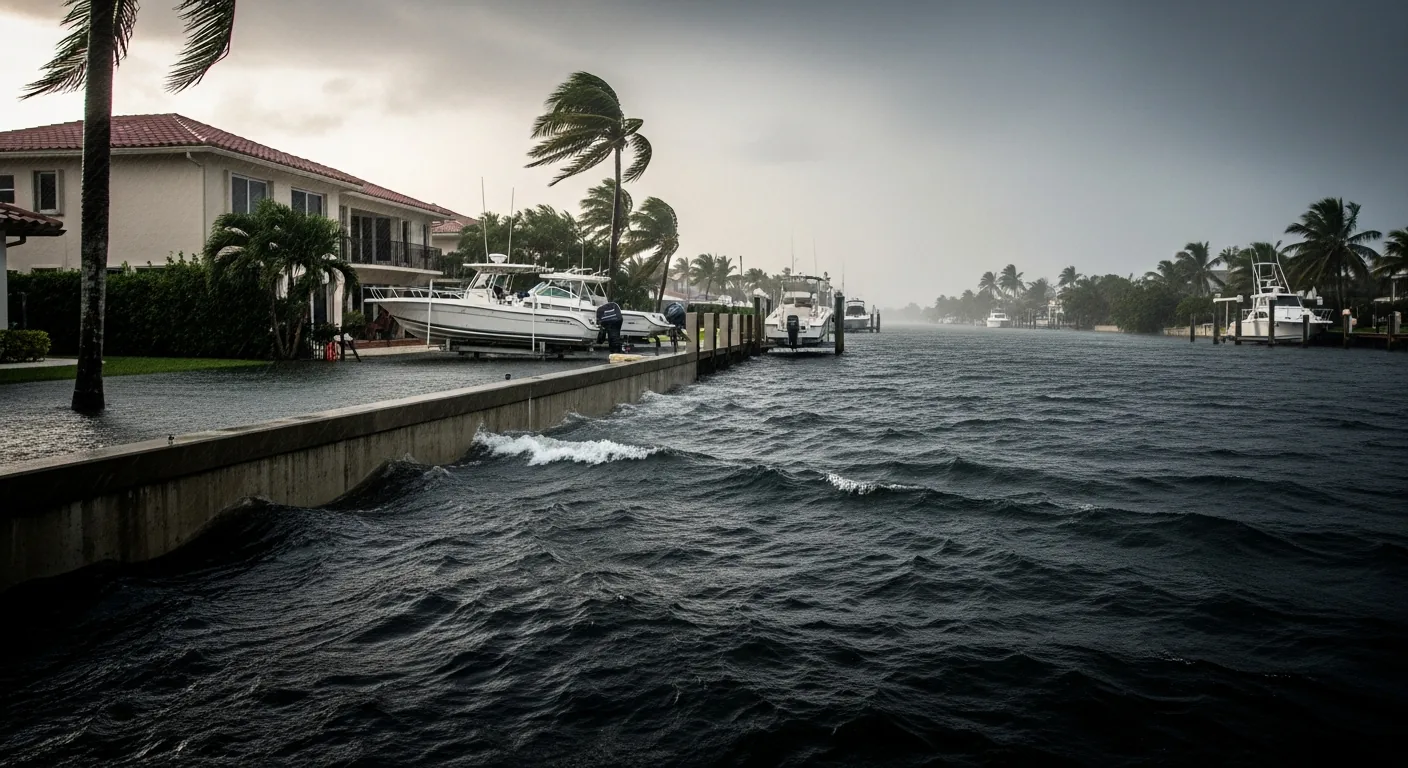
Saltwater storm surge through the Intracoastal canal network is Category 3 contamination — requiring full demolition of all affected porous materials
Emergency water extraction within hours of a storm event prevents mold colonization and reduces total restoration costs by 30-50%
The Palm Build Difference
Why Fort Lauderdale Homeowners Choose Palm Build After Hurricanes
25-45 Minute Fort Lauderdale Response
Our Deerfield Beach operations center is 18 miles from downtown Fort Lauderdale. Emergency crews deploy across Broward County within 45 minutes under normal conditions. During major hurricane events, we activate catastrophe response with pre-positioned crews and equipment staged at multiple points across Fort Lauderdale. Pre-storm clients receive priority dispatch ahead of the general queue.
IICRC Certified — Saltwater & Brackish Water Specialists
Every crew lead holds current IICRC Water Restoration Technician and Fire/Smoke Restoration Technician certifications. Our South Florida teams are additionally trained in Category 3 saltwater decontamination and Category 2-3 brackish water protocols — critical in Fort Lauderdale, where the 165+ mile canal network carries brackish water that requires different treatment than either pure freshwater or pure saltwater flooding.
Dual-Claim Documentation (Wind + Flood)
Our damage assessment classifies every item by cause — wind vs. surge vs. canal overflow vs. debris impact — ensuring each claim is filed with the correct policy. In Fort Lauderdale, where wind damage goes through homeowners (with hurricane deductible) and flood damage requires separate NFIP or private flood claims, this dual-documentation approach recovers significantly more for homeowners than generic damage reports that don't distinguish damage sources.
HVHZ Code Expertise
Fort Lauderdale is in the High Velocity Hurricane Zone — the strictest building code in the nation. All reconstruction must meet HVHZ standards under Florida Building Code Section 1626. Our project managers and subcontractors hold HVHZ-specific certifications and maintain current knowledge of Broward County permitting requirements. We handle engineer-sealed drawings, Miami-Dade NOA product specifications, and all HVHZ-required inspections as part of every storm reconstruction project.
Florida Insurance Navigation
We understand Florida's complex insurance landscape: Citizens depopulation, hurricane deductible percentages, NFIP proof-of-loss deadlines, assignment of benefits regulations, and the role of public adjusters. Palm Build coordinates with your carrier, your adjuster, and if needed your public adjuster to maximize claim recovery while keeping restoration moving. After the April 2023 Rain Bomb, we helped Fort Lauderdale homeowners navigate flood claims that many initially believed were covered by their standard homeowners policy.
Full Reconstruction — Emergency Through Final Punch
From emergency tarping through HVHZ-compliant final reconstruction, one company handles everything. We maintain relationships with HVHZ-rated material suppliers and licensed subcontractors who prioritize our projects during post-hurricane demand surges. Tile roof repair, impact window replacement, stucco restoration, and full interior rebuild — all coordinated through a single project manager with Broward County permit expertise.
Common Questions
Fort Lauderdale Hurricane Damage FAQ
How quickly can Palm Build respond after a hurricane in Fort Lauderdale?
Our Deerfield Beach operations center is 18 miles from downtown Fort Lauderdale. Under normal conditions, we respond in under 30 minutes. After major hurricane events, we activate catastrophe response protocols with pre-positioned crews and equipment staged across Broward County. Pre-storm clients receive priority dispatch.
What happened during the April 2023 Fort Lauderdale Rain Bomb?
On April 12-13, 2023, Fort Lauderdale received 25.91 inches of rain in approximately 12 hours — a 1-in-1,000-year rainfall event. The city's drainage system, designed for 3-7 inches per day, was overwhelmed within the first two hours. A total of 1,121 homes were damaged, with 766 sustaining major damage (18+ inches of standing water). Fort Lauderdale-Hollywood International Airport closed for the first time in its history, and water rescues were conducted in the Edgewood neighborhood. This event fundamentally changed how Fort Lauderdale homeowners should think about flood risk.
Does my homeowners insurance cover hurricane damage in Fort Lauderdale?
Yes — wind damage is a covered peril under Florida homeowners policies. However, Florida policies carry separate hurricane deductibles of 2-5% of your insured value, not a flat dollar amount. On a $617,000 Fort Lauderdale home (Broward County median), that means $12,340 to $30,850 out of pocket before coverage kicks in. Flood damage from storm surge, canal overflow, or rising water requires separate NFIP or private flood insurance — a critical distinction in a city with 165+ miles of canals.
Is saltwater storm surge damage different from canal flooding in Fort Lauderdale?
Significantly different. Under IICRC S500 standards, saltwater storm surge is classified as Category 3 (grossly contaminated) water, requiring complete demolition and removal of all affected porous materials. Salt crystals embedded in concrete, drywall, and wood framing continue absorbing atmospheric moisture indefinitely, creating perpetual dampness and accelerated corrosion. Canal overflow in Fort Lauderdale is typically brackish (mixed salt and fresh) and classified as Category 2 or 3 depending on canal salinity and contamination. Both are worse than freshwater flooding, but surge damage is the most destructive and expensive to remediate.
What are Fort Lauderdale's hurricane evacuation zones?
Fort Lauderdale Evacuation Zone A covers areas east of the Intracoastal Waterway — including Las Olas Isles, Harbor Beach, Seven Isles, Nurmi Isles, and the barrier island. These properties face direct storm surge exposure with saltwater Category 3 contamination risk. Zone B (Category 3+ storms) extends east of US-1, covering Victoria Park, Coral Ridge, and Flagler Village. However, the April 2023 Rain Bomb demonstrated that inland neighborhoods like Edgewood face severe freshwater and canal overflow flooding even outside surge zones.
What is the HVHZ and how does it affect my storm restoration?
Fort Lauderdale is in the High Velocity Hurricane Zone (HVHZ) — Florida Building Code Section 1626, the strictest wind-resistance building code in the United States. All reconstruction after storm damage must meet HVHZ standards, which require enhanced roof-to-wall connections, impact-rated windows and doors, reinforced garage doors, and specific wind-load engineering. HVHZ-compliant materials and installation add 15-25% to reconstruction costs compared to non-HVHZ Florida construction, but the enhanced protection is mandated for all permitted work in Broward County.
How long does hurricane damage restoration take in Fort Lauderdale?
Emergency tarping and water extraction: 1-2 days. Saltwater decontamination and structural drying: 5-10 days (longer than freshwater due to Category 3 protocols). HVHZ-compliant roof repair: 3-8 weeks depending on material availability and permit processing through Broward County. Full reconstruction: 8-20 weeks. After major hurricanes, timelines extend significantly due to contractor demand, HVHZ material shortages, and permitting backlogs across all of Broward County.
Why are Fort Lauderdale's canals a flooding risk during hurricanes?
Fort Lauderdale has 165+ miles of canals — more than Venice, Italy. During hurricanes, these canals face a dual threat: storm surge pushes seawater inland through canal mouths, while rainfall simultaneously overwhelms the drainage capacity of the canal network. The April 2023 Rain Bomb proved the system cannot handle extreme rainfall: it was designed for 3-7 inches per day, but received nearly 26 inches in 12 hours. Properties along the New River, Tarpon River, Middle River, and connecting canal network are most vulnerable to this combined surge-and-overflow dynamic.
Trusted Vendors
Trusted local pros in Fort Lauderdale
Outside our restoration scope, these are the vetted, licensed contractors we trust
alongside our work. Personally evaluated, reference-checked, and recommended by Palm
Build.
Hurricane Damage in Fort Lauderdale? Every Hour Counts.
With 165+ miles of canals and saltwater exposure from every direction, Fort Lauderdale storm damage spreads fast. Palm Build's Deerfield Beach team provides emergency tarping, saltwater extraction, and HVHZ-compliant structural stabilization — 24/7, with insurance documentation from the first call.