FORT LAUDERDALE FL — LARGE LOSS & CATASTROPHE RESPONSE
Large Loss Handling in Fort Lauderdale, Florida
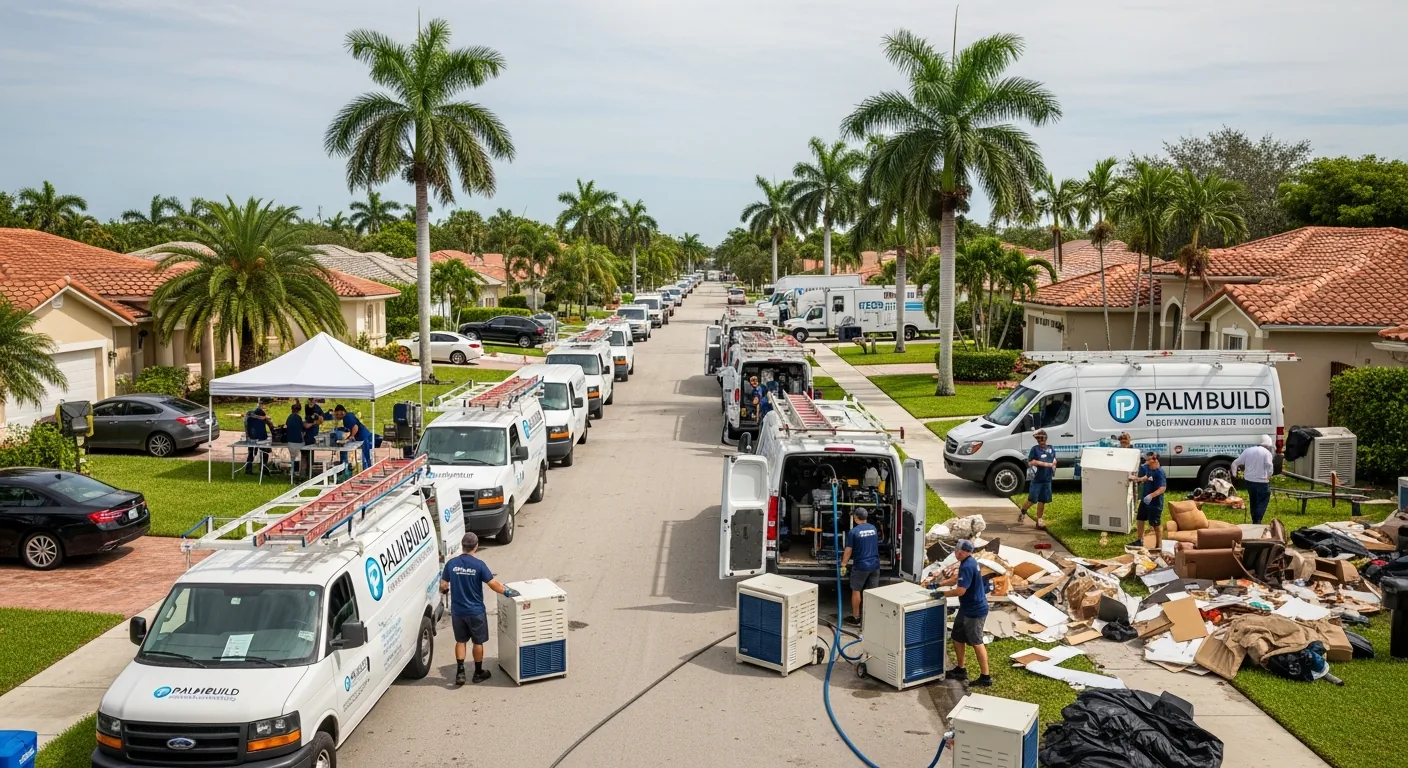
When damage exceeds $500,000, spans dozens of condo units, or overwhelms entire canal neighborhoods simultaneously, Palm Build's large loss division deploys with the surge capacity, multi-carrier insurance coordination, and FEMA-declaration experience Fort Lauderdale's most complex restoration events demand — from the April 2023 Rain Bomb to the next Category 4 hurricane.
Deerfield Beach — Minutes from Fort Lauderdale Under 30 min Response IICRC Certified
Why Fort Lauderdale Produces More Large Loss Events Than Almost Any City in Florida
Fort Lauderdale's combination of canal-threaded neighborhoods at sea level, the highest
condo tower density in Broward County, direct hurricane exposure in the HVHZ, and aging
infrastructure creates a large loss risk profile that exceeds most markets in the
country. When catastrophe strikes — whether a Rain Bomb, a Category 4 hurricane, or a
condo tower water event — the damage is measured in millions, not thousands. The
restoration company you choose determines whether recovery takes months or years.
Claims Exceeding $500,000
$500K+
Claim threshold
Fort Lauderdale's large loss threshold sits higher than most markets because the city's property values, condo density, and storm exposure routinely produce six- and seven-figure claims. A single plumbing failure in a Las Olas Isles waterfront tower can cascade through 40-60 units, generating $1M+ in combined damage before anyone turns off the main. A kitchen fire in a Harbor Beach estate can produce $500,000-$1.2M in structural, contents, and smoke remediation costs. Hurricane events affecting the barrier island or canal neighborhoods can create hundreds of simultaneous six-figure claims. These are not standard restoration projects — they require dedicated project management teams, multi-carrier insurance coordination, and the equipment depth to sustain operations across weeks or months.
Condo Tower & Multi-Unit Disasters
252K
Condo units countywide
Broward County has approximately 252,000 condo units, and Fort Lauderdale concentrates the highest density of high-rise towers along the Intracoastal and A1A corridor. Post-Surfside awareness (the 2021 Champlain Towers South collapse in neighboring Surfside) has heightened scrutiny on aging condo structures. When a water event, fire, or storm strikes a tower, damage cascades vertically through elevator shafts, plumbing chases, and stairwells — affecting 50-100+ units simultaneously. Each unit involves separate insurance (HO-6 policies) alongside the association's master policy, creating multi-party claims that require unit-by-unit scoping, separate carrier coordination, and phased restoration that allows partial building occupancy. This is the most complex restoration scenario in the industry.
Canal Neighborhood Flooding
165+
Miles of canals
Fort Lauderdale's 165+ miles of tidal canals — the feature that earns it the 'Venice of America' name — become the city's greatest vulnerability during major rain events and storm surge. Unlike inland cities where flooding follows predictable watershed patterns, Fort Lauderdale's canal system allows water to penetrate deep into residential neighborhoods from multiple directions simultaneously. The April 2023 Rain Bomb demonstrated this catastrophically: 25.91 inches in 12 hours overwhelmed the canal drainage system, flooding entire streets in Las Olas Isles, Rio Vista, Coral Ridge, and Victoria Park. When canal neighborhoods flood, every home on the street can sustain major damage simultaneously — creating mass-loss events that require catastrophe-scale response.
Hurricane & Catastrophe Events
1,121
Homes hit (April 2023)
Fort Lauderdale sits in the High Velocity Hurricane Zone (HVHZ) — the most stringent wind-load building code region in the United States. Hurricane Irma (2017) hit Fort Lauderdale with 87 mph sustained winds and 104 mph gusts, causing 115 homes to sustain major damage in the city alone. Hurricane Wilma (2005) crossed the state and struck Fort Lauderdale from the west, an unusual track that caught many properties unprepared. The April 2023 Rain Bomb proved that catastrophic events don't require a named hurricane — 1,121 homes were damaged, 766 with major damage (18+ inches of standing water), and FEMA declared a federal disaster (DR-4709-FL). These events require pre-positioned equipment, surge staffing, municipal coordination, and FEMA documentation capability that standard restoration companies do not possess.
April 12-13, 2023 — The Rain Bomb
When 26 Inches of Rain Fell on Fort Lauderdale in 12 Hours
The April 2023 Rain Bomb was not a hurricane. There was no advance evacuation order, no
FEMA pre-positioning, no days of warning. A stalled weather system parked over Fort
Lauderdale and dumped 25.91 inches of rain in 12 hours — more than twice the city's
monthly average in a single night. The result was the worst non-hurricane flood event in
Fort Lauderdale's history, exposing exactly why large loss capability is not optional in
this city.
25.91"
Rain in 12 Hours
1,121
Homes Damaged
766
Major Damage (18"+ Water)
FLL
Airport Closed
The Event — A City Underwater
Beginning late on April 12, 2023, an unprecedented rain event stalled over Broward
County. Fort Lauderdale's canal system — designed to manage normal tidal flow and
moderate rainfall — was overwhelmed within hours. Water rose through storm drains, over
seawalls, and through the canal network into neighborhoods that had never flooded
before. Las Olas Isles, Rio Vista, Victoria Park, Coral Ridge, and Sailboat Bend saw
standing water reaching 18 inches or more inside homes. Fort Lauderdale-Hollywood
International Airport closed after runways flooded. Governor DeSantis declared a state
of emergency, and FEMA issued disaster declaration DR-4709-FL.
By dawn on April 13, 1,121 homes had sustained water damage. Of those, 766 were
classified as major damage — meaning 18 or more inches of standing water had entered the
living space, destroying flooring, lower cabinetry, drywall, electrical systems, and
personal contents. Municipal emergency services were overwhelmed. Standard restoration
companies were at capacity within the first hour.
The Response — Why Surge Capacity Matters
The April 2023 event demonstrated the critical difference between restoration companies
with catastrophe infrastructure and those without it. Within the first 24 hours, every
standard-capacity restoration company in Broward County was booked out for weeks.
Homeowners who called small local firms were told wait times of 7-14 days — an eternity
when 18 inches of standing water is destroying their home and mold growth begins within
24-48 hours in South Florida's humidity.
Companies with surge capacity — pre-loaded equipment trailers, dual-state operations,
mutual aid networks, and the project management infrastructure to coordinate dozens of
simultaneous projects — were the only ones able to respond at the scale the event
demanded. Palm Build's Deerfield Beach hub activated surge protocols immediately,
deploying additional crews and equipment while coordinating with our Charlotte, NC
operations for supplemental manpower. The lesson was clear: in Fort Lauderdale, large
loss isn't about a single expensive project — it's about the capacity to handle hundreds
of properties simultaneously when the entire city floods at once.
The Aftermath — FEMA, Insurance, and Recovery
The FEMA disaster declaration (DR-4709-FL) activated federal Individual Assistance for
affected homeowners and SBA disaster loans for businesses and homeowners needing
financial assistance beyond insurance coverage. However, FEMA coordination added layers
of complexity: restoration work had to be documented in ways that preserved eligibility
for federal assistance, insurance claims had to be coordinated with FEMA payments to
avoid duplication of benefits, and SBA loan documentation required detailed cost
breakdowns that went beyond standard insurance scoping.
For homeowners without flood insurance (many canal-neighborhood homes had dropped NFIP
coverage after years without a major event), the financial impact was devastating. For
those with coverage, the multi-party coordination between private carriers, NFIP, and
FEMA created a documentation maze that many restoration companies could not navigate.
The April 2023 event proved that large loss in Fort Lauderdale demands restoration
partners who understand not just the physical work, but the federal disaster recovery
ecosystem.
The Lesson — It Will Happen Again
Climate scientists have been clear: the type of stalled, high-intensity rainfall event
that produced the April 2023 Rain Bomb is becoming more frequent due to warming ocean
temperatures in the Atlantic. Fort Lauderdale's low elevation (average 5-7 feet above
sea level in canal neighborhoods), aging drainage infrastructure, and continued
development that reduces natural water absorption mean the next catastrophic flood event
is not a question of if, but when. For Fort Lauderdale property owners, the April 2023
event should be the catalyst for ensuring your restoration partner has the catastrophe
infrastructure to respond at scale when it happens again.
Catastrophe-Scale Response
How Palm Build Scales for Mass-Loss Events in Fort Lauderdale
Fort Lauderdale's geography produces mass-loss events — hurricanes, rain bombs, and
condo tower cascades — that overwhelm standard-capacity restoration companies within
hours. Responding to 50, 100, or 1,000+ affected properties simultaneously requires
pre-built catastrophe infrastructure, not improvisation. Here is what Palm Build brings
to Fort Lauderdale when the scale exceeds what normal operations can handle.
Dual-State Surge Staffing
Palm Build operates from Deerfield Beach, FL and Charlotte, NC — a strategic dual-state model that becomes decisive during Fort Lauderdale catastrophe events. When the April 2023 Rain Bomb struck, Charlotte crews began southbound staging within hours. This dual-state model means we can double our workforce in a disaster zone within 24-48 hours. Our Charlotte team brings inland flood and structural restoration expertise while our South Florida team brings hurricane-specific experience from Irma, Wilma, and every major event since. For Fort Lauderdale, where mass-loss events can affect 1,000+ properties simultaneously, this crew depth is the difference between responding in days and responding in weeks.
Pre-Loaded Equipment Trailer Banks
A mass-loss event like the April 2023 Rain Bomb doesn't fail because of manpower alone — it fails because of equipment constraints. When 766 homes sustain major water damage simultaneously, the demand for dehumidifiers, air movers, truck-mounted extractors, and specialty drying systems exceeds every local supplier's inventory within hours. Palm Build maintains pre-loaded equipment trailer banks — maintained, inventoried, and deployment-ready — that allow us to scale drying and extraction capacity from a single home to an entire Fort Lauderdale neighborhood within 48 hours. Our equipment inventory is designed for the worst-case Fort Lauderdale scenario, not the average job.
Surge Material Supply Chain
After a catastrophe event in Fort Lauderdale, building materials become scarce across all of Broward County simultaneously. Drywall, plywood, impact-resistant windows, hurricane-rated roofing materials, and insulation that were readily available yesterday are backordered for months. Palm Build maintains relationships with building material suppliers across both Florida and North Carolina with pre-negotiated surge pricing and priority fulfillment agreements. When Fort Lauderdale suppliers are depleted — as they were after the April 2023 event — we source materials from our Charlotte supply chain. Single-state competitors cannot do this.
24/7 Command Center Operations
During Fort Lauderdale catastrophe events, Palm Build activates command center operations that coordinate all active projects from a centralized hub. Project managers track crew deployment, equipment allocation, material logistics, and insurance documentation across dozens of simultaneous projects. Daily situation reports provide every affected property owner with their project status, next-day plan, and updated timeline. This level of coordinated project management — borrowed from emergency management best practices — prevents the chaos that occurs when a restoration company tries to manage 50+ active projects with standard residential scheduling systems.
Municipal & FEMA Coordination
Fort Lauderdale's Emergency Management Division, Broward County Emergency Management, and FEMA Region IV all play roles during federally declared disasters. Palm Build maintains relationships with municipal emergency services that provide pre-storm coordination, post-hurricane re-entry credentials, and access to affected areas before general public re-entry. During FEMA-declared events, our documentation protocols ensure that restoration work preserves homeowner eligibility for Individual Assistance, SBA disaster loans, and other federal programs. We coordinate with FEMA Preliminary Damage Assessment teams and ensure our scoping aligns with federal damage categories.
Rapid Triage Assessment Teams
Within the first 24 hours of a Fort Lauderdale catastrophe event, the priority is triage — not restoration. Our rapid assessment teams deploy to affected neighborhoods and buildings with moisture meters, thermal cameras, and structural assessment tools to categorize properties by severity: immediate structural danger, active water intrusion requiring emergency intervention, stable damage awaiting full scoping, and minor damage suitable for standard scheduling. In Fort Lauderdale's condo communities, we coordinate with property management to systematically assess all units and common areas, providing the board with a comprehensive damage report within 48 hours of event conclusion.
Large Loss Timeline
How Palm Build Manages Large Loss Projects in Fort Lauderdale
Large loss restoration follows a structured six-phase approach that balances urgency
with thoroughness — from emergency stabilization through HVHZ-compliant reconstruction
and FEMA closeout. Here is the timeline our South Florida team follows for projects
exceeding $500,000 in scope.
01
Emergency Stabilization
Hours 0-24
02
Comprehensive Damage Documentation
Days 1-5
03
Scope Development & Insurance Coordination
Days 3-14
04
Multi-Trade Restoration Execution
Weeks 2-16+
05
HVHZ Code Compliance & Permitting
Concurrent
06
Project Closeout & Final Verification
Project End
01
Emergency Stabilization
Hours 0-24
When Fort Lauderdale sustains a large loss event, the first 24 hours determine whether damage escalates or is contained. Our emergency stabilization team deploys from Deerfield Beach in under 30 minutes for priority calls. Stabilization includes emergency board-up and tarping for wind-damaged structures, truck-mounted water extraction for flooded properties, temporary structural shoring where load-bearing elements are compromised, utility isolation and temporary generator power, and initial antimicrobial treatment. In Fort Lauderdale's subtropical humidity, mold colonization begins within 24-48 hours of water exposure — making rapid stabilization the single most important step in preventing a water event from becoming a full-scale mold remediation project that doubles or triples the total cost.
02
Comprehensive Damage Documentation
Days 1-5
Large loss documentation in Fort Lauderdale goes far beyond standard residential photography. Our teams deploy drone imaging for roof and exterior documentation, FLIR thermal cameras for moisture mapping behind walls and ceilings, calibrated moisture meters for quantitative drying verification, and detailed room-by-room photography with GPS-stamped timestamps. For FEMA-declared events, documentation must meet federal standards for Individual Assistance and SBA disaster loan eligibility. For condo tower events, we produce unit-by-unit damage reports that separate master-policy damage from individual unit damage — critical for multi-carrier claims processing.
03
Scope Development & Insurance Coordination
Days 3-14
Fort Lauderdale large loss scopes involve Xactimate line-item estimates, structural engineering reports from licensed FL engineers, environmental testing (asbestos in pre-1980 buildings, mold, lead), contents inventory with replacement cost documentation, and HVHZ code-compliance cost projections for reconstruction. We coordinate simultaneously with private carriers, Citizens Property Insurance, NFIP flood policies, FEMA Individual Assistance, and SBA disaster loan programs — each with different documentation requirements, different adjustment timelines, and different coverage triggers. Our project managers prepare carrier-specific documentation packages while maintaining a unified project scope.
04
Multi-Trade Restoration Execution
Weeks 2-16+
Large loss restoration in Fort Lauderdale executes in coordinated phases: Phase 1 — demolition, mold remediation, and structural drying to verified moisture standards. Phase 2 — structural repair, framing, rough-in electrical and plumbing. Phase 3 — finish work including drywall, flooring, painting, trim, cabinetry, and fixture installation. Phase 4 — contents return, final cleaning, and quality inspection. Each phase has quality checkpoints, insurance documentation milestones, and city inspection requirements. For condo tower projects, phased restoration allows partial building occupancy — residents in unaffected units can remain while restoration progresses floor by floor.
05
HVHZ Code Compliance & Permitting
Concurrent
Fort Lauderdale's position in the High Velocity Hurricane Zone means reconstruction must meet the most stringent building code requirements in Florida. Impact-resistant glazing, enhanced wind-load engineering, Miami-Dade product approvals for exterior materials, and upgraded electrical systems to current NEC standards are mandatory for substantial reconstruction. These code-required upgrades can add 15-30% to total reconstruction cost. Our estimators identify HVHZ-specific ordinance-and-law scope and separate it from standard restoration so your insurance coverage applies correctly. We manage the Broward County permitting process and coordinate all required inspections.
06
Project Closeout & Final Verification
Project End
Large loss closeout in Fort Lauderdale includes: final moisture verification confirming all materials meet IICRC S500 dry standards, air quality testing confirming mold spore counts are at ambient levels, Broward County building department final inspections for all permitted work, HVHZ compliance verification with engineering sign-off, final insurance documentation including before-and-after photography with timestamps, contents return and placement with final condition reports, and warranty documentation for all installed materials and systems. For FEMA-declared events, closeout includes final cost reconciliation with federal assistance programs to ensure no duplication of benefits issues arise post-project.
Large Loss Insurance Complexity in Fort Lauderdale
Fort Lauderdale large loss insurance claims are among the most complex in the country —
multiple carriers, FEMA disaster declarations, condo master-vs-unit policy disputes,
wind-vs-water allocation, HVHZ ordinance-and-law coverage, and SBA disaster loans all
converging on the same event. Here is what makes Fort Lauderdale large loss claims
uniquely challenging — and how Palm Build navigates the complexity.
Multiple Carriers on the Same Event
Fort Lauderdale large loss events routinely involve five or more insurance carriers on a single property or event. A condo tower water event may involve the association's master policy (often through Citizens Property Insurance), individual HO-6 unit owner policies from different private carriers, NFIP flood insurance for ground-level units, and sometimes umbrella or excess liability policies. A hurricane event affecting a canal neighborhood adds wind-vs-water allocation disputes between property and flood carriers. Each carrier has different documentation requirements, adjustment timelines, depreciation schedules, and approval processes. Palm Build's project managers prepare carrier-specific documentation packages while maintaining a unified project scope — ensuring no work falls through the cracks between carriers.
FEMA Disaster Declaration Coordination
Fort Lauderdale has received multiple FEMA disaster declarations, including DR-4709-FL for the April 2023 Rain Bomb. Federal disaster declarations activate Individual Assistance (IA) for homeowners, SBA disaster loans for homeowners and businesses, Public Assistance (PA) for municipal and commercial properties, and Hazard Mitigation Grant Programs. However, FEMA coordination creates a complex interplay with private insurance: FEMA assistance is secondary to insurance, meaning private coverage must be exhausted first. SBA disaster loans require detailed documentation of uninsured losses. Restoration work must be documented in ways that preserve federal eligibility. Palm Build's project managers understand the FEMA timeline and ensure our documentation supports both insurance claims and federal assistance applications simultaneously.
Condo Master Policy vs. HO-6 Coordination
Florida Statute 718 (the Condominium Act) defines the boundary between master policy and individual unit policy coverage — but in practice, this boundary creates constant disputes during large loss events. The master policy typically covers common elements and the structure 'as originally built,' while HO-6 policies cover unit owner improvements, personal property, and sometimes loss assessment. In Fort Lauderdale's aging condo stock, determining what constitutes 'original' construction vs. 'owner improvements' in a 40-year-old building is rarely straightforward. When 50+ units are damaged simultaneously, this determination must be made for each unit individually. Palm Build coordinates with both master policy adjusters and individual unit carrier adjusters to ensure complete coverage without gaps or duplication.
Wind vs. Water & Flood Allocation
After hurricane events in Fort Lauderdale, the most contentious issue in large loss claims is wind-vs-water damage allocation. Wind damage is covered under standard property policies. Rising water and storm surge require separate NFIP or private flood insurance. The distinction between wind-driven rain (property policy), rising water (flood), and storm surge (flood) determines which carrier pays for which damage. Fort Lauderdale's canal system complicates this further — water entering a home may be simultaneously wind-driven rain from above and canal overflow from below. Palm Build's documentation includes causation analysis: thermal imaging showing moisture migration patterns, photographic evidence of water entry points, water-level marks distinguishing flood height from wind-driven rain penetration, and timeline documentation correlating damage with storm progression.
HVHZ Ordinance & Law Coverage
Fort Lauderdale's position in the High Velocity Hurricane Zone means any substantial reconstruction must meet current HVHZ building code — which is significantly more expensive than standard Florida Building Code. Impact-resistant glazing, enhanced wind-load engineering, Miami-Dade product approvals, and upgraded electrical and mechanical systems can add 15-30% to total reconstruction cost. Ordinance-and-law coverage on your policy pays for these code-required upgrades — but only if they are properly identified, documented, and scoped as separate line items from standard restoration. Palm Build's estimators are trained to identify HVHZ-specific ordinance-and-law scope, separate it from standard restoration, and document it in a format that carriers can approve without extended negotiation.
Documentation That Survives Florida Scrutiny
Florida's large loss claims receive elevated scrutiny — driven by the state's history of fraudulent claims that have caused multiple carrier insolvencies and driven Citizens Property Insurance to become the largest homeowner insurer in the state. Senior adjusters, Special Investigation Unit (SIU) reviews, independent engineering firms, and forensic accounting are common on claims exceeding $500,000. Assignment of Benefits (AOB) reform has changed how restoration companies bill carriers directly. Palm Build's documentation standard is built for this scrutiny: timestamped photographs with GPS coordinates, daily moisture readings on standardized IICRC logs, structural engineering reports from licensed FL PE engineers, environmental testing from accredited laboratories, and change order documentation with carrier-approved authorization.
The Palm Build Difference
Why Fort Lauderdale Property Owners Choose Palm Build for Large Loss
Large loss events in Fort Lauderdale expose the difference between restoration companies
built for catastrophe scale and those that are not. When your project exceeds $500,000,
spans multiple structures or condo units, involves FEMA coordination, or requires
HVHZ-compliant reconstruction, the company you choose determines whether recovery takes
months or years. Here is why Fort Lauderdale property owners, HOA boards, and commercial
operators trust Palm Build with their most complex restoration projects.
Surge Capacity for Mass-Loss Events
Fort Lauderdale's geography produces events that affect hundreds of properties simultaneously — the April 2023 Rain Bomb damaged 1,121 homes in 12 hours. Standard restoration companies with 3-5 crews were at capacity before sunrise. Palm Build's operations are designed for exactly this scenario. Our equipment trailer banks, dual-state workforce, mutual aid network, and scalable project management system allow us to ramp from a single-home project to a 100+ property catastrophe response without sacrificing quality or documentation standards. When the next mass-loss event hits Fort Lauderdale, we don't improvise — we execute a protocol we've built and tested.
Dual-State Infrastructure
Our Deerfield Beach hub is minutes from Fort Lauderdale, providing sub-30-minute initial response. Our Charlotte, NC operations provide surge capacity that no single-state competitor can match. When Fort Lauderdale faces a hurricane, Charlotte crews deploy south with additional equipment and manpower. This dual-state model provides three critical advantages: workforce redundancy (one office supports the other during peak demand), diversity of expertise (hurricane, inland flood, fire, and structural restoration experience from two distinct markets), and supply chain depth (two independent sourcing markets when South Florida materials are depleted after a storm).
Condo & HOA Large Loss Experience
Fort Lauderdale's 252,000 condo units and dense HOA communities create the most complex multi-party restoration scenarios in the industry. Palm Build has managed condo tower events involving 50+ units, master-policy-vs-HO-6 coordination across multiple carriers, phased restoration allowing partial building occupancy, and board-level communication throughout the project. Our team understands Florida Statute 718, SB 4-D structural inspection requirements for buildings over three stories, and the unique logistics of high-rise restoration — from freight elevator scheduling to fire watch requirements during hot work above occupied floors.
HVHZ Code Compliance
Fort Lauderdale sits in the High Velocity Hurricane Zone — the most stringent wind-load building code region in the United States. Every reconstruction project must comply with HVHZ requirements including impact-resistant glazing, enhanced wind-load engineering with Miami-Dade product approvals, and construction methods certified for the zone. Many restoration companies from outside the HVHZ market don't understand these requirements, leading to permit denials, inspection failures, and reconstruction delays. Palm Build's South Florida estimators and project managers work within the HVHZ code daily — our scopes account for HVHZ compliance from the initial estimate, preventing costly change orders during reconstruction.
FEMA & Multi-Carrier Documentation
Fort Lauderdale large loss events frequently involve FEMA disaster declarations, SBA disaster loans, NFIP flood insurance, Citizens Property Insurance, and private carriers — all on the same event. Each has different documentation requirements, different timelines, and different approval processes. Palm Build's project managers maintain unified project records while producing carrier-specific and agency-specific documentation packages. We understand how to document restoration work in ways that preserve FEMA Individual Assistance eligibility, support SBA disaster loan applications, and satisfy the elevated scrutiny that Florida insurance carriers apply to claims exceeding $500,000.
After hurricane events, Fort Lauderdale and Broward County establish security perimeters that restrict access to damaged areas. Palm Build maintains the licensing, insurance coverage, and emergency management relationships required to obtain post-hurricane re-entry credentials — allowing us to begin emergency stabilization while competitors wait for general re-entry. Beyond initial response, we provide single-source restoration from emergency tarping through final reconstruction: mitigation, remediation, and rebuild under one project management team. For large loss projects, single-source restoration eliminates the coordination gaps, finger-pointing, and timeline delays that occur when separate companies handle different phases.
Common Questions
Fort Lauderdale Large Loss Restoration FAQ
What qualifies as a 'large loss' in Fort Lauderdale?
In Fort Lauderdale, large loss generally means any restoration project exceeding $500,000, affecting multiple structures or condo units simultaneously, requiring FEMA disaster declaration coordination, or involving catastrophe-level logistics such as surge staffing and multi-crew deployment. Common Fort Lauderdale examples include condo tower water events cascading through 50-100+ units, hurricane damage across entire canal neighborhoods like Las Olas Isles or Rio Vista, commercial complex flooding along Federal Highway, and multi-building HOA damage in communities like Coral Ridge Country Club Estates.
How did Palm Build respond to the April 2023 Fort Lauderdale Rain Bomb?
The April 12-13, 2023 event that dumped 25.91 inches of rain on Fort Lauderdale in 12 hours created a mass-loss event that overwhelmed municipal services. Palm Build deployed surge crews from our Deerfield Beach hub and activated our Charlotte, NC operations for additional manpower. We performed emergency water extraction, structural drying, and mold prevention across multiple properties simultaneously while coordinating with FEMA representatives for disaster declaration documentation. The event reinforced our catastrophe protocols for events affecting hundreds of properties at once.
How does Palm Build handle condo tower large loss events in Fort Lauderdale?
Condo tower events are among the most complex large losses we handle. A single water event in a Fort Lauderdale high-rise can cascade through elevator shafts, plumbing chases, and stairwells affecting 50-100+ units simultaneously. We coordinate with the condo association's master policy carrier, individual HO-6 unit owner carriers, and sometimes FEMA flood insurance — all on the same event. Our team manages unit-by-unit scoping, separate insurance documentation for each affected party, and phased restoration that allows partial building occupancy during the project. Post-Surfside SB 4-D structural inspection requirements add additional engineering coordination for buildings over three stories.
Does Palm Build coordinate with FEMA for Fort Lauderdale disaster declarations?
Yes. Fort Lauderdale has received multiple FEMA disaster declarations including the April 2023 Rain Bomb (DR-4709-FL). FEMA coordination involves disaster declaration documentation, Individual Assistance applications for affected homeowners, SBA disaster loan documentation, Public Assistance for commercial and municipal properties, and coordination between FEMA funding, NFIP flood insurance, and private carrier coverage. Our project managers understand the FEMA documentation timeline and ensure restoration work does not compromise a property owner's eligibility for federal assistance.
What makes Fort Lauderdale large loss events different from other Florida cities?
Fort Lauderdale's unique large loss factors include: 165+ miles of tidal canals that allow storm surge and flooding to penetrate deep inland, the highest condo tower concentration in Broward County creating vertical cascade events, a barrier island with limited evacuation routes during hurricane events, aging infrastructure (62% pre-1980 housing) that fails catastrophically during major water events, and the city's position in the High Velocity Hurricane Zone (HVHZ) requiring specialized building code compliance during reconstruction.
How quickly can Palm Build scale for a Fort Lauderdale catastrophe event?
Our Deerfield Beach hub is minutes from Fort Lauderdale, providing sub-30-minute initial response. For catastrophe events affecting hundreds of properties, we activate surge protocols within hours: Charlotte, NC crews begin southbound deployment, mutual aid partners are activated, equipment trailer banks are staged, and our supply chain partners are notified for surge material availability. We can scale from 5 active crews to 50+ within 48 hours — a capability built specifically for the mass-loss events Fort Lauderdale's geography produces.
How long do large loss projects typically take in Fort Lauderdale?
Large loss timelines vary by scope and complexity. Multi-unit condo tower water events: 6-12 weeks. Commercial building fire or flood damage: 8-16 weeks. Hurricane-event neighborhood restoration across multiple structures: 3-12 months for full recovery. HVHZ building code requirements add additional timeline for engineering review, permit processing, and specialized inspections. FEMA-declared events may extend timelines due to federal documentation requirements. Palm Build assigns dedicated project managers to every large loss to compress timelines and maintain momentum.
Does Palm Build have post-hurricane re-entry credentials for Fort Lauderdale?
Yes. After a hurricane, Fort Lauderdale and Broward County establish security perimeters and restrict access to damaged areas. Post-hurricane re-entry credentials allow authorized restoration companies to access damaged properties before the general public is permitted back. Palm Build maintains the licensing, insurance, and emergency services relationships required to obtain re-entry credentials, giving us a critical time advantage — we can begin emergency stabilization, tarping, and water extraction while competitors are still waiting for clearance.
Trusted Vendors
Trusted local pros in Fort Lauderdale
Outside our restoration scope, these are the vetted, licensed contractors we trust
alongside our work. Personally evaluated, reference-checked, and recommended by Palm
Build.
Catastrophic Damage in Fort Lauderdale? We Deploy at Scale.
Palm Build's large loss division deploys with the surge capacity, multi-carrier insurance coordination, and FEMA-declaration experience to handle Fort Lauderdale's most complex restoration events. From condo tower cascades to neighborhood-wide hurricane damage, we scale with the scope.