(888) 245-5155
Call Now 24/7
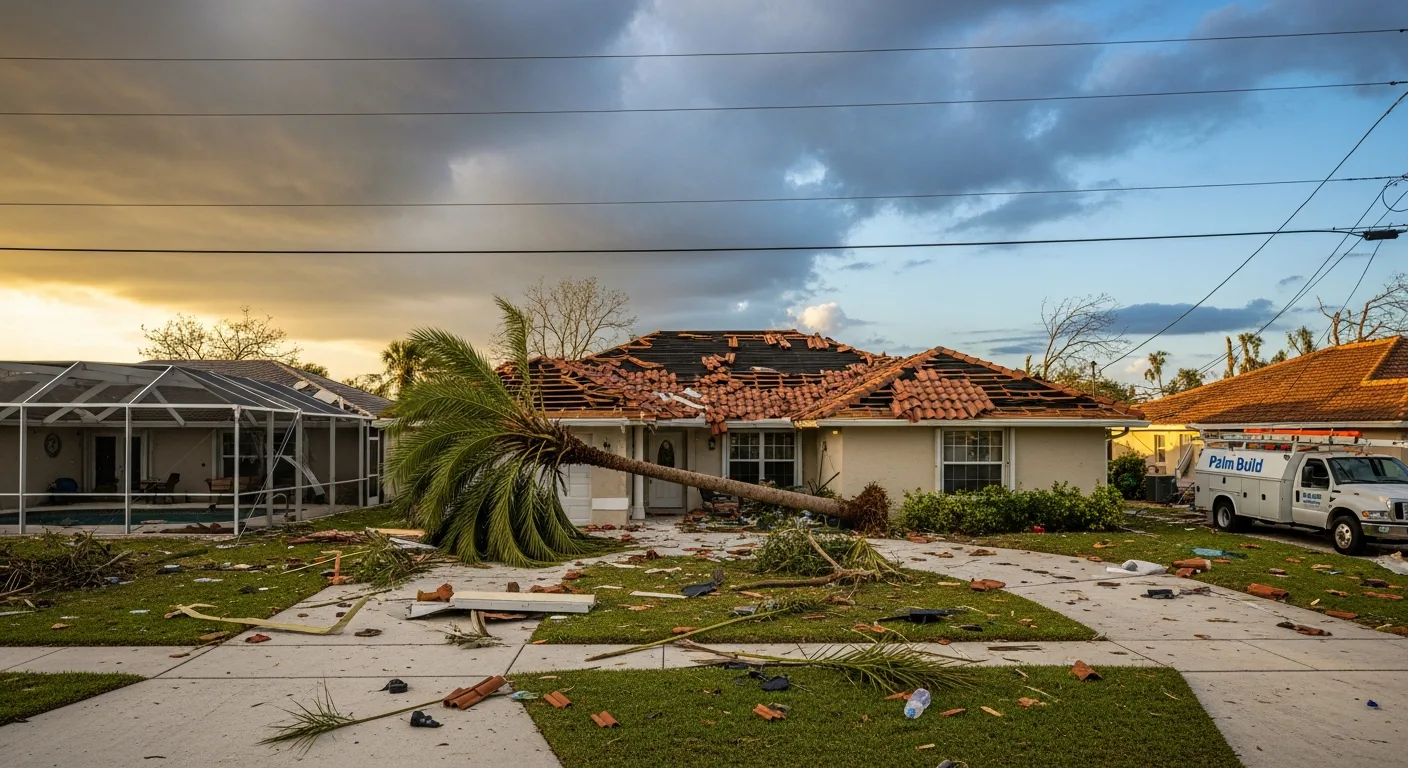
Storm damage restoration scene in Boynton Beach FL showing Palm Build crew responding to hurricane-damaged CBS stucco home with barrel tile roof and tropical landscaping
BOYNTON BEACH FL — 24/7 HURRICANE & STORM DAMAGE RESPONSE

Storm & Hurricane Damage Restoration in Boynton Beach, FL

With 42.2% of properties at flood risk, 50 LWDD lateral canals threading through the city, and barrel tile roofs vulnerable to wind uplift, Boynton Beach faces a storm damage profile unlike anywhere else in Palm Beach County. From Hurricane Nicole's Intracoastal flooding in November 2022 to the April 2023 tornado that ripped through residential neighborhoods, Boynton Beach homeowners need restoration teams who understand saltwater contamination, CBS stucco wind-driven rain intrusion, and canal overflow dynamics. Palm Build's Deerfield Beach team responds in 30-45 minutes with emergency tarping, extraction, and insurance-ready documentation from the first call.

Deerfield Beach — 20 Minutes from Boynton Beach 30-45 min Response IICRC Certified

30-45 min

Emergency Response

24/7

Dispatch Available

IICRC

Certified Technicians

A Boynton Beach Story

"Hurricane-Force Winds Just Tore the Tiles Off My Hunters Run Roof."

Hurricane-force winds tear barrel tiles off your Hunters Run roof at 3 a.m. Rain pours through the exposed underlayment into your condo. By dawn, three rooms are flooded, the ceiling is sagging, and your 2,860-unit community's main office is fielding hundreds of calls from residents reporting the same damage across dozens of buildings.

In Boynton Beach's year-round 60-80% humidity, the clock starts immediately. Mold can begin growing in 24 to 48 hours — and with rain still entering through the roof breach, every hour without emergency tarping adds thousands of dollars in damage. The community's insurance carrier needs documentation of the cause, the timeline, and the scope before they authorize emergency mitigation.

This is the call Palm Build's Deerfield Beach team answers during every hurricane season from Boynton Beach communities — from Hunters Run to Leisureville, from Aberdeen condos to Canyon Isles single-family homes. We respond in 30 to 45 minutes, arriving with emergency tarping materials, truck-mounted extraction, and the insurance documentation protocols that HOA boards and property managers require from day one.
What Storm Damage Restoration Costs in Boynton Beach

Emergency

Emergency tarping and board-up to stop further damage

$500 – $2,500

Moderate

Roof repair combined with interior water damage restoration

$5,000 – $20,000

Major

Major structural damage, multi-system failure, full reconstruction

$20,000 – $75,000+

Community

Community-wide HOA event — multiple buildings, common areas, shared infrastructure

$100K – $500K+

Boynton Beach Median Home Value: $317,500

Professional storm restoration protects your largest investment. Average Palm Beach County insurance premium: $6,327/year.

(754) 600-3369

Storm History

Boynton Beach's Recent Storm History

Boynton Beach sits in the heart of South Florida's hurricane corridor, where warm Gulf Stream waters just 3 miles offshore fuel rapid intensification. But the city's most destructive recent events haven't been major hurricanes — they've been tropical storms, tornadoes, and extreme rainfall that overwhelmed aging drainage infrastructure. This is the timeline that defines Boynton Beach's storm restoration landscape.

Hurricane Dorian

Significant

September 2019

Dorian tracked dangerously close to Florida's east coast as a Category 5 before turning north. Boynton Beach experienced tropical storm conditions with sustained winds and tidal flooding at the Boynton Beach Marina and along the Intracoastal Waterway. Storm surge pushed saltwater into low-lying properties east of Federal Highway. The near-miss exposed how many Boynton Beach homeowners had allowed hurricane preparedness to lapse after years without a direct hit.

Tropical Storm Nicole

Significant

November 10, 2022

An unusual November tropical storm that made landfall near Vero Beach as a Category 1 hurricane. Nicole brought 44 mph sustained winds and heavy rain to Boynton Beach, causing Intracoastal flooding that pushed water into Harbor Estates and Boynton Isles neighborhoods. The November timing caught many homeowners off-guard — storm shutters had been put away for the season, and hurricane preparedness supplies were stowed. Nicole proved that South Florida's storm season doesn't end when residents think it does.

April 2023 Tornado

Significant

April 2023

A confirmed tornado touched down in the Boynton Beach area during a severe spring thunderstorm, causing direct roof damage, downed trees, and structural impact across residential neighborhoods. The tornado displaced barrel tiles, collapsed screen enclosures, and tore fascia from homes that were never designed for tornadic wind loads. This event demonstrated that Boynton Beach faces storm damage risk well outside the traditional June-November hurricane season.

Tropical Storm Philippe

Catastrophic

October 2023

Philippe dumped 10.93 inches of rain on Boynton Beach in a single event — one of the heaviest rainfall totals ever recorded in the city. Three tornadoes were confirmed in Palm Beach County. The LWDD canal network was overwhelmed, flooding Lake Boynton Estates, Chapel Hill, and Coquina Cove neighborhoods. City drainage infrastructure exceeded capacity within hours. This event proved that even tropical storms — not hurricanes — can devastate Boynton Beach through sheer rainfall volume.

Hurricanes Helene & Milton

Significant

September–October 2024

Hurricane Helene in late September brought tropical storm conditions to Boynton Beach before devastating North Carolina. Two weeks later, Hurricane Milton made landfall near Siesta Key as a Category 3 but generated heavy rain bands and tornado warnings across Palm Beach County. The back-to-back threats exhausted emergency supplies — the City of Boynton Beach ran out of sandbags during Milton preparations, leaving residents scrambling for flood protection. Combined FPL outages affected tens of thousands of customers.

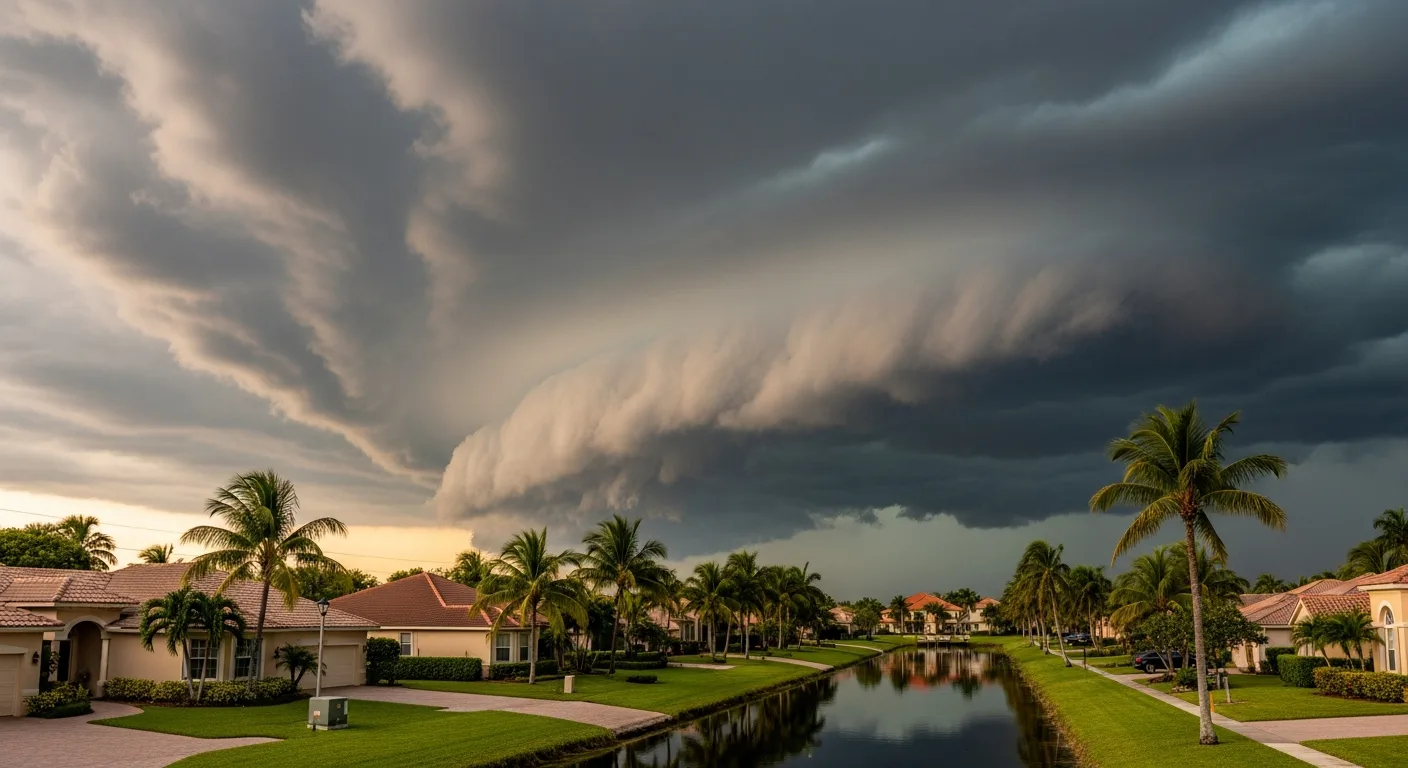
Storm clouds approaching Boynton Beach FL coastline with darkening skies over residential neighborhoods
Boynton Beach's hurricane season runs June through November, but the April 2023 tornado and November 2022 Nicole prove storm damage can occur any month of the year.

Case Study: October 2023

Tropical Storm Philippe: 10.93 Inches in a Single Event

In October 2023, Tropical Storm Philippe dumped 10.93 inches of rain on Boynton Beach in a single event — one of the most extreme rainfall totals the city has ever recorded. Three tornadoes were confirmed across Palm Beach County. The LWDD canal network, which Boynton Beach depends on entirely for stormwater management, was overwhelmed within hours.

Lake Boynton Estates, Chapel Hill, and Coquina Cove — three neighborhoods that sit adjacent to LWDD canals — experienced the worst flooding. Water backed up through storm drains and into streets, garages, and ground-floor living spaces. City drainage infrastructure, designed for lower rainfall intensity rates, exceeded capacity well before the rain stopped. Residents who had never flooded before found themselves wading through ankle- to knee-deep water in their own homes.

This event is the single most important data point for understanding Boynton Beach's storm risk. It wasn't a hurricane. It wasn't even a strong tropical storm by wind standards. It was a slow-moving rain event that overwhelmed an aging canal drainage system — and it demonstrated that Boynton Beach's most immediate storm threat may not be wind at all, but water.

10.93"

Rain in single event

3

Tornadoes confirmed

LWDD

Canal system overwhelmed

3+

Neighborhoods flooded

The LWDD Drainage Gap

Boynton Beach relies on the Lake Worth Drainage District's canal system for stormwater management. The LWDD system was engineered for rainfall rates that climate data increasingly shows are being exceeded. When canals reach capacity, water backs up through storm drains and into streets, garages, and homes. Properties adjacent to LWDD canals in Lake Boynton Estates, Chapel Hill, and Coquina Cove are the most vulnerable to this backflow dynamic. TS Philippe proved this isn't theoretical — it's a documented pattern.

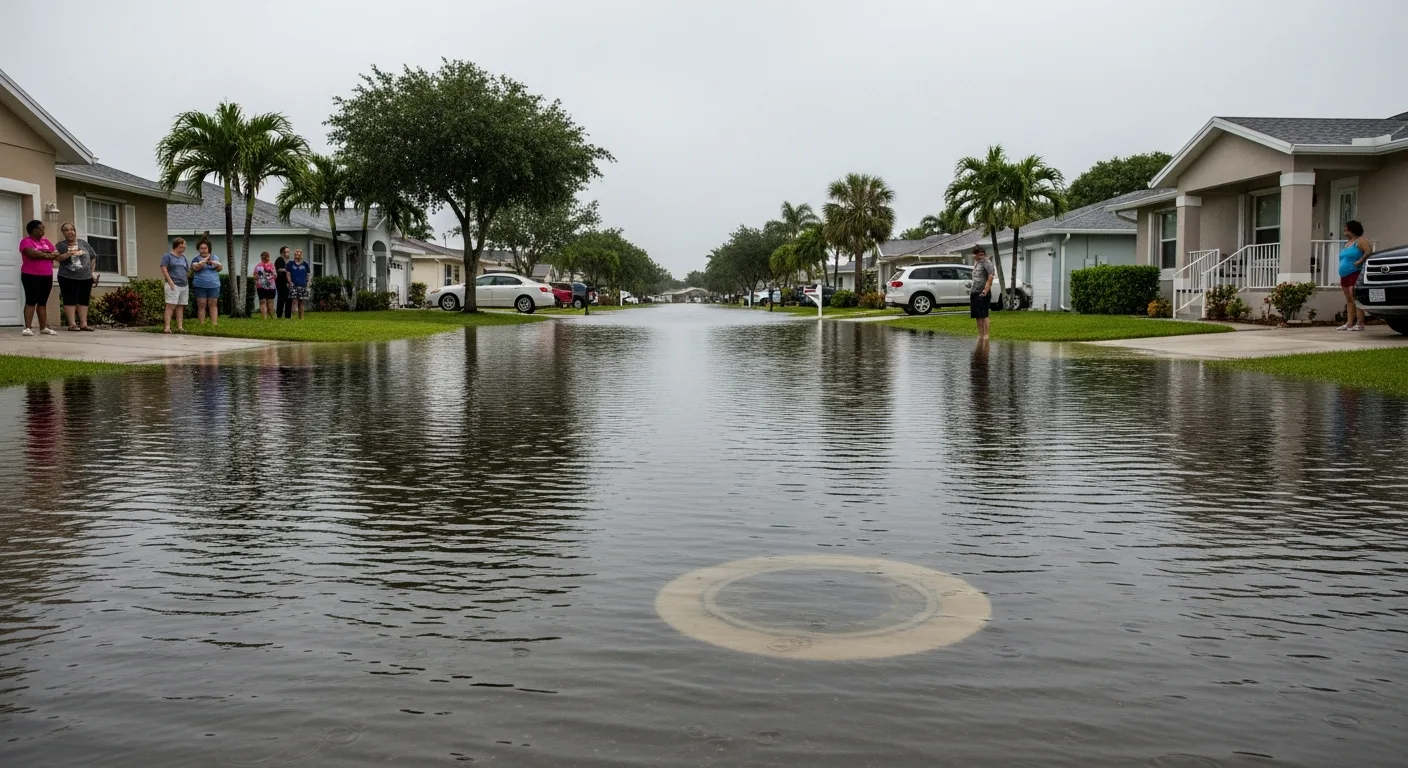
Flooding in Chapel Hill neighborhood of Boynton Beach FL during Tropical Storm Philippe October 2023
Chapel Hill neighborhood flooding during Tropical Storm Philippe — LWDD canal overflow backed water into residential streets and homes

Lessons from Philippe

  • Even "tropical storms" can produce catastrophic flooding in Boynton Beach — wind speed is not the only risk factor
  • Properties near LWDD canals face backflow flooding that FEMA maps may not reflect
  • Flood insurance is separate from homeowners insurance — many Philippe victims had no flood coverage
  • City infrastructure capacity is a hard ceiling — no amount of sandbags fixes a canal system at capacity

Types of Storm Damage

How Storms Damage Boynton Beach Homes

Storm damage in Boynton Beach manifests in four distinct ways — and major events typically trigger multiple damage types simultaneously. Understanding the full scope is critical for emergency response, insurance claims, and restoration because different damage types are covered by different policies and require different remediation protocols.

Wind Damage

Boynton Beach's barrel tile roofs are the primary wind vulnerability. Hurricane-force gusts lift individual tiles from the adhesive bond, displacing them and exposing the underlayment beneath. Screen enclosures — ubiquitous across Boynton Beach's lanai-heavy housing stock — collapse under sustained wind loads. Fascia boards and soffit panels are torn away, creating secondary entry points for wind-driven rain. Even homes with post-1994 hurricane code construction experience tile displacement in storms exceeding 110 mph sustained winds.

Wind-Driven Rain Intrusion

Wind-driven rain at hurricane velocities penetrates stucco walls through hairline cracks, window frame gaps, and deteriorated caulking joints that are invisible under normal conditions. Boynton Beach's CBS (concrete block and stucco) construction traps this moisture between the exterior finish and interior drywall, creating hidden water damage that may not become visible for days or weeks. Salt-laden hurricane rain accelerates corrosion of the wire lath and metal fasteners behind stucco, weakening the wall system for future storms.

Storm Surge & Canal Flooding

Properties east of the Intracoastal face saltwater storm surge — Category 3 under IICRC standards — requiring complete demolition of all affected porous materials. Inland, LWDD canal overflow produces Category 2 freshwater flooding that backs up through storm drains into streets and homes. The October 2023 Philippe event demonstrated that canal flooding can be just as widespread as surge flooding. Properties in Lake Boynton Estates, Chapel Hill, and Coquina Cove sit in the direct path of LWDD canal backflow.

Tornado Damage

The April 2023 tornado confirmed that Boynton Beach faces direct tornadic risk. Unlike hurricane wind that applies relatively even pressure across a structure, tornado vortices create extreme localized forces that can tear a roof off one side of a home while leaving the other side intact. Tornado damage assessment requires different documentation than hurricane wind damage — the concentrated, rotational destruction pattern is distinguishable from straight-line wind and must be documented correctly for insurance.

Storm Vulnerability Map

Boynton Beach's Most Storm-Vulnerable Areas

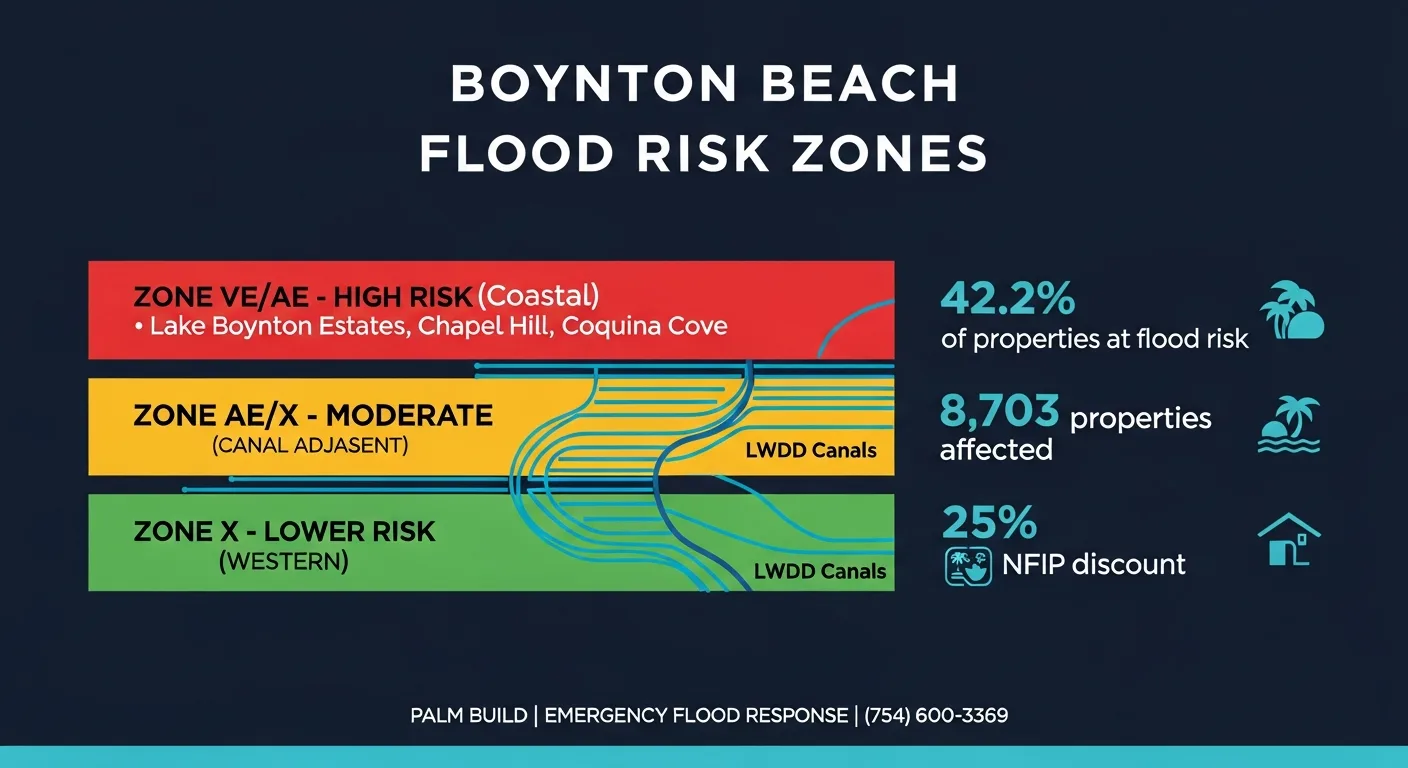
42.2% of Boynton Beach properties — 8,703 homes — face measurable flood risk. Storm damage concentrates along predictable corridors based on evacuation zone, LWDD canal proximity, elevation, FEMA flood zone designation, and construction era. Eastern properties face saltwater storm surge. Inland properties near LWDD canals face freshwater flooding that TS Philippe proved is far more widespread than FEMA maps suggest.

42.2%

Properties at flood risk

8,703

Properties in flood zones

B-C

Eastern evacuation zones

D-E

Western evacuation zones

Lake Boynton Estates

Critical

Adjacent to LWDD canals, confirmed TS Philippe flooding, 1970s CBS construction on slab-on-grade, canal backflow during heavy rainfall

Chapel Hill

Critical

Direct LWDD canal exposure, documented flooding during TS Philippe 2023, split-level homes with ground-floor vulnerability

Coquina Cove

Critical

Canal-adjacent neighborhood with confirmed flooding, low-lying elevation, LWDD overflow path during extreme rainfall events

Boynton Isles / Harbor Estates

Critical

Intracoastal-adjacent, saltwater storm surge exposure, Nicole 2022 flooding documented, evacuation Zone B-C

Hunters Run (2,860 units)

High Risk

Massive 55+ community with barrel tile roofs across hundreds of buildings, wind damage affects dozens of units simultaneously during hurricanes

Eastern Boynton Beach (East of I-95)

High Risk

Evacuation Zones B-C, storm surge exposure, older construction pre-dating post-Andrew code reforms, Intracoastal flooding path

Leisureville / Aberdeen

High Risk

Large 55+ condo communities with aging roof systems, pre-1992 construction in sections, community-wide damage during wind events

Western Boynton (Canyon Isles, Valencia Reserve)

Moderate

Evacuation Zones D-E, newer post-Andrew construction, but LWDD canal proximity and low elevation create flood risk during extreme rainfall

FEMA Flood Zones in Boynton Beach

VE

Coastal high-hazard — storm surge with wave action

AE

Base floodplain — 1% annual flood probability

A

Low-lying areas — flood risk without BFE determination

X

Moderate to minimal risk — but TS Philippe flooded X-zone homes

Infographic showing LWDD canal flood zones and vulnerable neighborhoods in Boynton Beach FL

Boynton Beach Roofing Vulnerability

Why Barrel Tile Roofs Are Boynton Beach's Biggest Storm Weakness

Barrel tile on CBS stucco is the dominant construction style across Boynton Beach. The tiles provide excellent UV and heat protection in normal conditions, but they are the most common point of hurricane failure. Understanding how barrel tile roofs fail during storms is critical for both pre-storm preparedness and post-storm damage assessment.

Wind Uplift Displaces Individual Tiles

Hurricane-force winds create uplift pressure that breaks the adhesive bond between barrel tiles and the underlayment. Individual tiles lift, slide, or shatter — creating gaps that expose the waterproofing layer beneath. A single displaced tile creates a cascade risk where adjacent tiles lose their interlocking support.

Damage Invisible from Ground Level

After a storm, barrel tiles may appear intact when viewed from the street. But water penetrates through cracked tiles, broken adhesive bonds, and displaced ridge caps that are only visible from roof level. Homeowners who skip post-storm roof inspections often discover water damage weeks later when ceiling stains appear — by which time mold has already colonized the wall cavity.

Underlayment Degradation from UV & Heat

The real waterproofing layer isn't the tile — it's the underlayment beneath. In Boynton Beach's extreme UV exposure and heat cycling (roof surface temperatures exceeding 150 degrees F in summer), felt underlayment degrades and becomes brittle within 10-15 years. When a tile displaces during a storm, the degraded underlayment beneath may already be compromised — allowing immediate water intrusion.

Pre-1992 vs. Post-1992 Construction

Hurricane Andrew in 1992 fundamentally rewrote Florida's building code. Homes built after 1994 have enhanced tile attachment systems — mechanical fasteners, improved adhesives, and hurricane clips. Pre-1992 Boynton Beach homes (Lake Boynton Estates, Leisureville, much of Chapel Hill) use older fastening methods that are significantly more vulnerable to wind uplift. If your home predates Andrew, a pre-hurricane roof inspection is essential.

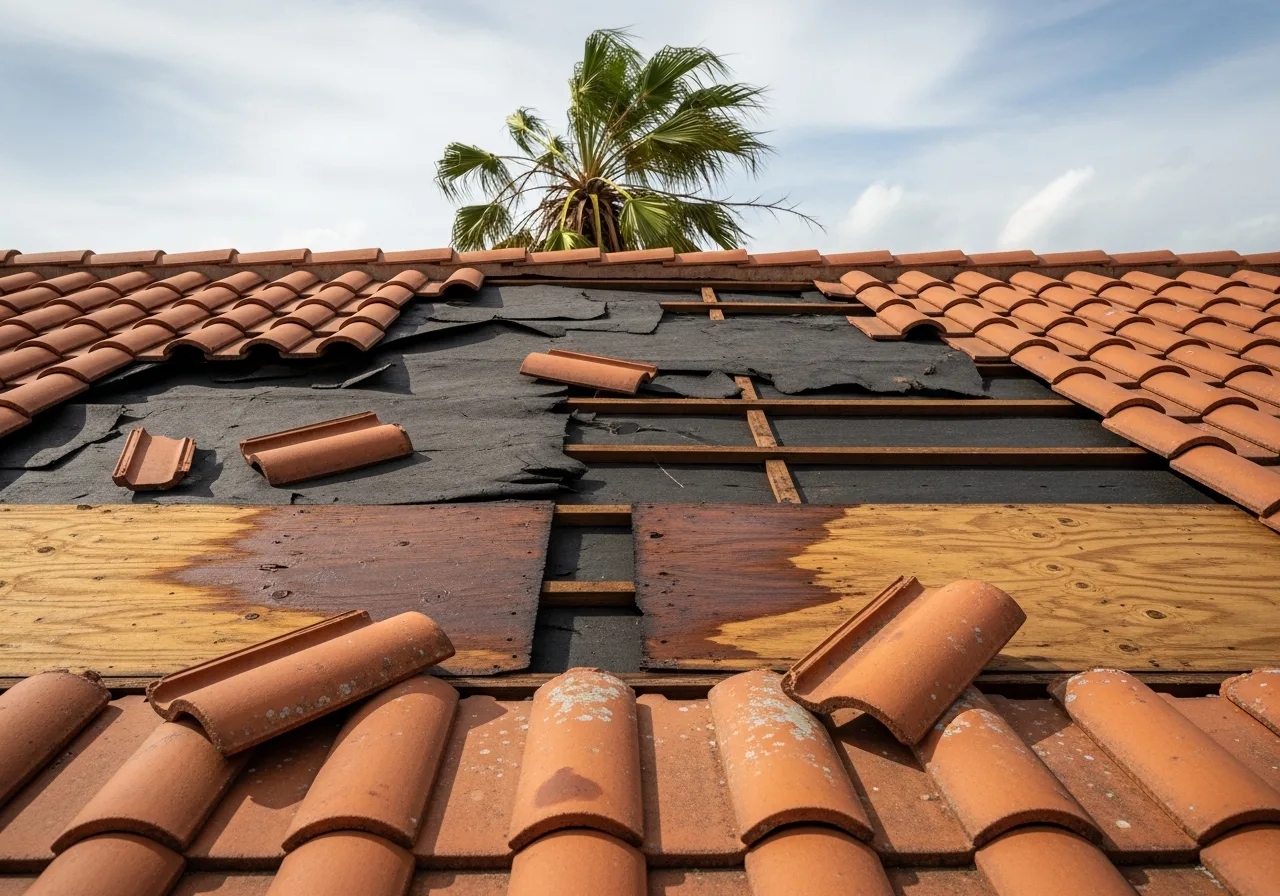
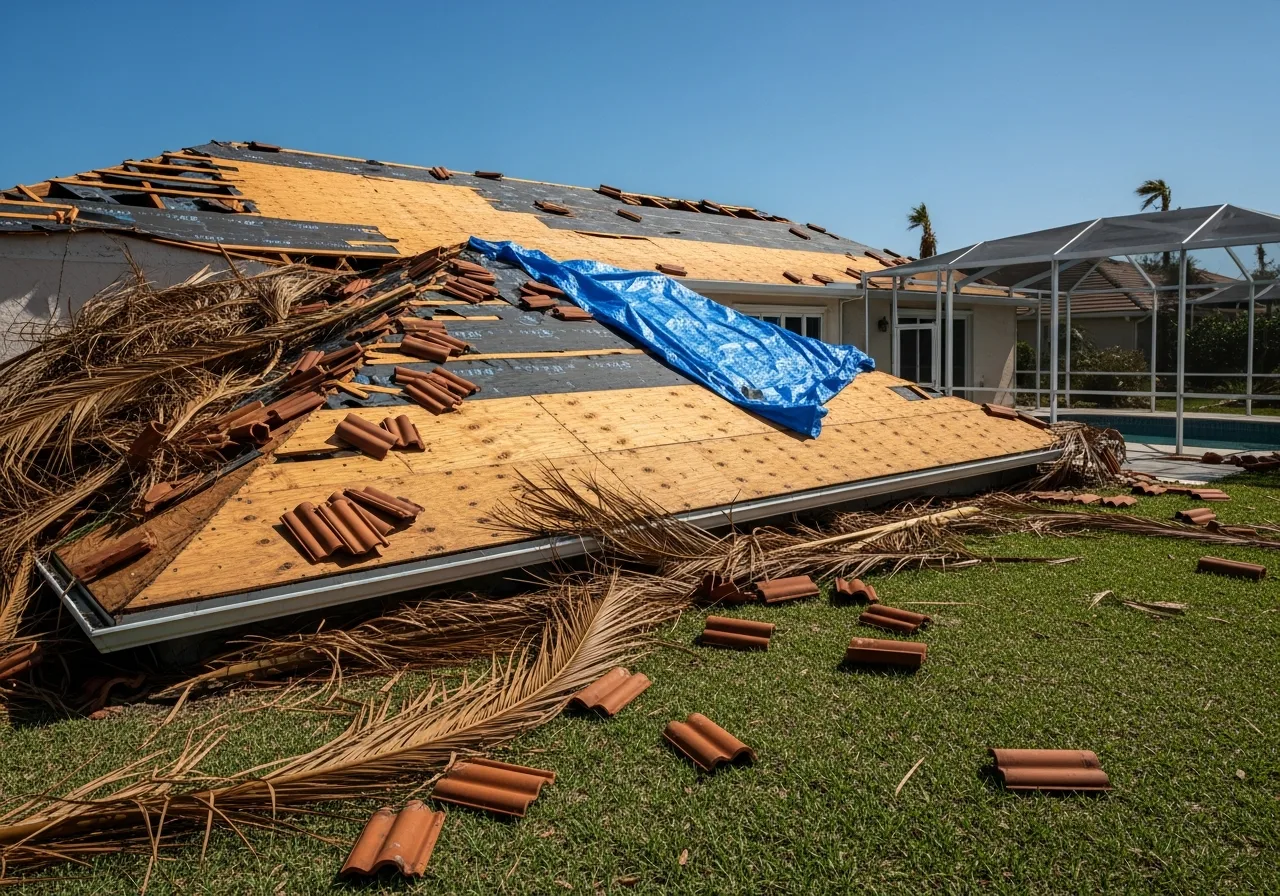
Displaced barrel tile roof on Boynton Beach FL home after hurricane showing exposed underlayment and water intrusion path
Barrel tile displacement exposes the underlayment beneath — where the actual waterproofing happens. Degraded underlayment means immediate rain intrusion.

The Bottom Line

A barrel tile roof can look perfectly intact from the ground and still be leaking. After any storm event with winds exceeding 75 mph, have a licensed roofer perform a physical on-roof inspection — not just a ground-level visual. The cost of a post-storm inspection ($200-$400) is negligible compared to the $15,000-$50,000+ in interior water damage that an undetected tile displacement can cause before the next rain.

Storm Restoration Process

How We Restore Boynton Beach Homes After Storm Damage

Storm restoration in Boynton Beach requires coordinating emergency response, water extraction, structural drying, mold prevention, and roof repair across a compressed timeline. Here's our proven six-step process from first call through final closeout.

01

Emergency Tarping & Board-Up

Hours 1-4

We secure your Boynton Beach home against further weather exposure. Displaced barrel tile sections are tarped with reinforced polyethylene, failed windows are boarded, and compromised doors are sealed. In hurricane conditions, this may require waiting for winds to drop below 45 mph for crew safety. Emergency tarping is covered by your insurance policy as part of your duty to mitigate further damage — and it's critical before the next rain band passes through.

02

Water Extraction

Hours 4-24

Truck-mounted extraction removes standing water from all affected areas. For storm surge (Category 3 saltwater), extraction is followed by antimicrobial treatment and demolition of all affected porous materials. For canal overflow flooding (Category 1-2 freshwater), extraction allows more aggressive salvage. In Boynton Beach, both types can occur simultaneously — surge from the east and canal flooding from the west — requiring different protocols in different rooms of the same home.

03

Moisture Mapping

Days 1-3

Thermal imaging cameras and pin/pinless moisture meters map the full extent of water intrusion behind walls, under flooring, and in ceiling cavities. In CBS slab-on-grade construction — the dominant building type in Boynton Beach — moisture wicks 12 to 24 inches up concrete block walls before becoming visible. Moisture mapping creates the documentation your insurance carrier needs and ensures no hidden damage is missed during restoration.

04

Structural Drying

Days 3-10

Commercial dehumidifiers and high-velocity air movers bring relative humidity below 60% throughout the affected structure. In Boynton Beach's 60-80% ambient humidity, structural drying requires significantly more equipment and time than in drier climates. Daily moisture readings document the drying curve for insurance and ensure target moisture content is achieved before reconstruction begins.

05

Mold Prevention

Concurrent

Antimicrobial treatment is applied to all exposed structural surfaces during the drying phase. In South Florida, mold colonization can begin within 24-48 hours of water intrusion. Our IICRC-certified crews apply EPA-registered antimicrobials to wall cavities, subfloor surfaces, and ceiling assemblies as part of the standard storm restoration protocol — not as an afterthought or separate scope.

06

Roof Repair & Reconstruction

Weeks 2-16

Once the structure is dried and mold-free, we begin full reconstruction: barrel tile roof repair or replacement, stucco restoration, window installation, drywall, flooring, painting, and finish work. Boynton Beach's building material costs and post-hurricane demand across Palm Beach County create 4-8 week lead times for tile roofing after major storms. We maintain supplier relationships that prioritize our projects during these demand surges.

Critical Insurance Distinction

Wind vs. Flood Insurance: The Most Expensive Misunderstanding

This is the single most important insurance concept for Boynton Beach storm damage. Wind damage and flood damage from the same hurricane are covered by different policies, carry different deductibles, and are filed as separate claims. Florida's hurricane deductible — 2-5% of insured value instead of a flat dollar amount — means Boynton Beach homeowners face $6,350 to $15,875 out of pocket on wind claims alone based on the $317,500 median home value. Many Boynton Beach homeowners have wind coverage but no flood coverage at all.

Wind Damage (HO-3 Homeowners Policy)

Barrel tile roof displacement from wind uplift
Screen enclosure collapse from sustained wind loads
Fascia and soffit damage from wind pressure
Rain entering through wind-created openings
Emergency tarping and board-up costs (duty to mitigate)
ALE (Additional Living Expenses) if home is uninhabitable
Hurricane Deductible: 2-5% of insured value. On a $317,500 Boynton Beach home = $6,350-$15,875 out of pocket before coverage begins.

Flood Damage (Separate NFIP or Private Flood Policy)

Storm surge from the Intracoastal (Category 3 saltwater)
LWDD canal overflow flooding (Category 2 freshwater)
Groundwater intrusion through slab foundation
Sewer backup from overwhelmed municipal systems
NFIP max dwelling coverage: $250,000
NOT covered by standard homeowners — requires separate flood policy
1-Year Claim Deadline: Florida flood insurance claims must be filed within 1 year of the loss event. Missing this deadline can void your entire flood claim.

25% CRS Discount Available in Boynton Beach

Boynton Beach participates in FEMA's Community Rating System (CRS), which provides a 25% discount on NFIP flood insurance premiums for properties in the city. This discount applies automatically to NFIP policies — but many Boynton Beach homeowners don't carry flood insurance at all. The TS Philippe flooding in October 2023 devastated homes in FEMA Zone X (minimal risk designation), proving that flood insurance is essential regardless of your FEMA zone. If you're near an LWDD canal, the 25% CRS discount makes flood coverage significantly more affordable than most homeowners expect.

Read our wind vs. flood insurance guide

Boynton Beach Pricing

Storm Damage Restoration Costs in Boynton Beach

Storm restoration costs in Boynton Beach reflect South Florida's elevated material and labor costs, barrel tile roofing premiums, and post-hurricane demand surges across Palm Beach County. After major storms, contractor demand and material shortages can increase costs 20-40% and extend timelines by months. Wind damage is covered by homeowners insurance with a hurricane deductible; flood damage requires separate flood insurance.

Emergency Tarping

Temporary roof covering, board-up, initial water mitigation

$500 – $2,500

Roof Tile Repair

Barrel tile replacement, underlayment repair, ridge cap restoration

$3,000 – $15,000

Water Damage from Roof Leak

Interior drying, drywall replacement, flooring, mold prevention

$5,000 – $18,000

Storm Surge Restoration

Saltwater decontamination, full demolition of porous materials, structural drying

$15,000 – $35,000+

Full Structural Reconstruction

Complete roof replacement, structural repair, interior rebuild, code upgrades

$25,000 – $75,000+

Cost factors unique to Boynton Beach: Barrel tile roofing commands premium pricing compared to shingle roofs. Post-hurricane demand across all of Palm Beach and Broward counties creates 4-8 week tile supply backlogs. Saltwater storm surge from the Intracoastal requires Category 3 demolition protocols that significantly increase scope compared to freshwater flooding. CBS slab-on-grade construction requires specialized drying equipment and extended dry-down timelines.

Before the Storm

Hurricane Preparedness Checklist for Boynton Beach

The most expensive storm damage is the damage you could have prevented or documented before the event. These eight steps, taken before June 1, can save Boynton Beach homeowners tens of thousands in unrecovered losses and months of extended displacement.

Inspect Your Barrel Tile Roof

Hire a licensed roofer to physically inspect your barrel tile roof for cracked tiles, deteriorated underlayment, and compromised adhesive bonds. Boynton Beach's sun and salt exposure degrades roofing materials faster than inland Florida. A pre-hurricane tile replacement costs $8-$15 per tile. After a hurricane, that same tile costs $30-$50+ and takes weeks to schedule.

Clean Gutters and Downspouts

Clogged gutters redirect rainwater against fascia boards and into soffit vents, creating water intrusion points that amplify during hurricane-force rain. Clean all gutters, verify downspouts discharge away from the foundation, and ensure no debris is blocking roof drainage paths. This is one of the least expensive and most impactful pre-hurricane tasks.

Verify Insurance Coverage (Wind + Flood Separate)

Confirm your homeowners policy's hurricane deductible percentage (2-5% of insured value = $6,350-$15,875 on the $317,500 Boynton Beach median). Separately verify you have flood insurance — standard homeowners does NOT cover flood damage. With Boynton Beach's 25% CRS discount on NFIP policies, flood coverage is more affordable than most homeowners realize.

Know Your Evacuation Zone

Eastern Boynton Beach is evacuation Zone B-C (storm surge risk). Western Boynton Beach is Zone D-E (shelter-in-place for most storms). Know your zone, know your route, and know when the mandatory evacuation order applies to your area. Palm Beach County Emergency Management maintains the official zone lookup tool.

Document Home Contents for Insurance

Walk through every room with your phone camera and record a video inventory of all contents, finishes, and structural features. Open every cabinet, closet, and drawer. Store the video in the cloud — not on a device that could be damaged in the storm. This documentation is the single most valuable asset for an insurance claim and costs nothing to create.

Clear LWDD Canal Bank Access on Your Property

If your property borders an LWDD canal, ensure the canal bank easement is clear of debris, vegetation overgrowth, and obstructions. LWDD maintenance crews need access to canals before and after storms to manage water levels. Blocked access delays canal management — which means water stays higher longer in your neighborhood.

Test Impact Shutters and Windows

Test every accordion shutter track, panel bolt, and locking mechanism before June 1. Corroded aluminum hardware is the most common shutter failure point — Boynton Beach's saltwater air corrodes shutter components year-round. Replacing a failed shutter costs $200-$500. Replacing the window and interior damage from a shutter failure during a hurricane costs $5,000-$25,000.

Program Palm Build: (754) 600-3369

After a major hurricane, every restoration company in Palm Beach County is overwhelmed simultaneously. Response times that are normally 30-45 minutes can stretch to days. Homeowners who have an existing relationship with a restoration company get prioritized. Save our number now — and call before hurricane season to establish your account.

Storm Damage in Boynton Beach

What Storm Damage Looks Like in Boynton Beach

Hurricane wind damage to barrel tile roof on Boynton Beach FL home showing displaced tiles and exposed underlayment
Barrel tile displacement is the most common hurricane damage in Boynton Beach — one displaced tile can lead to $15,000+ in interior water damage
Storm clouds approaching Boynton Beach FL coastline with darkening skies over residential area
Boynton Beach sits in South Florida's hurricane corridor with Gulf Stream waters 3 miles offshore fueling rapid storm intensification
Flooding in Chapel Hill neighborhood of Boynton Beach FL with water covering streets and approaching homes
Chapel Hill neighborhood flooding during Tropical Storm Philippe — LWDD canal overflow backed water into residential areas
Close-up of barrel tile roof damage on Boynton Beach FL home showing cracked and displaced tiles after storm
Barrel tile can look intact from ground level but water penetrates through cracked tiles and degraded underlayment beneath

The Palm Build Difference

Why Boynton Beach Homeowners Choose Palm Build After Storms

Multi-Crew Deployment for Community Events

When a hurricane hits Boynton Beach's large 55+ communities — Hunters Run (2,860 units), Aberdeen, Leisureville — dozens of buildings sustain damage simultaneously. Palm Build activates multi-crew catastrophe response, deploying parallel teams across affected buildings rather than working one unit at a time. HOA boards and property managers receive a single point of contact coordinating all units.

30-45 Minute Emergency Response

Our Deerfield Beach operations center is 12 miles from downtown Boynton Beach. Emergency crews deploy across the city within 30-45 minutes under normal conditions. During major hurricane events, we pre-position crews, equipment, and materials. Pre-storm contract clients receive priority dispatch ahead of the general queue.

IICRC WRT & ASD Certified

Every crew lead holds current IICRC Water Restoration Technician (WRT) and Applied Structural Drying (ASD) certifications. Our South Florida teams are additionally trained in Category 3 saltwater decontamination protocols — the IICRC classification for storm surge that requires fundamentally different remediation than freshwater flooding from LWDD canal overflow.

Saltwater Remediation Expertise

Boynton Beach properties east of the Intracoastal face saltwater storm surge — Category 3 under IICRC S500 standards. Salt crystals embedded in concrete, framing, and subfloor systems absorb atmospheric moisture indefinitely, creating perpetual dampness and accelerated corrosion. Our saltwater decontamination protocol addresses the salt itself, not just the water — a critical distinction that general contractors miss.

Insurance Documentation from Day One

Our damage assessment classifies every item by cause — wind vs. surge vs. freshwater flood vs. tornado impact — ensuring each claim is filed with the correct policy. In Boynton Beach, where wind damage goes through homeowners insurance and flood damage requires separate NFIP or private flood claims, this dual-documentation approach recovers significantly more than generic damage reports.

Pre-Storm Contracts for HOA Communities

Boynton Beach HOA communities can execute pre-storm restoration contracts with Palm Build before hurricane season. Pre-positioned contracts guarantee priority response, pre-negotiated rates (locked before post-hurricane price surges), and a defined scope of work that the HOA board has already reviewed and approved. When the storm hits, there's no negotiation delay — crews deploy immediately.

Common Questions

Boynton Beach Storm & Hurricane Damage FAQ

How quickly can Palm Build respond after a hurricane in Boynton Beach?
Our Deerfield Beach operations hub is approximately 20 minutes from Boynton Beach via I-95. Under normal conditions, we dispatch within 30-45 minutes of your call, 24 hours a day, 7 days a week. After major hurricane events, we activate catastrophe response protocols with pre-positioned crews and equipment staged across Palm Beach County. Pre-storm clients who schedule board-up and tarping services receive priority dispatch once conditions allow safe travel.
How do hurricane deductibles work for Boynton Beach homeowners?
Florida homeowners policies carry separate hurricane deductibles of 2-5% of your dwelling coverage — not a flat dollar amount. On a $317,000 Boynton Beach home (the city median), that means $6,350 to $15,875 out of pocket before your wind damage coverage kicks in. This deductible applies only to hurricane-declared events and resets per storm season. Flood damage from storm surge, canal overflow, or rising water is not covered by your homeowners policy at all — that requires separate NFIP or private flood insurance. Florida law requires filing your initial claim within 1 year of the date of loss.
Is saltwater flooding from the Intracoastal worse than freshwater canal flooding?
Significantly worse and substantially more expensive to remediate. Under IICRC S500 standards, saltwater flooding from the Intracoastal Waterway is classified as Category 3 (grossly contaminated) black water, requiring complete demolition and removal of all affected porous materials — drywall, carpet, insulation, cabinetry, and any organic material below the flood line. Salt crystals embedded in concrete, wood framing, and electrical components continue absorbing atmospheric moisture indefinitely, creating perpetual dampness and accelerated corrosion long after the water recedes. Freshwater flooding from LWDD canal overflow is typically Category 2 (gray water), allowing some porous materials to be salvaged if addressed within 24-48 hours. The cost difference between a saltwater and freshwater remediation of comparable scope is often 40-60% higher for saltwater.
How does the LWDD canal system affect flooding in Boynton Beach?
The Lake Worth Drainage District operates approximately 50 lateral canals spaced every half-mile through Boynton Beach, controlling the water table for the entire western communities corridor. During extreme rainfall events — like Tropical Storm Philippe in October 2023, which dumped 10.93 inches — these canals exceed capacity and back up into adjacent neighborhoods. Lake Boynton Estates, Chapel Hill, and Coquina Cove are particularly vulnerable. Chapel Hill experiences flooding even during moderate storms due to its low elevation relative to surrounding canal infrastructure. During the 2024 Helene and Milton threats, the city activated pre-emptive canal pumping but still experienced a sandbag shortage. Homes bordering LWDD canals face elevated flood risk even outside FEMA-designated Special Flood Hazard Areas, and standard homeowners insurance does not cover canal overflow flooding.
What happens to barrel tile roofs during hurricanes in Boynton Beach?
Barrel tile roofs — standard on Boynton Beach CBS stucco construction — have a specific failure mode under high winds. Wind uplift displaces individual tiles, but the leak damage originates at the underlayment layer beneath them. Once tiles shift or break, the felt or synthetic underlayment is exposed to wind-driven rain, which penetrates through nail holes, seams, and degraded sections into the roof deck and attic space. Florida Building Code requires 140 mph wind load compliance for new construction and re-roofing, but older tile installations may not meet current standards. After any hurricane or high-wind event, a professional roof inspection is critical — displaced tiles are often invisible from ground level, and underlayment damage can allow water intrusion for weeks before interior signs appear.
Do I need flood insurance in Boynton Beach, and what is the CRS discount?
If your Boynton Beach property is in a FEMA-designated Special Flood Hazard Area (SFHA) and you have a federally backed mortgage, flood insurance is mandatory. However, even properties outside SFHAs face significant risk — 42.2% of Boynton Beach properties have measurable flood risk over a 30-year window due to the LWDD canal network and low-lying topography. Boynton Beach participates in FEMA's Community Rating System (CRS), which earns residents a 25% discount on NFIP flood insurance premiums — one of the best rates in Palm Beach County. Given the city's canal exposure and hurricane frequency, flood insurance is strongly recommended even for properties not in mandatory zones. For NFIP claims, you must file a proof of loss within 60 days of the flood event.
What should I do immediately after a hurricane hits Boynton Beach?
First, ensure personal safety — never enter standing water that may be electrically charged or contaminated with sewage, chemicals, or saltwater. Once safe: (1) Call Palm Build at (754) 600-3369 to initiate emergency response. (2) Document all damage with timestamped photos and video before any cleanup begins. (3) Contact your insurance carrier within 24 hours — Florida's 1-year claim deadline begins at the date of loss. (4) Do not discard damaged materials until your adjuster has inspected them. (5) If water is standing inside your home, do not use the HVAC system — contaminated water pulled into ductwork seeds mold throughout the entire structure. (6) For flood claims under NFIP, file a proof of loss within 60 days. Palm Build provides insurance-ready documentation from arrival, including moisture mapping, thermal imaging, and photo evidence formatted for adjuster review.
Does Palm Build provide emergency tarping and board-up in Boynton Beach?
Yes — emergency tarping and board-up is one of our most critical storm response services in Boynton Beach. After high-wind events displace barrel tiles or damage roof sections, temporary tarping prevents ongoing water intrusion that compounds interior damage exponentially with every rain event. We deploy heavy-duty UV-resistant tarps secured to the roof deck — not just draped over damaged areas — to withstand subsequent storms. Board-up services secure broken windows, sliding glass doors, and compromised openings against further wind-driven rain entry. Both services are typically covered under your homeowners policy as emergency mitigation measures to prevent additional damage, and we document everything for your insurance claim from the moment we arrive. Pre-storm board-up is also available when hurricane watches are issued.

Storm Damage in Boynton Beach? Palm Build Responds 24/7.

With 8,703 properties at flood risk and 50 LWDD canals threatening overflow, Boynton Beach storm damage demands immediate professional response. Palm Build's Deerfield Beach team provides emergency tarping, saltwater extraction, barrel tile roof stabilization, and full reconstruction — with insurance documentation from the first call.

30-45 min Response IICRC Certified