Boynton Beach's 60-80% year-round humidity, aging CBS stucco construction, and the Paston Effect — warm humid air condensing on cold AC ducts inside attic assemblies — make this 55+ retirement community corridor one of Palm Beach County's most mold-vulnerable cities. From Hunters Run's 2,860 units to Leisureville's 1960s housing stock, Palm Build's DBPR-licensed team provides professional containment, HEPA-filtered remediation, and insurance-grade documentation.
Deerfield Beach — 20 Minutes from Boynton Beach 30-45 min Response IICRC Certified
"There's a Musty Smell Coming From the Master Closet."
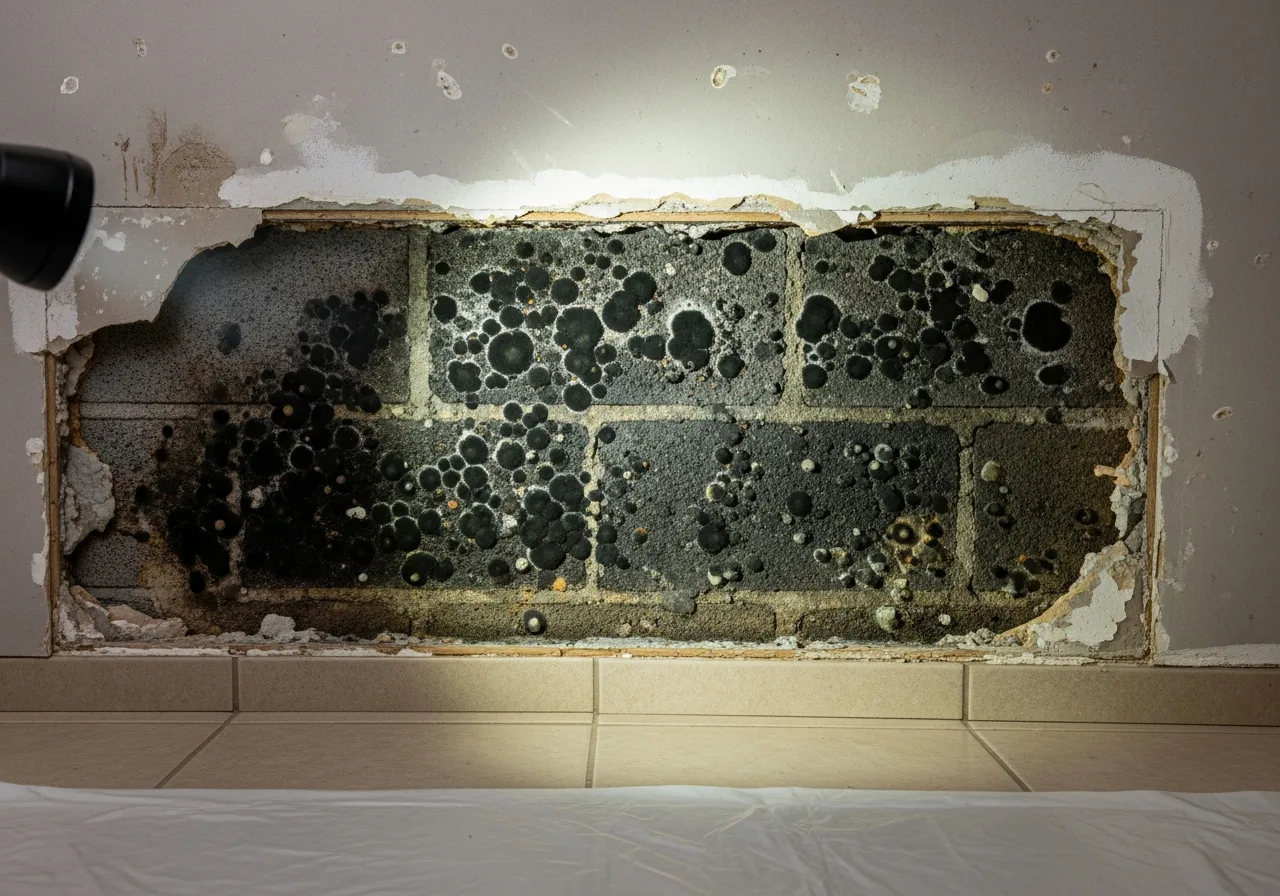
You notice a persistent musty smell coming from the master closet in your Aberdeen
condo. The wall looks fine — no stains, no discoloration. But behind that drywall,
inside the CBS concrete block wall cavity, mold has been growing for weeks. A hairline
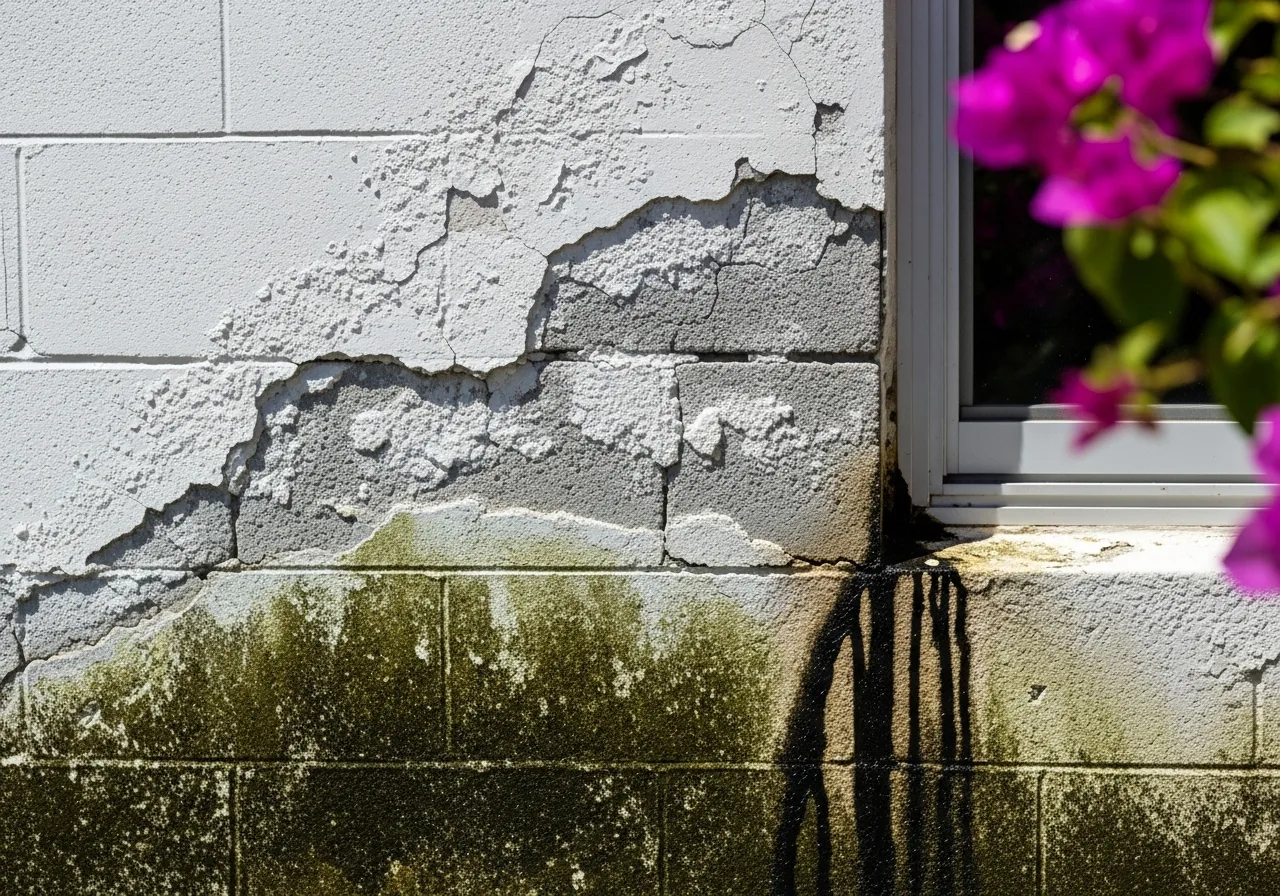
stucco crack on the exterior — invisible from your lanai — has been wicking rainwater
into the block wall every afternoon thunderstorm since June.
By the time the smell reaches you, the colony has spread from the closet wall into the
shared wall with the bathroom. The AC register in the hallway has been pulling spores
from the wall cavity and distributing them through the duct system. Your allergies
that "won't go away" are not seasonal — they're coming from inside the house.
This is the call Palm Build answers every week in Boynton Beach — from Aberdeen Golf
& Country Club condos to Leisureville ranch homes, from Hunters Run villas to
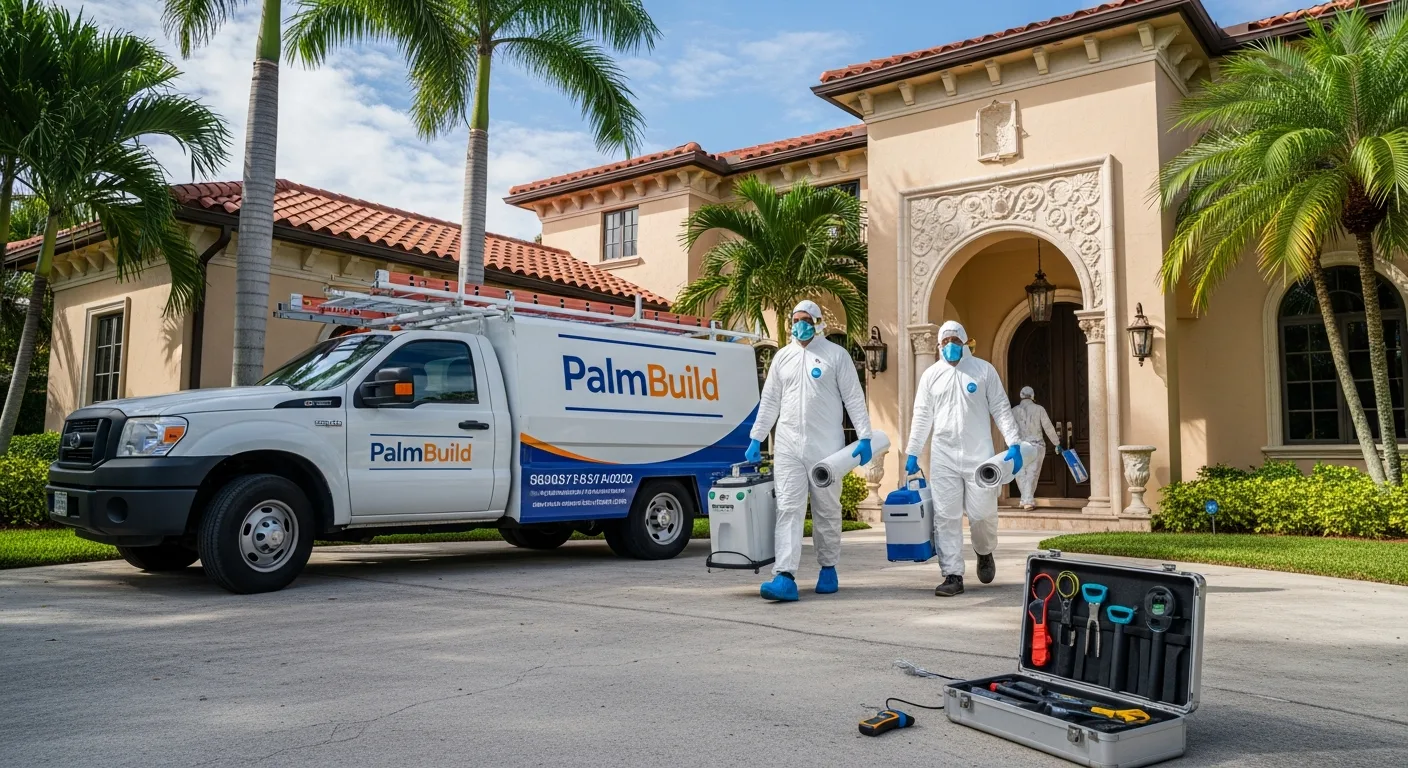
Chapel Hill split-levels. We respond in 30 to 45 minutes from our Deerfield Beach office, arriving
with moisture meters, infrared cameras, and the DBPR mold remediation license Florida requires.
What Mold Remediation Costs in Boynton Beach
Minor
Single wall section, bathroom, closet — surface mold on drywall or baseboards
$1,500 – $4,000
Moderate
Multiple rooms, CBS wall cavities, or localized HVAC contamination
$4,000 – $12,000
Extensive
Full HVAC system, multiple CBS walls, attic insulation, structural involvement
$12,000 – $30,000+
DBPR-Licensed Mold Remediation
Free initial consultation. Florida-compliant assessment and remediation with
third-party clearance testing.
The "Paston Effect": HVAC Condensation Mold in Boynton Beach Attics
Warm, humid outdoor air enters attic spaces through soffit vents — standard ventilation
required by Florida building code. When that 90-degree, 80% humidity air contacts the
cooler exterior surface of AC ductwork running through the attic, condensation forms on
the outside of the ducts. This is the "Paston Effect" — and in Boynton Beach, it is the
single largest driver of hidden attic mold.
The condensation drips onto attic trusses, soaks batt insulation, and saturates the
ceiling drywall from above. In homes built between the 1970s and 1990s — Hunters Run,
Aberdeen, Indian Spring, Leisureville — the original duct insulation has degraded,
exposing more cold duct surface to humid attic air. The mold grows on ceiling assemblies
and inside insulation for months before ceiling stains appear in living spaces below.
Unlike a pipe burst that announces itself, the Paston Effect is slow and invisible. By
the time homeowners notice ceiling discoloration or a musty smell from attic-fed
registers, contamination is typically extensive — requiring full attic remediation,
insulation replacement, and duct re-insulation or replacement.
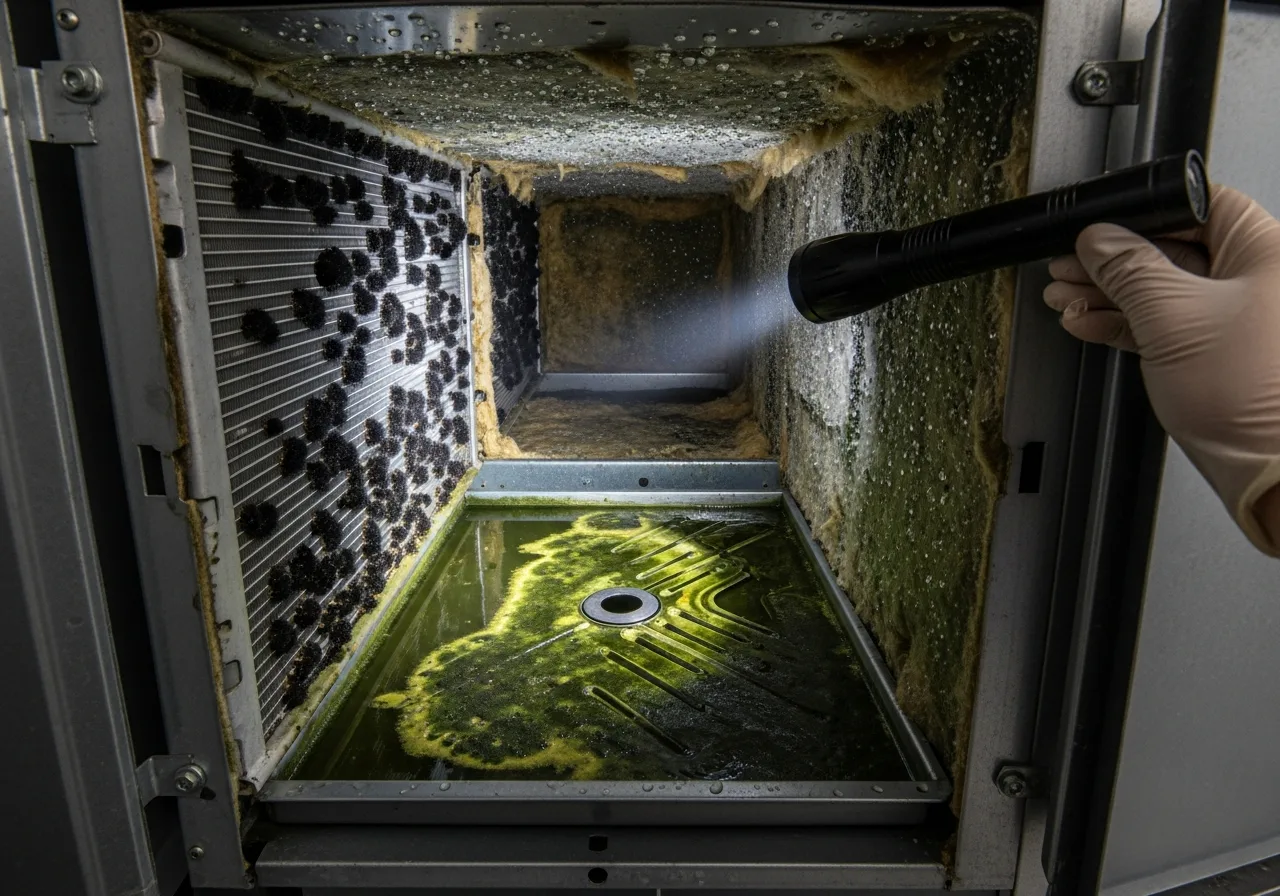
Condensation mold on degraded duct insulation in a Hunters Run attic — the Paston
Effect in action
Most Affected Communities
Homes built 1970s-1990s with original ductwork are highest risk:
Hunters Run (1970s-1980s, 2,860 units)
Aberdeen Golf & Country Club (1980s-1990s)
Indian Spring (1970s-1980s original HVAC)
Leisureville (1960s-1970s, oldest housing stock)
Chapel Hill (1970s ranch and split-level)
Know The Signs
Warning Signs of Mold in Boynton Beach CBS Stucco Homes
Mold in Boynton Beach rarely announces itself with visible growth on a wall. In CBS
stucco homes on slab-on-grade foundations, mold grows silently inside wall cavities,
attic assemblies, and HVAC systems for months — until health symptoms or structural
damage force a professional inspection.
Persistent Musty Odor
Most Reported
The most reported first sign in Boynton Beach homes. A musty smell from closets, under sinks, or when the AC cycles on indicates mold colonization inside CBS wall cavities or HVAC components. Many homeowners in Leisureville and Aberdeen dismiss this as "old house smell" — it is not.
Paint Bubbling on Interior Walls
Early Warning
Bubbling, peeling, or blistering paint on interior CBS walls signals moisture trapped between the concrete block and drywall. In Boynton Beach stucco homes, hairline exterior cracks allow rainwater to wick into the wall cavity during afternoon thunderstorms — creating invisible mold behind intact-looking surfaces.
Dark Staining at Wall Base Near Slab
Structural
Dark discoloration along the bottom 6-12 inches of interior walls, especially near exterior walls and planter beds, indicates moisture wicking up through the CBS block from the slab-on-grade foundation. Common in Hunters Run ground-floor units and Leisureville ranch homes with poor exterior grading.
Visible Mold on Bathroom Ceiling
Advanced
Black or dark green spotting on bathroom ceilings — particularly in homes with bath exhaust fans that vent into the attic rather than outside — signals attic-level moisture problems. In 1970s-1980s Boynton Beach homes, improper bathroom venting is endemic.
Ceiling Stains Without Roof Leak
Early Warning
Yellowish or brown ceiling stains with no apparent roof damage point to HVAC condensation — the Paston Effect. Warm humid attic air condensing on cool AC ductwork drips onto ceiling assemblies. This is the most misdiagnosed mold sign in Boynton Beach: homeowners call roofers when they need mold remediation.
Unexplained Respiratory Symptoms
Health Risk
Persistent sinus congestion, throat irritation, coughing, or allergy symptoms that worsen indoors and improve when you leave the house. Seniors in 55+ communities like Hunters Run and Aberdeen are especially vulnerable — longer time spent at home means extended mold exposure.
When to Call Immediately
If you see mold covering more than 10 square feet, mold on AC registers or inside
air handlers, ceiling stains in multiple rooms, or experience respiratory symptoms
that worsen indoors — do not attempt DIY cleanup. Contact a DBPR-licensed mold remediation professional and document everything for your insurance claim.
IICRC S520 Protocol
Our Boynton Beach Mold Remediation Process
Professional mold remediation follows a strict sequence defined by the IICRC S520
standard and Florida DBPR regulations. Timeline: 3-7 days depending on scope and whether
HVAC system work is required.
01
Assessment & Testing
Day 1
02
Containment & Negative Air
Day 1-2
03
Removal & HEPA Vacuuming
Days 2-4
04
Antimicrobial Treatment
Days 4-5
05
Clearance Testing
Days 5-7
01
Assessment & Testing
Day 1
Comprehensive visual inspection, moisture mapping with infrared cameras, and air quality sampling. We identify the moisture source — HVAC condensation, stucco crack intrusion, or plumbing failure — and classify contamination level per IICRC S520. Florida law requires a separate DBPR-licensed mold assessor for the initial report.
02
Containment & Negative Air
Day 1-2
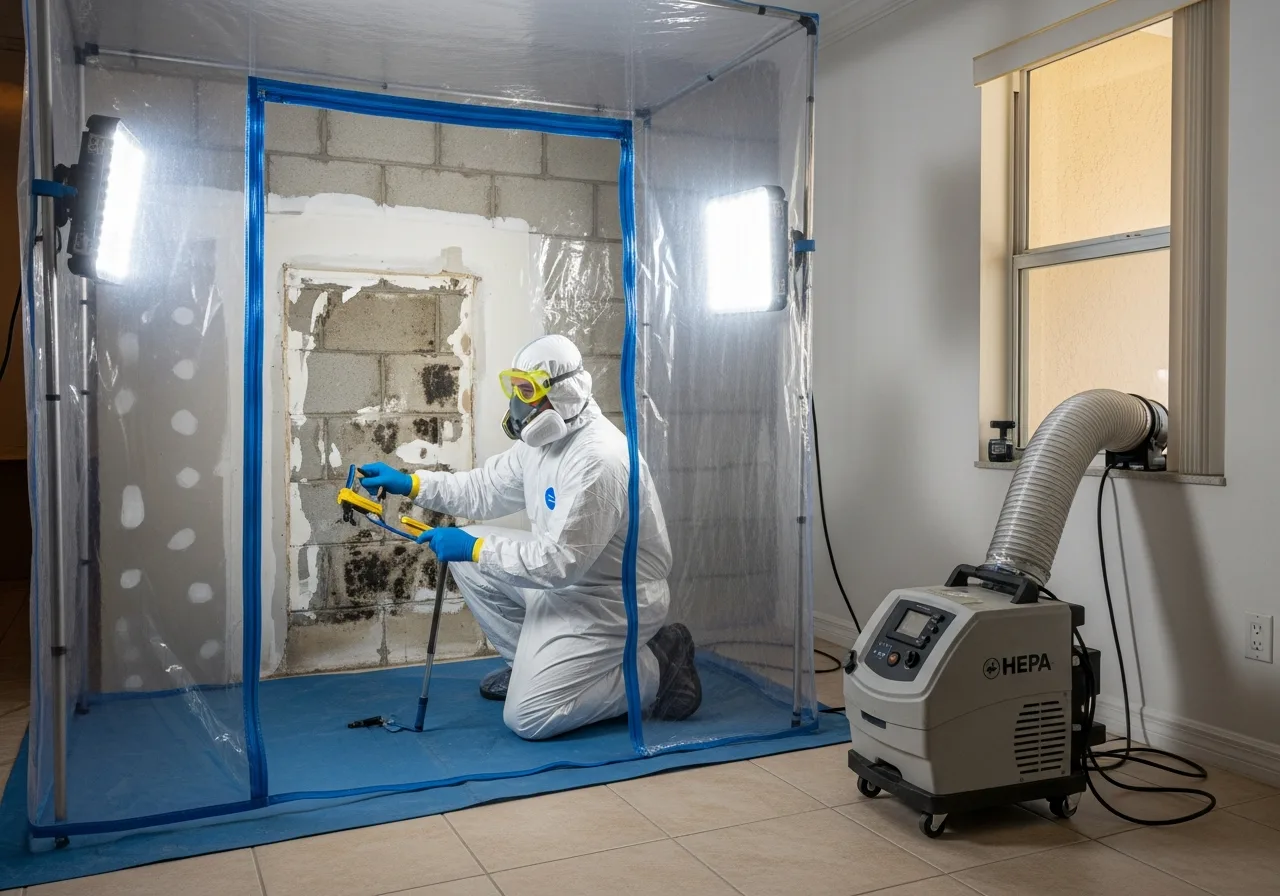
Sealed polyethylene containment barriers isolate affected areas, including CBS wall cavities and HVAC system components. HEPA air scrubbers create negative air pressure to prevent spore migration through the home. The AC system is isolated to stop duct-borne distribution.
03
Removal & HEPA Vacuuming
Days 2-4
Contaminated drywall is demolished to expose the CBS concrete block beneath. All affected materials — drywall, insulation, baseboards — are removed under containment. Salvageable block surfaces are HEPA-vacuumed to remove spore residue. Non-salvageable materials are double-bagged for disposal.
04
Antimicrobial Treatment
Days 4-5
EPA-registered antimicrobial agents are applied to all treated CBS block surfaces, window bucks, and structural elements. For HVAC-involved projects, evaporator coils, drain pans, and duct interiors receive specialized antimicrobial fogging. The moisture source is repaired to prevent recurrence.
05
Clearance Testing
Days 5-7
Post-remediation air quality testing by an independent DBPR-licensed mold assessor — a different licensed entity than Palm Build, as Florida law requires. Air samples confirm spore counts have returned to acceptable levels. Documentation is provided for your records and insurance carrier.
Why Containment Matters in CBS Homes
Disturbing mold without proper containment sends billions of spores airborne — and in
Boynton Beach's CBS construction, the HVAC system can distribute those spores to every
room within minutes. Our containment protocol ensures mold stays isolated during
removal.
1
Sealed Barriers
Polyethylene sheeting floor-to-ceiling on CBS walls
Mold Risks in Boynton Beach Retirement Communities
Boynton Beach's large 55+ population faces unique mold vulnerability: aging housing
stock with original HVAC and plumbing, health conditions that make mold exposure more
dangerous, and more time spent indoors — meaning longer cumulative exposure before
symptoms prompt professional inspection.
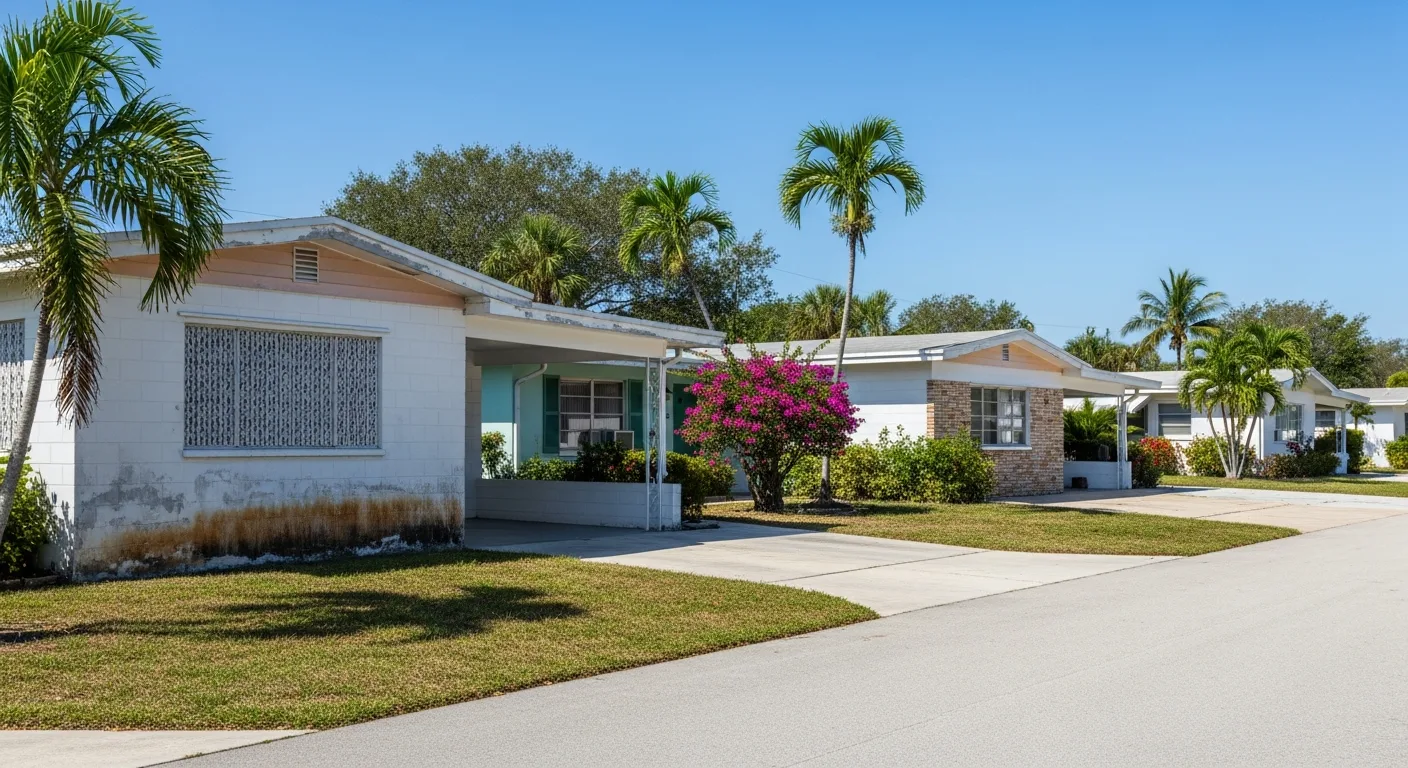
Leisureville ranch homes — 1960s-era CBS construction with original systems
Senior Health Vulnerability
Weakened immune systems increase infection risk from mold exposure
Existing respiratory conditions (COPD, asthma) are exacerbated by airborne spores
Medications that suppress immune response compound vulnerability
Delayed symptom recognition — mold symptoms mimic common aging complaints
Leisureville
Critical Risk1960s-1970s | ~2,600 homes
Oldest housing stock in Boynton Beach. Original plumbing, HVAC, and window assemblies. Cast iron drain lines corroding underground. Flat-roof ranch homes with minimal attic ventilation. Many units have never had ductwork replaced — 50+ year old systems harboring decades of moisture exposure.
Hunters Run
High Risk1970s-1980s | 2,860 units
Massive 55+ community with 30-40 year old HVAC systems approaching or past end of life. Original duct insulation has degraded, maximizing Paston Effect condensation. Canal-adjacent units face elevated groundwater and humidity. HOA deferred maintenance on shared HVAC infrastructure creates building-wide contamination risk.
Aberdeen Golf & Country Club
High Risk1980s-1990s | ~1,900 units
Canal-adjacent location elevates ambient humidity around CBS structures. Stucco micro-cracks from decades of thermal cycling allow rain intrusion into wall cavities. Condo units share walls — mold in one unit migrates through CBS block to adjacent units through shared cavities and HVAC plenum connections.
Indian Spring
Elevated Risk1970s-1980s | ~1,200 units
Deferred HVAC maintenance is the primary driver. Original air handlers with corroded drip pans, clogged condensate lines, and deteriorated evaporator coil insulation. Many units have supplemented with window AC units — creating additional condensation sources and moisture entry points through wall penetrations.
FL Regulatory Landscape
Florida Mold Licensing: What Boynton Beach Homeowners Must Know
Florida regulates mold work under Chapter 468, Part XVI of the
Florida Statutes, administered by the DBPR (Department of Business and Professional
Regulation). The state requires separate licenses for mold assessment and
mold remediation — and explicitly prohibits the same company from performing both on the
same project.
This separation prevents conflicts of interest: the company that finds the mold cannot
be the same company that profits from removing it. Mold remediators must document at
least 15 completed projects to qualify for licensure. Both assessors and
remediators must carry liability insurance and complete continuing education. Property owners
performing work on their own property are exempt — but condo and HOA remediation always
requires licensed professionals.
Palm Build holds both a Florida DBPR mold remediation license and works exclusively
with independent DBPR-licensed assessors for pre- and post-remediation testing — full
compliance with the separation requirement.
Verify DBPR mold remediator license before hiring — myfloridalicense.com
Assessor and remediator MUST be separate licensed entities
Same company cannot assess and remediate the same project
Post-remediation clearance requires a different licensed assessor
CBS construction and HVAC mold remediation expertise
Full liability insurance and workers' compensation coverage
Works with independent FL-licensed assessors for clearance
Serving Boynton Beach from Deerfield Beach — 30-45 min response
Ask for License Numbers
Most competitors don't explain this. Red flags to watch for:
No DBPR mold license or won't provide license number
Same company offers to assess AND remediate your mold
Offers to "spray and seal" without removing contaminated material
Won't set up containment barriers or HEPA filtration
Claims "no license needed" in Florida (false)
Quotes remediation before an independent assessment
Boynton Beach Pricing
Mold Remediation Costs in Boynton Beach
South Florida mold remediation costs typically exceed national averages due to CBS
construction, year-round humidity, and Florida's mandatory separate-assessor
requirement. Here are realistic ranges for Boynton Beach projects.
Small Area (<100 sq ft)
Bathroom, closet, single wall section, window frame
$1,500 – $4,000
Medium Area (100-500 sq ft)
Multiple rooms, CBS wall cavities, localized HVAC contamination
$4,000 – $12,000
Large Area (500+ sq ft / HVAC)
Multiple CBS walls, full HVAC system, structural involvement
Separate assessor requirement:FL law mandates independent pre/post testing — adds $800-$2,000 to total cost
Insurance Navigation
Mold Insurance Claims in Boynton Beach
Mold coverage in Florida is limited and has become more restrictive following recent
insurance reforms. The critical question: did the mold result from a covered peril
(burst pipe = likely covered) or from humidity/condensation (not covered)? Palm Build
documents the causal chain for your claim.
Mold resulting from a covered sudden water event (burst pipe, appliance failure) is typically covered up to your policy's mold sublimit
Some Florida carriers offer mold endorsements for additional premium — ask your agent about expanded coverage before you need it
Standard HO-3 policies typically cap mold coverage at $10,000-$50,000 — full HVAC remediation and CBS wall restoration frequently exceed these limits
Mold from gradual moisture, humidity, HVAC condensation, or long-term stucco intrusion is almost always excluded as "maintenance" issue
Florida's 1-year claim filing deadline is strictly enforced — delayed reporting can void otherwise valid mold claims even when the water event was covered
Post-AOB reform changes have restricted direct assignment of benefits to contractors — homeowners must now navigate the claim process more directly
Palm Build Documents the Causal Chain
When mold results from a covered water event, our documentation connects the mold to the
original loss — moisture maps, timeline photos, air quality reports, and remediation
scope all formatted for your adjuster. We understand post-AOB reform requirements,
Florida's strict 1-year claim deadline, and the mold sublimit structures used by
Citizens, Universal, and other Florida carriers. For non-covered mold (humidity,
condensation), we provide transparent pricing and payment options.
HVAC condensation mold on degraded duct insulation — the Paston Effect driving attic contamination in 1970s-1980s homes
Mold colonization behind drywall on CBS wall — invisible until professional demolition reveals the block surface
Sealed containment with HEPA negative air during CBS wall mold remediation in a Hunters Run condo
Stucco micro-crack allowing rain intrusion into CBS wall cavity — the moisture source feeding hidden interior mold
The Palm Build Difference
Why Boynton Beach Homeowners Choose Palm Build for Mold
DBPR Licensed Mold Remediator
Palm Build holds a Florida DBPR mold remediation license — the state-required credential under Chapter 468, Part XVI. Every crew lead carries current IICRC AMRT (Applied Microbial Remediation Technician) certification. We comply with Florida's strict separation of assessment and remediation requirements.
IICRC AMRT Certified Technicians
Our technicians are certified in the IICRC S520 standard for mold remediation — the industry protocol that defines containment, removal, and clearance procedures. This certification requires documented field experience and continuing education, not just a weekend class.
30-45 Minute Response Time
Our Deerfield Beach office is 20 minutes from Boynton Beach. When active water damage is feeding mold growth, rapid response prevents contamination from spreading. We arrive with moisture meters, infrared cameras, and containment equipment ready to deploy.
Know Boynton Beach Neighborhoods
We understand the specific mold patterns in Hunters Run, Aberdeen, Leisureville, Indian Spring, Chapel Hill, and Canyon Isles. We know CBS construction, the Paston Effect in 1970s-1980s attics, polybutylene plumbing failures, and flat-roof moisture trapping — the local factors that drive mold in this city.
Insurance Claim Documentation
We document the causal chain connecting mold to the original water event — moisture maps, timeline photos, air quality reports, and remediation scope formatted for your adjuster. We understand post-AOB reform requirements, Citizens policy mold sublimits, and the 1-year filing deadline.
Third-Party Clearance Testing
Florida law requires post-remediation clearance from a separate DBPR-licensed assessor. We coordinate with independent assessors for unbiased verification — giving you and your insurance carrier confidence the job meets Florida standards and IICRC S520 protocols.
Common Questions
Boynton Beach Mold Remediation FAQ
How quickly can Palm Build respond to mold in Boynton Beach?
Our South Florida Operations Hub in Deerfield Beach is 30 to 45 minutes from Boynton Beach. We provide same-day mold inspections and can begin containment and remediation immediately upon assessment. For active water events driving mold growth — burst pipes, AC condensate failures, storm flooding — we dispatch emergency crews 24/7 to stop the moisture source before mold colonizes further.
Does Florida require a mold remediation license?
Yes. Florida regulates mold work under DBPR Chapter 468, Part XVI — one of the strictest frameworks in the country. Mold assessors and mold remediators must hold separate state licenses issued by the Department of Business and Professional Regulation. A conflict-of-interest rule prevents the same licensee from performing both assessment and remediation on the same property within 12 months. Post-remediation clearance must come from a different licensed assessor than the company that performed the remediation. Always verify your contractor's DBPR license at myfloridalicense.com before hiring — unlicensed mold work in Florida is a criminal offense.
What is the Paston Effect and why does it affect Boynton Beach homes?
The Paston Effect occurs when warm, humid outdoor air enters attic soffits and contacts the cold surfaces of AC supply ducts running through the attic space. The temperature differential causes condensation to form on the duct exterior and surrounding ceiling assembly materials — creating a persistent moisture source that feeds mold growth hidden above your ceiling. This is especially severe in Boynton Beach homes built between the 1970s and 1990s — particularly in communities like Hunters Run, Aberdeen, and Indian Spring — where original duct insulation has degraded over 30 to 50 years, exposing more cold duct surface to humid attic air. Symptoms include mysterious ceiling stains, musty odors from supply vents, and elevated humidity readings in rooms with attic-routed ductwork.
Does homeowners insurance cover mold remediation in Boynton Beach?
Most Florida homeowners policies limit or exclude mold coverage. Standard policies typically cap mold at $10,000 — often insufficient for full remediation in Boynton Beach homes. Mold resulting from a covered sudden water event (burst pipe, appliance failure, storm damage through a roof breach) has better coverage prospects. Mold from gradual moisture, humidity, HVAC condensation, deferred maintenance, or long-term water intrusion is almost always excluded. Some carriers offer mold endorsements for additional premium that raise the cap to $25,000 or $50,000. Florida's 1-year claim filing deadline is strictly enforced. Palm Build provides the comprehensive documentation — moisture maps, containment protocols, photo evidence, remediation scope — that insurers require to process mold claims.
How do CBS stucco homes in Boynton Beach develop hidden mold?
CBS (concrete block and stucco) construction dominates Boynton Beach's housing stock, and it is uniquely vulnerable to hidden mold. Moisture migrates through hairline cracks in the exterior stucco finish — cracks that are invisible or dismissed as cosmetic — and enters the hollow block wall cavities behind the drywall. In Boynton Beach's 60-80% humidity, this trapped moisture never dries. Mold colonizes the backside of drywall, the interior block surfaces, and any organic material in the wall cavity. Homeowners often have no visible signs until the colony is extensive — the first indication may be a musty smell, unexplained allergy symptoms, or mold discovered during a renovation. Slab-on-grade construction compounds the problem: ground moisture wicks upward 12 to 24 inches through the concrete slab into the base of wall cavities, creating a second moisture pathway that feeds mold from below.
Is mold in my HVAC system dangerous?
HVAC mold is one of the most dangerous forms of indoor contamination because the blower fan actively distributes mold spores to every room in the home through the duct system — often before any visible signs appear. In Boynton Beach, AC systems run 10 to 11 months per year, generating constant condensation on evaporator coils, drip pans, and ductwork that supports mold growth. For the 55+ communities that define much of Boynton Beach — Hunters Run, Leisureville, High Point, Aberdeen — HVAC mold poses elevated health risks: respiratory infections, aggravated COPD and asthma, and immune system complications are all documented consequences of prolonged mold spore exposure in older adults. Professional HVAC mold remediation includes air handler decontamination, evaporator coil cleaning, condensate system repair, and full duct cleaning with antimicrobial treatment.
What should I do if I smell mold in my Boynton Beach condo?
A musty or earthy odor is often the first sign of hidden mold — do not ignore it. First, check visible areas: under sinks, around the air handler closet, behind furniture against exterior walls, and inside closets on exterior walls. If you cannot see mold but the smell persists, the colony is likely behind drywall, inside wall cavities, or in the HVAC system. Do not attempt to open walls yourself — disturbing a mold colony without proper containment releases millions of spores into your living space. Call Palm Build at (754) 600-3369 for a professional assessment. In condo buildings, also notify your HOA or property management immediately — mold can spread through shared walls, plumbing chases, and interconnected HVAC systems to adjacent units. Florida condo associations have legal obligations regarding common-element maintenance that may apply to the moisture source.
How does Boynton Beach's canal proximity affect mold risk?
Boynton Beach's network of canals — including the C-16 canal, the Intracoastal Waterway, and numerous community waterways threading through neighborhoods like Hunters Run, Indian Spring, and Canyon Isles — elevates ambient humidity in adjacent homes well beyond the already-high regional average. Homes within 500 feet of canal edges experience measurably higher exterior moisture loads, which translates to faster mold onset on exterior surfaces, increased moisture migration through stucco cracks, and higher indoor humidity that strains AC systems. During the May-to-October rainy season, canal levels rise and the evaporation rate increases, creating a feedback loop that pushes local humidity above 80% for extended periods. Homes with east-facing exterior walls along canal corridors are particularly vulnerable, as prevailing moisture-laden winds off the water drive condensation directly against the building envelope.
Trusted Vendors
Trusted local pros in Boynton Beach
Outside our restoration scope, these are the vetted, licensed contractors we trust
alongside our work. Personally evaluated, reference-checked, and recommended by Palm
Build.
Palm Build's DBPR-licensed mold remediation team provides same-day inspections, professional HEPA-filtered containment, and complete remediation with documentation your insurance carrier accepts. From our Deerfield Beach hub, we reach every Boynton Beach neighborhood in 30 to 45 minutes — from Hunters Run to Canyon Isles.