Key takeaways
- Attic mold is almost always a moisture problem — roof leaks, fans dumping into the attic, poor ventilation, warm air leaks, or wet insulation.
- Typical professional attic mold removal runs $1,000 to $4,000, climbing to $7,000+ when leaks have gone undetected or insulation must be removed.
- Mold can start growing within 24 to 48 hours of materials getting wet, and EPA guidance caps DIY cleanup at about 10 square feet.
- Remediation cost does not include roof repair, insulation replacement, or rebuild — those are separate line items on every estimate.
- Florida, North Carolina, and South Carolina each have different climate, licensing, and insurance dynamics that change how attic mold should be handled.
Mold in the attic is almost always a moisture problem: a roof leak, humid air trapped by poor ventilation, or warm indoor air leaking upward and condensing on cooler roof decking. Caught early, professional mold remediation for an attic typically runs $1,000 to $4,000 and can climb past $7,000 when a leak has gone undetected, the access is difficult, or contaminated insulation has to come out. Mold can start colonizing wet materials within 24 to 48 hours, and EPA guidance caps DIY cleanup at about 10 square feet of clean-water mold. Anything larger, recurring, or tied to storms, sewage, or HVAC should be handled by an IICRC-aligned remediation team that fixes the moisture source first and verifies the dry standard before they ever pull equipment.
Typical attic mold removal
$1,000–$4,000
Up to $7,000+ for hidden leaks or hard access
Mold growth window
24–48 hrs
EPA and CDC threshold for drying wet materials
EPA DIY ceiling
~10 sq ft
Anything larger is a professional remediation
What attic mold looks like and where to check first
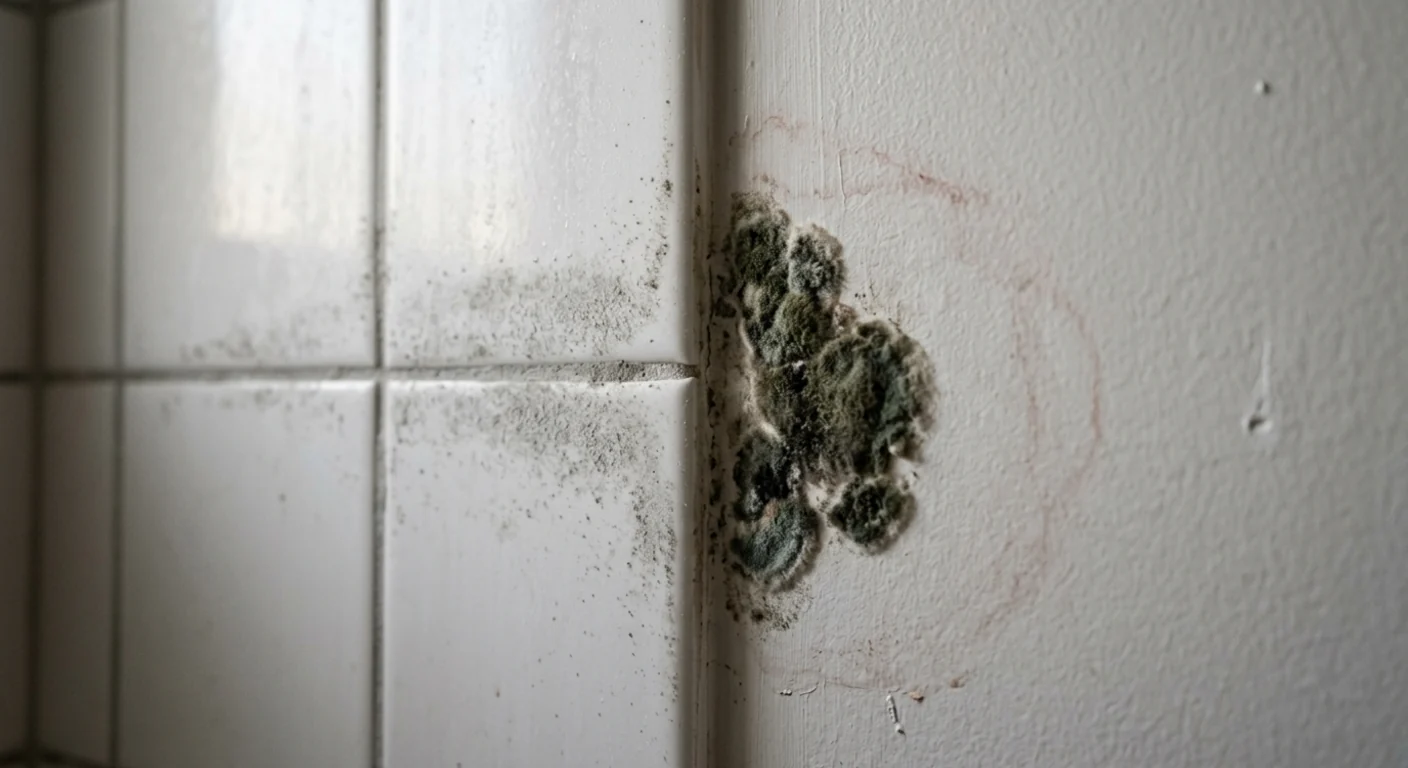
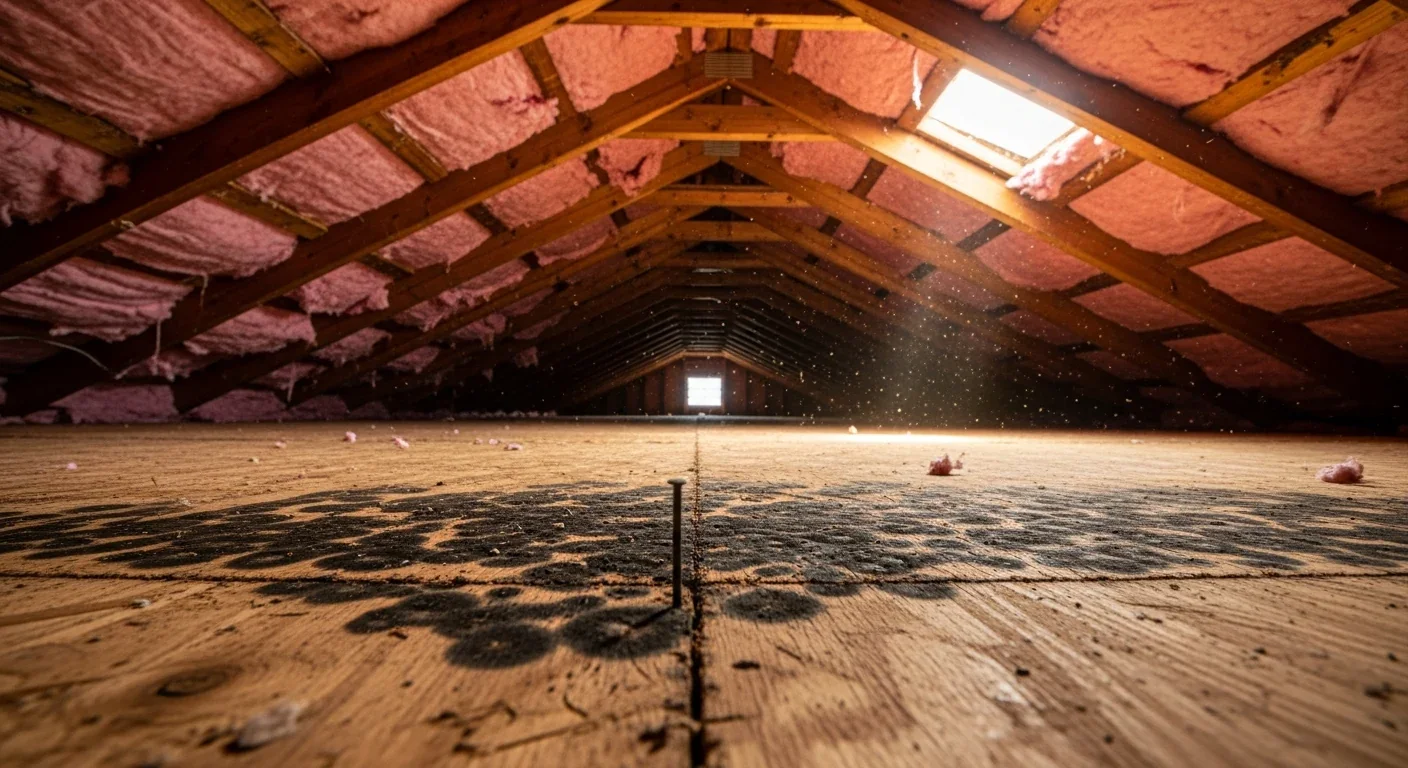
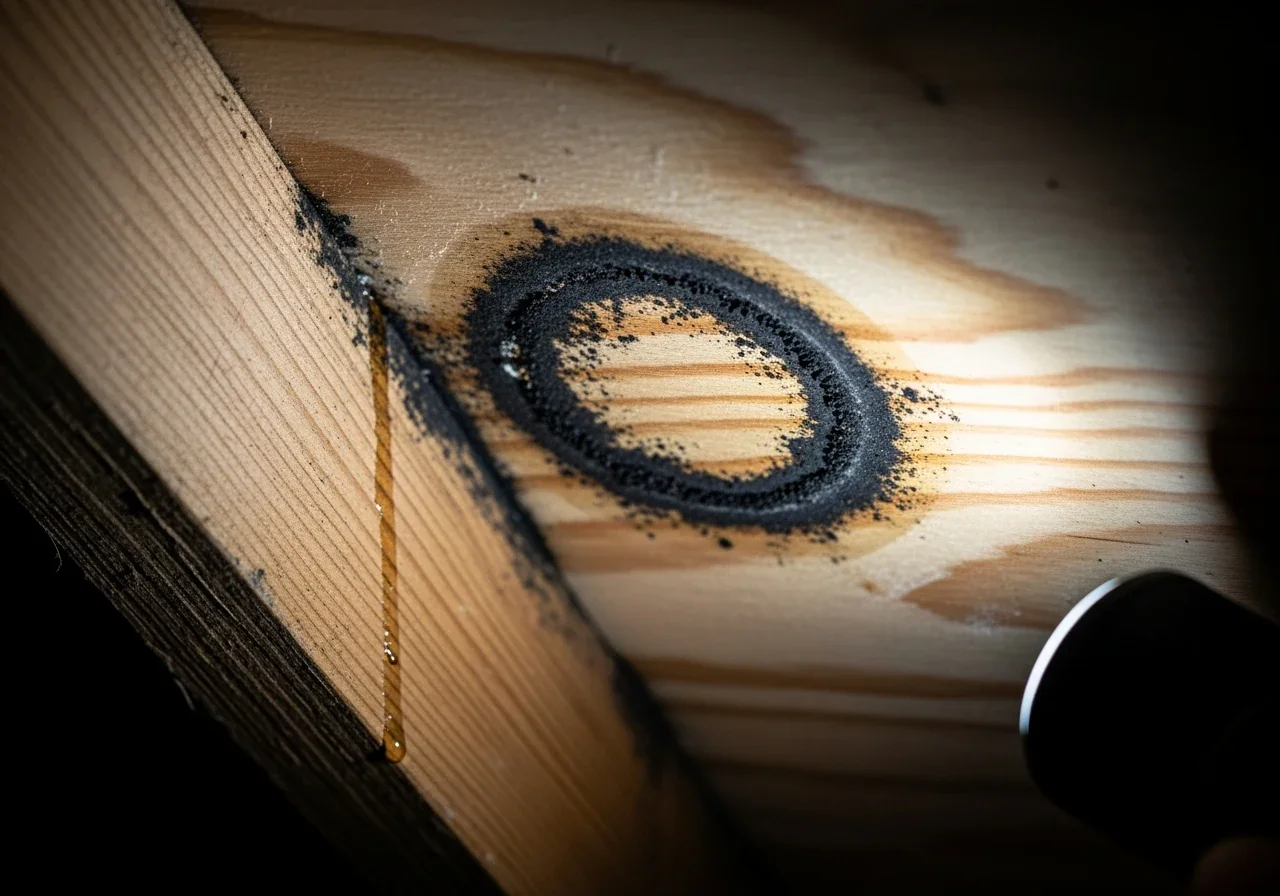
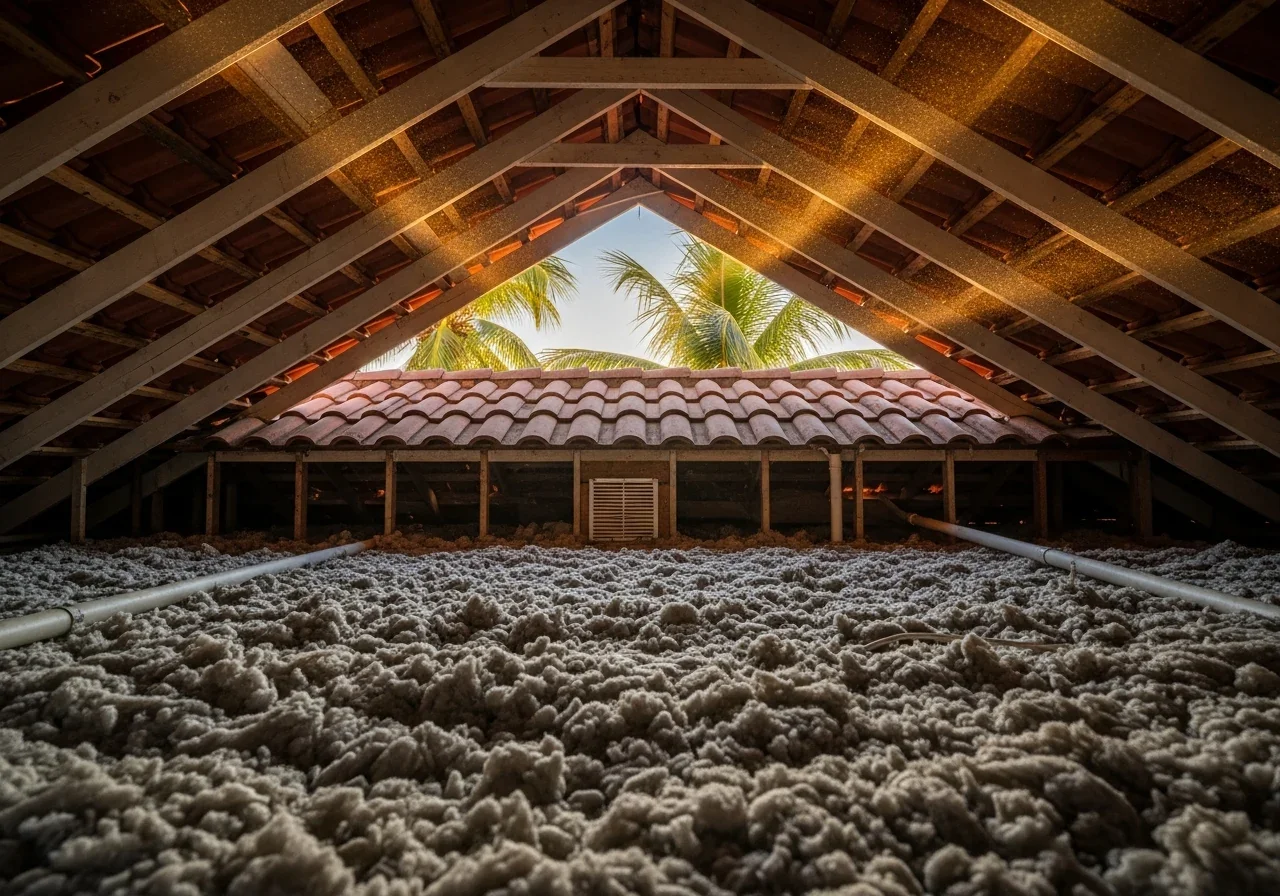
Attic mold rarely announces itself. Most homeowners only notice it during a re-roof, an insulation upgrade, or a real-estate inspection. When it is visible, it usually shows up as dark patches or fuzzy black, gray, or greenish staining on the underside of the roof sheathing, along the rafters, and around any penetration where moisture has a path in — plumbing vent boots, bathroom fan housings, recessed light boxes, attic hatches, and the area directly above bathrooms and laundry rooms. The pattern often follows the path of the moisture: ring-shaped stains under a leak, even discoloration across an entire north-facing slope where condensation has been forming, or concentrated colonies right where a duct dumps warm humid air into the attic.
- Dark, blotchy staining on the plywood roof sheathing or rafters that wipes off with a fingernail
- Musty or earthy smell when you open the attic hatch on a hot day
- Frost on nail tips or sheathing in winter (a sign humid air is reaching the cold deck)
- Stained or sagging insulation under a roof penetration
- Visible water trails or rust on roofing nails coming through the deck
- Recurring stains on a bedroom or hallway ceiling directly below the affected area
The 5 real causes of attic mold (ranked by likelihood)
Almost every attic mold case we see traces back to one of five moisture sources. Identifying which one is in play is the first job — and it determines whether the fix is a roofer, an HVAC tech, an insulation contractor, or a remediation crew.
- 1
Roof leaks and flashing failures
By far the most common cause. Aging shingles, cracked boots around plumbing vents, failed step flashing at chimneys and dormers, and wind-driven rain after named storms all push water into the attic. Florida and Carolina coastal homes see this most after hurricane season — a single afternoon of storm and hurricane damage can introduce enough moisture to start mold within two days, even if the active leak self-seals afterward.
- 2
Bathroom fans and dryers venting into the attic
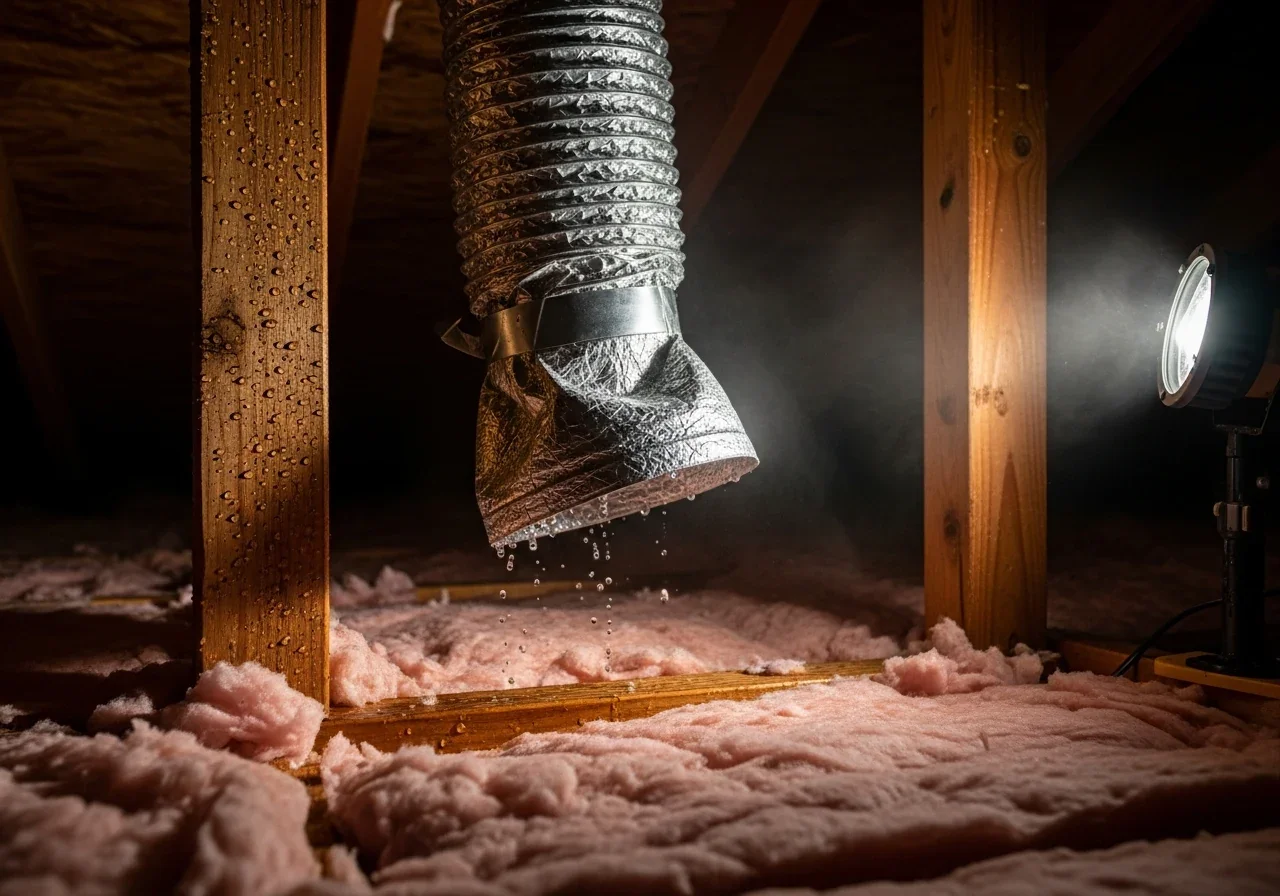
Code requires bathroom and laundry exhaust to terminate outside the building envelope, but in older homes (and plenty of newer ones) the duct ends loose in the attic insulation. Every shower dumps warm humid air directly onto cold sheathing, and the result is a perfectly localized mold colony right above the bathroom.
- 3
Poor attic ventilation
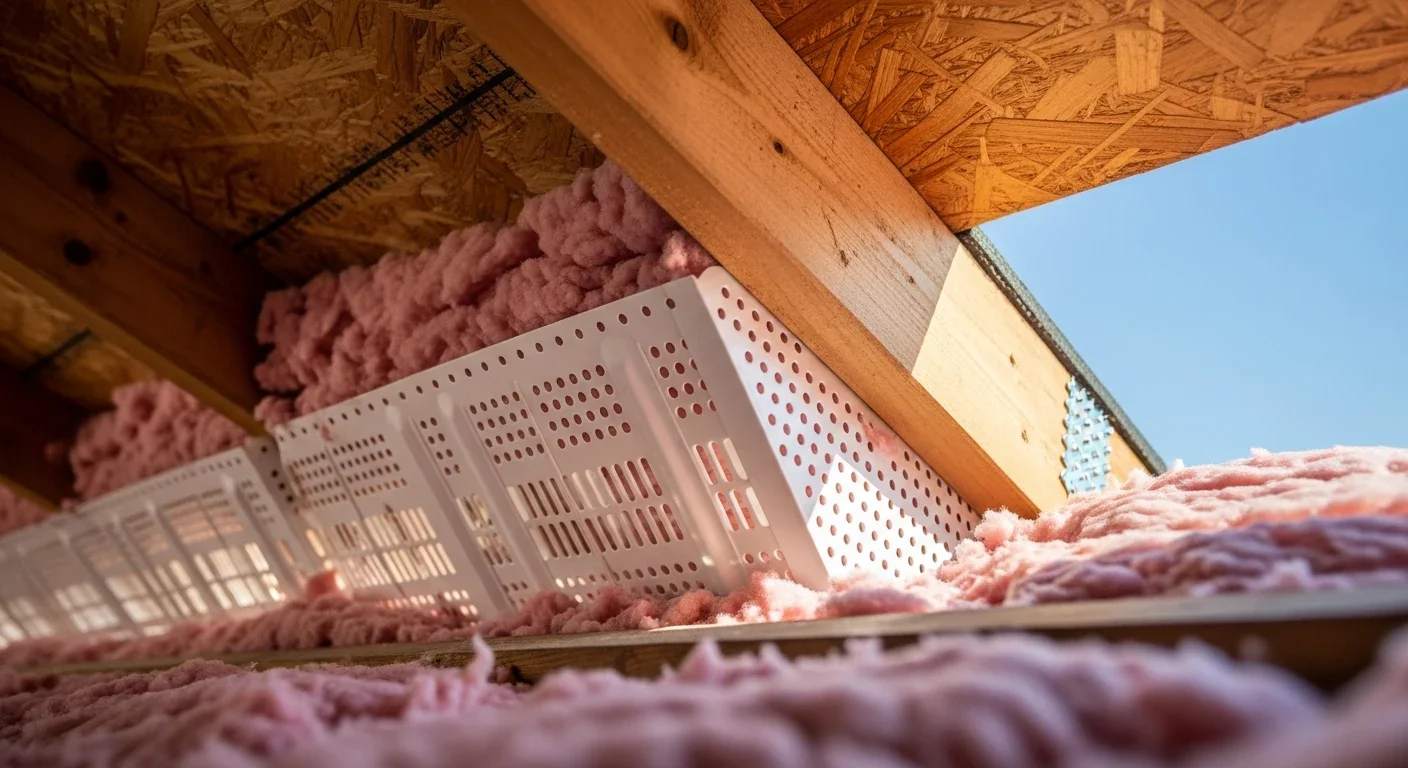
Most residential codes call for a net free vent area ratio of about 1:150 of attic floor area, with an exception that allows 1:300 when intake and exhaust vents are properly balanced. When soffit vents are blocked by paint, debris, or compressed insulation, the attic stops breathing — and humidity has nowhere to go.
- 4
Warm air leaks from the conditioned space
Recessed lights, attic hatches, plumbing chases, top plates, and leaky duct boots all let warm humid air from the house rise into the attic. In humid climates this drives summer condensation on cooled surfaces; in cold-weather snaps it condenses on cold roof sheathing within hours.
- 5
Wet or compressed insulation
Insulation that has been wet from a past leak holds moisture far longer than the surrounding wood. When insulation gets compressed against the underside of the deck or stuffed into the eaves, it both blocks ventilation and traps moisture against the framing. We almost always remove and replace contaminated insulation rather than try to dry it in place.
Why attic mold is a problem even if you never go up there
The most common reaction we hear from homeowners is "it's just the attic — does it really matter?" It does. Attics are not sealed off from the rest of the house. Recessed lights, attic hatches, leaky ducts, and bath fan housings all create air pathways between the attic and the conditioned space below. Warm air rising and cold air falling pulls attic air down through these gaps, which means mold spores from a contaminated attic can quietly become part of your indoor air. In sensitive occupants, that exposure can trigger respiratory irritation, allergy flare-ups, and asthma symptoms — see our guide to black mold health symptoms for the full breakdown of what the medical literature actually supports.
Beyond the indoor air angle, attic mold quietly degrades the structure. Sheathing that stays wet long enough loses strength, fasteners corrode, and rafters can soften where the colonies are most active. By the time a buyer's inspector pulls down the attic ladder during a sale, a small ventilation problem has often turned into a roof-decking replacement quote that derails the closing. Almost every real-estate deal we get pulled into for emergency mold work started as a problem the seller could have fixed for under $4,000 a year earlier.
DIY vs. professional: when to stop and call a pro
EPA guidance is the practical line homeowners look for: small areas of clean-water mold under about 10 square feet can usually be cleaned by a careful homeowner with the right PPE. Anything larger, recurring, contaminated, or tied to a system failure is a professional job — not because the cleaning is hard, but because the moisture diagnosis and the containment are.
DIY can be reasonable when…
- The visible mold is under 10 square feet total
- The moisture source was a one-time clean-water event you have already fixed
- You can wear a fitted N95 or P100 respirator, gloves, and eye protection
- You can isolate the work area and avoid cross-contaminating the rest of the house
- No one in the home is immunocompromised, asthmatic, or under treatment for respiratory illness
Call a professional when…
- The visible mold is larger than 10 square feet or spans multiple rafter bays
- The source is unknown, recurring, or tied to a roof leak you have not yet fixed
- Insulation, ductwork, or HVAC components are involved
- Storm water, sewage, or any non-clean-water source caused the moisture
- Anyone in the household has asthma, allergies, or a compromised immune system
How much attic mold removal actually costs
Attic mold removal cost depends on three things: how much surface area is affected, whether the moisture source has already been fixed, and whether contaminated insulation has to come out. National averages put most attic-only jobs in the $1,000 to $4,000 range. Hidden roof leaks, difficult access, and saturated insulation push that toward $7,000 or higher.
| Scenario | What's typically included | Price range | What pushes it higher |
|---|---|---|---|
| Small, accessible attic with limited growth | Containment, HEPA filtration, surface cleaning, antimicrobial treatment, post-remediation verification | $1,000 – $4,000 | Tight access, multiple trips, larger surface area |
| Attic mold tied to an ongoing roof leak | Remediation plus focused demo of damaged porous materials | Up to $7,000+ | Wet insulation removal, sheathing replacement, repeat moisture intrusion |
| General mold remediation reference (non-attic) | Professional remediation of a localized area | $1,200 – $3,750 (avg ~$2,300) | Behind-wall growth, HVAC involvement, widespread contamination |
| Whole-home or multi-area remediation | Large containment zones, negative air, material removal, rebuild coordination | $10,000 – $30,000 | Structural repairs, long-term wetting, multiple levels |
Typical attic mold removal cost ranges (national averages)
Step-by-step: how professionals remediate attic mold
Every attic mold job a certified team handles follows roughly the same five steps. The order matters — skipping or rearranging them is how mold comes back. For the general version that applies to any room or job type, see what mold remediation actually looks like, step by step.
- 1
Document everything and identify the moisture source
Photograph the affected areas before touching anything, then run a moisture map of the deck, rafters, and insulation. The source has to be identified and corrected first — whether that means a roofer, an HVAC tech, or air-sealing the recessed lights. Without source control, every subsequent step is wasted.
- 2
Protect occupants and reduce exposure during the job
Seal the attic hatch, switch the HVAC fan from ON to AUTO so it stops pulling attic air through the return, and relocate sensitive occupants for the duration of active work. This is also where the team coordinates with the adjuster if the loss is part of a covered claim.
- 3
Build containment and run HEPA air filtration
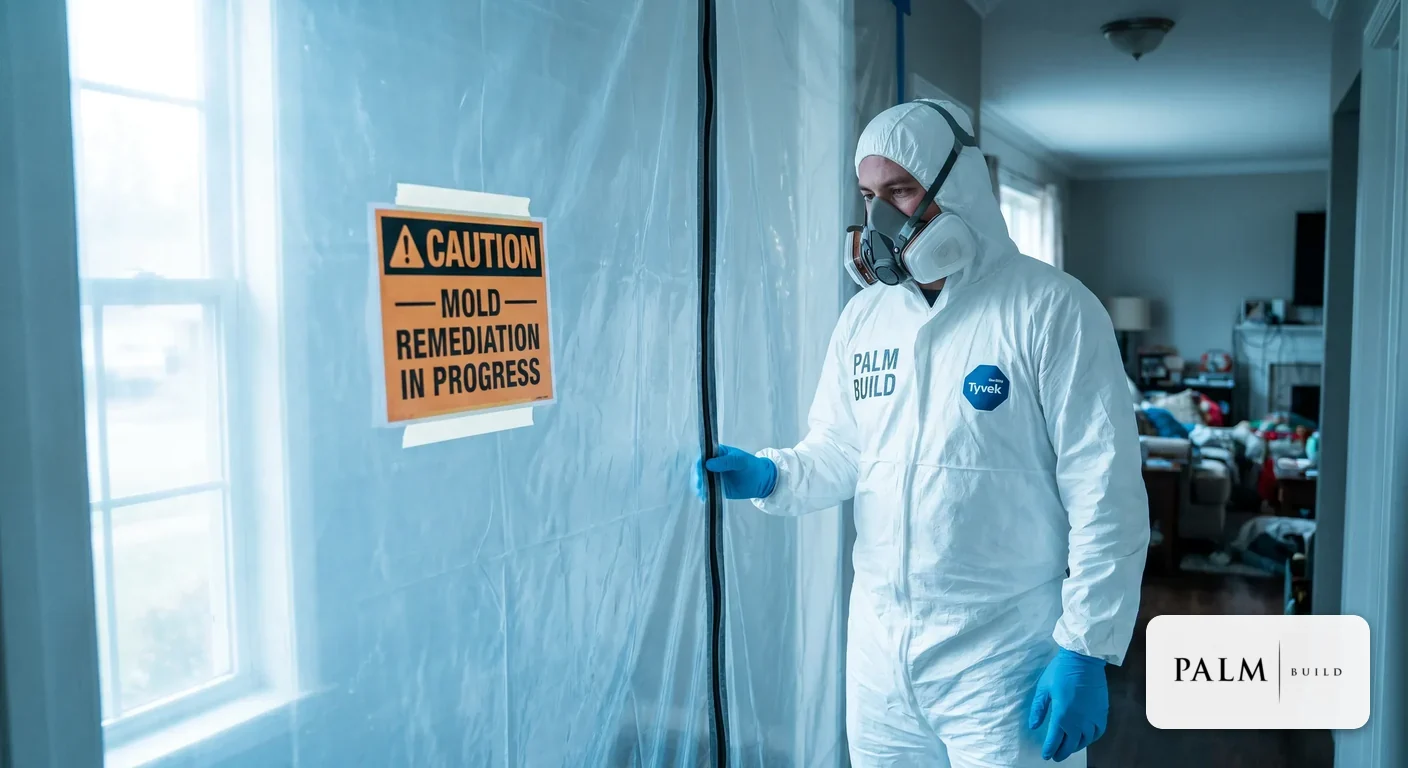
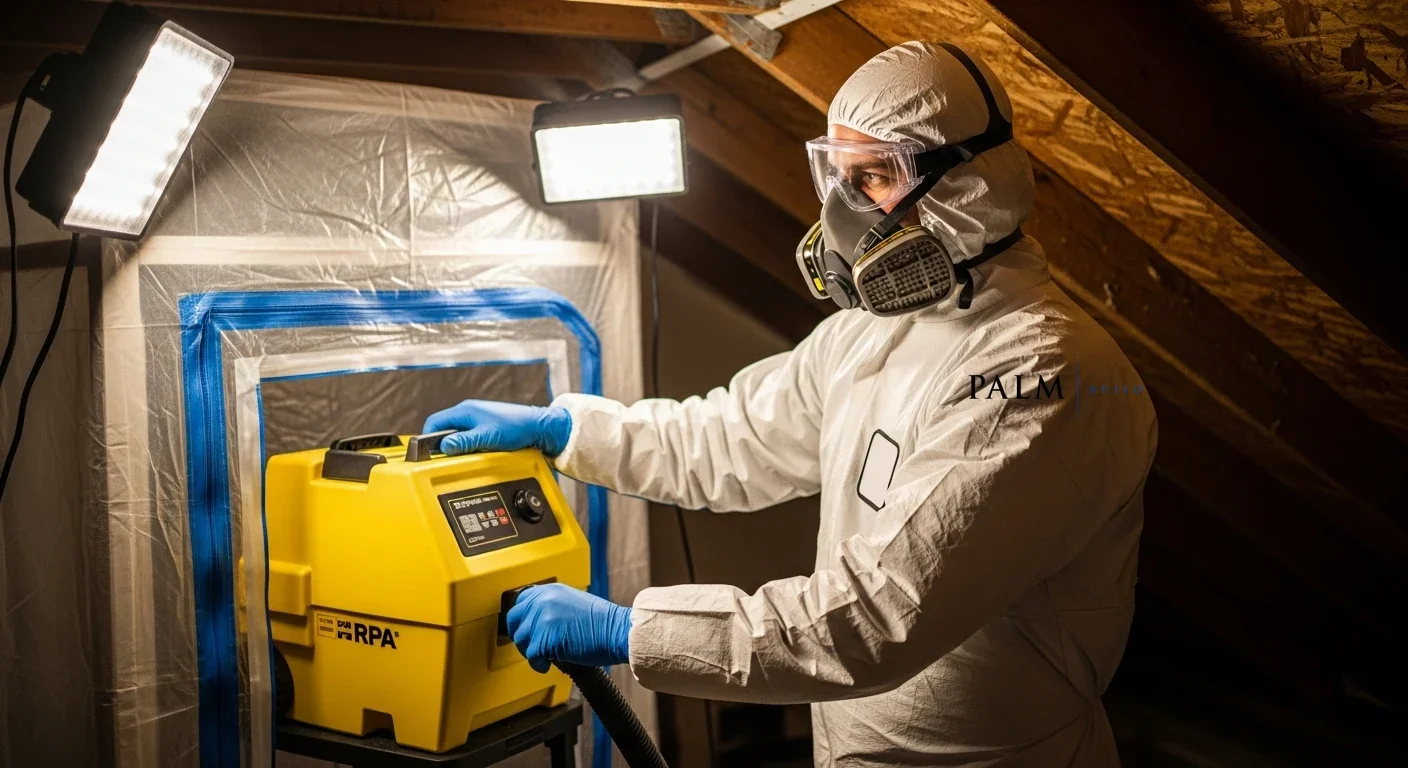
Plastic barriers seal the attic from the rest of the house, negative air machines keep the work area under lower pressure than the surrounding spaces, and HEPA scrubbers run continuously to capture airborne spores. This is the part that separates professional mold remediation from a DIY scrub-and-spray and is the reason cross-contamination is rare on a properly run job.
- 4
Remove or clean contaminated materials correctly
Non-porous materials (framing, sheathing) can usually be HEPA-vacuumed, abrasively cleaned, and treated with an antimicrobial. Porous materials that absorbed moisture — most insulation, some sheathing — get bagged and removed. If wet building materials are involved, the water damage restoration side of the job runs in parallel with the mold work.
- 5
Dry to verification, then prevent the next round
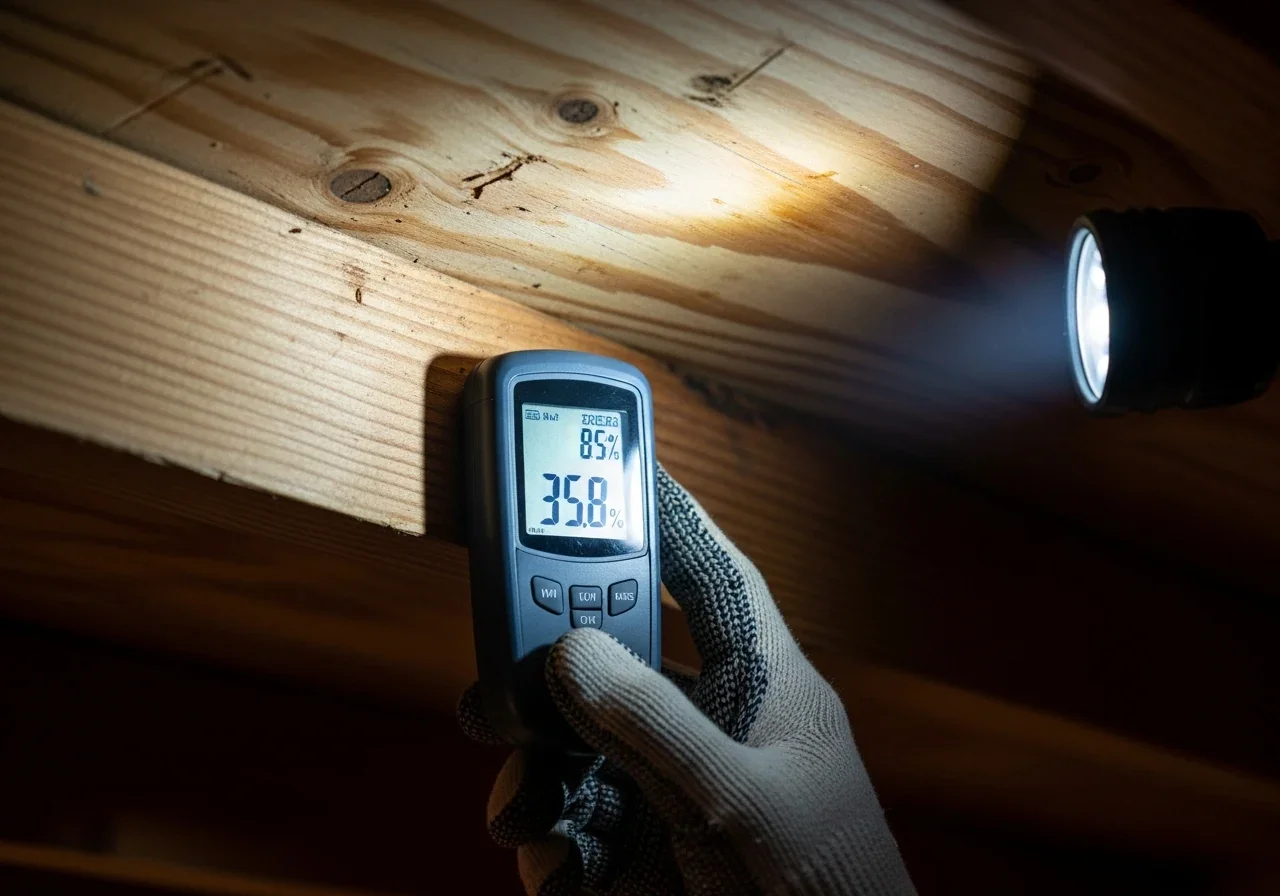
Once the cleaning is done, the team runs structural drying until moisture readings on the framing match unaffected areas of the attic. Only then does the prevention work happen — vent fans rerouted to the exterior, recessed lights air-sealed, soffit baffles reinstalled, and humidity targets dialed in below 60%.
- Reroute every bathroom and laundry exhaust fan to terminate outside the building envelope
- Air-seal recessed lights, attic hatches, and plumbing chases between the attic and the conditioned space
- Confirm soffit vents are open and protected by baffles so insulation cannot block airflow
- Replace wet or matted insulation rather than trying to dry it in place
- Hold attic and indoor humidity below 60% (ideally 30–50%) year-round
- Schedule a roof inspection after every named storm or wind event over 50 mph
Florida vs. North Carolina vs. South Carolina
Attic mold is a national problem, but the specifics of how it shows up — and how it should be handled — change a lot across the Southeast. Climate, licensing, and insurance timing all matter.
Florida: hot-humid, storm-driven, licensed mold assessors
Florida sits in the U.S. Department of Energy's hot-humid climate zone, with South Florida summer dew points routinely in the low to mid 70s and outdoor humidity above 70% for months at a time. That means attics in coastal Florida homes accumulate moisture year-round, and a single afternoon of wind-driven rain through a flashing failure can start a colony in two days. Florida is also one of the few states with a formal mold licensing framework: the Florida Department of Business and Professional Regulation licenses mold assessors and mold remediators separately, and the same firm generally cannot perform an assessment and the remediation on the same property within a 12-month window. On top of that, Florida statutes bar a property claim filed more than 1 year after the date of loss (or 18 months for a supplemental claim), so storm-driven attic mold tied to a hurricane has a real claim deadline. Our guide to Florida mold problems covers the climate angle in depth.
North Carolina: mixed-humid, winter condensation, no state mold licensing
North Carolina spans warm-humid and mixed-humid climate zones, which adds a season Florida homeowners do not deal with: cold-weather condensation. During winter, moisture-laden air leaking up from heated living space hits the cold underside of the roof deck and condenses, then freezes overnight and melts the next morning. That cycle wets the sheathing and rafters with no actual roof leak in sight. North Carolina DHHS recommends keeping indoor relative humidity below 60% to control mold, and explicitly notes that there are no federal regulations governing mold contractors — vetting comes down to certifications, experience, and references. Localized pricing matters: Angi's metro data puts mold remediation cost averages around $2,145 in Raleigh and $2,382 in Charlotte, which is a useful sanity check when comparing quotes.
South Carolina: humid coastal exposure, no licensed mold inspectors
South Carolina shares the Carolinas' humidity load and storm exposure, so the moisture mechanics overlap with both neighbors. The regulatory picture is different: South Carolina does not currently license mold inspectors or remediators, and Orangeburg County and other local government FAQs explicitly say so. South Carolina Emergency Management Division guidance for post-disaster mold recommends verifying contractor licensing through the state's labor licensing and regulation agency before signing anything — important after named storms when out-of-state crews arrive. A 2026 bill was introduced in February to create certification requirements for mold assessment and remediation services in South Carolina. It is not law yet, but it is a useful flag for any 'updated for 2026' guidance — confirm current requirements when hiring.
Frequently asked questions
What causes mold in an attic? +
Is attic mold dangerous if it stays in the attic? +
Can attic mold spread to the rest of the house? +
How quickly should I act after spotting attic mold? +
How much does attic mold remediation cost per square foot? +
Will my homeowners insurance pay for attic mold removal? +
Is attic mold growth always visible? +
When should I call a professional for attic mold remediation? +
Mold Remediation Cost Guide (2026)
Full national and state-by-state pricing for mold remediation across all property types and severities.
How Fast Does Mold Grow After Water Damage?
What the 24–48 hour mold window actually means and how to stay ahead of it.
Humidity and Mold Risk Across FL, NC, and SC
How regional climate differences change the mold risk profile and prevention playbook.
Post-Storm Mold: Why It Starts 48 Hours After Water Recedes
Timeline, claim deadlines, and what to do in the first two days after a storm-driven moisture event.
Professional Mold Remediation
IICRC-aligned containment, HEPA filtration, and verification across Florida, North Carolina, and South Carolina.
Just found mold in your attic?
Palm Build responds 24/7 across Florida, North Carolina, and South Carolina. We identify the moisture source first, contain the work area, and verify the dry standard before we ever pull equipment — so the mold does not come back.
Found this helpful? Send it to someone who needs it.