Quick Answer
In the first 72 hours after a hurricane large-loss event, a professional CAT crew completes pre-landfall staging before the storm passes, then moves immediately into multi-building triage, emergency board-up and tarping, Category 3 water extraction, and generator-powered drying deployment. TPA and adjuster coordination begins within the first day. The goal is to stop ongoing damage, document conditions before demolition, and establish the drying baseline — all within the window where mechanical drying is still cost-effective. In South Florida's HVHZ, where storm surge and sustained wind above 170 mph are design conditions, that window can close faster than in other markets.
Key takeaways
- CAT crews pre-stage before landfall — fuel, generators, equipment, and crew housing arranged in advance — so mobilization begins the moment it is safe to travel, not after an overnight logistics scramble.
- Storm surge and hurricane floodwater is treated as Category 3 (grossly contaminated) under IICRC S500, which changes the extraction, PPE, and demo protocols from a standard water loss.
- Multi-building triage in the first hours prioritizes occupant safety and water intrusion volume, not physical damage aesthetics — the worst-looking building is not always the most urgent.
- TPA and adjuster coordination begins in parallel with mitigation, not after — simultaneous documentation and damage reporting is what keeps a large-loss claim on track.
- South Florida's High-Velocity Hurricane Zone (HVHZ) building code and coastal flood exposure mean structural assessments, permits for emergency repairs, and replacement material sourcing all move on a compressed and sometimes constrained timeline.
A hurricane that crosses South Florida as a major storm can turn dozens of buildings into active large-loss claims before the winds even stop. At that scale, the outcome is not decided by how fast a single crew gets on site — it is decided by how well a CAT-level response was built before the storm arrived. Pre-positioned equipment, secured crew housing, coordinated TPA relationships, and a multi-building triage protocol all have to exist before landfall, because in the first 72 hours everything happens at once. This is an inside look at how large-loss handling actually unfolds in South Florida from the moment a watch is issued to the close of the initial response window.
When CAT crew staging begins — not after the storm passes
Pre-landfall
IICRC S500 water classification for storm surge and hurricane floodwater (grossly contaminated)
Cat 3
HVHZ design wind speed (Broward + Miami-Dade, Florida Building Code)
170–175 mph
Critical window to establish a drying baseline and document conditions before secondary damage sets in
72 hours
Why the First 72 Hours Define the Entire Claim
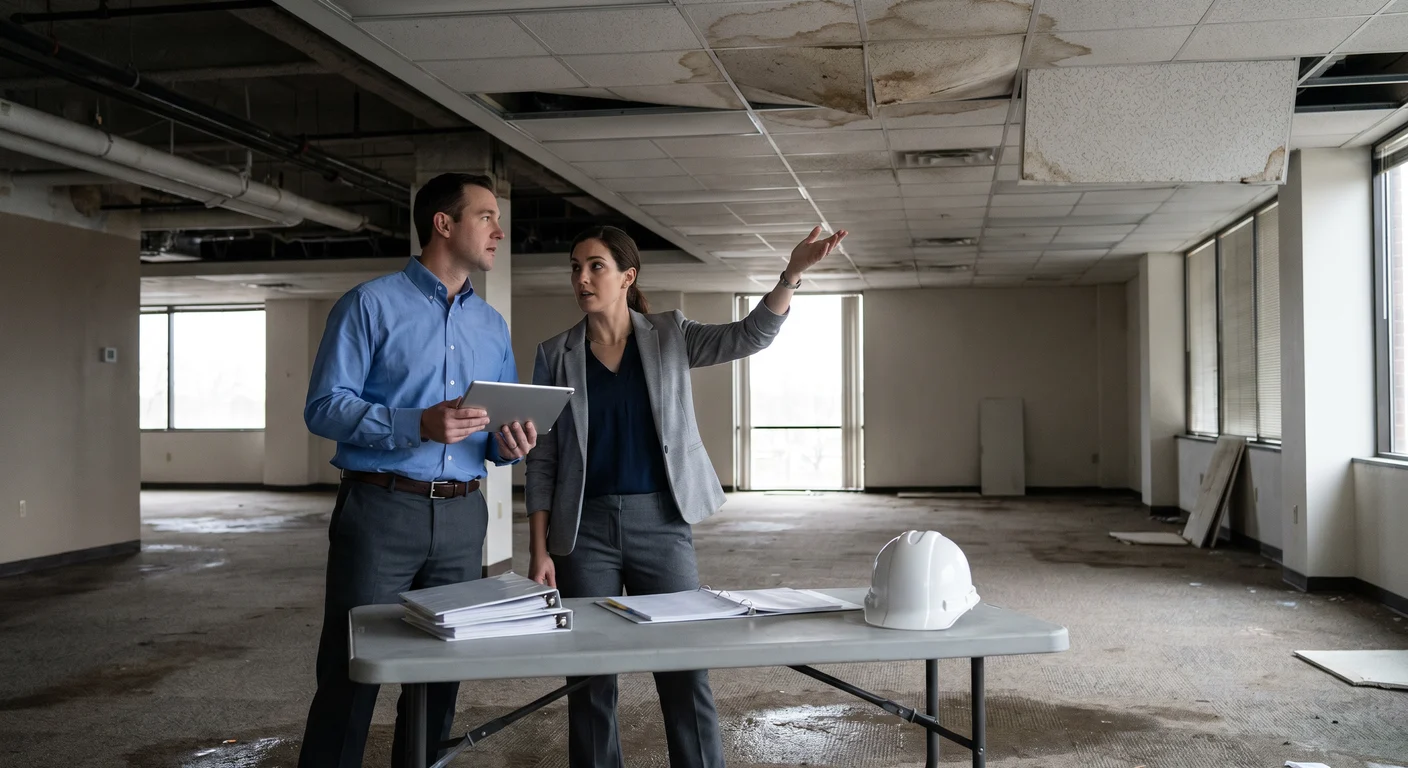
In a standard residential water loss, a crew arrives, extracts standing water, installs drying equipment, and returns for daily moisture readings. A hurricane large-loss event is a different category of problem. You may have a condo association with 40 units in active intrusion, a retail strip with a blown-through storefront and a collapsed roof section, and a neighboring apartment complex whose entire ground floor is under storm surge — all in the same ZIP code, all with the same adjuster on the phone. The insurance carrier, TPA, and property manager are each expecting status updates while extraction is still in progress. The decisions made in the first 72 hours — what gets opened, what gets board-up, what gets extracted versus gutted, and what gets photographed before anything is touched — set the documentation, cost, and timeline for a claim that could run months.
Equally important: storm surge and hurricane-driven floodwater are classified as Category 3 water under IICRC S500 — grossly contaminated, carrying sewage, chemicals, and biohazard material. That means extraction crews wear full PPE, affected porous materials are generally treated as unsalvageable and removed promptly, and the drying protocol is more aggressive than a clean-water leak. Any delay in extraction extends the contaminated wet contact time and typically accelerates secondary microbial growth. In South Florida's summer heat and humidity, that window is shorter than in a dry climate.
South Florida's HVHZ and What It Changes
South Florida — Broward and Miami-Dade counties — sits inside Florida's High-Velocity Hurricane Zone, a designation in the Florida Building Code that applies design wind speeds in the range of 170–175 mph to new construction and major renovations. Older building stock that predates the post-Andrew code era (pre-1994) may not meet current standards. That matters for large-loss response in several ways: structural assessments after a hurricane hit are more complex, emergency repair permits may be needed before board-up or temporary roofing, and replacement materials for HVHZ-compliant envelope repairs (impact-rated windows, specific roof assemblies) can be harder to source when every contractor in South Florida is competing for the same inventory after a regional event.
Coastal elevation and flood-zone mapping add another layer. Much of the low-lying coastline in coastal Broward — Dania Beach, Hallandale Beach, and Lighthouse Point — and in Miami-Dade's Aventura falls within FEMA-designated Special Flood Hazard Areas (SFHAs). Storm surge elevation projections from the National Hurricane Center directly inform how fast flood levels rise and what floors are at risk in a multi-story building. A CAT crew that operates regularly in South Florida pre-loads those flood-zone maps into its triage protocol.
The 72-Hour CAT Response Timeline
Here is how the first 72 hours of a hurricane large-loss response actually unfolds — from the moment a watch is issued through the handoff to structured program management. The timeline below reflects what a well-organized CAT operation runs through. Individual steps may overlap; in a multi-building event, the triage crew may be running board-up on one property while a second extraction crew is already deploying drying equipment three blocks away.
T-minus 48–72 hours: Pre-landfall staging
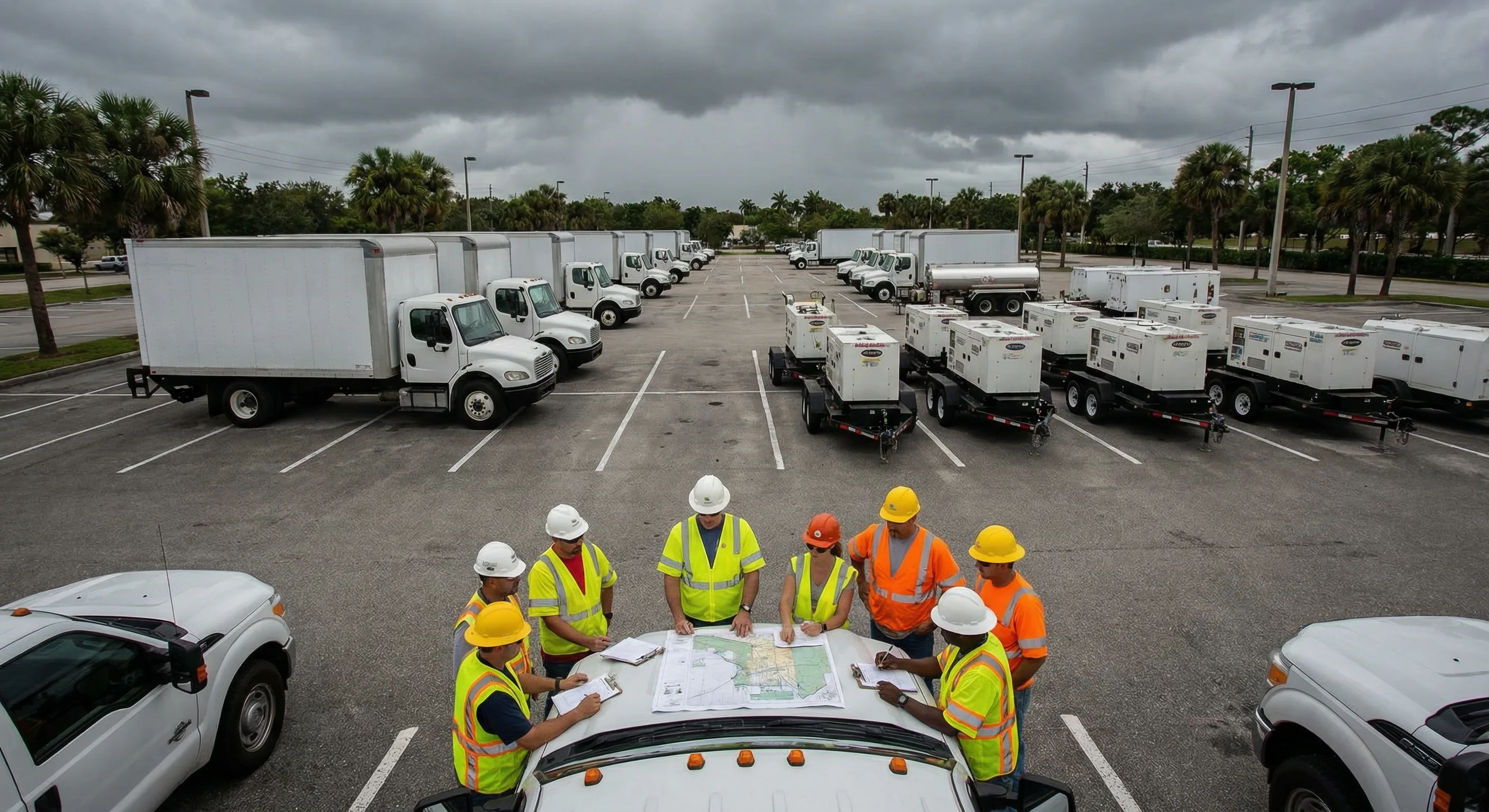
When the National Hurricane Center upgrades a watch to a warning and a track threatens South Florida, staging begins immediately. This means: fuel all generators and equipment, load extraction trucks and drying trailer banks, confirm crew housing well inland of the projected surge zone, establish contact with TPA partners and insurance program managers, and verify vehicle positioning so crews can reach active properties the moment road conditions allow. Pre-stage inventory of board-up panels, tarps, poly sheeting, PPE, and extraction consumables — supply chains lock up fast after a regional event.
Hour 0–4: All-clear and damage reconnaissance
Once winds drop below a safe threshold and roads are passable, the first units move. The initial pass is reconnaissance: document visible structural damage, water intrusion points, utility status, and access routes at each property in the portfolio. Photographs and video taken before any mitigation work has started are irreplaceable documentation for insurance. Do not begin extraction on any building where the structure is in question — a compromised roof or floor deck is a crew safety issue that overrides everything else.
Hour 4–16: Emergency board-up, tarping, and water cutoff
Buildings with open roof sections, blown-out windows, or breached envelopes get emergency board-up and tarping immediately. Every hour an opening remains exposed to post-storm rain adds Category 3 water volume to a building that may already be managing surge. Simultaneously, the crew locates and shuts main water supplies on any building where supply-line failures have compounded the storm damage — a burst pipe layered on top of surge intrusion doubles the extraction scope.
Hour 8–24: Category 3 extraction at scale
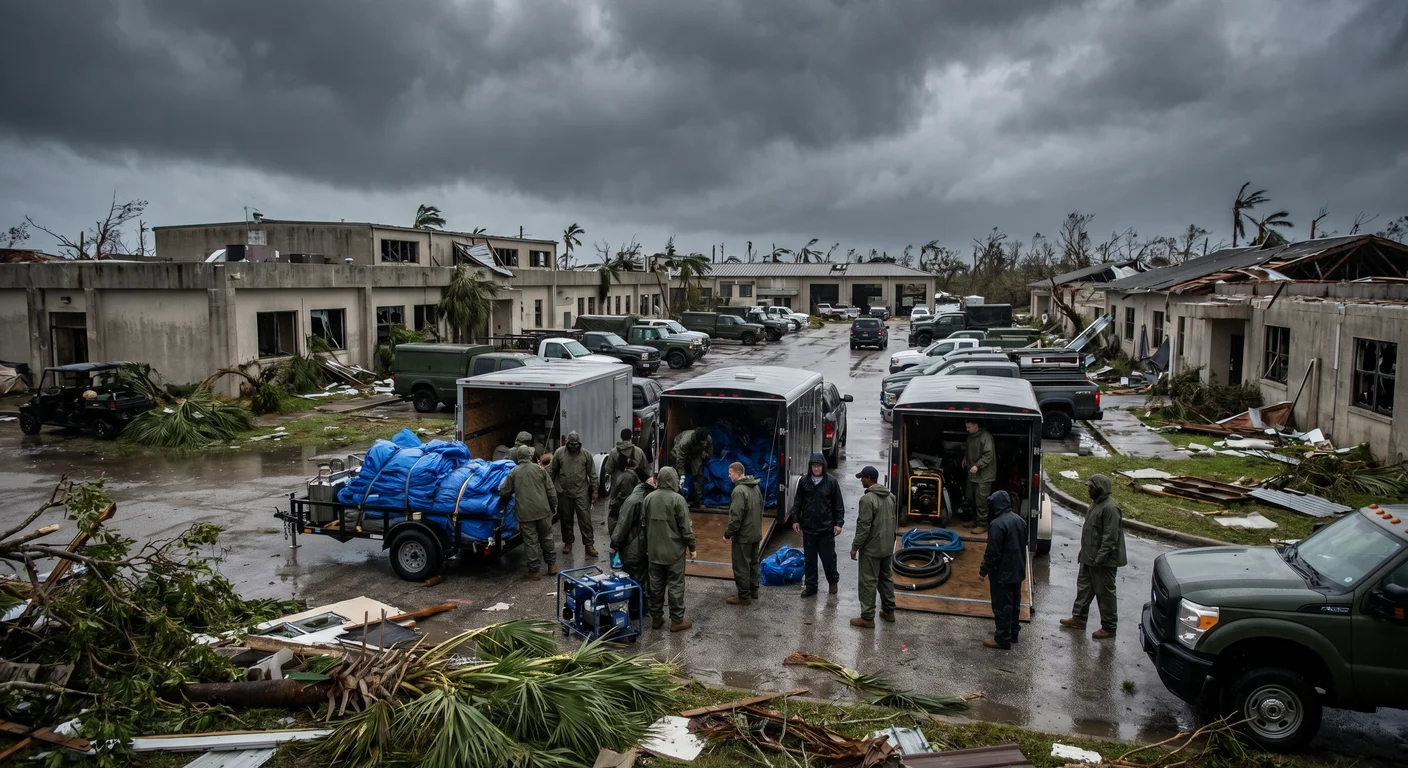
Extraction begins on confirmed standing-water floors with truck-mounted or trailer-mounted units capable of high-volume pull. Storm surge water is treated as Category 3 throughout: full PPE, no foot-traffic from unprotected personnel, and affected porous floor and wall assemblies are typically marked for removal rather than drying in place. Portable extraction units follow in rooms or floors inaccessible to trailer equipment. As each unit is extracted, air movers and dehumidifiers deploy — the drying clock starts the moment extraction ends.
Hour 16–48: Multi-building triage and drying deployment
With the acute extraction phase underway, project managers and TPA liaisons conduct a prioritized building-by-building triage: intrusion severity, occupant displacement, structural concerns, and damage category are logged in a format the adjuster can use directly. Drying equipment is load-balanced across properties based on measured wet square footage, ambient conditions, and the drying target established per IICRC S500 protocols. Moisture readings are logged at each affected building as a baseline for the monitoring record.
Hour 24–72: TPA, adjuster, and program-management coordination
From hour 24 onward, documentation and adjuster coordination runs in parallel with active mitigation. This means daily photo logs by unit or floor, moisture readings tied to building and date, scope-of-work documentation for each property, and a CAT report the TPA can reconcile against field observations. In a South Florida multi-building event, an insurance program manager may be coordinating simultaneous claims across a condo association, a commercial strip, and residential properties — the restoration PM's job is to make the adjuster's job faster, not slower.
Multi-Building Triage: How Priorities Get Set
When a large-loss response spans multiple properties simultaneously — a common scenario in dense coastal Broward — the biggest visible damage is not always where crews go first. Triage logic is built around intrusion volume per unit time, occupant safety, and the cost of delay. A unit with 6 inches of standing surge water requires more immediate action than a unit with a roof penetration and no active rainfall, even if the roof damage looks more dramatic. A well-run CAT response assigns a severity tier to each building in the first reconnaissance pass and dispatches extraction resources in priority order.
In South Florida, the triage list often includes properties across multiple coastal jurisdictions in the same 72-hour period. Properties in Dania Beach and Hallandale Beach tend to experience storm surge from both ocean and intracoastal exposure. Lighthouse Point's canal network means that even buildings not directly adjacent to open water can see interior flooding when canals overtop. Aventura, in Miami-Dade County rather than Broward, often experiences both surge and high-rise envelope failures, adding vertical multi-floor triage to the list. Palm Build's large-loss handling coverage in Aventura, Dania Beach, Hallandale Beach, and Lighthouse Point accounts for these geographic and hydrological differences in deployment planning.
TPA and Adjuster Coordination in a CAT Event
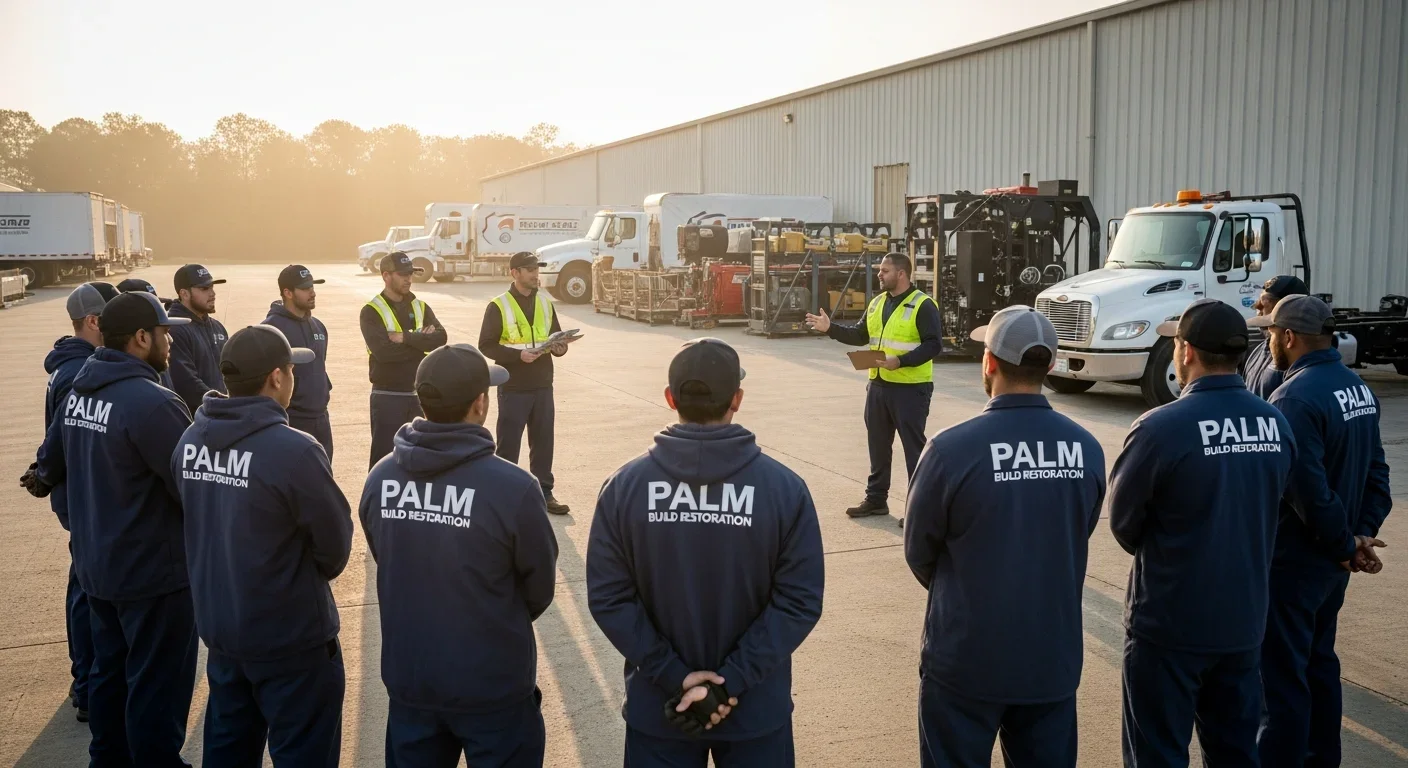
Third-party administrators (TPAs) coordinate between carriers and restoration vendors on complex commercial or multi-unit claims. In a hurricane large-loss event, TPA involvement typically begins before or immediately after mitigation starts, not after a claim is filed and reviewed. From the first site entry, documentation is built for the adjuster: geotagged photo sets by unit and floor, moisture readings with equipment identifiers, a preliminary scope of work, and a CAT event report summarizing conditions across the portfolio.
The practical consequence for property owners and managers: if your restoration vendor is not already familiar with TPA workflows and insurance program documentation requirements, the first large-loss event will be a costly learning curve. Supplements — additional scope items discovered after initial adjustment — are common in hurricane damage, especially where wall cavities, sub-floor assemblies, and structural elements have to be opened to complete drying. A PM who knows how to document and present supplements clearly reduces back-and-forth with the adjuster and shortens the overall claim cycle.
What Happens After Hour 72
The end of the 72-hour window does not mean the response is over — it marks the transition from emergency response to structured program management. Drying continues under daily monitoring until materials reach verified targets per IICRC S500 (typically 3–5 days on light intrusion, longer on Category 3 and structural saturation). Demolition of unsalvageable materials follows, and the scope-of-work documentation for reconstruction services is built from the post-demo assessment. In a major hurricane event, reconstruction queues can stretch weeks or months, making documentation completeness at the mitigation phase directly valuable to the rebuild timeline.
For multi-building condo or commercial properties, the complexity extends: individual unit-owner claims interact with the association's master policy, permit requirements for structural repairs in the HVHZ tier apply, and material lead times for impact-rated replacements can be significant when regional supply is strained after a major storm. The foundation of a smooth rebuild is the quality of the documentation assembled in the first 72 hours — scope, photos, moisture logs, and adjuster-ready CAT reports.
| Decision | Why it matters |
|---|---|
| Pre-landfall staging location and inventory | Determines whether mobilization is in hours or days post-storm — supply chains and roads lock up fast |
| Category classification of floodwater (Cat 3) | Dictates PPE, demo scope, and salvage feasibility for porous materials under IICRC S500 |
| Triage priority assignment per building | Limits secondary damage accumulation; the wrong priority order wastes crew time and increases total loss |
| Pre-demo photo and moisture documentation | Creates the adjuster record — undocumented damage is routinely disputed or underpaid in supplement review |
| TPA contact and report format alignment | Determines how fast supplements are processed and whether the claim cycle runs in weeks or months |
Key decisions made in the first 72 hours and why they matter for the full claim.
Frequently Asked Questions
When does a hurricane claim qualify as a 'large loss'? +
Is hurricane floodwater really Category 3? +
Can a restoration company start work before the adjuster inspects? +
How do I prepare a commercial or condo property before hurricane season? +
What is the difference between emergency mitigation and reconstruction after a hurricane? +
Related Guides & Next Steps
Large-Loss Handling
CAT-capable multi-building response, TPA coordination, and program management for South Florida hurricane and catastrophe claims.
Large-Loss Response: Dania Beach, FL
Hurricane and large-loss CAT coverage for Dania Beach's coastal and intracoastal properties.
Large-Loss Response: Hallandale Beach, FL
Multi-building CAT response and adjuster coordination for Hallandale Beach storm and catastrophe claims.
Large-Loss Response: Lighthouse Point, FL
CAT-level hurricane response for Lighthouse Point's canal-network and coastal properties.
Large-Loss Response: Aventura, FL
Hurricane large-loss and multi-building CAT coverage for Aventura's high-rise and mixed-use properties in Miami-Dade.
National Hurricane Center
Official storm track, surge projections, and hurricane watch and warning data from NOAA's National Hurricane Center.
Hurricane season is not the time to find out you don't have a CAT plan.
Palm Build's large-loss handling team is CAT-deployed, TPA-ready, and operating across South Florida. Whether you manage a condo association, a commercial portfolio, or a large residential property, we can establish a pre-authorization and build your emergency response protocol before storm season.
Found this helpful? Send it to someone who needs it.