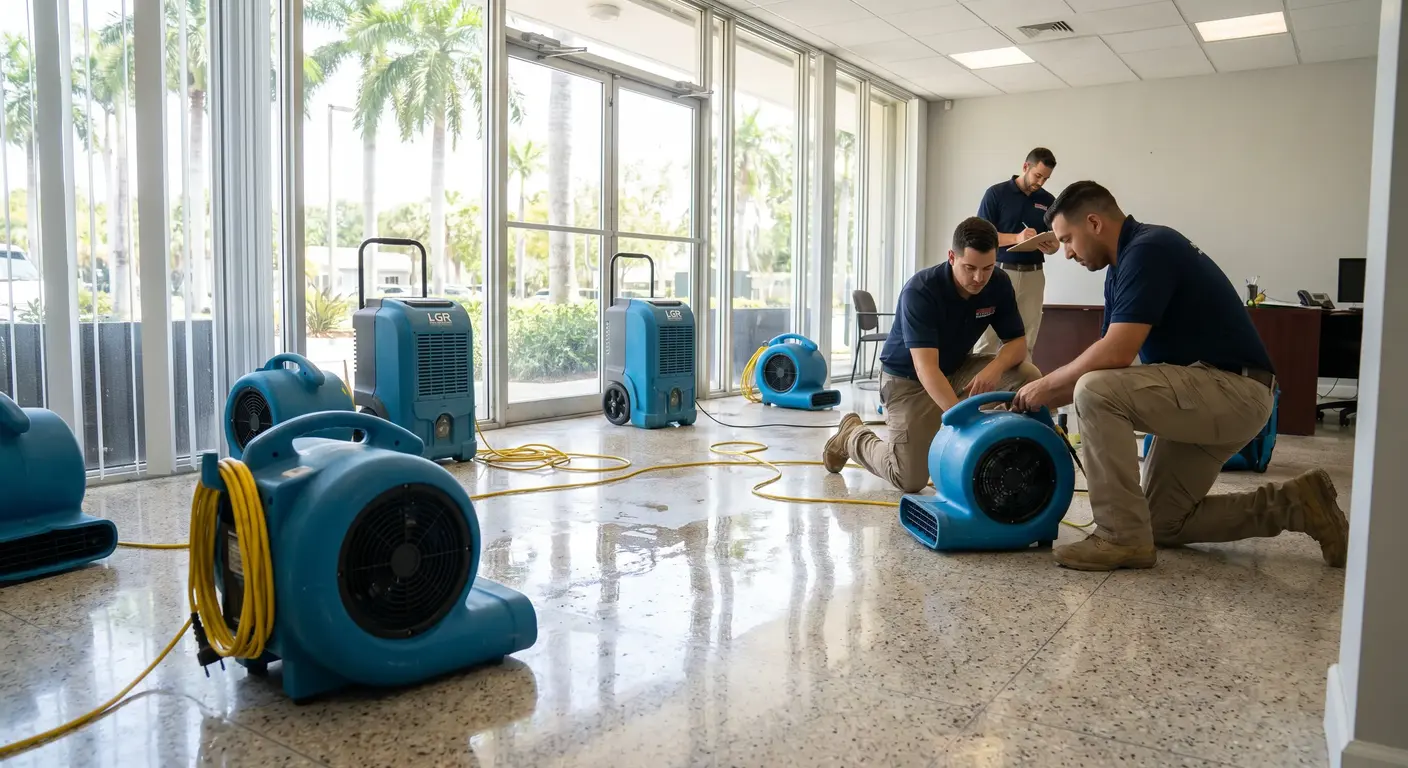
When damage exceeds $500,000, cascades through dozens of luxury condo units at Williams Island or Turnberry Isle, or a Category 4 hurricane pushes Biscayne Bay surge through Intracoastal seawalls into bayfront towers across Miami-Dade's most exclusive coastal community, Aventura demands catastrophe-scale restoration. Palm Build deploys from our Deerfield Beach hub with surge capacity, multi-carrier insurance coordination, FEMA-declaration experience, and the high-rise project management infrastructure to handle the most complex restoration events this city produces.
Deerfield Beach — approximately 25 miles from Aventura 30-40 min Response IICRC Certified
Aventura's combination of luxury high-rise condo towers on Biscayne Bay, direct
hurricane and storm surge exposure in Miami-Dade's HVHZ, one of South Florida's premier
commercial corridors, and FEMA Zone AE designation creates a large loss risk profile
that demands catastrophe-scale restoration capability. When a major event strikes these
towers, the damage is measured in millions — and the complexity of high-rise HOA
coordination, multi-carrier condo claims, and Miami-Dade code compliance determines
whether recovery takes months or years.
High-Rise Condo Tower Concentration
50+
High-rise towers on Biscayne Bay
Aventura's bayfront communities — Williams Island, Turnberry Isle, Porto Vita, and Mystic Pointe — are dense with luxury high-rise condo towers where a single pipe failure, fire suppression discharge, or window breach during a hurricane can cascade vertically through elevator shafts, plumbing risers, and stairwells, affecting 10–50+ units simultaneously. Each unit carries separate HO-6 insurance alongside the association's master policy and potentially sub-association coverage. Miami-Dade's 40-year recertification requirements and post-Surfside milestone inspection mandates add regulatory complexity to every large-scale event in these buildings.
Biscayne Bay Surge & Tidal Flood Exposure
Zone AE
FEMA Special Flood Hazard Area
Aventura's bayfront position on Biscayne Bay in FEMA Zone AE creates storm surge exposure that is among the most severe in Miami-Dade County. Bayfront towers at Williams Island and Porto Vita face direct Biscayne Bay surge during named storms, pushing saltwater classified as IICRC S500 Category 3 — grossly contaminated — through lower-floor units, parking structures, and common areas. Sea-level rise is increasing tidal baseline levels, compressing the buffer between normal high tide and surge-driven flooding events. Salt-air corrosion on curtain-wall systems, HVAC components, and electrical infrastructure adds a secondary long-term damage vector that extends restoration scope well beyond standard water damage.
Hurricane Surge & 175 mph Wind Exposure
~175 mph
Miami-Dade HVHZ design wind
Aventura sits in Miami-Dade County's High-Velocity Hurricane Zone (HVHZ), where design wind speeds reach approximately 175 mph under ASCE 7-22 / FBC 8th Edition. Every exterior product installed on these towers must carry a Miami-Dade Notice of Acceptance (NOA) — requiring large- and small-missile impact testing per TAS 201/202/203. When a major hurricane strikes, storm surge from Biscayne Bay, curtain-wall pressurization failures, and vertical riser cascade combine simultaneously across dozens of towers — creating mass-loss conditions that overwhelm standard-capacity restoration companies within hours. A direct Cat 4 hit on this coastline would be one of the most costly urban restoration events in Florida history.
Aventura Mall & Biscayne Blvd Commercial Corridor
$500K+
Typical large loss threshold
Aventura Mall — one of the largest shopping centers in the United States — and the Biscayne Boulevard (US-1) commercial corridor contain luxury retail, high-end restaurants, Class A office buildings, and mixed-use developments. A single commercial fire in this corridor can produce $500,000–$2M+ in structural, inventory, and business interruption losses. Hurricane wind damage across the corridor creates simultaneous large losses at dozens of businesses, each with separate commercial property policies, business interruption coverage, and complex landlord-versus-tenant insurance responsibilities. The density and dollar value of assets in this corridor give Aventura a commercial large-loss exposure profile that rivals Miami Beach.
Neighborhood Risk Profiles
Large Loss Risk by Aventura Area
Not every Aventura neighborhood faces the same large loss exposure. Bayfront high-rise
towers, luxury commercial corridors, and gated residential communities each produce
different categories of catastrophic damage under Miami-Dade's HVHZ standards.
Understanding your community's specific risk profile determines the restoration
capability you need when a major event strikes.
Guard-gated luxury high-rise community on the Intracoastal Waterway with direct Biscayne Bay exposure. FEMA Zone AE. Storm surge enters lower lobbies and parking structures during major hurricanes. Curtain-wall failures on upper floors trigger vertical riser cascade across multiple units simultaneously. Miami-Dade NOA-compliant materials required for all exterior work; ~175 mph design wind governs all reconstruction.
Resort-anchored luxury high-rise community with bayfront and Intracoastal towers. A single hurricane event can trigger simultaneous curtain-wall failures across multiple buildings, with water cascading through 30–50 floors of shared riser systems. Master-policy coordination for the HOA plus individual HO-6 claims for each unit means large loss events commonly involve 15+ insurance carriers. Miami-Dade 40-year recertification adds regulatory complexity to post-event reconstruction.
Typical Loss: $500K - $5M+
Porto Vita
Critical
Threats: Bayfront surge, saltwater intrusion, salt-air systems damage
Ultra-luxury bayfront high-rise on the east side of the Intracoastal, fully exposed to Biscayne Bay storm surge. Saltwater intrusion classified as IICRC S500 Category 3 requires complete demolition and replacement of all porous materials, HVAC systems, and electrical components in affected areas. Salt-air corrosion on balcony railings, curtain wall framing, and rooftop mechanical systems is an ongoing secondary damage driver between major events.
Typical Loss: $500K - $5M+
Mystic Pointe
High
Threats: High-rise vertical cascade, wind, multi-unit HOA events
Multi-tower high-rise community near the Intracoastal with significant hurricane wind exposure. Vertical cascade events — where a single supply line or roof-drain failure affects multiple floors simultaneously — are the primary large loss driver outside of named storms. HOA master policy coordination, individual unit owner HO-6 claims, and the logistics of working in occupied high-rise towers make these events among the most operationally complex in Miami-Dade.
Typical Loss: $300K - $3M+
Aventura Mall / Biscayne Blvd
High
Threats: Commercial fire, wind damage, business interruption
High-value commercial corridor anchored by Aventura Mall, one of the largest shopping centers in the U.S., with luxury retail, Class A office, and high-end dining throughout. A single commercial fire can trigger $500K–$2M+ in damage across connected units. Hurricane wind damage causes simultaneous losses at dozens of businesses, each with separate commercial property and business interruption policies. Reconstruction must meet City of Aventura and Miami-Dade County permitting standards.
Gated single-family and townhome community with CBS construction. Hurricane wind events damage multiple barrel-tile roofs simultaneously, creating HOA-wide large loss events affecting dozens of properties at once. Lower-lying areas experience stormwater flooding during major rain events. Reconstruction follows Miami-Dade HVHZ standards — Miami-Dade NOA products, ~175 mph wind-load engineering, and City of Aventura building department permitting.
Typical Loss: $300K - $2M+
Biscayne Bay Surge Simulation
What a Category 4 Hurricane Means for Aventura
This is not hypothetical fear — it is engineering reality. Biscayne Bay storm surge
simulations show a Category 4 hurricane pushing 8–12 feet of water through the
Intracoastal Waterway into Aventura's bayfront towers. Combined with ~175 mph design
winds shredding curtain-wall glazing, saltwater surge flooding lower-floor condo units
and parking structures, and simultaneous commercial corridor damage along Biscayne
Boulevard, a direct Cat 4 hit on Aventura would create the largest mass-loss event in
the city's history. Here is what that timeline looks like.
H-24
Storm Approach
Category 4 hurricane forecast to make landfall near the Miami-Dade coast. Miami-Dade Emergency Management orders mandatory evacuation for Zone A — including bayfront communities at Williams Island, Porto Vita, and Intracoastal-front towers in Aventura. Biscayne Bay water levels already elevated from outer-band rain. Palm Build pre-stages equipment trailers and activates out-of-region crew surge deployment from our national mutual aid network.
H-6
Outer Bands Arrive
Tropical storm force winds reach Aventura. Sustained 50–70 mph gusts begin testing curtain-wall glazing on bayfront towers. Rain bands deliver 4–6 inches per hour. The Intracoastal Waterway and Biscayne Bay begin rising visibly. Storm drains in lower-elevation areas back up. Power outages begin across western Aventura as transformers fail under wind load.
H-0
Eyewall Impact
Category 4 winds pound Aventura's bayfront towers. Biscayne Bay surge of 8–12 feet pushes through the Intracoastal Waterway, overtopping seawalls at Williams Island and Porto Vita. Surge water enters lobby levels and parking structures of bayfront towers. Curtain-wall failures on windward upper floors of towers at Turnberry Isle allow wind-driven rain to cascade through multiple floors simultaneously. The Aventura Mall sustains roof damage across multiple wings. Salt-classified floodwater reaches streets inland from the Intracoastal.
H+4
Eye Passage & Second Wall
Brief calm during eye passage. Surge water does not recede — Biscayne Bay continues pushing water through the Intracoastal into bayfront communities. Second eyewall arrives from the opposite direction, striking tower faces already compromised by the first wall. Towers at Mystic Pointe that sustained partial curtain-wall failures now experience internal pressurization, driving water deeper into unit interiors and elevator shafts.
H+12
Storm Departure
Winds drop below hurricane force. Biscayne Bay surge begins slow recession but Intracoastal remains elevated. Bayfront access roads at Williams Island and Porto Vita are impassable. Saltwater contamination is present in hundreds of units across multiple towers. Emergency services overwhelmed by simultaneous calls across Miami-Dade. Only restoration companies with post-hurricane re-entry credentials and established Miami-Dade permitting relationships can begin response.
H+24
Mass-Loss Reality
Assessment reveals the scope: thousands of condo units across Aventura's bayfront towers have sustained combined wind, surge, and saltwater damage. The Aventura Mall corridor has multiple roofing failures. Bayfront communities from Williams Island to Turnberry Isle have ground-floor and parking structure saltwater intrusion requiring full-system demolition per IICRC S500 Category 3 protocols. Mold colonization begins in Miami-Dade's heat and humidity within 24–48 hours. Every restoration company serving Miami-Dade County is at capacity. Wait times for under-resourced firms: 3–6 weeks. The difference between catastrophe-capable companies and the rest defines who recovers in months versus years.
This Will Happen — The Question Is When
Aventura has not taken a direct Category 4 hit in modern memory — but the city sits on
Biscayne Bay in Miami-Dade County, one of the most hurricane-exposed coastal positions
in the continental United States. Sea-level rise is increasing baseline tidal
elevations, reducing the margin between normal high tide and surge-driven flooding. The
next major Miami-Dade hurricane will create mass-loss conditions across Aventura's
bayfront towers that overwhelm every under-resourced restoration company in South
Florida. The partner you choose before the storm determines how quickly you recover
after it.
Aventura produces four distinct categories of large loss events, each requiring
specialized response protocols, Miami-Dade-compliant reconstruction standards, and
multi-party insurance coordination. Understanding which category your property faces
determines the restoration approach, timeline, and cost trajectory.
Hurricane Surge & Bayfront Wind
The defining large loss scenario for Aventura. A direct hurricane combines ~175 mph Miami-Dade HVHZ design winds — governed by ASCE 7-22 / FBC 8th Edition and requiring Miami-Dade NOA products — with Biscayne Bay storm surge of 8–12 feet pushing through the Intracoastal Waterway into bayfront towers. Curtain-wall pressurization failures allow wind-driven rain to cascade through multiple floors simultaneously. Salt-air corrosion on HVAC systems, elevator equipment, and electrical infrastructure creates secondary damage that extends scope well beyond the initial event. The simultaneous nature of hurricane damage across dozens of towers creates mass-loss conditions that overwhelm standard-capacity companies within hours of landfall.
Thousands of condo units damaged across bayfront towers simultaneously
Saltwater surge classified as IICRC S500 Category 3 — full demolition required
Curtain-wall failure + vertical riser cascade across 30–50 floors
FEMA disaster declaration and multi-carrier Miami-Dade coordination
High-Rise Condo Vertical Cascade
Aventura's luxury high-rise communities — Williams Island, Turnberry Isle, Porto Vita, Mystic Pointe — create vertical cascade scenarios where water from one unit or a shared riser damages 10, 20, or 50+ units below. Supply line failures, HVAC condensate overflows, fire suppression discharges, and storm-driven balcony breaches initiate cascading events. Water migrates through elevator shafts, plumbing chases, stairwell enclosures, and post-tensioned concrete floor assemblies, affecting units on every floor below the source. Each affected unit has separate HO-6 insurance alongside the HOA's master policy — and potentially a sub-association layer — making these among the most complex insurance coordination events in South Florida.
Single pipe failure affecting 10–50+ units across multiple floors
$500K–$5M+ in combined damage per event in luxury high-rises
Phased restoration with partial building occupancy required
Commercial & High-Rise Fire
Fire events along Aventura's Biscayne Boulevard corridor — including Aventura Mall, Class A office towers, and luxury retail — can produce $500,000–$3M+ in damage from a single incident. Connected commercial units share HVAC systems and attic spaces that allow fire and smoke to migrate rapidly through multiple tenants. High-rise condo fires in Aventura's towers create additional complexity: aerial fire attack is required, suppression water cascades through 10+ floors below the fire floor, and structural engineers must assess post-tensioned concrete integrity before restoration can proceed. Post-fire work in pre-1980 structures requires environmental testing for asbestos; all reconstruction follows Miami-Dade County permitting and NOA requirements.
Aventura Mall corridor fire spreading through connected luxury retail units
High-rise condo tower fire with suppression water cascading 15+ floors
Smoke remediation across building HVAC system on multiple floors
Structural engineering assessment of post-tensioned concrete frame required
High-Rise Systems & Infrastructure Failure
Aventura's newer high-rise stock is built to Miami-Dade HVHZ standards, but aging buildings approaching Miami-Dade's 40-year recertification milestone — and post-Surfside buildings requiring mandatory milestone inspections at 25 and 40 years under SB 4-D / SB 154 — face infrastructure failure risk from deteriorated plumbing risers, aging HVAC equipment, and salt-air-degraded electrical systems. A main riser rupture in a 40-story tower can flood every floor simultaneously before the shut-off is reached. When these failures occur in occupied luxury towers, the affected scope, the elevator and access logistics, and the requirement to document under Miami-Dade NOA standards at reconstruction create large loss events that only experienced high-rise restoration teams can manage.
Main riser failure flooding 30+ floors before building shut-off
Salt-air-degraded HVAC rooftop system requiring full replacement
Milestone inspection deficiency triggering emergency stabilization work
Catastrophe-Scale Response
Palm Build's Surge Capacity for Aventura
Aventura's high-rise density and bayfront exposure produce mass-loss events —
hurricanes, storm surge, and tower-wide cascade events — that overwhelm
standard-capacity restoration companies within hours. Responding to 50, 100, or 1,000+
affected luxury units simultaneously requires pre-built catastrophe infrastructure, not
improvisation. Here is what Palm Build brings when the scale exceeds what normal
operations can handle.
30–40 Minute Initial Response
Palm Build mobilizes to Aventura large loss events from our South Florida Operations Hub in Deerfield Beach — approximately 25 miles north, with a 30–40 minute response time. When a Williams Island tower sustains a riser failure, when a Biscayne Boulevard commercial fire threatens multiple tenants, or when storm surge begins entering bayfront lobbies, our initial response team deploys immediately with truck-mounted extraction, emergency tarping equipment, and structural assessment tools. In Aventura's year-round 70–75% humidity, every hour before water extraction begins increases mold colonization risk — and saltwater surge exposure makes Category 3 contamination cleanup time-critical.
Dual-State Surge Staffing
Palm Build operates from two regional hubs — a strategic dual-state model that becomes decisive during Aventura catastrophe events. When a hurricane strikes Miami-Dade, our out-of-region crews begin southbound staging within hours of landfall. This dual-state model means we can double our workforce in a disaster zone within 24–48 hours. Our regional teams bring complementary expertise: inland structural restoration experience combined with our South Florida team's hurricane, saltwater surge, and high-rise condo protocols. For Aventura, where a Cat 4 hurricane could damage thousands of luxury units simultaneously, this crew depth is the difference between responding in days and responding in weeks.
Pre-Loaded Equipment Trailer Banks
A mass-loss event in Aventura doesn't fail because of manpower alone — it fails because of equipment constraints. When hundreds of high-rise condo units sustain saltwater surge damage simultaneously, the demand for dehumidifiers, air movers, truck-mounted extractors, and specialty drying systems exceeds every local supplier's inventory within hours. Palm Build maintains pre-loaded equipment trailer banks — maintained, inventoried, and deployment-ready — that allow us to scale drying and extraction capacity from a single unit to an entire tower complex within 48 hours. Our equipment inventory is designed for the worst-case Aventura scenario, not the average job.
Dual-State Supply Chain
After a catastrophe event in Aventura, Miami-Dade NOA-compliant building materials become scarce across the region simultaneously. Impact-resistant glazing, curtain-wall components, roofing membranes, and structural materials are backordered for months. Palm Build maintains relationships with suppliers across both Florida and our second regional hub with pre-negotiated surge pricing and priority fulfillment agreements. When South Florida suppliers are depleted after a storm, we source materials from our out-of-region supply chain. Single-market competitors cannot do this — and material delays are the single largest timeline extender in post-hurricane reconstruction.
National Mutual Aid Network
For catastrophe events that exceed even our dual-state capacity, Palm Build activates mutual aid agreements with national restoration networks. These pre-negotiated partnerships provide additional crews, equipment, and specialized high-rise resources within 48–72 hours of activation. Mutual aid partners operate under our project management protocols, quality standards, and Miami-Dade NOA documentation requirements — ensuring consistent work quality even at surge capacity. For an Aventura Cat 4 scenario affecting thousands of luxury bayfront units, mutual aid activation is the difference between managing the response and being overwhelmed by it.
Rapid Triage Assessment Teams
Within the first 24 hours of an Aventura catastrophe event, the priority is triage — not restoration. Our rapid assessment teams deploy with moisture meters, FLIR thermal cameras, and structural assessment tools to categorize properties by severity: immediate structural danger, active saltwater intrusion requiring emergency Category 3 intervention, stable damage awaiting full scoping, and minor damage suitable for standard scheduling. In Aventura's high-rise condo communities, we coordinate with property management to systematically assess all units and common areas — providing the HOA board with a comprehensive damage report within 48 hours of event conclusion and priority triage to protect the most vulnerable units first.
Understanding the Scale
Large Loss Cost Scales in Aventura
Not all restoration projects are created equal. Aventura's luxury high-rise condo
inventory, premier commercial corridors, and direct Biscayne Bay hurricane exposure
produce restoration events that span five orders of magnitude in cost — from standard
unit repairs to multi-million-dollar catastrophe events. Each scale requires
fundamentally different capabilities and Miami-Dade HVHZ compliance.
Standard Residential
$10K - $75K
Scope: Single-unit water damage, small fire, localized mold
Insurance: Single carrier, standard adjustment
1-2 crews
Crew Depth
1-3 weeks
Timeline
Complex Residential
$75K - $250K
Scope: Major water event, significant fire, extensive mold, multi-room reconstruction
Insurance: Single carrier, possible supplemental claims
2-4 crews
Crew Depth
3-8 weeks
Timeline
Large Loss Threshold
$250K - $500K
Scope: Multi-unit condo damage, major commercial event, partial building involvement
Palm Build handles all five tiers, but our infrastructure is built for the bottom three —
the large loss and catastrophe events where standard-capacity companies fail. If your
Aventura project exceeds $250,000, call (754) 600-3369 for a dedicated large loss project manager.
Large Loss Timeline
How Palm Build Manages Large Loss Projects in Aventura
Large loss restoration follows a structured six-phase approach that balances urgency
with thoroughness — from emergency stabilization through Miami-Dade code-compliant
reconstruction and FEMA closeout. Here is the timeline our South Florida team follows
for projects exceeding $500,000 in scope.
01
Emergency Stabilization
Hours 0-24
02
Comprehensive Damage Assessment
Days 1-5
03
Scope Development & Insurance
Days 3-14
04
Multi-Trade Restoration
Weeks 2-16+
05
Code Compliance & Permitting
Concurrent
06
Project Closeout & Verification
Project End
01
Emergency Stabilization
Hours 0-24
When Aventura sustains a large loss event, the first 24 hours determine whether damage escalates or is contained. Our Deerfield Beach team mobilizes within 30–40 minutes for priority calls. Stabilization includes emergency board-up and tarping for wind-damaged structures, truck-mounted water extraction for flooded properties and surge-affected tower lobbies, temporary structural shoring where load-bearing elements are compromised, utility isolation and temporary generator power, and initial antimicrobial treatment. In Aventura's year-round 70–75% humidity, mold colonization begins within 24–48 hours of water exposure — and saltwater surge classified as IICRC S500 Category 3 requires immediate intervention to prevent full-system demolition becoming inevitable.
02
Comprehensive Damage Assessment
Days 1-5
Large loss documentation in Aventura goes far beyond standard residential photography. Our teams deploy drone imaging for roof and exterior curtain-wall documentation on bayfront towers, FLIR thermal cameras for moisture mapping behind CBS walls and ceilings, calibrated moisture meters for quantitative drying verification, and detailed floor-by-floor photography with GPS-stamped timestamps. For FEMA-declared events, documentation must meet federal standards. For high-rise condo cascade events, we produce unit-by-unit damage reports that separate master-policy common-element damage from individual unit owner damage — critical for multi-carrier claims processing across Williams Island, Turnberry Isle, and Mystic Pointe towers.
03
Scope Development & Insurance
Days 3-14
Aventura large loss scopes involve Xactimate line-item estimates, structural engineering reports from licensed Florida PE engineers, environmental testing (asbestos in pre-1980 construction, mold, salt-air corrosion assessment), contents inventory with replacement cost documentation, and Miami-Dade County code compliance projections for reconstruction — including Miami-Dade NOA product requirements and ~175 mph wind-load engineering. We coordinate simultaneously with private carriers, Citizens Property Insurance, NFIP flood policies, FEMA Individual Assistance, and SBA disaster loan programs — each with different documentation requirements and adjustment timelines.
04
Multi-Trade Restoration
Weeks 2-16+
Large loss restoration in Aventura executes in coordinated phases: Phase 1 — demolition, Category 3 saltwater decontamination, mold remediation, and structural drying to verified moisture standards. Phase 2 — structural repair, framing, rough-in electrical and plumbing meeting Miami-Dade County code. Phase 3 — finish work including drywall, flooring, painting, trim, cabinetry, and fixture installation. Phase 4 — contents return, final cleaning, and quality inspection. Each phase has quality checkpoints, insurance documentation milestones, and City of Aventura and Miami-Dade County inspection requirements. For high-rise condo tower projects, phased restoration allows partial building occupancy while work progresses floor by floor.
05
Code Compliance & Permitting
Concurrent
Aventura reconstruction must meet Miami-Dade County's HVHZ requirements — among the strictest building codes in the United States. Exterior products require Miami-Dade Notice of Acceptance (NOA) certification. Impact-resistant glazing and curtain-wall systems must pass TAS 201/202/203 large- and small-missile testing. Wind-load engineering must account for the ~175 mph design wind speed under ASCE 7-22 / FBC 8th Edition. Electrical systems must meet current NEC standards. These code-required specifications can add 15–25% to total reconstruction cost. Our estimators identify ordinance-and-law scope and separate it from standard restoration so your insurance coverage applies correctly.
06
Project Closeout & Verification
Project End
Large loss closeout in Aventura includes: final moisture verification confirming all materials meet IICRC S500 dry standards, air quality testing confirming mold spore counts at ambient levels, City of Aventura Building Department and Miami-Dade County final inspections for all permitted work, Florida Building Code compliance verification with licensed Florida PE engineering sign-off, Miami-Dade's 40-year recertification documentation where applicable, final insurance documentation including before-and-after photography with timestamps, contents return with final condition reports, and warranty documentation for all installed materials. For FEMA-declared events, closeout includes final cost reconciliation with federal assistance programs to prevent duplication of benefits issues.
Large loss events in Aventura involve far more parties than standard restoration
projects. Multiple insurance carriers, HOA boards, individual unit owners, FEMA
representatives, City of Aventura and Miami-Dade County permitting offices, and
engineering firms all converge on the same event. Managing this coordination is what
separates large loss-capable companies from standard restoration firms.
Multiple Insurance Carriers
Aventura large loss events routinely involve five or more insurance carriers on a single event. A high-rise condo cascade at Williams Island or Turnberry Isle may involve the association's master policy (often Citizens Property Insurance in Florida), individual HO-6 unit owner policies from different private carriers, NFIP flood insurance for lower-floor units, and sometimes umbrella or excess liability policies — plus potential sub-association layers in larger communities. Each carrier has different documentation requirements, adjustment timelines, depreciation schedules, and approval processes. Palm Build's project managers prepare carrier-specific documentation packages while maintaining a unified project scope — ensuring no work falls through the cracks between carriers.
HOA & Condo Board Communication
When large loss events hit Aventura's high-rise condo communities — Williams Island, Turnberry Isle, Porto Vita, Mystic Pointe — the association board becomes the critical coordination point. Emergency board meetings, unit owner communications, common area restoration decisions, master policy claim direction, access protocols for occupied towers, and elevator protection during equipment movement all flow through the board. Palm Build assigns a dedicated project manager as the board's single point of contact. We provide weekly situation reports, attend board meetings to present restoration progress, coordinate unit access schedules that minimize disruption to unaffected residents, and manage the complex relationship between master policy restoration and individual unit owner restoration happening simultaneously.
FEMA & Federal Coordination
The Miami-Dade metro has received multiple FEMA disaster declarations from major hurricanes. Federal coordination involves Individual Assistance (IA) applications for affected homeowners, SBA disaster loans for homeowners and businesses, Public Assistance (PA) for commercial and municipal properties, and Hazard Mitigation Grant Programs. FEMA assistance is secondary to private insurance — meaning coverage must be exhausted first. SBA loans require detailed documentation of uninsured losses. Restoration work must be documented in ways that preserve federal eligibility. Our project managers understand the FEMA timeline and ensure documentation supports both insurance claims and federal applications simultaneously.
Wind vs. Water & Flood Allocation
After hurricane events in Aventura, the most contentious large loss insurance issue is wind-vs-water damage allocation. Wind damage is covered under standard property policies. Storm surge, tidal flooding, and Biscayne Bay overflow require separate NFIP or private flood insurance. In high-rise towers, this distinction is particularly complex — water entering a unit may be simultaneously wind-driven rain through a curtain-wall failure from above and saltwater surge migrating up through elevator shafts and mechanical chases from below. Our documentation includes causation analysis: thermal imaging showing moisture migration patterns, photographic evidence of water entry points, water-level marks distinguishing surge height from wind-driven rain penetration, and timeline documentation correlating damage with storm progression.
Unit Owner Coordination
In cascade events at Aventura's high-rise towers, each affected unit owner becomes a separate stakeholder with their own insurance carrier, contents inventory, access schedule, and restoration expectations. Coordinating 10–50+ individual unit owners simultaneously — while managing the association's master policy restoration of common elements, lobbies, and shared risers — requires systematic communication protocols. Palm Build provides each unit owner with an individual project contact, maintains unit-specific documentation and photo logs, coordinates access schedules that allow efficient crew movement between floors, and provides weekly status updates tailored to each owner's specific scope and timeline.
Municipal Permitting & Inspection
Large loss reconstruction in Aventura requires City of Aventura Building Department permits and Miami-Dade County compliance verification, Florida Building Code (HVHZ, 8th Edition) approval, and municipal inspection at each construction phase. All exterior products must carry Miami-Dade NOA certification. When 50+ reconstruction permits are filed simultaneously after a catastrophe event, permitting offices experience surge demand that can add weeks to timelines. Palm Build's project managers maintain relationships with the City of Aventura Building Department and understand the Miami-Dade County permitting workflow — coordinating inspection schedules across multiple concurrent projects to prevent bottlenecks that extend timelines and increase costs.
Complex Claims Management
Large Loss Insurance Complexity in Aventura
Aventura large loss insurance claims are among the most complex in South Florida —
multiple carriers, FEMA disaster declarations, condo master-vs-unit policy disputes,
wind-vs-water allocation on Biscayne Bay surge events, Miami-Dade ordinance-and-law
coverage, and SBA disaster loans all converging on the same event. Here is what makes
Aventura large loss claims uniquely challenging — and how Palm Build navigates the
complexity.
Multiple Carriers on the Same Event
Aventura large loss events routinely involve five or more insurance carriers on a single property or event. A high-rise condo water event at Turnberry Isle or Williams Island may involve the association's master policy (often through Citizens Property Insurance), individual HO-6 unit owner policies from different private carriers, NFIP flood insurance for lower-level and parking structure damage, and umbrella or excess liability policies — plus sub-association coverage layers unique to Aventura's luxury communities. A hurricane event adds wind-vs-water allocation disputes between property and flood carriers. Each carrier has different documentation requirements, adjustment timelines, depreciation schedules, and approval processes. Palm Build prepares carrier-specific documentation packages while maintaining a unified project scope.
FEMA Disaster Declaration Coordination
The Miami-Dade metro has received multiple FEMA disaster declarations from major hurricanes. Federal declarations activate Individual Assistance (IA) for homeowners, SBA disaster loans for homeowners and businesses, Public Assistance (PA) for municipal and commercial properties, and Hazard Mitigation Grant Programs. FEMA assistance is secondary to insurance, meaning private coverage must be exhausted first. SBA disaster loans require detailed documentation of uninsured losses. Restoration work must be documented in ways that preserve federal eligibility. Palm Build's project managers understand the FEMA timeline and ensure our documentation supports both insurance claims and federal assistance applications simultaneously.
Condo Master Policy vs. HO-6 Coordination
Florida Statute 718 (the Condominium Act) defines the boundary between master policy and individual unit policy coverage — but in practice, this boundary creates constant disputes during large loss events. The master policy typically covers common elements and the structure "as originally built," while HO-6 policies cover unit owner improvements, personal property, and sometimes loss assessment. In Aventura's luxury high-rise stock, determining what constitutes "original" construction versus "owner improvements" in a tower with custom unit finishes valued at $200,000–$500,000+ is rarely straightforward. Palm Build coordinates with both master policy adjusters and individual unit carrier adjusters to ensure complete coverage without gaps or duplication.
Wind vs. Water & Flood Allocation
After hurricane events in Aventura, the most contentious issue in large loss claims is wind-vs-water damage allocation. Wind damage is covered under standard property policies. Storm surge and tidal flooding from Biscayne Bay require separate NFIP or private flood insurance. In Aventura's high-rise towers, this distinction is particularly complex — damage may result simultaneously from curtain-wall wind failure above and saltwater surge intrusion migrating up through mechanical shafts from below. Palm Build's documentation includes causation analysis: thermal imaging showing moisture migration patterns, photographic evidence of water entry points, water-level marks distinguishing surge height from wind-driven rain penetration, and timeline documentation correlating damage with storm progression.
Ordinance & Law Coverage
Aventura reconstruction must meet Miami-Dade County's HVHZ requirements — which can be significantly more expensive than restoring to pre-loss condition. Miami-Dade NOA-certified impact glazing and curtain-wall systems, ~175 mph wind-load engineering, upgraded electrical to current NEC standards, and modern plumbing requirements can add 15–25% to total reconstruction cost. Miami-Dade's 40-year recertification program and post-Surfside milestone inspection mandates (SB 4-D / SB 154) may require concurrent structural repairs that exceed the original loss scope. Ordinance-and-law coverage on your policy pays for these code-required upgrades — but only if properly identified, documented, and scoped as separate line items. Palm Build's estimators identify ordinance-and-law scope, separate it from standard restoration, and document it in a format carriers can approve without extended negotiation.
Documentation That Survives Florida Scrutiny
Florida large loss claims receive elevated scrutiny — driven by the state's history of fraudulent claims that have caused multiple carrier insolvencies. Senior adjusters, Special Investigation Unit (SIU) reviews, independent engineering firms, and forensic accounting are common on claims exceeding $500,000. Palm Build's documentation standard is built for this scrutiny: timestamped photographs with GPS coordinates, daily moisture readings on standardized IICRC S500 logs, structural engineering reports from licensed Florida PE engineers, environmental testing from accredited laboratories, and change order documentation with carrier-approved authorization. Our documentation supports your claim and withstands the adversarial review process that Florida large loss claims inevitably face.
Project Documentation
Aventura Large Loss Restoration Gallery
Every large loss project in Aventura is documented with professional photography at
every phase — from initial damage assessment through final restoration. This
documentation supports insurance claims, FEMA applications, and provides property owners
with a complete visual record of the restoration process.
Commercial large loss restoration along the Aventura Biscayne Boulevard corridor
1 of 6
The Palm Build Difference
Why Aventura Property Owners Choose Palm Build for Large Loss
Large loss events in Aventura expose the difference between restoration companies built
for catastrophe scale and those that are not. When your project exceeds $500,000, spans
multiple luxury condo units or structures, involves FEMA coordination, or requires
Miami-Dade HVHZ code-compliant reconstruction, the company you choose determines whether
recovery takes months or years.
30–40 Minutes from Every Aventura Neighborhood
Our South Florida Operations Hub in Deerfield Beach is approximately 25 miles north of Aventura — providing 30–40 minute initial response for emergency events and same-day deployment for scheduled large loss work. When a condo cascade begins at Williams Island or Turnberry Isle, or when storm surge threatens bayfront towers during a named storm, our team deploys with truck-mounted extraction, emergency tarping, and structural assessment tools. No under-resourced firm can match the combination of response speed, Miami-Dade HVHZ expertise, and high-rise condo protocol depth that Palm Build brings to Aventura.
Surge Capacity for Mass-Loss Events
Aventura's hurricane exposure and high-rise condo density produce events that affect hundreds or thousands of luxury units simultaneously. Standard restoration companies with 3–5 crews are at capacity before the storm passes. Palm Build's equipment trailer banks, dual-state workforce, mutual aid network, and scalable project management system allow us to ramp from a single-unit project to a 100+ property catastrophe response without sacrificing quality or documentation standards. When the next mass-loss event hits Aventura, we execute a protocol we have built and tested — not improvisation.
High-Rise Condo & HOA Large Loss Experience
Aventura's bayfront high-rise communities — Williams Island, Turnberry Isle, Porto Vita, Mystic Pointe — create the most complex multi-party restoration scenarios in South Florida. Palm Build has managed tower events involving dozens of units, master-policy-vs-HO-6 coordination across multiple carriers, phased restoration allowing partial building occupancy, and board-level communication throughout the project. Our team understands Florida Statute 718, Miami-Dade's 40-year recertification requirements, post-Surfside milestone inspection mandates, and the unique logistics of multi-story condo restoration — from elevator and valet-access protocols to fire watch requirements during hot work above occupied floors.
Miami-Dade HVHZ Code Compliance
Aventura reconstruction must meet Miami-Dade County's HVHZ requirements — the strictest building code in the United States. All exterior products require Miami-Dade NOA certification; curtain-wall and glazing systems must pass TAS 201/202/203 large- and small-missile testing; wind-load engineering must account for ~175 mph design wind speeds under ASCE 7-22 / FBC 8th Edition. Many restoration companies from outside South Florida do not understand these requirements, leading to permit denials, inspection failures, and costly reconstruction delays. Palm Build's South Florida estimators and project managers work within Miami-Dade HVHZ code daily — our scopes account for compliance from the initial estimate.
FEMA & Multi-Carrier Documentation
Aventura large loss events frequently involve FEMA disaster declarations, SBA disaster loans, NFIP flood insurance, Citizens Property Insurance, and private carriers — all on the same event. Each has different documentation requirements, timelines, and approval processes. Palm Build maintains unified project records while producing carrier-specific and agency-specific documentation packages. We document restoration work in ways that preserve FEMA eligibility, support SBA applications, and satisfy the elevated scrutiny Florida carriers apply to claims exceeding $500,000. Our documentation standard is built for adversarial review.
Single-Source Restoration: Mitigation Through Rebuild
Large loss projects fail most often at the handoff between mitigation and reconstruction — when one company completes water extraction and drying, and a different company begins structural repair. Information is lost, documentation gaps appear, and timeline delays compound. Palm Build provides single-source restoration from emergency response through final reconstruction: mitigation, remediation, and rebuild under one project management team. For Aventura large loss projects involving Miami-Dade NOA-compliant reconstruction, single-source delivery eliminates the coordination gaps and timeline delays that occur when separate companies handle different phases.
Common Questions
Aventura Large Loss Restoration FAQ
What qualifies as a 'large loss' in Aventura?
In Aventura, large loss generally means any restoration project exceeding $500,000 in total damage, affecting multiple condo units or structures simultaneously, requiring FEMA disaster declaration coordination, or involving catastrophe-level logistics such as surge staffing and multi-crew high-rise deployment. Common Aventura examples include high-rise condo water cascade events at Williams Island or Turnberry Isle affecting 10–50+ units, Biscayne Bay hurricane surge damaging bayfront tower lobbies and parking structures, commercial building damage along Biscayne Boulevard and Aventura Mall, and HOA-wide wind damage events affecting multiple towers under a single association.
How does Palm Build handle multi-unit condo large loss events in Aventura's high-rise towers?
Aventura's bayfront high-rise communities create some of Miami-Dade County's most complex large loss scenarios. A single riser failure, fire suppression discharge, or storm-driven curtain-wall breach can cascade through elevator shafts, plumbing risers, and stairwells affecting 10–50+ luxury units simultaneously. We coordinate with the condo association's master policy carrier, individual HO-6 unit owner carriers (each unit may have a different carrier), and NFIP flood insurance — all on the same event. Our team manages unit-by-unit scoping, separate insurance documentation for each affected party, emergency board communication, elevator and access logistics, and phased restoration that allows partial building occupancy. We understand Miami-Dade's 40-year recertification requirements and post-Surfside milestone inspection mandates that add regulatory complexity to every large-scale tower event.
What would a Category 4 hurricane do to Aventura?
Storm surge simulations for Aventura show a Category 4 hurricane pushing 8–12 feet of water from Biscayne Bay through the Intracoastal Waterway into bayfront communities. Combined with ~175 mph design-wind loads failing curtain-wall glazing on bayfront towers, saltwater surge flooding lower-floor condo units and parking structures at Williams Island and Porto Vita, and simultaneous commercial corridor damage along Biscayne Boulevard and Aventura Mall, a direct Cat 4 hit would create mass-loss conditions affecting thousands of luxury units simultaneously. Every restoration company serving Miami-Dade County would be at capacity within hours. Only companies with pre-built catastrophe infrastructure — surge staffing, equipment trailer banks, and national mutual aid networks — could respond at the scale required.
Does Palm Build coordinate with FEMA for Aventura disaster declarations?
Yes. The Miami-Dade metro has received multiple FEMA disaster declarations from major hurricanes. FEMA coordination involves disaster declaration documentation, Individual Assistance applications for affected homeowners, SBA disaster loan documentation, Public Assistance for commercial and municipal properties, and coordination between FEMA funding, NFIP flood insurance, and private carrier coverage. Our project managers understand the FEMA documentation timeline and ensure restoration work does not compromise a property owner's eligibility for federal assistance. We document restoration work to preserve both insurance claim eligibility and federal assistance eligibility simultaneously.
How quickly can Palm Build scale for an Aventura catastrophe event?
Our Deerfield Beach hub is approximately 25 miles from Aventura, providing 30–40 minute initial response. For catastrophe events affecting hundreds of luxury units, we activate surge protocols within hours: out-of-region crews begin southbound deployment from our second regional hub, mutual aid partners are activated, equipment trailer banks are staged, and our supply chain partners are notified for surge material availability including Miami-Dade NOA-certified products. We can scale from 5 active crews to 50+ within 48 hours — a capability built specifically for the mass-loss events Aventura's bayfront geography produces.
How does Palm Build coordinate between multiple insurance carriers on the same Aventura large loss event?
Aventura large loss events routinely involve five or more insurance carriers on a single event. A high-rise condo water cascade at Williams Island may involve the association's master policy, individual HO-6 unit owner policies from different carriers, NFIP flood insurance, and umbrella policies. A hurricane adds wind-vs-water allocation disputes between property and flood carriers on Biscayne Bay surge events. Each carrier has different documentation requirements, adjustment timelines, and approval processes. Palm Build's project managers prepare carrier-specific documentation packages while maintaining a unified project scope — ensuring no work falls through the cracks between carriers.
How long do large loss projects typically take in Aventura?
Large loss timelines vary by scope and complexity. Multi-unit high-rise condo water events at communities like Williams Island or Mystic Pointe: 6–12 weeks. Commercial building fire or flood damage along Biscayne Boulevard: 8–16 weeks. Hurricane-event multi-tower restoration involving Biscayne Bay surge: 6–18 months for full recovery. Miami-Dade County's HVHZ requirements add timeline for Miami-Dade NOA-compliant material procurement, engineering review, permit processing, and specialized inspections. FEMA-declared events may extend timelines due to federal documentation requirements. Palm Build assigns dedicated project managers to every large loss to compress timelines and maintain momentum.
What makes Aventura large loss events different from other South Florida cities?
Aventura's unique large loss factors include: luxury high-rise condo towers on Biscayne Bay with direct storm surge exposure and the most stringent Miami-Dade HVHZ code requirements in the state (~175 mph design wind, Miami-Dade NOA on every exterior product); the vertical cascade risk in occupied 30–50 story towers where a single pipe failure affects dozens of floors; Miami-Dade's 40-year recertification program and post-Surfside SB 4-D / SB 154 milestone inspection mandates adding regulatory complexity to every major repair; the multi-carrier complexity of luxury condo associations with both master policies and individual HO-6 unit owner policies; and the Aventura Mall and Biscayne Blvd commercial corridor with some of South Florida's highest-value retail and office inventory. Combined, these factors create a large loss risk profile unlike anywhere else in Miami-Dade County.
Trusted Vendors
Trusted local pros in Aventura
Outside our restoration scope, these are the vetted, licensed contractors we trust
alongside our work. Personally evaluated, reference-checked, and recommended by Palm
Build.
Catastrophic Damage in Aventura? We Deploy at Scale.
Palm Build's large loss division deploys from Deerfield Beach to Aventura in 30–40 minutes with the surge capacity, Miami-Dade HVHZ expertise, multi-carrier insurance coordination, and FEMA-declaration experience to handle Aventura's most complex restoration events. From Biscayne Bay high-rise condo cascades to neighborhood-wide hurricane surge, we scale with the scope.