Storm, Wind & Hurricane Damage Restoration in Fort Mill, SC
Fort Mill isn't on the coast — but Hurricane Helene proved inland York County takes a direct hit when tropical remnants track through the Piedmont. Downed trees across Baxter Village, flooding along the Catawba, and 99 storm days a year make professional storm response a necessity, not an option. Palm Build's Charlotte team reaches Fort Mill in 30-45 minutes with emergency tarping, water extraction, and full reconstruction.
Charlotte, NC — approx. 22 miles north 30-45 min Response IICRC Certified
Fort Mill's Storm History: Inland Doesn't Mean Safe
Sitting 200 miles from the coast, Fort Mill is often dismissed as storm-safe. The
historical record says otherwise. From the catastrophic 1916 Catawba flood to Hurricane
Helene's 2024 inland track, York County has faced repeated direct hits from tropical
systems. Rapid urbanization has compounded the risk — every new subdivision adds
impervious surface that accelerates runoff during severe rain events.
The Great Flood of 1916
Historic
September 1916
The Catawba River rose 47 feet above flood stage during the catastrophic flood of 1916 — a benchmark event that established the river's extraordinary capacity to overflow into York County communities. The flood resulted from a tropical cyclone tracking inland through the Carolinas, the same storm corridor Fort Mill residents still face today. While modern Army Corps projects and Duke Energy reservoir management reduce routine flooding, the underlying watershed geography has not changed. Fort Mill's proximity to the Catawba remains a defining risk factor during any major inland tropical event.
Hurricane Hugo — 85 mph Inland
Catastrophic
September 22, 1989
Hurricane Hugo made landfall near Charleston on September 21, 1989 and tracked directly through the York County corridor the following day, delivering 85 mph sustained winds well into the Piedmont — far above the 74 mph hurricane threshold. Hugo remains the benchmark inland hurricane event for the Charlotte-Fort Mill corridor, causing catastrophic structural damage, downed trees, and extended power outages throughout the region. Mature trees across Fort Mill communities like Bridgemill and Habersham trace their canopy density to trees planted in Hugo's aftermath — trees that now represent significant liability during future storms.
Hurricane Florence Remnants
Significant
September 2018
Florence made landfall near Wilmington and tracked slowly westward, dropping 3-5 inches of rain across York County with sustained winds of 39-57 mph. While Florence's direct wind impact was moderate, its extended duration saturated Fort Mill's soil, overwhelmed detention ponds in newer communities like Baxter Village and Waterside at the Catawba, and triggered flash flooding across Sugar Creek and Steele Creek drainage corridors. Florence demonstrated the flooding vulnerability created by Fort Mill's rapid residential development — thousands of acres of new impervious surface accelerating runoff beyond pre-development drainage capacity.
Hurricane Helene — Deadliest SC Hurricane in 100 Years
Catastrophic
September 27, 2024
Hurricane Helene tracked inland through the Carolinas after making landfall near the Florida-Georgia border, becoming the deadliest hurricane to hit South Carolina in a century. York County experienced downed trees, structural damage, extended power outages, and flooding throughout Fort Mill communities including Baxter Village, Waterside at the Catawba, and Bridgemill. FEMA authorized $323 million in Individual Assistance payments across 28 South Carolina counties — but York County fell below individual assistance thresholds, leaving Fort Mill homeowners dependent on private insurance rather than federal grants. Helene reset expectations: inland York County takes a direct hit when tropical remnants track the Piedmont corridor.
The Catawba River watershed defines Fort Mill's storm flooding risk — a risk amplified
by decades of upstream development and impervious surface growth across York County.
Case Study: September 27, 2024
Hurricane Helene: York County's Costliest Modern Storm
Hurricane Helene tracked inland through South Carolina on September 27, 2024, becoming
the deadliest hurricane to affect the state in a century. For Fort Mill and York County,
the storm produced downed trees across residential communities including Baxter Village,
Bridgemill, and Habersham — where mature tree canopies over densely built lots created
widespread structural damage. Power outages lasted days. Flooding occurred along the
Catawba corridor and in low-lying sections of Sugar Creek and Steele Creek.
Statewide, FEMA authorized $323 million in Individual Assistance payments across 28
South Carolina counties — one of the largest SC disaster assistance packages in recent
history. York County experienced substantial verified damage. However, the county fell
below the per-capita damage thresholds required to qualify for Individual Assistance
grants, meaning Fort Mill homeowners did not receive direct FEMA payments.
The practical consequence: every Fort Mill homeowner affected by Helene was thrown
entirely onto their private insurance policy and personal resources. Homeowners without
comprehensive coverage, those who underestimated wind deductibles, or those who lacked
flood coverage for rising water damage from retention pond overflow faced significant
out-of-pocket costs with no federal backstop. This makes thorough insurance
documentation at the time of loss — separating wind damage from flood damage, capturing
every affected area — critically important for Fort Mill residents.
$323M
FEMA assistance across 28 SC counties
York Co.
Below individual assistance thresholds
85 mph
Hugo 1989 inland benchmark
100 yrs
Deadliest SC hurricane in a century
The Federal Assistance Gap
York County's damage from Helene was real and significant — but per-capita damage
totals fell below FEMA's threshold for Individual Assistance eligibility. Fort Mill
homeowners received no direct federal grants. For a storm of Helene's severity, this
outcome means private insurance documentation quality directly determines whether you
recover fully or absorb tens of thousands out-of-pocket. Palm Build's cause-specific
damage documentation — wind vs. flood vs. tree impact — gives your adjuster everything
needed to maximize your covered claim.
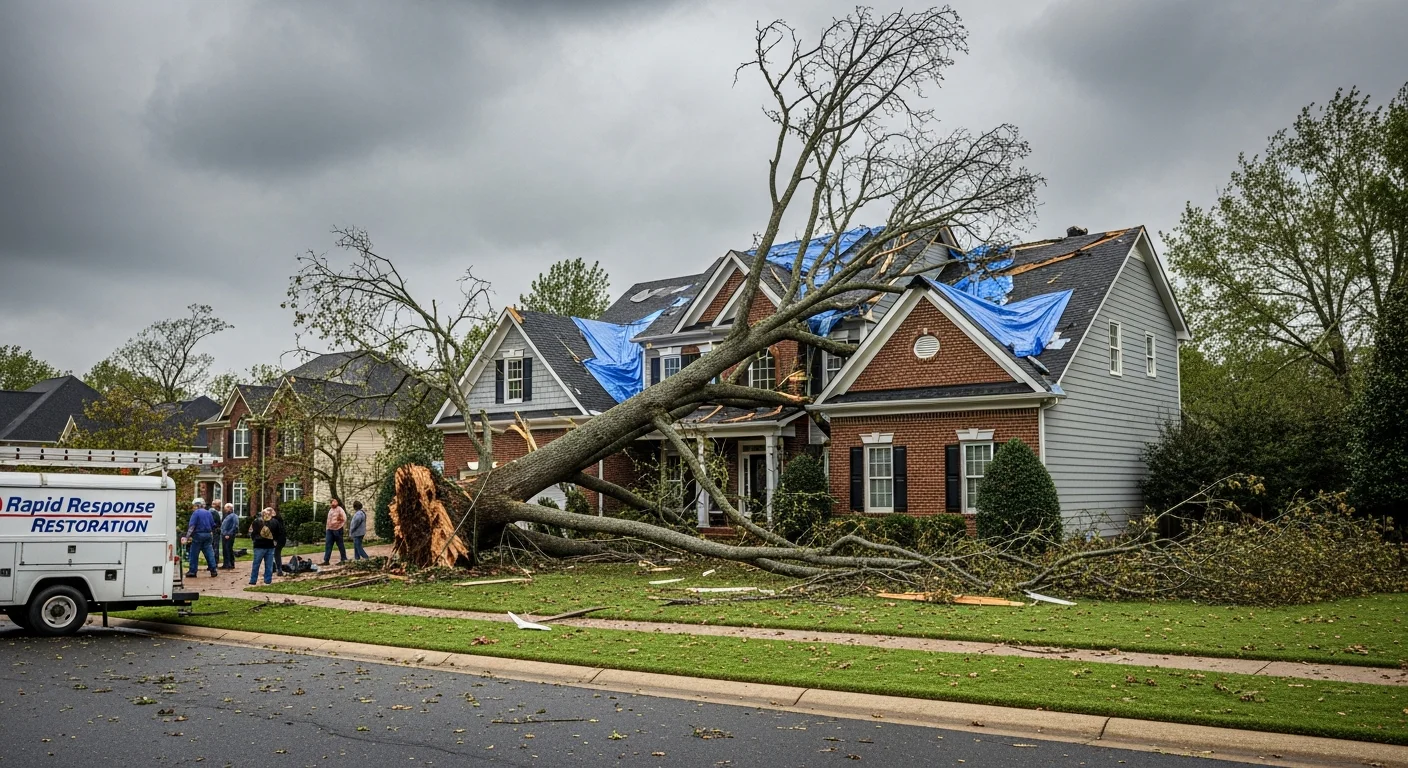
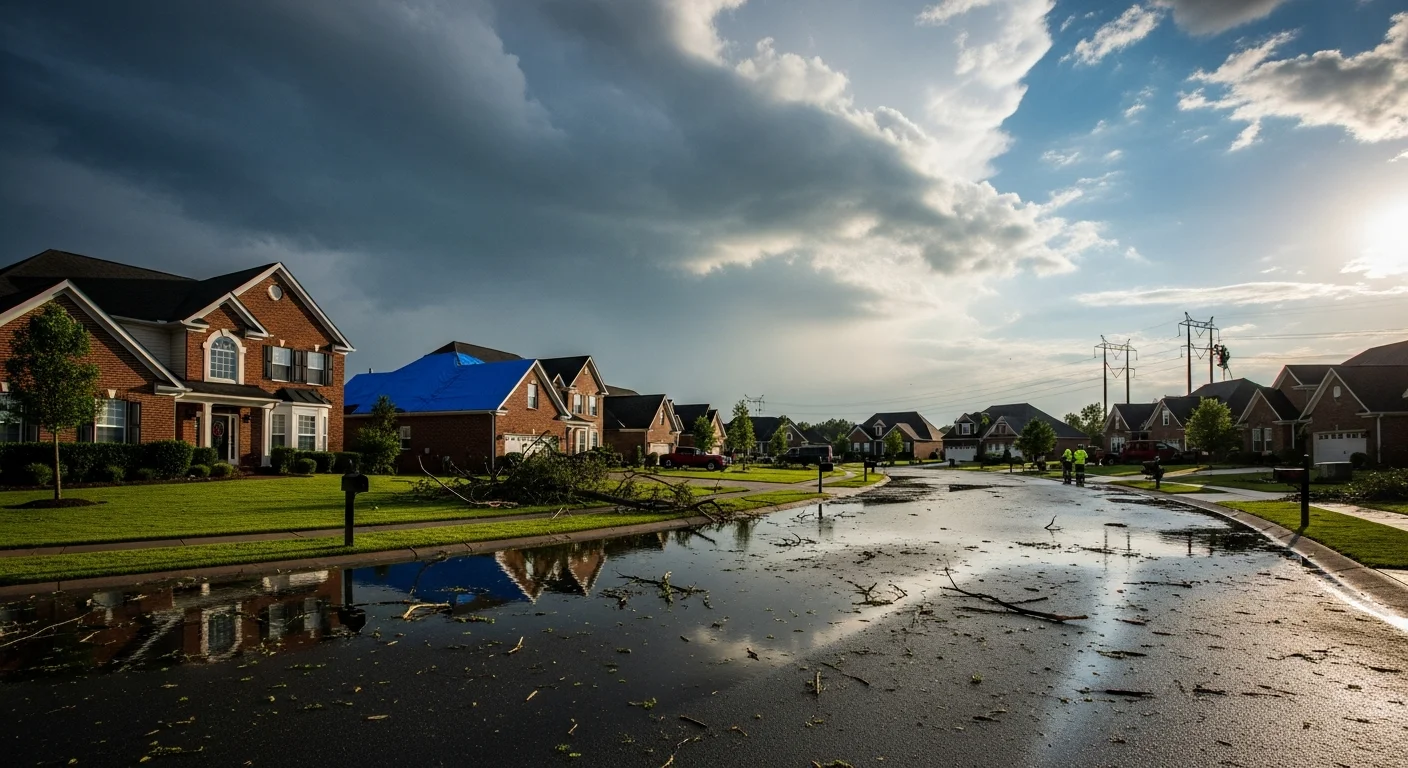
Fort Mill neighborhoods after Helene 2024 — tree debris, structural damage, and
days-long power outages across York County
Post-Helene Action Items for Fort Mill
Review your homeowners policy wind deductible — SC policies often have separate wind/hail
deductibles of 1-5% of dwelling coverage
If you're near Catawba, Sugar Creek, or Steele Creek — get an NFIP flood quote now
Document pre-storm condition annually with photos and video — no FEMA grants means your
insurance evidence is everything
Establish a restoration contact before storm season — Palm Build reaches Fort Mill in
30-45 minutes, but post-event queues fill fast
Types of Storm Damage
How Storms Damage Fort Mill Homes
Fort Mill's storm damage profile is distinct from Charlotte's — shaped by its tree
canopy density in established communities, the Catawba River watershed, and rapid
development that has outpaced drainage infrastructure. Most major storms produce
multiple damage types simultaneously, each potentially requiring a different insurance
coverage path.
Fallen Trees — Bridgemill, Habersham & Wooded Lots
Fort Mill's most common and costly storm damage type. Communities like Bridgemill, Habersham, Shelly Woods, and Baxter Village have dense mature tree canopies on residential lots platted well before the trees reached full size. During inland tropical events, wind-saturated root systems fail and trees fall directly onto homes, garages, vehicles, and power lines. A single mature hardwood can weigh 10,000-20,000 pounds. Emergency tree removal from a structure costs $5,000-$15,000 — before structural repair begins.
Roof Shingle Damage
Fort Mill's newer communities built from the mid-1990s through the 2010s rely on 30-year architectural (dimensional) shingles rated to 110-130 mph. Inland tropical events like Helene and Hugo routinely produce gusts approaching those thresholds, particularly over open areas like Waterside at the Catawba. Shingle failures often occur at unsealed edges, hail-cracked surfaces, and corners — creating water entry points that may not become visible inside the home for weeks. Post-storm roof inspection is essential even when damage isn't obvious from ground level.
Flash Flooding — Sugar Creek & Steele Creek
Fort Mill averages 99 precipitation days per year, and its rapid development has dramatically increased impervious surface area across York County. Parking lots, roads, driveways, and rooftops shed water instead of absorbing it — accelerating runoff into Sugar Creek, Steele Creek, and the Catawba River corridor. Flash flood events have required rescues in adjacent Steele Creek areas in June 2025, and Fort Mill experienced flash flooding in August 2025. Low-lying areas, properties near retention ponds, and homes in the Sugar Creek drainage basin face the highest risk.
Wind-Driven Rain Intrusion
A distinct and frequently underestimated damage type. During severe thunderstorms and tropical remnants, wind drives rain horizontally into gaps around windows, door frames, roof penetrations, and siding seams — even without obvious structural damage. In Fort Mill's newer construction with vinyl siding, wind can peel entire siding panels away. Wind-driven rain that enters through a wind-created opening is covered by standard HO-3 homeowners insurance — but only if the cause is properly documented. Water that entered as rising water (flooding) is not covered without separate flood insurance.
Power Outage Secondary Damage
Extended power outages — lasting days after Helene across York County — create secondary damage unrelated to the storm's direct impact. Sump pumps fail during outages, flooding crawl spaces and finished basements that never experienced direct storm water entry. Refrigerated and frozen food is lost. HVAC systems cycle off while humidity spikes, creating ideal conditions for mold growth within 24-48 hours of storm damage. Generator exhaust from improper indoor use creates carbon monoxide risk. Secondary damage from outages can equal or exceed the original storm damage.
Structural Wind Load Damage
Sustained high winds from inland tropical systems create uplift pressure on roof assemblies and lateral load on walls. Fort Mill's two-story frame construction in communities like Waterside at the Catawba and The Paddocks can experience racking and connection failures at elevated wind speeds. Garage doors are particularly vulnerable — failure allows wind to pressurize the home interior, dramatically increasing uplift forces on the entire roof structure. Baxter Village's townhomes face shared-wall complications when one unit sustains storm damage that affects adjacent units.
Storm Vulnerability Map
Fort Mill's Most Storm-Vulnerable Areas
Storm damage in Fort Mill concentrates in predictable zones based on Catawba River
proximity, tree canopy density, creek flooding exposure, and development-era drainage
infrastructure. Knowing your neighborhood's specific vulnerability helps you prepare
before storm season and respond faster when damage occurs.
Waterside at the Catawba
Critical
Catawba River corridor flooding — highest flood exposure in Fort Mill, river rose 47 ft above flood stage in 1916 event
Bridgemill & Habersham
Critical
Dense mature tree canopy on residential lots — highest fallen tree risk in York County during wind events
Sugar Creek Corridor
High Risk
Flash flooding from accelerated runoff — rapid development upstream has dramatically increased impervious surface area
Steele Creek Corridor
High Risk
Flash flooding — multiple rescues required in adjacent Steele Creek areas in June 2025; low-lying properties near drainage channels
Historic Downtown Fort Mill
High Risk
Aging building stock with deteriorating roof connections, older drainage infrastructure, mature street trees
Baxter Village
Moderate
Townhome density creates shared-wall complication; retention ponds overflow during severe events; tree canopy over clustered units
The Paddocks & Springfield
Moderate
Large lot tree exposure, two-story frame construction with wind uplift vulnerability at elevated speeds
Shelly Woods & Massey
Moderate
Newer development with maturing trees; impervious surface runoff into shared detention systems
Storm Restoration Process
How We Restore Fort Mill Homes After Storm Damage
Storm restoration requires coordinating emergency response, water mitigation, tree
removal, structural repair, and insurance claims simultaneously. Here's Palm Build's
proven six-step process from the first call through final York County inspection.
01
Emergency Tarping & Board-Up
Hours 1-4
Palm Build dispatches from Charlotte and reaches Fort Mill in 30-45 minutes. We immediately secure your home against the next weather event — damaged roof sections are tarped with reinforced polyethylene, broken windows are boarded, and all exposed openings are sealed. Your SC homeowners policy requires you to mitigate further damage, and tarping costs are covered as part of your standard claim. Every hour a damaged roof sits exposed is an hour of potential additional water infiltration turning a wind claim into a mold remediation project. Call (704) 464-0121 for 24/7 emergency dispatch.
02
Damage Assessment & Documentation
Days 1-3
Comprehensive cause-specific documentation of all storm damage — wind, tree impact, water intrusion, flooding, and structural. We photograph every affected area, map moisture with thermal cameras, and classify each damage item by cause: wind damage (covered by HO-3) versus flood damage (requires separate NFIP or private flood policy). This classification is especially important in Fort Mill where a single storm can produce both wind damage and retention pond overflow flooding — which are covered by entirely different policies. Our documentation gives your adjuster a complete, defensible scope.
03
Water Extraction & Structural Drying
Days 1-7
Storm damage almost always includes water intrusion — through damaged roofs, broken windows, or flooding. We extract standing water, deploy commercial dehumidifiers and air movers, and monitor drying daily with moisture meters and psychrometric logging. For Fort Mill homes with crawl spaces — common across communities like Bridgemill, Habersham, and Springfield — we address sub-floor water simultaneously. The 24-48 hour window for preventing secondary mold growth begins the moment water enters. IICRC S500 standard drying protocols govern every job.
04
Tree Removal & Debris Clearing
Days 2-7
Fallen trees are removed from structures using cranes and rigging when necessary — particularly for large hardwoods common in Bridgemill, Habersham, and Shelly Woods that fall across rooflines, porches, and HVAC equipment. We coordinate with arborists for damaged but still-standing trees that pose secondary fall risk. Debris is cleared and hauled. York County permitting requirements are followed for tree removal, even in emergency situations where trees have damaged structures.
05
Structural Repair & Reconstruction
Weeks 2-12
Once dried, secured, and cleared, full reconstruction begins: roof replacement, siding repair, window installation, drywall, insulation, flooring, painting, and finish work. York County building codes govern all structural, electrical, and mechanical work. Fort Mill's growing stock of townhomes in Baxter Village adds coordination complexity when adjacent units share walls affected by storm damage. Palm Build holds SC LLR contractor licensing and manages the complete scope from emergency through final punch list.
06
Final Inspection & Insurance Closeout
Week 12+
York County building inspections verify all structural, electrical, mechanical, and plumbing work meets current SC building code. We perform a final walk-through with the homeowner and provide complete documentation for insurance closeout — including all moisture readings, drying logs, photo documentation, material invoices, and scope reconciliation. Warranty information for all materials and workmanship is provided at closeout.
Fort Mill Pricing
Storm Damage Restoration Costs in Fort Mill
Storm restoration costs in Fort Mill vary by damage type, roof age, tree involvement,
and whether water intrusion is from wind-driven rain (covered by HO-3) or flooding
(requires separate flood policy). After wide-area events like Helene, contractor demand
across York County extends timelines and can affect material availability and pricing.
Covered by standard SC homeowners policy as mitigation
Tree Damage & Removal
Fallen tree removal from structure, crane rigging, debris haul-out
$2,000 – $15,000
Tree removal from structure typically covered; stump removal often excluded
Roof Repair & Replacement
Partial shingle repair through full roof system replacement
$5,000 – $25,000
Varies by roof size, slope, material, and extent of structural damage
Major Structural Damage
Tree-on-structure, flooding, full roof loss, wall compromise
$25,000 – $100,000+
Post-Helene timelines extended by contractor demand across York County
Insurance note: Standard SC HO-3 homeowners
policies cover wind damage, falling trees, and rain entering through wind-created openings.
Flood damage from rising water, retention pond overflow, or sheet flooding requires a separate
NFIP or private flood insurance policy. Many Fort Mill homeowners near Sugar Creek, Steele Creek,
or the Catawba corridor carry only HO-3 coverage — leaving flood damage entirely out-of-pocket.
Palm Build documents damage by cause so each portion of your claim is filed correctly.
Critical Insurance Distinction
Wind Damage vs. Flood Damage: Why It Matters for Fort Mill Claims
This is the most important insurance concept for Fort Mill storm damage. A single storm
event — Helene, a severe thunderstorm, even a named tropical storm — can produce both
wind damage and flood damage from the same weather system. Wind damage and flood damage
are covered by entirely different policies, filed as separate claims, and often adjusted
by different adjusters. Without cause-specific documentation, you risk having covered
damage denied. Palm Build classifies every item of damage by its cause to ensure correct
claim filing.
Wind Damage (HO-3 Homeowners Policy)
Roof damage from wind, fallen trees, flying debris
Siding, window, and door damage from wind pressure
Rain water entering through wind-created openings
Structural damage from wind load or fallen trees
Emergency tarping and board-up costs
Additional living expenses if home is uninhabitable
Flood Damage (Requires Separate Flood Policy)
Rising water from Catawba River, Sugar Creek, or Steele Creek
Retention pond overflow into yards and structures
Sheet flooding across impervious surfaces during heavy rain
Groundwater entering through foundation or crawl space
Sewer backup from overwhelmed storm drainage
NOT covered by standard HO-3 — requires NFIP or private flood policy
Fort Mill's Specific Overlap Problem
Fort Mill's rapid development has created a patchwork of flood exposure: properties
near the Catawba, Sugar Creek, and Steele Creek clearly need flood insurance — but so
do many properties adjacent to retention ponds that overflow during severe events. The
NFIP reports that approximately 1 in 3 flood insurance claims come from homes in Zone
X (minimal flood risk designation). During Helene, properties across York County
experienced what appeared to be flooding from multiple sources simultaneously: water
entering through wind-damaged roofs (covered), and water rising from overwhelmed
stormwater systems (not covered without flood insurance). Without cause-specific
documentation, insurers may attribute all water damage to flooding — denying coverage
that should have been approved. Palm Build's assessment process documents exactly
where each water source entered and by what mechanism.
The most expensive storm damage is the damage you could have prevented or documented
before it happened. These six steps — taken before storm season — can save Fort Mill
homeowners thousands in unrecovered losses and significantly reduce displacement time
after the next inland tropical event.
Annual Tree Risk Assessment
Fort Mill's greatest storm damage risk is its tree canopy — not wind speed. Have a certified arborist assess mature trees near your home in Bridgemill, Habersham, Shelly Woods, or any wooded community for structural defects, root damage, and lean. York County's clay soil becomes saturated during prolonged rain events, weakening root anchoring even in healthy-appearing trees. Proactive tree removal costs $1,000-$5,000. Emergency removal after it falls on your home costs $5,000-$15,000 plus the full cost of structural damage.
Gutter Maintenance & Drainage Check
Clean gutters and downspouts before storm season. Fort Mill's tree canopy deposits significant leaf debris that clogs gutters and forces water over fascia boards and into eave soffits. Verify that downspout extensions direct water at least 6 feet from your foundation. Check that grading around your home slopes away from the foundation. Inspect your sump pump — if you're in any low-lying area near Sugar Creek, Steele Creek, or a retention pond, test sump pump operation and consider a battery backup before power outages arrive with the next major storm.
Document Pre-Storm Condition Annually
Walk through your entire property and photograph every room, the roof, siding, crawl space, and landscaping with timestamps. This documentation is your primary asset when filing a storm claim — especially in Fort Mill where FEMA Individual Assistance was unavailable after Helene and private insurance is the only recovery mechanism. Without pre-loss documentation, your adjuster estimates pre-storm condition from memory and comparable properties. With it, you control the baseline and protect every dollar of your claim.
Review Your Insurance Coverage
Confirm your homeowners policy limits, your deductible structure (SC policies often have separate wind/hail deductibles of 1-5% of dwelling coverage, not a flat dollar amount), and whether you carry an ordinance-and-law endorsement for building code upgrade costs during reconstruction. If your property is within a half-mile of the Catawba River, Sugar Creek, Steele Creek, or a retention pond — get an NFIP or private flood insurance quote. Standard HO-3 does not cover rising water under any circumstances.
Secure Roof & Entry Vulnerabilities
Inspect roof flashing, valley seams, and ridge vent seals for deterioration. Replace cracked caulk around windows and door frames — these minor gaps become major intrusion points during wind-driven rain at 40+ mph. Evaluate your garage door: the garage door is the largest and most wind-vulnerable panel in most Fort Mill homes. Failure allows wind to pressurize the home interior, dramatically increasing uplift forces on the roof structure. Install bracing or upgrade to a wind-rated door before storm season if your current door is original construction.
Establish Emergency Contacts Before Storm Season
After a major storm across York County, every restoration company faces simultaneous demand across dozens of properties. Response times that are normally 30-45 minutes can stretch to days for unestablished customers. Homeowners with a pre-established relationship get priority dispatch. Save Palm Build's number now: (704) 464-0121. 24/7 emergency response. Charlotte dispatch reaches Fort Mill in 30-45 minutes — before the next wave of storms arrives.
Storm Damage in Fort Mill
What Storm Damage Looks Like in Fort Mill
From tree falls in wooded communities like Bridgemill and Habersham to flooding along
the Catawba corridor — Fort Mill storm damage takes multiple forms across its diverse
neighborhoods.
Fallen trees across wooded Fort Mill lots are the most common and costly storm damage type
York County communities after Helene — debris, downed trees, and days-long power outages
Waterside at the Catawba faces the highest flood exposure in Fort Mill during major inland storms
Emergency tarping secures exposed structures within hours — preventing secondary water damage
The Palm Build Difference
Why Fort Mill Homeowners Choose Palm Build After Storms
Storm restoration requires speed, licensing, and documentation expertise — all three at
once, in the hours immediately following damage. Palm Build brings all three to Fort
Mill from the first call through final inspection.
30-45 Minute Fort Mill Response
Palm Build dispatches from our Charlotte hub at 378 Crompton Street and reaches Fort Mill in 30-45 minutes — faster than most York County contractors who work locally. After wide-area events like Helene, we activate expanded capacity. Pre-established clients get priority dispatch when every minute of delay means additional water infiltration and compounding damage.
SC LLR Licensed Contractor
Palm Build holds South Carolina LLR contractor licensing, covering all structural, roofing, and restoration work in York County. We pull the required York County building permits for all reconstruction work and schedule SC building inspections at project completion. No unlicensed subcontractors, no permit shortcuts.
IICRC Certified — Water & Storm
Every crew lead carries current IICRC Water Restoration Technician (WRT) certification. Storm damage crosses multiple specialties — wind damage, water intrusion, tree impact, and sometimes mold from delayed response. Our certifications cover the full range of storm damage categories, and all drying work follows IICRC S500 standards with daily moisture monitoring and logged psychrometric readings.
Cause-Specific Damage Documentation
Our damage assessment classifies every item by cause — wind vs. flood vs. tree impact vs. wind-driven rain. This matters enormously in Fort Mill, where a single storm can produce both HO-3-covered wind damage and flooding that requires a separate NFIP policy. After Helene, homeowners who had cause-specific documentation recovered significantly more from their claims than those with generic damage reports.
Emergency + Restoration + Reconstruction
From the first emergency tarp call through final York County inspection, Palm Build manages every phase as a single project with one point of contact. No handoffs between emergency responders, water mitigation companies, and general contractors — a coordination gap that commonly costs homeowners weeks of additional displacement and thousands in duplicated overhead charges.
Hurricane Helene 2024 Response Experience
Palm Build responded to multiple properties across the Charlotte-Fort Mill corridor following Helene in September 2024. We understand the specific damage profile Helene produced — tree falls on wooded lots, extended power outages causing secondary damage, and the insurance documentation challenge created by York County's exclusion from FEMA Individual Assistance. When the next Helene-scale event tracks through York County, we know exactly what to do and how to document it.
Common Questions
Fort Mill Storm Damage FAQ
Answers to the questions Fort Mill homeowners ask most after storm damage — covering
insurance, coverage distinctions, response times, and what to expect from the
restoration process.
Fort Mill is inland — does it really get hurricane damage?
Yes. Fort Mill sits in the Piedmont, roughly 200 miles from the South Carolina coast, but inland-tracking tropical remnants regularly produce damaging winds and heavy rainfall across York County. Hurricane Helene on September 27, 2024 — the deadliest hurricane to hit South Carolina in 100 years — caused downed trees, structural damage, power outages lasting days, and flooding throughout York County even though the storm made landfall more than 300 miles away. Hugo in 1989 brought 85 mph inland winds through this corridor. Florence in 2018 dropped 3-5 inches with 39-57 mph wind gusts. There is no storm season off-season for Fort Mill.
What types of storm damage are most common in Fort Mill SC?
The four most common damage categories in Fort Mill are: (1) fallen trees and large limbs damaging roofs, fences, and vehicles — the mature tree canopy in Baxter Village, Bridgemill, Habersham, and Shelly Woods amplifies this risk significantly; (2) roof damage from high winds lifting or stripping 30-year architectural shingles; (3) flash flooding from rapid runoff — Fort Mill averages 99 precipitation days per year and urbanization has dramatically increased impervious surface area, accelerating runoff into low-lying areas; and (4) water intrusion through wind-damaged siding, windows, and roof penetrations. Unlike coastal SC, Fort Mill has no tidal surge exposure or salt-air corrosion risk.
What happened to Fort Mill during Hurricane Helene in 2024?
Hurricane Helene made landfall on September 27, 2024 and tracked inland through the Carolinas, producing downed trees, damaged homes, extended power outages, and flooding across York County including Fort Mill. Statewide, FEMA authorized $323 million in Individual Assistance payments across 28 South Carolina counties. York County experienced significant damage but fell below the individual assistance thresholds for direct federal grants — meaning most Fort Mill homeowners were dependent on private insurance and out-of-pocket resources rather than FEMA aid. This makes complete insurance documentation at the time of loss critically important.
Does standard homeowners insurance cover storm damage in Fort Mill?
Yes — wind damage, falling trees, and storm-driven rain intrusion are covered perils under standard SC homeowners policies (HO-3 form). However, flood damage from rising water — whether from the Catawba River corridor, retention ponds overflowing, or sheet flooding across impervious surfaces — requires a separate NFIP or private flood insurance policy. This distinction is critical in Fort Mill: a single storm event can cause both wind damage (covered by your homeowners policy) and flood damage (not covered without separate flood insurance). Palm Build documents damage by cause so each portion of your claim is filed correctly.
What are Fort Mill's flood risks given the Catawba River and urbanization?
Fort Mill sits in the Catawba River watershed, and the river's historic flooding potential is well-documented — the Great Flood of 1916 saw the Catawba rise 47 feet above flood stage. Beyond the river itself, rapid development across York County has dramatically increased impervious surfaces: parking lots, roads, rooftops, and driveways shed water instead of absorbing it, accelerating runoff into streams and drainage channels. The Waterside at the Catawba community has specific flood exposure. Flash flooding events have been recorded in the Fort Mill area in August 2025, and Steele Creek flash flooding in June 2025 required multiple rescues in adjacent areas. Properties in low-lying areas and near retention ponds carry elevated risk.
Can I get emergency tarping the same night as storm damage?
Yes. Palm Build dispatches from Charlotte and reaches Fort Mill in 30-45 minutes. Emergency tarping and structural board-up are available 24 hours a day, 7 days a week, including during and immediately after active weather. Your insurance policy's mitigation clause requires you to prevent additional damage — tarping before the next rain event is both a policy requirement and a practical necessity. Emergency tarping and board-up costs are covered as part of your standard claim. Delaying protection compounds interior water damage and complicates your insurance payout.
Are architectural shingles wind-rated enough for York County storms?
Standard 30-year architectural (dimensional) shingles — the most common roofing in Fort Mill's newer communities — are typically rated to 110-130 mph. Most thunderstorm wind gusts in York County stay below that threshold, but sustained winds from inland tropical systems like Helene or Hugo can approach or exceed it in gusts. More importantly, shingle failure often isn't about absolute wind speed — it's about lifting at unsealed edges, missing or insufficient fasteners, and shingles aged past their adhesion prime. Hail frequently precedes or accompanies wind events, creating micro-fractures that compound wind vulnerability. A post-storm inspection determines whether damage is cosmetic, functional, or structural.
How long does storm damage restoration take for a Fort Mill home?
Emergency tarping and water extraction: 1-2 days. Structural drying to IICRC standards: 3-5 days with monitoring. Roof repair (partial): 3-10 days depending on crew availability after regional storm events. Full roof replacement: 1-2 weeks. Interior repairs to drywall, insulation, and finishes: 2-6 weeks. Full reconstruction after major structural damage: 6-16 weeks. After wide-area events like Hurricane Helene, timelines extend due to contractor demand, material availability, and insurance adjuster scheduling across multiple affected counties. Starting the claims process immediately keeps your position at the front of the queue.
Storm Damage in Fort Mill? The Clock Starts Now.
Every hour an exposed roof or compromised wall sits unprotected, water infiltration compounds — turning a wind claim into a mold and structural remediation project. Palm Build's Charlotte team reaches Fort Mill in 30-45 minutes with emergency tarping, water extraction, and insurance documentation from the first call.