Crawl Space Cleanup & Encapsulation in Fort Mill, South Carolina
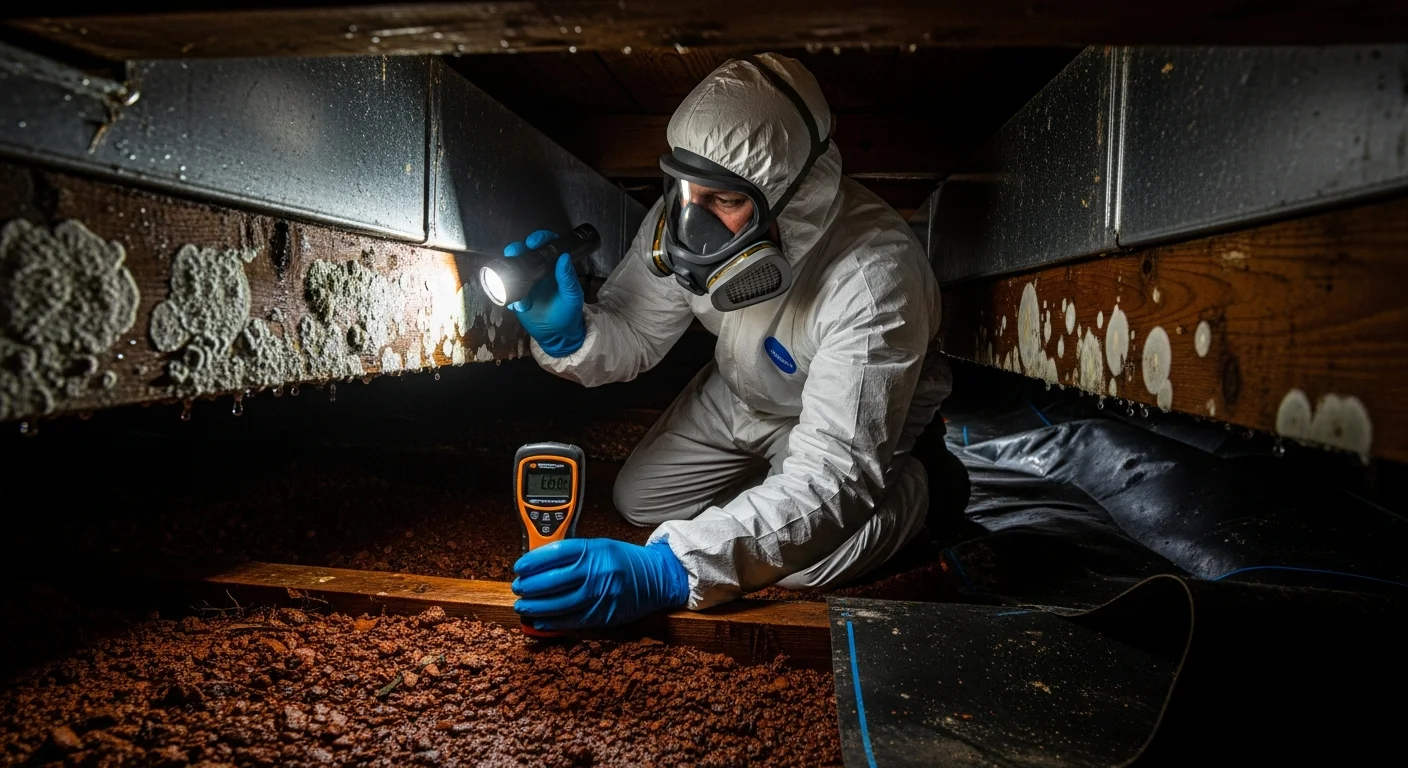
Fort Mill's 1990s and 2000s building boom produced thousands of crawl space homes on Piedmont clay soil — and those homes are now entering the 15-to-25-year window where original vapor barriers deteriorate, vent seals fail, and moisture problems accelerate. Palm Build provides complete crawl space remediation: mold removal, moisture control, full encapsulation, and structural repair, addressing the root cause before the damage compounds further.
Charlotte, NC — approximately 20 miles north of Fort Mill Same day Response IICRC Certified
Why Fort Mill's Boom-Era Crawl Spaces Are Failing Now
Fort Mill's 1990s and 2000s building boom produced thousands of crawl space homes on
Piedmont clay soil — and those homes are now entering the 15-to-25-year window where
original vapor barriers deteriorate, vent seals fail, and moisture problems accelerate
to crisis level. The same housing stock that was problem-free at year ten is now
developing visible mold, elevated moisture readings, and structural wood damage across
Baxter Village, Regent Park, Historic Downtown, and established neighborhoods throughout
York County.
The 1990s-2000s Boom Homes Are Failing Now
15-25 yrs
Vapor barrier failure window
Fort Mill's massive growth surge through the 1990s and early 2000s produced thousands of crawl space homes, and those homes are now entering the 15-to-25-year window where original vapor barriers deteriorate, vent seals fail, and moisture problems accelerate. Standard polyethylene vapor barriers carry a functional lifespan of 15-20 years before UV exposure, soil chemistry, and foot traffic cause degradation. Fort Mill homes that showed no crawl space symptoms at year ten can develop visible mold, elevated moisture readings, and soft subfloor sections within 12-18 months once the vapor barrier fails. The timing is now — and it's affecting thousands of Fort Mill properties simultaneously.
Piedmont Clay Soil Pressure
69-75%
York County ambient humidity
Fort Mill sits on the same Piedmont red clay as Charlotte — expansive, poorly draining soil that expands when wet and contracts when dry. This cyclical expansion physically pushes moisture-laden soil against foundation walls and vapor barriers, forcing water vapor through any seam, penetration, or degraded section. The contracting dry clay then opens new gaps along foundation footings that become fresh entry points when rain returns. York County's 46-inch annual average rainfall ensures this cycle never stops — Piedmont clay is never fully dry, and Fort Mill's crawl spaces are never fully free of moisture pressure.
Vented Design Flaw in SC Climate
Pre-2003
Homes with vented design
Building codes historically required foundation vents in crawl spaces — the theory being that air circulation would prevent moisture buildup. In the arid West, this works. In Fort Mill's humid Piedmont climate with 46 inches of annual rainfall and 69-75% ambient humidity, it's catastrophically wrong. Foundation vents invite warm, humid air into the crawl space, where it contacts cooler surfaces and condenses. The vents that were supposed to reduce moisture actively introduce it. Pre-2003 Fort Mill construction — representing thousands of homes in Baxter Village, Regent Park, and established neighborhoods — was built under this code requirement.
Mold Follows Moisture Within 24-72 Hours
24-72 hrs
Mold establishment window
Once Fort Mill's Piedmont clay soil and humid subtropical climate combine to push moisture through a failed vapor barrier, mold begins establishing colonies on floor joists, sill plates, and subfloor panels within 24-72 hours. The most common species — Aspergillus, Penicillium, and Cladosporium — are present in ambient air and require only moisture and an organic surface to colonize. Structural wood in crawl spaces provides exactly that. In Fort Mill's climate, a crawl space that develops a moisture problem in May will have visible mold by June and compromised structural wood by September if left untreated.
Fort Mill crawl spaces built in the 1990s-2000s are now reaching the failure window —
vapor barriers degrade, moisture intrudes, and mold follows.
Warning Signs
6 Signs Your Fort Mill Home Has a Crawl Space Problem
Crawl space problems in Fort Mill rarely announce themselves dramatically. They develop
slowly — over months or years — and by the time symptoms appear inside the home, the
crawl space condition has usually progressed significantly. Here are the warning signs
every Fort Mill homeowner should recognize, especially in homes built during the
1990s-2000s growth surge.
Musty or Earthy Smell
The most common first sign Fort Mill homeowners notice is a persistent musty smell on the first floor — particularly noticeable when the HVAC system cycles on. This smell originates in the crawl space, where mold and mildew are actively growing on floor joists, subfloor panels, fallen insulation, and sometimes the ground itself. Because warm air in the crawl space rises into the living space through gaps around plumbing penetrations, electrical runs, and HVAC supply boots, the odor migrates upward. In Fort Mill's 69-75% ambient humidity, this smell intensifies from May through September and often defines how visitors experience the home. If your Baxter Village or Regent Park home smells musty despite regular cleaning, the crawl space is almost certainly the source.
Sagging or Bouncy Floors
When crawl space moisture saturates floor joists and subfloor panels over months or years, the wood softens and loses structural integrity. Joists develop fungal decay — wood rot — that reduces load-bearing capacity, and subfloor panels (particularly the OSB used in 1990s-2000s Fort Mill construction) swell, delaminate, and lose rigidity. The result is floors that sag, bounce, or feel spongy underfoot. You might notice a low spot in a hallway, a bounce when walking across a living room, or doors that have started sticking because the floor has shifted. Fort Mill's boom-era homes with OSB subfloor over aging joists are especially susceptible once their original vapor barriers fail.
Condensation on Windows and Pipes
Excessive crawl space moisture raises overall home humidity. When indoor humidity exceeds 55-60%, condensation appears on cold surfaces — window glass in winter, cold water pipes year-round, toilet tanks, and air conditioning ducts. If you notice persistent window condensation, water droplets on bathroom cold water supply lines, or wet spots on HVAC registers, the crawl space is likely pushing moisture into the living space faster than your HVAC can remove it. Fort Mill homes with crawl space humidity of 80-90% can raise interior humidity to 60-70% — well above the 30-50% range recommended for comfort and health.
Worsening Allergy or Respiratory Symptoms
The connection between crawl space mold and indoor air quality is well documented. Mold spores, dust mite colonies (which thrive in humid environments), and bacterial growth in the crawl space all produce airborne particulate that migrates into the living space. Fort Mill residents with crawl space problems often report worsening allergy symptoms, unexplained respiratory issues, and chronic sinus problems that improve when they leave the house. Children, elderly residents — particularly in Sun City Carolina Lakes — and anyone with asthma or compromised immune systems are most affected. If your allergist can't explain why your symptoms are worse at home, request a crawl space inspection before pursuing additional medical treatments.
Falling or Sagging Insulation
Fiberglass batt insulation installed between floor joists in Fort Mill crawl spaces has a predictable failure pattern. When crawl space humidity saturates the fiberglass, the batts absorb moisture, become heavy, and pull away from the joists — sagging first, then falling to the ground. Once fallen, the insulation sits on the damp crawl space floor and becomes a breeding ground for mold and a habitat for pests. If you look into your crawl space and see insulation hanging like stalactites or lying in wet, compressed piles on the ground, you're seeing the end stage of a moisture problem that has been developing for months or years in your boom-era Fort Mill home.
Visible Mold or Deteriorating Wood
By the time you can see mold growth on crawl space surfaces — white, green, or black colonies on floor joists, rim joists, sill plates, or subfloor panels — the moisture problem has been active for an extended period. Visible wood damage (soft spots, dark discoloration, crumbling material when probed) indicates fungal decay that has compromised structural integrity. In Fort Mill crawl spaces, the most common mold species are Aspergillus, Penicillium, and Cladosporium, with Stachybotrys (black mold) appearing in areas with chronic water intrusion. Any visible mold or wood damage should be evaluated by an IICRC-certified remediation company — South Carolina does not license mold inspectors at the state level, making IICRC certification the only independently verifiable professional credential.
Neighborhood-Level Risk
Which Fort Mill Neighborhoods Have the Highest Crawl Space Risk
Crawl space problems in Fort Mill are not distributed evenly. Neighborhoods with older
construction, proximity to waterways, dense tree canopy, or homes now reaching the vapor
barrier failure window have significantly worse conditions than newer developments.
Here's our neighborhood-level risk assessment based on the Fort Mill projects we see
most frequently.
Historic Downtown Fort Mill & Whiteville Park
Critical Risk
Built: Late 1800s–1960s
Primary risks: Oldest homes in the city, aging or absent vapor barriers, cast-iron plumbing prone to slow leaks
Historic Downtown Fort Mill and Whiteville Park carry the highest overall crawl space risk in the city. These are the oldest homes — many dating to the late 1800s through 1960s — with aging crawl spaces, original or no moisture barriers, and cast-iron plumbing prone to slow leaks that introduce Category 3 water to the crawl space environment. The foundations are often original brick or stone with no damp-proofing. Years of deferred maintenance, infill development that has altered drainage patterns, and cast-iron drain line failure combine to create crawl space conditions we consistently rate as the most severe in Fort Mill.
Baxter Village
High Risk
Built: Late 1990s–early 2000s
Primary risks: Now 20+ years old, entering vapor barrier failure window, active HOA means exterior drainage work requires coordination
Baxter Village homes constructed in the late 1990s through early 2000s are now 20-plus years old and entering the vapor barrier failure window simultaneously. This is a community-wide phenomenon — thousands of homes installed with the same original vapor barriers, now all degrading at the same pace. The HOA structure in Baxter Village means that exterior drainage corrections may require architectural review committee approval, adding complexity to projects that need exterior grading work. Interior crawl space encapsulation, mold remediation, and dehumidification generally do not require HOA approval.
Regent Park
High Risk
Built: Early 2000s
Primary risks: Similar aging timeline to Baxter Village, clay soil moisture accumulation on lots with mature tree canopy
Regent Park homes from the early 2000s face a similar aging timeline to Baxter Village. The neighborhood's mature tree canopy — a selling point — also traps ground-level humidity and slows soil drying between rain events, keeping crawl space moisture elevated year-round compared to more open developments. Properties on wooded lots in Regent Park consistently show higher crawl space humidity readings than comparably aged homes on open lots, accelerating vapor barrier degradation and mold establishment.
Bridgemill & Habersham
Moderate Risk
Built: 2000s–2010s
Primary risks: Dense tree canopy traps ground-level humidity, limited soil drying between rain events
Bridgemill and Habersham sit under dense tree canopy that is both a neighborhood amenity and a crawl space risk factor. Shaded soil dries more slowly after rain events, maintaining higher moisture levels against foundations year-round. Even newer homes in these communities — built in the 2000s and 2010s — show elevated crawl space humidity compared to open-lot developments, and the moisture environment is accelerating vapor barrier aging in homes that technically haven't yet reached the standard failure window.
Waterside at Catawba
Moderate Risk
Built: 2010s–present
Primary risks: River-adjacent soil saturation, Catawba River flood history, homes with optional basements face distinct moisture profile
Waterside at Catawba's 1,142 homes sit adjacent to the Catawba River — a waterway with documented catastrophic flood history going back to 1916. Properties near the river experience river-adjacent soil saturation that keeps groundwater levels elevated, creating a different but equally serious moisture profile from the humidity-driven conditions in other Fort Mill neighborhoods. Homes with optional basements face hydrostatic pressure from saturated soil. After flood events like Hurricane Helene (2024), crawl spaces in Waterside can experience significant water intrusion that requires both drainage and encapsulation solutions.
Sun City Carolina Lakes
Moderate Risk
Built: 2000s–2010s
Primary risks: Active adult community, 3,160 homes, residents may not physically inspect crawl spaces regularly
Sun City Carolina Lakes is a 55+ community of 3,160 homes where many residents are less likely to physically inspect their crawl spaces regularly — meaning problems can develop further before being discovered. The community's age range of construction (2000s through 2010s) means some homes are entering the vapor barrier failure window while others are not yet there, but the humid coastal proximity and York County clay soil conditions apply equally across the community. For Sun City residents, an annual crawl space inspection is especially valuable given the combination of construction age, active lifestyle that keeps residents outdoors rather than in their crawl spaces, and the significant home values at stake.
Our Fort Mill Encapsulation Process
How We Fix Fort Mill Crawl Spaces — Permanently
Crawl space encapsulation isn't a single product — it's a multi-step system designed to
address every moisture pathway in Fort Mill's Piedmont clay soil environment. Here's the
complete process our team follows, from initial inspection through long-term monitoring
and York County permit closeout.
01
Comprehensive Inspection
Day 1
02
Mold Remediation
Days 2-7
03
Drainage Correction
Days 3-7
04
Vapor Barrier Installation
Days 5-9
05
Dehumidifier Installation
Days 7-10
06
Monitoring & York County Permit Closeout
Ongoing
01
Comprehensive Inspection
Day 1
Before any work begins, our Fort Mill crawl space team conducts a full documented assessment — not a 15-minute walkthrough with a flashlight. We take moisture readings at multiple points, measure humidity with calibrated hygrometers, probe structural wood for decay with pin-type and pinless moisture meters, collect mold samples where visible growth is present, and photograph every condition found. This inspection determines the full scope of work — whether the crawl space needs basic encapsulation, mold remediation plus encapsulation, or full-scope work including drainage, structural repair, and environmental remediation. York County requires this assessment to be conducted before any permit-required work begins.
02
Mold Remediation
Days 2-7
If the inspection reveals mold growth on crawl space surfaces — which it does in the majority of Fort Mill crawl spaces with moisture problems — remediation must happen before encapsulation. Sealing mold behind a vapor barrier doesn't kill it; it creates an environment where mold continues to grow unseen and releases spores into the enclosed space. Our remediation team removes all fallen insulation, debris, and organic material from the crawl space floor. All affected structural wood surfaces are treated with EPA-registered fungicide. Heavily contaminated or structurally compromised materials are removed and replaced. Post-remediation air quality testing confirms spore counts have returned to ambient levels before encapsulation begins.
03
Drainage Correction
Days 3-7
Fort Mill's Piedmont clay soil means surface water and groundwater continue pushing against foundations regardless of what happens inside the crawl space. For properties with active water intrusion — standing water during rain events, visible water entry through foundation walls, or hydrostatic pressure through the floor (common near Waterside at Catawba and Catawba River corridor properties) — interior drainage must be installed before encapsulation. Our drainage solutions include interior French drain systems, sump pump installation with battery backup, and grading corrections. Not every Fort Mill crawl space needs drainage — some have humidity-driven moisture only. But when liquid water is entering the space, no amount of encapsulation will solve the problem without addressing the water source.
04
Vapor Barrier Installation
Days 5-9
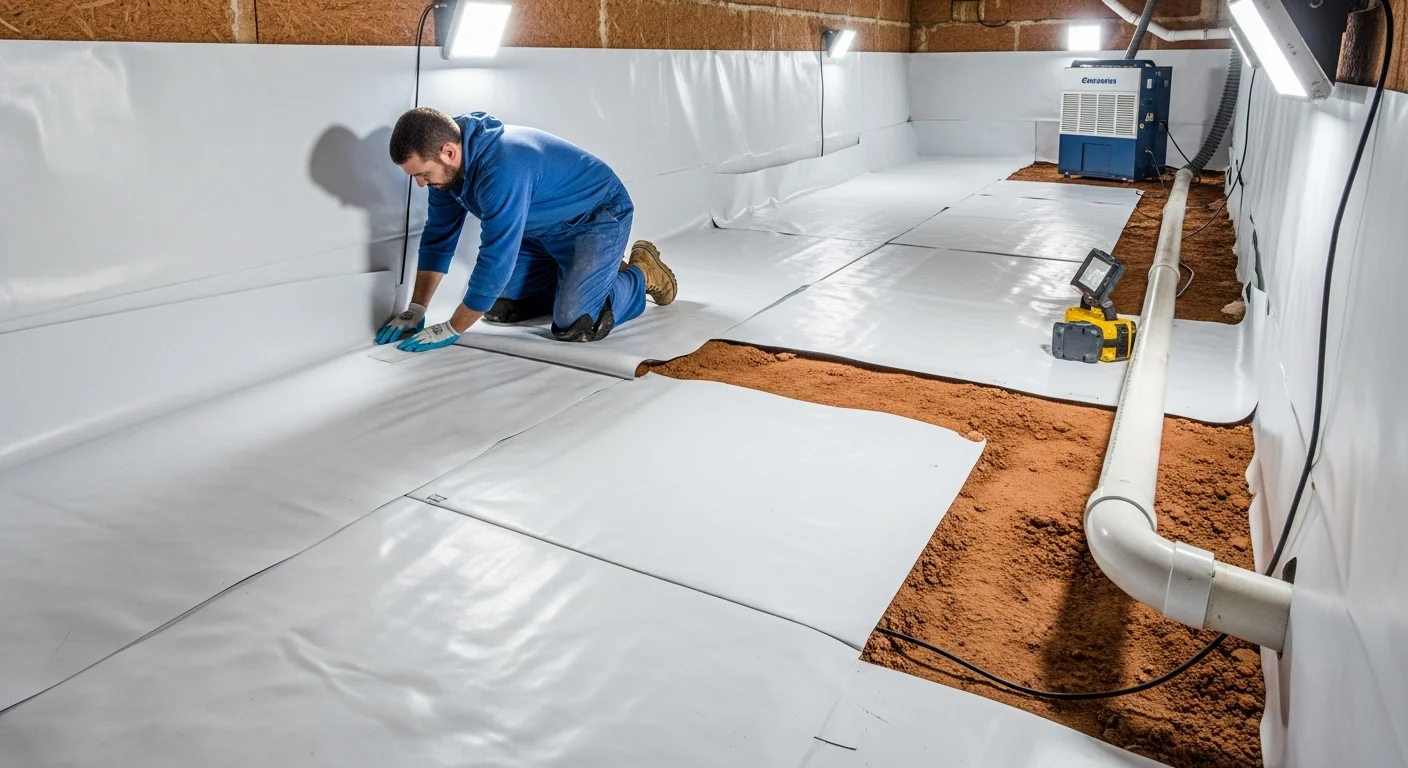
The vapor barrier is the centerpiece of crawl space encapsulation — a continuous, sealed sheet of reinforced polyethylene covering the crawl space floor and extending up the foundation walls to the sill plate. We use 20-mil reinforced vapor barrier material — not the 6-mil poly sheeting sold at hardware stores, which tears during installation and degrades within a few years. The barrier is sealed at every seam with polyethylene tape rated for below-grade adhesion, attached to foundation walls with mechanical fasteners and sealant, and sealed around every pier, pipe penetration, and support column. Foundation vents are permanently sealed with rigid foam board and sealant — eliminating the primary moisture entry point that has been feeding humidity into your Fort Mill crawl space since the house was built.
05
Dehumidifier Installation
Days 7-10
Encapsulation without active dehumidification is incomplete in Fort Mill's climate. Even with a properly sealed crawl space, moisture will continue entering through concrete foundation walls, soil vapor pressure beneath the barrier, and seasonal humidity fluctuations. A commercial-grade crawl space dehumidifier maintains humidity below 55% year-round. We install Santa Fe, Aprilaire, or equivalent commercial-grade units sized for the specific square footage and moisture load of your Fort Mill crawl space. These are purpose-built systems that operate continuously with direct drainage and are rated for below-grade temperatures. York County's requirement for mechanical dehumidification or conditioned air supply in closed crawl spaces makes proper dehumidifier sizing a code compliance issue, not just a best practice.
06
Monitoring & York County Permit Closeout
Ongoing
After encapsulation is complete, we install a remote humidity monitoring system that tracks crawl space conditions continuously and alerts both you and our team if humidity exceeds target thresholds. York County requires building permits for vented-to-closed crawl space conversions, and we manage all permit applications, code compliance verification, and inspection scheduling as part of our scope. Our York County permit documentation includes the required termite inspection clearance gap verification at the foundation perimeter. The monitoring system provides documented crawl space history for real estate transactions — increasingly important in Fort Mill, where buyers and home inspectors are more informed about crawl space conditions than ever before.
Full crawl space encapsulation — the long-term solution for Fort Mill's persistent 69-75%
ambient humidity
Crawl space costs in Fort Mill vary significantly based on what's needed. A simple
encapsulation for a dry crawl space with no mold runs around $5,100. A typical project
with mold remediation — the most common scope in Fort Mill's boom-era homes — runs
$12,000-$20,000. A full-scope project with drainage, structural repair, and remediation
can exceed $20,000. These are real-world cost ranges based on York County projects, not
national averages.
Basic Encapsulation
Humidity only — no mold, no standing water, no structural damage
This scope applies to Fort Mill crawl spaces with humidity problems but no active mold growth, no standing water, and no structural damage. In practice, this represents roughly 15-25% of Fort Mill projects — the majority of boom-era homes that have reached their vapor barrier failure window already have some mold by the time we are called.
Complete Moisture Remediation
Mold present — no drainage needed; most common Fort Mill scope
This is the most common scope for Fort Mill crawl space projects. Baxter Village homes built in the late 1990s through early 2000s, Regent Park properties, and established Downtown Fort Mill homes regularly fall into this category. The majority of 1990s-2000s boom-era homes we inspect have at least some mold on crawl space structural wood by the time moisture symptoms appear indoors.
Full Scope with Drainage & Structural Repair
Standing water, structural damage, mold, or river-adjacent soil saturation
Interior French drain system$3,000 – $6,000
Sump pump with battery backup$1,200 – $2,500
Mold remediation (full scope)$5,000 – $15,000
Structural joist/sill plate repair$2,000 – $8,000
Complete encapsulation system$4,000 – $6,000
Total full scope$20,000+
Full-scope projects are common in Historic Downtown Fort Mill (where original foundations have no moisture management), near Catawba River corridor properties in Waterside at Catawba, and in Baxter Village or Regent Park homes with structural joist decay from years of unaddressed moisture. These properties need drainage solutions in addition to encapsulation — sealing the space without addressing active water intrusion will trap water inside.
Every Fort Mill crawl space is different. Call (704) 464-0121 for a free inspection and detailed estimate.
We'll tell you exactly what your Fort Mill crawl space needs — and more importantly, what
it doesn't — before any work begins.
The Palm Build Difference
Why Fort Mill Homeowners Choose Palm Build for Crawl Space Work
Fort Mill has companies offering crawl space encapsulation. The difference is in how the
work is scoped, how mold is handled, and what happens when the crawl space reveals
problems beyond a vapor barrier and dehumidifier. Palm Build approaches crawl space work
as restoration professionals — IICRC certified, SC LLR licensed, and equipped to handle
the full scope of what Fort Mill's boom-era homes actually need.
Fort Mill and York County Specialists
We're not a national franchise applying a one-size-fits-all encapsulation template. Our team understands Fort Mill's Piedmont clay drainage, the specific moisture patterns in Baxter Village versus Historic Downtown versus Waterside at Catawba, and the foundation types found in each era of York County construction. We know which Fort Mill crawl spaces need drainage and which don't. We know which neighborhoods have aging cast-iron plumbing that should be addressed during the project and which have modern PEX that's fine. This local knowledge means we scope the work you actually need — not the maximum package regardless of conditions.
Mold Remediation Before Encapsulation — Always
Many York County contractors install vapor barriers on top of existing mold — sealing the contamination behind the barrier where it continues to grow unseen. Palm Build always remediates mold before encapsulating. We remove contaminated materials, treat affected structural wood with EPA-registered fungicides, and verify with post-remediation air testing that spore counts have returned to ambient levels before any vapor barrier goes down. South Carolina does not license mold inspectors at the state level — making IICRC certification the only independently verifiable credential for this work, and Palm Build is IICRC certified.
Complete Restoration Company — Not Just Encapsulators
Crawl space encapsulation companies install vapor barriers and dehumidifiers. When they encounter structural damage, plumbing failures, mold beyond their scope, or water damage that has migrated into the living space above, they refer you to another contractor. Palm Build is a full-service restoration company that handles the entire scope — mold remediation, structural joist repair, subfloor replacement, plumbing coordination, and any interior damage originating from the crawl space condition. One company, one project manager, one scope from beneath the house to the living space above.
Remote Monitoring and Accountability
Every encapsulation we install in Fort Mill includes remote humidity monitoring. We don't seal your crawl space and walk away — we verify performance continuously. If humidity spikes above target levels, our system alerts both you and our team so we can identify and address the cause before damage occurs. This monitoring provides documented crawl space history for real estate transactions — increasingly valuable in Fort Mill's active market, where buyers and home inspectors are more informed about crawl space conditions than ever before. For Sun City Carolina Lakes residents considering a future sale, documented encapsulation with performance history adds measurable value.
SC LLR Licensed with York County Permit Expertise
York County requires building permits for vented-to-closed crawl space conversions, and the closed crawl space must meet South Carolina Residential Building Code requirements including minimum Class I vapor barrier, mechanical dehumidification, and mandatory termite inspection clearance gap. Palm Build holds SC LLR licensing and handles all York County permit applications, code compliance verification, and inspection scheduling as part of our encapsulation scope. We also provide insurance-formatted documentation for claims where crawl space damage was caused by a covered peril — burst pipe, appliance failure, or storm damage — so coverage can be applied where it exists.
Common Questions
Fort Mill Crawl Space FAQ
Why are Fort Mill crawl spaces failing now when they were fine for years?
The timing reflects the age of Fort Mill's housing stock. The vast majority of Fort Mill's crawl space homes were constructed during the growth surge of the mid-1990s through early 2000s. Standard polyethylene vapor barriers installed during that era carry a functional lifespan of 15 to 20 years before UV exposure, soil chemistry, and foot traffic cause degradation. The same period's vent seals, insulation batts, and drainage systems are now aging out simultaneously. Add York County's persistent 69-75% ambient humidity and expansive Piedmont clay soil that pushes seasonal moisture against foundations, and the conditions for rapid deterioration are in place. Homes that showed no crawl space symptoms at year ten can develop visible mold, elevated moisture readings, and soft subfloor sections within 12 to 18 months once the vapor barrier fails.
Which Fort Mill neighborhoods have the highest crawl space risk?
Historic Downtown Fort Mill and Whiteville Park carry the highest overall risk — these are the oldest homes in the city, many dating to the late 1800s through 1960s, with aging crawl spaces, cast-iron plumbing prone to slow leaks, and original or no moisture barriers. Baxter Village homes constructed in the late 1990s through early 2000s are now 20-plus years old and entering the vapor barrier failure window. Regent Park homes from the early 2000s face similar aging timelines. Bridgemill and Habersham lots sit under dense tree canopy that traps ground-level humidity and slows soil drying between rain events, keeping crawl space moisture elevated year-round. Waterside at Catawba properties with optional basements face a different but equally serious moisture profile from river-adjacent soil saturation.
How does Fort Mill's clay soil make crawl space moisture worse?
Piedmont clay soil — the same red clay that runs through Charlotte and the entire Carolina foothills — expands significantly when saturated with water and contracts as it dries. This cyclical expansion and contraction does two damaging things to crawl spaces: first, expanding wet clay physically pushes moisture-laden soil against foundation walls and vapor barriers, forcing water vapor through any seam, penetration, or degraded section; second, contracting dry clay opens new gaps along foundation footings and grade beam perimeters that become fresh entry points for moisture and outdoor air when rain returns. Conventional vented crawl space designs — standard in pre-2003 Fort Mill construction — assume a drying cycle that clay soil disrupts, trapping moisture rather than allowing ventilation to remove it.
Does South Carolina require permits for crawl space encapsulation in Fort Mill?
York County requires building permits for conversions from vented to closed (encapsulated) crawl spaces. The closed crawl space must meet South Carolina Residential Building Code requirements including a minimum Class I vapor barrier, mechanical dehumidification or a conditioned air supply, and a mandatory termite inspection clearance gap at the foundation perimeter. South Carolina does not license mold inspectors or remediation contractors at the state level, which makes IICRC certification the only independently verifiable credential for any contractor doing mold-related crawl space work. Palm Build handles all York County permit coordination and inspection scheduling as part of our encapsulation scope.
How much does crawl space encapsulation cost in Fort Mill SC?
Basic encapsulation in Fort Mill — vapor barrier, vent sealing, and a dehumidifier — averages approximately $5,000 to $7,000 depending on square footage and accessibility. Complete moisture remediation that includes drainage correction, mold remediation, insulation replacement, and any structural joist or subfloor repair ranges from $12,000 to $25,000. For crawl spaces with active mold growth, professional mold remediation is required before encapsulation and typically adds $3,000 to $15,000 to the project total. Historic Downtown and Whiteville Park properties with original wood framing and no prior moisture management frequently fall in the higher end of these ranges.
Is crawl space damage covered by homeowners insurance in Fort Mill?
Coverage depends entirely on the cause of loss. Crawl space damage resulting from a sudden, covered event — a burst pipe that floods the crawl space, a storm that drives water through a foundation breach — is typically covered under standard South Carolina homeowners policies. Gradual moisture accumulation, condensation, long-term humidity damage, and vapor barrier deterioration from age are generally excluded as maintenance issues. If moisture damage has progressed to structural joist or subfloor failure, that structural damage may carry different coverage implications than the moisture that caused it. Palm Build documents every project with photographs, moisture readings, and written cause-of-loss assessments formatted to support insurance claims where coverage applies.
How long does crawl space encapsulation take in Fort Mill?
Encapsulation without mold remediation — vapor barrier, vent sealing, drainage, dehumidifier — takes two to four days for most Fort Mill homes. Projects that require mold remediation before encapsulation add five to ten business days for containment, treatment, and post-remediation clearance testing. Full-scope projects that include drainage correction, joist sistering or replacement, subfloor repair, and encapsulation typically run two to three weeks. York County's clay soil can slow exterior drainage work if heavy rain occurs during the installation window, which is a realistic consideration given Fort Mill's 46-inch annual average rainfall.
What areas around Fort Mill does Palm Build serve?
Palm Build serves all of Fort Mill and York County for crawl space cleanup and encapsulation, including Baxter Village, Historic Downtown Fort Mill, Whiteville Park, Regent Park, Bridgemill, Habersham, Waterside at Catawba, Sun City Carolina Lakes, Tega Cay, Indian Land, Lake Wylie, Rock Hill, and surrounding communities. Our Charlotte operations hub at 378 Crompton Street is approximately 20 miles north, enabling same-day response across the entire Fort Mill service area.
Fort Mill Crawl Space Problems? The Window to Act Is Now.
Fort Mill's 1990s-2000s crawl space homes are hitting their moisture failure window. Palm Build's crawl space team addresses the root cause — aging vapor barriers, clay soil moisture intrusion, and mold — with complete encapsulation, drainage correction, and structural repair managed as one coordinated project.