Water Damage Restoration in Fort Mill, South Carolina
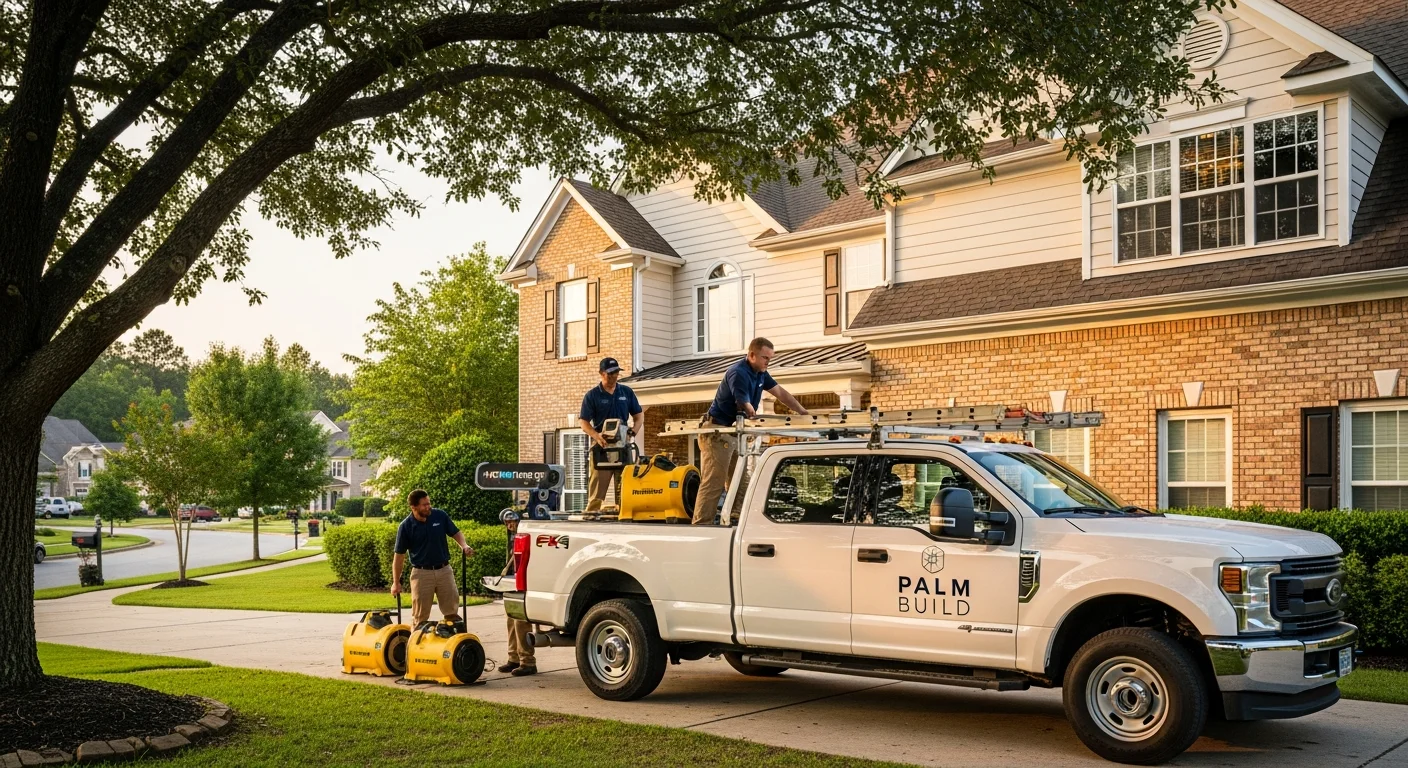
Fort Mill homeowners get Charlotte-level response times at South Carolina prices. Palm Build's NC operations hub is just across the border — 30 to 45 minutes to Baxter Village, Waterside at the Catawba, Sun City, or anywhere in York County.
Charlotte NC — ~8 miles to Fort Mill 30-45 min Response IICRC Certified
Why Fort Mill Homes Face Unique Water Damage Risks
Fort Mill's combination of Piedmont red clay soil, rapid-growth housing stock, Catawba
River flood exposure, and persistent subtropical humidity makes it one of the most
water-damage-prone communities in the Carolina Piedmont. When a burst pipe floods your
Baxter Village townhome or a Catawba event threatens your Waterside property, the clock
starts immediately — mold can begin growing in 24 to 48 hours.
Piedmont Red Clay Soil
<0.2 in/hr
Clay drainage rate
Fort Mill sits atop the same expansive Cecil and Appling series clay as Charlotte, with infiltration rates below 0.2 inches per hour. When Fort Mill's 44-45 inches of annual rainfall saturates this clay, water pools against foundations for days — feeding moisture into crawl spaces beneath historic-area homes and wicking through slab perimeters in newer communities.
Rapid Growth, Aging Infrastructure
+37.2%
Population growth 2020-2023
Fort Mill's explosive growth — 37.2% population increase from 2020 to 2023, making it the fastest-growing town in the US — means homes built in the 1990s and 2000s are now 15 to 25 years old. Baxter Village's first-wave units are approaching 25+ years of plumbing service life, and Sun City and Legacy Park slab builds are entering the peak window for copper supply line pinhole failures.
Catawba River Corridor
FEMA A/AE
Waterside flood zone
The Catawba River defines Fort Mill's entire eastern boundary, and Waterside at the Catawba sits in FEMA Zone A/AE — the highest flood risk classification short of coastal zones. The Great Flood of 1916 reached 47 feet above flood stage. Hurricane Helene in September 2024 became the deadliest SC hurricane in 100 years, with Catawba flooding impacting river-adjacent communities directly.
Persistent Year-Round Humidity
69-75%
Year-round relative humidity
Fort Mill averages 69 to 75% relative humidity year-round — slightly higher than Charlotte due to proximity to the Catawba River corridor. This baseline humidity means mold pressure never fully subsides between events. Any lingering moisture from a spring flood or summer burst pipe can activate mold growth within 24 to 48 hours, especially in historic-area crawl spaces where SC's lack of mold inspector licensing allows problems to go undetected for years.
Historic Fort Mill homes on crawl space foundations face the same Piedmont clay moisture
risks as Charlotte — but SC's unregulated market means many go uninspected until damage
is severe.
Neighborhood-Level Intelligence
Fort Mill Neighborhood Water Damage Risk Profiles
Water damage in Fort Mill follows predictable patterns based on housing age,
construction type, proximity to the Catawba River, and soil conditions. Here's what we
see in the neighborhoods where we work most frequently across York County.
Waterside at the Catawba
Critical
Built: 2010s–2020s
Primary risk: FEMA Zone A/AE — Catawba River adjacent flooding
Common damage: River flooding, storm surge, slab inundation during Catawba flood events
Historic Downtown / Whiteville Park
Critical
Built: Late 1800s–1960s
Primary risk: Crawl space construction on Piedmont clay — highest mold risk
Common damage: Crawl space moisture, mold on floor joists and subfloor, aging galvanized plumbing
Baxter Village
High Risk
Built: 1998–present
Primary risk: Aging plumbing — first wave units now 25+ years old
Common damage: Supply line failures, appliance leaks, HOA-adjacent water intrusion disputes
Sun City Carolina Lakes
High Risk
Built: 2000–2012
Primary risk: Slab-on-grade pinhole leaks in aging copper supply lines
Common damage: Under-slab copper failure, slab moisture wicking into LVP flooring
Regent Park
Moderate
Built: 2000s production builds
Primary risk: Production-built plumbing valve and supply line failures
Common damage: Supply line and valve failures, slab moisture, appliance line leaks
Legacy Park
High Risk
Built: 2005–2008
Primary risk: Copper plumbing at peak pinhole failure age
Common damage: Slow slab moisture from pinhole leaks, engineered hardwood cupping
Common damage: HVAC condensate overflow, high-end finish replacement costs
Massey
Moderate
Built: 2015–present ($800K+)
Primary risk: New construction plumbing, landscape grading drainage
Common damage: Builder-grade supply line failure, inadequate lot drainage in wet years
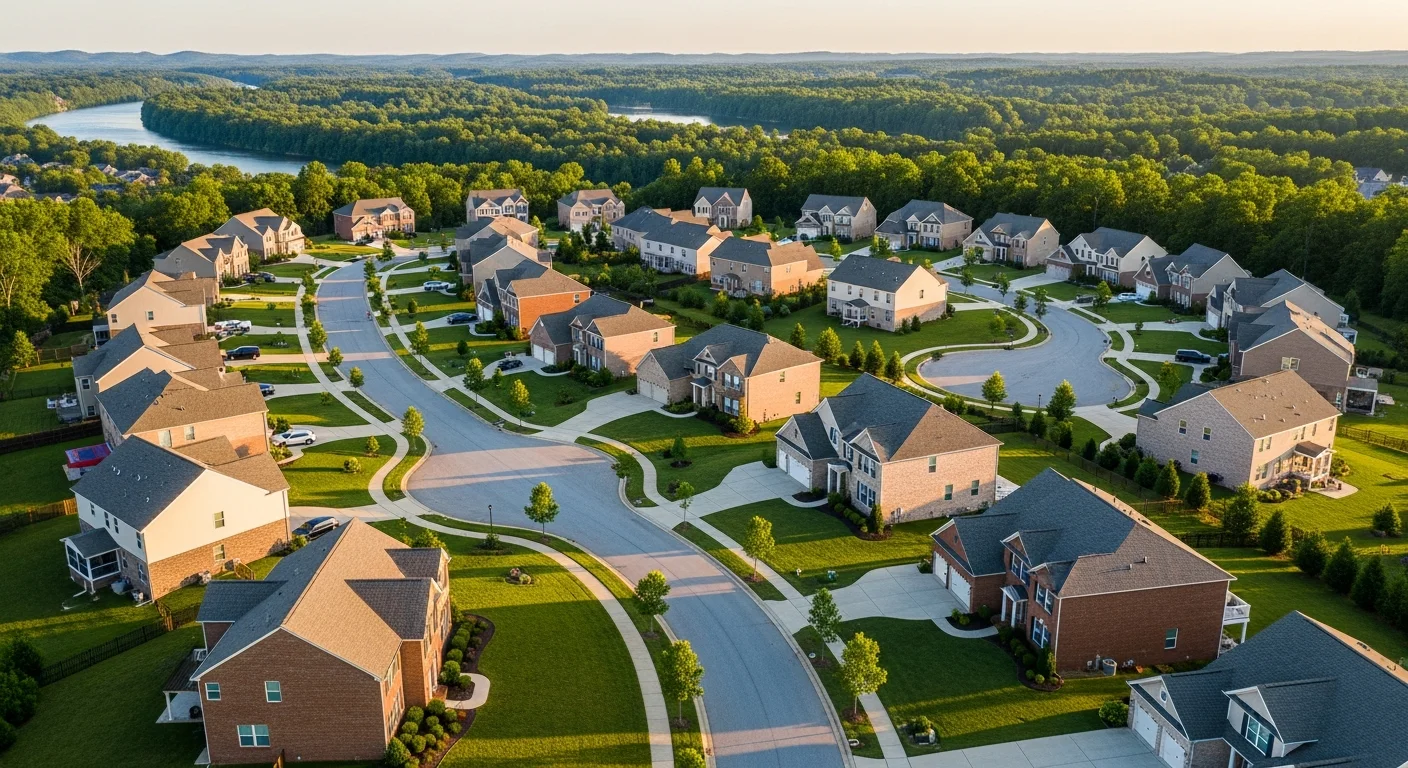
Fort Mill's rapid development has produced a diverse housing stock — from FEMA
flood-zone Catawba River communities to aging crawl space homes in the historic
district.
Fort Mill's Defining Risk
The Catawba River: Fort Mill's Most Underestimated Flood Risk
The Catawba River defines Fort Mill's entire eastern boundary — and it has a documented
history of catastrophic flooding that FEMA maps alone don't fully convey. From the Great
Flood of 1916 to Hurricane Helene in 2024, the Catawba corridor remains the single
highest flood risk in York County.
Great Flood of 1916
47 ft
Above flood stage
The 1916 flood remains the Catawba River's benchmark catastrophic event — 47 feet above flood stage. Hydrologists use this baseline when modeling the river's potential. Every flood risk assessment for Fort Mill's Catawba corridor references this event as the upper boundary of what is geologically possible.
Hurricane Helene 2024
FEMA A/AE
Waterside zone
Hurricane Helene in September 2024 became the deadliest hurricane to hit South Carolina in 100 years. Catawba River flooding devastated communities downstream from the Charlotte metro, with Waterside at the Catawba and other river-adjacent Fort Mill communities experiencing multi-day inundation events that standard homeowners policies did not cover.
Sugar Creek & Steele Creek Flash Flooding
2-3 in/hr
Peak storm intensity
Sugar Creek and Steele Creek — both Catawba tributaries draining portions of the Fort Mill area — flash flood during severe thunderstorm events that peak from May through August. Fort Mill's 44-45 inches of annual rainfall means the ground is frequently pre-saturated before these events begin, eliminating the soil's limited capacity to absorb additional water.
Urbanization Worsening Runoff
99 days/yr
Precipitation days
Fort Mill's 37.2% population growth between 2020 and 2023 has dramatically increased impervious surface cover — roads, parking lots, rooftops, driveways. These surfaces shed water instantly rather than allowing infiltration, accelerating runoff into stormwater infrastructure that development has stretched beyond its original design capacity.
Flood Insurance Gap — Standard Policies Exclude Rising Water
If you live near the Catawba River corridor and do not carry flood insurance, your
standard SC homeowners policy will not cover rising water damage — even from a named
hurricane. Properties in FEMA Zone A and AE are typically required by mortgage lenders
to carry NFIP or equivalent flood insurance. Private flood insurance through carriers
like Chubb, USAA, or Travelers is available for Fort Mill properties regardless of
your FEMA zone designation.
The Catawba River defines Fort Mill's eastern boundary — and its flood history includes
events reaching 47 feet above flood stage. Waterside at the Catawba sits in FEMA Zone
A/AE.
Our Fort Mill Process
How We Restore Fort Mill Homes After Water Damage
Every water damage event is different, but the science of restoration follows a proven
sequence. Here's exactly what happens when you call Palm Build's Charlotte-based team
for your Fort Mill property.
01
Emergency Dispatch
30-45 Minutes
02
Damage Assessment
First 2 Hours
03
Water Extraction
Hours 2-6
04
Structural Drying
3-5 Days
05
Mold Prevention
During Drying
06
Full Restoration
2-6 Weeks
01
Emergency Dispatch
30-45 Minutes
Call our Charlotte line at (704) 464-0121 any time, day or night. Our Crompton Street operations hub is roughly 8 miles from Fort Mill's core neighborhoods. We'll send a crew with truck-mounted extraction equipment, commercial dehumidifiers, and air movers ready to work — no staging, no delay.
02
Damage Assessment
First 2 Hours
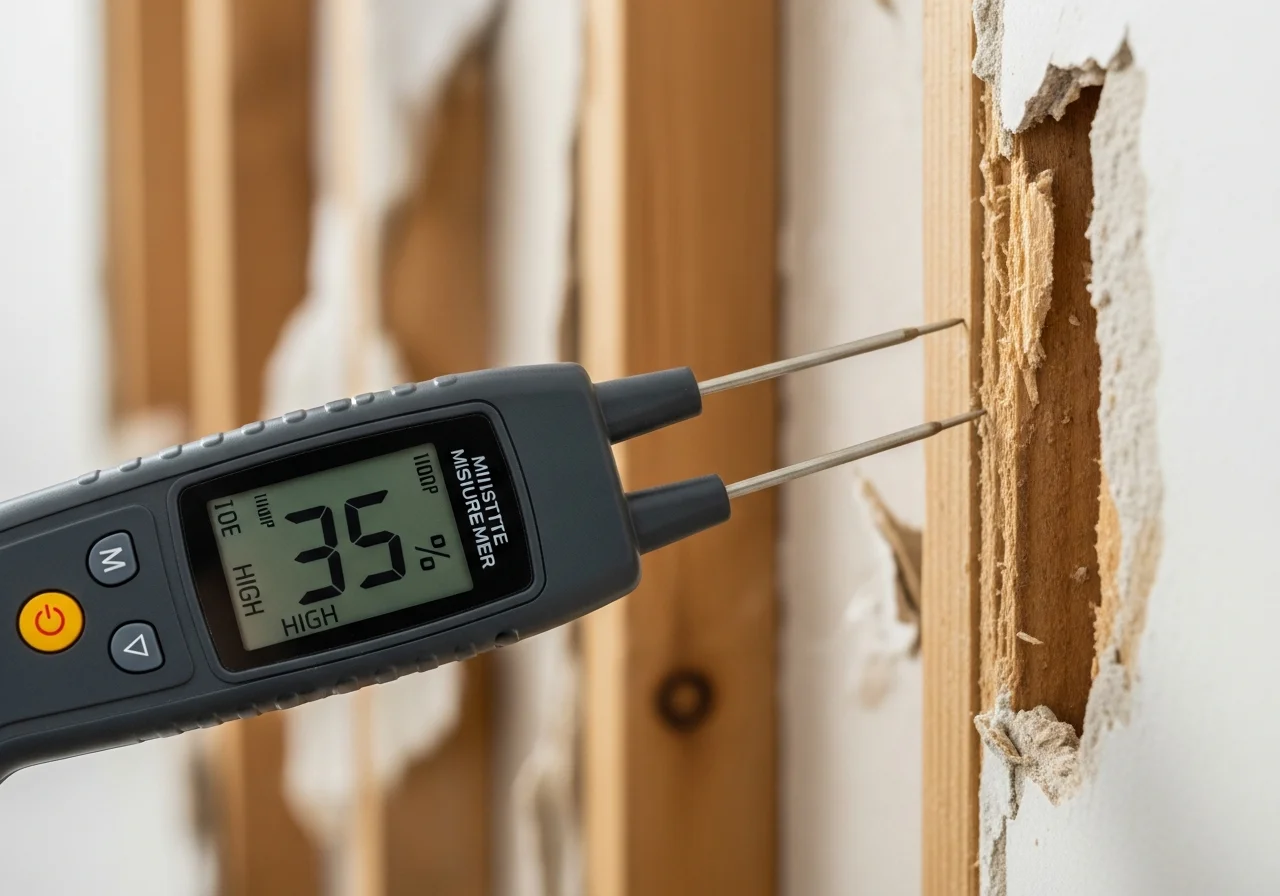
IICRC-certified technicians use infrared thermal imaging cameras and calibrated moisture meters to map exactly where water has migrated — behind drywall, under Fort Mill's slab-on-grade flooring, and into crawl spaces beneath historic-area homes. Every reading is documented using the IICRC S500 Category and Class framework your adjuster will reference. This becomes the foundation of your insurance claim.
03
Water Extraction
Hours 2-6
Truck-mounted extraction systems pull hundreds of gallons per hour. For Fort Mill's growing inventory of luxury vinyl plank and engineered hardwood — common in Sun City, Legacy Park, and Massey — speed is critical. LVP resists surface water but the subfloor and concrete below stay saturated long after the surface appears dry. We extract aggressively and verify with meters before transitioning to drying.
04
Structural Drying
3-5 Days
Commercial LGR dehumidifiers and high-velocity air movers are positioned based on moisture readings, not guesswork. Fort Mill's 69-75% year-round relative humidity means ambient air carries significant moisture load even on a clear day. For crawl space homes in Fort Mill's historic district, we address the crawl space directly — moisture under the house will re-humidify above and feed ongoing mold risk.
05
Mold Prevention
During Drying
EPA-registered antimicrobial treatments are applied during active drying. Fort Mill's persistent humidity means mold pressure begins within 24 to 48 hours of water intrusion. For historic downtown homes where pre-existing crawl space mold is common, we document findings and recommend a separate mold remediation scope before reconstruction — especially critical given SC's lack of mold inspector licensing.
06
Full Restoration
2-6 Weeks
Drywall, flooring, baseboard, trim, painting, and structural work completed under SC LLR license with York County permits. Fort Mill's roughly 80% HOA coverage often requires coordination with HOA managers and adherence to architectural standards. We navigate HOA approval processes and, for complex multi-unit events, our HOA services team manages the entire workflow from a single point of contact.
Why Our Fort Mill Process Works
1
Local Knowledge
We know Fort Mill clay, slab construction, Catawba flood patterns, and HOA dynamics
2
Speed
30-45 minute response from our Charlotte Crompton Street hub — ~8 miles away
3
Scientific Drying
Daily moisture readings until every material reaches dry standard per IICRC S500
4
Insurance-Ready
Documentation formatted for your adjuster — SC or NC policy, any major carrier
Fort Mill's diverse housing stock — spanning late 1800s crawl space homes to brand-new
$800K slab builds — means the failure modes vary significantly by neighborhood. Here's
what we respond to most frequently across York County.
Burst Pipes and Supply Line Failures
A common emergency across Fort Mill, especially in winter freeze events and in the 2000s-era slab communities where braided stainless supply lines have exceeded their 5-8 year service life. A single burst supply line can release 5-8 gallons per minute, flooding an entire floor in under an hour.
Slab Pinhole Leaks
Fort Mill's signature water damage type in newer construction. Sun City, Legacy Park, and Regent Park slab homes built between 2000 and 2010 are entering the peak window for copper supply line pinhole corrosion. A pinhole leak under a slab can silently saturate concrete and subfloor for months before LVP or engineered hardwood begins to cup.
Crawl Space Moisture Intrusion
Historic Downtown and Whiteville Park properties on crawl space foundations accumulate moisture year-round from Piedmont clay soil and Fort Mill's 69-75% ambient humidity. Many Fort Mill crawl spaces have never been professionally inspected — SC's lack of mold inspector licensing means problems go undetected until floors sag or odors become undeniable.
Catawba River and Tributary Flooding
Waterside at the Catawba faces direct Catawba River flood exposure in FEMA Zone A/AE. Sugar Creek and Steele Creek flash flood during intense summer thunderstorms. Hurricane Helene (2024) demonstrated that even well-planned river-adjacent communities can experience inundation events that standard homeowners policies do not cover without separate flood insurance.
HVAC Condensate Overflow
Fort Mill's long, humid summers push AC systems to peak operation from May through September. A clogged condensate drain line in an attic air handler can release gallons of water into ceiling cavities and adjacent walls before a homeowner notices. Sun City and Legacy Park homes with attic air handlers are particularly exposed during peak summer operation.
Appliance and HOA Multi-Unit Events
With roughly 80% of Fort Mill homes under HOA governance, a single appliance leak or supply line failure in a townhome can affect multiple units and common areas simultaneously. Water heaters, dishwashers, washing machines, and refrigerator ice maker connections are the leading source of interior water damage across Fort Mill's slab communities.
Calibrated moisture meters and thermal imaging are used on every Fort Mill job — the
only reliable way to detect slab leaks and hidden moisture before flooring fails.
Fort Mill Pricing
Water Damage Restoration Costs in Fort Mill
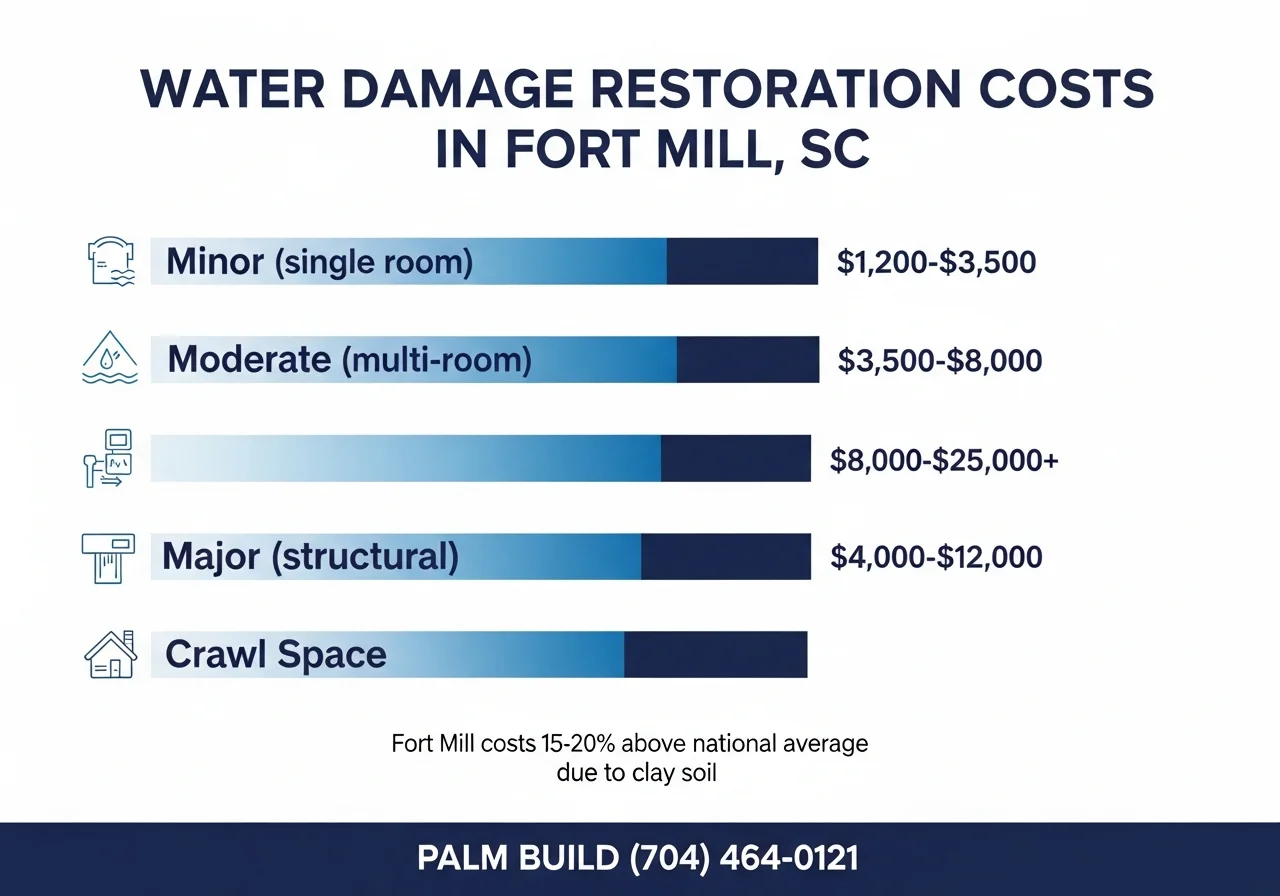
These ranges reflect real-world project costs for Fort Mill properties — not national
averages. Fort Mill's median home value of $519,256 and premium finishes in communities
like Springfield and Massey put restoration costs 15-20% above the national average. HOA
coordination and architectural review requirements can add scope and timeline.
Minor
$1,200 – $3,500
Small appliance leak, single room, no mold, LVP or tile flooring
Moderate
$3,500 – $8,000
Multi-room, drywall affected, engineered hardwood or carpet replacement
Major
$8,000 – $25,000+
Full-floor saturation, crawl space or under-slab involvement, possible mold
Crawl Space
$4,000 – $12,000
Historic-area homes — joist remediation, vapor barrier replacement, encapsulation
Standard Water Damage
Burst pipe, appliance failure, supply line rupture
Fort Mill restoration costs reflect local labor, premium home values, and the complexity
of HOA-governed communities where coordination adds scope.
Know Your Risk Window
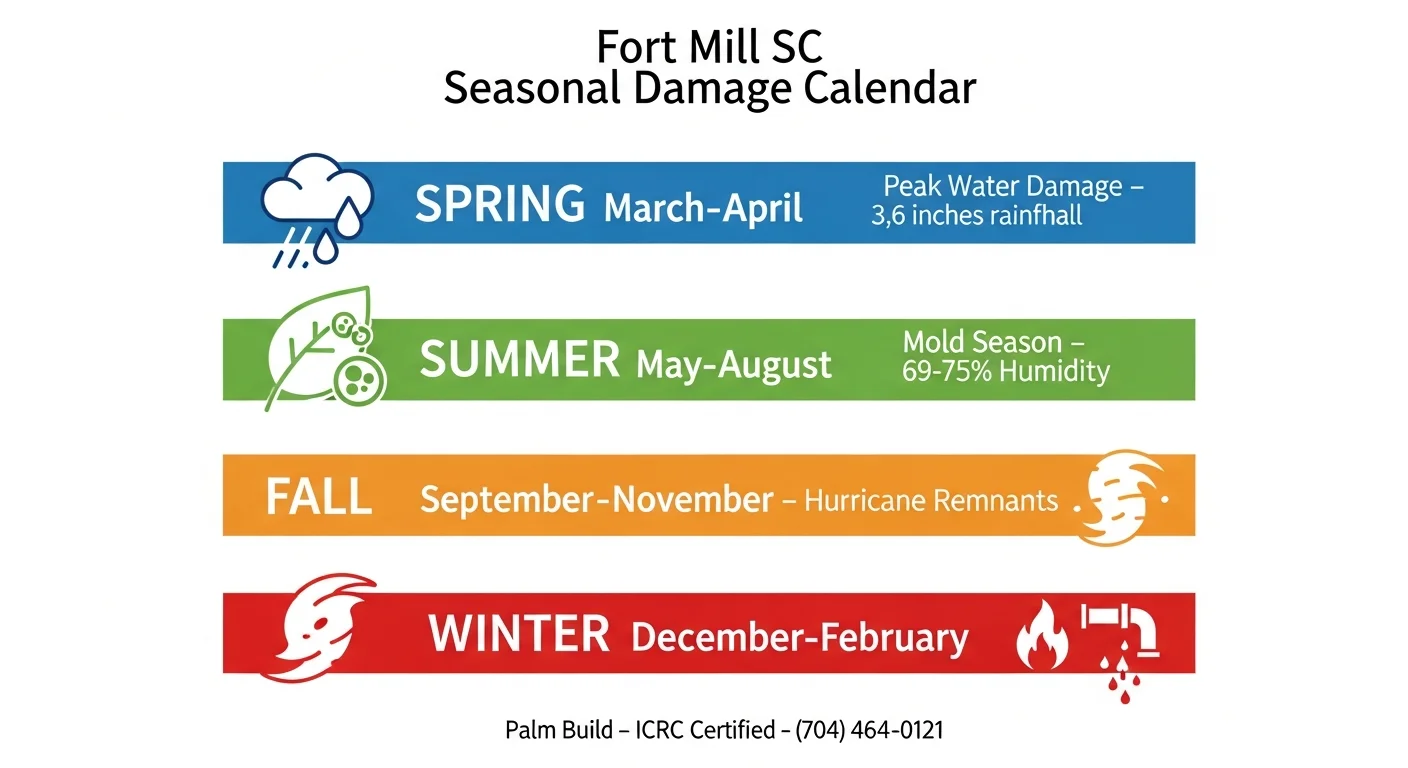
Fort Mill's Seasonal Water Damage Calendar
Fort Mill doesn't have a single "water damage season" — different types of damage peak
at different times of year. Understanding this calendar helps you catch problems early
and take preventive action before damage compounds.
January – February
Freeze-Thaw and Pipe Vulnerability Season
Fort Mill's winters are milder than Charlotte's, but temperatures regularly drop into the low 20s during cold snaps. Exposed pipes in crawl spaces beneath Historic Downtown homes and attic supply lines in Fort Mill's slab communities are at highest risk. Sun City homes with slab construction and minimal pipe insulation in exterior walls are particularly vulnerable to freeze-burst events during extended cold stretches.
March – April
Spring Saturation and Crawl Space Activation
Spring rains begin saturating Fort Mill's Piedmont clay soils. Crawl space moisture levels climb sharply in historic-area homes as warming temperatures introduce humid air through foundation vents. This is when musty odors first appear in older Fort Mill properties, and when HOA communities begin receiving reports of moisture-related odors in shared walls and common areas.
May – June
Severe Thunderstorm and Flash Flood Season
Fort Mill's most dangerous weather window for flash flooding. Severe thunderstorms capable of dropping 2 to 3 inches per hour overwhelm the Piedmont clay drainage system and push water toward foundations, slab perimeters, and storm drainage infrastructure that rapid development has stretched thin. Sugar Creek and Steele Creek tributaries reach action stage multiple times during a typical season.
July – August
Peak Humidity and Mold Growth Window
Fort Mill's relative humidity averages 69 to 75% year-round and spikes higher in July and August. Any lingering moisture from a spring event — even moisture that appeared resolved — can activate mold growth during peak summer humidity. HVAC condensate drain line clogs are also common in August during peak AC operation, causing sudden ceiling and wall water damage in Sun City and Legacy Park homes.
September – October
Hurricane Remnant and Catawba River Season
The Atlantic hurricane season peak runs through October. Remnants tracking inland follow the Piedmont corridor directly through York County. Hurricane Helene (September 2024) was the deadliest SC hurricane in 100 years, with Catawba River flooding affecting Fort Mill's river-adjacent communities. Post-storm mold is typically discovered 2 to 4 weeks later during cleanup or renovation.
November – December
Post-Storm Recovery and Pre-Winter Inspection
Fall is when many Fort Mill homeowners — especially in Sun City's 55+ community — venture into attics and utility spaces for winterization and discover water damage from summer events. Heating system activation also reveals HVAC-related moisture problems that went undetected during the AC season. Fire and pipe suppression water damage increases as heating systems run continuously.
Fort Mill's seasonal damage calendar — Catawba River flooding peaks in fall, crawl space
moisture activates in spring, and mold pressure never fully subsides in summer.
Insurance Navigation
Insurance Claims for Water Damage in Fort Mill
Fort Mill homeowners pay an average of $2,430 per year for homeowners insurance — 24%
below the South Carolina statewide average. But that affordability advantage disappears
quickly if your policy doesn't cover the specific water event you experience.
Understanding your coverage gaps before damage occurs is essential.
Sudden and accidental discharge (burst pipe, appliance failure, supply line rupture) is typically covered under standard SC HO-3 homeowners policies
Flood damage from the Catawba River, Sugar Creek, or Steele Creek overflowing requires separate NFIP or private flood insurance — standard policies exclude rising water
Gradual damage from slow slab leaks, seepage, or long-term crawl space moisture is almost always excluded — the most common SC claims dispute
Mold coverage is typically sublimited to $5,000–$10,000 on SC policies — historic Fort Mill crawl space mold remediation regularly exceeds this
HOA master policies cover common areas and building exteriors but often exclude interior unit damage — confirm your individual unit-owner policy fills the gap
Waterside at the Catawba and FEMA Zone AE properties are typically required by mortgage lenders to carry NFIP or equivalent flood insurance
Carriers writing Fort Mill premium properties ($690K+ Springfield, $800K+ Massey) include Chubb, USAA, Travelers, State Farm, and Allstate — each with different mold sublimits
Palm Build Handles the Documentation
We work directly with your insurance adjuster from the first inspection. Our moisture
maps, thermal images, daily drying logs, and photo documentation are formatted for the
adjuster workflow for every major carrier active in Fort Mill — State Farm, Allstate,
USAA, Travelers, and Chubb — reducing delays and disputes across the SC/NC border.
Our moisture mapping, thermal imaging, and daily drying logs provide the evidence your
adjuster needs — formatted for SC and NC carrier workflows.
Our Work
Fort Mill Water Damage: Before and After
Every Fort Mill project starts with scientific documentation and ends with a home
restored to pre-loss condition — or better. Here's a look at our team in action across
York County.
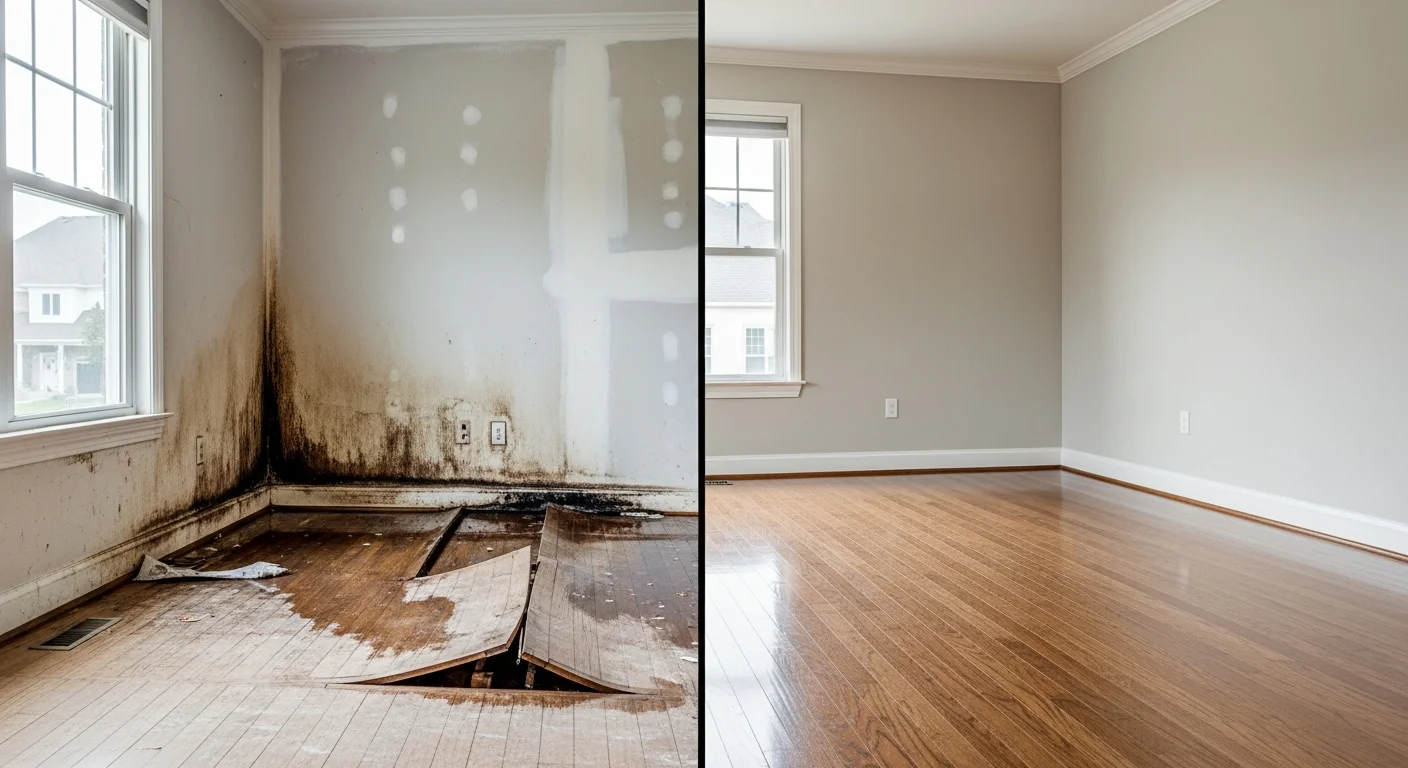
Before and after: complete water damage restoration in a Fort Mill master-planned community home
Commercial extraction in progress — fast removal is critical to prevent moisture migration into walls and subfloors
Every moisture reading is logged with location, time, and material type — giving your adjuster a complete, defensible record
Thermal imaging reveals hidden moisture behind finished surfaces — essential for Fort Mill slab homes where under-floor moisture is invisible
The Palm Build Difference
Why Fort Mill Homeowners Choose Palm Build
Fort Mill's restoration market has grown alongside its population, but the options
haven't kept pace with the quality the market demands. National franchise brands serve
York County from regional hubs with 60-90 minute response times and limited familiarity
with Fort Mill's specific construction patterns and HOA dynamics. Palm Build's Charlotte
hub changes that equation.
IICRC Certified Technicians
South Carolina does not license mold inspectors or restoration contractors — any company can claim expertise without independent verification. Every Palm Build crew lead holds current IICRC Water Restoration Technician (WRT) certification and follows the S500 standard. In SC's unregulated market, this is the credential that matters, and it's the one your insurance adjuster will reference.
SC Licensed (SC LLR)
Palm Build holds South Carolina LLR licensure, authorizing reconstruction work in York County. Our Charlotte NC hub is approximately 8 miles from Fort Mill's core neighborhoods — closer than most SC-based contractors. We pull York County permits, follow SC building code, and coordinate directly with local inspectors throughout the reconstruction phase.
Charlotte-Based Team, 30-45 Min Away
Our Crompton Street operations hub in Charlotte dispatches crews directly to Fort Mill — no relay through a regional franchise 60 to 90 minutes away. We're typically on-site faster than competitors anywhere in the Charlotte metro, with full truck-mounted extraction and drying equipment ready to deploy from the first call.
Insurance Claim Expertise
Fort Mill homeowners hold policies with SC carriers including State Farm, Allstate, USAA, Travelers, and Chubb. Our moisture maps, thermal images, daily drying logs, and photo documentation are formatted for each carrier's adjuster workflow — regardless of whether a SC or NC policy form applies. We coordinate with HOA master policy adjusters simultaneously when multi-unit events require it.
HOA Coordination Experts
With roughly 80% of Fort Mill homes under HOA governance, restoration work often requires coordination with community managers, architectural review committees, and multiple insurance adjusters. We're experienced navigating HOA approval processes, documenting damage by unit for multi-party events, and managing the communication workflow that prevents disputes from extending project timelines.
Complete Restoration — Extraction Through Rebuild
From emergency water extraction through final reconstruction, one company manages the entire Fort Mill project. No handoffs between a mitigation company and a separate contractor. No gaps in accountability. No delays while you find someone to do the rebuild. Our licensed reconstruction team handles drywall, flooring, structural work, and finish carpentry under the same project management.
Common Questions
Fort Mill Water Damage FAQ
How fast can Palm Build respond to a water emergency in Fort Mill SC?
Our Charlotte NC operations hub at 378 Crompton Street is approximately 8 miles from Fort Mill's core neighborhoods. We typically arrive in 30 to 45 minutes — faster than most competitors dispatching from anywhere else in the Charlotte metro. Call (704) 464-0121 any time, day or night.
Does homeowners insurance cover water damage in Fort Mill?
Standard SC HO-3 homeowners insurance covers sudden and accidental water damage — burst pipes, appliance failures, supply line ruptures. It does not cover flood damage from the Catawba River, Sugar Creek, or other rising water sources (that requires separate NFIP or private flood insurance). Gradual leaks and long-term crawl space moisture are almost always excluded. Mold coverage is typically sublimited to $5,000-$10,000 on SC policies, which often falls short of actual remediation costs in historic Fort Mill properties.
Do I need flood insurance in Fort Mill?
If your property is in FEMA Zone A or AE — which includes Waterside at the Catawba and other Catawba River-adjacent areas — flood insurance is typically required by your mortgage lender. Even outside these zones, Fort Mill's Catawba River flood history (including the 1916 event at 47 feet above flood stage) and Hurricane Helene's 2024 impact make private flood insurance worth serious consideration. Carriers like Chubb, USAA, and Travelers offer private flood policies for York County properties.
What are pinhole slab leaks and are they common in Fort Mill?
Pinhole leaks are small corrosion failures in copper supply lines embedded in or running through slab-on-grade foundations. They're common in Fort Mill communities built between 2000 and 2010 — Sun City Carolina Lakes, Legacy Park, and Regent Park — because copper piping from that era is now entering its peak failure window. A pinhole leak can silently saturate concrete and the subfloor above it for months before engineered hardwood or LVP flooring begins to cup or bubble. Thermal imaging is the most reliable early detection method.
How does SC's lack of mold licensing affect Fort Mill homeowners?
South Carolina does not license mold inspectors or remediation contractors, which means any company can claim mold expertise without independent verification. In Fort Mill's unregulated market, IICRC certification — specifically the Applied Microbial Remediation Technician (AMRT) designation — is the only independently verified credential. When hiring a mold or restoration contractor in York County, always ask for IICRC certification numbers, which can be verified at iicrc.org.
How does water damage restoration work in HOA communities?
Fort Mill's roughly 80% HOA coverage means most water damage events involve at least two layers of insurance: the HOA master policy (covering building exteriors and common areas) and the individual unit-owner policy (covering interior finishes and personal property). When a single supply line failure affects multiple units, each insured may need separate documentation. Palm Build coordinates directly with HOA management, documents damage by unit, and works with multiple adjusters simultaneously when needed. Our HOA services team handles complex multi-unit events from a single point of contact.
How long does water damage restoration take in Fort Mill?
Structural drying typically takes 3 to 5 days depending on the extent of saturation, materials affected, and Fort Mill's ambient humidity (69-75% year-round, peaking in summer). Full restoration including reconstruction typically takes 2 to 6 weeks for a standard residential project. HOA communities may extend the timeline if architectural review approval is required for exterior or common-area repairs.
What areas around Fort Mill does Palm Build serve?
We serve all of Fort Mill and York County including Baxter Village, Waterside at the Catawba, Sun City Carolina Lakes, Regent Park, Legacy Park, Springfield, Massey, Historic Downtown Fort Mill, Whiteville Park, Tega Cay, Indian Land, and surrounding ZIP codes 29715, 29708, and 29707. We also serve the greater Charlotte metro on both sides of the NC/SC border.
Water Damage in Fort Mill? We're 30-45 Minutes Away.
Palm Build's Charlotte NC team responds to Fort Mill water emergencies in 30 to 45 minutes with truck-mounted extraction, commercial drying equipment, and insurance-ready documentation. Call our local Charlotte line now — we answer 24/7.