Storm & Hurricane Damage Restoration in Miramar, Florida
Miramar sits 7-15 miles inland from the coast, outside mandatory evacuation zones for Category 1-2 hurricanes — but that distance does not protect it from wind damage. Hurricane Irma (2017) spawned an EF-1 tornado just 4 miles west of the city. The April 2023 historic flood dropped 25.6 inches in 12 hours. Tile roof failures, accordion shutter damage, and screen enclosure collapse are the signature storm losses in Miramar's western communities. Palm Build's Deerfield Beach team responds in under 45 minutes with emergency tarping, water extraction, and the carrier-ready documentation Florida insurers demand.
Deerfield Beach — Minutes from Miramar Under 45 min Response IICRC Certified
Why Miramar Faces a Storm Damage Profile Unlike Any Coastal City
Miramar is not a coastal city — and that is precisely what makes its storm damage
profile so misunderstood. Sitting 15 miles inland at just 3 feet above sea level,
Miramar does not face ocean storm surge. Instead, the city's 140,000+ residents face
pluvial flooding: extreme rainfall that overwhelms a flat, canal-dependent drainage
system engineered for normal storms, not the 20-inch rain events that South Florida
hurricanes and tropical systems now produce. When FEMA added 25,878 Miramar properties
to expanded flood zones in July 2024, it confirmed what the April 2023 flood had already
proven — Miramar's storm risk has been systematically underestimated.
Add a housing stock dominated by 20-year-old concrete tile roofs with aging
underlayment, accordion shutters that have never been tested in a real hurricane, and
master-planned communities built around retention lakes that become overflow hazards
during extreme rainfall — and Miramar presents a storm restoration challenge that
requires inland flood expertise, not coastal surge protocols.
3 ft
Average elevation
25,878
Properties added to flood zones
25.6"
April 2023 rainfall
15 mi
Inland — zero coastline
Miramar's inland location does not protect it from hurricane damage — pluvial flooding
and tile roof failures dominate the city's storm damage profile
Pluvial Flooding — Not Coastal Surge
Miramar sits 15 miles inland with zero coastline. The city's storm threat is pluvial flooding — extreme rainfall that overwhelms drainage faster than the canal system can discharge. Unlike coastal cities where storm surge dominates, Miramar floods from the sky down. The April 2023 rain event proved this definitively: 25.6 inches of rain in hours turned streets into rivers without a single foot of storm surge reaching the city. Every hurricane that stalls or slows over South Florida creates the same pluvial flood mechanism.
Three Feet Above Sea Level — Nowhere for Water to Go
Miramar's average elevation is just 3 feet above sea level across a flat limestone plain. There is no natural gradient to move stormwater. The city relies entirely on its engineered canal system — C-11 (running east along the northern border) and C-9 — to drain rainfall. When those canals reach capacity during extreme events, water backs up through storm drains into streets, garages, and living spaces. SFWMD canal gate operations during hurricanes can further restrict outflow, trapping water in Miramar's interior.
FEMA Added 25,878 Properties to Flood Zones — July 2024
In July 2024, FEMA's updated Flood Insurance Rate Maps added 25,878 Miramar properties to expanded flood zones. Homeowners who never needed flood insurance suddenly face mandatory purchase requirements if they hold a federally-backed mortgage. Many of these properties are in master-planned communities built in the 1990s-2000s that were marketed as low-flood-risk. The remapping reflects the reality that Miramar's pluvial flood risk was systematically underestimated for decades.
Tile Roof & Accordion Shutter Vulnerabilities
Miramar's housing stock is dominated by concrete tile roofs — S-tile and flat tile installed in the late 1990s through 2000s. At 20-25 years old, these roofs are approaching the age where underlayment fails, tile clips corrode in South Florida humidity, and wind uplift displaces tiles that were secure a decade ago. Accordion shutters, standard on most Miramar homes, develop corroded tracks and seized hardware from years of non-use. When a hurricane finally forces deployment, 15-20% of accordion shutters fail to close properly.
Miramar isn't on the coast — but its combination of near-sea-level elevation, an
overwhelmed canal system, aging tile roofs, and FEMA-reclassified flood zones creates
storm damage exposure that rivals any beachfront municipality. When hurricanes and
tropical storms hit, Miramar's inland position offers no protection from the rain, wind,
and flooding that follow.
Pluvial Flooding — Not Coastal Surge
Pluvial
Primary flood type
Miramar sits 7 to 15 miles inland from the Atlantic. Its storm flooding profile is driven entirely by rainfall accumulation — pluvial flooding — not coastal surge. When 10+ inches fall in hours, water has nowhere to go. It enters through garage doors, sliding glass doors, and around slab perimeters, saturating CBS wall bases and tile grout lines from ground level up.
Just 3 Feet Above Sea Level
~3 ft
Average elevation
Miramar's average elevation is approximately 3 feet above sea level — among the lowest in Broward County's inland cities. This near-zero gradient means stormwater drains slowly, pooling in streets, yards, and against home foundations for hours or days after major rainfall events. The flat terrain that made western Miramar easy to develop is the same terrain that makes it flood.
Canal System Overflow (C-11 / C-9)
C-11/C-9
Canal systems at risk
Miramar's stormwater infrastructure depends on the C-11 and C-9 canal systems managed by the South Florida Water Management District. When rainfall exceeds pump station capacity, canals overflow through culverts into residential streets and retention lakes already at capacity. The April 2023 historic flood — 25.6 inches in 12 hours — proved the system's catastrophic failure threshold.
25,878 FEMA Reclassified Properties
25,878
New flood zone properties
FEMA's July 2024 flood map remapping added 25,878 Miramar properties to Special Flood Hazard Areas — more than any other single city in Broward County. Tile roofs built 2000-2005 in Monarch Lakes, Silver Shores, and Sunset Lakes are now at their 20-year vulnerability window, where barrel tiles crack, underlayment degrades, and wind-driven rain finds new entry points during every storm.
Miramar's CBS stucco homes with barrel tile roofs face compounding storm damage — wind
displaces tiles, driving rain infiltrates exposed decking, and pluvial flooding
saturates interiors from ground level simultaneously.
Storm History
Major Storm Events That Shaped Miramar's Risk Profile
Each of these events exposed new vulnerabilities in Miramar's infrastructure and housing
stock — and each one drives how Palm Build prepares for the next.
Neighborhood Guide
Miramar Neighborhood Storm Damage Risk Profiles
Every Miramar community has a different storm vulnerability based on roof type,
construction age, elevation, and proximity to canals and retention lakes. Tap any
neighborhood to see specific risks.
Storm Damage Types
How Storms Damage Miramar Homes
Each storm damage type requires a different response protocol and insurance
documentation approach. Understanding the damage source determines the restoration
strategy — and whether your claim is filed under wind, flood, or both.
Tile Roof Displacement
Barrel tile uplift and underlayment failure
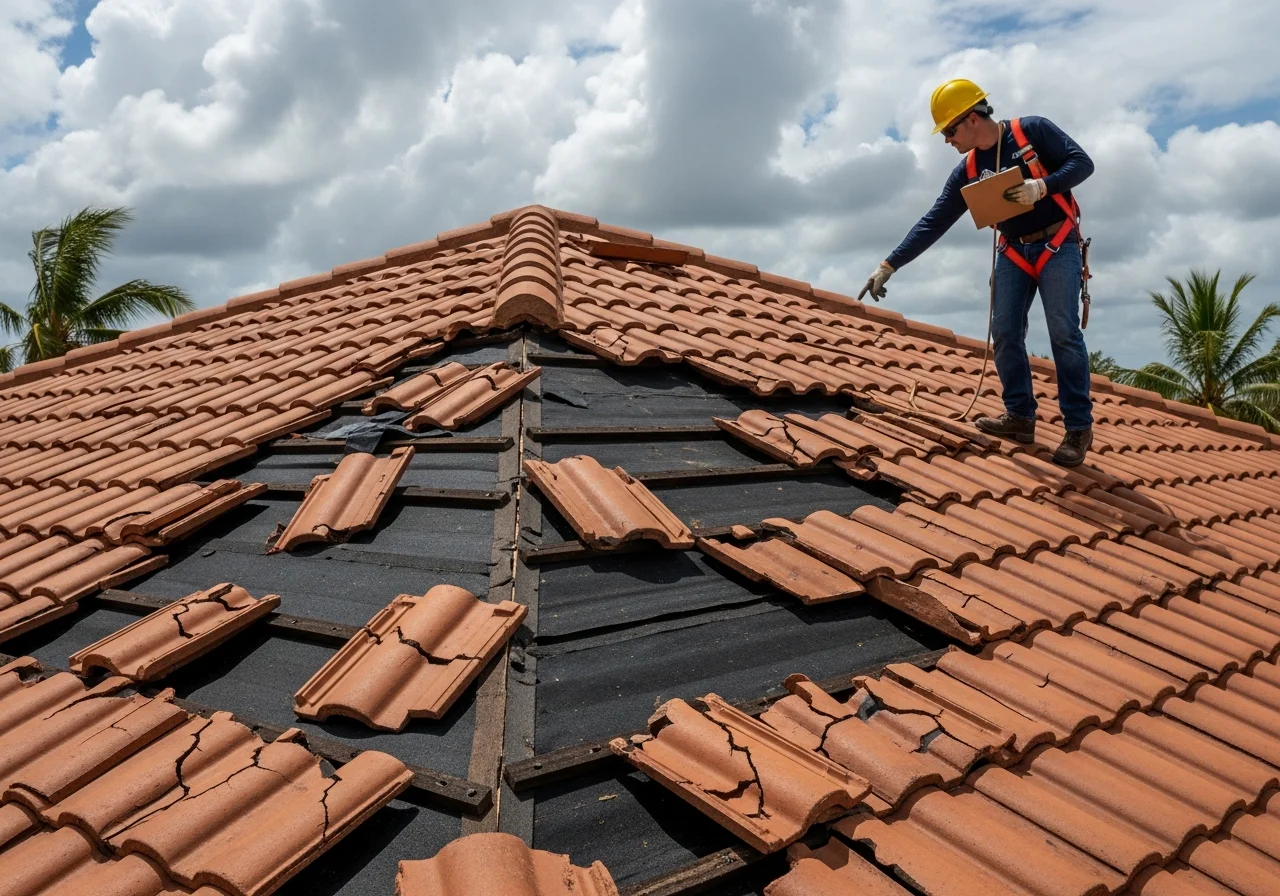
Miramar's dominant barrel tile roofs are secured with mortar sets and S-clips that degrade over 15-25 years. Hurricane-force winds lift individual tiles, exposing the felt underlayment beneath. Once underlayment is breached, every subsequent rain band drives water directly into roof decking, attic spaces, and interior ceilings. Post-storm, displaced tiles are often invisible from ground level — damage only appears when ceilings stain weeks later.
Screen Enclosure Collapse
Pool cage and patio structure failure
Screen enclosures are ubiquitous across western Miramar — nearly every home in Sunset Lakes, Monarch Lakes, and Riviera Isles has a pool cage or patio screen structure. These aluminum-framed enclosures fail catastrophically in winds above 80 mph. Collapsed screen enclosures become projectile debris that damages adjacent homes, vehicles, and roof surfaces. Replacement costs range from $8,000 to $25,000+.
Pluvial Flooding
Canal overflow and rainfall accumulation
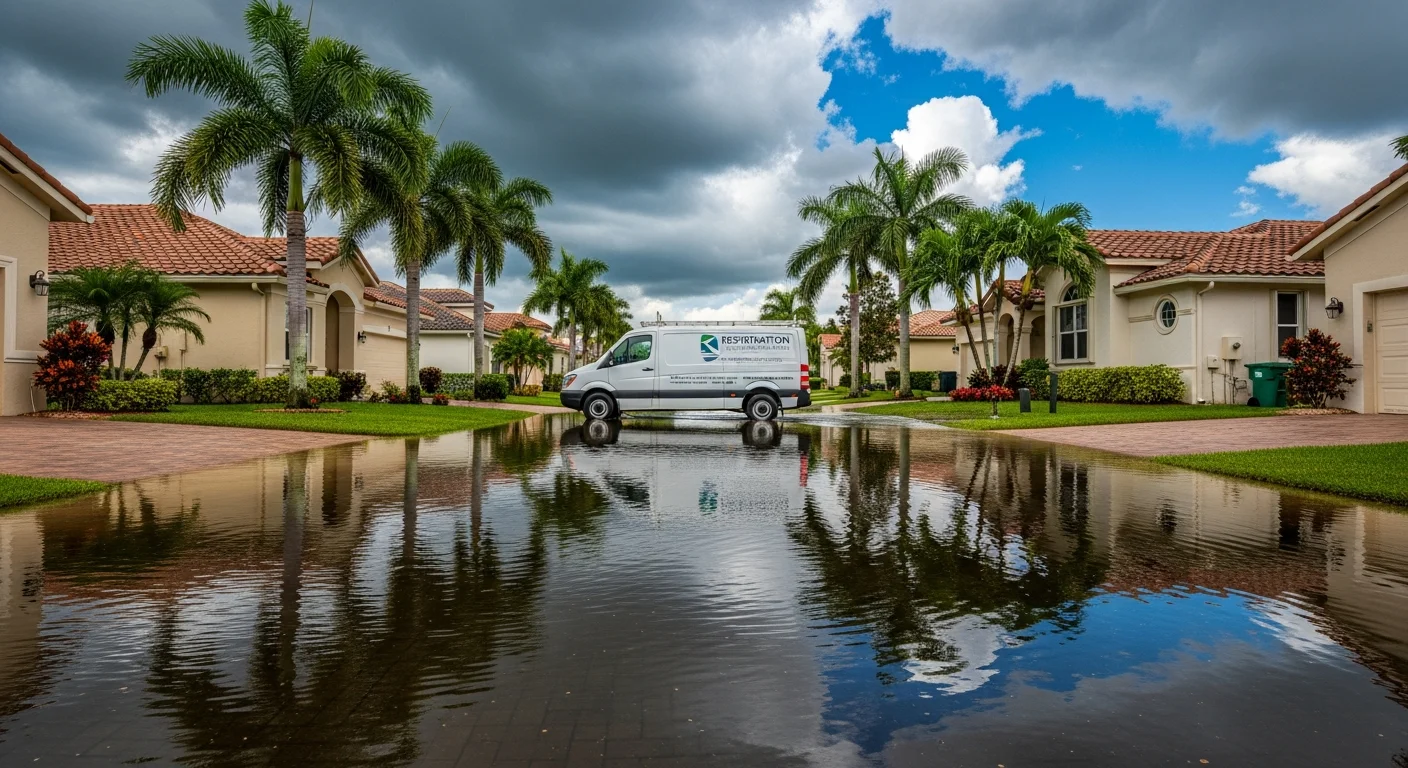
Miramar's primary flood mechanism during storms. When rainfall exceeds the C-11 and C-9 canal system's pump capacity, water backs up through culverts into streets and yards. It enters homes through garage doors, sliding glass doors, and around slab perimeters — saturating CBS wall bases, tile grout, and baseboards from the ground up. The April 2023 event proved this can happen without any hurricane at all.
Wind-Driven Rain Intrusion
Horizontal rain penetrating building envelope
During hurricanes, rain travels horizontally at 80-130+ mph. It penetrates window frames, door weatherstripping, soffit vents, and any stucco crack — entry points that never leak during normal vertical rainfall. Wind-driven rain saturates wall cavities from the outside in, creating hidden moisture that conventional drying misses. Infrared thermal imaging is required to map the full extent of intrusion.
Debris Impact Damage
Projectile damage from landscaping and structures
Western Miramar's mature royal palms, ficus trees, and dense tropical landscaping become projectile sources in hurricane-force winds. Fallen trees crush screen enclosures, fence sections, and roof surfaces. Airborne debris — roof tiles from neighboring homes, loose construction materials, street signage — punctures walls and windows. Debris impact damage triggers separate insurance documentation from wind damage.
Post-Storm Mold Growth
Secondary damage from delayed drying
The most expensive storm damage in Miramar is often invisible for weeks. After a hurricane, homes sit with compromised roofs, saturated walls, and no power (meaning no AC or dehumidification) for days. In 90-degree heat and 80%+ humidity, mold colonizes within 24-72 hours. By the time power returns and homeowners re-enter, mold has established behind drywall, in attic spaces, and through HVAC ductwork — turning a wind damage claim into a full mold remediation project.
Our Process
How Palm Build Restores Storm-Damaged Miramar Homes
Six documented steps from emergency stabilization to full reconstruction — each
calibrated for Miramar's tile roofs, CBS construction, screen enclosures, and
HOA-governed communities.
Cost Guide
Storm Damage Restoration Costs in Miramar
Storm restoration costs in Miramar run 40-60% above national averages due to tile roof
complexity, screen enclosure rebuilds, extended drying requirements, and Florida
Building Code compliance.
Barrel tile matching, underlayment replacement, Florida Building Code compliance, and permit costs.
Service
Screen Enclosure Rebuild
Miramar
$8,000 - $25,000+
National
N/A (regional)
Why
Screen enclosures are a South Florida-specific structure. Complete rebuild after collapse is common.
Service
Water Extraction & Structural Drying
Miramar
$3,000 - $10,000
National
$1,500 - $5,000
Why
Storm damage creates multiple entry points. Extended drying in 80%+ humidity requires more equipment days.
Service
Mold Remediation (Post-Storm)
Miramar
$5,000 - $20,000
National
$2,000 - $9,000
Why
Power outages accelerate mold growth. Florida DBPR licensing requirements. Larger affected areas typical.
Service
Full Storm Restoration (Major Event)
Miramar
$25,000 - $100,000+
National
$15,000 - $50,000
Why
Combined roof, interior, enclosure, and landscaping damage. Florida Building Code, HOA compliance, extended timelines.
Insurance note: Florida's hurricane deductible is typically 2% of dwelling
coverage — on a $514,000 Miramar home, that is $10,280 out-of-pocket before wind/hurricane
coverage activates. Flood damage from pluvial flooding requires a separate NFIP or private
flood policy. Only 18% of Floridians carry flood insurance — leaving most Miramar homeowners
exposed to the most common storm damage source.
Hurricane Season Calendar
Miramar Hurricane Season: June Through November
Atlantic hurricane season runs June 1 through November 30, with peak activity
concentrated in September and October. For Miramar homeowners — especially the 25,878
properties newly mapped into FEMA flood zones in 2024 — understanding the seasonal risk
curve determines when to complete preparations, when to verify insurance coverage, and
when to have your restoration company on speed dial.
June
Low-Moderate
Hurricane season begins June 1. Early-season storms are typically disorganized but can produce heavy rainfall and localized flooding. This is your last window to test accordion shutters, verify flood insurance (especially if your property was added to FEMA zones in 2024), and schedule a roof inspection before activity ramps up.
July
Moderate
Tropical development increases as Atlantic ocean temperatures rise. Severe thunderstorm events become common across Miramar — producing localized flooding, lightning damage, and occasional hail. These non-hurricane events cause significant tile roof and screen enclosure damage. July thunderstorms can drop 3-5 inches in under an hour, testing Miramar's drainage capacity.
August
High
Peak development zone shifts closer to Florida. Cape Verde storms begin their Atlantic crossing. Sea surface temperatures peak, fueling rapid intensification — a storm can strengthen from tropical storm to Category 4 in 36 hours. Accordion shutters should be accessible and tested. Emergency water and supply kits should be staged. Generator fuel should be fresh.
September
Peak
Statistically the most dangerous month for South Florida hurricanes. Hurricane Irma struck in September 2017. The concentration of warm water, low wind shear, and African easterly waves makes September the highest-probability month for a major hurricane affecting Miramar. This is the month where deferred preparation becomes a liability.
October
Peak
October rivals September for hurricane frequency in South Florida. Hurricane Wilma (2005) made landfall October 24 and caused catastrophic damage across Broward County. Hurricane Milton (2024) struck October 9. Late-season storms often approach from the southwest — catching communities that prepare only for Atlantic-origin storms off guard.
November
Low-Moderate
Season officially ends November 30 but late-season events remain possible. Tropical Storm Eta (2020) dumped 16-18 inches on Miramar in November, causing widespread flooding. Hurricane Nicole (2022) made landfall in November. Do not lower your guard until December. November tropical moisture combined with frontal boundaries can produce extreme rainfall events.
Miramar's flat terrain and canal-dependent drainage system creates pluvial flooding
during extreme rainfall events throughout hurricane season
Non-Hurricane Events Are Miramar's Biggest Threat
Miramar's most damaging recent events were not hurricanes. Tropical Storm Eta (2020) and
the April 2023 rain bomb caused more residential flood damage than any single hurricane
in the city's modern history. Stalled tropical moisture bands, slow-moving tropical
storms, and extreme thunderstorm complexes can dump 15-25 inches of rain on Miramar
without a hurricane warning ever being issued. These events receive no advance
evacuation orders, no emergency declarations until after the damage is done, and no FEMA
assistance unless the governor requests a disaster declaration. Flood insurance is your
only protection — and after the 2024 FEMA remapping, many Miramar homeowners now face
mandatory purchase requirements.
Broward County's average homeowners insurance premium exceeds $6,000/year — among the
highest in Florida. Storm damage claims involve separate deductibles, coverage gaps, and
filing deadlines that catch Miramar homeowners off guard. Palm Build documents every
storm project to the standard Florida carriers demand.
Hurricane Deductible (2%)
2% = $10,280
Miramar homeowners policies carry a separate hurricane deductible — typically 2% of dwelling coverage. On a $514,000 home, that is $10,280 out-of-pocket before wind/hurricane coverage activates. This is separate from your standard $1,000-$2,500 deductible. Many homeowners don't realize this threshold exists until they file a claim.
Separate Flood Policy Required
Not covered by HO-3
Standard HO-3 homeowners policies explicitly exclude flood damage — water entering the home from outside the structure. Pluvial flooding from canal overflow (Miramar's primary flood source) is NOT covered by wind/hurricane policies. You need a separate NFIP or private flood policy. With 25,878 Miramar properties now in FEMA flood zones, mortgage lenders are increasingly requiring flood coverage.
1-Year Filing Deadline
File within 1 year
Florida Statute 627.70132 requires property insurance claims for hurricane or windstorm damage to be filed within 1 year of the date of loss. Supplemental claims must be filed within 18 months. After major storms, many Miramar homeowners delay filing while managing immediate needs — and inadvertently forfeit their rights. Document damage immediately, even if you delay repairs.
AOB Reform — No More Assignment
No more AOB
As of January 1, 2023, Florida prohibits policyholders from assigning post-loss benefits (Assignment of Benefits) to contractors. Homeowners must remain directly involved in the claims process. Palm Build supports you through every step — damage documentation, adjuster coordination, scope negotiation, and supplement filing — without taking over your claim rights.
Common Insurance Carriers in Miramar / Broward County
Citizens Property InsuranceState insurer of last resort. Largest single carrier in Broward. 31%+ rate increases since 2022.
Security First FinancialActive in Broward County. Standard HO-3 wind policies.
Universal Property & CasualtyCommon in Miramar. Check wind vs. flood coverage gaps.
Heritage Insurance HoldingsSelect markets. Known for strict documentation requirements on storm claims.
NFIP / Private FloodRequired for flood zone properties. Max $250K dwelling coverage through NFIP.
Gallery
Storm Damage Restoration in Miramar
From emergency tarp-up to full reconstruction — Palm Build restores storm-damaged
Miramar homes to pre-loss condition with the documentation Florida insurers require.
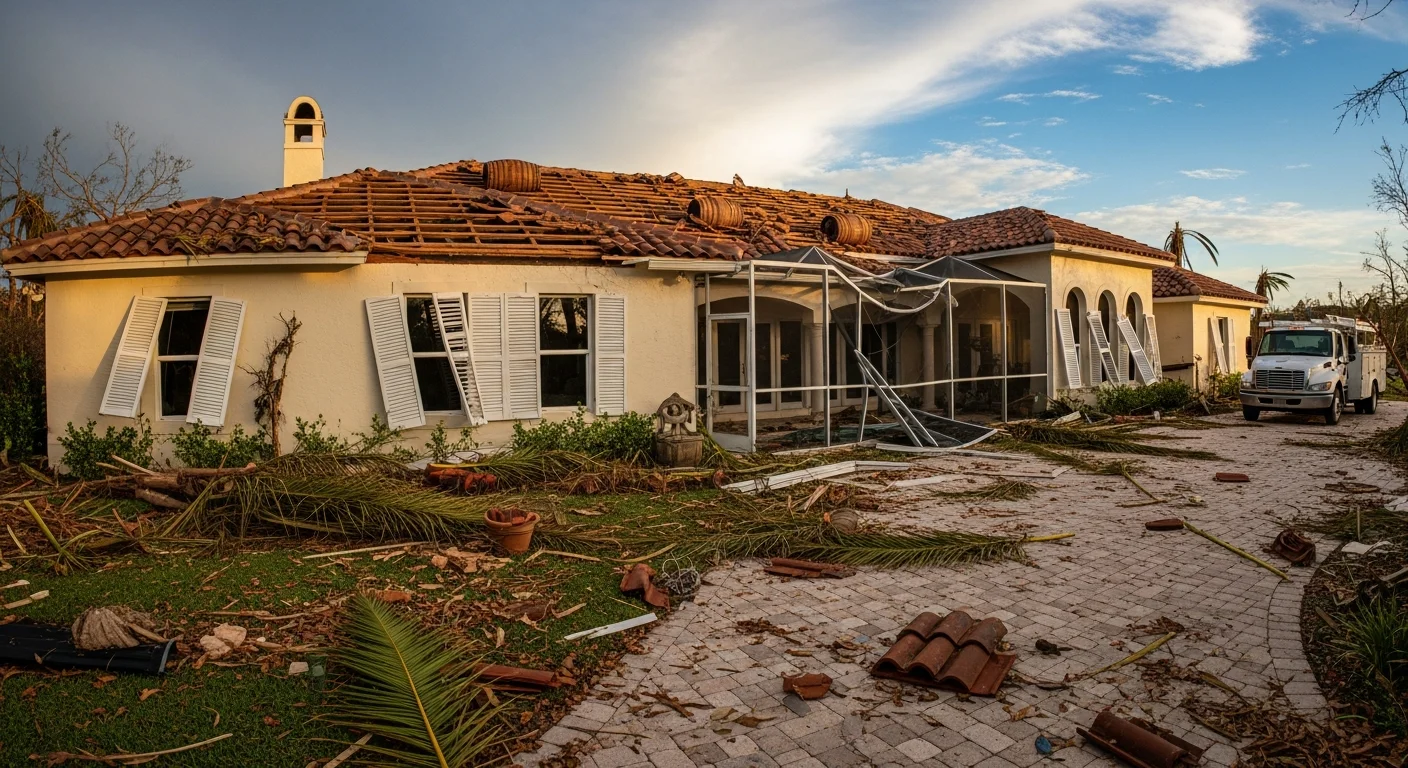
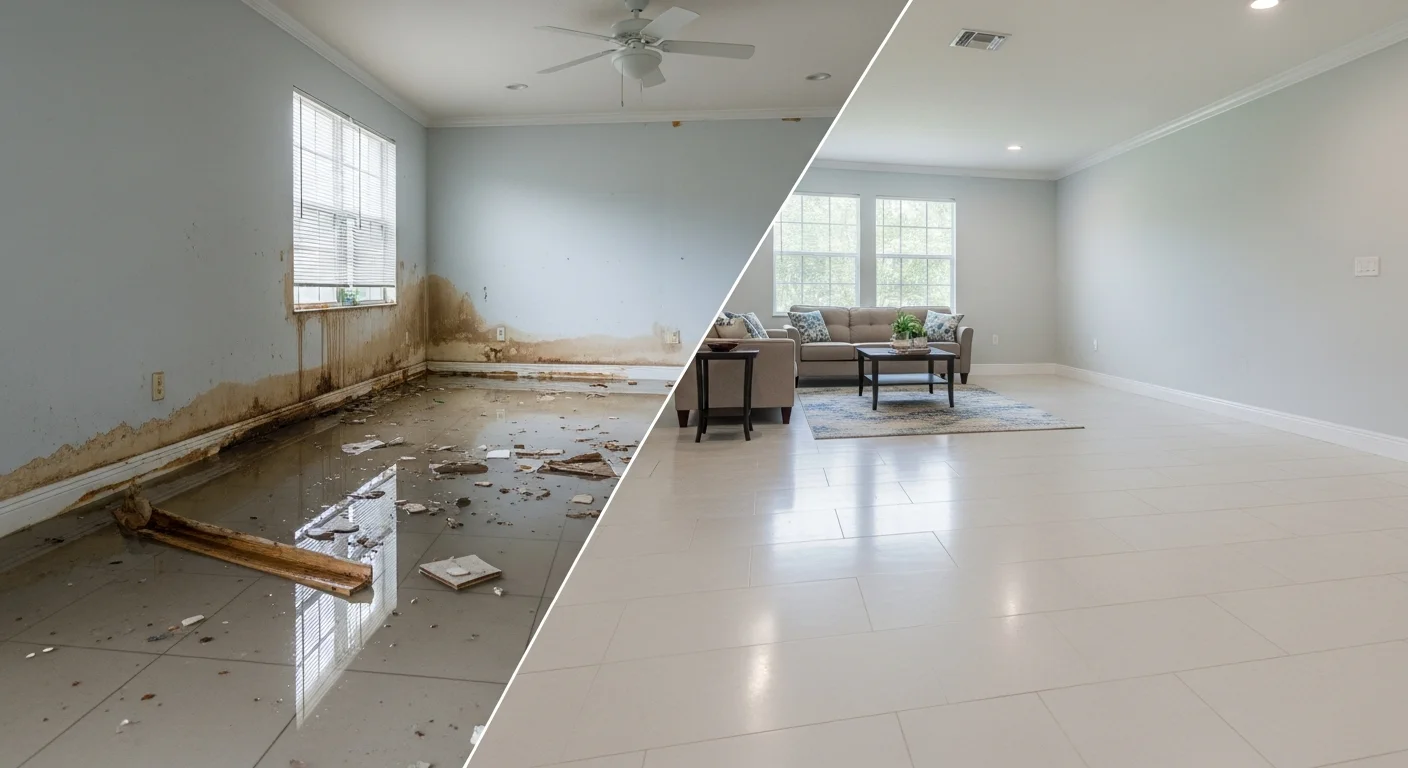
Hurricane damage to a western Miramar home — displaced barrel tiles, damaged screen enclosure framing, and storm debris requiring emergency tarp-up and full restoration.Barrel tile displacement exposes the felt underlayment beneath — once breached, every subsequent rain event drives water directly into roof decking and interior ceilings.Pluvial flooding from canal overflow and extreme rainfall — water enters Miramar homes at ground level through garage doors, sliding glass doors, and around slab perimeters.Before and after: a Miramar home restored from combined wind and water storm damage — new drywall, flooring, and paint matched to the original architectural style with full HOA compliance.
Why Palm Build
Why Miramar Homeowners Choose Palm Build for Storm Damage
No franchise, no generic playbook. Palm Build brings tile roof expertise, CBS
construction knowledge, HOA fluency, and Florida hurricane claims experience to every
Miramar storm damage project.
24/7 Emergency Storm Response
Our Deerfield Beach hub deploys crews during and immediately after storms — reaching every Miramar neighborhood via I-75 and Miramar Parkway. Emergency tarp and board-up teams stabilize your home while extraction crews begin water removal simultaneously.
IICRC & Florida Licensed
Every Palm Build technician holds active IICRC certifications in Water Damage Restoration (WRT) and Applied Structural Drying (ASD). Our mold remediation crews carry Florida DBPR credentials required by state law.
Hurricane Claims Documentation
We produce the wind damage surveys, moisture mapping, photo documentation, and detailed scope reports that Citizens, Security First, and every Florida carrier requires for hurricane claims. Post-AOB reform, carrier-quality documentation is the difference between claim approval and denial.
HOA-Fluent Storm Operations
Western Miramar's gated communities demand coordinated storm response — vendor pre-approval, architectural review for roof repairs, and common-area debris coordination. We maintain the HOA documentation Sunset Lakes, Monarch Lakes, and Riviera Isles associations require.
Tile Roof & CBS Specialists
We understand barrel tile roofing systems — mortar sets, S-clips, underlayment integrity — and the specific moisture pathways in CBS stucco construction during wind-driven rain events. Our roof assessments go beyond visible damage to evaluate what's hidden beneath.
Full Reconstruction to Code
Every storm reconstruction project includes City of Miramar building permits and Florida Building Code compliance. Screen enclosure rebuilds, tile roof replacement, stucco repair, and interior restoration — all to current code standards, not pre-storm conditions.
Common Questions
Miramar Storm & Hurricane Damage FAQ
How quickly can Palm Build respond to storm damage in Miramar?
Our Deerfield Beach operations hub is approximately 25 minutes from most Miramar neighborhoods. We typically arrive in under 45 minutes, 24/7/365. During active hurricane season, we pre-stage equipment and crews to ensure rapid deployment. Our trucks carry emergency tarping materials, truck-mounted extraction equipment, commercial dehumidifiers, and air movers — we begin stabilization immediately upon arrival. For western Miramar communities like Sunset Lakes, Riviera Isles, and Silver Shores, we access via I-75 and Miramar Parkway.
Is Miramar in a mandatory hurricane evacuation zone?
No. Miramar sits west of the Intracoastal Waterway, 7-15 miles inland from the Atlantic coast. It is not in a mandatory evacuation zone for Category 1 or Category 2 hurricanes. However, this does not mean Miramar is immune to hurricane damage. Wind speeds diminish only marginally across South Florida's flat terrain, and Miramar's primary storm threat is pluvial (rainfall-driven) flooding rather than coastal storm surge. During Tropical Storm Eta in 2020, Miramar received 16-18 inches of rainfall that caused knee-deep flooding across multiple neighborhoods despite being well inland.
What is the hurricane deductible on my Miramar homeowners insurance?
Most Florida homeowners policies carry a separate hurricane deductible of 2% of dwelling coverage. On the median Miramar home valued at $514,000, that means $10,280 out-of-pocket before hurricane coverage activates. This deductible applies only when the National Weather Service declares a hurricane — tropical storms and named storms below hurricane strength typically fall under the standard deductible. Florida law (Fla. Stat. 627.70132) requires claims to be filed within 1 year of the date of loss and supplemental claims within 18 months. Following 2022 AOB (Assignment of Benefits) reform, homeowners must now be directly involved in the claims process.
What is the difference between storm surge flooding and the flooding Miramar experiences?
Miramar's flooding is pluvial — caused by extreme rainfall overwhelming the drainage system — not coastal storm surge. Storm surge pushes saltwater inland from the ocean, but Miramar is 7-15 miles from the coast. Instead, Miramar floods when the C-11 and C-9 canal systems and community retention lakes exceed capacity during extreme rain events. The April 2023 historic flood dropped 25.6 inches in 12 hours, and Tropical Storm Eta (2020) delivered 16-18 inches. While not saltwater, canal water that enters homes is classified as Category 3 contaminated — meaning it carries sewage, chemicals, and biological contaminants that require full antimicrobial remediation protocols, not simply drying.
My barrel tile roof was damaged in a storm — what should I do first?
First, do not walk on the roof — displaced barrel tiles create unstable surfaces and further damage underlayment. Call Palm Build at (754) 600-3369 immediately. We perform emergency tarping to prevent further water intrusion from subsequent rainfall. Document all visible damage from ground level with photographs and video. If water has entered the home through the roof breach, turn off your HVAC to prevent moisture distribution through ductwork. Do not attempt to remove or reposition tiles yourself — improper handling cracks adjacent tiles and voids warranty coverage. Your homeowners policy typically covers sudden wind damage to roofing; file your claim within the 1-year Florida deadline.
Does FEMA's 2024 flood zone remapping affect my storm damage insurance coverage?
Yes. FEMA's updated Flood Insurance Rate Maps, effective July 2024, added 25,878 Miramar properties to Special Flood Hazard Areas. If your property is now in Zone AE, AH, or AO and you have a federally-backed mortgage, you are legally required to carry flood insurance — which is separate from your homeowners wind/storm policy. Standard homeowners policies cover wind damage (torn roofs, broken windows, structural impacts) but explicitly exclude flood damage (water entering from outside the structure). After a hurricane, carriers often dispute whether damage was caused by wind (covered) or flood (excluded). Palm Build documents every damage point with moisture mapping, thermal imaging, and photographic evidence to help establish the cause and timeline of each loss.
How does Palm Build handle storm damage restoration in Miramar's HOA-governed communities?
Western Miramar is dominated by HOA-governed gated communities — Sunset Lakes, Riviera Isles, Monarch Lakes, Silver Lakes, Vizcaya, and others — that require vendor pre-approval, insurance certificates, and detailed scope documentation before restoration work begins. Palm Build maintains the COI (Certificate of Insurance) documentation these communities require and understands the distinction between homeowner responsibility (interior, personal property) and association responsibility (shared roofs, common walls, community infrastructure like screen enclosures over common areas). After a major storm event, we coordinate directly with HOA management companies and community adjusters to prevent delays.
What should I do to prepare my Miramar home before hurricane season?
Before June 1, inspect your barrel tile roof for cracked, shifted, or missing tiles and degraded underlayment. Test all accordion shutters and impact window mechanisms — track corrosion is the leading cause of deployment failure. Clear all gutters, downspouts, and yard drains to maximize drainage capacity. Verify your screen enclosure frame bolts are tight and panels are intact. Photograph every room, closet, and exterior wall of your home for a pre-storm baseline — this documentation is invaluable during the insurance claims process. Confirm your homeowners and flood policy coverage limits and deductibles. Keep Palm Build's number — (754) 600-3369 — saved for immediate post-storm response.
Trusted Vendors
Trusted local pros in Miramar
Outside our restoration scope, these are the vetted, licensed contractors we trust
alongside our work. Personally evaluated, reference-checked, and recommended by Palm
Build.
Every hour of exposure worsens the damage. Palm Build's certified team arrives in under 45 minutes with emergency tarping and extraction — before wind-driven rain and Miramar's subtropical humidity turn structural damage into mold contamination.