Storm, Wind & Hurricane Damage Restoration in Concord, NC
Tropical Storm Debby spawned 10 tornadoes across North Carolina and sent the Rocky River surging 25 feet. Four weeks later, Hurricane Helene inflicted $59.6 billion in statewide damage, battering Cabarrus County with destructive winds and localized flooding. With 50+ severe thunderstorm events hitting the Charlotte metro annually and 9.6% of Concord in FEMA flood zones, storm damage is not a question of if — it's a question of when. Palm Build responds from Charlotte in 30 to 45 minutes with emergency tarping, water extraction, structural stabilization, and insurance documentation from the first call.
20 miles — Charlotte, NC 30-45 min Response IICRC Certified
Concord sits at the crossroads of Piedmont severe weather — exposed to summer supercell
thunderstorms rolling off the Blue Ridge, tropical storm remnants tracking inland from
the Carolina coast, and straight-line wind events that accompany fast-moving cold
fronts. The city's rapid growth from a quiet mill town to over 115,000 residents has
filled former farmland with subdivisions now entering their most storm-vulnerable years.
50+ Severe Thunderstorm Events Per Year
50+
Annual severe storms
The Charlotte metro averages more than 50 severe thunderstorm events annually, and Concord — positioned 20 miles northeast of Charlotte along the I-85 corridor — catches the full brunt of storm systems tracking from southwest to northeast across the urban heat island. Summer supercells, spring hail events, and winter straight-line winds deliver year-round punishment to Cabarrus County rooftops.
Tropical Storm Remnants (Debby & Helene 2024)
$59.6B
Helene statewide damage
Tropical Storm Debby spawned 10 tornadoes across North Carolina in August 2024 and sent the Rocky River surging 25 feet. Four weeks later, Hurricane Helene inflicted $59.6 billion in statewide damage. The back-to-back impact overwhelmed local contractors, extending non-emergency repair timelines to 8-12 weeks across the Charlotte metro.
Mature Oak Canopy — Tree Fall Risk
$85K+
Potential tree-strike claim
The mature oak, pine, and sweetgum canopy that gives older Concord neighborhoods like Beverly Hills, Logan, and West Concord their character creates a minefield of potential projectiles during high-wind events. A single tree strike on a Christenbury Hall home can generate a claim exceeding $85,000 when you factor in roof replacement, water damage to multiple floors, and premium finish restoration.
Composition Shingle Vulnerability
25-35 yrs
Dominant roof age
Concord's explosive growth between 1990 and 2015 produced thousands of homes with 20-to-30-year composition shingle roofs now approaching or past their rated service life. These aging asphalt shingle systems across Christenbury, Skybrook, Winding Walk, and Castlebrooke lose granulation and flexibility with age, making them increasingly vulnerable to hail impact and wind uplift.
Concord's mature tree canopy and 1990s-era composition shingle roofs make the city
uniquely vulnerable to wind and hail damage during severe weather events.
Recent Storm Impact
Recent Storm Events That Shaped Concord's Risk Profile
Two events in 2024 fundamentally changed how Concord homeowners, insurers, and
restoration companies think about storm risk in Cabarrus County. The back-to-back impact
overwhelmed local contractors, with non-emergency repair timelines extending to 8-12
weeks as contractor demand outpaced supply.
Tropical Storm Debby
Catastrophic
August 5-9, 2024
Tropical Storm Debby tracked inland through North Carolina, spawning 10 tornadoes across the state and dumping torrential rainfall on the Piedmont. In the Concord area, 70+ locations reported downed trees and power lines. The Rocky River rose approximately 25 feet in downstream reaches, flooding low-lying properties along the Poplar Tent Road and Weddington Road corridors. Many homeowners near the Rocky River discovered their standard homeowners insurance did not cover the flood damage.
10
Tornadoes spawned
~25 ft
Rocky River surge
Hurricane Helene
Catastrophic
September 27, 2024
Just four weeks after Debby, Hurricane Helene made landfall in Florida and tracked north through the Appalachians, delivering destructive winds across the NC Piedmont. Statewide damage totaled $59.6 billion — making Helene the costliest natural disaster in North Carolina history. Cabarrus County experienced sustained winds with gusts that damaged roofing systems, toppled mature trees, and caused localized flooding along creek corridors.
$59.6B
Statewide damage
8-12 wks
Repair backlog
Charlotte Metro Thunderstorm Frequency
Recurring
Annual (Recurring)
The Charlotte metro averages more than 50 severe thunderstorm events per year. Concord catches the full brunt of storm systems tracking southwest to northeast across the urban heat island. Summer convective storms form rapidly along the I-85 corridor, producing damaging hail, straight-line winds exceeding 60 mph, and localized flash flooding that overwhelms stormwater infrastructure along Rocky River, Coddle Creek, and Irish Buffalo Creek.
50+
Annual severe events
60+ mph
Wind gusts
Concord's impermeable clay soil and strained stormwater infrastructure produce
street-level flooding during heavy rainfall events — homes near Rocky River and Coddle
Creek face the highest risk.
Neighborhood-Level Intelligence
Concord Neighborhood Storm Risk Profiles
Storm damage patterns in Concord vary dramatically by neighborhood based on housing age,
roof type, tree canopy density, and proximity to flood corridors. Understanding your
neighborhood's specific risk profile helps you prepare — and helps our team prioritize
the right response when we arrive.
North & South Union Historic Districts
Critical
Built: 1880s-1930s
Claim range: $10,000-$45,000
Primary risk: Tree fall damage to aging structures, roof failure under wind load
Historic frame and brick homes with original or twice-replaced roofing systems. Mature hardwood canopy creates extreme tree-fall risk during high winds. Limited structural capacity to absorb impact loads without cascading damage.
Beverly Hills
High Risk
Built: 1950s-1970s
Claim range: $8,000-$35,000
Primary risk: Mature tree canopy, aging roof systems, crawl space flood intrusion
Dense oak and pine canopy planted 50-70 years ago creates a minefield of projectiles during high-wind events. Homes sit on vented crawl spaces vulnerable to wind-driven rain pooling against foundations on impermeable clay soil.
Logan / West Concord
High Risk
Built: 1940s-1970s
Claim range: $12,000-$50,000
Primary risk: Rocky River flooding, structural wind damage to older framing
Proximity to the Rocky River and Three Mile Branch flood corridors creates dual wind and flood risk. During Tropical Storm Debby, the Rocky River rose 25 feet in downstream reaches, flooding low-lying properties along Poplar Tent Road and Weddington Road.
Christenbury Village / Hall / Glen
High Risk
Built: 2007-2018
Claim range: $15,000-$85,000+
Primary risk: High-value wind and hail damage, complex multi-gable roof systems
Homes ranging from $500,000 to over $2 million with complex roof geometries and premium interior finishes. A single tree strike can cascade through multiple floors, damaging hardwood flooring, custom cabinetry, and specialty finishes.
Skybrook / Winding Walk
Moderate
Built: 2005-2020
Claim range: $6,000-$60,000
Primary risk: Higher elevation wind exposure, newer but exposed roof systems
Higher elevation increases wind exposure on rooflines and engineered wood siding. Newer composition shingle roofs perform better than aging 1990s systems but remain vulnerable to hail impact and uplift from sustained gusts exceeding 60 mph.
The 1990s-era composition shingle roofs found throughout Concord's major subdivisions
are now 25-35 years old — approaching or past their rated service life and increasingly
vulnerable to wind and hail damage.
Storm Restoration Process
How We Restore Concord Homes After Storm Damage
When severe weather strikes Concord, the damage clock starts immediately. Exposed roof
decking absorbs water within hours, and every storm that passes over an untarped roof
compounds the original damage exponentially. Here is exactly what happens when you call
Palm Build.
01
Emergency Board-Up & Tarping
Hours 1-4
Exposed rooflines get heavy-gauge tarps secured with battens and screws — not the blue poly sheeting that blows off in the next storm. Broken windows and compromised doors receive plywood board-up. The goal is to seal the building envelope within hours. Your insurance policy requires you to mitigate further damage, and emergency tarping costs are covered as part of your claim.
02
Damage Assessment & Documentation
Days 1-3
Before any restoration work begins, our IICRC-certified team leader conducts a comprehensive damage assessment — checking for compromised roof trusses, energized electrical hazards, hanging limbs, and gas leaks. Simultaneously, we create insurance-grade photo and video documentation, classifying every item of damage by cause (wind vs. flood vs. tree strike) to ensure correct claim filing.
03
Water Extraction (Storm Water)
Days 1-3
Wind-driven rain and roof leaks introduce water into wall cavities, attic insulation, ceiling assemblies, and flooring systems. We deploy truck-mounted extractors for standing water and use moisture meters and thermal imaging to identify hidden water behind walls and under flooring — the damage you cannot see is often worse than the damage you can.
04
Structural Drying
Days 3-7
Commercial dehumidifiers and air movers target every moisture pocket identified during assessment. Daily moisture readings track drying progress in wall cavities, subfloor assemblies, and attic spaces. For Concord homes with crawl spaces, we address sub-floor water simultaneously to prevent secondary mold growth in the 24-48 hour critical window.
05
Roof & Exterior Repair
Weeks 1-4
From partial shingle replacement to full roof tear-off, we restore your roof to pre-loss condition. Damaged siding, gutters, fascia, and soffits are replaced. Fallen trees are removed from structures with careful rigging to avoid compounding damage. All work is fully permitted through Cabarrus County Construction Standards Division.
06
Interior Restoration
Weeks 2-12
Drywall replacement, flooring restoration, painting, and finish work bring your Concord home back to pre-loss condition or better. For Christenbury and Skybrook homes with premium finishes, we match existing materials and specifications — custom cabinetry, hardwood flooring, specialty trim — to maintain property value.
Flood Risk Assessment
Concord's Flood Corridors and the Insurance Gap
Concord sits in the Pee Dee River Basin, bisected by five waterways that create
significant flood risk during major storm events. Approximately 9.6% of Concord's 64.7
square miles lies within FEMA Special Flood Hazard Areas — a significant percentage for
an inland Piedmont city.
9.6%
Of Concord in FEMA SFHA
64.7 sq mi
Concord total area
5
Flood corridor waterways
4
Repetitive loss structures
Rocky River
Highest Risk
The largest waterway — flows through western Concord and drains much of Cabarrus County. Rose approximately 25 feet during Tropical Storm Debby. Properties along Poplar Tent Road and Weddington Road carry the highest structural flood risk.
Coddle Creek
High Risk
Northeastern corridor draining into the Rocky River system. Flash flood risk during sustained rainfall events. Homes along the creek corridor in northeastern Concord face rising water during tropical storm remnants.
Irish Buffalo Creek
High Risk
Southern corridor running through developed subdivisions. Impervious surface runoff from 2000s-era development has intensified flow rates during severe storms.
Cold Water Creek
Moderate Risk
Smaller corridor feeding into the broader Rocky River watershed. Flash flood vulnerability during convective storms.
Three Mile Branch
Moderate Risk
Runs through older neighborhoods in western Concord near Logan and West Concord. Aging stormwater infrastructure struggles with modern runoff volumes.
The flood insurance gap that catches Concord homeowners by surprise
Standard HO-3 homeowners policies exclude flood damage entirely — including flood
damage caused by named tropical storms and hurricanes. Many Concord homeowners near
Rocky River, Coddle Creek, or Irish Buffalo Creek discovered this gap during
Tropical Storm Debby when rising water entered their homes and their insurance
carriers denied the claim. Wind damage from the same storm was covered; flood damage
was not. If your property is in or near a FEMA flood zone, separate NFIP or private
flood insurance is essential. Palm Build documents storm damage by cause (wind vs.
flood) to ensure each claim is filed under the correct policy.
Concord Pricing
Storm Damage Restoration Costs in Concord
Storm damage costs in Concord vary dramatically based on the type of damage, the age and
value of the home, and whether secondary water damage has had time to develop. Emergency
mitigation performed within the first 24 hours consistently reduces total claim costs.
Standard Wind/Hail Damage
Shingle blow-off, siding damage, minor tree limb
Emergency tarping (single slope)$500-$1,500
Window board-up (per opening)$150-$400
Shingle roof repair (partial)$2,500-$8,000
Siding replacement (per wall)$3,000-$7,500
Fence/outbuilding repair$1,500-$5,000
Tree removal (no structure contact)$800-$3,500
Typical wind/hail project$3,000-$20,000
Major Storm/Flood Damage
Full roof replacement, tree strike, flooding
Full roof replacement$12,000-$35,000
Tree-on-structure removal + repair$15,000-$65,000
Multi-room water damage (roof breach)$10,000-$40,000
Flood damage (Rocky River corridor)$20,000-$100,000+
Major storm/flood project$20,000-$100,000+
Critical Insurance Distinction
Insurance Claims for Storm Damage in Concord
Wind and storm damage are covered perils under standard North Carolina homeowners
policies (HO-3). However, the distinction between wind damage and flood damage is
critical — many Concord homes experience both types during the same storm event. Palm
Build documents each damage cause separately to ensure your claims are filed correctly.
Wind Damage (Homeowners Policy)
Roof damage from wind, fallen trees, flying debris
Siding, window, and door damage from wind pressure
Rain water entering through wind-created openings
Structural damage from wind load or tree strikes
Emergency tarping and board-up costs
Temporary living expenses if home is uninhabitable
Flood Damage (Separate Flood Policy)
Rising water from Rocky River, Coddle Creek, or tributaries
Groundwater entering through foundation or crawl space
Stormwater overflow from overwhelmed drainage systems
Sewer backup during flash flooding events
NOT covered by standard homeowners policy
Requires separate NFIP or private flood insurance
Documentation & Claims Timeline
Day 1
Call Palm Build for emergency response and initial documentation
Days 1-3
Report claim to carrier; our documentation package supports your filing
Days 3-10
Adjuster inspection; we meet adjuster on-site with cause-specific damage records
Days 10-30
Scope agreement and supplement filing if initial estimate is insufficient
Weeks 4-12
Restoration work proceeds with documented progress reports for carrier
The Overlap Problem in Concord
During Tropical Storm Debby and Hurricane Helene, many Concord homes experienced both
wind damage (covered by homeowners) and flood damage (not covered without separate
flood insurance) from the same event. Without cause-specific documentation, insurers
may attribute water damage to flooding rather than wind-driven rain entry — denying
coverage that should have been approved. Palm Build's damage assessment specifically
documents which water entered through wind-created openings (covered) versus which
entered as rising water (flood policy).
Every storm damage project begins with thorough documentation and ends with full
restoration. Here is what our work looks like across Concord neighborhoods.
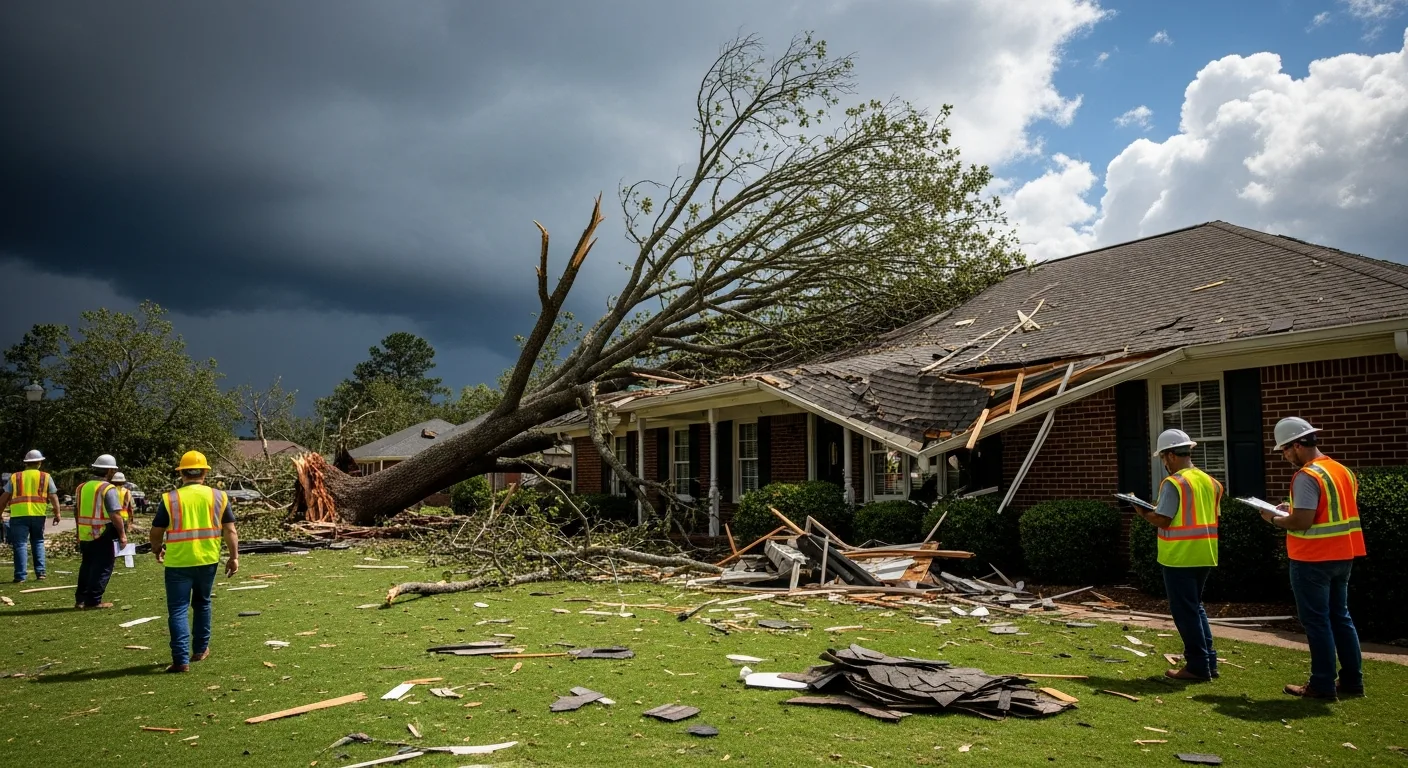
Storm damage assessment on a Concord home — documenting wind damage to roofing and tree strikes before emergency tarping begins
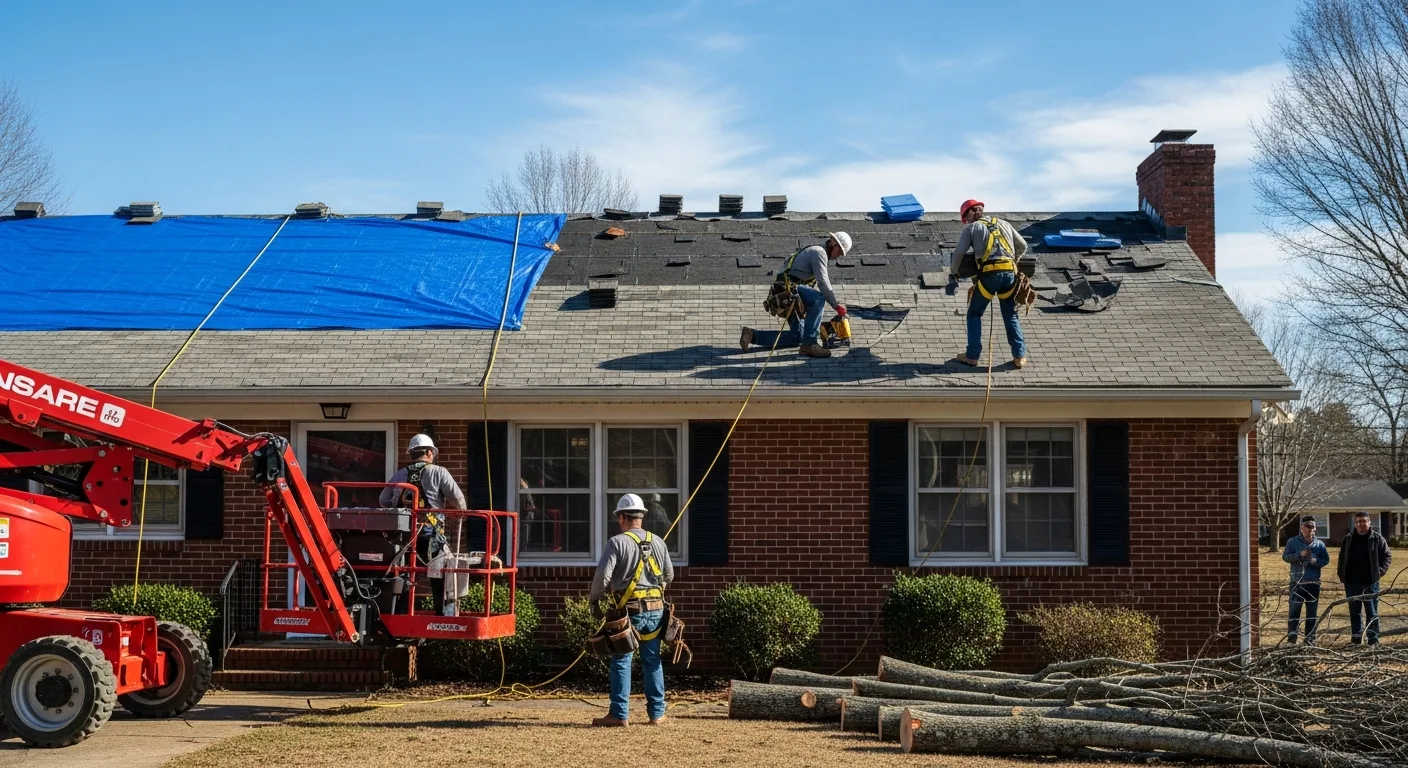
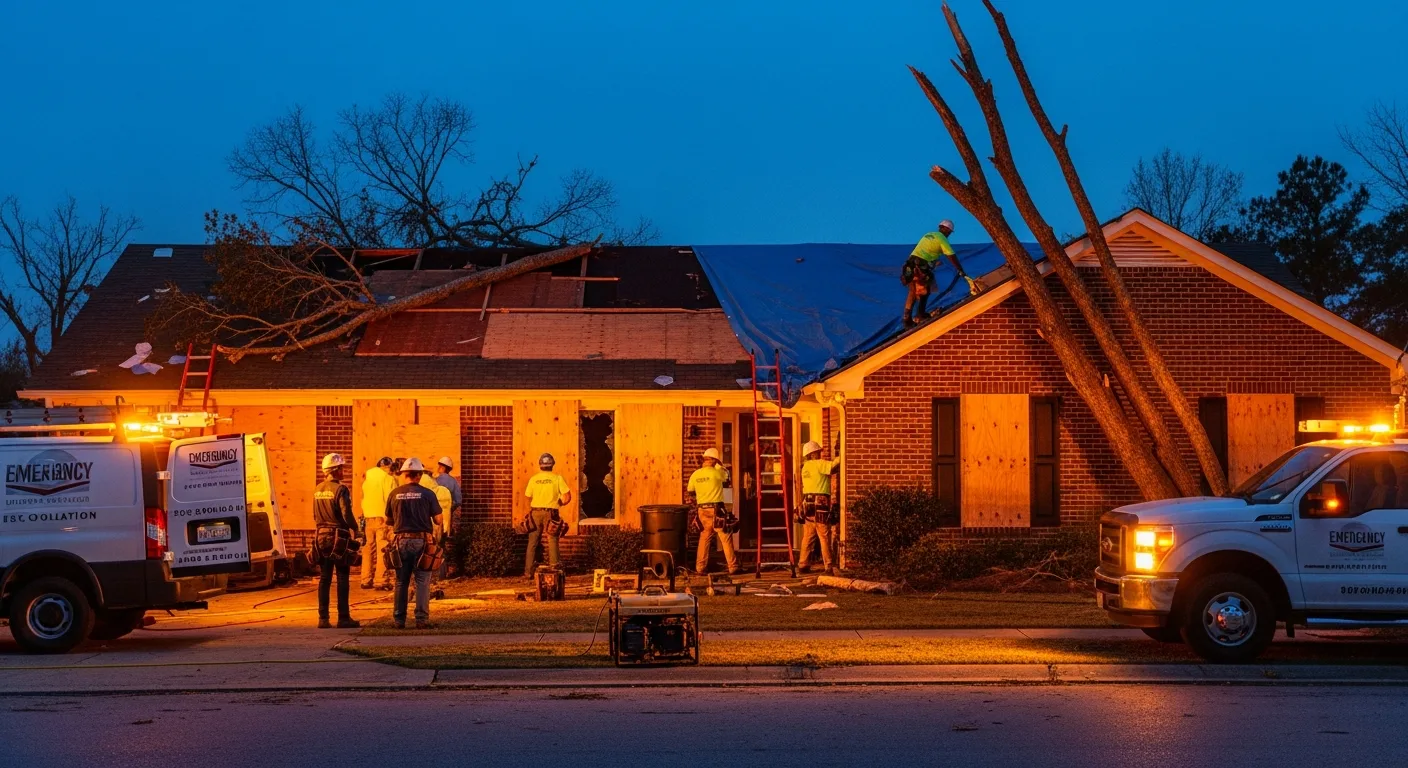
Emergency tarping and roof repair — sealing the building envelope to prevent secondary water damage
Emergency board-up at twilight — Palm Build's 24/7 response means we work through the night to protect your home
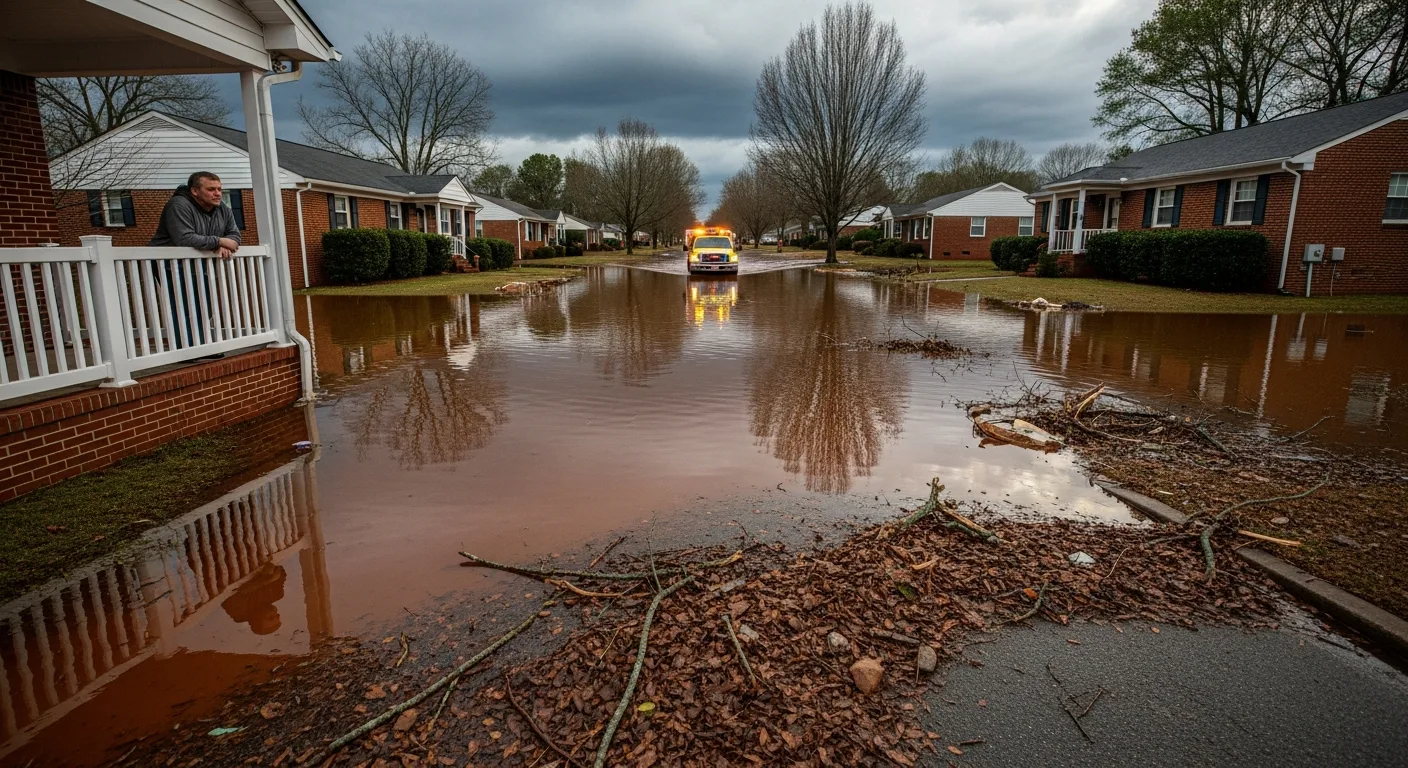
Concord's impermeable clay soil and strained stormwater infrastructure produce street-level flooding during heavy rainfall events
The Palm Build Difference
Why Concord Homeowners Choose Palm Build After Storms
When a 70 mph gust peels shingles off your Christenbury roof at 3 a.m. or an oak topples
onto your Beverly Hills carport, every hour of exposure compounds the water damage that
follows. Here is why Concord homeowners trust Palm Build to respond first and restore
right.
Rapid Mobilization — 30-45 Minutes to Concord
Our Crompton Street hub is 20 miles from Concord via I-85 — faster than any franchise dispatching from a national call center. We dispatch 24/7/365, including during active storm events. During major weather events with widespread damage, we activate catastrophe response protocol with additional crews.
Roof Tarp Expertise — Commercial-Grade Materials
We secure exposed rooflines with heavy-gauge tarps fastened with battens and screws — not the blue poly sheeting that blows off in the next storm. Our tarping crews have secured hundreds of Concord and Charlotte roofs during the 2024 tropical season and understand the specific roof geometries found in Christenbury, Skybrook, and Winding Walk.
Flood Corridor Knowledge — Rocky River to Coddle Creek
We responded to storm damage calls across all five of Concord's flood corridors during Tropical Storm Debby and Hurricane Helene. We know which neighborhoods flood first, which roads become impassable, and how to route crews for fastest response during active events.
Cabarrus County Permits — Fully Licensed Reconstruction
All structural work is permitted through Cabarrus County Construction Standards Division and reviewed by the City of Concord Planning Department. From roof replacement through interior reconstruction, we handle permitting, inspections, and code compliance so you do not have to.
We photograph, moisture-map, and classify damage by cause (wind vs. flood vs. tree strike) using the same standards your adjuster applies. After major events like Helene and Debby, carriers deploy catastrophe response teams with stricter documentation requirements — our records exceed those standards from the first visit.
Common Questions
Concord Storm Damage FAQ
How quickly can Palm Build respond to storm damage in Concord?
Our Charlotte-based team typically arrives in Concord within 30 to 45 minutes from our Crompton Street operations hub — approximately 20 miles via I-85. We dispatch 24/7/365, including during active storm events. During major weather events with widespread damage across the metro, we activate our catastrophe response protocol with additional crews. Call (704) 464-0121 any time.
What storm damage did Tropical Storm Debby cause in Concord?
Tropical Storm Debby impacted the Concord area in August 2024, spawning 10 tornadoes across North Carolina and causing 70+ locations to report downed trees and power lines in the region. The Rocky River rose approximately 25 feet in downstream reaches, flooding low-lying properties along the Poplar Tent Road and Weddington Road corridors. Many homeowners near the Rocky River discovered their standard homeowners insurance did not cover the flood damage.
How did Hurricane Helene impact Cabarrus County?
Hurricane Helene struck North Carolina in late September 2024, just four weeks after Tropical Storm Debby, causing $59.6 billion in statewide damage — making it the costliest natural disaster in NC history. Cabarrus County experienced wind damage to roofing systems, downed trees, and localized flooding along creek corridors. The back-to-back impact of Debby and Helene overwhelmed local contractors, extending non-emergency repair timelines to 8-12 weeks.
Does homeowners insurance cover storm damage in Concord?
Wind and storm damage are covered perils under standard NC homeowners policies (HO-3). However, flood damage from rising water — including flood damage caused by named tropical storms — requires separate NFIP or private flood insurance. This distinction is critical in Concord, where homes near Rocky River, Coddle Creek, and Irish Buffalo Creek may experience both wind damage and flood damage from the same storm. Palm Build documents damage by cause to ensure each claim is filed under the correct policy.
Is my Concord home in a flood zone?
Approximately 9.6% of Concord's 64.7 square miles lies within FEMA Special Flood Hazard Areas. Properties along the Rocky River corridor (Poplar Tent Road, Weddington Road, Odell area), Coddle Creek, Irish Buffalo Creek, Cold Water Creek, and Three Mile Branch carry the highest flood risk. Even if your property is not in a mapped FEMA zone, proximity to these waterways creates flood risk that standard homeowners insurance does not cover. You can check your flood zone status through FEMA's Flood Map Service Center or through the Cabarrus County GIS portal.
Should I get emergency tarping before filing an insurance claim?
Yes — and you should do it immediately. Your insurance policy contractually requires you to mitigate further damage after a loss event. Delaying tarping after roof damage allows wind-driven rain to enter the structure, causing secondary water damage to ceilings, walls, insulation, and flooring that dramatically increases the total claim cost. Emergency tarping and board-up expenses are covered as part of your claim. Call Palm Build at (704) 464-0121 for emergency tarping 24/7.
What areas of Concord are most vulnerable to storm damage?
Beverly Hills and Logan neighborhoods have mature oak tree canopy that creates significant tree-fall risk during high winds. The Poplar Tent Road and Weddington Road corridors along the Rocky River face the highest flood risk. Christenbury and Skybrook homes carry the highest claim amounts due to property values ranging from $500,000 to over $2 million. Homes built during the 1990s-2005 boom across all neighborhoods have aging composition shingle roofs approaching or past their rated service life, making them increasingly vulnerable to wind and hail damage.
How long does storm damage restoration take in Concord?
Emergency tarping and board-up: same day. Water extraction from storm intrusion: 1-2 days. Structural drying: 3-5 days. Partial roof repair: 1-3 weeks depending on material availability and contractor demand. Full roof replacement: 2-4 weeks. Complete reconstruction of major storm damage: 4-12 weeks. After widespread events like Hurricane Helene, timelines can extend significantly due to regional contractor and material demand.
Storm Damage in Concord? Every Hour of Exposure Compounds the Cost.
An exposed roof or broken window turns wind damage into water damage — and water damage into mold damage. Palm Build's Charlotte team responds to Concord in 30-45 minutes with emergency tarping, water extraction, and structural stabilization. Insurance documentation starts from our first call.