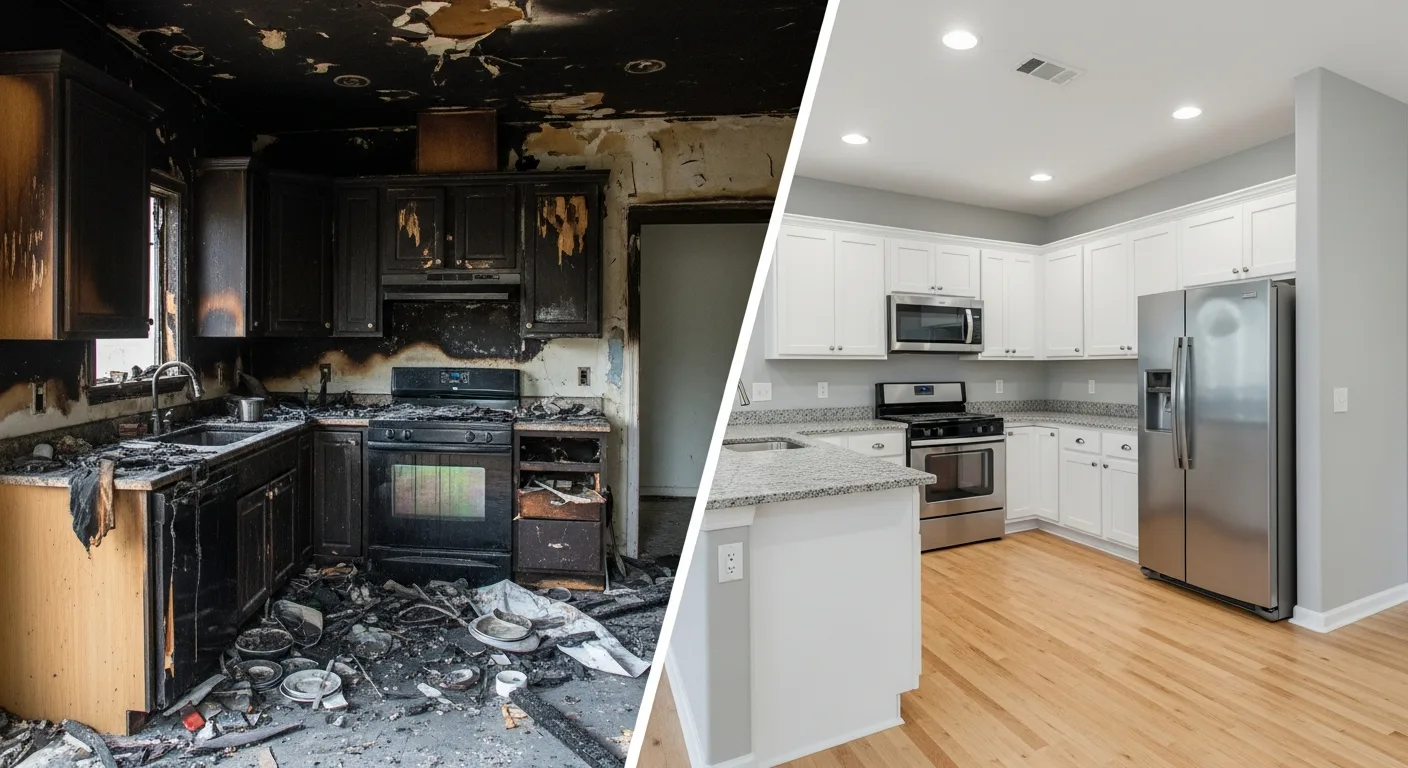
Fire & Smoke Damage Cleanup in Concord, North Carolina
From historic mill homes in Logan and Beverly Hills with aging electrical wiring to Christenbury Hall estates exceeding $1 million, Palm Build's IICRC-certified team delivers structural fire repair, professional soot removal, deep smoke odor elimination, and full reconstruction — with dual City of Concord and Cabarrus County permitting handled from the first call.
20 miles — Charlotte, NC 30-45 min Response IICRC Certified
Why Concord Homes Face Elevated Fire and Smoke Damage Risks
Concord's fire risk profile is shaped by two forces pulling in opposite directions:
a historic housing core built long before modern electrical codes, and an explosive
growth surge that has more than doubled the city's population since 2000. When fire
strikes your Concord home, smoke damage penetrates every surface within hours.
Historic Mill Homes with 80-120yr Old Wiring
80-120 yrs
Wiring age in mill homes
Concord's mill-era homes in Logan, West Concord, Coleman-Franklin, and Beverly Hills were built between the 1900s and 1950s with electrical systems designed for a handful of ceiling fixtures. Some still contain original knob-and-tube wiring behind plaster walls. Decades of added appliances — window AC units, space heaters, electric dryers — have piled demand onto circuits never designed to carry it, creating arc fault conditions invisible until a fire starts inside the wall cavity.
Heating Season: Wood Stoves & Fireplaces
29°F
Avg January low temp
January lows in Concord average 29 degrees F — cold enough that portable space heaters become a nightly necessity in older homes with single-pane windows and no wall insulation. Wood stoves and fireplaces common in Beverly Hills, Logan, and the historic districts add chimney fire risk when creosote buildup goes unaddressed season after season. The NFPA identifies space heaters as the leading cause of home heating fires nationwide.
Aging Electrical in 1980s-90s Homes
25-45 yrs
Dominant housing age
Oak Park, Sheffield Manor, and other 1980s-90s Concord neighborhoods carry recalled Federal Pacific and Zinsco electrical panels known for failure to trip during overload. These homes were built during a period of rapid construction when cost-cutting on electrical components was common. Modern appliance loads — EV chargers, home offices, upgraded kitchens — push these 25-45 year old systems beyond their design capacity.
Christenbury High-Value Properties
$1M+
Estate home values
The Christenbury corridor — Christenbury Hall, Glen, Village, and Chase — contains estate homes valued from $500K to well over $1 million, finished with hardwood floors, custom cabinetry, stone countertops, and designer fixtures. A kitchen grease fire in a Christenbury Hall estate generates a high-value contents and finish restoration project where matching custom materials can extend timelines and costs dramatically. Open floor plans allow smoke and soot to travel farther and faster.
Palm Build's Charlotte-area crew responds to fire and smoke emergencies across Concord
and Cabarrus County — on-site in 30 to 45 minutes from our operations hub.
Concord Fire Risk at a Glance
Mill-era homes with knob-and-tube wiring behind plaster walls
Space heater fires spike November through February (29 degrees F avg low)
Federal Pacific and Zinsco panels in 1980s-90s homes
Christenbury estates require premium material matching after fire
Dual permit system: City of Concord + Cabarrus County
Neighborhood Fire Risk Profiles
Fire Risk by Concord Neighborhood
Fire risk in Concord varies dramatically by neighborhood, driven by housing age,
construction materials, electrical system condition, and property values. Understanding
your neighborhood's specific risk profile helps you prioritize prevention — and know
what to expect if fire does strike.
Historic Districts (Logan, West Concord, Coleman-Franklin)
Original knob-and-tube wiring behind lath-and-plaster walls creates arc fault conditions invisible until fire starts inside wall cavities. Balloon-frame construction allows fire to travel rapidly through wall cavities. Lead paint abatement and historic material matching add complexity and cost to every restoration project.
North & South Union Historic Districts
Critical
1880s-1930s · Historic Homes with Preservation Requirements
Original electrical, overloaded circuits, gas appliance failures
The oldest homes in Concord with the most outdated electrical systems. Historic preservation requirements mandate custom millwork matching, period-appropriate materials, and design review. Restoration complexity is the highest of any Concord neighborhood — the most expensive per square foot to restore after fire damage.
Beverly Hills
High
1950s-1970s · Ranch Homes and Cape Cods
Aging aluminum wiring, space heaters, chimney creosote
Aluminum wiring common in 1965-1975 construction expands and contracts at connection points, causing arcing at outlets and junction boxes. Space heater dependence during winter months overloads circuits never designed for sustained heating loads. Asbestos remediation may be required in pre-1980 construction.
Newer construction with lower fire ignition risk, but extremely high restoration costs driven by premium finishes, custom cabinetry, hardwood floors, and designer fixtures. Open floor plans allow smoke and soot to travel through connected living spaces rapidly. Matching custom materials can extend timelines to 4-8 months.
Federal Pacific and Zinsco panels known for failure to trip during overload remain common throughout these neighborhoods. Standard construction materials make restoration straightforward, but accessible attic and wall systems allow fire to spread more rapidly than compartmentalized older construction.
Skybrook / Winding Walk
Moderate
2005-2018 · Newer Planned Communities
Cooking fires, garage electrical fires
Newer construction with modern electrical but open floor plans that allow rapid smoke spread. Garage electrical fires from EV charging equipment and workshop circuits are an emerging risk. Multi-story construction means smoke distribution through stairwells and vaulted ceilings complicates remediation.
Christenbury Village / Chase
Moderate
2007-2015 · Townhomes and Single-Family
Cooking fires, space heaters in bonus rooms
Multi-story construction with bonus rooms where portable space heaters are common. HOA exterior requirements add coordination complexity to fire restoration. Shared-wall townhome sections allow smoke migration between units — a single kitchen fire can require remediation in adjacent homes.
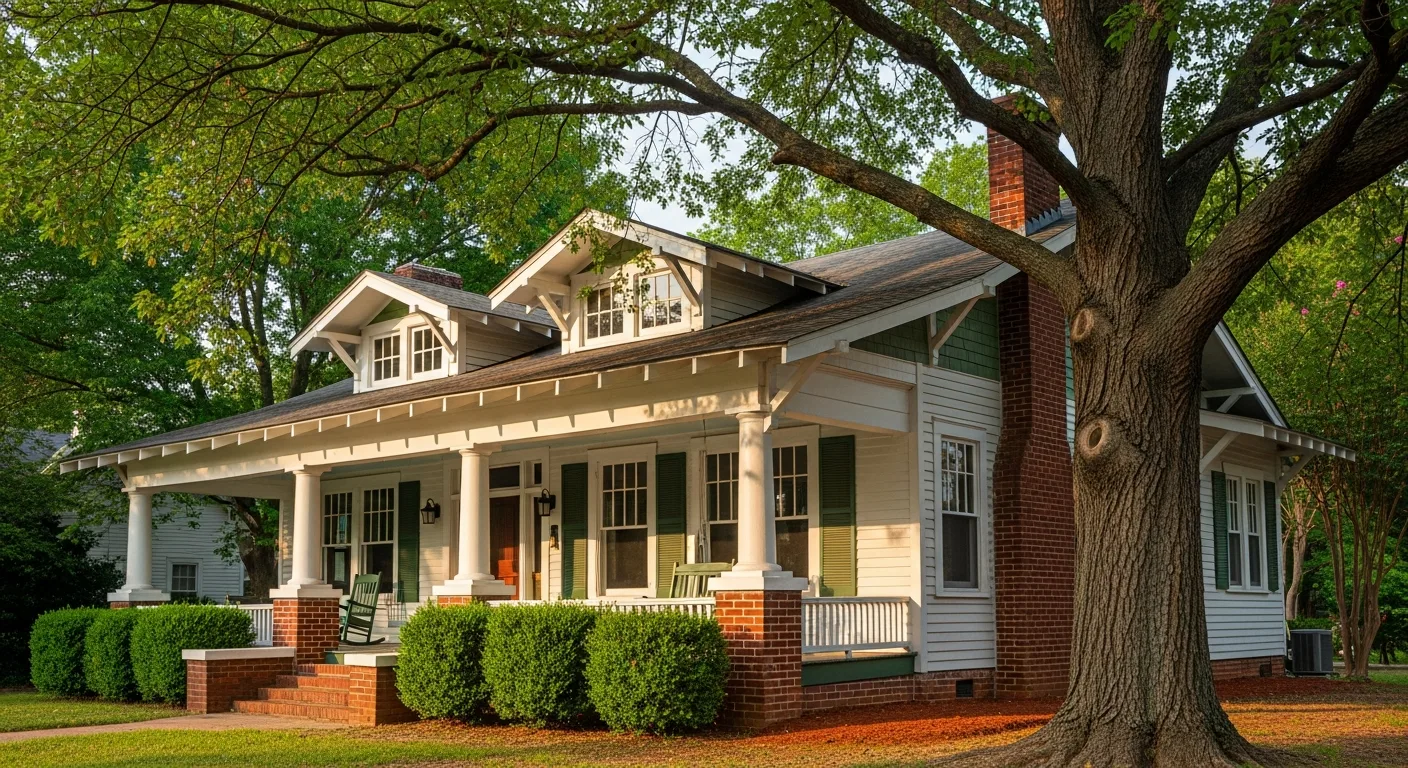
Concord's historic mill-era homes in Logan and Beverly Hills — beautiful but built with
aging electrical systems, wood-frame construction, and materials that make fire and
smoke damage especially severe.
Understanding the Damage
The Science of Smoke Damage: Why It Penetrates Beyond What You Can See
After a fire in a Concord home, visible soot is only the beginning. Smoke particles as
small as 0.1 microns penetrate walls, HVAC ductwork, insulation, and clothing — reaching
areas that show no visible fire damage. Using the wrong cleaning approach doesn't just
fail to clean the surface — it can permanently set stains and drive odors deeper into
materials.
Protein Residue (Kitchen Fires)
The most common fire type in Concord homes. Protein fires from cooking produce an almost invisible, yellowish residue with an extremely pungent odor that penetrates every surface — often far beyond the kitchen. In Concord's open-plan Christenbury estates, protein soot from a kitchen fire can contaminate the entire main level within minutes. The residue bonds chemically to surfaces rather than sitting on top of them. Standard cleaning products spread the residue and set the stain permanently.
Professional Cleaning Approach
Requires enzymatic cleaners and specialized degreasing agents. Thermal fogging with protein-specific solutions is needed for odor elimination.
Wet Smoke vs Dry Smoke
Dry soot from fast-burning fires (wood, paper, natural materials) produces powdery gray-black residue that's easier to clean but spreads extensively through HVAC systems. Wet smoke from slow-burning synthetic materials produces thick, sticky, black soot that smears when touched and adheres aggressively to every surface. Concord's older mill homes with original hardwood framing produce dry soot, while newer homes with synthetic carpeting, foam insulation, and engineered materials generate the more damaging wet smoke residue.
Professional Cleaning Approach
Dry soot: HEPA vacuuming first (never wipe), then chemical sponge treatment. Wet smoke: solvent-based cleaners specifically formulated for petroleum-based residues, multiple passes required.
Smoke Odor in HVAC Systems
Smoke particles as small as 0.1 microns penetrate through HVAC ductwork, coating interior surfaces and becoming trapped in filter media and insulation. In Concord's crawl space homes — the dominant foundation type in Beverly Hills, Logan, and the historic districts — ductwork running through the crawl space acts as a smoke distribution highway, pushing contaminated air into every room. Even after visible soot is cleaned, odor-laden HVAC systems recirculate smoke particles every time the system cycles.
Professional Cleaning Approach
Complete HVAC system decontamination including duct cleaning, coil treatment, blower wheel cleaning, and filter replacement. Crawl space ductwork may require replacement if smoke penetration is severe.
Invisible Penetration Beyond Visible Damage
After any fire in a Concord home, visible soot is only the surface layer. Smoke particles penetrate behind drywall, into wall cavities, through insulation batts, and into the pores of wood framing. In Concord's older plaster-and-lath wall homes, smoke travels through wall cavities, along pipe chases, and into rooms three or more rooms away from the fire origin. We regularly find soot contamination in attic insulation, crawl space framing, and inside electrical outlet boxes far from the fire. Every hour of delay allows acidic soot residue to chemically etch surfaces — what could be cleaned at hour 4 may require full replacement by hour 48.
Professional Cleaning Approach
Professional smoke testing using air quality monitoring and thermal imaging to map the full contamination extent. Targeted treatment of hidden contamination in wall cavities, attic spaces, and crawl spaces.
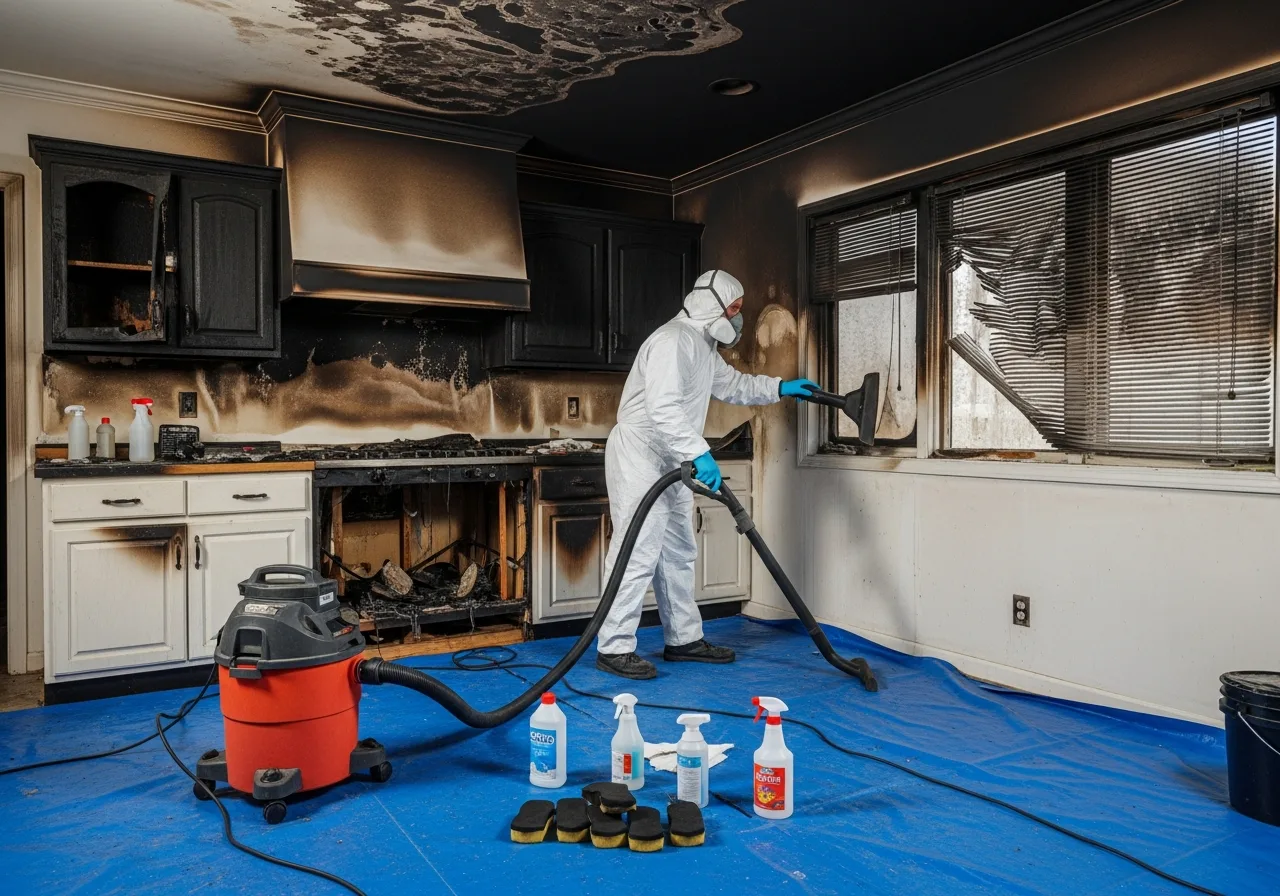
Precision soot removal in a Concord home — different fire types require different
cleaning chemistry and techniques.
Smoke Damage Is Invisible and Progressive
After a fire in a Concord home, every hour of delay allows acidic soot residue to
chemically etch hardwood floors, granite countertops, and painted surfaces. What could
be professionally cleaned at hour 4 may require full replacement by hour 48. If you've
had a fire of any size, call (704) 464-0121 for professional assessment before attempting DIY cleanup.
Our Fire Restoration Process
6-Step Fire and Smoke Restoration for Concord Homes
Fire restoration is not a single trade — it's a coordinated sequence of emergency
response, hazardous materials handling, precision cleaning, odor science, and full
reconstruction. Here's exactly what happens when you call Palm Build after a fire in
your Concord home.
01
Emergency Response & Board-Up
30-45 min
Call (704) 464-0121 any time — day or night. Our fire restoration crew dispatches from our Charlotte operations hub and arrives in Concord within 30 to 45 minutes. We assess structural integrity, board up windows and doors to prevent weather exposure and unauthorized entry, and tarp compromised roof sections. For Concord's older homes in Logan and Beverly Hills, we watch for hazards specific to balloon-frame construction — fire can travel through wall cavities in ways modern construction prevents.
02
Fire Damage Assessment
Day 1-2
Before any cleanup begins, our IICRC-certified technicians perform comprehensive documentation using thermal imaging, moisture meters, and air quality monitoring. We photograph every affected room, catalog damaged contents, and classify the fire damage type — protein (kitchen fires), complex (mixed fuels), or natural substance (wood-burning). This classification determines the cleaning chemistry required and becomes the foundation of your insurance claim. For Christenbury Hall and other high-value Concord properties, we create detailed inventories of custom finishes and premium materials.
03
Water Removal from Fire Suppression
Days 1-5
A single fire hose delivers 150 to 250 gallons per minute — firefighting suppression water is the leading cause of secondary damage after a house fire. In Concord's crawl space homes throughout Beverly Hills and Logan, suppression water pools beneath the structure and can trigger mold growth within 24 to 48 hours. We deploy truck-mounted extractors, submersible pumps for crawl spaces, and commercial dehumidifiers simultaneously with soot stabilization.
04
Smoke & Soot Cleanup
Days 3-10
Soot removal requires different techniques based on fire type and affected surfaces. Dry soot from fast-burning fires responds to dry chemical sponges and HEPA vacuuming. Wet, sticky protein soot from kitchen fires requires solvent-based cleaning. In Concord's historic homes with original plaster walls, hardwood floors, and wood trim, we use techniques that remove soot contamination without damaging underlying surfaces — every surface in the smoke path is addressed: walls, ceilings, trim, light fixtures, switch plates, window tracks, cabinet interiors, and HVAC components.
05
Structural Repairs
Weeks 2-8+
From drywall replacement to custom trim matching, we restore your Concord home to pre-fire condition — or better. All structural work is fully permitted through Concord's dual permit system: zoning approval from the City of Concord and building review by the Cabarrus County Construction Standards Division. For historic properties in the Union Historic Districts, we coordinate with preservation guidelines to maintain architectural character.
06
Odor Elimination & Final Restoration
Days 5-14+
Smoke odor is the most persistent element of fire damage. Palm Build uses a three-layer approach: thermal fogging to reach smoke particles inside wall cavities and HVAC systems, hydroxyl generator treatment to break down odor molecules at the chemical level, and ozone shock treatment for unoccupied spaces with deep penetration. For Concord's older plaster-wall homes where smoke penetrates the porous lime-based plaster, we apply odor-sealing primer to affected surfaces before repainting. Final walkthrough ensures pre-loss condition is restored.
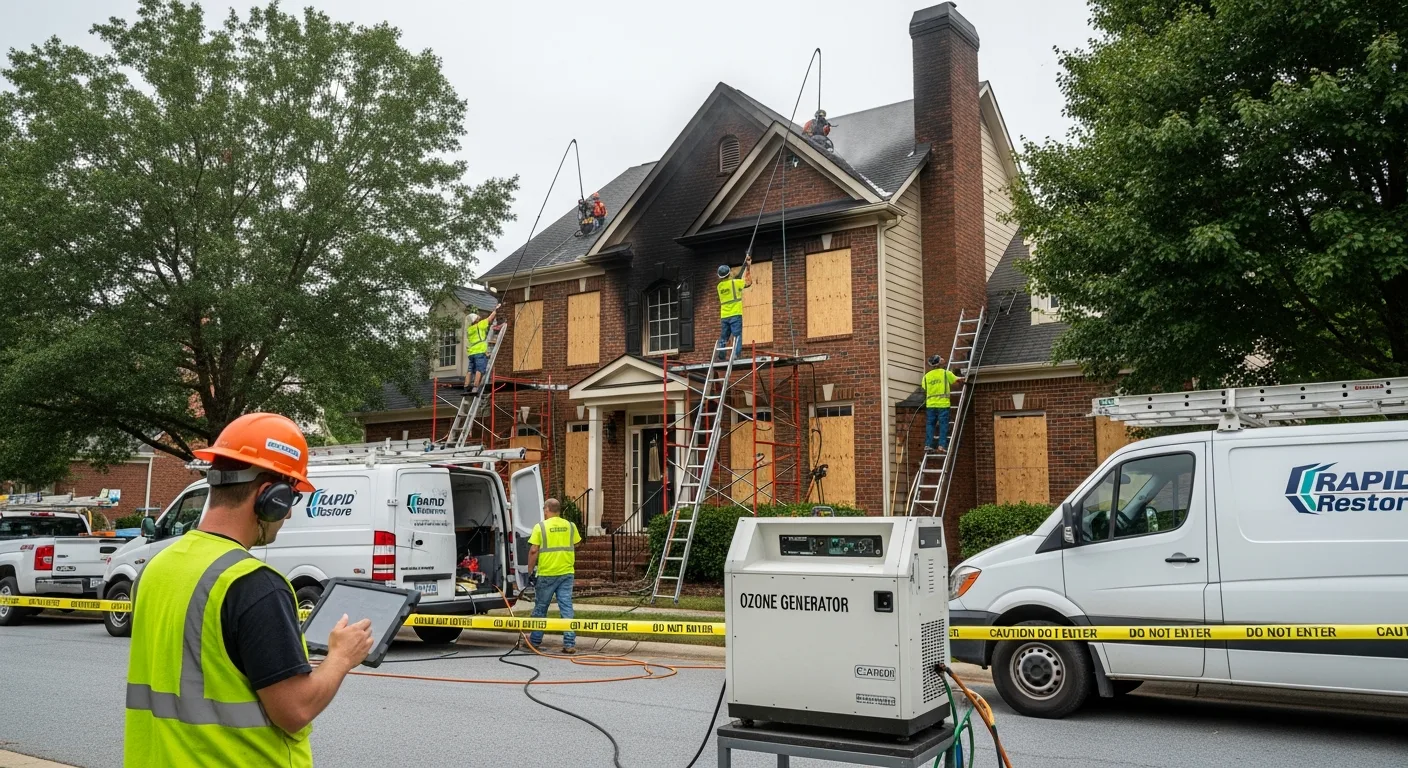
Palm Build's fire restoration team working on-site in Concord — IICRC-certified
technicians with specialized soot removal and smoke decontamination equipment.
Concord Pricing
Fire and Smoke Damage Restoration Costs in Concord
Fire restoration costs in Concord vary based on fire severity, smoke spread, property
type, and whether structural reconstruction is needed. Historic homes in Logan and the
Union Districts typically cost more due to material matching and preservation
requirements. Christenbury estates incur premium restoration costs driven by high-value
finishes and custom contents.
Standard Fire & Smoke Damage
$3,000 - $25,000
Contained kitchen fire cleanup: $3,000-$8,500
Single room soot and smoke cleaning: $2,500-$6,000
Historic home fire restoration (Logan/Beverly Hills): $50,000-$150,000
Christenbury estate fire + smoke + contents: $75,000-$250,000+
Full reconstruction after total loss: $150,000-$500,000+
Fire is fully covered under standard North
Carolina HO-3 homeowners policies. Concord homeowners pay approximately $2,045-$2,435 per
year for coverage. Palm Build provides detailed documentation from the first call to maximize
your claim settlement.
Seasonal Patterns
Concord's Seasonal Fire Risk Calendar
Fire incidents in Concord follow seasonal patterns driven by heating behavior, weather
conditions, and lifestyle factors. The November through February heating season
concentrates Concord's highest fire risk, but electrical and cooking fires remain a
year-round threat across all neighborhoods.
January - February
Peak Space Heater Fire Season
Critical
January lows average 29 degrees F in Concord. Portable space heaters — the leading cause of home heating fires — run continuously in older Beverly Hills and Logan homes with inadequate central heating. Frozen pipe bursts also trigger electrical shorts when water contacts aging wiring. Knob-and-tube circuits in historic mill homes are most vulnerable to overload during sustained cold snaps.
Active months: Jan-Feb
March - April
Electrical Storm Season Begins
Moderate
Spring thunderstorms bring lightning strikes and power surges. Homes without whole-house surge protection — common in Concord's pre-2000 housing stock — are vulnerable to electrical fires triggered by surge events. Older homes with aluminum wiring in Beverly Hills and Oak Park are especially susceptible to surge-related connector failures.
Active months: Mar-Apr
May - August
Cooking and Grilling Fire Peak
Moderate
Outdoor grilling near vinyl-sided homes in Skybrook and Christenbury neighborhoods creates exterior fire risk. Kitchen fires from unattended cooking spike during summer months. Concord's newer open-plan homes allow kitchen smoke and grease fires to spread rapidly through connected living spaces before containment.
Active months: May-Aug
September - October
HVAC Startup and Chimney Season
Moderate
First use of heating systems after summer dormancy can trigger electrical fires in neglected furnaces. Chimney fires begin as homeowners light wood stoves and fireplaces in Logan, Beverly Hills, and the historic districts without clearing creosote buildup from the prior season.
Active months: Sep-Oct
November - December
Heating Season and Holiday Fire Risk
High
Wood stoves and fireplaces run daily in Concord's older homes. Holiday decorating adds electrical load to already-strained circuits — string lights on aluminum wiring create dangerous heat buildup at connection points. Space heater use intensifies as temperatures drop. The combination of increased heating load, holiday electrical demand, and dry indoor air makes this Concord's highest overall fire risk period.
Active months: Nov-Dec
Insurance Coverage
Fire Insurance Claims in Concord: What's Covered
Fire is one of the most comprehensively covered perils under North Carolina homeowners
insurance policies (HO-3). Unlike water or mold damage, fire claims rarely face coverage
disputes — your policy is designed for exactly this situation. Concord homeowners pay
approximately $2,045-$2,435 annually for this coverage.
Structural repair and reconstruction to pre-loss condition
Professional soot and smoke cleaning of all affected surfaces
Water damage from fire suppression (extraction and drying)
Contents restoration or replacement (furniture, electronics, clothing)
Additional Living Expenses (ALE) for temporary housing during restoration
Debris removal and hazardous material disposal
Building code upgrades required during reconstruction (with ordinance-and-law endorsement)
Key Documentation Considerations
Smoke Damage Sublimits
Some NC policies contain sublimits on smoke-only claims where no visible fire occurred. If your home sustained smoke damage from a neighbor's fire or a small contained event, check your policy language carefully. Palm Build documents smoke damage to meet the highest evidentiary standard.
Contents Documentation
High-value contents in Christenbury estates — custom furniture, electronics, art, designer fixtures — require detailed inventory with pre-loss valuation. Standard contents limits may not cover premium items without a scheduled personal property endorsement. We photograph and catalog every affected item from day one.
ALE (Additional Living Expense) Coverage
ALE covers temporary housing, meals, and increased living expenses while your Concord home is uninhabitable. Most NC HO-3 policies provide ALE at 20-30% of dwelling coverage. For a $400,000 Concord home, that's $80,000-$120,000 in temporary living support. Palm Build provides timeline documentation to support ALE claims throughout the restoration process.
Palm Build Manages Your Fire Claim
We work directly with your insurance adjuster from the first inspection. Our fire damage
documentation — structural assessments, soot type classification, moisture readings,
photo evidence, and detailed scopes of work — is formatted exactly how carriers like
State Farm, Travelers, Safeco, and NC Farm Bureau expect to receive it. This reduces
back-and-forth and gets your claim approved faster.
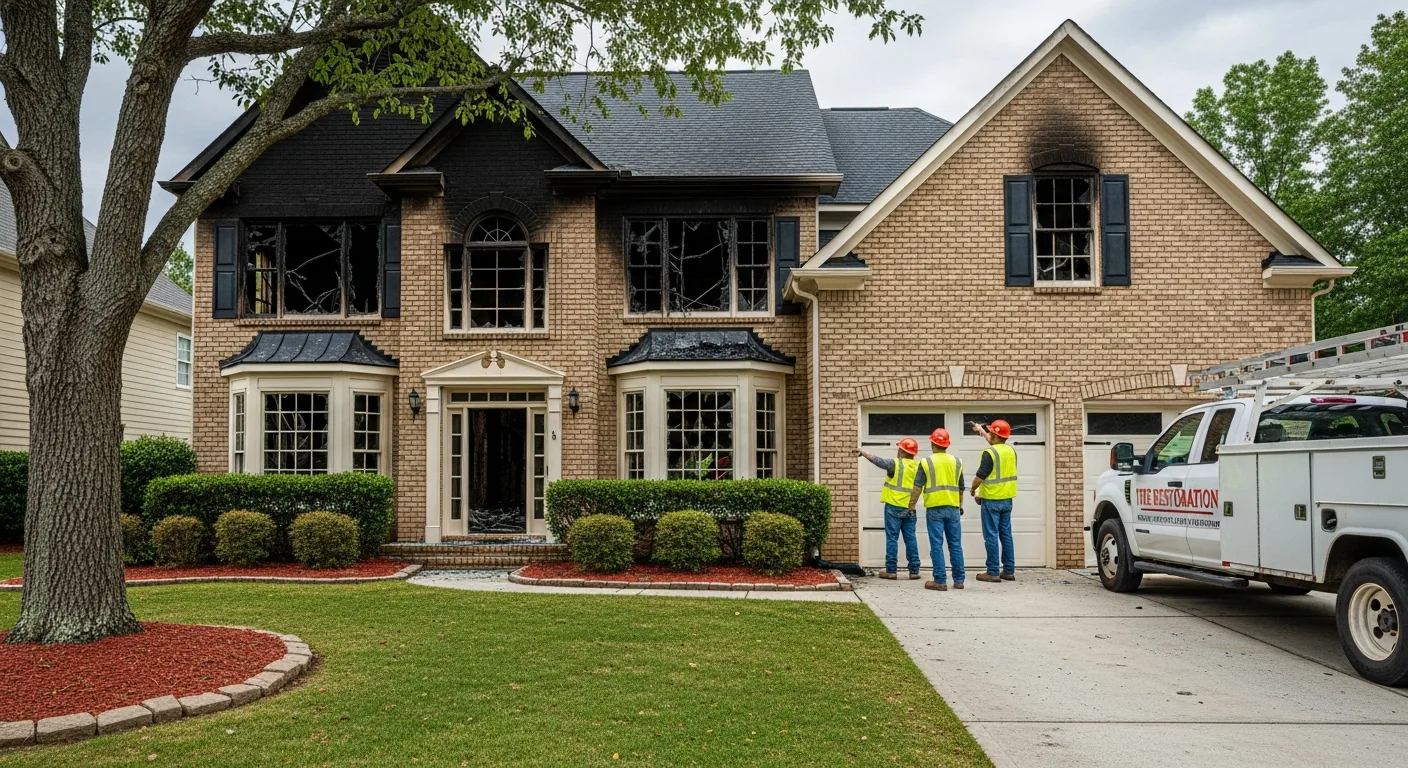
Full fire restoration: from charred structural damage to complete reconstruction in a Concord home
IICRC-certified fire restoration team on-site with specialized soot removal equipment
Precision soot removal — different fire types require different cleaning chemistry and techniques
Emergency fire response in Concord — our Charlotte team on-site within 30-45 minutes
The Palm Build Difference
Why Concord Homeowners Choose Palm Build After a Fire
Full-Service: Board-Up to Rebuild
From emergency board-up and tarping the night of the fire through final paint, trim, and punch list, Palm Build handles the entire fire restoration project. No subcontractor handoffs, no waiting for separate trades. One team, one point of contact, one scope of work from the first emergency call through certificate of occupancy.
IICRC Fire & Smoke Certified
Every crew lead holds current IICRC Fire and Smoke Restoration Technician (FSRT) certification. We follow the S540 standard for professional fire and smoke damage restoration procedures — the same standard insurance adjusters use to evaluate restoration quality. Our soot classification, cleaning chemistry, and odor elimination protocols are science-based, not guesswork.
Dual Permit Expertise: Cabarrus County + City of Concord
Concord operates a dual permit system for reconstruction: zoning approval from the City of Concord and building plan review and inspections from the Cabarrus County Construction Standards Division. Palm Build manages both permit tracks simultaneously — from application through final inspection — so your fire restoration is never delayed by paperwork, missed inspections, or compliance issues. For historic district properties, we coordinate with preservation guidelines.
Insurance Advocacy and Documentation
Fire claims involve the most comprehensive insurance documentation of any restoration type. Our structural assessments, soot type classification, moisture readings, photo evidence, and detailed scopes of work are formatted exactly how NC carriers — State Farm, Travelers, Safeco, NC Farm Bureau — expect to receive them. We advocate for full scope approval and minimize supplement disputes.
Contents Restoration Capability
Fire doesn't just damage your structure — it damages everything inside. Palm Build provides full contents restoration: professional cleaning of smoke-damaged furniture, electronics assessment and data recovery, textile and garment ozone treatment, document and photo preservation, and secure pack-out and storage during reconstruction. For Christenbury estates with high-value contents, we create detailed inventories with pre-loss valuation documentation.
Common Questions
Concord Fire & Smoke Cleanup FAQ
How quickly can Palm Build respond to a fire emergency in Concord?
Our Charlotte-based fire restoration team typically arrives in Concord within 30 to 45 minutes from our Crompton Street operations hub — approximately 20 miles. We dispatch 24/7/365 for fire and smoke emergencies. Call (704) 464-0121 any time, day or night. Early response is critical because soot becomes increasingly acidic within hours and begins permanently etching hardwood floors, countertops, and painted surfaces.
Does homeowners insurance cover fire damage in Concord?
Yes — fire damage is one of the most comprehensively covered perils under standard North Carolina homeowners policies (HO-3). Coverage typically includes structural repair, contents replacement, soot and smoke cleanup, temporary living expenses (ALE), and debris removal. Concord homeowners pay approximately $2,045-$2,435 per year for coverage through carriers like State Farm, Travelers, Safeco, and NC Farm Bureau. Palm Build provides detailed documentation from the first emergency call to maximize your claim settlement and minimize supplement disputes.
Why are older Concord homes at higher fire risk?
Concord's historic mill homes in Logan, West Concord, Coleman-Franklin, and Beverly Hills were built 80 to 120 years ago with electrical systems designed for a handful of ceiling lights and a few outlets per room. Some still contain original knob-and-tube wiring behind plaster walls. Decades of added appliances — space heaters, window AC units, modern kitchens — overload circuits never designed for today's electrical demand. Combined with wood-frame balloon construction that allows fire to travel rapidly through wall cavities, these homes represent Concord's highest fire risk category.
How long does fire damage restoration take in Concord?
Timeline depends on severity and property type. A contained kitchen fire in a Skybrook or Winding Walk home may take 1 to 3 weeks. Moderate residential fires with smoke spread throughout the structure typically require 4 to 8 weeks. Major structural fires in older Logan or Beverly Hills homes — where material matching, lead paint abatement, and potential asbestos remediation add complexity — can take 3 to 6 months. Christenbury estate restorations with custom finish matching may extend to 4-8 months.
What about water damage from firefighting in Concord homes?
Fire suppression water is the leading cause of secondary damage after a house fire — a single fire hose delivers 150 to 250 gallons per minute. In Concord's crawl space homes throughout Beverly Hills and Logan, suppression water pools beneath the structure on clay soil and can trigger mold growth within 24 to 48 hours. Palm Build handles fire and water damage simultaneously, beginning water extraction and structural drying while performing soot stabilization to prevent both types of secondary damage.
How does Concord's dual permit system affect fire restoration?
Concord operates a dual permit system for construction and reconstruction projects: zoning approval is issued by the City of Concord, while building plan review and inspections are handled by the Cabarrus County Construction Standards Division. Fire restoration involving structural reconstruction requires permits from both entities. Palm Build manages the entire permitting process — from application through final inspection — so your restoration is never delayed by paperwork or compliance issues.
Can smoke odor be completely eliminated from a Concord home?
Yes, but only with professional-grade equipment and techniques. Surface cleaning alone will not eliminate embedded smoke odor. Palm Build uses a three-layer approach: thermal fogging to reach smoke particles inside wall cavities and HVAC ductwork, hydroxyl generator treatment to break down odor molecules at the chemical level, and ozone shock treatment for deep penetration in unoccupied spaces. For Concord's older plaster-wall homes where smoke penetrates the porous lime-based material, we also apply odor-sealing primer before repainting.
What areas of Concord does Palm Build serve for fire restoration?
We serve all of Concord and Cabarrus County including Christenbury Hall, Christenbury Glen, Beverly Hills, Logan, West Concord, Coleman-Franklin, the North and South Union Historic Districts, Oak Park, Sheffield Manor, Castlebrooke, Skybrook, Winding Walk, Cannon Crossing, and surrounding communities including Kannapolis, Harrisburg, and Midland. Both 28025 and 28027 zip codes. Our Charlotte team reaches all Concord neighborhoods within 30 to 45 minutes.
Fire Damage in Concord? Every Hour Counts.
Soot becomes permanently damaging within hours — and Concord's hardwood floors, plaster walls, and premium finishes are especially vulnerable. Palm Build's Charlotte team responds in 30-45 minutes with emergency board-up, soot stabilization, and water extraction, plus full insurance documentation from the first call.