Storm & Hurricane Damage Restoration in Orlando, Florida
Orlando is inland, but it is not safe from hurricanes — Charley crossed directly over the metro in 2004, Ian brought historic freshwater flooding in 2022, and Milton drove damaging winds and a tornado outbreak across Central Florida in 2024. Palm Build's IICRC-certified crews handle wind, tree-impact, roof, soffit and screen-enclosure damage plus freshwater flooding 24/7 across all of Central Florida.
Serving Central Florida from our South Florida hub 3-4 hours Response IICRC Certified
Orlando's Hurricane History: Inland Is Not Out of Reach
Orlando sits more than 50 miles from either coast, yet hurricanes routinely track across
Central Florida and severe weather strikes year-round. From Hurricane Charley's direct
hit in 2004, to Hurricane Ian's historic freshwater flooding in 2022, to Hurricane
Milton's winds and tornado outbreak in 2024 and a 2025 EF2 tornado in Seminole County,
this is the timeline that defines Orlando's storm restoration landscape.
Hurricane Charley — A Direct Hit on Orlando
Catastrophic
August 13, 2004
Charley made landfall on Florida’s Gulf coast and then tracked northeast directly across the Orlando metro as a hurricane. It is the clearest proof that inland Central Florida is not safe from a direct hurricane strike: Charley tore off roofs and soffits, snapped power poles, downed thousands of mature live-oak limbs, and left much of Orange County without power. Every Orlando homeowner who lived through it understands that a Gulf-coast landfall can still devastate a city more than 80 miles inland.
Frances & Jeanne — The 2004 Onslaught Continued
Catastrophic
September 2004
Charley was only the beginning of the 2004 season for Central Florida. Within weeks, two more hurricanes brought tropical-storm-to-hurricane-force winds and heavy rain across the Orlando area, compounding roof and tree damage from the first strike. Tarps placed after one storm were stripped by the next, and overlapping claims created adjuster confusion that delayed payments for months across Orange and Seminole counties.
Hurricane Ian — Historic Inland Flooding
Catastrophic
September 28, 2022
Ian made its Florida landfall on the southwest Gulf shore and then crawled northeast across the peninsula, stalling over Central Florida and dropping historic rainfall on the Orlando area. The result was severe freshwater flooding — rising rainwater, far from any shoreline — that inundated neighborhoods such as Orlo Vista, overwhelmed retention ponds and closed-basin drainage, and put hundreds of inland homes under water that carried no flood insurance. Ian rewrote what Orlando homeowners expect from an inland storm: the rain, not the wind, did the most damage.
Hurricane Milton — Wind, Outages & a Tornado Outbreak
Significant
October 9, 2024
Milton made landfall on Florida’s Gulf coast and tracked across Central Florida, bringing damaging winds, heavy rain, and widespread power outages to the Orlando metro. As the outer bands swept ashore, Milton spawned a destructive tornado outbreak across Florida that threatened the Central Florida region directly. The storm reinforced that even a Gulf-coast landfall produces wind, debris, roof and tornado damage well inland in Orange and Seminole counties.
EF2 Tornado, Seminole County
Significant
March 2025
In March 2025 an EF2 tornado touched down in Seminole County, just north of Orlando, damaging roofs, walls and trees. Central Florida sits in one of the most tornado-active regions of the United States, and tornadoes strike outside of hurricane season as readily as during it. Tornado losses combine roof loss, wall breaches, broken glass and water intrusion — a full-structure restoration, not a simple roof repair.
Atlantic hurricane season runs June through November, with peak risk from August through
October — and Central Florida tornadoes can strike in any month.
Recent Central Florida Storms
Milton 2024 & Ian 2022: What Inland Storms Really Do to Orlando
Two recent storms reset what Orlando homeowners should expect from a hurricane. In
October 2024, Hurricane Milton made landfall on Florida's Gulf coast and tracked across
Central Florida, bringing damaging winds, heavy rain and widespread power outages to the
Orlando metro — and spawning a tornado outbreak across the state as its outer bands came
ashore.
Two years earlier, in September 2022, Hurricane Ian crawled northeast across the
peninsula and stalled over Central Florida, dropping historic rainfall on Orange and
Seminole counties. The result was severe freshwater flooding — rising rainwater, not a
shoreline event — that inundated neighborhoods such as Orlo Vista, overwhelmed retention
ponds and closed-basin drainage, and submerged hundreds of inland homes, many of them
outside FEMA Special Flood Hazard Areas and carrying no flood insurance.
For restoration professionals, Milton and Ian were a textbook demonstration of Orlando's
two distinct storm threats: damaging wind, tree-impact and tornado losses that move
through the homeowners policy, and freshwater flooding that requires separate flood
coverage. The same storm frequently causes both — which is why documenting damage by
cause from the first hour is critical.
2024
Milton — winds & outages across Central FL
Outbreak
Tornadoes spawned statewide by Milton
2022
Ian — historic inland freshwater flooding
EF2
2025 Seminole County tornado
The Inland Flooding Gap
Orlando's 300-plus lakes and many of its subdivisions sit in closed drainage basins —
areas with no natural outflow, where stormwater can only leave by evaporation or by
percolating into already-saturated ground. When a stalled storm like Ian drops feet of
rain, retention ponds overtop and water rises into homes that are nowhere near a FEMA
flood zone. Because a standard homeowners policy does not cover rising freshwater,
many of these owners discovered too late that they had no coverage for the loss.
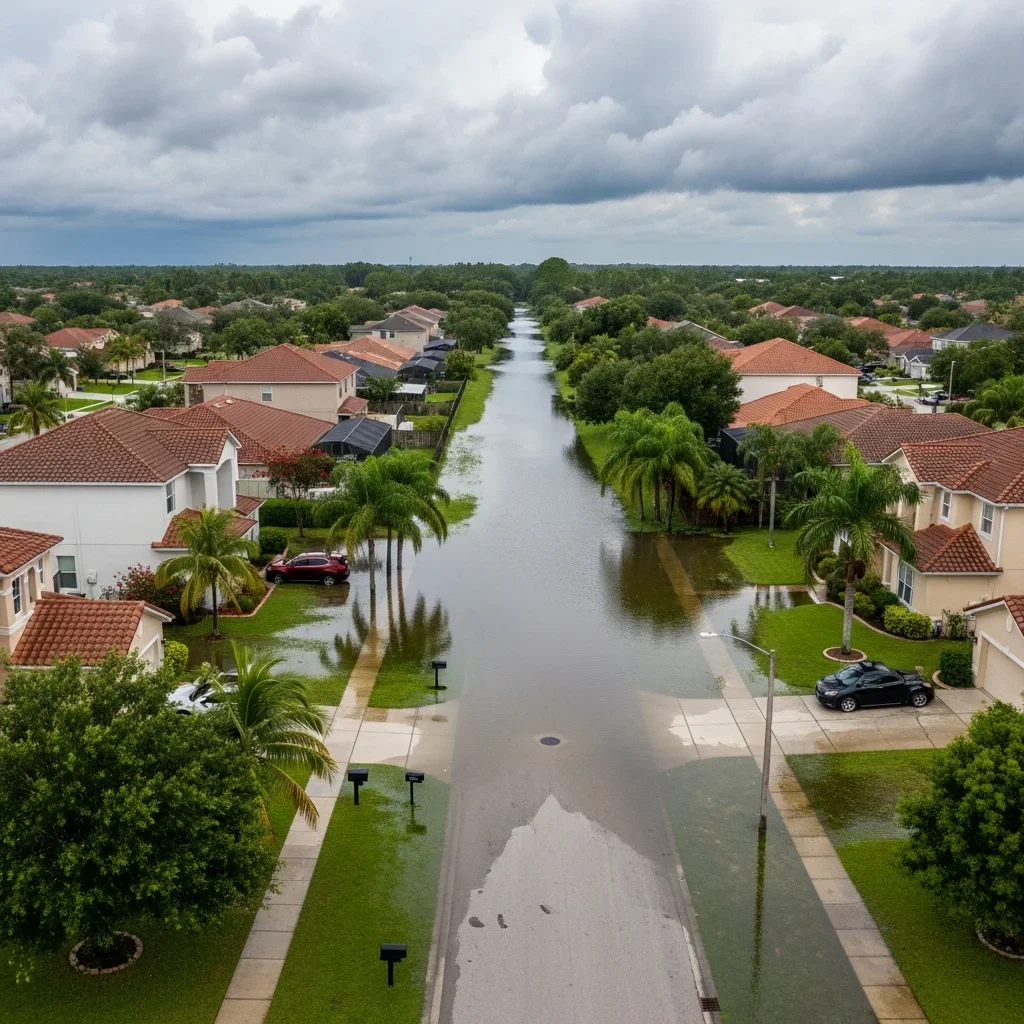
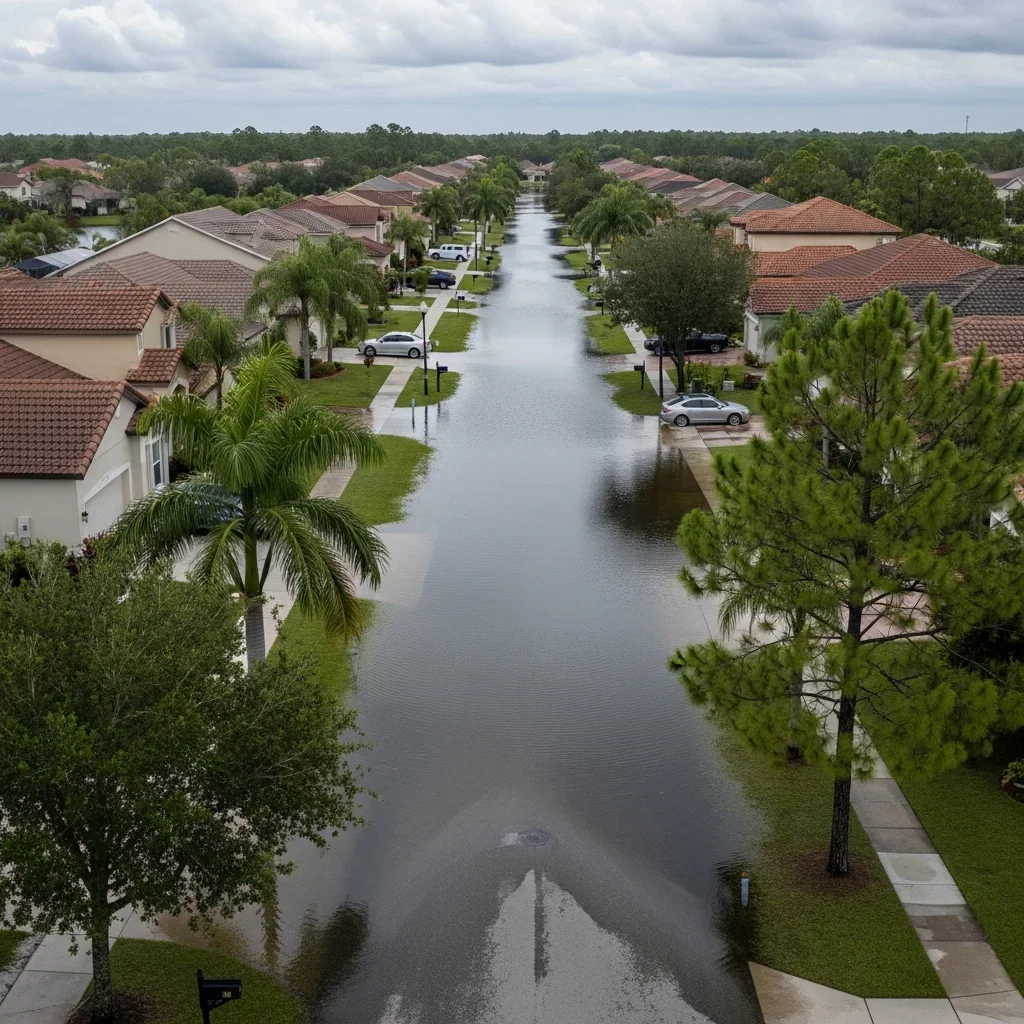
Closed-basin and retention-pond flooding overwhelms inland Orlando neighborhoods
during slow-moving storms — rising freshwater, far from any shoreline
Post-Storm Action Items
Get a flood insurance quote regardless of your FEMA zone — Ian flooded homes well outside
mapped flood areas
Trim or remove weak live-oak and laurel-oak limbs overhanging the roof before hurricane
season
Document your home's condition with photos now, so a wind-versus-flood claim is easy to
prove later
Establish a relationship with a restoration company before hurricane season — response
times triple during events
Types of Storm Damage
How Hurricanes & Storms Damage Orlando Homes
Storm damage in Orlando manifests in six distinct ways — and major storms typically
trigger multiple damage types simultaneously. Understanding the full scope is critical
for emergency response, insurance claims, and long-term restoration, because different
damage types are covered by different policies and require different remediation
protocols.
Tile Roof Displacement
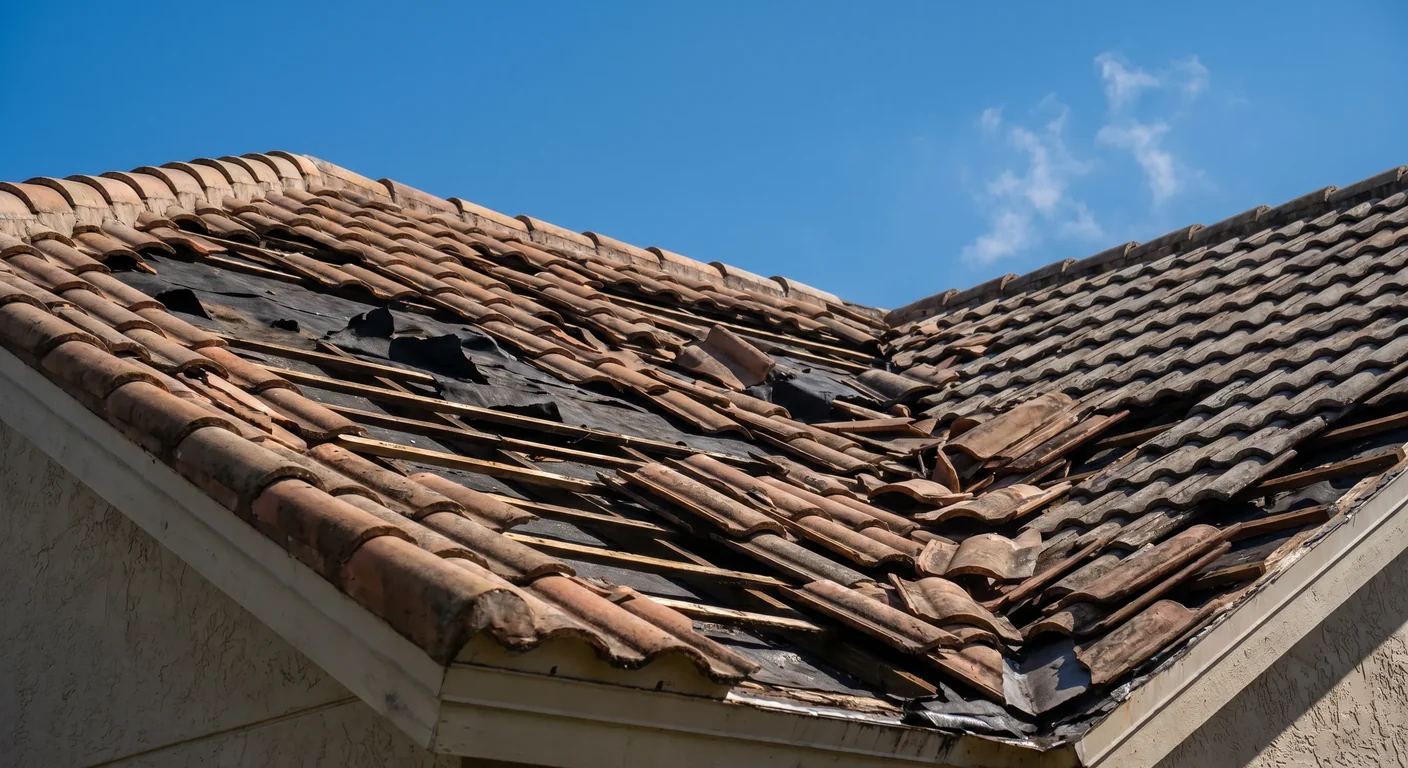
Orlando's barrel and concrete tile roofs are engineered for wind loads, but the adhesive and mechanical fasteners deteriorate over 15-25 years under Central Florida's intense sun and thermal cycling. Hurricane-force winds lift individual tiles, break adhesive bonds, and create cascading failures where one displaced tile exposes the underlayment to direct rain and wind. Orange County's many 2000s-era subdivisions are now reaching the age where attachment systems weaken. A single displaced tile can lead to $15,000-$50,000+ in interior water damage if not tarped immediately.
Tree Impact & Downed Limbs
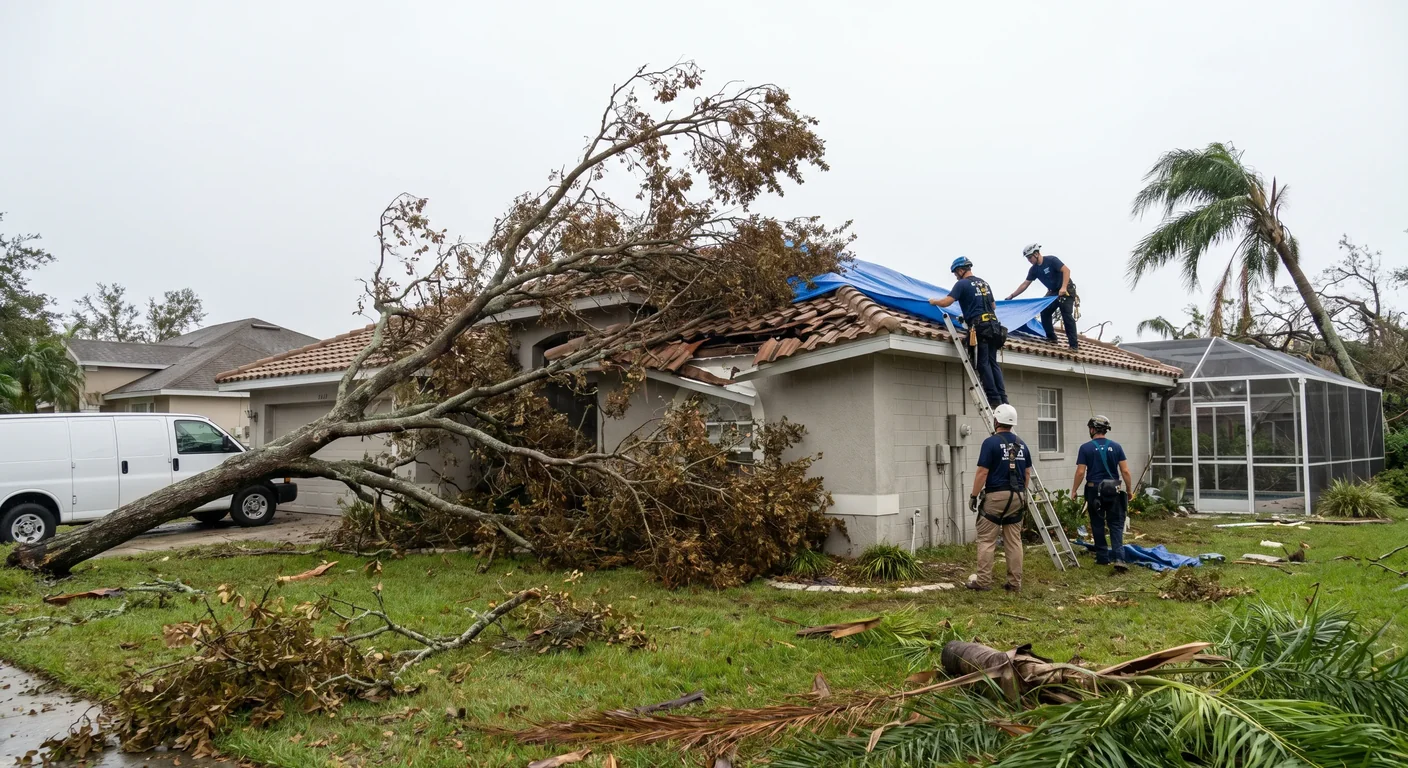
Mature live oaks and laurel oaks shade nearly every established Orlando neighborhood — and they are the single most common source of catastrophic storm damage here. High wind snaps limbs and topples whole trees onto roofs, screen enclosures, vehicles and power lines. A live-oak limb dropping through a barrel-tile roof breaches the structure, opens the interior to rain, and frequently severs power. We provide emergency tree and debris removal from structures, tarp the opening, and then rebuild the roof and interior.
Soffit, Fascia & Screen-Enclosure Failure
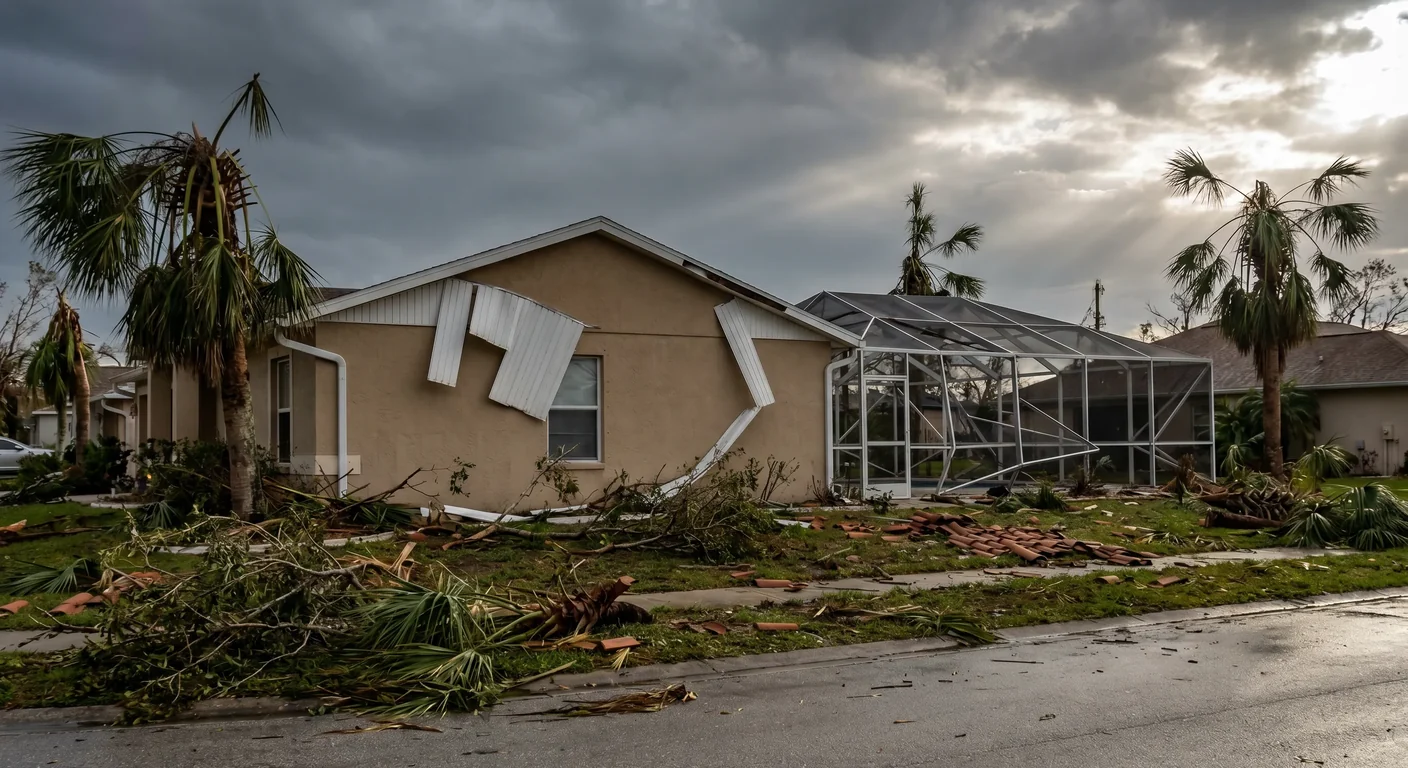
Wind finds the weakest edges of a Central Florida home first. Vinyl and aluminum soffit panels blow out, fascia tears free, and screen pool enclosures — nearly universal in Orlando — collapse or peel away in high wind. A failed soffit becomes a direct entry path for wind-driven rain into the attic and wall cavities, where moisture spreads invisibly for days. Screen-enclosure aluminum framing can also become flying debris that damages neighboring windows and walls.
Wind-Driven Rain & Freshwater Flooding
Orlando's storm water damage comes from two directions: wind-driven rain forced through hairline stucco cracks, window gaps and failed openings, and freshwater flooding when stalled storms overwhelm closed-basin drainage. Inland freshwater flooding is typically Category 1 or 2 water, allowing more aggressive salvage of affected materials. But Hurricane Ian proved that closed-basin and retention-pond flooding can be just as widespread and destructive as any major flood event — and most affected homes carried no flood insurance.
Tornado & Microburst Damage
Central Florida is one of the most tornado-prone regions in the country, and hurricanes such as Milton spawn tornado outbreaks well inland. A March 2025 EF2 tornado struck Seminole County just north of Orlando. Tornadoes and wet-season microbursts produce concentrated, violent damage — roof loss, wall breaches, blown-out windows and water intrusion all at once — that requires full structural stabilization and reconstruction rather than a simple roof repair.
Electrical & HVAC Storm Damage
Lightning strikes, power surges from grid failures, and flooding destroy electrical panels, HVAC systems and wiring. Orlando's outdoor HVAC condensers sit at ground level on the slab and are vulnerable to any flooding event — freshwater intrusion corrodes coils, compressors and electrical connections. Widespread, multi-day power outages after major hurricanes also cause secondary damage: food spoilage, interrupted dehumidification, and mold growth in a climate where humidity routinely exceeds 80%.
Barrel and concrete tile roofs are common across Orlando — and a frequent point of wind
failure. A single displaced tile can lead to $15,000+ in interior water damage.
Storm Vulnerability Map
Orlando's Most Storm-Vulnerable Areas
Storm damage across the Orlando metro concentrates along predictable corridors based on
tree canopy, lake and closed-basin drainage, construction era, and tornado track
history. Lake- and basin-adjacent neighborhoods face freshwater flooding that FEMA maps
routinely understate — as Hurricane Ian proved — while older, tree-shaded districts face
the heaviest wind and tree-impact damage.
Orlo Vista & West Orange County
Critical
Confirmed Hurricane Ian freshwater flood zone — closed-basin neighborhoods that inundated well outside FEMA flood maps; highest inland flooding risk
Howell Branch Basin / Winter Park lakes
Critical
Closed-basin drainage with no natural outflow — retention ponds and lakes overtop during stalled storms, flooding adjacent streets and ground floors
Seminole County (Sanford / Longwood)
Critical
March 2025 EF2 tornado corridor and a frequent track for hurricane outer bands — high wind, tree-impact and tornado damage exposure
College Park, Colonialtown & Ivanhoe Village
High Risk
Established neighborhoods with dense, mature live-oak canopy and older roofs — heavy tree-impact and downed-limb risk during high wind
Lake Nona & Conway
High Risk
Lake-adjacent subdivisions with extensive screen pool enclosures — wind-driven rain, enclosure failure, and lake-edge freshwater flooding
Baldwin Park & Thornton Park
Moderate
In-fill and 2000s-era construction near lakes and stormwater ponds — soffit/fascia failure and water intrusion through aging tile roofs
Metrowest & Kissimmee corridor
Moderate
Sprawling subdivisions on closed-basin drainage, far from any FEMA flood zone yet exposed to retention-pond overflow in extreme rainfall
Milk District & South Eola
Moderate
Urban-core mix of older and high-rise construction — flying-debris window damage and wind-driven rain intrusion through shared building envelopes
Storm Restoration Process
How We Restore Orlando Homes After Storm & Hurricane Damage
Storm restoration in Central Florida requires coordinating emergency response, tree and
debris removal, structural drying, repair, and insurance claims across multiple policies
simultaneously. Here's our proven process from first call through final closeout.
01
Emergency Tarping & Board-Up
Hours 1-4
We secure your Orlando home against further weather and water damage. Displaced tile-roof sections are tarped with reinforced polyethylene, openings from fallen limbs are covered, failed windows are boarded, and compromised doors are sealed. In hurricane conditions, this may require waiting for winds to drop below 45 mph for crew safety. Emergency tarping is covered by your insurance policy as part of your duty to mitigate further damage — and it's critical before the next Central Florida rain band passes through.
02
Damage Assessment & Classification
Days 1-3
Comprehensive documentation of all storm damage classified by cause: wind damage (tiles, soffit, fascia, windows, screen enclosures), tree and debris impact, and freshwater flooding (Category 1-2). We photograph every affected area, map moisture intrusion with thermal cameras, and create separate scopes for wind and flood claims. In Orlando, this cause-specific classification is essential — wind damage goes through your homeowners policy while freshwater flood damage requires a separate NFIP or private flood claim.
03
Tree & Debris Removal
Days 1-5
Central Florida's mature live oaks and laurel oaks are the most common cause of catastrophic storm damage. We remove fallen limbs and trees from the structure, clear debris from the roof and enclosure, and stabilize the opening so the interior is protected before reconstruction begins. Hazardous debris is sorted, documented for the insurance claim, and disposed of per Orange County and City of Orlando requirements.
04
Water Extraction & Structural Drying
Days 1-10
Storm damage in Orlando almost always includes water intrusion — through displaced tiles, failed openings, wind-driven rain, or freshwater flooding. We extract standing water, classify the contamination level, and begin appropriate protocols. Inland freshwater flooding is typically Category 1-2 water, allowing more aggressive salvage of affected materials. Commercial LGR dehumidifiers and air movers bring humidity below 60% to prevent mold colonization in the 24-48 hour critical window — vital in a climate where humidity routinely exceeds 80%.
05
Structural Repair & Reconstruction
Weeks 2-16
Once the property is dried, decontaminated and cleared, we begin full reconstruction: tile-roof repair or replacement, soffit and fascia, screen-enclosure rebuild, stucco and CBS wall repair, drywall, flooring, painting and finish work. Orange County follows the standard Florida Building Code, and we restore your home to current code. Tile roofing can require multi-week lead times after major storms due to demand across all of Central Florida.
06
Final Inspection & Closeout
Week 16+
City of Orlando and Orange County building inspections verify all structural, electrical, mechanical and plumbing work meets current Florida Building Code. We perform a final walk-through with the homeowner and provide complete documentation for insurance closeout including all invoices, permits, inspection records and warranty information. For HOA-governed communities, we coordinate architectural review board approval for exterior modifications.
Before the Storm
Hurricane Preparedness for Orlando Homeowners
The most expensive storm damage is the damage you could have prevented or documented
before the storm. These five steps, taken before June 1, can save Orlando homeowners
tens of thousands in unrecovered losses and months of extended displacement.
Schedule a Tile Roof Inspection
Have a licensed roofer inspect your barrel or concrete tile roof for cracked tiles, deteriorated underlayment and compromised adhesive bonds. Central Florida's intense sun and thermal cycling degrade roofing materials and weaken tile attachment as Orlando's 2000s-era subdivisions age. A pre-hurricane tile replacement costs a fraction of an emergency one — after a storm, when every roofer in Central Florida is booked for months, the same repair costs far more and takes weeks to schedule. Address the problem before hurricane season.
Trim Overhanging Live-Oak Limbs
Mature live oaks and laurel oaks are the single most common cause of catastrophic storm damage in Orlando. Before June 1, have an arborist trim or remove weak, dead or overhanging limbs near your roof, screen enclosure and power service. A limb that drops through a barrel-tile roof breaches the structure, opens the interior to rain, and frequently severs power — turning a preventable trim into a five-figure restoration project.
Protect Windows, Soffit & Screen Enclosures
Inspect impact windows for seal integrity and locking-hardware function, and test every shutter track and bolt before hurricane season. Check that soffit and fascia panels are securely fastened — wind finds the weakest edge first, and a blown-out soffit becomes a direct entry path for wind-driven rain into your attic. If you have a screen pool enclosure, confirm the anchors and framing are sound; collapsed enclosure aluminum becomes flying debris that damages neighboring homes.
Review Wind & Flood Coverage Separately
Florida homeowners policies carry a separate hurricane deductible that is a percentage of your dwelling coverage — typically 2-5% — not a flat dollar amount. Confirm your deductible percentage, dwelling limits, and whether you carry ordinance-and-law coverage for code upgrades. Separately, verify flood coverage: a standard homeowners policy does NOT cover rising freshwater, and Hurricane Ian flooded thousands of inland Orlando homes that sat outside FEMA flood zones with no flood policy at all. Get a flood quote regardless of your mapped zone.
Establish a Restoration Relationship
After a major storm, every restoration company serving Central Florida is overwhelmed simultaneously. Palm Build dispatches to Orlando from our Deerfield Beach operations hub with a typical 3-4 hour response, but those times stretch during catastrophe events. Homeowners who have an existing relationship with a restoration company get prioritized. Contact Palm Build before hurricane season to establish your account and review your property's specific vulnerabilities.
Critical Insurance Distinction
Wind vs. Flood Insurance in Florida: The Most Expensive Misunderstanding
This is the single most important insurance concept for Orlando storm damage. Wind
damage and freshwater flood damage from the same hurricane are covered by different
policies, carry different deductibles, and are filed as separate claims. Florida's
hurricane deductible structure — a percentage of your dwelling coverage (typically 2-5%)
instead of a flat dollar amount — means an Orlando homeowner can face $8,000 to $20,000+
out of pocket on a wind claim alone. Documenting damage by cause is the difference
between recovery and financial catastrophe.
Tile roof displacement from wind uplift and flying debris
Soffit, fascia, screen-enclosure, window and door damage from wind
Rain water entering through wind-created openings
Tree- and debris-impact structural damage
Emergency tarping and board-up costs
ALE (Additional Living Expenses) if the home is uninhabitable
FL Hurricane Deductible: 2-5% of dwelling coverage. On a $400K Orlando
home = $8,000-$20,000 out of pocket before coverage begins.
Flood Damage (Separate NFIP or Private Flood Policy)
Rising freshwater from closed-basin and retention-pond overflow
Lake-edge flooding when stalled storms drop feet of rain
Groundwater intrusion through the slab during saturation
Sewer backup from overwhelmed municipal systems
NFIP max dwelling coverage: $250,000 (verify it fits your home value)
NOT covered by standard homeowners — requires a separate flood policy
NFIP 60-Day Rule: Proof of loss must be filed within 60 days of the flood
event. Missing this deadline can void your entire flood claim.
Florida's Claim Deadline & the Insurance Crisis
Two Florida-specific rules catch Orlando homeowners off guard after a storm. First,
under FL Stat. 627.70132 you must give your insurer notice of a hurricane claim within
one year of the date of loss, with supplemental claims allowed up to 18 months — far
shorter than many people assume. Second, Florida's insurer of last resort, Citizens
Property Insurance, has been aggressively depopulating policies to private carriers
since 2022, and many Orlando homeowners have been moved to smaller insurers, some of
which have since been placed in receivership or restricted coverage. If your policy
was recently transferred, review your new carrier's financial-stability rating, your
hurricane deductible percentage, and any coverage exclusions. And because a standard
homeowners policy does not cover rising freshwater, consider private flood coverage
with higher limits than NFIP's $250,000 cap.
Storm & Hurricane Damage Restoration Costs in Orlando
Storm restoration costs in Orlando reflect tile roofing, CBS stucco construction, mature
tree canopy, and Central Florida's material and labor costs. After major hurricanes,
contractor demand and material shortages across Central Florida can increase costs and
extend timelines by months. Wind damage is covered by homeowners insurance with the
percentage hurricane deductible; rising freshwater flood damage requires separate flood
insurance.
Minor Storm Damage
Displaced tiles, soffit repair, minor stucco crack, screen enclosure
Closed-basin flooding inundates inland homes well outside FEMA flood zones — rising freshwater, far from any shoreline
The Palm Build Difference
Why Orlando Homeowners Choose Palm Build After Storms
3-4 Hour Central Florida Response
Palm Build dispatches to Orlando from our South Florida operations hub in Deerfield Beach, with a typical 3-4 hour response across Central Florida. During major hurricane events we activate catastrophe response with pre-positioned crews, equipment and materials, and pre-storm clients receive priority dispatch ahead of the general queue.
IICRC WRT & FSRT Certified Crews
Every crew lead holds current IICRC Water Restoration Technician and Fire/Smoke Restoration Technician certifications. Our teams are trained in the structural drying and contamination protocols that inland freshwater flooding and wind-driven rain demand — the difference between drying a home and demolishing it. This matters in Orlando, where wind, tree-impact and freshwater flooding can affect the same property simultaneously.
Dual-Claim Documentation
Our damage assessment classifies every item by cause — wind vs. tree/debris impact vs. freshwater flood — ensuring each claim is filed against the correct policy. In Orlando, where wind damage goes through homeowners (with the percentage hurricane deductible) and freshwater flood damage requires separate NFIP or private flood claims, this dual-documentation approach recovers significantly more for homeowners than generic damage reports.
Florida Insurance Navigation
We understand Florida's complex insurance landscape: the FL Stat. 627.70132 one-year claim deadline, Citizens depopulation, hurricane deductible percentages, NFIP proof-of-loss deadlines, assignment-of-benefits rules, and the role of public adjusters. Palm Build coordinates with your carrier, your adjuster, and if needed your public adjuster to maximize claim recovery while keeping restoration on schedule.
Full Reconstruction — Tree Removal to Finish
From emergency tarping and tree-and-debris removal through final punch list, one company handles everything. For Orlando's tile-roofed, CBS stucco homes, we maintain relationships with tile suppliers and trade contractors who prioritize our projects during post-hurricane demand surges. HOA architectural review board coordination is included for all governed communities.
Common Questions
Orlando Storm & Hurricane Damage FAQ
How quickly can Palm Build respond after a storm in Orlando?
Palm Build dispatches to Orlando from our South Florida operations hub in Deerfield Beach, with a typical response time of 3-4 hours for emergencies across Central Florida. After major hurricane events, we activate catastrophe response protocols with pre-positioned crews and equipment, and pre-storm clients receive priority dispatch ahead of the general queue.
Is inland Orlando really at risk from hurricanes?
Yes. Orlando is inland Central Florida, more than 50 miles from either shoreline, but it still takes direct and damaging hurricane hits. Hurricane Charley crossed directly over the Orlando metro as a hurricane in 2004, Hurricane Ian brought historic freshwater flooding to the Orlando area in 2022, and Hurricane Milton tracked across Central Florida in 2024 with damaging winds, power outages and a tornado outbreak. A March 2025 EF2 tornado in Seminole County is further proof of the region's severe-weather exposure.
What is the difference between wind and flood coverage for an Orlando storm claim?
Wind damage — roof, soffit, fascia, windows, screen enclosures and wind-driven rain entry — is covered by your Florida homeowners policy, but it carries a separate hurricane deductible that is a percentage of your dwelling coverage, typically 2-5%, rather than a flat dollar amount. Flood damage from rising freshwater (closed-basin flooding, retention-pond or lake overflow) is not covered by a standard homeowners policy and requires separate NFIP or private flood insurance. Wind-versus-flood causation disputes are common after Central Florida storms, which is why we document every item by cause.
What should I do immediately after storm damage in Orlando?
Get everyone to safety, then prevent further damage: tarp exposed roof areas, board broken openings, and move valuables away from water intrusion. Photograph and video everything before any cleanup — this protects your claim. Call Palm Build for emergency tarping and water extraction, and file your claim promptly. Under Florida law (FL Stat. 627.70132), you must give your insurer notice of a hurricane claim within one year of the date of loss, with supplemental claims allowed up to 18 months.
Do you handle tree-impact and roof damage in Orlando?
Yes. Downed live-oak limbs and flying debris are among the most common storm losses in Central Florida. We provide emergency tree and debris removal from structures, tarp and dry the affected areas to stop secondary water damage, and then handle full repair of the barrel- or concrete-tile roof, soffit, fascia and any interior damage. Orange County follows the standard Florida Building Code, and we restore your roof to current code.
Can you repair tornado damage to my Orlando home?
Yes. Central Florida is one of the most tornado-prone regions in the country, including a verified March 2025 EF2 tornado in Seminole County and the tornado outbreak spawned by Hurricane Milton in 2024. Tornado damage often combines roof loss, wall breaches, broken glass and water intrusion. Palm Build stabilizes the structure, dries it out, removes debris and rebuilds — coordinating the insurance claim throughout.
How much does storm damage restoration cost in Orlando?
Minor storm damage such as displaced tiles, soffit repair or a damaged screen enclosure typically runs $3,000-$15,000. Moderate damage including partial tile-roof replacement, window failure and water-intrusion drying generally runs $15,000-$75,000. Major hurricane or tree-impact losses requiring full roof replacement and structural rebuild can run $75,000-$500,000 or more. After major storms, contractor demand and material shortages across Central Florida can increase costs and extend timelines. Wind damage is covered by homeowners insurance with the percentage hurricane deductible.
Do you handle the insurance claim for Orlando storm damage?
Yes. Palm Build documents all storm damage by cause — separating wind (homeowners policy) from freshwater flood (NFIP or private flood policy) — so each loss is filed against the correct coverage. We coordinate with your carrier and adjuster from the first call, provide a detailed scope and photo documentation, and keep the restoration on schedule while your claim is processed.
Storm or Hurricane Damage in Orlando? Act Before the Next Rain Band.
Wind-driven rain, downed limbs and exposed roofs cause escalating water and mold damage within hours. Palm Build's crews provide 24/7 emergency tarping, debris removal and structural stabilization across Central Florida — with insurance documentation from the first call.