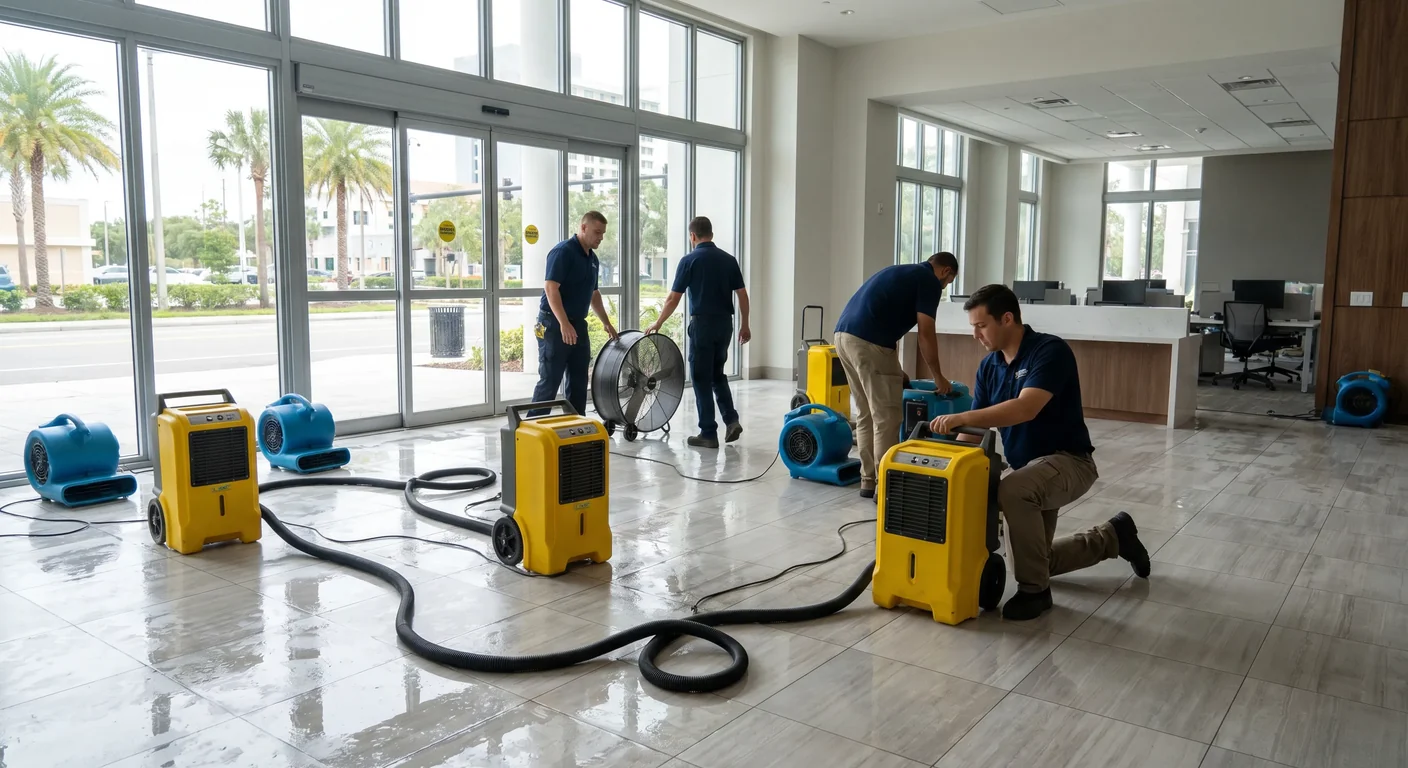
Orlando's commercial base is hospitality-heavy — the International Drive tourism corridor, the Orange County Convention Center, theme-park-adjacent hotels and restaurants, Downtown offices, Lake Nona's Medical City, and the UCF and Central Florida Research Park tech cluster. Palm Build delivers 24/7 commercial restoration with off-hours phasing to minimize business interruption, commercial-grade equipment, and insurance documentation built for Central Florida property managers and business owners.
Serving Central Florida from our South Florida hub 3-4 hours Response IICRC Certified
Why Commercial Restoration Requires a Different Approach
Commercial property damage in Orlando is not "residential restoration at a bigger
scale." It's a fundamentally different discipline with different urgency, stakeholders,
equipment, and insurance structures. Here's why choosing a restoration company with
genuine commercial experience matters more than any other factor.
Revenue Loss Every Hour
Residential damage is stressful but commercial damage is financially catastrophic. A flooded I-Drive restaurant loses $3,000-$10,000 per day in revenue. A water-damaged medical office in Lake Nona's Medical City cancels appointments affecting patient care and practice income. A fire-damaged retail store near the convention center loses event-season sales that can never be recovered. Orlando's year-round, theme-park-driven tourism economy means there is no off-season — commercial restoration must prioritize speed-to-reopening above all else, and the restoration approach, equipment scale, and crew deployment reflect that urgency.
Multi-Stakeholder Coordination
Commercial projects in Orlando involve property owners, tenants, property managers, commercial insurance carriers (sometimes multiple policies including Citizens Property Insurance), city and county inspectors, health departments, and sometimes regulatory agencies. Each stakeholder has different interests, timelines, and documentation requirements. Residential projects have one homeowner and one adjuster. Commercial projects may have a dozen decision-makers who all need to be informed and coordinated throughout the restoration process — especially in multi-tenant properties along the I-Drive corridor and in Downtown office buildings.
CBS Construction & Florida Building Code
Orlando's commercial buildings are predominantly concrete block and stucco (CBS) construction on slab-on-grade foundations, built to the Florida Building Code. This construction type creates unique restoration challenges: water trapped behind stucco can migrate through block walls for weeks, commercial HVAC systems in sealed CBS buildings spread contaminants rapidly through ductwork, and Central Florida's humidity drives mold growth fast once moisture is present. The equipment, crew size, and project management required for CBS commercial restoration is fundamentally different from residential work.
Florida Commercial Insurance Structures
Commercial property policies in Florida face unique challenges: Citizens Property Insurance serves as an insurer of last resort for many commercial properties, premium costs have risen sharply in recent years, and business-interruption and extra-expense coverages are routinely under-documented. Commercial policies include business interruption, extra expense, business personal property, equipment breakdown, and ordinance-and-law coverages that must be coordinated separately. The claims process involves commercial adjusters who expect different documentation formats and detail levels than residential adjusters.
Local Market Knowledge
Orlando's Commercial Corridors
Orlando's commercial districts each have distinct property types, building uses, and
restoration challenges. Our team knows the specific requirements of each corridor — from
International Drive's hotels and dining to Lake Nona Medical City's life-sciences campus
and the UCF / Central Florida Research Park tech cluster.
International Drive (I-Drive)
Types: Hotels, restaurants, retail, attractions, entertainment
Key challenges: Multi-tenant food service health compliance, high guest-volume hotels that cannot fully close, year-round revenue pressure with no off-season, and phased restoration to keep rooms and dining areas operational during work
Key challenges: Large-footprint hospitality near one of the largest convention centers in the U.S., booking commitments that punish downtime, and the need to restore around scheduled events and conventions
Key challenges: High room counts where revenue loss can exceed tens of thousands per day, guest-experience and online-review pressure, and cancellation-cascade risk requiring fast partial reopening
Downtown Orlando CBD
Types: Class A offices, government buildings, hospitality, mixed-use
Key challenges: Sealed CBS office buildings where HVAC spreads contamination through ductwork, multi-tenant lease coordination, and after-hours scheduling to avoid disrupting business operations
Lake Nona Medical City
Types: Hospitals, medical offices, life-sciences labs, research
Key challenges: Medical and lab environments with strict cleanliness and continuity requirements, sensitive equipment, regulatory compliance, and zero tolerance for moisture or microbial contamination
UCF & Central Florida Research Park
Types: University facilities, research labs, tech offices, defense and simulation
Key challenges: Research data and specialized equipment protection, modeling-and-simulation tech infrastructure, multi-building campus coordination, and compliance for specialized facilities
Commercial Process
Our Orlando Commercial Restoration Process
Commercial restoration requires larger equipment, faster timelines, and
multi-stakeholder coordination. Here's how we manage the process from emergency call
through business reopening.
01
Emergency Response & Stabilization
Hours 1-4
Deployment of commercial-scale equipment: truck-mounted extractors, industrial dehumidifiers, large-format air scrubbers. Board-up and tarping for storm exposure. Utilities assessment (gas, water, electrical safety). Initial damage documentation begins simultaneously. For Orlando's CBS commercial buildings, we deploy specialized moisture detection equipment designed for concrete block walls that retain water behind stucco exteriors for weeks after an event.
02
Damage Assessment & Scope Development
Days 1-3
Comprehensive documentation using thermal imaging, moisture mapping, and room-by-room photography. We develop zone-based drying plans for multi-tenant buildings, identify areas that can be occupied during restoration vs. areas requiring full evacuation, and create a phased restoration timeline that minimizes business interruption. For multi-tenant buildings along I-Drive or in Downtown office towers, we map damage by tenant for separate insurance claims.
03
Mitigation & Active Restoration
Days 1-14
Industrial-scale water extraction, structural drying, soot removal, mold containment, or debris clearing depending on loss type. For Orlando's commercial properties, we deploy during off-hours when possible — nights and weekends for restaurants and retail, after-business-hours for offices. Daily progress reports are provided to property managers, owners, and insurance adjusters. Central Florida's humidity requires aggressive dehumidification protocols that exceed standard practices.
04
Reconstruction & Tenant Coordination
Weeks 2-12
Full commercial reconstruction including tenant improvements, ADA compliance, Florida Building Code requirements, health department requirements (food service), and fire code compliance. We coordinate with each tenant's schedule, manage phased occupancy during reconstruction, and handle Orange County and City of Orlando building department permitting and inspections — including any ordinance-and-law upgrades triggered by the rebuild.
05
Final Inspection & Business Reopening
Project Completion
All regulatory inspections completed (building, fire, health department as applicable). Certificate of occupancy or re-occupancy confirmed. Business reopening coordination with tenants, property management, and insurance carriers. Final documentation package provided for claim closeout including business interruption timeline evidence.
Protecting Revenue
Business Interruption: The Hidden Cost of Commercial Damage
$5K-$15K/day
Typical Orlando restaurant revenue loss
2-8 weeks
Average commercial restoration timeline
60-70%
Claims requiring supplements
Business interruption coverage is one of the most valuable — and most under-documented
— portions of commercial insurance claims. Your commercial policy likely includes BI
coverage that pays for lost revenue during the period your business cannot operate due
to a covered loss. But the coverage only pays what you can prove. Without detailed
timeline documentation showing exactly when the damage occurred, when mitigation
began, when partial occupancy was restored, and when full operations resumed, your BI
claim is based on your adjuster's estimate rather than documented fact.
In Orlando's year-round tourism economy, business interruption costs are amplified —
there is no slow season to absorb losses. An I-Drive restaurant or theme-park-area
hotel closed during a convention week loses peak revenue that cannot be recovered.
Palm Build provides detailed restoration timelines specifically designed to support
business interruption claims. Our daily progress reports, milestone documentation, and
phased occupancy tracking create the evidence trail that commercial adjusters need to
approve BI payments. We also document "extra expense" items — temporary relocation
costs, expedited shipping for replacement equipment, overtime labor for accelerated
restoration — that are covered under most commercial policies but often go unclaimed.
Each commercial property type has specific regulatory, safety, and operational
requirements that inform the restoration approach. Here's our Orlando-specific expertise
across the major commercial property categories.
Hotels & Resorts
Orlando is one of the densest hotel markets in the country, anchored by the theme parks, the Orange County Convention Center, and the International Drive corridor. Resort restoration requires coordination across guest rooms, common areas, restaurants, spas, conference space, and pool complexes — each with different operational priorities and finish standards. Revenue loss for a large hotel can exceed $50,000 per day during a convention or peak season. Our phased approach keeps portions of the property operational while restoring damaged areas, minimizing cancellation cascades and protecting online review ratings.
Restaurants & Food Service
Orlando's dining scene — from I-Drive and theme-park-area restaurants to Downtown's Thornton Park and the Milk District — faces unique restoration requirements. Commercial kitchens have grease-laden exhaust systems that complicate fire restoration, walk-in coolers and freezers that must maintain temperature during water events to prevent inventory loss, and health department clearance requirements before reopening. The Florida Department of Health and Orange County require post-restoration inspection for any food service establishment affected by water, fire, or mold. We coordinate this inspection as part of our commercial scope.
Retail & Shopping Centers
From I-Drive's outlet centers and tourist retail to neighborhood plazas across Orange County, Orlando's retail spaces face year-round revenue pressure from a tourism-driven economy. Water or fire damage during a peak event window can wipe out a large share of seasonal revenue for specialty retailers. Our retail restoration approach prioritizes getting the sales floor operational first while continuing back-of-house and storage area restoration in parallel. For high-end retailers, premium finish standards require exact-match materials and specialized cleaning protocols for fixtures.
Offices & Corporate Suites
Downtown Orlando's CBD and the office parks around the Central Florida Research Park house corporate, government, professional services, and defense and simulation firms. These CBS-construction office buildings with sealed envelopes and centralized HVAC systems can spread water and mold contamination across entire floors through ductwork within hours. Multi-tenant office buildings require coordination with each tenant's schedule, separate insurance documentation per tenant, and phased restoration that keeps unaffected suites operational. Server rooms and data centers require specialized drying protocols to protect critical technology infrastructure.
Medical & Life-Sciences (Lake Nona)
Lake Nona's Medical City concentrates hospitals, medical offices, and life-sciences research into one of Central Florida's most demanding restoration environments. Medical and lab facilities require strict cleanliness, continuity of operations, and zero tolerance for microbial contamination. Our protocols address sensitive equipment, regulated materials, infection-control containment, and the documentation these facilities need for both insurance and regulatory compliance — all while keeping unaffected clinical areas in service.
Warehouse, Logistics & Multi-Tenant
Orlando's logistics corridors near Orlando International Airport house distribution centers, flex warehouse space, and multi-tenant industrial buildings. These properties have specialized fire suppression systems that create unique cleanup requirements, high-value inventory that needs rapid documentation and salvage assessment, and operational equipment that may need professional cleaning and testing before restart. Central Florida's humidity accelerates mold growth in warehouses with compromised roofing or ventilation, making rapid response critical for preventing secondary damage that exceeds the original event.
Commercial Coverage
Commercial Insurance Coverage for Orlando Businesses
Florida's commercial insurance landscape is uniquely complex — from Citizens Property
Insurance as an insurer of last resort to under-documented business-interruption and
extra-expense coverages. Orange County follows the standard Florida Building Code (it is
not in the High-Velocity Hurricane Zone), so reconstruction is scoped to standard FBC
and any ordinance-and-law upgrades the rebuild triggers. Palm Build's commercial claims
team ensures every applicable coverage is activated and documented — including business
interruption and extra-expense items that are frequently left on the table.
Building coverage — structural damage repair and CBS reconstruction to the Florida Building Code
Business personal property — furniture, equipment, inventory, fixtures
Business interruption — lost revenue during the restoration period (critical in Orlando year-round economy)
Extra expense — temporary relocation, expedited restoration costs
Equipment breakdown — specialized equipment repair or replacement
Ordinance and law — Florida Building Code upgrades triggered during reconstruction
Debris removal — commercial-scale demolition and disposal
Tenant improvements — custom buildout restoration for leased spaces
Wind vs. water delineation — proper allocation of damage after a windstorm or rain event
The Palm Build Difference
Why Orlando Businesses Choose Palm Build
3-4 Hour Commercial Response
We dispatch commercial-scale equipment to Orlando from our South Florida operations hub — truck-mounted extractors, industrial dehumidifiers, large air scrubbers — with initial team arrival typically within 3-4 hours. For major commercial losses, we activate additional crews from our Charlotte operations center. We work nights, weekends, and holidays to minimize your business interruption.
CBS & Central Florida Expertise
Orlando's commercial buildings are predominantly CBS construction on slab-on-grade foundations, built to the Florida Building Code. We understand the unique challenges of restoring water-damaged concrete block and stucco structures — moisture trapped behind stucco, rebar corrosion concerns, and the need for specialized drying equipment designed for high-mass wall assemblies. Orange County follows standard Florida Building Code (not the High-Velocity Hurricane Zone), and our reconstruction meets current code including any ordinance-and-law upgrades the rebuild requires.
Multi-Stakeholder Coordination
Commercial projects involve property owners, tenants, property managers, multiple insurance carriers (including Citizens Property Insurance), and regulatory agencies. We manage all stakeholder communication, provide separate documentation packages per carrier, and coordinate restoration scheduling across all parties.
Florida Commercial Claims Expertise
Florida's commercial insurance market is uniquely complex — Citizens Property Insurance, premium increases, and routinely under-documented business-interruption coverage have changed how commercial claims are processed. We understand building vs. contents, business interruption, extra expense, tenant improvements, and equipment breakdown coverages. Our Xactimate estimates are formatted for Florida commercial claims processing.
Off-Hours & Phased Restoration
We routinely perform commercial work during nights, weekends, and holidays to keep Orlando businesses operational. For multi-tenant buildings and I-Drive hotels, we phase restoration to maintain partial occupancy. For restaurants, we coordinate Florida Department of Health and Orange County re-inspection as part of the restoration scope.
How quickly can Palm Build respond to a commercial emergency in Orlando?
Palm Build dispatches commercial-scale crews and equipment to Orlando from our South Florida operations hub, with initial team arrival typically within 3–4 hours of your call. For large commercial losses we activate our catastrophe response protocol with additional crews and equipment. Our 24/7 commercial line is (754) 600-3369. We understand that for an I-Drive hotel or an OCCC-area property, every hour of business interruption costs money — our response reflects that urgency.
Can you work around our business hours to minimize disruption?
Yes. We routinely perform commercial restoration during off-hours — nights, weekends, and holidays — to minimize disruption to operations. For Orlando's hotels, resorts, and restaurants on International Drive and near the theme parks, we phase work to keep rooms, units, and dining areas in service. For Downtown offices and Lake Nona medical buildings, we coordinate with property management to schedule noisy or disruptive work outside business hours.
Do you handle multi-tenant commercial buildings in Orlando?
Yes. Multi-tenant properties require coordination between owners, tenants, property managers, and multiple insurance carriers. Palm Build manages this coordination, documenting each party's responsibilities and providing each carrier the documentation it needs for its portion of the loss. We handle multi-tenant losses across Downtown office buildings, I-Drive retail and hospitality, Lake Nona medical complexes, and warehouse and flex space near Orlando International Airport.
What types of commercial properties does Palm Build restore in Orlando?
We restore all commercial property types in Orlando including hotels and resorts, restaurants and food service, retail and shopping centers, offices and corporate suites, medical and life-sciences facilities in Lake Nona's Medical City, UCF and Central Florida Research Park tech and research buildings, multi-tenant and mixed-use buildings, warehouse and logistics space near the airport, and HOA and condominium common areas. Each property type carries specific regulatory, safety, and operational requirements that shape our restoration approach.
How do you handle business interruption documentation?
Business interruption coverage requires documentation proving the duration and financial impact of the interruption. Palm Build provides detailed timelines showing when damage occurred, when mitigation began, when the space was safe for partial occupancy, and when full operations could resume. That timeline, combined with our Xactimate scope, supports your business interruption and extra-expense claim with the evidence your carrier needs — critical in Orlando's no-off-season hospitality economy.
What about Florida building code compliance during commercial restoration?
Commercial restoration in Orlando must comply with the standard Florida Building Code. Orange County is not subject to the enhanced high-velocity wind-zone product requirements that apply only to the far southeast Florida counties, so Orlando properties are scoped and rebuilt to standard Florida Building Code. Our commercial crews handle ordinance-and-law upgrades triggered during reconstruction and coordinate with Orange County and City of Orlando building officials for all required permitting and inspections.
Do you work with commercial insurance policies?
Yes. Commercial property policies (CP, BOP, and similar) have different coverage structures than residential homeowner policies. We understand commercial coverage including building vs. contents, business personal property, business interruption, extra expense, ordinance-and-law, and equipment breakdown. Our Xactimate estimates are formatted for commercial claims processing, and we have experience with Citizens Property Insurance, which also writes some commercial policies in Florida.
Can you restore theme-park-area and I-Drive hospitality properties without shutting them down?
In most cases, yes. Hotels, resorts, and restaurants near International Drive and the theme parks live and die by occupancy, so we build a phased plan that isolates the affected zone, runs containment and commercial drying behind temporary barriers, and keeps unaffected rooms, suites, and dining areas operating. Daily progress reports go to property management and adjusters so revenue-per-available-room loss is documented and minimized.
Commercial Damage in Orlando? Every Hour Costs Revenue.
Palm Build's commercial restoration team deploys to Central Florida with industrial-scale equipment and a plan built to minimize your business interruption. We work nights, weekends, and holidays to keep Orlando properties operating.