Storm & Hurricane Damage Restoration in Miami, Florida
Miami-Dade County sits in the High Velocity Hurricane Zone — the most stringent wind-resistance building code jurisdiction in the United States. The 2024 Atlantic season delivered 18 named storms, 11 hurricanes, and 5 major hurricanes, while June 2024 dumped 20 inches of rain across parts of South Florida in just 2 days. From tile roof failures in Kendall to impact window breaches in Brickell high-rises and saltwater storm surge flooding in Key Biscayne, Palm Build's Deerfield Beach team provides emergency tarping, saltwater extraction, and full HVHZ-compliant reconstruction — 24/7 with insurance coordination from the first call.
Deerfield Beach — Rapid Response to Miami-Dade Under 60 min Response IICRC Certified
Miami's Hurricane History: From Andrew to the 2024 Hyperactive Season
Miami-Dade County sits at the southern tip of Florida's hurricane corridor — the most
exposed major metropolitan area in the United States. Hurricane Andrew's destruction in
1992 rewrote the building code. Wilma in 2005 proved storms from any direction can
devastate the county. Irma in 2017 pushed saltwater surge into Brickell. And the 2024
season — 18 named storms, 11 hurricanes, 5 major — reminded Miami that the next
catastrophic landfall is a matter of when, not if.
Hurricane Andrew
Catastrophic
August 24, 1992
Andrew made landfall in Homestead as a Category 5 with 165 mph sustained winds — the most destructive hurricane in Florida history at the time. The storm obliterated 63,000 homes across southern Miami-Dade County, left 250,000 people homeless, and caused $27.3 billion in damage (1992 dollars). Andrew exposed catastrophic failures in building code enforcement and directly led to the creation of the High Velocity Hurricane Zone (HVHZ) — the strictest wind-resistance building code in the United States. Every permitted reconstruction in Miami-Dade County today exists because Andrew proved the previous code was insufficient.
Hurricane Wilma
Catastrophic
October 24, 2005
Wilma crossed Florida from the Gulf side as a Category 3 and struck Miami-Dade with 95+ mph sustained winds on its exit over the Atlantic. Despite approaching from the west — unusual for Miami — the storm caused $21 billion in statewide damage. Brickell high-rises lost windows on upper floors from wind pressure differentials. Coral Gables and Coconut Grove experienced massive tree canopy destruction. Power was out across Miami-Dade for up to three weeks. Wilma demonstrated that Miami is vulnerable to storms approaching from any direction, not just the traditional Atlantic track.
Hurricane Irma
Catastrophic
September 10, 2017
Irma made Florida landfall in the Keys as a Category 4 and tracked up the west coast, but Miami-Dade took a severe hit on the dangerous northeastern eyewall side. Sustained winds reached 90+ mph with gusts exceeding 115 mph. Storm surge pushed 3-4 feet of saltwater into Brickell, flooding ground-floor condos and garages along Biscayne Bay. Crane collapses in the Brickell construction corridor made national news. Irma caused $50 billion in total US damage and proved that post-Andrew HVHZ construction performed significantly better than pre-1992 building stock — but no code makes a building invulnerable.
June 2024 Flooding Event
Significant
June 12-13, 2024
A stalled tropical moisture band dumped 20 inches of rain across parts of South Florida in just 2 days, overwhelming Miami-Dade drainage infrastructure. Streets from Kendall to Edgewater flooded with 2-3 feet of standing water. The storm drain system — designed for typical afternoon thunderstorm volumes — could not keep pace with sustained torrential rainfall. Vehicles were submerged on major arterials including US-1 and SW 8th Street. Like Fort Lauderdale's April 2023 Rain Bomb, this event proved that Miami's greatest flood threat is not always a named hurricane — extreme rainfall events can cause catastrophic damage without tropical storm-force winds.
18 Named Storms, 11 Hurricanes, 5 Major
Significant
2024 Atlantic Season
The 2024 Atlantic hurricane season was hyperactive: 18 named storms formed, 11 reached hurricane strength, and 5 became major hurricanes (Category 3+). While Miami-Dade avoided a direct major hurricane hit, the sheer volume of tropical activity kept the region under repeated watches and warnings from June through November. The season reinforced that Miami sits in the most hurricane-exposed metropolitan area in the United States — it is not a question of if, but when the next major hurricane makes landfall in Miami-Dade County.
1992
Andrew — HVHZ born from Category 5
18
2024 named storms
20"
Rain in 2 days — June 2024
A-E
Storm surge evacuation zones
Evacuation Zones & Vulnerability Map
Miami's Most Storm-Vulnerable Neighborhoods
Miami-Dade County uses storm surge evacuation zones A through E, with Zone A properties
ordered to evacuate for even a Category 1 hurricane. But as June 2024 proved, urban
flooding from extreme rainfall devastates neighborhoods well outside surge zones.
Understanding your area's specific risk profile — surge exposure, construction era, FEMA
flood zone, and drainage capacity — is essential for insurance planning and emergency
preparation.
Key Biscayne / Fisher Island / Virginia Key (Zone A)
Critical
Evacuation Zone A — Category 1
Island communities surrounded by Biscayne Bay and the Atlantic Ocean. First to evacuate for any hurricane. Direct saltwater storm surge exposure on all sides — IICRC Category 3 contamination from any surge event. Key Biscayne is connected to the mainland by a single causeway that closes before hurricane conditions arrive. Fisher Island is accessible only by ferry. Properties range from $1M to $50M+ with extreme per-home exposure.
Miami Beach / South Beach / Mid-Beach (Zone A)
Critical
Evacuation Zone A — Category 1
Barrier island with Atlantic exposure to the east and Biscayne Bay to the west. Storm surge from both directions during major hurricanes. Art Deco and mid-century structures along Ocean Drive and Collins Avenue lack HVHZ protections. High-rise condo towers face wind pressure differentials that fail windows on upper floors. The MacArthur, Julia Tuttle, and Venetian causeways close during hurricane conditions, stranding anyone who has not evacuated.
Brickell / Downtown / Edgewater (Zone A-B)
Critical
Evacuation Zone A (bayfront) to Zone B
Bayfront high-rise corridor with direct Biscayne Bay storm surge exposure. Hurricane Irma pushed 3-4 feet of saltwater into Brickell ground-floor condos and parking garages. Upper-floor condo units are vulnerable to wind pressure differentials that fail window seals and impact glass. June 2024 flooding affected ground-level retail and parking structures. Post-storm mold in sealed high-rise units is especially problematic because HVAC systems distribute spores throughout entire buildings.
Coconut Grove / Coral Gables (Zone B-C)
Critical
Evacuation Zone B-C
Mature tree canopy — live oaks, banyans, and royal poinciana — creates severe debris and structural impact risk during hurricanes. Hurricane Wilma destroyed 70% of the Coral Gables canopy. Coconut Grove waterfront properties face Biscayne Bay surge. Coral Gables historic homes predate HVHZ standards and feature tile roofs with aging underlayment. Both neighborhoods experienced significant June 2024 flooding from overwhelmed drainage systems.
Little Havana / Flagami / West Miami (Zone C-D)
High Risk
Evacuation Zone C-D
Inland neighborhoods with lower storm surge risk but extreme vulnerability to wind damage and urban flooding. High density of pre-1992 construction without HVHZ protections. Calle Ocho corridor floods during heavy rainfall events. Older CBS construction with deteriorated stucco and original windows provides limited wind-driven rain resistance. Many properties lack impact windows or shutters despite HVHZ requirements for permitted renovations.
Kendall / Pinecrest / Palmetto Bay (Zone D-E)
High Risk
Evacuation Zone D-E
Suburban communities that bore the worst of Hurricane Andrew in 1992. Post-Andrew reconstruction meets HVHZ standards, but homes built before 1992 that survived Andrew may have been repaired without full code upgrades. June 2024 brought significant flooding to Kendall via overwhelmed drainage. Tile roof failures at aging underlayment — not the tiles themselves — are the primary wind damage concern.
Miami Shores / El Portal / North Miami (Zone B-C)
High Risk
Evacuation Zone B-C
Residential neighborhoods along Biscayne Boulevard and the Little River corridor. Mix of pre-HVHZ and post-HVHZ construction. Biscayne Canal overflow exposure during extreme rainfall events. Miami Shores historic homes feature original windows, barrel tile roofs, and construction predating wind-resistance codes. Proximity to Biscayne Bay increases storm surge risk for eastern properties.
Wynwood / Design District / Overtown
Moderate
Urban Core — Flood Vulnerable
Low-elevation urban neighborhoods with commercial and mixed-use properties. Wynwood warehouse conversions lack residential-grade waterproofing. Design District luxury retail faces ground-floor flooding exposure. The Miami River corridor floods during combined storm surge and extreme rainfall events. These neighborhoods experienced some of the worst June 2024 flooding, with standing water damaging ground-floor commercial spaces and inventory.
Nation's Strictest Wind Code
HVHZ: Why Miami's Building Code Changes Everything About Storm Restoration
Miami-Dade County sits entirely within the High Velocity Hurricane Zone — a building
code jurisdiction born directly from Hurricane Andrew's destruction of 63,000 homes in
1992. The HVHZ imposes the strictest wind-resistance requirements in the United States,
and every permitted repair, replacement, or reconstruction after storm damage must meet
these standards. This is not optional — it is the law for all work in Miami-Dade County.
For homeowners, the HVHZ means higher restoration costs — typically 15-25% more than
non-HVHZ Florida construction — but significantly better protection against the next
hurricane. For restoration contractors, it means every project requires HVHZ-specific
product approvals, engineer-sealed wind-load calculations, and Miami-Dade County
building department inspections that are more rigorous than anywhere else in the
country.
Palm Build's project managers maintain current knowledge of Miami-Dade's HVHZ permitting
requirements, approved product lists, and inspection protocols. We handle the
documentation, engineering, and code compliance so homeowners can focus on getting their
lives back to normal.
Impact Windows & Doors
All openings must be protected by impact-rated products tested under TAS 201, 202, and 203 protocols — the missile-impact and cyclic-pressure tests developed specifically for the HVHZ. Products must carry a current Miami-Dade Notice of Acceptance (NOA).
Hurricane Straps & Roof-to-Wall Connections
Enhanced roof-to-wall connectors (hurricane straps) are mandatory in the HVHZ. Every truss or rafter must be mechanically connected to the wall system with approved connectors installed per engineer specifications — not toe-nailed as in pre-Andrew construction.
Reinforced Garage Doors
Garage doors — the largest unbraced opening on most homes — must be rated for HVHZ wind loads. A failed garage door allows wind inside the building envelope, creating uplift pressure that can blow the roof off from the inside.
Engineer-Sealed Wind Load Calculations
All structural repairs require wind-load calculations sealed by a Florida-licensed structural engineer. These calculations account for the specific wind speed, exposure category, building height, and terrain of each property location within Miami-Dade.
HVHZ-Approved Materials Only
Every product used in HVHZ reconstruction must carry a current Miami-Dade NOA or Florida Product Approval. Standard building materials approved in the rest of Florida may not be approved for use in the HVHZ. Palm Build maintains relationships with HVHZ-rated material suppliers.
HVHZ Cost Premium
HVHZ-compliant materials and installation add 15-25% to reconstruction costs compared
to standard Florida Building Code. On a $50,000 roof replacement, that is $7,500 to
$12,500 more than the same roof outside the HVHZ. This premium is non-negotiable — it
is required by law for all permitted work in Miami-Dade County. Your insurance claim
should reflect HVHZ pricing, and Palm Build's documentation ensures it does.
Case Study: June 12-13, 2024
20 Inches of Rain in 2 Days: Miami's Drainage Collapse
On June 12-13, 2024, a stalled tropical moisture band parked over South Florida and
unleashed approximately 20 inches of rain across parts of Miami-Dade County in just 2
days. There was no named hurricane. No tropical storm warning. Just an overwhelming
deluge that exposed every weakness in Miami's storm drainage infrastructure — proving
once again that the city's greatest flood threat is not always a named storm.
Miami's drainage system was designed for the typical afternoon thunderstorm pattern —
intense but short-duration rainfall that the porous limestone geology and canal network
can absorb and channel. The June 2024 event delivered sustained, multi-day rainfall at
rates far exceeding the system's capacity. When the water table — already close to the
surface in Miami's flat, porous limestone terrain — rose to ground level, water had
nowhere to go. Storm drains became fountains, pushing water upward into streets.
Streets from Kendall to Edgewater flooded with 2-3 feet of standing water. Vehicles were
submerged on US-1, SW 8th Street (Calle Ocho), and arterials throughout western
Miami-Dade. Ground-floor commercial spaces in Wynwood, the Design District, and along
Calle Ocho took on water. Residential neighborhoods throughout the county experienced
garage, ground-floor, and in some areas living-space flooding. For restoration
professionals, the June 2024 event mirrors Fort Lauderdale's April 2023 Rain Bomb — a
non-hurricane event that causes widespread damage through drainage failure alone.
20"
Rain in 2 days
2-3 ft
Street flooding depth
No Storm
No named hurricane
Rising
Water table breakthrough
Countywide
Kendall to Edgewater
Cat 2-3
IICRC contamination level
The Limestone Problem
Miami sits on porous oolitic limestone — a geological formation that normally helps
absorb rainfall. But when sustained heavy rain saturates the limestone and the water
table rises to ground level, the geology works against the city. Water rises through
slab foundations from below while simultaneously flooding from above through
overwhelmed storm drains. This double-source flooding creates complex contamination
scenarios: surface runoff (Category 2-3) mixing with groundwater intrusion (Category
1-2) requires testing at multiple points to determine the correct IICRC remediation
protocol for each zone of the structure.
June 2024 flooding overwhelmed Miami streets and drainage infrastructure, proving that
extreme rainfall — not just hurricanes — creates catastrophic flood damage across
Miami-Dade County
Lessons from June 2024
Flood insurance is essential regardless of your FEMA zone — the June 2024 event flooded
areas well outside Special Flood Hazard Areas
Standard homeowners insurance does not cover flood damage — a separate NFIP or private
flood policy is the only protection
Miami's porous limestone geology means groundwater rises through slab foundations during
sustained rainfall — waterproofing and backflow preventers are critical
Establish a restoration company relationship before hurricane season — response times
multiply during area-wide flooding events
Hurricane Restoration Process
How We Restore Miami Homes After Hurricane Damage
Hurricane restoration in Miami requires navigating HVHZ building code requirements,
saltwater decontamination protocols, and dual wind/flood insurance claims
simultaneously. Here is our proven six-step process from emergency response through
final Miami-Dade inspection.
01
Emergency Tarping, Board-Up & Sandbagging
Hours 1-4
We secure your Miami home against further weather and water damage. Displaced barrel tile sections are tarped with reinforced polyethylene rated for HVHZ wind loads, failed impact windows are boarded with plywood meeting Miami-Dade specifications, and low-lying entry points are sandbagged against rising water. Emergency tarping is covered by your insurance policy as part of your duty to mitigate further damage. In major hurricane events, tarping begins as soon as winds drop below 45 mph for crew safety — our pre-positioned equipment means we don't wait for supply deliveries.
02
Damage Assessment & Water Category Classification
Days 1-3
Comprehensive documentation of all storm damage classified by cause: wind damage (tiles, stucco, windows), saltwater storm surge from Biscayne Bay (Category 3), urban flooding from drainage overwhelm (Category 2-3), and wind-driven rain intrusion (Category 1-2). We test flooding contamination levels on-site — critical in Miami where saltwater surge through bayfront neighborhoods carries different contamination profiles than inland drainage flooding. Thermal cameras map hidden moisture behind CBS stucco walls. Separate scopes are created for wind claims (homeowners policy) and flood claims (NFIP or private flood).
03
Water Extraction & Decontamination
Days 1-10
Storm damage in Miami almost always includes water intrusion — through displaced tiles, failed impact glass, Biscayne Bay storm surge, or overwhelmed drainage. We extract standing water with truck-mounted systems, classify contamination level, and begin appropriate IICRC protocols. Saltwater surge (Category 3) requires full demolition of all affected porous materials — drywall, insulation, carpet, pad, and compromised cabinetry. Drainage flooding (Category 2-3) requires contamination testing to determine salvage viability. Every hour of delay in Miami's 73% average humidity environment accelerates mold colonization exponentially.
04
Structural Drying & Mold Prevention
Days 3-14
Miami's tropical humidity makes structural drying more demanding than almost anywhere in the country. Without power (common for days or weeks after hurricanes), air conditioning and dehumidification stop, and mold colonization begins within 24-48 hours. We deploy industrial LGR and desiccant dehumidifiers, establish negative air pressure containment, and monitor moisture levels twice daily until all building materials reach target moisture content. HEPA air scrubbing removes airborne mold spores. In Miami's CBS construction, moisture trapped behind stucco requires extended drying protocols compared to frame construction.
05
HVHZ-Compliant Reconstruction
Weeks 2-16
Once the property is dried, decontaminated, and cleared, we begin full reconstruction to HVHZ standards — the strictest wind-resistance building code in the United States. Every element must meet Miami-Dade requirements: impact-rated windows and doors tested to TAS 201/202/203, hurricane straps on every truss-to-wall connection, reinforced garage doors rated for HVHZ loads, and wind-load engineering sealed by a Florida-licensed structural engineer. All products must carry a current Miami-Dade Notice of Acceptance (NOA). HVHZ compliance adds 15-25% to costs but is mandatory for all permitted work in Miami-Dade County.
06
Final Inspection & Insurance Closeout
Week 16+
Miami-Dade Building Department inspections verify all structural, electrical, mechanical, and plumbing work meets current HVHZ standards. Miami-Dade's inspection process is the most rigorous in Florida — our project managers attend every inspection to address questions in real time and prevent delays. We perform a final walk-through with the homeowner and provide complete documentation for insurance closeout: invoices, permits, inspection records, HVHZ compliance certificates, NOA product documentation, and warranty information. For hurricane claims involving both wind and flood policies, we coordinate dual-claim closeout to ensure maximum recovery.
Types of Storm Damage
How Hurricanes Damage Miami Homes
Hurricane and storm damage in Miami manifests in six distinct ways — and major storms
typically trigger multiple damage types simultaneously. Miami-Dade's unique combination
of HVHZ building code requirements, Biscayne Bay storm surge exposure, porous limestone
geology, and tropical humidity creates a restoration landscape that demands specialized
knowledge of each damage category, its insurance coverage, and the appropriate IICRC
remediation protocol.
High
Wind-Driven Rain Through CBS Stucco
Miami's concrete block and stucco (CBS) construction dominates the housing stock. Hurricane-force winds drive rain through hairline stucco cracks, control joint failures, and deteriorated window caulking at velocities that turn microscopic openings into high-pressure water intrusion pathways. Post-Andrew HVHZ homes feature enhanced stucco attachment and flashing systems, but Miami-Dade's pre-1992 housing stock — roughly 40% of residences — lacks these protections. Wind-driven rain damage is insidious because stucco traps moisture behind the exterior finish, concealing interior water damage for weeks. Thermal imaging and moisture meter surveys are essential after every hurricane to detect hidden intrusion.
Critical
Biscayne Bay Storm Surge (Category 3 Saltwater)
Miami's storm surge evacuation zones A through E are defined by Biscayne Bay and Atlantic exposure. Zone A — Key Biscayne, Miami Beach, Fisher Island, and bayfront Brickell — evacuates for Category 1 with as little as 4-6 feet of surge. Under IICRC S500 standards, saltwater storm surge is Category 3 (grossly contaminated), requiring complete demolition and removal of all affected porous materials: drywall, insulation, carpet, pad, cabinetry, and any wood framing that cannot be dried and decontaminated within 72 hours. Salt crystals embedded in concrete and masonry continue absorbing atmospheric moisture indefinitely, creating perpetual dampness. This is the most destructive and expensive form of storm damage in Miami.
High
Urban Flooding & Drainage Overwhelm
June 2024 proved what residents already knew: Miami's drainage infrastructure cannot handle extreme rainfall events. Twenty inches of rain in 2 days overwhelmed storm drains from Kendall to Edgewater, flooding streets with 2-3 feet of standing water. Miami's porous limestone geology means the water table sits just feet below the surface — when rain exceeds drainage capacity, groundwater rises through slab foundations, creating simultaneous flooding from above and below. This double-source flooding complicates remediation because contamination levels differ between surface runoff and groundwater intrusion.
High
Tile Roof Failures (Underlayment & Flashing)
Miami's barrel tile and flat tile roofs are engineered for HVHZ wind loads, but failures rarely occur at the tile shells themselves. The underlayment membrane beneath the tiles deteriorates in Miami's UV-intense environment over 15-20 years, becoming brittle and losing its waterproofing integrity. When wind lifts or displaces tiles — exposing the degraded underlayment — water pours through to the roof deck and into the structure. Flashing failures around vent pipes, skylights, and parapets are the second most common water entry point. A single tile displacement during a hurricane can cause $15,000-$50,000+ in interior water damage if not tarped within hours.
Moderate
Impact Window & Shutter System Failures
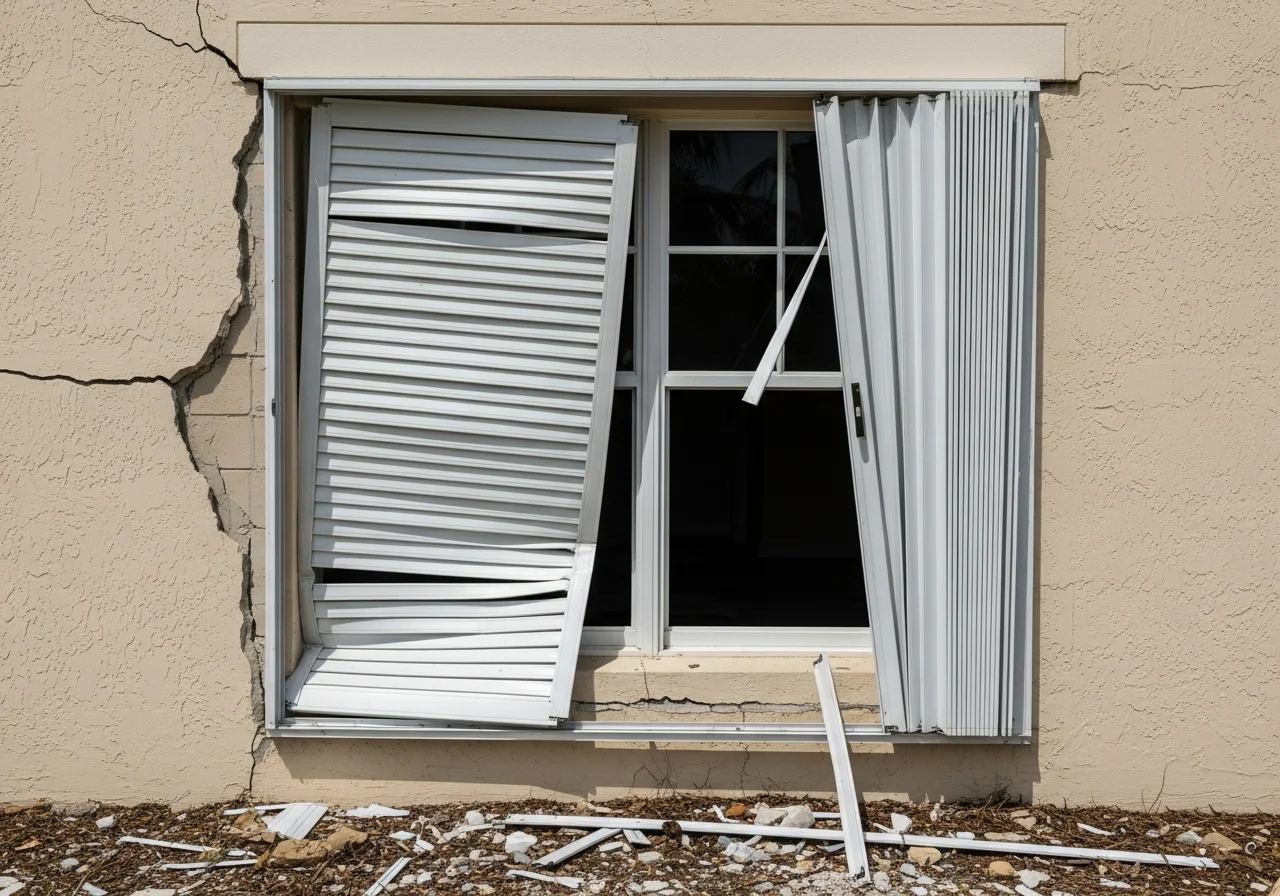
HVHZ impact windows tested under TAS 201, 202, and 203 protocols are designed to withstand large missile impact at 170+ mph wind speeds. When impact glass fails — from age, improper installation, or debris loads exceeding design capacity — catastrophic interior pressurization results. Wind entering through a failed opening creates uplift pressure that can blow the roof off from the inside. Accordion shutter track corrosion from Miami's salt air is the most common failure point in shutter systems. Impact window seal failures along the frame-to-wall junction — not glass breakage — account for the majority of post-hurricane water intrusion through window openings.
Critical
Post-Storm Mold Colonization (24-48 Hours)
Miami's tropical climate — average relative humidity of 73% with morning levels reaching 84% during wet season — creates ideal conditions for mold colonization within 24 to 48 hours of water intrusion. After a hurricane, power outages disable air conditioning and dehumidification across entire neighborhoods for days or weeks. Stachybotrys (black mold), Aspergillus, and Penicillium species colonize behind wet drywall, under flooring, and inside HVAC ductwork. Without aggressive structural drying initiated within the first day, a wind damage restoration becomes a wind-plus-mold remediation project — adding $10,000-$40,000+ to costs and weeks to timeline.
Miami-Dade Pricing
Storm Damage Restoration Costs in Miami
Hurricane restoration costs in Miami are among the highest in the nation due to
mandatory HVHZ-compliant materials and installation, saltwater exposure, high-rise
complexity, and South Florida's elevated labor costs. The HVHZ premium alone adds 15-25%
to reconstruction costs compared to non-HVHZ Florida construction. After major
hurricanes, contractor demand surges and HVHZ-approved material shortages across
Miami-Dade increase costs 20-40% and extend timelines by months.
The most expensive hurricane damage is the damage you could have prevented or documented
before the storm. These six steps, taken before June 1, can save Miami homeowners tens
of thousands in unrecovered losses and months of extended displacement. The 2024
Atlantic season — 18 named storms, 11 hurricanes, 5 major — proved that preparation is
not optional in Miami-Dade County.
Document Your Home Before Hurricane Season
Walk every room with a video camera and photograph high-value items, serial numbers, and existing conditions of walls, ceilings, and flooring. For Miami condos, document common-area conditions and your specific unit. Store documentation in cloud storage — not on a phone that could be lost in an evacuation. This pre-storm baseline is your strongest evidence for insurance claims. After June 2024 flooding, Miami homeowners without documentation waited months longer for claim settlements because adjusters had no baseline for pre-loss condition.
Know Your Evacuation Zone & FEMA Flood Zone
Check your storm surge evacuation zone at miamidade.gov and your FEMA flood zone at FEMA's Map Service Center. Miami-Dade uses zones A through E: Zone A (Key Biscayne, Miami Beach, bayfront Brickell) evacuates for Category 1. Zone B (coastal Coconut Grove, Edgewater) evacuates for Category 2. But June 2024 proved that drainage flooding devastates areas well outside surge zones. VE zones (coastal) and AE zones (high risk) require flood insurance for federally backed mortgages. X zones do not — but should carry flood insurance anyway.
Verify Insurance Coverage — Wind AND Flood Separately
Florida homeowners policies carry separate hurricane deductibles of 2-5% of insured value — not a flat dollar amount. On a $570,000 Miami home (Miami-Dade median), that's $11,400 to $28,500 out of pocket on wind claims alone. Confirm your deductible percentage and dwelling coverage limits. Separately, verify flood insurance: NFIP policies cap at $250,000 dwelling coverage, which is insufficient for most Miami homes. Consider private flood for higher limits. Florida law requires filing claims within 1 year of the date of loss.
Inspect Your HVHZ Protection Systems
Before hurricane season, inspect every impact window seal, accordion shutter track, and storm panel mounting point. Salt air corrosion is the leading cause of shutter system failure in Miami-Dade. Accordion tracks should move freely without binding. Storm panel bolts should thread smoothly. Impact window perimeter seals should be intact without gaps or cracking. Garage door reinforcement — if your garage door predates current HVHZ standards — is the single most cost-effective upgrade you can make. A failed garage door allows wind into the building envelope and can result in total roof loss.
Establish a Restoration Company Relationship
After major hurricane events, every restoration company in South Florida is overwhelmed simultaneously. Response times that are normally under 60 minutes stretch to days. Homeowners with an existing relationship receive prioritized dispatch. Contact Palm Build at (754) 600-3369 before hurricane season to establish your account, review your property's specific vulnerabilities (surge zone, construction era, HVHZ compliance status), and get pre-positioned on our priority response list.
Prepare a Go-Bag & Critical Document Kit
Pack a waterproof go-bag with insurance policy numbers and agent contacts, mortgage documents, condo association contact information (for Miami condo owners), photo ID, prescription medications, and a portable phone charger. Include your restoration company's emergency number ((754) 600-3369 for Palm Build). Store copies of all documents in cloud storage accessible from any device. In a mandatory evacuation, Zone A residents may have 24-36 hours to leave — having these items pre-packed eliminates critical decision-making under pressure.
Critical Insurance Distinction
Wind vs. Flood Insurance: Miami's Most Expensive Misunderstanding
This is the single most important insurance concept for Miami storm damage. Wind damage
and flood damage from the same hurricane are covered by different policies, carry
different deductibles, and are filed as separate claims. In a coastal city with Biscayne
Bay storm surge zones, porous limestone geology, and drainage systems overwhelmed by
extreme rainfall, most hurricane events produce both wind and flood damage
simultaneously — making proper damage classification the difference between full
recovery and financial catastrophe.
Tile roof displacement and underlayment failure from wind uplift
Impact window, shutter, and door damage from wind pressure or debris
Rain water entering through wind-created openings in the building envelope
Stucco, CBS wall, and structural damage from wind load or debris impact
Emergency tarping, board-up, and sandbagging costs (duty to mitigate)
ALE (Additional Living Expenses) if home is uninhabitable
FL Hurricane Deductible: 2-5% of insured value. On a $570K Miami home =
$11,400-$28,500 out of pocket before coverage begins.
Flood Damage (Separate NFIP or Private Flood Policy)
Storm surge from Biscayne Bay or the Atlantic (Category 3 saltwater)
Urban flooding from overwhelmed drainage systems (June 2024 scenario)
Groundwater intrusion through porous limestone and slab foundations
Sewer backup from overwhelmed municipal systems
NFIP max dwelling coverage: $250,000 (insufficient for most Miami homes)
NOT covered by standard homeowners — requires separate flood policy
1-Year Claim Deadline: Florida law (Fla. Stat. 627.70132) requires filing
your initial hurricane claim within 1 year of the date of loss. Missing this deadline can
void your entire claim.
Hurricane Deductible Calculator: Miami-Dade
Miami-Dade County's median home value is approximately $570,000. At a 2% hurricane
deductible, that is $11,400 out of pocket before your wind claim pays anything. At 5%,
it is $28,500. This deductible applies to every named storm event — not annually. If
two hurricanes hit in one season (as Frances and Jeanne did in 2004), you pay the
deductible twice. Brickell and Key Biscayne properties with $1M+ insured values face
hurricane deductibles of $20,000-$50,000+. Many Miami homeowners are stunned by this
number when they file their first hurricane claim. Review your policy now, before a
storm forces the conversation.
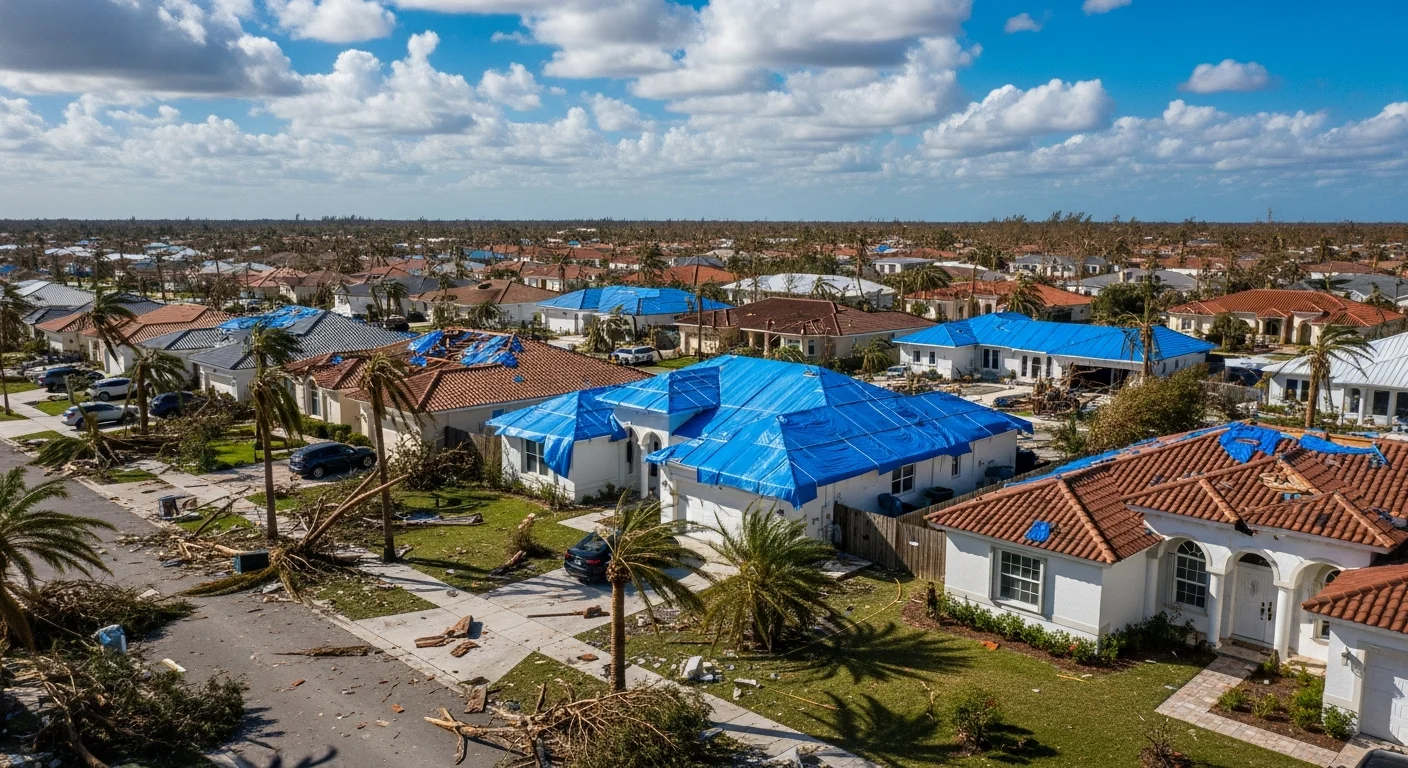
Aerial view reveals the scale of hurricane damage across Miami neighborhoods — roof failures, tree canopy destruction, and debris fields requiring coordinated cleanup
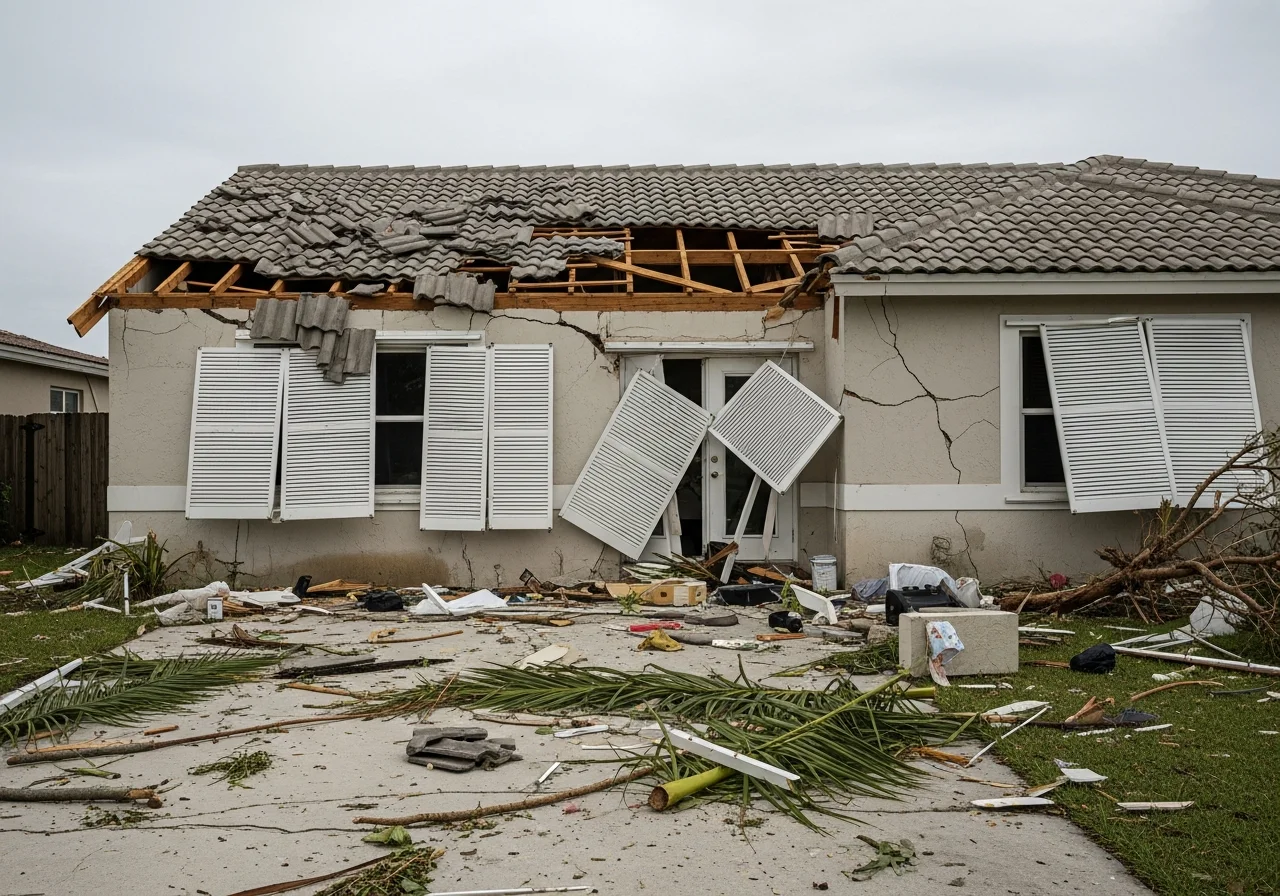
Barrel tile roof failures in Miami typically occur at the aging underlayment and flashing — not the tile shells — exposing the roof deck to catastrophic water intrusion
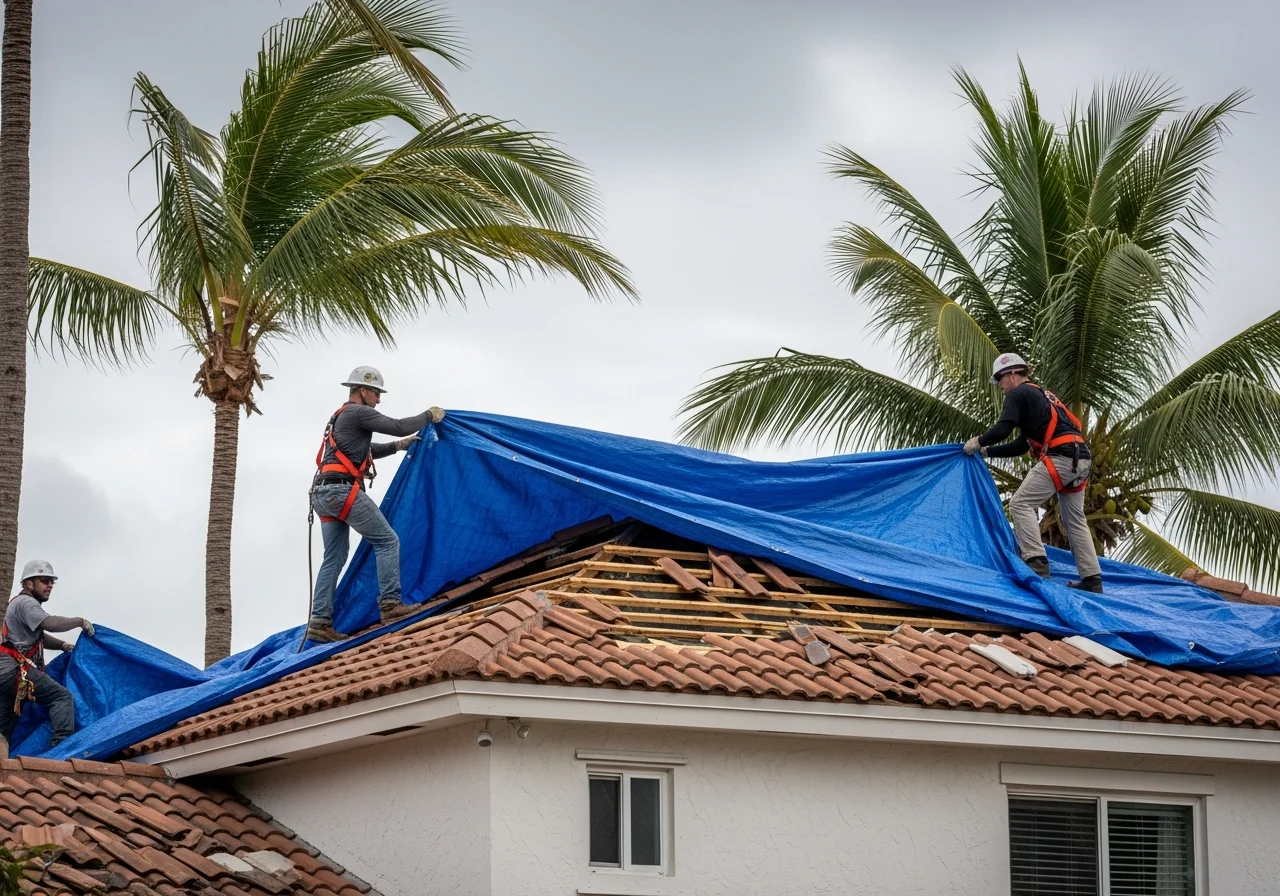
Emergency tarping with reinforced polyethylene rated for HVHZ wind loads — the critical first step to prevent compounding water and mold damage
Impact window and accordion shutter failures — salt air corrosion on shutter tracks is the most common failure point in Miami-Dade HVHZ protection systems
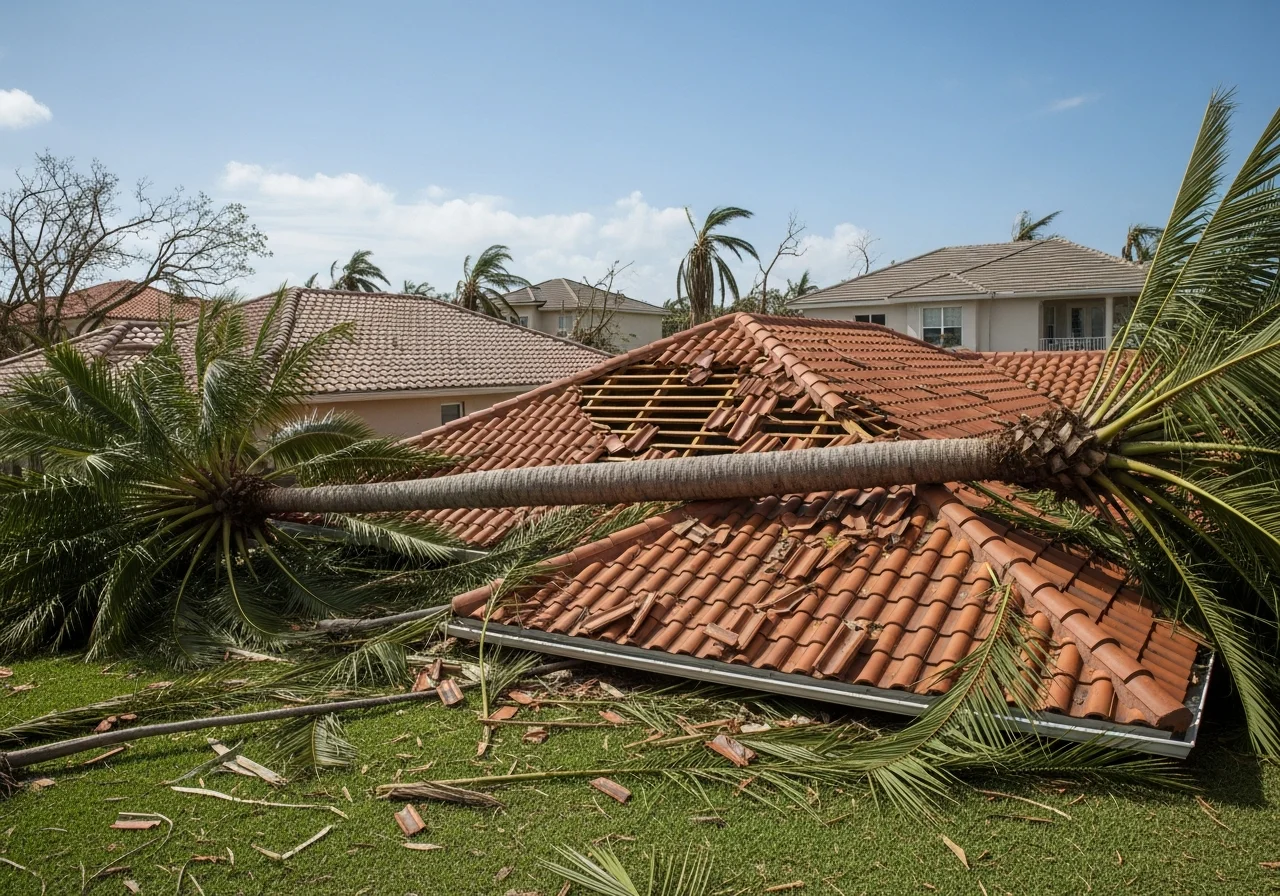
Tree-on-structure damage from fallen palms and mature canopy trees requires immediate tarping to prevent water intrusion through the punctured roof system
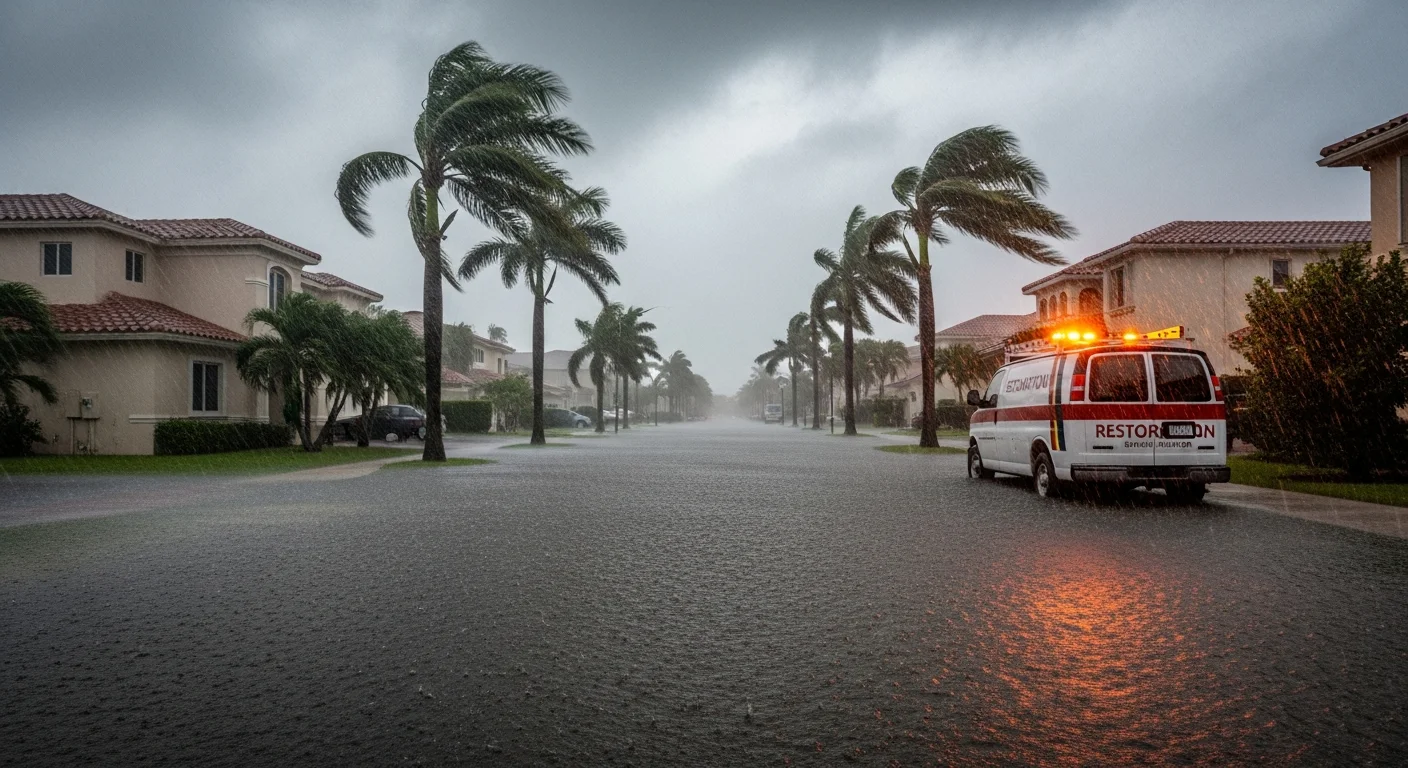
Urban flooding from overwhelmed drainage systems — June 2024 dumped 20 inches of rain in 2 days, flooding streets from Kendall to Edgewater
The Palm Build Difference
Why Miami Homeowners Choose Palm Build After Hurricanes
Under 60-Minute Miami-Dade Response
Our Deerfield Beach operations center deploys to all of Miami-Dade County with response times under 60 minutes during normal conditions. During major hurricane events, we activate catastrophe response with pre-positioned crews and equipment staged at multiple points across South Florida. Pre-storm clients receive priority dispatch ahead of the general queue. Our trucks carry emergency tarping materials, truck-mounted extraction equipment, commercial LGR dehumidifiers, and air movers — we begin mitigation immediately upon arrival.
Every crew lead holds current IICRC Water Restoration Technician and Fire/Smoke Restoration Technician certifications. Our South Florida teams are trained in Category 3 saltwater decontamination protocols critical for Biscayne Bay storm surge events — where contaminated saltwater requires complete demolition of all affected porous materials. We test contamination levels on-site to determine the correct IICRC remediation protocol for each affected area of your home.
Dual-Claim Documentation (Wind + Flood)
Our damage assessment classifies every item by cause — wind vs. storm surge vs. drainage flooding vs. debris impact — ensuring each claim is filed with the correct policy. In Miami, where wind damage goes through homeowners (with hurricane deductible of 2-5%) and flood damage requires separate NFIP or private flood claims, this dual-documentation approach recovers significantly more than generic damage reports. Florida's 1-year claim deadline makes accurate initial documentation critical.
HVHZ Code Expertise — TAS 201/202/203
Miami-Dade County sits entirely within the High Velocity Hurricane Zone — the strictest building code in the nation. All reconstruction must meet HVHZ standards: impact windows tested to TAS 201, 202, and 203; hurricane straps on every roof-to-wall connection; reinforced garage doors; and engineer-sealed wind-load calculations. Our project managers maintain current knowledge of Miami-Dade's permitting requirements, NOA product specifications, and HVHZ inspection protocols. We handle the engineering, documentation, and code compliance.
Florida Insurance Navigation
We understand Florida's complex insurance landscape: Citizens depopulation, hurricane deductible percentages (2-5% of insured value), NFIP proof-of-loss deadlines, assignment of benefits regulations, and the role of public adjusters. Palm Build coordinates with your carrier, your adjuster, and if needed your public adjuster to maximize claim recovery while keeping restoration moving. We helped Miami-Dade homeowners navigate the 1-year filing deadline and supplemental claim requirements after every recent storm event.
Full Reconstruction — Emergency Through Final Punch
From emergency tarping through HVHZ-compliant final reconstruction, one company handles everything. We maintain relationships with HVHZ-rated material suppliers and licensed subcontractors who prioritize our projects during post-hurricane demand surges. Barrel tile roof repair, impact window replacement, CBS stucco restoration, and full interior rebuild — all coordinated through a single project manager with Miami-Dade County permit expertise and NOA product knowledge.
Common Questions
Miami Hurricane Damage FAQ
How quickly can Palm Build respond after a hurricane in Miami?
Our Deerfield Beach operations hub serves all of Miami-Dade County with response times under 60 minutes during normal conditions. After major hurricane events, we activate catastrophe response protocols with pre-positioned crews and equipment staged across South Florida. Pre-storm clients who schedule board-up and tarping services receive priority dispatch once conditions allow safe travel. Our trucks carry emergency tarping, truck-mounted extraction equipment, commercial LGR dehumidifiers, and air movers — we begin mitigation immediately upon arrival.
Does my Miami homeowners insurance cover hurricane damage?
Wind damage from hurricanes is a covered peril under Florida homeowners policies, but Florida policies carry separate hurricane deductibles of 2-5% of your dwelling coverage — not a flat dollar amount. On a $570,000 Miami home (Miami-Dade median), that means $11,400 to $28,500 out of pocket before your wind coverage kicks in. Critically, flood damage from storm surge or rising water is not covered by your homeowners policy — that requires separate NFIP or private flood insurance. Florida law (Fla. Stat. 627.70132) requires filing your initial claim within 1 year of the date of loss, with supplemental claims within 18 months. Palm Build provides insurance-ready documentation from arrival.
What is the difference between wind damage and flood damage for insurance purposes?
This distinction is critical in Miami. Wind damage — roof uplift, siding failure, impact window breaches, and wind-driven rain entry through the building envelope — is covered by your homeowners policy with a hurricane deductible. Flood damage — rising water from Biscayne Bay storm surge, canal overflow, or ground saturation — requires separate flood insurance through NFIP or a private carrier. Storm surge in Miami is classified as IICRC Category 3 (grossly contaminated) saltwater, requiring complete demolition of all affected porous materials. Many Miami claims involve both wind and flood damage simultaneously, which means two separate claims filed with two different carriers.
What are the HVHZ rebuild requirements after hurricane damage in Miami?
Miami-Dade County sits entirely within the High Velocity Hurricane Zone, the strictest wind-resistance building code in the United States. All permitted reconstruction after storm damage must meet HVHZ standards: impact-rated windows and doors tested to TAS 201, 202, and 203 protocols; enhanced roof-to-wall connections with Miami-Dade approved straps and connectors; reinforced garage doors rated for HVHZ wind loads; and specific wind-load engineering certified by a Florida-licensed structural engineer. HVHZ-compliant materials and installation add 15-25% to reconstruction costs compared to standard Florida building code, but compliance is mandatory for all permitted work in Miami-Dade County.
How quickly does mold grow after hurricane damage in Miami?
In Miami's tropical climate — with average relative humidity of 73% and morning humidity reaching 84% during wet season — mold colonization begins within 24 to 48 hours of water intrusion. After a hurricane breaches the building envelope through roof damage, window failure, or wind-driven rain, every hour of delay compounds the problem. Mold growth behind wet drywall, inside saturated wall cavities, and on exposed roof decking turns a wind damage claim into a combined wind and mold remediation project. This is why emergency tarping and structural drying within the first 24 hours is critical — it can prevent tens of thousands of dollars in secondary mold damage.
What should I do about tree damage to my Miami home after a hurricane?
Miami's mature tree canopy — including live oaks, royal palms, banyans, and mahogany trees — creates significant falling debris and structural impact risk during hurricanes. If a tree falls on your home: (1) Do not enter the structure until it has been assessed for structural stability. (2) Call Palm Build at (754) 600-3369 for emergency stabilization and tarping. (3) Document all damage with timestamped photos before any debris is removed. (4) Contact your homeowners insurance — tree removal is typically covered when the tree damages an insured structure. (5) If the tree punctured the roof or walls, emergency tarping must happen immediately to prevent water intrusion and secondary mold damage. The tree itself is the homeowner's responsibility to remove, but damage it caused to the structure is a covered peril under standard HO-3 policies.
How does emergency tarping work after hurricane damage?
Emergency tarping is the single most important step after hurricane wind damage to prevent compounding water intrusion. Palm Build deploys heavy-duty UV-resistant tarps secured directly to the roof deck with screws, battens, and edge sealing — not simply draped over damaged areas. We tarp tile roof sections where uplift displaced or shattered tiles, exposed underlayment areas, penetration points from fallen debris, and ridge cap failures. In Miami-Dade, emergency tarping is typically covered by your homeowners insurance as a reasonable and necessary measure to mitigate further damage. We document the tarping scope with photos and measurements formatted for your insurance claim. Tarps remain in place until permanent HVHZ-compliant repairs are completed — which can take 4 to 12 weeks depending on material availability and permit processing.
What storm surge evacuation zone is my Miami property in?
Miami-Dade County uses storm surge evacuation zones A through E. Zone A — covering Key Biscayne, Miami Beach, Fisher Island, and bayfront Brickell — is evacuated for Category 1 hurricanes with as little as 4-6 feet of surge. Zone B activates for Category 2, covering coastal Coconut Grove and Edgewater. Zones C through E extend progressively inland for stronger storms. Properties in Zones A and B face direct saltwater storm surge exposure — IICRC Category 3 contamination requiring complete demolition of all affected porous materials. You can check your zone at Miami-Dade County's interactive evacuation zone map at miamidade.gov/global/emergency/hurricane-evacuation-zones.page.
Trusted Vendors
Trusted local pros in Miami
Outside our restoration scope, these are the vetted, licensed contractors we trust
alongside our work. Personally evaluated, reference-checked, and recommended by Palm
Build.
Miami's tropical humidity turns wind damage into mold damage within 24 to 48 hours. Palm Build's Deerfield Beach team provides emergency tarping, saltwater extraction, and HVHZ-compliant structural stabilization across all of Miami-Dade County — 24/7, with insurance documentation from the first call.