Key takeaways
- Water damage escalates from cleanup to mold and rebuild within 24 to 48 hours if drying is not underway and verified.
- The first hour determines liability exposure: life safety, source control, and utility isolation must happen before anything else.
- Insurance-grade documentation (timestamped photos, moisture readings, communication logs) is not optional. It is what separates a paid claim from a denied one.
- Florida insurers must acknowledge claims within 7 days and pay or deny within 60 days. NC allows 30 days for acknowledgment. SC requires proof-of-loss forms within 20 days.
- Budget for mitigation at $3 to $7.50 per square foot depending on water category, before reconstruction costs.
Property managers need a repeatable, time-critical water damage protocol because the situation escalates from "cleanup" to "mold plus rebuild plus claim friction" fast. The EPA, CDC, and OSHA all converge on the same operational deadline: wet materials must be dried within 24 to 48 hours to prevent mold growth. Your protocol should focus on four priorities in order: life safety, source control (stop the water), loss documentation (photos and moisture notes for the claim), and rapid mitigation (extraction, dehumidification, and verified drying). Budget early at roughly $3 to $7.50 per square foot for mitigation alone depending on whether the water is clean, gray, or black, before reconstruction. In Florida, insurers must acknowledge claim communications within 7 days and generally pay or deny within 60 days, which makes organized documentation operationally critical from minute one.
Mold growth window
24-48 hrs
EPA, CDC, and OSHA all cite this drying deadline
Mitigation cost range
$3-$7.50/sqft
Varies by water category (clean to black)
Claim severity increase
+29.6%
Weather-related water loss severity, 2023 to 2024
FL claim pay/deny deadline
60 days
After notice, with defined exceptions
This protocol is designed for property managers responsible for multi-unit residential buildings, commercial spaces, and HOA-managed properties. It is not a homeowner checklist. It accounts for the multi-party coordination (tenants, owners, boards, adjusters, vendors) that makes commercial water damage operationally different from a single-family event. Print it. Laminate it. Put it in the maintenance office next to the shutoff map.
Step 1: Secure Life Safety and Utilities
Before you touch a mop, evaluate whether anyone is in danger. Water and electricity are a lethal combination, and structural elements saturated with water can fail without warning. Your first job is making sure no one gets hurt. Everything else, including documentation and vendor calls, waits.
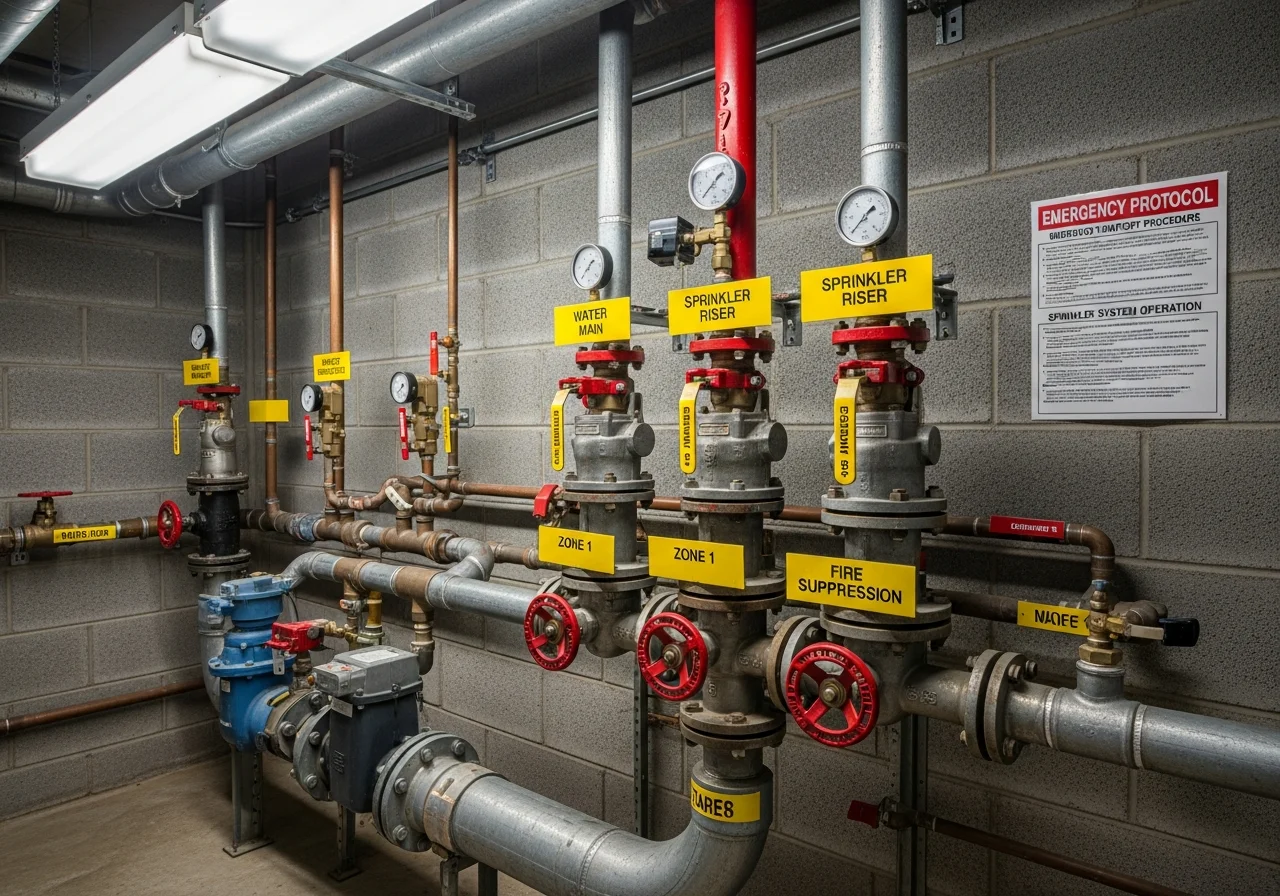
- Evacuate affected areas if you see ceiling sagging, active electrical sparking, gas odors, or sewage contamination
- Shut off electrical breakers for affected areas from a dry location only. If the panel is in standing water, call an electrician immediately
- Locate and close the water main, unit-level supply valves, or sprinkler riser control valves depending on the source
- Shut down HVAC systems serving affected zones to prevent cross-contamination through ductwork
- If elevators are in the affected wing, lock them out and call the elevator service company
- Post a maintenance team member at the entry point to control access until the scene is safe
Step 2: Stop the Source and Contain the Spread
Once people are safe and utilities are controlled, your goal shifts to stopping the water at its origin and preventing it from reaching additional units, floors, or building systems. Every minute water continues flowing increases the scope of demolition and the cost of the claim.
| Source scenario | Immediate action | Who to call |
|---|---|---|
| Supply line or pipe burst | Close the main water valve or the unit isolation valve | Plumber (emergency) |
| Appliance failure (water heater, washing machine, dishwasher) | Shut off the appliance supply valve and unplug the unit | Plumber + appliance vendor |
| Roof leak or storm intrusion | Tarp the entry point if safe; place containment barriers below | Roofer (emergency) + storm damage restoration |
| Sprinkler system activation | Close the riser control valve only after confirming no active fire | Fire alarm company + sprinkler contractor |
| Sewer backup (black water) | Do not touch. Evacuate the area. This is Category 3 water. | Emergency water damage restoration + plumber |
Source control scenarios and immediate actions for property managers
For multi-story buildings, gravity is your enemy. Water on the third floor will reach the second and first floors through wall cavities, ceiling penetrations, and elevator shafts faster than you expect. Containment means working from the top down: stop the source, dam the spread on the origin floor, then check every floor below for secondary intrusion.
Step 3: Document Like Your Insurance Adjuster Is Already Reviewing It
This is the step that separates property managers who get claims paid from those who fight for months. Documentation does not start when the adjuster arrives. It starts the moment you walk into the affected area. Everything you record in the first hours becomes the foundation of your claim, your liability protection, and your tenant communication trail.
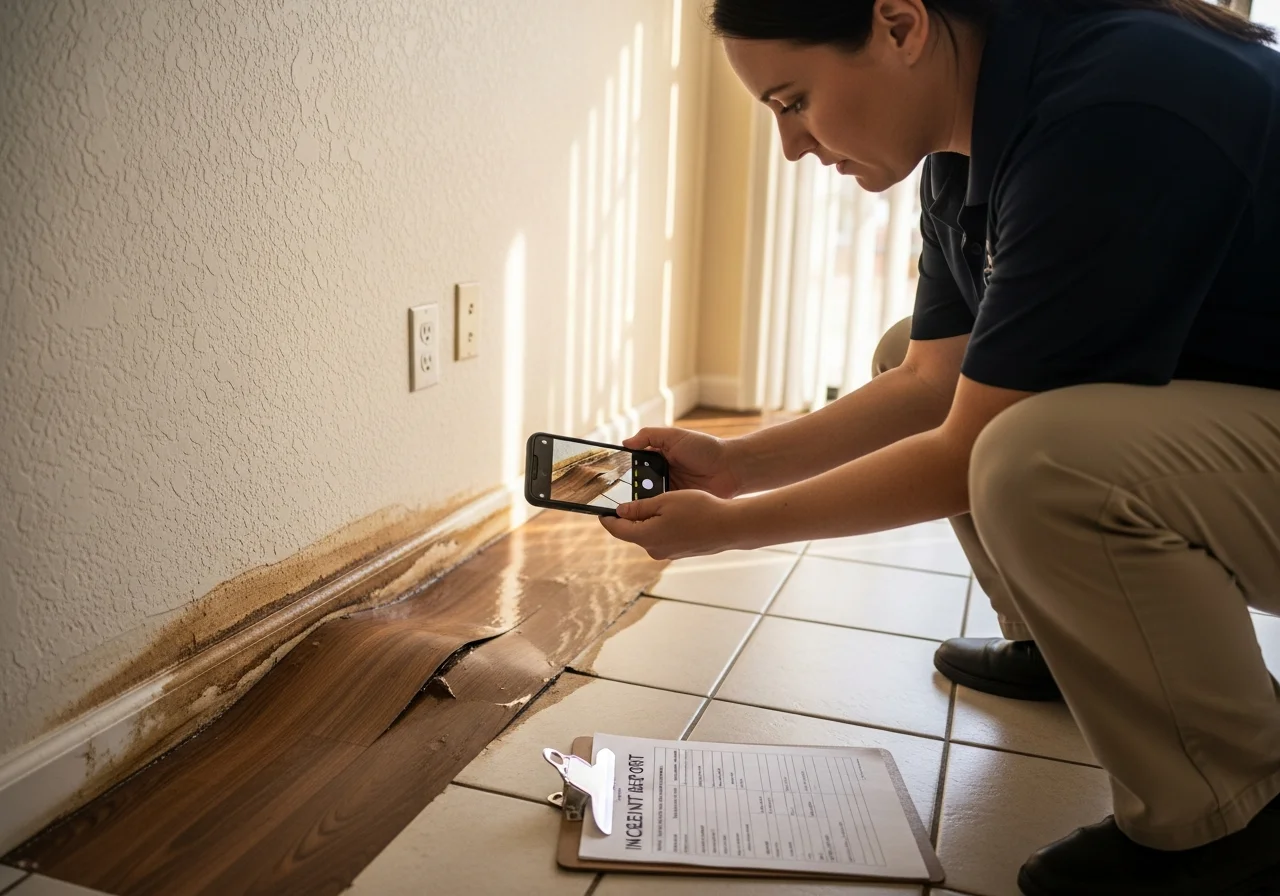
Photo and video protocol
- Start with wide-angle shots of each affected room showing the full extent of water intrusion
- Capture close-ups of damage to baseboards, flooring, drywall, and any visible water line marks
- Photograph serial numbers and model information on damaged equipment and appliances
- Document the suspected source (the broken pipe, failed appliance, roof penetration)
- Record a walkthrough video narrating what you see, when you discovered it, and what actions you have taken
- Ensure timestamps are enabled on your phone camera. If not, hold a piece of paper with the date and time in the first photo of each room
Written incident log
Start a running log immediately. Every entry should include the time, who was present, what was observed, and what actions were taken. This log becomes your claim narrative and your legal protection. Include: who discovered the water, when they reported it, what shutoffs were used, which vendors were called and when they responded, and what communications went to tenants, owners, and the insurer.
What to ask your restoration vendor to provide daily
- Moisture readings at mapped locations (same points every day, documented on a floor plan)
- Equipment placement log (number and type of dehumidifiers, air movers, and their locations)
- Photos of drying progress at each check-in
- Psychrometric data (temperature, relative humidity, grain depression) if they are following IICRC S500 standards
- Written confirmation when each area reaches "dry standard" before reconstruction begins
Step 4: Notify the Right Stakeholders in the Right Order
This is where property management water damage diverges completely from residential. You are coordinating messaging to tenants, unit owners, HOA boards, insurance carriers, and multiple vendors simultaneously. Getting the order and tone wrong creates confusion, liability exposure, and angry phone calls that consume your time for weeks.
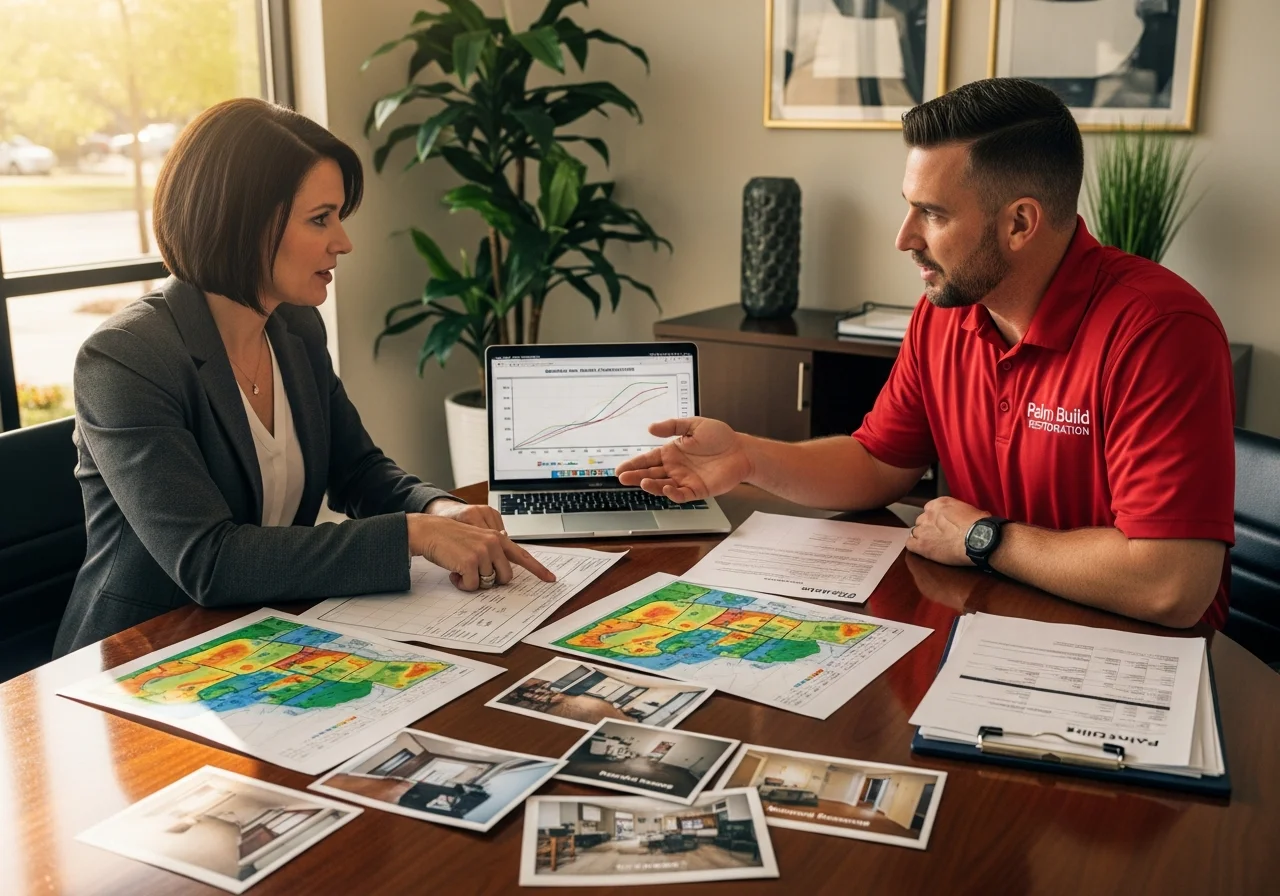
Notification priority order
Immediate
Emergency services and utilities
Fire department (if active fire preceded the water), electrician (if panel is compromised), elevator company (if water entered shaft)
Within 30 min
Restoration vendor
Call your pre-contracted commercial restoration company. If you do not have one, this is why you needed this protocol before today.
Within 1 hour
Affected tenants
Safety instructions, access restrictions, what not to do (do not use affected electrical outlets, do not attempt cleanup of Category 3 water), and when to expect the next update
Within 2 hours
Property owner or HOA board
Scope estimate, immediate costs authorized, restoration vendor engaged, next update time. Keep it factual, not emotional.
Within 4 hours
Insurance carrier
File the claim with your initial documentation package: photos, incident log, vendor contact info, and preliminary scope. Start the clock on their response obligations.
Within 24 hours
Adjacent and non-affected tenants
Building-wide notice about equipment noise, access changes, and any shared-area closures. Prevents complaint calls.
Vendor call tree
Your protocol binder should include pre-vetted contacts for: licensed plumber (emergency), licensed electrician (emergency), IICRC-certified restoration company, roofing contractor, elevator service company, and a locksmith (for unit access if tenants are unreachable). For HOA and multi-family properties, also include your association attorney and master policy insurance contact.
Step 5: Start Professional Mitigation and Control the Mold Clock
Once your restoration vendor arrives, professional mitigation begins. This is not the time for your maintenance team to handle it with shop vacuums and box fans. Commercial water damage requires commercial equipment, documented drying science, and daily verification that the building is actually getting dry, not just looking dry.
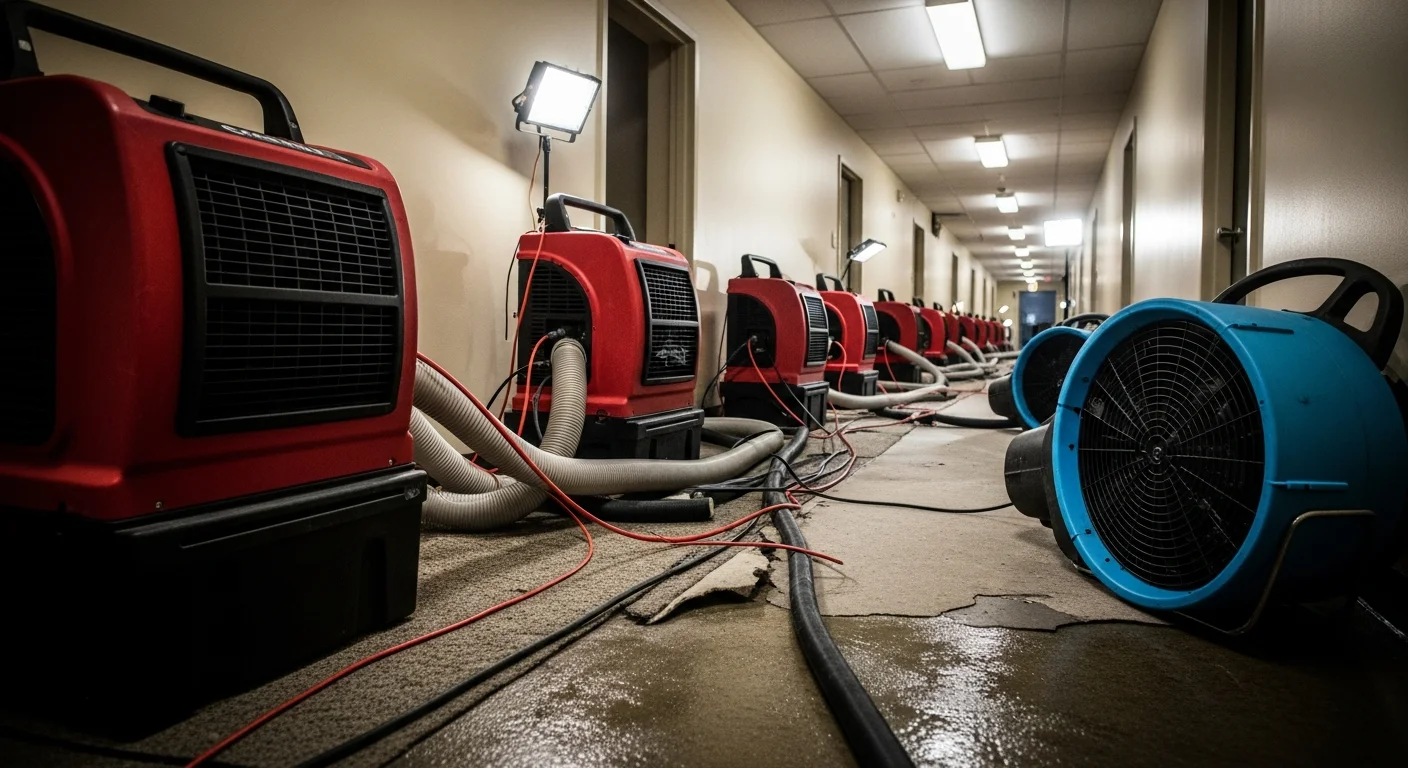
Why the 24 to 48 hour window matters
The U.S. Environmental Protection Agency advises drying water-damaged areas within 24 to 48 hours to prevent mold growth. The CDC echoes this guidance for post-flooding cleanup. OSHA frames prevention around the same prompt-action window for commercial and workplace settings. This is not a marketing number. It is the consensus of every major federal agency that deals with indoor environmental quality. Miss this window and you are no longer managing water damage. You are managing a mold remediation project on top of it.
Water category escalation
| Water category | Source examples | Cost benchmark (per sqft) | Protocol implication |
|---|---|---|---|
| Category 1 (Clean) | Broken supply line, faucet failure, rainwater | ~$3.50 | Standard extraction and drying. No PPE beyond basics. |
| Category 2 (Gray) | Dishwasher discharge, washing machine overflow, toilet overflow with urine | ~$5.25 | Antimicrobial treatment required. PPE upgrade. Remove porous materials that contacted gray water. |
| Category 3 (Black) | Sewer backup, rising flood water, toilet overflow with feces | ~$7.50+ | Full PPE required. Extensive removal of porous materials. Biohazard protocols. Do not allow tenants to re-enter until cleared. |
Water category determines scope, safety requirements, and cost. Source: Angi cost benchmarks, Dec 2025
What "verified dry" means in plain English
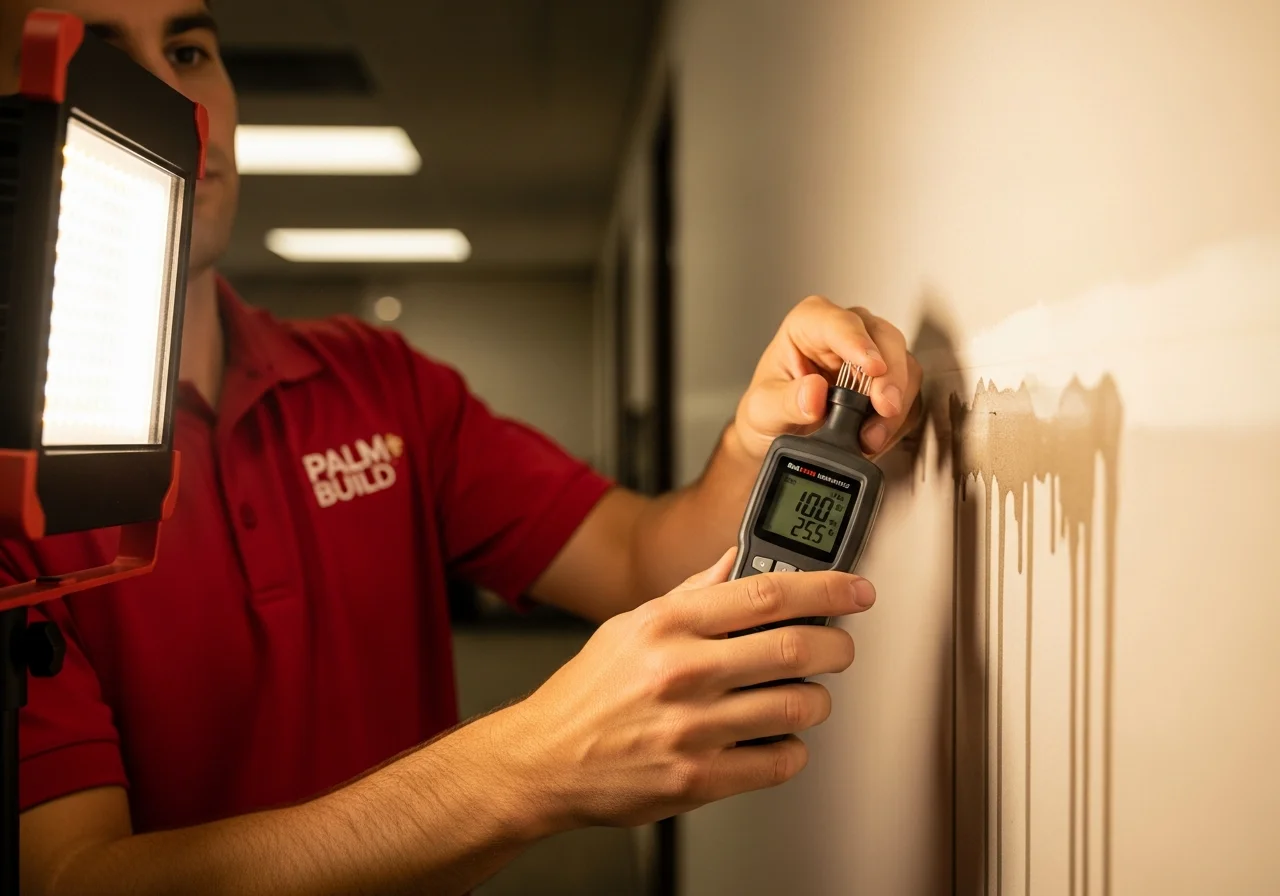
"Verified dry" means moisture readings at mapped locations have returned to the baseline range for each material type, confirmed by daily psychrometric measurements. It does not mean the wall feels dry to the touch. It does not mean the carpet looks dry. Drywall that feels dry on the surface can hold moisture deep in the core for days. Hardwood and concrete can retain moisture for a week or more. Your restoration vendor should provide written confirmation with data before any reconstruction begins. Rebuilding over moisture is how you guarantee a mold callback three months later.
Step 6: Run Daily Operations Until Rebuild-Ready
Mitigation is not a one-day event. For most commercial water losses, active drying runs 3 to 7 days depending on materials, water category, and humidity conditions. During this period, you are managing an active restoration site inside an occupied building. That means daily coordination, tenant updates, equipment monitoring, and documentation continuity.
Daily update cadence
- Morning check-in with restoration team: review overnight moisture readings, adjust equipment placement based on data, identify any areas that are not drying as expected
- Midday tenant update: brief email or text to affected tenants with progress and any access changes for the next 24 hours
- End-of-day owner or board update: summary of progress, cost tracking, and expected timeline to transition from mitigation to reconstruction
- Insurance communication log: every call, email, and adjuster visit logged with date, time, participants, and outcomes
Transition to reconstruction
The handoff from mitigation to reconstruction is where many projects stall. Your restoration vendor should provide a detailed scope of work and a written "dry certificate" before demolition boundaries are finalized. If your mitigation and reconstruction services come from the same company, you eliminate the handoff friction, scope disagreements, and the scheduling gap that often adds weeks to project timelines.
Response Window: What Changes and When
Use this table to calibrate your urgency at each phase. The property manager who understands these windows makes better vendor, documentation, and communication decisions under pressure.
| Response window | What changes operationally | Why it matters |
|---|---|---|
| First hour | Water spreads to electrical systems, elevators, and adjacent units. Decisions focus on stop and isolate. | Early source control and utility safety reduce secondary damage and liability. |
| 24 to 48 hours | Mold prevention window closes if drying is not underway and verified. | EPA, CDC, and OSHA all emphasize drying within this window to prevent mold growth. |
| Days 1 to 7 | Moisture mapping, equipment adjustments, and documentation determine rebuild readiness. | Drying is a measured process. Some materials take days to reach dry standard. |
| Week 2+ | Transition to reconstruction scoping, material procurement, and tenant relocation planning. | Delays here compound. Every week without reconstruction adds to loss-of-use costs and tenant attrition. |
Response windows and their operational impact on commercial water damage recovery
When to Handle In-House vs. When to Call Restoration Immediately
Not every water event requires a full restoration mobilization. But most property managers wait too long to make the call, and by the time they escalate, the scope has doubled. Use this framework to make the right decision in the first 30 minutes.
Maintenance team can handle
- Small, contained leak from a single supply line (less than 50 sqft affected)
- Clean water only (Category 1), caught within 1 to 2 hours
- Hard surface flooring only (tile, sealed concrete), no carpet or drywall saturation
- Single unit, no spread to adjacent spaces or floors below
- Maintenance has a wet vac and can extract water within the hour
Call restoration immediately
- Any gray or black water (Category 2 or 3), regardless of size
- Water has spread to multiple units or multiple floors
- Ceiling saturation, structural sagging, or water in wall cavities
- HVAC system has been exposed to water (cross-contamination risk)
- Water has been standing more than 4 hours without extraction
- Any amount of water near electrical panels, elevators, or server rooms
State-Specific Claim Timing: FL, NC, and SC
Insurance claim timelines are not the same in every state, and property managers operating across Florida, North Carolina, and South Carolina need to know the differences. These deadlines affect your documentation cadence, your escalation triggers, and your expectations for payment.
| Requirement | Florida | North Carolina | South Carolina |
|---|---|---|---|
| Insurer must acknowledge claim | 7 calendar days | 30 days | Reasonable promptness (codified as improper if not met) |
| Pay or deny deadline | 60 days after notice (with exceptions) | Not codified as a specific day count | 90-day demand triggers attorney fee exposure if denied in bad faith |
| Notice-of-claim filing deadline | 1 year after date of loss; supplemental claims within 18 months | Varies by policy | Varies by policy |
| Proof-of-loss forms | Insurer must begin investigation within 7 days of receiving | No state-specific mandate | Insurer must furnish forms within 20 days after notice |
| Mold professional licensing | State-licensed individuals required for assessment and remediation | No state certification; IICRC standards are industry reference | No statewide licensing; rely on professional credentials |
State-by-state insurance claim timing and mold licensing requirements for FL, NC, and SC
Your One-Page Emergency Protocol Checklist
Print this. Laminate it. Post it in the maintenance office, the front desk, and the emergency binder. When water hits at 2 AM on a Saturday, this is the page your on-call team reaches for.
- 1
Life safety first
Evacuate if structural risk, electrical hazard, gas odor, or sewage. Kill power from a dry location. Lock out elevators.
- 2
Stop the water source
Close the appropriate valve. If unknown, close the building main. For storm intrusion, contain and redirect.
- 3
Document before touching anything
Timestamped photos (wide + close-up), video walkthrough, written incident log. This is your claim foundation.
- 4
Call your restoration vendor
Pre-contracted 24/7 water damage restoration on speed dial. Provide scope estimate, water category, and access instructions.
- 5
Notify tenants in affected units
Safety instructions, access restrictions, what not to do, and when to expect the next update.
- 6
Notify owner or HOA board
Scope, cost authorization, vendor engaged, and next update time. Factual, not emotional.
- 7
File the insurance claim
Initial documentation package: photos, incident log, vendor contact. Start the statutory clock.
- 8
Manage daily drying operations
Morning moisture readings, equipment adjustments, tenant updates, insurer communication log, end-of-day owner report.
- 9
Verify dry before reconstruction
Written dry certificate from your vendor with mapped moisture data. Never rebuild over moisture.
Why Pre-Contracted Restoration Partnerships Matter
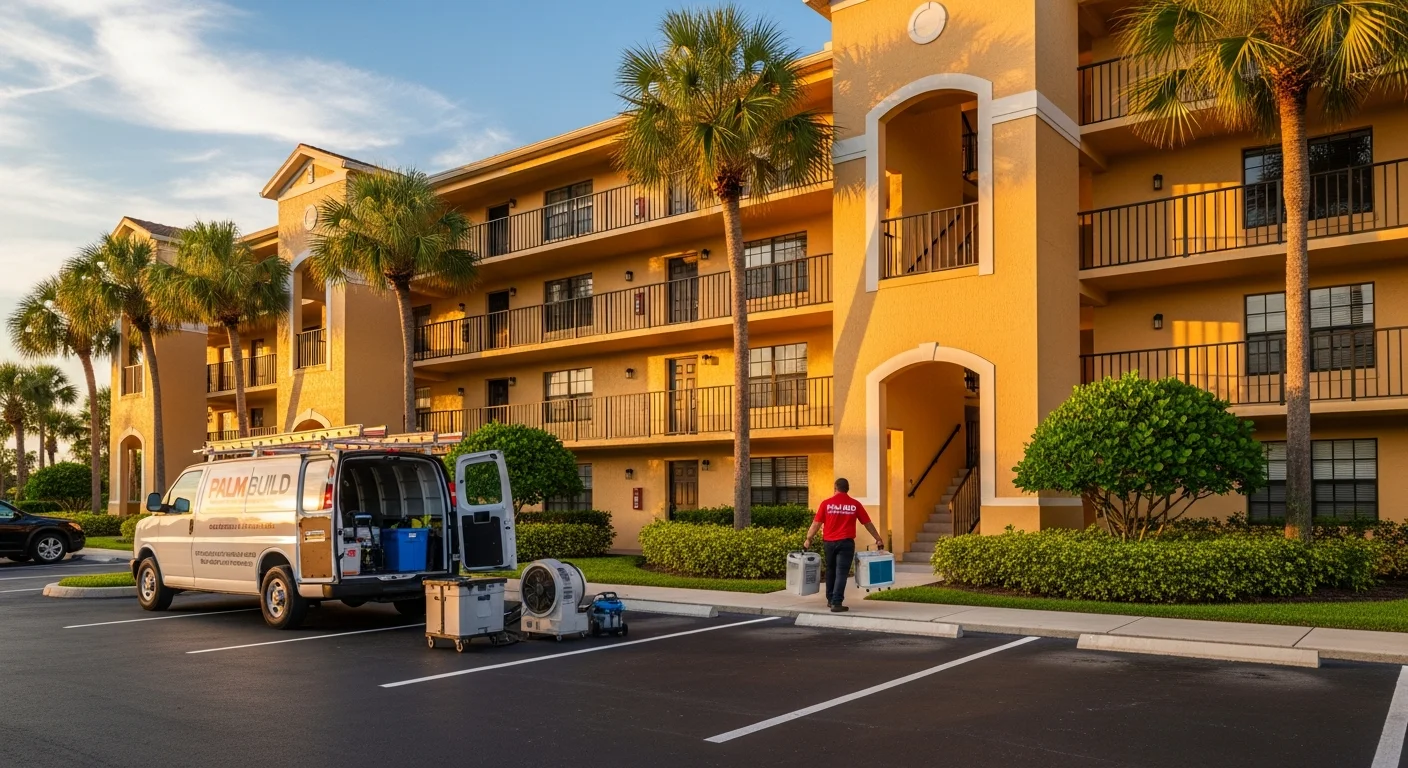
The worst time to search for a restoration company is during an emergency. Property managers who have a pre-vetted, pre-contracted restoration partner gain three critical advantages: faster mobilization (hours instead of days), established documentation standards that match what adjusters expect, and a single point of contact for mitigation through reconstruction that eliminates scope disagreements between separate vendors.
When evaluating restoration partners, prioritize IICRC certification (S500 for water damage, S520 for mold), experience with commercial and multi-unit properties, 24/7 emergency response capability, direct insurance billing experience, and the ability to handle large loss events that exceed single-unit scope. A vendor who can manage a single broken pipe should also be able to scale to a building-wide event without bringing in subcontractors you have not vetted.
Frequently Asked Questions
What should a property manager do first after water damage is reported? +
How fast can mold grow after water damage? +
How long does water damage restoration usually take? +
Does insurance cover water damage restoration for commercial properties? +
What is the typical cost per square foot for water mitigation? +
What should be included in a property manager water damage incident report? +
In Florida, how long does the insurance company have to respond to a property claim? +
Do I need a licensed mold professional in Florida? +
Related Palm Build Services
24/7 Emergency Water Damage Restoration
Immediate response with commercial-grade extraction, dehumidification, and daily moisture documentation for multi-unit and commercial properties.
Commercial Restoration Services
Full-scope restoration for office buildings, retail centers, and multi-unit properties with minimal business disruption.
HOA and Multi-Family Restoration
Coordinated restoration for shared-wall properties including board communication, master policy navigation, and resident messaging.
Insurance Restoration Process
We work directly with your insurance carrier, providing the documentation, daily logs, and adjuster-ready scope packages that keep claims moving.
Need a restoration partner for your properties?
Palm Build provides 24/7 emergency water damage response for property managers across Florida, North Carolina, and South Carolina. IICRC-certified teams, direct insurance billing, and daily documentation that keeps your claims on track.
Found this helpful? Send it to someone who needs it.