(888) 245-5155
Call Now 24/7
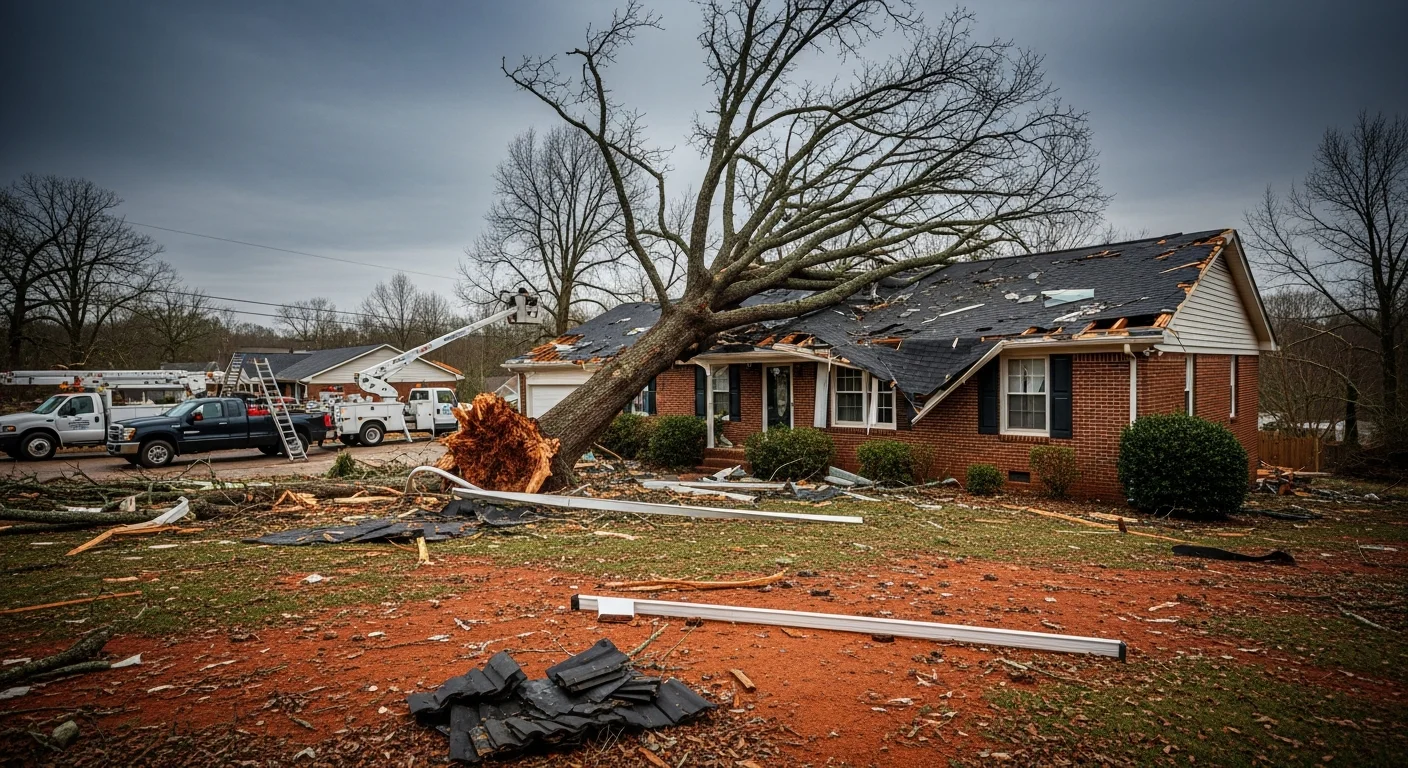
Storm damage to residential properties in Shelby NC showing wind-damaged roofing and fallen tree limbs across a Cleveland County neighborhood
SHELBY NC — 24/7 STORM DAMAGE RESPONSE

Storm & Wind Damage Restoration in Shelby, North Carolina

Hurricane Helene carved a path of destruction through the NC Foothills in September 2025. The February 2020 tornado outbreak struck Cleveland County directly. Severe thunderstorms punish Shelby every spring and summer with downbursts, hail, and wind-driven rain. Palm Build responds from Charlotte in 90 to 120 minutes with emergency tarping, water extraction, structural stabilization, and insurance documentation from the first call.

55 minutes from Charlotte office 90-120 min Response IICRC Certified

90-120 min

Emergency Response

24/7

Dispatch Available

IICRC

Certified Technicians

Local Risk Factors

Why Shelby Faces Elevated Storm Damage Risk

Shelby's position in the NC Foothills corridor creates a unique storm damage profile — channeled tropical remnants, tornado-spawning supercells, and severe thunderstorm downbursts all converge on Cleveland County with regularity. The city's aging housing stock amplifies every storm's destructive potential.

Tropical Remnant Funnel — Foothills Corridor

Funnel zone

Foothills storm corridor

Shelby sits in the NC Foothills corridor where tropical remnants funnel between the Blue Ridge escarpment and the Piedmont plateau. Unlike coastal storms that weaken over land, these channeled systems maintain destructive wind speeds and dump massive rainfall as they compress through the mountain gaps. Hurricane Helene in September 2025 demonstrated this pattern with devastating effect across western NC.
Tornado Alley Overlap — Feb 2020 Outbreak

EF-1/EF-2

Feb 2020 tornadoes

The February 2020 tornado outbreak produced EF-1 and EF-2 tornadoes that struck Cleveland County directly. Shelby sits in the Dixie Alley overlap zone where warm Gulf moisture colliding with Blue Ridge terrain generates rotating supercell thunderstorms. The Foothills topography can enhance low-level wind shear that spawns tornadoes — a risk factor unique to this geographic corridor.

Severe Thunderstorm Corridor — April to June

40+

Annual severe storms

The Foothills region averages 40+ severe thunderstorm events per year, with peak activity from April through June. These storms produce straight-line winds exceeding 60 mph, damaging hail, and downbursts that snap mature hardwoods and pines onto rooflines. Shelby's tree-lined neighborhoods — particularly the older sections with 50-80 year old oak and pine canopy — face extreme projectile risk during these events.

Aging Roof Stock on Mid-Century Homes

15-25 yrs

Typical roof age

Shelby's dominant housing type — mid-century brick ranch homes built from the 1950s through 1970s — carries roofing systems that have been replaced once or twice with composition shingles now 15 to 25 years old. These aging asphalt shingle systems lose granulation and flexibility with age, making them vulnerable to hail impact and wind uplift. The compact roof geometry of ranch homes means even partial shingle loss quickly exposes large areas of decking to rain.

Storm damage to a brick ranch home in Shelby NC showing wind-damaged roof and fallen tree limbs typical of Cleveland County severe weather
Shelby's mid-century brick ranch homes and mature tree canopy create a high-risk combination during severe weather — aging roofs and heavy limbs are a destructive pairing.

Neighborhood-Level Intelligence

Shelby Neighborhood Storm Risk Profiles

Storm damage patterns in Shelby vary by neighborhood based on housing age, roof condition, tree canopy density, and proximity to flood corridors. Understanding your area's specific risk profile helps you prepare — and helps our team prioritize the right response when we arrive.

Uptown / Historic District

Critical

Built: 1890s-1940s

Claim range: $8,000-$40,000

Primary risk: Tree fall on aging structures, roof failure under wind load

Historic frame and brick homes with original or twice-replaced roofing systems. Mature hardwood canopy in the Uptown core creates extreme tree-fall risk during high winds. Limited structural capacity in aging framing absorbs impact loads poorly, causing cascading damage from a single tree strike.

Mid-Century Ranch Belt

High Risk

Built: 1950s-1975

Claim range: $5,000-$30,000

Primary risk: Aging composition shingle roofs, mature tree canopy, crawl space flooding

The dominant housing type in Shelby — these brick-veneer ranch homes sit on vented crawl spaces with composition shingle roofs now 15-25 years old. Low-pitch roof geometry means even partial shingle loss exposes large decking areas. Cleveland County's red clay soil channels storm water toward foundations rather than absorbing it.

Cleveland Country Club Area

High Risk

Built: 1960s-1990s

Claim range: $8,000-$45,000

Primary risk: Higher-value wind and hail damage, mature landscape trees

Larger homes with higher-value finishes and more complex roof systems. Mature oak and pine canopy planted 40-60 years ago creates significant projectile risk. Storm damage claims here are elevated by the need to match premium interior finishes damaged by water intrusion through compromised roofs.

Southern / Western Subdivisions

Moderate

Built: 1990s-2010s

Claim range: $4,000-$20,000

Primary risk: Vinyl siding wind damage, hail damage to newer shingle roofs

Newer construction with better-rated roofing systems but vinyl siding vulnerable to wind and hail impact. Higher elevation on the western edge of Shelby increases wind exposure. These homes perform better structurally during storms but still suffer shingle, siding, and gutter damage from moderate to severe events.

Lake / Creek Corridor Properties

Critical

Built: Mixed

Claim range: $10,000-$60,000+

Primary risk: Flash flooding along First Broad River and Buffalo Creek, tree falls

Properties along First Broad River, Buffalo Creek, and lake corridors face dual wind and flood risk. These waterways can rise rapidly during heavy rainfall events, flooding low-lying properties while wind damage compounds from above. Standard homeowners insurance does not cover flood damage — separate flood insurance is essential for these locations.

Boiling Springs / Eastern Cleveland County

High Risk

Built: Mixed

Claim range: $6,000-$35,000

Primary risk: Rural exposure to straight-line winds, longer emergency response times

Open terrain in eastern Cleveland County increases exposure to straight-line winds and downbursts. Rural properties with fewer windbreaks and longer emergency response distances mean storm damage goes unmitigated longer. Tree damage to outbuildings and secondary structures is common across these properties.

Storm History

Major Storm Events That Shaped Shelby's Risk Profile

Shelby's storm history demonstrates that Cleveland County is not sheltered from catastrophic weather. From hurricane remnants to direct tornado strikes, these events define the risk every Shelby homeowner faces.

Hurricane Helene

Catastrophic

September 2025

Hurricane Helene devastated the western NC Foothills, making it the costliest natural disaster in North Carolina history at $59.6 billion in statewide damage. Shelby and Cleveland County experienced destructive winds, downed trees, widespread power outages, and localized flooding along creek corridors. The Foothills corridor channeled the storm's remnant energy directly through the region, maintaining wind speeds that caused severe roof damage, siding failure, and tree strikes across Shelby neighborhoods.

$59.6B

Statewide damage

Tropical remnant

Category

February 2020 Tornado Outbreak

Catastrophic

February 6, 2020

A powerful winter storm system spawned multiple tornadoes across western North Carolina on February 6, 2020. Cleveland County was struck directly by EF-1 and EF-2 tornadoes with winds reaching 120 mph. Homes were damaged or destroyed, trees were snapped and uprooted, and debris was scattered across rural and suburban neighborhoods. This event shattered the assumption that western NC Foothills communities are somehow sheltered from tornado risk.

EF-1/EF-2

Tornado strength

86-120 mph

Wind speeds

Severe Thunderstorm Corridor

Recurring

Annual (April-June Peak)

The NC Foothills corridor averages 40+ severe thunderstorm events per year, with peak activity from April through June. These storms produce straight-line winds exceeding 60 mph, damaging hail up to golf-ball size, and microbursts/downbursts that concentrate wind energy on narrow swaths of neighborhoods. The terrain-enhanced instability of the Foothills corridor generates storms that are often more intense than those hitting the adjacent Piedmont.

40+

Annual severe events

Apr-Jun

Peak season

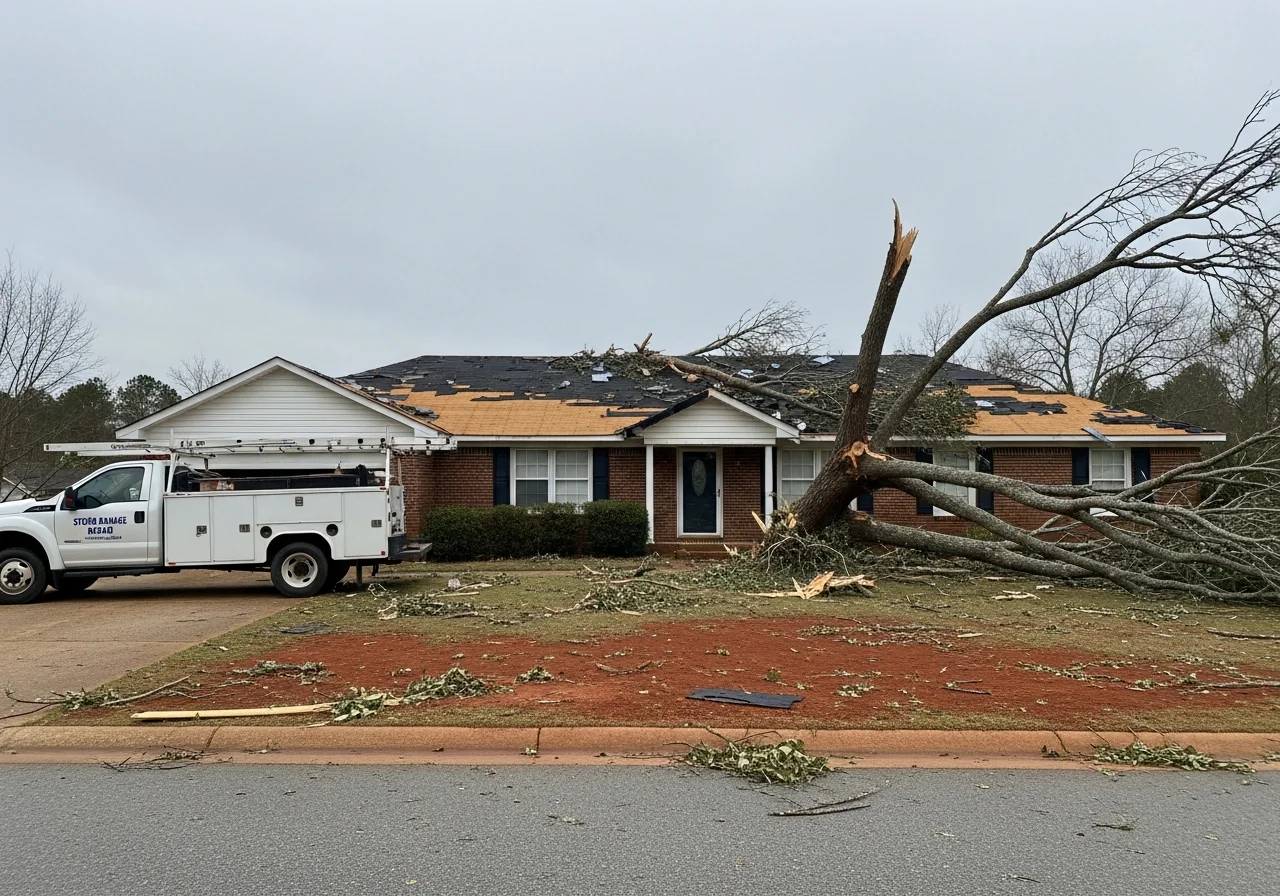
Storm damage assessment in a Shelby NC neighborhood showing wind-damaged roofing and fallen trees typical of Cleveland County severe weather events
Shelby's Foothills corridor position channels tropical remnants and severe thunderstorms directly through Cleveland County — these events are not rare, they are recurring.
Storm Restoration Process

How We Restore Shelby Homes After Storm Damage

When severe weather strikes Shelby, the damage clock starts immediately. Exposed roof decking absorbs water within hours, and every storm that passes over an untarped roof compounds the original damage exponentially. Here is exactly what happens when you call Palm Build.

01

Emergency Tarping & Board-Up

Hours 1-4

Exposed rooflines get heavy-gauge tarps secured with battens and screws — not the blue poly sheeting that blows off in the next storm. Broken windows and compromised doors receive plywood board-up. The goal is to seal the building envelope within hours. Your insurance policy requires you to mitigate further damage, and emergency tarping costs are covered as part of your claim.

02

Damage Assessment & Documentation

Days 1-3

Before any restoration work begins, our IICRC-certified team leader conducts a comprehensive damage assessment — checking for compromised roof trusses, energized electrical hazards, hanging limbs, and gas leaks. Simultaneously, we create insurance-grade photo and video documentation, classifying every item of damage by cause (wind vs. flood vs. tree strike) to ensure correct claim filing. For Shelby's older Uptown homes, we document aging structural conditions separately from storm-caused damage.

03

Water Extraction (Rain Intrusion)

Days 1-3

Wind-driven rain and roof leaks introduce water into wall cavities, attic insulation, ceiling assemblies, and flooring systems. We deploy truck-mounted extractors for standing water and use moisture meters and thermal imaging to identify hidden water behind walls and under flooring. In Shelby's crawl space ranch homes, we address sub-floor water pooling on Cleveland County's red clay soil to prevent secondary mold growth.

04

Structural Drying

Days 3-7

Commercial dehumidifiers and air movers target every moisture pocket identified during assessment. Daily moisture readings track drying progress in wall cavities, subfloor assemblies, and attic spaces. Shelby's humid Foothills climate makes thorough drying especially critical — inadequate drying leads to mold growth within 48-72 hours.

05

Roof & Exterior Repair

Weeks 1-4

From partial shingle replacement to full roof tear-off, we restore your roof to pre-loss condition. Damaged siding, gutters, fascia, and soffits are replaced. Fallen trees are removed from structures with careful rigging to avoid compounding damage. All work is fully permitted through Cleveland County.

06

Interior Restoration & Full Rebuild

Weeks 2-12

Drywall replacement, flooring restoration, painting, and finish work bring your Shelby home back to pre-loss condition or better. For older homes in the Uptown district with original trim, hardwood, and plaster, we match existing materials and profiles. For all structural reconstruction, permits are handled through Cleveland County Building Inspections.

Damage Patterns

Types of Storm Damage in Shelby Homes

Storm damage in Shelby takes many forms — from obvious tree strikes to hidden rain intrusion that doesn't reveal itself for days. Understanding the damage types helps you know what to look for after a storm and why professional assessment is essential.

Tree Falls on Roofs and Structures

Shelby's mature oak, pine, and sweetgum canopy — particularly in the Uptown district, the ranch belt, and rural properties — creates the highest-frequency damage pattern during storms. A single mature oak falling on a ranch home can collapse the roof system, punch through ceiling and floor assemblies, and expose the entire interior to rain. Tree-on-structure removal requires careful rigging to avoid compounding the damage.

Wind-Driven Rain Intrusion

Even without visible roof damage, wind-driven rain can penetrate through ridge vents, soffit joints, and micro-gaps in aging flashing. In Shelby's ranch homes with low-pitch roofs, wind-driven rain pools on decking rather than sheeting off. This water enters wall cavities and attic insulation where it causes hidden damage — often not discovered until mold develops days or weeks later.

Hail Damage to Roofing and Siding

Severe thunderstorms in the Foothills corridor produce hail ranging from pea-size to golf-ball diameter. Hail impacts fracture shingle granulation, crack vinyl siding, dent gutters and downspouts, and can shatter skylights and window glass. The damage may appear cosmetic but compromises the waterproof integrity of the roofing system. Hail damage claims in Shelby spike April through June during peak thunderstorm season.

Siding and Gutter Damage

Vinyl siding on newer Shelby subdivisions is rated for wind resistance but can fail under straight-line winds exceeding 60 mph or from flying debris impact. Gutters and downspouts tear away from fascia boards, and loose gutters become projectiles that damage adjacent structures. Missing gutters also redirect water flow against foundations, causing basement and crawl space water intrusion.

Lightning Strike Damage

Cleveland County's open terrain and proximity to the Blue Ridge creates elevated lightning risk during thunderstorm season. Lightning can destroy electrical panels, ignite attic insulation, blow out electronics, and follow plumbing and wiring paths that cause hidden damage throughout the structure. Properties near lake and creek corridors face the highest lightning exposure in the Shelby area.

Downburst and Straight-Line Wind Damage

Downbursts — concentrated columns of air that slam to the ground and spread outward — can produce wind speeds exceeding 80 mph in narrow swaths through Shelby neighborhoods. Unlike tornadoes, downbursts create a fan-shaped damage pattern that can affect an entire block. Roof shingles are lifted, siding is peeled, and porch roofs and carports — common on Shelby ranch homes — can be torn away entirely.

Shelby Pricing

Storm Damage Restoration Costs in Shelby

Storm damage costs in Shelby vary based on the type of damage, the age and condition of the home, and whether secondary water damage has had time to develop. Emergency mitigation performed within the first 24 hours consistently reduces total claim costs.

Standard Wind/Hail Damage

Shingle blow-off, siding damage, minor tree limb

Emergency tarping (single slope) $500-$1,500
Window board-up (per opening) $150-$400
Shingle roof repair (partial) $2,000-$7,000
Siding replacement (per wall) $2,500-$6,500
Fence/outbuilding repair $1,200-$4,500
Tree removal (no structure contact) $600-$3,000
Typical wind/hail project $2,500-$18,000

Major Storm/Tornado Damage

Full roof, tree strike, tornado, flooding

Full roof replacement $10,000-$28,000
Tree-on-structure removal + repair $12,000-$50,000
Multi-room water damage (roof breach) $8,000-$35,000
Structural framing repair $6,000-$20,000
Tornado damage restoration $25,000-$150,000+
Flood damage (creek corridor) $15,000-$75,000+
Major storm/tornado project $15,000-$150,000+

Critical Insurance Distinction

Insurance Claims for Storm Damage in Shelby

Wind and storm damage are covered perils under standard North Carolina homeowners policies (HO-3). However, the distinction between wind damage and flood damage is critical — Shelby homes near First Broad River and creek corridors may experience both types during the same storm. Palm Build documents each damage cause separately to ensure your claims are filed correctly.

Wind Damage (Homeowners Policy)

Roof damage from wind, fallen trees, flying debris
Siding, window, and door damage from wind pressure
Rain water entering through wind-created openings
Structural damage from wind load or tree strikes
Emergency tarping and board-up costs
Temporary living expenses if home is uninhabitable

Flood Damage (Separate Flood Policy)

Rising water from First Broad River or Buffalo Creek
Groundwater entering through foundation or crawl space
Stormwater overflow from overwhelmed drainage systems
Sewer backup during flash flooding events
NOT covered by standard homeowners policy
Requires separate NFIP or private flood insurance

Documentation & Claims Timeline

Day 1

Call Palm Build for emergency response and initial documentation

Days 1-3

Report claim to carrier; our documentation package supports your filing

Days 3-10

Adjuster inspection; we meet adjuster on-site with cause-specific damage records

Days 10-30

Scope agreement and supplement filing if initial estimate is insufficient

Weeks 4-12

Restoration work proceeds with documented progress reports for carrier

Wind/Hail Deductibles in North Carolina

Many NC homeowners policies include separate wind/hail deductibles — typically 1-2% of dwelling coverage rather than a flat dollar amount. For a $200,000 Shelby home, a 2% wind/hail deductible means $4,000 out of pocket before coverage begins. Check your policy declarations page for your specific deductible. Palm Build's detailed damage documentation helps ensure your claim exceeds the deductible threshold and receives full settlement.

The Palm Build Difference

Why Shelby Homeowners Choose Palm Build After Storms

When severe weather strikes Cleveland County, every hour of exposure compounds the damage. Here is why Shelby homeowners trust Palm Build to respond first and restore right.

Rapid Mobilization — 90-120 Minutes to Shelby

Our Crompton Street hub is 55 miles from Shelby via US-74 — and we dispatch 24/7/365, including during active storm events. While franchise companies route calls through national call centers, our Charlotte crew is already rolling with tarping materials, extraction equipment, and board-up supplies before the call center answers.

Commercial-Grade Roof Tarping

We secure exposed rooflines with heavy-gauge tarps fastened with battens and screws — not the blue poly sheeting from the hardware store that blows off in the next storm. Our tarping crews understand the specific low-pitch roof geometry of Shelby's ranch homes and the steeper profiles of Uptown historic homes.

Cleveland County Local Knowledge

We know which Shelby neighborhoods flood first, which creek corridors rise during heavy rain, and how the Foothills terrain channels storms through specific areas. This knowledge means faster routing during active events and more accurate damage assessment when we arrive.

Cleveland County Permits — Fully Licensed

All structural work is permitted through Cleveland County Building Inspections. From roof replacement through interior reconstruction, we handle permitting, inspections, and code compliance so you do not have to. For Uptown historic properties, we coordinate with local preservation considerations.

Insurance Advocacy — Cause-Specific Documentation

We photograph, moisture-map, and classify damage by cause (wind vs. flood vs. tree strike vs. hail) using the same standards your adjuster applies. After major events like Hurricane Helene, carriers deploy catastrophe response teams with stricter documentation requirements — our records exceed those standards from the first visit.

Common Questions

Shelby Storm Damage FAQ

How quickly can Palm Build respond to storm damage in Shelby?
Our Charlotte-based team typically arrives in Shelby within 90 to 120 minutes from our Crompton Street operations hub — approximately 55 miles west via US-74. We dispatch 24/7/365, including during active storm events. During major weather events with widespread damage, we activate our catastrophe response protocol with additional crews. Call (704) 464-0121 any time.
How did Hurricane Helene impact Shelby and Cleveland County?
Hurricane Helene struck the western NC Foothills in September 2025, delivering destructive winds and heavy rainfall across Cleveland County. Statewide NC damage totaled $59.6 billion — making Helene the costliest natural disaster in North Carolina history. Shelby experienced roof damage, downed trees, power outages, and localized flooding along creek corridors. The storm exposed the vulnerability of Shelby's aging housing stock and overwhelmed local contractors for months afterward.
Does homeowners insurance cover storm damage in Shelby?
Wind and storm damage are covered perils under standard NC homeowners policies (HO-3). However, flood damage from rising water requires separate NFIP or private flood insurance. This distinction matters in Shelby, where homes near First Broad River and creek corridors may experience both wind damage and flooding from the same storm event. Palm Build documents damage by cause to ensure each claim is filed under the correct policy.
Is Shelby at risk for tornadoes?
Yes. The February 2020 tornado outbreak produced multiple tornadoes across western North Carolina, with EF-1 and EF-2 tornadoes striking Cleveland County directly. Shelby sits in the Foothills corridor where terrain-channeled wind patterns can enhance tornado development during severe weather events. Tornado damage is covered under standard homeowners policies, but the catastrophic nature of tornado damage often requires large loss handling expertise.
Should I get emergency tarping before filing an insurance claim?
Yes — and you should do it immediately. Your insurance policy contractually requires you to mitigate further damage after a loss event. Delaying tarping after roof damage allows wind-driven rain to enter the structure, causing secondary water damage that dramatically increases total claim cost. Emergency tarping and board-up expenses are covered as part of your claim. Call Palm Build at (704) 464-0121 for emergency tarping 24/7.
How long does storm damage restoration take in Shelby?
Emergency tarping and board-up: same day. Water extraction from storm intrusion: 1-2 days. Structural drying: 3-5 days. Partial roof repair: 1-3 weeks depending on material availability. Full roof replacement: 2-4 weeks. Complete reconstruction of major storm damage: 4-12 weeks. After widespread events like Hurricane Helene, timelines can extend significantly due to regional contractor and material demand.

Storm Damage in Shelby? Every Hour of Exposure Compounds the Cost.

An exposed roof or broken window turns wind damage into water damage — and water damage into mold damage. Palm Build's Charlotte team responds to Shelby in 90-120 minutes with emergency tarping, water extraction, and structural stabilization. Insurance documentation starts from our first call.

90-120 min Response IICRC Certified