Storm & Hurricane Damage Restoration in Lauderhill, FL
Lauderhill's 1970s Inverrary condo stock, CBS concrete block construction, and C-13/C-14 canal drainage basin create distinct storm damage conditions in central Broward County. The city sits fully within the High-Velocity Hurricane Zone — design wind approximately 170 mph, HVHZ product approval and TAS 201/202/203 impact testing required for every exterior product. Palm Build responds from our South Florida Operations Hub in Deerfield Beach in 15–20 minutes with emergency tarping, flat and barrel tile roof repair, canal-and-rain flood extraction, and Inverrary condo HOA coordination built for this market.
Deerfield Beach Office — ~15 miles to Lauderhill 15-20 min Response IICRC Certified
Why Lauderhill Homes Face Serious Hurricane and Wind Damage Risk
Lauderhill is an inland central-Broward city built almost entirely in the 1970s around
the Inverrary master-planned community. The city sits fully within the High-Velocity
Hurricane Zone — subject to design winds of approximately 170 mph and the strictest
impact-product requirements in Florida. Unlike coastal communities, flooding here is
driven by the C-13 and C-14 canal basin and intense tropical rainfall — Lauderhill holds
a CRS Class 7 rating for its stormwater management program. The dominant building stock
is CBS concrete block with flat and barrel tile roofing, aging shared plumbing in
closed-unit condominiums, and HVAC systems that predate modern energy codes.
Palm Build responds to Lauderhill from our South Florida Operations Hub in Deerfield
Beach — approximately 15 miles away, with crews on-site in 15 to 20 minutes. We know
Broward's HVHZ permit process, the City of Lauderhill Building Division requirements,
and the specific restoration demands of Inverrary's condo communities.
~170 mph
HVHZ design wind speed
CRS 7
Lauderhill's flood rating
2–5%
Hurricane deductible
15-20 min
Response from Deerfield HQ
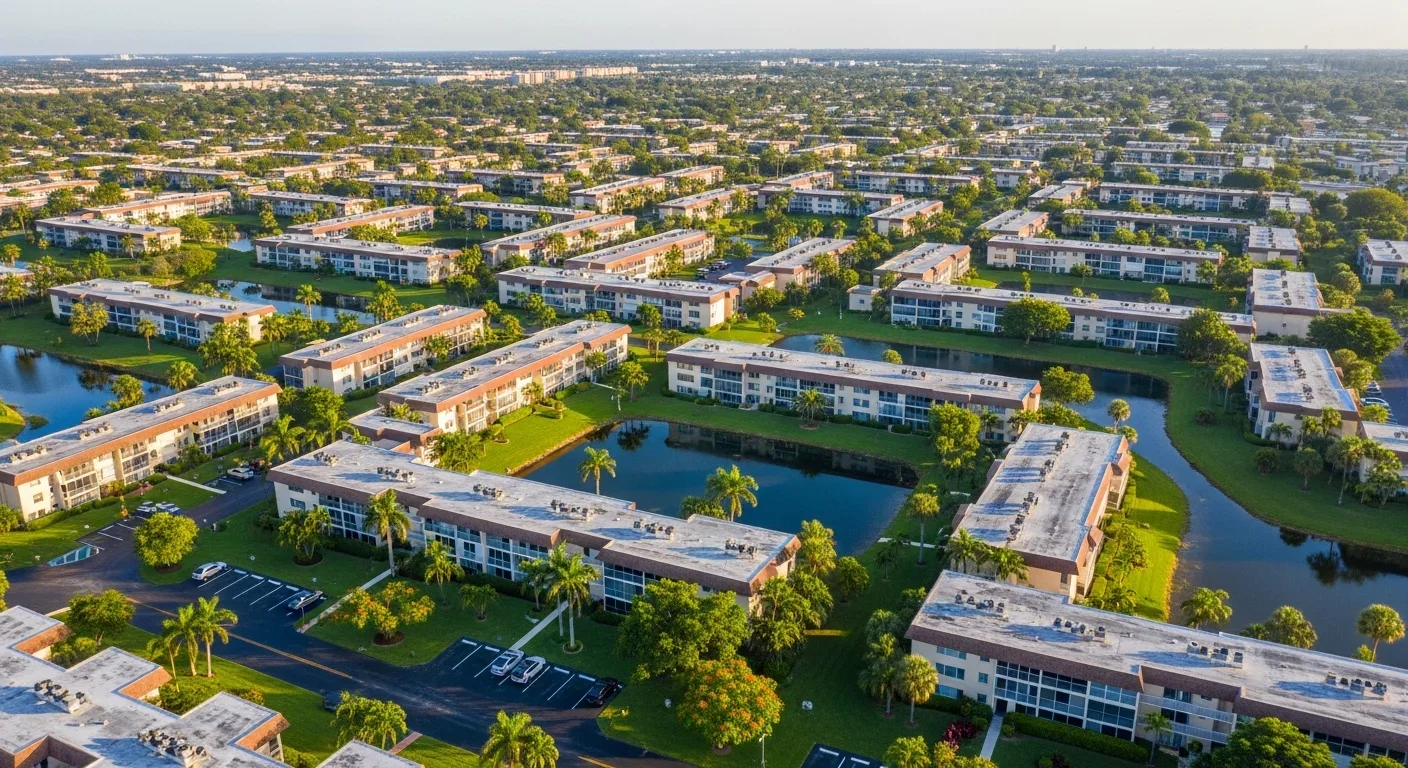
Lauderhill's Inverrary master-planned community and C-13/C-14 canal basin — central
Broward County's largest concentration of 1970s closed-unit condo stock
~170 mph HVHZ Design Wind Speed
Lauderhill sits fully inside Broward County's High-Velocity Hurricane Zone — one of only two Florida counties subject to HVHZ building code. Every exterior product used in storm restoration must carry Florida or Broward Product Approval, or a Miami-Dade Notice of Acceptance (NOA), and pass TAS 201/202/203 large- and small-missile impact testing. Design wind for Risk Category II structures is approximately 170 mph (ASCE 7-22, 3-second gust). This is the strictest residential hurricane code in the continental United States.
C-13 / C-14 Canal Basin — Central Broward Flooding
Unlike coastal Broward cities that face Atlantic tidal flooding, Lauderhill's flooding is canal-and-rain driven — controlled by the C-13 and C-14 drainage canals that run through the city. When intense rainfall exceeds canal capacity — as it did during the April 2023 event that dropped 25.91 inches at Fort Lauderdale-Hollywood International Airport — streets flood, parking structures fill, and ground-floor condo units in Inverrary are inundated. CRS Class 7 community rating provides a 15% NFIP premium discount for qualifying properties.
The majority of Lauderhill was built during the 1970s construction boom as a master-planned community of closed-unit condominiums and golf villages. Inverrary — with International Village, Castle Gardens, Environ, Lakes of Inverrary, and Boulevard Woods — represents one of Broward County's largest concentrations of aging CBS concrete block buildings. Flat-roof membrane systems, aging HVAC fan-coil units, and shared plumbing stacks in closed-unit buildings create compounding storm and moisture damage pathways unique to this market.
Broward Avg Premium ~$6,220/yr — Rising After Named Storms
Broward County homeowners pay an average of approximately $6,220 per year in homeowners insurance premiums (FL OIR 2026). Florida's hurricane deductible — typically 2–5% of the insured dwelling value — applies as a separate per-event threshold. Under Florida Statute 627.70132, initial claim notice must be filed within 1 year of the date of loss, and supplemental claims within 18 months. AOB assignments for policies issued after January 1, 2023 are void under SB 2-A.
Neighborhood Storm Risk Profiles
Storm Risk by Lauderhill Neighborhood
Storm and wind damage in Lauderhill concentrates in predictable patterns tied to the
city's Inverrary-era condo stock, the C-13/C-14 canal drainage basin, and aging CBS
construction. Understanding your community's specific risk profile determines your
insurance needs, evacuation planning, and the type of storm restoration your property
will require.
Inverrary / International Village
High Risk
Central Lauderhill — Canal-Adjacent, Wind Primary
International Village is one of the earliest Inverrary sub-communities, built in the early 1970s with low-rise condo buildings that predate modern wind-load engineering. Aging HVAC fan-coil units and slider-door seals are the first failure points during tropical-storm-force winds. When rainfall overwhelms the C-13 canal system, ground-level parking and common-area utility rooms flood. Shared plumbing stacks mean water losses in one unit migrate quickly to adjacent units — multiplying the restoration scope. Closed-unit construction traps humidity and amplifies mold risk in the days after any wind event.
Castle Gardens is an early-1970s 55-plus condo community within the Inverrary master plan. Intermittent unit occupancy — common in age-restricted communities with seasonal residents — means slow leaks develop into significant mold before discovery. Flat roof membrane systems on low-rise buildings are the primary wind vulnerability: membrane edges lift in sustained tropical-storm winds, admitting rain into the roof assembly and ceiling below. HVAC condensate pan overflows are the most common individual-unit water source. Deferred maintenance on shared elements adds to post-storm restoration complexity.
Environ
High Risk
Inverrary North — 1970s Condo Clusters, Shared-Wall Risk
Environ comprises condo clusters in the northern Inverrary area where shared concrete walls and elevator shaft humidity create above-average moisture migration pathways. When wind-driven rain enters through stucco cracks or aging window seals, moisture travels laterally through shared assemblies before appearing as interior damage. Ground-floor units in low-lying areas face ponding from canal system overload during intense rainfall. The 1970s vintage building stock means original plumbing risers and cast-iron drain connections are approaching end-of-service, compounding storm damage with infrastructure failure.
Lakes of Inverrary
High Risk
Inverrary South — Lake-Adjacent, Rain & Wind
Lakes of Inverrary condo buildings border small lakes and retention ponds connected to the C-13/C-14 canal basin. During hurricane season rainfall events, lake levels rise and threaten low-lying units and garages. Wind-driven rain penetrates through aging condo window and slider seals — 50-year-old hardware that has never been replaced in many units. Barrel tile roofs on clubhouse and some villa structures show underlayment deterioration. Post-storm mold risk is elevated due to lake-proximity humidity and the closed-unit construction typical of Inverrary.
Boulevard Woods East, North, and West are single-family residential neighborhoods built in the 1970s through 1980s. Barrel tile roofs with aging underlayment are the primary storm vulnerability — tiles hold against sustained wind loads, but the underlayment beneath deteriorates with age, allowing wind-driven rain intrusion when tiles momentarily lift. Stucco envelope cracks from decades of thermal cycling create additional pathways for water intrusion during hurricane bands. Post-storm hidden moisture inside CBS walls requires thermal imaging to detect before drywall damage escalates.
Broward Estates
Moderate
Western Lauderhill — Older Single-Family, Drainage Risk
Broward Estates is one of Lauderhill's older single-family communities, with housing stock from the 1960s through 1980s and aging cast-iron drain systems that fail under storm pressure loads. Streets in lower-lying sections of Broward Estates pond during intense rainfall events when the C-13 canal system reaches capacity. Slab-on-grade foundations mean lateral moisture wicking through flooring assemblies is common. Wind damage to flat and low-slope roofing systems, soffit vents, and mature tropical landscaping are primary storm damage patterns here.
Evacuation Zones & Storm Preparedness
Lauderhill Evacuation Zones: What Your Zone Means for Storm Damage
As an inland central-Broward city, Lauderhill sits in lower-risk evacuation zones
compared to coastal communities. Most Lauderhill residents are in outer Broward County
evacuation zones or non-mandatory areas — a genuine advantage of the city's inland
location. But lower evacuation risk does not mean lower storm damage risk. Wind at ~170
mph design speed, intense tropical rainfall overwhelming the C-13 and C-14 canal system,
and aging 1970s condo construction create real and costly damage patterns in every
hurricane season.
Wind Damage — The Primary Threat
Affects every Lauderhill property
Who it affects: Every property in Lauderhill — Inverrary
condos, Boulevard Woods single-family, Broward Estates, and all commercial corridors face
hurricane wind at HVHZ design speeds.
Primary patterns: Barrel tile displacement exposing
aging underlayment; flat-roof membrane edge lift on Inverrary condos; wind-driven rain
through stucco cracks and aging slider seals; screen enclosure and soffit destruction.
Insurance: Wind damage covered by your Florida homeowners
policy — subject to a separate hurricane deductible of 2–5% of insured dwelling value.
On a $300,000 Lauderhill condo, that is $6,000–$15,000 before wind coverage begins.
Restoration Reality
Wind damage to Inverrary condo buildings is complicated by shared roof assemblies, HOA
master policies, and the multi-unit migration of water once any opening is breached.
Emergency tarping, board-up, and same-day mitigation are critical to containing a
single-unit wind event from becoming a multi-unit water claim.
Canal & Rain Flooding — The Secondary Risk
C-13 / C-14 basin, intense rainfall
How it works: Unlike coastal Broward cities, Lauderhill's
flooding is rain-driven — when intense tropical rainfall overwhelms the C-13 and C-14
canals, water backs up through storm drains into streets, parking structures, and ground-floor
condo units.
Water category: Freshwater rain and canal overflow
is typically Category 1–2 under IICRC S500 standards — allowing more materials to be dried
and salvaged compared to saltwater contamination. Sewage backup during storm events elevates
to Category 3.
Insurance: Flood damage from external rainwater and
canal overflow is excluded from standard homeowners and HO-6 policies. A separate NFIP
or private flood policy is required. Lauderhill's CRS Class 7 rating provides a 15% NFIP
premium discount for qualifying SFHA properties.
Restoration Reality
Canal and rain flooding in Lauderhill condos requires two separate claims: wind damage
to the homeowners carrier, flood damage to the NFIP or private flood carrier. Palm
Build documents all damage by cause from day one — wind scope versus flood scope — to
maximize recovery from both policies.
Inland Advantage: Lauderhill Properties Are Largely Outside Mandatory Evacuation Zones
Lauderhill residents benefit from the city's inland location — most properties fall in
lower-priority or non-mandatory Broward County evacuation zones, unlike Atlantic-facing
communities that must evacuate for any hurricane. This means less pre-storm disruption and
faster return after an event. However, wind damage, intense rainfall, and C-13/C-14 canal
flooding can be severe even for properties that never face mandatory evacuation. Flood
insurance is strongly recommended regardless of evacuation zone — FEMA flood maps
effective July 31, 2024 reclassified flood zones across Broward County, and some
Lauderhill properties moved into higher-risk designations.
Hurricane and storm damage in Lauderhill takes six distinct forms — and major storms
trigger multiple damage types simultaneously. The city's combination of 1970s condo
stock, aging CBS construction with barrel and flat tile roofing, the C-13/C-14 canal
drainage basin, and HVHZ wind exposure at ~170 mph creates a restoration landscape that
demands specialized knowledge of each damage category, its insurance coverage, and the
correct remediation protocol.
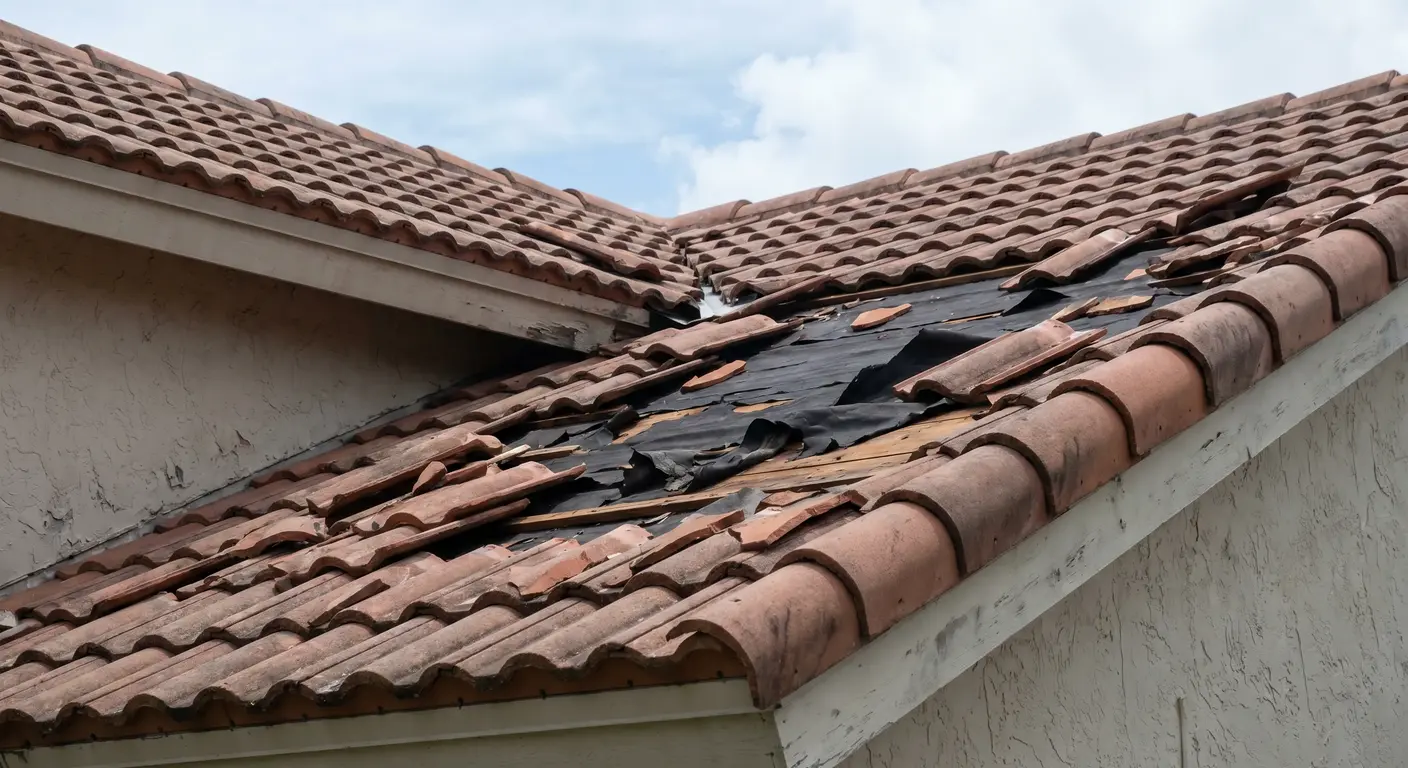
Lauderhill's barrel tile roofs — standard on CBS homes built in the 1970s through 1990s — are rated for hurricane wind loads. The tiles themselves rarely break. The failure point is the underlayment beneath: the waterproof membrane that prevents water intrusion. After 15–25 years of South Florida UV exposure, underlayment dries out and cracks. Hurricane winds momentarily lift tiles, wind-driven rain penetrates compromised underlayment, and tiles reseat post-storm. The result is $15,000–$50,000+ in hidden interior water damage that goes undetected for weeks without a professional post-storm inspection. This is the number-one storm damage pattern in Lauderhill's single-family neighborhoods.
High
Flat-Roof Membrane Failure on Inverrary Condos
Lauderhill's Inverrary-era low-rise condominiums predominantly feature flat or low-slope roofing systems with modified bitumen or built-up membrane assemblies. At ~170 mph HVHZ design wind speed, membrane edge terminations and flashings are the primary failure points — wind lifts membrane edges, admitting rain into the roof assembly and ceiling structure below. A single membrane breach in a shared-roof building can migrate water into multiple units before it surfaces as visible ceiling damage. Emergency tarping and same-hour intervention limits the scope of interior damage dramatically.
High
CBS Wall Wind-Driven Rain Intrusion
Lauderhill's dominant CBS (concrete block and stucco) construction is tested by every hurricane. Wind-driven rain at tropical storm force and above penetrates through hairline stucco cracks, mortar joint failures, and deteriorated window sealant joints. CBS walls trap moisture between the exterior stucco and interior drywall, drying 20–40% slower than wood-frame construction. Homes from the 1970s through mid-1990s predate modern stucco attachment requirements. Post-storm moisture meter inspection of every exterior wall is essential — visible damage represents only a fraction of actual water intrusion in Lauderhill CBS homes.
High
C-13 / C-14 Canal Overflow — Rain-Driven Flooding
Lauderhill's drainage runs through the C-13 and C-14 canal system. When tropical rainfall exceeds canal capacity — as it did in the April 2023 event that dropped 25.91 inches near Fort Lauderdale-Hollywood International Airport — water backs up through storm drains into streets, parking structures, and ground-floor condo units. Unlike coastal flooding, this is freshwater and canal-water driven, typically Category 1–2 under IICRC standards — allowing more materials to be salvaged with rapid extraction. Lauderhill is a CRS Class 7 community, reflecting its engineered stormwater management, but intense storms can overwhelm any system.
Moderate
Tree & Debris Impact Damage
Lauderhill's mature tropical landscaping — royal palms, live oaks, and established shade trees throughout Inverrary and Boulevard Woods — becomes projectile debris in hurricane winds. Fallen trees crush roofing, lanais, screen enclosures, carports, and vehicles. Flying debris can break impact-rated windows on older buildings that predate modern NOA requirements. In condo communities, landscaping debris clogs storm drains, worsening parking-level flooding. Tree-related damage often equals or exceeds direct wind damage to the structure itself in Lauderhill's heavily landscaped residential areas.
Moderate
Window & Slider Seal Failure
Many Lauderhill condo units — particularly Inverrary-era buildings from the early 1970s — retain original aluminum sliding glass doors and windows with aging seals and tracks. When a slider seal fails under wind-driven rain pressure, water enters the unit at the frame perimeter before any structural damage occurs. Accordion shutter tracks on older buildings corrode from South Florida humidity, preventing full closure. For buildings permitted before the 2002 Florida Building Code update, exterior openings may not meet current Product Approval or NOA requirements — creating concealed vulnerability in every hurricane season.
Hurricane Restoration Process
How We Restore Lauderhill Homes and Condos After Hurricane Damage
Hurricane restoration in Lauderhill requires navigating HVHZ code compliance, barrel and
flat-tile roof repair, CBS wall structural drying, condo HOA coordination, and dual
wind/flood insurance claims simultaneously. Here is our proven six-step process from
first call through final City of Lauderhill Building Division inspection.
01
Emergency Tarping & Board-Up
Hours 1–4
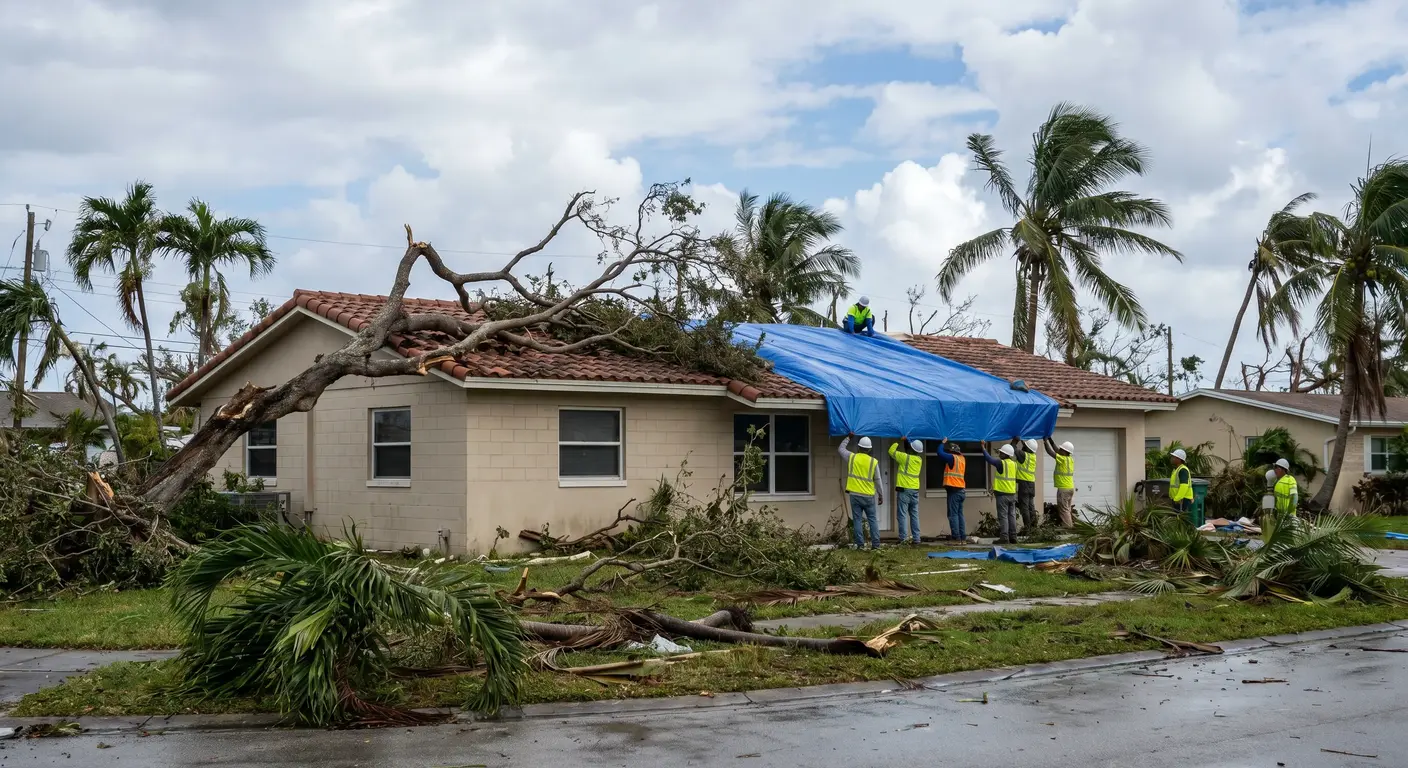
We secure your Lauderhill property against further weather exposure. Displaced barrel tiles are tarped with reinforced polyethylene rated for South Florida wind loads, flat-roof membrane breaches are covered, failed windows and sliders are boarded, and compromised doors are sealed. Palm Build responds from our Deerfield Beach Operations Hub in 15–20 minutes — covering Inverrary condos, Boulevard Woods single-family, and Broward Estates in one rapid dispatch. Emergency tarping is covered by your insurance policy as part of your duty to mitigate further damage.
02
Damage Assessment & Water Category Testing
Days 1–3
Full documentation of all storm damage classified by cause: wind damage (tiles, flat-roof membrane, sliders, stucco), and rain or canal overflow flooding (Category 1–2 freshwater). In Lauderhill, where damage concentrates in Inverrary condo buildings with shared roofing and plumbing, we assess adjacent units above, below, and laterally to determine migration scope before containment. We photograph every affected area, map moisture with thermal cameras, and create separate scopes for wind claims (homeowners) and flood claims (NFIP or private flood policy).
03
Water Extraction & Decontamination
Days 1–10
Storm damage in Lauderhill almost always includes water intrusion — through displaced barrel tiles, lifted flat-roof membrane, slider seal failures, or C-13/C-14 canal overflow. We extract standing water, confirm water category (Category 1–2 for freshwater rain and canal overflow; Category 3 for sewage backup), and begin appropriate IICRC S500 protocols. Commercial dehumidifiers and air movers bring humidity below 60% to prevent mold colonization — critical in Lauderhill's year-round subtropical humidity where mold can establish within 24–48 hours of a water event.
04
Structural Drying & Mold Prevention
Days 3–14
South Florida's year-round humidity makes structural drying more demanding than most of the country. Without air conditioning (common after hurricanes), mold colonization begins within 24–48 hours in Lauderhill's closed-unit condo buildings. We deploy industrial LGR and desiccant dehumidifiers, establish negative air pressure containment in affected zones, and monitor moisture levels daily. HEPA air scrubbing removes airborne spores. CBS concrete block walls retain moisture longer than wood-frame — structural drying timelines for Lauderhill's dominant building type run 20–40% longer than national averages.
05
Full Structural Reconstruction
Weeks 2–16
Once the property is dried, decontaminated, and cleared, we begin reconstruction to current Florida Building Code requirements. All of Lauderhill is in the HVHZ — requiring that every exterior product carry Florida or Broward Product Approval, or Miami-Dade NOA, and pass TAS 201/202/203 impact testing. Barrel tile or flat-roof membrane repair, stucco restoration, interior drywall and flooring replacement, electrical and plumbing repairs, and painting — all permitted through the City of Lauderhill Building Division with Broward County Notice of Commencement.
06
Final Inspection & Insurance Closeout
Week 16+
City of Lauderhill Building Division inspections verify all structural, electrical, mechanical, and plumbing work meets current code. We perform a final walk-through with the homeowner or HOA and provide complete documentation for insurance closeout — all invoices, permits, inspection records, code compliance certificates, and warranty information. For hurricane claims involving both wind and flood policies, we coordinate dual-claim closeout to ensure maximum recovery from both carriers within Florida's statutory deadlines (Fla. Stat. 627.70132).
Lauderhill Pricing
Storm Damage Restoration Costs in Lauderhill, FL
Hurricane restoration costs in Lauderhill are driven by the city's condo-heavy Inverrary
market, CBS wall drying complexity, flat and barrel tile roof systems, and South Florida
labor costs. After major hurricanes, contractor demand and material shortages across
Broward County increase costs 20–40% and extend timelines by months. Understanding what
you will pay out of pocket starts with understanding your hurricane deductible.
Separate flood policy required — homeowners excludes external flooding
Full Hurricane / Multi-Unit Condo Loss
Shared-roof failure, multi-unit water migration, HOA coordination, full interior rebuild
$40,000 – $150,000+
Dual claims: wind (homeowners) + flood (NFIP/private) often both required
Hurricane Deductible Calculator: Lauderhill
Lauderhill condos in the Inverrary area range widely in value — from $100,000–$200,000
for smaller HO-6 units to $250,000–$400,000 for larger models. At a 2% hurricane
deductible on a $200,000 unit, you pay $4,000 out of pocket before wind coverage
begins. At 5%, it is $10,000. For a $350,000 home in Boulevard Woods at 2%, the
deductible is $7,000. This deductible applies to each hurricane event — not annually.
If two named storms impact in one season, you pay the deductible twice. Many
Lauderhill condo owners are surprised by the deductible amount when they file their
first hurricane claim — especially when combined with a separate flood deductible.
Hurricane Season Calendar
Lauderhill Hurricane Season: June Through November
Atlantic hurricane season runs June 1 through November 30, with peak activity in
September and October. For Lauderhill homeowners and condo owners — with aging 1970s
Inverrary stock, the C-13/C-14 canal drainage basin, and HVHZ wind exposure —
understanding the seasonal risk curve determines when to complete preparations, when to
stage emergency supplies, and when to have your restoration company on speed dial.
June
Low-Moderate
Hurricane season begins June 1. Early-season storms are typically disorganized but can produce heavy rainfall and localized canal-basin flooding in Lauderhill. This is your last window to complete roof inspections, verify insurance policies, test HVAC condensate drain pans, and confirm shutter hardware before tropical activity ramps up. June averages approximately 9.5 inches of rainfall near Fort Lauderdale.
July
Moderate
Tropical development increases as Atlantic sea-surface temperatures rise. Severe afternoon thunderstorms become daily in central Broward County, capable of producing damaging wind gusts and intense 1–3 hour rainfall bursts that overwhelm the C-13/C-14 canal system. These non-hurricane events cause significant barrel tile displacement, flat-roof membrane stress, and screen enclosure damage across Lauderhill neighborhoods.
August
High
Peak development zone shifts toward Florida as ocean temperatures reach seasonal highs. Rapid intensification events become more likely — a tropical depression can become a major hurricane within 24–48 hours. In Lauderhill, August represents the transition from preparation to full readiness: shutters should be accessible, emergency supplies staged, and a restoration company identified before storm watches are issued.
September
Peak
Statistically the most dangerous month for South Florida hurricanes. September and October together account for the majority of major hurricane landfalls in Broward County history. Lauderhill's inland location protects against direct coastal surge but not against sustained ~170 mph design-speed winds, wind-driven rain intrusion into condo buildings, and intense rainfall overwhelming the C-13/C-14 basin. Full storm readiness is essential throughout this month.
October
Peak
October rivals September for hurricane frequency. Hurricane Wilma (2005) made Florida landfall on October 24, causing widespread wind and flooding damage across Broward County — including central cities like Lauderhill. Late-season storms often approach from unexpected directions. The June 2024 Broward County emergency declaration shows that even post-season intense rainfall events can produce major flooding in inland communities served by the C-13/C-14 canal system.
November
Low-Moderate
Season officially ends November 30 but late-season storms remain possible. Property owners and HOA managers returning from reduced occupancy often discover hidden damage from summer storms in November — slow leaks behind walls, mold in HVAC closets, and moisture under flooring that developed 60–90 days earlier. November is the highest-volume month for post-storm mold discovery calls in Lauderhill's condo communities.
Lauderhill's hurricane season spans June through November — with September and October
representing peak risk for major wind events and intense C-13/C-14 canal-basin flooding
April 2023 and June 2024 — Inland Flooding at Scale
The April 2023 event dropped 25.91 inches of rain near Fort Lauderdale-Hollywood
International Airport — one of the most intense single-day rainfall events in South
Florida history. The June 2024 Broward County emergency declaration followed another
season-opening deluge that overwhelmed canal systems across central Broward, including
Lauderhill. Both events underscored that for inland cities like Lauderhill, intense
tropical rainfall — not coastal surge — is the flooding mechanism that matters most, and
the C-13/C-14 canal system can be overwhelmed by any sufficiently intense storm.
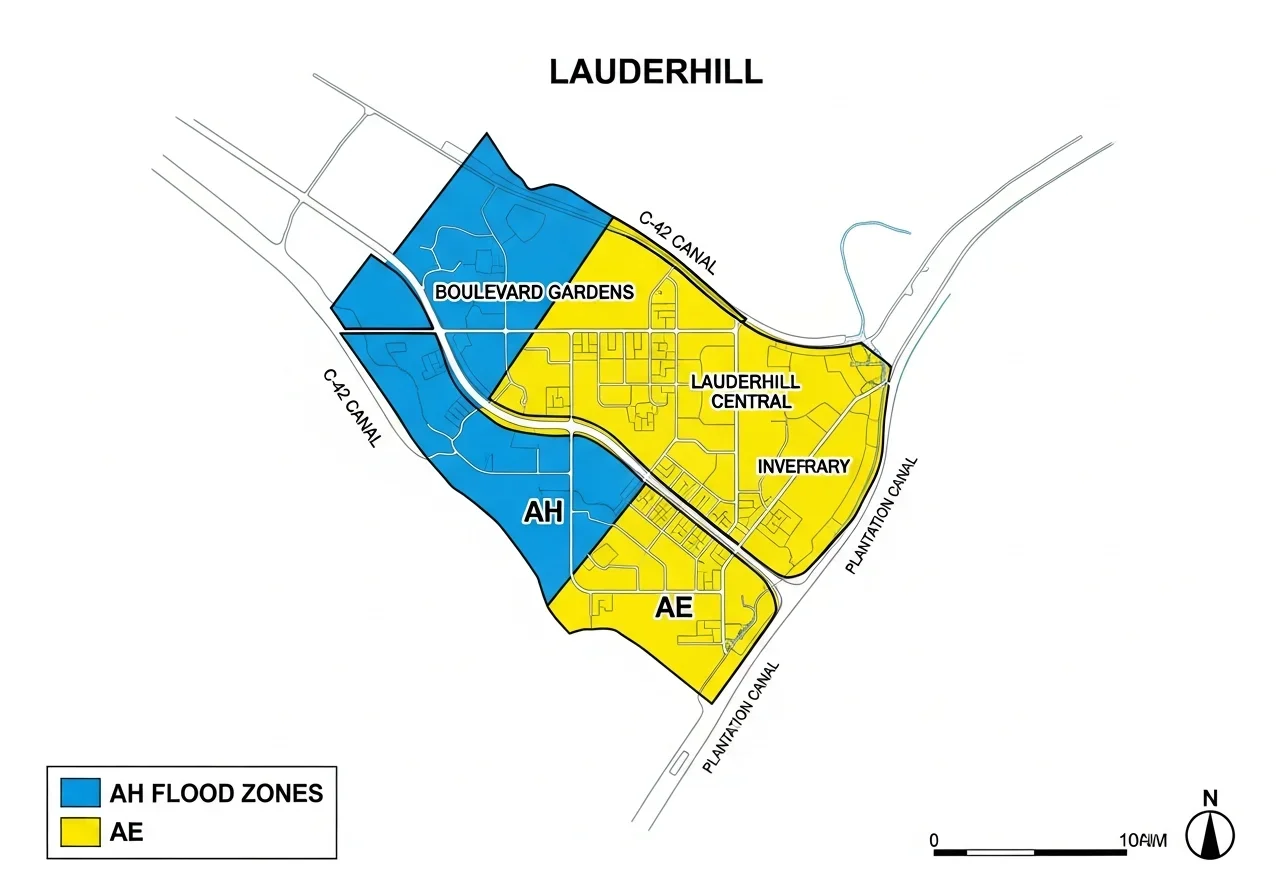
FEMA Flood Zones in Lauderhill: AE, AH, and Zone X
Lauderhill contains three FEMA flood zone designations reflecting the city's C-13/C-14
canal basin, engineered stormwater system, and CRS Class 7 community rating. As an
inland city, Lauderhill does not carry coastal VE or AO wave-action zones — flooding
here is rain-driven and canal-overflow driven. Your FEMA zone determines whether flood
insurance is mandatory, what your premiums cost, and what type of water event your
property faces during major storms. Broward County flood maps were updated July 31,
2024.
AE Zone — Special Flood Hazard Area
Canal-adjacent properties along C-13/C-14 corridors, low-lying sections near retention ponds
AE zones face a 1% annual chance of flooding (100-year floodplain) with determined Base Flood Elevations. In Lauderhill, AE zones follow the C-13 and C-14 canal corridors and surrounding low-lying areas that are most exposed to canal overflow during intense tropical rainfall. Properties must be built to or above BFE. Flood insurance is mandatory for federally-backed mortgages. Flooding in Lauderhill AE zones is driven by rainfall and canal overflow — freshwater to Category 1–2 in most events, elevated to Category 3 only if sewage backup occurs. Broward County's new Flood Insurance Rate Maps, effective July 31, 2024, updated AE zone boundaries across the county.
Flood insurance mandatory for federally-backed mortgages in AE zones.
AH Zone — Shallow Flooding
Interior Lauderhill low-lying areas, portions of Inverrary and Boulevard Woods near retention areas
AH zones face shallow flooding — typically 1–3 feet of ponding — during extreme rainfall events. Water pools in low-lying areas when the C-13/C-14 canal system and local storm drains are overwhelmed. In Lauderhill, AH zones include portions of the Inverrary area and surrounding communities where the engineered drainage meets its capacity limits during intense tropical events. Flood insurance may not be required by mortgage lenders for all AH properties but is strongly recommended. Lauderhill's CRS Class 7 designation provides a 15% discount on NFIP premiums for qualifying SFHA properties.
Higher-elevation portions of central Lauderhill, most of Broward Estates and western neighborhoods
Zone X properties face minimal flood hazard under current FEMA mapping and are not required to carry flood insurance. In Lauderhill, Zone X covers higher-elevation portions of the city where the canal system provides adequate drainage under most storm conditions. However, Zone X does not mean flood-proof — the April 2023 event that overwhelmed Broward County drainage infrastructure impacted properties across all flood zone designations. Broward County's July 31, 2024 FIRM update reclassified some previously Zone X properties. Over 25% of NFIP flood insurance claims nationally come from properties outside Special Flood Hazard Areas.
Flood insurance not required but recommended — major storms exceed zone boundaries.
CRS Class 7: Lauderhill Earns a 15% NFIP Discount
Lauderhill participates in FEMA's Community Rating System and holds a Class 7 designation
— one of the better ratings in central Broward County. This means qualifying properties in
Special Flood Hazard Areas receive a 15% discount on their National Flood Insurance
Program premiums, reflecting the city's investment in engineered stormwater management,
floodplain regulation, and public outreach. New Broward County Flood Insurance Rate Maps
effective July 31, 2024 updated zone designations across Lauderhill. If your property's
flood zone changed in the update, your insurance requirements and restoration
documentation standards may have changed as well. Palm Build creates complete
Xactimate-standard documentation from the first hour on any flood-affected property.
Critical Insurance Distinction
Wind vs. Flood Insurance: Lauderhill's Most Expensive Misunderstanding
Wind damage and flood damage from the same hurricane are covered by different policies,
carry different deductibles, and are filed as separate claims. In Lauderhill — where
wind at ~170 mph HVHZ design speed threatens every rooftop and the C-13/C-14 canal
system can overflow during intense tropical rainfall — most significant storm events
produce both wind and flood damage simultaneously. Proper damage classification is the
difference between full recovery and a costly gap in coverage.
Barrel tile displacement from wind uplift and flying debris
Flat-roof membrane edge lift on Inverrary condo buildings
Slider, window, and door damage from wind pressure or debris impact
Rain entering through wind-created openings in roofing or stucco
Emergency tarping and board-up costs (duty to mitigate)
ALE (Additional Living Expenses) if the unit or home is uninhabitable
FL Hurricane Deductible: 2–5% of insured value. On a $200,000 Lauderhill
condo = $4,000–$10,000 out of pocket before wind coverage begins.
Flood Damage (Separate NFIP or Private Flood Policy)
C-13/C-14 canal overflow flooding ground-floor condo units and parking areas
Intense tropical rainfall exceeding storm drain capacity — street and garage flooding
Groundwater intrusion through slab-on-grade foundations during saturation events
Sewer backup from overwhelmed municipal systems during extreme rainfall
NFIP max dwelling coverage: $250,000 building / $100,000 contents
NOT covered by standard homeowners or HO-6 — requires a separate flood policy
NFIP 60-Day Rule: Proof of loss must be filed within 60 days of the flood
event. Missing this deadline can void your entire flood claim.
Claim Deadline Alert: File Both Claims Simultaneously
After a hurricane in Lauderhill, you may need to file two separate claims: wind damage
to your homeowners or HO-6 carrier, and flood damage to your NFIP or private flood
carrier. Each has different deductibles, adjusters, and deadlines. The NFIP 60-day
proof of loss deadline is the most critical — miss it and your entire flood claim can
be denied. Under Florida Statute 627.70132, initial wind claim notice must be filed
within 1 year of the date of loss. Palm Build documents all damage by cause from day
one — separate wind and flood scopes that align with each policy's requirements. For
Inverrary condo losses, we also create parallel documentation packages for the unit
owner and the HOA master policy carrier simultaneously.
What Hurricane Damage Looks Like in Lauderhill, FL
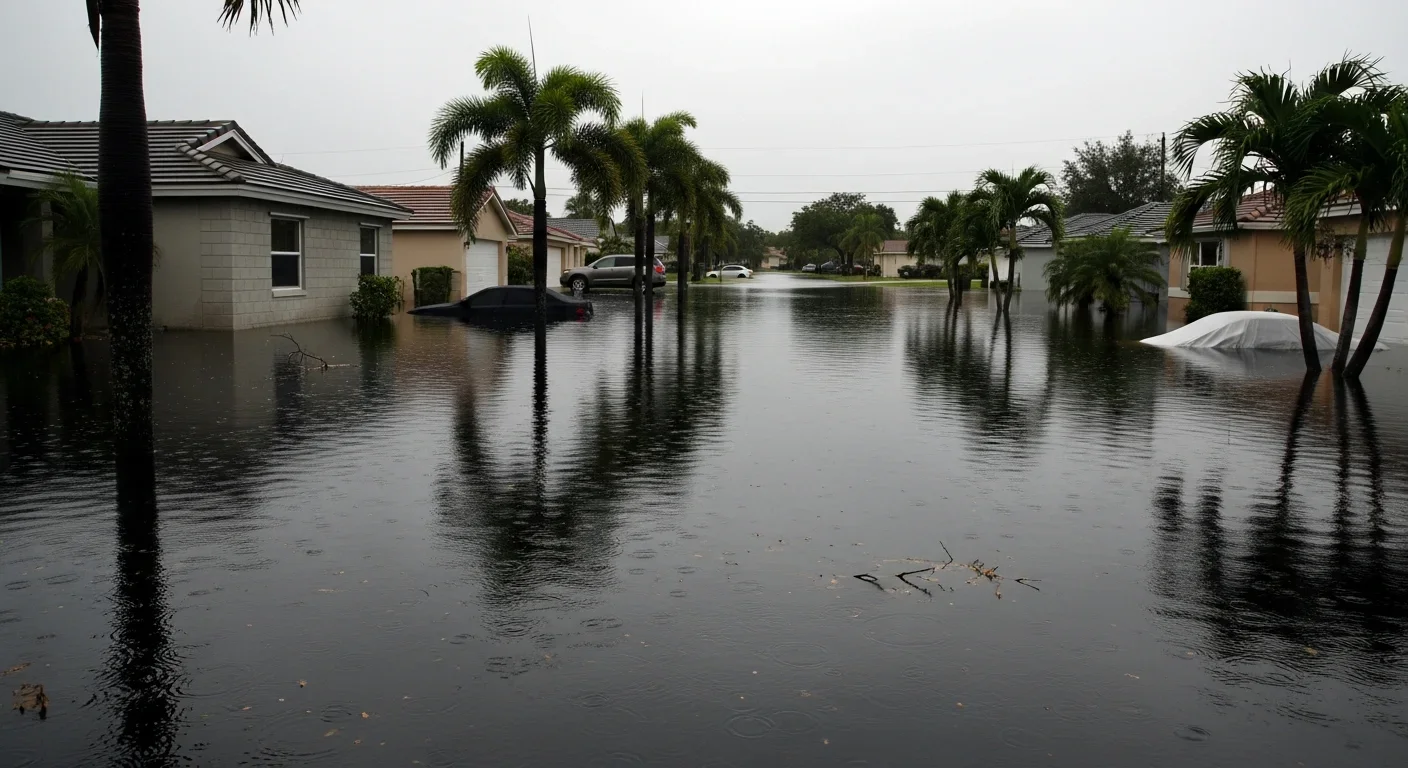
Inverrary condo buildings in Lauderhill face compound storm damage: wind loads at ~170 mph HVHZ design speed stress flat-roof membrane edges while intense rainfall overwhelms the C-13/C-14 canal drainage system simultaneously
Barrel tile displacement on a Lauderhill single-family home exposes deteriorated underlayment — the number-one hidden storm damage pattern in central Broward County's 1970s–1980s housing stock
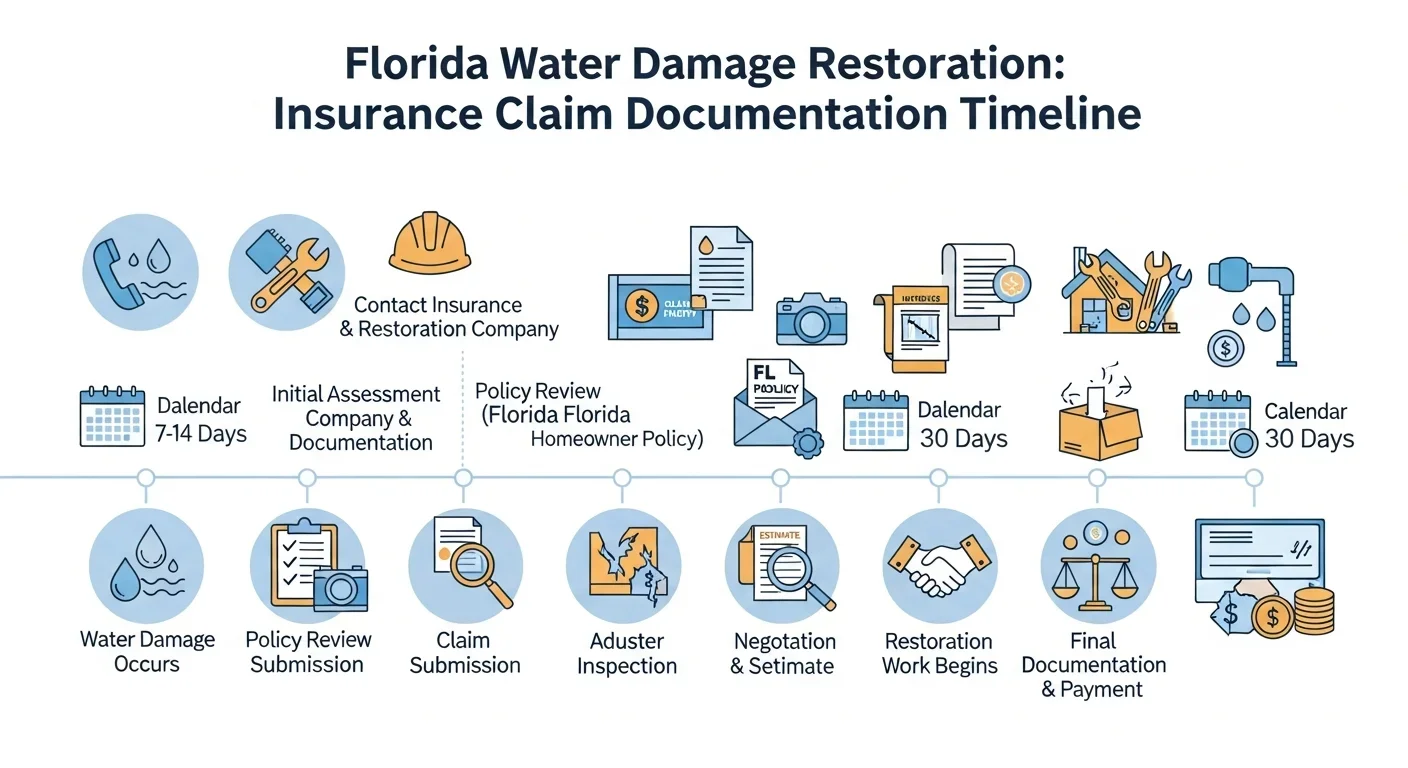
Lauderhill holds a CRS Class 7 community flood rating — providing a 15% NFIP discount on flood insurance premiums for qualifying properties in Special Flood Hazard Areas
Lauderhill canal-adjacent properties along the C-13/C-14 basin face rain-driven flooding when intense tropical rainfall events overwhelm canal capacity — April 2023 and June 2024 both produced Broward-wide flooding declarations
The Palm Build Difference
Why Lauderhill Homeowners and Condo Owners Choose Palm Build After Hurricanes
Deerfield Beach HQ — 15–20 Minutes to Lauderhill
Palm Build operates from our South Florida Operations Hub at 786 S Military Trail, Deerfield Beach, FL 33442 — approximately 15 miles from central Lauderhill. Emergency crews reach Inverrary, International Village, Boulevard Woods, and Broward Estates in 15–20 minutes. During major hurricane events, we activate catastrophe response with pre-positioned crews and equipment. Pre-storm clients receive priority dispatch ahead of the general queue. We are a local South Florida team — not a national franchise driving in from another region.
Every crew lead holds current IICRC Water Restoration Technician and Fire/Smoke Restoration Technician certifications. Our South Florida teams are trained in the specific restoration demands of Lauderhill's market: closed-unit condo moisture migration, flat-roof membrane failure, CBS wall wind-intrusion drying, and C-13/C-14 canal-overflow freshwater extraction. We confirm water category on-site before choosing the IICRC S500 remediation protocol — distinguishing rain-driven Category 1–2 from Category 3 sewage backup.
Dual-Claim Documentation (Wind + Flood)
Our damage assessment classifies every item by cause — wind versus rainfall/canal flooding versus debris impact — ensuring each claim is filed with the correct policy. For Inverrary condo losses, we create parallel documentation packages for the unit owner (HO-6) and the association master policy carrier simultaneously. This dual-documentation approach recovers significantly more than generic damage reports that do not distinguish damage sources, and prevents disputes between unit owners and HOA boards from delaying emergency drying.
HVHZ & Inverrary Condo Construction Expertise
All restoration and reconstruction in Lauderhill must comply with HVHZ requirements — every exterior product requires Florida or Broward Product Approval, or Miami-Dade NOA, with TAS 201/202/203 impact testing. Permits run through the City of Lauderhill Building Division with a Broward County Notice of Commencement. We understand the specific demands of Inverrary's 1970s condo stock: flat-roof membrane systems, aging fan-coil HVAC units, shared plumbing risers, and closed-unit moisture dynamics that standard single-family restoration protocols do not address.
Florida Insurance Navigation
We understand Florida's complex insurance landscape: Citizens depopulation, hurricane deductible percentages, NFIP proof-of-loss deadlines, AOB restrictions under SB 2-A, and the role of public adjusters. Under Florida Statute 627.70132, initial claim notice must be filed within 1 year of loss; supplemental claims within 18 months. Palm Build coordinates with your carrier, adjuster, and if needed your public adjuster to maximize claim recovery while keeping restoration moving. We help Lauderhill property owners navigate the wind versus flood distinction that determines which policy covers what.
Full Reconstruction — Emergency Through Final Punch
From emergency tarping through code-compliant final reconstruction, one company handles everything. We maintain relationships with barrel and flat-tile suppliers, CBS masonry contractors, HVHZ-certified impact-window vendors, and licensed subcontractors who prioritize our projects during post-hurricane demand surges. Tile roof repair, flat-roof membrane replacement, stucco restoration, impact window and slider installation, condo interior rebuild — all coordinated through a single project manager with City of Lauderhill Building Division permit expertise.
Common Questions
Lauderhill Hurricane Damage FAQ
How quickly can Palm Build respond after a hurricane in Lauderhill?
Palm Build dispatches from our South Florida Operations Hub in Deerfield Beach — approximately 15 miles from central Lauderhill. Under normal conditions we reach Inverrary condos, Boulevard Woods, and Broward Estates in 15–20 minutes. After major hurricane events we activate catastrophe response with pre-positioned crews and equipment. Pre-storm clients receive priority dispatch ahead of the general queue.
Is Lauderhill at risk of flooding during hurricanes?
Lauderhill is an inland central-Broward city — its flooding during hurricanes is driven by intense tropical rainfall and C-13/C-14 canal overflow, not Atlantic coastal tidal flooding. This is actually a meaningful advantage compared to coastal Broward communities: flooding is typically freshwater to Category 1–2 under IICRC standards, allowing more materials to be dried and salvaged. Lauderhill holds a CRS Class 7 community rating for its stormwater management program, providing a 15% NFIP discount on flood insurance premiums for qualifying SFHA properties.
Does my homeowners or HO-6 insurance cover hurricane damage in Lauderhill?
Wind damage is covered under your Florida homeowners or HO-6 policy with a separate hurricane deductible of 2–5% of insured value. On a $200,000 Lauderhill condo, that means $4,000–$10,000 out of pocket before wind coverage begins. Flood damage from canal overflow or intense rainfall requires a separate NFIP or private flood policy — standard homeowners and HO-6 policies exclude external flooding entirely. After a hurricane, you may need to file two separate claims with different carriers.
What are the HVHZ requirements for storm restoration in Lauderhill?
All of Lauderhill is in the High-Velocity Hurricane Zone. Every exterior product used in restoration or reconstruction must carry Florida or Broward Product Approval, or a Miami-Dade Notice of Acceptance (NOA), and must pass TAS 201/202/203 large- and small-missile impact testing. Design wind for HVHZ is approximately 170 mph (ASCE 7-22, 3-second gust, Risk Category II). Permits run through the City of Lauderhill Building Division with a Broward County Notice of Commencement. Palm Build handles all permit coordination.
Why are barrel tile roofs in Lauderhill vulnerable to storm damage?
Lauderhill's barrel tile roofs — standard on CBS homes from the 1970s through 1990s — are rated for hurricane wind loads. The tiles themselves rarely break. The failure point is the underlayment beneath: the waterproof membrane that actually prevents water intrusion. After 15–25 years of South Florida UV exposure, underlayment deteriorates. Hurricane winds momentarily lift tiles, rain penetrates compromised underlayment, and tiles reseat post-storm. The result is $15,000–$50,000+ in hidden interior water damage that goes undetected without a professional post-storm inspection.
Who is responsible for storm damage in an Inverrary condo — the unit owner or the HOA?
The boundary between unit owner (HO-6) and association (master policy) coverage depends on your specific condo documents. Generally, associations cover common elements — roof, exterior walls, shared systems — while owners cover walls-in improvements. In Lauderhill's older Inverrary buildings, disputes are common when wind breaches a shared roof assembly and water damages individual units. Palm Build begins mitigation immediately while creating independent documentation packages for all parties, so drying is not delayed by coverage disputes.
What is the Florida hurricane damage insurance claim deadline?
Florida Statute 627.70132 requires initial claim notice within 1 year of the date of loss, and supplemental claims within 18 months. The NFIP proof of loss deadline for flood claims is 60 days from the event. Under SB 2-A (effective January 1, 2023), Assignment of Benefits agreements are void for most policies — you remain in control of your own claim. Document damage immediately, file both wind and flood notices simultaneously, and contact Palm Build so we can create complete Xactimate-standard documentation from day one.
How long does hurricane damage restoration take in a Lauderhill condo?
Emergency tarping and water extraction: 1–2 days. Structural drying of Category 1–2 canal/rain flooding: 5–10 days. Flat-roof membrane repair: 2–6 weeks depending on material availability and City of Lauderhill Building Division permit processing. Full condo interior reconstruction: 8–20 weeks. After major hurricanes, timelines extend significantly due to contractor demand surges and permitting backlogs across Broward County.
Trusted Vendors
Trusted local pros in Lauderhill
Outside our restoration scope, these are the vetted, licensed contractors we trust
alongside our work. Personally evaluated, reference-checked, and recommended by Palm
Build.
Hurricane Damage in Lauderhill? We Are 15 Minutes Away.
Palm Build's IICRC-certified team responds from our Deerfield Beach Operations Hub with emergency tarping, HVHZ-compliant reconstruction, canal-and-rain flood extraction, and insurance documentation built for Lauderhill's Inverrary condo market — 24/7.