Infection Control Risk Assessment (ICRA) is required for any construction or restoration work in healthcare settings. Before work begins, we perform a risk assessment that classifies the project by activity type and patient risk level. Containment barriers, negative air pressure, HEPA filtration, and designated entry/exit paths are implemented based on the ICRA classification.
Healthcare Facility Restoration
Restoring Healthcare Facilities Without Compromising Patient Safety
Healthcare environments demand the highest standard of safety and compliance during restoration. From hospitals and surgery centers to dental offices and senior living facilities, every decision must prioritize patient welfare, infection control, and regulatory compliance.
- ICRA Protocols
- Infection Control
- Patient Safety
- FL & NC
What you need to know
Patient care continuity must be maintained throughout restoration. Many healthcare facilities cannot evacuate all patients. ICU, dialysis, and nursing home residents may be too fragile to relocate. Restoration in these environments often happens in occupied buildings with extremely tight infection control requirements.
Healthcare compliance is multi-layered. The Joint Commission, CMS (Centers for Medicare & Medicaid Services), state health departments, and local building codes all have requirements that apply during restoration. Documentation must demonstrate that all standards were upheld throughout the project.
Specialized equipment in healthcare facilities (MRI machines, laboratory equipment, sterilization systems, medication storage) may require expert assessment and recalibration after water, fire, or storm damage. We coordinate with equipment vendors and biomedical engineering teams.
HIPAA compliance applies even during disaster response. Patient records and protected health information must be secured throughout the restoration process. Our crews are briefed on privacy protocols and work under supervision in areas containing sensitive information.
Air quality is critically important in healthcare settings. Restoration work generates dust, particulates, and potentially biological contaminants. HEPA air scrubbers run continuously during work, and air quality testing confirms safe levels before patient areas are reopened.
From the Field
What this work actually looks like
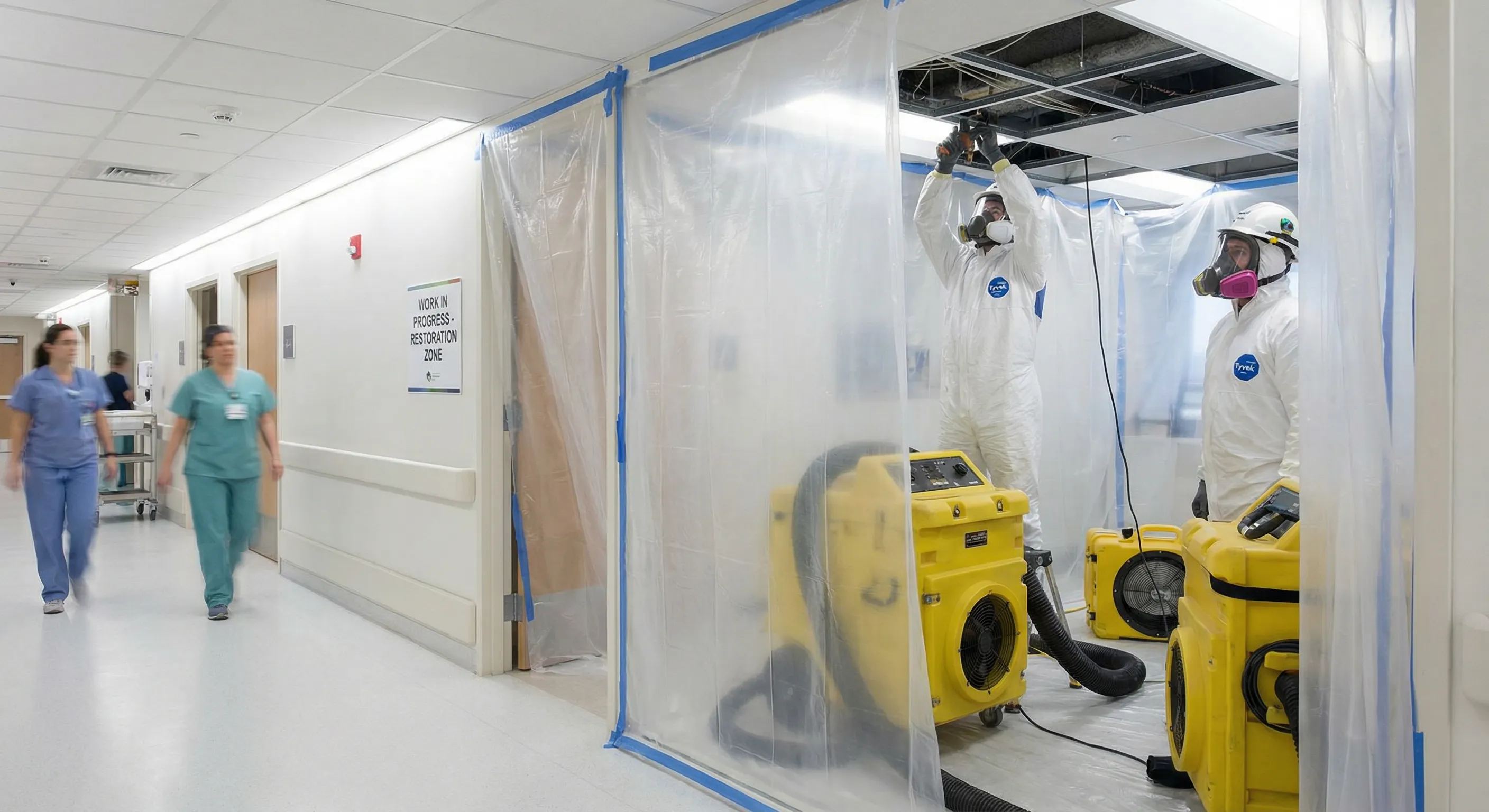
ICRA containment in active hospital corridor
Polyethylene barriers create sealed work zones while hospital operations continue on the other side. Negative air pressure prevents contaminant migration.
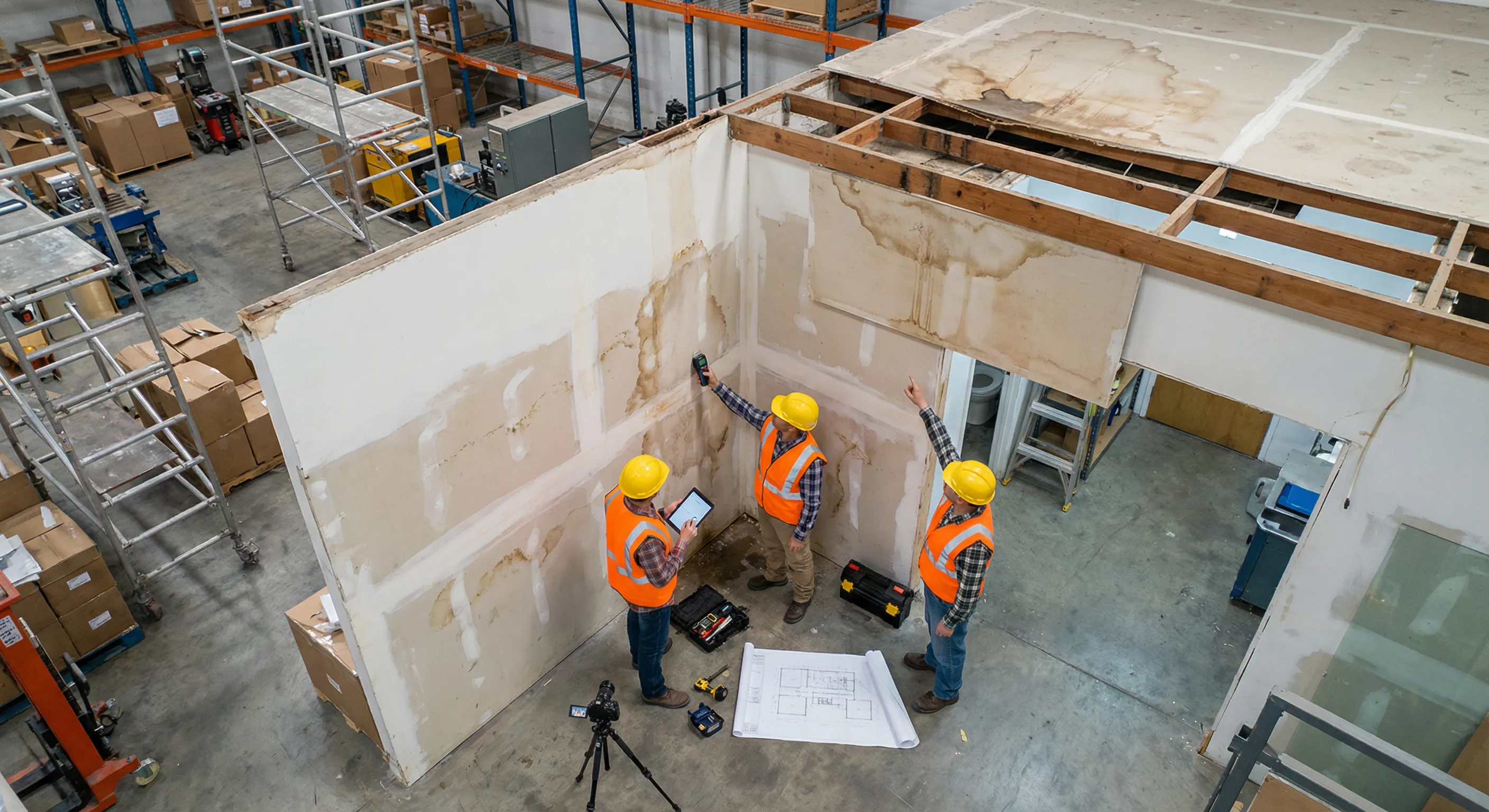
Damage assessment in healthcare facility
Thorough documentation of damage extent, affected systems, and patient area proximity informs the ICRA risk classification and restoration plan.

Restored clinical area cleared for patient use
Air quality testing confirmed safe particulate levels. Space passed Joint Commission and state health department inspection.
Professional Process
How this work is done right
Each step ensures quality, compliance, and minimal business interruption.
ICRA classification and containment plan
Infection Control Risk Assessment performed in collaboration with facility infection prevention team. Containment class determined based on construction activity type and patient population risk. Sealed barriers, HEPA filtration, and negative air implemented before any restoration work begins.
Emergency stabilization with patient safety priority
Water extraction, board-up, or fire stabilization performed with strict infection control measures. Patient areas isolated. Critical systems (medical gases, emergency power, nurse call) assessed and maintained. Equipment vendors contacted for specialized systems.
Monitored restoration under ICRA protocols
All restoration work proceeds within ICRA containment. Daily air quality monitoring. Dust and particulate levels tracked. Work schedules coordinated with patient care activities. Regular updates provided to facility administration and infection control.
Clearance testing and regulatory approval
Air quality testing confirms safe levels for patient occupancy. Life safety systems tested and certified. State health department inspection scheduled. Joint Commission notification completed if applicable. Full documentation package provided to facility for compliance records.
Regional considerations
Florida
Florida AHCA (Agency for Health Care Administration) oversees healthcare facility compliance. Hurricane damage to healthcare facilities requires rapid response due to vulnerable patient populations. Florida humidity demands aggressive mold prevention in any healthcare water loss.
North Carolina
NC DHSR (Division of Health Service Regulation) oversees healthcare facility inspections. Winter pipe bursts in NC healthcare facilities are common. Senior living facilities in the Charlotte and Triangle areas represent a growing portion of healthcare restoration projects.
South Carolina
SC DHEC oversees healthcare facilities. Coastal healthcare facilities face hurricane exposure. Senior care communities in Charleston and Myrtle Beach areas need expedited restoration to maintain patient care continuity during tourist season staffing.
Related Commercial Services
Explore our other commercial restoration specialties
Related Guides
Connect this work with the bigger picture
Need commercial restoration?
Get a free commercial assessment. We evaluate damage, develop scope with your insurance company, and manage the entire restoration with minimal business interruption.