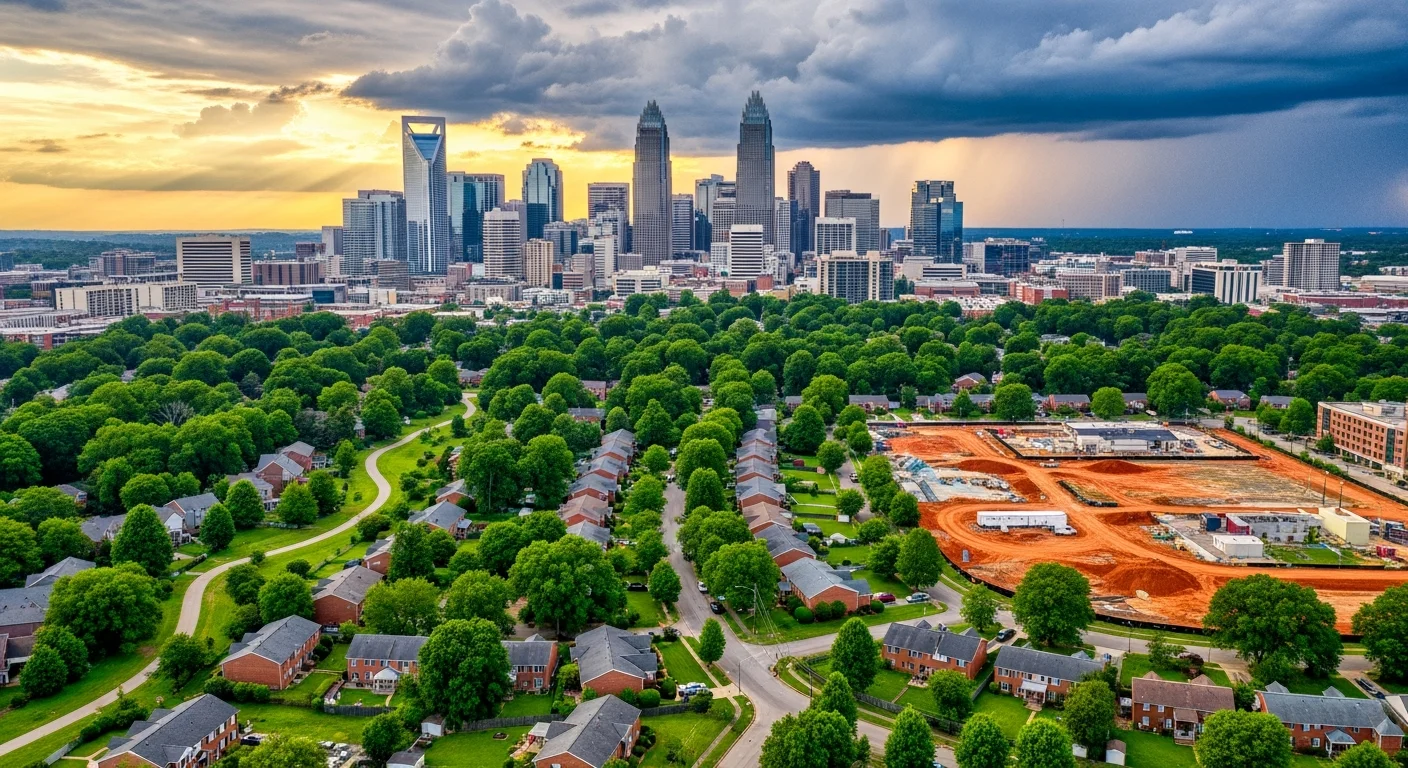
Commercial Restoration in Charlotte, North Carolina
From Uptown Charlotte high-rises to South End restaurants and Ballantyne office parks, Palm Build provides 24/7 commercial restoration with corridor-based drying plans, phased occupant communication, and insurance documentation designed for commercial property managers and business owners.
Local Office — Charlotte, NC 30-60 min Response IICRC Certified
Why Commercial Restoration Requires a Different Approach
Commercial property damage in Charlotte is not "residential restoration at a bigger
scale." It's a fundamentally different discipline with different urgency, stakeholders,
equipment, and insurance structures. Here's why choosing a restoration company with
genuine commercial experience matters more than any other factor.
Revenue Loss Every Hour
Residential damage is stressful but commercial damage is financially catastrophic. A flooded Charlotte restaurant loses $3,000-$10,000 per day in revenue. A water-damaged medical office cancels appointments affecting patient care and practice income. A fire-damaged retail store loses holiday season sales that can never be recovered. Commercial restoration must prioritize speed-to-reopening above all else — and the restoration approach, equipment scale, and crew deployment reflect that urgency.
Multi-Stakeholder Coordination
Commercial projects involve property owners, tenants, property managers, commercial insurance carriers (often multiple policies), city inspectors, health departments, and sometimes regulatory agencies. Each stakeholder has different interests, timelines, and documentation requirements. Residential projects have one homeowner and one adjuster. Commercial projects may have a dozen decision-makers who all need to be informed and coordinated throughout the restoration process.
Scale and Complexity
Commercial buildings have larger HVAC systems that spread contaminants further, multi-floor water migration through elevator shafts and stairwells, fire suppression systems that discharge thousands of gallons, specialized equipment (commercial kitchens, server rooms, medical equipment), and occupancy loads that create safety concerns during restoration. The equipment, crew size, and project management required for commercial work is fundamentally different from residential restoration.
Commercial Insurance Structures
Commercial property policies (CP, BOP, umbrella) have different coverage structures than residential HO-3 policies. They include business interruption, extra expense, business personal property, equipment breakdown, and ordinance-and-law coverages that must be coordinated separately. The claims process involves commercial adjusters who expect different documentation formats and detail levels than residential adjusters.
Property Expertise
Commercial Property Types We Restore in Charlotte
Each commercial property type has specific regulatory, safety, and operational
requirements that inform the restoration approach. Here's our Charlotte-specific
expertise across the major commercial property categories.
Office Buildings & Corporate
Charlotte's Class A office towers in Uptown, mid-rise office parks in SouthPark and Ballantyne, and flex office spaces in South End each present different restoration challenges. Uptown high-rises require coordination with building management, elevator access for equipment, and phased work to keep unaffected floors operational. Water from a burst pipe on the 15th floor can migrate through 14 floors below via elevator shafts, stairwells, and utility chases — requiring multi-floor response within hours. Ballantyne and SouthPark office parks allow more direct equipment access but often have multi-tenant lease complications.
Restaurants & Food Service
Charlotte's booming restaurant scene — from South End breweries to upscale NoDa eateries to fast-casual in Ballantyne — faces unique restoration requirements. Commercial kitchens have grease-laden exhaust systems that complicate fire restoration, walk-in coolers and freezers that must maintain temperature during water events to prevent inventory loss, and health department clearance requirements before reopening. Mecklenburg County Environmental Health requires post-restoration inspection for any food service establishment affected by water, fire, or mold. We coordinate this inspection as part of our commercial scope.
Medical & Healthcare
Charlotte's medical corridor includes major hospital systems, private practices, dental offices, urgent care centers, and specialized medical facilities across Mecklenburg County. Healthcare restoration involves patient record protection (HIPAA compliance during document handling), medical equipment salvage assessment, pharmaceutical storage integrity, and infection control during restoration work in clinical spaces. Sterilization and air quality requirements for healthcare spaces exceed standard commercial standards.
Retail & Shopping Centers
From SouthPark Mall to the mixed-use developments along South Boulevard, Charlotte's retail spaces face seasonal revenue pressure that makes restoration timing critical. A water-damaged retail store during the November-December holiday season loses sales that represent 25-40% of annual revenue. Our retail restoration approach prioritizes getting the sales floor operational first while continuing back-of-house and storage area restoration in parallel. We also handle inventory documentation for contents claims.
Houses of Worship & Community
Charlotte's churches, synagogues, mosques, and community centers often have irreplaceable architectural features — stained glass, custom woodwork, pipe organs, historic masonry — that require specialized restoration techniques. These buildings also serve as community gathering spaces, making restoration timeline critical for congregations that depend on the facility. We've restored historic and modern houses of worship across Charlotte with sensitivity to both the architectural and community significance of these spaces.
Industrial & Warehouse
Charlotte's industrial properties — from the I-77 corridor to Steele Creek and Airport/West Charlotte — include manufacturing facilities, distribution centers, cold storage, and flex industrial spaces. These properties have specialized fire suppression systems (dry chemical, foam, clean agent) that create unique cleanup requirements, high-value inventory that needs rapid documentation and salvage assessment, and operational equipment that may need professional cleaning and testing before restart. Industrial restoration also involves OSHA compliance for contractor safety in the work environment.
Local Market Knowledge
Charlotte's Commercial Corridors
Charlotte's commercial districts each have distinct property types, building ages, and
restoration challenges. Our team knows the specific requirements of each corridor — from
Uptown high-rise coordination to NoDa's adaptive-reuse mill buildings.
Uptown Charlotte
Types: Class A office towers, hotels, government
Key challenges: Multi-floor water migration, elevator shaft contamination, high-density occupancy coordination
Commercial restoration requires larger equipment, faster timelines, and
multi-stakeholder coordination. Here's how we manage the process from emergency call
through business reopening.
01
Emergency Response & Stabilization
Hours 1-4
Immediate deployment of commercial-scale equipment: truck-mounted extractors, industrial dehumidifiers, large-format air scrubbers. Board-up and tarping for weather exposure. Utilities assessment (gas, water, electrical safety). Initial damage documentation begins simultaneously. For Charlotte's Uptown buildings, we coordinate building access, freight elevator scheduling, and loading dock logistics.
02
Damage Assessment & Scope Development
Days 1-3
Comprehensive documentation using thermal imaging, moisture mapping, and room-by-room photography. We develop corridor-based drying plans for multi-unit buildings, identify areas that can be occupied during restoration vs. areas requiring full evacuation, and create a phased restoration timeline that minimizes business interruption. For multi-tenant buildings, we map damage by tenant for separate insurance claims.
03
Mitigation & Active Restoration
Days 1-14
Industrial-scale water extraction, structural drying, soot removal, mold containment, or debris clearing depending on loss type. For Charlotte's commercial properties, we deploy during off-hours when possible — nights and weekends for restaurants and retail, after-business-hours for offices. Daily progress reports are provided to property managers, owners, and insurance adjusters.
04
Reconstruction & Tenant Coordination
Weeks 2-12
Full commercial reconstruction including tenant improvements, ADA compliance, fire code compliance, health department requirements (food service), and building code upgrades. We coordinate with each tenant's schedule, manage phased occupancy during reconstruction, and handle Mecklenburg County LUESA permitting and inspections.
05
Final Inspection & Business Reopening
Project Completion
All regulatory inspections completed (building, fire, health department as applicable). Certificate of occupancy or re-occupancy confirmed. Business reopening coordination with tenants, property management, and insurance carriers. Final documentation package provided for claim closeout including business interruption timeline evidence.
Protecting Revenue
Business Interruption: The Hidden Cost of Commercial Damage
$3K-$10K/day
Typical restaurant revenue loss
2-8 weeks
Average commercial restoration timeline
60-70%
Claims requiring supplements
Business interruption coverage is one of the most valuable — and most under-documented
— portions of commercial insurance claims. Your commercial policy likely includes BI
coverage that pays for lost revenue during the period your business cannot operate due
to a covered loss. But the coverage only pays what you can prove. Without detailed
timeline documentation showing exactly when the damage occurred, when mitigation
began, when partial occupancy was restored, and when full operations resumed, your BI
claim is based on your adjuster's estimate rather than documented fact.
Palm Build provides detailed restoration timelines specifically designed to support
business interruption claims. Our daily progress reports, milestone documentation, and
phased occupancy tracking create the evidence trail that commercial adjusters need to
approve BI payments. We also document "extra expense" items — temporary relocation
costs, expedited shipping for replacement equipment, overtime labor for accelerated
restoration — that are covered under most commercial policies but often go unclaimed.
Commercial Insurance Coverage for Charlotte Businesses
Commercial property policies cover more than most business owners realize. Palm Build's
commercial claims team ensures every applicable coverage is activated and documented —
including business interruption and extra expense items that are frequently left on the
table.
Building coverage — structural damage repair and reconstruction
Business personal property — furniture, equipment, inventory, fixtures
Business interruption — lost revenue during restoration period
Extra expense — temporary relocation, expedited restoration costs
Equipment breakdown — specialized equipment repair or replacement
Ordinance and law — building code upgrades during reconstruction
Debris removal — commercial-scale demolition and disposal
Tenant improvements — custom buildout restoration for leased spaces
The Palm Build Difference
Why Charlotte Businesses Choose Palm Build
30-60 Min Commercial Response
Our Charlotte hub dispatches commercial-scale equipment — truck-mounted extractors, industrial dehumidifiers, large air scrubbers — within an hour. For major commercial losses, we activate additional crews from our Florida operations center. We work nights, weekends, and holidays to minimize your business interruption.
Multi-Property-Type Experience
We've restored Charlotte offices, restaurants, medical facilities, retail, industrial, and houses of worship. Each property type has specific regulatory, safety, and operational requirements — from health department clearance for food service to HIPAA compliance for healthcare to OSHA requirements for industrial.
Multi-Stakeholder Coordination
Commercial projects involve property owners, tenants, property managers, multiple insurance carriers, and regulatory agencies. We manage all stakeholder communication, provide separate documentation packages per carrier, and coordinate restoration scheduling across all parties.
Commercial Claims Expertise
Commercial property policies have different coverage structures than residential. We understand building vs. contents, business interruption, extra expense, tenant improvements, and equipment breakdown coverages. Our Xactimate estimates are formatted for commercial claims processing.
Off-Hours & Phased Restoration
We routinely perform commercial work during nights, weekends, and holidays to keep businesses operational. For multi-tenant buildings, we phase restoration to maintain partial occupancy. For restaurants, we coordinate health department re-inspection as part of the restoration scope.
Common Questions
Charlotte Commercial Restoration FAQ
How quickly can Palm Build respond to a commercial emergency in Charlotte?
Our Charlotte team dispatches within 30-60 minutes from our Crompton Street operations hub. For large commercial losses, we activate our catastrophe response protocol with additional crews and equipment. We understand that every hour of business interruption costs money — our response time reflects that urgency.
Can you work around our business hours to minimize disruption?
Yes. We routinely perform commercial restoration during off-hours — nights, weekends, and holidays — to minimize disruption to business operations. For Charlotte's restaurant and retail tenants, we can phase work to keep portions of the space operational during restoration. For office buildings, we coordinate with property management to schedule noisy or disruptive work outside business hours.
Do you handle multi-tenant commercial buildings?
Yes. Multi-tenant buildings require coordination between property owners, tenants, property managers, and multiple insurance carriers. Palm Build manages this coordination, ensuring each party's responsibilities are documented and each carrier receives the appropriate documentation for their portion of the loss. We've handled multi-tenant commercial losses in Uptown Charlotte, SouthPark, and Ballantyne office parks.
What types of commercial properties does Palm Build restore in Charlotte?
We restore all commercial property types in Charlotte including Class A office buildings, medical and dental offices, restaurants and food service, retail stores, warehouses, churches and houses of worship, schools and educational facilities, hotels and hospitality, automotive dealerships, and industrial facilities. Each property type has specific regulatory, safety, and operational requirements that inform our restoration approach.
How do you handle business interruption documentation?
Business interruption coverage requires documentation proving the duration and financial impact of the interruption. Palm Build provides detailed timelines showing when damage occurred, when mitigation began, when the space was safe for partial occupancy, and when full operations could resume. This timeline documentation, combined with our Xactimate scope, supports your business interruption claim with the evidence your carrier needs.
What about OSHA and health department compliance during commercial restoration?
Commercial restoration in Charlotte must comply with OSHA safety standards, Mecklenburg County health department requirements (especially for restaurants and healthcare facilities), and any industry-specific regulations. Palm Build's commercial crews are OSHA-trained, and we coordinate with relevant regulatory agencies when required — especially for food service establishments that need health department clearance before reopening.
Do you work with commercial insurance policies?
Yes. Commercial property policies (CP, BOP, etc.) have different coverage structures than residential homeowners policies. We understand commercial coverage including building vs. contents, business personal property, business interruption, extra expense, ordinance-and-law, and equipment breakdown coverage. Our Xactimate estimates are formatted for commercial claims processing.
Commercial Damage in Charlotte? Every Hour Costs Revenue.
Palm Build's commercial restoration team responds in 30-60 minutes with industrial-scale equipment and a restoration plan designed to minimize your business interruption. We work nights, weekends, and holidays.