COCONUT CREEK FL — FIRE & SMOKE DAMAGE RESTORATION
Fire & Smoke Damage Cleanup in Coconut Creek, Florida
In a city where 70%+ of the housing stock shares walls, rooflines, and HVAC systems, a single kitchen fire becomes a multi-unit smoke event within minutes. Coconut Creek's 1980s-era CBS construction both contains flame spread through concrete block walls and traps smoke residue deep inside those same block cavities — creating persistent odor that resurfaces for months without professional cavity treatment. Palm Build's Deerfield Beach team responds in 15-25 minutes with emergency board-up, industrial air scrubbing, and the multi-carrier condo insurance coordination this HOA-dense North Broward community demands.
5 miles — Coconut Creek, FL 15-25 min Response IICRC Certified
Why Coconut Creek Homes Face Unique Fire & Smoke Damage Risks
Coconut Creek is Broward County's "Butterfly Capital" — a master-planned city of gated
communities, 55+ villages, and tightly-packed condo developments built predominantly in
the 1980s and 1990s. When fire strikes here, aging electrical systems, CBS construction,
and multi-unit density create a combination of risks that demands specialized
restoration expertise.
Multi-Unit Fire Spread
72%
Condo/townhome density
Coconut Creek is approximately 72% condos and townhomes — communities like Wynmoor Village, Country Woods, and Palm Beach Villas pack units wall-to-wall. When fire breaks out in one unit, smoke migrates through shared walls, common hallways, and interconnected HVAC plenums within minutes, contaminating adjacent units long before flames ever reach them. Multi-unit fire response in Coconut Creek requires simultaneous teams addressing the fire-origin unit and every smoke-affected neighbor.
Aging Electrical Systems
1975-1995
Peak construction era
Most of Coconut Creek was built between 1975 and 1995 — an era of aluminum wiring, Federal Pacific breaker panels, and circuit designs that never anticipated modern electrical loads. Central AC running 12 months, pool pumps, smart home systems, and EV chargers push 40-year-old circuits past their design limits daily. Overloaded panels and corroded connections arc and ignite inside walls where homeowners cannot detect them until smoke appears.
CBS Construction: Double-Edged Sword
95%+
CBS construction homes
Coconut Creek homes are almost universally CBS (concrete block and stucco) — great for containing fire spread between rooms, but a challenge for smoke remediation. Once smoke enters the hollow cores of CBS block walls through electrical outlets, plumbing penetrations, and mortar joints, it becomes trapped. Surface cleaning alone leaves smoke compounds embedded inside wall cavities, producing persistent odor that resurges in Coconut Creek's 70%+ humidity for months after visible damage is addressed.
Kitchen & Lanai Fires
#1
Kitchen fire ignition source
Compact condo kitchens in Coconut Creek communities leave minimal clearance between stovetops and cabinetry, making grease fires the most common ignition source. Screened lanai patios — standard in virtually every Coconut Creek home — host outdoor grills placed dangerously close to vinyl screen enclosures and fiberglass roof panels. A grease fire or grill flare-up can ignite the entire screen enclosure in under 60 seconds, spreading to the soffit and roof system.
CBS construction contains flame spread between rooms but traps smoke inside hollow block
wall cavities — requiring specialized extraction techniques unique to South Florida
homes.
Neighborhood Fire Risk Profiles
Fire Risk by Coconut Creek Neighborhood
Every Coconut Creek community has a distinct fire risk profile shaped by construction
era, building density, and electrical infrastructure age. Understanding your
neighborhood's specific risks helps Palm Build respond with exactly the right equipment
and techniques from minute one.
One of the largest 55+ communities in Florida. Original electrical panels serving modern loads, shared HVAC plenums between units, and close-set CBS buildings create cascading fire and smoke scenarios. Space heater use during cold snaps adds seasonal risk.
Country Woods
High
1980s · Townhome Community
Shared-wall fire migration, aging wiring
Attached townhome construction with shared party walls. Fire in one unit sends smoke through wall penetrations, attic spaces, and shared plumbing chases to adjacent units. Original 1980s aluminum wiring and Federal Pacific panels common.
Palm Beach Villas
High
1970s-80s · Condo/Villa Community
Outdated electrical, compact condo kitchens
Small-footprint villas with original electrical systems. Kitchen fires spread quickly in compact layouts. Screen enclosures with vinyl panels ignite rapidly from grill fires on lanais.
Coconut Creek Commons
High
1980s · CBS Single-Family & Townhomes
Overloaded circuits, Federal Pacific panels
Mix of single-family CBS and attached units. Many homes retain original Federal Pacific Stab-Lok panels — known for breakers that fail to trip during overcurrent events. Pool pumps and AC add constant electrical load.
Regency Lakes
Moderate
1990s-2000s · Planned Single-Family Community
Higher electrical loads, modern appliance density
Newer construction with larger floor plans. Higher electrical loads from multiple AC zones, pool equipment, and smart home systems. CBS construction generally sound but kitchen fire risk elevated with open-concept layouts that allow rapid smoke distribution.
Winston Park
Moderate
1980s-90s · CBS Single-Family Homes
Transitional-era wiring, aging CBS infrastructure
Residential CBS homes from the late 1980s through early 1990s. Electrical systems in the transition period between aluminum and modern copper. CBS block walls trap smoke effectively after any fire event.
Coconut Creek Estates
High
1975-85 · CBS Ranch Homes
Oldest housing stock, complete electrical aging
Among the oldest homes in Coconut Creek. Original aluminum wiring, undersized 100-amp panels, and decades of DIY modifications. Polybutylene plumbing adds concurrent water damage risk when fire suppression activates.
Condo Fire Risk
How Fire & Smoke Spread in Coconut Creek Multi-Unit Buildings
With 72% of Coconut Creek's housing stock in condo and townhome communities, multi-unit
fire spread is the defining challenge of fire restoration here. Smoke doesn't stop at
property lines — it migrates through every gap, duct, and penetration in shared
construction.
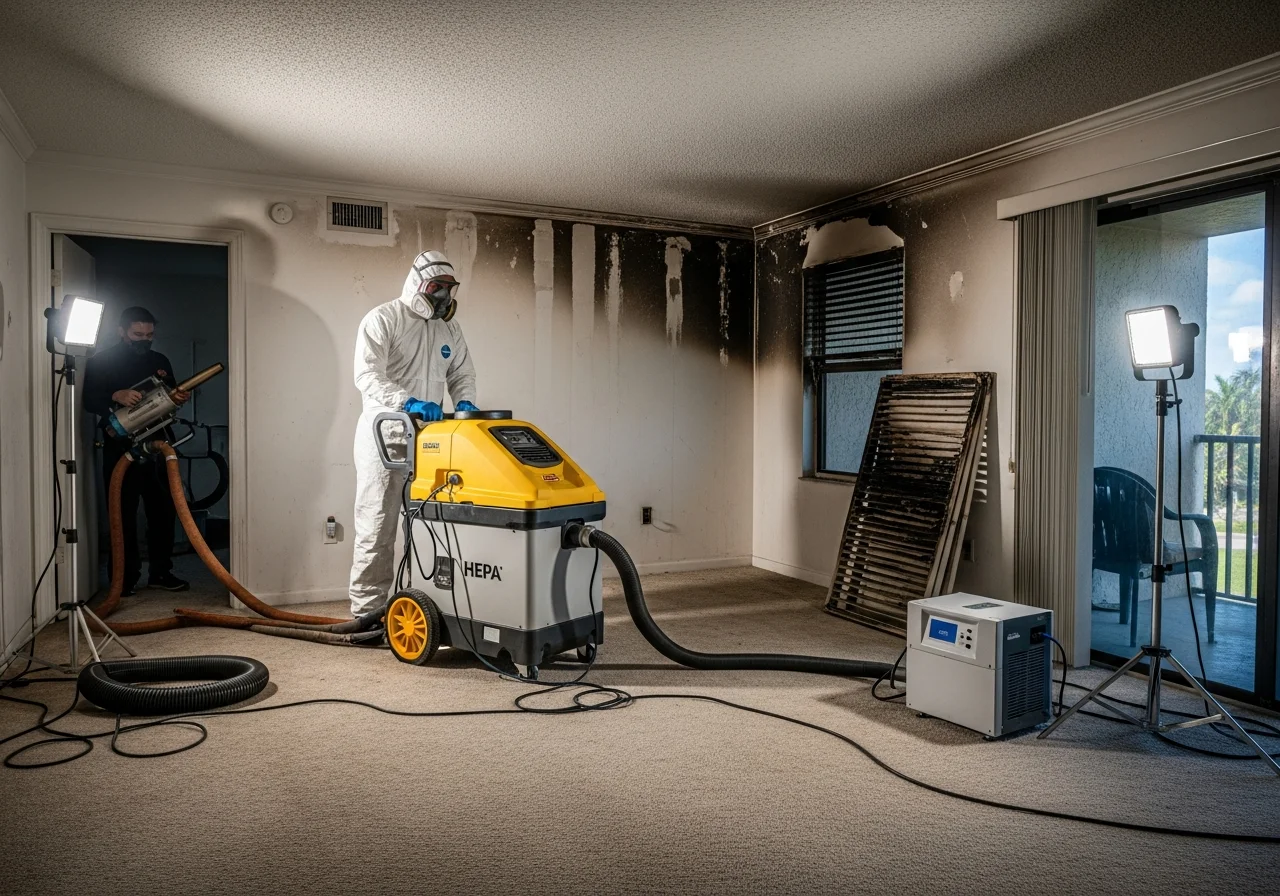
Smoke contamination in a Coconut Creek condo unit adjacent to the fire-origin —
migrated through shared HVAC and wall penetrations
Coconut Creek condo buildings — particularly in Wynmoor Village and Country Woods — share HVAC plenums between units. When fire erupts, smoke particles are drawn into the HVAC return and pushed into every connected unit within minutes. Even with the system off, smoke penetrates through shared CBS party walls at electrical outlet boxes, plumbing chases, and mortar joints. A single kitchen fire can contaminate 4-8 adjacent units before the fire department arrives.
Adjacent Unit Contamination Assessment
Every multi-unit fire in Coconut Creek requires systematic adjacent-unit assessment. Our team uses thermal imaging and air quality testing to map exactly how far smoke has traveled through shared walls, common hallways, and stairwells. In Wynmoor's 9,000+ unit community, a fire in one building can produce smoke odor complaints from units two and three buildings away — carried through connected maintenance corridors and shared parking structures.
Common-Area Smoke Damage
Hallways, lobbies, elevator vestibules, and parking garages in Coconut Creek condos accumulate significant smoke damage even from contained unit fires. Carpet, upholstered lobby furniture, and textured ceiling finishes absorb smoke compounds aggressively. Common-area damage falls under the HOA master policy, requiring separate documentation and scope from unit-owner claims. Palm Build provides separate damage reports for common-area and unit-owner insurance submissions.
HOA & Condo Association Coordination
Coconut Creek fire restoration in condos requires constant coordination with HOA boards, property managers, and building maintenance. Access to adjacent units for assessment, common-area remediation scheduling, noise restrictions during cleaning, elevator reservations for equipment staging — every step must align with association rules. Palm Build carries the insurance certificates and vendor credentials Coconut Creek HOAs require before any work begins.
Palm Build's Multi-Unit Condo Response
We deploy separate crews to the fire-origin unit and every smoke-affected unit
simultaneously. The origin unit receives full structural fire restoration. Adjacent
units get HEPA air scrubbing, soot testing, surface cleaning, HVAC duct sanitation,
and professional odor treatment — all documented separately for each unit owner's HO-6
policy and the HOA master policy. Our team understands Coconut Creek's condominium
association compliance requirements and coordinates with your property manager
throughout the project.
How We Restore Coconut Creek Homes After Fire & Smoke Damage
Fire restoration involves multiple damage types simultaneously — structural fire damage,
soot contamination, smoke odor, and water from fire suppression. Our six-step process
addresses all four in a coordinated sequence tailored to Coconut Creek's CBS
construction and Broward County code requirements.
01
Emergency Board-Up & Securing
15-25 Min Response
Palm Build secures your Coconut Creek property against weather, unauthorized entry, and further damage within minutes. Board-up crews cover exposed openings, tarp any roof damage, and stabilize the structure. In South Florida — where afternoon thunderstorms develop daily May through October — an unsecured fire-damaged home can sustain thousands in additional water damage within hours. For condo units, we coordinate with HOA management and building security for common-area access.
02
Fire Damage Assessment
Day 1-2
IICRC-certified technicians perform a comprehensive structural evaluation and smoke pattern analysis. We use thermal imaging to map heat damage behind CBS walls, classify soot type (protein, natural, synthetic), and assess structural integrity of concrete block walls and tie-beam systems. Every finding is photographed, measured, and documented for your insurance carrier from hour one.
03
Smoke & Soot Removal
Days 2-8
HEPA air scrubbers run continuously to capture airborne particulate while our team performs surface cleaning matched to soot type. CBS stucco requires specialized cleaning chemistry to avoid permanent finish damage. Tile grout — found in every Coconut Creek home — needs extraction-level cleaning to prevent permanent discoloration. Ozone treatment addresses sealed spaces. For multi-unit condo fires, containment barriers isolate affected areas to prevent cross-contamination during cleaning.
04
Content Pack-Out & Cleaning
Days 3-14
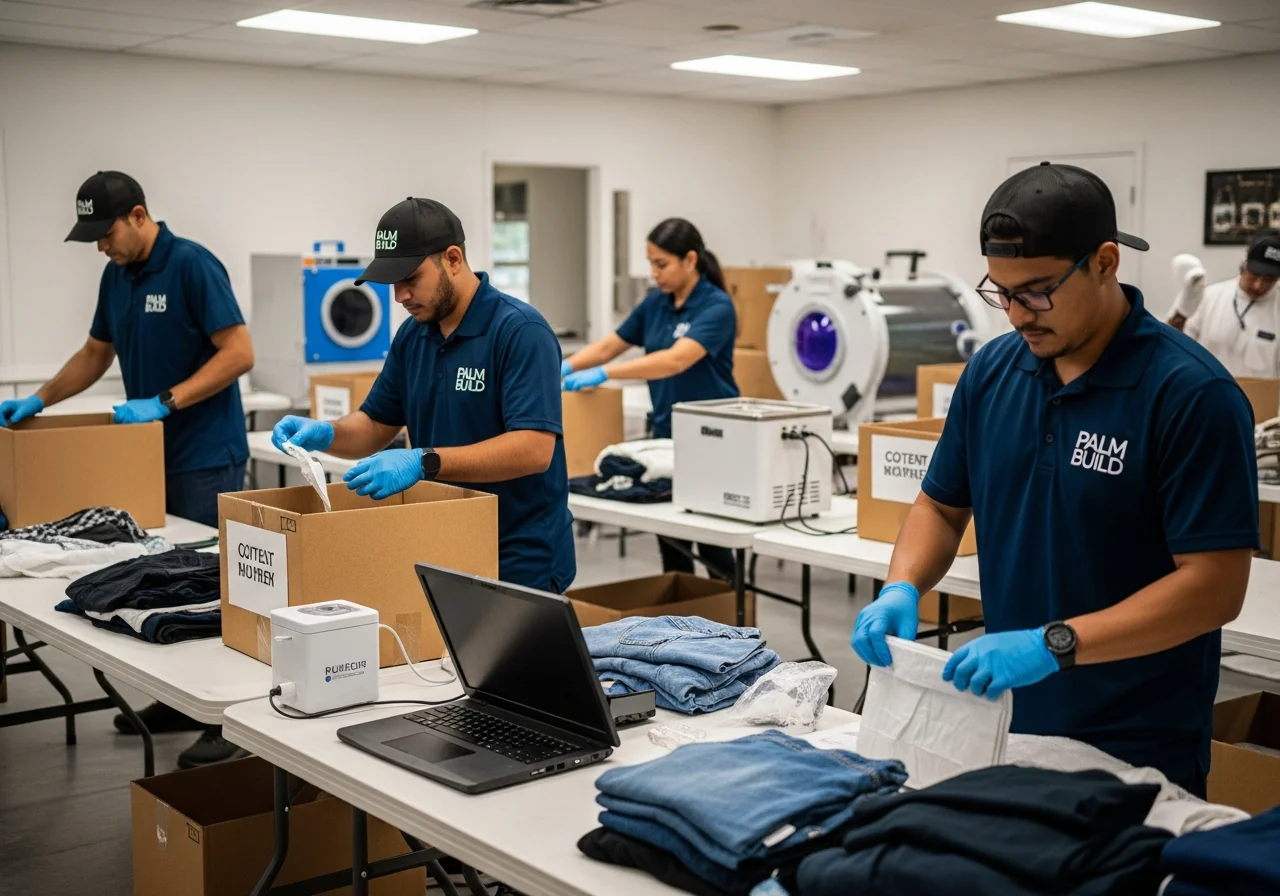
Salvageable contents are inventoried, photographed, and transported to our climate-controlled facility. Electronics, clothing, documents, and furniture each require specific cleaning protocols. Coconut Creek condo units present unique pack-out challenges — limited staging space, elevator scheduling, and HOA move-out procedures must all be coordinated. Our detailed inventory becomes part of your insurance claim documentation.
05
Odor Elimination
Days 5-14
Smoke odor in Coconut Creek's humidity requires multiple treatment approaches. Thermal fogging penetrates CBS wall cavities where smoke becomes trapped. Hydroxyl generators treat occupied areas safely. Complete HVAC duct cleaning is mandatory — systems run year-round, continuously recirculating residual smoke particles. Expect 2-3 additional treatment cycles compared to dry-climate restoration due to Coconut Creek's 70-75% ambient humidity reactivating odor compounds.
06
Reconstruction
Weeks 2-8+
Full rebuild to current Florida Building Code: CBS block repair, impact-rated windows and doors, electrical rewiring to NEC standards, and current insulation requirements. Coconut Creek falls within Broward County building code jurisdiction — all reconstruction must pass Broward County inspections. For condo reconstruction, we manage HOA architectural review, coordinate adjacent-unit impact, and ensure all finishes match community standards.
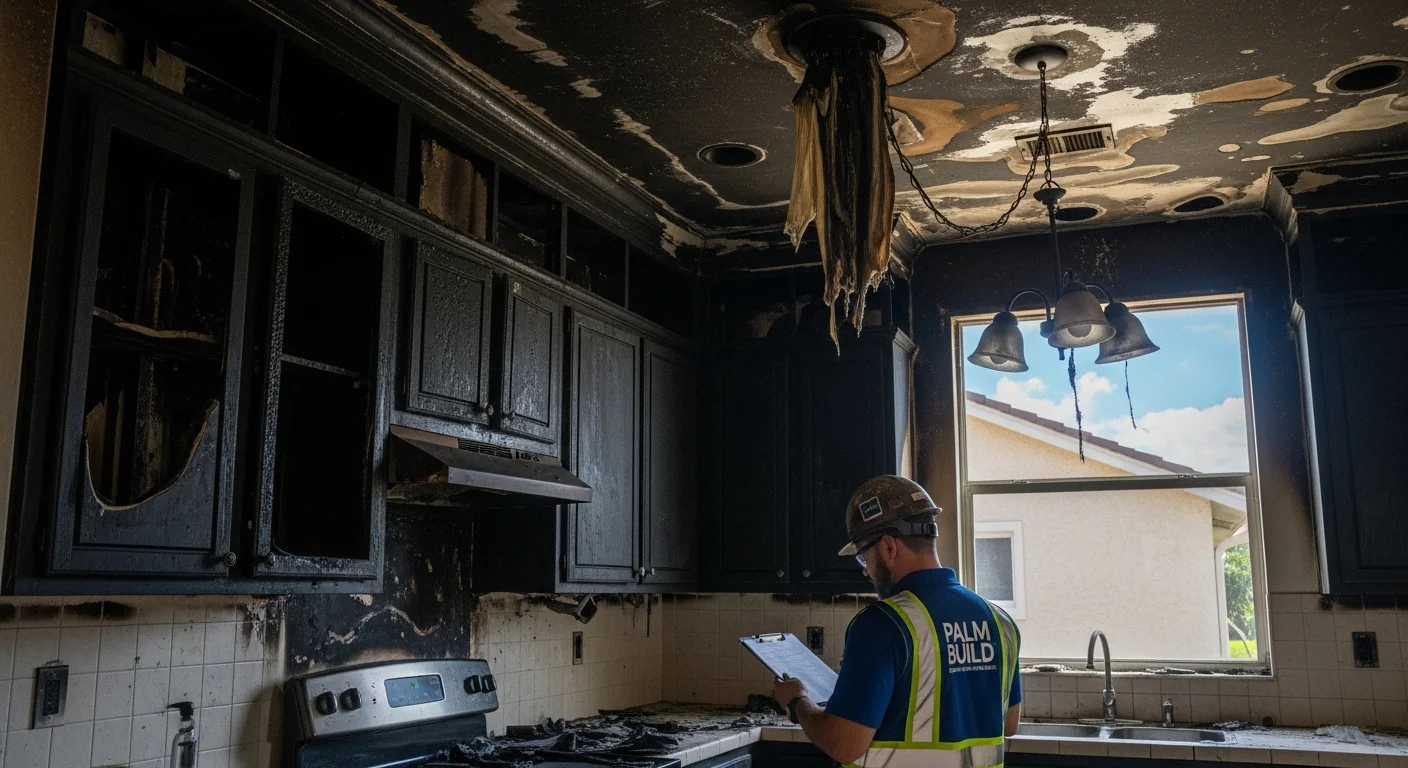
Palm Build's IICRC-certified team performing structural fire damage assessment at a
Coconut Creek home — thermal imaging reveals heat damage hidden behind CBS walls.
Seasonal Patterns
Coconut Creek Fire Risk Calendar
Unlike northern cities with strong seasonal fire patterns tied to heating season,
Coconut Creek's fire risks are predominantly year-round — driven by aging electrical
systems under constant load. Lightning season and holiday cooking create seasonal
spikes, but electrical fires remain the dominant risk every month.
Year-Round
Electrical Fires (Overloaded Panels)
High
Coconut Creek's 1975-1995 electrical infrastructure creates fire risk every day of the year. Central AC running 12 months, pool pumps, smart home systems, and modern appliances on aging circuits maintain constant load stress. Federal Pacific Stab-Lok panels — common in Wynmoor Village, Country Woods, and Coconut Creek Estates — are notorious for breakers that fail to trip during overcurrent events. The busiest months for electrical fire calls are June through September when AC runs at maximum capacity.
Active months: Jan-Dec (peaks Jun-Sep)
June - October
Lightning Strike Fires
Seasonal High
South Florida averages 80-90 thunderstorm days per year, making it the lightning capital of North America. Coconut Creek's flat terrain and abundant tree canopy attract strikes that ignite roof trusses, destroy electrical panels, and cause power surges throughout neighborhoods. Lightning entering through cable or phone lines can ignite wall cavities behind outlets. Whole-home surge protectors are rare in Coconut Creek's older housing stock.
Active months: Jun-Oct
November - December
Holiday Cooking & Grill Fires
Seasonal Moderate
Holiday cooking fires spike across Coconut Creek in November and December. Deep-frying turkeys near screened lanais, unattended stovetops during gatherings, and candle use near window treatments drive seasonal protein fire incidents. Coconut Creek's compact condo kitchens — especially in Wynmoor and Palm Beach Villas — have minimal clearance between cooking surfaces and combustible materials. Outdoor grill fires on lanais ignite vinyl screen enclosures within seconds.
Active months: Nov-Dec
January - February
Space Heater Fires (Cold Snaps)
Seasonal Low-Moderate
Brief cold snaps pushing overnight temperatures into the 30s-40s drive Coconut Creek residents — especially in 55+ communities like Wynmoor Village — to use portable space heaters. These heaters are placed too close to drapes, bedding, and upholstered furniture in homes without central heating. Multiple heaters on the same circuit overload panels never designed for that draw. The combination of aging wiring and unfamiliar heating equipment creates a brief but dangerous seasonal fire spike.
Active months: Jan-Feb
Damage Patterns
5 Types of Fire & Smoke Damage in Coconut Creek
Each type of fire and smoke damage requires different cleaning chemistry, equipment, and
restoration techniques. Coconut Creek's CBS stucco construction, condo-dense housing,
and year-round humidity create unique challenges for every damage type.
Wet Smoke Damage (Smoldering/Plastic Fires)
Wet smoke results from slow, smoldering fires burning plastics, rubber, and synthetic materials at low temperatures. It produces thick, sticky, black residue with a pungent, acrid odor. In Coconut Creek's CBS stucco homes, wet smoke soot bonds aggressively to porous concrete block surfaces and tile grout — standard cleaning smears it deeper into the material. Wet smoke is the most difficult soot type to clean and requires specialized chemical solvents matched to the specific plastics that burned.
Dry Smoke Damage (Fast, High-Temperature Fires)
Dry smoke comes from fast-burning, high-temperature fires fueled by wood, paper, and natural materials. It produces fine, powdery, gray-white residue that settles on every horizontal surface and infiltrates HVAC ductwork. In Coconut Creek condos with shared HVAC plenums, dry smoke particles distribute rapidly through supply registers to every connected unit. While easier to clean than wet smoke, dry smoke penetrates deep into CBS block wall cavities and requires thermal fogging for complete odor elimination.
Protein Smoke Damage (Kitchen Fires)
Protein smoke from cooking fires — grease fires, unattended stovetops, oven incidents — is nearly invisible but produces an extremely strong, nauseating odor. It leaves a thin, yellowish film on every surface including glass, stainless steel, and tile. In Coconut Creek's dense condo communities, protein smoke is the most common type, occurring year-round from the 60,000+ permanent residents cooking daily. Open-concept floor plans allow protein soot to contaminate entire living spaces from a single kitchen event.
Electrical Fire Smoke
Electrical fires from aging 1980s panels, overloaded circuits, and lightning surges produce a distinctive fine, corrosive soot that damages electronics and metal surfaces. Wire insulation, circuit board components, and electrical enclosures generate toxic byproducts when they burn. In Coconut Creek homes built in the polybutylene era, original 100-150 amp panels now powering modern AC, home offices, and sometimes EV chargers create persistent electrical fire risk — the second most common fire type after kitchen incidents.
Water Damage from Fire Suppression
Fire department hoses deliver 150-250 gallons per minute — creating massive secondary water damage. In Coconut Creek's slab-on-grade CBS construction, suppression water pools on concrete slabs and saturates the thin-set mortar bed beneath tile. In multi-story condos, water cascades through floor assemblies to units below. We treat fire suppression water as Category 2 (gray water) due to contamination from soot, ash, and building materials — requiring full extraction, antimicrobial treatment, and structural drying.
Different soot types require different cleaning chemistry — wet smoke from smoldering
plastics requires specialized solvents, while dry smoke from fast-burning fires responds
to HEPA vacuuming and chemical sponges.
Cost Guide
Fire & Smoke Cleanup Costs in Coconut Creek
Coconut Creek fire restoration costs reflect South Florida's higher labor and material
market, Broward County's strict HVHZ building codes, and the specialized smoke
remediation techniques required for CBS stucco construction. Multi-unit condo losses can
multiply these costs across affected units.
Emergency Board-Up & Securing
Window boarding, door securing, roof tarping after fire damage
Coconut Creek
$500 - $2,000
National Avg
$300 - $1,500
Immediate response prevents additional water and weather damage
Smoke & Soot Cleaning
HEPA vacuuming, chemical sponging, wet cleaning of all surfaces
Coconut Creek
$2,000 - $6,000
National Avg
$1,500 - $4,500
CBS stucco requires specialized soot removal from porous block surfaces
Content Pack-Out & Cleaning
Inventory, packing, transport, professional cleaning of salvageable items
Coconut Creek
$1,000 - $5,000
National Avg
$800 - $3,500
Climate-controlled storage prevents humidity damage to smoke-affected contents
Broward County HVHZ code upgrades required during rebuild
Why Coconut Creek Fire Costs Run Higher
CBS stucco construction traps smoke in hollow block cavities requiring thermal
fogging — a specialized technique not needed in wood-frame construction common in
other regions. Year-round 70%+ humidity causes smoke odor reactivation, requiring
additional treatment cycles. Broward County HVHZ code upgrades during
reconstruction add 15-25% to rebuild costs compared to standard building code
jurisdictions. Multi-unit condo losses multiply costs across affected units and
require dual policy (master + HO-6) claims coordination.
Insurance Guide
Coconut Creek Fire Damage Insurance: What You Need to Know
Fire damage is a covered peril under standard Florida homeowners and condo policies, but
navigating ALE benefits, personal property claims, and condo dual-policy coordination
requires expert documentation from the moment damage occurs. Florida's 1-year claim
deadline means every day counts.
Florida Fire Insurance Rules & Coverage
1 Year — Claim Filing Deadline
Fla. Stat. 627.70132 requires notice of claim within 1 year of the date of loss. Fire damage must be reported immediately — delayed filing risks denial. Coconut Creek homeowners must act fast after any fire event.
HO-3 & HO-6 Fire Coverage
Standard Florida HO-3 (homeowners) and HO-6 (condo) policies include fire and smoke damage as a named peril. Coverage includes structural damage, personal property, smoke damage to contents, and fire department water damage. HO-6 policies in Coconut Creek condos cover "walls-in" improvements while the HOA master policy covers the building shell and common areas.
Additional Living Expenses (ALE)
When fire damage makes your Coconut Creek home uninhabitable, your policy's ALE coverage pays for temporary housing, meals, storage, and related expenses. ALE typically covers 12-24 months of displacement. Document all expenses from day one — keep every receipt for hotel stays, restaurant meals, laundry, and storage fees.
Personal Property Claims & Documentation
Fire destroys contents that must be individually documented for replacement value claims. We photograph and inventory every damaged item during pack-out — clothing, electronics, furniture, artwork, documents. Professional content cleaning determines what is salvageable versus what requires replacement. Detailed documentation speeds adjuster review and maximizes your settlement.
AOB Reform (HB 7065, January 2023)
Florida eliminated Assignment of Benefits on new and renewed policies after January 1, 2023. Coconut Creek homeowners can no longer assign insurance benefits directly to restoration companies — but can authorize contractors for documentation, inspection, and scope preparation. Palm Build handles all Xactimate documentation and works directly with carriers.
Condo Fire — Dual Policy Coordination
Condo fire damage in Coconut Creek triggers dual claims: the HOA master policy for structural and common area damage, plus individual HO-6 policies for each affected unit owner. The boundary between master and HO-6 coverage varies by association. Palm Build separates damage documentation by policy from day one to prevent claim disputes.
Major Carriers in Coconut Creek
Citizens Property InsuranceState insurer of last resort — largest by policy count in FL
State Farm FloridaLarge but restricted in high-risk Broward areas
Slide InsuranceGrowing market presence in Broward County
Palm Build documents every detail your adjuster needs — from soot classification to
content inventory — formatted for your specific carrier from the moment we arrive at
your Coconut Creek home.
Our Work
Coconut Creek Fire Restoration Gallery
From emergency board-up to complete reconstruction, every project reflects Palm Build's
commitment to quality craftsmanship and attention to the details that matter in CBS
stucco fire restoration and Broward County code compliance.
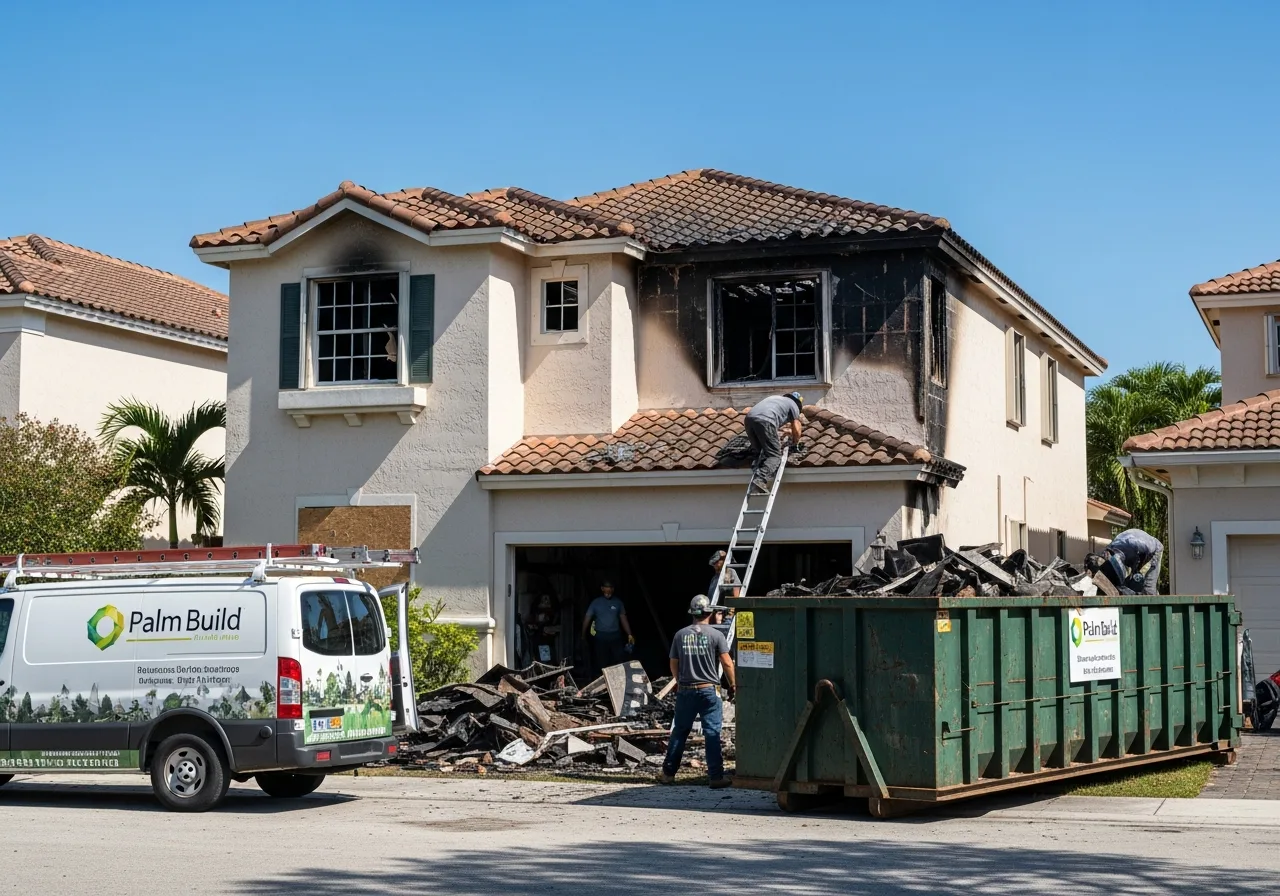
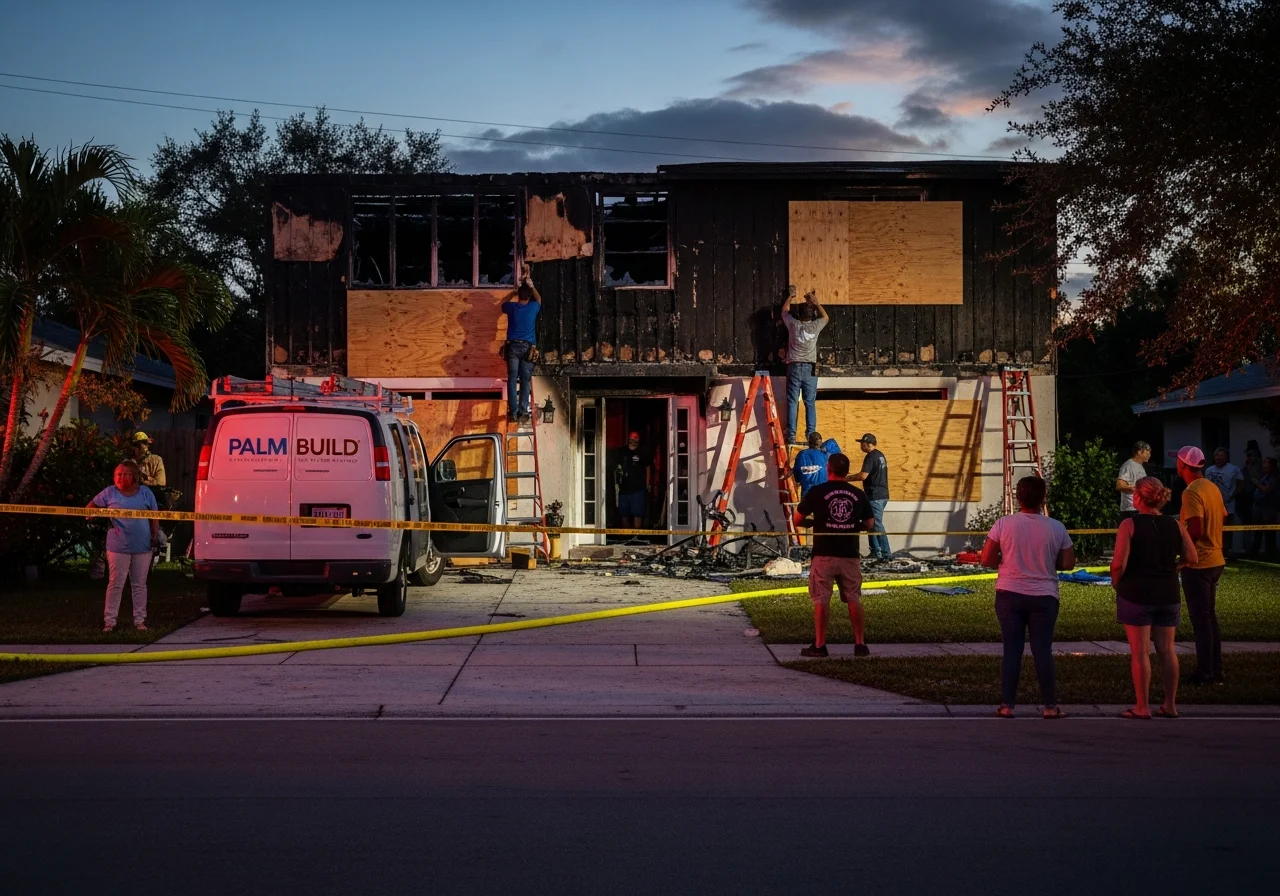
Emergency board-up within hours of fire damage — securing the structure against weather intrusion and unauthorized entry before restoration begins
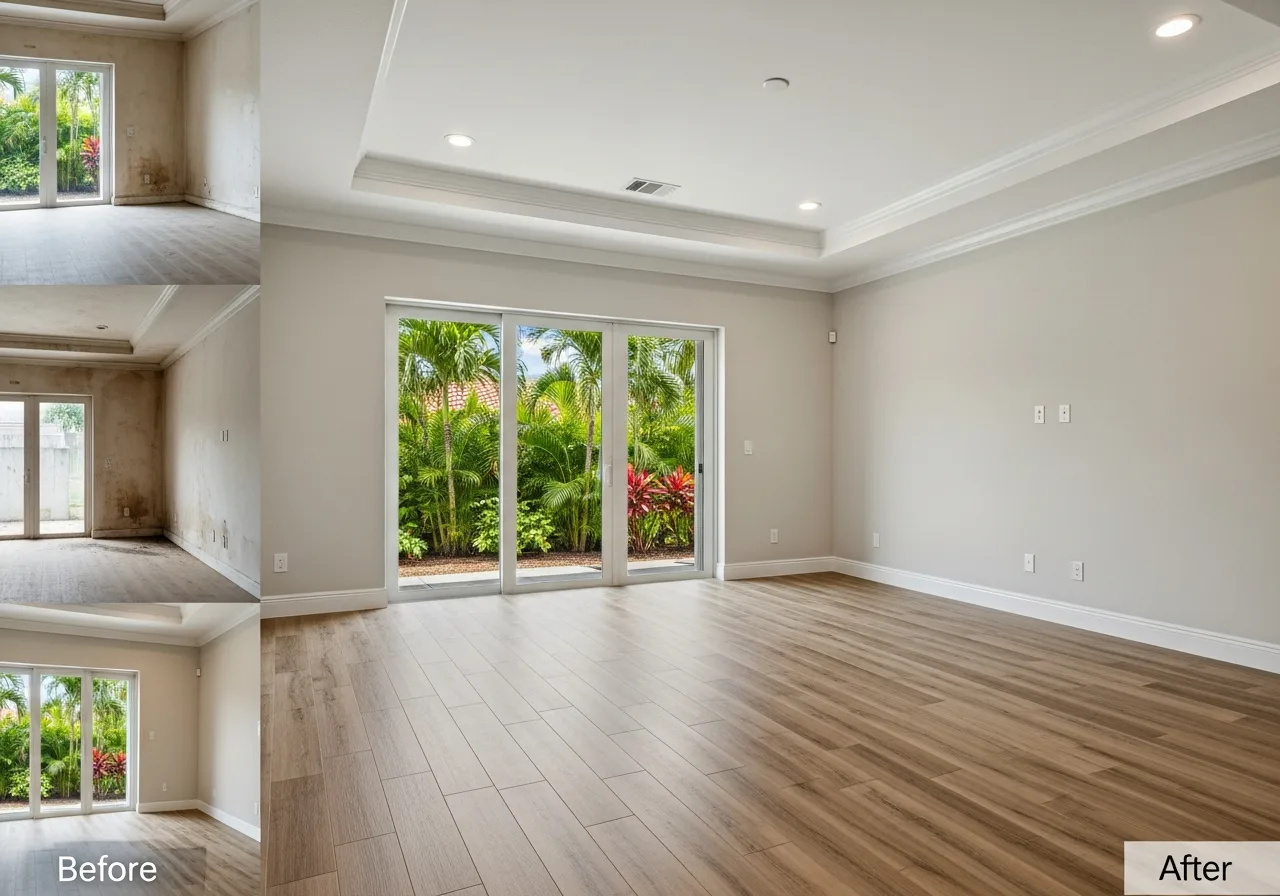
Post-fire living room reconstruction — new drywall, flooring, and paint meeting Broward County HVHZ building code standards
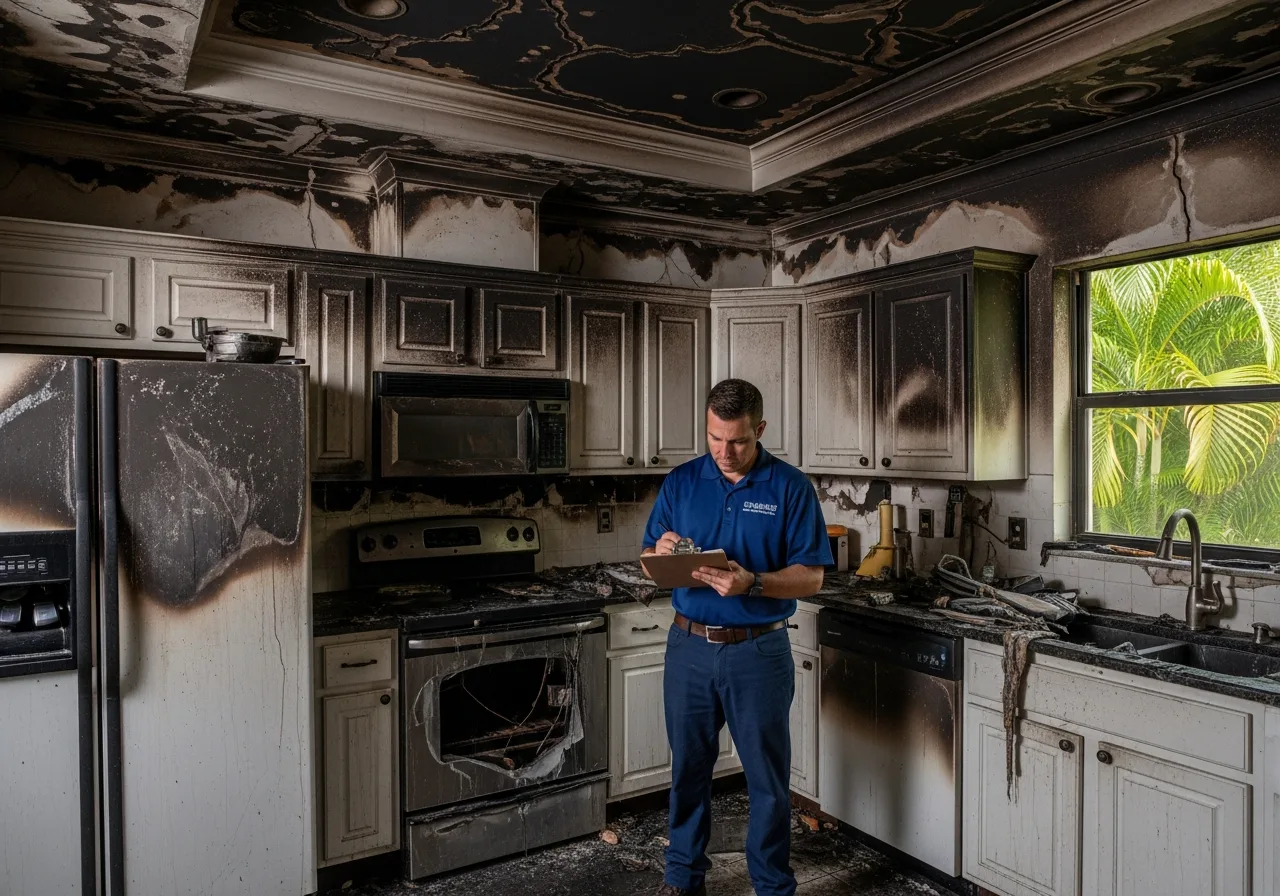
Full kitchen rebuild after a cooking fire — new cabinetry, countertops, and electrical upgrades to current NEC standards
The Local Advantage
Why Coconut Creek Homeowners Choose Palm Build for Fire Damage
Headquartered in neighboring Deerfield Beach, Palm Build delivers the speed of a local
company with the resources of a full-service fire restoration firm — specialized for the
CBS stucco construction and condo-dense housing that defines Coconut Creek.
5 Miles Away — 15-Minute Emergency Response
Our Deerfield Beach headquarters at 786 S Military Trail is just 5 miles from Coconut Creek. When you call (754) 600-3369, our crew arrives with board-up materials, HEPA scrubbers, and thermal fogging equipment before secondary water and weather damage compounds your fire loss.
IICRC Fire & Smoke Restoration Certified
Every technician is IICRC-certified in fire and smoke damage restoration (FSRT). We classify soot types on-site — protein, synthetic, dry, wet — and match cleaning chemistry to each surface. Our company holds Florida DBPR mold remediation and assessment licenses for the mold that follows fire-suppression water damage.
Professional Content Cleaning Capability
We operate a climate-controlled content cleaning facility for fire-damaged belongings. Clothing, electronics, documents, artwork, and upholstery each receive cleaning methods matched to the specific soot type. In Coconut Creek's 70%+ humidity, contents left in smoke-damaged homes absorb moisture and smoke compounds simultaneously — professional pack-out prevents permanent damage.
Condo Fire Damage Expertise
With 72% of Coconut Creek housing in multi-unit buildings, we handle multi-unit fire claims daily. We coordinate with HOA boards, property managers, and multiple insurance carriers simultaneously. We carry the insurance certificates your association requires and separate damage documentation by policy (master vs. HO-6) from day one.
24/7 Emergency Fire Response
Fire doesn't wait for business hours. Our emergency line (754) 600-3369 is staffed 24/7/365. For gated communities like Wynmoor and Centura Parc, we pre-coordinate gate access, parking logistics, and after-hours entry procedures. Our crew is fully equipped and dispatches from Deerfield Beach within minutes of your call.
Insurance Documentation from Hour One
Florida's 1-year claim deadline means documentation cannot wait. We photograph, classify soot, inventory contents, and scope every detail your adjuster needs — formatted for your specific carrier — from the moment we arrive. Our Xactimate documentation covers both master policy and HO-6 scopes for condo fire losses.
The Palm Build team — IICRC-certified fire and smoke restoration specialists based in
nearby Deerfield Beach serving Coconut Creek with 15-minute emergency response times.
Common Questions
Coconut Creek Fire & Smoke Damage FAQ
How quickly can Palm Build respond to fire damage in Coconut Creek?
Our Deerfield Beach operations hub is approximately 5 miles from Coconut Creek via Sample Road and Lyons Road. We typically arrive within 15-25 minutes of your call, 24 hours a day, 7 days a week. Our initial response includes emergency board-up and tarping to secure the structure, deployment of industrial air scrubbers to begin removing airborne soot particles, and water extraction from fire suppression efforts — critical steps that prevent secondary mold damage and stop soot from permanently etching surfaces in Coconut Creek's humid environment.
How does fire in one condo unit affect neighboring units in Coconut Creek?
In Coconut Creek's condo and townhome communities, fire in one unit routinely impacts 3-12 adjacent and connected units through multiple smoke migration pathways. Shared HVAC plenums pull smoke from the fire unit and distribute it through supply registers into every connected space. Smoke permeates shared CBS block walls through mortar joints and unsealed penetrations. Plumbing chases and electrical conduit runs between units create pressure-driven smoke channels. Fire suppression water flows downward through floor assemblies into units below. Palm Build conducts full-building smoke assessments using thermal imaging and particle counters to identify every affected unit — not just the obvious ones.
What are the most common causes of fires in Coconut Creek?
Kitchen fires are the most frequent fire type in Coconut Creek, particularly in condo communities where small kitchens, grease buildup, and unattended cooking create daily risk. Aging electrical systems in the city's 1980s-era housing stock — wiring and panels never designed for modern AC loads, pool pumps, and smart home systems — represent the highest structural fire risk. Lightning strikes during the May-October wet season cause both direct ignition and surge damage that degrades wiring. Screened lanai grill fires from charcoal or propane grills used too close to exterior soffits and screens account for a notable percentage of single-family fire calls. Some homes built or renovated between 2001-2008 may contain Chinese drywall that accelerates wiring corrosion, creating a latent electrical fire risk.
How do you remove smoke odor from CBS block construction in Coconut Creek?
Smoke odor in CBS construction requires a fundamentally different approach than wood-frame homes. Porous concrete block absorbs smoke particles at a molecular level, and Coconut Creek's 70-75% year-round humidity continuously reactivates those embedded compounds — causing the odor to surge on humid days and recede on dry days. We deploy hydroxyl generators for continuous molecular odor destruction, inject thermal fog into block cavities through weep holes and selective openings to reach trapped compounds, and use ozone shock treatment in unoccupied spaces for deep-set protein-based kitchen fire odor. Surface deodorizers and air fresheners cannot reach smoke trapped inside block cavities. CBS treatment typically requires 5-10 additional days compared to wood-frame restoration.
Does insurance cover fire damage in Coconut Creek condos?
Fire is comprehensively covered under both HO-3 homeowners and HO-6 condo unit-owner policies. Coverage includes structural repair, soot and smoke cleaning, content restoration or replacement, and Additional Living Expenses (ALE) for temporary housing during displacement. Coconut Creek condo fire claims involve multiple policies: the unit owner's HO-6 covers interior improvements and personal property, the association's master policy covers structural elements and shared systems, and the fire-origin unit's liability coverage may respond to neighbor claims. Florida law requires claims to be filed within 1 year of the loss date with supplemental claims within 18 months. Palm Build provides separate scope documentation for each policy to prevent inter-carrier disputes that delay payment.
Can fire-damaged personal belongings be professionally restored?
Many contents can be professionally restored depending on smoke type and exposure duration. Hard-surface items like electronics, metal cookware, and glass respond well to ultrasonic cleaning and ozone treatment. Clothing and soft goods exposed to protein-based smoke from kitchen fires are the most challenging — the odor embeds deeply in fabric fibers and often survives standard dry cleaning, requiring specialized enzymatic treatment. Items exposed to synthetic smoke from electrical or plastic fires have chemical residue that may render soft goods non-restorable. Palm Build inventories every item with photographs and condition assessment, categorizes items as restorable, questionable, or non-restorable, and provides this documentation for your insurance claim's contents coverage.
How much does fire damage restoration cost in Coconut Creek?
Costs depend on fire severity, smoke type, and the number of units affected. Minor smoke-only damage confined to one condo unit typically runs $3,000-$10,000 for soot cleaning, HVAC decontamination, and odor treatment. Moderate fire damage affecting the origin unit plus adjacent smoke-affected units ranges from $15,000-$60,000. Major structural fire events requiring demolition and full CBS-compliant reconstruction can exceed $75,000-$250,000+. Multi-unit condo fires in communities like Wynmoor routinely generate total restoration costs of $100,000+ when smoke migration affects 6-12 units — though costs are distributed across multiple insurance policies. CBS construction and Broward County code compliance add 10-15% compared to national averages.
How long does fire and smoke damage restoration take in Coconut Creek?
Timeline depends on fire severity and building complexity. Minor smoke-only damage in a single condo unit takes 5-10 days for full soot removal, HVAC decontamination, and odor elimination — CBS block construction extends odor treatment by 5-10 days compared to wood-frame homes. Moderate fire damage with selective demolition and reconstruction takes 4-10 weeks. Major structural fire requiring full rebuild takes 3-6+ months including City of Coconut Creek permitting and inspections. Multi-unit condo scenarios add coordination time for HOA architectural approvals, adjacent unit access scheduling, and multi-carrier insurance coordination. Coconut Creek's high humidity extends odor treatment cycles — plan for additional treatment rounds during the wet season.
Trusted Vendors
Trusted local pros in Coconut Creek
Outside our restoration scope, these are the vetted, licensed contractors we trust
alongside our work. Personally evaluated, reference-checked, and recommended by Palm
Build.
Fire or Smoke Damage in Coconut Creek? Emergency Response in 15-25 Minutes.
Smoke compounds bond deeper into CBS block walls with every passing hour, and Coconut Creek's humidity reactivates embedded odor for months without professional cavity treatment. Palm Build's IICRC-certified team is 5 miles away in Deerfield Beach — call now for emergency board-up, soot stabilization, multi-unit smoke assessment, and the insurance documentation Florida carriers require from day one.