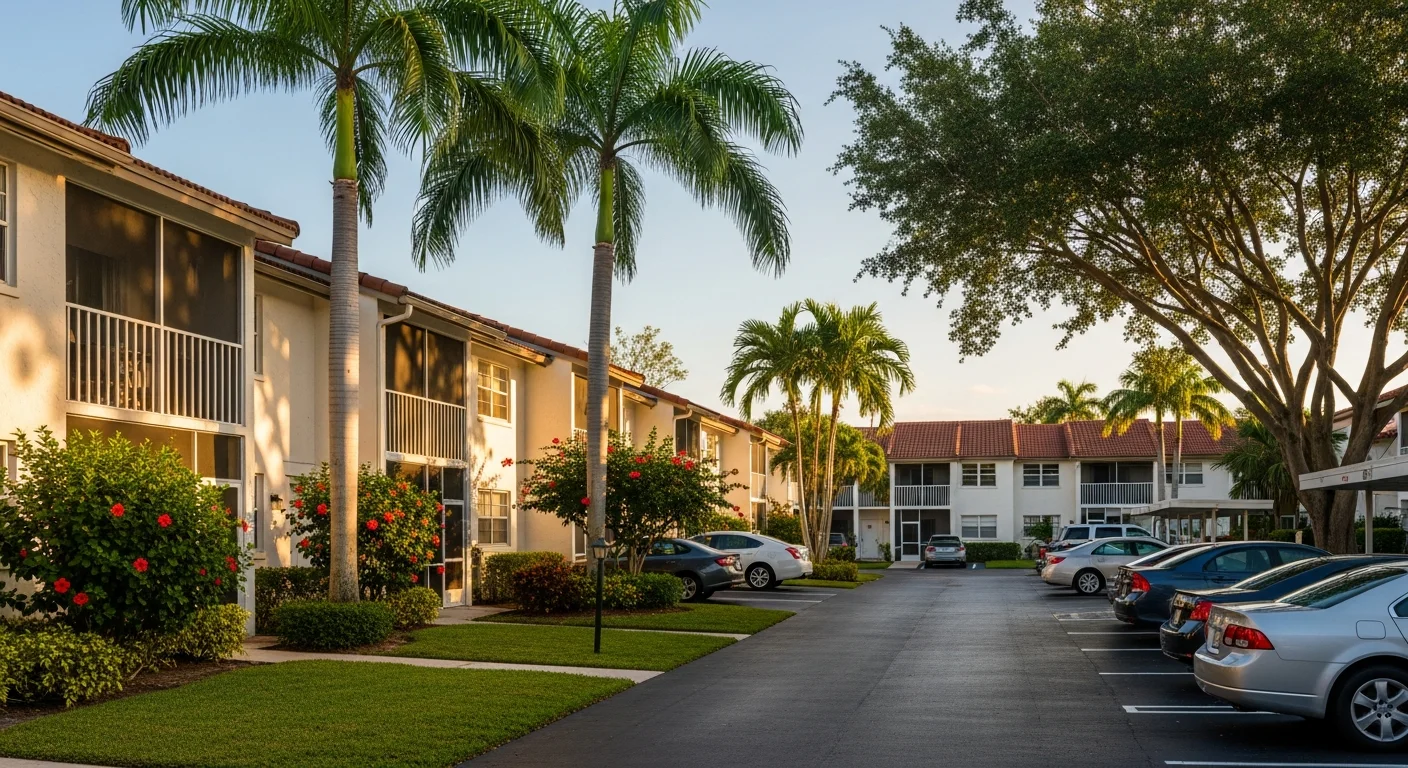
Coconut Creek's 72% multi-unit housing stock means shared HVAC systems, shared walls, and shared mold problems. When condensation from an aging air handler feeds colonies through the CBS block cavity between your condo and your neighbor's, Florida DBPR licensing isn't optional — it's the law. Palm Build's licensed team responds from Deerfield Beach in 15-25 minutes with containment protocols built for the multi-unit challenges that define this city.
5 miles — Coconut Creek, FL 15-25 min Response IICRC Certified
Why Coconut Creek Is One of North Broward's Worst Mold Environments
Coconut Creek sits in a subtropical zone where humidity never drops low enough to
inhibit mold growth. Combined with aging CBS stucco construction, 72% multi-unit housing
density, and HVAC systems approaching end-of-life, the city faces chronic mold
conditions that require professional remediation — not DIY bleach treatments. When
moisture enters these structures, mold can begin growing in 24 to 48 hours.
Year-Round Humidity Above 70%
70%+
Year-round humidity
Unlike seasonal climates where winter cold kills active colonies, Coconut Creek never drops below 60% relative humidity. This chronic subtropical moisture sustains mold growth 365 days a year — every wall cavity, every HVAC plenum, every tile grout line is a potential colonization site regardless of season.
Multi-Unit Moisture Migration
72%
Multi-unit housing stock
With 72% of Coconut Creek housing in condos and townhomes, shared walls act as moisture highways. A slow HVAC condensate leak in one Wynmoor unit can wick through the shared CBS block wall and establish a mold colony in the adjacent unit within days — often without either owner knowing until spore counts trigger health symptoms.
Aging HVAC Systems & Ductwork
1989
Median year built
Coconut Creek's median build year of 1989 means thousands of homes still run on original HVAC ductwork approaching 35+ years old. Condensation forms inside aging ducts, drip pans overflow from clogged drain lines, and the system distributes spores to every room in the home. HVAC-related mold is the #1 hidden mold source we find in Coconut Creek.
CBS Construction Traps Moisture
CBS
Dominant construction type
Concrete block and stucco (CBS) construction dominates Coconut Creek. When exterior stucco develops hairline cracks — inevitable in 35-year-old homes — wind-driven rain penetrates and saturates the porous block core. This trapped moisture never dries in South Florida humidity, creating an invisible mold incubator inside the wall cavity that surface inspection cannot detect.
Upstairs water leaks are one of the most common mold triggers in Coconut Creek condos —
moisture migrates through shared floor-ceiling assemblies and colonizes hidden cavities
before visible staining appears.
Neighborhood Mold Risk Profiles
Coconut Creek Neighborhood Mold Risk by Community
From Wynmoor's 6,300+ condo units to Emerald Lake Park's 1969-era homes, every Coconut
Creek neighborhood carries a distinct mold risk profile shaped by construction era,
housing density, and building materials.
Wynmoor's 6,368 condo units share CBS block walls and aging HVAC systems. One unit's condensate leak creates mold in two units. Original 1982 ductwork distributes spores through entire buildings. The community's size means a single water event can trigger multi-unit mold cascades requiring coordinated remediation across HOA and individual policies.
Homes in The Hammocks era often contain polybutylene plumbing that reacts with chlorinated municipal water and cracks from the inside. These hidden leaks saturate CBS block walls for months before visible mold appears. By the time you smell mold, the colony has penetrated deep into the block core.
Emerald Lake Park
Very High
Built: 1969Type: SFH/duplex — oldest stock
Cast iron leaks, chronic hidden moisture, oldest housing
As Coconut Creek's oldest housing stock, Emerald Lake Park homes may still have original cast iron drain pipes that corrode from the inside. These slow, chronic leaks create persistent hidden moisture that feeds mold colonies for years. The 55+ year age of these structures means every water system component is at or past end-of-life.
Centura Parc
High
Built: 1982Type: Gated community condos
Aging building envelope, interior humidity issues
Centura Parc's gated condo community features 1982-era CBS construction with aging window seals, stucco cracks, and original weatherstripping. The building envelope no longer seals out South Florida moisture, and AC systems struggle to maintain humidity below 60%. Interior mold appears most commonly around windows, behind vanities, and in HVAC closets.
Coco Parc
Moderate-High
Built: 1980Type: Townhome community
Repeated micro-wetting events, hidden moisture in older assemblies
Coco Parc townhomes experience repeated micro-wetting events from HVAC condensate, minor plumbing drips, and stucco penetration that individually seem minor but cumulatively saturate building materials. Mold in these units often grows behind baseboards and under flooring where repeated small water events keep materials chronically damp.
Regency Lakes
Moderate
Built: 1997Type: Newer townhomes/SFH
HVAC condensation mold, ductwork colonization
As one of Coconut Creek's newer communities, Regency Lakes has fewer plumbing and envelope issues — but HVAC-related mold is prevalent. The 25+ year old systems develop condensation inside ductwork, creating visible mold on supply registers and musty odors when the system cycles on. Duct cleaning alone won't resolve the issue; the condensation source must be addressed.
Coconut Creek's 72% multi-unit housing density means mold remediation often requires
coordination between unit owners, HOAs, and multiple insurance policies.
Hidden Mold Locations
Where Mold Hides in Coconut Creek Homes
CBS stucco construction, multi-unit shared walls, and year-round humidity create mold
colonization sites that surface cleaning cannot reach. Here's where our DBPR-licensed
team finds mold most frequently in Coconut Creek.
Behind Bathroom Vanities
Bathrooms — All Floor Levels
Upstairs bathrooms create the most common mold path in Coconut Creek condos. Slow supply line drips, failed wax ring seals, and condensation from hot showers migrate downward through the floor assembly. Mold colonizes the wall cavity behind vanities where warm, humid air meets the cooler CBS block surface — creating the ideal condensation-mold cycle.
Supply line drip behind vanity cabinet
Failed wax ring seal at toilet base
Condensation on cold CBS block behind drywall
Grout failure in shower allowing water behind tile
Inside CBS Wall Cavities
Exterior & Shared Walls
CBS (concrete block and stucco) wall cavities are invisible mold incubators. Hairline stucco cracks admit wind-driven rain that saturates the porous block core. In Coconut Creek's 70%+ humidity, this trapped moisture never dries. Mold grows inside the cavity — invisible from both sides of the wall — until spore counts trigger respiratory symptoms or a musty odor becomes unmistakable.
Stucco hairline crack moisture penetration
Wind-driven rain wicking into block cores
Invisible colonization between block cells
Requires controlled demolition to expose and treat
On HVAC Ductwork & Plenums
Throughout Home via Duct System
When warm, humid air contacts cold duct surfaces, condensation forms inside the ductwork. This chronic moisture supports mold growth on duct interiors and supply register surfaces. Every time the system cycles, it distributes spores to every room. In Coconut Creek homes with original 1980s-era ductwork, the problem is compounded by degraded duct insulation that holds moisture.
Condensation inside supply duct runs
Mold on supply register grilles (visible dark spots)
Degraded duct insulation trapping moisture
Air handler interior mold from clogged drain lines
Under Tile Flooring Near Wet Areas
Kitchens, Bathrooms, Laundry
Coconut Creek homes predominantly feature tile-on-slab construction. Water from appliance leaks, overflows, and condensation migrates under tile through grout joints and settles at the slab-tile interface. Mold colonies grow on the underside of tile and in thinset mortar — invisible from above but detectable by musty odors and elevated moisture meter readings.
Appliance leak migration under tile via grout joints
Slab moisture wicking upward through compromised grout
Thinset mortar as organic food source for mold
Requires tile removal for proper remediation
Behind Baseboards After Water Events
All Rooms — Post-Water Damage
After any water event — pipe burst, HVAC condensate overflow, upstairs flooding — water pools at the wall-floor junction and wicks up behind baseboards into the bottom 6-12 inches of drywall. This trapped moisture zone is the fastest mold colonization site in a Coconut Creek home, often showing visible growth within 48-72 hours in summer humidity.
Water wicking up drywall behind baseboard trim
Mold growth in bottom 6-12 inches of wall cavity
Paper-faced drywall as primary food source
Often missed by surface-only drying attempts
In Shared Walls Between Condo Units
Multi-Unit Buildings
Shared CBS block walls between condo units create direct moisture migration paths. When one unit experiences a water event, moisture travels through the porous block core to the adjacent unit. The receiving unit often discovers mold before the originating unit does — creating complex multi-party insurance and HOA liability situations unique to Coconut Creek's high-density housing.
Moisture migration through shared CBS block walls
Adjacent unit mold from neighbor's water event
Complex HOA/owner liability determination
Requires access to both units for proper remediation
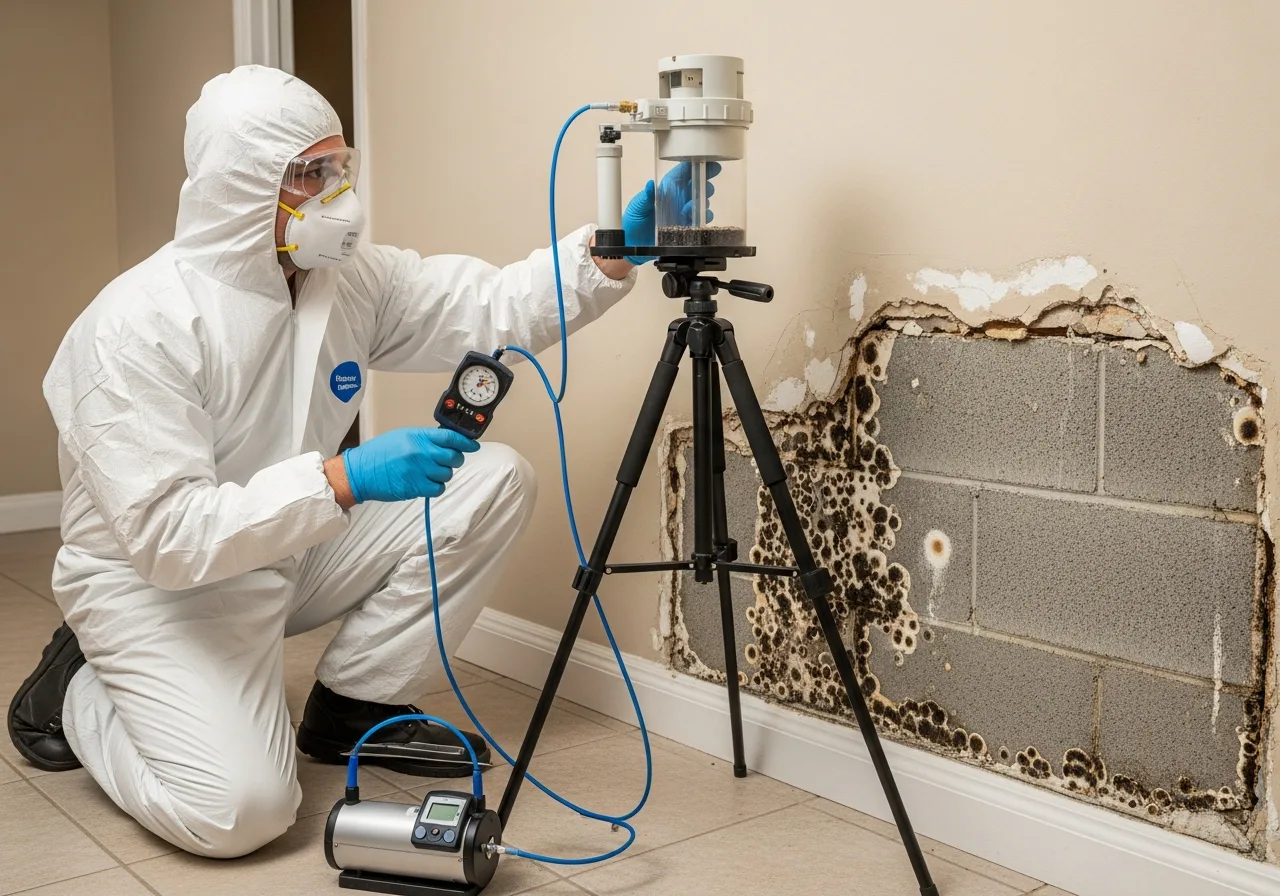
Air quality testing detects elevated spore counts from hidden mold colonies — critical
in Coconut Creek CBS homes where mold grows inside wall cavities invisible to the eye.
Our Coconut Creek Process
How We Remediate Mold in Coconut Creek Homes
Every mold remediation follows IICRC S520 protocols adapted for Coconut Creek's CBS
stucco construction and multi-unit housing. Here's exactly what happens when you call
Palm Build.
01
Mold Inspection & Testing
Day 1
02
Containment Setup
Day 1-2
03
HVAC Isolation
During Containment
04
Mold Removal & Treatment
Days 2-4
05
Structural Drying
Days 3-7
06
Clearance Testing & Restoration
Days 5-10+
01
Mold Inspection & Testing
Day 1
DBPR-licensed mold assessors perform visual inspection, infrared thermal imaging to locate hidden moisture sources, and air quality sampling to quantify spore counts by species. In Coconut Creek CBS homes, we use pin-type and non-invasive moisture meters to map moisture inside block walls without unnecessary demolition.
02
Containment Setup
Day 1-2
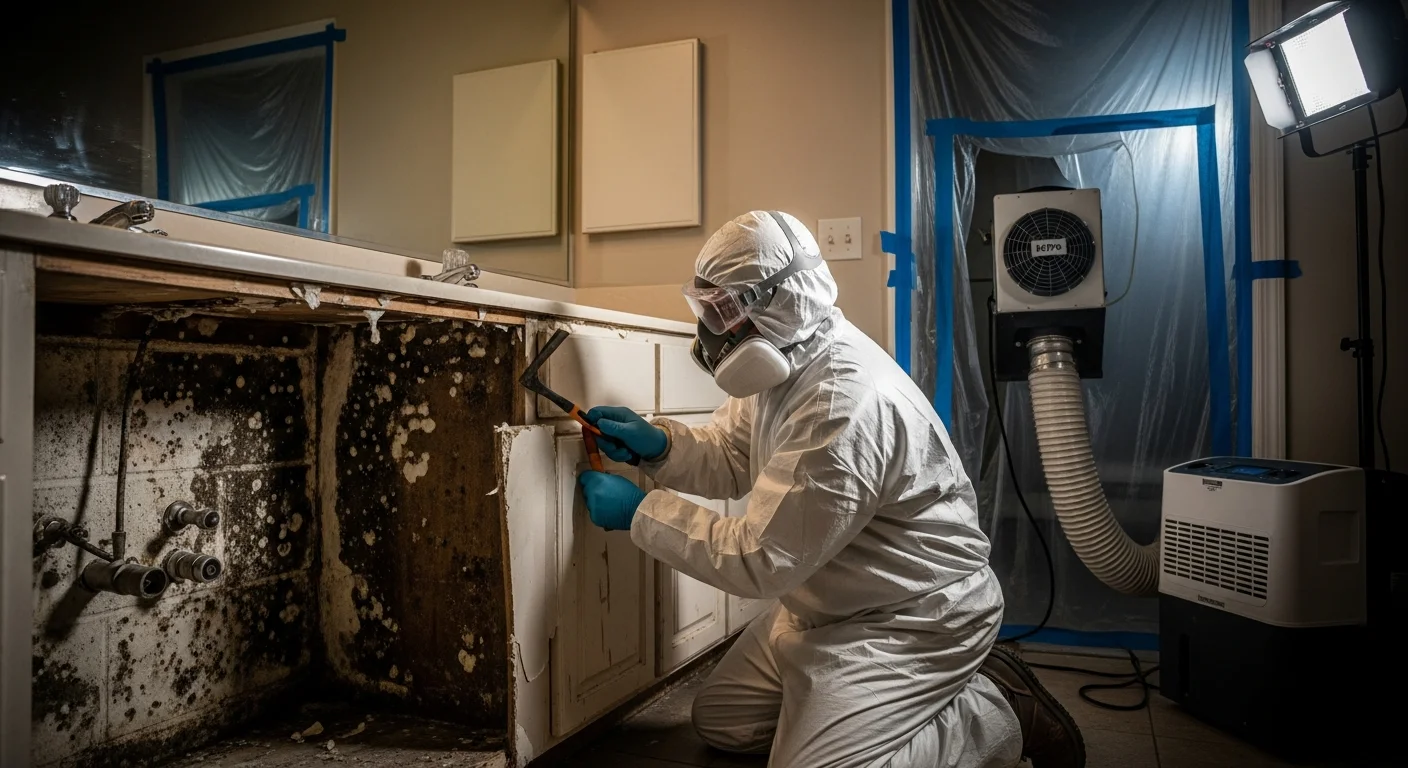
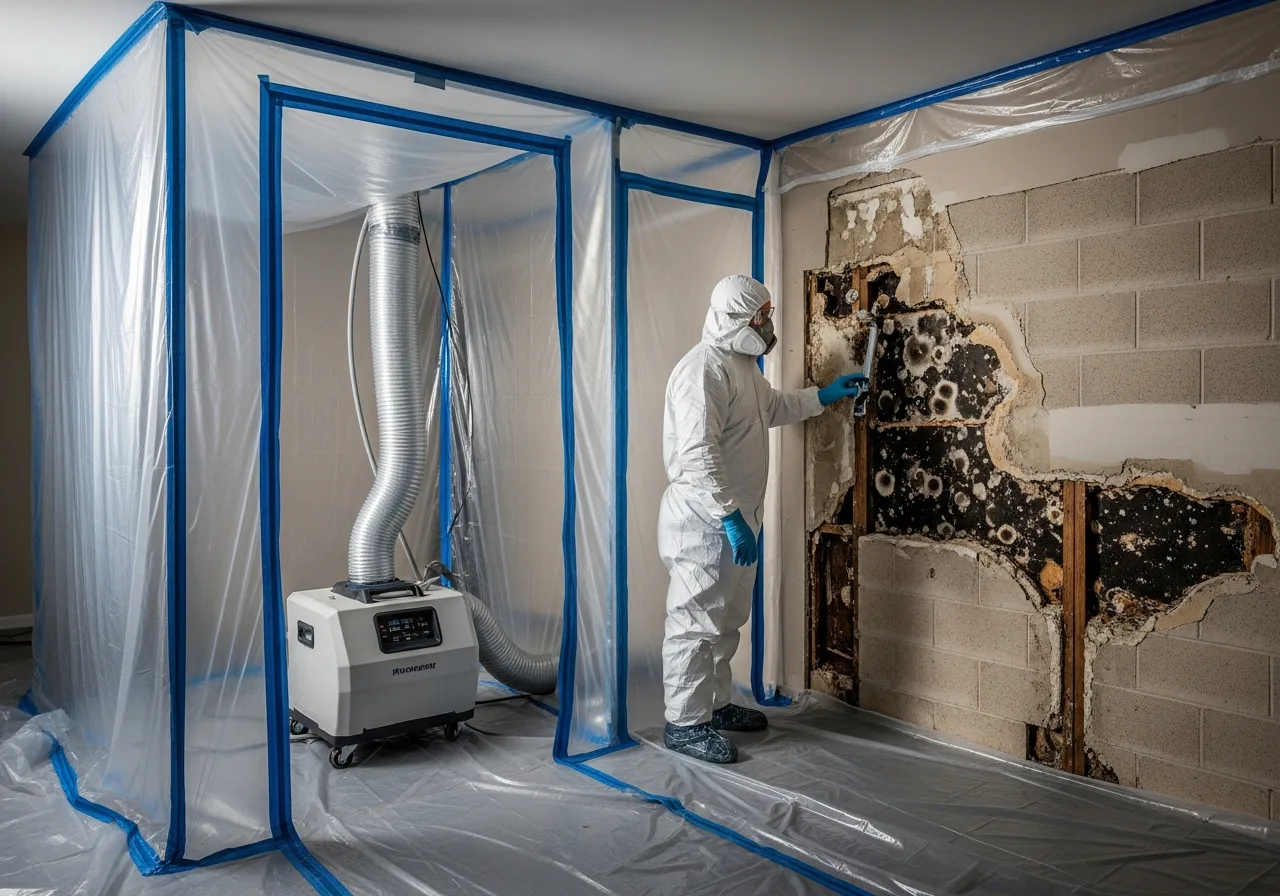
Negative air pressure containment using 6-mil poly barriers isolates the affected area. HEPA air scrubbers filter particles down to 0.3 microns. In Coconut Creek condos, containment is critical — without proper barriers, remediation in one unit can push spores through shared HVAC systems and wall penetrations into adjacent units.
03
HVAC Isolation
During Containment
The HVAC system is shut down and sealed at supply and return registers within the containment zone to prevent spore distribution through ductwork. In multi-unit Coconut Creek buildings with shared HVAC infrastructure, we coordinate with the HOA to isolate the building system if needed — preventing cross-contamination to other units.
04
Mold Removal & Treatment
Days 2-4
HEPA vacuuming removes surface spores from all materials. Affected porous materials (drywall, insulation, carpet) are cut out and removed in sealed bags. Non-porous surfaces receive EPA-registered antimicrobial treatment. For CBS block walls in Coconut Creek homes, controlled demolition exposes the block core for direct treatment of colonized substrate.
05
Structural Drying
Days 3-7
Addressing the root moisture source is essential — without it, mold returns. Commercial LGR dehumidifiers and air movers dry CBS block walls, subfloor assemblies, and building cavities to dry standard. In Coconut Creek's 70%+ humidity, aggressive mechanical drying is required because ambient air cannot dry building materials below the mold-safe threshold.
06
Clearance Testing & Restoration
Days 5-10+
A third-party DBPR-licensed mold assessor (not our company — Florida law requires separation) performs post-remediation verification (PRV) air sampling. Clearance means spore counts are at or below outdoor ambient levels. Only after clearance do we begin reconstruction: drywall, paint, flooring, and trim to match Coconut Creek home finishes.
Why Our Coconut Creek Process Works
1
DBPR Licensed
Fully licensed mold remediation company under Florida Statute Chapter 468, Part XVI
2
CBS Expertise
Specialized techniques for mold inside concrete block wall cavities — the dominant construction in Coconut Creek
3
Condo Coordination
Experience working with HOAs, property managers, and multi-party claims across Wynmoor, Centura Parc, and all major communities
4
Third-Party Clearance
Post-remediation verification by independent DBPR-licensed assessor ensures your home is safe to reoccupy
When Coconut Creek Homes Are Most Vulnerable to Mold
Mold risk in Coconut Creek follows predictable patterns — but the year-round subtropical
humidity means there is no safe season. Knowing when risk peaks helps you respond faster
and prevent costly colonization.
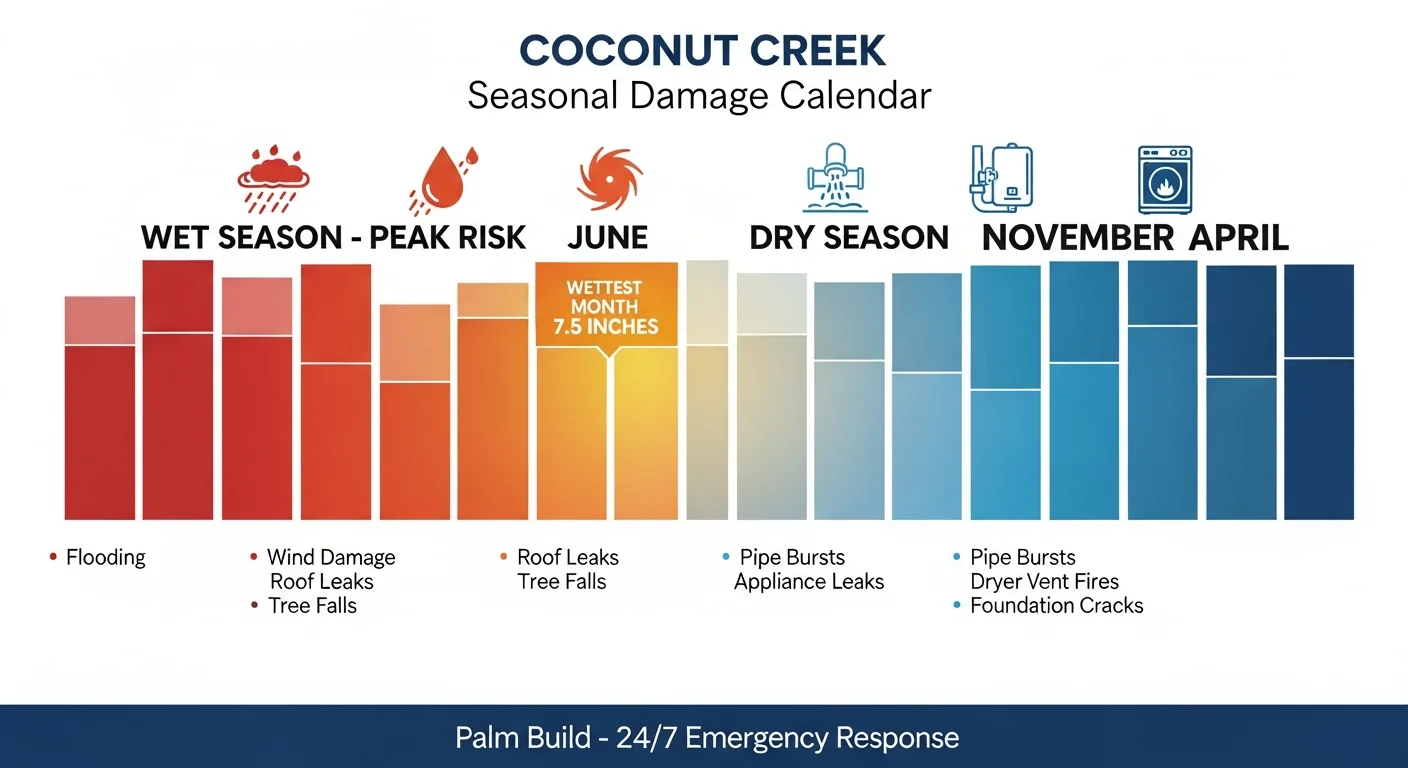
Coconut Creek's wettest months combine peak rainfall (August averages 8+ inches), peak humidity (80-90%), and frequent storm-driven water intrusion events. Every roof tile displaced, every stucco crack penetrated, and every HVAC system overwhelmed by condensation feeds mold colonization. Post-storm hidden moisture is the #1 mold trigger we respond to in Coconut Creek.
October - December
Post-Storm Mold Discovery
High Risk
Hidden moisture from summer storms, deferred drying, CBS block saturation
Mold discovered in fall typically traces back to water intrusion events weeks or months earlier. CBS block walls hold moisture invisibly — there's no discoloration or warping to alert homeowners. By the time musty odors or health symptoms appear, the colony is well established inside wall cavities and HVAC systems.
Year-Round
HVAC Condensation Mold
AC runs 12 months, condensate drain clogs, duct condensation
The most common hidden mold source in Coconut Creek — not seasonal but constant. AC condensate drain pans, drain lines, and air handler interiors produce chronic moisture when not serviced. Coconut Creek's aging 1980s-era HVAC systems are particularly prone to condensation inside ductwork, creating mold that the system distributes to every room.
January - April
Snowbird Return Mold Discovery
Units closed for months, AC set too high, no air circulation
Coconut Creek's 55+ communities (Wynmoor, Centura Parc) have significant seasonal populations. Units closed during summer with AC set to 78-80°F cannot maintain humidity below 60%. Returning owners discover mold in closets, behind furniture, and inside HVAC systems that ran unmonitored for months. We see a surge in mold calls every January-February.
In Coconut Creek's 72% multi-unit housing, mold migration between units is a year-round event. A small leak in one unit saturates the shared CBS block wall and colonizes the neighbor's side. These events spike after any plumbing failure but occur constantly from chronic condensate and micro-leak sources across the city's condo stock.
Mold Damage Categories
Types of Mold Damage in Coconut Creek Homes
CBS stucco construction, multi-unit shared walls, and year-round subtropical humidity
create mold damage patterns unique to Coconut Creek. Here's what our DBPR-licensed team
encounters most frequently.
HVAC Condensate & Plumbing Mold
Year-Round
AC systems in Coconut Creek run 12 months continuously. Condensate drain pans overflow, drain lines clog with biofilm, and air handler interiors become mold incubators. Add polybutylene pipe failures in 1978-1995 homes — slow, hidden leaks inside CBS walls create the chronic moisture that feeds persistent mold colonies invisible to the homeowner.
Condensate pan overflow — most common hidden mold source
Clogged condensate drain lines creating standing water
Polybutylene pipe micro-cracks behind CBS walls
Air handler interior mold distributed through ductwork
Storm-Driven Moisture & Post-Hurricane Mold
June - November
Hurricane season drives wind-blown rain through stucco cracks, displaces barrel tiles creating roof intrusion paths, and overwhelms drainage systems. The mold from these events often doesn't appear until weeks later when hidden moisture in CBS block walls reaches critical saturation. Post-storm mold remediation is our highest-volume service in Coconut Creek.
Wind-driven rain through stucco micro-cracks into block core
Barrel tile displacement exposing underlayment to rain
Saturated CBS block walls holding moisture for weeks
Post-storm mold appearing 2-6 weeks after water intrusion
CBS Block Wall Cavity Mold
Year-Round
CBS (concrete block and stucco) construction traps moisture inside block cores where it cannot be seen or dried from the surface. In Coconut Creek's 70%+ humidity, this trapped moisture sustains invisible mold colonies that grow for months or years. Detection requires moisture meters and thermal imaging — visual inspection alone is unreliable for CBS wall mold.
Mold growing inside hollow block cores — invisible from both sides
Stucco crack moisture penetration wicking into porous block
Requires controlled demolition for access and treatment
Thermal imaging reveals temperature anomalies indicating hidden moisture
Multi-Unit Cross-Contamination Mold
Condo & Townhome Specific
Coconut Creek's 72% multi-unit housing stock creates unique mold scenarios. Shared CBS block walls transmit moisture between units. Shared plumbing risers leak into adjacent walls. Upstairs units flood downstairs neighbors. Each event creates mold in two or more units — requiring coordinated remediation, multiple insurance claims, and HOA involvement.
Shared-wall moisture migration creating adjacent unit mold
Upstairs water events causing downstairs ceiling/wall mold
Shared plumbing riser failures affecting multiple units
Complex multi-party claims involving HOA master policy and HO-6
Cost Guide
Mold Remediation Costs in Coconut Creek
Costs depend on scope, mold species, and the specific challenges of CBS stucco
construction. Coconut Creek's high condo density and CBS block walls often push costs
higher than drywall-only homes because block wall remediation requires more demolition
and reconstruction.
Single Room
$1,500 - $5,000
Contained area, one surface type
Common Scenarios
Bathroom mold behind vanity from slow supply leak
HVAC closet mold from condensate pan overflow
Single-wall mold from stucco crack penetration
Laundry area mold from washing machine line failure
Multi-Room
$5,000 - $15,000
CBS block wall demolition, multiple areas
Common Scenarios
CBS block wall cavity mold requiring controlled demolition
HVAC ductwork mold affecting multiple rooms
Post-storm hidden moisture mold in 2-3 rooms
Upstairs flooding causing mold in unit below
Multi-Unit / Large Scale
$20,000 - $50,000+
Cross-unit migration, full system remediation
Common Scenarios
Multi-unit condo mold cascade through shared CBS walls
Building-wide HVAC contamination from shared duct systems
Post-hurricane multi-unit mold from extended saturation
Full CBS block wall system mold with structural involvement
Mold Insurance Coverage in Florida
Most Florida homeowners policies cover mold only when it results from a covered peril
(sudden pipe burst, appliance failure). Many policies cap mold coverage at $10,000 - $25,000 unless a mold endorsement was
purchased. Mold from long-term humidity, deferred maintenance, or gradual leaks is
typically excluded. Under Florida's 2022 reform, you have 1 year to file an initial claim. Palm Build documents
the moisture source with thermal imaging and moisture data to support your covered-peril
claim.
Florida Mold Licensing
Florida Mold Remediation Licensing: What Coconut Creek Homeowners Need to Know
Florida requires specific DBPR licensing for mold remediation — one of the strictest
regulatory frameworks in the nation. Understanding these requirements protects your
health, your insurance claim, and your investment.
DBPR Chapter 468, Part XVI Requirements
Florida law — not optional
Florida is one of the few states that requires licensing for mold remediation. Under Chapter 468, Part XVI of Florida Statutes, any company performing mold remediation must hold an active license through the Department of Business and Professional Regulation (DBPR). This applies to all work in Coconut Creek — residential, commercial, and condo.
Mold Assessor vs. Mold Remediator
Must be separate companies
Florida law mandates that mold assessment and mold remediation be performed by separately licensed entities. The company that tests and identifies your mold cannot be the same company that remediates it. This separation of duties prevents conflicts of interest — the assessor who writes the clearance report must be independent from the remediation company.
Risks of Hiring Unlicensed Companies
Can void insurance claims
Unlicensed mold work in Florida is illegal. Beyond the legal risk, hiring an unlicensed company can void your insurance claim entirely — carriers require proof of licensed remediation for claim reimbursement. Unlicensed companies also cannot provide the post-remediation verification (PRV) documentation that proves your home is safe to reoccupy.
How to Verify a Mold License
myfloridalicense.com
Before hiring any mold company in Coconut Creek, verify their license at myfloridalicense.com — the official DBPR license verification portal. Search by company name or license number. Confirm the license is active (not expired, suspended, or revoked) and that it covers the specific service type: mold remediation or mold assessment.
Palm Build's Licensing Credentials
DBPR licensed + IICRC certified
Palm Build holds active DBPR mold remediation licenses and maintains IICRC certifications in Applied Microbial Remediation (AMRT). Our technicians are individually certified and undergo annual continuing education. We carry the liability insurance coverage required by Florida law and by every HOA in Coconut Creek — including Wynmoor, Centura Parc, and Regency Lakes.
What Proper Licensing Means for You
Your protection
Working with a DBPR-licensed remediation company ensures your project follows IICRC S520 protocols, uses proper containment and PPE, provides legally compliant documentation, and produces a valid post-remediation clearance report from an independent assessor. This documentation is essential for insurance claims, real estate transactions, and your family's health.
Verify Before You Hire — Every Time
In Coconut Creek's competitive restoration market, unlicensed operators frequently
advertise mold services. Before signing any contract, verify the company's DBPR mold
remediation license at myfloridalicense.com. Ask for the license number upfront — legitimate companies provide it readily. Palm
Build's license information is available upon request and verifiable through DBPR.
Mold Insurance Guide
Navigating Mold Insurance Claims in Coconut Creek
Florida mold insurance is uniquely restrictive. Most policies cap mold coverage at
$10,000-$25,000 with strict sublimits, and only cover mold resulting from a "covered
peril." Coconut Creek's condo density adds complexity with master policy vs. HO-6
liability questions.
Florida Claim Filing Deadlines (Shortened in 2022)
1 Year
Initial and reopened claims must be filed within 1 year of date of loss
Fla. Stat. §627.70132
18 Months
Supplemental claims must be filed within 18 months of original claim date
Fla. Stat. §627.70132
Missing either deadline forecloses coverage entirely. Palm Build documents
the mold source and extent from day one so your claim filing meets these tight deadlines.
Typically Covered (Mold from Covered Peril)
Mold from sudden pipe burst or supply line failure
Mold from appliance malfunction (dishwasher, washing machine)
Mold from storm-driven rain intrusion through roof or windows
Mold from upstairs unit flooding (condo — HO-6 or master policy)
Mold from accidental overflow (toilet, bathtub)
Typically NOT Covered
Mold from long-term humidity or poor ventilation
Mold from deferred HVAC maintenance (clogged condensate)
Mold from gradual/slow leaks discovered over time
Mold from flood damage (requires separate flood policy)
Mold exceeding policy sublimit ($10K-$50K cap)
Condo Mold Claims: Master Policy vs. HO-6
In Coconut Creek's condo communities, mold liability depends on where the moisture
originated. Under Florida Statute 718.111(11), the HOA's master
policy covers common elements — shared plumbing risers, exterior walls, and roofing.
If mold in your unit resulted from a common element failure, the master policy
responds first. If the mold stems from conditions within your unit (HVAC condensate,
dishwasher leak), your HO-6 unit-owner policy applies. Most HO-6
policies carry mold sublimits of $10,000-$50,000. Palm Build
documents the moisture origin point for both carriers and coordinates directly with
property management to determine liability.
Palm Build's project managers guide Coconut Creek homeowners and condo owners through
mold insurance claims — from documenting the moisture source to coordinating with HOA
master policies and individual HO-6 carriers.
Our Local Work
Mold Remediation in Coconut Creek
Real mold remediation projects in Coconut Creek CBS stucco homes and condos — from
initial containment and HEPA filtration through complete clearance testing and
restoration.
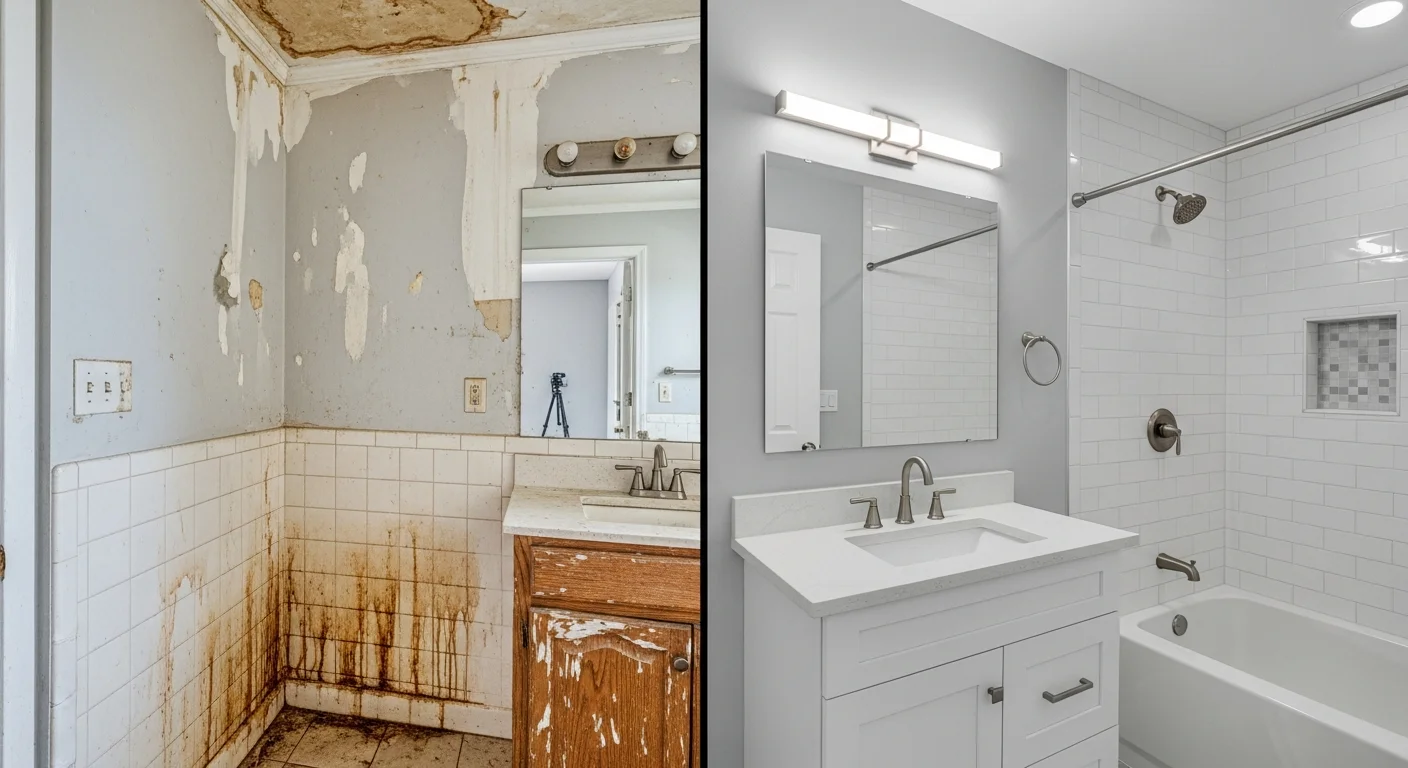
Coconut Creek condo bathroom — from mold-damaged walls and ceiling to complete remediation and restoration
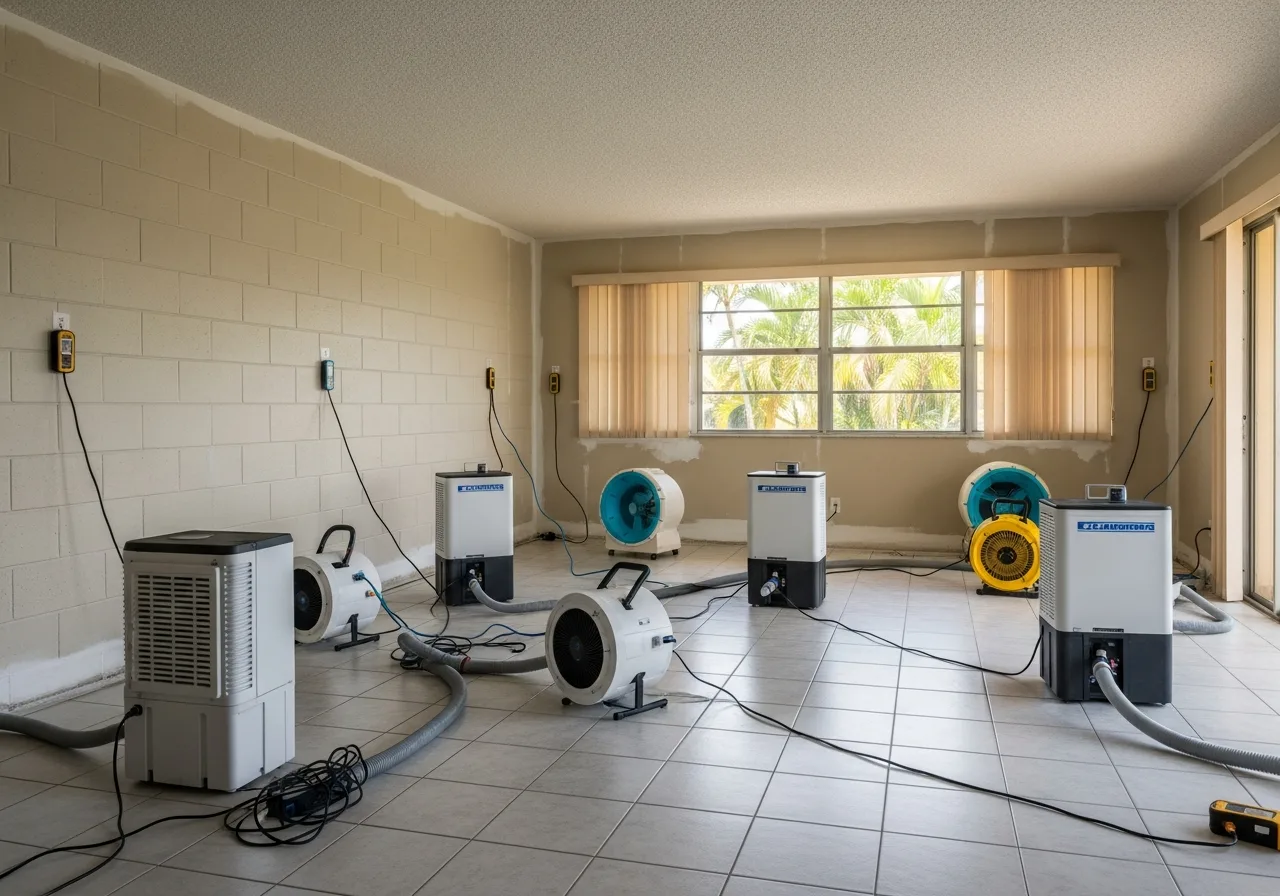
Commercial drying and HEPA air scrubbing setup in a Coconut Creek condo — critical for CBS block wall drying after mold remediation
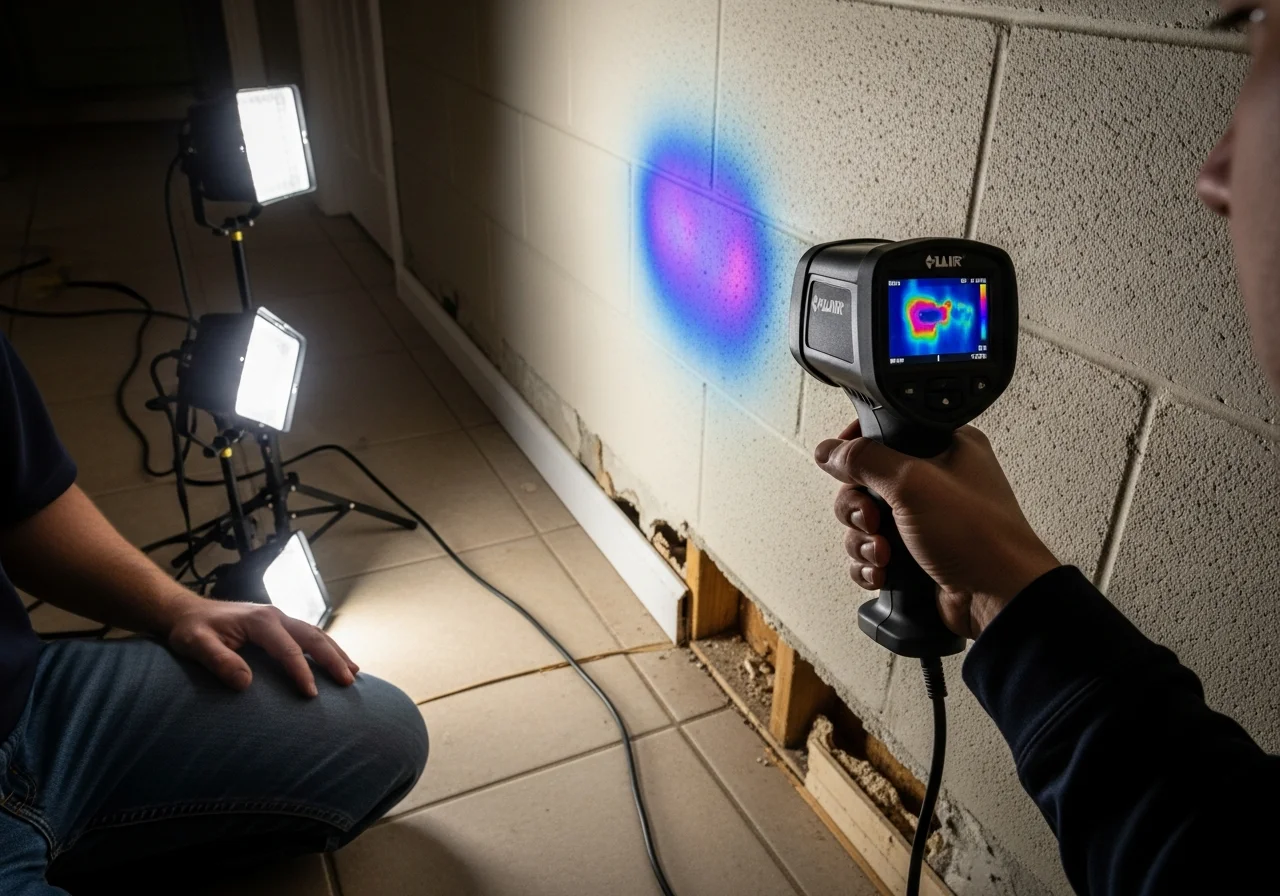
Thermal imaging reveals hidden moisture behind CBS block walls that visual inspection misses — the first step in locating hidden mold
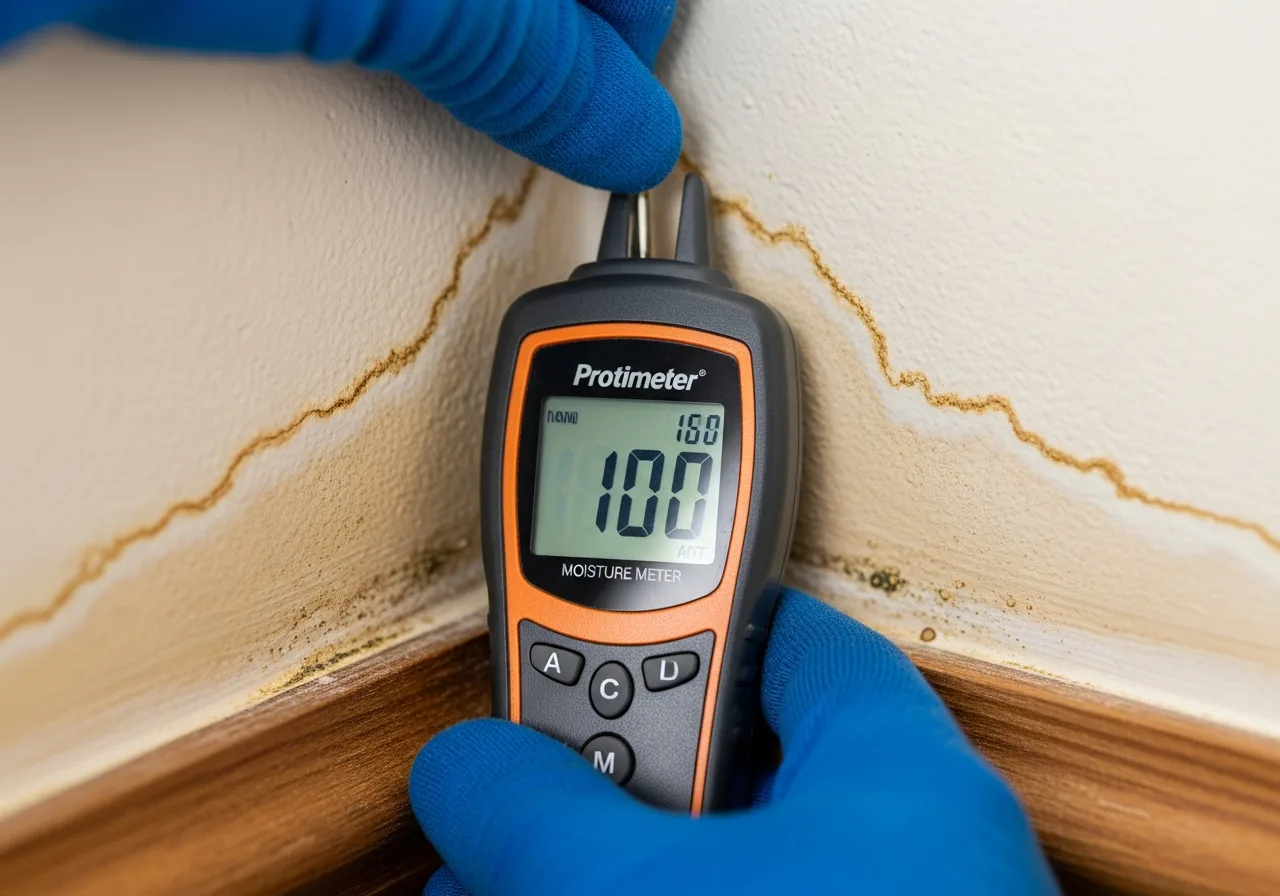
Elevated moisture readings on a CBS block wall confirm hidden water — the moisture source feeding mold colonization inside the wall cavity
The Local Advantage
Why Coconut Creek Homeowners Choose Palm Build for Mold Remediation
Palm Build's South Florida hub is 10 minutes from Coconut Creek. DBPR-licensed,
IICRC-certified, and deeply experienced with CBS block wall mold and multi-unit condo
remediation — the exact challenges that define Coconut Creek's mold landscape.
10 Minutes from Coconut Creek
Our South Florida operations hub is at 786 S Military Trail in Deerfield Beach — just east on Sample Road. We deploy to Coconut Creek in approximately 20 minutes, faster than any franchise operating from Fort Lauderdale or Boca Raton.
DBPR Licensed Mold Remediation
Fully licensed under Florida Statute Chapter 468, Part XVI for mold remediation. Our technicians hold individual IICRC Applied Microbial Remediation (AMRT) certifications. We meet every licensing and insurance requirement that Florida law and Coconut Creek HOAs demand.
CBS Block Wall Mold Specialists
We understand how mold colonizes CBS stucco construction at a molecular level. Our techniques — including controlled block core demolition, injection drying, and antimicrobial treatment of porous block substrate — are engineered specifically for the concrete block construction that makes up virtually every Coconut Creek home.
Condo & HOA Mold Experts
With Wynmoor, Centura Parc, Coco Parc, and dozens of HOA-governed communities in Coconut Creek, we work with property managers, boards, and multi-party insurance claims daily. We carry the insurance certificates your HOA requires and coordinate access to adjacent units when shared-wall mold migration requires multi-unit remediation.
20-Minute Emergency Response
Because we are based in Deerfield Beach — not a satellite office 30 miles away — our emergency response to anywhere in Coconut Creek is approximately 20 minutes. When you discover mold, speed matters: every hour without containment increases spore distribution through your HVAC system.
Insurance Documentation from Day One
Florida's 1-year claim deadline means documentation cannot wait. We photograph, moisture-map with thermal imaging, collect air quality samples, and scope every detail your adjuster needs — formatted for your specific carrier — from the moment we arrive. For condo claims, we document the moisture origin point to determine master policy vs. HO-6 liability.
Common Questions
Coconut Creek Mold Remediation FAQ
Does Florida require a license for mold remediation in Coconut Creek?
Yes. Florida Statute Chapter 468, Part XVI requires all mold remediation exceeding 10 square feet to be performed by a DBPR-licensed mold remediator. A separate DBPR-licensed mold assessor must conduct pre-remediation testing and write the remediation protocol — the same company cannot perform both assessment and remediation on the same structure within 12 months. This conflict-of-interest rule prevents the company that finds the mold from profiting by removing it. Palm Build holds a current DBPR mold remediator license and coordinates with independent licensed assessors for all pre- and post-remediation testing. Verify any company's license at myfloridalicense.com before hiring.
Who is responsible for mold in a Coconut Creek condo — the unit owner or the HOA?
Liability depends on where the moisture source and mold originate. Under Florida Statute 718.111(11), the condo association maintains common elements including the building structure, exterior walls, roof, and shared plumbing risers. If mold in your unit resulted from a roof leak, a failed plumbing riser, or inadequate building envelope maintenance, the HOA's master insurance policy generally responds first. If the mold stems from conditions within your unit — a failing HVAC condensate line, a leaking appliance, or a deteriorated shower pan — your HO-6 unit-owner policy applies. When mold migrates through a shared wall, both the source unit's insurance and the affected unit's insurance may be involved. Palm Build documents the moisture origin point for both carriers.
How does mold spread between condo units in Coconut Creek?
CBS (concrete block and stucco) walls between Coconut Creek condo units are not hermetically sealed. Moisture migrates through mortar joints, electrical and plumbing penetrations, and the hollow cores of the concrete blocks themselves. A slow HVAC condensate leak in one unit can saturate the shared wall and feed mold growth in the neighboring unit's closet, bedroom, or bathroom. Upstairs plumbing leaks in one unit feed mold on the ceiling of the unit below. In buildings with shared HVAC ductwork or plenum connections, spores from one contaminated air handler can distribute to multiple units simultaneously. Palm Build traces mold migration paths using thermal imaging and moisture mapping across all potentially affected units.
How much does mold remediation cost in Coconut Creek?
Costs depend on contamination scope and construction complexity. Single-room remediation in a contained area typically runs $1,500-$5,000. Multi-room remediation involving CBS wall cavity demolition and reconstruction ranges from $5,000-$15,000. Multi-unit projects with shared-wall migration, HVAC decontamination, and adjacent unit coordination can reach $20,000-$50,000+. Coconut Creek costs run higher than drywall-only construction because CBS block wall remediation requires specialized demolition, cavity treatment, and reconstruction. Add $300-$800 for the independent mold assessment and $300-$600 for post-remediation clearance testing — both required by Florida law.
Does homeowners insurance cover mold in Coconut Creek?
Most Florida homeowners and HO-6 condo policies cover mold only when it results from a covered sudden water event — a burst pipe, water heater failure, or appliance discharge. Mold from gradual moisture, HVAC condensation, humidity, or deferred maintenance is almost always excluded. Coverage is typically capped at a mold sublimit of $10,000-$25,000, often insufficient for full CBS wall remediation. Florida's 1-year claim filing deadline under Statute 627.70132 is strictly enforced. For condo mold involving shared walls, your HO-6 policy and the association's master policy may both apply depending on the moisture source location. Palm Build documents every project to connect the mold to the original covered water event when applicable.
What are the most common mold species found in Coconut Creek homes?
The four species Palm Build encounters most frequently in Coconut Creek are: Aspergillus — the most common indoor mold, thrives in HVAC systems and CBS wall cavities, causes allergic reactions and respiratory irritation; Penicillium — fast-growing blue-green mold that colonizes water-damaged drywall at lower moisture levels than other species; Cladosporium — the dominant outdoor mold in South Florida that enters through windows and HVAC fresh air intakes; and Stachybotrys chartarum (black mold) — requires continuous moisture to grow, produces mycotoxins causing respiratory distress and chronic fatigue, most commonly found behind walls with slow HVAC condensate leaks or persistent plumbing seepage.
How long does mold remediation take in a Coconut Creek condo?
Single-room remediation typically takes 2-4 days from containment setup through post-remediation clearance testing. Multi-room projects involving CBS wall demolition, HVAC decontamination, and structural drying extend to 5-10 days. Multi-unit projects with shared-wall involvement, adjacent unit access coordination, and HOA approval requirements can take 2-3 weeks. All timelines include the mandatory 24-48 hour wait for post-remediation clearance test lab results from the independent assessor. Coconut Creek's year-round humidity means dehumidification must run continuously during remediation — extending drying times compared to lower-humidity climates.
How can I prevent mold in my Coconut Creek condo?
In Coconut Creek's year-round high-humidity environment, prevention means controlling moisture below 60% relative humidity at all times. Have your HVAC system serviced twice per year with condensate drain line flushing and pan inspection. Run the AC continuously — not just when occupied — to dehumidify. If your unit will be vacant for more than two weeks (snowbird season), do not turn off the AC; set it to 78 degrees to maintain dehumidification. Check under sinks, behind toilets, and around water heaters monthly for slow leaks. Report any ceiling stains, musty odors, or elevated humidity to your property manager immediately — in Coconut Creek's shared-wall buildings, early intervention prevents one unit's moisture from becoming the building's mold problem.
Trusted Vendors
Trusted local pros in Coconut Creek
Outside our restoration scope, these are the vetted, licensed contractors we trust
alongside our work. Personally evaluated, reference-checked, and recommended by Palm
Build.
Mold Problem in Coconut Creek? Licensed Remediation 5 Miles Away.
Palm Build's DBPR-licensed mold remediation team responds from Deerfield Beach in 15-25 minutes with multi-unit containment expertise, IICRC AMRT-certified technicians, CBS wall cavity specialists, and the dual-policy insurance documentation Coconut Creek's condo owners need. Every hour of delay lets the colony spread further through shared walls.