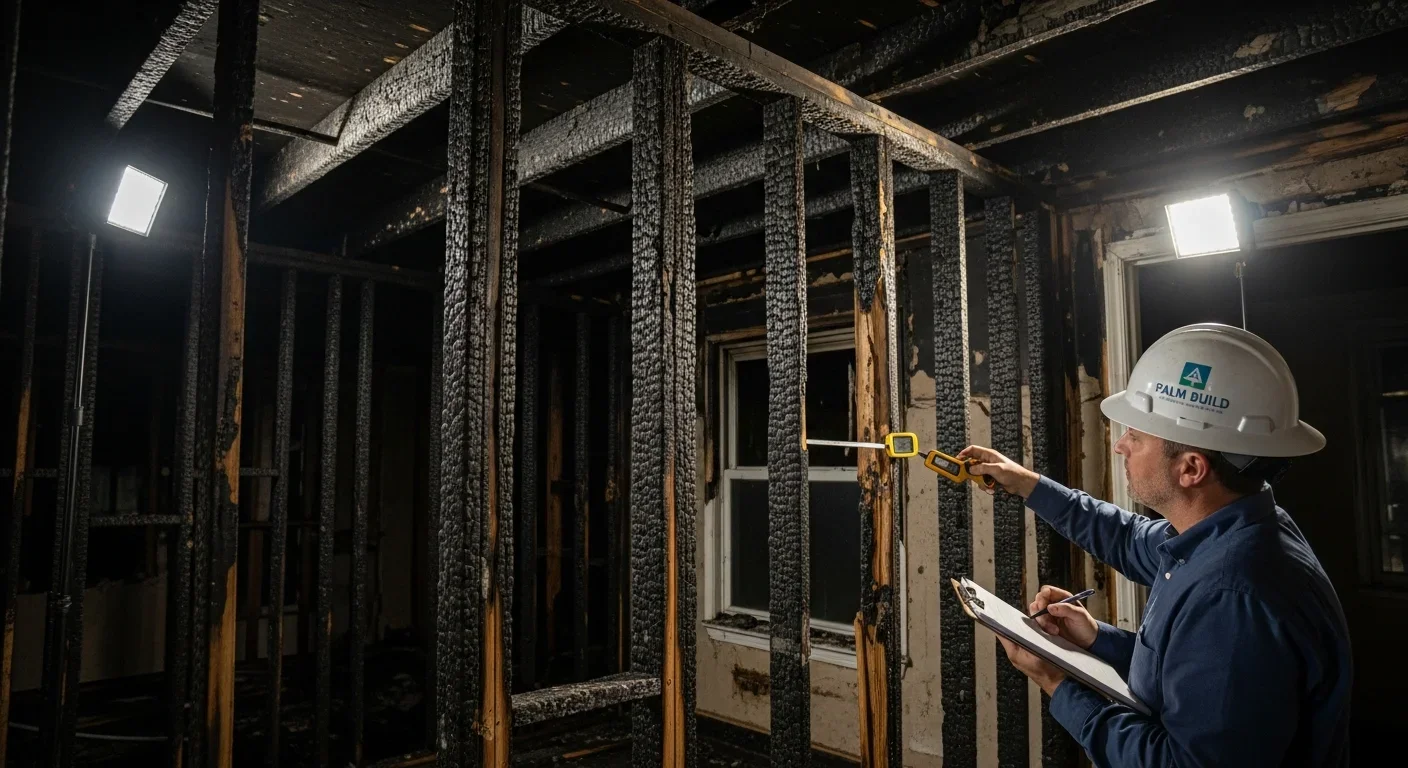
Engineer-Coordinated Structural Rebuild
Structural Fire Damage Restoration And Rebuild
When fire damages load-bearing framing, roof trusses, or headers, you're no longer dealing with a cleanup project — you're dealing with a structural rebuild that requires licensed engineer assessment, code-compliant design, and permit-level documentation. Palm Build coordinates every step: char depth measurement, structural engineer involvement, code upgrade scope, insurance supplement negotiation, and the actual rebuild.
Cost range
$15K-$200K+
Timeline
3-12 mo
Coordinated
Engineer + Code
Coverage
FL · NC · SC
How Char Depth Determines Rebuild vs Replace
Every charred structural member is evaluated using a char depth gauge — a thin metal probe that measures how deeply fire has damaged the wood from the surface inward. The remaining "sound wood" cross-section must be adequate to carry the member's intended load. This measurement, not appearance, determines whether the framing can be reused or must be replaced.
| Char depth | Status | Verdict | Protocol |
|---|---|---|---|
| 0 - 1/4 inch | Safe to clean and reuse | Salvageable | Dry-ice blast or chemical clean → sand → encapsulate with shellac primer → reuse in place |
| 1/4 - 1/2 inch | Engineer evaluation required | Conditional | Licensed structural engineer measures remaining sound cross-section vs load requirements |
| 1/2 - 1 inch | Likely replacement | Often replaced | Structural capacity typically compromised for standard 2x4/2x6 framing; replacement faster than repair |
| > 1 inch | Mandatory replacement | Replace | Structural member has lost critical cross-section; cannot be reliably reused even with reinforcement |
When A Licensed Structural Engineer Is Required
For any project involving load-bearing framing, roof trusses, or significant fire involvement, most building departments require a licensed structural engineer's stamp before issuing the rebuild permit. Palm Build maintains working relationships with engineers across Charlotte, South Florida, and the Carolinas, and coordinates their assessment as part of our standard structural fire damage workflow.
Step 1
Palm Build initial assessment
Our IICRC S700 certified crew walks the property, documents visible structural damage with photos, and measures preliminary char depths. If we identify any load-bearing member with > 1/4" char, we escalate to engineer involvement automatically.
Step 2
Licensed engineer walk-through
A licensed structural engineer performs a formal walk-through, typically within 3-5 business days. They verify char depths, calculate remaining load capacity, and identify which members can be reused vs replaced. The engineer produces a stamped report.
Step 3
Stamped rebuild plans
Engineer-stamped rebuild plans are submitted to the building department for permit. Palm Build's project manager coordinates with the plan reviewer and addresses any revision requests. Most municipalities return permits within 2-4 weeks of complete submission.
Load-Bearing Component Concerns
Not all structural members are equal. A charred roof truss cannot be handled the same way as a non-bearing partition wall. Here is how Palm Build classifies load-bearing concerns in a typical fire-damaged residential structure.
| Structural component | Concern | Standard action |
|---|---|---|
| Header / lintel above openings | Critical — carries floor and roof load above windows and doors | Replace any charred header. No repair-in-place for compromised headers. |
| Load-bearing wall studs | Critical — transfer gravity loads to foundation | Engineer assessment required. Replace if char > 1/4" or if any visible warping or delamination. |
| Floor joists & girder beams | Critical — support live load, dead load, and impact loads | Replace typically required. Sistering (adding new joist beside old) sometimes acceptable for minor char. |
| Roof trusses & rafters | Critical — engineered assemblies cannot be repaired piecemeal | Any fire-damaged truss member typically requires replacing the entire truss. Do NOT cut and splice. |
| Ceiling joists (non-load) | Moderate — may carry attic storage load, HVAC equipment | Engineer verifies non-load-bearing status before any reuse decision. |
| Non-bearing partition walls | Low structural — but smoke penetration concerns | Often cleaned and reused; smoke odor encapsulation critical before drywall replacement. |
Common Code Upgrades In A Fire Rebuild
Building codes change. When you rebuild after a fire, you're typically required to bring the affected portion of the home up to current code. Most insurance policies include an Ordinance or Law endorsement (often 10% of dwelling coverage) that pays for required code upgrades — but this coverage is often overlooked on initial claim estimates.
Electrical
Updated wiring, GFCI outlets in kitchens/baths, AFCI breakers, smoke detectors on every floor
Plumbing
PEX or copper supply lines (no polybutylene), updated DWV, water heater straps, expansion tanks
HVAC
Higher efficiency units, updated duct insulation, ventilation requirements for tight enclosures
Structural (FL)
Hurricane clips at every truss-to-wall connection, impact-rated windows in wind-borne debris zones
Energy code
Updated insulation R-values, blower door testing, updated window U-factors
Fire protection
Upgraded smoke detector placement, interconnected alarms, possible sprinkler requirement for major rebuilds
Ordinance or Law coverage — check your policy
Most HO-3 policies include an Ordinance or Law endorsement, typically set at 10% of your dwelling coverage. On a $400,000 dwelling policy, that's $40,000 available specifically for required code upgrades — separate from your main rebuild budget. This coverage is one of the most commonly missed line items on initial insurance estimates. Ask your adjuster directly about it.
Structural Fire Damage Cost Breakdown
Structural fire damage pricing spans a very wide range because scope varies enormously. These are the typical cost bands Palm Build sees for residential structural fire projects across FL, NC, and SC.
| Scope | Cost range | Timeline | Includes |
|---|---|---|---|
| Partial structural (one room) | $15,000 - $35,000 | 6-12 weeks | Assessment, limited demo, engineered repair, drywall/paint/flooring restoration |
| Whole-floor structural | $35,000 - $85,000 | 3-5 months | Full demo to frame, structural rebuild, MEP re-run, complete finish work |
| Multi-floor structural | $75,000 - $150,000 | 4-8 months | Full engineering scope, roof involvement, code upgrades, major rebuild |
| Total structural loss | $150,000 - $500,000+ | 8-18 months | Demo to foundation, new framing throughout, full MEP, all code upgrades, complete rebuild |
Pricing anchored to 2026 national averages. Regional variation (FL/NC/SC) typically ±15-20%. See our 2026 fire damage cost guide for the full methodology.
Don't Rebuild Until An Engineer Has Checked Your Frame
Palm Build coordinates licensed structural engineer assessments for every fire damage project involving load-bearing framing. Stamped reports, permit-ready plans, and code-compliant rebuilds across Florida, North Carolina, and South Carolina.
Related Fire & Smoke Services
Continue with related fire & smoke restoration services
Structural Fire Damage — Frequently Asked Questions
Expert answers about structural fire assessment, load-bearing integrity, rebuild vs. replace decisions, and insurance.
FAQ Topics
Structural Assessment
Visible char on framing, sagging or warped floors, cracked or bowed drywall, doors that no longer close properly, and visible deflection in load-bearing walls are all signs of structural compromise. However, fire damage is often hidden inside wall cavities and above ceilings — a professional structural assessment with a char-depth gauge is the only reliable way to know if framing can be cleaned and reused or must be replaced. Palm Build coordinates with licensed structural engineers for any project with visible framing involvement.
Still have questions about structural assessment?
Structural fire damage requires engineer-certified assessment. We coordinate everything.
Hidden char depth, load-bearing integrity, and code-compliance issues can turn a standard rebuild into a much larger project. Palm Build coordinates with structural engineers, local code officials, and your insurance adjuster from Day 1.
Engineer-Coordinated
Licensed structural assessment
Code-Compliant
Modern building code rebuilds
Insurance Supplements
Hidden damage documentation
Full Reconstruction
Frame-out through finish work
Request Emergency Service
Need help right now? Call us.
24/7 live dispatch — average answer time under 30 seconds