NADCA-Aligned HVAC Decontamination

HVAC Smoke Cleanup And Post-Fire Duct Decontamination

Your HVAC system is the single biggest smoke distribution pathway in your home. Without post-fire duct cleaning, coil cleaning, and full system decontamination, the system will recirculate smoke odor indefinitely — even after every other cleanup step is complete. Palm Build follows NADCA ACR standards for HVAC smoke remediation across Florida, North Carolina, and South Carolina.

Cost

$500-$5K

Standard

NADCA ACR

Timeline

4-8 hrs

Coverage

FL · NC · SC

Smoke Spread Science

Why HVAC Is The #1 Smoke Distribution System

Modern HVAC systems are designed to distribute air efficiently to every room in the home. When smoke enters the return air intake, the system becomes an extremely effective smoke distribution system — pushing contamination into rooms that the fire itself never reached. This is why HVAC shutdown and cleanup is the single most important step in post-fire restoration.

Return air draws smoke in

During a fire, the HVAC blower continues running (unless manually shut down) and actively pulls air from every room through the return air ducts. This means smoke from a single room is immediately distributed throughout the home — even rooms with closed doors.

Supply ducts deposit soot everywhere

The smoke-laden air passes over the evaporator coil (where moisture and soot stick to the fins), then through every supply duct to every register in the house. Every room gets a fresh layer of soot from a system that was designed to distribute air efficiently.

The coil becomes a smoke reservoir

The evaporator coil is the worst-affected component. Its fin arrays have enormous surface area, the humidity inside the system causes soot to bond tightly, and the coil continues contaminating any clean air passing through it indefinitely until it's cleaned.

Filters fail within minutes

Standard residential HVAC filters are designed for particulate, not fire soot. They become saturated within minutes of a fire event and then begin bypassing their media, letting contaminated air through. A saturated filter is worse than no filter at all.

Action: shut down the HVAC immediately

The moment you're safely outside the home after a fire, shut down the HVAC system. Turn the thermostat to OFF (not AUTO), then flip the HVAC breaker at the electrical panel to ensure it cannot restart. Every minute the system runs is another minute of active smoke distribution. This single action can reduce your total restoration scope significantly.

Duct Borescope Inspection

Verifying The Damage Inside Your Ductwork

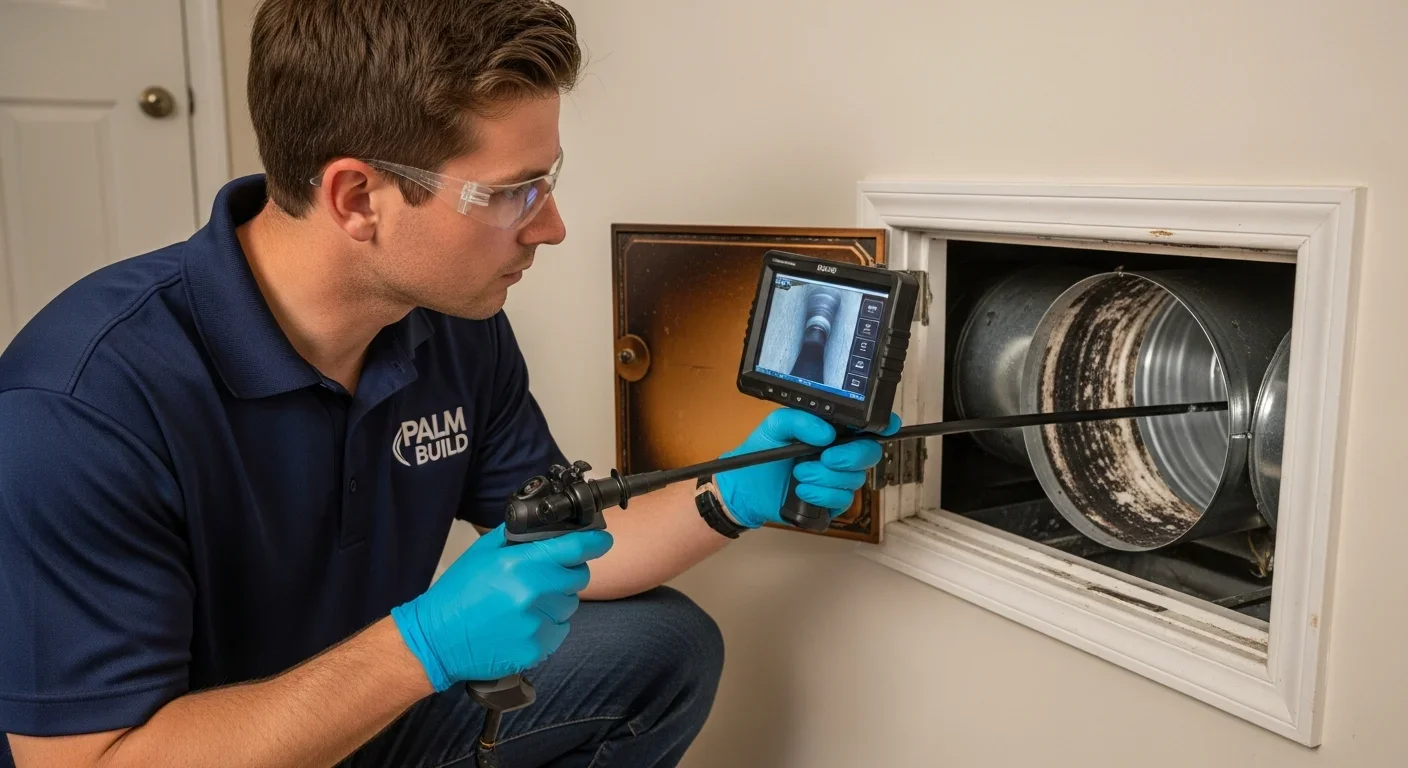
You can't assess what you can't see. Palm Build uses a flexible fiber-optic borescope camera to inspect the interior of every duct run before, during, and after cleaning. This provides photo documentation of contamination depth, identifies any duct sections that need replacement, and verifies the cleaning work was actually effective — not just sprayed with deodorant.

Palm Build technician performing borescope inspection of HVAC ductwork for smoke contamination
Borescope inspection provides photo documentation that insurance adjusters rely on for scope review.

What the borescope reveals

Contamination depth and distribution, flex duct delamination, blower fan soot buildup, coil fin bending, moisture accumulation in ductwork, and any pre-existing issues that should be addressed during cleanup. The visual evidence matters more than verbal descriptions for insurance supplements.

Replace vs clean decisions

Flex ducts with heavy contamination typically get replaced because the interior liner cannot be reliably cleaned. Rigid metal ducts almost always can be cleaned. Fiberglass-lined ducts with protein soot or puffback oil usually need replacement. The borescope gives Palm Build the visual evidence to defend these decisions to your adjuster.

Post-cleaning verification

After cleaning is complete, a second borescope inspection verifies the work. This is the biggest differentiator between NADCA-aligned crews and budget cleaners — budget cleaners never re-inspect, so you have no proof the work was effective.

NADCA ACR Standard

The 8-Step NADCA-Aligned HVAC Cleanup Protocol

The National Air Duct Cleaners Association (NADCA) publishes the Assessment, Cleaning, Restoration (ACR) standard. Palm Build follows this protocol on every post-fire HVAC cleanup. Budget cleaners that skip steps leave behind contamination that recirculates smoke odor indefinitely.

1

Pre-inspection & assessment

Borescope inspection of every duct run to document contamination level, identify any flex duct requiring replacement, and establish baseline photos for insurance. Estimated scope developed from this inspection.

2

System shutdown & containment

HVAC system is shut down at the thermostat AND breaker. Containment is set up to prevent soot from migrating during cleaning. Return and supply registers are sealed.

3

Negative-air HEPA extraction

A high-powered HEPA-filtered negative air machine is connected to the main return. This pulls loose soot out of the duct system while preventing cross-contamination. Connection moves progressively through the system.

4

Source removal agitation

Mechanical brushes and air whips dislodge soot from the duct interior walls while the HEPA extraction captures it. This is "source removal" — not chemical masking. NADCA ACR standard requires physical removal of contamination.

5

Coil deep cleaning

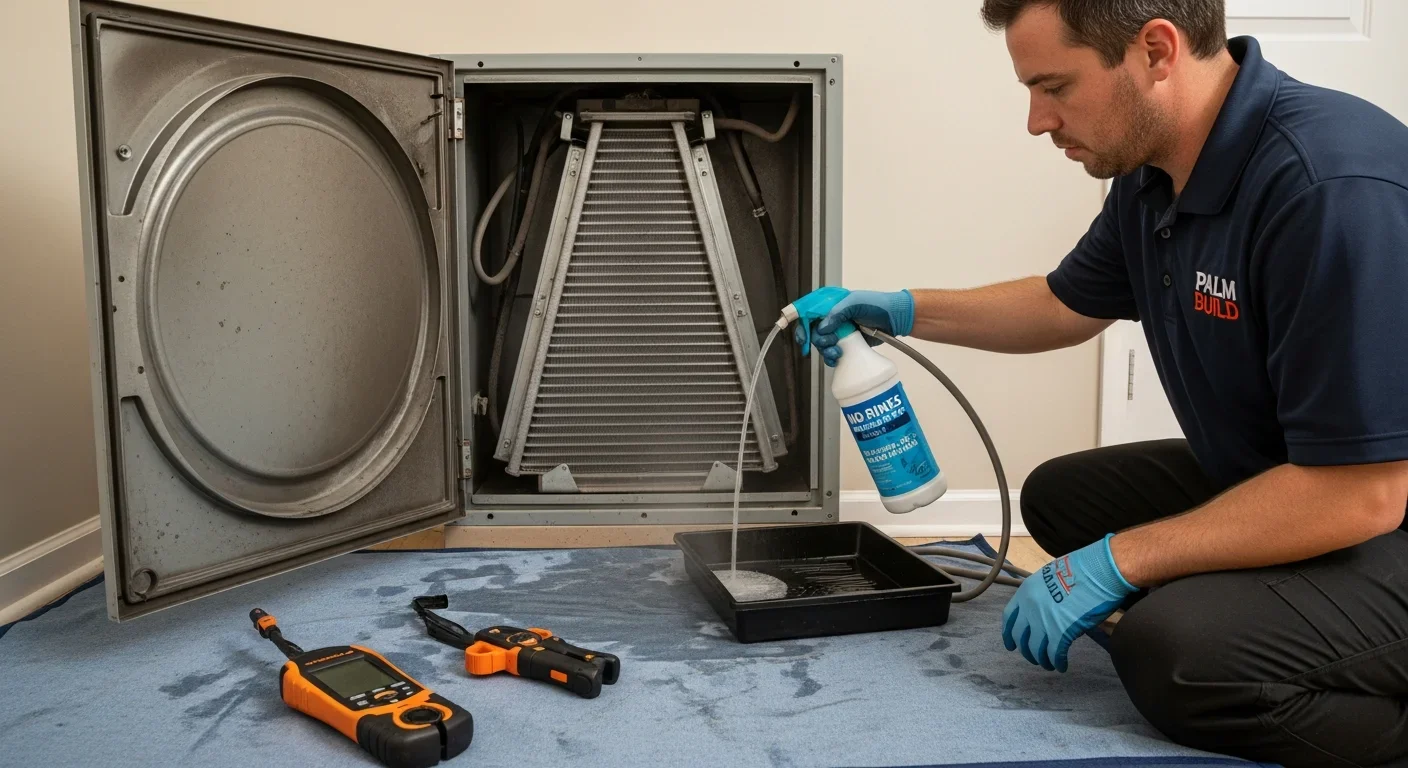
Evaporator coil is cleaned with no-rinse coil cleaner applied via pump sprayer. Fin combs are used to straighten bent fins. Drain pan is cleaned and sanitized. Condensate lines are flushed to prevent contamination.

6

Blower wheel cleaning

Blower wheel is removed if possible for direct cleaning, or cleaned in place with soft brushes and compressed air. Motor bearings are inspected. The blower wheel is often missed by budget cleaners but carries significant contamination.

7

Register & grille hand-cleaning

Every supply and return register is removed, hand-cleaned in a detergent solution, dried, and reinstalled. Register boots inside the wall are HEPA-vacuumed and wiped.

8

Post-cleaning verification & filter swap

Borescope re-inspection verifies cleanliness. Fresh high-MERV filter is installed (MERV 13+ recommended). System is run briefly to verify operation. Final documentation is provided to homeowner and insurance adjuster.

Coil Cleaning Protocol

The Evaporator Coil: HVAC's Worst-Affected Component

The evaporator coil inside your air handler is the hardest-hit HVAC component after a fire. Its fin arrays have enormous surface area, humidity inside the system causes soot to bond tightly, and the coil's job is to continuously filter and condition air — which means it concentrates contamination faster than any other component.

Palm Build technician cleaning smoke-contaminated HVAC evaporator coil with pump sprayer no-rinse cleaner

Professional coil cleaning uses a no-rinse, biodegradable coil cleaner designed specifically for HVAC applications. The cleaner is applied via pump sprayer at high pressure to penetrate between the fins. Capillary action carries the cleaner through the fin pack, dissolving bonded soot. Residual moisture evaporates into the air stream during normal system operation.

Bent fins are straightened with a fin comb — a toothed tool that slips between fins and corrects bending caused by handling or heavy soot deposition. Bent fins restrict airflow and reduce system efficiency, so this step is both restoration and performance-related.

The drain pan and condensate line are cleaned and sanitized. Post-fire HVAC systems often show moisture accumulation and biological growth in the drain pan from the combination of firefighting water and contaminated condensate. Flushing the condensate line prevents this from spreading into the home.
Regional Considerations

HVAC Smoke Cleanup Across FL, NC, And SC

Florida

Hot-humid cleanup urgency

Florida's high ambient humidity accelerates soot bonding on coil fins and duct interiors. Post-fire HVAC cleanup is especially time-sensitive — the longer the system sits contaminated, the harder the cleaning becomes. Palm Build's Deerfield Beach office dispatches 24/7 for South FL HVAC emergency cleanup.

North Carolina

Puffback and oil furnace cleanup

NC has higher rates of oil furnace puffback events — where a furnace ignition malfunction distributes fine oil soot throughout the home via HVAC. Puffback cleanup is different from standard fire cleanup; the residue is greasy and acidic, requiring solvent-based cleaning rather than standard duct cleaning agents.

South Carolina

Older systems, hidden ducts

SC's older brick housing stock often has ductwork routed through attics and crawl spaces, adding access complexity to HVAC smoke cleanup. Palm Build's regional crews know the building patterns and coordinate with local HVAC technicians as needed for any system repair work identified during cleanup.

Filter Replacement

Always Replace Your HVAC Filter After A Fire

Even if the filter looks superficially clean, it has been pulling contaminated air through its media during and immediately after the fire. Standard residential filters (MERV 8-11) saturate quickly on fire soot. Post-fire, install a fresh high-MERV filter — MERV 13 or higher is strongly recommended for the first 30-60 days after restoration, then you can switch back to your normal filter.

Some homeowners run two filters in parallel during the initial 30 days post-cleanup to capture any residual particulate from the cleanup process itself. Budget $20-$80 for replacement filters — it's the single most cost-effective step in preventing odor recurrence.

Stop Your HVAC From Recirculating Smoke

HVAC cleanup is the single most-missed step in budget fire restoration work. Palm Build follows NADCA ACR standards with borescope verification before and after cleaning. Documented scope for your insurance adjuster.

HVAC Smoke Cleanup — Frequently Asked Questions

Expert answers about HVAC duct cleaning, coil cleaning, smoke contamination, and why the HVAC system must be shut down immediately after a fire.

FAQ Topics

HVAC Smoke Contamination

HVAC systems are the primary pathway smoke uses to reach every room in your home. During a fire, the running system pulls smoke into return air ducts and distributes it through supply ducts to every register. Soot coats the interior of every duct, the evaporator coil, the blower motor, and accumulates on the filter. Without HVAC decontamination, the system will recirculate smoke odor through the whole home indefinitely — even after the rest of the fire cleanup is complete.

Still have questions about hvac smoke contamination?

Shut down the HVAC immediately. Every minute it runs spreads smoke whole-home.

HVAC systems are the primary pathway smoke uses to spread throughout a home. A running system distributes soot into every duct, register, and coil within minutes. Palm Build provides NADCA-aligned duct cleaning and whole-system decontamination.

Duct Inspection

Borescope verification

Coil Cleaning

Evaporator & condenser

NADCA Standards

Industry-aligned protocol

Filter Replacement

Full system reset

Request Emergency Service

Need help right now? Call us.

24/7 live dispatch — average answer time under 30 seconds

(888) 245-5155