Fire & Smoke Damage Cleanup in Raleigh, North Carolina
From Oakwood's Victorian wood-frames to North Hills' newer construction, Palm Build's IICRC S700-certified team handles structural fire damage, crawl-space water extraction, soot removal, smoke odor elimination, and full reconstruction — with insurance coordination from the first call.
Serving Raleigh from Charlotte, NC Same-day Response IICRC Certified
After a Fire in Raleigh, Every Hour of Delay Costs You
The fire department puts out the flames — but that's when the real damage clock starts.
Soot, smoke residue, and fire-suppression water in the crawl space are all actively
damaging your Raleigh home right now. The difference between a $15,000 restoration and a
$60,000 rebuild often comes down to how fast professional mitigation begins. Here's
what's happening inside your home while you wait.
CRITICAL FACTOR 1
Soot Becomes Permanent in Hours
Acidic soot residue begins etching into metal, glass, and stone surfaces within hours of a fire. Stainless steel appliances, chrome fixtures, and HVAC coils can be permanently damaged if soot isn't neutralized quickly. The chemical reaction accelerates in Raleigh's humid climate — NC Piedmont relative humidity averages 60–70% in warmer months — where moisture in the air reacts with soot compounds to form acidic solutions on surfaces. IICRC S700 guidance: begin pH neutralization of metals within 48–72 hours of fire suppression.
CRITICAL FACTOR 2
Smoke Penetrates Deeper Every Day
Smoke odor molecules are measured in microns and continue migrating into porous materials for days after the fire is out. In Raleigh's brick-veneer homes, smoke enters stud cavities through weep holes and mortar gaps — surface-cleaning interior drywall does not reach these cavities. In older wood-frame neighborhoods like Boylan Heights and Oakwood, smoke penetrates deeply into original plaster walls and hardwood floors. Every day without professional treatment makes odor elimination more complex and expensive.
CRITICAL FACTOR 3
Crawl-Space Water Starts Mold Within 48 Hours
Fire suppression — whether from hose lines, sprinklers, or extinguishers — saturates your home with water. A single fire hose delivers 150 to 250 gallons per minute. In Raleigh's crawl-space homes, that water flows under the house through foundation vents, pooling against floor joists and subfloor. In NC's humid climate, trapped moisture begins feeding mold growth within 24 to 48 hours on wooden structural members already weakened by heat. You're dealing with fire damage, water damage, and mold risk simultaneously — all from the same event.
Emergency Fire Restoration
Palm Build dispatches from our North Carolina operations hub same-day. We begin
emergency board-up, soot stabilization, and crawl-space water extraction
simultaneously — stopping all three damage clocks at once. Call now for immediate
response.
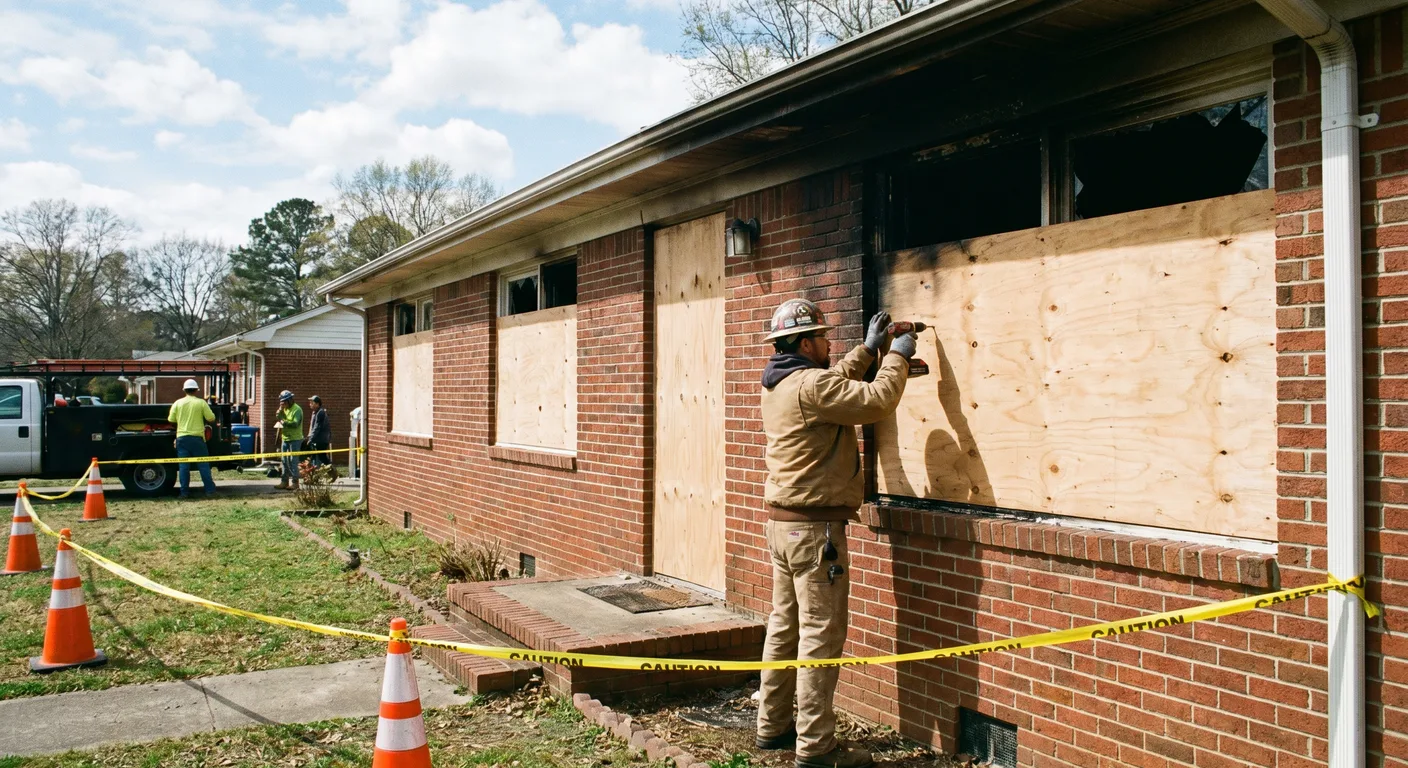
Emergency board-up and tarping secures your Raleigh home within hours of the fire
Understanding the Damage
The Science of Soot: Why Fire Type Determines the Restoration Approach
Not all fire damage is the same. The type of materials that burned determines what kind
of soot your Raleigh home is coated with — and that determines the cleaning chemistry,
equipment, and timeline required. Using the wrong approach doesn't just fail to clean
the surface — it can permanently set stains and drive odors deeper into materials.
Protein Residue (Kitchen Fires)
The most common fire type in Raleigh homes. Protein fires from cooking produce an almost invisible, yellowish residue with an extremely pungent odor that penetrates every surface in the home — often far beyond the kitchen. The residue is nearly invisible on light surfaces but discolors significantly over time. Protein soot is notoriously difficult to remove because it bonds chemically to surfaces rather than sitting on top of them. In Raleigh homes with open-concept layouts (North Hills, Brier Creek), kitchen smoke travels rapidly through the entire living area and into the ducted forced-air HVAC system. Standard cleaning products spread the residue and set the stain permanently.
Professional Cleaning Approach
Requires enzymatic cleaners and specialized degreasing agents. Thermal fogging with protein-specific solutions is typically needed for odor elimination. HVAC duct cleaning is essential when the system was running during the fire.
Dry Soot (Wood, Paper, Natural Materials)
When Raleigh's older homes with original hardwood framing, wood paneling, or cellulose insulation burn, they produce dry, powdery, gray-black soot. This type is lighter and more easily disturbed by air movement — it spreads throughout the entire home via HVAC systems and natural air currents, coating surfaces in rooms far from the fire origin. Ionization drives charge deposition: smoke particles carry an electrostatic charge and actively deposit on cooler surfaces, corners, ceilings, and the interior surfaces of HVAC ducts — the 'ghosting' pattern visible on ceilings and walls far from the fire. In Raleigh homes with forced-air HVAC (virtually all of them), dry soot from a fire in one room can contaminate ductwork and distribute residue throughout the entire house within hours.
Professional Cleaning Approach
HEPA vacuuming first — never wipe dry soot, it smears and sets stains permanently. Followed by chemical sponge treatment, then wet cleaning with appropriate detergents. Full duct cleaning before the system is restarted.
Synthetic Soot (Plastics, Polymers)
Modern Raleigh homes — especially post-2000 construction in North Hills, Brier Creek, and Hedingham — contain significant amounts of synthetic materials: engineered wood flooring, foam insulation, PVC trim, synthetic carpeting, and plastic fixtures. When these materials burn, they produce thick, black, sticky soot that is extremely difficult to remove. Synthetic soot smears easily when touched, adheres aggressively to all surfaces, and contains toxic compounds including hydrogen cyanide and dioxins. IICRC S700 requires a residue assessment before selecting cleaning protocols — the wrong cleaning chemistry can spread or set synthetic residues. This is the most hazardous soot type for both occupants and restoration technicians.
Professional Cleaning Approach
Requires solvent-based cleaners formulated for petroleum-based residues. Multiple cleaning passes are standard. Escalated PPE is required per IICRC S700 and OSHA guidance due to toxic compounds.
Local Risk Factors
Fire Risks Specific to Raleigh Homes
Raleigh's housing stock — from Oakwood's Victorian wood-frames to North Hills' and Brier
Creek's newer construction — creates distinct fire risk profiles. Understanding which
risks apply to your neighborhood helps you prepare and ensures your restoration company
knows what they're dealing with from the first call.
Historic Wood-Frame Homes (Oakwood, Boylan Heights)
Specialized
Raleigh's oldest neighborhoods — Oakwood and Boylan Heights, both listed as local historic districts — contain Victorian and late 19th-century wood-frame homes with balloon-frame stud cavities. In balloon framing, studs run continuously from the foundation sill to the roof rafter without horizontal blocking at the floor plates. This means smoke and fire travel vertically without obstruction from the crawl space to the attic in a single unbroken cavity — dramatically accelerating fire spread and smoke contamination. Restoration in these structures requires assessment for cavity contamination, selective demolition to treat framing, and materials that meet the Raleigh Historic Development Commission's Certificate of Appropriateness (COA) requirements.
Peak season: Year-round
Heating-Related Fires (November–March)
High
Raleigh's heating season — colder than the coast but milder than the mountains — drives a measurable spike in residential fires. Space heaters placed too close to combustibles, malfunctioning furnaces in aging crawl-space installations, unattended fireplaces in Hayes Barton and Cameron Park homes with original masonry chimneys, and overloaded electrical circuits from holiday lighting all contribute. NC's brick-veneer construction means heating-related fires often start inside wall assemblies or behind fireplaces, where smoke can travel through stud cavities before flames become visible.
Peak season: Nov – Mar
Electrical Fires in Aging Raleigh Homes
High
Raleigh's pre-1970 housing stock — especially in Boylan Heights, Oakwood, Glenwood, and East Raleigh — often contains electrical systems never designed for modern load demands. Knob-and-tube wiring in pre-1940 homes, undersized service panels in 1950s–1960s ranch houses, and aluminum wiring in 1965–1975 construction all create elevated fire risk. These fires frequently start behind walls and smolder for hours before detection — meaning smoke damage is typically extensive before flames become visible. The brick-veneer exterior delays detection further because smoke exiting through weep holes is not immediately obvious.
Peak season: Year-round
Kitchen Fires in Raleigh Homes
Most Common
Cooking fires are the leading cause of residential fires nationwide, and Raleigh is no exception. Protein soot from kitchen fires is among the most challenging to remediate — it creates an invisible, bonding residue that standard cleaning cannot remove and that produces severe persistent odor. In Raleigh's open-concept newer homes (North Hills, Brier Creek), kitchen fire smoke travels rapidly through the entire living area and into the HVAC return. In older homes with enclosed kitchens (Boylan Heights, Rochester Heights), damage may be more contained but the concentrated heat and protein residue can be more intense in the affected area.
Peak season: Year-round
Our Fire Restoration Process
How We Restore Raleigh Homes After Fire Damage
Fire restoration is more complex than water or mold because it involves multiple damage
types simultaneously — structural fire damage, soot contamination, smoke odor,
crawl-space water from fire suppression, and potential stud-cavity infiltration. Our
process addresses all of these in a coordinated sequence.
01
Emergency Board-Up & Securing
Hours 1-4
We secure your Raleigh home against weather, theft, and further damage. This includes boarding windows, tarping damaged roof sections, and securing doors. For Wake County's afternoon summer thunderstorms, this is critical — an unsecured fire-damaged home can sustain thousands in additional water damage from a single storm.
02
Damage Assessment & Documentation
Day 1-2
Our IICRC S700-certified team performs a comprehensive walk-through documenting every affected area with photos, video, moisture readings, and thermal imaging. We classify the fire type (protein, dry natural-material, synthetic), assess stud-cavity smoke penetration behind brick veneer, evaluate the attic and crawl space, and create a detailed scope of work. This documentation becomes the foundation of your insurance claim.
03
Crawl-Space Water Extraction & Structural Drying
Days 1-5
Firefighting water is addressed simultaneously with soot stabilization. In Raleigh's crawl-space homes, we pump standing water from under the house, remove saturated batt insulation from between joists, set up large-volume dehumidifiers and commercial air movers, and monitor moisture readings daily. This step prevents secondary mold growth in the same crawl-space joists already stressed by heat — a step with no equivalent in concrete-slab fire restoration.
04
Soot & Smoke Removal
Days 3-10
Professional soot removal uses chemistry matched to the specific soot type per IICRC S700. HEPA vacuuming removes loose particulate (never wipe dry soot — it smears). Chemical sponges lift embedded residue. Wet cleaning with specialized detergents addresses remaining contamination. Every surface in the affected area is treated — walls, ceilings, trim, cabinetry, fixtures, and structural members. Raleigh homes with original hardwood floors, plaster walls, or exposed brick require specialized techniques. Brick-veneer stud cavities are assessed via thermal imaging; selective interior drywall demolition treats framing where cavity contamination is confirmed.
05
Odor Elimination
Days 5-14
Smoke odor elimination is a multi-step process that treats the source — not just masks the smell. We use thermal fogging (heated deodorizing agents that penetrate materials the same way smoke did), ozone treatment for sealed unoccupied spaces, and hydroxyl generation for occupied areas. Attic insulation typically requires full replacement; roof sheathing is encapsulated before new insulation is installed. HVAC ducts are cleaned or replaced before the system is restarted. For Raleigh's older homes with porous plaster, brick, and hardwood, a combination approach across multiple days is often required.
06
Reconstruction & Restoration
Weeks 2-8+
Once cleaning and odor treatment are verified complete, we handle full reconstruction: drywall, flooring, cabinetry, painting, electrical, plumbing, and finish work under the 2018 NC Residential Code (the code currently in force; the 2024 code adoption is delayed to no earlier than March 2027). For Raleigh homes in local historic districts — Boylan Heights and Oakwood — all restoration work must meet Raleigh Historic Development Commission standards, including a Certificate of Appropriateness and period-appropriate materials. Cameron Park, a National Register district, does not require a COA but we source appropriate materials.
The Hidden Damage
Water Damage From Firefighting: Into the Crawl Space and Under the House
Many Raleigh homeowners are shocked to discover that fire suppression causes more
damage to their home than the fire itself. A single fire hose delivers 150 to 250
gallons of water per minute. In a concrete-slab home, water runs off the floor. In
Raleigh's crawl-space homes, that water goes under the house — through foundation
vents and any penetration in the subfloor — where it saturates floor joists (typically
dimensional lumber or engineered I-joists), subflooring (plywood and OSB absorb water
rapidly and swell or delaminate), and batt insulation between joists, which acts as a
sponge.
Standing water in the crawl space must be pumped out. Wet batt insulation cannot dry
in place without creating mold conditions on the same joists already stressed by heat
— it must be removed. Subfloor moisture is mapped and targeted with desiccant drying
before reconstruction can begin. In severe cases, joist assessment for mold or
structural compromise is required before new insulation and subfloor are installed. In
NC's humid climate, this cascade begins within 24 to 48 hours of fire suppression —
and you're now managing fire damage, water damage, and mold risk from a single event.
Palm Build's fire restoration team handles crawl-space water extraction and structural
drying as an integrated part of the fire cleanup process — not as a separate project
that adds weeks and thousands to your timeline. Our technicians are cross-trained in
both fire and water damage restoration, so one team manages the entire scope.
How We Permanently Eliminate Smoke Odor in Raleigh Homes
Smoke odor is the most persistent aspect of fire damage. Masking products — candles, air
fresheners, even consumer ozone machines — do not eliminate smoke odor. They temporarily
cover it. Professional odor elimination requires treating the source at the molecular
level using one or more of these methods, matched to the specific materials and
construction type in your Raleigh home.
Thermal Fogging
Heated deodorizing agents are converted into a fog that penetrates materials the same way smoke did — through microscopic pores, cracks, and wall cavities. This is the most effective method for Raleigh's older homes with porous materials like original plaster, real hardwood, and exposed brick. In brick-veneer construction, thermal fogging reaches into stud cavities where smoke has deposited through weep holes — surface cleaning of drywall does not. The fogging agent chemically neutralizes odor molecules rather than masking them. Multiple applications are often needed for deep-penetrating smoke in Raleigh's brick ranch and wood-frame construction.
Best for: Porous materials, deep penetration, brick-veneer stud cavities, attic framing
Ozone Treatment
Ozone generators create O3 — a highly reactive oxygen molecule that breaks down odor compounds at the molecular level. Ozone treatment is extremely effective but requires the space to be completely unoccupied (including plants and pets) during treatment. We use ozone for sealed, evacuated spaces like closets, attics, and enclosed rooms where the concentrated treatment reaches maximum effectiveness. Attic spaces — particularly in Raleigh homes where the attic acts as a massive smoke filter — respond well to extended ozone treatment before new insulation is installed.
Best for: Sealed spaces, attic deodorization, heavy odor concentration, unoccupied areas
Hydroxyl Generation
Hydroxyl generators produce hydroxyl radicals — the same molecules that naturally purify outdoor air via sunlight — to break down odor compounds. Unlike ozone, hydroxyl treatment is safe for occupied spaces. We use this method in areas where occupants or workers need to be present, and as a continuous treatment during the multi-day cleaning process to keep air quality manageable. This is particularly valuable for Raleigh projects where the homeowner is on-site coordinating insurance and contents decisions.
Best for: Occupied spaces, ongoing treatment during restoration, HVAC deodorization
Raleigh Pricing
Fire Damage Restoration Costs in Raleigh
Fire restoration costs vary dramatically based on the fire's severity, affected area,
and construction type. In Raleigh's crawl-space homes, the cost of crawl-space water
extraction, insulation removal, and structural drying adds a line item that simply
doesn't exist in slab construction. The good news: fire is one of the most
comprehensively covered perils under NC homeowners insurance.
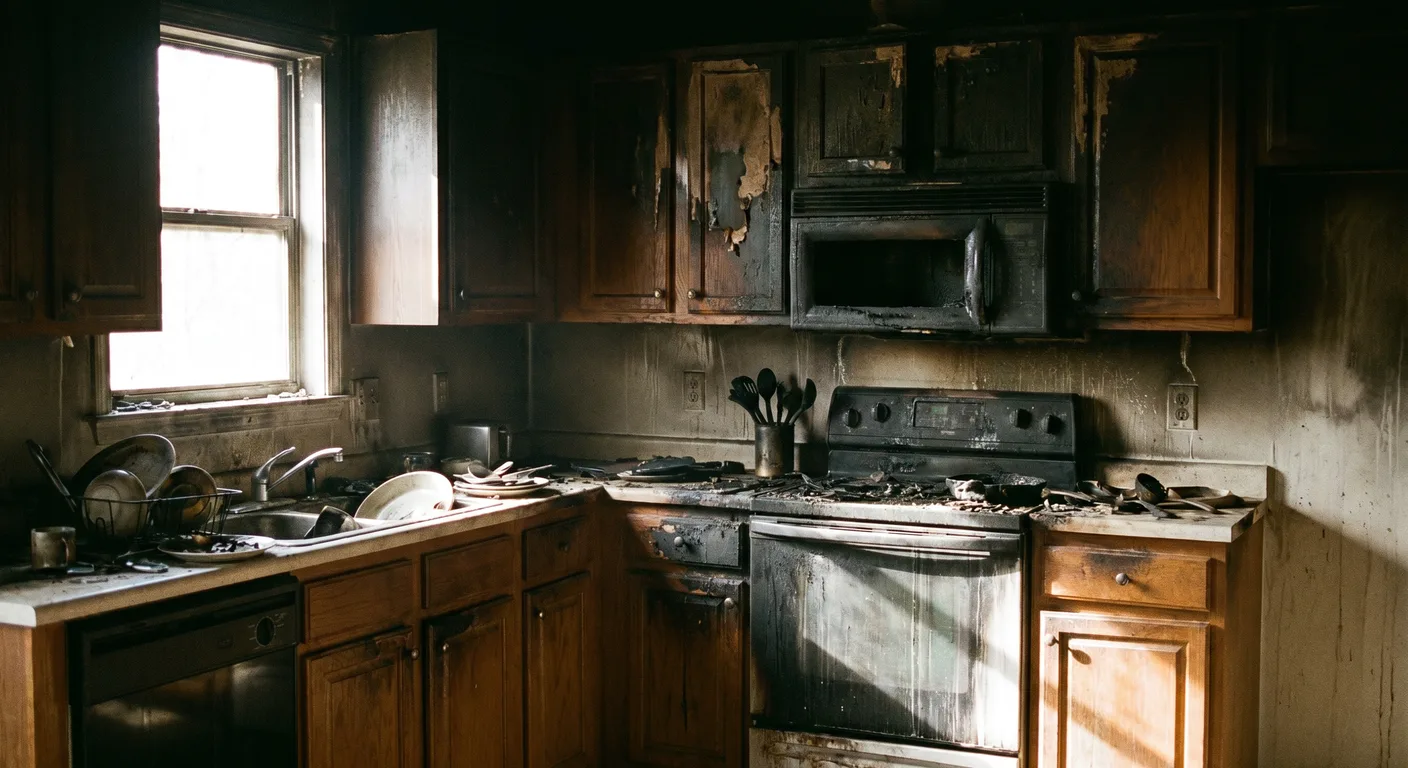
Kitchen fire damage with charred cabinets and heavy soot coating
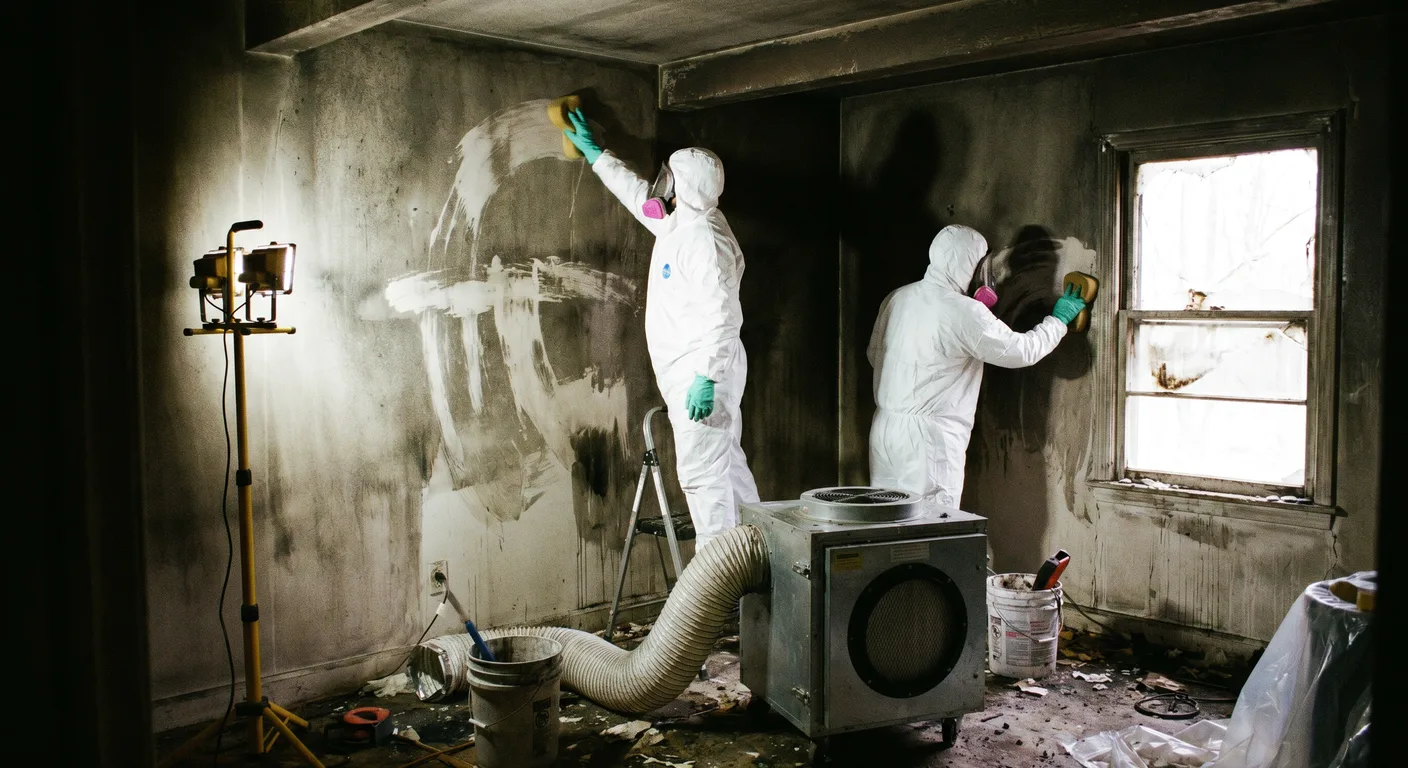
Professional soot removal with HEPA vacuums and chemical sponges
After: Fully restored with new finishes, paint, and refinished floors
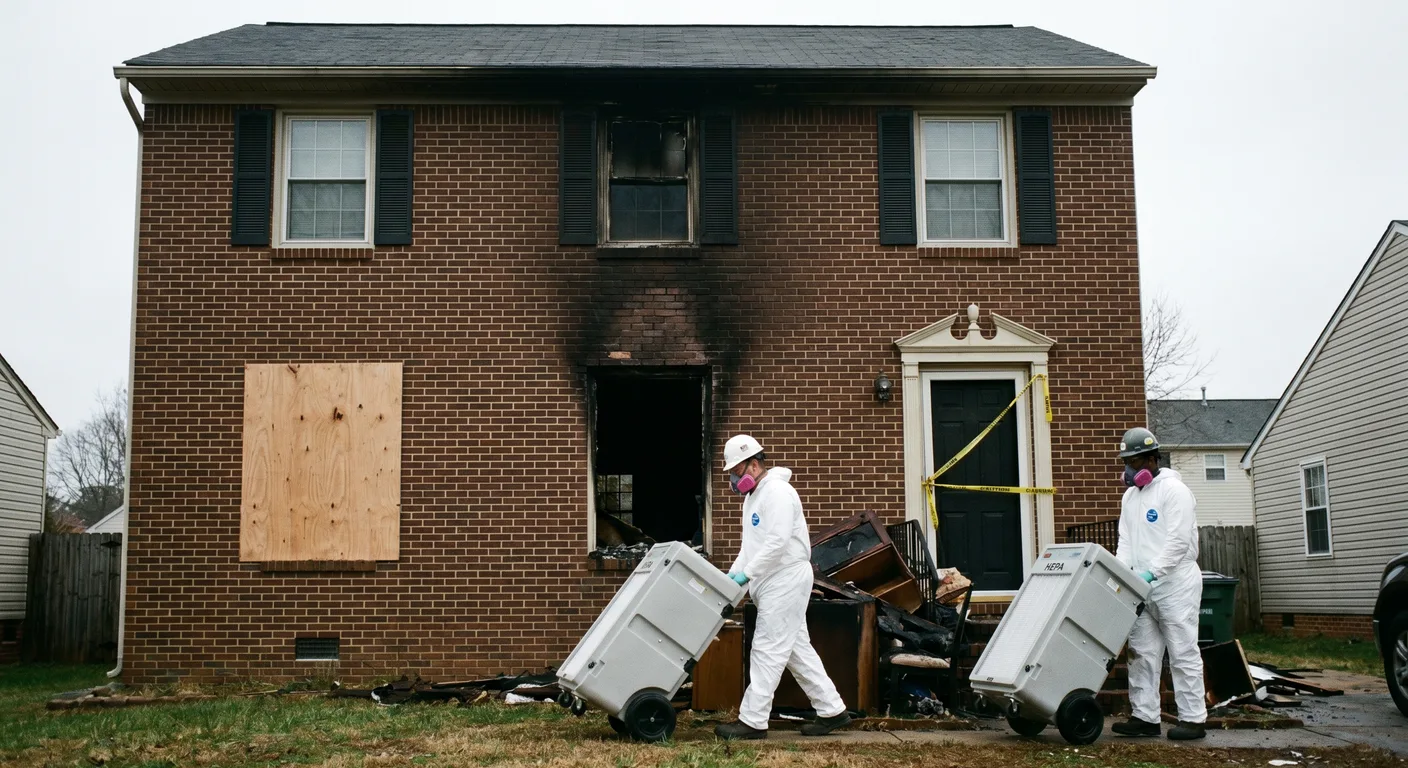
Emergency board-up secures the property within hours of the fire
Insurance Coverage
Fire Insurance Claims in Raleigh: What's Covered
Fire is one of the most comprehensively covered perils under North Carolina homeowners
insurance policies. Unlike water or mold damage, fire claims rarely face coverage
disputes — your policy is designed for exactly this situation. NC law (Gen. Stat. Ch.
58) requires prompt notice and a signed proof of loss within 60 days. Here's what a
standard HO-3 policy covers for fire damage.
Structural repair and reconstruction to pre-loss condition
Professional soot and smoke cleaning of all affected surfaces
Crawl-space water extraction and structural drying from fire suppression
Contents restoration or replacement (furniture, electronics, clothing)
Additional Living Expenses (ALE) for temporary housing during restoration
Debris removal and hazardous material disposal
Building code upgrades required during reconstruction (with ordinance-and-law endorsement)
Palm Build Manages Your Fire Claim
We work directly with your insurance adjuster from the first inspection. Our fire damage
documentation — crawl-space assessments, soot type classification, stud-cavity thermal
imaging, moisture readings, photo evidence, and detailed scopes of work — is formatted
exactly how NC carriers expect to receive it. This reduces back-and-forth and gets your
claim approved faster.
Why Raleigh Homeowners Choose Palm Build After a Fire
NC-Based Emergency Response
Our North Carolina operations hub dispatches same-day across Raleigh and Wake County — day or night. Board-up, tarping, soot stabilization, and crawl-space water extraction begin within hours of your call.
IICRC S700 Fire & Smoke Certified
Every crew lead holds current IICRC Fire and Smoke Restoration Technician (FSRT) certification. We follow the ANSI/IICRC S700 standard (2025 First Edition) for professional fire and smoke damage restoration procedures — including residue classification, PPE escalation for synthetic soot, and odor elimination sequencing.
Multi-Damage Expertise
Fire projects in Raleigh always involve crawl-space water from suppression and often involve mold risk in NC's humid climate. Our technicians are cross-trained in fire, water, and mold restoration — one team manages the entire scope without handoffs between contractors.
Insurance Documentation Specialists
Fire claims involve the most comprehensive insurance documentation of any restoration type. Our soot classification, crawl-space assessments, stud-cavity thermal imaging, and scope-of-work documentation are formatted exactly how NC carriers expect to see them — reducing claim approval time.
Full Reconstruction Capability
From emergency board-up through final paint and punch list, Palm Build handles the entire project under the 2018 NC Residential Code. For Raleigh's Boylan Heights and Oakwood historic districts, we source period-appropriate materials and coordinate with the Raleigh Historic Development Commission for Certificates of Appropriateness.
Common Questions
Raleigh Fire & Smoke Damage FAQ
How quickly can Palm Build respond to fire damage in Raleigh?
Palm Build coordinates Raleigh response 24/7 from our North Carolina operations hub, dispatching same-day at (704) 464-0121. Speed matters: acidic soot begins corroding appliances and HVAC coils within 48–96 hours in NC's humidity, smoke odor migrates into brick-veneer wall cavities and the attic, and firefighting water in the crawl space can start mold growth within 24–48 hours on joists already weakened by heat. If it is safe to do so, shut down your HVAC system to stop it from spreading soot through the home while you wait.
Does homeowners insurance cover fire damage restoration in Raleigh?
Yes — fire is one of the most comprehensively covered perils under standard NC homeowners policies (HO-3). Coverage typically includes structural repair, contents restoration, smoke and soot cleanup, temporary living expenses (ALE), and debris removal. NC Gen. Stat. Ch. 58 governs the claim process; prompt notice and a signed proof of loss within 60 days are required. Palm Build prepares adjuster-ready documentation from day one to support your claim.
What happens to a Raleigh crawl-space home when firefighters suppress a fire?
Fire hoses deliver 150–250 gallons per minute. In a crawl-space home, that water follows gravity through foundation vents and penetrates under the house, saturating floor joists, plywood or OSB subflooring, and batt insulation. Unlike slab construction where water runs off, crawl-space water must be pumped out, the space dehumidified, wet insulation removed, and the joist system dried before reconstruction can start. Palm Build handles crawl-space water extraction as an integrated part of fire restoration — not a separate project.
Why does smoke odor linger in Raleigh brick-veneer homes, and how do you remove it?
Brick-veneer construction — the dominant exterior in Raleigh's mid-century and historic neighborhoods — has a 1-inch air gap between the brick and the wood-stud wall. Smoke enters through weep holes and mortar gaps into stud cavities, then travels vertically into the attic. Surface cleaning of interior drywall does not reach these cavities. We use thermal fogging to penetrate porous materials, thermal imaging to identify stud-cavity contamination, selective framing deodorization, and full attic assessment with insulation replacement where needed. HVAC duct cleaning is also standard — skip it and the system re-distributes odor with every heating or cooling cycle.
Can smoke damage be cleaned without replacing everything?
Often yes. Professional smoke and soot cleaning can restore many materials that appear severely damaged. The key factors are the type of fire (protein/wet, dry natural-material, or synthetic), how long smoke had contact with surfaces, and whether soot has been sealed in by moisture or cleaning attempts. Palm Build's IICRC S700-trained technicians classify the soot type before cleaning — using the wrong method on dry soot smears it and sets stains permanently.
Do I need to leave my home during fire restoration in Raleigh?
For most fire damage projects, yes. Smoke residue contains toxic compounds including carbon monoxide, hydrogen cyanide, and fine particulate matter. Even in rooms that appear unaffected, airborne contaminants may be present. Your NC homeowners policy's Additional Living Expenses (ALE) coverage pays for temporary housing during restoration. Palm Build coordinates with your adjuster to confirm ALE coverage from the first inspection.
How long does fire damage restoration take in Raleigh?
Timeline depends on severity. Small kitchen fires with contained smoke may take 1–2 weeks. Moderate residential fires typically require 4–8 weeks including crawl-space drying. Major structural fires can take 3–6 months with full reconstruction. Raleigh homes in local historic districts (Boylan Heights, Oakwood) may take longer due to Certificate of Appropriateness requirements from the Raleigh Historic Development Commission and sourcing of period-appropriate materials.
What areas of Raleigh does Palm Build serve for fire restoration?
We serve all of Raleigh and Wake County including Boylan Heights, Oakwood, Hayes Barton, Cameron Park, Glenwood, North Hills, Brier Creek, Biltmore Hills, Hedingham, Rochester Heights, Moore Square, Capitol Square, East Raleigh, and surrounding zip codes 27601–27617. We also serve the greater Research Triangle area.
Fire Damage in Raleigh? Every Hour Counts.
Acidic soot corrodes metals within 48–96 hours, crawl-space water starts mold within 24–48 hours, and smoke odor migrates deeper into stud cavities and attic insulation every day. Palm Build's NC team dispatches same-day with emergency board-up, soot stabilization, crawl-space extraction, and adjuster-ready documentation from the first call.