Water Damage Restoration in Raleigh, North Carolina
Raleigh's three major creek systems — Crabtree Creek, Walnut Creek, and the Neuse River — drain over 23 square miles of floodplain through Wake County. Clay soil slows drainage, crawl spaces trap moisture, and summer storms arrive fast. Palm Build's North Carolina team dispatches 24/7 with truck-mounted extraction, structural drying, and insurance-ready documentation. From Boylan Heights bungalows to Brier Creek subdivisions, we know Raleigh.
Serving Raleigh from Charlotte, NC Same-day Response IICRC Certified
Four converging factors make Wake County homes more vulnerable to water damage — and
harder to dry — than most of the Southeast.
Humid Subtropical Climate
46"
Annual precipitation (KRDU)
Raleigh averages 46 inches of annual rainfall, with its wettest months from July through September — September alone averages over 5 inches. Combined with summer humidity of 70-90%, structural drying after water damage is significantly harder in Raleigh than in drier climates. Wet materials stay wet.
Three-Creek Flood Network
23+ mi²
Wake County floodplain
Raleigh sits in the Neuse River watershed, which drains through three major creek systems — Crabtree Creek in the north, Walnut Creek through South Raleigh, and the Neuse River to the east. The City manages over 23 square miles of floodplain. Intense short-duration rainfall causes rapid creek rises that can inundate neighborhoods with no advance warning.
Clay Soil Drainage
Cecil series
Slow-drain Piedmont clay
Wake County's Piedmont clay soils drain slowly after rainfall. Water pools at foundations and wicks upward into crawl spaces for days after a storm passes. Even a home that wasn't directly flooded can experience crawl space moisture intrusion simply because surrounding soil stays saturated for extended periods.
Crawl Space Prevalence
60%+
Homes with crawl spaces
A large share of Raleigh homes — particularly in neighborhoods built before 1990 — sit on vented crawl space foundations. Crawl spaces act as moisture collectors: every storm event, pipe failure, or ground saturation event that reaches below your floor joists requires professional drying to prevent the 24-48 hour mold activation window from triggering.
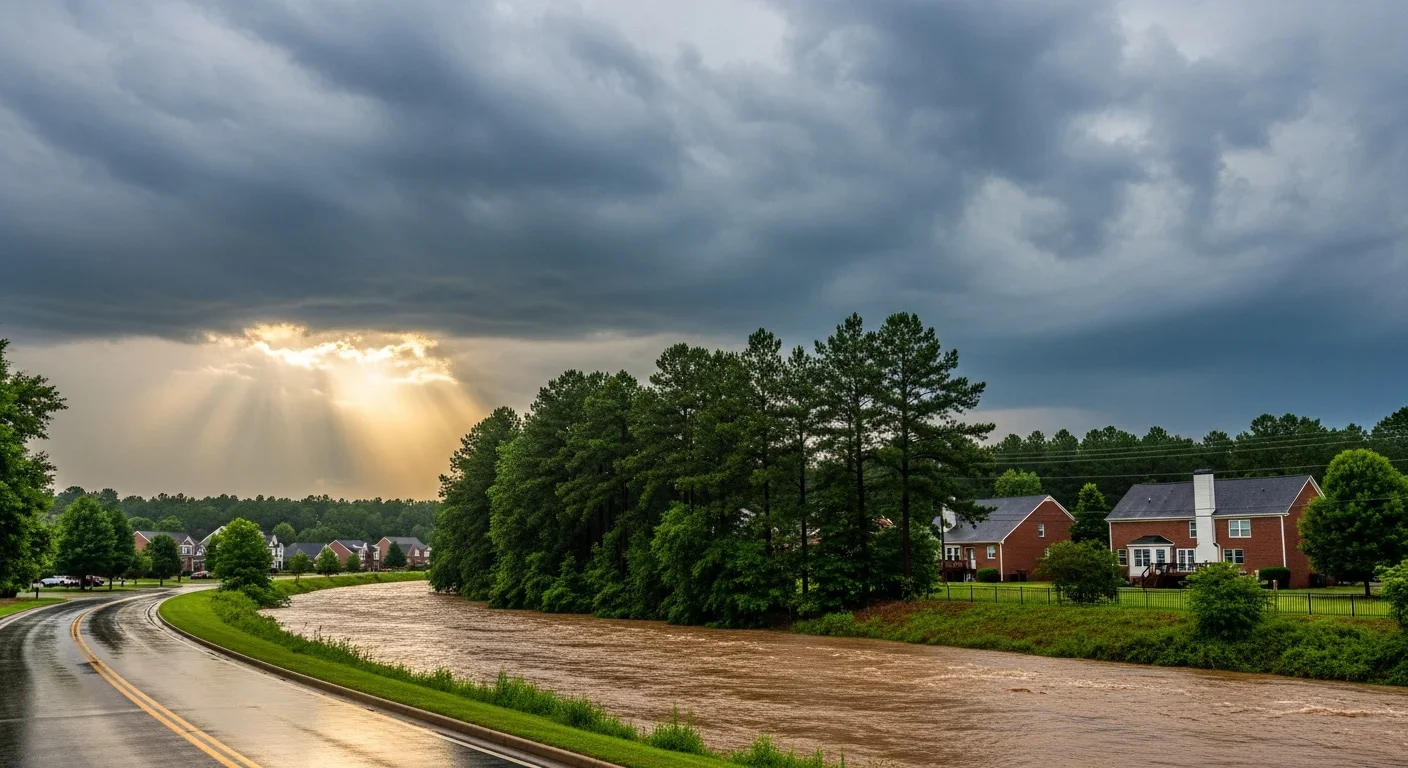
Crabtree Creek during a high-rain event — rapid rises at Anderson Drive are documented
in NOAA gauge data, creating sudden flood risk for adjacent Raleigh neighborhoods.
Raleigh-Specific Guide
Raleigh NC Neighborhood Water Damage Risk by Build Era
Raleigh's housing stock spans over a century of construction — each era with distinct
water damage vulnerabilities. Find your neighborhood.
Neighborhood
Built
Foundation
Primary Risk
Flood Zone
Risk Level
Boylan Heights
~1907
Crawl space
Old plumbing, layered remodels hiding leak paths
Low
Higher Risk
Cameron Park
~1910
Crawl space
Retrofitted copper over original supply lines, cast-iron drains
Low
Higher Risk
Glenwood
~1900s
Crawl space
Attic moisture from poor ridge venting, older flat-roof additions
Low
Higher Risk
Hayes Barton
~1910s
Crawl space
High-value finishes, original plaster walls that hold moisture
Low
Moderate Risk
North Hills
Mix: 1970s–present
Mix (crawl/slab)
Multifamily stacked plumbing failures, shared-wall water migration
Low
Moderate Risk
Biltmore Hills
~1960s
Slab/crawl mix
Walnut Creek flooding, clay soil saturation near creek corridor
SFHA adjacent
Higher Risk
Hedingham
~1990s
Slab
East Raleigh creek ponding during intense rain events
Moderate
Moderate Risk
Brier Creek
~2000s
Slab
HVAC condensate failures, appliance supply line leaks in OSB subfloor
Low
Lower Risk
Risk ratings reflect primary structural vulnerabilities, not individual property conditions.
Call (704) 464-0121 for a same-day assessment specific to your home.
Raleigh Floodplain Guide
Raleigh's Creek System and Your Flood Risk
Raleigh manages over 23 square miles of floodplain tied to three major creek systems.
Understanding which flood-risk category applies to your property matters for insurance,
restoration scope, and permit requirements after a loss.
Crabtree Creek
North & Central Raleigh
NOAA gauge data documents roadway inundation at Anderson Drive during high-stage events. Rapid rise characteristics during intense short-duration rainfall make this creek particularly dangerous for adjacent neighborhoods with minimal warning time.
Walnut Creek
South Raleigh
Documented nuisance flooding in Rochester Heights, Biltmore Hills, and surrounding South Raleigh communities. Walnut Creek flooding is often repetitive — some addresses in the corridor have experienced multiple loss events. Flood insurance is strongly recommended.
Neuse River
East Raleigh & Beyond
The primary watershed for all of Raleigh. Hurricane Isaias (August 2020) demonstrated that tropical storm remnants can cause significant Neuse River watershed flooding even when the storm makes landfall far from Raleigh. SFHA designations cover extensive areas along the corridor.
Raleigh Flood Map Update: July 19, 2022
The City of Raleigh adopted updated FEMA flood maps effective July 19, 2022. Some Wake
County properties changed flood zone designations. If your property assessment,
mortgage disclosure, or insurance quote predates this update, your flood risk
designation may have changed.
Critical for Raleigh homeowners: The
City's stormwater guidance explicitly states that some flood-susceptible areas may not appear on FEMA maps. Your home could
be at real flood risk even if it is not in a designated SFHA. Creek-adjacent homes
in South Raleigh and near Hedingham should consult the City's full floodplain
mapping portal — not just the FEMA FIRM.
Raleigh's Four Floodplain Risk Categories
FEMA Special Flood Hazard Area
Federally designated 100-year floodplain. Standard flood insurance typically required for federally-backed mortgages. Properties here face the highest direct flood risk.
Where this applies: Creek corridors along Crabtree Creek, Walnut Creek, and Neuse River
City Drainage-Basin Study Maps
Raleigh's own floodplain mapping — often stricter than federal maps. The City studies drainage basins independently and identifies additional flood-hazard areas beyond FEMA's scope.
Where this applies: Local areas at risk that federal maps may miss
Flood Hazard Soils
Areas with clay-based and low-permeability soils that create standing water during storms. Identified in Raleigh's UDO floodplain guidance. Important for crawl space moisture assessment.
Where this applies: Wake County Piedmont clay soil areas
Future-Conditions Hazard Areas
Areas mapped for anticipated development-driven changes to drainage patterns. As Raleigh's rapid growth continues, impervious surface coverage increases and flood risk in lower areas rises.
Where this applies: Growth-corridor neighborhoods in outer Raleigh
How We Work
Water Damage Restoration Process for Raleigh NC Homes
From emergency extraction to full restoration, every step is calibrated for Raleigh's
specific conditions — clay soil wicking, historic construction, and high ambient
humidity that extends drying beyond national averages.
01
Emergency Dispatch & Assessment
Same day
We dispatch 24/7 with truck-mounted extraction equipment. On arrival, we assess water source, categorization (clean/gray/black water), and full extent of damage with moisture meters and thermal cameras. In Raleigh homes, we always check the crawl space — creek-adjacent flooding frequently involves below-grade intrusion that is easy to miss.
02
Water Extraction
Hours 1-6
Truck-mounted extraction removes standing water faster than portable units. For Raleigh crawl spaces with clay-soil wicking, we use submersible pumps, weighted extraction tools, and follow-up portable units for low-clearance areas beneath the main extraction threshold.
03
Content Protection & Material Removal
Day 1
We protect or remove contents depending on saturation level. In historic Raleigh homes (Boylan Heights, Cameron Park, Hayes Barton), this step requires particular care — original hardwood, plaster, and period millwork require specialist handling to avoid damage during extraction and drying setup.
04
Structural Drying
3-7 days
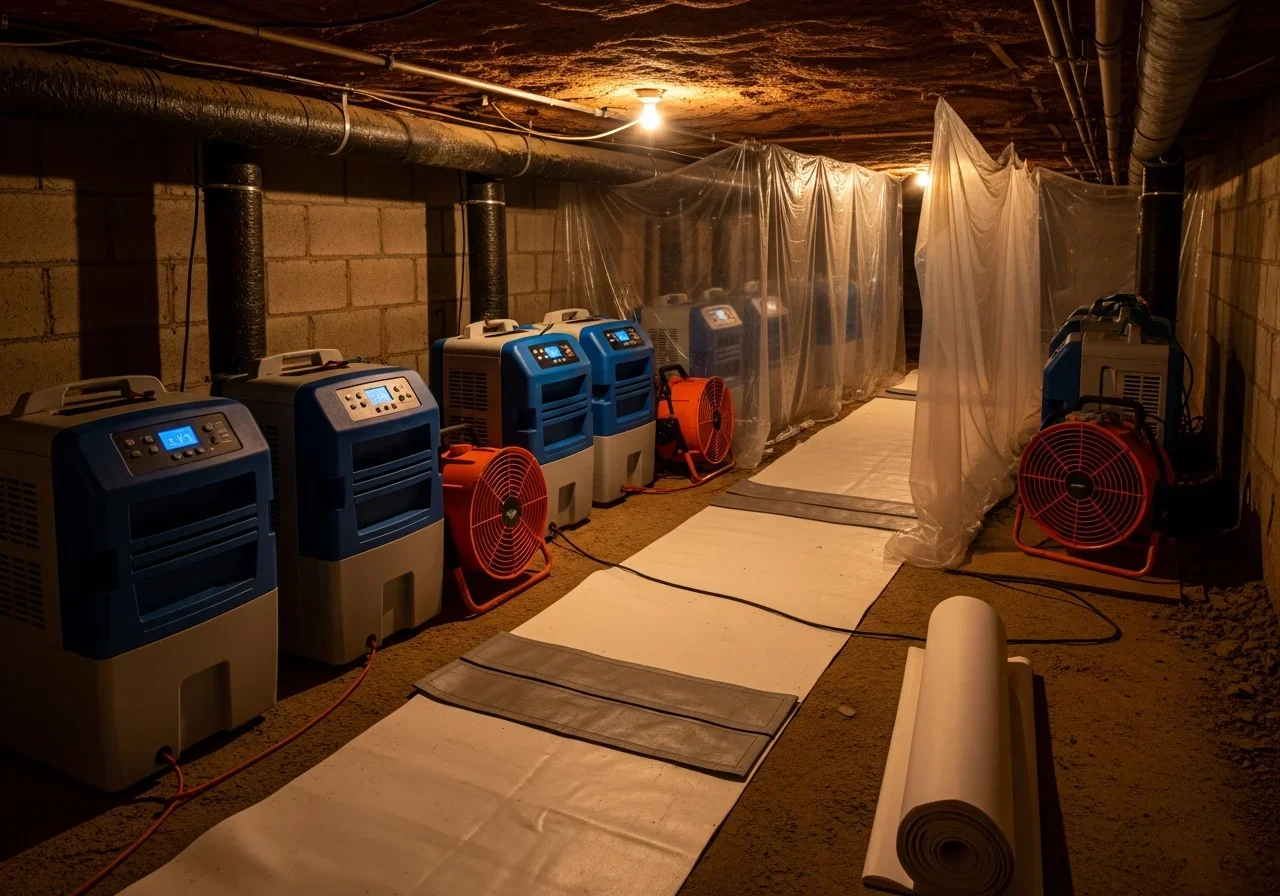
Industrial dehumidifiers and air movers are placed per IICRC S500 drying science to create a drying system, not just blow air around. In Raleigh, ambient summer humidity requires continuous dehumidification — passive airflow does not dry materials in 70-90% humidity. We monitor daily and adjust.
05
Daily Moisture Monitoring
Daily
We return daily to monitor dryness progress using calibrated moisture meters and psychrometric calculations. Every reading is documented for your insurance file. Wake County clay soil wicks moisture back from below — drying must account for this continuous ground-vapor load, which extends drying time compared to homes on slab.
06
Mold Prevention & Restoration
1-4 weeks
After structural dry standard is reached, we apply EPA-registered antimicrobial treatment to all affected areas. If pre-existing mold is found during the process — common in Raleigh crawl spaces — we scope a separate remediation. Full restoration (flooring, drywall, trim) follows once dry standard is verified.
Seasonal Risk
Raleigh NC Property Damage Risk Calendar
Raleigh's damage patterns follow a predictable seasonal cycle driven by KRDU climate
normals. Understanding peak risk windows helps homeowners prepare before emergencies
occur.
Raleigh costs reflect Wake County labor rates, the extended drying time required by high
ambient humidity, and the added complexity of historic home finishes and crawl space
drying.
Minor Damage
$800 – $3,500
Single room, contained area, or appliance-source leak
Dishwasher overflow contained to kitchen
Toilet overflow, single bathroom
Small roof leak, limited ceiling damage
Typical timeline: 3-5 day drying
Most Common
Moderate Damage
$3,500 – $12,000
Multiple rooms, structural materials affected
Burst pipe affecting 2-3 rooms
Partial crawl space flooding
Storm-driven water through roof or windows
Typical timeline: 5-10 day drying + repairs
Major / Crawl Space
$12,000 – $35,000
Whole-home or crawl space flooding, structural drying required
Full crawl space flood from Walnut Creek overflow
Category 2/3 water (gray/black) multi-room
HVAC failure + multi-system water loss
Typical timeline: 7-14+ day drying + full restoration
Raleigh note: Wake County clay soil continuously wicks moisture into
crawl spaces after flooding — extending drying time 1-3 additional days compared to
slab-on-grade homes. Historic home finishes in Boylan Heights, Cameron Park, and Hayes
Barton require specialist contents handling. Both factors add cost over national averages.
All ranges are 2026 market estimates. Call (704) 464-0121 for a same-day quote.
Insurance Navigation
Filing a Water Damage Claim in Raleigh NC
NC homeowner insurance rates are rising. Knowing what is and is not covered — and having
the right documentation — makes the difference in claim outcomes.
Raleigh Rate Reality: 2025–2026
Base homeowner premiums in Raleigh and Durham are rising approximately 7.5% in 2025 + 7.5% mid-2026 under the state-approved phased rate settlement. NC averages $3,000–$3,750 annually.
Carriers are scrutinizing documentation more carefully. Thorough cause-and-origin documentation
is now essential for successful claims.
What NC Policies Cover (and Don't)
✓
Sudden and accidental water damage — burst pipes, appliance failures
✓
Storm-driven roof or window intrusion (not from rising water)
✓
Water damage from firefighting efforts after a covered fire
✗
Rising water from creek flooding (Crabtree Creek, Walnut Creek, Neuse River)
✗
Long-term seepage, gradual leaks, or maintenance-driven failures
✗
Mold caused by ongoing crawl space moisture without a triggering event
Creek flooding from Crabtree Creek, Walnut Creek, or the Neuse River requires
separate NFIP or private flood insurance — your standard homeowner policy will not
cover it.
Documentation Palm Build Provides
Cause-and-origin determination (sudden vs. gradual)
Moisture readings at all affected materials on Day 1
Daily psychrometric drying logs throughout project
Photographic documentation of full damage extent
Itemized scope of work with material removal details
Mold assessment results if pre-existing mold is found
Common NC Homeowner Carriers
State FarmNC Farm BureauUSAAAllstateErie InsuranceNationwideTravelersAuto-Owners
Palm Build works with all major NC carriers. We provide insurance-ready documentation
from day one and can communicate directly with adjusters on your behalf.
What We Handle
Common Water Damage Types in Raleigh NC Homes
SeasonalCat. 3
Creek & Stormwater Flooding
Crabtree Creek, Walnut Creek, and Neuse River watershed flooding during intense storms. This is Category 3 (black water) contamination — requires full decontamination protocol, not just extraction and drying.
Year-roundCat. 1–2
Plumbing Failures
Burst pipes, supply line failures, and slow drain leaks are the most common source in Raleigh's older neighborhoods. Pre-1980 homes with polybutylene supply lines (common in Raleigh from the 1970s–1990s) are at particular risk for sudden catastrophic failure.
Dec–FebCat. 1
Pipe Freeze & Burst
Raleigh experiences roughly 3-5 weeks annually where normal low temperatures drop to or below freezing. Pipes on exterior walls, in vented crawl spaces, and in unheated areas are vulnerable. When ice melts, the damage can be extensive.
Jul–OctCat. 1
Storm & Hurricane Wind Damage
Tropical remnants can reach the Research Triangle even when storms make landfall on the NC coast — Hurricane Isaias (2020) demonstrated this. Wind-driven rain penetrates roof assemblies, window flashings, and siding at angles normal rain doesn't.
May–SepCat. 2
HVAC Condensate Overflow
In Raleigh's humid summers, HVAC systems work harder and produce more condensate. Clogged drain lines, failed condensate pumps, and improperly leveled units cause overflow damage — often into ceilings, walls, and crawl spaces directly below air handlers.
Storm-drivenCat. 3
Sewer & Drain Backup
Older sewer infrastructure in Raleigh historic neighborhoods can be overwhelmed during intense rain events, causing drain backups through floor drains, toilets, and tub drains. This is always Category 3 water — full decontamination required, not DIY cleanup.
Raleigh NC Work
Water Damage Restoration in Wake County
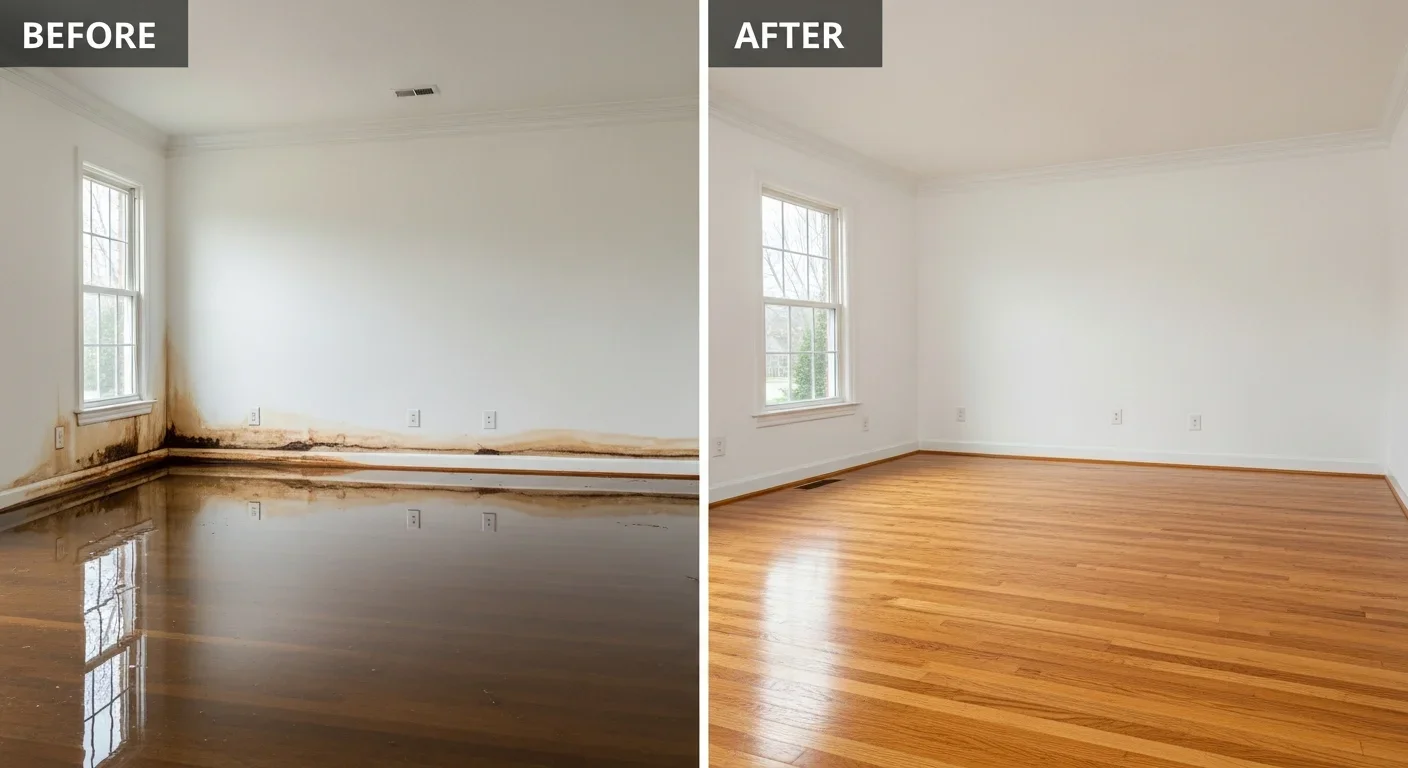
Water damage restoration in Raleigh, NC — hardwood floors fully recovered with proper extraction and dryingCrawl space structural drying setup — Raleigh clay soil requires continuous dehumidification to reach dry standard
Why Palm Build
Why Raleigh Homeowners Choose Palm Build
Water damage restoration in Raleigh requires specific knowledge of Wake County's
climate, soil, and construction — not a national-franchise checklist.
24/7 Same-Day Dispatch
We dispatch around the clock for Raleigh water emergencies. When Crabtree Creek rises fast or a pipe bursts at 2 AM, every hour without extraction expands mold risk. We're available year-round — including during the summer storm peak when demand is highest.
Insurance-Ready Documentation From Day One
With NC homeowner premiums rising 7.5% in 2025 and again in 2026, carriers are reviewing cause-and-origin documentation carefully. We establish the damage narrative and document every moisture reading from first arrival — creating the file your adjuster needs to process the claim correctly.
Mold Prevention Is Built In
Water damage and mold are one problem in Raleigh's climate. We don't just dry the visible damage — we check crawl spaces, monitor humidity throughout drying, apply EPA-registered antimicrobials, and flag any pre-existing mold for immediate scoping. We stop the second problem before it starts.
Research Triangle Local Knowledge
We know Wake County's creek corridors, the specific drying challenges of Boylan Heights crawl spaces, the HOA documentation requirements for North Hills multifamily, and why Brier Creek OSB subfloor needs faster response than older solid lumber. This specificity produces better outcomes.
Water Damage in Your Raleigh NC Home? Every Hour Matters.
Raleigh's clay soil, creek flooding, and humid climate make professional response within hours essential — not days. Call Palm Build for 24/7 emergency extraction, structural drying, and complete restoration with insurance-ready documentation.