Key takeaways
- Fort Mill grew 37% between 2020 and 2023 — the 7th fastest growth rate in the United States — and most homes in the subdivisions that drove that boom are now 15–35 years old, the age where plumbing, HVAC condensate lines, and crawl space vapor barriers begin to fail.
- Piedmont red clay soil expands when wet and contracts when dry, pushing moisture into crawl spaces and creating gaps that let more water in the next time.
- Neighborhoods like Waterside at the Catawba border the Catawba River and sit in FEMA Zone A — but roughly one-third of federal flood claims come from Zone X, which is where most of Fort Mill lives.
- South Carolina does not license mold remediators at the state level. IICRC certification is the only credential Fort Mill homeowners can reliably verify.
- NC-licensed contractors cannot legally perform restoration work in SC without a separate South Carolina LLR license — a common problem for Fort Mill homeowners who work in Charlotte and default to their commuter network.
- Roughly 80% of Fort Mill housing is HOA-governed (Baxter Village, Sun City Carolina Lakes, Waterside, Massey, and dozens more) — meaning master policy vs. HO-6 coordination and HOA approval letters are baseline restoration mechanics here, not edge cases.
Fort Mill is not a coastal city. You will not find hurricane shutters on most of these homes, and the people who moved here from New Jersey or Ohio during the Charlotte-metro boom often assume their water damage risk is lower than what they left behind. That assumption is wrong in specific, expensive ways. York County's red clay soils, the Catawba River on its eastern edge, a summer humidity floor that never drops below 69 percent, and a wave of homes built between 1998 and 2010 that are now deep into their plumbing-failure years have combined to create a water damage and crawl space risk profile that does not look like anywhere else in South Carolina. This guide walks through what actually happens when water enters a Fort Mill home, which neighborhoods carry the highest risk, why Piedmont clay makes crawl spaces worse than you think, and the first 48 hours that decide whether you end up with a drying job or a gut renovation.
Fort Mill growth
+37.2%
Population growth 2020–2023 — 7th fastest in the U.S. among cities over 20,000
Median home value
$519K
Zillow Dec 2025 — premium home values mean every claim has more at stake
Summer humidity floor
69–75%
Relative humidity never drops below the mold-growth threshold
Mold risk window
24–48 hrs
IICRC guidance for drying wet materials before mold amplification
Why Water Damage in Fort Mill Is Not Like Water Damage Anywhere Else in SC
Fort Mill sits in the Piedmont, not the Lowcountry. That single geographic fact changes almost everything about how water damage happens here. There is no salt air corroding roof fasteners, no tidal flooding pushing water up through storm drains, no 5,790-dollar-a-year homeowners insurance premium driven by hurricane proximity. The average Fort Mill homeowners policy runs around 2,430 dollars per year — roughly 24 percent below the South Carolina state average — because the underwriting spreadsheets correctly identify that Fort Mill does not see storm surge. What those spreadsheets do not capture is that Fort Mill gets 44 to 45 inches of rain per year across 99 precipitation days, that its soils do not absorb water well, that its houses increasingly sit on crawl spaces that were built to a 1990s moisture standard, and that the Catawba River has a documented history of catastrophic flooding going back more than a century.

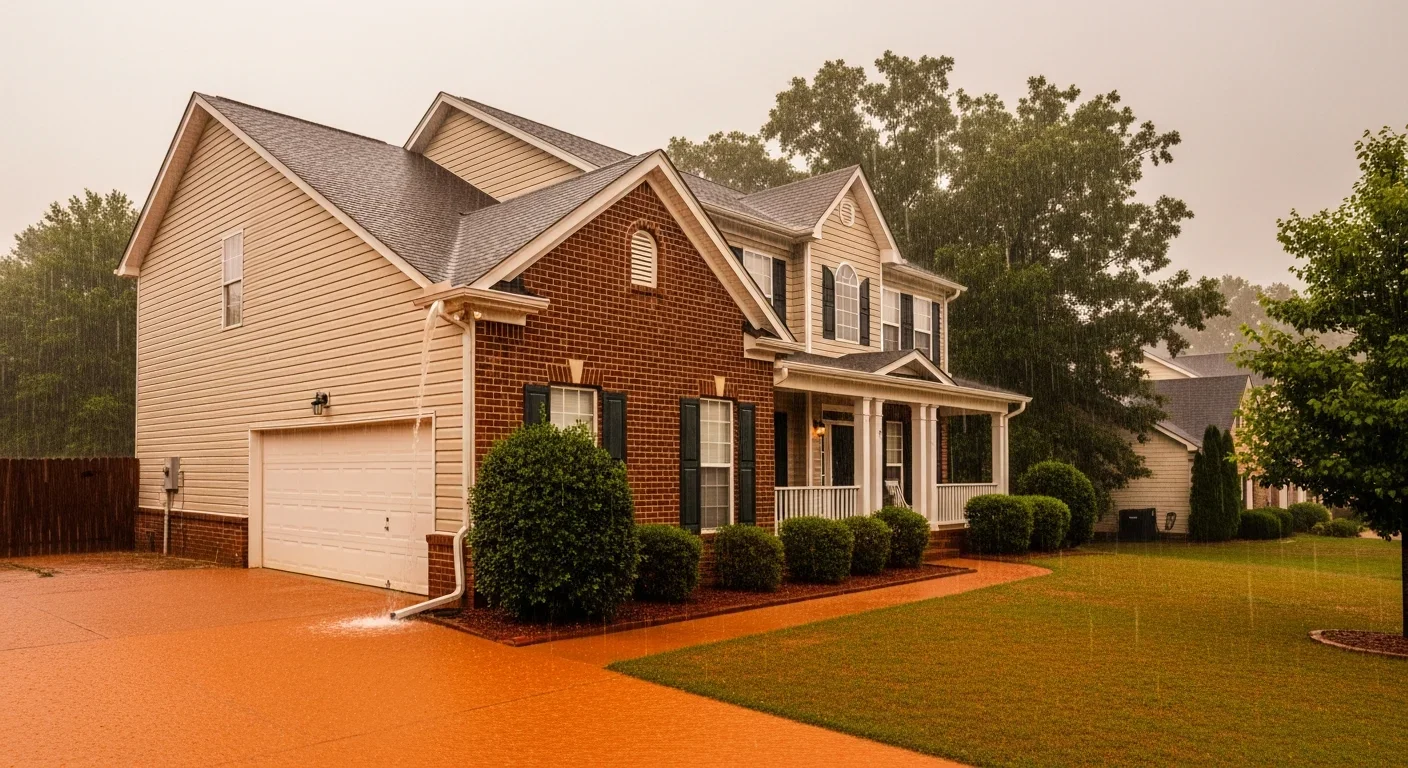
The Great Flood of 1916 is still the benchmark Catawba River event. Water rose 47 feet above flood stage, took out every bridge and railroad trestle in York County, and rewrote the assumptions local officials had about where the river could go. Since then, modern urbanization has made the underlying problem worse rather than better. Every new subdivision added during the 1998 to 2010 Fort Mill boom replaced permeable land with impervious surface — driveways, rooftops, cul-de-sac asphalt — which sends stormwater racing across the surface into Sugar Creek, Steele Creek, and the Catawba instead of soaking into the ground the way the pre-development landscape used to handle it. In August 2025, a Flash Flood Warning was issued specifically for Fort Mill, Rock Hill, and York SC, with York County Emergency Management tracking active creek-corridor flooding. Two months earlier, flash flooding through the Steele Creek corridor required overnight rescues of residents. These are not 100-year events. They are the new normal.
1916
The Great Flood — Catawba 47 feet above flood stage
The benchmark Catawba River event. Every bridge and railroad trestle in York County destroyed. Still the basis hydrologists use when modeling worst-case flood scenarios for the basin a century later.
1989
Hurricane Hugo — 85 mph inland winds reach York County
Hugo proved that Fort Mill is not insulated from Atlantic hurricanes simply because it sits inland. Widespread tree damage, multi-day power outages, and water intrusion through wind-compromised roofs across older Fort Mill subdivisions.
2018
Hurricane Florence — 3 to 5 inches of rain, 39–57 mph winds
A reminder that the inland tracking remnants of an Atlantic system can still drop event-level rainfall on already-saturated Piedmont clay. Sugar Creek and Steele Creek tributaries reached action stage repeatedly during the event.
September 27, 2024
Hurricane Helene — deadliest SC storm in 100 years
FEMA paid $323 million in Individual Assistance across 28 SC counties. York County experienced downed trees, widespread power outages, and flooding along the Catawba corridor — but damage thresholds for Individual Assistance fell short, leaving Fort Mill homeowners almost entirely dependent on private insurance for recovery.
June 2025
Steele Creek corridor — overnight flash flood rescues
Multiple residents pulled from a mobile home community along the Steele Creek corridor after rapid water rise. The corridor runs through the Fort Mill / Charlotte border area and is a recurring flash-flood hot spot.
August 2025
Flash Flood Warning — Fort Mill, Rock Hill, York
York County Emergency Management issued a targeted Flash Flood Warning for the Fort Mill / Rock Hill / York triangle. Active creek-corridor flooding tracked in real time by local emergency management. Five months earlier the same area had been classified as low risk in standard FEMA Zone X.
Fort Mill's Highest-Risk Neighborhoods for Water Damage
Fort Mill's water damage risk is not evenly distributed. Some subdivisions face elevated flood exposure from their proximity to the Catawba or to the creek corridors that cut through the area. Others face a different and slower kind of risk: 1998-to-2010 production homes that are now deep into the age where original supply lines, HVAC condensate systems, and vapor barriers start to fail at the same time. A restoration company that treats both situations identically will make mistakes in both directions. Below is a breakdown of the Fort Mill neighborhoods that come up most often in local damage reports and permit records.
| Neighborhood | Built | Foundation | Primary Risk |
|---|---|---|---|
| Waterside at the Catawba | 2015–present | Slab with optional basements | Directly adjacent to the Catawba River; FEMA Zone A exposure; basement moisture intrusion during heavy rain |
| Baxter Village | 1998–present | Slab and crawl space mix | Oldest homes now 25+ years; aging plumbing, shared townhome walls enable lateral water spread, strong HOA approvals required |
| Regent Park | Late 1990s–2010s | Slab common | Production-built early-2000s homes entering peak plumbing failure window; higher density means neighbor-to-neighbor propagation |
| Sun City Carolina Lakes | 2005–2016 | Slab-on-grade | Any slab leak floods the entire single-story living area; 55+ community where insurance advocacy matters most |
| Massey | 2010s–present | Slab | $800K+ luxury inventory; hardwood, stone counter, custom cabinetry replacement costs run premium; Chubb-tier underwriting |
| Masons Bend | 2010s–present | Slab | $850K–$935K+ upscale construction; high contents complexity and matched-finish requirements drive scope on every claim |
| Springfield | 2000s–present | Slab and crawl mix | Golf-course community with irrigation moisture against foundations; large lots; $690K+ price band; HOA review on every exterior repair |
| Legacy Park | 2005–2008 | Slab | 15–20 years old; pinhole supply line leaks, original HVAC drain line clogs, first-generation water heaters reaching end of life |
| Historic Downtown / Whiteville Park | Late 1800s–1960s | Crawl space | Highest crawl space mold risk; original moisture barriers either degraded or never installed; cast-iron plumbing |
| Bridgemill / Habersham / Shelly Woods | 2000s–2010s | Crawl space common | Heavy tree canopy accumulates roof debris and holds moisture; storm-damage exposure from falling oaks |
Fort Mill neighborhoods by water damage and crawl space risk profile
Waterside at the Catawba deserves specific attention. The community sits directly along the Catawba River off Whites Road, began construction in 2015, and includes optional basement units in a market where basements are otherwise uncommon. Those basements are the most flood-exposed residential spaces in Fort Mill. French drains and sump pumps are standard equipment there for a reason, and when the power goes out during a storm — which is exactly when the sump pump is needed most — the margin between a dry basement and a ruined one comes down to battery backup and how fast the homeowner can get a professional extraction crew on site.

Anne Springs Close Greenway and the Sugar Creek corridor
The 2,100-acre Anne Springs Close Greenway runs through the heart of Fort Mill — more than twice the size of New York's Central Park — and sits between Sugar Creek to the west and the Catawba River to the east. Local landmarks like Lake Haigler, the Dairy Barn entry, and the Blue Star trails are the markers most longtime residents use to talk about Fort Mill geography. The Greenway also serves as a bellwether for water risk: when the trail corridors flood, Sugar Creek is at action stage and the cul-de-sacs along its watershed are next. The Close family — descendants of the Springs Industries founders who built Fort Mill in the late 1800s — preserved this corridor specifically because the floodplain was never going to support development. Treat trail flood reports as a leading indicator, not a curiosity.
Red Clay + 1990s Crawl Spaces = A Very Specific Kind of Problem
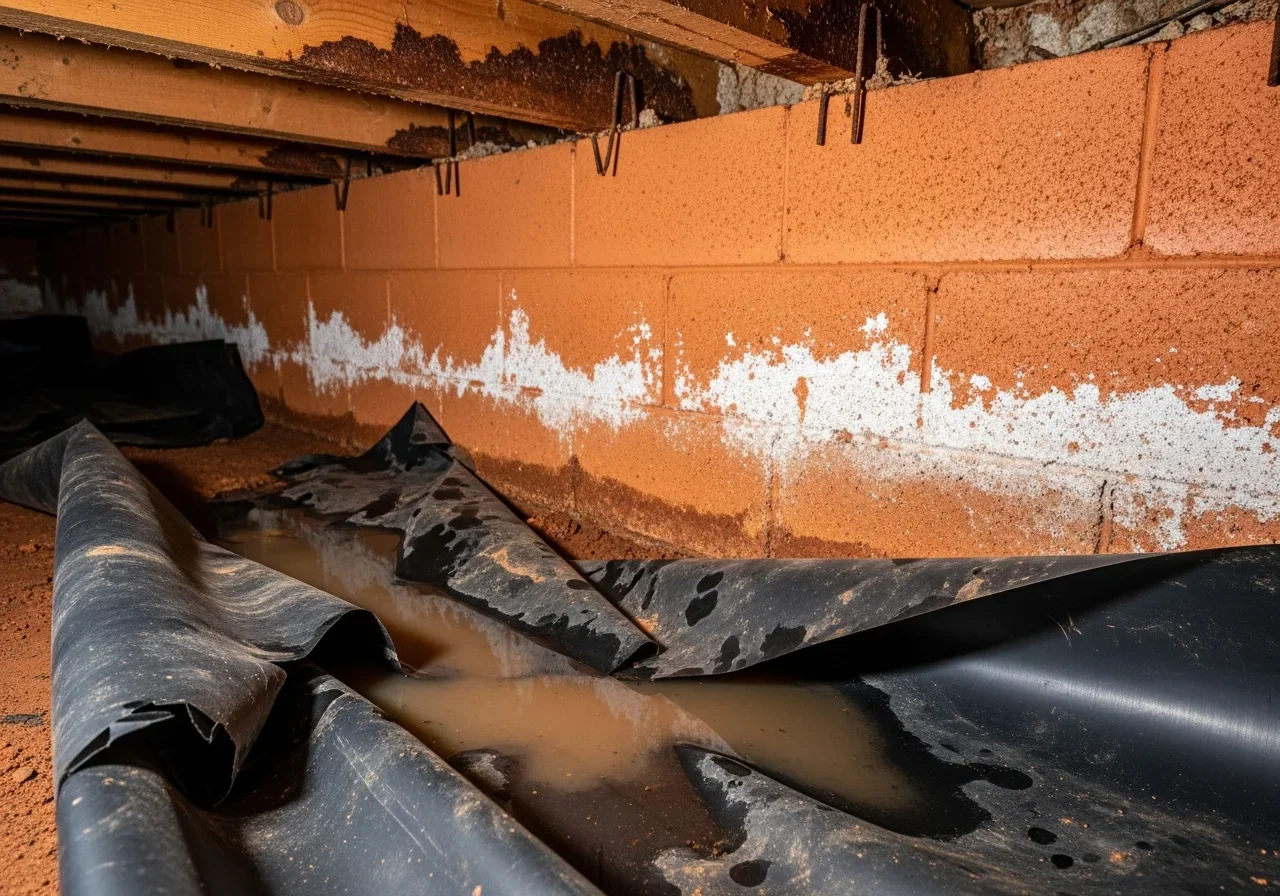
If you dig a hole anywhere in Fort Mill, you will hit the same orange-red Piedmont clay that runs under most of western York County. It is a beautiful soil to look at and a terrible soil to build a crawl space above. This is what soil scientists call expansive clay — soil that expands when saturated and contracts when dry, with enough force to push moisture laterally against foundation walls and up through any crack or gap it can find. When the clay contracts during a dry stretch, it opens new gaps along the foundation perimeter that were not there before the last heavy rain. The cycle repeats itself every spring through fall. Meanwhile, any surface water that cannot infiltrate the ground ponds around the foundation and then migrates into the crawl space through vapor pressure, through wall cracks, or through the crawl space vents themselves.
Those vents are the other half of the problem. Through the 1990s and well into the 2000s, South Carolina code required crawl space vents to move air through the foundation. That assumption — borrowed from drier climates — is exactly backwards for the Piedmont humid subtropical climate. When warm, humid outside air enters a cooler vented crawl space during a Fort Mill summer, it condenses on the floor joists, on the underside of the subfloor, and on any cool surface it can find. By August, when the outdoor dew point hits 70 and relative humidity sits around 75 percent, the crawl space has essentially become a permanent condensation chamber. This is why so many Fort Mill homeowners discover crawl space mold years after they move in, during a routine HVAC service visit or when a home inspector opens the access hatch during a pre-sale walkthrough.
The age curve of 1998–2010 Fort Mill homes
Common risk factors
- Washing machine and refrigerator supply lines past 10-year replacement window
- HVAC condensate drain lines clogging with biofilm and releasing water into ceiling cavities
- First-generation vapor barriers torn, displaced, or never sealed at edges
- Original water heaters at 12–20 years — tank failures and relief valve drips common
- PEX plumbing fittings from the mid-2000s installed before improved crimp-ring standards
What to watch for in your Fort Mill home
- Musty odor that intensifies when the HVAC kicks on — a sign of crawl space or duct contamination
- Cupping or springiness in hardwood floors above crawl space areas
- Ceiling stains below second-floor laundry or bathroom locations
- Unexplained jumps in the monthly York County water bill
- Efflorescence (white mineral deposits) on crawl space concrete block walls
- Visible rust or corrosion on crawl space ductwork or metal straps
"Mold growth on wet structural materials can occur within 24 to 48 hours under conditions favorable to growth. The timing of professional drying and the verification of moisture content below growth thresholds are the most important factors in preventing secondary microbial damage after a water intrusion event."
What Happens in the First 24 to 48 Hours After Water Enters a Fort Mill Home
Fort Mill's climate gives you a shorter response window than most of the country. IICRC S500 and S520 standards both reference the 24 to 48 hour mark as the point where wet structural materials begin supporting active mold growth, and that timeline is generous for Fort Mill. When the ambient relative humidity in your home is already sitting at 70 percent — which it is, year-round, in July and August — wet drywall and wet floor joists reach the moisture content that supports mold faster than they would in Denver or Phoenix. A homeowner who leaves for a long weekend and tries to dry a flooded laundry room with a box fan is almost always returning to a mold job on Monday.
- If standing water is in contact with any electrical outlet, extension cord, or appliance, shut off power to the affected zone at the breaker panel before you enter the area
- Call a licensed South Carolina restoration company — not a Charlotte NC contractor. NC-only licensees cannot legally perform work in SC
- Photograph and video every affected room, baseboard, ceiling stain, and piece of standing water before you move anything. Your insurance claim depends on pre-remediation documentation
- Do not run your HVAC system to dry the space. It will spread moisture and potential contaminants through the ductwork into rooms that are currently unaffected
- Move contents — furniture, rugs, books, electronics — to a dry staging area, photographing what you move as you go
- If your home is in a Baxter Village, Sun City, Waterside, or other HOA community, notify the HOA board in writing as soon as possible — most require written notification before any exterior work or shared-wall work begins
- If you live in any HOA community (≈80% of Fort Mill housing), capture the HOA name, your community manager's name, and the management company contact in your claim file from the start — having that documentation in hand from hour one prevents downstream coordination delays with the master policy carrier
- Call your homeowners insurance carrier to open a claim. Note the date, time, weather event, and the apparent source of water entry. Ask specifically whether you have sewer and drain backup coverage
- If water entered from outside — creek overflow, surface runoff, river rise — notify your flood insurance carrier as a separate claim. These are two different policies with two different adjusters
Cost expectations for Fort Mill water damage and crawl space work
Fort Mill restoration costs land where they do for three reasons that have very little to do with the restoration company itself. First, premium home values — a $519,000 median home value Zillow tracked at the end of 2025 — mean every claim involves higher-grade finishes than the U.S. average. Second, South Carolina building code requires a Class I vapor barrier in any encapsulated crawl space, plus mechanical dehumidification or conditioned air supply, which adds material and labor cost compared to the older vented designs. Third, York County permitting and HOA approval letter coordination — required on most communities — adds project management overhead that does not show up in a one-line quote. The ranges below are written against the Xactimate-software pricing standard that every major SC carrier uses, which is also what Palm Build writes estimates in by default.
| Project type | Typical range | Notes |
|---|---|---|
| Standard water damage restoration | $7,000 – $24,000 | Extraction, structural drying (3–5 days), mold prevention treatment, drywall and flooring repair on a single-room loss |
| Complex / multi-room or multi-floor water loss | $14,000 – $60,000+ | Crawl space remediation, mold remediation if present, structural joist or slab repair, encapsulation; typical for older Whiteville Park or Historic Downtown homes |
| Crawl space — basic vapor barrier package | $5,000 – $7,000 | Class I vapor barrier, vent sealing, dehumidifier; assumes no active mold; 2–4 days install |
| Crawl space — full encapsulation | $12,000 – $25,000 | Drainage correction, sealed perimeter, conditioned air supply, mechanical dehumidification, insulation replacement |
| Encapsulation with mold remediation | $12,000 – $50,000+ | Adds containment, IICRC S520 remediation protocol, post-remediation clearance testing before encapsulation goes in |
Fort Mill restoration cost ranges (Xactimate-aligned, current SC regional pricing)
South Carolina Does Not License Mold Remediators — Here Is What That Means for You
This is the part of Fort Mill restoration that most homeowners do not know until they need it. Unlike Florida and a handful of other states, South Carolina does not license mold inspectors or mold remediators at the state level. There is no state database you can query to verify that the person in your crawl space is qualified to do the work they are doing. SC House Bill 3203, filed during the 2022–2023 legislative session, proposes a voluntary certification framework aligned with IICRC S520 (the Standard for Professional Mold Remediation). As of this writing, the bill remains in committee and has not become law. Until it does, IICRC certification is the only credential a Fort Mill homeowner can meaningfully verify. A legitimate mold remediation firm will hold current IICRC certifications in Water Damage Restoration (WRT), Applied Structural Drying (ASD), and Applied Microbial Remediation (AMRT), and will be willing to show you the credentials of the specific technicians entering your home.
"The Department of Health and Environmental Control may establish voluntary minimum standards for mold remediation companies, aligned with IICRC S520, approve training courses and certifications, and publish a publicly accessible list of certified remediators on the department's website."
- 1
Confirm IICRC certification
Ask for the company's IICRC firm certification number. Verify it at iicrc.org using the certified firm locator. Confirm they hold WRT (Water Damage Restoration), ASD (Applied Structural Drying), and AMRT (Applied Microbial Remediation) if any mold work is involved.
- 2
Check the SC LLR contractor license
South Carolina requires state-level contractor licensing. Look up the company at llr.sc.gov and verify the license is active and in the appropriate classification for restoration work.
- 3
Verify insurance and bonding
Request a current certificate of insurance (general liability and workers compensation). A legitimate firm will have this sent from their carrier directly to you within hours.
- 4
Ask about HOA coordination experience
Fort Mill's dominant subdivisions are HOA-governed. A company that has not done work in Baxter Village, Sun City, or Waterside will not know the local board approval process — and delays on approvals mean delays on drying.
- 5
Request a written scope with moisture readings
A professional scope includes initial moisture content readings, target dry standards, a drying plan, and daily moisture logs. If the proposal is one line and a price, the company is not documenting to insurance-claim standards.
What every SC LLR contractor license actually requires
- **Active SC LLR Residential Builders license** in the appropriate classification, verifiable at llr.sc.gov before you sign any contract
- **IICRC firm certification** matched to the specific scope — WRT for water, ASD for structural drying, AMRT for any mold work, FSRT/OCT for fire and smoke
- **Current general liability and workers compensation certificates of insurance** sent directly from the carrier (not photocopied by the contractor)
- **IICRC technician credentials available on demand** — not just at the firm level but for the specific people walking onto your property
- **Documented history of York County or Town of Fort Mill permits** in the appropriate residential classification — ask for the most recent two or three permit numbers and verify them with the building department
- **Familiarity with HOA approval letters** as a baseline workflow item, not a special request — most Fort Mill projects require one before the permit can issue
Decoding the credentials: a Fort Mill homeowner's glossary
- IICRC S500
- The Institute of Inspection, Cleaning and Restoration Certification standard for professional water damage restoration. Defines water damage categories, classes, drying targets, and documentation requirements that every reputable Fort Mill restorer follows.
- IICRC S520
- The IICRC standard for professional mold remediation. Defines containment, removal, post-remediation verification, and clearance testing — the framework SC House Bill 3203 would adopt as voluntary state standard if it ever passes.
- WRT
- Water Damage Restoration Technician — the entry-level IICRC technician credential for water work. Required for any water mitigation crew lead.
- ASD
- Applied Structural Drying — the IICRC credential covering psychrometric monitoring, dehumidifier sizing, and the drying-to-target-moisture-content workflow that decides whether a job avoids mold or grows it.
- AMRT
- Applied Microbial Remediation Technician — the IICRC mold credential. Required for anyone scoping or executing mold remediation under S520 protocol.
- SC LLR
- South Carolina Department of Labor, Licensing, and Regulation. Administers the Residential Builders Commission, which licenses residential contractors in SC. Verification at llr.sc.gov.
- SC House Bill 3203
- Proposed legislation (2022–2023 session) that would create a voluntary mold remediator certification framework administered by SC DHEC and aligned with IICRC S520. Remains in House committee — not yet law.
- DHEC
- South Carolina Department of Health and Environmental Control. Provides indoor air quality and mold guidance for SC residents and would administer any future voluntary mold remediator registry under HB 3203.
- FEMA Zone A
- FEMA Special Flood Hazard Area — properties with a 1% annual chance of flooding (25% over a 30-year mortgage). Includes parts of Waterside at the Catawba and properties along Sugar Creek and Steele Creek tributaries. Mortgage lenders typically require flood insurance in Zone A.
- FEMA Zone X
- Moderate-to-minimal flood risk — where most of Fort Mill sits. Flood insurance is not federally required, but roughly one-third of all federal flood disaster claims come from Zone X properties.
- NFIP
- National Flood Insurance Program — the federal flood insurance program. Required in Zone A, optional but worth carrying in Zone X. Private flood policies through Chubb, USAA, and Travelers are an alternative for higher-value Fort Mill homes.
- HO-3
- The standard South Carolina homeowners insurance form. Covers sudden and accidental water damage from inside the home. Excludes flood, gradual leaks, and most mold beyond a small sublimit.
- Mold sublimit
- A coverage cap inside an HO-3 policy that limits payment for mold remediation — typically $10,000–$15,000 in Fort Mill, but varies by carrier. Easily exceeded on a Whiteville Park crawl space remediation.
- Sewer/drain backup endorsement
- An optional rider added to an HO-3 policy that covers water damage from a backed-up sewer or drain line. Excluded from the base policy. The single most underbought endorsement in York County — worth every dollar.
Insurance Coverage Gaps Fort Mill Homeowners Routinely Learn About the Hard Way
The Fort Mill carrier landscape is dominated by State Farm — the most affordable major writer in SC at an average of roughly $1,961 per year — alongside Allstate, USAA (well-represented through the area's military retiree population), Travelers, Nationwide, and SC Farm Bureau. Premium homes in Massey, Masons Bend, and Stanton Heights ($800K+) typically write through Chubb, which underwrites differently and tends to settle scope at higher line-item values. Fort Mill's average homeowners premium of $2,430 per year is roughly 24 percent below the SC statewide average of $3,205 — affordable, but affordability does not equal comprehensiveness. Most HO-3 policies in York County contain specific limitations that only become visible during a claim. The most expensive surprise is the flood exclusion, but it is not the only one. Mold coverage is typically sub-limited to $10,000 or $15,000 and frequently excluded entirely if the mold is deemed to have resulted from a gradual leak rather than a sudden event. Sewer and drain backup is excluded from the base policy and requires an added endorsement. And the fundamental distinction between water coming from inside the home (usually covered) and water coming from outside the home (usually not) determines whether a claim is paid at all.
| Loss Type | Standard HO-3 Policy | NFIP Flood Policy | Notes |
|---|---|---|---|
| Burst supply line (washer, fridge, ice maker) | Covered | Not applicable | Classic sudden and accidental claim |
| HVAC condensate line overflow | Often covered | Not applicable | Some carriers exclude slow leaks — verify with your agent |
| Slab leak from pressurized line | Typically covered | Not applicable | Access and repair may be separate from water damage coverage |
| Catawba River or creek overflow | Not covered | Covered | Classic flood peril — NFIP or private flood policy required |
| Surface water from heavy rain | Not covered | Covered | Classified as flood even when no creek or river is nearby |
| Sewer or drain backup | Not covered (base policy) | Not covered (base policy) | Requires an added endorsement on your HO policy — worth every dollar |
| Mold from a gradual leak | Often excluded or sub-limited | Very limited | Document immediately — sub-limits vary widely between carriers |
| Basement flooding in Waterside at the Catawba | Not covered | Covered with NFIP | Waterside's optional basements are in FEMA Zone A — flood insurance is effectively mandatory |
Coverage comparison: York County SC homeowners insurance vs. NFIP flood insurance
There is also a cross-border wrinkle that catches Fort Mill homeowners regularly. Because Fort Mill is essentially a Charlotte suburb in a different state, many homeowners work for NC-based employers, carry NC-based group homeowners insurance through their employer, or hold policies with carriers whose local agents are based in Charlotte. Those agents are not always deeply familiar with SC-specific contractor licensing, SC DHEC guidance, or how York County handles permits for restoration work. When a claim requires cross-border coordination, a restoration company that operates on both sides of the line and holds licensing in both states is materially faster to get started.
HOA-governed restoration in Fort Mill: roughly 80% of housing
Fort Mill is the most HOA-intensive restoration market in the Charlotte metro. Roughly 80 percent of the city's housing sits in an HOA-governed community — Baxter Village, Sun City Carolina Lakes (3,160 homes), Waterside at the Catawba, Springfield, Massey, Masons Bend, McCullough, Four Seasons at Gold Hill, Carolina Orchards, plus dozens of smaller subdivisions. This changes the restoration mechanics from the very first hour. Master policy versus HO-6 split is the central question on every claim: in Baxter Village townhomes the wall assemblies are shared, so a leak in one unit can damage a neighbor through the party wall and trigger both the source-unit owner's HO-6, the affected-unit owner's HO-6, the source-unit owner's carrier subrogation, and the HOA master policy all in parallel. In Sun City Carolina Lakes carriage homes and in Waterside's basement units, the master policy may be 'walls-in' or 'all-in' depending on the CC&Rs. Town of Fort Mill or York County permitting offices will not issue building permits for covered restoration scope until the HOA approval letter is on file, which means the HOA approval workflow runs in parallel with mitigation, not after.
- Notify the HOA board in writing within 24 hours — most Fort Mill HOAs require written notification before any exterior work or shared-wall work begins
- Request a copy of the HOA master policy declarations page from the property management company so master vs. HO-6 boundary is documented from day one
- Photograph and document shared-wall versus unit-only damage separately — the adjusters from each policy will need attribution at the line-item level
- Secure the HOA approval letter on board letterhead, signed by an authorized board member or property manager — required before York County or Town of Fort Mill issues a permit
- Coordinate parallel walkthroughs with the master policy adjuster and your HO-6 adjuster on the same visit when possible — eliminates the scope-gap problem between policies
- Confirm permit jurisdiction (Town of Fort Mill Building Department for incorporated areas, York County Building Services for unincorporated) and submit the permit application alongside the HOA package
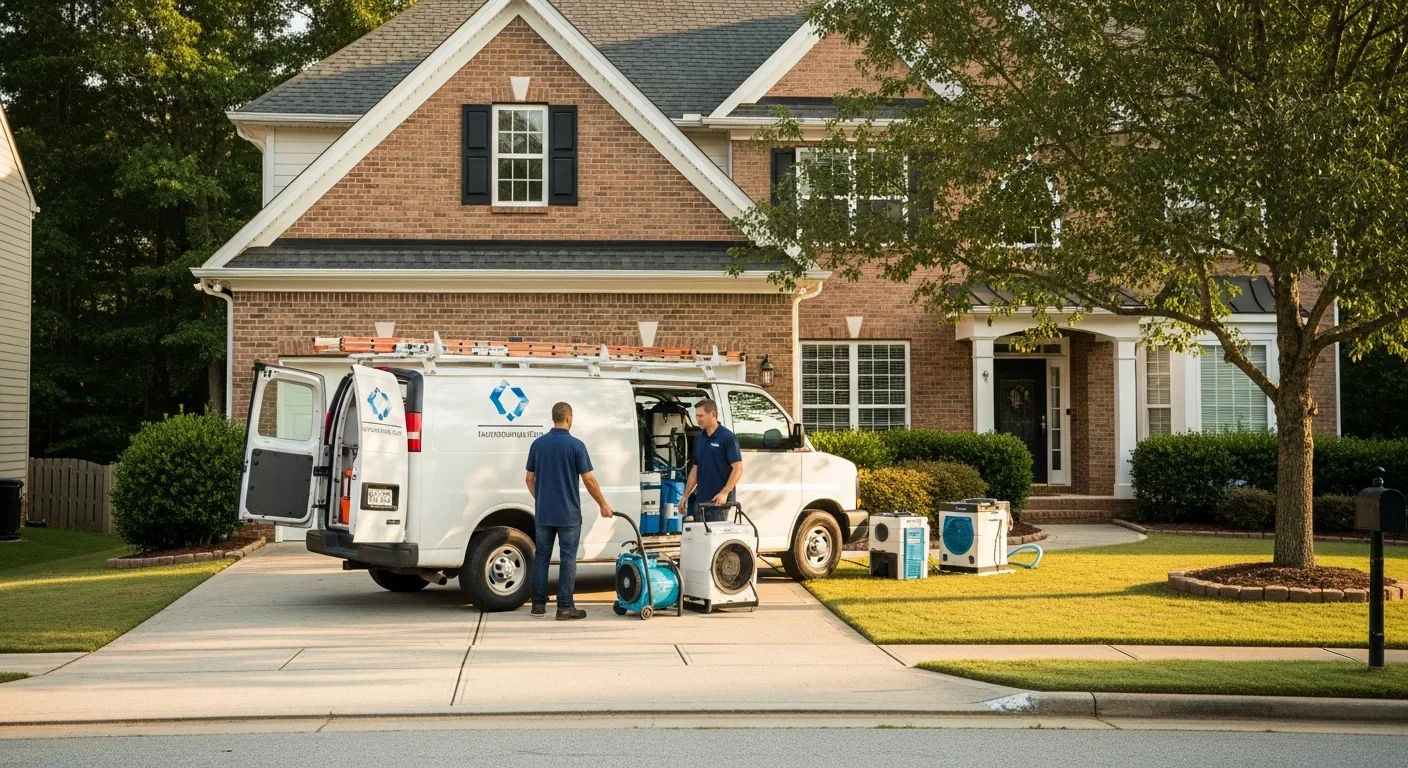
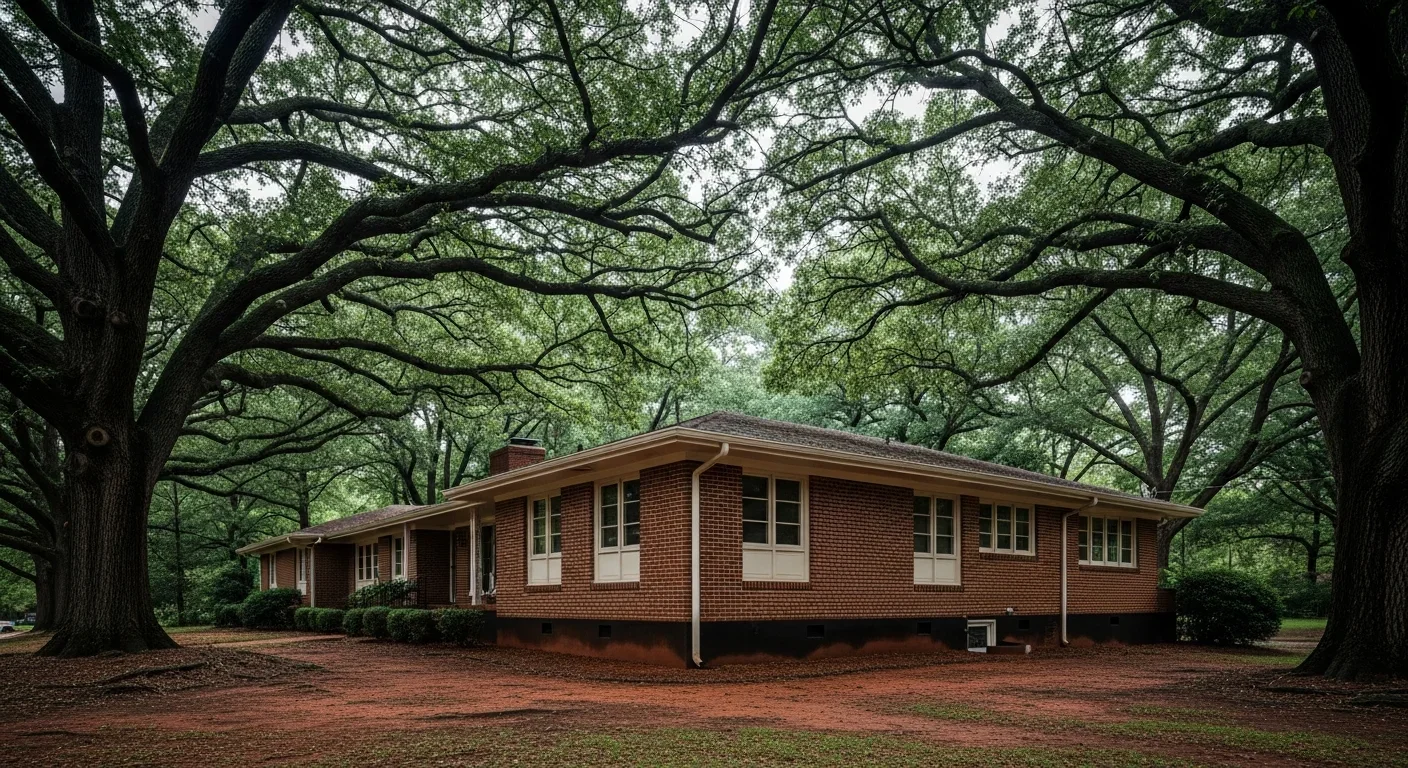
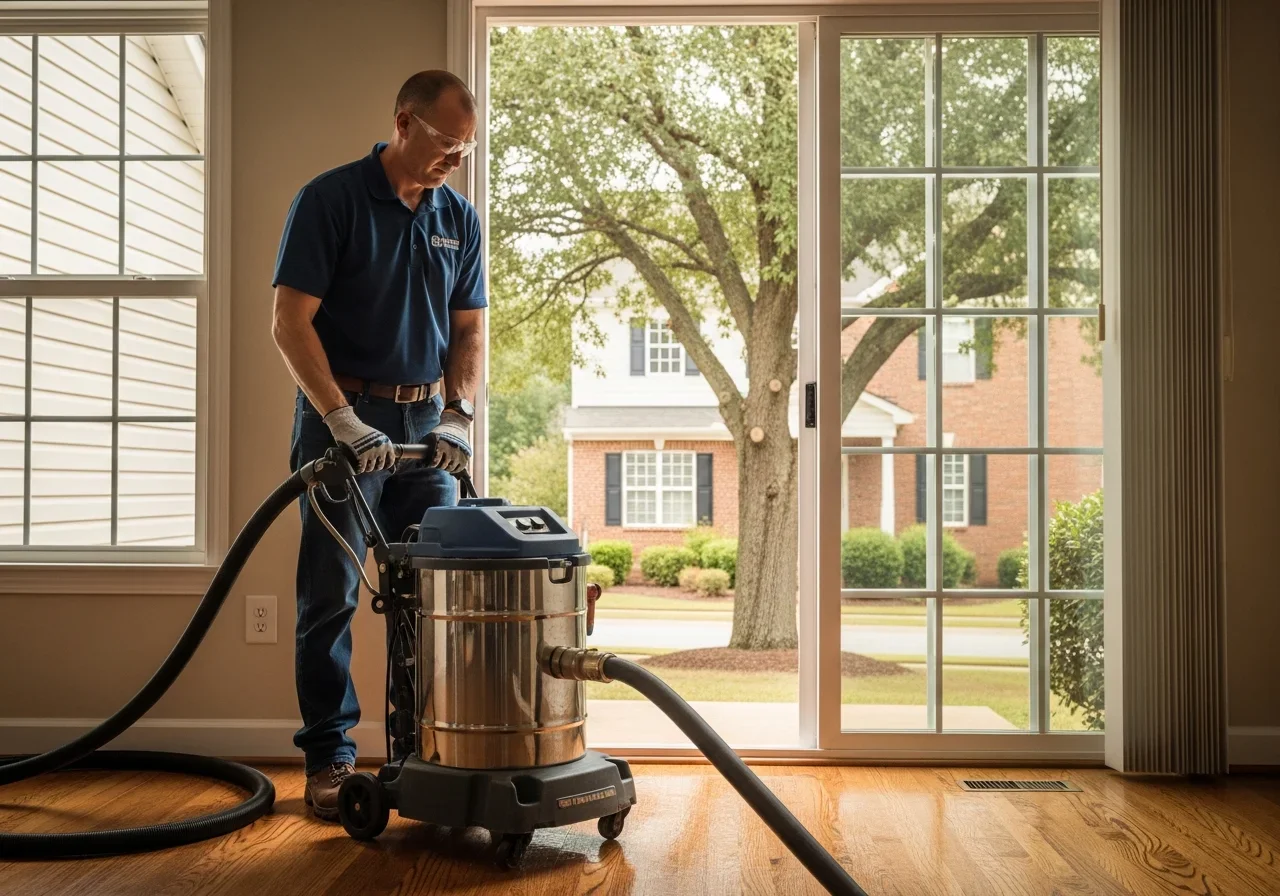
Fort Mill in pictures: neighborhoods, weather, and what damage actually looks like
Frequently Asked Questions: Water Damage & Crawl Spaces in Fort Mill, SC
Does homeowners insurance cover water damage in Fort Mill SC? +
Is Fort Mill in a flood zone? +
Why do crawl spaces in Fort Mill get so moldy? +
How fast does mold grow in a Fort Mill home after water damage? +
Can a North Carolina contractor do restoration work in Fort Mill SC? +
Which Fort Mill neighborhoods have the highest water damage risk? +
Do I need a permit for water damage repairs in Fort Mill? +
How does basement flood cleanup work in Fort Mill, especially in Waterside at the Catawba? +
How long does crawl space encapsulation take in Fort Mill? +
Can my Charlotte insurance agent handle a Fort Mill claim? +
Water Restoration in Fort Mill, SC
Palm Build's Fort Mill water damage extraction, drying, and restoration services with SC LLR licensing and IICRC certification.
Crawl Space Cleanup in Fort Mill, SC
Encapsulation, vapor barrier replacement, and crawl space mold remediation built for Piedmont red clay conditions.
Mold Remediation in Fort Mill, SC
IICRC S520-compliant mold remediation in a state without mandatory mold licensing.
North Carolina Crawl Space Problems
Companion guide covering Piedmont crawl space moisture issues across the Charlotte metro area.
First 24 Hours After Water Damage
Hour-by-hour action plan for the critical first day of any water damage event.
Post-Storm Mold: The 48-Hour Window
Why mold starts establishing 48 hours after water recedes — and how to stop it.
Mold Remediation Cost (2026)
National and Carolinas-regional cost guide for mold remediation by scope, square footage, and substrate type.
Crawl Space Encapsulation Cost (2026)
What encapsulation actually costs in the Carolinas, broken down by basic vapor barrier, full encapsulation, and encapsulation-with-mold-remediation tiers.
Water Damage Categories and Classes Explained
The IICRC S500 framework — Categories 1, 2, 3 and Classes 1 through 4 — that every adjuster references when scoping your claim.
Water damage in your Fort Mill home?
Palm Build holds both South Carolina LLR contractor licensing and IICRC certification, and we respond to Fort Mill, York County, Rock Hill, and the greater Charlotte metro 24/7. Every job is documented to IICRC standards so your water damage restoration claim is supported from day one. Call our team now.
Found this helpful? Send it to someone who needs it.