Quick Answer
Water damage is classified two ways under the IICRC S500 standard. Categories (1–3) describe contamination: Category 1 is clean, sanitary water, Category 2 (gray water) can cause illness, and Category 3 (black water) is grossly contaminated, like sewage or floodwater. Classes (1–4) describe drying difficulty and scope — and any category can pair with any class.
Key takeaways
- Water damage categories (1-3) describe contamination level: Category 1 is sanitary water, Category 2 can cause illness, and Category 3 is grossly contaminated (sewage, floodwater).
- Water damage classes (1-4) describe drying difficulty: Class 1 is the smallest scope, Class 4 involves specialty drying for materials like hardwood, plaster, or concrete.
- Any category can pair with any class. A 'clean' Category 1 loss can still be a massive Class 3 or 4 drying project.
- There is no 'Category 4' in the IICRC S500 standard. People who say it usually mean Class 4 or are confusing hurricane categories with water damage classification.
- Drying wet materials within 24 to 48 hours helps prevent mold growth in many cases, according to the EPA and FEMA.
Water damage is classified two ways, and knowing both helps you understand what you are dealing with. Categories (1 through 3) describe how contaminated the water is: Category 1 is sanitary "clean" water, Category 2 has significant contamination that can cause illness, and Category 3 is grossly contaminated and can contain harmful agents like sewage or floodwater. Classes (1 through 4) describe how much water is in the structure and how difficult it will be to dry: Class 1 involves the least water, Class 2 typically affects an entire room, Class 3 means widespread saturation, and Class 4 is a specialty drying situation for dense materials like hardwood, plaster, or concrete. Act quickly, because drying wet materials within 24 to 48 hours helps prevent mold growth. If you need help now, contact our 24/7 emergency water restoration team.
Avg. restoration cost
$3,867
National average per Angi 2026 data
Claim frequency
1 in 67
Insured U.S. homes with water damage claims (2019-2023)
Mold growth window
24-48 hrs
EPA and FEMA drying benchmark to help prevent mold
What Are Water Damage Categories?
Water damage categories classify the contamination level of the water source. The most referenced professional framework in the U.S. is the ANSI/IICRC S500 Standard for Professional Water Damage Restoration. It defines three categories based on the source of the water, what it has contacted, and how long it has been present. Category is not about how much water is in the building. It is about how safe that water is to be around.
| Category | Description | Typical sources | Cleanup implications |
|---|---|---|---|
| Category 1 | Sanitary water from a clean source | Broken supply lines, tub/sink overflow (no contaminants), toilet tank breaks, rainwater before ground contact | More materials may be salvageable if dried promptly; can deteriorate over time |
| Category 2 | Significant contamination that may cause illness | Dishwasher/washing machine discharge, toilet overflow with urine (no feces), hydrostatic seepage, aquariums | Requires more aggressive cleaning and often more removal of porous materials |
| Category 3 | Grossly contaminated with potentially harmful agents | Sewage backups, toilet backflows beyond the trap, seawater, rising river water, storm surge, hurricane floodwater | Highest health risk; typically requires extensive removal and disposal of porous materials |
Water damage categories by contamination level
Category 1: Clean Water
Category 1 water originates from a sanitary source: a broken supply line, an overflowing bathtub with clean water, or a malfunctioning ice maker line. At the source, this water does not pose a health threat. However, Category 1 is time-sensitive. As clean water sits on surfaces, contacts building materials, and picks up contaminants from drywall, carpet backing, dust, and organic matter, it can deteriorate into Category 2 or even Category 3. This is why restoration professionals emphasize speed regardless of the water source.
Category 2: Gray Water
Category 2 water carries significant contamination that could cause illness if contacted or consumed. Common sources include washing machine and dishwasher discharge, toilet overflows containing urine but no feces, and sump pump failures. Gray water requires more aggressive cleaning than Category 1 and often means more porous materials (carpet padding, lower sections of drywall) need to be removed rather than dried in place.
Category 3: Black Water
Category 3 is the most serious classification. This water is grossly contaminated and may contain bacteria, viruses, chemicals, and other harmful agents. Sewage backups, rising floodwater, storm surge, and hurricane-driven water intrusion all fall into this category. Cleanup requires full personal protective equipment, containment protocols, removal and disposal of virtually all porous materials that contacted the water, and thorough disinfection. Do not attempt to clean Category 3 water damage without professional help.
What Are Water Damage Classes?
While categories describe contamination, classes describe the drying problem. The IICRC S500 defines four classes based on the relative degree of water saturation and the expected evaporation load. Classes determine how much drying equipment is needed, how long the project will take, and whether selective demolition is required to access hidden moisture.
| Class | Description | Key identifiers | Typical drying implications |
|---|---|---|---|
| Class 1 | Least amount of water and absorption | Under 5% of combined surfaces are wet; limited area, low-absorption materials | Simpler equipment setup, shorter drying time if addressed fast |
| Class 2 | More water with higher evaporation load | Affects at least an entire room; wicking up walls typically under 24 inches | More dehumidification and air movement needed; whole-room drying plan |
| Class 3 | Greatest amount of water, fastest evaporation | Water often from overhead; ceilings, walls, insulation saturated; over 40% wet porous surfaces | Larger equipment needs; higher chance of selective demolition to access wall cavities |
| Class 4 | Specialty drying for low-permeance materials | Hardwood, plaster, brick, concrete, or stone deeply saturated; slow moisture release | Requires specialty methods, lower humidity targets, and longer drying times |
Water damage classes by drying difficulty
Class 1 and 2 losses are the most common in residential settings. A supply line break in a kitchen caught within an hour might be Class 1. The same break left running overnight, soaking through to an adjacent room with wicking up the drywall, becomes Class 2 or 3. Class 4 situations often involve finished hardwood floors, plaster walls in older homes, or saturated concrete slabs. These materials hold moisture deep inside and release it slowly, requiring specialty drying techniques and extended timelines.
For water damage affecting crawl spaces, concrete foundations, or subfloor assemblies, the drying challenge is often Class 4 regardless of how "small" the water source seems. Our crawl space cleanup and drying teams use targeted dehumidification designed for these low-permeance environments.
Category vs Class: How They Work Together
The two systems answer different questions. Category answers: "Is this water safe to be around?" Class answers: "How big is the drying problem?" Any category can pair with any class. You can have a small, contained sewage backup (Category 3, Class 1) where the health risk is high but the drying scope is small. You can also have a clean supply line break that floods an entire floor (Category 1, Class 3) where the water is safe but the drying project is massive.
| Scenario | Likely category | Likely class | What it means for restoration |
|---|---|---|---|
| Supply line break on tile, caught quickly | Category 1 | Class 1 | Extraction and targeted drying; document moisture readings early |
| Water heater failure floods a finished room, wicking into drywall | Category 1 | Class 2-3 | Clean water but big drying scope; may need baseboard and drywall cuts for airflow |
| Dishwasher discharge spreads across kitchen and adjacent rooms | Category 2 | Class 2-3 | Higher cleaning and disinfection needs plus whole-area drying strategy |
| Sewer backup in bathroom, limited to a small footprint | Category 3 | Class 1-2 | Health risk is high even though the area is small; removal of porous materials and careful decontamination |
| Storm surge or floodwater saturates slab and lower walls | Category 3 | Class 3-4 | Large-loss drying plus decontamination plus material removal; longer timeline and more documentation |
Real-world category and class combinations
What category tells you
- Health risk level of the water
- Required PPE and safety controls
- Which materials need cleaning vs. disposal
- Disinfection and decontamination protocols
- Whether you can safely enter the space
What class tells you
- How much drying equipment is needed
- Expected project timeline
- Whether walls or ceilings need selective demolition
- Dehumidification targets and airflow strategy
- Whether specialty drying methods are required
What to Do Right After Water Damage
Regardless of the category or class, the first actions matter most. The EPA, CDC, and FEMA all emphasize that drying wet materials within 24 to 48 hours helps prevent mold growth in many cases. Here is what to prioritize in the first 24 hours after water damage.
- 1
Stop the water source and protect yourself
Shut off the water supply if possible. If standing water is near electrical outlets or panels, turn off electricity at the breaker before entering. For Category 3 water (sewage, floodwater), do not enter without protective equipment.
- 2
Document everything for your insurance claim
Take photos and videos of all affected areas before any cleanup begins. Note timestamps, the apparent source, and how far the water has spread. This documentation is critical for your insurance claim and can affect whether your insurer accepts the restoration scope.
- 3
Start drying as fast as possible
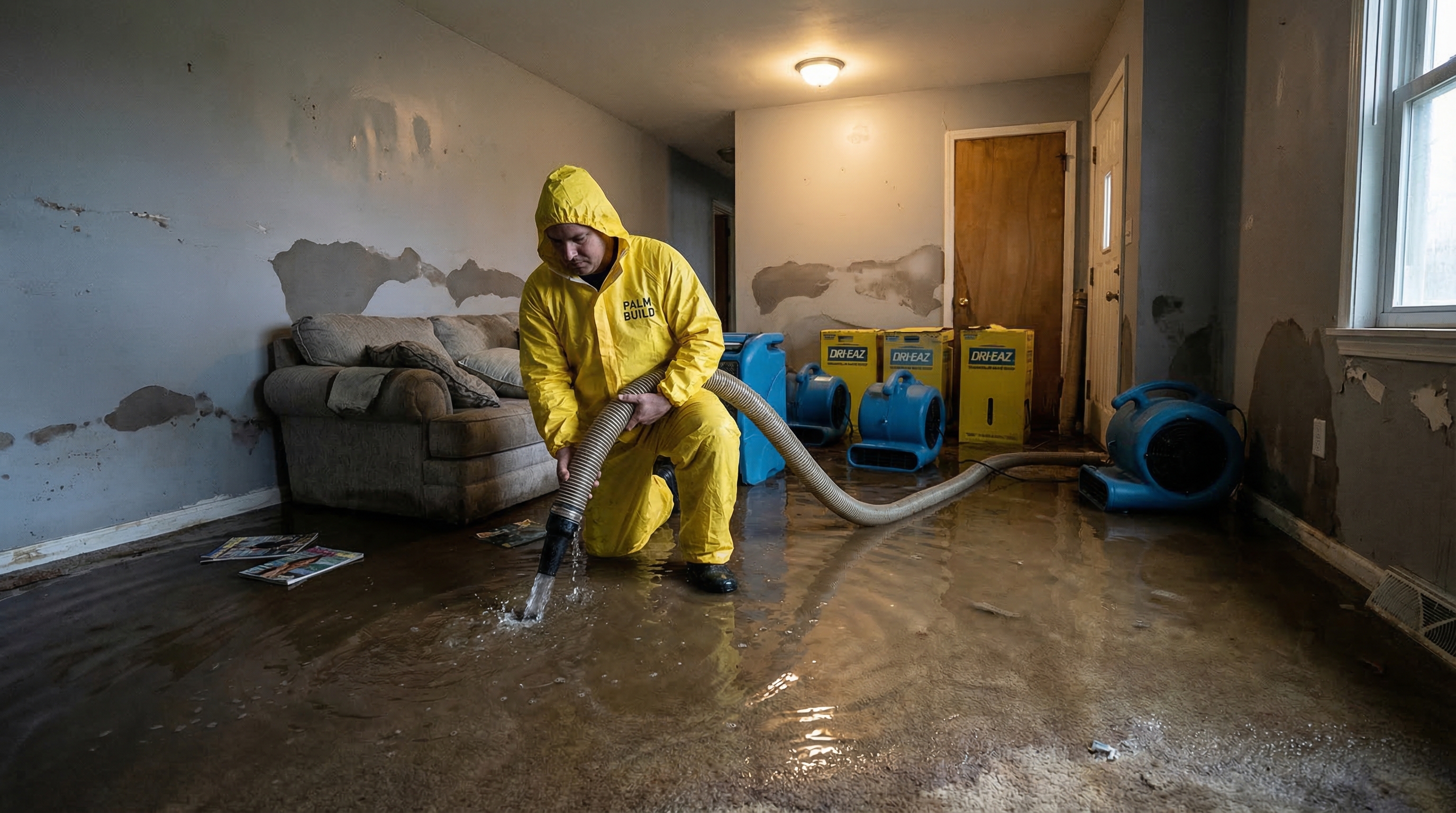
Remove standing water with a wet/dry vacuum if safe. Open windows and run fans for Category 1 losses only. Do not use household fans on Category 2 or 3 water because you may spread contaminants. Professional-grade extraction and dehumidification make the biggest difference in this window.
- 4
Call a certified restoration team for assessment
A qualified team will classify the loss by category and class, create a moisture map, set up drying equipment, and begin documenting for insurance. If you need help vetting contractors, our guide to choosing a restoration company covers credentials, licensing, and red flags. The classification determines every subsequent decision: safety protocols, demolition scope, equipment count, and timeline.
Costs and Timelines by Category and Class
Restoration costs vary widely based on the category, class, and total affected area. According to Angi's 2026 dataset, the national average for water damage restoration is around $3,867, with a typical range from $450 to $16,000. Per-square-foot costs generally run $3 to $7.50, with contamination level being the primary cost driver. For a full breakdown, see our water damage restoration cost guide.
| Water type | Approx. cost per sq ft | Primary cost drivers |
|---|---|---|
| Clean water (Category 1) | ~$3.50/sq ft | Affected area, drying class, and whether materials can be salvaged |
| Gray water (Category 2) | ~$5.25/sq ft | Higher labor for cleaning and disinfection; more material removal |
| Black water (Category 3) | ~$7.50/sq ft | Full PPE, containment, extensive disposal, decontamination, and often larger rebuild scope |
Approximate restoration cost by water type
| Phase | Typical duration | Notes |
|---|---|---|
| Inspection and moisture mapping | 1-4 hours | Category, class, and affected materials are assessed; scope is set here |
| Water extraction | Same day to 1-2 days | Standing water removal is the first priority for preventing deterioration and mold |
| Drying and dehumidification | 3-7 days (longer for Class 4) | Classes 3 and 4 can extend timelines due to hidden cavities and dense materials |
| Cleaning, sanitizing, and selective demolition | 1-3 days (overlaps drying) | Category 2 and 3 losses increase the cleaning and material removal burden |
| Repairs and reconstruction | Varies widely | From minor drywall patching to full room rebuilds depending on scope |
Typical restoration timeline by phase
For losses that require structural reconstruction and rebuild, timelines extend significantly. Commercial properties and HOA or condo buildings typically face larger scopes and more complex coordination with the insurance restoration process.
State-Specific Insurance and Licensing Notes
Water damage classification is consistent nationwide under the IICRC S500 standard, but insurance timelines and licensing requirements differ by state. Here is what homeowners in Florida, North Carolina, and South Carolina should know.
Florida
Florida also regulates mold-related services through a state licensing program under Chapter 468, Part XVI. This means mold remediation in Florida is not just a generic term. It intersects with a formal licensing framework, and homeowners should verify that any firm performing mold work holds the appropriate state license.
North Carolina
North Carolina statute requires insurers to acknowledge claims within 30 days after receiving adequate notice. On the mold side, NC State Extension notes that no federal or state certification programs currently exist for mold remediation services, though industry certifications like IICRC and best practices are still widely used. Homeowners should prioritize firms with documented processes and professional credentials even without a formal state licensing requirement.
South Carolina
South Carolina law includes a 20-day requirement for insurers to furnish proof-of-loss forms after notice of loss. The state also provides for attorneys' fees if an insurer refuses to pay a covered claim within 90 days after demand and a court finds the refusal was without reasonable cause. For mold, the current state agency guidance indicates there are no enforceable state or federal mold regulations, though proposed legislation introduced in early 2026 would create a certification framework for mold assessment and remediation providers.
Frequently Asked Questions
What is the difference between water damage category and class? +
What are the three categories of water damage? +
What are the four classes of water damage? +
What is Class 4 water damage and why is it expensive? +
Can Category 1 water turn into Category 2 or 3? +
How fast can mold start growing after a water leak? +
Does homeowners insurance cover water damage? +
Why does a 'clean water' loss sometimes require removing drywall? +
The First 24 Hours After Water Damage
Step-by-step guide to the critical actions in the first day after a water loss.
Water Damage Restoration Cost Guide (2026)
Full cost breakdown by category, scope, and region with national averages.
How Fast Does Mold Grow After Water Damage?
The real 24-48 hour mold timeline, what the EPA actually says, and prevention steps.
How to File a Water Damage Insurance Claim
Documentation, timelines, and what insurers look for when processing your claim.
24/7 Water Damage Restoration
Emergency water extraction, drying, and full-scope restoration across FL, NC, and SC.
Dealing with water damage right now?
Our certified teams respond 24/7 across Florida, North Carolina, and South Carolina. We classify the loss, set up drying, and handle insurance documentation from day one.
Found this helpful? Send it to someone who needs it.