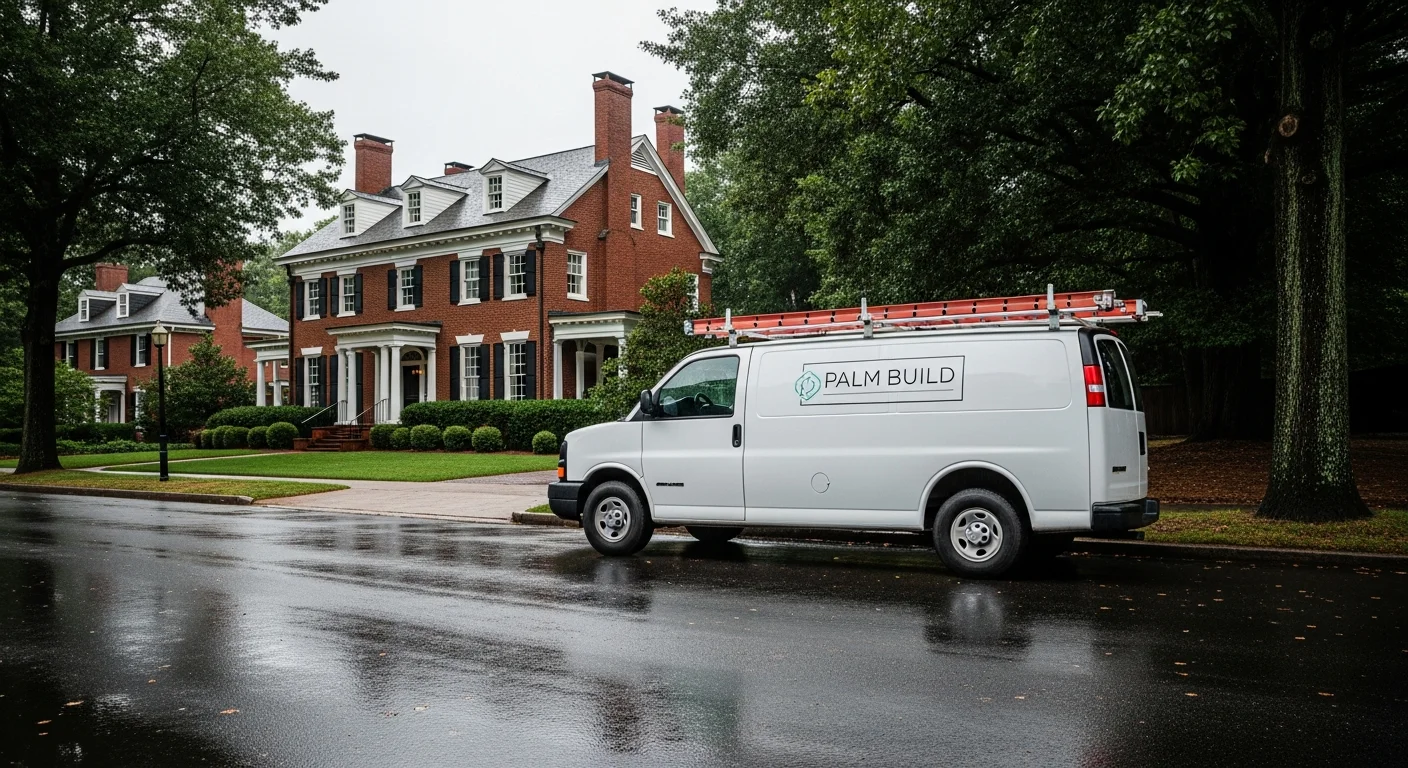
Water Damage Restoration in Greensboro, North Carolina
Greensboro averages 44 inches of rain per year — with September the wettest month — and North Buffalo Creek has repeatedly flooded Latham Park and surrounding corridors when summer storms overwhelm the Cridland Road Bridge bottleneck. Whether your Irving Park brick Colonial took on water after a thunderstorm, your Fisher Park bungalow has a wet crawl space, or a supply line burst in your Sunset Hills home, Palm Build's Charlotte team responds 24/7 with IICRC-certified water restoration.
~90 min
Emergency Response
24/7
Dispatch Available
IICRC
Certified Technicians
Greensboro Flood Reality
Why Parts of Greensboro Keep Flooding — The Buffalo Creek Story
North Buffalo Creek's repeated flooding of Latham Park isn't random bad luck. It's a documented infrastructure constraint that competitors don't explain — and homeowners in affected corridors need to understand before the next July storm.
Piedmont Triad International station normals — September is Greensboro's wettest month at 4.6".
Built in 1925 — documented as a flow constriction contributing to Latham Park flooding during heavy rain.
CDC-confirmed: mold begins growing within 24–48 hours of moisture exposure in Greensboro's warm humid months.
Palm Build Charlotte hub to Greensboro — 24/7 IICRC-certified emergency response.
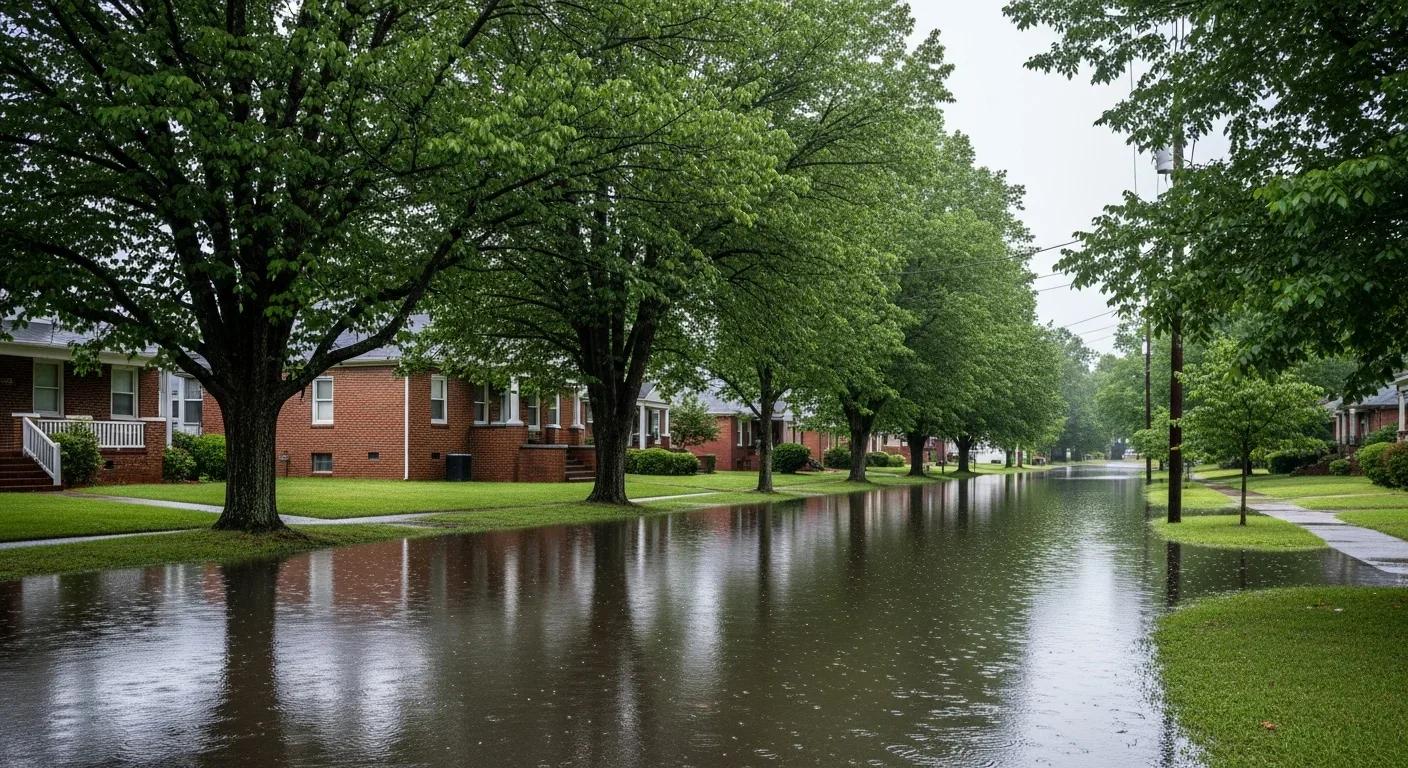
Latham Park corridor: North Buffalo Creek flooding here isn't hypothetical — a July 2021 event is documented in local reporting, and the city has been actively planning mitigation including Cridland Road Bridge replacement, floodplain benching, and a bypass channel at Revolution Mills. Homeowners in this watershed need separate flood coverage.
Latham Park — North Buffalo Creek
Highest RiskNorth Buffalo Creek has repeatedly flooded Latham Park and the surrounding corridor during heavy summer rain events, with a July 2021 flooding event documented in local reporting. The primary constraint is the Cridland Road Bridge, built in 1925, which creates a documented flow bottleneck — water backs up when the creek can't discharge fast enough through the old bridge opening. The city has studied mitigation options including bridge replacement and floodplain benching in the park itself.
What to know: Properties near Latham Park should have flood insurance separate from homeowners coverage. Flood is excluded from standard NC homeowners policies.
North Elm Street & Wendover Corridor
Elevated RiskThe North Elm Street and Wendover Avenue areas appear in local flood discussion as points affected by North Buffalo Creek overflow and stormwater conveyance constraints. The city has explored replacing the North Elm Street Bridge as part of its flood mitigation planning for this watershed. Properties in the low-lying sections near this corridor are susceptible to basement and crawl space water entry during the peak rain months of July through September.
What to know: Verify FEMA flood zone status for your specific parcel — the city's Water Resources department manages floodplain development permits for this area.
Revolution Mills Area
Moderate RiskThe Revolution Mills corridor appears in city flood mitigation planning, including discussion of a bypass channel to reduce flooding at lower structures. The area's industrial-to-residential transition creates unique building performance considerations — masonry moisture management and large-structure drying logistics that differ from typical residential restoration scopes.
What to know: Post-flood assessment for masonry buildings requires moisture mapping of thick wall assemblies — standard residential drying timelines don't apply.
Neighborhood Risk Guide
Greensboro Neighborhoods — Water Damage Risk by Area
From historic Irving Park to the Buffalo Creek corridor — here is what Palm Build sees on the ground in Greensboro's distinct neighborhoods.
Latham Park
— Single-family, mixed ageNorth Buffalo Creek overflow flooding
Directly in the documented North Buffalo Creek flood corridor. Cridland Road Bridge bottleneck causes repetitive flooding. Separate flood insurance essential.
Irving Park Historic District
— Single-family, 1911–1930sAging plumbing, complex rooflines, high-value finishes
Tudor Revival, Colonial Revival, Classical Revival homes. Older supply lines and drain systems, flashing-prone rooflines, hardwood and plaster assemblies that require specialty drying.
Fisher Park Historic District
— Single-family, 1900s–1930sHidden wall cavity moisture, older assemblies
Houses largely built 1900s–1930s. Complex cavity conditions between subfloor and hardwood trap moisture after any plumbing leak or storm intrusion.
Sunset Hills Historic District
— Single-family, 1925–1965Mid-century plumbing failures, mixed renovation quality
Contributing buildings 1925–1965. Aging supply lines, older drain systems, and variable renovation quality create water loss risk throughout.
Lindley Park
— Single-family, developed 1917+Older drainage, mature tree canopy roof damage
Developed 1917 as park-centered neighborhood. Mature tree canopy contributes to roof and gutter damage; older neighborhood drainage infrastructure.
Revolution Mills Corridor
— Mixed residential/commercial, convertedMasonry moisture, flood mitigation planning area
In city flood mitigation discussion for bypass channel work. Masonry structures require extended drying timelines and specialized moisture mapping after any water event.
North Elm / Wendover Area
— Mixed residentialBuffalo Creek watershed flooding, bridge constraints
Named in city flood mitigation planning. North Elm Street Bridge replacement studied as mitigation option. Low-lying sections susceptible to basement and crawl space flooding.
Lake Brandt / Lake Townsend Corridors
— Residential near reservoirStorm runoff, tree fall, wind near lake corridors
Properties near the city's three reservoirs face storm runoff and wind-driven tree damage risks. Reservoir watershed protection rules may affect restoration permitting.
Battleground Area
— Established single-familyStormwater corridor, supply line age
Referenced in local flood narratives as part of the broader stormwater corridor. Mix of housing ages with older plumbing and drainage systems.
Newer Subdivisions (post-2000)
— Single-family, slab/newer crawl spaceAppliance failures, HVAC condensate, roof flashing
More modern construction but not immune. Water losses here are most commonly supply line failures, dishwasher overflows, and HVAC condensate drainage issues.
Not sure about your specific address? Call Palm Build for a free assessment — (704) 464-0121. We'll identify your flood zone status and moisture risks specific to your home's age and construction type.
Crawl Space Flooding Guide
Crawl Space Water Damage in Greensboro — What You Need to Know
Crawl space flooding is the most under-treated water loss in Greensboro. Clay soil, older foundations, and Buffalo Creek proximity combine to make this a year-round concern.
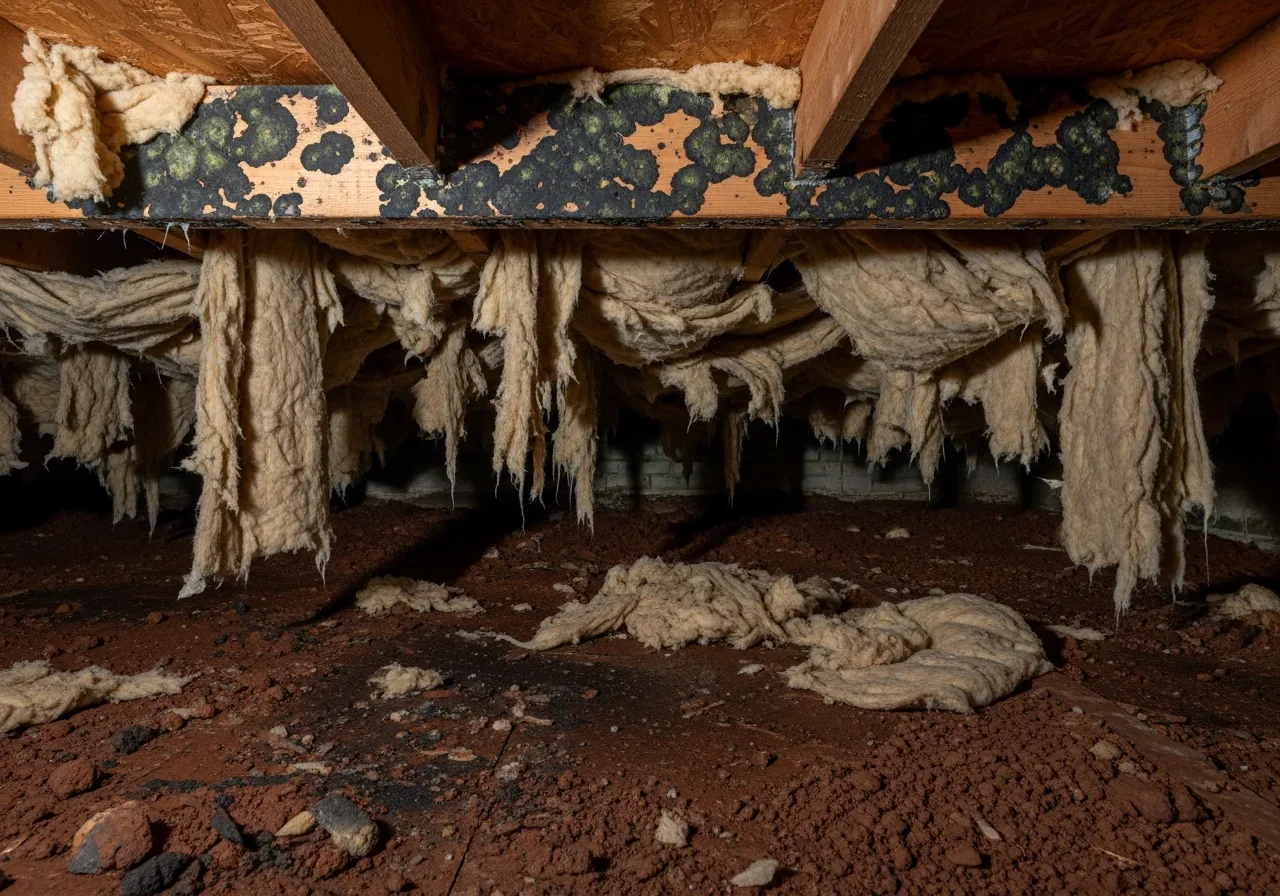 BEFORE
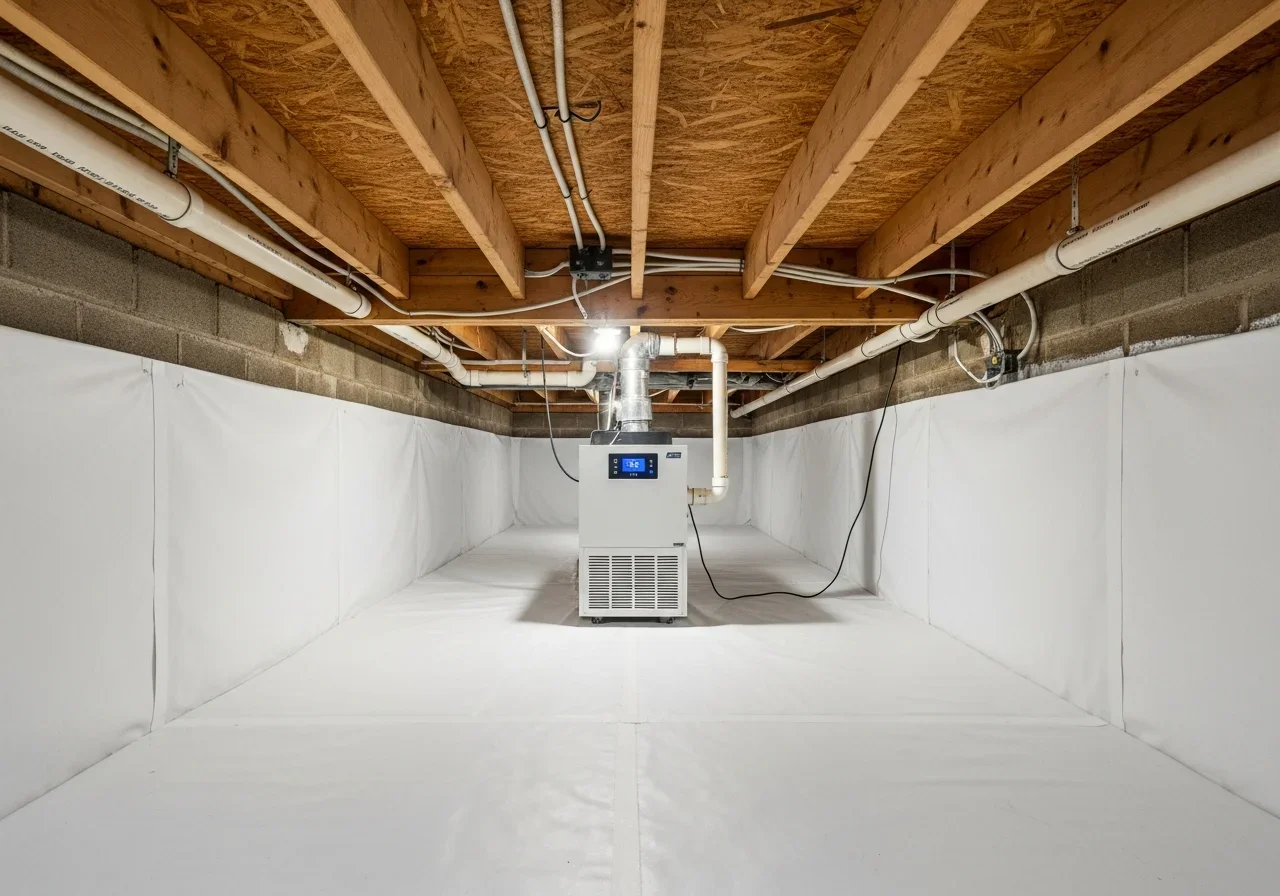 AFTER
AFTERPiedmont Clay Soil — Greensboro's Hidden Drainage Problem
The Piedmont Triad's clay-heavy soil drains slowly — far slower than the sandy soils of the coast or the permeable soils of the mountains. After a heavy rain, the soil under and around Greensboro crawl spaces can remain saturated for 24 to 72 hours. That moisture wicks upward through the ground and radiates as humidity into the crawl space. Without an intact vapor barrier and active dehumidification, this creates sustained elevated moisture in the joist system — the primary mold growth surface in a crawl space.
Crawl Space Flooding from Buffalo Creek and Surface Runoff
For homes in low-lying sections near North Buffalo Creek — particularly in the Latham Park corridor and along North Elm Street — heavy rain events can cause direct surface water intrusion into crawl spaces through foundation vents, improper grading, or overwhelmed drainage. This type of event is not a plumbing failure: it's a flood event, which standard homeowners policies typically exclude. Flood water that enters a crawl space carries silt, bacteria, and elevated contamination risk that requires Category 3 cleanup protocols.
What Homeowners Get Wrong After a Wet Crawl Space
The most common mistake Palm Build sees after a Greensboro crawl space water event is waiting. Homeowners open the crawl space access door, don't see standing water anymore, and assume the problem resolved itself. It didn't. Saturated wood joists and sill plates at 20%+ moisture content are actively feeding mold growth even with no standing water. By the time visible mold appears on joist surfaces, the system has been growing for weeks.
Palm Build's Crawl Space Drying Protocol
Extract any standing water with submersible pump or truck-mounted extraction
Moisture-map all structural lumber — joists, sill plates, rim joists — with a calibrated pin meter
Remove damaged insulation and vapor barrier material if contaminated or saturated
Stage commercial dehumidification units sized for crawl space volume and clay soil humidity load
Monitor daily moisture readings until all structural lumber reaches goal moisture content
Apply antimicrobial treatment to structural surfaces as needed
Install new heavy-gauge vapor barrier and restore or improve air sealing
Provide written clearance documentation confirming drying goal achieved
Our Process
How Palm Build Handles Water Damage in Greensboro — Step by Step
From Buffalo Creek flooding to supply line failures in historic Fisher Park — every Greensboro water loss follows IICRC S500 protocol adapted for Piedmont NC conditions.
Emergency Dispatch — ~90 Minutes from Charlotte
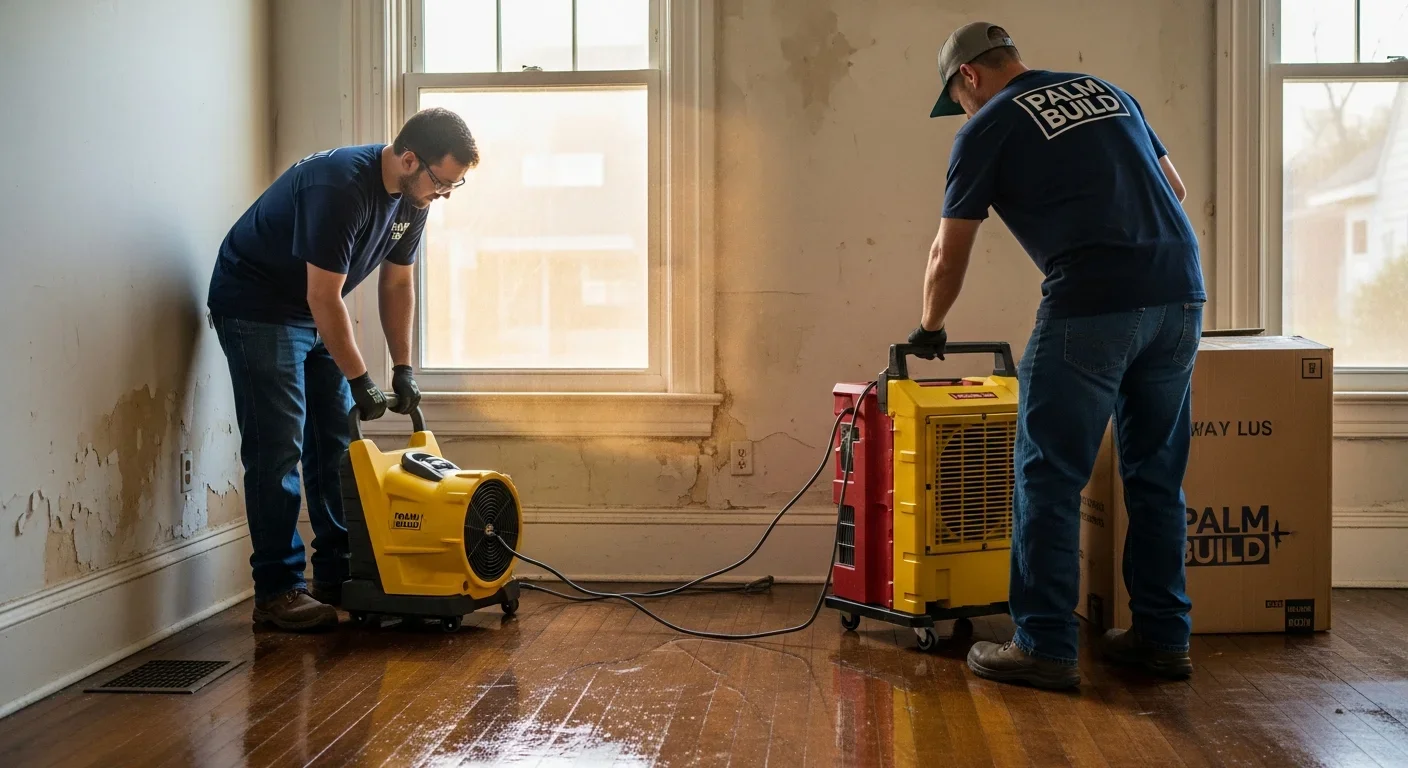
Call (704) 464-0121 and our Charlotte team dispatches immediately. Greensboro is approximately 90 miles on I-85/I-40 — roughly 90 minutes under normal conditions. We operate 24/7/365. For historic homes in Irving Park or Fisher Park, we note the property type during dispatch so the right equipment and expertise arrives on the first truck.
Water Source Identification & IICRC Classification
We identify and document the water source before any work begins. In Greensboro, this matters because tidal backflow from Buffalo Creek is Category 3 (contaminated), a supply line failure is Category 1 (clean), and sewer backup — which standard NC policies often exclude without a rider — requires specific classification that affects both cleanup protocol and coverage. This determination is made on arrival and documented for insurance.
Extraction & Crawl Space Assessment
Truck-mounted extraction removes standing water from living areas and basements. For homes with crawl spaces — the dominant foundation type in Greensboro's older neighborhoods — we assess and extract separately, then moisture-map all structural lumber. Clay soil saturation means crawl space drying requires standalone equipment and extended monitoring beyond the main living area.
Structural Drying — Calibrated for NC Piedmont Humidity
Air movers and commercial dehumidifiers are staged to IICRC S500 drying targets. Psychrometric settings account for Greensboro's ambient humidity, which runs 70–90% in summer months and compresses drying windows significantly. For historic homes with plaster walls and hardwood floors, drying protocol adjusts to protect finishes while achieving complete structural moisture reduction.
Insurance Documentation
Every Palm Build response generates a complete documentation package: moisture readings by location and date, water source classification, scope of loss, photo evidence, and materials inventory. NC insurers handle claims on standard contract timelines — thorough documentation from day one prevents supplement disputes and supports any additional scope identified during drying.
Clearance & Written Confirmation
Final moisture readings confirm all structural materials have reached IICRC drying goals. Written clearance is provided before equipment removal — critical for insurance claim closure and for any crawl space encapsulation or reconstruction work that follows. No work is called complete until numbers confirm it.
Insurance Guide
Water Damage Insurance Claims in Greensboro — Critical Coverage Gaps
North Carolina's insurance market is less complex than Florida's, but the coverage gaps are just as painful if you discover them after a loss.
Flood damage is not covered by standard homeowners insurance
This is the most common gap in Greensboro. Standard policies exclude flood damage. Properties near North Buffalo Creek, in low-lying sections of Latham Park, or anywhere with surface water flood risk need a separate NFIP or private flood policy. Discovering this after a flood event is devastating.
Sewer and drain backup requires a specific endorsement
The NC Department of Insurance explicitly states that water damage from sewer backup is excluded from standard homeowners policies without a sewer backup endorsement. This is a common cause of water damage in Greensboro's older neighborhoods with aging cast iron drain lines. Review your declarations page now.
Gradual damage and maintenance neglect are excluded
Slow leaks, ongoing roof drainage issues, and deferred crawl space maintenance are routinely excluded. Insurers distinguish between "sudden and accidental" losses (covered) and gradual deterioration (not covered). Document your property annually to establish baseline condition.
Greensboro homeowners pay $2,064–$2,206/year on average
City-level estimates for $300,000 coverage with a $1,000 deductible. With a $1,000 deductible, small water losses may not justify a claim — Palm Build can advise on whether a loss is likely to exceed your deductible after assessment.
What to Do Immediately After a Water Loss
Document everything with photos immediately — before any cleanup begins
Call Palm Build for emergency mitigation — we document scope from day one
Notify your insurance company promptly — follow your policy's reporting requirement
Do not dispose of damaged materials until your adjuster inspects them
Keep all receipts for emergency expenses, temporary housing, and mitigation costs
Ask specifically about sewer backup endorsement and flood coverage in your policy
NC vs. Florida claims timeline: Unlike Florida's strict 1-year notice deadline (Fla. Stat. 627.70132), North Carolina doesn't have a single statewide statutory claim-filing deadline. However, your policy contract will specify prompt-reporting requirements, and NC has a 3-year statute of limitations framework for certain insurance claims. Act fast regardless — documentation quality degrades quickly and mold risk is real within 48 hours.
Cost Guide
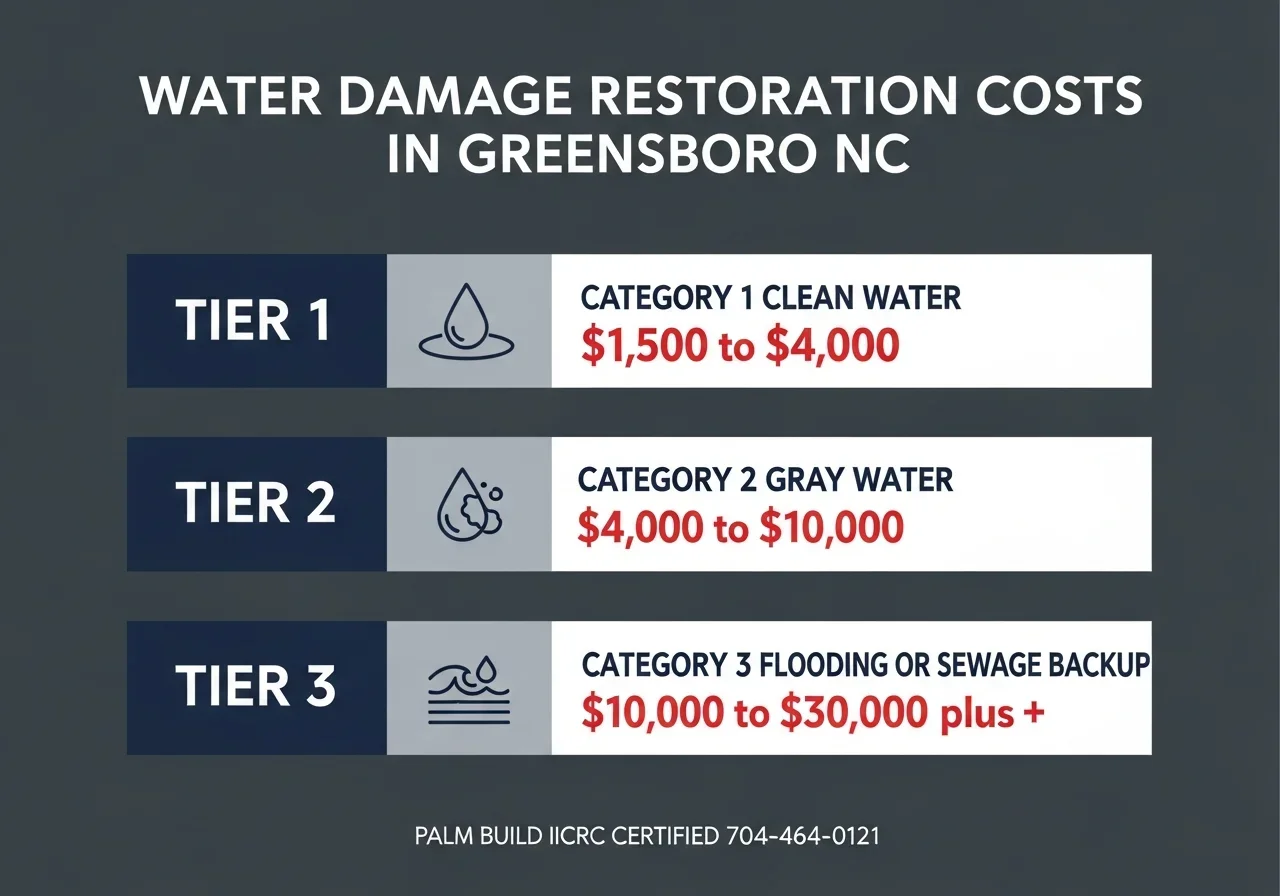
Water Damage Restoration Costs in Greensboro, NC
Costs depend on water category, area, and Greensboro-specific factors like crawl space involvement and historic home construction.
Category 1 — Clean Water
Supply line break, appliance overflow, roof leak through window
Category 2 — Gray Water
HVAC condensate, dishwasher overflow, toilet without solids
Category 3 — Flooding / Sewage
Buffalo Creek overflow, sewer backup, storm flooding
Greensboro-Specific Cost Factors
Historic home specialty drying
+15–25%Plaster, hardwood, older assemblies require slower, more controlled drying
Crawl space assessment + drying
+$800–$2,500Separate scope from main living area; clay soil saturation extends timeline
Floodplain permit (if applicable)
+$300–$800Required for certain repair scopes in FEMA flood zones
Travel from Charlotte
IncludedNo travel surcharge — Palm Build serves Greensboro at standard rates
Written estimates before any work begins.
Get a Free Estimate — (704) 464-0121Before & After
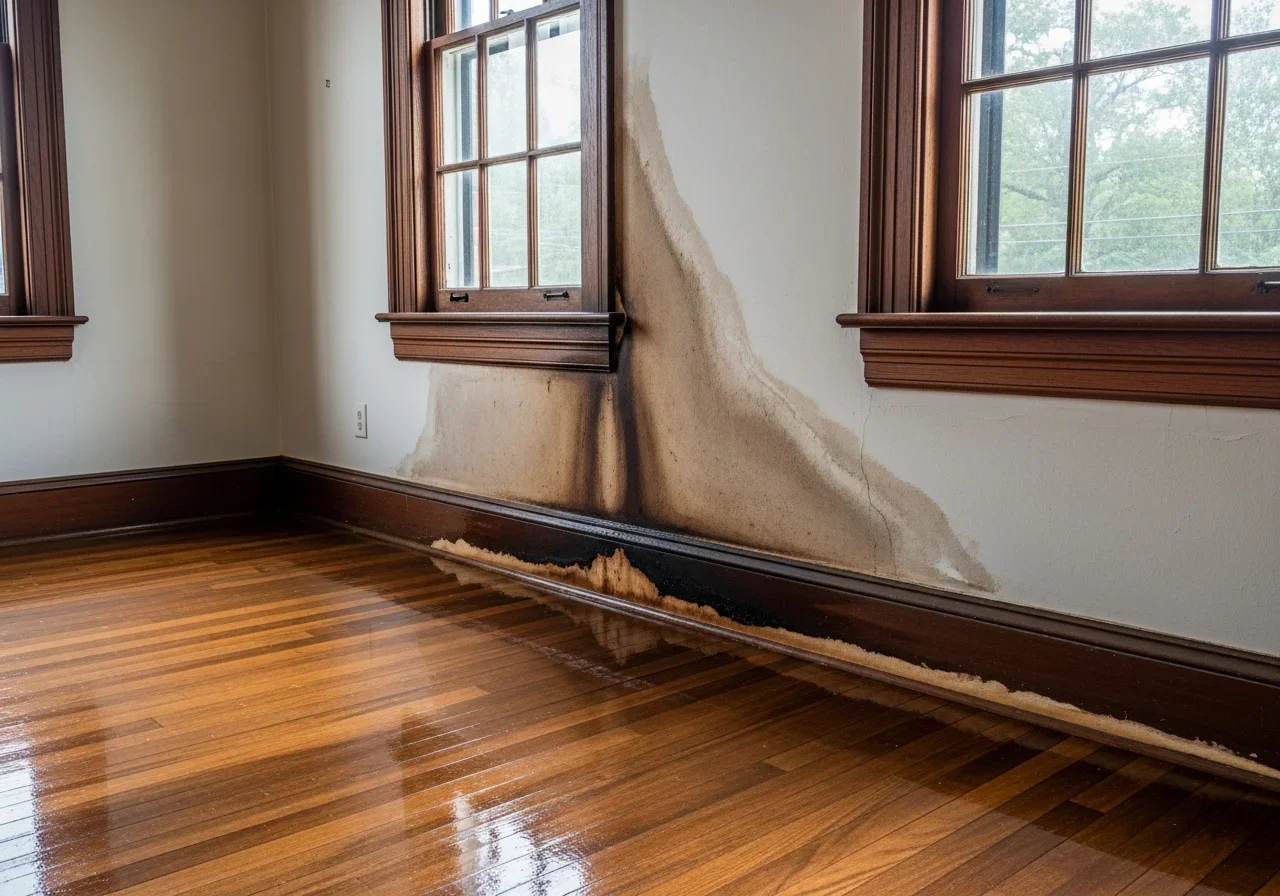
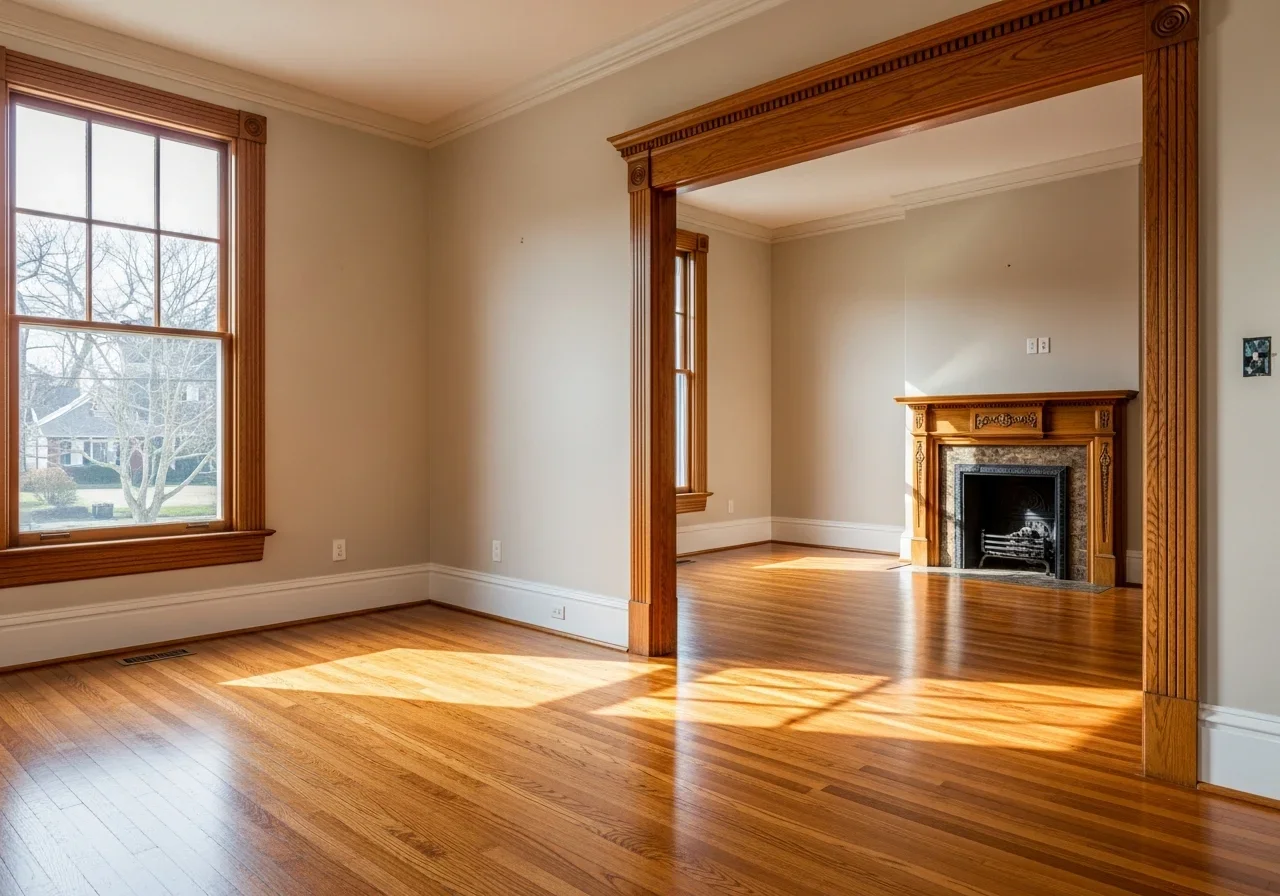
Greensboro Water Damage Restoration — Real Results
From historic brick homes in Irving Park to crawl space flooding in Fisher Park — this is what Palm Build restores in the Triad.
 BEFORE
 AFTER
AFTERIrving Park — Historic Brick Home, Supply Line Failure
Wet hardwood floors, plaster wall damage. Specialty drying protocol, floor restoration.
BEFORE AFTERFisher Park — Crawl Space Saturation
Clay soil moisture, joist surface mold risk. Full extraction, drying, encapsulation.
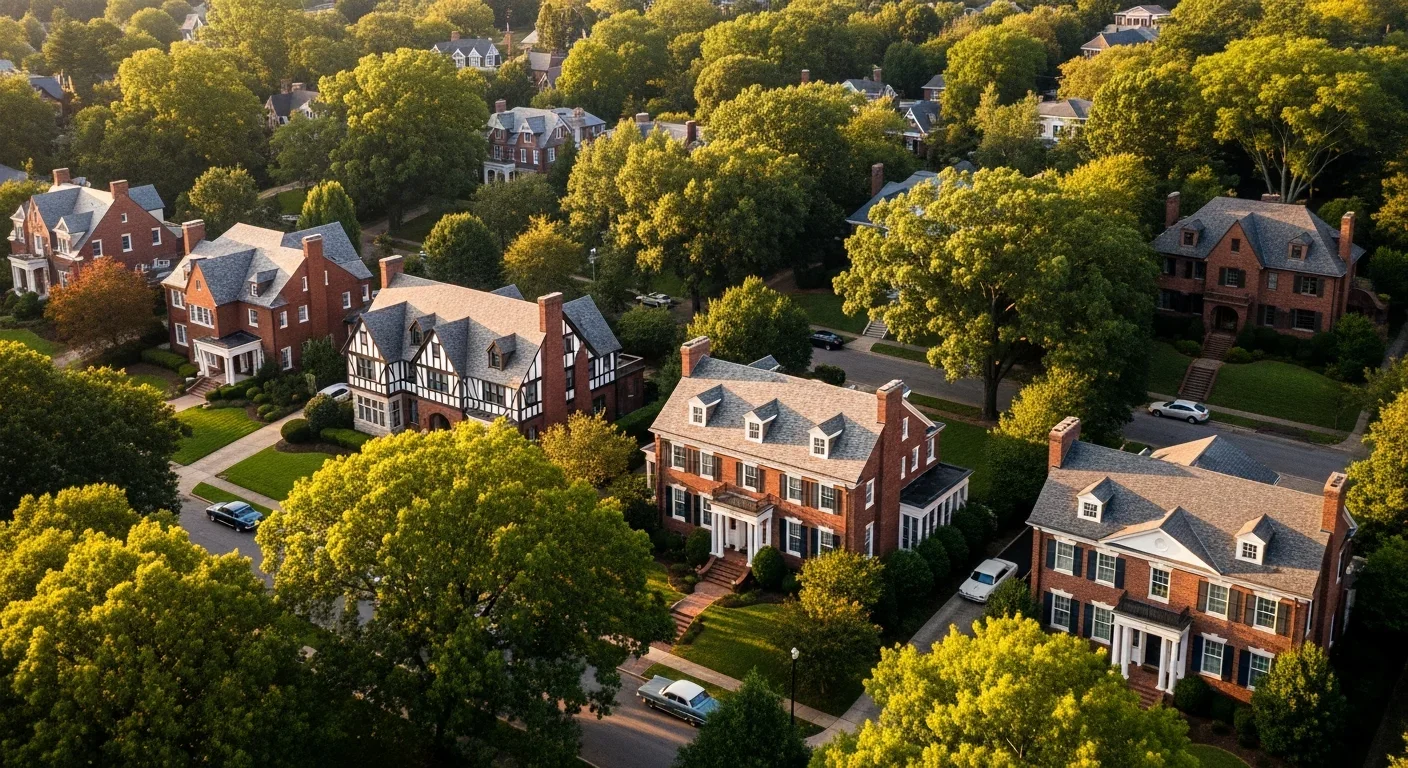
Irving Park Historic District — one of Greensboro's most distinctive neighborhoods, with homes largely built 1911–1930s. Palm Build serves the entire Triad from our Charlotte hub.
Why Palm Build
Why Greensboro Homeowners Choose Palm Build
IICRC certification, historic home expertise, and crawl space protocols built for Piedmont NC clay soil conditions.
IICRC Certified — The Standard That Matters
IICRC S500 certification means our technicians follow the Water Damage Restoration standard your insurance adjuster expects. Water source classification, psychrometric drying targets, and written clearance documentation are protocol on every job — not optional extras.
Historic Home Specialists
Fisher Park bungalows and Irving Park Colonial Revivals are not the same as new construction. Palm Build's drying protocols account for plaster walls, hardwood floors, and cavity conditions in older assemblies. We dry historic homes without creating more damage than the water event itself.
Crawl Space Expertise — Clay Soil Ready
Greensboro's Piedmont clay soil creates crawl space moisture conditions that outlast any visible water event. Palm Build stages crawl space drying equipment separately from main living areas, monitors structural lumber moisture to calibrated goals, and provides written clearance before any encapsulation work begins.
24/7 Response — Charlotte to Greensboro
Approximately 90 miles on I-85/I-40. We dispatch immediately, day or night, and arrive ready to work — not to assess and schedule. In Greensboro's humid summers, every hour before extraction starts matters for mold prevention.
Insurance-Ready Documentation
Every response generates a complete documentation package: water source classification, moisture readings by location and date, scope of loss, photo evidence, and IICRC protocol followed. Supports initial claims and any supplement scope within NC's 3-year insurance claim limitation framework.
One Call. Full Service.
Water extraction, structural drying, crawl space restoration, mold prevention, and reconstruction coordination — one company, one point of contact, one documentation package for your insurance adjuster.
Or call our main line: (888) 245-5155
Frequently Asked Questions
Water Damage Restoration in Greensboro — Common Questions
Answers specific to Greensboro's Buffalo Creek flooding, crawl space conditions, and North Carolina insurance landscape.
Still have questions about your Greensboro property?
Call (704) 464-0121 — 24/7More in Greensboro
Other Restoration Services in Greensboro, NC
Related Services