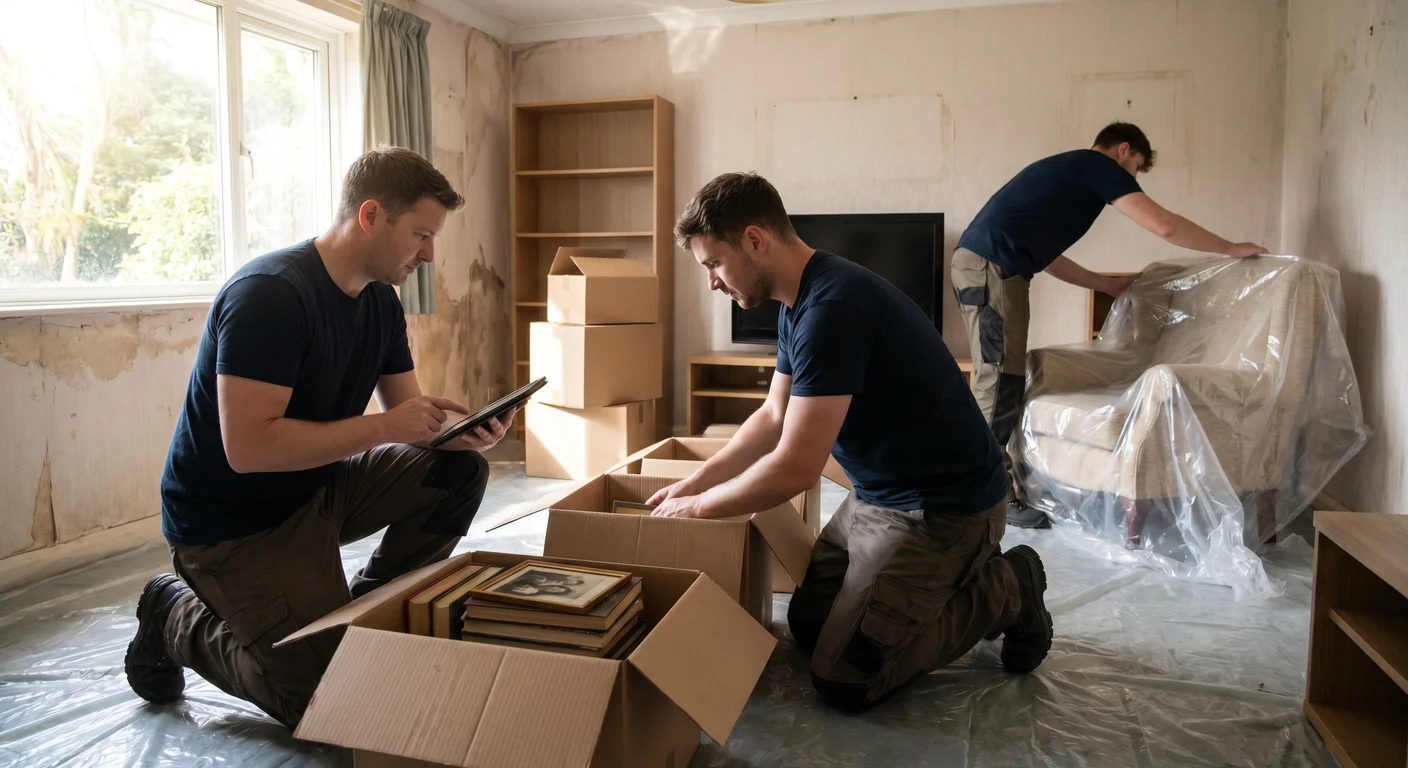
Contents Restoration in Greensboro, North Carolina
When fire soot, smoke odor, or water from a burst pipe damages your personal property, professional contents restoration can save furniture, electronics, documents, artwork, and clothing you assumed were lost. Palm Build provides on-site cleaning, professional pack-out, and off-site restoration with detailed inventory documentation for your insurance claim across Greensboro and the Piedmont Triad.
Charlotte — approximately 90 miles from Greensboro ~90 min Response IICRC Certified
Protecting What Insurance Can't Replace in Greensboro Homes
When a kitchen fire fills your Sunset Hills home with smoke, or a freeze-pipe burst
during an ice storm soaks your Fisher Park bungalow, the structure gets immediate
attention — but your personal belongings often get overlooked in the chaos. Furniture,
electronics, family photos, heirloom artwork, and irreplaceable documents require a
separate, specialized restoration process that most general contractors simply don't
offer. In Greensboro, where older homes in neighborhoods like Irving Park, Fisher Park,
and Lindley Park hold antique furnishings and generations of personal property, the
contents restoration decision can be worth tens of thousands of dollars.
Time Sensitivity Is Everything
48-72 hrs
Critical salvage window
Every hour that passes after a fire, smoke, or water event reduces the probability of successful contents restoration. Smoke residue turns acidic and corrosive within roughly 72 hours of a fire, etching metal surfaces and discoloring fabrics if it isn't removed. Water-saturated documents begin to bond together and develop mold within 48 hours, and a winter freeze-pipe burst during one of the Triad's ice storms can soak an entire room of furniture, electronics, and stored papers before anyone notices. Electronics exposed to moisture suffer progressive circuit-board corrosion that worsens even after the visible water is gone. The restoration window is narrower than most Greensboro homeowners realize, and waiting for the insurance adjuster before starting contents work can cost thousands in otherwise-salvageable belongings.
Professional vs. DIY Recovery
60-80%
Typical salvage rate
Homeowners who try to clean smoke-damaged clothing in a standard washing machine often set the soot permanently into the fabric. Those who dry water-damaged documents with a household hair dryer cause pages to curl, ink to bleed, and photos to permanently adhere to their frames. Professional contents restoration uses ultrasonic cleaning for electronics, ozone and hydroxyl treatments for odor, freeze-drying for documents, and injection cleaning for upholstery — techniques that simply aren't available outside a professional facility. In Greensboro neighborhoods like Irving Park and Fisher Park, where an older home may hold heirloom furniture and generations of personal property, the cost of professional restoration is a fraction of replacement value.
Insurance Requires Documentation
ACV vs. RCV
Proof of loss matters
Your North Carolina homeowners policy covers contents restoration — but only when the process is properly documented. Every item must be inventoried, photographed, categorized by damage type, and tracked through restoration with before-and-after records. Adjusters need to see that professional restoration was attempted before they approve replacement-cost payments, and N.C. Gen. Stat. Chapter 58 makes a detailed inventory and timely proof of loss central to the claim. In Guilford County, where a single household can hold tens of thousands of dollars in furnishings, antiques, and documents, thorough documentation is often the difference between a partial settlement and full coverage.
Restoration Costs Far Less Than Replacement
25-40%
Cost vs. replacement
Professional contents restoration typically costs 25 to 40 percent of replacement value. For a Greensboro home with $150,000 in personal property damage, that's a potential savings of $90,000 to $112,000 — savings that benefit the homeowner through lower out-of-pocket deductible offsets and the carrier through a smaller payout. This is why most major insurers prefer restoration over replacement and encourage policyholders to use qualified contents restoration companies. Palm Build has the documentation discipline and track record with State Farm, Allstate, USAA, and Nationwide adjusters working the Piedmont Triad market.
What We Restore
Contents Categories We Restore for Greensboro Homeowners
Every item in your home tells a story and serves a purpose. Our contents restoration
team handles six major categories of personal property — each with specialized
techniques, equipment, and timelines tailored to the Piedmont's climate and the kinds of
belongings we see most often in Greensboro and Guilford County homes.
Furniture & Upholstery
Greensboro's older neighborhoods — Irving Park, Fisher Park, Sunset Hills — and the High Point furniture corridor next door mean many homes hold solid-wood pieces that hold or appreciate in value. Restoration of water-damaged hardwood antiques involves controlled drying, refinishing, and structural repair. Smoke-damaged upholstery requires ozone treatment followed by injection cleaning to pull particulate out of the padding layers. We routinely restore individual pieces worth $5,000 to $25,000 from Triad homes, including hand-carved dining sets, leather sectionals, and antique sideboards passed down for generations. After a freeze-pipe burst, the first 24 to 48 hours decide whether restoration is viable — wood that sits in standing water begins to delaminate and warp permanently.
Salvage Rate70-85%
Higher for hardwood, lower for particleboard
Electronics & Appliances
A typical Greensboro home holds $15,000 to $40,000 in electronics: home theater systems, smart-home hubs, gaming setups, home-office equipment, and high-end kitchen appliances. Water from a burst supply line or an appliance overflow causes immediate short-circuit risk and progressive circuit-board corrosion even after the device looks dry. Smoke residue leaves a conductive, corrosive film on components that causes intermittent failures over weeks or months. Our facility uses ultrasonic cleaning baths and compressed-air drying chambers to restore electronics that appear destroyed. Home offices serving UNCG, NC A&T, and the PTI and FedEx-hub workforce often hold $20,000 or more in computing equipment that professional restoration can save.
Salvage Rate50-70%
Depends on exposure duration and type
Documents & Photographs
This is where contents restoration becomes irreplaceable — literally. Family photographs, birth certificates, marriage licenses, property deeds, tax records, children's artwork, and handwritten letters cannot be repurchased at any price. Water-damaged documents must be freeze-dried within 48 hours to prevent permanent bonding and mold growth. Smoke-damaged photographs require chemical cleaning that lifts soot without disturbing the emulsion layer. Greensboro families in established neighborhoods like College Hill, Dunleath, and Lindley Park often keep multi-generational photo collections and document archives in attics and crawl spaces — exactly the spots most exposed to a freeze-pipe leak or a house fire. Our team has recovered documents from homes where the owner had given them up as lost.
Salvage Rate60-80%
Freeze-drying critical within 48 hours
Clothing & Textiles
A Greensboro family of four typically owns $10,000 to $25,000 in clothing, bedding, drapes, and linens. Smoke-damaged textiles require ozone treatment before any washing — running soot-contaminated clothing through a standard washer permanently sets the damage. Water-damaged textiles develop mold and mildew odor within 24 to 48 hours in the Piedmont's humidity, so they need antimicrobial treatment in addition to cleaning. High-value items like wedding dresses, fur coats, designer collections, and handmade quilts call for specialized handling that differs from standard textile work. Our facility processes textiles through commercial-grade ozone chambers, professional laundering, and climate-controlled drying to return them to pre-loss condition.
Salvage Rate75-90%
Highest success rate of all content types
Artwork & Antiques
Greensboro's deep stock of historic homes — and proximity to the High Point furniture market — means many households contain original artwork, sculptures, antique furniture, and collectibles worth $10,000 to $500,000 or more. Oil paintings react to smoke differently than watercolors. Bronze sculptures corrode differently than marble. Antique wood needs different drying protocols than modern manufactured furniture. Our contents team assesses each piece individually and coordinates with local appraisers and conservators when items call for museum-grade restoration beyond standard protocols. We've restored artwork from fire-damaged homes that the owner's insurance company had already written off as total losses.
Salvage Rate55-75%
Varies widely by medium and exposure
Specialty & High-Value Items
Wine collections, musical instruments, gun safes and firearms, sports memorabilia, coin collections, jewelry, and other specialty items each call for a unique restoration approach. A water-damaged piano in a Sedgefield home needs completely different treatment than a smoke-damaged wine collection in a Starmount Forest cellar. Firearms exposed to fire-suppression water will rust within hours without proper treatment. Musical instruments warp irreversibly if not dried under controlled conditions. Greensboro's varied housing means we encounter specialty items on nearly every contents job — and our team knows which pieces need immediate attention and which can safely wait while we prioritize the most time-sensitive ones.
Salvage Rate40-70%
Highly item-dependent; early intervention critical
Our Greensboro Pack-Out Process
How We Handle Contents Restoration in Greensboro
A professional pack-out is not just moving your belongings out of a damaged home. It's a
documented, tracked, insured process that preserves your property and protects your
insurance claim from start to finish.
01
Inventory & Documentation
Day 1
02
Professional Pack-Out
Days 1-3
03
Transport to Restoration Facility
Days 2-4
04
Restoration & Cleaning
1-4 Weeks
05
Delivery & Placement
After Structural Restoration
01
Inventory & Documentation
Day 1
Our team arrives within hours of authorization and begins a room-by-room inventory of every item in the affected area. Each piece is photographed in place, cataloged with condition notes, and assigned a tracking barcode. For older Greensboro homes in Irving Park or Fisher Park with extensive heirloom property, this initial inventory alone can take a full day. The inventory becomes the foundation of your insurance claim — every item documented, every condition recorded, every photograph timestamped. We use cloud-based inventory software that gives you and your adjuster real-time access to the complete contents list from any device.
02
Professional Pack-Out
Days 1-3
Once inventoried, items are carefully packed using category-specific materials — acid-free tissue for documents and photographs, custom crating for artwork and antiques, anti-static wrap for electronics, and garment boxes for clothing. Fragile antiques and heirlooms common in Greensboro's historic homes receive individual wrapping and padding. Every box is labeled with its tracking barcode, destination (cleaning, restoration, or storage), and priority level. Our pack-out crews are trained to handle fine art, antique furniture, and specialty items — not just general moving. The difference between a professional contents pack-out and a standard moving crew is the difference between saving and losing irreplaceable belongings.
03
Transport to Restoration Facility
Days 2-4
Packed items are transported in climate-controlled vehicles to our restoration facility. Temperature and humidity control during transit prevents secondary damage — critical in the Piedmont, where a standard moving truck can swing from summer heat well past 130 degrees to freezing on a winter morning, both of which warp furniture and stress electronics. Electronics, documents, and photographs are transported separately from furniture and textiles to prevent cross-contamination. Items needing emergency stabilization — such as water-saturated documents that require immediate freeze-drying — are prioritized for same-day transport and processing.
04
Restoration & Cleaning
1-4 Weeks
This is where the specialized work happens. Smoke-damaged items go through ozone treatment, ultrasonic cleaning, or chemical sponging depending on the material and damage type. Water-damaged items enter controlled drying environments — freeze-drying chambers for documents, dehumidification rooms for furniture, and air-drying racks for textiles. Electronics are disassembled, ultrasonically cleaned, and tested component by component. Throughout the process, each item's status is updated in our tracking system, and your adjuster receives progress reports with photographs comparing restoration results against initial condition. For large Greensboro projects, we provide weekly update calls to keep homeowners informed.
05
Delivery & Placement
After Structural Restoration
Once your Greensboro home's structural restoration is complete and the space is certified safe for contents return, our team delivers and places every item in its original location. We don't just drop boxes in your living room — we unpack, place, and arrange your belongings according to the room layout documented during inventory. Final photographs document the restored condition, and you walk through each room to confirm satisfaction. Any items that could not be restored to pre-loss condition are documented with before-and-after photos to support replacement-cost claims with your insurance carrier.
What Can Be Saved After Damage in Greensboro Homes
One of the most common questions Greensboro homeowners ask after a fire or water event
is "can any of this be saved?" The answer depends on the material, the type of damage,
the contamination level, and — critically — how quickly professional restoration begins.
Here's a practical guide based on what we see in Guilford County homes.
Typically Restorable
With professional intervention
Hardwood furniture (tables, dressers, bed frames)
Even water-logged solid wood furniture can often be restored through controlled drying and refinishing. Heirloom antiques from Greensboro's Irving Park and Fisher Park homes are well worth the investment.
Most clothing and textiles
Professional ozone treatment and laundering can remove smoke odor and soot from the vast majority of fabrics. Wedding dresses, suits, and designer items respond well to specialized cleaning.
Electronics (if treated within 48 hours)
Circuit boards, hard drives, and components can be ultrasonically cleaned and restored if corrosion hasn't progressed too far. Speed is the deciding factor.
Photographs and documents (if freeze-dried promptly)
Wet photos and papers that are frozen within 48 hours can be vacuum freeze-dried with 60-80% recovery rates. Even partially damaged photos can be digitally restored.
Oil paintings are surprisingly resilient to smoke and water. Canvas can be re-stretched, frames replaced, and surface contamination cleaned by trained conservators.
Leather goods (furniture, jackets, bags)
Professional leather restoration uses pH-balanced cleaners and conditioners that remove smoke residue without damaging the material. Leather absorbs odor but releases it with proper treatment.
Case-by-Case
Depends on circumstances
Upholstered furniture with water damage
Depends on padding saturation level, contamination category, and time elapsed. Clean water for under 48 hours is often restorable. Gray water exposure or extended saturation usually is not.
Area rugs and carpets
Handmade Oriental rugs from Greensboro's established neighborhoods are almost always worth restoring. Machine-made synthetic carpets over 5 years old are often more cost-effective to replace.
Appliances exposed to water
Small appliances are usually replaced. Large appliances (refrigerators, washers, dryers) can sometimes be restored if electrical components are professionally dried and tested. Age and value determine the decision.
Usually Not Restorable
Replacement recommended
Particleboard and MDF furniture (when saturated)
Engineered wood products swell irreversibly when saturated. IKEA-style furniture and laminate pieces are almost always total losses after significant water exposure.
Mattresses and pillows exposed to contaminated water
Category 2 or 3 water (sewage, floodwater) renders absorbent bedding unsanitary. Even with cleaning, health standards prohibit restoration of these items after contaminated water exposure.
Food, cosmetics, and medications
Any consumable product exposed to fire, smoke, or contaminated water must be discarded. This includes sealed containers that may have been exposed to heat sufficient to compromise packaging integrity.
Items with heavy char or structural fire damage
When fire has burned through the structural integrity of an item — not just surface soot — restoration is not feasible. The distinction between smoke damage and fire damage is critical.
Not sure what can be saved? Call our Greensboro team at (704) 464-0121 for a free contents assessment.
We'll evaluate your belongings on-site and provide an honest assessment of what's worth
restoring versus replacing — before any work begins.
The Palm Build Difference
Why Greensboro Homeowners Choose Palm Build for Contents Restoration
Most restoration companies serving the Triad subcontract contents work to third-party
vendors — creating handoff delays, documentation gaps, and lost items. Palm Build
handles contents restoration in-house with a dedicated team, a climate-controlled
facility, and a tracking system that keeps you and your adjuster informed at every
stage.
Serving Greensboro & the Piedmont Triad
Our contents crews serve Greensboro and the surrounding Triad, dispatched from our Charlotte Operations Hub about 90 miles away with crews on the ground the same day. When your Sunset Hills home suffers a kitchen fire or a freeze-pipe burst floods your Fisher Park bungalow, we begin inventory and pack-out right away. We already know the Triad's older housing stock, the crawl spaces, and the kinds of heirloom personal property Greensboro homeowners value most.
Insurance-Ready Documentation
Every item we handle is photographed, cataloged, barcoded, and tracked through our cloud-based inventory system. Your adjuster gets real-time access to the complete contents list, restoration progress reports, and before-and-after documentation — the level of detail that separates a smooth North Carolina claim from a disputed one, and the reason adjusters working the Triad market recommend our contents services.
Climate-Controlled Facility
The Piedmont's humid summers and freezing winter snaps can cause secondary damage to contents sitting in a standard storage unit or moving truck. Our climate-controlled restoration facility holds optimal temperature and humidity for every category of personal property — from the freeze-drying chamber for documents to the dehumidification rooms for furniture to the ozone chambers for textiles. Your belongings are safer with us than in most homes.
Full-Service Pack-Out to Return
We handle the entire process from initial inventory through final placement in your restored home. No handoffs to third-party movers, no gaps in the chain of custody, no items lost in transition. One team, one tracking system, one point of contact from the day we pack your Greensboro home to the day we return every item to its original location.
Specialty Item Expertise
Greensboro's historic homes and the nearby High Point furniture corridor mean a lot of personal property needs specialized handling — antique furniture, original artwork, wine collections, firearms, musical instruments, and irreplaceable family heirlooms. Our team includes specialists trained on high-value and specialty items, and we coordinate with local appraisers and conservators when a piece needs expertise beyond standard restoration protocols.
Common Questions
Greensboro Contents Restoration FAQ
What types of contents can be restored after fire, smoke, or water damage in Greensboro?
Most hard goods (furniture, electronics, appliances), soft goods (clothing, linens, drapery), documents (paper records, photos, books), and specialty items (artwork, antiques, musical instruments) can be professionally restored. The deciding factor is how quickly restoration begins — items cleaned within 48 to 72 hours of damage have far higher salvage rates than items left untreated, especially after a kitchen fire or a winter freeze-pipe burst soaks furniture and stored documents in a Guilford County home.
How does the pack-out process work?
Our team inventories every item with detailed photos and descriptions, wraps and packs items for safe transport, and moves them to our climate-controlled processing facility. Each item receives a barcode for tracking throughout the restoration process. When your Greensboro home is ready, we deliver and place every item back in its original location.
Is contents restoration covered by insurance in North Carolina?
Yes — personal property coverage (Coverage C on a standard North Carolina homeowners policy) covers restoration or replacement of contents damaged by a covered peril such as fire, smoke, or sudden water release. Carriers prefer restoration over replacement when it costs less, which saves both you and the insurer. Under N.C. Gen. Stat. Chapter 58, a detailed inventory and proof of loss matter; Palm Build documents each item's condition, restoration scope, and cost to support your contents claim and the ACV-versus-RCV decision.
What about heirloom furniture, antiques, and family documents in Greensboro's older homes?
Greensboro's large stock of pre-1985 homes — the brick Colonials of Irving Park, the historic bungalows of Fisher Park, and the period houses of Sunset Hills and College Hill — often hold heirloom furniture, antique pieces, and multi-generational document and photo collections stored in attics and crawl spaces. We coordinate with specialized conservators for fine art, rare documents, and museum-quality pieces, which require specific environmental controls and cleaning techniques beyond standard contents restoration.
Can smoke-damaged electronics from a house fire be saved?
Often yes. Smoke residue on circuit boards, connectors, and components turns acidic and corrosive within roughly 72 hours, causing short circuits if left untreated, but professional ultrasonic cleaning can remove the residue and restore function. The key rule is that electronics should NOT be powered on after smoke exposure until they are professionally cleaned — turning on contaminated electronics can cause permanent damage.
Contents Damaged in Greensboro? Don't Throw Anything Away.
Professional contents restoration saves Greensboro homeowners thousands by restoring items that appear lost. Palm Build's inventory, pack-out, and restoration services are covered by your insurance.