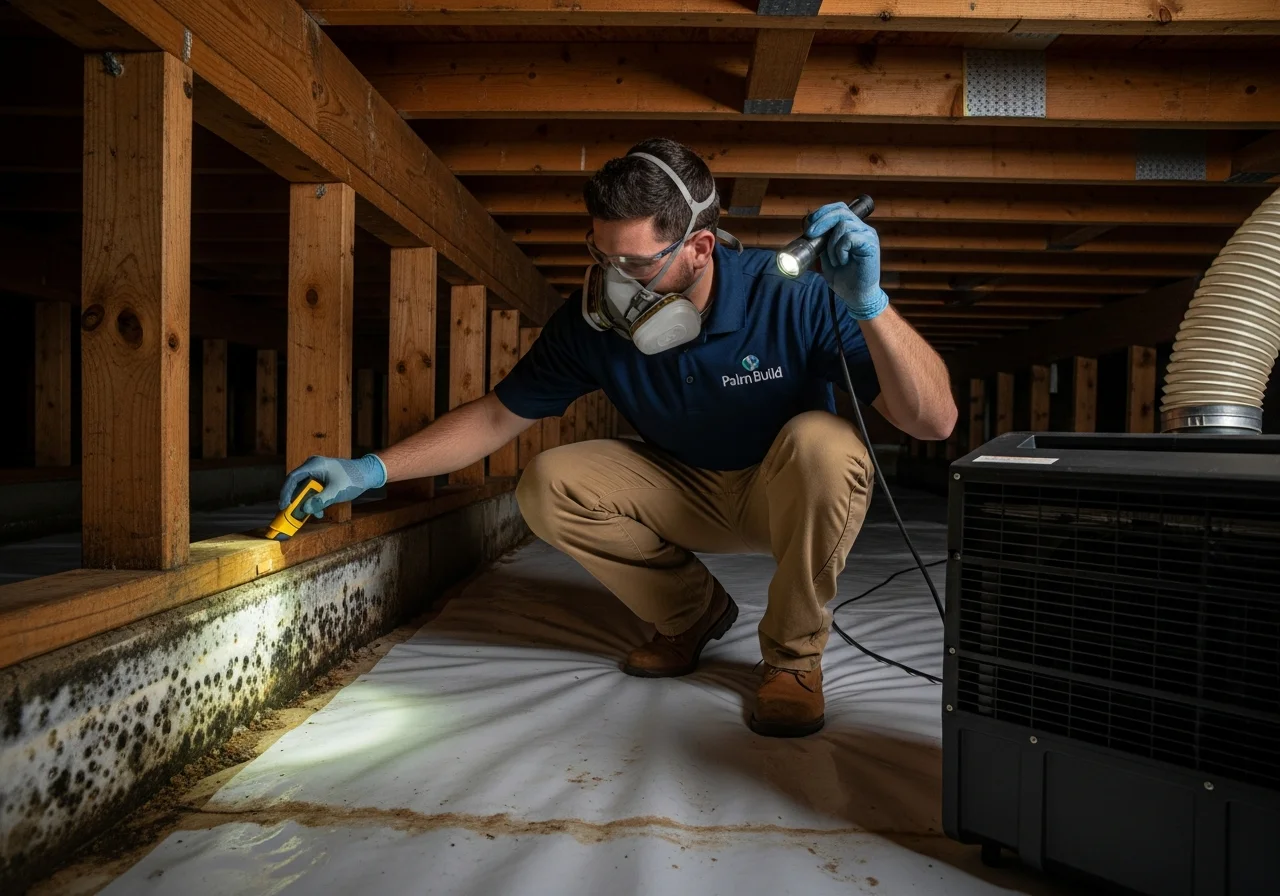
Mold Remediation in Greensboro, North Carolina
Greensboro's Piedmont clay soil drains slowly, its housing stock averages a 1985 build year, and crawl space foundations are the dominant construction type in older neighborhoods from Fisher Park to Sunset Hills. Any water event — a supply line failure, a July thunderstorm that saturates the crawl space, or an unvented bathroom above a cold basement — becomes a mold risk within 24 to 48 hours. Unlike Florida, North Carolina has no state mold remediation license: Palm Build's IICRC S520 certification is the credential that actually matters here.
~90 min
Emergency Response
24/7
Dispatch Available
IICRC
Certified Technicians
NC Mold Contractor Guide
Mold Credentials in North Carolina — What Greensboro Homeowners Need to Know
Unlike Florida, North Carolina does not license mold remediation contractors. This is not common knowledge — and it creates real risk for homeowners who assume a "certified" claim is backed by state oversight.
North Carolina Has No State Mold License
NC DHHS and NC State University Extension both explicitly state that there is no state or federal certification program for mold remediation companies in North Carolina. This means the state does not license, certify, or regulate mold remediation contractors the way Florida does under Chapter 468, or the way electrical and plumbing contractors are licensed. Any company claiming to hold a "state mold license" in North Carolina is misrepresenting their credentials — there is no such thing.
IICRC S520 Is the Accepted Benchmark
In the absence of state licensing, NC DHHS and NC State Extension identify IICRC (Institute of Inspection Cleaning and Restoration Certification) as the industry benchmark for mold remediation contractors. The IICRC S520 Standard for Professional Mold Remediation establishes the technical requirements for containment, controlled demolition, HEPA treatment, clearance, and documentation. Palm Build holds IICRC S520 certification — the credential your insurance adjuster will ask about.
How to Verify a Mold Contractor in Greensboro
Ask any mold contractor for their IICRC certification number. You can verify it directly at iicrc.org/verify. Also ask: Do you follow IICRC S520 protocol? Do you provide written clearance documentation? Will you provide a written scope before work begins? A reputable contractor answers yes to all three. Be especially cautious of contractors who push aggressive testing ("you need air sampling in every room") before assessment — the NC DHHS guidance does not recommend routine sampling absent a visible moisture source.
Mold Contractor Verification Checklist
Ask for IICRC certification number and verify at iicrc.org
Confirm they follow IICRC S520 Standard for Mold Remediation
Request a written scope and estimate before any work begins
Ask how they identify and eliminate the moisture source first
Verify they provide written clearance documentation after completion
Ask about containment protocol — negative air pressure, HEPA filtration
Do not accept vague "bio-cleaning" or "spraying" as the full scope
Palm Build holds IICRC S520 certification
We provide our certification number on every estimate. Ask for it — and verify it. That is exactly what the NC DHHS guidance tells you to do when hiring a mold contractor.
Mold Risk Calendar
Greensboro Mold Risk — Season by Season
44 inches of annual rainfall, Piedmont clay soil that stays saturated for days, and summer humidity reaching 90%. Here is what mold risk looks like in Greensboro throughout the year.
Winter freeze/thaw cycles trigger pipe bursts — especially in older Greensboro homes with inadequate insulation. A supply line failure in January in an unoccupied home can go undetected for days, producing mold growth that compounds through February. Heating systems also run continuously, creating condensation points on cold surfaces near exterior walls.
Action: Inspect under sinks, around supply lines, and in crawl spaces after any hard freeze.
Spring rains saturate Piedmont clay soil. Crawl spaces that were relatively dry over winter begin absorbing ground moisture as temperatures rise. HVAC systems switching from heat to cooling create condensation transition points. A wet crawl space discovered in April often traces back to February or March moisture that went unnoticed.
Action: Schedule a crawl space inspection in April — before summer heat accelerates any mold already present.
Peak mold season. Greensboro's station normals show July (4.18"), August (4.36"), and September (4.59") as the wettest months. Ambient humidity runs 70–90%, which is at or near the mold activation threshold continuously. Any unresolved moisture event from a summer storm, roof leak, or Buffalo Creek flooding can produce active mold growth within 24 to 48 hours. The 48-hour CDC guidance is at the very short end here.
Action: Treat every summer water event as a 24-hour emergency. Do not wait for visible mold before calling.
Summer mold from July and August events commonly surfaces in October as temperatures drop and homeowners spend more time indoors. HVAC systems transitioning back to heat create different airflow patterns that can spread spores from previously contained areas. Roof damage from late-season tropical remnants (Tropical Storm Debby affected NC) creates new intrusion points heading into winter.
Action: Have a mold inspection if any summer water event occurred, even a minor one that seemed to dry quickly.
The CDC confirms: mold can begin growing within 24 to 48 hours of moisture exposure. In Greensboro's June through September peak season, where ambient humidity runs 70–90%, the window is at the short end. Any water event during these months is a same-day emergency.
Crawl Space Mold Guide
Crawl Space Mold in Greensboro — Why It Happens and How to Fix It
Crawl space mold is the most common mold remediation call in Greensboro's older neighborhoods. Clay soil, summer humidity, and vented crawl spaces are a predictable combination.
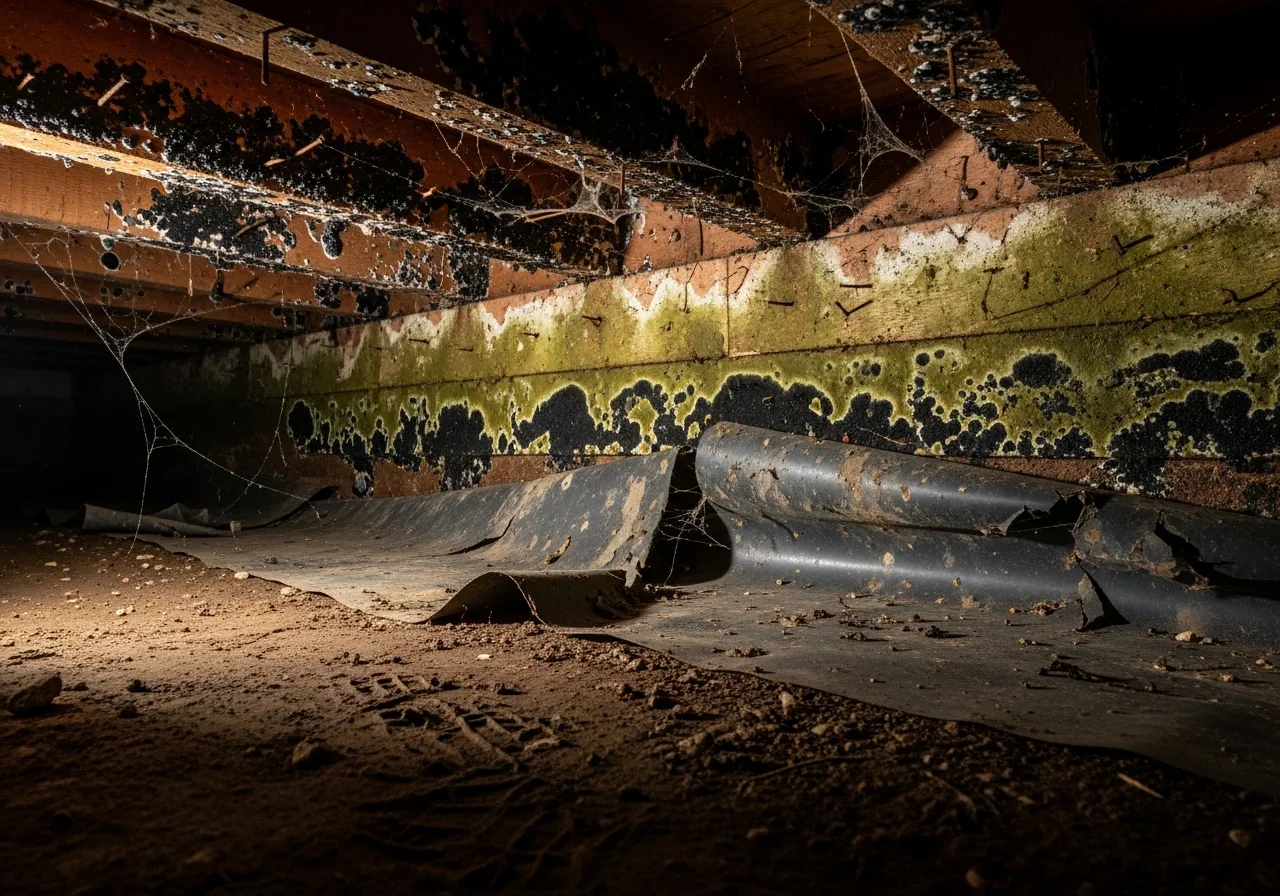 BEFORE
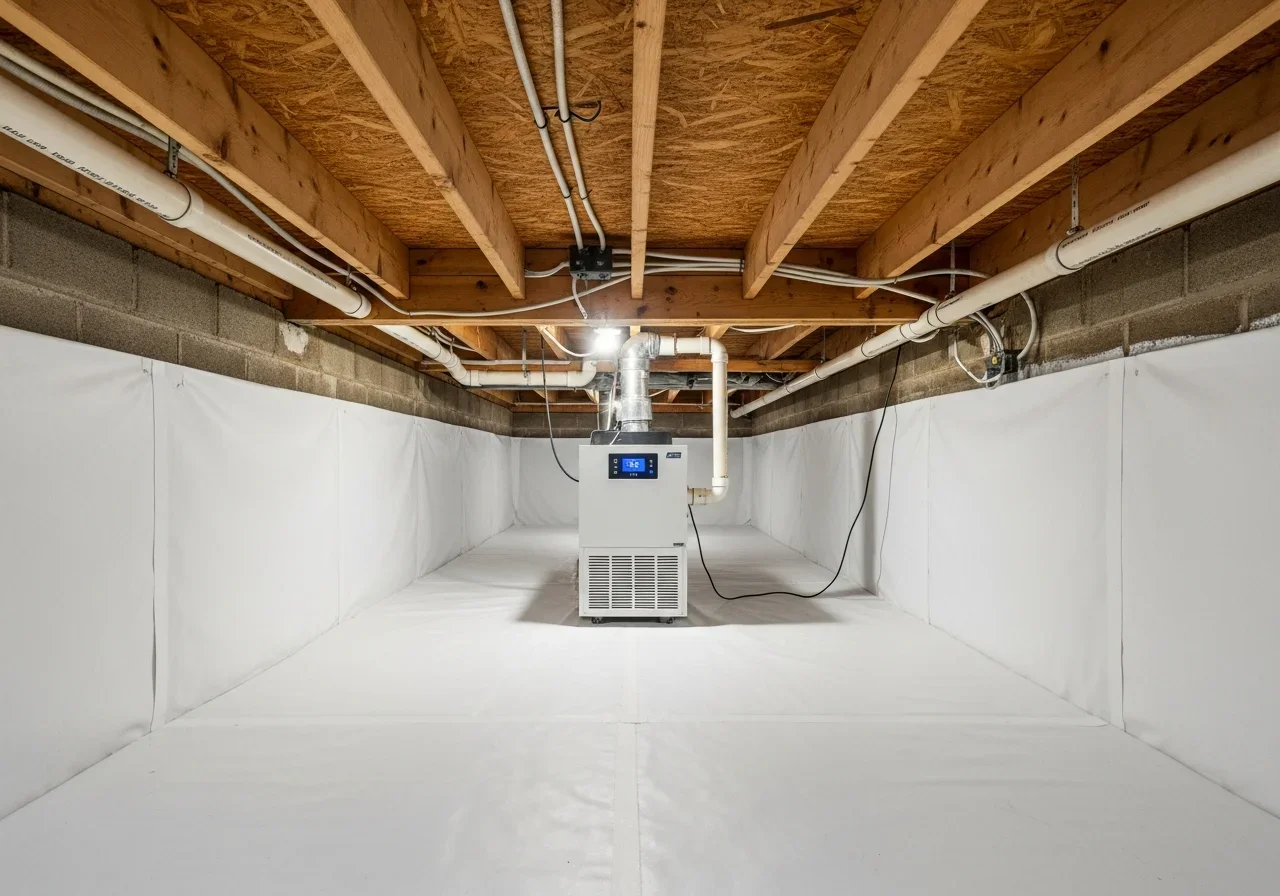 AFTER
AFTERPiedmont Clay Soil Stays Saturated
Unlike sandy coastal soils that drain quickly, Greensboro's Piedmont clay holds water for days after rain. This sustained saturation creates a constant moisture vapor source directly below crawl spaces. In older homes from Fisher Park to Sunset Hills with minimal or degraded vapor barriers, this ground moisture continuously evaporates into the crawl space air — keeping humidity above the 60% threshold at which mold colonizes wood surfaces.
Vented vs. Encapsulated — The Greensboro Problem
Greensboro's older homes were built with vented crawl spaces — the theory being that outdoor air would dilute crawl space humidity. In Piedmont NC's summer climate, this is exactly backwards: outdoor air in July and August at 80–90% humidity makes a vented crawl space wetter, not drier. Building science and NC State Extension guidance have moved toward encapsulated crawl spaces with dehumidifiers as the effective solution for this climate. Vented crawl spaces in Greensboro's summer are a mold factory.
The Warning Signs Homeowners Miss
Crawl space mold in Greensboro rarely announces itself dramatically. By the time a homeowner notices musty smell or discoloration on floor joists, the mold colony has often been active for weeks or months. The warning signs that appear earlier: wood floors that feel slightly soft or springy, increased allergy symptoms in the home, or HVAC running harder than usual (the system is fighting the moisture load the crawl space is pumping into the living space).
Palm Build Crawl Space Mold Remediation Protocol
Source identification — determine whether moisture is from ground vapor, surface intrusion, or plumbing
Remove and dispose of contaminated insulation and degraded vapor barrier
HEPA vacuum all joist surfaces and structural wood
Apply EPA-registered antimicrobial treatment to all wood surfaces
Install commercial dehumidification and monitor until wood reaches goal moisture content
Install heavy-gauge encapsulation system with sealed seams over entire floor area
Provide written clearance documentation — moisture content and visual confirmation
Remediation Process
How Palm Build Remediates Mold in Greensboro — Step by Step
IICRC S520 protocol every time. From source identification to written clearance — here is exactly what happens on every Greensboro mold remediation.
Moisture Source Identification First
Mold treatment without source control is temporary. In Greensboro, the most common sources are crawl space vapor from clay soil, HVAC condensate drainage failures in older systems, aging plumbing supply lines, and roof or window envelope failures. We identify and confirm the source before any remediation begins — and remediation scope includes addressing the source, not just the mold it created.
Containment — Negative Air Pressure
Containment barriers with negative air pressure prevent mold spores from spreading to clean areas of your Greensboro home during remediation. HEPA air scrubbers filter particles to 0.3 microns. For crawl space work, containment is established at access points and HVAC vents are sealed in the work area to prevent recirculation through the heating and cooling system.
Controlled Demolition & Material Removal
Affected porous materials — drywall, insulation, compromised subfloor, damaged vapor barrier — that cannot be cleaned to IICRC S520 standard are removed and bagged within containment. For historic Greensboro homes with original plaster, we evaluate salvageability before removal — preserving historic fabric where sound, removing what cannot be saved. All materials are disposed of appropriately.
HEPA Vacuuming & Antimicrobial Treatment
After materials are removed, all remaining surfaces are HEPA vacuumed to capture loose spores, then treated with EPA-registered antimicrobial appropriate for wood, concrete, and masonry surfaces encountered in Greensboro's older construction. Crawl space structural wood surfaces receive separate treatment after vapor barrier removal.
Structural Drying to Goal Moisture Content
Remaining structural materials are dried to goal moisture content before reconstruction. In Greensboro's summer ambient humidity, this requires commercial dehumidification maintained to psychrometric targets — not just running until surfaces look dry. Daily moisture readings document drying progress. Crawl space wood must reach below 19% moisture content to be below the mold activation threshold.
Written Clearance Documentation
Written clearance confirming visual remediation is complete and moisture content targets are met. This documentation supports insurance claim closure, satisfies home buyer inspection requirements, and establishes the property baseline for any future moisture assessments. In North Carolina, IICRC-based clearance is what adjusters and home inspectors look for.
Cost Guide
Mold Remediation Costs in Greensboro, NC
Cost depends on mold extent, affected materials, and whether crawl space or historic home construction is involved. Here is what Greensboro homeowners typically pay.
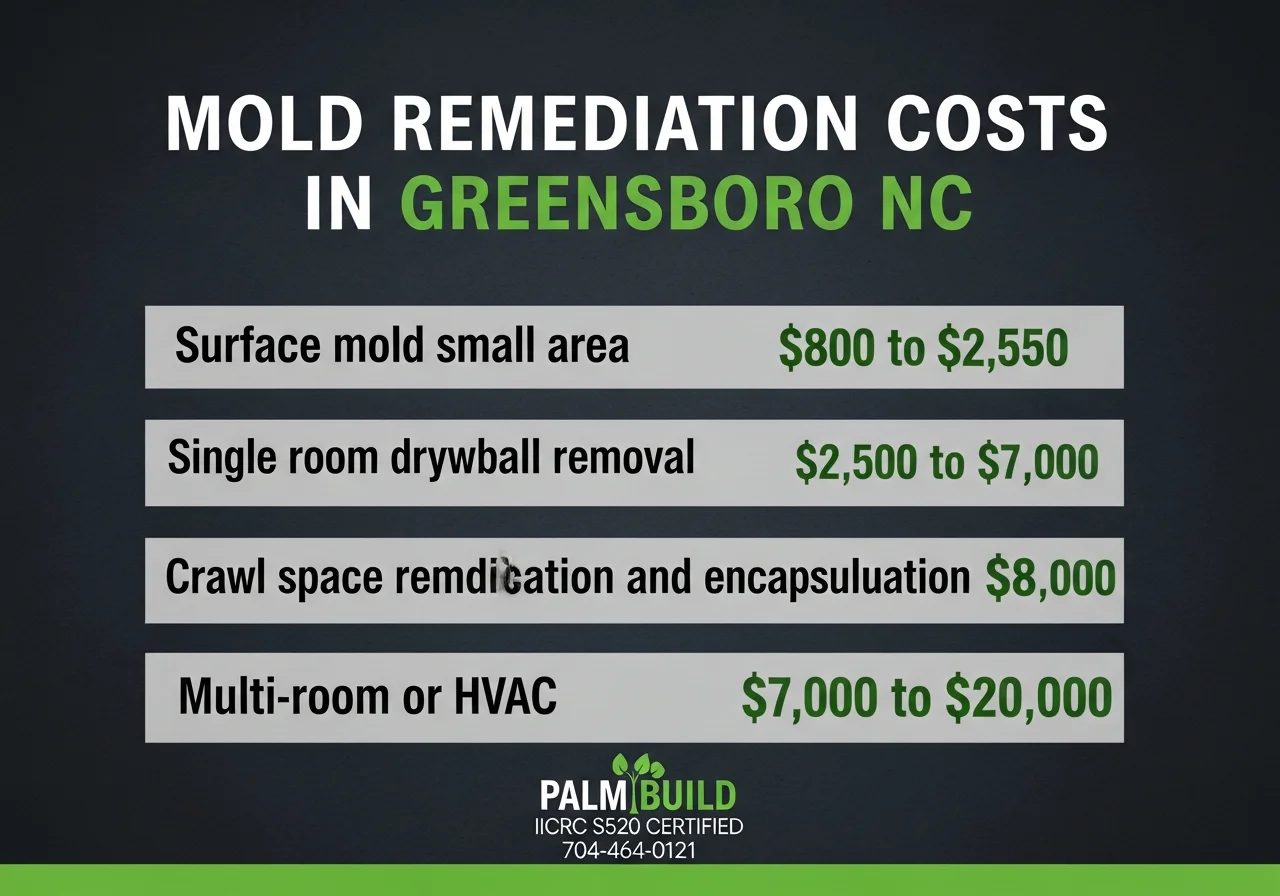
Small isolated area, no structural material removal, accessible location.
- Bathroom tile and grout surface mold
- Small HVAC condensate drip area
- Window sill condensation mold
One room affected, drywall or insulation removal required, structural drying.
- Bedroom wall from roof leak
- Basement wall from foundation seepage
- Bathroom from supply line failure
Joist surface mold, vapor barrier replacement, encapsulation, dehumidifier.
- Full crawl space mold remediation
- Vapor barrier replacement + encapsulation
- Joist surface treatment + drying
Extensive mold, multiple rooms, historic home specialty drying, HVAC.
- Multi-room historic home remediation
- Combined crawl space + living areas
- HVAC system mold including ductwork
Written estimates before any work begins.
Get a Free Mold Assessment — (704) 464-0121Gallery
Greensboro Mold Remediation — Before, During & After
Crawl space mold, clay soil moisture damage, and the professional encapsulation that solves it — this is what Palm Build remediates in Greensboro and the Triad.
BEFORE Crawl Space Joist Mold — Fisher Park
AFTER After Encapsulation — Clean & Verified
ASSESSMENT IICRC Certified Assessment
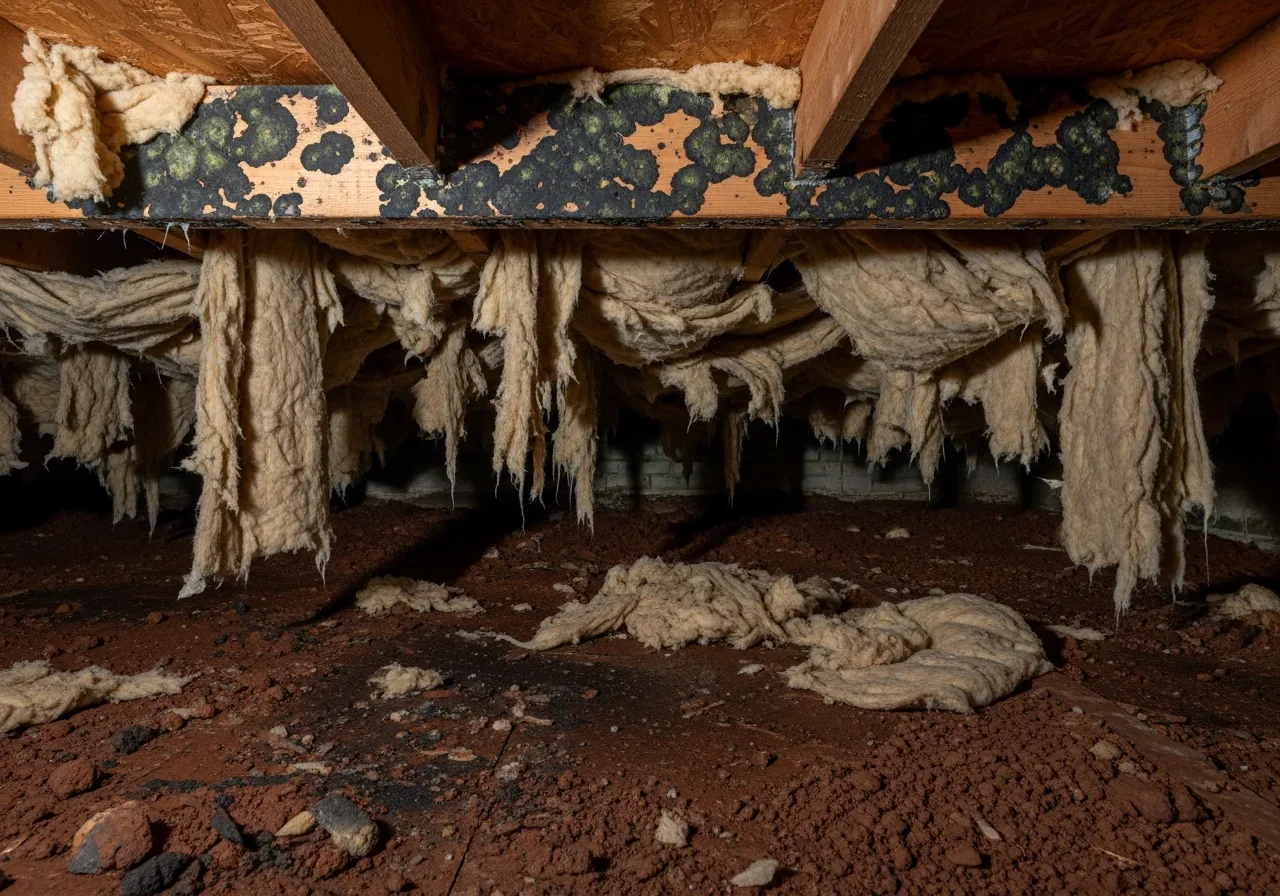 BEFORE
 Moisture Damage — Before Remediation
Why Palm Build
Why Greensboro Homeowners Choose Palm Build for Mold
IICRC certification, crawl space expertise, and source-first protocol — built for Piedmont NC's clay soil conditions and older housing stock.
IICRC S520 Certified — the NC Standard
NC has no state mold license. IICRC S520 is what NC DHHS and NC State Extension identify as the accepted benchmark. Palm Build holds this certification and provides our number on every estimate. Verify it at iicrc.org.
Crawl Space Specialists — Built for Piedmont NC
Clay soil, vented crawl spaces, and Greensboro summers are a predictable mold combination. Our crawl space protocol covers source identification, contaminated material removal, structural drying to calibrated wood moisture content goals, and heavy-gauge encapsulation — not just spraying.
Historic Home Expertise
Plaster walls, hardwood floors, and pre-war construction assemblies in Fisher Park and Irving Park require different protocols than new drywall construction. We evaluate and remediate without creating more damage than the mold itself.
24/7 Response from Charlotte
~90 miles, ~90 minutes. We dispatch immediately. In Greensboro's summer peak season, every hour between moisture event and extraction matters for the 24 to 48-hour mold clock.
No Unnecessary Testing
NC DHHS guidance: routine mold sampling is not recommended absent a visible moisture source. We find the source, eliminate it, and remediate — without selling testing you don't need. Our documentation provides the evidence your insurance adjuster requires.
Written Clearance Included
Every remediation includes written clearance documentation — moisture content readings, visual confirmation, and protocol followed. Required for insurance claim closure, home sale, and any future reference.
Frequently Asked Questions
Mold Remediation in Greensboro — Common Questions
Answers specific to NC's no-license environment, crawl space conditions, and Piedmont NC seasonal mold patterns.
Still have questions about mold in your Greensboro home?
Call (704) 464-0121 — 24/7More in Greensboro
Other Restoration Services in Greensboro, NC
Related Services
Related Restoration Services
Helpful Resources