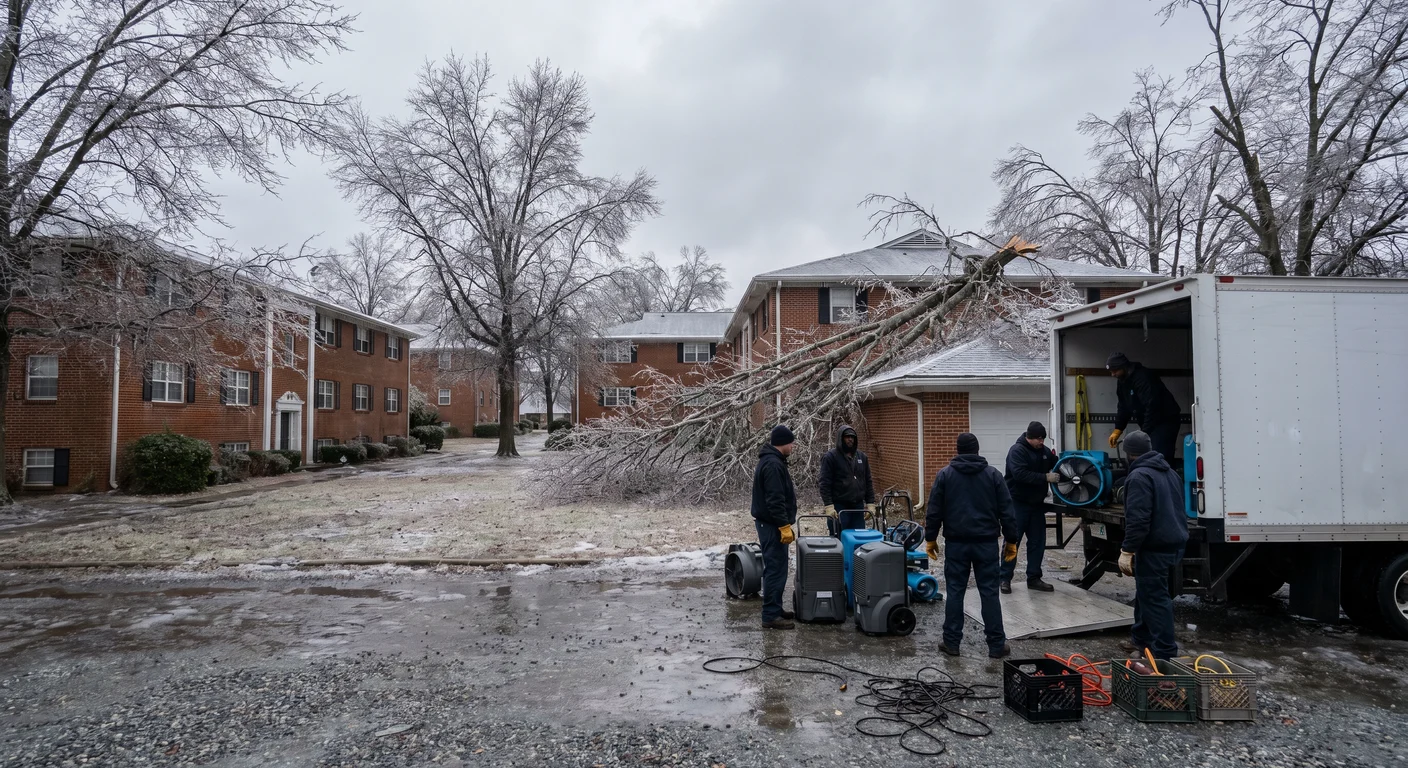
Large-scale structural damage at a multi-building Greensboro NC property after a severe ice storm, with Palm Build large loss crew and drying equipment staged for coordinated catastrophe restoration
GREENSBORO NC — LARGE LOSS & CATASTROPHE RESPONSE

Large Loss Handling in Greensboro, North Carolina

When damage exceeds $100,000, involves multiple buildings, or requires catastrophe-level coordination, Palm Build's large loss team deploys with the equipment, crew depth, and project management capability to handle the Piedmont Triad's most complex restoration projects — from ice-storm freeze losses across multi-unit buildings to multi-building commercial fires.

Charlotte — approximately 90 miles from Greensboro ~90 min Response IICRC Certified

~90 min

Emergency Response

24/7

Dispatch Available

IICRC

Certified Technicians

What Defines Large Loss

Why Large Loss Restoration Requires a Different Approach in Greensboro

Not every restoration project is a burst pipe and a few rooms of drywall. Some events are catastrophic — exceeding $100,000, spanning multiple structures, or involving complexity that overwhelms standard restoration companies. Greensboro's mix of high-value historic homes, large multi-family communities, and exposure to ice storms, tornadoes, and derecho-driven weather means large loss scenarios occur more frequently than most people realize. When they do, the restoration company you choose determines whether recovery takes months or years.

Claims Exceeding $100,000

$100K+

Claim threshold

Large loss events are defined by their scale — both financial and physical. When a restoration project exceeds $100,000 in scope, the complexity escalates exponentially. Multiple insurance carriers may be involved, structural engineering assessments become mandatory, environmental testing is required, and the project management overhead rivals a commercial construction job. In Greensboro, large loss events are more common than most property owners realize. A single freeze-burst supply line in a three-story Irving Park colonial can cause $150,000 or more in damage when water migrates through multiple floors, soaks hardwood flooring, and saturates the crawl space below. A kitchen fire in a Fisher Park or Sunset Hills home that reaches the attic can generate $200,000-$400,000 in combined structural, contents, and smoke remediation costs. These are not small claims handled with a portable dehumidifier and a drywall patch — they require a fundamentally different approach.

Multi-Structure or Multi-Unit Events

2+

Structures affected

When damage spans multiple buildings, units, or structures on a property, coordination complexity multiplies. Greensboro's multi-family communities and HOA-governed developments — from Latham Park and Hamilton Lakes to Adams Farm and Sedgefield — regularly experience events where a single water source (a freeze-burst riser, a failed roof, storm damage) affects multiple attached units or neighboring structures at once. A hard freeze during a multi-day outage is the classic trigger: dozens of supply lines rupture across a single building when the heat is lost. Multi-structure events require separate scopes of work, separate insurance claims (often involving a master policy and individual HO-6 policies), separate timelines, and coordination among multiple property owners and adjusters who may have conflicting priorities. A standard restoration contractor working one unit at a time will extend a multi-unit project by weeks or months.

Catastrophe and Weather Events

1.5–1.8M

2002 ice-storm NC outages

The Piedmont Triad is not immune to catastrophe. The December 2002 ice storm proved it, knocking out power to 1.5–1.8 million North Carolinians for as long as ten days — surpassing Hurricane Hugo's outage record — and triggering frozen and burst pipes across multi-unit buildings once heat was lost. The April 15, 2018 EF-2 tornado carved a roughly 16-mile track across east Greensboro, damaging homes and three elementary schools. Ice-load roof failures, tornado and derecho outbreaks, hail, and freeze-driven pipe bursts can overwhelm local restoration capacity in hours. Catastrophe events require pre-positioned equipment, mutual aid agreements, surge staffing protocols, and the ability to scale from 5 crews to 50 within 48 hours. Palm Build surges crews from our Charlotte Operations Hub roughly 90 miles away and from a Southeast network of IICRC-certified mutual-aid partners — catastrophe-response infrastructure that single-office competitors cannot match.

Complex Stakeholder Environments

5-15

Typical stakeholders

Large loss projects involve more people than standard restoration jobs. Structural engineers, environmental consultants, public adjusters, forensic accountants, city inspectors, historical preservation boards, HOA management companies, and sometimes attorneys all become part of the project ecosystem. In Greensboro, properties in the local historic districts — Fisher Park, College Hill, and Dunleath — add Greensboro Historic Preservation Commission review to the stakeholder list. Commercial and institutional properties, from the Revolution and Cone mill-district buildings to UNCG, NC A&T, and Cone Health facilities, add tenant coordination, business interruption documentation, and commercial insurance carriers with different documentation requirements. Managing these stakeholders requires dedicated project management resources that a standard restoration crew simply does not have.

Catastrophe-Scale Response

How Palm Build Scales for Major Events in Greensboro

A restoration company that handles your burst pipe may not be able to handle your building's ice-storm freeze losses or a tornado that hits an entire block at once. Catastrophe response requires pre-built infrastructure, supply chain depth, and scalable operations that most restoration companies never develop because they never need them — until the one time they do. Here's what Palm Build brings to Triad-area catastrophe events.

Hub-and-Surge Crew Deployment

When an ice storm or tornado outbreak hits the Triad, the fastest help comes from the Charlotte Operations Hub roughly 90 miles down I-85/I-40 — crews are typically on the ground in Greensboro inside about 90 minutes. Behind that first wave, Palm Build surges supplemental labor through a Southeast network of IICRC-certified mutual-aid partners we have vetted in advance. This hub-and-surge model means we can multiply our workforce in a Greensboro disaster zone within 24-48 hours — something single-crew local competitors simply cannot do. Our North Carolina teams bring the inland storm, ice-load, and freeze-burst restoration expertise the Piedmont actually demands, not generic catastrophe staffing.

Equipment Trailer Banks

Large loss events don't fail because of manpower — they fail because of equipment constraints. A standard restoration company carries enough dehumidifiers and air movers for 2-3 concurrent residential projects. An ice-storm freeze event across a multi-unit Greensboro building may require 50-100 dehumidifiers, hundreds of air movers, multiple truck-mounted extractors, and specialized equipment like desiccant dehumidifiers and injectidry systems. Palm Build maintains equipment trailer banks — pre-loaded, maintained, and ready to deploy — that can scale our drying capacity from a single home to an entire building or neighborhood within 48 hours.

Surge Material Supply Chain

After a catastrophe, building materials become scarce. Drywall, plywood, roofing materials, and insulation that were readily available yesterday are backordered for weeks. Palm Build maintains relationships with multiple building material suppliers across the Piedmont and the broader Carolinas, with pre-negotiated surge pricing and priority fulfillment agreements. For Triad catastrophe events, we can source materials through our regional supply network — including the Charlotte and Triangle markets — when Greensboro-area suppliers are depleted by demand from every contractor in the region at once.

Mutual Aid Network

No single restoration company can handle a true catastrophe alone. Palm Build participates in a mutual aid network of vetted restoration companies across the Southeast — companies we've worked with before, whose quality standards we've verified, and whose insurance and licensing we've confirmed. When a Greensboro catastrophe event exceeds even our expanded capacity, we activate mutual aid partners who deploy under our project management and quality standards, ensuring consistency even at massive scale.

Pre-Event Positioning

When the National Weather Service issues an ice-storm warning or a severe-weather and tornado watch for the Piedmont Triad, Palm Build begins positioning equipment and staging crews before impact. Pre-event positioning means we're not waiting in line behind every other contractor after the storm — we're already in the field doing emergency tarping, water extraction, and structural stabilization while competitors are still mobilizing. For Greensboro property managers with Palm Build on retainer, pre-event building inspections and board-up services protect their properties before the event occurs.

Rapid Damage Assessment Teams

Within the first 24 hours of a catastrophe event, the priority is triage — not restoration. Our rapid damage assessment teams deploy to affected neighborhoods with moisture meters, thermal cameras, and structural assessment tools to categorize homes by severity: immediate structural danger, active water intrusion requiring emergency intervention, stable damage awaiting full scoping, and minor damage suitable for standard scheduling. This triage approach ensures that the most critical properties receive attention first and that limited resources are deployed where they'll prevent the most secondary damage.

Case Study: The December 2002 Ice Storm

Greensboro's December 2002 Ice Storm — and the Triad's Tornado Risk

On December 4–5, 2002, a slow-moving winter system glazed the Piedmont Triad in heavy freezing rain, knocking out power to between 1.5 and 1.8 million North Carolinians and surpassing Hurricane Hugo as the most damaging outage event in the state's modern history. Restoration ran nearly ten days in the hardest-hit neighborhoods. The storm exposed what large loss looks like inland: it is rarely a single dramatic flood — it is ice load crushing roofs, then a cascade of secondary failures as buildings sit cold and dark for over a week.

1.5–1.8M

NC Power Outages

~10 days

Restoration Time

16 mi

2018 EF-2 Tornado Track

<90 min

Our Response

Why the Triad Ices Over

The Piedmont Triad sits in a notorious freezing-rain climate band. When a warm, moist layer rides over a shallow dome of sub-freezing air trapped near the surface, rain falls in liquid form but freezes on contact with everything it touches. In December 2002, that setup laid a thick rind of ice across Greensboro for hours. The danger is not the storm's drama — it is the ice load. Accumulated ice can add tons of dead weight to roof trusses, ridge lines, and gutters across older homes in Fisher Park, Irving Park, Sunset Hills, and Lindley Park. Trusses and gutters can fail under that load before a single limb falls — and when ice-laden limbs and entire trees do come down, they punch through roofs that were already stressed to their limit.

The Secondary Losses That Define the Claim

The roof breach is only the first loss. Outages stretching toward ten days meant homes and multi-unit buildings sat without heat through hard freezes. Plumbing in exterior walls and unheated crawl spaces froze, expanded, and burst — often after the building had already been damaged, and often discovered only when power returned and the ice in the lines finally thawed. Across apartment buildings, condos, and campus housing near UNCG and NC A&T, a single freeze event can rupture dozens of supply lines at once, sending water through multiple units and down into crawl spaces and lower floors. The result is a compound large loss: structural roof damage, then widespread water and freeze damage, then the mold risk that follows standing water in a still-cold building.

These claims rarely fit one neat policy line. Multi-unit buildings layer a master policy over individual HO-6 policies; commercial properties add business interruption; and freeze-related water damage triggers different coverage analysis than the wind or ice-load roof damage that preceded it. Untangling causation across a building full of burst lines is precisely the documentation challenge large loss handling exists to solve.

Palm Build's Response

For a Triad ice event, Palm Build crews stage from our Charlotte Operations Hub roughly 90 miles down I-85/I-40 — typically on the ground in Greensboro inside about 90 minutes — and surge with IICRC-certified mutual-aid partners across the Southeast for the supplemental labor a multi-building freeze demands. The first 24 hours are triage, not finish work: emergency roof tarping over ice-load breaches, board-up, temporary structural shoring where trusses are compromised, and rapid water extraction from every unit and crawl space touched by burst lines. From there our crews run systematic structural drying with commercial dehumidifiers and air movers, antimicrobial treatment to halt mold in buildings that sat wet and cold, and demolition of materials too far gone to dry. A dedicated project manager documents causation building-by-building so each carrier — and each policy layer — gets a clean, defensible claim package.

The Triad's Tornado Risk

Ice is the Triad's signature winter catastrophe; tornadoes are its warm-season one. On April 15, 2018, an EF-2 tornado touched down near I-40 and carved a roughly 16-mile track across east Greensboro, tearing roofs from homes and damaging three elementary schools. It was not an outlier — south Greensboro was struck by a catastrophic F4 tornado on April 2, 1936 that killed 14 people, and the region has weathered derecho and severe-thunderstorm outbreaks since. Tornado and derecho damage produces the same large loss profile as a major ice event: multiple structures hit at once, mixed wind-and-water scopes, and the need to scale crews and equipment far beyond what a standard residential job requires.

The Lesson for Greensboro

Greensboro is inland — there is no storm surge here — but the Triad is far from immune to catastrophe-scale loss. Ice loading governs roofs across the Piedmont, multi-unit buildings concentrate freeze-burst risk across dozens of units in a single outage, and the region's tornado history is long and deadly. For Greensboro property owners — especially those managing older homes in the historic districts, multi-family buildings, or commercial and campus facilities — having a restoration partner with true large-loss capability isn't optional. It's the difference between a structured recovery and an open-ended crisis.
Large Loss Timeline

How Palm Build Manages Large Loss Projects in Greensboro

Large loss restoration follows a structured, phased approach that balances urgency with thoroughness. Here's the timeline and process our Greensboro team follows for projects exceeding $100,000 in scope.

01

Rapid Assessment & Triage

Hours 0-24

Large loss events require immediate structural and environmental assessment before restoration work can begin safely. Our rapid response team deploys structural engineers, environmental consultants, and senior project managers to the site within hours. We assess structural integrity, identify immediate safety hazards (gas leaks, electrical exposure, ice-load collapse risk), document environmental concerns (asbestos, lead paint, mold, contaminated water), and establish a preliminary scope of work that guides all subsequent decisions. For multi-structure Greensboro events — such as a freeze that bursts lines across an entire apartment building — triage determines which units need emergency stabilization versus those that can safely wait for full scoping.

02

Emergency Stabilization

Hours 6-72

Before full restoration begins, the property must be stabilized to prevent further damage and ensure worker safety. This includes emergency board-up and tarping over ice-load roof breaches, water extraction from all affected areas, temporary structural shoring where trusses or other load-bearing elements are compromised, utility isolation and temporary power setup, and initial antimicrobial treatment to halt mold growth. In Greensboro, where Piedmont clay soil holds moisture against foundations for weeks after a freeze-burst or water event, crawl space and foundation stabilization is often the most urgent priority — water that isn't extracted from the crawl space will re-humidify the entire structure from below.

03

Detailed Scoping & Documentation

Days 3-10

Once the property is stabilized, our project management team develops a comprehensive scope of work that becomes the blueprint for the entire restoration. This includes room-by-room damage mapping with moisture readings, thermal imaging, and photographic documentation; structural engineering reports for compromised framing, foundation, or load-bearing elements; environmental testing results for mold, asbestos, and lead; contents inventory and pack-out scope; and preliminary cost estimates broken down by trade, phase, and timeline. For Greensboro historic-district properties in Fisher Park, College Hill, or Dunleath, we include Greensboro Historic Preservation Commission compliance requirements in the scope from the outset — preventing costly redesigns later.

04

Phased Restoration Execution

Weeks 2-16+

Large loss restoration doesn't happen in a linear sequence — it happens in coordinated phases with multiple trades working simultaneously under centralized project management. Phase 1 focuses on demolition, mold remediation, and structural drying. Phase 2 addresses structural repair, framing, and rough-in work. Phase 3 handles finish work — drywall, flooring, painting, trim, and fixture installation. Phase 4 covers contents return, final cleaning, and quality inspection. Each phase has its own timeline, quality checkpoints, and insurance documentation milestones. For Greensboro large loss projects, we assign a dedicated project manager who coordinates all trades, manages the insurance communication, and provides weekly progress reports.

05

Final Inspection & Closeout

Project End

Large loss closeout is more than walking through the finished space. It includes final moisture verification confirming all materials are at or below acceptable levels, air quality testing confirming mold spore counts are at ambient levels, city and county inspection sign-offs for all permitted work, final insurance documentation package including before-and-after photographs, cost reconciliation between original scope and actual work, contents return and placement with final condition documentation, and warranty documentation for all work performed. Our Greensboro large loss closeout process ensures that the insurance claim is fully documented, all work meets or exceeds Guilford County and 2018 NC Residential Code requirements, and the owner is confident in the quality of every aspect of the restoration.

Complex Claims Management

Large Loss Insurance Complexity in Greensboro

Standard homeowner claims are straightforward: one policy, one adjuster, one scope. Large loss claims are anything but. Multiple carriers, public adjusters, forensic accountants, and code-compliance requirements create an insurance environment that requires dedicated expertise to navigate. Here's what makes large loss claims different in Greensboro — and how Palm Build manages the complexity.

Multi-Carrier Claims

Large loss events in Greensboro frequently involve multiple insurance carriers. A multi-unit freeze loss may trigger both the master policy and individual HO-6 policies. A fire affecting neighboring properties involves separate homeowner policies with different carriers. A complex water event may require coordination between standard homeowner's coverage, separate wind and water claims, and code-upgrade coverage. Each carrier has different documentation requirements, different adjustment timelines, different coverage limits, and different depreciation schedules. Palm Build's Greensboro project managers are experienced in multi-carrier coordination — preparing separate documentation packages for each carrier while maintaining a unified project scope that prevents gaps and overlaps.

Public Adjuster Coordination

For large loss claims exceeding $100,000, many Greensboro property owners retain public adjusters to represent their interests with the insurance carrier. Public adjusters serve an important function — but they can also create friction if the restoration company and the public adjuster are not aligned on scope, pricing methodology, and documentation standards. Palm Build has established working relationships with the most active public adjusters in the Piedmont Triad market. We understand their fee structures (typically 10-15% of the claim settlement), their documentation expectations, and their negotiation approach. This experience allows us to prepare documentation that supports rather than conflicts with the public adjuster's advocacy.

Forensic Accounting Support

Large loss claims often require financial documentation beyond standard restoration scoping. Business interruption claims need revenue verification and loss projections. Additional Living Expense (ALE) claims for displaced Greensboro homeowners require documentation of temporary housing costs, meal expenses, and incremental transportation costs. Some large loss claims involve subrogation against third parties (contractors whose work caused the damage, product manufacturers, utility companies). Palm Build provides the technical documentation — moisture readings, damage causation analysis, timeline of events — that forensic accountants and attorneys need to support these financial claims.

Ordinance & Law Coverage

North Carolina's building code has been updated multiple times over the past decades, and Greensboro work today is governed by the 2018 NC Residential Code. When a large loss event requires substantial reconstruction, current code requirements may mandate upgrades beyond simply restoring the pre-loss condition. Electrical panels must meet current NEC standards, plumbing must meet current plumbing code, energy efficiency requirements apply to replacement windows and insulation, and structural requirements — including the ice-load roof design that governs Triad construction — may require reinforcement that the original construction didn't include. Ordinance-and-law coverage on your homeowner's policy pays for these code-required upgrades — but only if they're properly identified, documented, and scoped as separate line items. Palm Build's Greensboro estimators are trained to identify ordinance-and-law scope and separate it from standard restoration scope so your coverage applies correctly.

Documentation That Withstands Scrutiny

Large loss claims receive more scrutiny from insurance carriers than standard claims. Adjusters may be replaced with senior adjusters or independent consultants. Engineering firms may be retained to evaluate structural damage claims. Contents claims may be reviewed by specialty auditors. Every scope item, every line item, every photograph needs to withstand this elevated level of review. Palm Build's large loss documentation includes timestamped photographs with GPS coordinates, daily moisture readings on standardized logs, structural engineering reports from licensed NC engineers, environmental testing from accredited laboratories, line-item estimates cross-referenced to industry pricing databases, and change order documentation for scope changes approved during the project. We also prepare the signed and sworn proof of loss that North Carolina carriers require within 60 days under NC Gen. Stat. Chapter 58. This level of documentation is not standard practice in the Greensboro restoration market — but it's essential for large loss claims.

The Palm Build Difference

Why Greensboro Property Owners Choose Palm Build for Large Loss

Large loss events expose the difference between restoration companies that can handle scale and those that cannot. When your project exceeds $100,000, spans multiple structures, or requires catastrophe-level response, the company you choose determines whether recovery takes months or years. Here's why Greensboro property owners trust Palm Build with their most complex restoration projects.

Scalable Operations

Most Greensboro restoration companies operate at a fixed capacity — 3-5 crews, limited equipment inventory, and a project management structure designed for standard residential work. When they encounter a large loss project, they're forced to subcontract work to companies they may not have vetted, extend timelines to accommodate capacity constraints, and improvise project management. Palm Build's operations are designed to scale. Our equipment trailer banks, our crews surging in from the Charlotte Operations Hub, and our Southeast mutual aid network allow us to ramp from a single-home project to a 50-unit catastrophe response without sacrificing quality or project management discipline.

Hub-and-Surge Infrastructure

Our Charlotte Operations Hub sits roughly 90 miles from Greensboro on I-85/I-40, close enough to put crews on the ground in about 90 minutes yet far enough that the same storm rarely floods both markets at once. When the Triad faces an ice storm or tornado outbreak, crews and equipment surge up from Charlotte while a Southeast network of IICRC-certified mutual-aid partners backfills the supplemental labor a multi-building event demands. This hub-and-surge model provides redundancy (capacity that scales past any single crew), diversity of experience (ice, freeze-burst, tornado, and fire), and supply chain depth across the Carolinas rather than reliance on a single depleted local market.

Catastrophe Protocol

We don't wait for catastrophe events to develop our response plans. Palm Build maintains written catastrophe protocols that define trigger points for crew staging, equipment pre-positioning, supply chain activation, and mutual aid deployment. When the National Weather Service issues an ice-storm warning or tornado watch for the Piedmont Triad, our protocols activate automatically. When a multi-structure fire or industrial accident occurs, our rapid assessment teams deploy within hours. This pre-built infrastructure means our response to your large loss event is systematic, not improvised.

Dedicated Project Management

Every large loss project in Greensboro receives a dedicated project manager — not a crew lead who doubles as a coordinator, but a full-time project manager whose sole responsibility is managing your restoration from assessment through closeout. Your project manager coordinates all trades, manages insurance communication, produces weekly progress reports, handles change order documentation, and serves as your single point of contact for every aspect of the project. For projects exceeding $500,000, we assign a senior project manager with an assistant project manager to ensure nothing falls through the cracks.

Proven Large Loss Track Record

Palm Build has managed large loss projects across the Carolinas, including ice-storm freeze losses that burst supply lines across entire multi-unit buildings, commercial building restorations in mill-district and warehouse properties, multi-unit HOA restorations, and fire damage restorations exceeding $400,000 in high-value historic homes. Our track record isn't theoretical — it's documented in project files, insurance records, and satisfied clients who chose us because we'd proven we could handle the scale.

Common Questions

Greensboro Large Loss Restoration FAQ

What qualifies as a 'large loss' in Greensboro?
Generally, any restoration project exceeding $100,000, involving multiple structures, requiring more than 10 crew members simultaneously, or involving complex multi-party insurance coordination. Greensboro examples include multi-unit ice-storm freeze losses where dozens of units burst pipes during the same outage, commercial building fires in the Revolution and Cone mill district, logistics and warehouse fires near the PTI/FedEx hub, and university or hospital facility losses at UNCG, NC A&T, or Cone Health.
How does Palm Build scale up for catastrophe events in Greensboro?
We activate our catastrophe response protocol, surging additional crews and equipment from our Charlotte Operations Hub roughly 90 miles down I-85/I-40 and from our Southeast network of IICRC-certified mutual-aid partners. Our equipment inventory includes truck-mounted extractors, trailer-mounted dehumidifier banks, and large-format air scrubbers staged specifically for large loss deployment across the Piedmont Triad.
Does Palm Build handle insurance for large loss claims?
Yes. Large loss claims involve specialized adjusters — often from national firms like Crawford, Sedgwick, or Engle Martin, or a carrier's TPA — and require more detailed documentation than standard residential claims. Our large loss documentation includes project management timelines, daily crew and equipment logs, Xactimate scopes with detailed line items, and regular progress reporting to all stakeholders. We also prepare the signed and sworn proof of loss North Carolina carriers require within 60 days.
What large loss events should Greensboro property owners plan for?
The Triad's signature catastrophes are inland, not coastal. The December 2002 ice storm knocked out power to 1.5–1.8 million North Carolinians for as long as ten days, surpassing Hurricane Hugo's outage record and triggering frozen and burst pipes across multi-unit buildings once heat was lost. The April 15, 2018 EF-2 tornado carved a roughly 16-mile track across east Greensboro, damaging homes and three elementary schools. Ice loading on roof trusses, tornado and derecho outbreaks, and freeze-driven pipe bursts — not storm surge — are the large loss drivers our Greensboro team plans for.
How long do large loss projects take in Greensboro?
Large loss timelines vary dramatically by scope. Multi-unit ice-storm freeze events: 4–8 weeks. Commercial building fires: 8–16 weeks. Catastrophe-event multi-building corridors: 3–12 months for full recovery. Timelines for large losses extend due to insurance complexity, material supply constraints, and sequential inspection requirements under the 2018 NC Residential Code.

Large-Scale Damage in Greensboro? We Scale With You.

Palm Build's large loss team deploys with the crew depth, equipment, and project management to handle the Piedmont Triad's most complex restoration projects. We coordinate multi-party insurance, multi-building logistics, and catastrophe-level timelines across Greensboro and Guilford County.

~90 min Response IICRC Certified