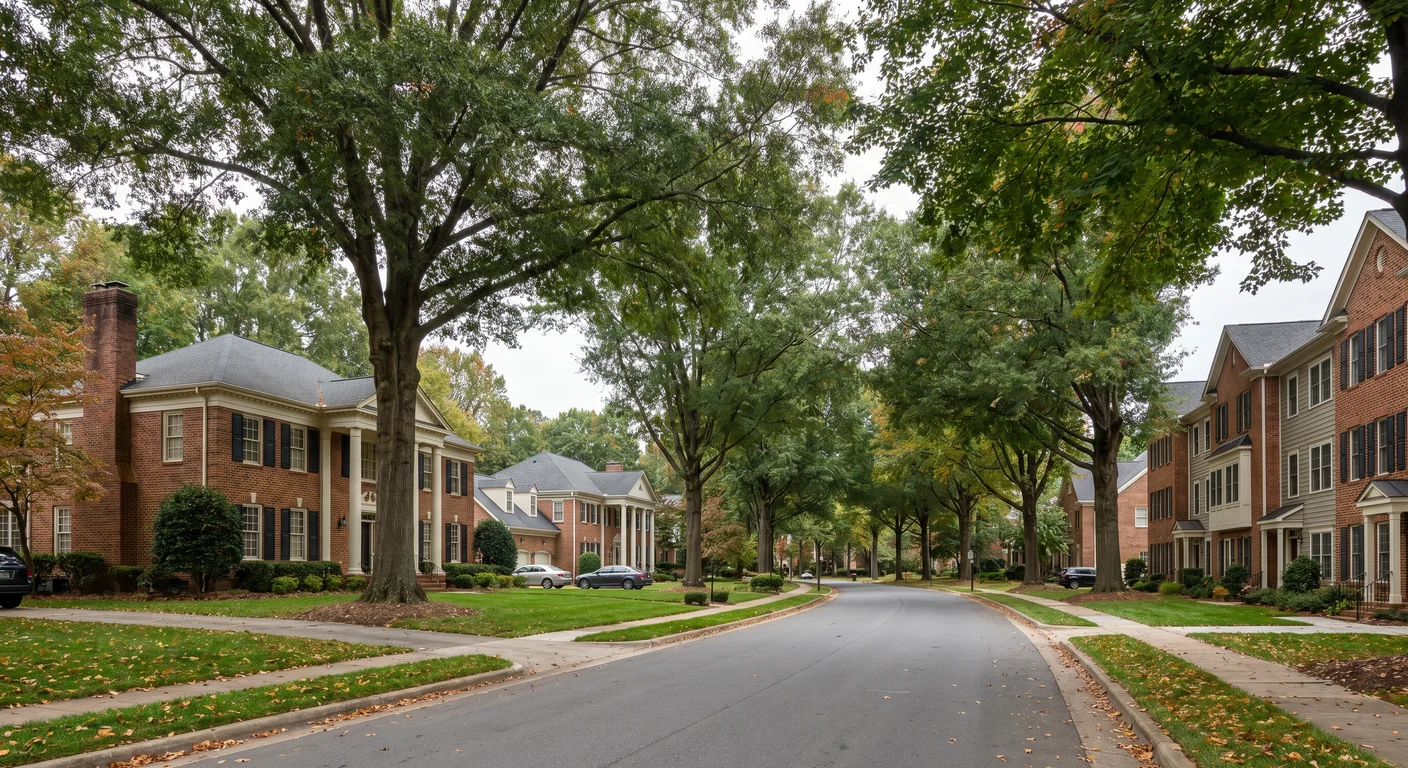
From Irving Park's near-downtown estates to Sedgefield's historic golf community and the condo and townhome associations around Friendly Center, Palm Build navigates the unique complexities of HOA restoration across the Piedmont Triad — master policy coordination, board approval processes, and owner-vs-association responsibility disputes.
Charlotte — approximately 90 miles from Greensboro ~90 min Response IICRC Certified
The Unique Complexities of HOA Restoration in Greensboro
HOA and multi-family restoration isn't just residential restoration with more
stakeholders. It involves fundamentally different insurance structures, approval
processes, and coordination requirements that most restoration companies — especially
national franchises — aren't equipped to navigate. Here are the four challenges that
make Greensboro HOA restoration uniquely complex.
Owner vs. Association Responsibility
The most common source of conflict in Greensboro HOA restoration. Your governing documents (CC&Rs, bylaws, master deed) define exactly where the association's responsibility ends and the unit owner's begins. In most Greensboro condos, the association covers the building envelope — roof, exterior walls, shared plumbing, and common areas — through the master policy. Unit owners cover interior finishes — drywall from the studs in, flooring, cabinets, fixtures, and personal property — through their HO-6 policy. But this split varies by community. Some Guilford County associations use 'bare walls' coverage where the owner is responsible for everything inside the studs. Others use 'all-in' coverage where the master policy covers interior finishes to original spec. Getting this wrong means someone pays out of pocket for work that should have been covered by the other party's insurance.
Board Approval Requirements
Most Greensboro HOA boards must approve restoration work exceeding a certain dollar threshold — often $5,000-$25,000 depending on the community's governing documents. For emergency mitigation (water extraction, board-up, mold containment), most documents authorize the property manager to act without board vote. But reconstruction requires board approval, which means scheduling a board meeting or obtaining email consent from a quorum. This approval step adds days to weeks if not managed proactively. Palm Build submits board-ready documentation packages and coordinates with property management to obtain approval as quickly as the governing documents allow.
Multi-Carrier Insurance Coordination
A single water event in a Greensboro condo building can trigger 5-15 separate insurance claims: one master policy claim for building and common area damage, plus individual HO-6 claims for each affected unit. Each carrier needs separate documentation, separate scopes, and separate communication, and North Carolina sets a sixty-day proof-of-loss window (NC Gen. Stat. Ch. 58) that runs independently for each claim. The master policy carrier may use a different adjuster than the unit owner carriers. Palm Build manages all of these relationships simultaneously — providing carrier-specific documentation packages and coordinating scope approvals across all parties.
Architectural Review & Historic-District COA
Greensboro's gated and golf communities — Starmount Forest, Sedgefield, the Cardinal in Jamestown — often have architectural review committees (ARCs) that must approve any exterior changes, even those required by storm or fire damage. This means replacement roofing materials, siding colors, window styles, and exterior paint must match the community's architectural standards. On top of that, the city's local historic districts — Fisher Park, College Hill, and Dunleath — require a Certificate of Appropriateness (COA) from the Greensboro Historic Preservation Commission before exterior restoration in those neighborhoods. For communities with strict aesthetic requirements, sourcing matching materials can extend timelines. Palm Build coordinates with ARCs and the Historic Preservation Commission proactively, submitting material samples, specifications, and COA applications before ordering to avoid delays.
Greensboro HOA Communities
Greensboro's Major HOA & Gated Communities We Serve
Greensboro's HOA-governed communities span historic-district condo conversions, gated
golf neighborhoods, master-planned associations, and the townhome communities around
Friendly Center. Each has unique access requirements, architectural standards, and
restoration dynamics. Here are the major named communities across Guilford County where
Palm Build has direct experience.
Irving Park
High-value estates
North Greensboro · Luxury near-downtown estates
One of Greensboro's premier neighborhoods — large estate homes with high-value contents and active architectural review. National Register district but not a local COA district, so exterior restoration follows association standards rather than Historic Preservation Commission approval.
Sedgefield
Established golf community
Southwest Greensboro · Historic golf community
Anchored by Sedgefield Country Club with an established HOA. Mature, tree-lined neighborhood where storm and tree-fall exposure and architectural review shape exterior restoration.
Starmount Forest
Established golf community
West Greensboro · Golf community
Built around Starmount Forest Country Club — a mature neighborhood of established homes. Architectural review and material matching apply to exterior repairs.
Adams Farm
Large master-planned HOA
Southwest Greensboro · Master-planned HOA
One of the largest master-planned associations in the city, mixing single-family homes and townhomes. Different responsibility splits apply to detached versus attached units, and the active board reviews larger reconstruction scopes.
Hamilton Lakes
Established upscale neighborhood
Friendly Center · Established upscale neighborhood
Upscale neighborhood near Friendly Center with mature hardwoods. Established homes with high-value finishes and tree-fall exposure during Triad storms and ice events.
The Cardinal
Gated golf community
Jamestown · Gated golf community
Gate-controlled golf community on the Greensboro–Jamestown line. Crew and equipment access must be pre-registered at the gate, and exterior changes go through architectural review.
Friendly Center Condos & Townhomes
Multi-unit associations
Friendly Center · Condo & townhome associations
Shared-wall condo and townhome associations where water migrates vertically and horizontally between units. Master policy and individual HO-6 coordination is required on nearly every loss.
Fisher Park
Local COA district
Central Greensboro · Historic-district condo conversions
A local historic district where condo conversions and associations must obtain a Certificate of Appropriateness from the Greensboro Historic Preservation Commission before exterior restoration. We coordinate COA submissions alongside the insurance scope.
Insurance Structure
Master Policy vs. HO-6: Who Pays for What?
This is the question every Greensboro condo and HOA homeowner asks after damage. The
answer depends on your community's governing documents, but here's the most common split
in Guilford County associations. Palm Build reviews your specific documents before work
begins to ensure the correct party's insurance covers each component of the restoration.
Master Policy (HOA Responsibility)
Roof, exterior walls, and building envelope
Shared plumbing risers and main water lines
Common areas (lobbies, hallways, pools, clubhouse)
Structural framing and foundation
Building-wide HVAC systems and fire suppression
Exterior damage from storm, wind, or fallen trees
HO-6 Policy (Unit Owner Responsibility)
Interior drywall, paint, and finishes (studs-in)
Flooring — hardwood, tile, carpet, vinyl
Kitchen cabinets, countertops, and appliances
Bathroom fixtures and vanities
Personal property and contents
Unit-specific plumbing fixtures and supply lines
Loss assessment coverage (HOA special assessments)
Important: This is the most common split,
but your community may differ. Some Greensboro associations use "bare walls" coverage
(owner responsible for everything inside studs) or "all-in" coverage (master policy covers
interior finishes to original spec). Always check your governing documents. Palm Build reviews your CC&Rs and master
deed before beginning work to ensure the correct insurance carrier is billed for each scope
item.
HOA Restoration Process
How We Manage HOA Restoration in Greensboro
HOA restoration requires additional steps that residential projects don't — governing
document review, board approval, multi-carrier coordination, and resident communication.
Here's our process.
Immediate dispatch for mitigation — water extraction, board-up, or mold containment. Simultaneous notification to the property management company and HOA board president. Most governing documents authorize emergency mitigation without board vote. We begin protecting the property while coordinating approval for the full restoration scope.
We review the association's CC&Rs, bylaws, and master deed to determine the exact responsibility split between the master policy and individual unit owners. This prevents incorrect billing, coverage disputes, and out-of-pocket costs for work that should be covered by the other party's insurance. Each scope item is mapped to the responsible party before work begins.
03
Board Approval & Multi-Carrier Coordination
Days 3-14
We submit a board-ready documentation package including scope, estimate, timeline, and any required architectural review materials. For multi-unit events, we coordinate with the master policy carrier and each affected unit owner's HO-6 carrier simultaneously — providing separate documentation packages formatted for each carrier's requirements.
04
Restoration & Resident Coordination
Weeks 2-8
Phased restoration minimizes resident displacement. For occupied buildings, we schedule disruptive work during business hours, coordinate temporary relocation when necessary, and provide regular progress updates to property management and residents. For gated communities, all crew and equipment access is pre-registered and scheduled.
05
Final Inspection & Claims Closeout
Project Completion
Walk-through with property manager, board representative, and affected unit owners. Separate completion documentation for the master policy carrier and each HO-6 carrier. All City of Greensboro / Guilford County permitting and inspections completed, plus any historic-district COA close-out. Warranty documentation provided to both the association and individual unit owners.
Multi-Unit Specialty
Multi-Unit Water Damage: Greensboro's Most Complex Restoration Scenario
The Piedmont Triad's signature multi-unit hazard is the winter ice storm: a hard freeze
bursts a supply line in one upper-floor condo, and the moment it thaws, water cascades
through 10-15 units below via shared wall cavities, floor assemblies, and utility chases.
Within hours, you have a dozen affected unit owners, a master policy claim for building
elements, multiple HO-6 claims for interior damage, and a property manager fielding calls
from every resident in the building.
This scenario requires simultaneous response across all affected units — not sequential.
Water doesn't wait while the restoration company moves from unit to unit. Every hour of
delay allows moisture to migrate further, saturate additional materials, and increase the
total scope of the loss. Mold risk compounds exponentially with multi-unit events because
the building's shared HVAC system can distribute moisture and spores throughout the entire
structure — and a single Triad freeze can rupture lines in several units of the same
building at once.
Palm Build deploys multiple crews simultaneously to all affected units during multi-unit
events. We set up centralized drying equipment in corridors and common areas while also
placing unit-specific equipment in each affected space. Our documentation maps damage
per-unit for individual claims while also documenting building-level damage for the master
policy. This coordinated approach — serving as a single point of contact for the property
manager, the master carrier, and all affected unit owners — is what distinguishes us from
companies that treat each unit as a separate job.
We review your CC&Rs and master deed before work begins — mapping every scope item to the correct responsible party. This prevents billing disputes, coverage gaps, and out-of-pocket costs for work that should be covered by the other party's insurance.
Multi-Carrier Coordination
We manage relationships with the master policy carrier and all affected unit owner HO-6 carriers simultaneously. Separate documentation packages, separate scopes, separate communication — coordinated as one project.
Greensboro Community Experience
We've worked in Irving Park, Sedgefield, Adams Farm, the Cardinal, the Friendly Center condo and townhome associations, and dozens of other Guilford County HOA communities. We know the gate access procedures, board approval timelines, architectural review requirements, and Greensboro historic-district COA process.
Board-Ready Documentation
Our scopes, estimates, and timelines are formatted for board review — not just insurance submission. We attend board meetings when requested and provide the detail boards need to make informed approval decisions.
Resident-Sensitive Scheduling
We schedule disruptive work during appropriate hours, coordinate temporary relocation when necessary, and provide regular updates to property management and residents. For age-restricted and 55+ communities, we're especially attentive to accessibility and displacement concerns.
Common Questions
Greensboro HOA Restoration FAQ
Who is responsible for restoration in a Greensboro condo — the owner or the HOA?
It depends on your association's governing documents and the location of the damage. Generally, the HOA's master policy covers common elements (roof, exterior walls, shared plumbing, common areas) while individual unit owners are responsible for interior finishes (drywall, flooring, cabinets, personal property) through their HO-6 policy. Greensboro associations are governed by the NC Planned Community Act (Ch. 47F) or the NC Condominium Act (Ch. 47C), and the exact responsibility split varies by community. Palm Build reviews your governing documents to determine the correct responsibility allocation before work begins.
Does Palm Build work with HOA boards for approval?
Yes. We understand that HOA restoration often requires board approval before significant work can begin. We provide detailed scopes, estimates, and timelines formatted for board review. For emergency situations, we begin mitigation immediately (which most governing documents authorize without board vote) and coordinate board approval for reconstruction in parallel.
How do master policy and HO-6 claims work together?
Water from a burst pipe in one Greensboro condo unit can damage units below and adjacent through shared wall and floor assemblies. The master policy covers damage to common elements and the building structure. Each affected unit owner files an HO-6 claim for their interior damage. Palm Build coordinates with both the master policy carrier and individual unit owner carriers simultaneously — providing separate documentation packages to each, and tracking the NC Gen. Stat. Ch. 58 sixty-day proof-of-loss windows for every claim.
What Greensboro HOA communities does Palm Build serve?
We serve all HOA-governed communities across Greensboro and Guilford County including Irving Park, Sedgefield, Starmount Forest, Adams Farm, Hamilton Lakes, the Cardinal in Jamestown, the condo and townhome associations around Friendly Center, and the historic-district condo conversions in Fisher Park — plus hundreds of smaller townhome and condo associations throughout Greensboro, High Point, Jamestown, Kernersville, and Burlington.
What about restoration in Greensboro's historic districts and gated communities?
Greensboro's local historic districts — Fisher Park, College Hill, and Dunleath — require a Certificate of Appropriateness (COA) from the Greensboro Historic Preservation Commission for exterior work, even repairs driven by storm or fire damage. Gated golf communities such as the Cardinal add gate-controlled crew access and architectural review for exterior changes. Palm Build coordinates COA submissions, gate registration, and architectural-review approvals so exterior restoration stays compliant and on schedule.
HOA or Condo Damage in Greensboro? We Navigate the Complexity.
Palm Build handles the unique challenges of HOA restoration — master policy coordination, board approvals, multi-unit damage, and owner-vs-association responsibility. One team manages it all.