Key takeaways
- Slow the clock down. Scams succeed by controlling speed, paperwork, and money flow — door-to-door pressure, "today-only" pricing, and cash deposits are the three highest-signal red flags per FTC, BBB, and NAIC guidance.
- Document → Insurer → Contractor, always in that order. Photographs, attic shots, and dated receipts before any non-emergency work; carrier on the phone before any contract is signed; never sign over an insurance check.
- Florida's AOB regime is the most aggressive in the country. The FL Office of Insurance Regulation explicitly states you are not required to sign an Assignment of Benefits to have repairs completed, and Fla. Stat. § 489.147 prohibits deductible rebating as a third-degree felony.
- The FTC Cooling-Off Rule gives you 3 business days to cancel a door-to-door contract above the federal threshold (16 CFR Part 429); FL and SC mirror this in state home-solicitation statutes.
- Verify three things in minutes — state contractor license (FL DBPR / NCLBGC / SC LLR), liability and workers' comp insurance, and a real local address. FEMA does not license or certify contractors, so anyone who claims a "FEMA endorsement" is lying.
After a hurricane, the fastest way to avoid storm chaser scams is to control the order of operations: secure the property, document the damage, contact your insurance carrier, and only then vet contractors against state license, insurance, and contract-language standards. Federal Trade Commission consumer data underscores how common contractor fraud is — 81,925 reports landed in the FTC Consumer Sentinel Network's "Home Improvement, Repair, and Solar" category in 2024 alone. The four highest-signal red flags converge across BBB, FTC, FEMA, and NAIC guidance: door-to-door pressure, deposit demands, deductible-waiver offers, and any push to sign over an insurance check. For the broader pillar, see our storm and hurricane damage restoration overview, and for the carrier side of the workflow read our storm damage insurance claim guide.
FTC contractor fraud reports
81,925
Consumer Sentinel Network reports in the "Home Improvement, Repair, and Solar" category in 2024
EPA / CDC mold window
24–48 hrs
Wet materials must be dried inside this window or mold growth becomes likely
FTC Cooling-Off Rule
3 business days
Cancellation right for covered door-to-door sales under 16 CFR Part 429
FL deductible-rebate statute
§ 489.147
Florida statute making knowing deductible rebating a third-degree felony
How Storm Chaser Scams Work After Hurricanes
Storm chasers are typically out-of-area contractors who flood storm-hit neighborhoods with door-to-door offers, instant inspections, and high-pressure promises that sound like relief when you are exhausted and your home is exposed. The Better Business Bureau is careful to note that not every out-of-town contractor is automatically a scam — sometimes legitimate firms expand to disaster regions because demand exceeds local capacity. The risk rises sharply, however, when a contractor has no community accountability, unclear licensing, or a pitch designed to rush you past the things that protect you: licensing verification, written estimates, and the ability to call your insurance carrier before signing anything.
The same scam patterns repeat across every government and insurance-regulator advisory because the underlying mechanics are simple. Scams succeed when they control four levers: speed (door-knocking and "today-only" deals that stop you from checking licenses and reviews), paperwork (blank scopes, vague clauses, AOBs that hand over your insurance benefits), payment (cash demands, large deposits, gift cards, or wire transfers that aren't recoverable), and insurance manipulation ("insurance will pay 100%," "we'll waive your deductible," or steering you away from calling your carrier). Your job in the first 72 hours is to take those four controls back.
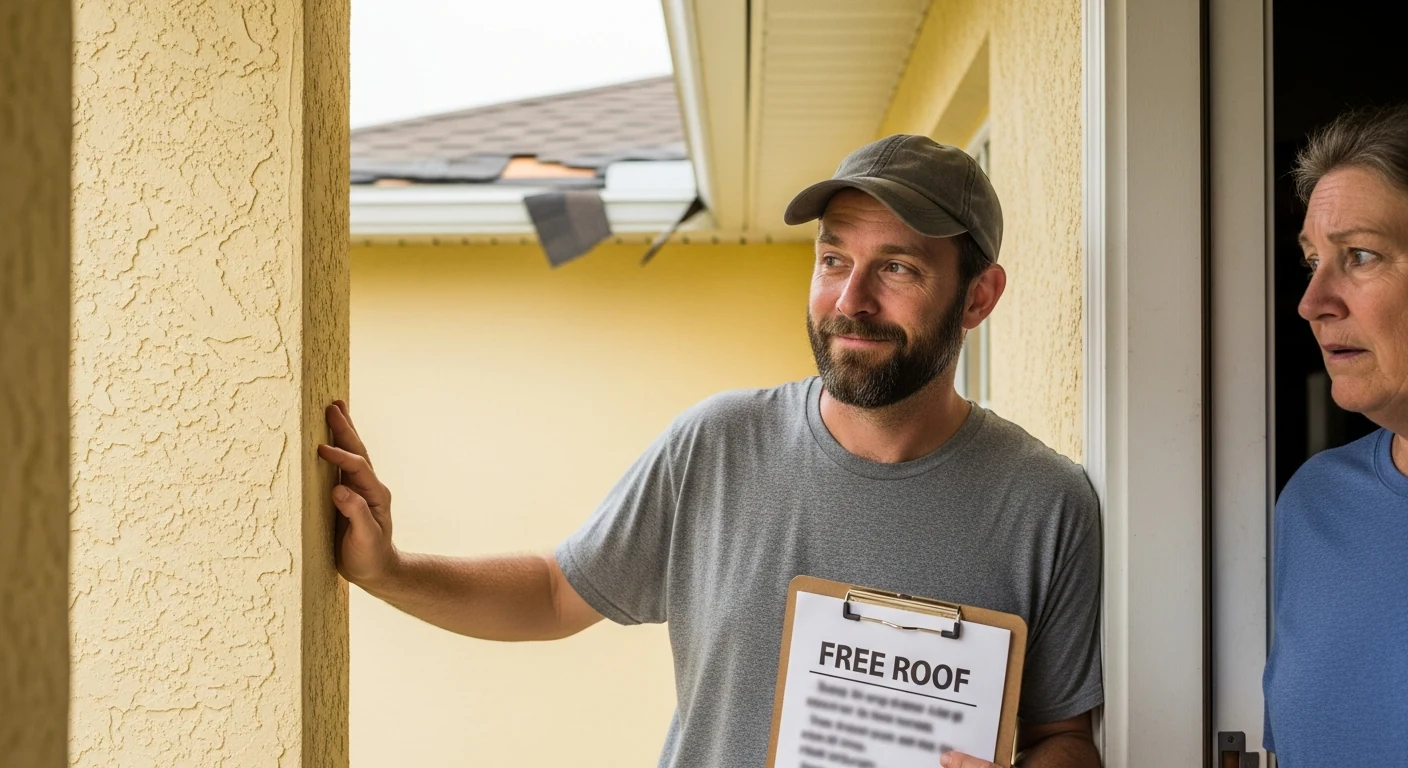
Storm Chaser Red Flags vs Reputable Contractor Green Flags
The cleanest mental model is a side-by-side: every behavior that screams scam has a mirror behavior reputable contractors do instead. The table below distills the BBB, FTC, NAIC, and FEMA advisories into the six pairs that show up across all of them — the ones that catch the overwhelming majority of post-hurricane fraud.
| Storm chaser red flag | Reputable contractor green flag |
|---|---|
| Knocks on doors within 24–48 hours of the storm and pushes you to sign on the spot | Encourages you to call your insurance carrier first and gives you days, not minutes, to review documents |
| Demands a large up-front deposit, cash only, wire transfer, gift cards, or payment apps | Uses traceable payment methods — check or card — with milestone billing tied to completed work |
| Offers to "waive" or "cover" your deductible as a sales incentive | Confirms in writing that the deductible is your responsibility and prices the job transparently |
| Won't provide a verifiable state license number, GL insurance certificate, or workers' comp coverage | Hands you the license number and proof of insurance unprompted and expects you to verify them |
| Wants you to sign over your insurance check or sign an Assignment of Benefits before any inspection | Bills you and coordinates with your carrier without taking control of your insurance proceeds |
| Won't commit to a detailed scope, timeline, or permit responsibility in writing — wants you to sign a blank or vague form | Uses a written, itemized contract with start and finish dates, change-order rules, and clear permit ownership |
Storm chaser red flags vs reputable contractor green flags — the six pairs that show up across BBB, FTC, NAIC, and FEMA guidance
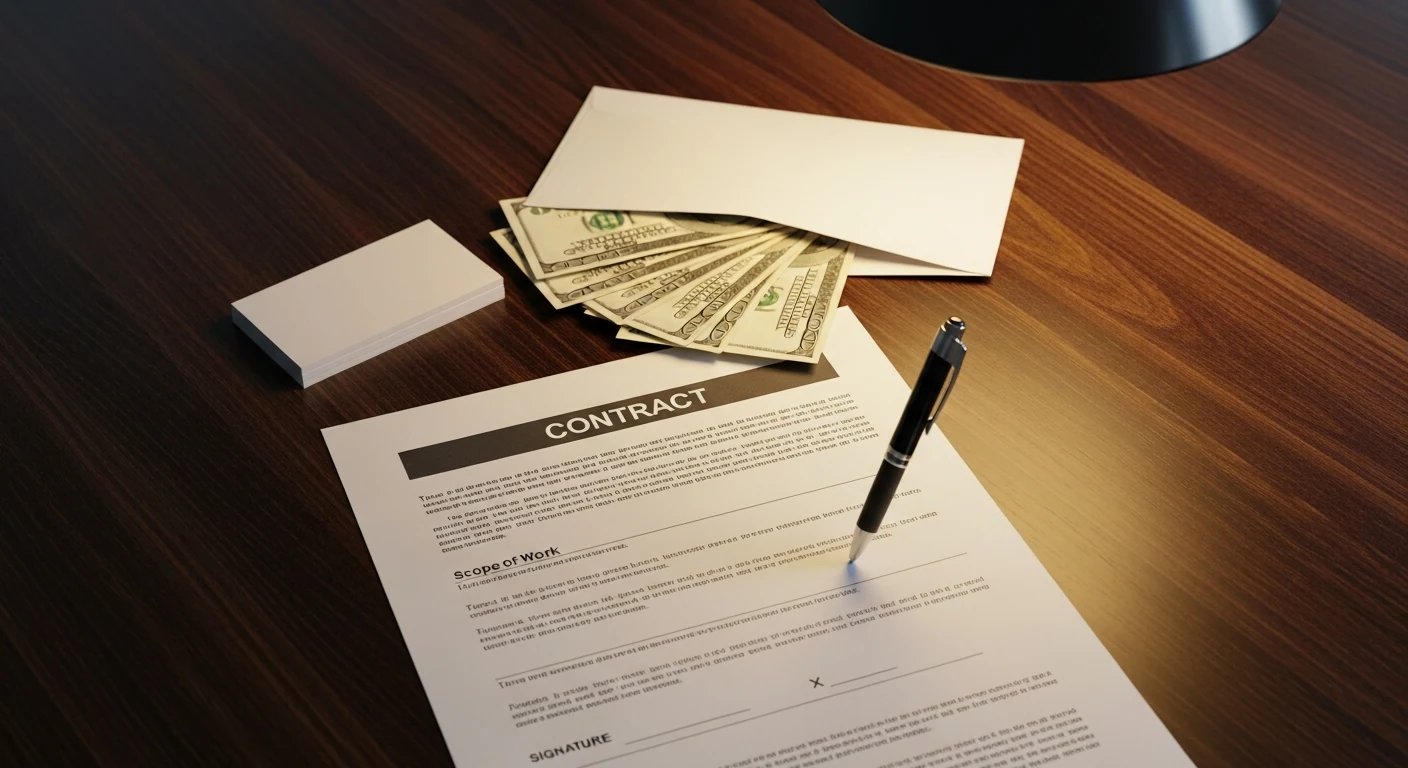
Step 1: Secure the Property and Limit Work to Emergency Mitigation
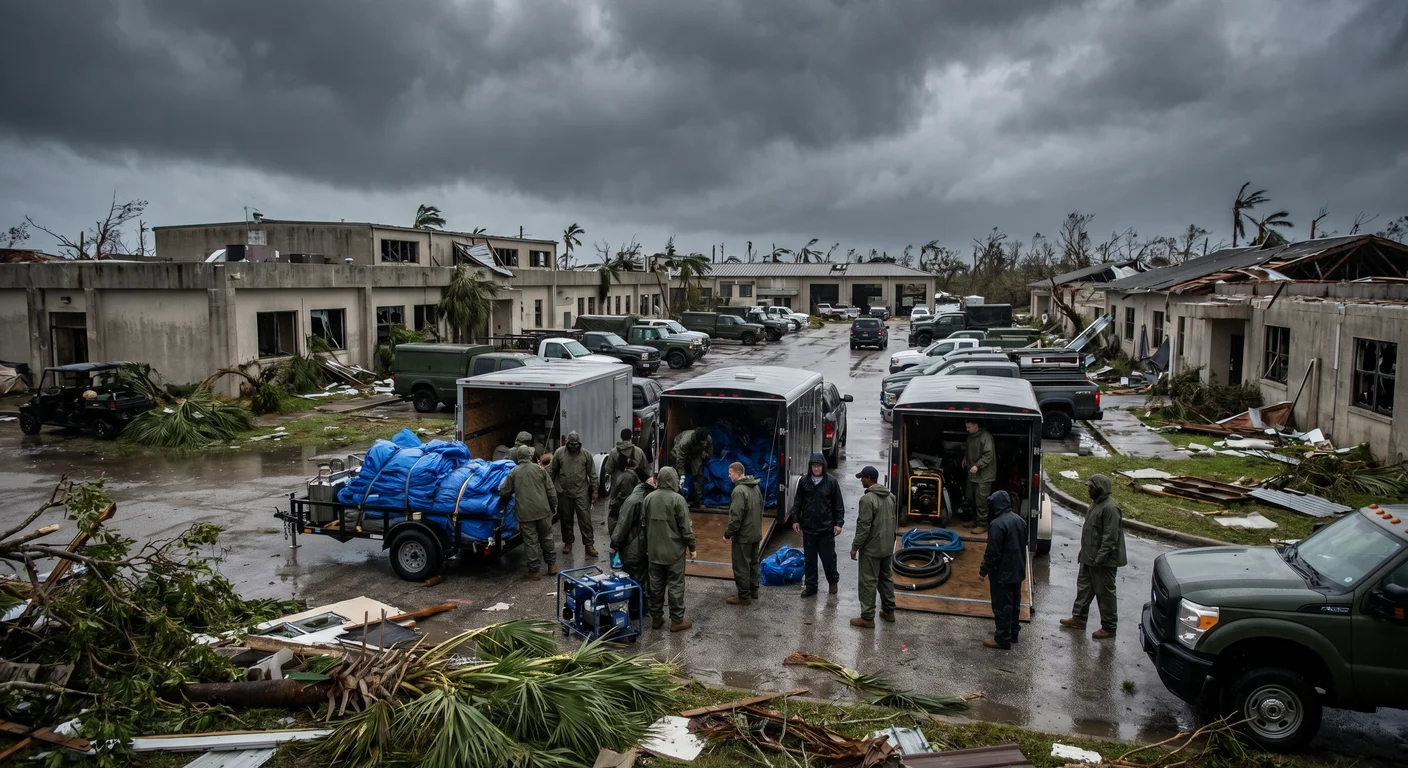
Your first move after a hurricane is safety and loss prevention, not selecting a forever contractor. That means shutting off power if water has reached fixtures or panels, avoiding unsafe roof climbs, and authorizing only emergency mitigation — tarping, board-up, water extraction, and initial drying — to prevent the damage from spreading while you gather documentation. Government safety guidance on disaster scams consistently emphasizes resisting urgency tactics while still addressing legitimate emergencies. The distinction matters: "my roof is open and rain is forecast tonight" is an emergency that justifies a same-day mitigation call. "Sign here for a full roof replacement before sundown" is not. For the cost, scope, and timeline of mitigation specifically, see our emergency roof tarping cost and process deep dive. If water reached the interior, our post-storm mold within 24–48 hours breakdown lays out the exact drying clock you're racing.
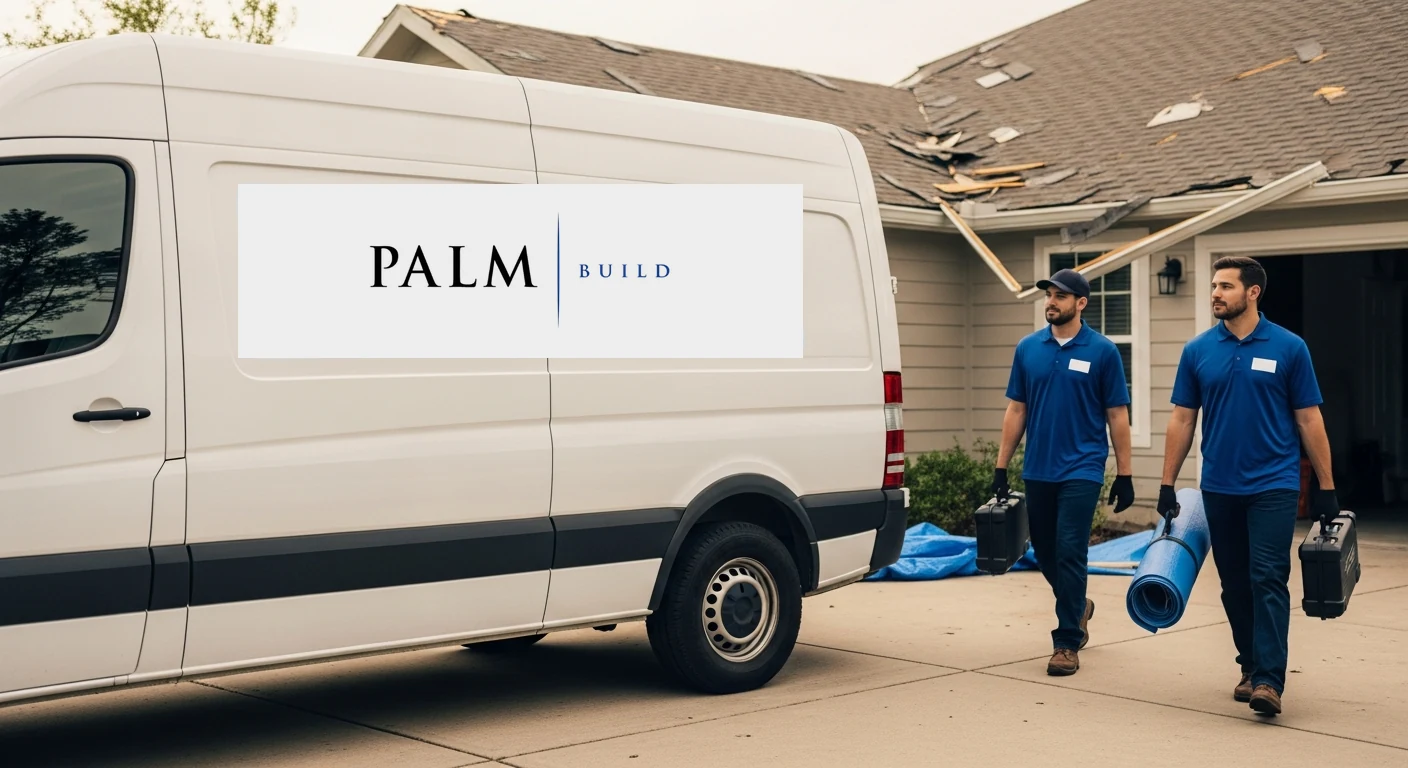
This is exactly the moment when an established local restoration operator earns its keep — because mitigation and documentation need to start immediately and cleanly, with photos, moisture readings, and itemized receipts that an adjuster will accept later. Palm Build's 24/7 dispatch covers Florida, North Carolina, and South Carolina with IICRC-certified crews who tarp, extract, and document the same day, keeping you inside the EPA mold window without locking you into a rebuild contract before you've even spoken to your carrier. For the full pillar, see our storm and hurricane damage restoration overview.
Step 2: Document Damage and Contact Your Insurer Before Hiring Anyone
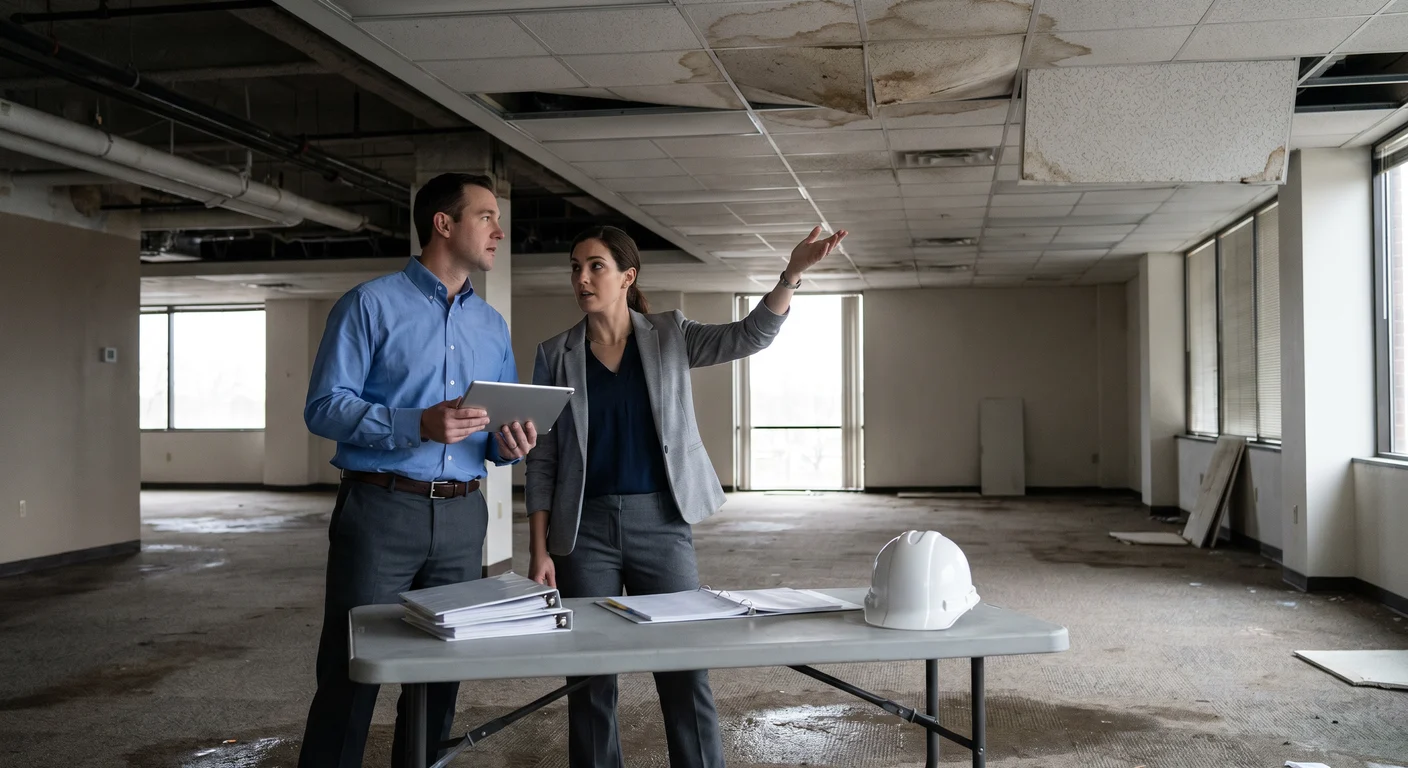
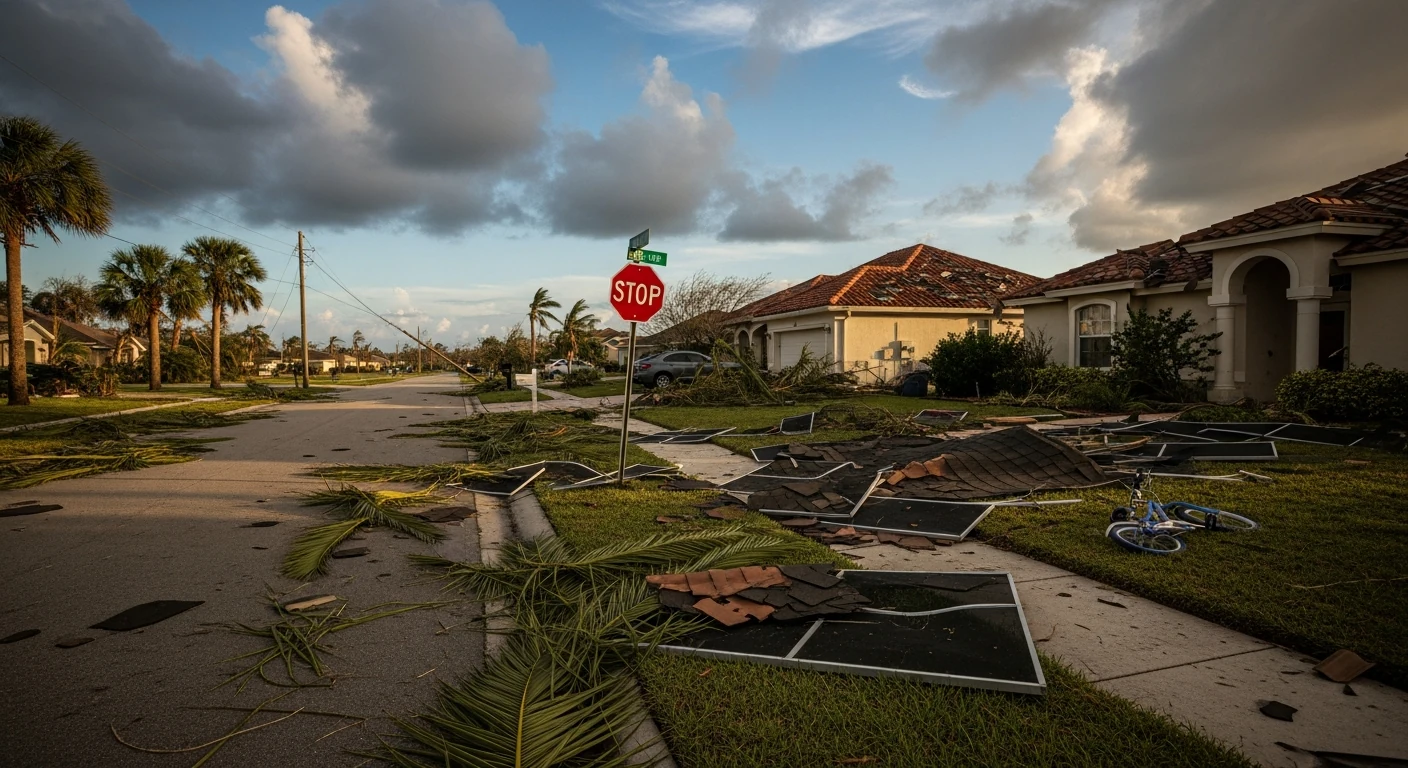
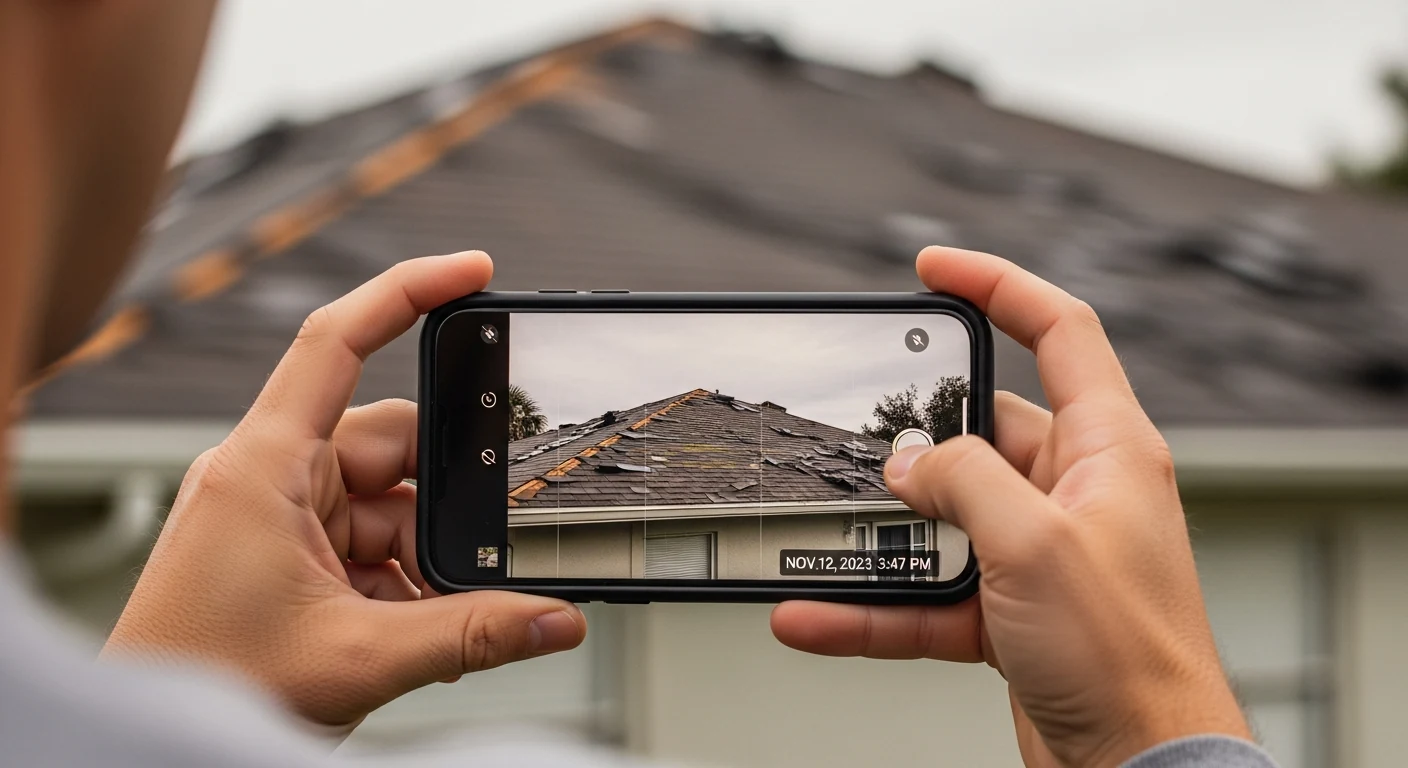
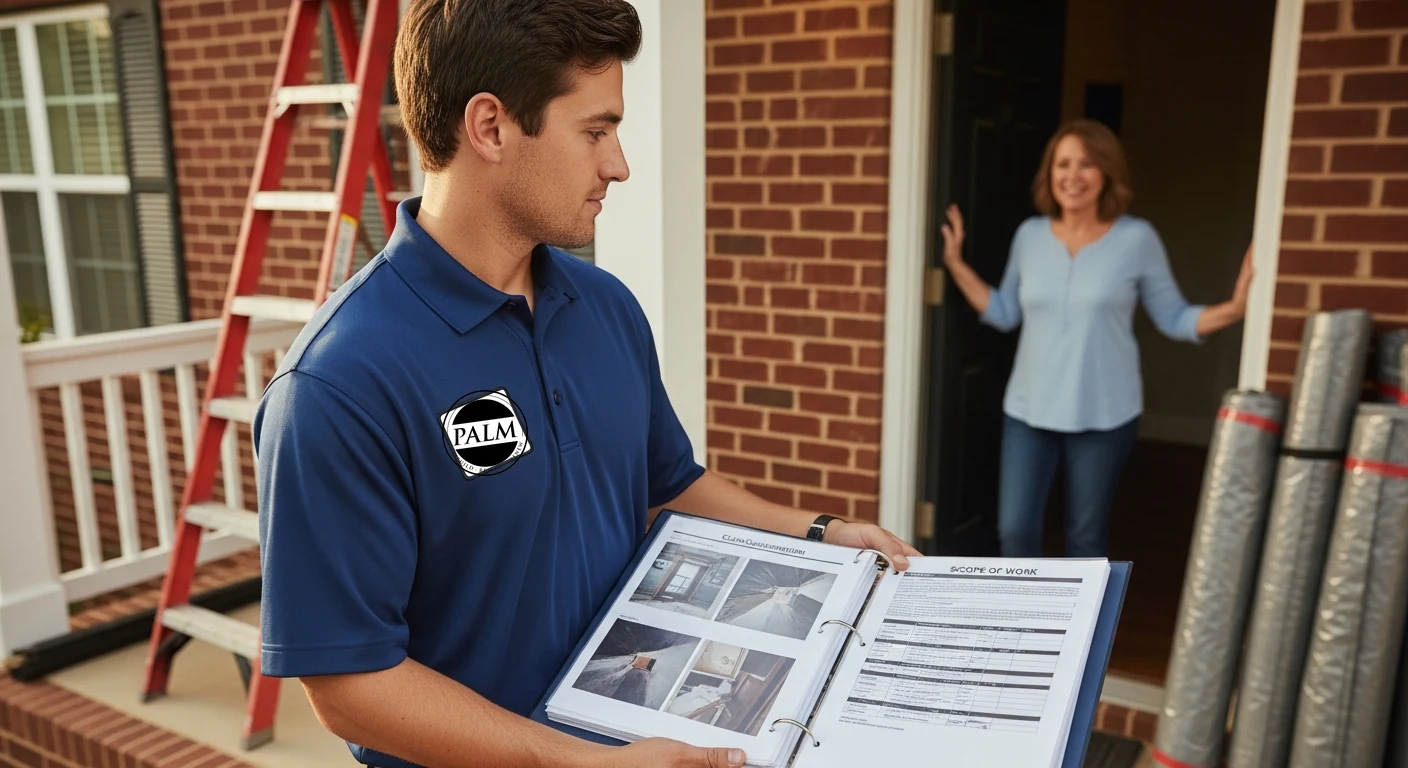
Before any contractor starts non-emergency work, lock in your evidence. This is the single most leveraged ten minutes in any storm claim — and it's also the step that defangs most scams, because storm chasers rely on confusion to define the scope and the price. A clean documentation pass produces the same artifact your adjuster wants: dated photos by side of the home, attic shots, close-ups of soft-metal dents with a coin for scale, and an organized receipt stack. The FTC, NAIC, and BBB all recommend contacting your insurance carrier first to understand coverage rather than relying on a contractor to define what's covered. For the full claim arc, see our storm damage insurance claim guide, how the insurance restoration process works, and our visual checklist on how to spot storm damage on your roof.
- Wide ground-level photos from all four sides of the home (north, east, south, west) before any cleanup
- Close-up photos of every visible damage point with a coin or ruler in frame for scale
- Attic photos with visible timestamps showing water stains on decking, damp insulation, or daylight pinholes
- Photographs of every dented soft-metal piece — vent caps, flashing, gutters, downspouts, AC condenser fins
- Granule piles at downspout exits and splash blocks, photographed before they wash away
- Pre-existing condition photos (older photos of the roof and home, if you have them) for context
- Itemized receipts for tarp materials, board-up labor, fans, dehumidifiers, hotel stays, and any other emergency mitigation
- Storm date verified against NOAA Storm Prediction Center records and saved to the claim file as a PDF
- Written, dated bids from any contractor who has offered an estimate — at least two and ideally three
- A simple log of dates, names, and what was said to each contractor and to the carrier
Step 3: Verify Licensing, Insurance, and Local Presence
The fastest way to filter out storm chasers is to verify three things you can prove in minutes: state license or registration status (where required), liability and workers' compensation coverage, and a stable local presence — a real address, a real phone number that picks up the next day, and a permit-pulling track record. FEMA's post-disaster contractor fraud guidance is unambiguous on one point homeowners frequently get wrong: FEMA does not license or certify contractors. Anyone who arrives flashing a "FEMA-certified" or "FEMA-endorsed" badge is lying, and that single statement should end the conversation. FEMA recommends using local contractors known in the community, verifying license and insurance independently, and getting multiple written estimates before signing anything.
| State | Verify a contractor (do this first) | Report a scam or fraud |
|---|---|---|
| Florida | Verify license through the Florida Department of Business and Professional Regulation (DBPR) license portal. Match the license type to the actual scope of work (roofing vs general contractor vs mold). Confirm Fla. Stat. § 489.147 disclosures in any solicitation document. | Report contractor fraud or price gouging during a declared emergency to the Florida Attorney General. Use Florida DFS Insurance Consumer Advocate resources for solicitation-fraud indicators. |
| North Carolina | Verify license through the NC Licensing Board for General Contractors (NCLBGC) lookup. NC DOI guidance: avoid door-to-door offers, refuse blank contracts, confirm GL and workers' comp coverage, and call the carrier before signing. | Contact the NC Department of Justice consumer protection division for scams and price-gouging complaints during a declared emergency. NC DOI handles insurance-related complaints. |
| South Carolina | Verify license through SC Department of Labor, Licensing and Regulation (SC LLR). SC DOI and SC Department of Consumer Affairs (SCDCA) guidance: written contract only, no blank contract, no full upfront payment, GL and WC verified. | Report scams to SCDCA. Price-gouging complaints during a declared State of Emergency are investigated by the SC Attorney General's office. |
State-by-state quick checks and reporting paths for FL, NC, and SC contractor verification
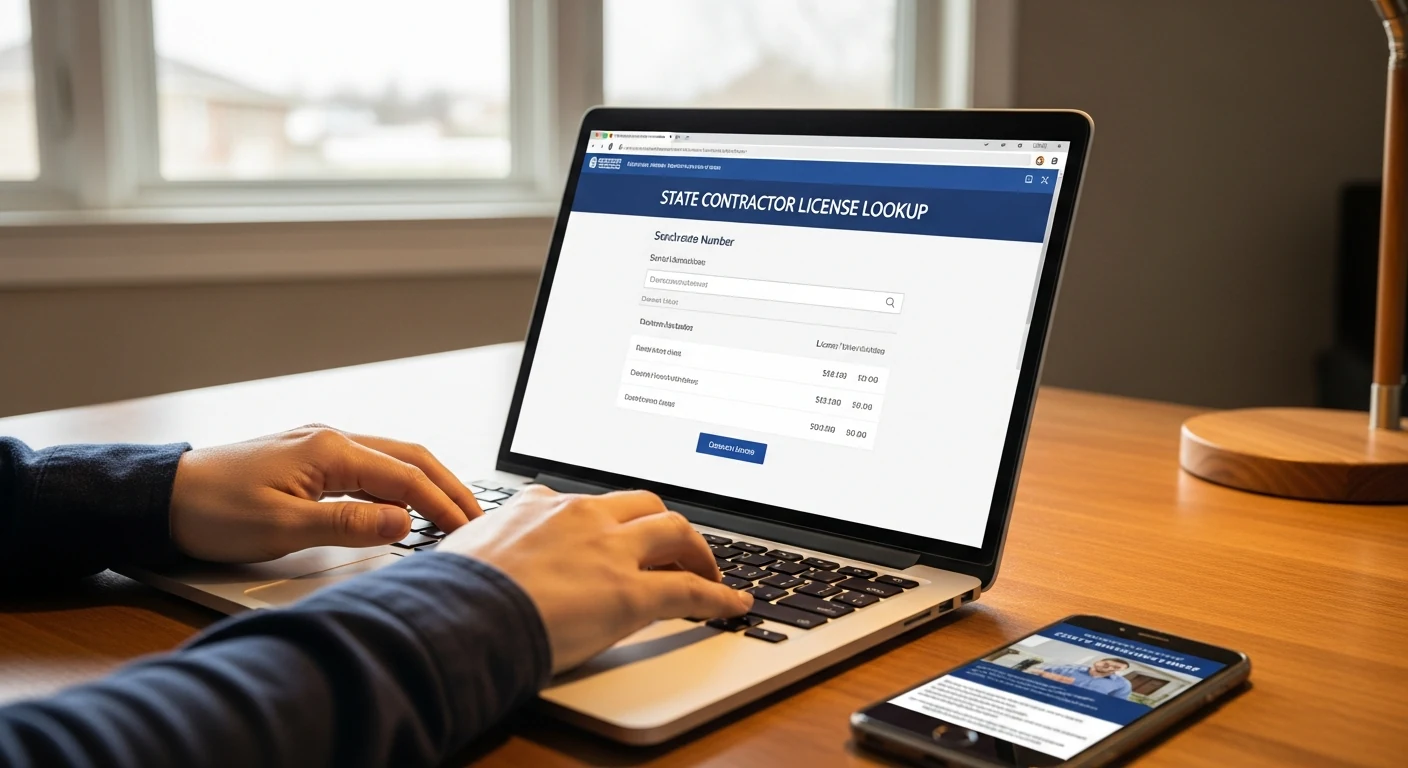
North Carolina has a licensing nuance worth flagging. The NCLBGC notes that certain projects at or above a stated dollar threshold require a valid NC general contractor license, and warns specifically about unlicensed contractor activity during hurricane season. Because license rules vary by trade and by job value across all three states, the safest approach is to treat "I'm licensed" as unproven until you confirm it on the state site and match the license type to the work being offered. A contractor with a roofing license cannot legally lead a structural rebuild, and a contractor with no license at all cannot legally pull permits — which means the work won't pass inspection and the carrier may refuse to fund it.
Florida: Why AOB Restrictions Matter Most Here
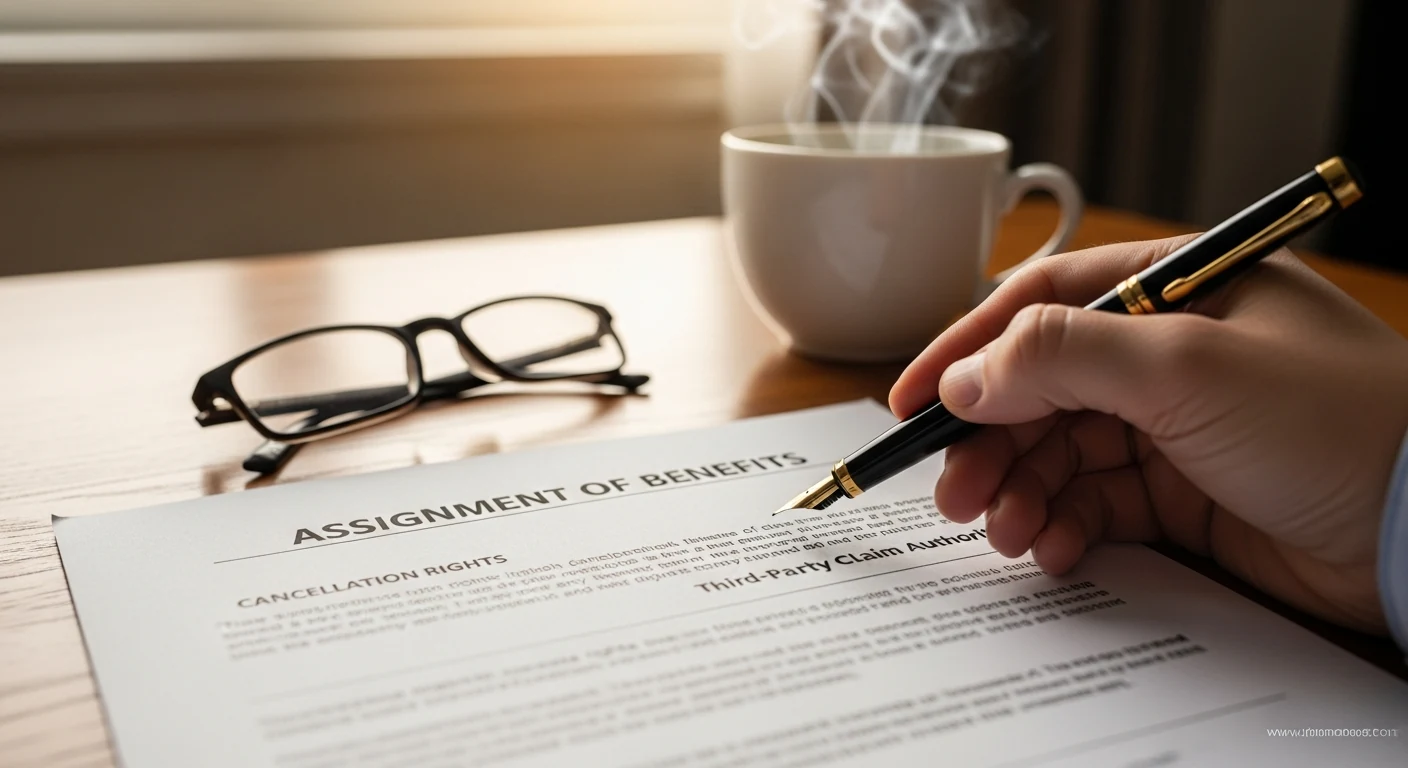
Florida's AOB regime is the most aggressive in the country, but the broader principle — never sign over your insurance benefits to a contractor before you've vetted them — applies in the Carolinas too. The mechanics differ slightly, and the table below compares how SC and NC handle the same risk so you can act in either state without re-learning the rules.
| State | AOB / assignment rule | How to verify a contractor |
|---|---|---|
| South Carolina | SC Department of Insurance warns consumers about signing AOBs, defines them as agreements that allow a third party to act on behalf of the insured and receive direct payment from the insurer, and recommends contacting the carrier before signing anything. SC home-solicitation sale code provides a 3-business-day cancellation window for door-to-door contracts above the statutory threshold. | SC LLR license lookup, GL + WC certificates, written contract with no blanks, no full upfront payment per SCDCA guidance. |
| North Carolina | NC does not have a Florida-style AOB statute, but NC DOI consumer guidance flags storm-chaser scams that pressure homeowners into signing exclusive contracts or into handing over insurance checks. NC AG consumer guidance discusses cancellation windows (typically three days) for door-to-door home solicitation sales when a right to cancel applies. | NCLBGC license lookup, GL + WC certificates, license type matched to job scope and dollar value, written contract with permit responsibility specified. |
AOB and door-to-door rules at a glance: SC and NC compared
Step 4: Avoid Contract, Payment, and Assignment Traps
Most post-hurricane scams become expensive because of what you sign, not just what you pay. Your goal is a contract that matches reality, protects your cancellation rights, and keeps you in control of insurance proceeds — not a one-page form with vague language and a kitchen-table pen. Regulators converge on the same safeguards: never sign a contract with blanks, get at least two or three written estimates, avoid large upfront payments and never pay in full upfront, and never sign over an insurance check or sign documents that hand a contractor the keys to your insurance claim. The CFPB adds a baseline principle for disaster recovery: verify identity, ask questions, and ensure written contracts match every verbal promise.
Reputable contract terms
- Contractor's legal name, physical address, license number, and proof of insurance printed on the contract
- Detailed itemized scope of work with materials, quantities, and explicit exclusions
- Start and finish dates plus a written change-order process for scope additions
- Payment schedule tied to milestones — never full upfront, never cash-only
- Cancellation language that quotes the FTC Cooling-Off Rule or the relevant state statute
- Explicit statement that the homeowner stays in control of insurance proceeds — no AOB, no signed-over check
Scam contract red flags
- Blank fields where the scope, price, or timeline should be — "we'll fill it in later"
- Vague scope language like "all necessary repairs" without itemization
- No start or finish dates and no change-order process
- Cash-only or large up-front deposit demanded before any work begins
- No mention of cancellation rights — or worse, language waiving them
- AOB clause buried in the contract or a request to endorse the insurance check over to the contractor
| Must-have contract item | Why it matters |
|---|---|
| Contractor's legal name, physical address, license number, and proof of GL + WC insurance | Lets you verify identity on the state license site and gives you a real party to enforce against if work fails. |
| Detailed scope of work, materials, quantities, and explicit exclusions | Prevents bait-and-switch and surprise invoices once demolition starts. |
| Start and finish expectations, plus a written change-order process | Makes the timeline enforceable and stops slow-walked projects from drifting indefinitely. |
| Payment schedule tied to milestones — not vague dates and not full upfront | Aligns payment with real progress and reduces the risk of a contractor walking off mid-job. |
| Cancellation language that quotes the FTC Cooling-Off Rule or the state statute | Protects you from high-pressure home-solicitation deals and makes the 3-day window enforceable. |
| Explicit statement that you stay in control of insurance proceeds — no AOB, no endorsed-over check | Prevents losing leverage if the work quality slips or the carrier disputes the scope. |
The kitchen-table contract checklist — six must-haves and why each one matters

Step 5: Choose a Restoration Partner That Can Finish the Job
You are not just buying "repairs." You are buying project follow-through — emergency mitigation, IICRC-aligned documentation, code-compliant rebuild, insurance coordination, and a warranty that someone will actually be around to honor. This is exactly where storm chasers fail, because they optimize for quick signatures, not multi-month accountability. After a hurricane the same property typically needs a stack of services: water mitigation, sometimes mold remediation after storm flooding, almost always reconstruction after hurricane damage, and for apartment complexes or commercial portfolios, large-loss restoration or commercial restoration services. HOAs and condo boards have their own coordination layer covered in our HOA and multi-unit services overview. Picking a single restoration partner that can carry the whole arc removes the handoffs that create scope disputes and blame shifting.
The trust signals that matter more than a slick pitch are concrete and verifiable. The Institute of Inspection, Cleaning and Restoration Certification (IICRC) S500 standard describes professional water damage restoration procedures, and IICRC certification is the industry baseline serious carriers expect to see on a mitigation invoice. Documentation discipline — moisture maps, daily drying logs, photo timestamps, and itemized scopes priced to Xactimate — is what carries a claim from notice to payment without a fight. Capacity to handle what hurricanes actually create — water intrusion, hidden mold risk, contents issues, reconstruction, and sometimes commercial or multi-unit scopes — is what separates a roof patcher from a restoration partner.
Hurricane damage looks different across our service area — terracotta tile in Florida, asphalt shingle in the Carolinas, standing-seam metal on the SC coast — but the verification, documentation, and contract discipline are the same in all three states.
Hour 0–6
Secure and document
Wait for the weather window to open, then walk the four sides of the home with a phone and binoculars. Photograph everything before any cleanup. Headlamp through the attic for water stains, damp insulation, and daylight pinholes. No contracts. No signatures.
Hour 6–24
Notify the carrier and tarp
File claim notice with your insurance company before any contractor pitch. If the roof is open, dispatch a certified mitigation crew for tarping inside the EPA's 24-to-48-hour mold window. Save every receipt for reimbursement.
Day 1–7
Vet and verify contractors
Verify state license through DBPR / NCLBGC / SC LLR. Get at least two or three written, itemized estimates. Decline kitchen-table signatures. Cross-check addresses, phone numbers, and BBB profiles for every bidder.
Day 7–30
Sign a vetted contract and start the rebuild
Sign only after the scope, schedule, payment milestones, and cancellation language are in writing — and only with a contractor who keeps you in control of insurance proceeds. Code-compliant rebuild begins under permit, with daily documentation.
"A scam works by controlling speed, paperwork, and money flow. Take those controls back, and the scam dies on the porch."
Storm, Wind & Hurricane Damage
24/7 emergency response across Florida, North Carolina, and South Carolina — the central pillar for everything storm-related.
Water Damage Restoration
IICRC S500-aligned mitigation, structural drying, and moisture documentation when a storm has reached the interior.
Mold Remediation
Containment, removal, and post-remediation verification when storm water sits longer than the 48-hour EPA mold window.
Insurance Restoration Process
How Palm Build coordinates directly with FL, NC, and SC carriers from initial claim notice through rebuild completion.
FTC — Disaster-Related Scams
Federal consumer-protection guidance on post-disaster contractor fraud, payment red flags, and identity scams.
FEMA — Contractor Fraud
FEMA's consumer guidance on disaster contractor fraud, fraud reporting channels, and the explicit notice that FEMA does not license or certify contractors.
NAIC — Contractor Scam Checklist
National Association of Insurance Commissioners checklist on insurer-first sequencing, multi-bid behavior, and blank-contract avoidance.
IICRC — S500 Standards
Professional water damage restoration standard widely referenced by carriers as the baseline for mitigation work.
Frequently Asked Questions
What is a storm chaser roofer, and are they always a scam? +
Should I contact insurance before hiring a contractor? +
Is it a red flag if a contractor wants me to sign over my insurance check? +
Can a contractor waive my insurance deductible? +
How fast does mold grow after hurricane water damage? +
What is an Assignment of Benefits, and should I sign one? +
What should I do if I think I've already been scammed after a hurricane? +
Are there online scams after hurricanes too, not just door-to-door? +
Hurricane damage? Get an honest, IICRC-certified inspection across FL, NC & SC.
Palm Build's 24/7 emergency teams document, mitigate, and rebuild — with a claim-ready paper trail from the first photo to the final invoice. No kitchen-table pressure, no AOB demands, no signed-over checks.
Found this helpful? Send it to someone who needs it.