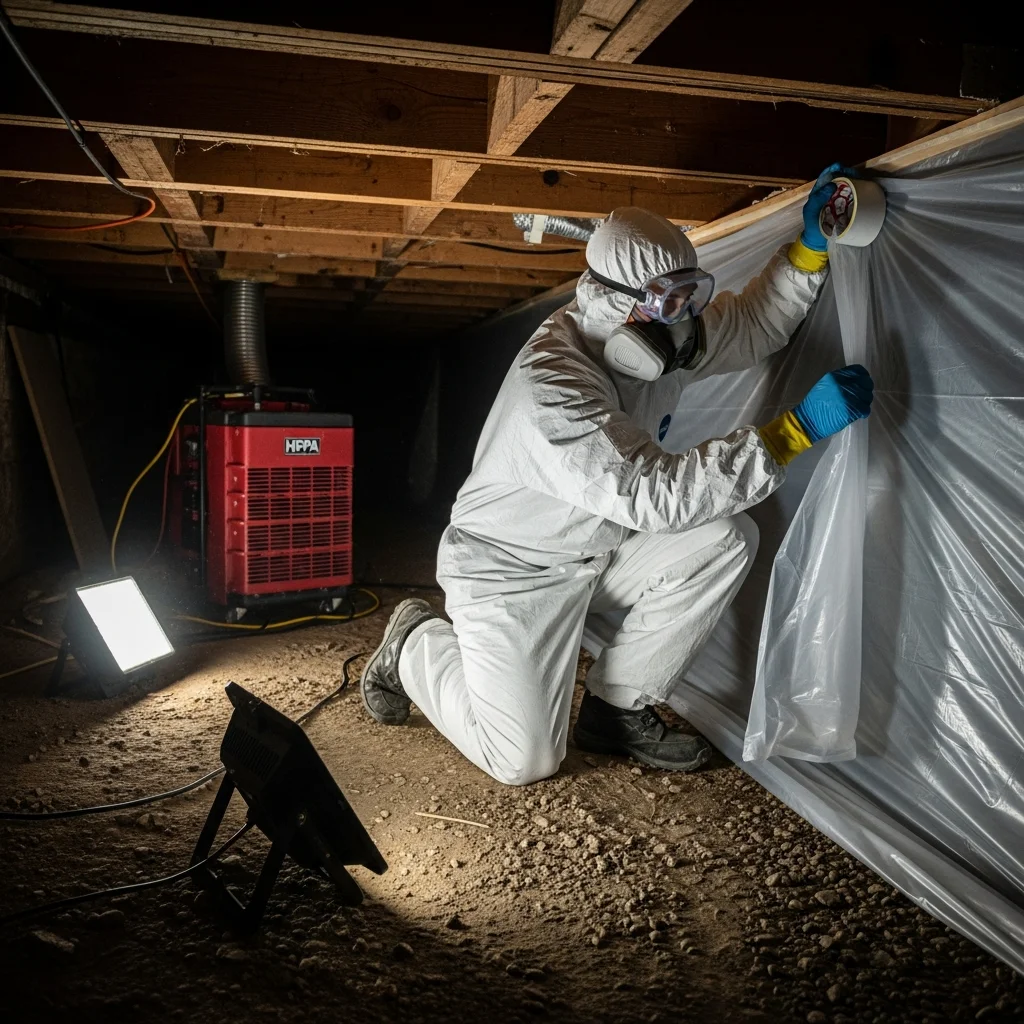
Palm Build technician in full white Tyvek PPE hazmat suit setting up polyethylene containment barrier in a crawl space beneath a Lake Wylie, South Carolina home with HEPA air scrubber visible
LAKE WYLIE SC — IICRC S520 CERTIFIED MOLD REMEDIATION

Mold Remediation in Lake Wylie, South Carolina

Lake Wylie's Catawba Reservoir location creates a humidity-loading effect that makes mold one of the most persistent and underdiagnosed problems in York County's lakefront communities. Older communities like River Hills Plantation have decades-old crawl spaces, while newer communities like Handsmill and The Sanctuary face HVAC moisture issues in tightly enclosed volumes. Palm Build's IICRC S520-certified team provides professional assessment, full remediation, and the documentation your insurance carrier accepts.

~25 miles from Lake Wylie 35-45 min Response IICRC Certified

35-45 min

Emergency Response

24/7

Dispatch Available

IICRC

Certified Technicians

Why Mold Thrives Here

Why Lake Wylie Has a Mold Problem Most Neighbors Don't

The Catawba Reservoir doesn't just provide lakeside living — it loads the local humidity environment in ways that directly accelerate mold growth in Lake Wylie homes. Combined with older crawl space construction and high annual rainfall, this creates year-round mold risk that doesn't disappear in winter.

Lake-Modified Humidity

>70%

Summer RH with lake modifier

Lake Wylie is a Catawba River reservoir — and large open water bodies modify local humidity in ways that comparable inland SC communities don't experience. The reservoir's thermal mass sustains elevated relative humidity through overnight and early morning hours, when mold germination conditions are most favorable. Even homes with properly functioning HVAC systems can struggle to fully offset this lake-moisture loading during peak summer humidity. This humidity modifier is the defining characteristic that makes mold risk in Lake Wylie systematically higher than in comparable York County inland towns.
Crawl Space Foundations

1970s–80s

River Hills construction era

River Hills Plantation and other older Lake Wylie communities were built predominantly with vented crawl space foundations — a design now understood to pull humid exterior air directly under the home. The lake-modified exterior humidity that vented crawl spaces pull in is higher than comparable inland SC towns, which means the moisture condensing on cooler crawl space surfaces is more persistent. Vapor barriers installed 40 to 50 years ago in River Hills have long since degraded, leaving exposed soil that continuously evaporates moisture into the crawl space structure.

44–50 Inches Annual Rainfall

24-48 hrs

Mold germination window

South Carolina's Piedmont receives annual precipitation in the 44 to 50 inch range, with two distinct peaks: spring (March is the wettest month) and summer thunderstorm season (July-August). Any water event that isn't fully dried — including small roof leaks, HVAC condensate overflows, and minor appliance failures — becomes a mold event in Lake Wylie's climate within 24 to 48 hours. Post-storm mold discovery typically occurs 2 to 4 weeks after the moisture event, when visible growth has already spread beyond the initial wet area.

Newer Large Homes with High Mold Exposure

2007

Median home construction year

Lake Wylie's newer homes have more bathroom wet-wall density per home, multiple HVAC systems and condensate drain lines, complex ceiling assemblies with tray details that can trap moisture after small roof leaks, and high-volume interior spaces that can circulate mold spores widely if a single HVAC system is running while a containment breach occurs. The combination of larger homes and lake-modified humidity means mold events spread more quickly and require more equipment to remediate than comparable square footage in drier inland environments.

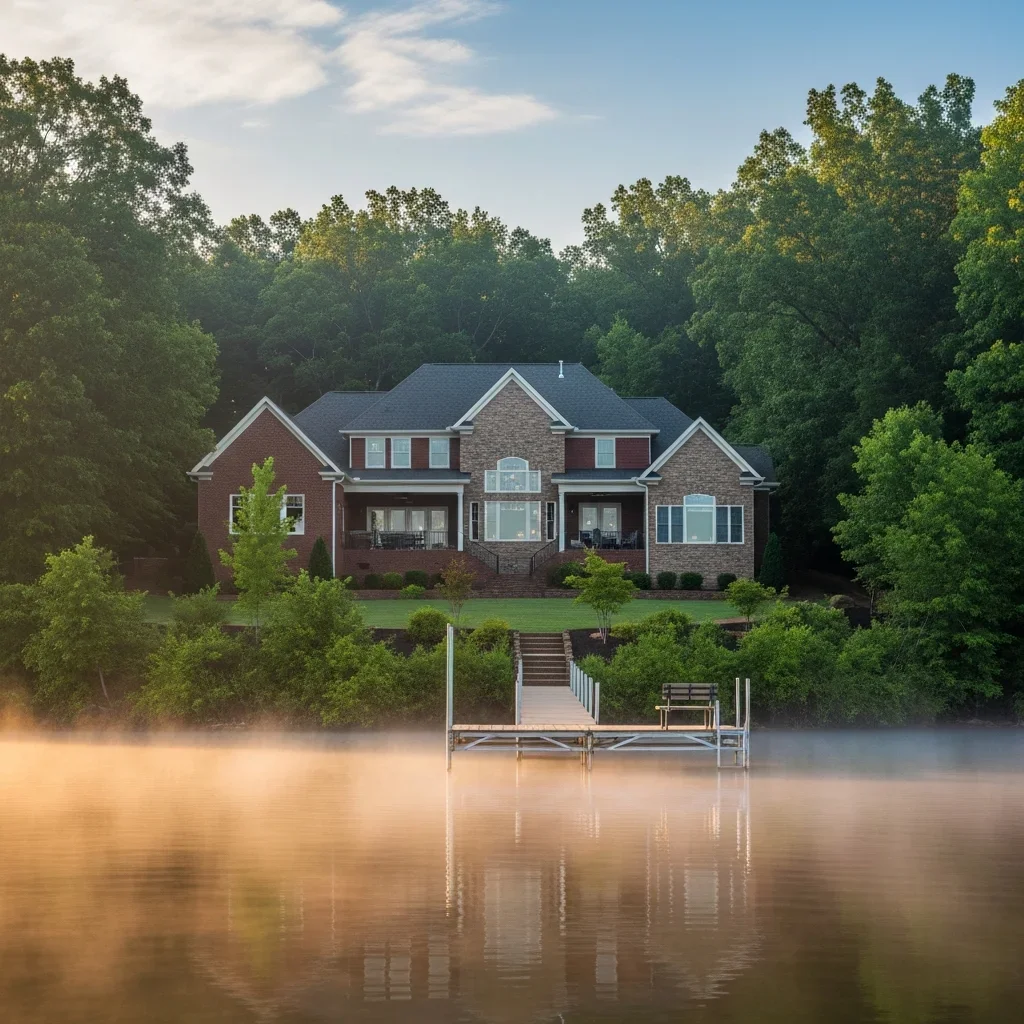
Lake Wylie lakefront home at dawn with visible morning humidity and mist rising from the Catawba Reservoir — the lake's thermal mass sustains elevated humidity that directly accelerates mold growth in nearby homes
Morning mist off the Catawba Reservoir is more than scenery — it's a measurable humidity modifier that makes mold risk in Lake Wylie systematically higher than comparable inland South Carolina communities.

Lake Wylie Exclusive — Local Intelligence

The Lake Wylie Humidity Modifier: How the Reservoir Accelerates Mold

Water bodies like Lake Wylie act as humidity reservoirs — continuously evaporating moisture into surrounding air, especially during the warm months. This creates a local humidity environment where mold doesn't just survive; it thrives year-round in ways that no comparable inland SC town experiences.

Mold Growth Timeline After Water Intrusion in Lake Wylie

0–12 Hours Water Intrusion

Water enters the structure from any source. Visible wetness but no mold yet.

12–24 Hours Surface Saturation

Porous materials (drywall, wood, insulation) absorb moisture. Mold spores begin to evaluate surfaces. The lake humidity modifier means ambient RH assists spore settling.

24–48 Hours Mold Germination Begins

Mold spores begin colonizing on damp porous materials. In Lake Wylie's elevated humidity environment, the germination window is at the faster end of the 24-48 hour range. Invisible at this stage but present.

5–10 Days Visible Growth

Mold colonies become visible — dark gray, green, or black patches on drywall, wood, grout, and insulation. Musty odor intensifies. Affected area is now larger than the original wet zone.

30+ Days Structural Risk

Prolonged mold colonization begins deteriorating the structural integrity of wood framing, subfloor panels, and insulation. Remediation scope and cost increase significantly. Some materials become unsalvageable.

Conditions That Accelerate Mold in Lake Wylie Homes

Lake humidity modifier

Reservoir raises ambient RH above inland SC baseline

Warm temperatures (65–90°F)

Lake Wylie summers sustain ideal mold growth temps

Crawl space vapor migration

Ground moisture + lake humidity compound in older homes

Inadequate HVAC dehumidification

Systems sized for cooling, not always for humidity control

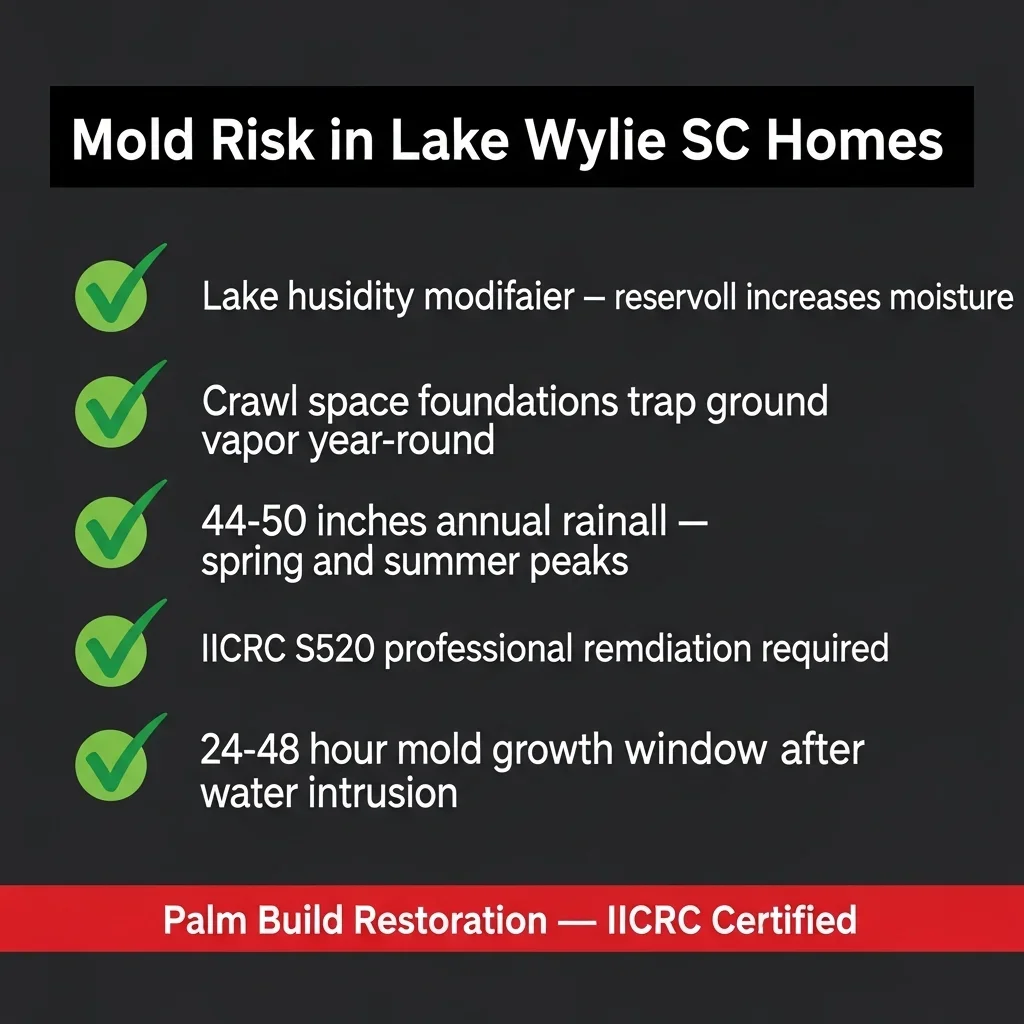
Mold risk infographic for Lake Wylie SC homes showing checklist of risk factors: lake humidity modifier, crawl space foundations, 44-50 inches annual rainfall, IICRC S520 standard, 24-48 hour mold window

Handsmill on Lake Wylie note: Handsmill's active adult community has HOA standards that may require professional documentation and rapid response for any mold event — even in new construction. Small appliance leaks in Handsmill can trigger HOA exterior inspection requirements. We work directly with HOA management companies throughout York County.

Community Mold Profiles

Mold Risk by Lake Wylie Community

Mold risk in Lake Wylie varies significantly by community age, construction type, and proximity to the reservoir. This guide covers the communities where Palm Build most commonly finds mold issues.

River Hills Plantation

Critical Risk

Built: 1970s–1980s (gated community)

Risk factors: Decades-old vented crawl spaces, degraded vapor barriers, aging HVAC systems, mature tree canopy limiting natural drying

Common mold profile: Crawl space mold on floor joists, musty odors throughout living area, potential subfloor compromise in older sections

The Sanctuary

High Risk

Built: Newer high-end development

Risk factors: Multiple HVAC zones with condensate drain lines, tile-heavy bathrooms, tray ceiling assemblies that trap moisture

Common mold profile: Hidden mold behind tile, attic mold from unbalanced HVAC, ceiling tray mold after slow roof leak

Heron Cove

High Risk

Built: Established suburban single-family

Risk factors: Standard vented crawl space, proximity to lake humidity loading, moderate-age construction

Common mold profile: Crawl space mold, closet and basement wall mold, musty odors during humid months

Somerset on Autumn Cove

High Risk

Built: Mixed single-family and townhomes

Risk factors: Water-adjacent, wind-driven rain exposure, shared-wall townhome units (mold migration between units)

Common mold profile: Wind-driven moisture in siding assemblies, crawl space humidity, shared-wall moisture migration in townhomes

The Landing

High Risk

Built: Late 1990s–2020s (HOA)

Risk factors: Open floor plans allow moisture spread and mold spore distribution when HVAC runs

Common mold profile: Mold following water events in open-plan areas, attic mold in complex roofline valleys

Handsmill on Lake Wylie

Moderate-High

Built: 2020s active adult community

Risk factors: New construction but HOA documentation standards, active adult owners may be slower to detect warning signs

Common mold profile: Small appliance leaks becoming mold quickly in warm months, HOA-triggered inspections

The Vineyards on Lake Wylie

Moderate

Built: Mixed interior and lake-adjacent

Risk factors: Wet month moisture intrusion, periodic tropical remnant exposure

Common mold profile: Mold in enclosed closets and utility areas following wet season events

Mill Creek Falls

Moderate

Built: Established suburban

Risk factors: HVAC condensation issues, standard suburban humidity levels

Common mold profile: HVAC-related mold, attic and crawl space mold if moisture control is inadequate

Crawl Space Intelligence

Crawl Space Mold in Lake Wylie Homes

Crawl space mold is the most common and most underdiagnosed mold problem in Lake Wylie. The lake's humidity loading, combined with older vented crawl space construction, creates conditions where mold growth is nearly inevitable without active moisture management.

Musty Odor That Intensifies After Rain

The most reliable early indicator. In Lake Wylie homes, musty odors from the crawl space are often pulled into living areas through HVAC return air systems and floor penetrations. The odor intensifies after rain events because the new moisture reactivates dormant mold colonies and adds to active growth. If the smell is strongest near floor registers or crawl space access points, mold is the likely cause.

Dark Staining on Floor Joists

Dark gray, green-black, or fuzzy growth on the underside of floor joists and subfloor sheathing is visible mold. In River Hills Plantation and other older communities, this staining is sometimes mistaken for normal wood weathering — it isn't. Any dark, fuzzy surface growth on wood should be treated as active mold until confirmed otherwise by a moisture assessment and professional inspection.

Soft Spots or Bounce in Wood Floors

When mold and moisture have compromised subfloor panels and floor joists over time, the structural integrity declines before the damage is visible from above. Soft spots underfoot, particularly near bathroom fixtures, exterior walls, and low-traffic areas near the home's perimeter, can indicate crawl space moisture compromise. In Lake Wylie's climate, this can develop more rapidly than homeowners expect.

Unexplained Respiratory Symptoms Indoors

Allergy-type symptoms — sneezing, congestion, eye irritation, coughing — that improve noticeably when you leave the house are a recognized sign of indoor mold exposure. In Lake Wylie homes with crawl spaces, mold spores in the crawl space can enter the living space through air infiltration and HVAC return air. These symptoms don't always mean a severe mold problem, but they warrant professional assessment.

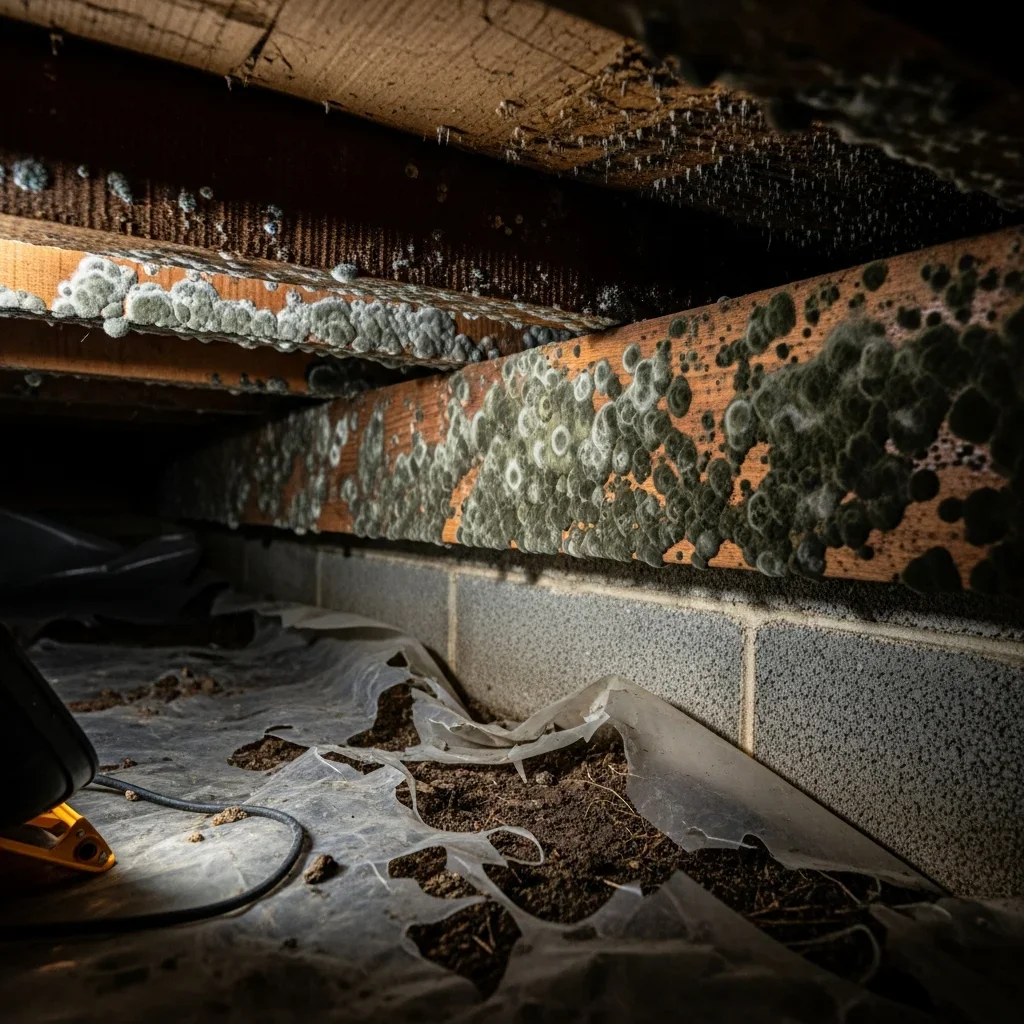
Close-up of dark gray and green mold growth on floor joists in a crawl space beneath a Lake Wylie, South Carolina home with degraded vapor barrier and exposed soil visible
Mold on floor joists — the most common crawl space mold presentation in Lake Wylie's older communities with vented crawl space foundations.

Inspection Guidance for Lake Wylie Homeowners

  • Homes in River Hills Plantation should be inspected at least every 2-3 years regardless of visible symptoms — older vented crawl spaces in humid lakefront conditions develop mold slowly and often invisibly
  • Post-storm inspections after any significant rainfall event are recommended for all lakefront and cove-adjacent communities
  • Any musty odor persisting more than 48 hours after weather improves warrants professional assessment, not just airing out
Schedule a Crawl Space Assessment

IICRC S520 Process

How Palm Build Remediates Mold in Lake Wylie

Every project follows the ANSI/IICRC S520 Standard for Professional Mold Remediation — the industry's accepted protocol for safe, thorough, and documented mold removal.

01

Mold Assessment and Moisture Mapping

We identify all mold-affected areas with moisture meters, thermal imaging, and air quality sampling. The assessment includes crawl space, HVAC system components, and all areas connected to the original moisture source. We identify the root cause — not just the visible mold — and produce a detailed remediation scope before any work begins.

02

Containment Setup — Negative Pressure

Polyethylene containment barriers isolate the work area from occupied spaces. Negative air pressure prevents cross-contamination during remediation. In Lake Wylie homes with open floor plans and connected HVAC systems, proper containment is critical — a single HVAC system running during active mold disturbance can spread spores throughout the entire home.

03

HEPA Air Filtration

Commercial HEPA air scrubbers with MERV 17 filtration run continuously throughout remediation to capture airborne mold spores. In Lake Wylie's humid environment, we run air scrubbers for additional time after physical removal is complete to ensure spore counts have returned to baseline levels before containment is broken.

04

Physical Removal of Contaminated Materials

Affected drywall, insulation, vapor barrier, and unsalvageable wood are carefully removed and disposed of per IICRC S520 protocols. In crawl spaces, we remove all degraded vapor barrier material and dispose of contaminated insulation before treating structural wood. HEPA vacuuming of all surfaces precedes antimicrobial treatment.

05

Antimicrobial Treatment and Drying

EPA-registered antimicrobial agents are applied to all remediated surfaces. For crawl space wood framing, this includes a two-step process: physical mold removal followed by antimicrobial treatment to address surface colonies and residual hyphae. New vapor barrier is installed after treatment. Active drying with dehumidifiers and air movers follows.

06

Post-Remediation Verification Testing

We perform clearance air quality testing to verify mold spore counts have returned to acceptable baseline levels per IICRC S520 clearance criteria. A post-remediation report is provided documenting test results, all work completed, materials removed, and products used — in the format required by SC insurance carriers for mold claims documentation.

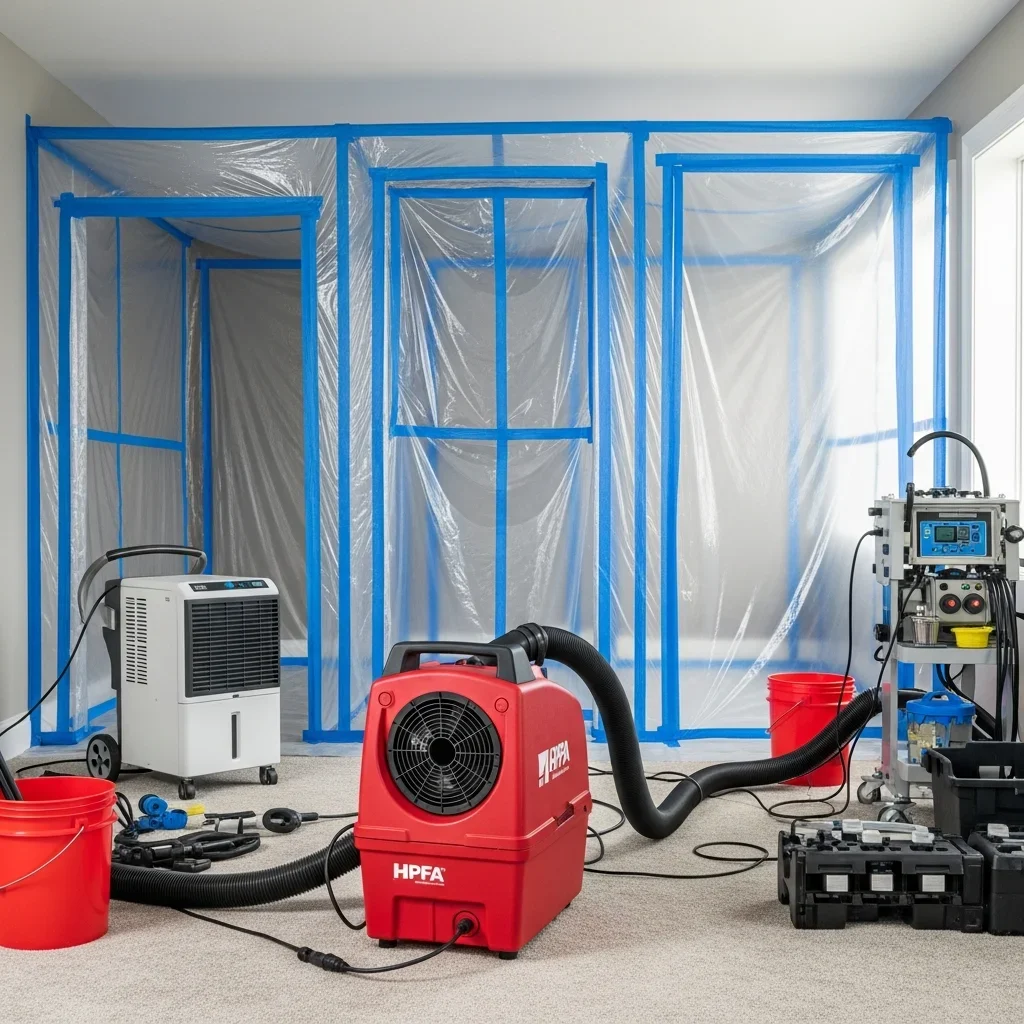
Professional mold remediation containment setup in a Lake Wylie SC home with HEPA air scrubbers, polyethylene barriers at doorways, and negative air pressure equipment running
Proper containment with negative air pressure is non-negotiable in Lake Wylie's open-plan homes — without it, active mold remediation can spread spores throughout connected living areas via HVAC systems.

Cost Guide

Mold Remediation Costs in Lake Wylie SC

Lake Wylie's larger homes and higher-end finishes push mold remediation costs toward the upper end of each tier compared to comparable projects in smaller SC markets. A same-day assessment gives you an accurate scope before any work begins.

Localized

$1,500 – $4,000

  • Single bathroom, closet, or wall cavity
  • Limited air sampling and testing
  • Targeted removal of affected materials
  • Antimicrobial treatment of affected area
  • Post-remediation clearance test

Bathroom grout mold, isolated closet growth, single-wall cavity from small leak — most common first-time mold call in Lake Wylie

Moderate

$4,000 – $8,000

  • Multiple rooms or partial crawl space
  • Full containment setup required
  • Significant material removal and disposal
  • HVAC inspection and potential cleaning
  • Vapor barrier replacement (partial)

Post-water-event mold in multiple rooms, or partial crawl space remediation in older Lake Wylie communities

Full Crawl Space

$8,000 – $20,000+

  • Complete crawl space remediation
  • Full vapor barrier removal and replacement
  • Structural wood treatment throughout
  • Optional encapsulation system
  • Moisture management recommendations

Full crawl space remediation is the most common major mold project in River Hills Plantation and similar older Lake Wylie communities — larger crawl spaces push costs to upper range

Get a Same-Day Assessment — (704) 464-0121

Serving all of Lake Wylie and York County SC

Remediation Results

Mold Remediation in Lake Wylie — Before and After

Dark gray and green-black mold growth on wood floor joists in a Lake Wylie, South Carolina crawl space with degraded vapor barrier visible on the ground BEFORE
Before: Active mold on floor joists — the typical presentation in River Hills Plantation and other older Lake Wylie communities with vented crawl spaces
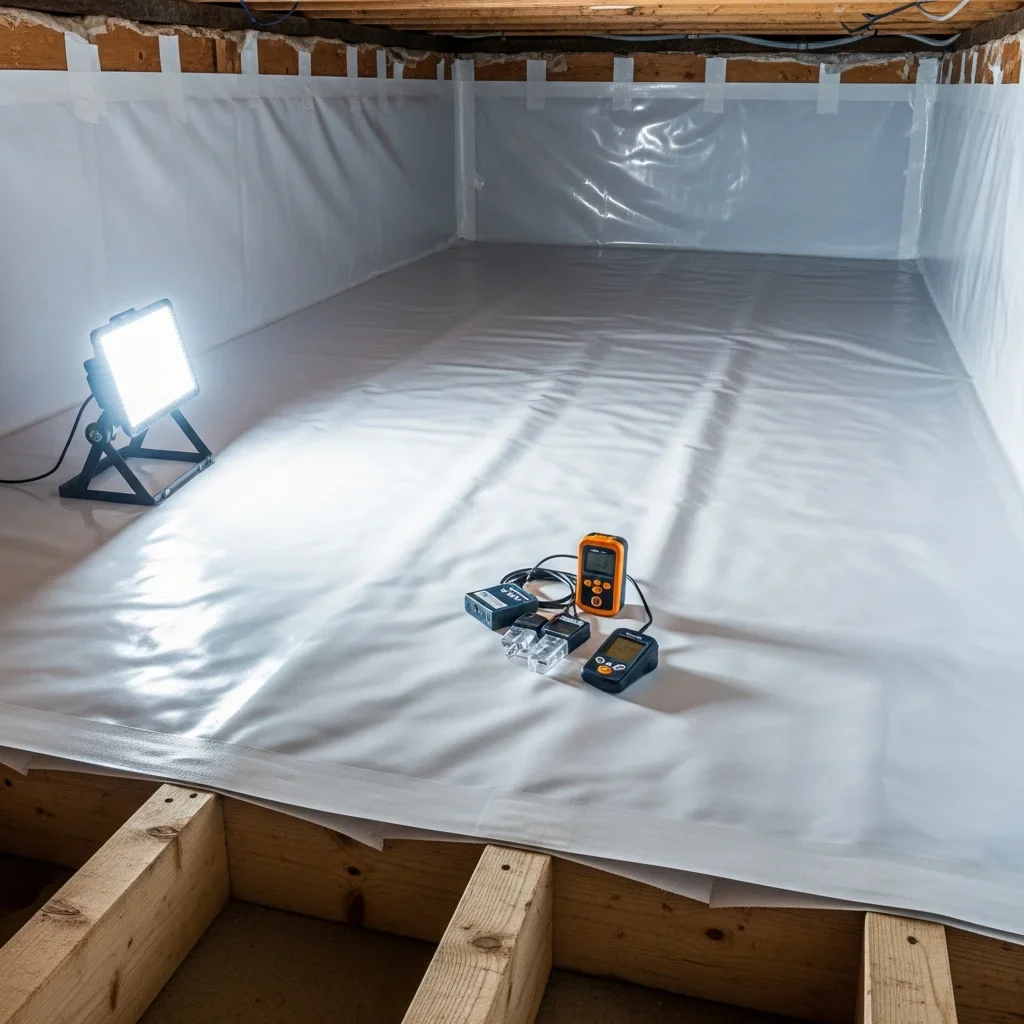
Clean crawl space after professional mold remediation in a Lake Wylie SC home — white vapor barrier installed, floor joists HEPA-cleaned and treated, no mold visible AFTER
After: Clean floor joists, HEPA-vacuumed and antimicrobial-treated, with new 20-mil vapor barrier sealed at foundation walls
Professional mold remediation containment setup in a Lake Wylie SC residence with HEPA air scrubbers running and polyethylene barriers at doorways IN PROGRESS
Active remediation: HEPA air scrubbers and negative pressure containment prevent cross-contamination during mold removal in Lake Wylie homes

SC Licensing and Standards

Mold Contractor Standards in South Carolina

What SC Law Currently Says

South Carolina has no statewide mold inspector or mold remediator licensing requirement. This means any contractor can call themselves a mold remediation company in SC without any formal credential. As of early 2026, the SC legislature has introduced bills in both the 2023-2024 and 2025-2026 sessions discussing a voluntary certification framework aligned with IICRC S520 — but no mandatory licensing regime exists statewide.

York County advises homeowners to verify professional training and certifications through recognized associations when hiring for mold work. The practical standard in insurance claims, property transactions, and litigation is IICRC S520 compliance — regardless of whether a state license exists.

The IICRC Standard — What to Ask For

The ANSI/IICRC S520 Standard for Professional Mold Remediation is the industry's accepted benchmark — the standard insurance carriers, property attorneys, and real estate professionals reference. Palm Build follows S520 on every project.

ANSI/IICRC S520 — Standard for Professional Mold Remediation — the industry benchmark
Mold Remediation Specialist (MRS) — IICRC certification for mold remediation professionals
Water Damage Restoration Technician (WRT) — Required foundation for mold-related water events
Applied Microbial Remediation Technician (AMRT) — Advanced mold and microbial remediation certification

Always ask your mold contractor: Show me your current IICRC credentials. Describe your post-remediation testing process. What documentation will you provide for my insurance carrier? A company that can't answer these questions clearly shouldn't be working in your Lake Wylie home.

Insurance Guidance

Mold Insurance Claims in Lake Wylie SC

Mold coverage in SC is limited — but the right documentation can maximize what your carrier pays. Here's what Lake Wylie homeowners need to understand.

When SC Policies Cover Mold

South Carolina standard homeowners policies typically include mold coverage sublimits of $5,000 to $10,000. Coverage prospects are best when mold traces directly to a covered sudden water event — a burst pipe, a storm-driven roof leak, an appliance failure — and when the homeowner acted promptly after discovering the water event. The documentation connecting the mold damage to the original water loss timeline is critical for claim support.

The Coverage Gap in High-Value Lake Wylie Homes

A $5,000 to $10,000 mold sublimit sounds reasonable until you price a full crawl space remediation in a 2,500+ square foot Lake Wylie home with larger-than-average crawl space square footage. The math often doesn't work — which is why Palm Build's documentation connecting mold scope to the original water loss event can be the difference between a $5,000 sublimit payout and full coverage under the water damage portion of your claim.

What Palm Build Documents for Your Claim

From the first assessment, we document: moisture source identification and timeline, affected square footage and material inventory, air quality baseline and post-remediation test results, all materials removed and disposed of, all antimicrobial products applied with EPA registration numbers, and daily drying logs through completion. This documentation is provided in the format required by major SC carriers including State Farm, USAA, Allstate, Travelers, Liberty Mutual, and SC Farm Bureau.

Common Questions

Mold Questions from Lake Wylie Homeowners

Mold in Your Lake Wylie Home? Act Before It Spreads.

Lake Wylie's reservoir humidity and York County's clay soil create year-round mold risk. Palm Build's IICRC S520-certified team provides same-day assessment, professional remediation, and documentation your insurance carrier accepts.

35-45 min Response IICRC Certified