Lake Wylie's humidity makes Tega Cay homes especially vulnerable to mold. Palm Build's IICRC-certified team provides containment, HEPA filtration, and long-term moisture control — from crawl space encapsulation to full structural remediation.
Charlotte Office — ~20 miles to Tega Cay Same-day assessment Response IICRC Certified
Tega Cay's Lake Wylie Peninsula — A Mold Factory by Geography
Tega Cay's unique peninsula geography surrounded by Lake Wylie creates a humidity
envelope that makes mold growth not just possible but inevitable in homes without proper
moisture control. Lake humidity plus vented crawl spaces equals chronic mold conditions
year-round.
Lake Wylie Humidity — 6+ Months Above 70%
6+ months
Above 70% RH annually
Tega Cay is a peninsula surrounded by Lake Wylie on three sides. This geography creates a persistent moisture envelope that keeps relative humidity above 70% for more than six months per year — well above the 60% threshold where mold actively colonizes organic materials. Unlike inland communities, Tega Cay's lake-driven humidity doesn't break overnight.
Vented Crawl Spaces — 70-90% With Moisture Issues
70-90%
Crawl space RH range
The majority of Tega Cay homes built between the 1970s and early 2000s use vented crawl space foundations — a design that pulls Lake Wylie's humid air directly beneath the home. Moisture readings in vented crawl spaces across Tega Cay routinely measure 70-90% relative humidity, creating ideal conditions for mold growth on floor joists, subfloor sheathing, and HVAC ductwork.
Year-Round Growth Window — 24-48 Hours to Colonize
24-48 hrs
Time to colonize
Mold requires moisture, organic material, and temperatures between 40-100°F to grow. Tega Cay provides all three year-round. Once spores land on a damp surface, visible colonies can form in 24-48 hours. The lake's thermal mass moderates winter temperatures enough that Tega Cay never experiences a true mold dormancy period.
No State Mold Licensing in South Carolina
0
SC mold licensing laws
South Carolina has zero state-level licensing, certification, or oversight for mold remediation contractors. Anyone can advertise mold services in Tega Cay with no credentials, no training, and no accountability. This regulatory vacuum means homeowners must verify contractor qualifications independently — IICRC S520 certification is the only meaningful benchmark.
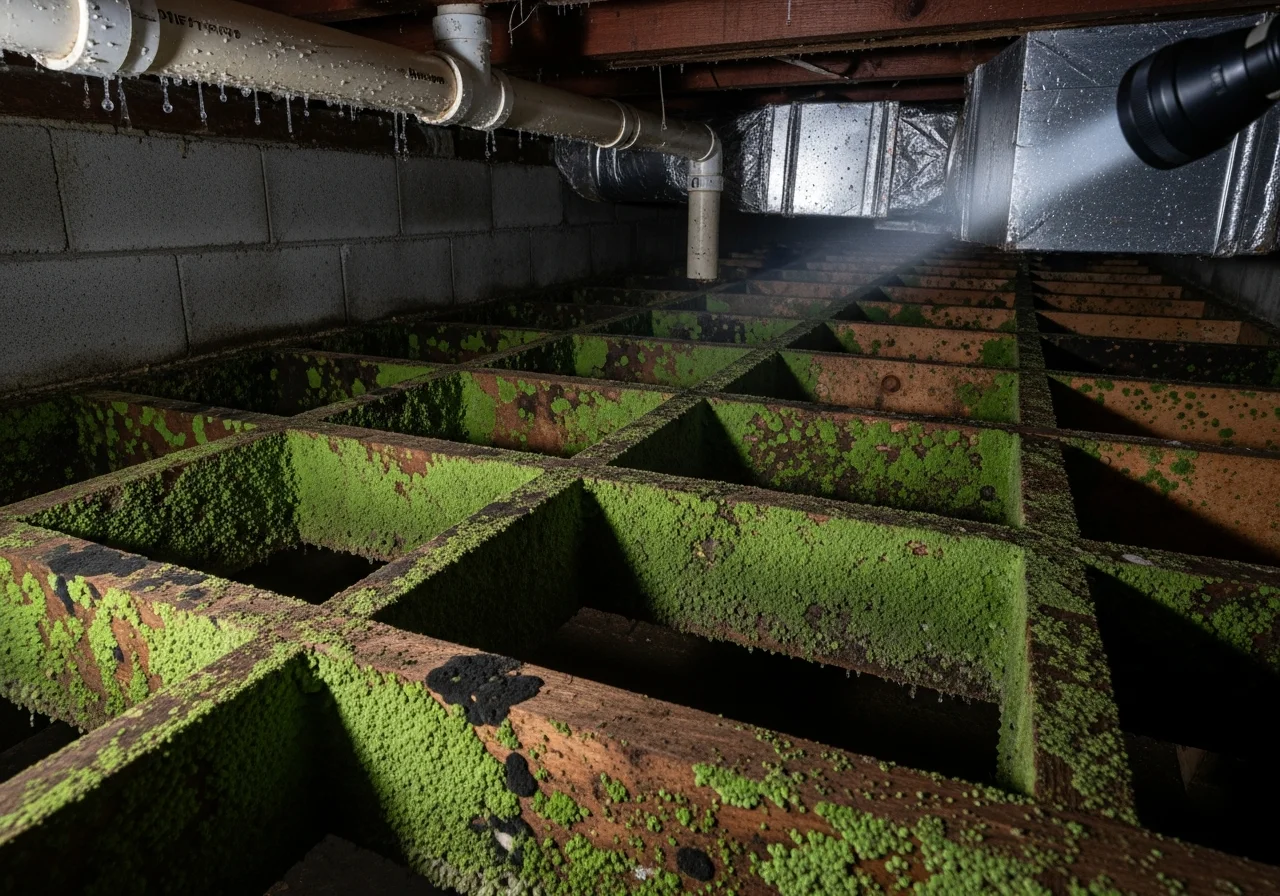
Active mold colony on structural framing — typical in Tega Cay homes with vented crawl
spaces exposed to Lake Wylie's persistent humidity envelope.
Neighborhood Risk Map
Mold Risk by Tega Cay Neighborhood
Not every Tega Cay neighborhood carries the same mold risk. Construction era, foundation
type, and proximity to Lake Wylie all determine how vulnerable your home is to chronic
moisture and mold growth.
Neighborhood
Era
Construction Type
Mold Risk
Primary Cause
Brooksmill
1980s–1990s
Crawl space, vented
Critical
Aging crawl space + lake proximity
Anchorage
1990s
Crawl space, waterfront lots
High
Direct Lake Wylie moisture exposure
Heron Harbor
1980s–1990s
Crawl space, aging HVAC
High
Aging HVAC condensation + vented crawl
Cameron Creek
2000s
Mixed slab/crawl space
Moderate
Grading and drainage issues
Lake Ridge
2000s–2010s
Slab and crawl space mix
Moderate
Elevated humidity from lake terrain
Windhaven
2000s
Townhomes, slab on grade
Moderate
Shared walls trap moisture between units
Calloway
2010s
Townhomes, slab on grade
Low-Moderate
Newer construction, bathroom ventilation issues
Reflection Pointe
2010s–2020s
Newer, encapsulated crawl
Low
Modern construction, isolated HVAC issues
South Carolina Has No Mold Licensing Law
Any person or company can legally advertise, sell, and perform mold remediation in
Tega Cay with zero training, zero credentials, and zero accountability to any state authority. There is no license to check, no state database to verify, and no regulatory
agency with jurisdiction over mold contractors anywhere in SC.
SC Regulatory Landscape
South Carolina Mold Licensing: What Tega Cay Homeowners Need to Know
South Carolina has no state-specific mold remediation license requirement. The state's regulatory framework offers essentially no consumer protection in the
mold remediation space — a critical gap for Tega Cay homeowners dealing with
lake-driven humidity and chronic crawl space moisture.
A 2025-2026 legislative bill proposing voluntary mold certification
is currently under review. Even if passed, "voluntary" means nothing is checked,
nothing is enforced, and nothing is verified. The only credential that matters right
now is IICRC S520 certification.
The IICRC (Institute of Inspection, Cleaning and Restoration Certification) publishes
the S520 standard for professional mold remediation. You can verify any contractor's
certification at iicrc.org before paying
a single dollar.
Full liability insurance and workers' compensation
Charlotte hub — approximately 25 miles from Tega Cay
SC Red Flags — Watch For These
No IICRC certification or refuses to provide the certificate number
Offers to "spray and seal" without full removal
No polyethylene containment barriers or HEPA filtration
Claims "SC licensed" — SC has no mold license
Same company does both testing and remediation
IICRC S520 Protocol
Our Tega Cay Mold Remediation Process
Professional mold remediation follows a strict sequence defined by the IICRC S520
standard. In South Carolina — where no state mold licensing exists — this protocol is
the only meaningful benchmark for Tega Cay homeowners.
01
Assessment & Air Sampling
Day 1
Comprehensive visual inspection of all accessible areas — crawl space, attic, HVAC system, bathrooms, and window zones. Moisture mapping with infrared cameras identifies hidden moisture sources. Air quality sampling establishes baseline spore counts. In Tega Cay's lake-adjacent homes, crawl space access and full thermal scanning is standard on every assessment.
02
Containment Setup
Day 1-2
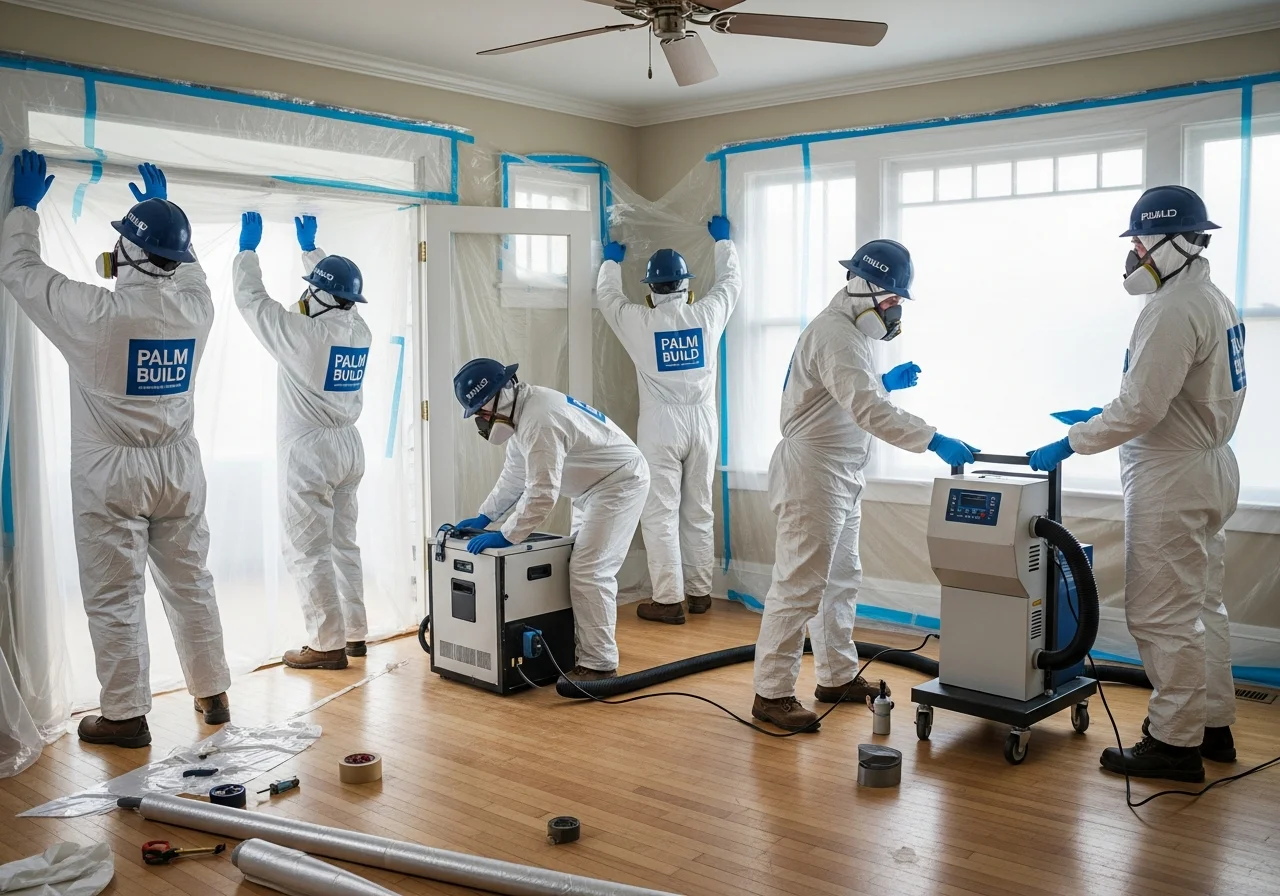
Sealed polyethylene containment barriers isolate affected areas from clean living spaces. HEPA-filtered negative air machines create pressure differentials that prevent cross-contamination. In Tega Cay where no state mold oversight exists, this containment step is what separates qualified operators from spray-and-walk contractors.
03
HEPA Air Scrubbing
Continuous
HEPA air scrubbers run continuously throughout the entire project, capturing airborne mold spores down to 0.3 microns. This protects both occupants and technicians. Air exchanges are maintained from initial containment through final clearance verification — typically 5-7 days of continuous filtration.
04
Mold Removal & Antimicrobial Treatment
Days 2-5
Contaminated materials removed with controlled demolition techniques. Salvageable surfaces cleaned with HEPA vacuuming, wire brushing, and media blasting. EPA-registered antimicrobial agents applied to all treated surfaces. For Tega Cay crawl spaces, this includes joist faces, subfloor panels, rim joists, and foundation walls.
05
Verification Testing
Day 5-6
Post-remediation air quality testing by an independent third party confirms spore counts have returned to acceptable levels. Visual inspection verifies all contamination has been addressed. Clearance documentation is provided for your records and insurance. In SC's unregulated market, this independent verification is your only objective proof of successful remediation.
06
Moisture Control & Encapsulation
Days 6-10
The critical final step that prevents recurrence. For Tega Cay homes with vented crawl spaces, this means full crawl space encapsulation — 20-mil vapor barrier, sealed vents, drainage correction, and mechanical dehumidification. Without encapsulation, Lake Wylie's humidity will re-establish mold conditions within one season.
Common Damage Locations
Where Mold Hides in Tega Cay Homes
Mold in Tega Cay rarely announces itself on visible surfaces first. These are the six
most common locations where we find established colonies — each requiring different
remediation approaches and access strategies.
Critical
Crawl Space Joists
The most common mold location in Tega Cay homes. Floor joists and subfloor sheathing in vented crawl spaces absorb Lake Wylie's persistent humidity. When wood moisture content exceeds 19%, mold colonies establish on joist faces, often spreading to subfloor panels before homeowners notice floor softness above.
High
HVAC Ductwork
Ductwork running through humid crawl spaces develops condensation on exterior surfaces. Insulation wrap traps this moisture, creating hidden mold growth on flex duct jackets and metal duct seams. Contaminated ductwork distributes mold spores throughout Tega Cay homes every time the system runs.
High
Bathroom & Shower Walls
Inadequate ventilation in bathrooms — especially in Tega Cay's 1980s-90s Brooksmill and Anchorage homes — allows moisture to penetrate behind tile and drywall. Mold grows on the backside of drywall where it's invisible until the wall is opened or staining appears on the surface.
Moderate
Attic Insulation
Attic ventilation deficiencies trap warm, humid air against roof sheathing. In Tega Cay's climate, this creates condensation that saturates insulation and feeds mold growth on sheathing panels. Attic mold is frequently discovered during home inspections for property sales.
Moderate
Window Condensation Zones
Single-pane and older double-pane windows in Tega Cay's pre-2000 homes develop chronic condensation during temperature swings. The moisture collects on sills and frames, saturating drywall returns and feeding mold colonies in the wall cavity beneath the window.
Moderate
Deck & Porch Connections
Where exterior decks and porches attach to the home, flashing failures allow rain to penetrate the rim joist area. In Tega Cay's lakefront and golf community homes, deck connections are a frequent source of hidden rim joist mold that spreads into the crawl space or wall cavity.
Tega Cay Pricing
Mold Remediation Costs in Tega Cay, SC
Costs depend on contamination extent, materials affected, and whether crawl space
encapsulation is needed. SC standard insurance policies typically cap mold coverage at
$5,000-$10,000 — Tega Cay crawl space projects routinely exceed this sublimit.
Small Area (Under 100 sq ft)
Assessment & air sampling$300 – $600
Containment setup$500 – $1,500
Mold removal & treatment$1,000 – $3,000
Estimated Total$1,800 – $5,100
Large Area / Full Crawl Space
Full crawl space assessment$500 – $1,000
Containment + HEPA filtration$2,000 – $5,000
Remediation & antimicrobial$5,000 – $15,000
Crawl space encapsulation$4,000 – $12,000
Estimated Total$11,500 – $33,000+
SC's Unregulated Market Drives Hidden Cost Risk
Because South Carolina has no mold licensing requirement, Tega Cay homeowners
frequently receive low bids from unqualified contractors who deliver incomplete
remediation. Mold that isn't fully removed and its moisture source corrected will
return within months, requiring a full second remediation at full cost. Verify IICRC
S520 certification at iicrc.org before signing any contract.
Seasonal Risk Calendar
When Mold Strikes in Tega Cay — Season by Season
Lake Wylie's thermal mass and Tega Cay's peninsula geography mean mold risk never truly
goes to zero. Each season brings different triggers and different areas of concern for
homeowners.
Spring (Mar–May)
Crawl Space Activation
Rising temperatures and spring rains saturate York County clay soils, pushing moisture into crawl spaces that have been relatively dormant. As temps climb above 60°F, dormant mold colonies reactivate. Lake Wylie's spring warming creates the season's first humidity spikes — vented crawl spaces absorb it directly.
Summer (Jun–Aug)
Peak Mold Pressure
Tega Cay's most aggressive mold season. Humidity routinely exceeds 80% with daily highs above 90°F. Lake Wylie's evaporation adds a moisture layer that inland communities don't experience. HVAC systems run constantly, generating condensation on cold ductwork in crawl spaces. This is when small colonies become large-scale contamination.
Fall (Sep–Nov)
Post-Storm Discovery
Hurricane and tropical storm season drives late-season rain events. Homeowners who delayed crawl space inspections during summer discover established colonies. Cooling temperatures slow but don't stop mold growth — Tega Cay rarely drops below 50°F until December. Home sales inspections in fall frequently trigger emergency remediation calls.
Winter (Dec–Feb)
Hidden Growth Behind Walls
Mold growth slows but doesn't stop. Heated interior air meeting cold exterior walls creates condensation in wall cavities — especially in Tega Cay's older Brooksmill and Anchorage homes with minimal insulation. Hidden growth behind drywall and in crawl space rim joist areas continues throughout winter, often discovered only during spring inspections.
Insurance Navigation
Mold Insurance Claims in Tega Cay, SC
South Carolina homeowners insurance mold coverage is limited and varies by carrier.
Understanding your policy's sublimits before you need them can save thousands —
especially when Tega Cay's lake-driven crawl space projects routinely exceed standard
coverage caps.
Mold resulting from a sudden, covered water event (burst pipe, appliance failure, roof storm damage) is typically covered up to policy sublimits
SC standard policies typically cap mold at $5,000-$10,000 — Tega Cay crawl space projects with encapsulation routinely exceed $25,000+
Gradual moisture buildup, long-term humidity accumulation, and deferred maintenance are almost universally excluded
Immediate mitigation after a covered water loss reduces denial risk — document everything from day one
When mold traces to a covered event, proper documentation connecting the mold to the original loss dramatically improves claim outcomes
Pre-existing mold discovered during renovation, inspection, or home sale is not covered regardless of when it started growing
What to Document for Your Tega Cay Mold Claim
Date and source of original water event
Photos and video of all affected areas before any cleanup
Moisture readings with timestamps and locations
Third-party air quality sampling results
Written remediation plan and scope of work
Daily progress photos throughout remediation
Palm Build's Approach to SC Mold Claims
When Tega Cay mold results from a covered water event, our documentation connects the
mold directly to the original loss — moisture maps with timestamps, thermal imaging
showing moisture migration paths, and remediation scope formatted for your SC adjuster.
For non-covered mold, we provide transparent pricing and phased remediation approaches.
Every phase of remediation — from initial inspection through final encapsulation —
documented with professional photography for your insurance records and peace of mind.
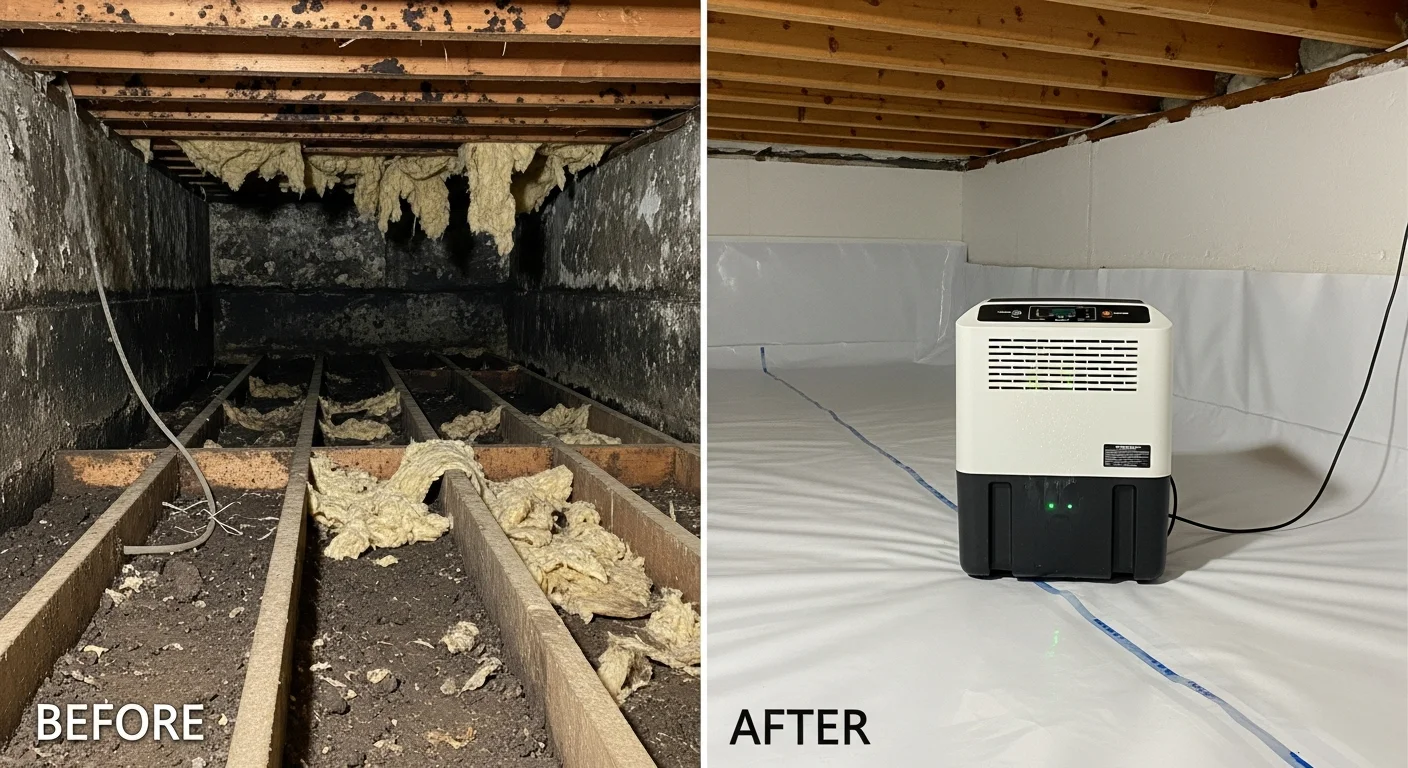
Before and after — complete mold remediation in a Tega Cay crawl space home
Sealed containment with HEPA negative air — the step unqualified SC contractors skip
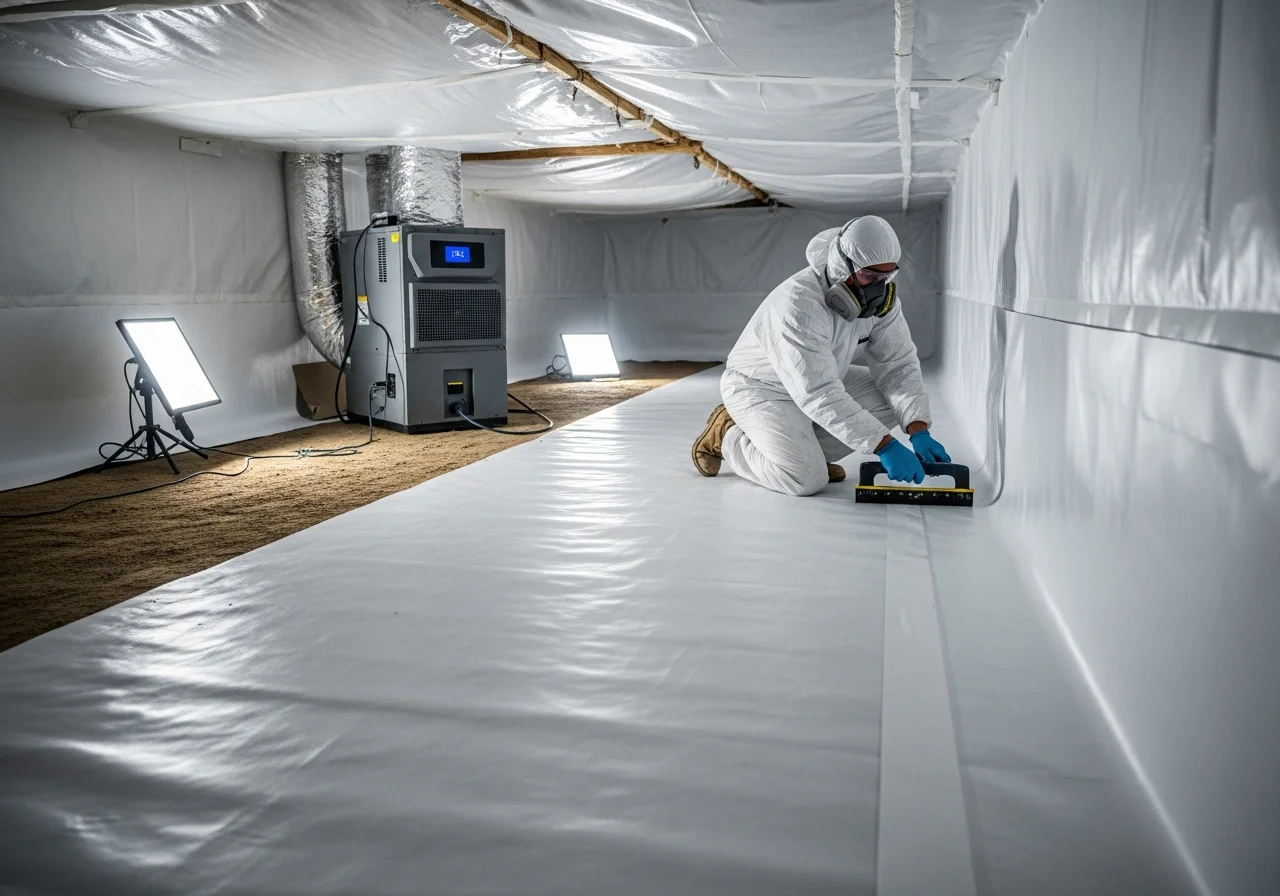
After: Full encapsulation with vapor barrier — the permanent solution to Tega Cay's lake humidity
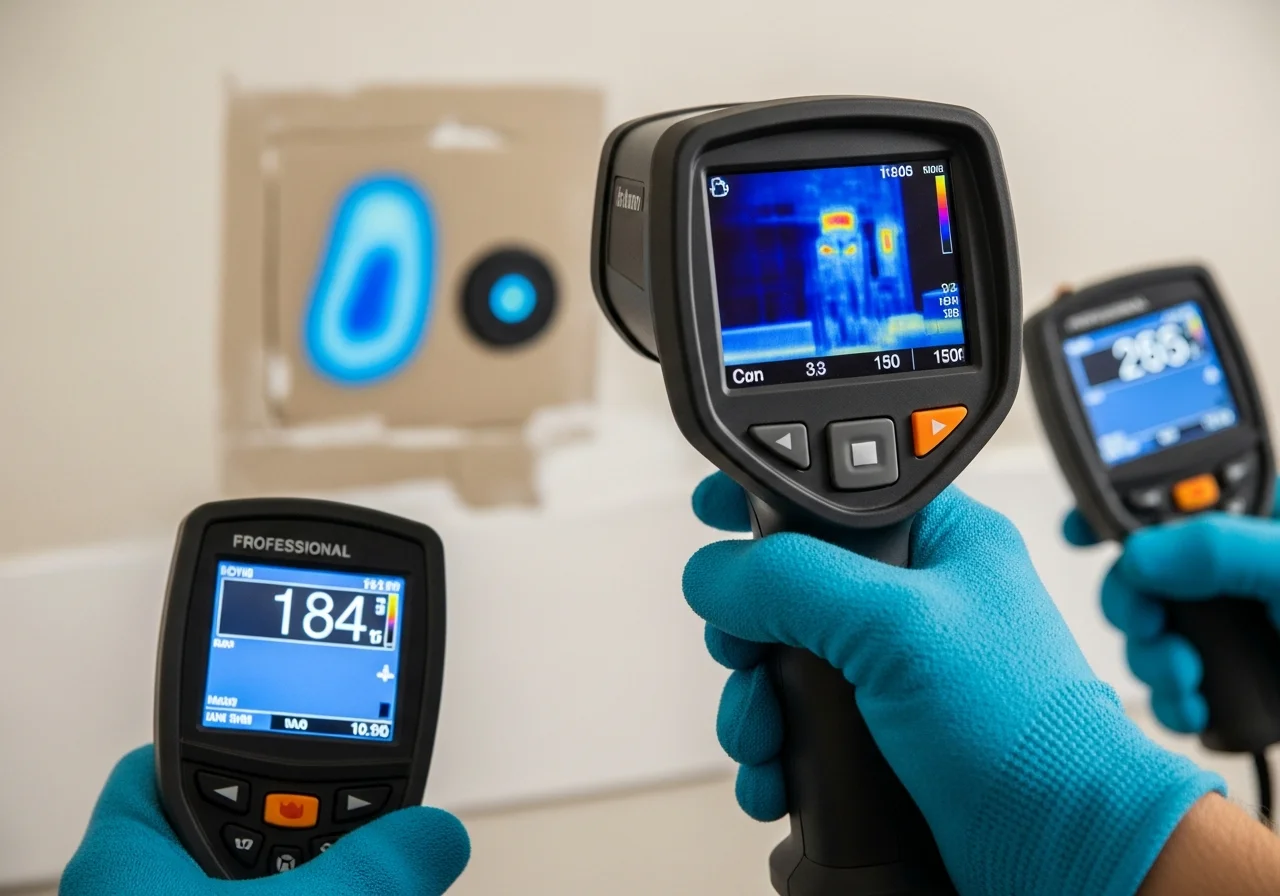
Thermal imaging reveals hidden moisture before visible mold appears — critical for accurate scoping
The Palm Build Difference
Why Tega Cay Homeowners Choose Palm Build for Mold
In South Carolina's unregulated mold market, your contractor choice is the only
protection you have. Here is what separates Palm Build from the hundreds of unlicensed
operators who legally service Tega Cay.
IICRC S520 Certified — In a State That Requires Nothing
Every Palm Build crew lead holds current IICRC Mold Remediation Specialist (MRS) certification and follows the S520 standard. In South Carolina, where no state mold licensing exists and anyone can legally offer mold services, this independently verifiable credential is the only meaningful benchmark for Tega Cay homeowners.
Lake Wylie Crawl Space Experts
Tega Cay's peninsula geography surrounded by Lake Wylie creates crawl space conditions that inland contractors don't understand. Palm Build has remediated dozens of lake-adjacent crawl spaces across York County — we know how Lake Wylie's humidity envelope, clay soils, and seasonal water table changes drive chronic mold in this specific geography.
Containment + HEPA Protocol — Every Project
Full polyethylene containment barriers and HEPA-filtered negative air on every Tega Cay project — no exceptions. This isn't optional; it's what separates legitimate mold remediation from the spray-and-walk operators who legally operate in SC's unregulated market.
Verification Testing — Independent Proof
Post-remediation air quality testing by an independent third party confirms spore counts have returned to acceptable levels. In SC where no state oversight verifies contractor work, this independent clearance testing is your only objective proof that remediation was successful.
Encapsulation Solutions — Permanent Prevention
We don't remediate and leave you with a vented crawl space that will re-grow mold within one Lake Wylie summer. Palm Build performs complete crawl space encapsulation — 20-mil vapor barrier, sealed vents, drainage correction, and mechanical dehumidification — the permanent solution to Tega Cay's lake-driven humidity.
Verify Before You Hire
Confirm any mold contractor's IICRC certification at iicrc.org before signing a contract. SC's unregulated market means your verification is the only
protection you have. Palm Build's credentials are always available to verify independently.
Common Questions
Tega Cay Mold Remediation FAQ
Honest answers to the questions Tega Cay homeowners ask most — including the ones about
South Carolina's lack of mold licensing that other contractors won't address.
What are the first signs of mold in a Tega Cay home?
The earliest indicators in Tega Cay's lake-adjacent homes are persistent musty odors — especially noticeable when you return home after time away — and elevated indoor humidity above 60% on a hygrometer. Physical signs include soft or buckling hardwood floors, discoloration on walls or ceilings, condensation on windows, and allergy symptoms (sneezing, itchy eyes, congestion) that worsen when you are inside. In peninsula-area homes with crawl spaces, mold often colonizes floor joists and subfloor sheathing long before you see or smell anything in the living space. Professional inspection with moisture mapping and crawl-space entry is the only reliable detection method.
Is mold in Tega Cay dangerous to my family's health?
Prolonged exposure to elevated indoor mold spore levels can cause respiratory symptoms, allergic reactions, headaches, fatigue, and aggravation of asthma. Children, elderly residents, and anyone with compromised immune systems face higher risk. The EPA and SCDES both connect excess indoor moisture to mold growth that can affect indoor air quality. In Tega Cay homes with crawl-space mold, the stack effect draws contaminated air upward through the subfloor into living areas — studies estimate up to 50% of first-floor air originates from the crawl space below. Addressing the mold source and the moisture feeding it is the only way to reduce exposure.
How long does mold remediation take in a Tega Cay home?
Small contained areas such as a bathroom or utility closet typically take 1-2 days. Crawl-space mold remediation without structural damage runs 2-4 days. Projects involving joist or subfloor damage, structural repair, and full encapsulation require 1-3 weeks depending on the extent of colonization and reconstruction scope. Post-remediation verification — including third-party air quality testing when required — adds 1-2 days. Palm Build provides a detailed timeline during the initial assessment so you can plan accordingly.
How much does mold remediation cost in Tega Cay SC?
Residential mold remediation in Tega Cay typically ranges from $1,500 to $5,000 for small contained areas. Crawl-space remediation without structural damage runs $3,000 to $9,000. Projects with joist or subfloor damage range from $9,000 to $20,000+. Full crawl-space encapsulation after remediation — strongly recommended for Lake Wylie homes — adds $4,000 to $12,000 depending on square footage and dehumidification system requirements. Costs vary based on colonization extent, materials affected, accessibility, and whether structural repair is needed.
Does homeowners insurance cover mold remediation in Tega Cay?
South Carolina standard homeowners policies typically include mold coverage sublimits of $5,000 to $10,000. Coverage is strongest when mold results directly from a sudden, covered water event — a burst pipe, appliance failure, or storm-driven roof leak. Gradual moisture buildup, chronic crawl-space humidity, and deferred maintenance are generally excluded. Post-storm mold may be covered under the original storm claim if documented as a direct consequence. Palm Build documents all findings with photos, moisture readings, and written reports formatted to support insurance claims where coverage applies.
How do I prevent crawl space mold from returning after remediation?
The most effective long-term solution for Tega Cay's lake-adjacent homes is full crawl-space encapsulation: sealing the crawl space with a 20-mil vapor barrier, closing foundation vents, and installing a commercial-grade dehumidifier to maintain humidity below 50% year-round. Without encapsulation, Lake Wylie's ambient humidity will recreate the conditions for mold growth within months — especially in vented crawl spaces where warm, humid air enters and condenses on cooler structural members. Annual inspections and dehumidifier maintenance are also recommended to catch any issues early.
How does Lake Wylie's humidity affect mold growth in Tega Cay?
Lake Wylie creates a localized microclimate with elevated ambient humidity that exceeds inland readings by a measurable margin. Evaporation from the reservoir adds constant moisture to the air, and the peninsula geography of Tega Cay means homes are surrounded by water on multiple sides. During six or more months of the year, outdoor relative humidity regularly exceeds 70% — well above the 60% threshold at which mold can actively grow. This moisture load enters homes through vented crawl spaces, open windows, HVAC systems, and any gap in the building envelope. The result is year-round mold pressure, not just a summer problem.
Why does IICRC certification matter for mold remediation in South Carolina?
South Carolina has no state-level licensing, certification, or regulatory requirement for mold inspectors or mold remediation contractors. Anyone can legally advertise mold services with zero training or accountability. A 2025-2026 legislative bill proposed a certification framework, but no requirement has been enacted. The IICRC S520 certification — issued by the Institute of Inspection, Cleaning and Restoration Certification — is the only independently verifiable credential that confirms a contractor has completed rigorous training in mold remediation protocols, containment procedures, and safe handling practices. Always ask for an IICRC certificate number and verify it at iicrc.org before hiring.
Suspect Mold in Your Tega Cay Home?
Lake Wylie's humidity means mold doesn't wait. Palm Build's IICRC-certified team provides same-day assessments with professional containment and remediation.