Crawl Space Cleanup & Encapsulation in Tega Cay, SC
Living on a Lake Wylie peninsula means your crawl space fights moisture from every direction — elevated groundwater from the lake, 46 inches of annual rainfall saturating Piedmont clay, and humid air pulled through foundation vents five months of the year. Palm Build provides complete crawl space remediation for Tega Cay homes: mold removal, moisture control, vapor barrier installation, structural repair, and dehumidification — addressing the root cause beneath your home, not just the symptoms above it.
Charlotte Office — ~20 miles to Tega Cay Same day Response IICRC Certified
Tega Cay's peninsula location on Lake Wylie creates a perfect storm for crawl space
problems. Constant humidity, elevated water tables, and aging vented foundations combine
to make crawl space moisture damage one of the most common — and most damaging — issues
for Tega Cay homeowners.
Lake Wylie Humidity
70-85%
Avg summer humidity
Tega Cay is surrounded on three sides by Lake Wylie, creating a constant moisture source that elevates ambient humidity year-round. Homes within 500 feet of the shoreline experience significantly higher crawl space moisture levels than inland properties.
Peninsula Geography
3-Sided
Water exposure
Tega Cay's peninsula geography means the water table is closer to the surface than in most York County communities. Groundwater seepage into crawl spaces is common, especially during spring saturation and after heavy rain events.
Vented Crawl Spaces
1970s-90s
Peak construction era
Many Tega Cay homes built in the 1970s-90s sit on vented crawl spaces — a construction method that was code-compliant at the time but acts as a moisture factory in this climate. Warm, humid air enters through foundation vents, contacts cooler surfaces, and condenses on joists and ductwork.
Rapid Development
12K+
Population growth
New residential development in Tega Cay has altered drainage patterns across the peninsula. Grading changes, impervious surface increases, and stormwater rerouting have increased crawl space water intrusion in established neighborhoods.
Lake Wylie's proximity elevates humidity and groundwater levels in Tega Cay crawl
spaces, creating ideal conditions for mold growth and structural decay.
Neighborhood-Level Intelligence
Tega Cay Crawl Space Risk by Neighborhood
Crawl space risk in Tega Cay varies dramatically by neighborhood based on proximity to
Lake Wylie, construction era, foundation type, and terrain. Here's what we see in the
communities we serve most frequently.
Brooksmill / Windsong Bay
Critical
Foundation: Crawl space
Era: 1980s-1990s
Primary issue: Lake-adjacent + aging vented crawl space = maximum moisture exposure
The Anchorage
High Risk
Foundation: Crawl space
Era: 1980s
Primary issue: Waterfront lots with high water table and original vapor barriers
Heron Harbor
High Risk
Foundation: Crawl space / Mixed
Era: 1970s-1980s
Primary issue: Oldest homes in Tega Cay — deteriorating joists and insulation common
Cameron Creek
Moderate
Foundation: Crawl / Slab mix
Era: 2000s
Primary issue: Newer construction but grading changes alter drainage to crawl spaces
Calloway
Moderate
Foundation: Crawl space
Era: 1990s-2000s
Primary issue: Mid-age homes with original vented crawl spaces nearing failure
Windhaven
Moderate
Foundation: Mixed
Era: 2000s-2010s
Primary issue: Lake-adjacent, newer construction, some conditioned crawl spaces
Lake Ridge
Low-Moderate
Foundation: Slab / Conditioned crawl
Era: 2010s-present
Primary issue: Newer conditioned crawl spaces — moisture still enters through slab cracks
Tega Cay Golf Course Homes
High Risk
Foundation: Crawl space
Era: 1970s-1990s
Primary issue: Irrigated golf course elevates nearby groundwater and crawl space humidity
Our Encapsulation Process
How We Restore Tega Cay Crawl Spaces
From initial inspection to fully sealed encapsulation, our six-step process transforms
your vented crawl space from a moisture factory into a conditioned, protected space.
01
Crawl Space Inspection & Assessment
1-2 Hours
02
Debris & Standing Water Removal
Day 1
03
Mold Treatment & Antimicrobial Application
Days 1-3
04
Vapor Barrier Installation (20-mil Poly)
Days 2-4
05
Dehumidifier Installation & Conditioning
Days 3-5
06
Vent Sealing & Encapsulation Completion
Days 4-7
01
Crawl Space Inspection & Assessment
1-2 Hours
A thorough inspection including moisture readings at multiple points, visual assessment of joists, subfloor, insulation, and ductwork, plus identification of water entry points. We document everything for your records and any potential insurance claim.
02
Debris & Standing Water Removal
Day 1
Remove standing water, saturated insulation, fallen vapor barrier material, debris, and any pest nesting. For Tega Cay homes with groundwater seepage, we address the water source before proceeding with cleanup.
03
Mold Treatment & Antimicrobial Application
Days 1-3
EPA-registered antimicrobial treatments are applied to all wood surfaces — joists, rim board, subfloor, and sill plate. For active mold colonies, HEPA vacuuming and mechanical removal precede chemical treatment.
04
Vapor Barrier Installation (20-mil Poly)
Days 2-4
A 20-mil polyethylene vapor barrier is installed across the entire crawl space floor and sealed to foundation walls. Seams are overlapped 12 inches and taped. This heavy-duty barrier prevents ground moisture from entering the crawl space.
05
Dehumidifier Installation & Conditioning
Days 3-5
A commercial-grade dehumidifier sized for your crawl space volume is installed to maintain relative humidity below 55%. For lake-adjacent Tega Cay homes, we size the unit larger to account for elevated ambient moisture.
06
Vent Sealing & Encapsulation Completion
Days 4-7
Foundation vents are permanently sealed, and the vapor barrier is sealed to all walls, piers, and penetrations. The crawl space becomes a conditioned space — no more outside air, no more condensation, no more mold factory.
Common Crawl Space Issues
What We Find in Tega Cay Crawl Spaces
Standing Water
Groundwater seepage, plumbing leaks, and drainage failures create standing water in crawl spaces. On Tega Cay's peninsula, the elevated water table makes standing water especially persistent after rain events.
Mold on Joists
Chronic humidity causes mold colonization on floor joists, rim board, and subfloor. Black mold, white mold, and green mold are all common in Tega Cay crawl spaces — the species varies, but the structural damage is the same.
Deteriorating Insulation
Fiberglass batt insulation absorbs moisture, sags, and falls from between joists. Saturated insulation holds water against wood surfaces, accelerating rot and mold growth rather than preventing it.
Pest & Rodent Damage
Damp crawl spaces attract termites, carpenter ants, mice, and rats. Pest nesting in insulation and gnawing on vapor barriers compound moisture problems and create health hazards.
Ductwork Condensation
HVAC ductwork running through a humid crawl space develops condensation on exterior surfaces. This dripping water damages insulation, promotes mold on nearby joists, and reduces HVAC efficiency.
Foundation Cracks
Hydrostatic pressure from saturated soils creates cracks in block and poured foundation walls. These cracks become entry points for groundwater, and in Tega Cay's clay soils, the pressure intensifies during wet seasons.
Insurance Realities
Crawl Space Insurance Coverage in Tega Cay
Most crawl space damage in Tega Cay results from gradual moisture intrusion — which
homeowner policies do not cover. However, when a sudden event like a pipe burst causes
crawl space damage, proper documentation can activate coverage for restoration work.
Sudden pipe burst causing crawl space flooding — water extraction and structural drying are covered under standard homeowner policies
Gradual moisture damage from humidity, condensation, or long-term seepage — maintenance-related damage is excluded from coverage
Mold from chronic crawl space moisture — mold not caused by a sudden covered event is typically excluded or subject to low sublimits
Encapsulation and vapor barrier installation — these are considered preventive improvements, not insurable restoration work
Mold remediation resulting from a covered sudden water loss — if a burst pipe causes mold, remediation up to the sublimit ($5K-$10K) applies
Dehumidifier installation — considered a home improvement, not damage restoration, even when installed as part of encapsulation
Documentation Helps Future Claims
Even though encapsulation itself is not covered, documenting the current condition of
your crawl space before and after encapsulation creates a baseline. If a future covered
event (pipe burst, sudden flood) damages the encapsulated crawl space, the documentation
proves the pre-loss condition and supports a stronger claim.
Crawl Space Cleanup & Encapsulation Costs in Tega Cay
These ranges reflect real-world crawl space project costs in the Tega Cay area.
Lake-adjacent homes typically fall in the higher ranges due to elevated moisture loads
and the need for larger dehumidification systems.
Basic Cleanup
Debris removal, treatment, vapor barrier
Debris removal & standing water extraction$500 – $1,500
Total full encapsulation + remediation$9,500 – $34,000
The Lake Effect
Lake Wylie and Your Crawl Space: The Moisture Connection
Living on Lake Wylie is a privilege — but it comes with a crawl space challenge that
most inland homeowners never face. Understanding how the lake affects your crawl space
is the first step toward a permanent solution.
Elevated Groundwater
Lake Wylie maintains a consistent pool elevation that keeps the surrounding water table higher than inland areas. Homes on the Tega Cay peninsula sit above water-saturated soil year-round, and this moisture migrates upward through foundation floors and walls into the crawl space.
Ambient Humidity
Large bodies of water moderate temperature extremes but increase ambient humidity. Lake Wylie generates a constant evaporative moisture source that keeps relative humidity 10-15% higher than inland York County locations — particularly devastating for vented crawl spaces that draw this air directly underneath the house.
Why Vented Crawl Spaces Fail Near the Lake
Standard vented crawl spaces were designed to allow air circulation to remove moisture. But near Lake Wylie, the "fresh air" entering through foundation vents is already saturated. When this warm, humid air contacts the cooler crawl space surfaces, condensation forms on every exposed surface — joists, ductwork, subfloor, and insulation.
Energy Efficiency Benefits
Encapsulation does more than prevent mold — it reduces the energy load on your HVAC system. A conditioned crawl space eliminates the temperature differential that causes condensation and reduces the volume of humid air your AC must dehumidify. Tega Cay homeowners typically see 15-20% reduction in summer energy costs after encapsulation.
Dehumidifier Sizing for Lake-Adjacent Homes
Standard crawl space dehumidifiers rated for inland homes are often undersized for
lake-adjacent properties. We size dehumidifiers based on actual crawl space volume,
measured humidity levels, and proximity to Lake Wylie — typically recommending
25-40% more capacity than standard sizing charts suggest for Tega Cay peninsula
homes.
Our Work
Tega Cay Crawl Space: Before and After
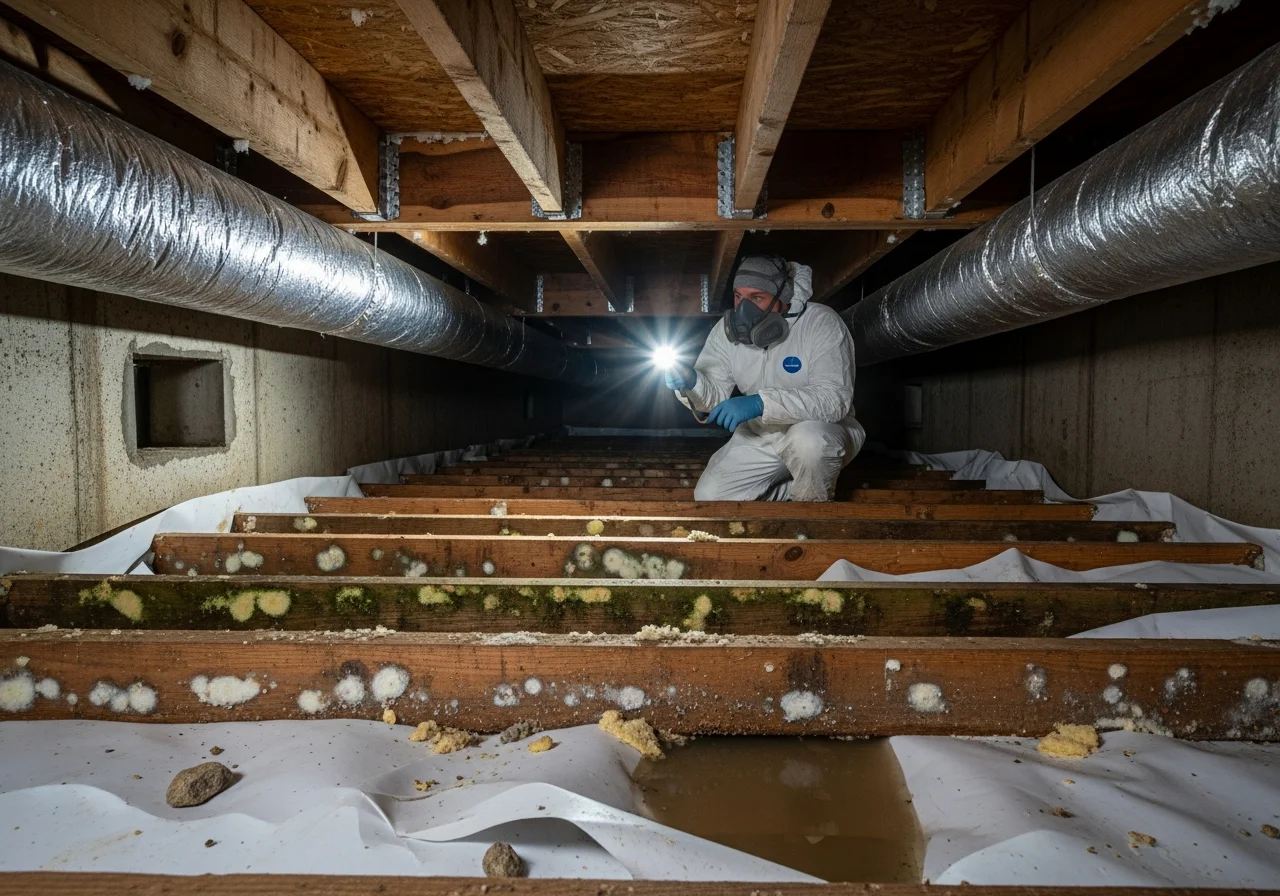
Initial crawl space inspection revealing moisture damage and failing insulation
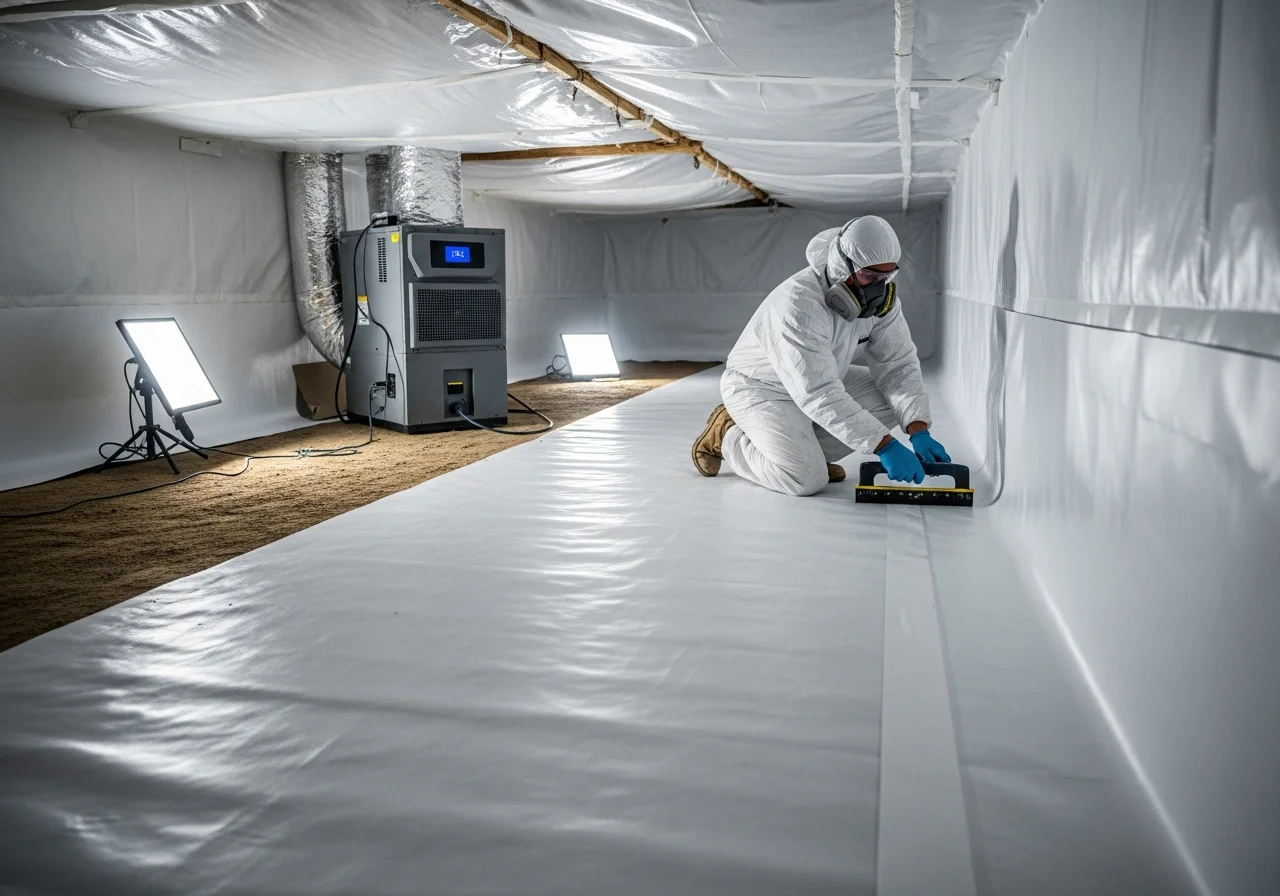
Completed encapsulation with 20-mil vapor barrier sealed to all surfaces
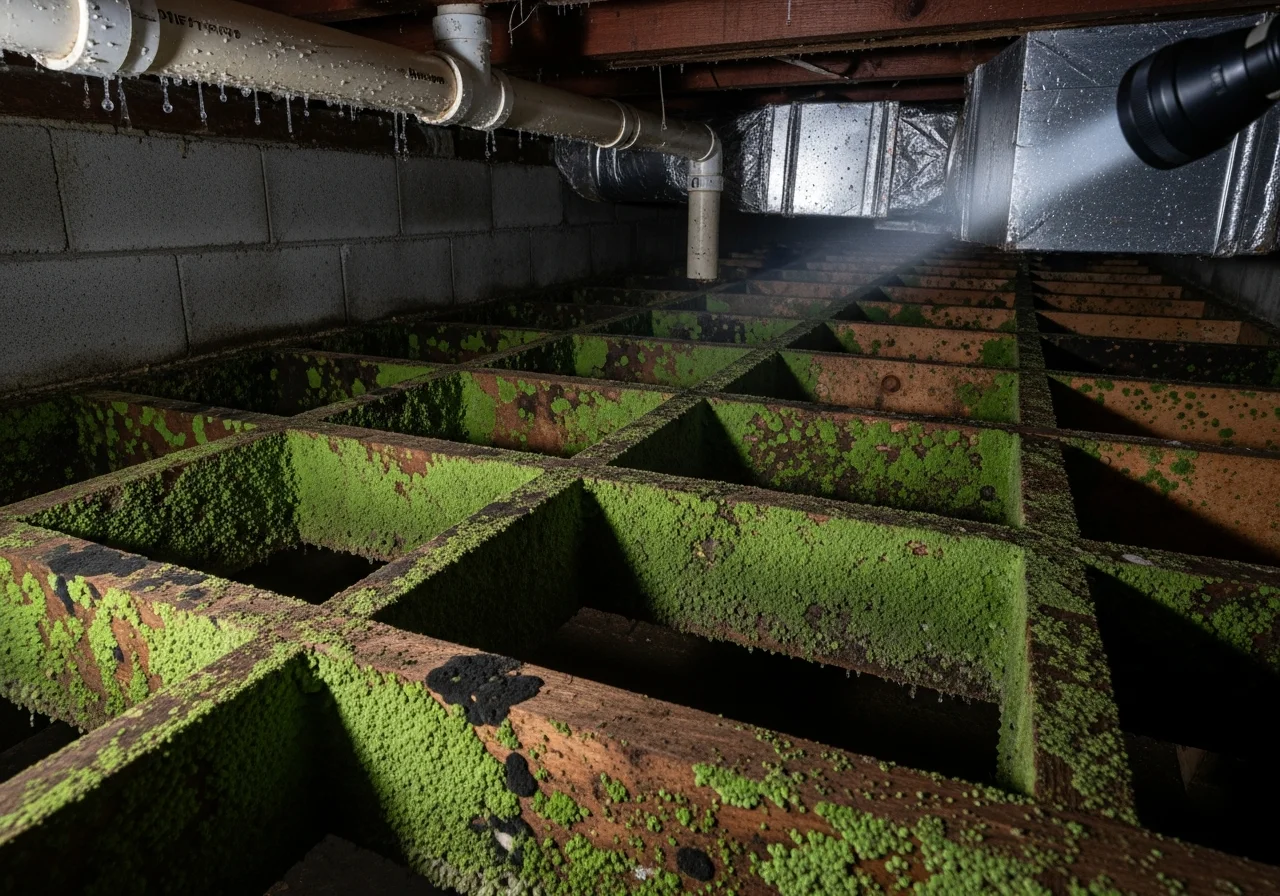
Active mold colonization on floor joists from chronic crawl space humidity
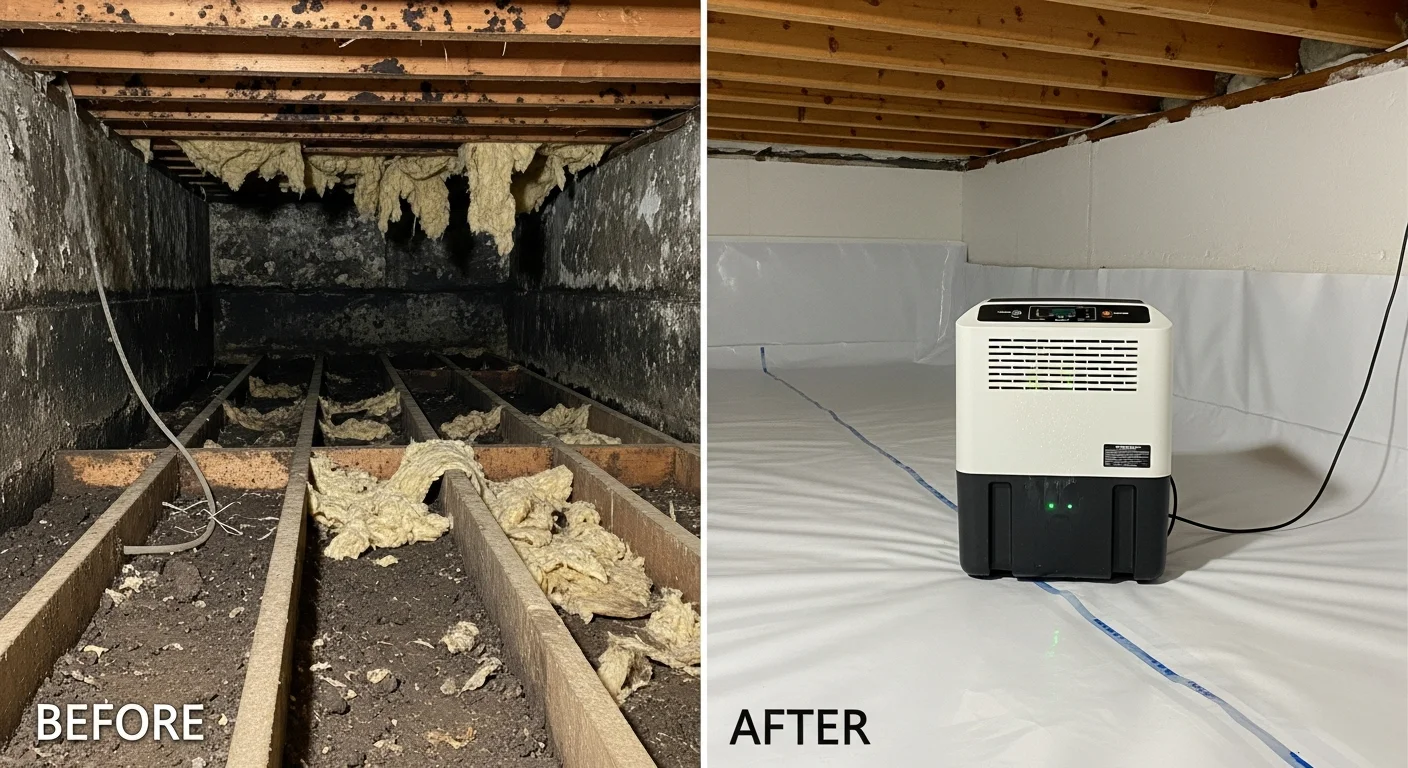
Joists after HEPA vacuuming, sanding, and antimicrobial treatment
Seasonal Crawl Space Risk
Tega Cay Crawl Space Seasonal Calendar
Crawl space conditions in Tega Cay follow a predictable annual cycle driven by Lake
Wylie's influence on humidity, groundwater, and temperature. Understanding this cycle
helps you time preventive action and recognize warning signs.
March – May
Saturation Peak & Musty Odors Emerge
Spring rains saturate Tega Cay's clay soils, and groundwater levels rise across the peninsula. Crawl space moisture climbs rapidly, and many homeowners first notice musty odors coming through floor vents. This is the season most crawl space problems are first discovered.
June – August
Maximum Humidity & Peak Mold Growth
Summer humidity from Lake Wylie regularly exceeds 80% in vented crawl spaces. Warm, moisture-laden air condenses on cooler surfaces beneath the house — joists, ductwork, and subfloor become coated with condensation. This is the peak window for active mold colonization.
September – November
Ideal Time for Encapsulation
Falling humidity and moderate temperatures make fall the optimal season for crawl space encapsulation work. Ground moisture is receding, working conditions are best, and completing encapsulation before winter protects pipes and ensures the crawl space is conditioned before the next humidity season.
December – February
Frozen Pipes in Uninsulated Crawl Spaces
Tega Cay's vented crawl spaces expose plumbing to freezing air during winter cold snaps. Uninsulated water supply lines and drain pipes are vulnerable to freezing and bursting — causing catastrophic water damage above and below the house simultaneously.
The Palm Build Difference
Why Tega Cay Homeowners Choose Palm Build for Crawl Space Work
Generic crawl space companies use the same approach for every home. We build our
solutions around Tega Cay's unique Lake Wylie moisture dynamics — because a one-size
approach fails in lake-adjacent environments.
Lake Wylie Specialists
We understand how Lake Wylie's proximity affects crawl space moisture dynamics — elevated water tables, ambient humidity, and condensation patterns unique to peninsula properties. Our solutions are sized for lake-adjacent conditions, not inland assumptions.
Full Encapsulation Capability
From basic vapor barrier installation to complete crawl space encapsulation with 20-mil poly, sealed vents, and dehumidifier installation — we handle the entire scope from cleanup through conditioning.
Mold Remediation + Cleanup
When mold is present — and in Tega Cay crawl spaces, it usually is — we perform full remediation: HEPA vacuuming, mechanical removal, antimicrobial treatment, and clearance testing before encapsulation begins.
Energy Efficiency Gains
Encapsulation typically reduces summer energy costs by 15-20% in Tega Cay homes. We document the energy efficiency improvement so you can track the return on your investment through lower utility bills.
Long-Term Moisture Monitoring
We install humidity monitoring in encapsulated crawl spaces so you can verify the system is performing. If humidity trends upward, early detection prevents mold recurrence before it becomes visible.
Common Questions
Tega Cay Crawl Space FAQ
Why are Tega Cay crawl spaces worse than other York County homes?
Geography. Tega Cay is a peninsula surrounded on three sides by Lake Wylie. The lake's surface elevation influences the water table across the entire peninsula, keeping groundwater closer to the surface than in landlocked communities like Fort Mill or Rock Hill. Homes near the lakefront — Anchorage, Windsong Bay, Heron Harbor, Lake Ridge — face the highest groundwater influence. Combined with Piedmont clay soil that drains at less than 0.2 inches per hour and ambient humidity from the surrounding lake surface, Tega Cay crawl spaces receive moisture from three simultaneous sources: rising from soil below, entering through foundation vents, and migrating through foundation walls.
How much does crawl space encapsulation cost in Tega Cay?
Basic cleanup and encapsulation (vapor barrier, vent sealing, commercial dehumidifier, minor drainage) runs $5,000-$9,000 depending on crawl space size. Full remediation including mold removal, structural repair, drainage correction with sump pump, and complete encapsulation ranges from $12,000-$25,000+. Tega Cay's lakefront and near-lake homes — where groundwater influence and mold severity tend to be greatest — typically fall in the higher range. Homes on the peninsula's interior may fall in the mid-range depending on construction era and current conditions.
Is crawl space encapsulation covered by insurance?
Encapsulation itself is generally classified as home improvement and is not covered by standard homeowners insurance. However, if crawl space damage resulted from a sudden covered event — a burst pipe flooding the crawl space or storm water intrusion through a foundation breach — the remediation of that specific damage may be covered. Mold remediation from a covered water event may carry coverage up to your policy's mold sublimit, which in SC is typically $5,000-$15,000. Palm Build documents every project with cause-of-loss analysis to identify which portions may be claimable under your policy.
How long does crawl space encapsulation take in Tega Cay?
Encapsulation only (no mold, no structural damage): 2-4 days. Mold remediation plus encapsulation: 1-2 weeks, including containment, treatment, post-remediation air testing, and then encapsulation. Full-scope projects with drainage correction, structural repair, mold remediation, and encapsulation: 2-4 weeks. Tega Cay's lake-adjacent environment can extend timelines if heavy rain raises the water table during work — drainage systems must be operational before the vapor barrier is sealed.
Do I need a dehumidifier after encapsulation in Tega Cay?
Absolutely — and on the Tega Cay peninsula, this is non-negotiable. Sealing the vents and installing a vapor barrier stops airborne and soil moisture from entering, but the lake's influence on the water table means some moisture will always attempt to migrate through the foundation and soil interface. A commercial-grade crawl space dehumidifier maintains humidity below 55% year-round, well below the 60% mold threshold. Without active dehumidification, a sealed crawl space in Tega Cay can actually become more problematic than a vented one — moisture has no escape path when the vents are closed.
What is the difference between a vented and sealed crawl space?
A vented crawl space has foundation openings designed to let outdoor air circulate beneath the home. In theory, this dries the space. In practice, on the Tega Cay peninsula, it does the opposite — warm humid lake air enters through the vents, condenses on cooler crawl space surfaces, and creates 70-90% humidity levels that support active mold growth. A sealed (encapsulated) crawl space has all vents permanently closed, a heavy-duty vapor barrier covering the soil floor and sealed to foundation walls, and a commercial dehumidifier maintaining controlled humidity. Sealed crawl spaces in Piedmont climates consistently measure below 60% RH versus 80%+ for vented crawl spaces.
Can encapsulation improve my Tega Cay home's energy efficiency?
Yes — measurably. When your crawl space operates at 80%+ humidity, the fiberglass insulation absorbs moisture and loses R-value, HVAC ductwork sweats and leaks conditioned air, and the unconditioned space creates a thermal load on your first floor. After encapsulation, first-floor temperatures even out, HVAC runtime decreases, and energy bills typically drop 10-20%. Advanced Energy NC research supports these findings. For Tega Cay homes, the energy savings partially offset the encapsulation cost over time while also protecting structural integrity and indoor air quality.
Does South Carolina require permits for crawl space encapsulation?
SC may require building permits for vented-to-closed crawl space conversions, depending on the scope of work and local jurisdiction. The encapsulated crawl space must meet SC building code requirements including appropriate vapor barrier specification, mechanical dehumidification or conditioned air supply, and proper termite inspection accessibility. Palm Build handles all permit requirements through Tega Cay's Evolve portal as part of our encapsulation scope — you do not need to navigate the permitting process independently.
Lake Wylie Peninsula Moisture? We Fix Crawl Spaces at the Source.
Palm Build's crawl space team addresses moisture, mold, and structural damage beneath Tega Cay homes at the root cause — lake-adjacent groundwater, Piedmont clay, and vented construction that was never designed for peninsula humidity. Complete remediation: mold removal, encapsulation, structural repair, dehumidification — managed as one coordinated project.