(888) 245-5155
Call Now 24/7
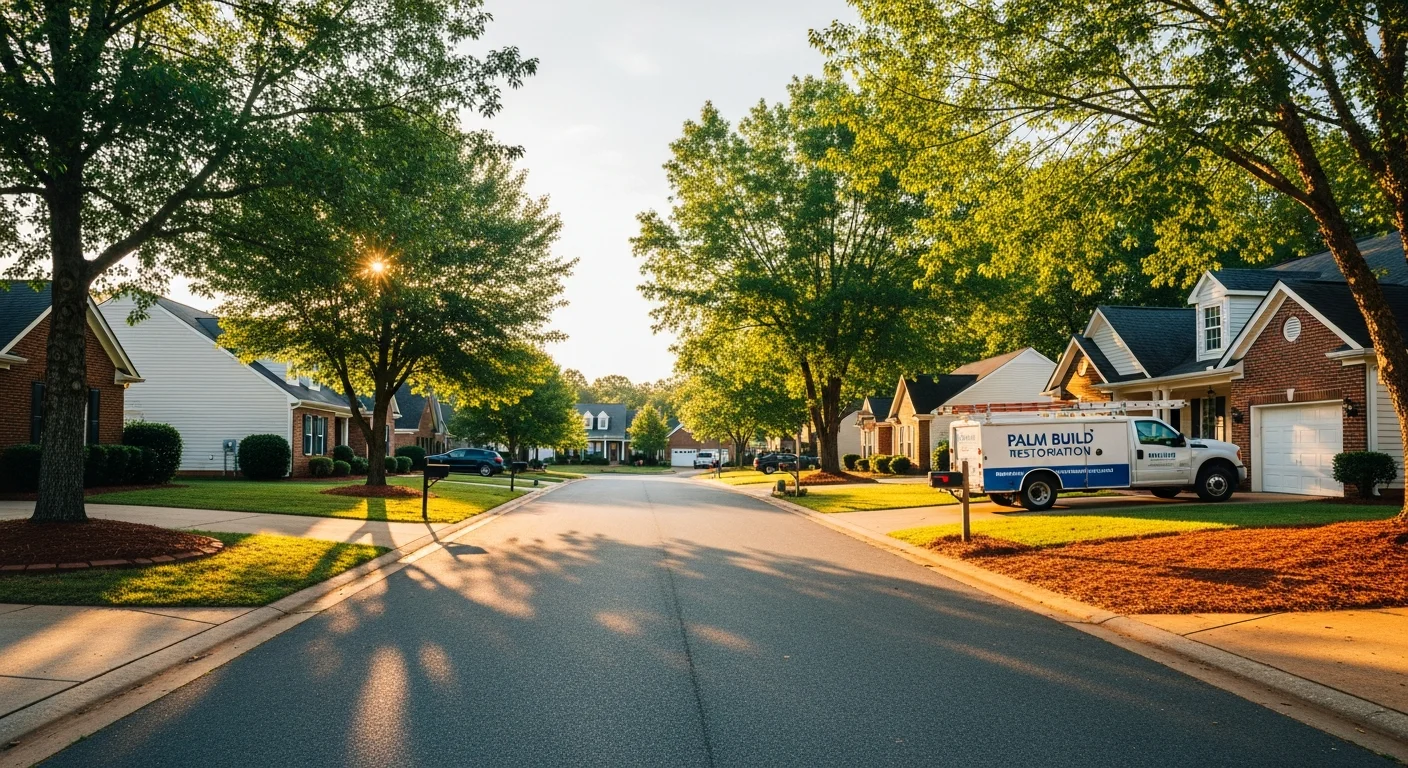
Palm Build restoration truck parked at a Mount Holly, North Carolina brick and vinyl home with Piedmont red clay soil and mature trees visible
MOUNT HOLLY NC — 24/7 WATER DAMAGE RESPONSE

Water Damage Restoration in Mount Holly, North Carolina

From Riverfront crawl spaces to Stonewater lakeside homes, Palm Build's Charlotte-based team responds fast with truck-mounted extraction, structural drying, and insurance-ready documentation — backed by deep knowledge of Mount Holly's river-corridor moisture challenges.

Approximately 20 minutes from Mount Holly 30-45 min Response IICRC Certified

30-45 min

Emergency Response

24/7

Dispatch Available

IICRC

Certified Technicians

Local Risk Factors

Why Mount Holly Homes Face Unique Water Damage Risks

Mount Holly's identity as a river town isn't just marketing — it defines your water damage risk profile. The Catawba River, Mountain Island Lake, and Dutchman's Creek create a humidity baseline that combines with Piedmont clay soil and a rapidly growing housing stock to produce damage patterns unlike anywhere else in the Charlotte metro.

Catawba River Corridor Humidity

70-90%

Summer humidity

Mount Holly is nestled along the Catawba River and adjacent to Mountain Island Lake — a drinking water reservoir and impoundment that keeps ambient humidity elevated year-round. River-adjacent neighborhoods like Riverfront and Stonewater face baseline moisture exposure that purely inland subdivisions never see.
Piedmont Red Clay Soil

<0.2 in/hr

Clay drainage rate

Gaston County sits atop Cecil series clay with infiltration rates below 0.2 inches per hour. After any meaningful rain, water pools against foundations for days — sometimes weeks — feeding moisture into crawl spaces and wicking through slab edges. Even moderate storms create yard saturation and downspout overflow.

Four-Season Damage Exposure

43.6 in

Annual rainfall

Mount Holly averages 43.6 inches of rain annually with no dry season. Summer dew points in the low to mid-70s make structural drying harder. Winter freeze-thaw cycles burst supply lines in crawl spaces. Spring saturates the clay. There is no off-season for water damage here.

Mixed-Era Housing Stock

1997

Median build year

Mount Holly's housing spans from 1913 Adrian Park homes with legacy plumbing and dense materials to 2022 Arbordale construction with tight envelopes and HVAC condensate issues. The median build year is 1997 — an era that mixed crawl space foundations with older waterproofing norms now entering end-of-life.

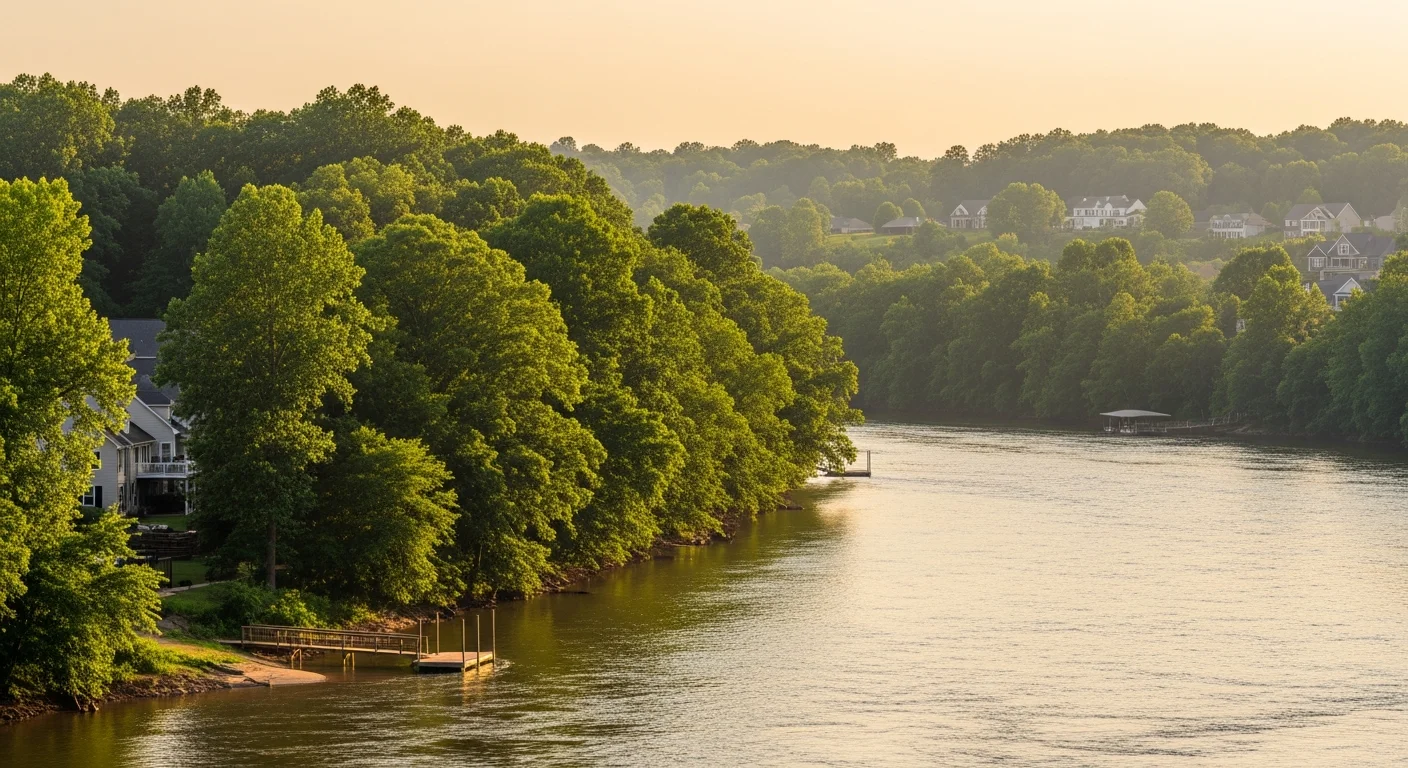
Catawba River near Mount Holly North Carolina with residential homes visible along the wooded shoreline
Mount Holly's position along the Catawba River and Mountain Island Lake creates elevated baseline humidity that drives crawl space moisture and accelerates mold growth after water events.

Neighborhood-Level Intelligence

Mount Holly Neighborhood Water Damage Risk Profiles

Water damage in Mount Holly follows predictable patterns based on proximity to the Catawba River, housing age, construction type, and lot grading. Here's what we see in the neighborhoods where we work most frequently.

Riverfront

High Risk

Built: 1998–2016

Primary risk: Catawba River adjacency, high groundwater, HOA-managed flood zone proximity

Common damage: Crawl space humidity, foundation water infiltration, flood risk even outside mapped zones

Stonewater

High Risk

Built: ~2009

Primary risk: Mountain Island Lake shoreline moisture, wind-driven rain exposure

Common damage: Elevated humidity, lakeside foundation moisture, HVAC condensate issues

Dutchmans Ridge

High Risk

Built: ~2017

Primary risk: Dutchman's Creek watershed, stormwater behavior

Common damage: Creek-adjacent flooding, crawl space humidity from watershed runoff

Adrian Park

Critical

Built: ~1913

Primary risk: Century-old construction, legacy plumbing, dense materials

Common damage: Slow structural drying, hidden cavities, cast-iron drain failure, lead-safe concerns

Ashlyn Place

Moderate

Built: ~1997

Primary risk: Median-era crawl space with aging waterproofing

Common damage: Chronic crawl space dampness, end-of-life vapor barriers, condensation on ductwork

Cottonwood Acres

High Risk

Built: ~1985

Primary risk: Older plumbing, weak exhaust ventilation

Common damage: Supply line failures, bathroom/closet humidity-driven mold, insulation degradation

Stockbridge Estates

Moderate

Built: ~2021

Primary risk: New construction appliance and supply-line failures

Common damage: Dishwasher/ice maker leaks, builder-grade flashing failures, warranty documentation needs

Kellys Landing

Moderate

Built: ~2011

Primary risk: Water heater age-out zone, storm-vulnerable gable ends

Common damage: Water heater failures, wind-driven rain at roof transitions, dishwasher supply bursts

River Park

Moderate

Built: ~2020

Primary risk: River-adjacent new construction, drainage design

Common damage: Stormwater management issues, slab moisture wicking, HVAC condensate problems

Imagery On Mtn Island

Moderate

Built: ~2020

Primary risk: Tight envelope near lake, summer moisture loading

Common damage: HVAC sizing issues, condensate drainage, attic humidity, mystery odors and localized mold

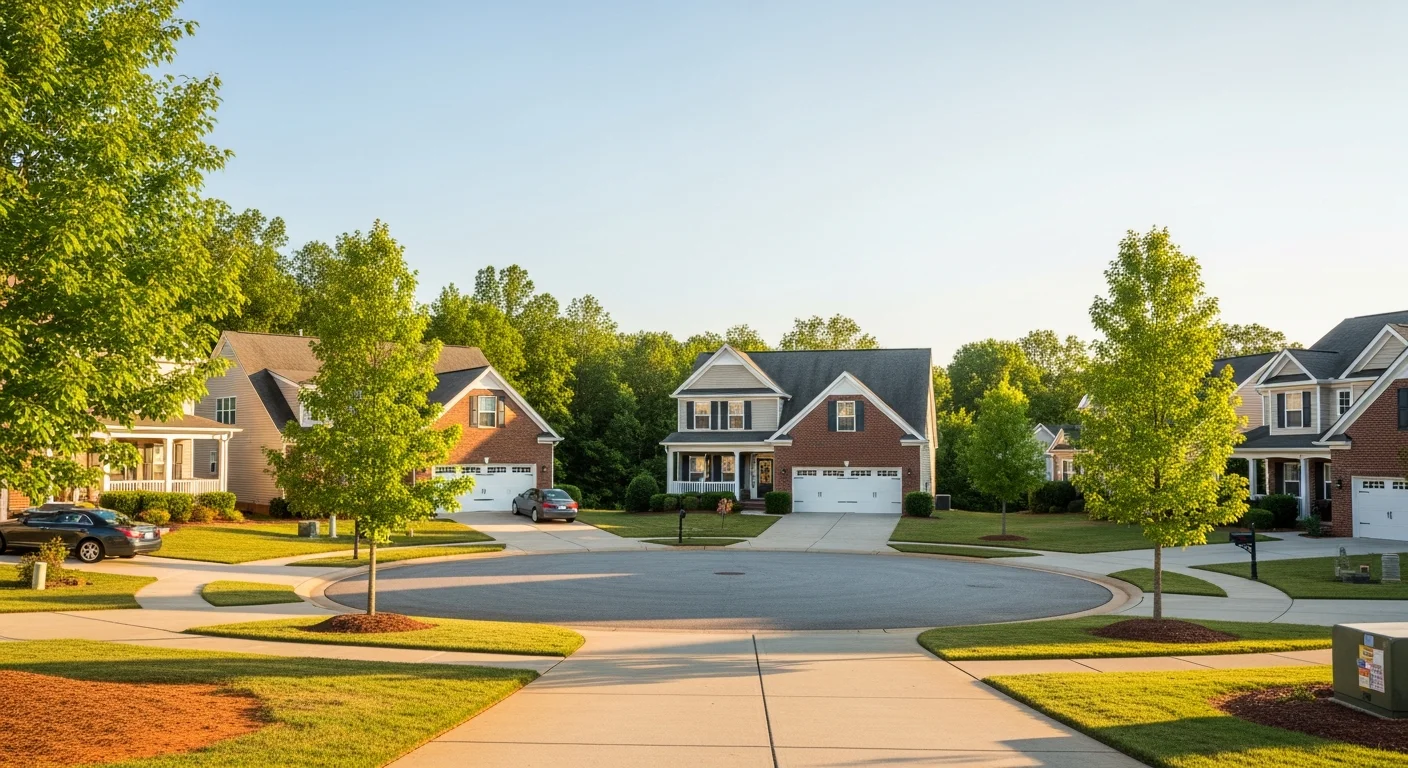
Typical Mount Holly North Carolina subdivision with brick and vinyl homes and mature landscaping
Mount Holly's 2000s-era subdivisions are entering the window where water heaters, dishwasher supply lines, and builder-grade flashing begin to fail — driving a surge in water damage calls.
Our Mount Holly Process

How We Restore Mount Holly Homes After Water Damage

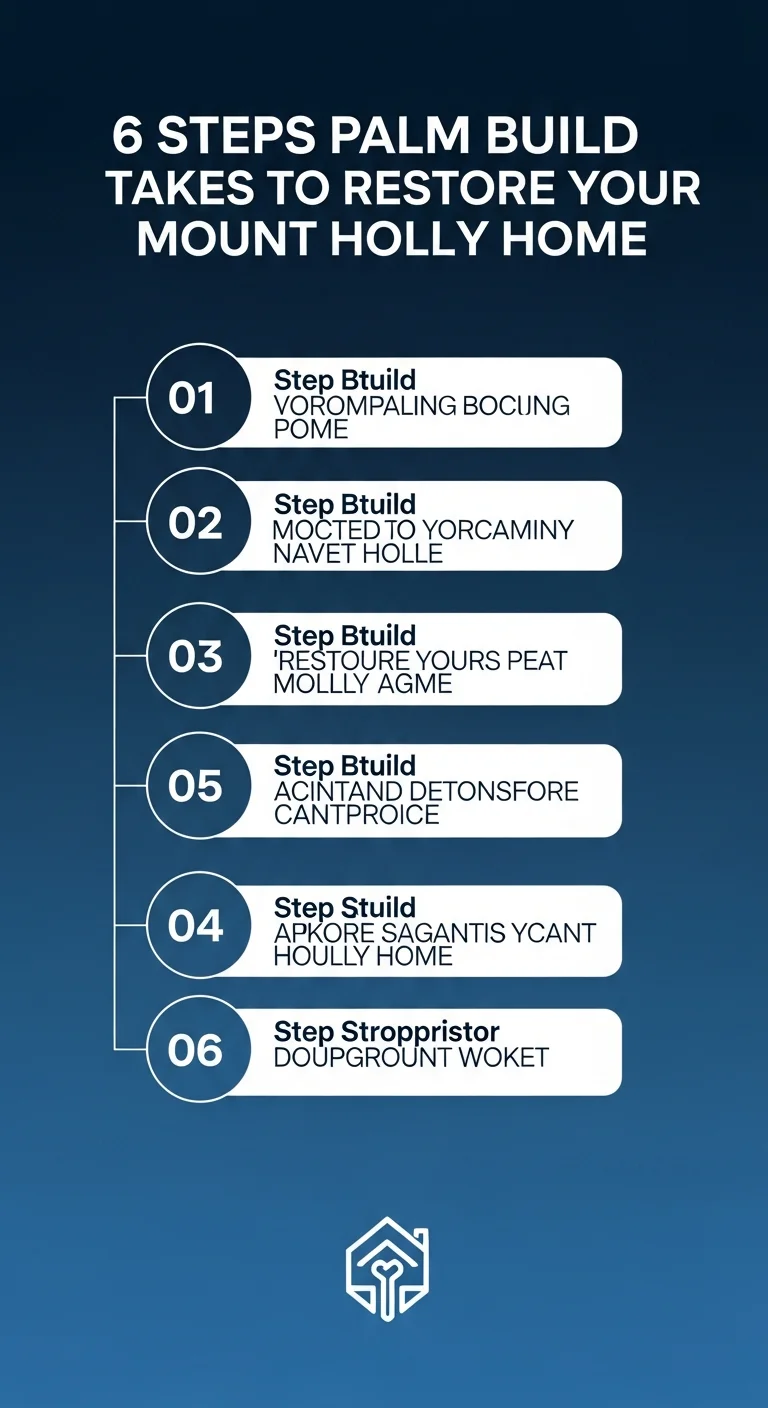
Every water damage event is different, but the science of restoration follows a proven sequence. Here's exactly what happens when you call Palm Build for your Mount Holly home.

01

Emergency Dispatch

30-45 Minutes

Call our line at (704) 464-0121 any time, day or night. Our dispatcher sends a crew from our Charlotte hub with truck-mounted extraction, commercial dehumidifiers, and air movers — arriving in Mount Holly within 30-45 minutes.

02

Damage Assessment

First 2 Hours

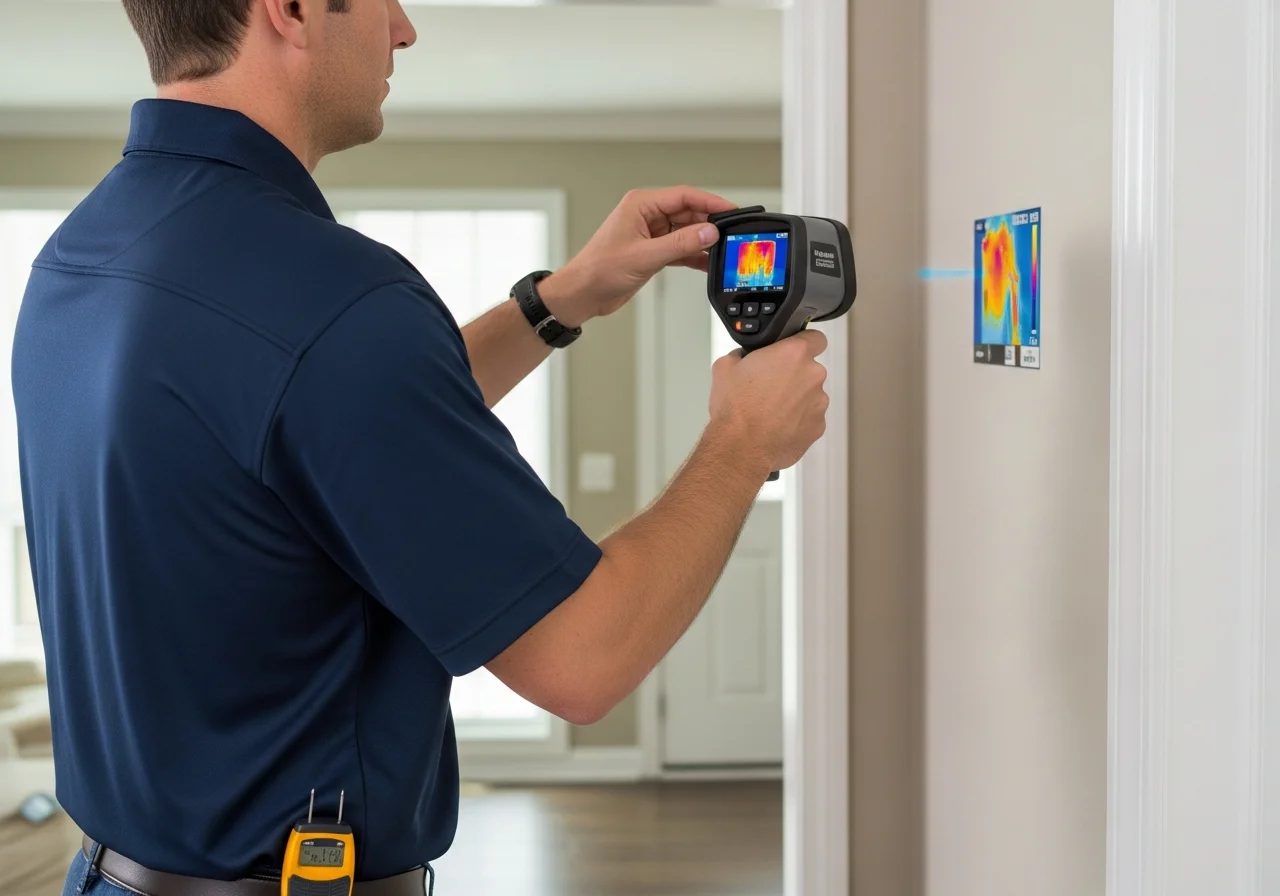
IICRC-certified technicians use infrared thermal imaging and pin-type moisture meters to map exactly where water has traveled — behind walls, under flooring, into crawl spaces. In Mount Holly's river-corridor homes, we check for pre-existing crawl space moisture that complicates drying.

03

Water Extraction

Hours 2-6

Truck-mounted extraction systems pull hundreds of gallons per hour. For Mount Holly homes with hardwood floors — common in brick-and-vinyl construction here — speed is critical to prevent permanent cupping and buckling.

04

Structural Drying

3-5 Days

Commercial LGR dehumidifiers and high-velocity air movers positioned strategically. Mount Holly's summer humidity (70-90%) makes ambient conditions challenging — our drying plans account for the river-corridor moisture baseline that slows drying compared to inland locations.

05

Mold Prevention

During Drying

EPA-registered antimicrobial treatments applied during drying. With Mount Holly's clay soil trapping moisture against foundations and crawl space humidity elevated year-round, mold prevention is not optional — it's essential on every water damage project here.

06

Full Restoration

1-4 Weeks

Drywall, flooring, baseboard, trim, painting, and structural work. For older Adrian Park homes, we plan around dense materials and potential lead-safe requirements. For newer subdivisions, we coordinate with builder warranties where applicable.

Infographic showing Palm Build's 6-step water damage restoration process for Mount Holly NC homes

Why Our Mount Holly Process Works

1

River-Town Knowledge

We understand Catawba River corridor moisture and Gaston County floodplain rules

2

Speed

30-45 minute response from our Charlotte operations hub

3

Scientific Drying

Daily moisture readings calibrated to Mount Holly's humidity baseline

4

Insurance-Ready

Documentation formatted for your adjuster — including flood zone verification

Schedule an Assessment

Cost Transparency

Water Damage Restoration Costs in Mount Holly

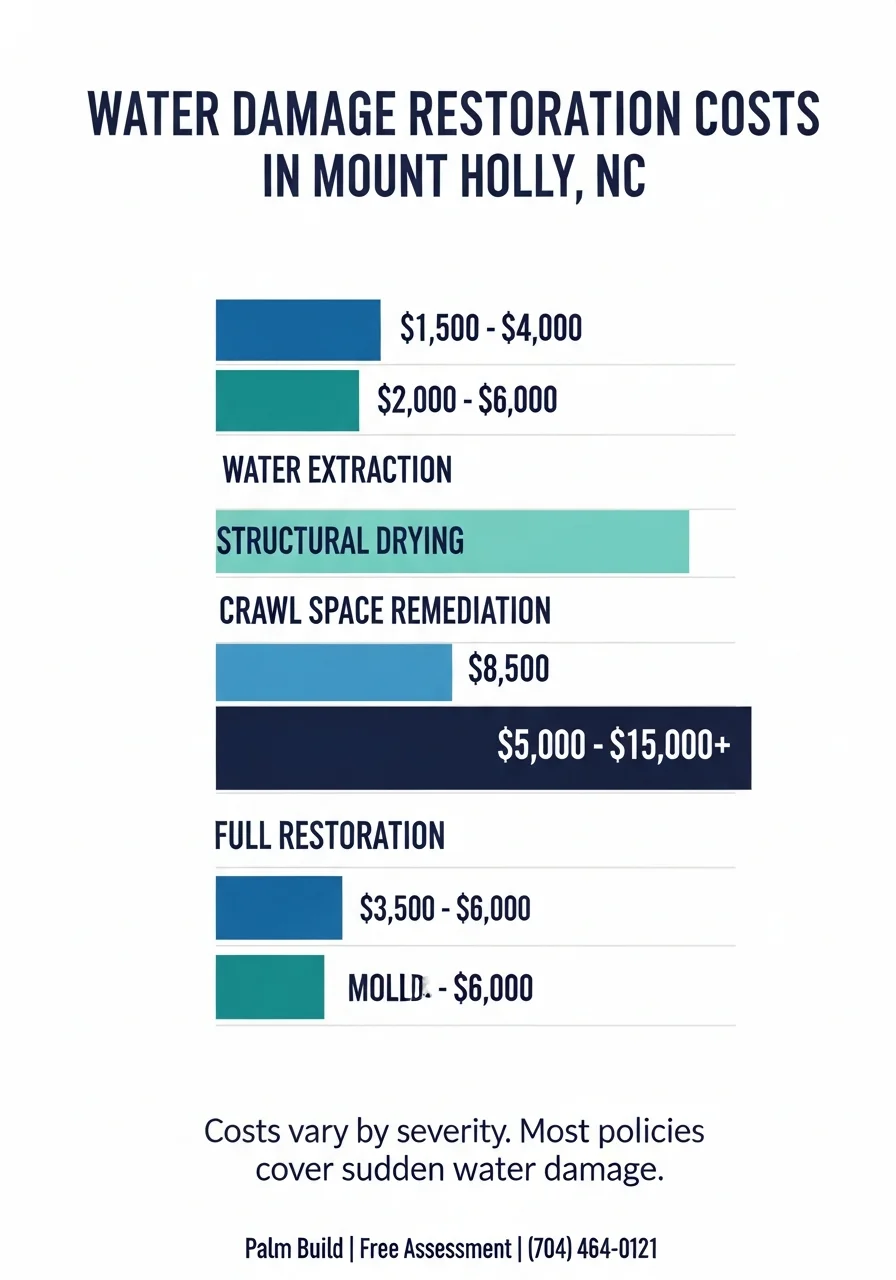
Mount Holly restoration costs run slightly higher than national averages due to Piedmont clay soil, river-corridor humidity that extends drying times, and the prevalence of crawl space foundations. Here's what to expect.

ServiceMount Holly Range

Emergency Water Extraction

River-corridor homes may require extended extraction for crawl spaces

$1,500 – $4,000

Structural Drying (3-5 days)

Mount Holly's humidity extends drying time vs. drier climates

$2,000 – $6,000

Crawl Space Water Remediation

Clay soil moisture + vented foundations increase scope in Gaston County

$3,500 – $8,500

Full Water Damage Restoration

Includes drywall, flooring, trim, paint — scope drives final cost

$5,000 – $15,000+

Mold Remediation (if needed)

Pre-existing crawl space mold triggers a separate remediation scope

$2,000 – $6,000

Most homeowner policies cover sudden water damage. We document everything your adjuster needs from day one, including moisture maps, affected material inventories, and daily drying logs. For flood-related losses, separate NFIP coverage is required — Gaston County's CRS Rating 8 provides a 10% premium discount.

Water damage restoration cost ranges for Mount Holly NC homes showing service-by-service pricing

Know Your Risk Window

Mount Holly's Seasonal Water Damage Calendar

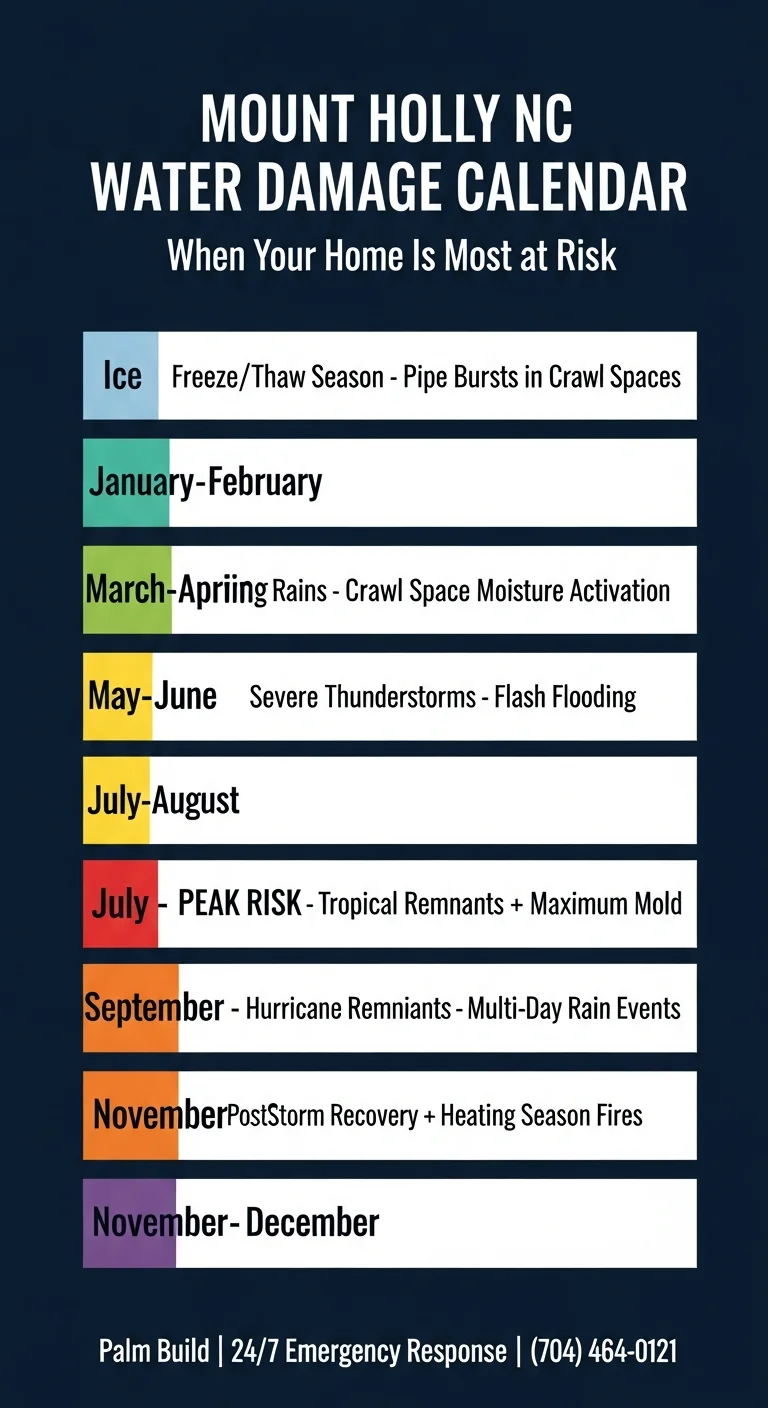
Mount Holly doesn't have a single "water damage season" — different types of damage peak at different times of year. Understanding this calendar helps you catch problems before they escalate.

January – February

Freeze-Thaw & Burst Pipe Season

Mount Holly winter temperatures swing between the 20s and 50s. Exposed pipes in crawl spaces and attics are vulnerable — especially in older Cottonwood Acres and Adrian Park homes with inconsistent insulation. Hidden freeze damage in crawl spaces is a common late-winter discovery.

March – April

Spring Saturation & Crawl Space Activation

Spring rains saturate Gaston County's red clay soil, and crawl space moisture levels begin climbing. Homeowners in Ashlyn Place and Autumn Woods often first notice musty smells, condensation on ductwork, or sagging insulation as temperatures rise.

May – June

Severe Thunderstorm Season

June averages the highest percentage of rainy days. Flash flooding overwhelms storm drains and sends water into crawl spaces and ground-level entries. Dutchman's Creek watershed neighborhoods see the first surge of stormwater-related damage calls.

July – August

Peak Risk: Maximum Humidity & Tropical Remnants

August averages 4.35 inches of rain. Dew points in the low to mid-70s make structural drying significantly harder. Crawl spaces and attics become persistent mold incubators. This is when Riverfront and Stonewater homes see the most moisture-related problems.

September – October

Hurricane Remnant Season

Inland rain bands from tropical systems bring multi-day heavy rainfall to Gaston County. The Catawba River can rise significantly during these events. Post-storm mold is typically discovered 2-4 weeks after the water event in hidden areas.

November – December

Post-Storm Discovery & Heating Season

Many homeowners discover water damage during fall when they venture into crawl spaces for winterization or when HVAC systems reveal moisture problems. Heating-related fire risk increases. Supply line freeze preparation becomes critical.

Mount Holly NC seasonal water damage risk calendar showing month-by-month damage patterns

Mount Holly Floodplain Guide

Floodplain Reality Check for Mount Holly Homeowners

Most Mount Holly restoration competitors never explain this. Understanding your flood zone status, permit requirements, and insurance coverage gaps before damage occurs can save you thousands — and prevent the worst surprise of all: discovering your policy doesn't cover your loss.

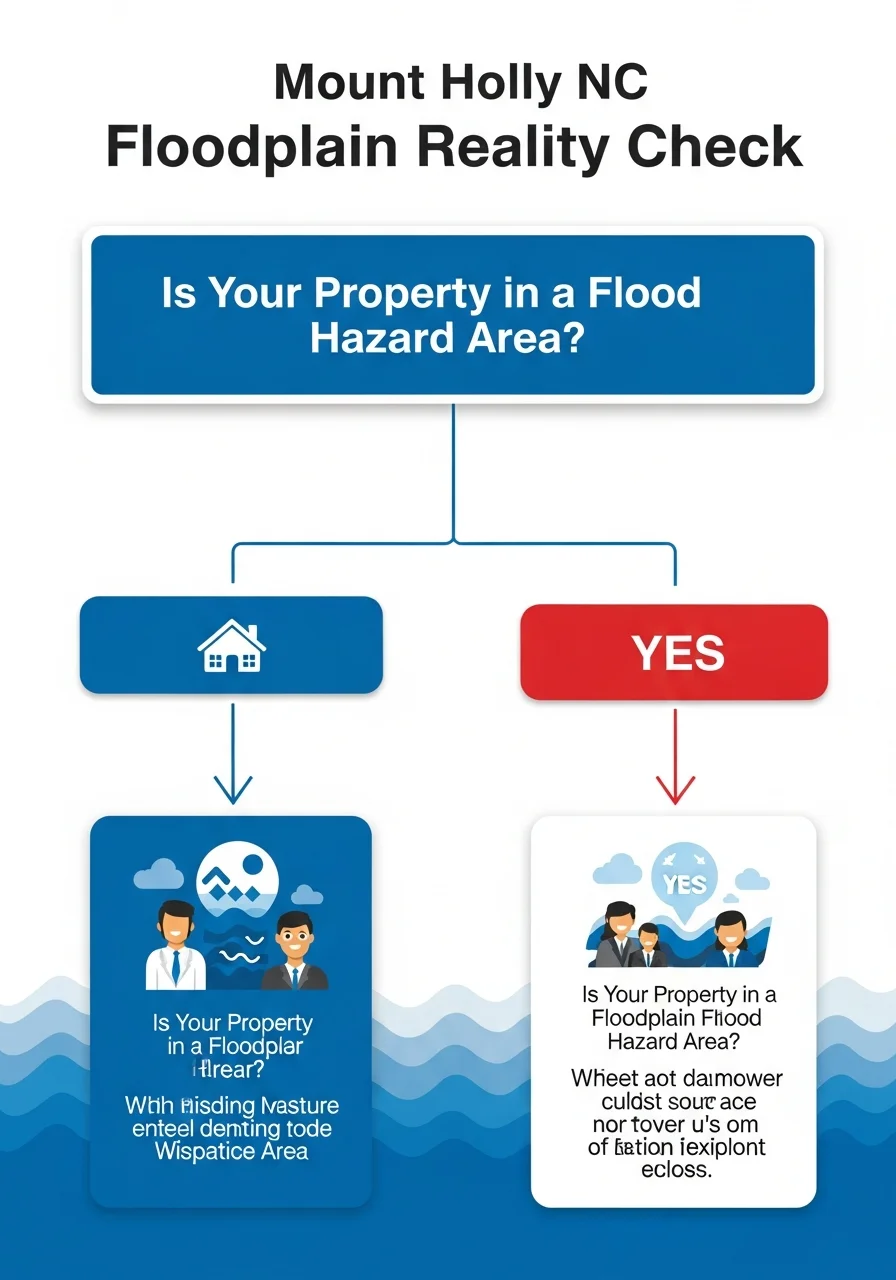
Are You in a Flood Hazard Area?

Mount Holly's position along the Catawba River means many properties fall within FEMA-designated flood zones. The City of Mount Holly emphasizes that flood hazard areas are subject to periodic inundation. Check the FEMA Flood Map Service Center or contact Mount Holly's planning department.

Floodplain Development Permit Required

If your property is in a flood hazard area, Mount Holly requires a Floodplain Development Permit ($100 fee), an elevation certificate, and a site plan before any development activity or man-made change. This applies to restoration and reconstruction work, not just new construction.

Homeowners Insurance Does NOT Cover Flooding

Gaston County's floodplain page states this directly: homeowners insurance will not cover losses due to flooding. If your loss involves river or creek overflow, you need separate National Flood Insurance Program (NFIP) coverage. The standard HO policy covers sudden interior plumbing failures — but not rising water.

Gaston County CRS Rating 8 = 10% Discount

Here's the good news: Gaston County participates in FEMA's Community Rating System with a CRS Rating of 8, which provides a 10% reduction in flood insurance premiums for NFIP policyholders. This is an unusually strong local benefit that many Mount Holly homeowners don't know about.

Mount Holly NC floodplain decision tree showing permit requirements and insurance coverage for flood hazard areas

Palm Build coordinates floodplain compliance. When your restoration project falls within a mapped flood hazard area, we handle the permit documentation, coordinate with Mount Holly's floodplain administrators, and ensure your rebuild meets all Gaston County requirements. You focus on your family — we handle the paperwork.

Insurance Guidance

Filing Water Damage Claims in Mount Holly

We work with every major carrier serving Gaston County. NC's insurance market is experiencing rate changes through mid-2026 with location-based variation — here's what Mount Holly homeowners need to know.

Common Carriers in Gaston County

State Farm

Largest NC homeowners insurer — generally covers sudden water damage

16.9%

NC Farm Bureau

Strong presence in Gaston County — responsive local agents

12.2%

Nationwide

Common in newer subdivisions — varies by policy endorsements

Major

Erie Insurance

Growing NC presence — competitive on crawl space claims

Regional

Flood vs. Water Damage — The Critical Distinction

Your HO policy covers sudden interior water events (burst pipe, appliance failure). It does NOT cover rising water, river overflow, or creek flooding. If you're near the Catawba River or Dutchman's Creek, verify your flood coverage separately through the NFIP.

Document Everything Before Cleanup

Before extraction begins, photograph all damage. Our technicians create timestamped photo documentation, moisture maps, and affected material inventories from minute one — formatted for your specific carrier's adjuster.

Sudden vs. Gradual — Know the Line

Insurers distinguish between sudden water damage (covered) and long-term seepage or maintenance failure (often denied). Documenting the timeline is critical — especially in Mount Holly crawl spaces where pre-existing moisture can complicate claims.

We Handle the Paperwork

Palm Build creates insurance-ready documentation from the moment we arrive — moisture maps, photo timelines, affected material inventories, and daily drying logs formatted for your specific carrier. We've worked with every major insurer in Gaston County and know what each adjuster expects. Call (704) 464-0121 to start your claim.

Our Work in Action

Mount Holly Water Damage Restoration Gallery

Every project follows the same scientific approach — from emergency extraction through full restoration. Here's what that looks like in Gaston County homes.

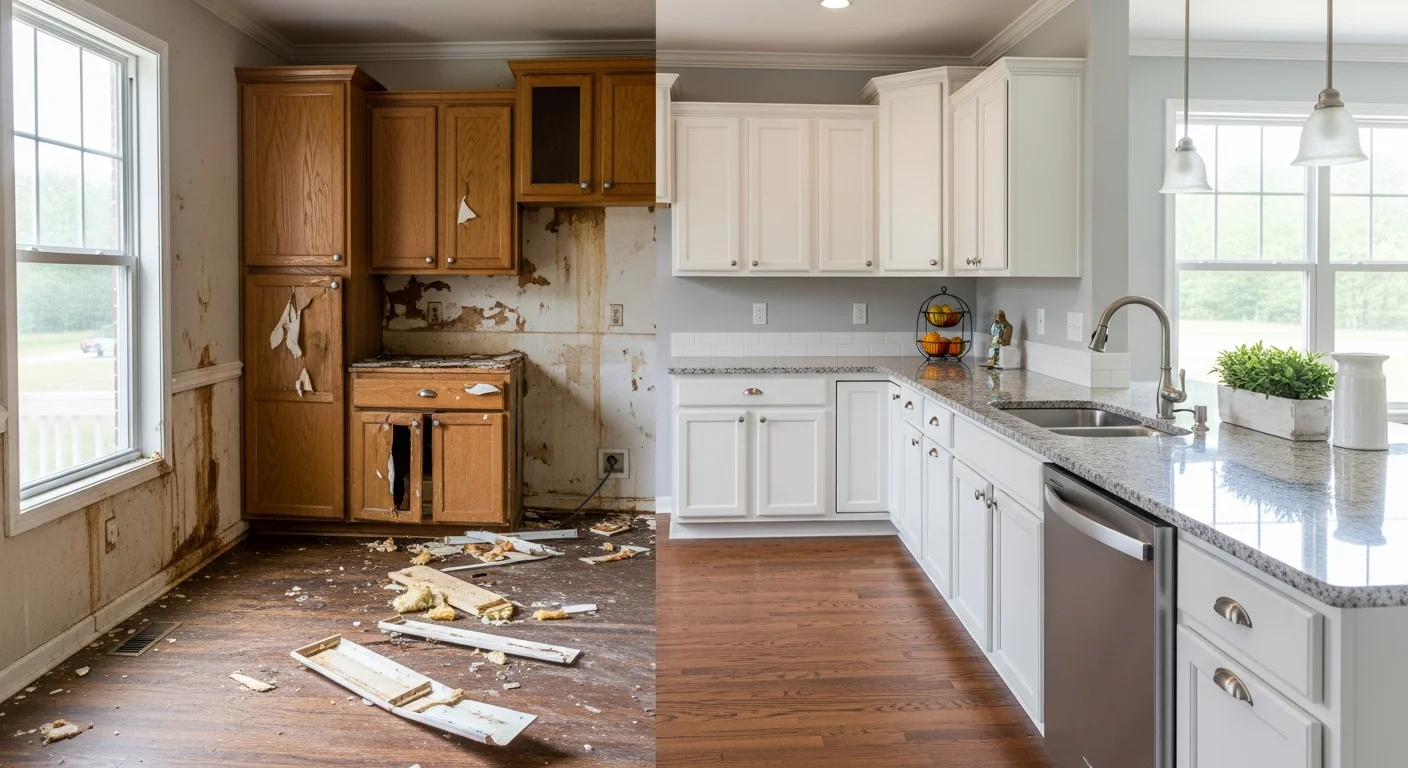
Before and after water damage restoration in a Mount Holly NC kitchen showing buckled floors restored to new hardwood

Kitchen water damage restoration — buckled hardwood floors and warped cabinets fully restored

Commercial dehumidifiers and air movers set up for structural drying in a Mount Holly NC home

Scientific drying in progress — LGR dehumidifiers and air movers positioned for maximum efficiency

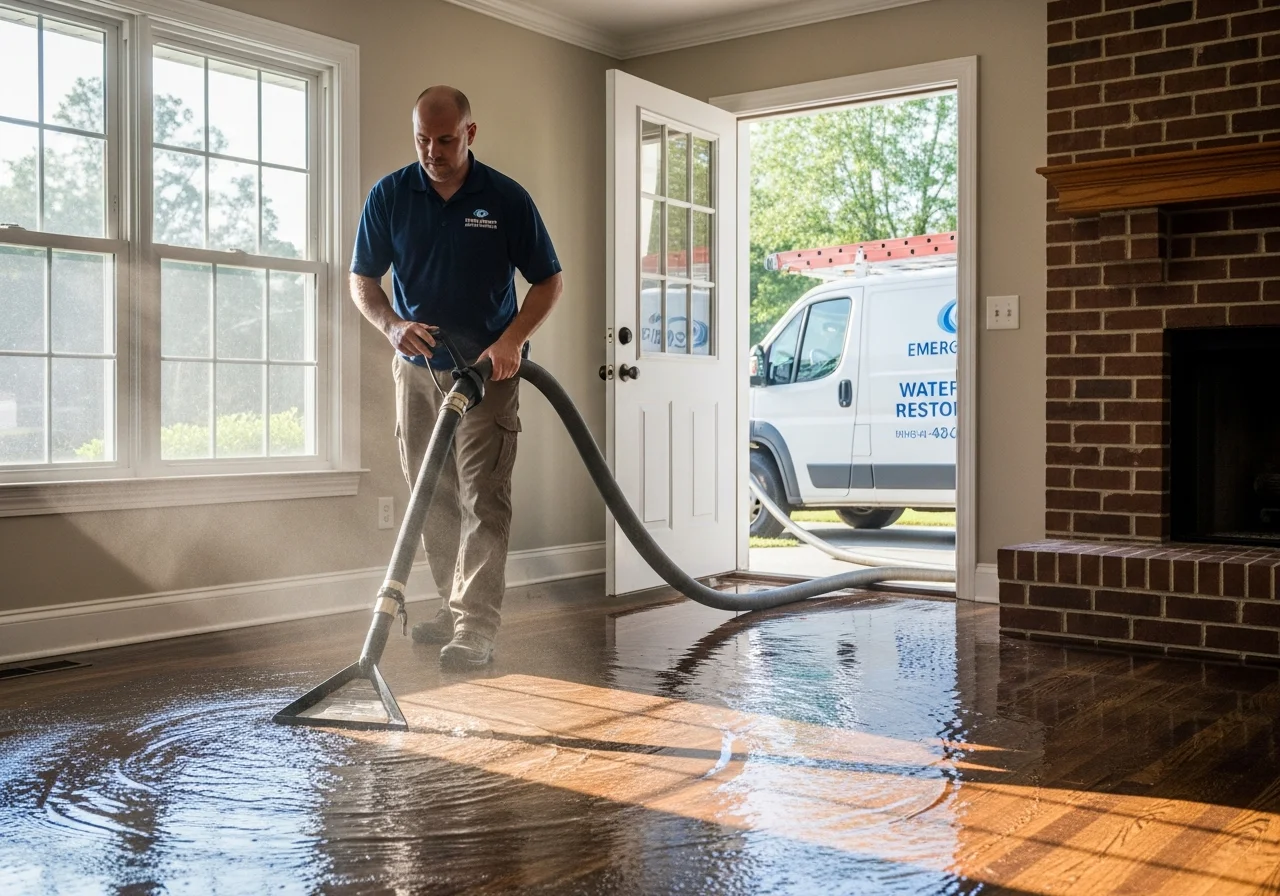
Palm Build technician performing emergency water extraction with truck-mounted equipment in a Mount Holly home

Emergency extraction — truck-mounted systems removing standing water within hours of the call

Restoration technician using infrared thermal imaging camera to detect hidden moisture in Mount Holly NC home walls

Thermal imaging reveals hidden moisture behind walls that visual inspection would miss

Damage Categories

Common Water Damage Types in Mount Holly Homes

Water damage in Mount Holly isn't one-size-fits-all. Each type requires different equipment, techniques, and timelines. Here are the six categories we see most frequently in Gaston County.

Most Common

Burst Pipes & Supply Line Failures

The most common single cause of water damage in Mount Holly. Homes built in the late 1990s through 2010s are entering the window where water heaters, dishwasher supply lines, and ice maker connections begin to fail. Older Cottonwood Acres homes with aging plumbing are highest risk.

Seasonal Peak

Storm-Driven Water Intrusion

Severe thunderstorms overwhelm Gaston County's clay-based drainage. Water enters through wind-driven rain at gable ends, roof transitions, and foundation-grade openings. Dutchmans Ridge and creek-adjacent lots see the highest volume of storm-related calls.

Year-Round

Crawl Space Flooding & Moisture

Mount Holly's river-corridor location and clay soil create chronic crawl space moisture. Even without a dramatic water event, humidity condensation on joists, ductwork, and insulation causes progressive damage — musty odors, cupping floors, and mold growth.

Winter

Freeze-Related Damage

Winter freeze-thaw cycles burst exposed pipes in crawl spaces, attics, and exterior walls. Older homes with inconsistent insulation are most vulnerable. Hidden crawl space freeze damage often isn't discovered until spring.

Sept-Oct

Tropical Remnant Flooding

While not coastal, Mount Holly receives inland rain bands from tropical systems. Multi-day rainfall events can raise the Catawba River and overwhelm Dutchman's Creek, producing flooding that standard homeowners insurance won't cover.

Summer Peak

HVAC Condensate & Appliance Leaks

Newer Mount Holly homes with tight building envelopes face HVAC condensate drainage problems. Clogged drain lines, oversized units, and improper installation cause slow leaks behind walls that go undetected until mold appears.

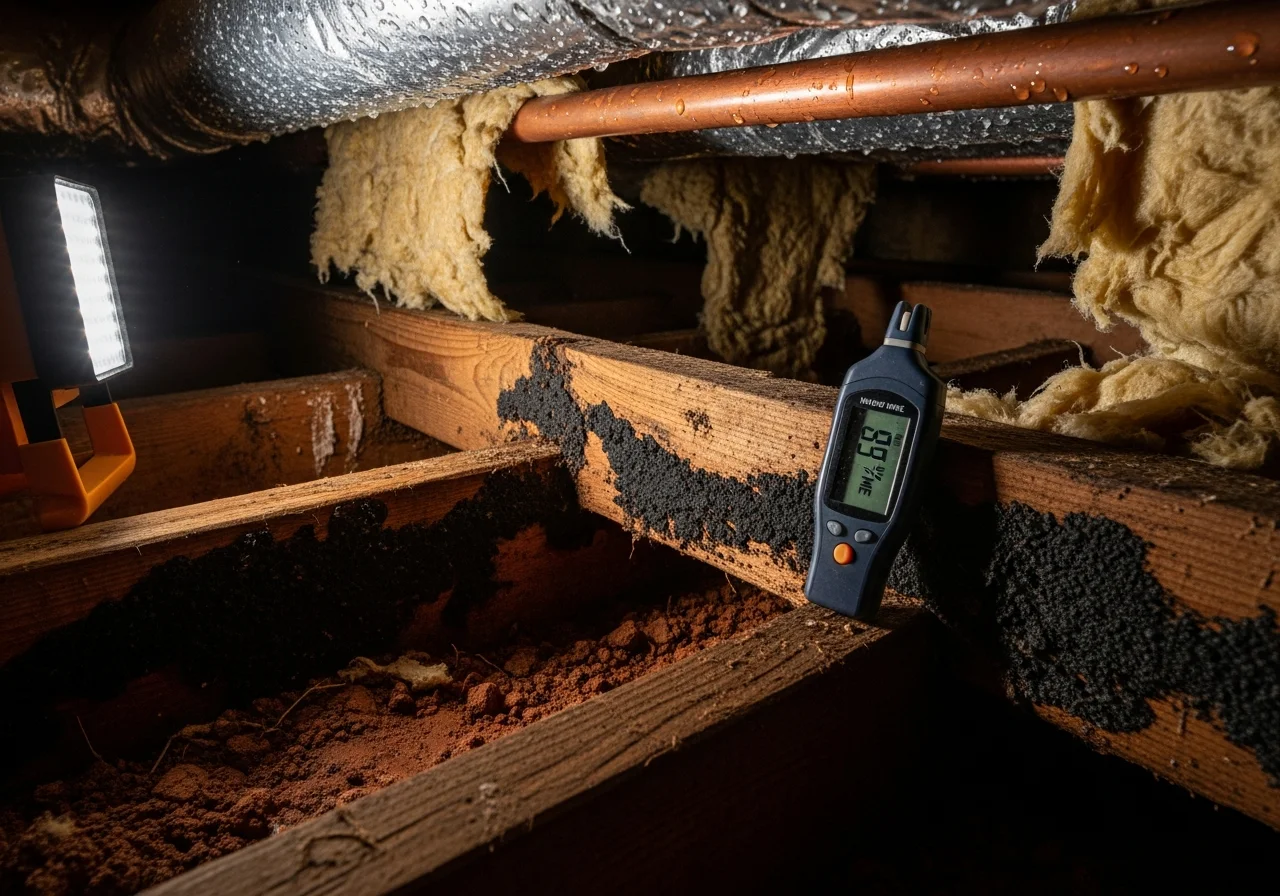
Close-up of crawl space moisture damage showing mold on floor joists and sagging insulation in a Mount Holly NC home
Crawl space damage in a Mount Holly home — mold on floor joists, sagging insulation, and condensation on pipes are telltale signs of chronic moisture from clay soil and river-corridor humidity.

Why Mount Holly Homeowners Choose Us

Why Palm Build for Water Damage in Mount Holly

Mount Holly has franchise operators and out-of-area contractors bidding on your emergency. Here's what makes Palm Build different — and why Gaston County homeowners trust us with their homes.

30-45 Minute Response

Our Charlotte operations hub is approximately 20 minutes from Mount Holly. We dispatch immediately with fully loaded trucks — no waiting for equipment to arrive from a distant warehouse.

Gaston County Expertise

We work in Mount Holly, Belmont, Gastonia, and surrounding communities regularly. We know the clay soil, the river corridors, the crawl space patterns, and the floodplain permit requirements.

IICRC Certified Technicians

Every technician holds current IICRC certifications including WRT and ASD. North Carolina has no state-specific restoration licensing — IICRC is the accepted industry benchmark, and we exceed it.

Insurance-Ready from Day One

We create carrier-specific documentation — moisture maps, photo timelines, material inventories, and daily drying logs formatted for your adjuster. We've worked with State Farm, NC Farm Bureau, and every major carrier in Gaston County.

Full-Service Restoration

We don't just dry your home and leave. Palm Build handles extraction, drying, mold prevention, and full reconstruction — drywall, flooring, painting, trim — under one contract and one point of contact.

Direct Communication

You get a dedicated project manager who picks up the phone. Daily moisture readings, regular updates, and transparent timelines — not a call center routing you to voicemail.

Common Questions

Mount Holly Water Damage FAQ

How quickly can Palm Build reach my Mount Holly home after water damage?
Our Charlotte-based team can reach most Mount Holly locations within 30 to 45 minutes. We respond 24/7, including holidays. Call (704) 464-0121 and we dispatch immediately with truck-mounted extraction equipment and commercial dehumidifiers.
Does homeowners insurance cover water damage in Mount Holly?
Most standard homeowners policies cover sudden water damage like burst pipes or appliance failures. However, Gaston County's floodplain page explicitly states that homeowners insurance does NOT cover flood damage — if your loss involves river or creek overflow, you need separate NFIP flood coverage. Gaston County's CRS Rating of 8 provides a 10% flood insurance premium discount. We document everything your adjuster needs from day one.
Is my Mount Holly home in a flood zone?
Homes near the Catawba River, Mountain Island Lake, and Dutchman's Creek may be in FEMA-designated flood hazard areas. Mount Holly requires a Floodplain Development Permit ($100 fee), elevation certificate, and site plan for work in these areas. Check the FEMA Flood Map Service Center or contact Mount Holly's planning department to verify your property's flood zone status.
Why does my Mount Holly crawl space always feel damp?
Mount Holly's Piedmont red clay soil drains at less than 0.2 inches per hour. After rain, moisture sits against your foundation for days. In summer, when humidity exceeds 70-90%, warm air enters vented crawl spaces, contacts cooler surfaces, and condenses on joists and ductwork. This creates a chronic moisture factory even without a visible water event.
How long does water damage restoration take in Mount Holly?
Extraction typically takes 2-6 hours. Structural drying requires 3-5 days of monitored dehumidification, though Mount Holly's summer humidity can extend this. Full restoration including drywall, flooring, and trim takes 1-4 weeks depending on the scope. We provide daily moisture readings and keep you updated throughout.
What certifications does Palm Build hold for water damage work?
Our technicians hold IICRC certifications including WRT (Water Restoration Technician) and ASD (Applied Structural Drying). North Carolina has no state-specific water restoration licensing requirement, making IICRC certification the accepted industry benchmark. We follow ANSI/IICRC S500 standards for every project.
Do I need mold remediation after water damage in Mount Holly?
If water sits for more than 24-48 hours or if your crawl space had pre-existing moisture issues — common in Mount Holly's river-corridor homes — mold testing is strongly recommended. We apply EPA-registered antimicrobial treatments during drying and can scope a separate remediation if needed. NC has no state mold certification; we remediate to ANSI/IICRC S520 standards.
What makes Mount Holly water damage different from other cities?
Three factors make Mount Holly unique: river-corridor humidity from the Catawba River and Mountain Island Lake, Piedmont red clay soil that holds moisture against foundations for weeks, and a housing stock ranging from 1913 Adrian Park homes to 2022 Arbordale construction — each era with distinct failure patterns. Our team understands these specific challenges because we work in Gaston County regularly.

Water Damage in Mount Holly? We're 30 Minutes Away.

Palm Build's Charlotte-based team responds to Mount Holly water emergencies 24/7. Truck-mounted extraction, commercial drying, and insurance-ready documentation from technicians who understand your river-corridor home.

30-45 min Response IICRC Certified