MOUNT HOLLY NC — IICRC S520 CERTIFIED MOLD REMEDIATION
Mold Remediation in Mount Holly, North Carolina
Mount Holly's Catawba River corridor humidity, Mountain Island Lake moisture, and Piedmont red clay soil with infiltration rates below 0.2 inches per hour create a mold environment that most homeowners never see — until the musty smell reaches the living space. From Riverfront crawl spaces to Dutchmans Ridge basements, Palm Build's IICRC S520-certified team provides containment, remediation, and prevention backed by the credentials North Carolina does not require but your home demands.
Approximately 20 minutes from Mount Holly 30-45 min Response IICRC Certified
Mount Holly's geography is a mold incubator: three major waterways driving persistent
humidity, heavy clay soil that traps moisture against foundations, a housing stock split
between century-old construction and modern subdivisions, and a state with zero mold
oversight. Understanding these factors is the first step toward protecting your home.
Catawba River Corridor Humidity
70%+
Summer humidity sustained
Mount Holly sits at the convergence of the Catawba River, Mountain Island Lake, and Dutchman's Creek. This river-corridor geography sustains ambient humidity above 70% from May through October — well above the 60% threshold where mold actively colonizes building materials. Crawl spaces in Riverfront and Stonewater absorb this moisture continuously.
Cecil Series Red Clay Soil
<0.2 in/hr
Clay drainage rate
Mount Holly's Piedmont red clay (Cecil series) drains at less than 0.2 inches per hour. After a typical rain event, saturated clay holds 40-60% moisture by volume and evaporates it upward into crawl spaces for 5-10 days — feeding mold colonization from the ground up. This is the same clay that defines mold risk across Gaston County.
Mixed-Era Housing Stock
1997
Median build year
Mount Holly's population surged 37% from 2010 to 2024, producing a housing stock that spans from 1913 Adrian Park bungalows to 2022 Arbordale construction. Older homes have vented crawl spaces with degraded vapor barriers. Newer homes have tighter building envelopes that trap moisture differently. Every era has distinct mold failure patterns — and the median build year of 1997 means much of the stock is entering the critical 25-30 year window.
No State Mold License Required
None
NC mold licensing requirement
North Carolina has zero state mold licensing — no training mandate, no certification requirement, no exam, no oversight body. Anyone with a truck and a spray bottle can advertise mold remediation in Mount Holly. In a city where the median home value is $331,220, this is not an abstract concern — it's a financial risk that plays out in Mount Holly homes every week.
Mount Holly's clay soil and river-corridor humidity create persistent crawl space
moisture — our technicians find active mold in the majority of unencapsulated crawl
space inspections across Gaston County.
Neighborhood Intelligence
Mount Holly Neighborhood Mold Risk Profiles
Mold risk in Mount Holly varies dramatically by neighborhood age, foundation type,
proximity to water features, and lot grading. These profiles are based on construction
era data and Gaston County remediation experience.
Neighborhood
Era Built
Foundation
Primary Mold Risk
Adrian Park
~1913
Crawl space
Highest risk: century-old homes with original or degraded vapor barriers, vented crawl spaces on clay soil, aging plumbing. Mold on floor joists, subfloor, and foundation walls is common after 100+ years of moisture accumulation.
Cottonwood Acres
~1985
Crawl space
High risk: 40-year-old vented crawl space construction on red clay. Vapor barriers degraded or displaced. HVAC systems at end-of-life with condensate line failures. Paper-backed insulation traps and feeds mold.
Ashlyn Place
~1997
Crawl space; some slab
High risk: entering the 25-30 year window when crawl space moisture systems fail. Original dehumidification often undersized. Mold on fiberglass batt insulation and ductwork common.
Riverfront
1998–2016
Mix: crawl + slab
Moderate-high risk: Catawba River proximity amplifies humidity exposure. Older phases with crawl spaces show moisture intrusion from clay soil. River flooding events push standing water into low-lying foundations.
Stonewater
~2009
Crawl space; some slab
Moderate risk: Mountain Island Lake proximity adds humidity load. Homes entering the 15-year maintenance window. HVAC condensate drain failures and bathroom exhaust issues emerging.
Dutchmans Ridge
~2017
Slab (primary)
Lower crawl space risk, but Dutchman's Creek proximity and clay soil grading issues can drive moisture under slab edges. HVAC condensate and interior plumbing leaks are primary mold sources.
Kellys Landing
~2011
Mix: crawl + slab
Moderate risk: clay soil moisture against foundations, aging vapor barriers in crawl space units. Shared-wall townhome construction means one unit's moisture problem becomes a multi-unit mold event.
Stockbridge Estates
~2021
Slab
Lowest risk: newer construction with better moisture management. Primary exposure is HVAC condensate overflow, post-construction moisture trapped in building materials, and landscaping grading failures.
Arbordale
~2022
Slab
Low risk: newest construction in Mount Holly. Monitor for construction moisture drying issues, HVAC commissioning problems, and clay soil settlement affecting drainage around foundation.
River Park
~2020
Slab
Low-moderate risk: Catawba River proximity with newer slab construction. Watch for moisture intrusion at slab-to-wall transitions and post-storm moisture events from river-corridor flooding.
Mount Holly's neighborhoods span from 1913 Adrian Park to 2022 Arbordale — each era with
distinct foundation types and mold risk profiles shaped by Gaston County's clay soil and
river-corridor humidity.
IICRC S520 Process
Our Mount Holly Mold Remediation Process
Mold remediation is not mold removal. Remediation is an engineered process governed by
IICRC S520 — the standard North Carolina should require but doesn't. Here's exactly what
a Palm Build mold remediation project looks like in Mount Holly.
Independent Mold Assessment
We never test and remediate on the same project. An independent certified assessor collects air samples, surface samples, and moisture readings to identify species, concentration, and source conditions. For Mount Holly's crawl space homes, the assessment includes full moisture mapping of clay soil contact areas, vapor barrier condition, floor joists, subfloor, and HVAC ductwork.
Engineering Controls and Containment
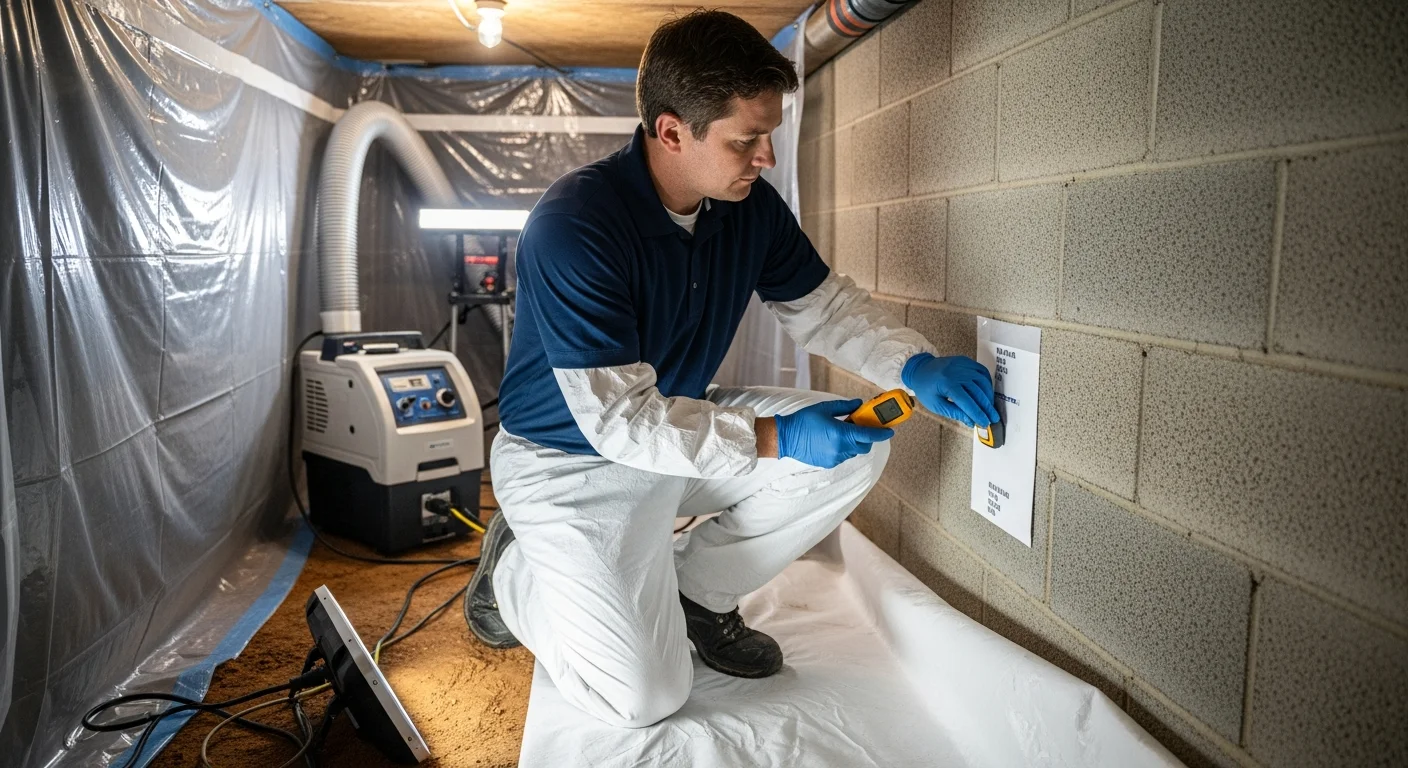
Before disturbing a single spore, we isolate the affected area with polyethylene barriers, negative air pressure via HEPA air scrubbers exhausting to the exterior, and critical barriers at every penetration point. For crawl space projects — common in Riverfront, Cottonwood Acres, and Adrian Park — containment includes sealing the access and all floor penetrations to prevent spore migration into the living space above.
Source Identification and Moisture Elimination
Mold is a moisture problem. In Mount Holly, the source is usually crawl space humidity from Cecil series clay soil vapor transmission, Catawba River corridor ambient humidity, plumbing failure, or bulk water intrusion from grading failures. We identify and correct the source as part of every project — often including crawl space encapsulation with vapor barrier, dehumidification, and drainage correction.
HEPA Vacuuming and Antimicrobial Treatment
All affected surfaces are HEPA-vacuumed before wet cleaning. EPA-registered antimicrobial agents are applied appropriate to the substrate. Affected porous materials that cannot be cleaned to standard — drywall, insulation, carpet padding — are removed under containment. In Mount Holly crawl spaces, this frequently includes all fiberglass batt insulation and deteriorated vapor barriers.
Structural Material Removal (When Required)
Mold that has penetrated porous materials beyond the surface must be removed. In Mount Holly, this commonly includes water-damaged drywall, paper-backed insulation, OSB subfloor panels with through-penetration mold, and in severe cases — particularly in Adrian Park and Cottonwood Acres — structural joist material that has lost integrity from prolonged moisture exposure.
Post-Remediation Verification (PRV)
The independent assessor returns to verify clearance criteria: visual inspection, air sampling confirming spore counts at or below outdoor baseline, and moisture readings confirming source elimination. Only after independent PRV passes do we release containment. This step separates professional remediation from cosmetic cleanup — and it's the step most unlicensed NC contractors skip.
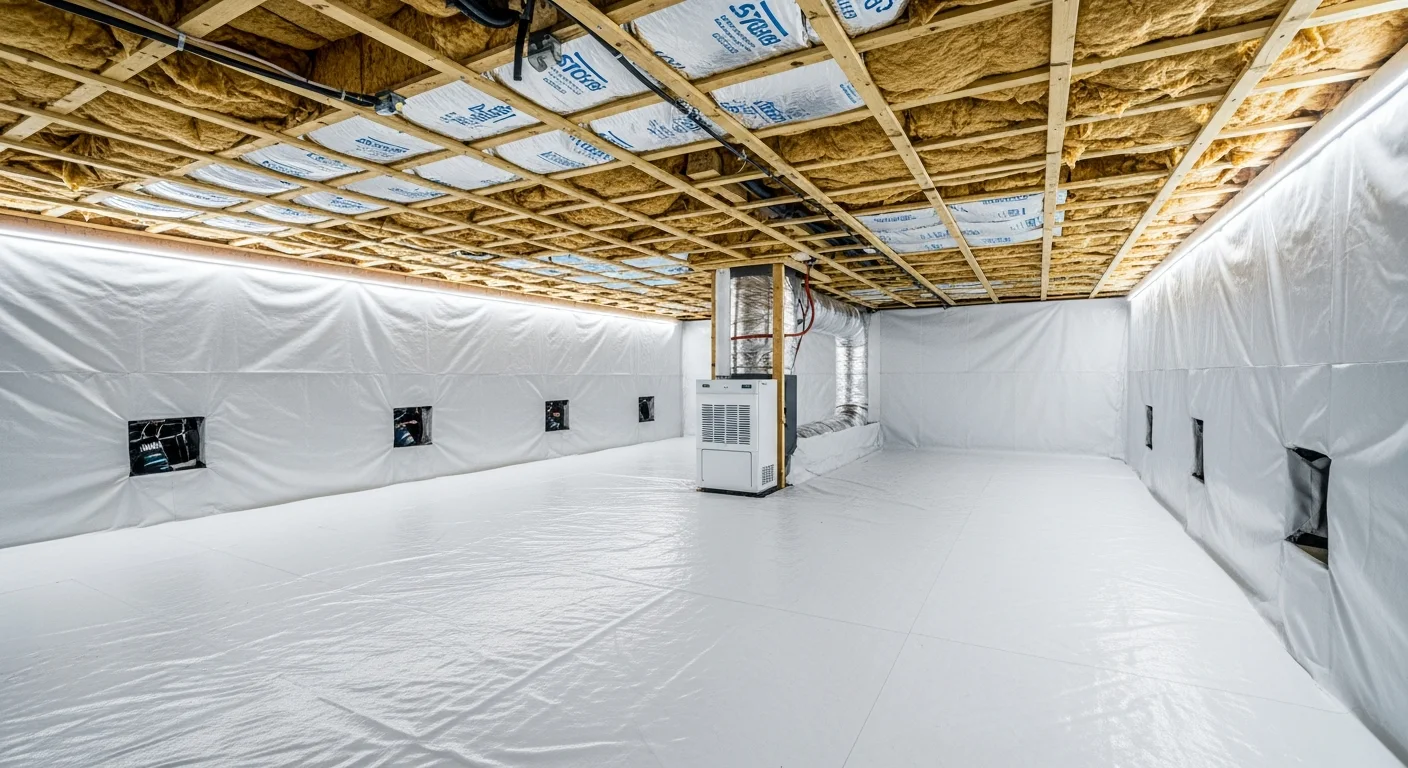
Full containment with HEPA air scrubbers and negative pressure followed by encapsulation
— the standard North Carolina doesn't require but Mount Holly homeowners deserve.
Cost Transparency
Mold Remediation Costs in Mount Holly
Costs depend on three factors: extent of colonization, whether crawl space work is
involved, and whether structural materials need replacement. These ranges reflect
real-world project costs in the Mount Holly and Gaston County market.
Insurance reality check: Standard NC HO-3 policies cap
mold coverage at $5,000 to $10,000 as a sublimit — and only when mold resulted from a covered
peril like a burst pipe. Chronic crawl space mold from humidity and clay soil is excluded as
gradual damage. A comprehensive crawl space remediation in Adrian Park or Cottonwood Acres can
reach $20,000 to $35,000. The gap is your responsibility.
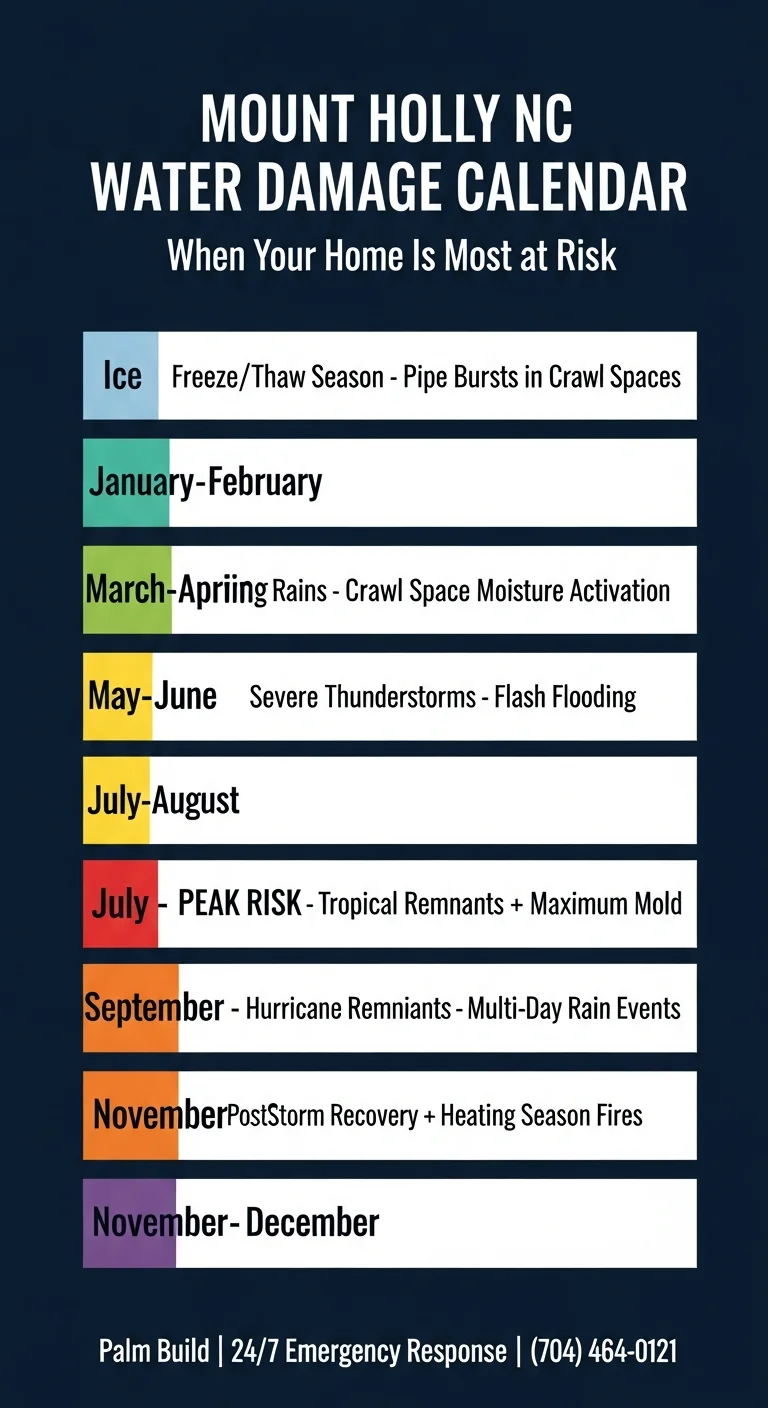
Seasonal Mold Risk Calendar
When Mold Risk Peaks in Mount Holly
Mold risk in Mount Holly follows seasonal patterns driven by the Catawba River
corridor's humidity cycle, Piedmont rainfall, and the age-related failure modes of homes
built from 1913 through 2022.
January - February
Frozen Pipe Bursts Feed Winter Mold
Mount Holly's January lows average 29°F. Burst pipes in crawl spaces and attics saturate building materials. If drying is delayed beyond 48 hours, mold colonization begins. Adrian Park and Cottonwood Acres homes with aging polybutylene or copper plumbing are highest risk.
March - April
Spring Rainfall Saturates Clay Foundations
March brings 4+ inches of rain to Mount Holly. Cecil series clay soil saturates and holds moisture against foundations for days. Crawl space humidity climbs sharply. Homeowners in Riverfront and Ashlyn Place first notice musty odors during this window as dormant mold reactivates.
May - June
River Corridor Humidity Ramps Up
Catawba River and Mountain Island Lake drive outdoor humidity past 65% and climbing. HVAC condensate drain failures begin as AC systems reach full load. Clogged condensate lines overflow into walls, attics, and crawl spaces — feeding mold growth that may not surface for weeks.
July - August
Peak Mold Growth Season
Summer humidity routinely exceeds 70% outdoors along the river corridor. Unencapsulated crawl spaces sustain 80%+ relative humidity continuously. This is when crawl space mold is most aggressive — Aspergillus and Penicillium can double colony size in 24-48 hours in these conditions.
September - October
Hurricane Remnants and Storm-Driven Mold
Tropical remnants bring flooding risk to Mount Holly's river corridor. Any storm-driven water intrusion that isn't dried within 48 hours becomes a mold event. Dutchman's Creek and low-lying Riverfront areas are most vulnerable to post-storm moisture accumulation.
November - December
Discovery Season and Winter Stack Effect
Crawl space mold often discovered during fall inspections or real estate transactions. Closing windows concentrates indoor air quality problems. The stack effect pulls crawl space air — and mold spores — upward into heated living spaces as the temperature differential increases.
Mold risk in Mount Holly peaks from May through October when river-corridor humidity
drives aggressive colonization in crawl spaces, HVAC systems, and hidden wall cavities.
Consumer Protection
NC Has No Mold License — What Mount Holly Homeowners Must Know
North Carolina has no state mold licensing requirement. No training mandate. No certification requirement. No exam. No continuing
education. No oversight body. Any contractor with a truck and a spray bottle can
advertise mold remediation services in Mount Holly without a single credential.
Compare this to states like Texas (licensed mold
assessors and remediators), Florida (licensed mold
assessors and remediators), and Louisiana (licensed
mold remediation contractors). In those states, performing mold remediation without a license
is a criminal offense. In North Carolina, it's Tuesday.
The accepted benchmark is IICRC S520 — the ANSI-accredited
Standard for Professional Mold Remediation. This is the standard that governs assessment
protocols, containment engineering, air filtration requirements, and post-remediation verification.
When you hire a mold contractor in Mount Holly, this is the credential that separates professional
remediation from cosmetic cleanup.
Questions to Ask Any Mount Holly Mold Contractor
Are your technicians IICRC S520 certified? Can I see proof?
Will you use an independent assessor for testing — separate from remediation?
Will you provide a written remediation protocol referencing IICRC S520?
Will you establish full containment with negative air pressure and HEPA filtration?
Will post-remediation verification be performed by an independent third party?
Do you carry mold-specific pollution liability insurance — not just standard GL?
Palm Build Credentials
IICRC S520 certified remediation protocols
Independent third-party testing on every project
Licensed NC general contractor for structural repairs
Full liability insurance with mold-specific coverage
Post-remediation clearance by independent assessor
Red Flags to Watch For
No IICRC certification or refuses to provide proof
Offers to "spray and seal" without removing contaminated material
No containment barriers or HEPA filtration in scope
Same company does mold testing AND remediation
Quotes a flat price without inspecting the property
Insurance Guide
Mold Insurance Coverage in Gaston County
Standard NC HO-3 policies cap mold coverage at $5,000 to $10,000 as a sublimit. A crawl
space mold remediation with encapsulation in Mount Holly can reach $20,000 to $35,000.
Here's what's typically covered and what isn't.
Sudden and accidental mold from a covered peril (burst pipe, appliance failure) — typically covered up to mold sublimit ($5K-$10K)
Chronic crawl space mold from river-corridor humidity, clay soil moisture, and degraded vapor barriers — excluded as gradual damage on virtually all NC policies
Mold from slow or hidden plumbing leaks — usually excluded once the insurer determines the leak was gradual rather than sudden
Crawl space encapsulation as part of mold remediation — typically excluded as an upgrade or maintenance item, not a repair
Structural joist repair from long-term mold damage — often denied when the insurer attributes damage to ongoing moisture, not a single event
Post-flood mold (from Catawba River or Dutchman's Creek rising water) — requires separate NFIP or private flood insurance; standard HO-3 excludes flood entirely. Gaston County CRS Rating 8 = 10% NFIP premium discount.
Supplemental mold endorsement ($25K-$50K coverage) available from some carriers for $50-$150/year additional premium
Palm Build documents every mold project for insurance purposes from day one — moisture
maps, air sampling results, photo evidence, and daily work logs formatted for adjuster
workflows. Even within restrictive mold sublimits, proper documentation maximizes your
covered amount. For the full claims process, see our insurance restoration process guide.
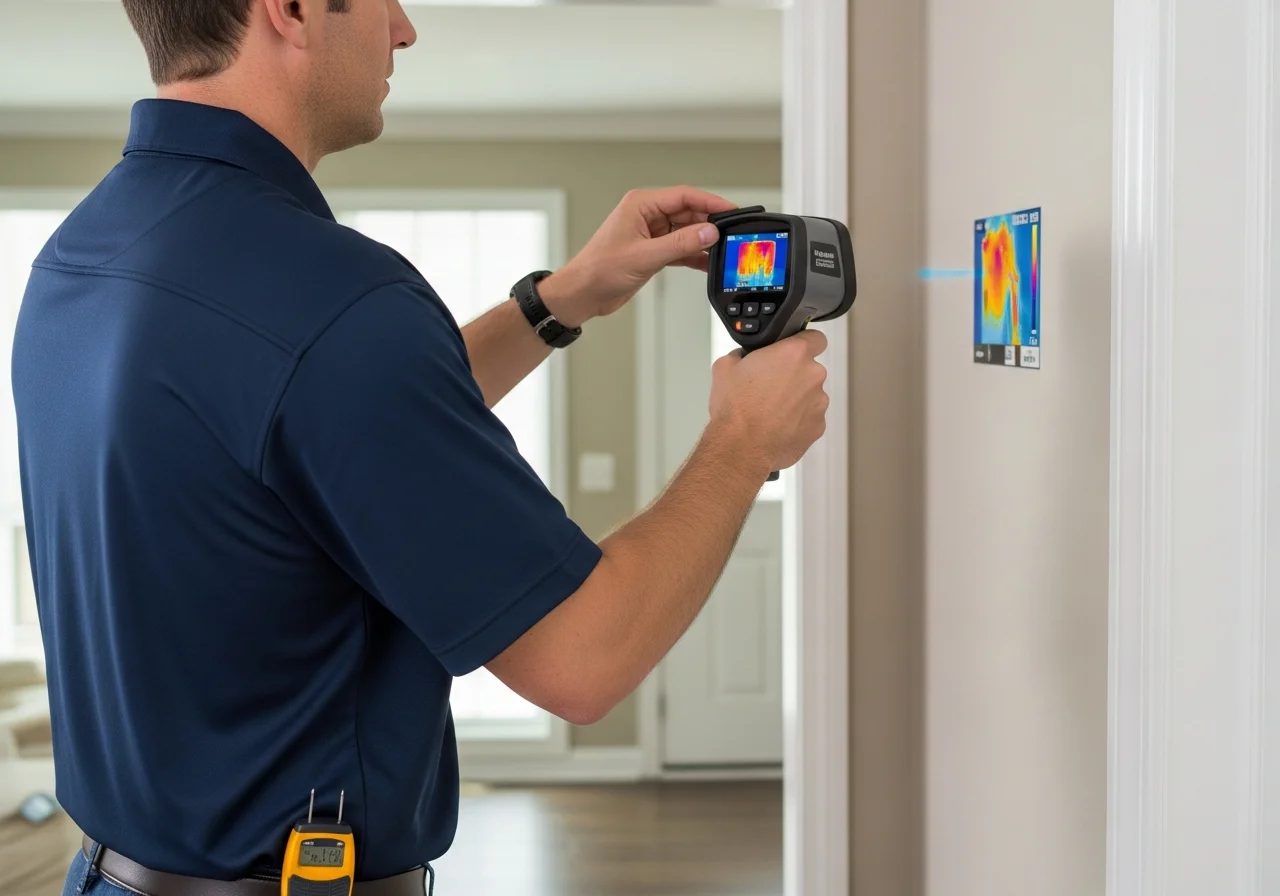
Thermal imaging and moisture mapping provide the documentation your insurance adjuster
needs to process mold claims — we capture this data from the first day on every Mount
Holly project.
Our Work
Mount Holly Mold Remediation: Before and After
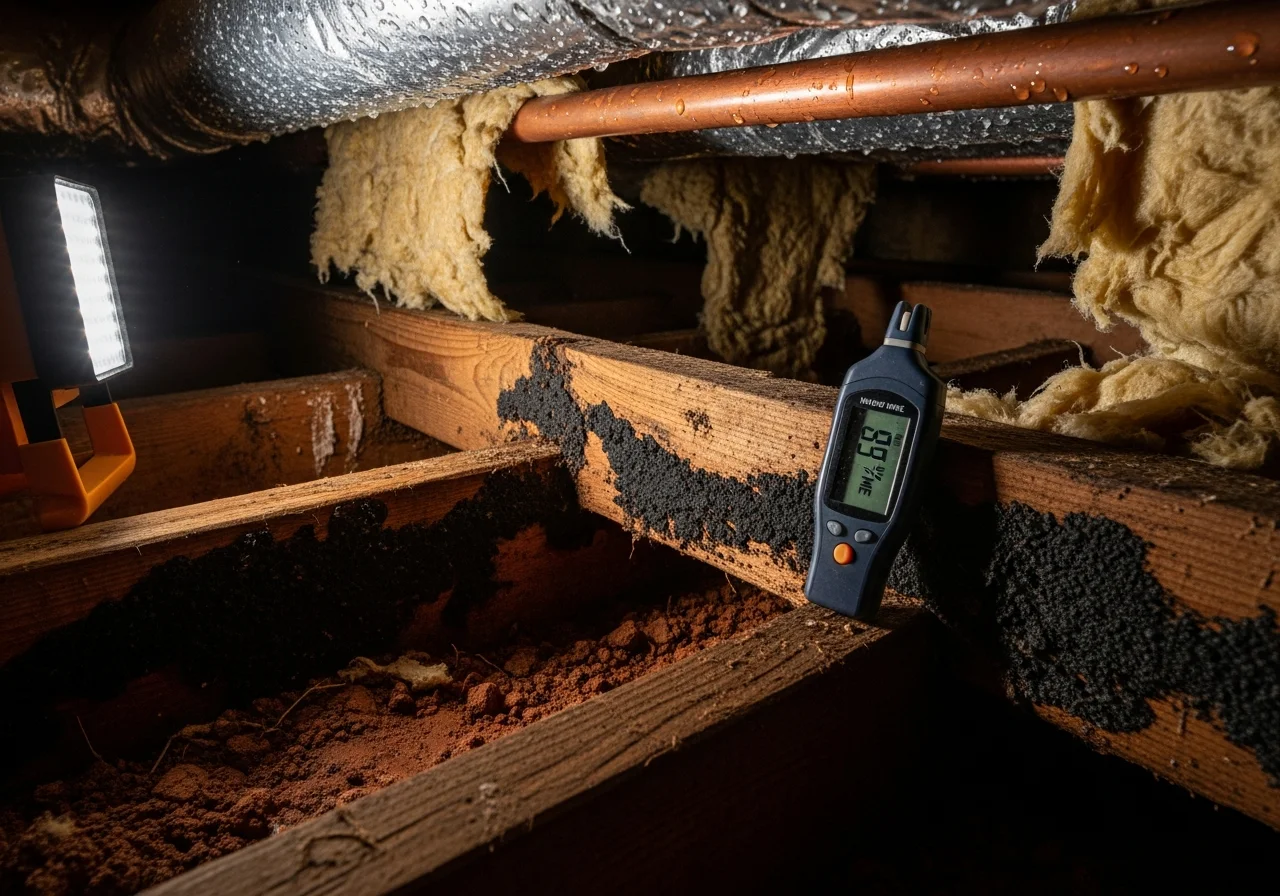
Before: Active mold colonization on floor joists in a Mount Holly crawl space on Cecil series red clay soil
After: Full encapsulation with vapor barrier and dehumidification system — moisture problem permanently solved
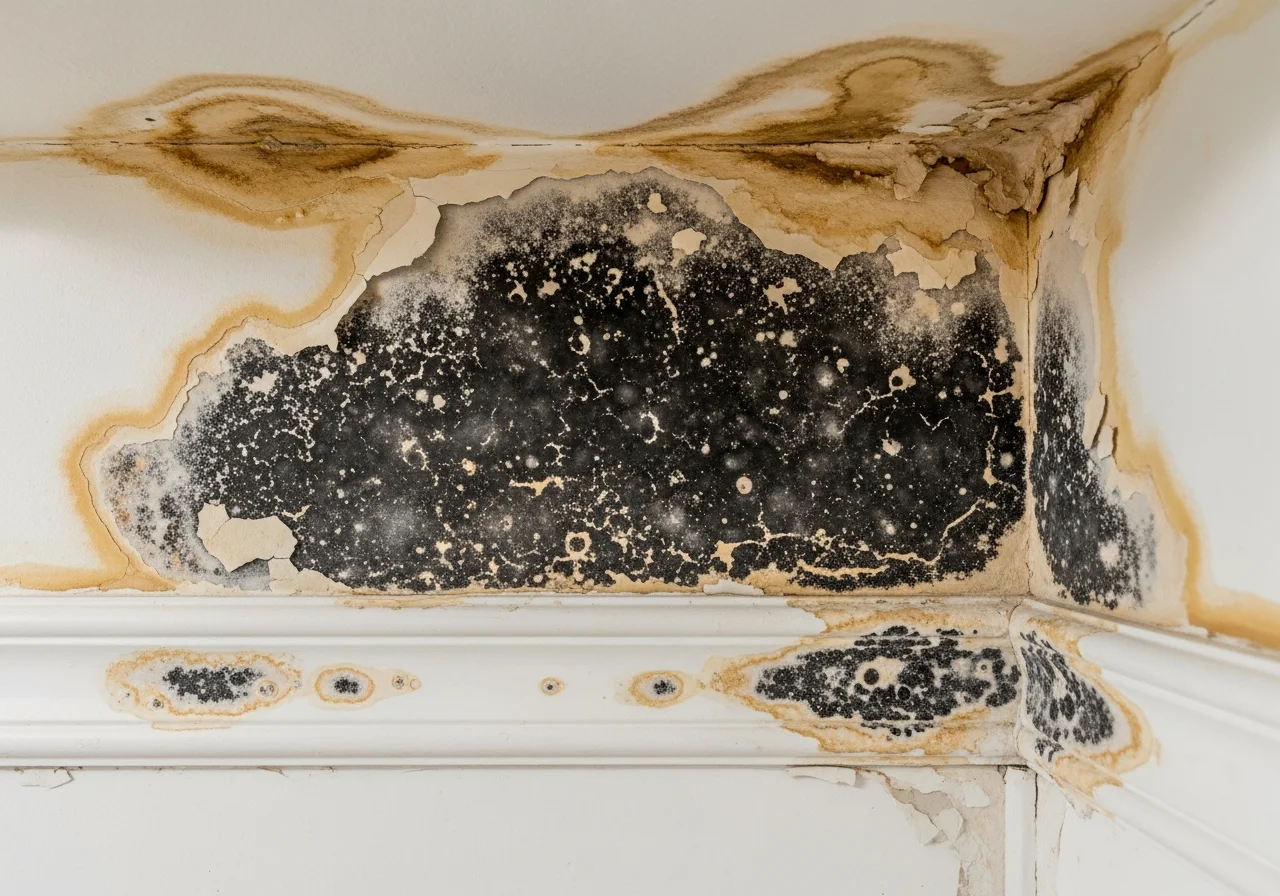
Before: Hidden mold discovered behind drywall during renovation — typical of slow plumbing leaks in Mount Holly homes
IICRC S520 remediation in progress — HEPA air scrubbers and commercial dehumidifiers maintaining controlled conditions
Why Palm Build
Why Mount Holly Homeowners Choose Palm Build for Mold
National franchises have a presence in the Gaston County market. But none of them will
tell you what we just told you: North Carolina has no mold license, your crawl space on
clay soil is likely feeding your mold problem, and your insurance probably won't cover
most of the work.
IICRC S520 Certified on Every Project
Every mold remediation project follows the full S520 protocol: independent assessment, written remediation plan, engineering controls, containment, HEPA air filtration, post-remediation verification. In a state with zero oversight, we hold ourselves to the national standard.
Charlotte-Based, Mount Holly-Focused
Our Crompton Street operations hub puts us within 30-45 minutes of any Mount Holly address. We respond 24/7 for mold emergencies tied to active water events — burst pipes, flooding, or storm damage.
Gaston County Crawl Space Expertise
We understand the Cecil series clay moisture cycle, the vented-to-sealed crawl space conversion, joist repair and sistering that crawl space mold requires, and the encapsulation systems that permanently solve the moisture source. This is the same clay soil and construction profile we work across Gaston County.
HOA and Multi-Unit Coordination
We carry COI documentation and coordinate with property management companies and HOA boards across Mount Holly's planned communities — Riverfront, Stonewater, Kellys Landing, Dutchmans Ridge, and newer subdivisions.
Insurance Documentation from Day One
Moisture maps, air sampling results, photo evidence, and daily work logs — all formatted for the adjuster workflow. We help maximize your coverage even within the restrictive $5K-$10K mold sublimits on standard NC HO-3 policies.
Full-Service Capability
From mold assessment coordination through remediation, structural repair, crawl space encapsulation, and interior reconstruction. One company, one project manager, no vendor handoffs.
Common Questions
Mount Holly Mold Remediation FAQ
How quickly can Palm Build respond to mold in my Mount Holly home?
Our Charlotte-based team reaches most Mount Holly locations within 30 to 45 minutes. For mold emergencies tied to active water events — burst pipes, flooding, appliance failures — we respond 24/7 with containment equipment and commercial dehumidifiers. For non-emergency mold assessments, we typically schedule within 24-48 hours. Call (704) 464-0121.
Why is mold so common in Mount Holly crawl spaces?
Three factors converge: Piedmont red clay soil (Cecil series) drains at less than 0.2 inches per hour, holding moisture against foundations for days after rain. River-corridor humidity from the Catawba River and Mountain Island Lake sustains ambient humidity above 70% from May through October. And many Mount Holly homes — especially in Riverfront, Cottonwood Acres, and Adrian Park — have vented crawl space foundations that draw humid air underneath the home where it condenses on cooler surfaces. This creates a chronic moisture factory that feeds mold growth year-round.
Does North Carolina require a mold remediation license?
No. North Carolina has zero state mold licensing — no training mandate, no certification requirement, no exam, no oversight body. Anyone can advertise mold remediation services in Mount Holly without any credentials. This puts the entire burden of contractor vetting on you. Ask for IICRC S520 certification, demand independent testing, and verify mold-specific insurance coverage. Palm Build holds IICRC S520 certification and follows the full standard on every project.
Does homeowners insurance cover mold remediation in Mount Holly?
Standard NC HO-3 policies cap mold at a $5,000-$10,000 sublimit — and only when mold resulted from a sudden covered peril like a burst pipe. Chronic crawl space mold from humidity and clay soil moisture is excluded as gradual damage on virtually all policies. Gaston County's CRS Rating of 8 provides a 10% flood insurance discount, but NFIP flood policies also have limited mold coverage. A crawl space remediation with encapsulation in Mount Holly can reach $20,000-$35,000. We document everything for your adjuster from day one to maximize covered amounts.
What is IICRC S520 and why does it matter for Mount Holly?
IICRC S520 is the national standard for professional mold remediation. It governs independent assessment, written remediation protocols, engineering controls (containment, negative air pressure), HEPA filtration, antimicrobial treatment, and post-remediation verification by an independent party. In states like Florida and Texas, following this standard is legally required. In North Carolina, it's voluntary — which means most mold contractors in Mount Holly don't follow it. Palm Build does, on every project.
How much does mold remediation cost in Mount Holly?
Contained interior mold remediation (single room or area) typically ranges from $3,500-$11,000 including assessment, containment, remediation, and verification. Crawl space mold remediation with encapsulation runs $12,000-$35,000 depending on crawl space size, extent of contamination, and whether structural joist repair is needed. Mount Holly's clay soil often requires comprehensive encapsulation and dehumidification to prevent recurrence.
Can I stay in my Mount Holly home during mold remediation?
For contained interior projects (single room with proper containment and HEPA air scrubbing), most homeowners can remain in the home during remediation. For whole-house mold events, crawl space projects with significant contamination, or situations where immunocompromised individuals live in the home, we recommend temporary relocation. We assess each project individually and give you a clear recommendation before work begins.
How do I know if my Mount Holly home has mold?
Common indicators include persistent musty or earthy odor (especially from crawl space vents or floor registers), visible discoloration on walls, ceilings, or floor joists, condensation on windows, elevated humidity readings, and allergy-like symptoms that worsen indoors. In Mount Holly's river-corridor homes, mold is often hidden in crawl spaces, behind walls near bathrooms, and in HVAC systems. A professional mold assessment with air sampling is the only way to confirm species, concentration, and source.
Mold in Your Mount Holly Home? We're 30 Minutes Away.
Palm Build's IICRC S520-certified team provides professional mold remediation for Mount Holly homes — with containment, HEPA filtration, and independent verification that North Carolina doesn't require but your family deserves.