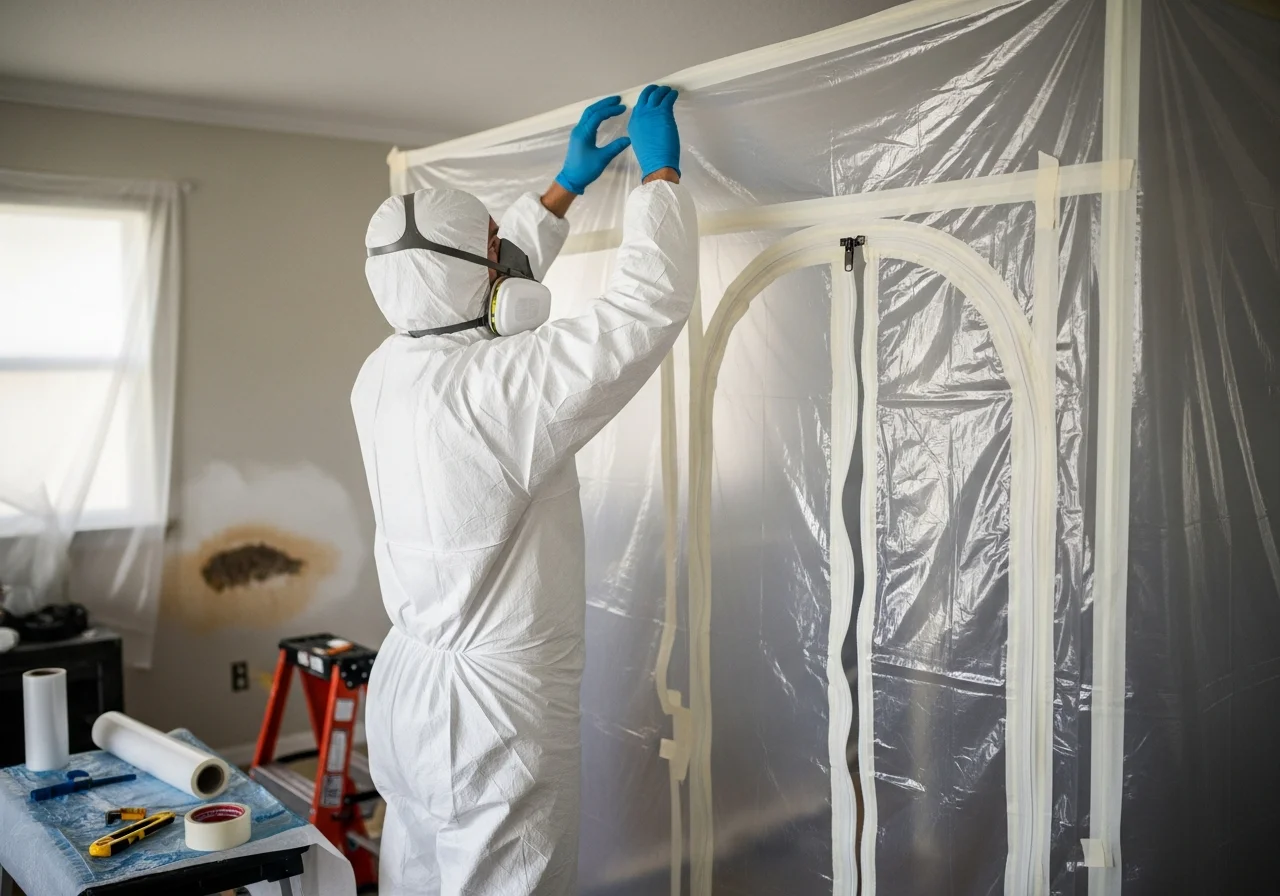
Mold Remediation in Royal Palm Beach, Florida
Royal Palm Beach's 70–75% year-round humidity keeps every home above the mold growth threshold every single month. When CBS stucco traps moisture in block cores and HVAC systems run 12 months straight generating condensate, mold finds its way in. Palm Build's Florida DBPR-licensed team provides professional containment, remediation, and prevention — with the documentation your insurer requires.
Under 60 min
Emergency Response
24/7
Dispatch Available
IICRC
Certified Technicians
A Royal Palm Beach Story
"The AC Has Been Running Fine — So Why Does My Laundry Room Smell Like Mold?"
"I noticed a musty smell coming from the laundry room for months — figured it was the washer drain or something minor. Then I saw it: dark spots spreading across the ceiling above the AC air handler. I called Palm Build and they found the condensate drain line had been completely blocked for over six months. The overflow pan had been quietly dripping into the wall cavity the entire time."
— Madison Green homeowner, Royal Palm Beach
This is one of the most common mold scenarios in Royal Palm Beach — and one of the most predictable. In a city where air conditioning runs every single month of the year, the condensate drain line is constantly working. In Florida's warm, humid climate, algae and debris accumulate quickly, blocking the drain before most homeowners ever think to check it.
Royal Palm Beach sits at 70–75% relative humidity year-round — well above the 60% threshold at which mold growth begins. Unlike northern climates where winter cold halts mold activity, every month here is mold-favorable. The combination of year-round HVAC operation, CBS block construction that traps moisture in wall cores, and a significant number of homes built during the polybutylene plumbing era creates conditions where hidden mold is not an occasional surprise — it is an ongoing risk that requires active management.
Palm Build's DBPR-licensed team responds from our Deerfield Beach office, approximately 40 miles south, arriving with moisture meters, infrared cameras, and full containment equipment ready to deploy.
Cost Reference
Mold Remediation Cost Guide for Royal Palm Beach, FL
Royal Palm Beach mold scopes are shaped by CBS construction, year-round HVAC operation, and Florida's mandatory separate-assessor requirement. Use these ranges as a baseline — scope and cost are confirmed after professional moisture mapping and air quality sampling.
Air handler + ductwork mold
Scope depends on ductwork extent; duct replacement often needed
1–2 rooms, contained mold
CBS wall involvement adds cost vs wood-frame
Multiple rooms, block-core moisture
HEPA containment + block-core treatment
Chronic untreated moisture, multiple systems
Older HOA properties, poly-B leak origin
Florida Mold Insurance Cap
Florida HO policies typically cap mold coverage at $10,000–$25,000. Scope your claim before remediation begins — document the moisture source, discovery date, and extent of contamination. Mold resulting from a covered sudden water event (e.g., pipe burst) generally receives better coverage than maintenance-related growth.
Free Scope Consultation
Palm Build provides a written remediation scope estimate after moisture mapping and visual inspection — no obligation, no cost, DBPR-licensed.
Why RPB Has a Mold Problem
Four Reasons Royal Palm Beach Homes Are Mold-Prone
Royal Palm Beach's mold risk is driven by a combination of climate, construction, and plumbing history that creates year-round conditions for hidden growth.
60%
Mold growth threshold
70–75% Humidity Year-Round
Royal Palm Beach never drops below the 60% relative humidity threshold at which mold growth begins. Every month of the year is mold-favorable — there is no 'dry season' reprieve that homeowners in northern states rely on to arrest mold activity.
12 mo
Continuous AC runtime
HVAC Runs 12 Months
Florida's warm climate means air conditioning never shuts down for winter. Condensate drain lines accumulate algae and debris year-round, clogging quietly. Overflow drips into wall cavities below the air handler — the most common hidden mold source we find in Royal Palm Beach homes.
1990
Median build year
CBS Block Traps Moisture
Concrete block construction dominates Royal Palm Beach's housing stock. Stucco cracks on the exterior wick rainwater into hollow block cores, where moisture persists for weeks or months without visible interior signs. By the time you smell mold, the block-core colony is well established.
1978–1995
Poly-B plumbing era
Polybutylene Leaks Feed Mold
Homes built during the polybutylene pipe era are at elevated risk for pinhole leaks inside walls. In Royal Palm Beach's 70–75% humidity environment, even a slow leak that goes undetected for weeks creates ideal conditions for a mold colony to establish and spread through wall cavities.
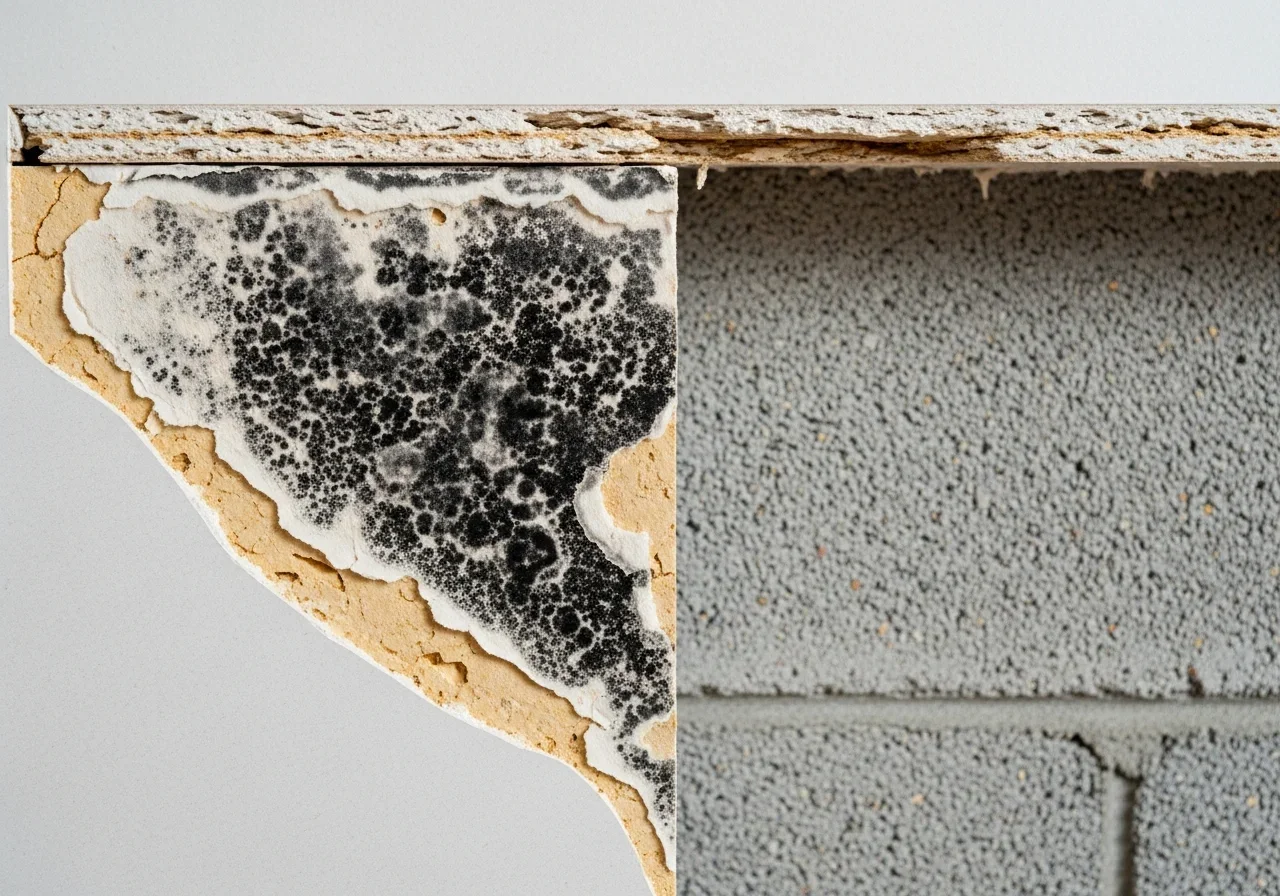
Mold colonization behind drywall in a Royal Palm Beach home — the CBS block surface concealed active growth for months before air quality complaints prompted investigation.
Neighborhood Guide
Royal Palm Beach Neighborhood Mold Risk Guide
Mold risk in Royal Palm Beach varies by construction era, proximity to water features, and building type. Use this guide as a starting point — individual property conditions always require professional assessment.
Build era: 1980s–2000s
Canal proximity + elevated humidity, aging stucco
Build era: 1970–1999
Polybutylene plumbing era; wall leaks behind drywall
Build era: 1980s–1990s
Stucco cracks feeding block-core mold
Build era: 2000s
Lakefront HVAC loads; high condensate volume
Build era: 2000s
Retention pond proximity + sustained humidity
Build era: Late 20th c.
Aging HVAC systems; deferred maintenance
Build era: 2000s
Roof tile failures; moisture infiltration feeds ceiling mold
Build era: 2010s+
High-finish interiors; expensive remediation scope
Build era: 1970s–1980s
Attached units; shared wall mold migration
Build era: 1970s–1980s
HOA attached construction; poly-B risk in older units
Build era: Mixed
Appliance line leaks → cabinet and floor mold
Build era: 2000s
HOA high finishes; water losses expensive to remediate
Build era: Mixed
Drainage variability; standing water events
Build era: Mixed
Irrigation overwatering of perimeter; foundation moisture
Build era: Mixed
Repeated roof replacement cycles; ceiling insulation mold
Risk levels reflect general construction, plumbing, and environmental factors for each neighborhood. Individual property conditions vary. Professional moisture mapping and air quality sampling are required to confirm the presence and extent of mold.
Royal Palm Beach's Hidden Mold Source
Your Air Conditioner: Royal Palm Beach's #1 Hidden Mold Source
In northern states, the furnace sits dormant for six or seven months a year, giving HVAC systems a break. In Royal Palm Beach, the AC runs every month — 12 months of condensation, algae growth, and spore accumulation with no seasonal reset.
Condensate Line Clogging
In Florida's warm climate, algae and debris accumulate inside condensate drain lines year-round — far faster than in cooler northern states. When the line blocks, the drain pan fills with standing water. That water spills into the air handler cabinet and, over weeks and months, drips into the wall cavity below. By the time a homeowner notices discoloration or odor, a colony has been feeding on that moisture for months.
Ductwork Mold Colonization
Royal Palm Beach's 70–75% relative humidity means ductwork interiors are never truly dry. Mold spores drawn in through return air vents — particularly in older homes with unsealed duct connections — colonize duct liner material. Once established, the AC system becomes a distribution network, circulating spores to every room in the home with every cooling cycle.
The Signs You Are Missing
Most HVAC mold builds slowly enough that homeowners attribute the symptoms to other causes. A musty smell strongest when the AC turns on, visible discoloration or dark spots around supply vents, humidity that feels high despite running the AC continuously, and allergy or respiratory symptoms that are worse indoors than outside — these are the fingerprints of HVAC mold. By the time visible growth appears on the ceiling near an air handler, the remediation scope has usually expanded well beyond that room.
What to Check First — Before Calling for Remediation
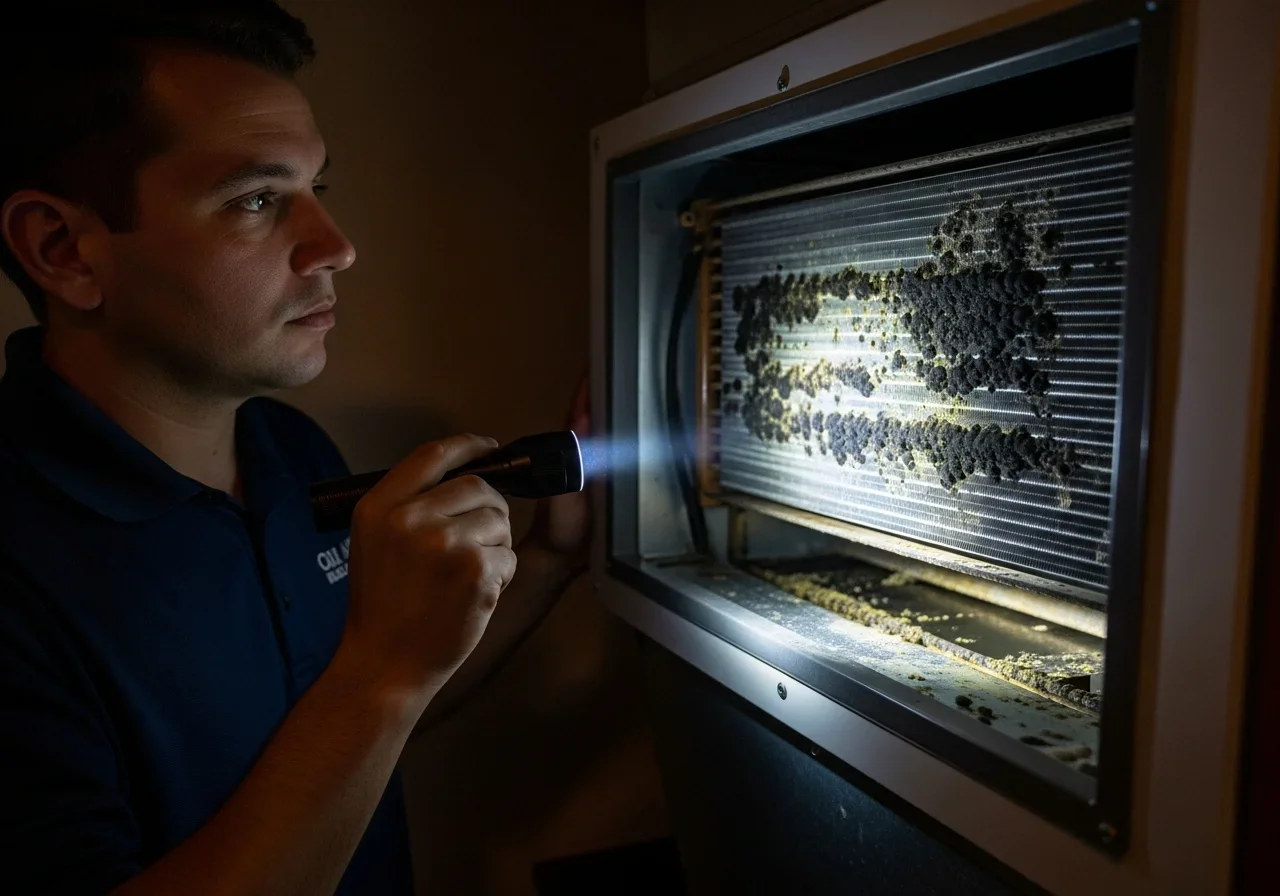
Palm Build HVAC mold inspection — moisture mapping the air handler cavity and ductwork for condensate overflow and mold colonization.
How Palm Build Remediates Mold in Royal Palm Beach Homes
Professional mold remediation in Royal Palm Beach follows a strict sequence defined by the IICRC S520 standard and Florida DBPR regulations. Typical timeline: 3–7 days depending on scope.
Assessment & Air Sampling
Day 1Visual inspection of all moisture-prone areas — HVAC system, CBS wall exteriors, plumbing walls, and attic. Moisture mapping with infrared cameras to locate hidden wet zones. Air quality baseline sampling establishes pre-remediation spore counts. A separate DBPR-licensed mold assessor provides the written assessment report required by Florida law.
Containment Setup
Day 1–2Polyethylene sheeting barriers isolate all affected zones from clean areas of the home. HEPA air scrubbers create negative air pressure inside the containment zone, preventing spore migration through the HVAC system or open doorways. The AC system is sealed to stop spore distribution.
Source Elimination
Day 2The moisture source is repaired before remediation begins — this is the step most contractors skip. Condensate drain lines are cleaned or rerouted, plumbing leaks are repaired, stucco cracks are sealed, and irrigation systems are corrected. Remediating mold without eliminating the moisture source guarantees recurrence.
Mold Removal
Days 2–4Contaminated drywall is demolished to expose CBS block surfaces beneath. All affected materials — drywall, insulation, baseboards — are removed under containment and double-bagged for disposal. Salvageable block and structural surfaces are HEPA-vacuumed, wire-brushed, and hand-cleaned per IICRC S520 protocol.
Antimicrobial Treatment
Days 4–5EPA-registered antimicrobial agents are applied to all remediated CBS block surfaces, window bucks, and structural elements. HVAC-involved projects receive specialized antimicrobial fogging of evaporator coils, drain pans, and duct interiors. All surfaces are documented with before-and-after photography for insurance records.
Clearance Testing
Days 5–7Post-remediation air quality testing by an independent DBPR-licensed mold assessor — a different licensed entity from Palm Build, as Florida law requires. Air samples confirm spore counts have returned to acceptable levels. Written clearance documentation is provided for your insurance carrier and property records.
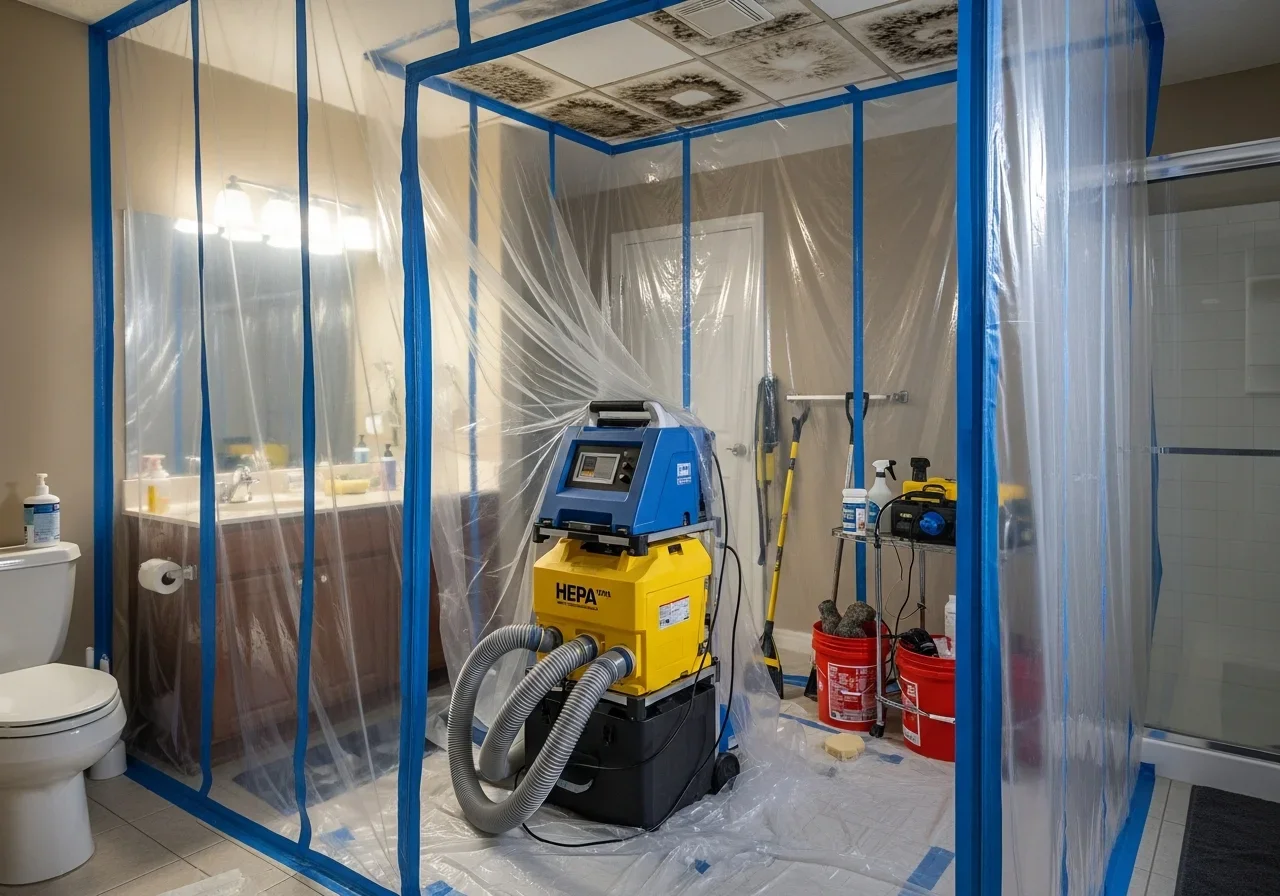
Why Containment Matters in CBS Homes
Disturbing mold without proper containment sends billions of spores airborne. In Royal Palm Beach's CBS homes, the HVAC system can distribute those spores to every room within minutes. Our containment protocol ensures remediation stays isolated.
Sealed Barriers
Polyethylene sheeting floor-to-ceiling; CBS wall cavities fully isolated
Negative Pressure
HEPA scrubbers pull air through containment and exhaust outside
HVAC Isolation
AC system sealed to prevent spore distribution during work
Decontamination Protocol
Personnel decon before exiting containment zone
Know Your Mold
Common Mold Species Found in Royal Palm Beach Homes
South Florida's warm, humid climate favors specific mold species that exploit CBS construction, HVAC systems, and polybutylene plumbing failures.
Cladosporium
Most Common in South Florida CBS Homes
Cladosporium thrives on organic building materials in elevated humidity environments. In Royal Palm Beach CBS homes, it commonly colonizes drywall paper facing, painted concrete block surfaces, and the fibrous interior coating of HVAC ductwork. It is the species most frequently found in moisture-affected wall cavities following stucco crack intrusion or condensate line overflow.
Stachybotrys Chartarum
Black Mold — High-Cellulose Environments
Stachybotrys requires extended, sustained moisture — it grows on high-cellulose materials that have been wet for weeks or months. In Royal Palm Beach, it is typically associated with undetected polybutylene pipe leaks inside wall cavities, chronic condensate drain failures, and CBS block-core moisture that saturates drywall paper over time. These are the scenarios that produce the most serious and expensive remediation scopes.
Aspergillus / Penicillium
HVAC and Ductwork Colonizers
Aspergillus and Penicillium species are among the most common HVAC-associated molds in South Florida. They colonize air handler evaporator coils, drain pans, and duct liner material — and because they're distributed through the cooling system with every cycle, contamination can be widespread throughout a home even when the visible growth is contained to a small area. Remediation requires both source elimination and duct cleaning or replacement.
Important: Mold identification requires professional air sampling by a DBPR-licensed mold assessor — visual identification alone is insufficient and not admissible for insurance claims. Palm Build coordinates independent DBPR-licensed assessment as part of the remediation process.
Year-Round Risk
Royal Palm Beach Mold Risk by Month
Unlike northern climates where mold risk drops significantly in winter, Royal Palm Beach's 70–75% year-round humidity means mold-favorable conditions never fully subside.
Jan
Feb
Mar
Apr
May
Jun
Jul
Aug
Sep
Oct
Nov
Dec
Royal Palm Beach Has No Mold Off-Season
Unlike northern climates where mold risk drops in winter because humidity falls below the 60% growth threshold, Royal Palm Beach's year-round humidity of 70–75% means mold-favorable conditions persist every month. HVAC mold and plumbing leaks do not take a seasonal break. October is particularly high-risk as unresolved summer moisture feeds secondary mold growth heading into fall.
Know Before You Hire
Florida Mold Law: What Royal Palm Beach Homeowners Must Know
Florida regulates mold work under DBPR Chapter 468, Part XVI — one of the strictest licensing regimes in the country. Understanding your rights protects you from unlicensed operators and ensures your insurance claim is properly documented.
DBPR Licensing Requirements
Separate DBPR licenses required for mold assessors and mold remediators (Chapter 468, Part XVI)
The assessor who writes the initial mold report cannot remediate the same property within 12 months — this prevents conflicts of interest
Mold remediators must document at least 15 completed projects to qualify for a Florida license
Verify any contractor's mold license at myfloridalicense.com before signing a contract or authorization
Insurance & Claim Considerations
Policy Mold Cap
Most Florida HO policies cap mold coverage at $10,000–$25,000, regardless of total remediation cost. Review your declarations page before remediation begins.
Covered vs. Maintenance Mold
Mold resulting from a covered sudden water event (burst pipe, appliance failure) has better coverage than mold from maintenance failures like a condensate drain that was never serviced. Document the causal chain carefully.
Post-AOB Reform (2023)
Under Florida's 2023 post-AOB insurance reform, you must coordinate your own claim — you cannot assign benefits to a contractor. Palm Build provides documentation to support your adjuster, not as a claim assignee.
Claim Filing Deadline
Florida Statute §627.70132 requires filing an initial claim within 1 year of the loss event and a supplemental claim within 18 months. Document your mold discovery date immediately with photos and written records.
Red Flags — Walk Away If You See These
Our Work
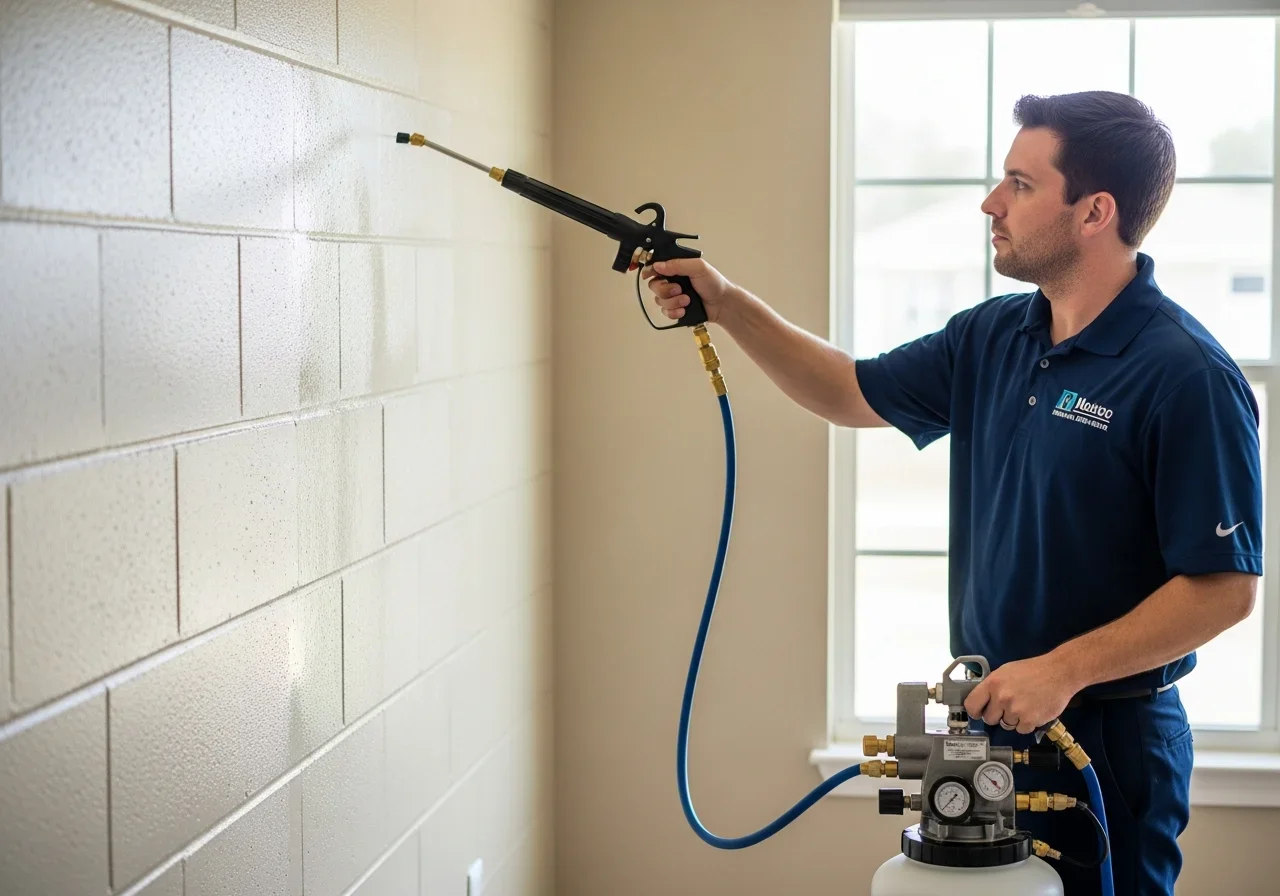
Mold Remediation in Royal Palm Beach — Before & After
Each project documents the full scope: source identification, containment setup, removal, treatment, and clearance verification.
The Palm Build Difference
Why Royal Palm Beach Homeowners Choose Palm Build for Mold Remediation
DBPR licensing, IICRC certification, independent clearance testing, and insurance documentation built for Florida carriers — from day one.
DBPR Licensed
Palm Build holds a Florida DBPR mold remediation license under Chapter 468, Part XVI — the state-required credential for residential and commercial mold remediation. License numbers are available on request. Every crew lead carries current IICRC AMRT (Applied Microbial Remediation Technician) certification.
IICRC S520 Protocol
We follow the IICRC S520 Standard and Reference Guide for Professional Mold Remediation on every project — the industry protocol that defines containment, removal, antimicrobial application, and clearance verification. This is the standard insurance carriers and DBPR inspectors recognize.
Assessment / Remediator Separation
Florida law prohibits the same company from assessing and remediating the same property within 12 months. Palm Build coordinates with independent DBPR-licensed mold assessors for pre-remediation reports and post-clearance testing — full compliance with the separation requirement, every time.
Insurance Documentation
Scope letters, moisture maps, timeline photography, air quality sampling reports, and clearance certificates — all formatted for Florida insurance carriers and adjusters. We document the causal chain from moisture source to mold colony so your adjuster has what they need to process the claim under your mold coverage sub-limit.
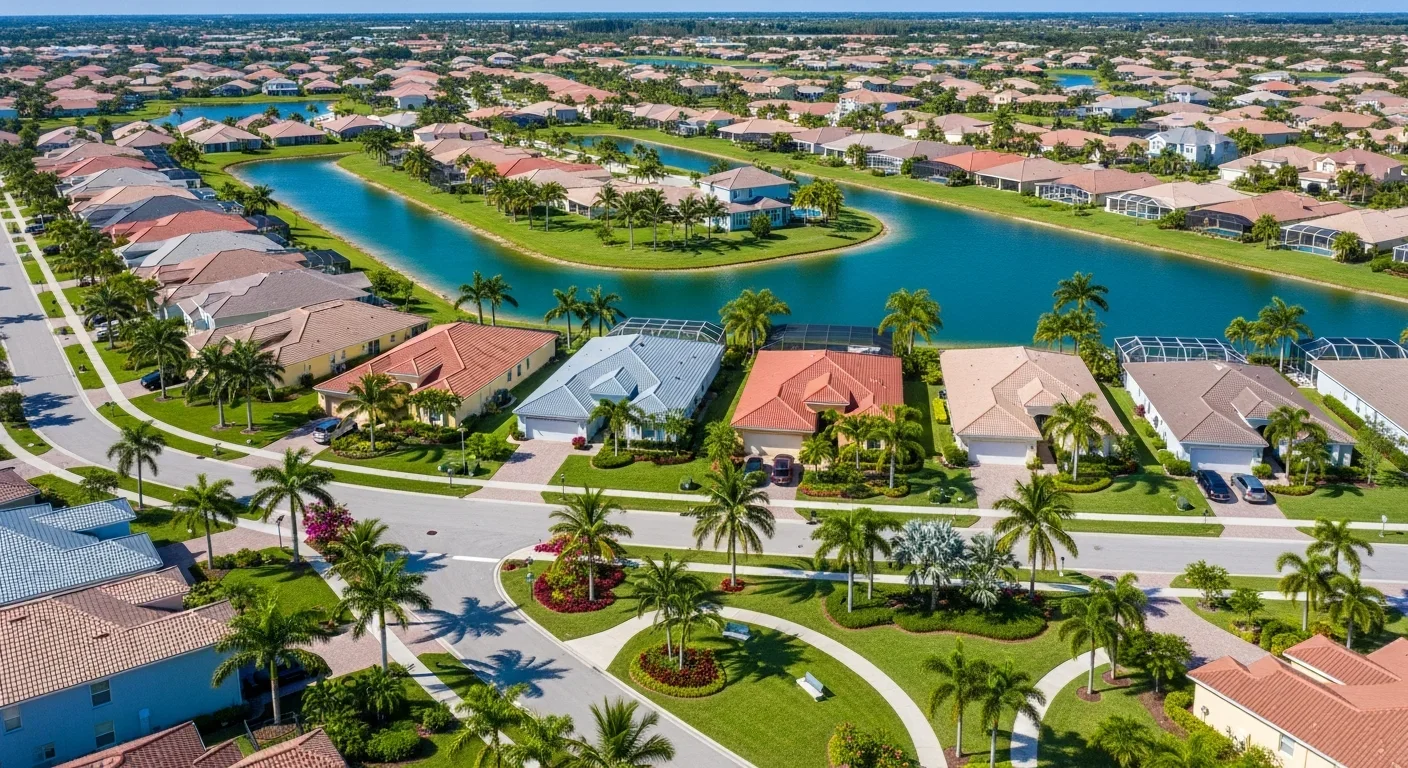
Palm Build serves all Royal Palm Beach neighborhoods — from Crestwood canal communities and La Mancha poly-B-era homes to Madison Green lakefront properties and Portosol's high-finish new construction.
Common Questions
Mold Remediation Questions from Royal Palm Beach Homeowners
Answers to the most common questions we receive from homeowners in Royal Palm Beach about mold remediation, Florida licensing, and insurance.
Trusted local pros in Royal Palm Beach
Outside our restoration scope, these are the vetted, licensed contractors we trust alongside our work. Personally evaluated, reference-checked, and recommended by Palm Build.
Copperhead Plumbing LLC
West Palm Beach, FL
West Palm Beach's veteran-owned plumber Palm Build calls when the scope runs north of Boynton — Palm Beach County and northern Broward, owner-led by Nicholas P. Miller on a single Florida CFC1431257 license.
Dee Maria Plumbing, Inc.
West Palm Beach, FL
Plumbing West Palm Beach since September 1981 — the only Trusted Vendor on Palm Build's list with 44 years of continuous local service and a Florida-issued gas appliance, equipment, and piping installer license.
Flamingo Plumbing & Backflow Services
West Palm Beach, FL
The only Rinnai-installing tankless specialist in Palm Build's directory with 'Backflow' as a top-line brand-name specialty — Paul Shaughnessy's two-office West Palm Beach + Palm City shop has 813+ Google reviews at 4.9 stars and a Treasure Coast dispatch posture no other vendor on our list has natively.
Mold in Your Royal Palm Beach Home? DBPR-Licensed Team Available 24/7.
Don't let Royal Palm Beach's year-round humidity turn a small mold spot into a whole-room remediation. Palm Build's licensed team responds around the clock with professional containment, HEPA air scrubbing, and the documentation your carrier needs.
Nearby Service Areas